Student support services are a broad and important concept in education. This study aims to explain the student support system in virtual learning environments. This study was a qualitative research project. An extensive search in scientific databases was carried out based on predetermined strategies, and 53 documents were reviewed from 1996 until 2019. Data were analyzed based on Hugh McKenna’s 9-step approach. According to the literature review, determining students’ support services in virtual learning and providing academic and nonacademic services is the responsibility of students’ cognitive, emotional, and social needs. These services lead to greater student participation in self-learning and academic achievement, which is done at 3 levels: (preprogram, learning process, and postgraduate support services). Student support services in virtual learning can be divided into academic and nonacademic. Policymakers can use these results for different types of virtual learning.
Introduction
The internet provides the basis for new learning environments called “virtual learning” (Shieh & Yu, 2016). The world is becoming more interconnected and complex, and online learning is going through a period of rapid and unprecedented change. The following elearning trends and predictions for 2020 will help us prepare for this space (Lopez-Catalan & Bañuls, 2017). Medical education is a process that continues throughout the life of medical students, and the development of information has made medical science knowledge constantly evolving. As a result, the knowledge and skills gained at the end of academic education cannot guarantee the skills needed during the individual’s lifetime. Therefore, medical students need to acquire more skills during education, such as self-directed learning to lifelong learning (Duffy & Holmboe, 2006).
Due to the benefits of virtual education and its effective impact on medical education, it seems mandatory to incorporate it into the current curriculum so that conventional teaching methods are a combination of traditional education and e-learning (Frehywot et al., 2013; Liu et al., 2014). Blended learning is an educational approach that combines online educational materials and opportunities for interaction online with traditional place-based classroom methods. Using a combination of digital instruction and one-on-one Face-Time, students can work on their own with new concepts that free up teachers to circulate and support individual students who may need individualized attention.
Rather than playing to the lowest common denominator—as they would in a traditional classroom—teachers can now streamline their instruction to help all students reach their full potential. Working in a blended learning environment requires high flexibility. (Wikipedia, 2019)
The width and depth of distance learning depend on the objectives and prospects of this type of education based on upstream policies (Lenar et al., 2014). For many reasons, such as the complexity of this learning environment, all the learners cannot perform this responsibility as fully as possible. Some do not achieve success and satisfaction due to the lack of requirements management (Yukselturk & Yildirim, 2008). Student support is a generic term used for a wide range of services. It offers by institutions to help students acquire and develop learning objectives and achieve knowledge, attitudes, and skills (Arko-Achemfuor, 2017).
Support services are a crucial element for all educational institutions; however, these services are much more essential in elearning than face to face. One of the most important reasons is that teachers and students are not in a physical environment, and distance learning sessions usually require more interpersonal interactions than group interactions (Kumtepe et al., 2003). Some learners feel lonely. In addition, some students stop attending class or drop out of college due to the lack of selfmanagement skills, motivation, and a sense of belonging to their institution. Student support services have emerged as an important element of the distance education system (Chatpakkarattana & Khlaisang, 2013). Although emphasizing active learners support systems, the new courses facilitate the learning process through learning tools and services (Cheawjindakarn et al., 2013; Usun, 2004). The development of an organization-based support system is accomplished through several techniques. The main focus of this support system is on the satisfaction and facilitation of learners (Cheawjindakarn, 2013). Much research shows that comprehensive support for education can lead to academic wellbeing. Academic well-being is the attitude of students to education. This attitude has meaning in four dimensions: the general attitude to the academic life, the attitude to the teacher, the attitude to the peers, and the attitude to the organizational structure of colleges (Unwin, 2009). In many studies, the impact of support service on students’ well-being has been demonstrated, but what are the dimensions and components of the concept of support in blended learning? There is very little research in this field, and it only has focused on when the student support service should be activated (Tamulienė, 2014). There is no specific support mechanism in blended learning. In this study, concept analysis has been used to identify student service dimensions and refine basic conceptual components to provide a clear and practical definition.
Method
Search Strategy Concept Analysis
The search strategy of this concept analysis included a protocol-driven search. Original articles, as well as theoretical and conceptual articles, were consulted. We looked at peer-reviewed papers in all fields. Nine databases were searched (Pro-Quest, ERIC, Google Scholar, Science Direct, Scopus, Medline, ISI, ISC, and web of science) with the following keywords entered: support system, support service, education support system, training support, practical or emotional support system, and academic support, learner support, student support service, smart support service, e-support, faculty support system. The search terms above were combined with the following terms: distance learning, e-learning, blended learning, virtual learning, distance education, computer enhanced learning, online education, and online class.
Eligibility Criteria
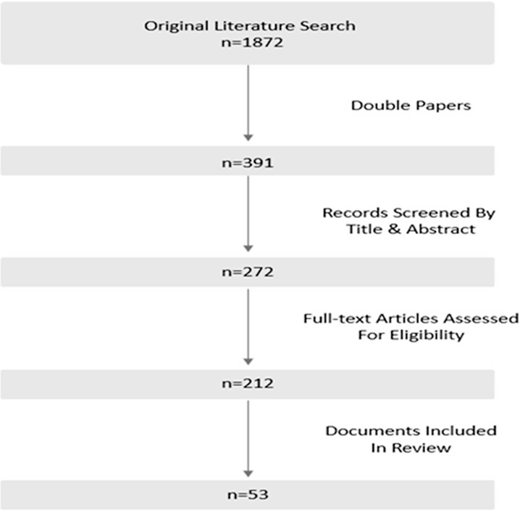
In the literature review, 1,872 related articles available on the databases from 1996 until 2019 were found. Therefore, a data management strategy was developed; the search was limited to articles that listed the search terms in their title. At first, abstracts of the study articles were selected, and articles that described the concept or provided evidence related to the concept were selected for the full-text study. No further assessment of the validity or quality of the full text was conducted. Two peers screened all the definitions from the same research unit and evaluated the definitions’ appropriateness. Finally, 53 documents were reviewed (Figure 1).
Concept Analysis
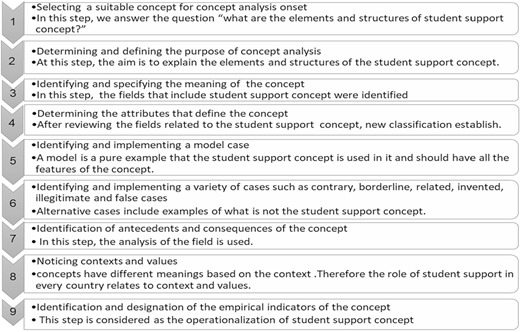
Conceptual analysis is a precise process that attempts to identify, clarify, and explain an abstract concept and distinguish it from similar concepts (McKenna, 2006; Morse et al., 1991; Schwartz-Barcott & Kim, 2000; Walker & Avant, 2005). There are different approaches in this study; the Hugh McKenna approach is used for concept analysis. The analysis was comprised of the nine steps shown in Figure 2.
Results
Definitions
Support service is a complex concept; it can be approached from several perspectives (the students, teachers, or the education system) that lead to different dimensions. There was a nonobvious distinction between academic support, learner support, faculty support system, education support system, e-support, training support, smart support service, support service, or emotional support system in context from reliable sources. At this stage, reference phrases, also known as primary concept structures, were extracted from the existing documentation, that is, the exact sentences were quoted. In the next stage, we introduced our interpretation of primary phrases. Then we introduced our interpretation of primary phrases in documentation as the potential attributes that define the concept of support service. Some attributes of the concept are repeated frequently. This stage was performed with high accuracy, and the specific attributes of the concept were extracted.
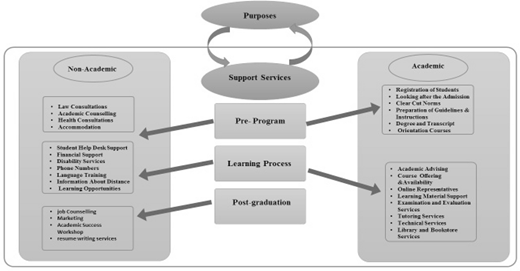
Therefore, the purpose of student supportive service in blended learning is to provide academic and nonacademic services that respond to students’ cognitive, affective, and social needs. These services lead to further engaging the student in self-learning and academic achievement. They are performed at three levels: preprogram, learning process, and postgraduation support services. Based on resources that discussed support service, the main components of this concept were determined as follows: supportive service levels, supportive service Dimensions, and supportive service purposes (Figure 3).
Levels of Student Supportive Service
The study of the texts showed that this field has three separate parts: preprogram support services, the learning process support services, and postgraduation, shown in Table 1.
Preprogram Student Support Services
Moreover, institutions in the education sector are expected to use information and communication technologies effectively to succeed in educational activities and programs. At this phase, entry requirements and all rules and regulations of the academic calendar will be announced. These items illustrate the college’s commitment to programs and facilitate decision-making for students.
Learning Process Student Support Services
The development of a learning support service for distance learning during the academic years includes: (1) establishing and improving information media, (2) exploring learning strategies for learners, and (3) access to all digital resources. If support services are further developed, learning outcomes will clearly improve (Lehtinen et al., 1999). The support system has been described in two different ways: (1) individual-oriented (interaction with the individual and their learning systems), and (2) Intrapersonal interactions (learner-learner, learner-instructor, learner-content-material/interface, etc.) that are both necessary during student life.
Postgraduation Student Support Services
During this phase, students need services to help them find job opportunities. Student support services should be userfriendly and learner-centered; however, delivering effective and efficient service has always been a major challenge for higher education managers.
Student Supportive Service Dimensions
In the literature review, student support services include two types: academic and nonacademic services. The academic services are supervised by academic staff, are based on university decisions, and are related to teaching and learning issues and problems. However, nonacademic services are centralized services that are not related to the teaching-learning process but improve learning conditions (Tamulien?, 2014). Table 2 shows the attributes of each dimension.
Supportive Service purposes
The purpose of student support is to increase graduation rates and improve student retention rates. There is competition between institutions to give grants. They also provide opportunities for students to improve their academic performance by motivating students. Supporting and enhancing the student experience from the first contact to becoming alumni is critical to success in higher education today for both the student and the institution. Student support and services contribute to the quality of students’ learning experience and their academic success. Ciobanu said,
The student services value needs greater recognition, support, and development in the interests of all students. Student services contribute to the quality of students’ learning experience and their academic success, contribute as well at the university dropout rate decrease and to the increase in students’ life diversity, encouraging and establishing an open method of making rational decisions and also resolving conflicts and preparing students for active involvement in society. (Ciobanu, 2013)
Table 3 shows the purposes of student supportive service.
Discussion
Every day the higher education market is becoming more competitive. Many students are interested in online courses, and educational institutions need special program institutions to support students online to stay in the competition. Students seek to identify the best distance education program that can provide the most services and the quality of education (Allen & Seaman, 2010).
The result of extensive studies in this field show:
Student support is a general term used for institutions’ wide range of services to help students complete their learning objectives and their course (Arko-Achemfuor, 2017).
Student support services are essential elements for all educational institutions, especially e-learning (Kumtepe et al., 2003).
Developing an organization-based support system is accomplished through techniques.
The primary focus of this support system is on the satisfaction and facilitation of learners (Cheawjindakarn et al., 2013).
The support for learners is an essential element in creating an effective learning experience for distance learning (Wright et al., 2013).
The support is the basis of an open learning system and can respond to the needs of the individual learning process (Thorpe, 2002).
In addition to studies focusing on the importance of learning support, the support of academic staff is necessary for the success of any distance education system (Gorder, 2008).
Floyd and Casey-Powell (2004) also reported that educational support creates a positive interactive environment between learners and staff. Various studies have shown that in successful universities worldwide, student support extends from preuniversity to postgraduation (Ali et al., 2016; Astin & Vogelgesang, 2008; Athiyaman, 1997). Helping students develop and complete a professional resume and advising on interview strategies is needed. At some universities, such as Portland Community College, students can participate in different job workshops, such as how to succeed in job interviews, decision making, and goal setting. Rio Salado College also provides an electronic self-assessment tool and information on the job market in various occupations (Floyd & Casey-Powell, 2004).
Student support services are defined in two ways: academic and nonacademic services. Academic services are performed by academic staff and are based on university decisions related to teaching and learning issues and problems. However, nonacademic services are not related to academic topics, but they provide suitable conditions for the student (Räisänen & Fortanet-Gómez, 2008; Sewart, 1993; Tamulienė, 2014). Students’ needs play an important role in designing and improving educational systems. Developing a quality management system in higher education is based on the student’s expectations as customers, and evaluation of their opinions, especially in the negative ones, can improve quality (Eagle & Brennan, 2007; Kochhar, 1984). Student support services guarantee academic success. Student support services in the virtual environment are essential because in this space, the student feels alone (Shernoff, 2013). Teacher and student separation affects teaching and learning. A dynamic and active system helps students not to be isolated and decentralized. As a result, it prevents declining levels of motivation, interaction, and laziness (Jun, 2009). If supportive strategies are not considered in an e-learning system, there will be a rapid decline and an increase in dropout (Dalbani, 2009).
Limitations
First, the subdivision of dimensions was sometimes subjective and artificial. Secondly, we did not systematically evaluate the quality of the included research articles. Thirdly, the search was limited to articles that listed the search terms in their title. Finally, we only reviewed English articles.
Conclusion
Working in virtual education requires flexibility (Lenar et al., 2014). Some students leave online courses because they have low motivation and lack self-management skills. Student support services have emerged to overcome all these problems for the effective and sustainable distance education system (Chatpakkarattana & Khlaisang, 2013). The institution should provide face-to-face and distance support services.
The student support system can encourage students and faculty in cyberspace (Wagner et al., 2008). All individuals and structural resources in the distance education system should be considered an integral part of support services. Student support services in this type of education can create favorable conditions for the student. Unfortunately, even experienced virtual educational institutions are not paying attention to the student support system. Research in this area has been scant and has only focused on when the student support system should be activated (Adelman, 2009). No research has shown that supports fit the students’ needs (Tamulienė, 2014).
About the authors



Acknowledgments
This article is part of a research project approved by xxxx Medical Affairs Strategic Research Center (xxxxxx). We appreciate all the professors who collaborated on this research. The National Agency funded this project for Strategic Research in Medical Education. xxxxxx. xxxxxxx. Grant No.xxxxxxx. This research did not have any conflicts of interest with any individual or organization.