Skip to Main Content

In response to the increasing implementations of online problem-based learning (PBL), this paper presents a new framework, 4S PBL, with a wide range of strategies and technologies to empower instructors and learners. Based on a critical synthesis of research on and practice of PBL, self-regulated learning (SRL), socially shared regulated learning (SSRL), and related learning technologies, the 4S PBL framework outlines key strategies to address each of the four domains (i.e., motivation, affect, cognition and behaviors) at each PBL stage. A wide range of strategies is recommended with practical examples and research support. In addition, an array of learning technologies is discussed (e.g., asynchronous, synchronous, specialized, and emerging) with an emphasis on their proven or potential benefits in supporting online PBL. From multiple perspectives, the 4S PBL framework provides a solid foundation for educators and instructional design professionals to understand the complex dynamics of online PBL fully and empowers them with a pool of strategies and technologies accordingly. Similarly, online learners could leverage the strategies to develop their SRL and SSRL skills, collaborative learning, creative thinking, critical thinking, and problem-solving skills needed in the 21st century.

Problem-based learning (PBL) has been introduced to online environments to promote higher order thinking, support knowledge acquisition, and improve learning outcomes (Delialioğlu, 2012; Hmelo-Silver, 2004; Lajoie et al., 2014; Schmidt et al., 2011). Educators and researchers have created many models and frameworks to help online instructors from different perspectives, such as generational learners (Dede, 2005; Zhang & Bonk, 2010), community building (Swan, 2002), multiple intelligence, and e-learning technologies (Zhang & Aslan, 2020, 2021; Zhang & Bonk, 2009), learner preferences (Bonk & Zhang, 2006, 2008), problem-solving (Bonk & Zhang, 2008), and e-learning stages (Salmon, 2012, 2013). However, little work is available specifically to facilitate online PBL.

To succeed in online PBL, self-regulated learning (SRL) and socially shared regulations of learning (SSRL) are critical (Bannert et al., 2014; Hadwin et al., 2011; Rogat & Linnenbrink-Garcia, 2011). SRL happens when learners adjust their cognitions, behaviors, motivations, and emotions in the learning process to achieve individual learning goals (Zimmerman, 2000). SSRL emphasizes the social perspectives of SRL, especially the interactions among group members to achieve shared learning goals (Hadwin et al., 2011; Järvelä & Hadwin, 2013; Malmberg et al., 2017; Volet et al., 2009). However, students do not automatically master regulatory skills (Malmberg et al., 2015) because mastering and applying SRL and SSRL are challenging (Järvelä et al., 2010). Thus strategic scaffolding and careful facilitation are necessary.

Instructors’ facilitation efforts are imperative in online PBL (Salmon, 2012, 2013; Savery, 2006; Zhang et al., 2009; Zhang & Ge, 2006; Zhang & Toker, 2011) while transitioning their role from knowledge giver to a facilitator of learning (Ertmer & Simons, 2006; Hmelo-Silver, 2004; Authors, 2006). Thus, in this article, we summarize key research and literature on SRL and SSRL related to online PBL, synthesize a wide range of strategies and technologies, and present a new framework, namely 4S PBL, to guide instructors’ facilitation efforts in online PBL.

SRL occurs when learners actively adjust their cognitions, behaviors, motivations, and emotions to achieve learning goals (Järvelä & Hadwin, 2013; Pintrich, 2000; Zimmerman, 2000). With self-regulation skills, students set meaningful learning goals for themselves, monitor their progress, and remain motivated, and thus are more likely to achieve satisfactory learning outcomes (Järvelä et al., 2016; Lin & Lai, 2013). Researchers conceptualize SRL processes as several cyclical stages (Winne & Hadwin, 1998; Zimmerman, 2000). A widely accepted model identifies the four iterative stages of the SRL process as (1) task understanding, (2) goal setting and planning, (3) strategy enactment, and (4) evaluation (Winne & Hadwin, 1998, 2008). Recently, researchers (Zheng et al., 2019) have also adapted this model to explore the sequential patterns of SRL and SSRL of science technology, engineering, and mathematics learning in collaborative learning.

SSRL occurs when group members work together to negotiate shared perceptions and goals, enact strategies for the task, monitor group progress and performance, and adjust when needed to achieve shared learning goals (Hadwin et al., 2011; Winne & Hadwin, 1998). In SSRL, learners collaboratively regulate their cognition, behaviors, motivations, and emotions through negotiations to achieve shared goals (Hadwin et al., 2018; Järvelä & Hadwin, 2013; Kim & Lim, 2018). Unlike SRL, SSRL emphasizes the process of group interactions and group achievements (Rogat & Linnenbrink-Garcia, 2011). Research shows that SSRL is positively related to participation, learning attitudes (Lin et al., 2020; Tsai et al., 2018), learning outcomes, and performances (De Backer et al., 2020; Volet et al., 2009).

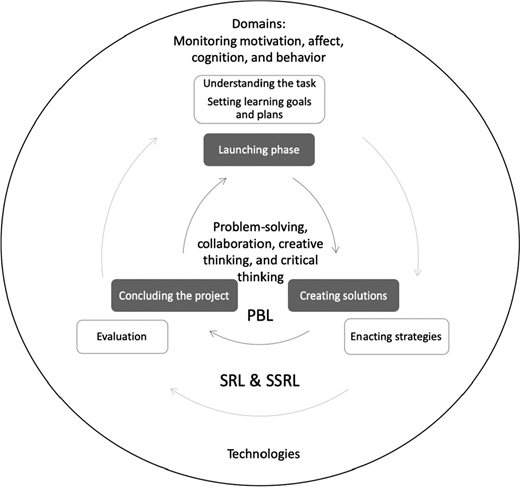
Group PBL involves three primary stages: (1) launching the project, (2) creating solutions, and (3) concluding the project (English & Kitsantas, 2013). SSRL happens when group members collectively regulate their group learning behaviors and processes (Järvelä et al., 2013; Panadero & Järvelä, 2015). In the following, we present a framework with strategies to facilitate online PBL by stage from the SRL and SSRL perspectives (see Figure 1).

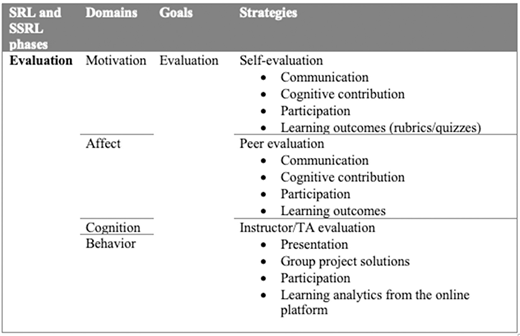
As illustrated in Figure 1, the inner circle of the 4S PBL framework is the three stages or stages of the PBL process, which focuses on problem-solving, collaboration, creative thinking, and critical thinking skills. The middle circle represents the corresponding SRL and SSRL stages. The launching stage in PBL corresponds to understanding tasks, setting goals, and planning processes in SRL and SSRL. The creating solutions stage in PBL is related to strategy enactment in SRL and SSRL. The concluding stage is associated with the evaluation stage in SRL and SSRL. The primary stages have a cyclical relationship. Although SRL and SSRL stages are described as cyclical, it is not in any strict order (Greene & Azevedo, 2010).

All these stages, supported by technologies, constantly monitor the four domains: motivation, affect, cognition, and behavior. Motivation is essential in SRL (Corno, 1989); thus, regulation of motivation is critical for successful SRL (Wolters, 1998). Affect refers to feelings that influence cognitions, moods, affect, and well-being. Cognitive regulations include planning, monitoring, and self-evaluation. Generally, positive affect is expected to support cognitive regulations, while negative affect may interfere with cognitive regulations (Rogat & Linnenbrink-Garcia, 2011).

In the planning stage, learners actively set learning goals. Monitoring cognition is when learners appraise their understanding and learning progress. Self-evaluation involves their judgment about their content understanding and task performance. Behavioral regulations may include sustaining on-task behaviors by eliminating distractions and focusing on tasks. The strategies that regulate learners’ motivations and affect cognitions and behaviors may overlap as they are closely related (Wolters, 1998). Based on the 4S PBL framework, an array of strategies is recommended at each stage.

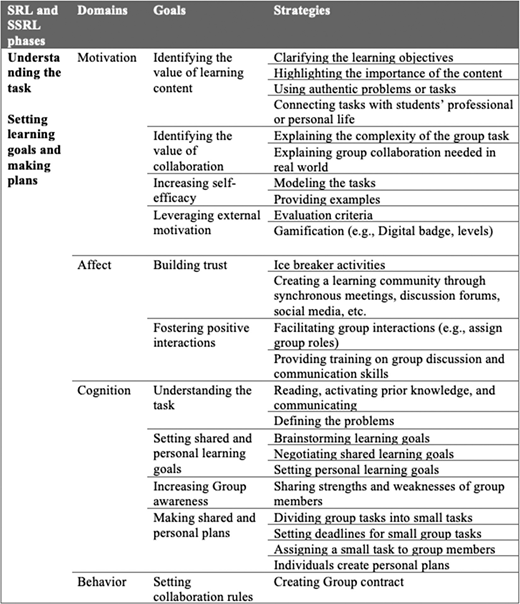
In the launching stage, it is critical to identify the value of collaboration and learning tasks. Authentic, real-world problems and appropriately challenging tasks (Zhang & Ge, 2006; Zhang et al., 2009) are powerful. Increasing self-efficacy is also imperative (Wolters, 1998, 2003), as it is positively related to SRL skills (Demirören et al., 2016). Modeling (Panadero & Järvelä, 2015) the problemsolving procedure and providing examples are powerful strategies to help develop self-regulation skills.

Leveraging external motivation (Zimmerman & Martinez-Pons, 1990) is also highly effective. Such strategies include recognizing individual contributions in the evaluation of group projects, and gamification of the evaluations (e.g., digital badges, levels, and progress bars), especially with the tech-savvy generational learners (Dede, 2005; Zhang & Bonk, 2009, 2010).

Affect plays a vital role in group work. positive affect is typically associated with beneficial outcomes in engagement and satisfaction (Rogat & Linnenbrink-Garcia, 2011; Volet et al., 2009), while negative affect is likely to result in withdrawals or lower levels of engagement and satisfaction. Group affect is significant in complex collaborative learning (Bakhtiar et al., 2018). Icebreakers and online community activities are beneficial for building trust, and it is also vital to foster positive interactions and emotions. Instructors can help groups identify necessary roles and strategies or assign roles to individual learners. In addition, a brief training session on how to collaborate effectively in online PBL can also be impactful and effective.

Cognitive regulations in the launching stage include key tasks like understanding the group task, setting shared and personal learning goals, increasing group awareness, and making shared and individual plans. Setting learning goals is critical for successful SRL and SSRL (Bakhtiar et al., 2018; Volet & Mansfield, 2006; Zhu, 2021). It is critical to make plans to achieve the learning goals, including task allocations and deadlines (Järvelä et al., 2015; Malmberg et al., 2017; Zhu, 2021). Rogat and Linnenbrink-Garcia (2011) found that high-quality planning can set the initial stage for promoting the monitoring of cognitive processes. Instructors can also scaffold by providing planning tools to create a work schedule and allocate their steps to planners (Järvelä et al., 2015; Malmberg et al., 2017) or to illustrate group members’ strengths and weaknesses to enhance SSRL (Järvelä et al., 2015).

Behavioral regulations aim to keep group members on task and avoid distractions. A group contract and the contracting process are highly recommended (Volet & Mansfield, 2006; Zhang & Ge, 2006). Group contracts empower members to create a shared understanding of the tasks, expected behaviors, and deliverables. A group contract may be a template provided by the instructor or a document entirely created by group members or formulated cooperatively by the instructor and the students (Zhang & Ge, 2006). All group members should sign and date the document to confirm their commitment to the contract.

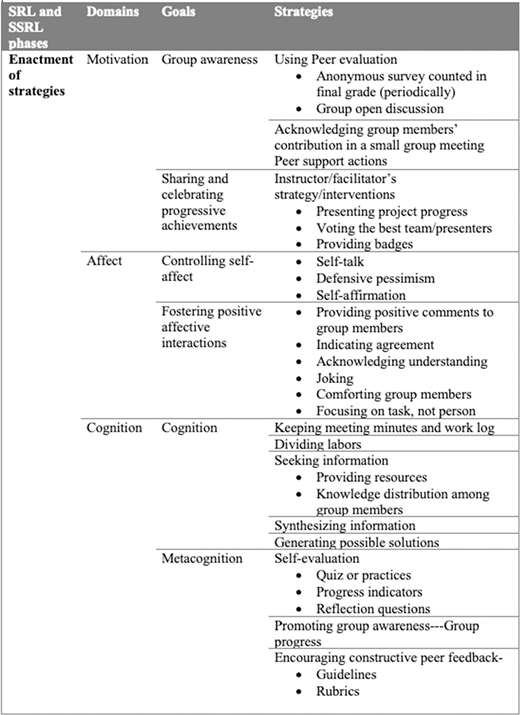
Learners’ motivation influences the quality of collaboration (Volet et al., 2009). Powerful strategies include group contracts (Volet & Mansfield, 2006), peer evaluation (Lin, 2018), celebrating progressive achievements, and acknowledging individual contributions (Zhu & Bonk, 2019). Peer evaluation is a practical approach to motivating students, reducing free-rider issues, and engaging them in collaborative work (Lin, 2018). The instructor can administer anonymous peer evaluations, have the class vote for the best group project, and recognize individual contributions and group performance. These actions can be supported by technologies such as learning progress indicators and group contribution indicators (Zhu & Bonk, 2019).

Affective regulations keep learners motivated (Wolters, 2003). Positive social or emotional interactions facilitate high-quality SSR, resulting in behavioral engagement and effective feedback communication (Rogat & Linnenbrink-Garcia, 2011; Volet et al., 2009). It is essential to control self-affect. For instance, self-talk or inner speech strategies can control negative affect, while defensive pessimism can control negative emotions and thus improve performance. Likewise, self-affirmation empowers learners to seek positive self-evaluations and avoid negative emotional experiences. Second, fostering positive affective interactions is necessary. Social communications are imperative to create and sustain a positive collaboration climate (Grau & Whitebread, 2012). Therefore, instructors may encourage learners to provide positive comments, praise other group members, acknowledge understanding, joke, and comfort group members (Bakhtiar et al., 2018).

Monitoring cognition allows learners to receive feedback and support, which promotes deeper knowledge understanding (Rogat & Linnenbrink-Garcia, 2011). Thus, it positively affects students’ collaborative learning (Molenaar & Chiu, 2014) and may lead to high-quality collaboration (Lee et al., 2015). Keeping project records and meeting minutes can support monitoring and reduce individuals’ or groups’ cognitive load. Roleplay can also enhance learners’ understanding of group tasks (Hadwin & Oshige, 2011) while building reciprocal, interdependent relations through roleplaying (Park & Kim, 2014). Monitoring learners’ progress is also essential (Malmberg et al., 2017). When learners encounter challenges, instructors could provide necessary resources and support. Metacognitive processes are vital at the individual and group social levels (De Backer et al., 2014). Instructors can provide rubrics or guidelines for peer feedback.

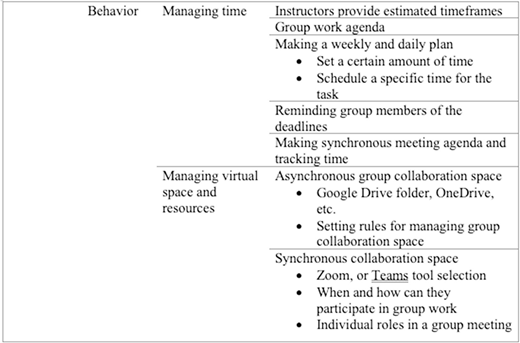
Behavioral regulations are essential to keep groups on task and to achieve high performance (Rogat & Linnenbrink-Garcia, 2011). At the solution creation stage, instructors can guide learners to create time management plans and mark their weekly and daily calendars (Zhu, 2021; Zhu et al., 2021). In addition, constant evaluations of the group work timeline are necessary (Malmberg et al., 2017).

In online PBL, managing the virtual collaboration space includes decisions on who, when, and how to administer the technologies for file sharing, storage, and coauthoring (e.g., Google Drive, OneDrive, etc.). Instructors may encourage equal power to share such responsibilities among group members (Panadero & Järvelä, 2015). Member’s contribution indicators can help promote group regulations.

Concluding the project is the last stage of PBL. While many of the previously mentioned strategies also apply here, evaluations are particularly vital at this stage, including those done by learners themselves, their peers, instructors, and outside experts from authentic professional contexts. For self-evaluation, instructors can provide surveys or ask students to write reflection papers on their interactions with peers, cognitive contributions to the group project, and their learning outcomes assessed by appropriate criteria. Rubrics are also highly recommended as a tool to facilitate group regulation and evaluation (Panadero & Järvelä, 2015). In addition, instructors can evaluate group projects and individual learning through students’ presentations, projects, products, or other artifacts and deliverables. Learning analytics are applied to monitor students’ learning progress, identify struggling students, predict learner success, and facilitate adaptive learning (Ryan et al., 2019; Sedrakyan et al., 2020). Specialized technologies are also created to facilitate self- and group evaluation, such as OurEvaluation (Järvelä et al., 2015) to monitor individual and group progress.

It is impossible to identify all technologies; thus, in this section, we briefly discuss some of the most widely applied types of learning technology, including asynchronous (Chatterjee & Correia, 2020; Elola & Oskoz, 2017; Zhang & Bonk, 2009; Zhang & DeLoose, 2009; Zhang et al., 2009), synchronous (Chatterjee & Correia, 2020; Elola & Oskoz, 2017; Ishtaiwa & Aburezeq, 2015), specialized (Lin et al., 2016; Järvelä et al., 2015) and the emerging ones (Zhang & Aslan, 2020, 2021). Different communication modalities influence learners’ attention and learning performance (Cho, 2018; Frear & Bitchener, 2015). Asynchronous communication tools, such as discussion boards, wikis (Zhang & DeLoose, 2009), blogs, and more, are widely applied (Zhu & Bonk, 2019). Discussion boards, for example, facilitate multiple types of interactions to minimize the transactional distance (Moore, 1993) and may increase learners’ satisfaction (Ku et al., 2013). Slack (https://slack.com) has been increasingly popular for collaborations, with functions like group and individual communication channels, sharing documents, and setting deadlines.

Synchronous technologies empower learners with real-time communications, discussions, and decision-making capacities and increase productivity in collaborative tasks (Huang, 2017). The synchronous editing and chatting tools, for instance, allow users to create, share, revise, and edit documents, make comments, and provide feedback simultaneously or asynchronously and thus facilitating knowledge sharing (Al-Samarraie & Saeed, 2018) in PBL. Google Docs and Google Drive are available for collaborative writing, peer review, progress reports, and resources and drafts sharing (Liu et al., 2014). It supports collaborative problem-solving (Qin et al., 2016). In addition, online conference tools, such as Google Hangout, Zoom, Microsoft Teams, and Skype, provide rich media (Dennis & Kinney, 1998) and allow learners to capture the nuances of gestures and facial expressions; thus, such technologies are also powerful for bounding and trust building in online PBL.

Social media can facilitate teaching, learning, and community building in formal education, MOOCs, and informal and lifelong learning (e.g., Gao et al., 2012; Greenhow & Lewin, 2016; Zhang, 2015; Zhang & Gao, 2014), which further foster SRL (Zhu & Bonk, 2019). It also increases learners’ satisfaction and promotes knowledge sharing and exchange (Al-Rahmi & Othman, 2013). For example, the Facebook chat window can be used for live discussions, social networking, and trust building (Charlton et al., 2009). However, it can be really distracting (Lampe et al., 2011).

Researchers have also developed specialized technology (e.g., Deason & Zhang, 2012) to support SRL or SSRL (Chang et al., 2013; Poitras et al., 2021; Shih et al., 2010). For example, using an SRL training system for students to set personal learning goals and review their learning progress (Shih et al., 2010) or a collaborative mind mapping tool to improve learning and self-efficacy (Zheng et al., 2020). Learning technology researchers (Deason & Zhang, 2012) creates an interactive, culturally sensitive computer-based learning environment, utilizing hip-hop pedagogy to motivate at-risk teenagers and to promote active and effective learning. A research group in Canada (Winne et al., 2006) adopt a collaborative software, gStudy, to scaffold SRL through activities like making notes, creating concept maps, searches, and collaborations. Other research groups implement group awareness tools to promote SRL for collaboration (Lin et al., 2016; Järvelä et al., 2015). With the increasing application of learning management systems (LMS) in online or blended learning, instructors can track students’ online participation and monitor individual and group progress on LMS (Hershey & Wood, 2011). Many LMS now also provide visual analytics by the learner, class, or time frame (i.e., day, week, date, etc.).

With advanced learning analytics (LA), instructors can apply LA-based predictive models to promote student success (Hung & Zhang, 2008, 2012; Sedrakyan et al., 2020; Xing et al., 2015). Through LA-based feedback and other interventions, learners can benefit from adaptive learning experiences (Gaševic et al., 2016; Tlili et al., 2019), customized guidance and recommendations (Dawson et al., 2014; Karaoglan Yilmaz & Yilmaz, 2020; Ustun et al., 2022) and scalable personalized support (Pardo et al., 2019; Ryan et al., 2019; Zhang & Aslan, 2021) in online PBL.

A recent review on AI in education (AIEd) research (Zhang & Aslan, 2021) has identified a range of AIEd technologies and their educational benefits, such as chatbots, expert systems, intelligent tutors or agents, machine learning, personalized learning systems or environments (PLS/E), and visualization. AIEd, as a technology element in 4S PBL, could foster SRL and SSRL in PBL through expert systems, visual feedback, and immersive learning environments (Zhang & Aslan, 2020, 2021). For learners, AIEd could engage learners, facilitate interaction, and provide metacognitive prompts, which play a critical role in supporting SRL and SSRL in online PBL. From educators’ and administrators’ perspectives, the functions enabled by AIEd, such as predictive models, gifted or at-risk students’ identification, learning progress indicators, assessments, and feedback could tremendously help educators to facilitate learners’ SRL and SSRL in online PBL.

During the COVID-19 pandemic, over 200 million students, 12.5% of total students worldwide, were influenced by the shutting down of the university and schools by the end of December 2020 (UNESCO, 2020). As a response to the global crisis, online learning was implemented in educational systems worldwide (Gardner, 2020). This paper presents 4S PBL, a new framework to facilitate online PBL in four domains from SRL and SSRL perspectives throughout the three PBL stages. Aligning the PBL process and SRL/SSRL phases, the 4S PBL framework outlines key strategies to address each of the four domains (i.e., motivation, affect, cognition and behaviors) at each PBL stage. A wide range of strategies is recommended with practical examples and research support. In addition, an array of learning technologies is discussed (e.g., asynchronous, synchronous, specialized, and emerging) with an emphasis on their proven or potential benefits in supporting online PBL.

The 4S PBL framework synthesizes research and practice concerning PBL, SRL, SSRL, and related learning technologies. 4S PBL is a unique framework that leverages SRL, SSRL, and learning technologies to support effective online PBL. From multiple perspectives, the 4S PBL framework provides a solid foundation for educators and instructional design professionals to understand the complex dynamics of online PBL fully and empowers them with a pool of strategies and technologies accordingly. Educators and instructional design professionals could creatively integrate strategies of their choice to facilitate online PBL, SRL, and SSRL. Similarly, online learners could leverage the strategies to develop their SRL and SSRL for collaborative learning, creative thinking, critical thinking, and problem-solving skills needed in the 21st century. Future research may further explore, test, validate or otherwise study any specific strategies or technologies per the 4S PBL framework to support online PBL.


Al-Samarraie
,
H.
, &
Saeed
,
N.
(
2018
).
A systematic review of cloud computing tools for collaborative learning: Opportunities and challenges to the blended-learning environment
.
Computers & Education
,
124
,
77
91
.
Bakhtiar
,
A.
,
Webster
,
E. A.
, &
Hadwin
,
A. F.
(
2018
).
Regulation and socio-emotional interactions in a positive and a negative group climate
.
Metacognition and Learning
,
13
(
1
),
57
90
.
Bandura
,
A.
(
1994
). Self-efficacy. In
V. S.
Ramachaudran
(Ed.),
Encyclopedia of human behavior
(pp.
71
81
).
Academic Press
.
Bannert
,
M.
,
Reimann
,
P.
, &
Sonnenberg
,
C.
(
2014
).
Process mining techniques for analyzing patterns and strategies in students’ selfregulated learning
.
Metacognition and Learning
,
9
(
2
),
161
185
.
Barrows
,
H. S.
, &
Tamblyn
,
R. M.
(
1980
).
Problem-based learning: An approach to medical education
.
Springer
.
Bonk
,
C. J.
, &
Zhang
,
K.
(
2006
).
Introducing the R2D2 model: Online learning for the diverse learners of this world
.
Distance Education
,
27
(
2
),
249
264
.
Bonk
,
C. J.
, &
Zhang
,
K.
(
2008
).
Empowering online learning: 100+ activities for reading, reflecting, displaying, and doing
.
John Wiley & Sons
.
Boyer
,
N. R.
,
Maher
,
P. A.
, &
Kirkman
,
S.
(
2006
).
Transformative learning in online settings: The use of self-direction, metacognition, and collaborative learning
.
Journal of Transformative Education
,
4
(
4
),
335
361
.
Chang
,
C. C.
,
Tseng
,
K. H.
,
Liang
,
C.
, &
Liao
,
Y. M.
(
2013
).
Constructing and evaluating online goal-setting mechanisms in a webbased portfolio assessment system for facilitating self-regulated learning
.
Computers & Education
,
69
,
237
249
.
Charlton
,
T.
,
Devlin
,
M.
, &
Drummond
,
S.
(
2009
).
Using Facebook to improve communication in undergraduate software development teams
.
Computer Science Education
,
19
(
4
),
273
292
.
Chatterjee
,
R.
, &
Correia
,
A. P.
(
2020
).
Online students’ attitudes toward collaborative learning and sense of community
.
American Journal of Distance Education
,
34
(
1
),
53
68
.
Cho
,
M.
(
2018
).
Task complexity, modality, and working memory in L2 task performance
.
System
,
72
,
85
98
.
Corno
,
L.
(
1989
). Self-regulated learning: A volitional analysis. In
B.
Zimmerman
&
D.
Schunk
(Eds.),
Self-regulated learning and academic achievement: Theory, research, and practice
(pp.
111
141
).
Springer-Verlag
.
Deason
,
C.
, &
Zhang
,
K.
(
2012
).
Technology-enhanced rap music pedagogy for history learning at an alternative school: impacts of a culturally-sensitive computer environment on at-risk teenagers
.
Asia-Pacific Collaborative Education Journal
,
8
(
1
),
39
58
.
De Backer
,
L.
,
Van Keer
,
H.
, &
Valcke
,
M.
(
2014
).
Socially shared metacognitive regulation during reciprocal peer tutoring: Identifying its relationship with students’ content processing and transactive discussions
.
Instructional Science
,
43
(
3
),
323
344
.
De Backer
,
L.
,
Van Keer
,
H.
, &
Valcke
,
M.
(
2020
).
Variations in socially shared metacognitive regulation and their relation with university students’ performance
.
Metacognition and Learning
,
15
(
2
),
233
259
.
Dede
,
C.
(
2005
).
Planning for neomillennial learning styles
.
Educause Quarterly
,
28
(
1
),
71
2
.
Delialioğlu, Ö
. (
2012
).
Student engagement in blended learning environments with lecture-based and problem-based instructional approaches
.
Journal of Educational Technology & Society
,
15
(
3
),
310
322
. https://www.jstor.org/stable/10.2307/jeductechsoci.15.3.310
Demirören
,
M.
,
Turan
,
S.
, &
Öztuna
,
D.
(
2016
).
Medical students’ self-efficacy in problembased learning and its relationship with selfregulated learning
.
Medical education online
,
21
(
1
),
30049
.
Dennis
,
A. R.
, &
Kinney
,
S. T.
(
1998
).
Testing media richness theory in the new media: The effects of cues, feedback, and task equivocality
.
Information Systems Research
,
9
(
3
),
256
274
. http://home.business.utah.edu/actme/7410/Dennis.pdf
Dochy
,
F.
,
Segers
,
M.
,
Van den Bossche
,
P.
, &
Gijbels
,
D.
(
2003
).
Effects of problem-based learning: A meta-analysis
.
Learning and instruction
,
13
(
5
),
533
568
.
Elola
,
I.
, &
Oskoz
,
A.
(
2017
).
Writing with 21st-century social tools in the L2 classroom: New literacies, genres, and writing practices
.
Journal of Second Language Writing
,
36
,
52
60
.
English
,
M. C.
, &
Kitsantas
,
A.
(
2013
).
Supporting student self-regulated learning in problem-and project-based learning
.
Interdisciplinary Journal of Problem-Based Learning
,
7
(
2
),
128
150
.
Ertmer
,
P. A.
, &
Simons
,
K. D.
(
2006
).
Jumping the PBL implementation hurdle: Supporting the efforts of K–12 teachers
.
Interdisciplinary Journal of Problem-based Learning
,
1
(
1
),
40
54
.
Frank
,
T.
, &
Scharff
,
L. L.
(
2013
).
Learning contracts in undergraduate courses: Impacts on student behaviors and academic performance
.
Journal of the Scholarship of Teaching and Learning
,
13
(
4
),
36
53
. https://scholarworks.iu.edu/journals/index.php/josotl/article/view/3453
Frear
,
M. W.
, &
Bitchener
,
J.
(
2015
).
The effects of cognitive task complexity on writing complexity
.
Journal of Second Language Writing, pp. 30
,
45
57
.
Gardner
,
L.
(
2020
).
COVID-19 has forced higher ed to pivot to online learning. here are 7 takeaways so far
.
The Chronicle of Higher Education
. https://www.chronicle.com/article/Covid-19-Has-Forced-Higher-Ed/248297
Glazewski
,
K. D.
, &
Ertmer
,
P. A.
(
2020
).
Fostering complex problem solving for diverse learners: Engaging an ethos of intentionality toward equitable access
.
Educational Technology Research and Development
,
68
(
2
),
679
702
.
Grau
,
V.
, &
Whitebread
,
D.
(
2012
).
Self and social regulation of learning during collaborative activities in the classroom: The interplay of individual and group cognition
.
Learning and Instruction
,
22
(
6
),
401
412
.
Greene
,
J. A.
, &
Azevedo
,
R.
(
2010
).
The measurement of learners’ self-regulated cognitive and metacognitive processes while using computer-based learning environments
.
Educational Psychologist
,
45
(
4
),
203
209
.
Greenhow
,
C.
, &
Lewin
,
C.
(
2016
).
Social media and education: Reconceptualizing the boundaries of formal and informal learning
.
Learning, Media and Technology
,
41
(
1
),
6
30
.
Hadwin
,
A. F.
,
Järvelä
,
S.
, &
Miller
,
M.
(
2011
). Self-regulated, co-regulated, and socially shared regulation of learning. In
B. J.
Zimmerman
&
D. H.
Schunk
(Eds.),
Handbook of self-regulation of learning and performance
(pp.
65
86
).
Routledge
.
Hadwin
,
A.
,
Järvelä
,
S.
, &
Miller
,
M.
(
2018
).
Selfregulation, co-regulation, and shared regulation in collaborative learning environments
. In
D. H.
Schunk
&
J. A.
Greene
(Eds.),
Educational psychology handbook series. Handbook of self-regulation of learning and performance
(pp.
83
106
). Routledge/Taylor & Francis Group
Hadwin
,
A. F.
, &
Oshige
,
M.
(
2011
).
Self-regulation, co-regulation, and socially-shared regulation: Exploring perspectives of social in self-regulated learning theory
.
Teachers College Records
,
113
(
2
),
240
264
.
Hadwin
,
A. F.
,
Oshige
,
M.
,
Gress
,
C. L. Z.
, &
Winne
,
P. H.
(
2010
).
Innovative ways for using gStudy to orchestrate and research social aspects of self-regulated learning
.
Computers in Human Behavior
,
26
(
5
),
794
805
.
Hershey
,
L.
, &
Wood
,
P.
(
2011
).
Using the blackboard CMS to develop teamwork skills in undergraduate marketing principles class
.
Academy of Educational Leadership Journal
,
15
(
1
),
57
64
.
Hmelo-Silver
,
C. E.
(
2004
).
Problem-based learning: What and how do students learn?
Educational Psychology Review
,
16
(
3
),
235
266
.
Hung
,
W.
,
Jonassen
,
D. H.
, &
Liu
,
R.
(
2008
). Problem-based learning. In
Handbook of research on educational communications and technology
( (3rd) ed., pp.
485
506
).
Routledge
.
Hung
,
J. L.
, &
Zhang
,
K.
(
2008
).
Revealing online learning behaviors and activity patterns and making predictions with data mining techniques in online teaching
.
MERLOT Journal of Online Learning and Teaching
,
4
(
4
),
426
437
.
Hung
,
J. L.
, &
Zhang
,
K.
(
2012
).
Examining mobile learning trends 2003–2008: A categorical meta-trend analysis using text mining techniques
.
Journal of Computing in Higher education
,
24
(
1
),
1
17
.
Ishtaiwa
,
F. F.
, &
Aburezeq
,
I. M.
(
2015
).
The impact of Google Docs on student collaboration: A UAE case study
.
Learning, Culture, and Social Interaction
,
7
,
85
96
.
Järvelä
,
S.
, &
Hadwin
,
A. F.
(
2013
).
New frontiers: Regulating learning in CSCL
.
Educational Psychologist
,
48
(
1
),
25
39
.
Järvelä
,
S.
,
Järvenoja
,
H.
,
Malmberg
,
J.
, &
Hadwin
,
A. F.
(
2013
).
Exploring socially shared regulation in the context of collaboration
.
Journal of Cognitive Education and Psychology
,
12
(
3
),
267
286
.
Järvelä
,
S.
,
Kirschner
,
P. A.
,
Hadwin
,
A.
,
Järvenoja
,
H.
,
Malmberg
,
J.
,
Miller
,
M.
, &
Laru
,
J.
(
2016
).
Socially shared regulation of learning in CSCL: Understanding and prompting individual-and group-level shared regulatory activities
.
International Journal of Computer-Supported Collaborative Learning
,
11
(
3
),
263
280
.
Järvelä
,
S.
,
Kirschner
,
P. A.
,
Panadero
,
E.
,
Malmberg
,
J.
,
Phielix
,
C.
,
Jaspers
,
J.
,
Koivuniemi
,
M.
, &
Järvenoja
,
H.
(
2015
).
Enhancing socially shared regulation in collaborative learning groups: designing for CSCL regulation tools
.
Educational Technology Research and Development
,
63
(
1
),
125
142
.
Järvelä
,
S.
,
Malmberg
,
J.
, &
Koivuniemi
,
M.
(
2016
).
Recognizing socially shared regulation by using the temporal sequences of online chat and logs in CSCL
.
Learning and Instruction
,
42
,
1
11
.
Järvelä
,
S.
,
Volet
,
S.
, &
Järvenoja
,
H.
(
2010
).
Research on motivation in collaborative learning: Moving beyond the cognitive-situative divide and combining individual and social processes
.
Educational Psychologist
,
45
(
1
),
15
27
.
Karaoglan Yilmaz
,
F. G.
(
2020
).
Modeling different variables in flipped classrooms supported with learning analytics feedback
.
Journal of Information and Communication Technologies
,
2
(
1
),
1
16
.
Karaoglan Yilmaz
,
F. G.
, &
Yilmaz
,
R.
(
2019
).
Impact of pedagogic agent-mediated metacognitive support towards increasing task and group awareness in CSCL
.
Computers & Education
,
134
,
1
14
.
Karaoglan Yilmaz
,
F. G.
,
Olpak
,
Y. Z.
, &
Yilmaz
,
R.
(
2018
).
The effect of the metacognitive support via pedagogical agent on self-regulation skills
.
Journal of Educational Computing Research
,
56
(
2
),
159
180
.
Karaoglan Yilmaz
,
F. G.
, &
Yilmaz
,
R.
(
2020
).
Student opinions about personalized recommendation and feedback based on learning analytics
.
Technology, Knowledge and Learning
,
25
(
4
),
753
768
.
Kim
,
D.
, &
Lim
,
C.
(
2018
).
Promoting socially shared metacognitive regulation in collaborative project-based learning: a framework for the design of structured guidance
.
Teaching in Higher Education
,
23
(
2
),
194
211
.
Kim
,
H. R.
,
Song
,
Y.
,
Lindquist
,
R.
, &
Kang
,
H. Y.
(
2016
).
Effects of team-based learning on problem-solving, knowledge and clinical performance of Korean nursing students
.
Nurse Education Today
,
38
,
115
118
.
Ku
,
H. Y.
,
Tseng
,
H. W.
, &
Akarasriworn
,
C.
(
2013
).
Collaboration factors, teamwork satisfaction, and student attitudes toward online collaborative learning
.
Computers in Human Behavior
,
29
(
3
),
922
929
.
Kwon
,
K.
,
Liu
,
Y. H.
, &
Johnson
,
L. P.
(
2014
).
Group regulation and social-emotional interactions observed in computer supported collaborative learning: Comparison between good vs. poor collaborators
.
Computers & Education
,
78
,
185
200
. .
Lajoie
,
S. P.
,
Hmelo-Silver
,
C. E.
,
Wiseman
,
J. G.
,
Chan
,
L. K.
,
Lu
,
J.
,
Khurana
,
C.
,
Cruz-Panesso
,
I.
,
Poitras
,
E.
&
Kazemitabar
, &
M
. (
2014
).
Using online digital tools and video to support international problem-based learning
.
Interdisciplinary Journal of Problem-Based Learning
,
8
(
2
),
60
75
.
Lampe
,
C.
,
Wohn
,
D. Y.
,
Vitak
,
J.
,
Ellison
,
N. B.
, &
Wash
,
R.
(
2011
).
Student use of Facebook for organizing collaborative classroom activities
.
International Journal of Computer-Supported Collaborative Learning
,
6
(
3
),
329
347
.
Lee
,
A.
,
O’Donnell
,
A. M.
, &
Rogat
,
T. K.
(
2015
).
Exploration of the cognitive regulatory subprocesses employed by groups characterized by socially shared and other-regulation in a CSCL context
.
Computers in Human Behavior
,
52
,
617
627
. http://doi.org/10.1016/j.chb.2014.11.072
Li
,
J.
,
Lin
,
Y.
,
Sun
,
M.
, &
Shadiev
,
R.
(
2020
).
Socially shared regulation of learning in game-based collaborative learning environments promotes algorithmic thinking, learning participation and positive learning attitudes
.
Interactive Learning Environments
,
1
12
.
Lin
,
J. W.
(
2018
).
Effects of an online team project-based learning environment with group awareness and peer evaluation on socially shared regulation of learning and self-regulated learning
.
Behaviour & Information Technology
,
37
(
5
),
445
461
.
Lin
,
J. W.
, &
Lai
,
Y. C.
(
2013
).
Harnessing collaborative annotations on online formative assessments
.
Journal of Educational Technology & Society
,
16
(
1
),
263
274
. https://www.jstor.org/stable/10.2307/jeductechsoci.16.1.263
Lin
,
J. W.
,
Lai
,
Y. C.
,
Lai
,
Y. C.
, &
Chang
,
L. C.
(
2016
).
Fostering self-regulated learning in a blended environment using group awareness and peer assistance as external scaffolds
.
Journal of Computer Assisted Learning
,
32
(
1
),
77
93
.
Liu
,
S. H. J.
,
Lan
,
Y. J.
, &
Ho
,
C. Y. Y.
(
2014
).
Exploring the relationship between self-regulated vocabulary learning and web-based collaboration
.
Educational Technology & Society
,
17
(
4
),
404
419
. https://www.jstor.org/stable/10.2307/jeductechsoci.17.4.404
Lin
,
J. W.
,
Mai
,
L. J.
, &
Lai
,
Y. C.
(
2015
).
Peer interaction and social network analysis of online communities with the support of awareness of different contexts
.
International Journal of Computer-Supported Collaborative Learning
,
10
(
2
),
139
159
.
Malmberg
,
J.
,
Järvelä
,
S.
, &
Järvenoja
,
H.
(
2017
).
Capturing temporal and sequential patterns of self-, co-, and socially shared regulation in the context of collaborative learning
.
Contemporary Journal of Educational Psychology
,
49
,
160
174
. .
Malmberg
,
J.
,
Järvelä
,
S.
,
Järvenoja
,
H.
, &
Panadero
,
E.
(
2015
).
Promoting socially shared regulation of learning in CSCL: Progress of socially shared regulation among high-and low-performing groups
.
Computers in Human Behavior
,
52
,
562
572
.
Miller
,
M.
, &
Hadwin
,
A.
(
2015
).
Scripting and awareness tools for regulating collaborative learning: Changing the landscape of support in CSCL
.
Computers in Human Behavior
,
52
,
573
588
.
Molenaar
,
I.
, &
Chiu
,
M. M.
(
2014
).
Dissecting sequences of regulation and cognition: Statistical discourse analysis of primary school children’s collaborative learning
.
Metacognition and Learning
,
9
(
2
),
137
160
.
Moore
,
M. G.
(
1993
). Theory of transactional distance. In
D.
Keegan
(Ed.),
Theoretical principles of distance education
(pp.
22
38
).
Routledge
.
Obizoba
,
C.
(
2016
).
Effective facilitation methods for online teaching
.
International Journal of Higher Education Management
,
2
(
2
),
14
25
.
Panadero
,
E.
, &
Järvelä
,
S.
(
2015
).
Socially shared regulation of learning: A review
.
European Psychologist
,
20
(
3
),
190
203
.
Pardo
,
A.
,
Jovanovic
,
J.
,
Dawson
,
S.
,
Gašević
,
D.
, &
Mirriahi
,
N.
(
2019
).
Using learning analytics to scale the provision of personalised feedback
.
British Journal of Educational Technology
,
50
(
1
),
128
138
.
Park
,
S.
, &
Kim
,
C.
(
2014
).
Virtual tutee system: A potential tool for enhancing academic reading engagement
.
Educational Technology Research and Development
,
62
(
1
),
71
97
.
Pintrich
,
P. R.
(
2000
). The role of goal orientation in self-regulated learning. In
M.
Boekaerts
,
P. R.
Pintrich
, &
M.
Zeidner
(Eds.),
Handbook of self-regulation
(pp.
451
502
).
Academic Press
.
Poitras
,
E. G.
,
Doleck
,
T.
,
Huang
,
L.
,
Dias
,
L.
, &
Lajoie
,
S. P.
(
2021
).
Time-driven modeling of student self-regulated learning in networkbased tutors
.
Interactive Learning Environments
,
1
22
.
Qin
,
L.
,
Hsu
,
J.
, &
Stern
,
M.
(
2016
).
Evaluating the usage of cloud-based collaboration services through teamwork
.
The Journal of Education for Business
,
91
(
4
),
227
235
.
Rogat
,
T. K.
, &
Linnenbrink-Garcia
,
L.
(
2011
).
Socially shared regulation in collaborative groups: An analysis of the interplay between quality of social regulation and group processes
.
Cognition & Instruction
,
29
(
4
),
375
415
.
Ryan
,
T.
,
Gašević
,
D.
, &
Henderson
,
M.
(
2019
). Identifying the impact of feedback over time and at scale: Opportunities for learning analytics. In
M.
Henderson
,
R.
Ajjawi
,
D.
Boud
, &
E.
Molloy
(Eds.),
The impact of feedback in higher education
(pp.
207
223
).
Palgrave Macmillan
.
Salmon
,
G.
(
2012
).
E-moderating: The key to online teaching and learning
.
Routledge
.
Salmon
,
G.
(
2013
).
E-tivities: The key to active online learning
.
Routledge
.
Savery
,
J. R.
(
2006
).
Overview of problem-based learning: Definitions and distinctions
.
Interdisciplinary Journal of Problem-Based Learning
,
1
(
1
),
9
20
.
Schmidt
,
H. G.
,
Rotgans
,
J. I.
, &
Yew
,
E. H.
(
2011
).
The process of problem-based learning: What works and why
.
Medical Education
,
45
(
8
),
792
806
.
Sedrakyan
,
G.
,
Malmberg
,
J.
,
Verbert
,
K.
,
Järvelä
,
S.
, &
Kirschner
,
P. A.
(
2020
).
Linking learning behavior analytics and learning science concepts: Designing a learning analytics dashboard for feedback to support learning regulation
.
Computers in Human Behavior
,
107
,
105512
.
Shih
,
K. P.
,
Chen
,
H. C.
,
Chang
,
C. Y.
, &
Kao
,
T. C.
(
2010
).
The development and implementation of scaffolding-based self-regulated learning system for e/m-learning
.
Journal of Educational Technology & Society
,
13
(
1
),
80
93
. https://www.jstor.org/stable/10.2307/jeductechsoci.13.1.80
Splichal
,
J. M.
,
Oshima
,
J.
, &
Oshima
,
R.
(
2018
).
Regulation of collaboration in project-based learning mediated by CSCL scripting reflection
.
Computers & Education
,
125
,
132
145
.
Swan
,
K.
(
2002
).
Building learning communities in online courses: The importance of interaction
.
Education, Communication & Information
,
2
(
1
),
23
49
.
Tsai
,
C. W.
,
Shen
,
P. D.
,
Chiang
,
I. C.
,
Chen
,
W. Y.
, &
Chen
,
Y. F.
(
2018
).
Exploring the effects of web-mediated socially-shared regulation of learning and experience-based learning on improving students’ learning
.
Interactive Learning Environments
,
26
(
6
),
815
826
.
UNESCO
. (
2020
,
December
22
).
COVID-19 educational disruption and response
. https://en.unesco.org/themes/education-emergencies/coronavirus-school-closures
Ustun
,
A. B.
,
Zhang
,
K.
,
Karaoğlan-Yilmaz
,
F. G.
, &
Yilmaz
,
R.
(
2022
).
Learning analytics based feedback and recommendations in flipped classrooms: an experimental study in higher education
.
Journal of Research on Technology in Education
,
1
17
.
Volet
,
S.
, &
Mansfield
,
C.
(
2006
).
Group work at university: Significance of personal goals in the regulation strategies of students with positive and negative appraisals
.
Higher Education Research & Development
,
25
(
4
),
341
356
.
Volet
,
S.
,
Summers
,
M.
, &
Thurman
,
J.
(
2009
).
High-level co-regulation in collaborative learning: How does it emerge and how is it sustained?
Learning and Instruction
,
19
(
2
),
128
143
.
Wang
,
X.
,
Chen
,
Y.
,
Ritzhaupt
,
A. D.
, &
Martin
,
F.
(in press).
Examining competencies for the instructional design professional: An exploratory job announcement analysis
.
International Journal of Training and Development
,
25
(
2
),
95
123
.
Webb
,
N. M.
,
Ing
,
M.
,
Kersting
,
N.
, &
Nemer
,
K. M.
(
2006
). Help seeking in cooperative learning groups. In
S. A.
Karabenick
&
R. S.
Newman
(Eds.),
Academic help seeking: Goals, groups and contexts
(pp.
45
88
).
Erlbaum
.
Winne
,
P. H.
, &
Hadwin
,
A. F.
(
1998
). Studying as self-regulated learning. In
D. J.
Hacker
,
J.
Dunlosky
, &
A. C.
Graesser
(Eds.),
Metacognition in educational theory and practice
(pp.
277
304
).
Erlbaum
.
Winne
,
P. H.
, &
Hadwin
,
A.
(
2008
). The weave of motivation and self-regulated learning. In
D. H.
Schunk
&
B. J.
Zimmerman
(Eds.),
Motivation and self-regulated learning: Theory, research, and applications
(pp.
297
314
).
Erlbaum
.
Winne
,
P. H.
,
Nesbit
,
J. C.
,
Kumar
,
V.
,
Hadwin
,
A. F.
,
Lajoie
,
S. P.
,
Azevedo
,
R.
, &
Perry
,
N. E.
(
2006
).
Supporting self-regulated learning with gStudy software: The Learning Kit Project
.
Technology Instruction Cognition and Learning
,
3
(
1/2
),
105
113
.
Wolters
,
C. A.
(
1998
).
Self-regulated learning and college students’ regulation of motivation
.
Journal of Educational Psychology
,
90
(
2
),
224
235
.
Wolters
,
C. A.
(
2003
).
Regulation of motivation: Evaluating an underemphasized aspect of self-regulated learning
.
Educational Psychologist
,
38
(
4
),
189
205
.
Xing
,
W.
,
Guo
,
R.
,
Petakovic
,
E.
, &
Goggins
,
S.
(
2015
).
Participation-based student final performance prediction model through interpretable genetic programming: Integrating learning analytics, educational data mining and theory
.
Computers in Human Behavior
,
47
,
168
181
.
Zhang
,
K.
(
2008
).
Ubiquitous technology for language learning: The U-Japan movement in higher education
.
Journal of Computing in Higher Education
,
20
(
2
),
81
91
.
Zhang
,
K.
(
2015
).
Mining data from Weibo to WeChat: A comparative case study of MOOC communities on social media in China
.
International Journal on E-Learning
,
14
(
3
),
305
329
. https://www.learntechlib.org/primary/p/150662/
Zhang
,
K.
, &
Aslan
,
A. B.
(
2020
).
Preparing industry-ready engineers with virtual reality: Recent research and future directions
.
International Journal of Smart Technology and Learning
,
2
(
2–3
),
136
150
.
Zhang
,
K.
&
Aslan
,
A. B.
(
2021
).
AI technologies for education: Recent research & future directions
.
Computers and Education: Artificial Intelligence
,
2
(
2021
),
100025
.
Zhang
,
K.
, &
Bonk
,
C. J.
(
2009
).
Addressing diverse learner preferences and intelligences with emerging technologies: Matching models to online opportunities
.
Canadian Journal of Learning and Technology/La revue canadienne de l’apprentissage et de la technologie
,
34
(
2
). https://www.learntechlib.org/p/42833/
Zhang
,
K.
, &
Bonk
,
C. J.
(
2010
).
Generational learners & e-learning technologies
.
Handbook of research on practices and outcomes in e-learning: Issues and Trends
,
76
92
.
Zhang
,
K.
, &
DeLoose
,
S.
(
2009
). Wiki. In
S.
Mishra
(Ed.),
Handbook on eLearning
(pp.
92
95
).
Gandhi National Open University on eLearning
.
Zhang
,
K.
, &
Gao
,
F.
(
2014
).
Social media for informal science learning in China: A case study
.
Knowledge Management & E-Learning: An International Journal
,
6
(
3
),
262
280
.
Zhang
,
K.
, &
Ge
,
X.
(
2006
). The dynamics of online collaborative learning: Team task, group development, peer relationship, and communication media. In
A. D.
de Figueiredo
&
A. A.
Afonso
(Eds.),
Managing learning in virtual settings: The role of context
(pp.
98
116
).
Idea Group
.
Zhang
,
K.
, &
Peck
,
K.
(
2003
).
The effects of peer-controlled or moderated online collaboration on group problem solving and related attitudes
.
Canadian Journal of Learning and Technology/La revue canadienne de l’apprentissage et de la technologie
,
29
(
3
).
Zhang
,
K.
,
Peng
,
S. W.
, &
Hung
,
J. L.
(
2009
).
Online collaborative learning in a projectbased learning environment in Taiwan: A case study on undergraduate students’ perspectives
.
Educational Media International
,
46
(
2
),
123
135
.
Zhang
,
K.
, &
Toker
,
S.
(
2011
).
Stimulating critical thinking in a virtual learning community with instructor moderations and peer reviews
.
Knowledge Management & E-Learning: An International Journal
,
3
(
4
),
534
547
.
Zheng
,
X.
,
Johnson
,
T. E.
, &
Zhou
,
C.
(
2020
).
A pilot study examining the impact of collaborative mind mapping strategy in a flipped classroom: Learning achievement, self-efficacy, motivation, and students’ acceptance
.
Educational Technology Research and Development
,
68
(
6
),
3527
3545
.
Zheng
,
J.
,
Xing
,
W.
, &
Zhu
,
G.
(
2019
).
Examining sequential patterns of self-and socially shared regulation of STEM learning in a CSCL environment
.
Computers & Education
,
136
,
34
48
.
Zhu
,
M.
(
2021
).
Enhancing MOOC learners’ skills for self-directed learning
.
Distance Education
,
42
(
3
),
441
460
.
Zhu
,
M.
,
Berri
,
S.
, &
Zhang
,
K.
(
2021
).
Effective instructional strategies and technology use in blended learning: A case study
.
Education and Information Technologies
,
1
19
.
Zhu
,
M.
, &
Bonk
,
C. J.
(
2019
).
Designing MOOCs to facilitate participant self-monitoring for self-directed learning
.
Online Learning
,
23
(
4
),
106
134
. https://files.eric.ed.gov/fulltext/EJ1237813.pdf
Zhu
,
M.
,
Sari
,
A. R.
, &
Lee
,
M. M.
(
2022
).
Trends and Issues in MOOC learning analytics empirical research: A systematic literature review (2011–2021)
.
Education and Information Technologies
,
1
26
.
Zimmerman
,
B. J.
(
2000
). Attaining self-regulation: A social cognitive perspective. In
M.
Boekaerts
,
P.
Pintrich
, &
M.
Zeidner
(Eds.),
Handbook of self-regulation
(pp.
13
39
).
Academic Press
.
Zimmerman
,
B. J.
, &
Martinez-Pons
,
M.
(
1990
).
Student differences in self-regulated learning: Relating grade, sex, and giftedness to self-efficacy and strategy use
.
Journal of Educational Psychology
,
82
(
1
),
51
59
.
Licensed re-use rights only

Data & Figures

Professor, College of Education, Wayne State University. 385 Education, 5424 Gullen Mall, Detroit, MI, 48202.

Professor, College of Education, Wayne State University. 385 Education, 5424 Gullen Mall, Detroit, MI, 48202.

Close modal

Assistant Professor, College of Education, Wayne State University, 365 Education, 5425 Gullen Mall, Detroit, MI, 48202.

Assistant Professor, College of Education, Wayne State University, 365 Education, 5425 Gullen Mall, Detroit, MI, 48202.

Close modal
Figure 1
A schematic representation of a learning process and technologies is shown. The diagram includes a large circle enclosing several shapes and arrows.The schematic representation shows a learning process within a large outer circle labeled Domains: Monitoring motivation, affect, cognition, and behavior, and Technologies. Inside the large circle is a flow of three main boxes and two sub-boxes. The top box is labeled Launching phase, with a smaller box above it marked Understanding the task, Setting learning goals, and plans. An arrow points from the Launching phase box to a box labeled Creating solutions. A smaller box below the creating solutions box is labeled Enacting strategies. The Creating solutions box has an arrow pointing to a box labeled Concluding the project. A smaller box below the concluding the project box is labeled Evaluation. Arrows connect all three main boxes in a circular fashion. The main flow of boxes has a label in the center marked P B L, while the circular flow of arrows is labeled S R L and S S R L.

SRL and SSRL strategies to support PBL (4S PBL).

Figure 1
A schematic representation of a learning process and technologies is shown. The diagram includes a large circle enclosing several shapes and arrows.The schematic representation shows a learning process within a large outer circle labeled Domains: Monitoring motivation, affect, cognition, and behavior, and Technologies. Inside the large circle is a flow of three main boxes and two sub-boxes. The top box is labeled Launching phase, with a smaller box above it marked Understanding the task, Setting learning goals, and plans. An arrow points from the Launching phase box to a box labeled Creating solutions. A smaller box below the creating solutions box is labeled Enacting strategies. The Creating solutions box has an arrow pointing to a box labeled Concluding the project. A smaller box below the concluding the project box is labeled Evaluation. Arrows connect all three main boxes in a circular fashion. The main flow of boxes has a label in the center marked P B L, while the circular flow of arrows is labeled S R L and S S R L.

SRL and SSRL strategies to support PBL (4S PBL).

Close modal
Figure 2
A table presents information in three columns and multiple rows. The columns are labeled S R L and S S R L phases, Domains, and Goals.The table presents three columns labeled S R L and S S R L phases, Domains, and Strategies. The S R L and S S R L phases column has two main sections labeled Understanding the task and Setting learning goals and making plans. The Understanding the task section has one row with two sub-rows. The first sub-row has the Domain marked Motivation and the Strategy is marked Clarifying the learning objectives, Highlighting the importance of the content, and Using authentic problems or tasks. The second sub-row has the Strategy marked Connecting tasks with students professional or personal life. The Setting learning goals and making plans section has two main rows. The first main row has the Domain labeled Motivation, with four sub-rows. The first sub-row has a Goal marked Identifying the value of learning content, and Strategies marked Explaining the complexity of the group task, and Explaining group collaboration needed in real world. The second sub-row has a Goal marked Increasing self efficacy, and Strategies marked Modeling the tasks and Providing examples. The third sub-row has a Goal marked Leveraging external motivation, and a Strategy marked Evaluation criteria. The fourth sub-row has a Strategy marked Gamification for example, Digital badge, levels. The second main row has the Domain labeled Affect. The first sub-row has a Goal labeled Building trust, and Strategies labeled Ice breaker activities, and Creating a learning community through synchronous meetings, discussion forums, social media, and so on. The second sub-row has a Goal labeled Fostering positive interactions, and a Strategy labeled Facilitating group interactions for example, assign group roles. The third sub-row has a Strategy labeled Providing training on group discussion and communication skills. The third main row has the Domain labeled Cognition. The first sub-row has a Goal labeled Understanding the task, and Strategies labeled Reading, activating prior knowledge, and communicating, and Defining the problems. The second sub-row has a Goal labeled Setting shared and personal learning goals, and Strategies labeled Brainstorming learning goals, Negotiating shared learning goals, and Setting personal learning goals. The third sub-row has a Goal labeled Increasing Group awareness, and a Strategy labeled Sharing strengths and weaknesses of group members. The fourth sub-row has a Goal labeled Making shared and personal plans, and Strategies labeled Dividing group tasks into small tasks, Setting deadlines for small group tasks, and Assigning a small task to group members. The fifth sub-row has a Strategy labeled Individuals create personal plans. The fourth main row has the Domain labeled Behavior. It has one row with a Goal labeled Setting collaboration rules and a Strategy labeled Creating Group contract.

4S PBL: The launching stage.

Figure 2
A table presents information in three columns and multiple rows. The columns are labeled S R L and S S R L phases, Domains, and Goals.The table presents three columns labeled S R L and S S R L phases, Domains, and Strategies. The S R L and S S R L phases column has two main sections labeled Understanding the task and Setting learning goals and making plans. The Understanding the task section has one row with two sub-rows. The first sub-row has the Domain marked Motivation and the Strategy is marked Clarifying the learning objectives, Highlighting the importance of the content, and Using authentic problems or tasks. The second sub-row has the Strategy marked Connecting tasks with students professional or personal life. The Setting learning goals and making plans section has two main rows. The first main row has the Domain labeled Motivation, with four sub-rows. The first sub-row has a Goal marked Identifying the value of learning content, and Strategies marked Explaining the complexity of the group task, and Explaining group collaboration needed in real world. The second sub-row has a Goal marked Increasing self efficacy, and Strategies marked Modeling the tasks and Providing examples. The third sub-row has a Goal marked Leveraging external motivation, and a Strategy marked Evaluation criteria. The fourth sub-row has a Strategy marked Gamification for example, Digital badge, levels. The second main row has the Domain labeled Affect. The first sub-row has a Goal labeled Building trust, and Strategies labeled Ice breaker activities, and Creating a learning community through synchronous meetings, discussion forums, social media, and so on. The second sub-row has a Goal labeled Fostering positive interactions, and a Strategy labeled Facilitating group interactions for example, assign group roles. The third sub-row has a Strategy labeled Providing training on group discussion and communication skills. The third main row has the Domain labeled Cognition. The first sub-row has a Goal labeled Understanding the task, and Strategies labeled Reading, activating prior knowledge, and communicating, and Defining the problems. The second sub-row has a Goal labeled Setting shared and personal learning goals, and Strategies labeled Brainstorming learning goals, Negotiating shared learning goals, and Setting personal learning goals. The third sub-row has a Goal labeled Increasing Group awareness, and a Strategy labeled Sharing strengths and weaknesses of group members. The fourth sub-row has a Goal labeled Making shared and personal plans, and Strategies labeled Dividing group tasks into small tasks, Setting deadlines for small group tasks, and Assigning a small task to group members. The fifth sub-row has a Strategy labeled Individuals create personal plans. The fourth main row has the Domain labeled Behavior. It has one row with a Goal labeled Setting collaboration rules and a Strategy labeled Creating Group contract.

4S PBL: The launching stage.

Close modal
Figure 3
A table presents information in three columns and multiple rows. The columns are labeled S R L and S S R L phases, Domains, and Goals.A table presents information in three columns and multiple rows. The columns are labeled S R L and S S R L phases, Domains, and Goals.The table presents four columns labeled S R L and S S R L phases, Domains, Goals, and Strategies. The S R L and S S R L phases column has one main section labeled Enactment of strategies. The first main row has the Domain labeled Motivation. The first sub-row has a Goal labeled Group awareness, and Strategies labeled Using Peer evaluation, Anonymous survey counted in final grade periodically, and Group open discussion. The second sub-row has a Strategy labeled Acknowledging group members' contribution in a small group meeting and Peer support actions. The third sub-row has a Goal labeled Sharing and celebrating progressive achievements, and Strategies labeled Instructor slash facilitator's strategy slash interventions, Presenting project progress, Voting the best team slash presenters, and Providing badges. The second main row has the Domain labeled Affect. The first sub-row has a Goal labeled Controlling self-affect, and Strategies labeled Self-talk, Defensive pessimism, and Self-affirmation. The second sub-row has a Goal labeled Fostering positive affective interactions, and Strategies labeled Providing positive comments to group members, Indicating agreement, Acknowledging understanding, Joking, Comforting group members, and Focusing on task, not person. The third main row has the Domain labeled Cognition. The first sub-row has a Goal labeled Cognition, and Strategies labeled Keeping meeting minutes and work log, and Dividing labors. The second sub-row has a Goal labeled Seeking information, and Strategies labeled Providing resources, and Knowledge distribution among group members. The third sub-row has a Goal labeled Synthesizing information, and a Strategy labeled Generating possible solutions. The fourth sub-row has a Goal labeled Metacognition, and Strategies labeled Self-evaluation, Quiz or practices, Progress indicators, and Reflection questions. The fifth sub-row has a Goal labeled Promoting group awareness, and a Strategy labeled Group progress. The sixth sub-row has a Goal labeled Encouraging constructive peer feedback, and Strategies labeled Guidelines and Rubrics.

4S PBL: The creating solutions stage.

Figure 3
A table presents information in three columns and multiple rows. The columns are labeled S R L and S S R L phases, Domains, and Goals.A table presents information in three columns and multiple rows. The columns are labeled S R L and S S R L phases, Domains, and Goals.The table presents four columns labeled S R L and S S R L phases, Domains, Goals, and Strategies. The S R L and S S R L phases column has one main section labeled Enactment of strategies. The first main row has the Domain labeled Motivation. The first sub-row has a Goal labeled Group awareness, and Strategies labeled Using Peer evaluation, Anonymous survey counted in final grade periodically, and Group open discussion. The second sub-row has a Strategy labeled Acknowledging group members' contribution in a small group meeting and Peer support actions. The third sub-row has a Goal labeled Sharing and celebrating progressive achievements, and Strategies labeled Instructor slash facilitator's strategy slash interventions, Presenting project progress, Voting the best team slash presenters, and Providing badges. The second main row has the Domain labeled Affect. The first sub-row has a Goal labeled Controlling self-affect, and Strategies labeled Self-talk, Defensive pessimism, and Self-affirmation. The second sub-row has a Goal labeled Fostering positive affective interactions, and Strategies labeled Providing positive comments to group members, Indicating agreement, Acknowledging understanding, Joking, Comforting group members, and Focusing on task, not person. The third main row has the Domain labeled Cognition. The first sub-row has a Goal labeled Cognition, and Strategies labeled Keeping meeting minutes and work log, and Dividing labors. The second sub-row has a Goal labeled Seeking information, and Strategies labeled Providing resources, and Knowledge distribution among group members. The third sub-row has a Goal labeled Synthesizing information, and a Strategy labeled Generating possible solutions. The fourth sub-row has a Goal labeled Metacognition, and Strategies labeled Self-evaluation, Quiz or practices, Progress indicators, and Reflection questions. The fifth sub-row has a Goal labeled Promoting group awareness, and a Strategy labeled Group progress. The sixth sub-row has a Goal labeled Encouraging constructive peer feedback, and Strategies labeled Guidelines and Rubrics.

4S PBL: The creating solutions stage.

Close modal
Figure 4
A table details self regulated learning and social shared regulated learning phases, domains, goals, and strategies.The table is titled Self Regulated Learning and Social Shared Regulated Learning phases, Domains, Goals, and Strategies, with four columns. The first column is labeled Self Regulated Learning and Social Shared Regulated Learning phases and has one item listed, Evaluation. The second column is Domains and has Motivation, Affect, and Cognition Behavior listed. The third column is Goals and lists Evaluation. The fourth column is Strategies, which has three main sections: Self evaluation, Peer evaluation, and Instructor Teaching Assistant evaluation. Self evaluation includes Communication, Cognitive contribution, Participation, and Learning outcomes labeled with rubrics or quizzes in parentheses. Peer evaluation lists Communication, Cognitive contribution, Participation, and Learning outcomes. Instructor Teaching Assistant evaluation lists Presentation, Group project solutions, Participation, and Learning analytics from the online platform.

4S PBL: The concluding stage.

Figure 4
A table details self regulated learning and social shared regulated learning phases, domains, goals, and strategies.The table is titled Self Regulated Learning and Social Shared Regulated Learning phases, Domains, Goals, and Strategies, with four columns. The first column is labeled Self Regulated Learning and Social Shared Regulated Learning phases and has one item listed, Evaluation. The second column is Domains and has Motivation, Affect, and Cognition Behavior listed. The third column is Goals and lists Evaluation. The fourth column is Strategies, which has three main sections: Self evaluation, Peer evaluation, and Instructor Teaching Assistant evaluation. Self evaluation includes Communication, Cognitive contribution, Participation, and Learning outcomes labeled with rubrics or quizzes in parentheses. Peer evaluation lists Communication, Cognitive contribution, Participation, and Learning outcomes. Instructor Teaching Assistant evaluation lists Presentation, Group project solutions, Participation, and Learning analytics from the online platform.

4S PBL: The concluding stage.

Close modal

Supplements

References

Al-Samarraie
,
H.
, &
Saeed
,
N.
(
2018
).
A systematic review of cloud computing tools for collaborative learning: Opportunities and challenges to the blended-learning environment
.
Computers & Education
,
124
,
77
91
.
Bakhtiar
,
A.
,
Webster
,
E. A.
, &
Hadwin
,
A. F.
(
2018
).
Regulation and socio-emotional interactions in a positive and a negative group climate
.
Metacognition and Learning
,
13
(
1
),
57
90
.
Bandura
,
A.
(
1994
). Self-efficacy. In
V. S.
Ramachaudran
(Ed.),
Encyclopedia of human behavior
(pp.
71
81
).
Academic Press
.
Bannert
,
M.
,
Reimann
,
P.
, &
Sonnenberg
,
C.
(
2014
).
Process mining techniques for analyzing patterns and strategies in students’ selfregulated learning
.
Metacognition and Learning
,
9
(
2
),
161
185
.
Barrows
,
H. S.
, &
Tamblyn
,
R. M.
(
1980
).
Problem-based learning: An approach to medical education
.
Springer
.
Bonk
,
C. J.
, &
Zhang
,
K.
(
2006
).
Introducing the R2D2 model: Online learning for the diverse learners of this world
.
Distance Education
,
27
(
2
),
249
264
.
Bonk
,
C. J.
, &
Zhang
,
K.
(
2008
).
Empowering online learning: 100+ activities for reading, reflecting, displaying, and doing
.
John Wiley & Sons
.
Boyer
,
N. R.
,
Maher
,
P. A.
, &
Kirkman
,
S.
(
2006
).
Transformative learning in online settings: The use of self-direction, metacognition, and collaborative learning
.
Journal of Transformative Education
,
4
(
4
),
335
361
.
Chang
,
C. C.
,
Tseng
,
K. H.
,
Liang
,
C.
, &
Liao
,
Y. M.
(
2013
).
Constructing and evaluating online goal-setting mechanisms in a webbased portfolio assessment system for facilitating self-regulated learning
.
Computers & Education
,
69
,
237
249
.
Charlton
,
T.
,
Devlin
,
M.
, &
Drummond
,
S.
(
2009
).
Using Facebook to improve communication in undergraduate software development teams
.
Computer Science Education
,
19
(
4
),
273
292
.
Chatterjee
,
R.
, &
Correia
,
A. P.
(
2020
).
Online students’ attitudes toward collaborative learning and sense of community
.
American Journal of Distance Education
,
34
(
1
),
53
68
.
Cho
,
M.
(
2018
).
Task complexity, modality, and working memory in L2 task performance
.
System
,
72
,
85
98
.
Corno
,
L.
(
1989
). Self-regulated learning: A volitional analysis. In
B.
Zimmerman
&
D.
Schunk
(Eds.),
Self-regulated learning and academic achievement: Theory, research, and practice
(pp.
111
141
).
Springer-Verlag
.
Deason
,
C.
, &
Zhang
,
K.
(
2012
).
Technology-enhanced rap music pedagogy for history learning at an alternative school: impacts of a culturally-sensitive computer environment on at-risk teenagers
.
Asia-Pacific Collaborative Education Journal
,
8
(
1
),
39
58
.
De Backer
,
L.
,
Van Keer
,
H.
, &
Valcke
,
M.
(
2014
).
Socially shared metacognitive regulation during reciprocal peer tutoring: Identifying its relationship with students’ content processing and transactive discussions
.
Instructional Science
,
43
(
3
),
323
344
.
De Backer
,
L.
,
Van Keer
,
H.
, &
Valcke
,
M.
(
2020
).
Variations in socially shared metacognitive regulation and their relation with university students’ performance
.
Metacognition and Learning
,
15
(
2
),
233
259
.
Dede
,
C.
(
2005
).
Planning for neomillennial learning styles
.
Educause Quarterly
,
28
(
1
),
71
2
.
Delialioğlu, Ö
. (
2012
).
Student engagement in blended learning environments with lecture-based and problem-based instructional approaches
.
Journal of Educational Technology & Society
,
15
(
3
),
310
322
. https://www.jstor.org/stable/10.2307/jeductechsoci.15.3.310
Demirören
,
M.
,
Turan
,
S.
, &
Öztuna
,
D.
(
2016
).
Medical students’ self-efficacy in problembased learning and its relationship with selfregulated learning
.
Medical education online
,
21
(
1
),
30049
.
Dennis
,
A. R.
, &
Kinney
,
S. T.
(
1998
).
Testing media richness theory in the new media: The effects of cues, feedback, and task equivocality
.
Information Systems Research
,
9
(
3
),
256
274
. http://home.business.utah.edu/actme/7410/Dennis.pdf
Dochy
,
F.
,
Segers
,
M.
,
Van den Bossche
,
P.
, &
Gijbels
,
D.
(
2003
).
Effects of problem-based learning: A meta-analysis
.
Learning and instruction
,
13
(
5
),
533
568
.
Elola
,
I.
, &
Oskoz
,
A.
(
2017
).
Writing with 21st-century social tools in the L2 classroom: New literacies, genres, and writing practices
.
Journal of Second Language Writing
,
36
,
52
60
.
English
,
M. C.
, &
Kitsantas
,
A.
(
2013
).
Supporting student self-regulated learning in problem-and project-based learning
.
Interdisciplinary Journal of Problem-Based Learning
,
7
(
2
),
128
150
.
Ertmer
,
P. A.
, &
Simons
,
K. D.
(
2006
).
Jumping the PBL implementation hurdle: Supporting the efforts of K–12 teachers
.
Interdisciplinary Journal of Problem-based Learning
,
1
(
1
),
40
54
.
Frank
,
T.
, &
Scharff
,
L. L.
(
2013
).
Learning contracts in undergraduate courses: Impacts on student behaviors and academic performance
.
Journal of the Scholarship of Teaching and Learning
,
13
(
4
),
36
53
. https://scholarworks.iu.edu/journals/index.php/josotl/article/view/3453
Frear
,
M. W.
, &
Bitchener
,
J.
(
2015
).
The effects of cognitive task complexity on writing complexity
.
Journal of Second Language Writing, pp. 30
,
45
57
.
Gardner
,
L.
(
2020
).
COVID-19 has forced higher ed to pivot to online learning. here are 7 takeaways so far
.
The Chronicle of Higher Education
. https://www.chronicle.com/article/Covid-19-Has-Forced-Higher-Ed/248297
Glazewski
,
K. D.
, &
Ertmer
,
P. A.
(
2020
).
Fostering complex problem solving for diverse learners: Engaging an ethos of intentionality toward equitable access
.
Educational Technology Research and Development
,
68
(
2
),
679
702
.
Grau
,
V.
, &
Whitebread
,
D.
(
2012
).
Self and social regulation of learning during collaborative activities in the classroom: The interplay of individual and group cognition
.
Learning and Instruction
,
22
(
6
),
401
412
.
Greene
,
J. A.
, &
Azevedo
,
R.
(
2010
).
The measurement of learners’ self-regulated cognitive and metacognitive processes while using computer-based learning environments
.
Educational Psychologist
,
45
(
4
),
203
209
.
Greenhow
,
C.
, &
Lewin
,
C.
(
2016
).
Social media and education: Reconceptualizing the boundaries of formal and informal learning
.
Learning, Media and Technology
,
41
(
1
),
6
30
.
Hadwin
,
A. F.
,
Järvelä
,
S.
, &
Miller
,
M.
(
2011
). Self-regulated, co-regulated, and socially shared regulation of learning. In
B. J.
Zimmerman
&
D. H.
Schunk
(Eds.),
Handbook of self-regulation of learning and performance
(pp.
65
86
).
Routledge
.
Hadwin
,
A.
,
Järvelä
,
S.
, &
Miller
,
M.
(
2018
).
Selfregulation, co-regulation, and shared regulation in collaborative learning environments
. In
D. H.
Schunk
&
J. A.
Greene
(Eds.),
Educational psychology handbook series. Handbook of self-regulation of learning and performance
(pp.
83
106
). Routledge/Taylor & Francis Group
Hadwin
,
A. F.
, &
Oshige
,
M.
(
2011
).
Self-regulation, co-regulation, and socially-shared regulation: Exploring perspectives of social in self-regulated learning theory
.
Teachers College Records
,
113
(
2
),
240
264
.
Hadwin
,
A. F.
,
Oshige
,
M.
,
Gress
,
C. L. Z.
, &
Winne
,
P. H.
(
2010
).
Innovative ways for using gStudy to orchestrate and research social aspects of self-regulated learning
.
Computers in Human Behavior
,
26
(
5
),
794
805
.
Hershey
,
L.
, &
Wood
,
P.
(
2011
).
Using the blackboard CMS to develop teamwork skills in undergraduate marketing principles class
.
Academy of Educational Leadership Journal
,
15
(
1
),
57
64
.
Hmelo-Silver
,
C. E.
(
2004
).
Problem-based learning: What and how do students learn?
Educational Psychology Review
,
16
(
3
),
235
266
.
Hung
,
W.
,
Jonassen
,
D. H.
, &
Liu
,
R.
(
2008
). Problem-based learning. In
Handbook of research on educational communications and technology
( (3rd) ed., pp.
485
506
).
Routledge
.
Hung
,
J. L.
, &
Zhang
,
K.
(
2008
).
Revealing online learning behaviors and activity patterns and making predictions with data mining techniques in online teaching
.
MERLOT Journal of Online Learning and Teaching
,
4
(
4
),
426
437
.
Hung
,
J. L.
, &
Zhang
,
K.
(
2012
).
Examining mobile learning trends 2003–2008: A categorical meta-trend analysis using text mining techniques
.
Journal of Computing in Higher education
,
24
(
1
),
1
17
.
Ishtaiwa
,
F. F.
, &
Aburezeq
,
I. M.
(
2015
).
The impact of Google Docs on student collaboration: A UAE case study
.
Learning, Culture, and Social Interaction
,
7
,
85
96
.
Järvelä
,
S.
, &
Hadwin
,
A. F.
(
2013
).
New frontiers: Regulating learning in CSCL
.
Educational Psychologist
,
48
(
1
),
25
39
.
Järvelä
,
S.
,
Järvenoja
,
H.
,
Malmberg
,
J.
, &
Hadwin
,
A. F.
(
2013
).
Exploring socially shared regulation in the context of collaboration
.
Journal of Cognitive Education and Psychology
,
12
(
3
),
267
286
.
Järvelä
,
S.
,
Kirschner
,
P. A.
,
Hadwin
,
A.
,
Järvenoja
,
H.
,
Malmberg
,
J.
,
Miller
,
M.
, &
Laru
,
J.
(
2016
).
Socially shared regulation of learning in CSCL: Understanding and prompting individual-and group-level shared regulatory activities
.
International Journal of Computer-Supported Collaborative Learning
,
11
(
3
),
263
280
.
Järvelä
,
S.
,
Kirschner
,
P. A.
,
Panadero
,
E.
,
Malmberg
,
J.
,
Phielix
,
C.
,
Jaspers
,
J.
,
Koivuniemi
,
M.
, &
Järvenoja
,
H.
(
2015
).
Enhancing socially shared regulation in collaborative learning groups: designing for CSCL regulation tools
.
Educational Technology Research and Development
,
63
(
1
),
125
142
.
Järvelä
,
S.
,
Malmberg
,
J.
, &
Koivuniemi
,
M.
(
2016
).
Recognizing socially shared regulation by using the temporal sequences of online chat and logs in CSCL
.
Learning and Instruction
,
42
,
1
11
.
Järvelä
,
S.
,
Volet
,
S.
, &
Järvenoja
,
H.
(
2010
).
Research on motivation in collaborative learning: Moving beyond the cognitive-situative divide and combining individual and social processes
.
Educational Psychologist
,
45
(
1
),
15
27
.
Karaoglan Yilmaz
,
F. G.
(
2020
).
Modeling different variables in flipped classrooms supported with learning analytics feedback
.
Journal of Information and Communication Technologies
,
2
(
1
),
1
16
.
Karaoglan Yilmaz
,
F. G.
, &
Yilmaz
,
R.
(
2019
).
Impact of pedagogic agent-mediated metacognitive support towards increasing task and group awareness in CSCL
.
Computers & Education
,
134
,
1
14
.
Karaoglan Yilmaz
,
F. G.
,
Olpak
,
Y. Z.
, &
Yilmaz
,
R.
(
2018
).
The effect of the metacognitive support via pedagogical agent on self-regulation skills
.
Journal of Educational Computing Research
,
56
(
2
),
159
180
.
Karaoglan Yilmaz
,
F. G.
, &
Yilmaz
,
R.
(
2020
).
Student opinions about personalized recommendation and feedback based on learning analytics
.
Technology, Knowledge and Learning
,
25
(
4
),
753
768
.
Kim
,
D.
, &
Lim
,
C.
(
2018
).
Promoting socially shared metacognitive regulation in collaborative project-based learning: a framework for the design of structured guidance
.
Teaching in Higher Education
,
23
(
2
),
194
211
.
Kim
,
H. R.
,
Song
,
Y.
,
Lindquist
,
R.
, &
Kang
,
H. Y.
(
2016
).
Effects of team-based learning on problem-solving, knowledge and clinical performance of Korean nursing students
.
Nurse Education Today
,
38
,
115
118
.
Ku
,
H. Y.
,
Tseng
,
H. W.
, &
Akarasriworn
,
C.
(
2013
).
Collaboration factors, teamwork satisfaction, and student attitudes toward online collaborative learning
.
Computers in Human Behavior
,
29
(
3
),
922
929
.
Kwon
,
K.
,
Liu
,
Y. H.
, &
Johnson
,
L. P.
(
2014
).
Group regulation and social-emotional interactions observed in computer supported collaborative learning: Comparison between good vs. poor collaborators
.
Computers & Education
,
78
,
185
200
. .
Lajoie
,
S. P.
,
Hmelo-Silver
,
C. E.
,
Wiseman
,
J. G.
,
Chan
,
L. K.
,
Lu
,
J.
,
Khurana
,
C.
,
Cruz-Panesso
,
I.
,
Poitras
,
E.
&
Kazemitabar
, &
M
. (
2014
).
Using online digital tools and video to support international problem-based learning
.
Interdisciplinary Journal of Problem-Based Learning
,
8
(
2
),
60
75
.
Lampe
,
C.
,
Wohn
,
D. Y.
,
Vitak
,
J.
,
Ellison
,
N. B.
, &
Wash
,
R.
(
2011
).
Student use of Facebook for organizing collaborative classroom activities
.
International Journal of Computer-Supported Collaborative Learning
,
6
(
3
),
329
347
.
Lee
,
A.
,
O’Donnell
,
A. M.
, &
Rogat
,
T. K.
(
2015
).
Exploration of the cognitive regulatory subprocesses employed by groups characterized by socially shared and other-regulation in a CSCL context
.
Computers in Human Behavior
,
52
,
617
627
. http://doi.org/10.1016/j.chb.2014.11.072
Li
,
J.
,
Lin
,
Y.
,
Sun
,
M.
, &
Shadiev
,
R.
(
2020
).
Socially shared regulation of learning in game-based collaborative learning environments promotes algorithmic thinking, learning participation and positive learning attitudes
.
Interactive Learning Environments
,
1
12
.
Lin
,
J. W.
(
2018
).
Effects of an online team project-based learning environment with group awareness and peer evaluation on socially shared regulation of learning and self-regulated learning
.
Behaviour & Information Technology
,
37
(
5
),
445
461
.
Lin
,
J. W.
, &
Lai
,
Y. C.
(
2013
).
Harnessing collaborative annotations on online formative assessments
.
Journal of Educational Technology & Society
,
16
(
1
),
263
274
. https://www.jstor.org/stable/10.2307/jeductechsoci.16.1.263
Lin
,
J. W.
,
Lai
,
Y. C.
,
Lai
,
Y. C.
, &
Chang
,
L. C.
(
2016
).
Fostering self-regulated learning in a blended environment using group awareness and peer assistance as external scaffolds
.
Journal of Computer Assisted Learning
,
32
(
1
),
77
93
.
Liu
,
S. H. J.
,
Lan
,
Y. J.
, &
Ho
,
C. Y. Y.
(
2014
).
Exploring the relationship between self-regulated vocabulary learning and web-based collaboration
.
Educational Technology & Society
,
17
(
4
),
404
419
. https://www.jstor.org/stable/10.2307/jeductechsoci.17.4.404
Lin
,
J. W.
,
Mai
,
L. J.
, &
Lai
,
Y. C.
(
2015
).
Peer interaction and social network analysis of online communities with the support of awareness of different contexts
.
International Journal of Computer-Supported Collaborative Learning
,
10
(
2
),
139
159
.
Malmberg
,
J.
,
Järvelä
,
S.
, &
Järvenoja
,
H.
(
2017
).
Capturing temporal and sequential patterns of self-, co-, and socially shared regulation in the context of collaborative learning
.
Contemporary Journal of Educational Psychology
,
49
,
160
174
. .
Malmberg
,
J.
,
Järvelä
,
S.
,
Järvenoja
,
H.
, &
Panadero
,
E.
(
2015
).
Promoting socially shared regulation of learning in CSCL: Progress of socially shared regulation among high-and low-performing groups
.
Computers in Human Behavior
,
52
,
562
572
.
Miller
,
M.
, &
Hadwin
,
A.
(
2015
).
Scripting and awareness tools for regulating collaborative learning: Changing the landscape of support in CSCL
.
Computers in Human Behavior
,
52
,
573
588
.
Molenaar
,
I.
, &
Chiu
,
M. M.
(
2014
).
Dissecting sequences of regulation and cognition: Statistical discourse analysis of primary school children’s collaborative learning
.
Metacognition and Learning
,
9
(
2
),
137
160
.
Moore
,
M. G.
(
1993
). Theory of transactional distance. In
D.
Keegan
(Ed.),
Theoretical principles of distance education
(pp.
22
38
).
Routledge
.
Obizoba
,
C.
(
2016
).
Effective facilitation methods for online teaching
.
International Journal of Higher Education Management
,
2
(
2
),
14
25
.
Panadero
,
E.
, &
Järvelä
,
S.
(
2015
).
Socially shared regulation of learning: A review
.
European Psychologist
,
20
(
3
),
190
203
.
Pardo
,
A.
,
Jovanovic
,
J.
,
Dawson
,
S.
,
Gašević
,
D.
, &
Mirriahi
,
N.
(
2019
).
Using learning analytics to scale the provision of personalised feedback
.
British Journal of Educational Technology
,
50
(
1
),
128
138
.
Park
,
S.
, &
Kim
,
C.
(
2014
).
Virtual tutee system: A potential tool for enhancing academic reading engagement
.
Educational Technology Research and Development
,
62
(
1
),
71
97
.
Pintrich
,
P. R.
(
2000
). The role of goal orientation in self-regulated learning. In
M.
Boekaerts
,
P. R.
Pintrich
, &
M.
Zeidner
(Eds.),
Handbook of self-regulation
(pp.
451
502
).
Academic Press
.
Poitras
,
E. G.
,
Doleck
,
T.
,
Huang
,
L.
,
Dias
,
L.
, &
Lajoie
,
S. P.
(
2021
).
Time-driven modeling of student self-regulated learning in networkbased tutors
.
Interactive Learning Environments
,
1
22
.
Qin
,
L.
,
Hsu
,
J.
, &
Stern
,
M.
(
2016
).
Evaluating the usage of cloud-based collaboration services through teamwork
.
The Journal of Education for Business
,
91
(
4
),
227
235
.
Rogat
,
T. K.
, &
Linnenbrink-Garcia
,
L.
(
2011
).
Socially shared regulation in collaborative groups: An analysis of the interplay between quality of social regulation and group processes
.
Cognition & Instruction
,
29
(
4
),
375
415
.
Ryan
,
T.
,
Gašević
,
D.
, &
Henderson
,
M.
(
2019
). Identifying the impact of feedback over time and at scale: Opportunities for learning analytics. In
M.
Henderson
,
R.
Ajjawi
,
D.
Boud
, &
E.
Molloy
(Eds.),
The impact of feedback in higher education
(pp.
207
223
).
Palgrave Macmillan
.
Salmon
,
G.
(
2012
).
E-moderating: The key to online teaching and learning
.
Routledge
.
Salmon
,
G.
(
2013
).
E-tivities: The key to active online learning
.
Routledge
.
Savery
,
J. R.
(
2006
).
Overview of problem-based learning: Definitions and distinctions
.
Interdisciplinary Journal of Problem-Based Learning
,
1
(
1
),
9
20
.
Schmidt
,
H. G.
,
Rotgans
,
J. I.
, &
Yew
,
E. H.
(
2011
).
The process of problem-based learning: What works and why
.
Medical Education
,
45
(
8
),
792
806
.
Sedrakyan
,
G.
,
Malmberg
,
J.
,
Verbert
,
K.
,
Järvelä
,
S.
, &
Kirschner
,
P. A.
(
2020
).
Linking learning behavior analytics and learning science concepts: Designing a learning analytics dashboard for feedback to support learning regulation
.
Computers in Human Behavior
,
107
,
105512
.
Shih
,
K. P.
,
Chen
,
H. C.
,
Chang
,
C. Y.
, &
Kao
,
T. C.
(
2010
).
The development and implementation of scaffolding-based self-regulated learning system for e/m-learning
.
Journal of Educational Technology & Society
,
13
(
1
),
80
93
. https://www.jstor.org/stable/10.2307/jeductechsoci.13.1.80
Splichal
,
J. M.
,
Oshima
,
J.
, &
Oshima
,
R.
(
2018
).
Regulation of collaboration in project-based learning mediated by CSCL scripting reflection
.
Computers & Education
,
125
,
132
145
.
Swan
,
K.
(
2002
).
Building learning communities in online courses: The importance of interaction
.
Education, Communication & Information
,
2
(
1
),
23
49
.
Tsai
,
C. W.
,
Shen
,
P. D.
,
Chiang
,
I. C.
,
Chen
,
W. Y.
, &
Chen
,
Y. F.
(
2018
).
Exploring the effects of web-mediated socially-shared regulation of learning and experience-based learning on improving students’ learning
.
Interactive Learning Environments
,
26
(
6
),
815
826
.
UNESCO
. (
2020
,
December
22
).
COVID-19 educational disruption and response
. https://en.unesco.org/themes/education-emergencies/coronavirus-school-closures
Ustun
,
A. B.
,
Zhang
,
K.
,
Karaoğlan-Yilmaz
,
F. G.
, &
Yilmaz
,
R.
(
2022
).
Learning analytics based feedback and recommendations in flipped classrooms: an experimental study in higher education
.
Journal of Research on Technology in Education
,
1
17
.
Volet
,
S.
, &
Mansfield
,
C.
(
2006
).
Group work at university: Significance of personal goals in the regulation strategies of students with positive and negative appraisals
.
Higher Education Research & Development
,
25
(
4
),
341
356
.
Volet
,
S.
,
Summers
,
M.
, &
Thurman
,
J.
(
2009
).
High-level co-regulation in collaborative learning: How does it emerge and how is it sustained?
Learning and Instruction
,
19
(
2
),
128
143
.
Wang
,
X.
,
Chen
,
Y.
,
Ritzhaupt
,
A. D.
, &
Martin
,
F.
(in press).
Examining competencies for the instructional design professional: An exploratory job announcement analysis
.
International Journal of Training and Development
,
25
(
2
),
95
123
.
Webb
,
N. M.
,
Ing
,
M.
,
Kersting
,
N.
, &
Nemer
,
K. M.
(
2006
). Help seeking in cooperative learning groups. In
S. A.
Karabenick
&
R. S.
Newman
(Eds.),
Academic help seeking: Goals, groups and contexts
(pp.
45
88
).
Erlbaum
.
Winne
,
P. H.
, &
Hadwin
,
A. F.
(
1998
). Studying as self-regulated learning. In
D. J.
Hacker
,
J.
Dunlosky
, &
A. C.
Graesser
(Eds.),
Metacognition in educational theory and practice
(pp.
277
304
).
Erlbaum
.
Winne
,
P. H.
, &
Hadwin
,
A.
(
2008
). The weave of motivation and self-regulated learning. In
D. H.
Schunk
&
B. J.
Zimmerman
(Eds.),
Motivation and self-regulated learning: Theory, research, and applications
(pp.
297
314
).
Erlbaum
.
Winne
,
P. H.
,
Nesbit
,
J. C.
,
Kumar
,
V.
,
Hadwin
,
A. F.
,
Lajoie
,
S. P.
,
Azevedo
,
R.
, &
Perry
,
N. E.
(
2006
).
Supporting self-regulated learning with gStudy software: The Learning Kit Project
.
Technology Instruction Cognition and Learning
,
3
(
1/2
),
105
113
.
Wolters
,
C. A.
(
1998
).
Self-regulated learning and college students’ regulation of motivation
.
Journal of Educational Psychology
,
90
(
2
),
224
235
.
Wolters
,
C. A.
(
2003
).
Regulation of motivation: Evaluating an underemphasized aspect of self-regulated learning
.
Educational Psychologist
,
38
(
4
),
189
205
.
Xing
,
W.
,
Guo
,
R.
,
Petakovic
,
E.
, &
Goggins
,
S.
(
2015
).
Participation-based student final performance prediction model through interpretable genetic programming: Integrating learning analytics, educational data mining and theory
.
Computers in Human Behavior
,
47
,
168
181
.
Zhang
,
K.
(
2008
).
Ubiquitous technology for language learning: The U-Japan movement in higher education
.
Journal of Computing in Higher Education
,
20
(
2
),
81
91
.
Zhang
,
K.
(
2015
).
Mining data from Weibo to WeChat: A comparative case study of MOOC communities on social media in China
.
International Journal on E-Learning
,
14
(
3
),
305
329
. https://www.learntechlib.org/primary/p/150662/
Zhang
,
K.
, &
Aslan
,
A. B.
(
2020
).
Preparing industry-ready engineers with virtual reality: Recent research and future directions
.
International Journal of Smart Technology and Learning
,
2
(
2–3
),
136
150
.
Zhang
,
K.
&
Aslan
,
A. B.
(
2021
).
AI technologies for education: Recent research & future directions
.
Computers and Education: Artificial Intelligence
,
2
(
2021
),
100025
.
Zhang
,
K.
, &
Bonk
,
C. J.
(
2009
).
Addressing diverse learner preferences and intelligences with emerging technologies: Matching models to online opportunities
.
Canadian Journal of Learning and Technology/La revue canadienne de l’apprentissage et de la technologie
,
34
(
2
). https://www.learntechlib.org/p/42833/
Zhang
,
K.
, &
Bonk
,
C. J.
(
2010
).
Generational learners & e-learning technologies
.
Handbook of research on practices and outcomes in e-learning: Issues and Trends
,
76
92
.
Zhang
,
K.
, &
DeLoose
,
S.
(
2009
). Wiki. In
S.
Mishra
(Ed.),
Handbook on eLearning
(pp.
92
95
).
Gandhi National Open University on eLearning
.
Zhang
,
K.
, &
Gao
,
F.
(
2014
).
Social media for informal science learning in China: A case study
.
Knowledge Management & E-Learning: An International Journal
,
6
(
3
),
262
280
.
Zhang
,
K.
, &
Ge
,
X.
(
2006
). The dynamics of online collaborative learning: Team task, group development, peer relationship, and communication media. In
A. D.
de Figueiredo
&
A. A.
Afonso
(Eds.),
Managing learning in virtual settings: The role of context
(pp.
98
116
).
Idea Group
.
Zhang
,
K.
, &
Peck
,
K.
(
2003
).
The effects of peer-controlled or moderated online collaboration on group problem solving and related attitudes
.
Canadian Journal of Learning and Technology/La revue canadienne de l’apprentissage et de la technologie
,
29
(
3
).
Zhang
,
K.
,
Peng
,
S. W.
, &
Hung
,
J. L.
(
2009
).
Online collaborative learning in a projectbased learning environment in Taiwan: A case study on undergraduate students’ perspectives
.
Educational Media International
,
46
(
2
),
123
135
.
Zhang
,
K.
, &
Toker
,
S.
(
2011
).
Stimulating critical thinking in a virtual learning community with instructor moderations and peer reviews
.
Knowledge Management & E-Learning: An International Journal
,
3
(
4
),
534
547
.
Zheng
,
X.
,
Johnson
,
T. E.
, &
Zhou
,
C.
(
2020
).
A pilot study examining the impact of collaborative mind mapping strategy in a flipped classroom: Learning achievement, self-efficacy, motivation, and students’ acceptance
.
Educational Technology Research and Development
,
68
(
6
),
3527
3545
.
Zheng
,
J.
,
Xing
,
W.
, &
Zhu
,
G.
(
2019
).
Examining sequential patterns of self-and socially shared regulation of STEM learning in a CSCL environment
.
Computers & Education
,
136
,
34
48
.
Zhu
,
M.
(
2021
).
Enhancing MOOC learners’ skills for self-directed learning
.
Distance Education
,
42
(
3
),
441
460
.
Zhu
,
M.
,
Berri
,
S.
, &
Zhang
,
K.
(
2021
).
Effective instructional strategies and technology use in blended learning: A case study
.
Education and Information Technologies
,
1
19
.
Zhu
,
M.
, &
Bonk
,
C. J.
(
2019
).
Designing MOOCs to facilitate participant self-monitoring for self-directed learning
.
Online Learning
,
23
(
4
),
106
134
. https://files.eric.ed.gov/fulltext/EJ1237813.pdf
Zhu
,
M.
,
Sari
,
A. R.
, &
Lee
,
M. M.
(
2022
).
Trends and Issues in MOOC learning analytics empirical research: A systematic literature review (2011–2021)
.
Education and Information Technologies
,
1
26
.
Zimmerman
,
B. J.
(
2000
). Attaining self-regulation: A social cognitive perspective. In
M.
Boekaerts
,
P.
Pintrich
, &
M.
Zeidner
(Eds.),
Handbook of self-regulation
(pp.
13
39
).
Academic Press
.
Zimmerman
,
B. J.
, &
Martinez-Pons
,
M.
(
1990
).
Student differences in self-regulated learning: Relating grade, sex, and giftedness to self-efficacy and strategy use
.
Journal of Educational Psychology
,
82
(
1
),
51
59
.

Languages

or Create an Account

Close Modal
Close Modal

Gift article access

As a benefit of your subscription, you can share temporary access to restricted articles.

Each link will stop working after 30 days or 10 uses. You may create up to 10 links in a 30 day period.

Please sign in to your personal account to gift article access.

Register

Gift article access

As a benefit of your subscription, you can share temporary access to restricted articles.

Each link will stop working after 30 days or 10 uses. You may create up to 10 links in a 30 day period.

Gift articles remaining: --

Gift article access

Each link will stop working after 30 days or 10 uses. You may create up to 10 links in a 30 day period.

Gift articles remaining: --

Gift article access

As a benefit of your subscription, you can share temporary access to restricted articles.

Each link will stop working after 30 days or 10 uses.

You have reached the limit of 10 links within a 30 day period.