Whether meeting with an expert to discuss or clarify details or preparing a witness for a difficult day in court, face-to-face is the preferred method of communication in the legal industry. In many cases, court reporters need to be present at the meetings as well to record agreements and legally track events in the case. Travel and time costs to meet in person can absorb profits and cut valuable productivity hours.

Seeing that need, Ron Goldman, founder and CEO of VideoTeleCon, embraced technology to meet lawyers’ requirements for in-person communication. Utilizing interactive videoconferencing provided by Polycom, Goldman began the i2i Legal Network, an affiliation of more than 225 court reporting firms that use Polycom solutions to bring lawyers together—virtually—with clients, potential witnesses, and colleagues. The video conferencing solution eliminates the need for travel, saving those most precious of commodities: time and money.
The solution is having real impact on the legal industry. “Videoconferencing solves many of the most pressing challenges faced by the legal profession,” Goldman says. “We’ve only just begun to scratch the surface in terms of helping this market realize the full potential of the technology for reducing the costs and headaches of travel and boosting productivity.”
Soon after the terrorist attacks of September 11, 2001, one New Jersey attorney needed to depose witnesses in England, Germany, and Jordan for a high-profile employment case. Given the prevailing security issues, the client was reluctant to travel, particularly to the Middle East. With a single phone call to an i2i Legal Network member, the attorney was able to schedule 8 days of video conferences with the required court reporter, videographer, and interpreters—within 5 minutes of his office, saving days, even weeks, of time and tens of thousands of dollars.
Virtual Collaboration Now in Session
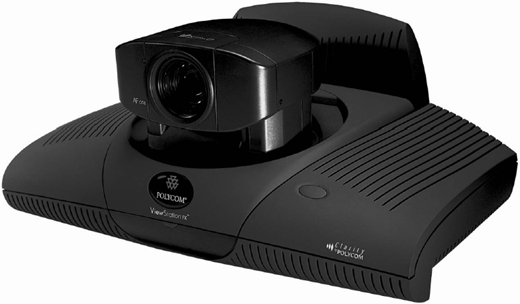
The i2i Network has deployed more than 250 Polycom ViewStation® videoconferencing systems at court reporting and law firms throughout the United States. Lawyers go to an i2i Network location and via videoconferencing handle depositions, expert consultations, judicial hearings, settlement conferences, co-counsel strategy sessions, partner and board meetings, staff development, and job interviews. For instance:
In New York, an attorney and his co-counsel were preparing for their opening statement in an important case on Long Island regarding a pediatric brain injured patient. With jury selection winding down, they needed to clarify a critical detail involving a CAT scan for the next morning’s opening argument, but they did not have time to travel to consult with their expert, a leading pediatric neuroradiologist in Philadelphia. Using Polycom technology and the i2i Network, the attorneys convened in their New York office to consult with the doctor by video conference and were able to see the exact detail to which the doctor was referring on the exhibit. Armed with this critical knowledge, the team was able to make their argument the following morning.
In Seattle, an attorney was relying heavily on a geographically distant expert witness for his case. Some of the buildings in the Seattle court system had videoconferencing capabilities installed, but he was scheduled in a room that did not. The attorney considered flying his expert in to testify or paying for a satellite truck to beam the expert into court, which would have cost tens of thousands of dollars each day of testimony. By connecting his firm’s Polycom system to the court’s IP network, his expert could testify remotely at a fraction of the cost of flying him in or bringing in a satellite truck.
In New York, all of the supreme courts in the state now have videoconferencing. Lawyers use the court system’s network and an i2i Network hub to connect to any videoconferencing center in the world, and the civil division of the Supreme Court has a Polycom system available for any attorney’s use, saving legal professionals time and money for many different uses.
Nationally, videoconferencing via the i2i Legal Network is aiding attorneys in mass tort suits, such as those involving diet drugs, tobacco, or asbestos litigation. Such cases often involve numerous attorneys spread out nationally or even globally. Co-counsel collaborate via videoconferencing, eliminating complicated scheduling issues and massive travel costs.
With videoconferencing, even interested parties who may not be able to attend every meeting in a case can stay abreast of developments via a videotape recording of the meeting. By using a standard VCR to record the meeting, attorneys can share the tape with experts, clients, or with other lawyers in their office. They can even play back videotapes of previous meetings, witness testimony, or “day in the life” videos for review.
Goldman believes that as more attorneys are exposed to videoconferencing, many are deciding to bring it in-house at their own firms. For attorneys who travel frequently, videoconferencing has become an indispensable and competitive business tool. Videoconferencing also provides an effective way to connect with clients with whom they would usually only be able to catch up with by phone. In today’s competitive environment, this provides a valuable client development and retention tool. Law firm customers report that the cost of implementing a videoconferencing solution is quickly recouped through client retention and reduction in travel expenses.