MENTORSHIP FOR GIFTED AND TALENTED STUDENTS
One of the most valuable experiences a gifted and talented student can have is exposure to a mentor who is willing to share personal values, a particular interest, time, talents, and skills. When the experience is properly structured, and the mentor is a good match for the student, the relationship can provide both mentor and student with encouragement, inspiration, new insights, and other personal rewards. The idea of mentoring is as old as mankind. The term mentor does not imply an internship, an apprenticeship, or a casual hit-or-miss relationship in which the student simply spends time in the presence of an adult and information is transmitted. A mentorship is rather a dynamic, shared relationship in which values, attitudes, passions, and traditions are passed from one person to another and internalized. Its purpose is to transform lives.
Research and case studies focusing on mentors and mentorship often address the effects of the mentor in terms of career advancement. The research emphasis on professional advancement and success takes priority over clarifying the basic characteristics of the relationship and its importance to gifted students (Kaufmann, Harrel, Milam, Woolverton, & Miller, 1986). Having a role model, support, and encouragement are often the most frequently found benefits. Gifted students benefit from mentors who set an example, offer intellectual stimulation, communicate excitement and joy in the learning process, and who understand them and their needs.
Traditionally, mentorship programs provide motivated gifted and talented students with an opportunity to apply inductive thinking and problem-solving skills to advanced content that is often associated with real-life situations. Mentorship activities allow gifted students the ability to investigate the complexities and interrelationships among disciplines that can only be discovered with assistance from highly knowledgeable experts. As gifted students develop their interests and talents in a chosen area of study, it is often necessary to structure learning experiences with out-of-school mentors. A true mentor relationship does not formally end. In many instances, both parties are energized by the process and continue to learn from one another, growing personally and academically. Mentor and “mentee” identify with each other, each having made an indelible imprint on the life of the other.
This case study offers a new approach by developing a mentoring program in which gifted and talented students learn to perform newly acquired educational technology skills. These new skills were taught by school district personnel from the Education Technology Services (ETS) Department, while each participating student received continuing technology support from an instructional mentor at their New River Middle School site. This unique extracurricular opportunity offered intellectual challenges to participating gifted students. This structured study, mutually agreed upon by gifted student and supervising teacher, allowed participating gifted students to individually investigate an area of high interest and to advance their knowledge in this area of interest.
Broward County Public Schools currently serve students who are gifted through the Department of Advanced Academic Programs. The mission of the Department of Advanced Academic Programs is to research, develop, coordinate, and support quality enrichment and acceleration programs and services for academically talented students, to provide leadership and support in their identification and scholastic preparation, and to offer professional development opportunities and support for educators and parents of the academically talented. Through the collaborative efforts of ETS, New River MS, and the Department of Advanced Academic Programs, this proposal offers an expansion of program options available to gifted students. This program proposal helps to facilitate their reaching the following goals:
increasing the number of students ready for success in advanced academic coursework
increasing the number of challenging programs for academically talented students
supporting the schools in building capacity to offer quality advanced academic programs
One goal of this study was to improve the academic performance of Broward County Public Schools’ gifted students through active participation in an innovative redesign of the social studies and science eighth grade curriculum. The program hopes to introduce new perspectives, information, skills, and talents to the instruction of gifted, exceptional student education (ESE) and English language learners (ELL) students. This study anticipated the development of the following additional abilities that participating students are expected to acquire at the end of the program:
increased technology literacy skills, including an appreciation for, and a hands-on knowledge of assistive technologies;
an appreciation of computer-based instruction that brings together the best technology with the best instructional practices;
the development of skills that can assist in the successful transition to post-secondary educational institutions and to the workplace;
to become self-motivated and self-directed; and
to build meaningful peer relationships and work cooperatively in group activities.
Gifted students participating in this study conducted the business of creating the digital data used by converting written text from eighth grade science and social studies textbooks to video files using both Kurzweil (2000) and Camtasia software applications. After capturing the digital text on to CDs, gifted students then edited text and zones as needed (they listened to text and corrected any word pronunciation errors captured by the text to speech software). Once the CDs had been corrected, gifted students then imported the video content onto the Archos 504, and in turn trained and mentored the participating ESE, ELL and general education students on how to use, care for, and utilize the data stored on the handheld devices. The gifted students’ role in this study began in November 2006 and will continue throughout the remainder of the 2006-2007 school year.
ESE/ELL STUDENT PARTICIPATION
The 2004 reauthorization of the Individuals with Disabilities Education Act (Public Law 108-466) requires the use of assistive technology (AT) services to be considered for every child when developing their individualized education program (Day & Huefner, 2003). Students with emotional/behavioral disorders display:
a lack of ability to learn that is not due to intellectual, sensory, or heath concerns;
an inability to maintain appropriate relationships with peers and teachers;
actions inappropriate under normal situations;
feelings of depression or unhappiness; and
physical fears connected to school or personal issues (Edyburn, 2000).
Students with learning disabilities have normal IQs, but have one or more disorders in the psychological processes of using or comprehending language, spoken or written, that manifest in processing deficits with listening, thinking, speaking, reading, writing, spelling or their ability to perform mathematical calculations (Edyburn, 2000). These subgroups account for 71% of the student population receiving special education services (Eggen & Kauchak, 1994). Many of these students are also identified as ELL. As many as 8 of 10 students with learning disabilities cannot read and comprehend grade-level material (Hasselbring & Bausch, 2006). Additionally, both ESE and ELL students demonstrate similar weaknesses in reading comprehension and reading fluency and benefit from similar teaching strategies (Bryant, Linan-Thompson, Ugel, Hamff, & Hougen, 2001). In fact, 12% of students labeled as ELL could be placed into ESE services (Minow, 2001). Today’s general education classroom has both ESE and ELL students included in the learning environment, which has teachers instructing many different reading abilities at one time. Using educational technology is one way to address the different reading levels within one classroom environment.
Bimodal presentation of content involves visual and auditory channels receiving sensory inputs from the environment simultaneously. Case studies of students with below average reading skills have reported that using bimodal presentation of student texts has increased reading comprehension and fluency (Elkind, 1998; Hecker, Burns, Elkind, Elkind, & Katz, 2002; Montali & Lewandowski, 1996). These same case studies report that students indicated less fatigue when reading and demonstrated increases in completion of assignments. Additionally, studies conducted with learning-disabled students which provided assessment tests in reading math questions orally, documented an increase in student’s scores (Fuchs, Fuchs, Eaton, Hamlett, & Karns, 2002; Tindal, Heath, Hollenbeck, Almond, & Harniss, 1998).
Bimodal presentation is built from Vygotsky’s theory of the zone of proximal development, Baddeley’s theory of working memory, Mayer’s principles of multimedia learning, and Mayer’s cognitive theory of multimedia learning. The zone of proximal development is the phase in the students’ learning where they would benefit from assistance, whereas without this help, they would be incapable of doing the requested work (Vygotsky, 1978). The theory directly relates to this case study, as both the ESE and ELL students have an inability to independently comprehend the grade level curriculum without the use of assistive technology. The assistive technology provides the assistance to the ESE and ELL students at their zone of proximal development. In this regard, assistive technology takes on the role of the intelligent tutor.
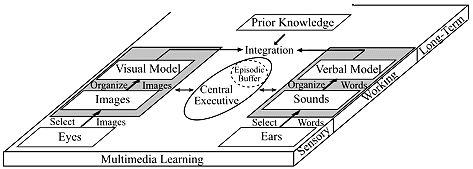
The working memory of the ESE and ELL students also need to be examined, as it to can affect comprehension of the text. The reading abilities of disabled students have a general working memory deficit related to the language and the numerical domain (de Jong, 1998). Disabled students have a general failure for the simultaneous processing and storage of verbal information (phonological loop). Additionally, ESE students who were administered the Working Memory Test Battery for Children showed that in the area of language, the students’ mean standard scores for both the central executive and phonological loop was 83, with a score of 100 as the norm (Pickering & Gathercole, 2004). In the area of language, it is important to note that in both studies the students with special needs performed poorly on the phonological loop portion of working memory that could be addressed through bimodal text presentation. Bimodal educational delivery (see Figure 1) includes both Mayer’s principles of multimedia learning and Mayer’s cognitive theory of multimedia learning.
APPLICATION IN THIS CASE STUDY
This case study extended the traditional notion of mentoring (adult to student). The study included gifted and talented students utilizing their newly acquired technology skills learned in their adult-student mentor relationships, by incorporating them into new mentoring relationships (student to student) with exceptional students with learning disabilities (ESE) and English language learners (ELL). This study trained each gifted student as an action researcher, by giving them the skills to become the technology and curriculum mentor to three participating students who have been classified as either ESE or ELL. Each gifted student received intensive technology training from ETS technology personnel, and was subsequently supported by on-site school personnel on the techniques used to capture, transfer, and store the eighth grade social studies and science curriculum on to the Archos 504 digital video recorder (DVR). On-site school personnel also assisted the gifted students to develop the essential peer mentorship skills needed to successfully interact with their ESE and ELL mentees. As such, gifted students became part of the research and development team to determine and examine the effects on student achievement as a result of using the Archos model 504 as a handheld assistive technology tool to digitally deliver the eighth grade social studies and science textbooks and workbooks in a bimodal presentation.
Gifted students were trained how to convert written content into video content that can orally read and highlight the written word for the ESE and ELL student. They learned how to use Camtasia, a software application video screen capturing tool, in conjunction with Kurzweil 3000, a text to speech reading software that created the videos used in this study. They then learned how to import the content into the Archos 504 handheld at various reading rates. They were trained how to determine the appropriate reading rate that would be most beneficial for use by their selected mentees. The school district’s Peer Counseling course objectives and strategies were used in training gifted students on mentoring techniques.
RESEARCH AND SUGGESTED ACTIVITIES BASED ON THE RESEARCH
READING RATES AND TEXT TO SPEECH READERS
This case study examined the effects of using the Archos model 504 handheld as an intelligent mobile assistive technology tutoring tool delivering eighth grade Social Studies and Science content by using videos that orally read and visually highlight the written word to the student. Participating gifted students from New River MS were trained to use Camtasia, a video screen capturing tool, used simultaneously with Kurzweil 3000 text to speech reading software to create videos that were imported into the Archos 504. Gifted students were trained by the technology staff at Education Technology Services (ETS) of Broward County Public Schools, and further supported by individual curriculum/technology personnel at New River Middle School. Gifted students were mentored through the entire process of digitizing the content and importing the content onto the handheld devices, in addition to learning the appropriate strategies and techniques to be successful peer mentors to ESE and ELL students.
Assistive Technology helps ESE and ELL students develop independent knowledge skills by allowing them to interact within the curriculum (Rapp, 2005). Through the use of bimodal (seeing and hearing) instruction, it is expected that the ESE and ELL students will increase their reading comprehension and fluency, increase their completion of assignments, and have less fatigue when reading. Student perspectives measuring the success of this project proposal were captured through ongoing student reflections housed on a Web log (blog) created specifically for this project. Ongoing peer-to-peer mentorship can be delivered and its quality can be measured by using a teacher-created and -monitored blog. As such, this project proposal reflects curriculum design modifications and instructional strategies that demonstrate authentic tasks, student reflection, and student products.
Research conducted by the gifted student participants in this study found that the average reading rate of an eighth grade student is 200 words per minute (wpm); however, readers adjust their reading rate depending on the content of the reading activity (Mather & Goldstein, 2001). A 3-year longitudinal study of learning disabled middle school students revealed a fluency pretest score range of 4 to 100 words per minute (Mercer, Campbell, Miller, Mercer, & Lane, 2000). A slow conversational oral reading style is 120-160 wpm (Beattie & Rose, 1986). Based on these studies, gifted student participants were trained to create text to speech videos at a rate of 125 wpm.
Gifted student participants also identified that text to speech readers do not have the same qualities of voices for all the software available, but generally the male voices were found to have better quality (Stevens, Lees, Vonwiller, & Burnham, 2005). Regardless of what software one uses as a text to speech reader, the listener is faced with a synthetic voice that does not replicate the tonality of a natural voice and a properly chosen voice could influence the learning of the listener (Lee, Nass, & Brave, 2000). For this reason, gifted students were exposed to a variety of synthetic voices and trained to use the Kurzweil text to speech reader as the software application offering the highest quality male and female voices.
MAYER’S EIGHT PRINCIPLES OF MULTIMEDIA LEARNING
Creating digital content to be uploaded onto handheld digital video recorders aligns with Mayer’s (2005) eight principles of multimedia learning:
multimedia principle: deeper learning occurs when pictures are presented with words than with words alone;
contiguity principle: deeper learning occurs when pictures and words are shown at the same time;
coherence principle: deeper learning occurs when unnecessary words, sounds, and pictures are left out of the presentation;
modality principle: deeper learning occurs when words are read orally instead of being shown on the screen;
redundancy principle: deeper learning occurs with animation and narration being presented on the screen at the same time;
personalization principle: deeper learning occurs when words are presented in an informal style;
interactivity principle: deeper learning occurs when the learner has the ability to control the pace of the presentation; and
signaling principle: deeper learning occurs when important facts are signaled to the learner.
Gifted students were exposed to these principles as part of the mentoring process with their ETS trainers and the support personnel at the school site. As part of their reflection activities, gifted student mentors monitored the academic success of their three ESE/ELL student mentees and added or adjusted video content stored on the Archos 504 handheld according to the needs of their mentees. Gifted students were trained how to use Unitedstreaming, the districtwide video content provider licensed by the school district. Students searched, found, downloaded, and finally uploaded streaming content to the Archos 504 that aligned with the diagnosed individual needs of their mentees. In addition, gifted students were trained on using video editing tools. PC users were trained to use Movie Maker. Mac users were trained to use either iMovie or Final Cut Pro. With these additional technological skills, participating gifted students were able to learn how to individualize instruction by accessing and creating content that they felt were beneficial to their individual ESE/ELL student mentees. In this aspect, gifted students became action researchers, by first identifying individual student needs and then by determining content and strategies that could be used to address those needs. By monitoring their mentees’ success, students gathered data that was useful in determining whether or not their instructional strategies resulted in increased student achievement.
THE TECHNOLOGY ACCEPTANCE MODEL
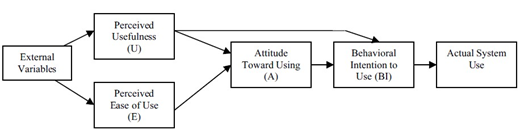
The Technology Acceptance Model (TAM) was constructed to rate users’ intentions of using the information technology available, and postulates students’ intention of using the assistive technologies (Davis, Bagozzi, & Warshaw, 1989). The TAM claims that the user’s perceived usefulness and ease of use as measured by questionnaires, directly relates to use of the technology being introduced (Davis et al., 1989). Bandura’s (1993) theory of self-efficacy which states that students perform at their perceived abilities is reflected in the TAM’s measure of perceived ease of use and usefulness. Past research has shown that 35% of purchased assistive technology devices are not used by the learner (Dawe, 2006). During one-to-one interviews with teachers, parents, and students using assistive technology, the following was noted as key points about their assistive technology experiences: portability of the assistive technology, social appropriateness of the assistive technology, and the ability of the technology to grow with the learner. The following diagram details these aspects.
Relating the diagram to this case study, the external variables are the videos in the handheld devices, box U represents the ESE and ELL students’ perceptions of success with using the AT, box E represents the ESE and ELL students’ perceptions that AT will have ease of use, box A represents the ESE and ELL students’ overall attitude towards AT, and box BI represents the ESE and ELL students’ intentions to use the AT. By incorporating peer-to-peer mentorship between gifted students and ESE/ELL students in this project proposal, it is anticipated that U, E, A, and BI can be raised to a high level such that there is actual system usage of the handheld device, thereby enabling greater student achievement through such use.
MEASURABLE OBJECTIVES
Some measurable objectives of this case study were a direct result of the significant gaps in the research literature regarding assistive technology use. Research studies that used the Kurzweil 3000 were limited to a desktop computer. There are no known studies of a text to speech reader capturing videos that are then made portable for the learner in a handheld device (Elkind, 1998; Hecker et al., 2002). This case study sought to collect data on student success using Kurzweil software in this fashion.
Furthermore, previous studies have allowed users to select their reading rate but did not definitively report what listening rate is best for the ESE or ELL population, as their individual reading rates vary (Elkind, 1998, Hecker et al., 2002, Beattie & Rose, 1986, Mercer et al., 2000). This case study sought to determine the best listening rate for ESE and ELL students. Additionally, male voices have been found to have a better quality in text to speech software (Stevens et al., 2005). However, since there are continually new advances made in technology, this needs to be evaluated. This case study sought to determine which gender voice had the best success rate. Mayer (2005) has conducted numerous case studies involving the multimedia principle. An objective of this study was to determine whether this project reproduces his findings. Finally, the TAM has been applied to studies involving e-mail and desktop applications such as Word Perfect, Lotus 123, and Chart Master (Adams et al., 1995, Davis, 1989, Davis et al., 1989). However, it has not been used for handhelds with eighth grade middle school students using a text to speech reader as an assistive technology tool. By using peer-to-peer mentorship as an integral part of this case study, the collaboration team seeks to determine whether or not such relationships can increase the perceived usefulness, perceived ease of use, attitudes towards using, and the behavioral intentions to use assistive technology such that there is an increase in actual system use.
To address the gaps and variables identified in the research, the following question was posed: What are the benefits that can be derived from using a bimodal text presentation enabled by the use of handheld assistive technology devices to the ELL, ESE, gifted and general education students?
QUANTITATIVE:
How do pre/post informal (ORT Fluency and SRI) test scores of fluency and reading comprehension and formal test scores of the Benchmark Assessment Tests (BAT) compare for ELL, ESE, and general education students before and after usage of handheld assistive technology?
How does completion of assignments and fatigue of reading for ELL, ESE, and general education students compare before and after using handheld assistive technology?
QUALITATIVE:
How do the general education, ESE, and ELL students feel about their interaction with the multimedia principles of contiguity, redundancy, interactivity, and signaling that is embedded in the use of handheld assistive technology?
How do the general education, ESE, and ELL students feel about their interaction with the synthetic male and female voices in the text to speech reader?
How do the general education, ESE and ELL students feel about the reading rate provided in the videos of the handheld assistive technology?
What impact is identified by the general education, ESE, and ELL students as a direct result of the peer-to-peer mentorship given to them by the gifted students in this case study?
What impact to their academic growth is identified by the participating gifted students as a direct result of their mentor relationships with district technology staff and school-based support staff?
What impact to their academic and social growth is identified by the participating students as a direct result of the peer-to-peer mentorship provided in this case study?
EVALUATION
The quantitative data collected from this case study were obtained from the district’s Benchmark Achievement Tests (BAT) because these mini-assessments are excellent predictors for student success on the statewide assessment test (FCAT). Quantitative and qualitative data were also collected informally, based on classroom assignments, homework, and daily student engagement in classroom activities. Student and parent surveys were given to assess: the frequency of handheld use by students, the enjoyment of using the handheld, the significance of using the handheld as it relates to student efficacy and increased student achievement, and the study’s effect on the gifted student participants as it relates to intellectual, social, and educational gains derived from both sides of the mentorship process (being both a mentor to peers, and a mentee with district instructional and technology staff).
Prior to using the Archos 504 digital video recorders, students were administered a fluency test, a reading comprehension test, and a BAT to determine a baseline of their reading skills. After one semester of using the AT, the students will then receive the same battery of tests to offer a comparison between their pre/post test scores. A modified version of the TAM questionnaire was be constructed and modified to fit the parameters of this study. The questionnaire was administered to the ESE and ELL students, their parents, and their teachers prior to and after the completion of the project. Data analysis on the responses to the questionnaire pre- and post-project will offer information on students’ perceived usefulness and ease of use regarding the handheld devices to determine whether this technology increases student self-efficacy.
Additionally, prior to receipt of the handheld, each student was administered a survey utilizing a rating scale to determine their perception of themselves in regard to certain criteria relating to their ability to complete school assignments and their fatigue level while reading. Within the same survey, the students rated their satisfaction with the male/female voices and the reading rate of the bimodal videos. In addition, because Mayer’s multimedia principles of contiguity, redundancy, interactivity, and the signaling principles are embedded in the use of the assistive technology, a rating scale was constructed to measure the students’ perceptions of these principles post-use of the AT.
A separate survey was constructed and administered to the participating gifted students to determine the benefits derived from the mentorship between gifted students and the participating ESE, ELL, and general education students. This survey sought to determine the types of relationships that were forged and how peer mentorship enhanced or detracted from social skills and learning gains. Through collaboration with the Department of Advanced Academic Programs and our district’s Research and Evaluation Department, valid surveys and rating scales will be constructed, and data analysis will be conducted to determine if there were any correlations between the use of the Archos 504 handheld devices and participating student achievement.
A Web log (blog) was created for students, teachers, and parents to communicate their thoughts and opinions on the use of handheld devices as assistive technology intelligent tutoring devices, and to monitor their impact on student learning and achievement. Included on this blog site were discussions on mentorship from both the perspective of the gifted student, and the ESE and ELL students. Blogging used as an instructional strategy usually encourages students to blog as well. Blogging welcomes parents into the classroom by facilitating active at-home participation in the child’s educational experiences at school. Blogging provides time for students to develop information and communication technology (ICT) skills that are necessary for twenty-first century schooling and workforce.
The case study is presently in progress with an anticipated end date of May 2008. At that time, additional data will be analyzed to determine the answers to the questions posed.
SUPPORT FOR STRATEGIC IMPERATIVES
This case study addresses the State’s reading initiative of Just Read, Florida! By giving ESE and ELL students the bimodal ability to see and hear text, this study hopes to inspire the love of reading in struggling students. This aligns with the statewide goal that all Florida students are able to read at or above grade level by the year 2012. By using assistive technology and mentorship relationships in this study, we hope to demonstrate reading gains for all participating students.
Using blogs to express and communicate students’ thoughts regarding this project proposal enabled participation in the project’s processes and offers a platform for publishing and copublishing content, not merely finding and accessing it. Research indicates that teachers whose students blog within the context of lessons, improved writing and dramatically improved attitudes toward learning, classrooms, and schools.
The project proposal also incorporated one of the Florida State Board of Education (SBE) Strategic Imperatives. This is strategic imperative #3, to improve student rates of learning, thereby allowing for every student to be proficient on grade level in reading, writing, and mathematics. This case study focused on the reading content area by using the assistive technology handheld devices, and the writing content area by using blogs.
DISSEMINATION PLAN FOR ECONOMY OF SCALE
Several methods/strategies were used to disseminate and market information about the case study to other educators and appropriate population. They include:
A recording to be created by the instructional leader and ETS staff using Tandberg videoconferencing equipment capabilities to deliver an explanation of the study’s design, objectives, processes, as well as demonstrating all technology tools used in the project.
This recording was burned as DVDs for distribution to other interested schools throughout the district.
This recording was be uploaded to the district’s Unitedstreaming video content server for access by any Broward County Public School personnel using their login and password information.
A demonstration of the handheld assistive device and the projected educational gains from the project will be delivered by the collaborative group (New River MS, ESE Department, Department of Advanced Academic Program, ETS) to school board members at a school board retreat at the end of the study.
This project proposal is scalable within both the initial test site (New River MS) and to other schools throughout the district. Scheduled professional development and student training can be delivered through both the ESE Department and ETS using districtwide videoconferencing and collaborative services.
About the authors