Introduction
What do quizzes, gamification, infographics, and videos all have in common? They can all be prepared in bite-sized chunks of information. Such forms of multimedia capitalize on presenting information in short segments of information. Furthermore, with media platforms such as Twitter, Facebook, and Instagram so heavily accessed, many people are becoming more readily accustomed to receiving and processing small chunks of information. Microlearning, lauded as one of the fastest growing online learning trends for 2018, also captures student attention by sharing short bursts of information to more readily engage learners (Anand, 2018). Microlearning focuses on one learning concept at a time and presents bite-sized bits information meant to be consumed in a short period of time through a technology-based medium. The format microlearning takes will vary situationally according to learner content and the instructor’s choice in tech tools, but it often surfaces in the form of short videos, tutorials, games, podcasts, graphics, or quizzes.
The reasons microlearning works are rich and varied, starting with the idea that processing bite-sized bits of content may increase information retention by 20% (Giurgiu, 2017). In addition to reducing cognitive load, microlearning also is largely beneficial because of its accessibility as it is most often technology-based and therefore available on any smartphone, tablet, or computer (Perry, 2017). In fact, the inherent mobility of microlearning increases the likelihood of students engaging in the learning activity due to its ease in accessibility (Dingler et al., 2017). Finally, microlearning has been found to increase conceptual understanding while also being the stimulus for intrapersonal growth by enhancing student self-expression and providing more meaningful opportunities for social interaction among students (Brebera, 2017). Clearly, the many advantages offered through microlearning can benefit students in mixed and worthwhile ways.
Presenting Bite-Sized Learning
The creation of a microlearning activity should foremost focus on one learning concept at a time. To put this into context, present theories of instructional design note that the micro level of instructional design reflects the construction of a single lesson, the meso level depicts the course objective, and the macro level of design reflects the program or school curriculum (Kerres, 2007). To illustrate, consider how a microlesson on thesis statements contributes to the meso and macro levels of instructional design (see Figure 1).
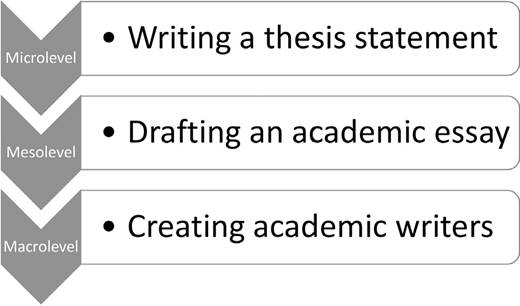
How a microlesson on thesis statements contributes to the meso and macro levels of instructional design.
How a microlesson on thesis statements contributes to the meso and macro levels of instructional design.
Furthermore, engaging the learner in a captivating way should be a primary focal point of development (Eldridge, 2017). Additionally, the presentation of the content should last only a few minutes (Giurgiu, 2017). With so many social media outlets and personal and professional obligations vying for adult students’ attention these days, it is important for instructors to capitalize on these compact and easily accessible microlearning opportunities. Such bite-sized learning opportunities are more relevant today than ever before.
Preparing Snackable Content
If implemented appropriately, microlearning can also be more financially feasible and effective for learners than traditional classes (“Microlearning FAQs,” 2018). To incorporate learning nuggets into the classroom, consider the following approaches to microlearning that can be adapted to embody such an approach to learning.
Online Quizzes
To entice learners into engaging with educational content, one format of microlearning often used is the standard quiz. Such quizzes can be developed to function as follow-up activities to assigned readings or podcasts. Likewise, the quizzes can also be easily embedded into learning activities, such as videos. Quizzes that accompany assigned readings or videos help to enhance student learning, improve the self-regulation of learning, and increase comprehension (Li, 2016). Embedding such quizzes in a no-stakes or low-stakes manner allows students to approach learning with less pressure, and in turn many students use such quizzes in multiple ways. For instance, some may take the quiz as both a pretest and posttest. Allowing students the opportunity to engage in this formative assessment helps them to selfmonitor their learning more deftly as they recognize their own strengths and weakness regarding the learning points (Maher, Latulipe, Lipford, & Rorrer, 2015). Free resources available for instructors to use for the creation of standard quizzes include Google Forms and ProProfs. Free resources for the coupling of quizzes and videos include TED-Ed and PlayPosit.
Videos
Applauded as its own trend, videobased learning is seen as a viable way to learn, and there are also multiple reasons to serve up this microsized approach to learning as well. First, video-based learning appeals to most students due to its dual-coding approach, which reaches students both in visual and audio ways. In one study, video-based education is preferred over traditional teaching approaches and proved to be more satisfying to students (Arslan, Ozden, Goktuna, & Ayik, 2018). Additionally, videos can be found to reduce course dropout rates (Brecht, 2012). Importantly, comprehension of content is improved when supplied in a video-based format rather than a textbased format (Gunawardhana & Palaniappan, 2016). Moreover, most reflective of the importance of microsizing, one source indicates that online students prefer videos to range from 3–7 minutes, whereas traditional face-to-face learners prefer even shorter video lengths, ranging from 90 seconds to 3 minutes (Buzzetto-More, 2015). As illustrated, if using videos to enhance instruction, microsizing them readily meets students’ preferences and needs. Free or low-cost sources for generating videos include Screencast-O-Matic for screencasting and Vyond for animations.
Infographics
Another way to improve a learner’s appetite for knowledge is through the easily digested format of an infographic. Infographics are graphics depicting one major learning concept in a visual way; in such a presentation, one might include charts, graphs, text, and/or images. No matter the appearance, infographics distill learning into one visual experience. Perfect for presenting microsized data, in fact, one study reports that infographics are instructive and preferred as a learning format; additionally, this foundational approach to presenting information is thought to aid in knowledge retention (Yildirim, 2017). Chunking information in a creatively appealing way engages the cognitive skills such as interpretation, explanation, analysis, conclusion, and assessment, thereby helping learners to develop the visual literacy so necessary to today’s visual culture (Damyanov & Tsankov, 2018). The benefits of infographics are both academic and aesthetic. If a picture is worth 1,000 words, how much is an infographic worth? Free resources for developing infographics include Canva or Piktochart.
Gamification
Gamification is another way to present snackable content to students. Gamification allows instructors to add game-like elements to learning tasks. In an empirical study focused on the role of gamification in education, it was found that most studies reported gamification as having great possibility as a learning approach if well designed (Dicheva, Dichev, Agre, & Angelova, 2015). While being popular for its ability to engage, gaming also provides adult learners with real-life problemsolving skills while boosting a learner’s self-awareness and interaction amidst peers (Orwoll et al., 2018). Also, gamification, as compared to traditional text-based assignments, proves to be more motivating and engaging to students as a format for learning (Garneli, Giannakos, & Chorianopoulos, 2017). Students also greatly appreciate the instantaneous feedback supplied through gamification while also noting that gamification enhanced student study habits (Alabbasi, 2017). Free resources for creating games to include in one’s classroom include Educaplay and Classtools.
Conclusion
Keeping these many benefits in mind, it should be noted that microlearning is not appropriate for every content lesson. At times, content may need to be presented in larger segments of information. Microlearning also should not replace e-learning; it should serve as a way to enhance the presentation of concepts, engage students, and reinforce content. Also, microlearning does not guarantee mastery and understanding of a topic; it only supports it.
Microlearning breathes fresh air into an online classroom. Including bite-sized bits of learning in one’s classroom is a great way to empower students and ensure better content understanding. Online quizzes, videos, infographics, and gamification all have the potential to positively impact student learning. A testament to microlearning, research notes, “As humans, we also crave instant gratification. This type of learning content is perfect to satisfy that need. It is great for satisfying short-term goals that will support your long-term goals” (Perry, 2017, p. 7). By redefining approaches to education and incorporating sound teaching approaches, such as microlearning, instructors can capitalize on their windows of teaching opportunity while whetting the appetites of their students for more engaging learning.
About the author