Educational Responsibility in the Era of AI and XR Multimodal Teaching and Learning
The use of existing and emerging technologies in teaching modalities and learning spaces provides the opportunity to present subject-area content using devices, programs, and modalities in more authentic ways that promote higher order thinking and promote longterm concept retention. In the last decade, advances in artificial intelligence (AI) have resulted in the development of augmented, mixed, and virtual reality (XR or extended reality) programs that enable end-users to interact with content in third and fourth dimensional interactive spaces that in many instances is meant to mimic human-to-human interactions. The transformation beyond traditional human-to-human or two-dimensional teaching and learning, while it has provided unique, immersive opportunities to not only deliver instructional content but also actualize student learning outcomes, has resulted in unforeseen digital side effects. The digital side effects present in the form of semantic cognitive disconnect between traditional teaching and learning as reimagined in digital environments, which can negatively impact desired student learning outcomes. Thus, the premise of this writing is to present an empirical primer using the Technological, Pedagogical, and Content Knowledge (TPACK, Mishra & Koehler, 2006) and the Johari Self-Perception Window (Luft & Ingham, 1955) as contextualized within Vygotskian (1978) object/other to self-regulation cognitive progression through the zone of proximal development (ZPD) as theorized in sociocultural theory (SCT) to explicate a student’s digital positionality and proximal perceptions when traditional teaching and learning is reimagined using AI-driven platforms. The introduction of this scaffolded primer will also be informed by the related digital literacy subset further aligned by the level of use (Hall & Loucks, 1977).
Teaching and learning methods and modalities in the 21st century continue to evolve as technologies advance and change. As such, today’s learners expect their learning environment to reflect the technologies they have adopted in their everyday lives including smart devices, apps, and wearables. Educators, then, are charged with ensuring that subject-area content is delivered using a variety of technology-infused and content-relevant instructional strategies that will keep learners engaged while ensuring learning outcomes promote higher order thinking and produce long-term content retention. As more digitally immersed learners enter colleges, schools, and universities, they expect teaching faculty and course work to reflect a digitally informed and enriched multimodal environment. Today’s learners are more digitally literate than even their counterparts a decade ago and crave interactions that more closely mirror activities in daily life (almost to a saturation point), and this is evinced by the increase in the use of AI-powered programs that allow educators to reimagine teaching content in XR spaces. This is particularly noted with the rise in use, especially in the last decade of programs specifically driven by AI that have cross-platform operability (Horizon Report, 2022). The technical skill set of the 21st-century teacher educator, then, must be responsive in kind by filtering their existing human-to-human instructional models through an established, empirically informed framework such as the Technological, Pedagogical, and Content Knowledge (TPACK) framework and Johari Window to enable the ZPD to open and self-regulation to occur to actuate salient, higher order learning outcomes. External to the educational setting, many learners are regular users of AI and XR technologies to enrich their learning experiences beyond traditional teaching and learning modalities. Therefore, if the efficacy of using AI and XR is filtered through the TPACK framework and Johari descriptors as operationalized through an SCT lens, not only will this facilitate digital and multimodal literacy competencies among teachers and learners but also provide additional scaffolded support structures to mitigate perception and proximity semantic cognitive transfer issues from negatively impacting subject-related content when it is interpreted in digital form. It is anticipated that these scaffolded progression will also facilitate LOU movement from mechanical (Level III) to integrated (Level IV/V) further enabling the end goal of self-regulation within AI-powered teaching and learning spaces.
Choosing the right technologies to match student learning outcomes in today’s digitally enriched classrooms presents educators with multiple instructional design challenges including selecting appropriate technologies to match desired student learning outcomes. As students continue to have broad access to information from a variety of web and app-based platforms, teachers are tasked with ensuring the information used to complete key assignments is authentic, especially when moving between static digital and interactive AI sources. Educators must properly vet content that has been translated among digital multimodalities to ensure content reliability and verifiability. As such, the era of end-user perception and proximity among images, audios, videos, and digital media is more prevalent than ever as numerous programs using AI can significantly alter original content to fundamentally change the semantic meaning of its original intent. Because many of these AI programs are more user-friendly and easily accessible on the internet or mobile devices in a free or relatively inexpensive app, changes in digital semantic perception have been particularly noticeable within the last decade. Accordingly, educators are now tasked with employing best practices to not only scaffold perception, but also recognize how technology infused learning environments impact how digital content is interpreted between modalities. To effectively scaffold semantic proximal perceptions, teaching methods must be informed by a research-based empirical framework or theory. In this writing, discussion of multi-layered pedagogic scaffolding will serve as the primer for using the TPACK framework aligned with Johari descriptors filtered through the scaffolded lens of Vygotskian (1978) sociocultural theory as interpreted by Lantolf and Thorne (2006). Specifically, the notions of object, other, and self-regulation aligned with TPACK subdomain dyads and Johari descriptors will be discussed as potential scaffolding techniques to mitigate semantic perception and proximity issues in AI-powered teaching and learning spaces.
Combating Perception and Proximity Digital Semantic Content Issues With Scaffolded Teaching
Canned messaging, stylized imagery, and visual manipulation of digital content are hallmarks of several image-driven industries including advertising agencies, news programs, and social media outlets. Image and text manipulation are two methods used to potentially advance a desired narrative by altering the original content’s semantic denotation. With the continued rise in use of AI programs typically associated with XR in online media and mass communication outlets to distribute content, a new type of concern has emerged among educators that digital interpretations of digital images and texts may lose meaning when moving among sources. Perception and proximity issues, then, can assume many forms, including the students’ disassociation between semantic denotation and connotation. For educators and researchers, particularly those in higher education, transfer reality issues are problematic in terms of ensuring learners are receiving accurate information to complete key assignments and achieve desired learning outcomes.
One of the hallmarks of education is access to relevant materials and resources that accurately reflect instructional content and anticipated student learning outcomes. For educators, it is of critical importance that the information learners have access to and use to complete content-related tasks is sourced from resources that accurately reflect the desired information the content is meant to convey. However, a growing trend in education is misrepresentation of otherwise factual information due to unintended (or in some instances intended) digital transfer issues among AI and non-AI platforms. Manipulating images and text between digital and nondigital modalities can result in perception and proximity semantic miscues, especially if the intentional teaching of how to mitigate miscues using specific digital literacy skills is not explicitly taught. While research in this area is still emerging, early literature suggests a noticeable multimodal, digital skill gap among both teachers and learners requiring directed mitigation framed around established empirical frameworks or theories. In the case here, these mitigations will be contextualized within the TPACK framework filtered through a sociocultural lens as semantically translated through Johari descriptors informed by digital literacy subset skills paralleling level of use.
Empirically Guided Techniques
The current ethos in teaching and learning positions the teacher and learner as subservient to institutional constraints— constraints which may be fiscal, logistical, or technical. However, in order for 21st century students to acquire the necessary skills to effectively learn in today’s highly immersive AI-powered digital teaching environments, these constraints must be lifted such that the institution does not impede students’ abilities to grow beyond what is expected to what is instructionally transformational. Accordingly, the bulk of research has primarily focused on (and accepted) teachers and learners as passive recipients of perceived roles and learning norms that are typically contextualized within human-to-human instructional settings. These roles and norms are perceived as something done to the teacher and learner rather than done with them; they ultimately become noticeably distant from the learning environment and are then viewed as instructionally “tamed” through this process (Hayes et al., 2020; Lingard et al. 2003). Teaching and learning practices that are considered as a more process-outcome linear approach is favored by most educational institutions in order to maintain the status quo of distancing the instructional relationship between teacher and student (Granjo et al., 2021; Zembylas, 2003). Teaching and learning have become almost scripted to follow idealized professional standards with no real accommodations for individual teacher and student differences especially in digital modalities. Traditional human-to-human instruction, then, is characterized by the noted cognitive distancing between teacher and learner. This distancing results in the perceptive and proximal removal of the teacher and learner from authentic instruction which can contribute to semantic disconnects.
Although much has been written about the need to harmonize teaching and learning with authentic practices, current teaching certainly reflects the opposite (Albion & Maddux, 2007; Blankenship, 2013; Rios, 2017). The lack of authentic and real-world AI practice is most likely the result of ends-oriented development standards. Colleges and universities in the United States have been characterized by their notable use of business-type, cognitively distanced instructional models. Rather than consider them as microecosystems reflective of the larger teacher and student population, a more controllable, assembly-line managerial standard is applied to control content. Albion and Maddux (2007) noted that this approach is entirely reflective of the industrial movement of the early 20th century as well as the behaviorist psychology movement of the 1950s and 1960s (Skinner, 1967). Atwell (2007) characterized this as a dysfunctional relationship between institutional expectations and cognitive development that can implicate the recognition and remediation of perceptions and proximity when teaching and learning occurs in multimodal content.
As the sociocultural and economic statuses of the United States have changed, the need for teachers and learners to change their cognitive and perceptive approaches within AI and non-AI multimodal content has necessarily changed as well. Teachers and students are more digitally engaged as technologies have changed to become more user-friendly and interactive providing alternative methods to demonstrate competencies in subject areas. This is particularly noted with the rise in use, especially in the last decade, of apps, smart phones, and social media (Prensky, 2010; Prensky, 2013). As Prensky noted, the technology-driven brain functions within a different cognitive plane resulting in the need to reimagine the relationships among teachers and learners as they interact, think, learn, and create in digital spaces, especially those powered by AI. Here, he posits a new way of demonstrating content acquisition using higher order, problem-based solutions to real-world issues which aligns with TPACK subdomains and Johari descriptors. By so doing, cognitive perceptive and proximal distancing between teachers and learners could be significantly reduced which would facilitate the type of digital-cognitive semantic recognitions needed to effectively teach and learn in multimodal spaces. This must, of course, be situated within empirical frameworks that serve as guiding principles for instructional planning.
Since 2002, the New Media Consortium has partnered with the EDUCAUSE Learning Initiative to generate an annual report highlighting what practitioners in the fields of education and technology project to be the current and anticipated technology trends that will be potentially adopted into higher education pedagogy. The Horizon Report (2022) identifies key trends and predicts the time from recognition to exploration to adoption. With each annual iteration of what is trending in educational technology, the New Media Consortium is careful to point out that, even though many trends have ultimately been adopted into and are actively used in higher education, understanding the long-term impact on teaching and learning is in its relative infancy particularly with the marked increase in the use of AI and XR multimodal platforms to deliver content and instruction. As noted in the 2022 report, AI and XR now play ubiquitous roles in terms of how and where teachers and learners choose to interact within multimodal digital learning spaces. While the technical skill set among teachers and learners is relatively competent and trends at LoU Level III, Mechanical according to Hall and Loucks (1977) Levels of Use (i.e., creating posts, commenting/liking, uploading media, wearables, and the like), there is an increasingly noticeable gap in perception and proximity among multimodal content sharing. In other words, the sharing of relevant and salient information has not kept pace with semantic accuracy. Of the six key technologies and practices identified in the report, the evolution of AI and XR are two of the driving forces behind the emergence and adoption of more interactive, multimodal teaching and learning. AI and XR have enabled content developers to use sophisticated editing software to alter, manipulate, or completely change images and video among digital media formats, some to the extent that recognizing the difference between the original and edited versions are almost indistinguishable, especially noted among the overlays used in mixed reality (MR) programs. Accordingly, as noted in the TPACK framework (Figure 1) and Johari Window (Figure 2), providing appropriate context within subdomains and descriptors has the potential of becoming a model framework to mitigate perception and proximity concerns. Thus, the two frameworks work in tandem to inform the teaching and learning components (TPACK) and the individual’s proximal perception.
 The Venn diagram displays three large circles intersecting with one another. The circles are labeled Technological Knowledge marked T K, Pedagogical Knowledge marked P K, and Content Knowledge marked C K. The intersection of the Technological Knowledge and Pedagogical Knowledge circles is labeled Technological Pedagogical Knowledge marked T P K. The intersection of the Technological Knowledge and Content Knowledge circles is labeled Technological Content Knowledge marked T C K. The intersection of the Pedagogical Knowledge and Content Knowledge circles is labeled Pedagogical Content Knowledge marked P C K. The central area where all three circles intersect is labeled Technological Pedagogical Content Knowledge marked T P A C K. The entire diagram is enclosed by a large dashed circle labeled Contexts.
The technological pedagogical and content (Context) knowledge model conceptualized by Mishra and Koehler (2006).
The Venn diagram displays three large circles intersecting with one another. The circles are labeled Technological Knowledge marked T K, Pedagogical Knowledge marked P K, and Content Knowledge marked C K. The intersection of the Technological Knowledge and Pedagogical Knowledge circles is labeled Technological Pedagogical Knowledge marked T P K. The intersection of the Technological Knowledge and Content Knowledge circles is labeled Technological Content Knowledge marked T C K. The intersection of the Pedagogical Knowledge and Content Knowledge circles is labeled Pedagogical Content Knowledge marked P C K. The central area where all three circles intersect is labeled Technological Pedagogical Content Knowledge marked T P A C K. The entire diagram is enclosed by a large dashed circle labeled Contexts.The technological pedagogical and content (Context) knowledge model conceptualized by Mishra and Koehler (2006).
 The diagram is a two by two quadrant grid. The top of the grid is marked Known to Self, and the bottom is marked Unknown to Self. The left side of the grid is marked Known to Others, and the right side is marked Unknown to Others. The upper left quadrant is labeled Open Self, and the text below it reads Information about you that both you and others know. The upper right quadrant is labeled Blind Self, with the text Information about you that you don’t know but others do know. The lower left quadrant is labeled Hidden Self, with the text Information about you that you know but others don’t know. The lower right quadrant is labeled Unknown Self, with the text Information about you that neither you nor others know.
The Johari Window of Personal Awareness as conceptualized by Luft and Ingham (1955).
The diagram is a two by two quadrant grid. The top of the grid is marked Known to Self, and the bottom is marked Unknown to Self. The left side of the grid is marked Known to Others, and the right side is marked Unknown to Others. The upper left quadrant is labeled Open Self, and the text below it reads Information about you that both you and others know. The upper right quadrant is labeled Blind Self, with the text Information about you that you don’t know but others do know. The lower left quadrant is labeled Hidden Self, with the text Information about you that you know but others don’t know. The lower right quadrant is labeled Unknown Self, with the text Information about you that neither you nor others know.The Johari Window of Personal Awareness as conceptualized by Luft and Ingham (1955).
Aligning TPACK Subdomains and Johari Descriptors to Mitigate Semantic Perception and Proximity Miscues in Multimodal AI Teaching and Learning Spaces
Understanding the connection between teaching and learning and multimodal proximity is particularly important in recognizing why semantic perception is such a prevalent concern in 21st century teaching and learning spaces. The importance of aligning one or more frameworks when planning instruction is particularly relevant for teachers when conceptualizing courses and student learning outcomes (SLOs) that include the use of existing and emerging technologies to introduce and evaluate subject-specific content. Accordingly, educators are not only charged with implementing best pedagogic practices but also ensuring learners possess skills essential to demonstrating knowledge acquisition through higher order tasks which include the ability, as Prensky (2013) opined, to analyze and evaluate content to solve authentic, real-world scenarios, many of these scenarios now which are achievable in AI-powered, XR programs. Here, educators can mitigate gaps in semantic perception by using the TPACK framework aligned with the Johari Window descriptors actuated through self-regulation (sociocultural theory as interpreted by Lantolf and Thorne, 2007) specifically aligned with key assignments and higher order student learning outcomes. In the following sections, different types of digital literacy skills are explored and paralleled to the TPACK framework/Johari descriptors to advance the construct to accommodate for AI technology changes that can increase the exposure to semantic perceptive disconnections. Here, and of most important note, equipping learners with a variety of digital resources to cross-reference the accuracy of subject-related content becomes a scaffolded essential in the teaching and learning process. As Lee (2021) asserted, scaffolding learners’ epistemic cognition while working across different virtual modalities is essential to ensure proximity and perception are not negatively impacting student learning outcomes and key assignment goals. Thus, the following sections (Figure 3) define the types of scaffolds used to support learners as they transition from object/other to self-regulation and how the scaffolds parallel the TPACK subdomains and Johari descriptors informed by digital literacy skill subset and level of use.
 The diagram presents three vertical columns, each representing a scaffold type. The first column is labeled Supported with the number 1 and contains a description that reads A series of interconnected platforms supported by rigid, load-bearing items such as poles or beams. The second column is labeled Suspended with the number 2 and contains a description that reads Supported by overhead roped support. The third column is labeled Arial with the number 3 and contains a description that reads Personal hoists or some type of vehicle or other machinery. The top of the diagram is marked Operationalizing 3 Scaffold Types.
Definitional operationalizing three different types of instructional scaffolds.
The diagram presents three vertical columns, each representing a scaffold type. The first column is labeled Supported with the number 1 and contains a description that reads A series of interconnected platforms supported by rigid, load-bearing items such as poles or beams. The second column is labeled Suspended with the number 2 and contains a description that reads Supported by overhead roped support. The third column is labeled Arial with the number 3 and contains a description that reads Personal hoists or some type of vehicle or other machinery. The top of the diagram is marked Operationalizing 3 Scaffold Types.Definitional operationalizing three different types of instructional scaffolds.
Operationalizing Scaffold Type 1—Supported Through Other Regulation, Information Digital Literacy Skill, and Level III Mechanical Use
Eshet-Alkalai (2004) defines information literacy as, “the cognitive skills that consumers use to evaluate information in an educated and effective manner” (p. 101). Since this article was published 20 years ago, the amount of information available from different digital platforms and resources has grown and changed exponentially, especially in the transfer of traditional print sources to digital formats. This growth is apparent as personal computing experienced a significant transformation from the traditional notions of a personal computer or laptop to smart phones. As end-users became more mobile, so did their ability to interact with information in an anytime/anywhere on-the-go format having 24/7 access to information. It is even more pertinent today that teachers and learners have multimodal digital literacy competencies and well-developed semantic understanding of information literacies to combat perceptive and proximal concerns. Further, Eshet-Alkalai and Amichai-Hamburger (2004) explained that those who possess the information literacy skill are ones that, “have the ability to make educated, smart information assessments” (p. 423). Here, teachers would scaffold learners using the technological content knowledge dyad as direct modeling to deepen cognitive skills to evaluate effectively the accuracy of information used to complete key assignments while actualizing student learning outcomes. Thus, learners would be considered “other-regulated,” falling under Level III, mechanical use in which the end-user experiences modality stabilization, particularly as it relates to more static types of AI programs. This other regulation is characterized in the Johari descriptors as part of the unknown self or the “blind self.” Other regulation occurs in instructional contexts when the educator knows information about the learner that is not known by the learner. In the case of supported scaffolding, this would indicate that the teacher is aware of the student’s semantic cognitive perceptive disconnect with the content when it is moved among different AI modalities, whether those modalities are static or dynamic.
 The schematic representation is a three tiered pyramid labeled Operationalizing 3 Scaffold Types, cont. The pyramid is divided horizontally into three sections. The largest bottom section is marked Supported, the middle section is marked Suspended, and the smallest top section is marked Arial. A dashed diagonal arrow is placed on the left side of the pyramid. The arrow points from the base to the top of the pyramid and is marked More to Less Cognitive Support.
Cognitive movement, that is object, other, self-regulation, among the three instructional scaffolds.
The schematic representation is a three tiered pyramid labeled Operationalizing 3 Scaffold Types, cont. The pyramid is divided horizontally into three sections. The largest bottom section is marked Supported, the middle section is marked Suspended, and the smallest top section is marked Arial. A dashed diagonal arrow is placed on the left side of the pyramid. The arrow points from the base to the top of the pyramid and is marked More to Less Cognitive Support.Cognitive movement, that is object, other, self-regulation, among the three instructional scaffolds.
A supported scaffold is considered the most rigid and stable of the three types of scaffolding (Figure 5). It is notably characterized by the teacher’s ability to stabilize the learning environment by conscious selection of AI modalities tailored to the learner’s unknown digital self (Figure 6). This infers that the teacher knows something about the learner’s semantic perceptions based on their level of use and digital literacy skills. In terms of the TPACK construct, supported scaffolds align with the technological content knowledge subdomain dyad as it explicates the cyclical movements teachers and learners experience as they work through content-related tasks using different technologies. Here, learners would be considered as “other-regulated,” as it is the teacher who guides them to the types of AI modalities that will shorten the proximal distancing between content and modality.
 The flow chart has a box on the left marked Supported, which branches into three smaller boxes. The top branch is marked T C K, which then branches to two boxes marked Information Literacy and Perceptive. The middle branch is marked Other Regulated. The bottom branch is marked L O U three, which branches to one box marked Mechanical Static Digital A R. To the right of the flow chart is a realistic illustration of a two level supported scaffold, marked with the number 1 in the bottom right corner.
Illustration of supported scaffold as it aligns with the TPACK subdomain, digital literacy skill, level of use, and type of regulation.
The flow chart has a box on the left marked Supported, which branches into three smaller boxes. The top branch is marked T C K, which then branches to two boxes marked Information Literacy and Perceptive. The middle branch is marked Other Regulated. The bottom branch is marked L O U three, which branches to one box marked Mechanical Static Digital A R. To the right of the flow chart is a realistic illustration of a two level supported scaffold, marked with the number 1 in the bottom right corner.Illustration of supported scaffold as it aligns with the TPACK subdomain, digital literacy skill, level of use, and type of regulation.
 The diagram is a four quadrant grid with a large circle encompassing the top right quadrant. The top of the grid is labeled Known to Self, and the bottom is labeled Unknown to Self. The left side of the grid is labeled Known to Others, and the right side is labeled Unknown to Others. The upper left quadrant is labeled Open Self, with text reading Information about you that both you and others know. The upper right quadrant, circled in the section, is labeled Blind Self, with the text Information about you that you don’t know but others do know. The lower left quadrant is labeled Hidden Self, with the text Information about you that you know but others don’t know. The lower right quadrant is labeled Unknown Self, with text that reads Information about you that neither you nor others know.
Johari window descriptor associated with supported, other-regulated instructional scaffolding—the blind self.
The diagram is a four quadrant grid with a large circle encompassing the top right quadrant. The top of the grid is labeled Known to Self, and the bottom is labeled Unknown to Self. The left side of the grid is labeled Known to Others, and the right side is labeled Unknown to Others. The upper left quadrant is labeled Open Self, with text reading Information about you that both you and others know. The upper right quadrant, circled in the section, is labeled Blind Self, with the text Information about you that you don’t know but others do know. The lower left quadrant is labeled Hidden Self, with the text Information about you that you know but others don’t know. The lower right quadrant is labeled Unknown Self, with text that reads Information about you that neither you nor others know.Johari window descriptor associated with supported, other-regulated instructional scaffolding—the blind self.
Scaffold Type 2—Suspended Through Object Regulation, Branching Digital Literacy Skill, and Level IV—A Routine Use
The advent and advancements in AI-powered technologies has enabled end-users to interact with content that is almost unbound by traditional two-dimensional linear thinking. Web browsers such as Google have provided search platforms which have liberated teachers and learners in their search for the most pertinent information available on a given topic. By extension, social media platforms such as Facebook, Instagram, and Twitter are additional search platforms that have gained prevalence in the late 2010s as alternatives to traditional web-based content searchers. Web browsers and social media platforms are driven by embedded AI algorithms that key on certain search terms to customize the browsing and information seeking experience. Rather than just receiving the information provided on one search engine or social media page, teachers and learners can explore (i.e., branch) many more related topics in a non-linear method through these algorithms and embedded links (Figure 7). This is further achievable through AI-powered XR where the information can be layered and interacted with either dynamically or statically depending on the modality. Such object-regulated interactions will necessarily determine the learner’s semantic perceptive experience. Eshet-Alkali (2004) explains that branching literacy provides teachers and learners with opportunities to seek knowledge through non-linear means thus challenging them to bring together information collected in a different way and between different modalities to create new thoughts and concepts about a particular subject, especially when translated among AI digital forms. Branching literacy requires teachers and learners to “step outside of the thinking box” to explore new areas of information without losing their focus on the subject matter at hand. This branching stabilizes semantic perceptions through cross-referencing among AI and non-AI digital modalities which engages the controlled stability of the supported scaffold. Accordingly, the end-user would be considered a Level IVA, routine user of these technologies as they have become routinely integrated into people’s daily interactive routines. In terms of the TPACK framework, the Technological Pedagogical Knowledge subdomain enables the teacher to explore (branch) to customize teaching modalities for both the teacher and learner to discover what is unknown to both about the learner’s semantic perceptions (Figure 8).
 The flowchart shows a box on the left labeled Suspended that branches into three smaller boxes. The top branch is labeled T P K, which then branches into two boxes labeled Branching and Proximal. The middle branch is labeled Object Regulated. The bottom branch is labeled L O U I V A, which branches to one box labeled Routine Virtual Interactive M R. To the right of the flowchart, there is a realistic illustration of a suspended scaffold with a platform hanging from overhead supports, marked with the number 2 in a black circle in the bottom right corner.
Illustration of suspended scaffold as it aligns with the TPACK subdomain, digital literacy skill, level of use, and type of regulation.
The flowchart shows a box on the left labeled Suspended that branches into three smaller boxes. The top branch is labeled T P K, which then branches into two boxes labeled Branching and Proximal. The middle branch is labeled Object Regulated. The bottom branch is labeled L O U I V A, which branches to one box labeled Routine Virtual Interactive M R. To the right of the flowchart, there is a realistic illustration of a suspended scaffold with a platform hanging from overhead supports, marked with the number 2 in a black circle in the bottom right corner.Illustration of suspended scaffold as it aligns with the TPACK subdomain, digital literacy skill, level of use, and type of regulation.
 The diagram is a four quadrant grid with a large circle encompassing the bottom right quadrant. The top of the grid is labeled Known to Self, and the bottom is labeled Unknown to Self. The left side of the grid is labeled Known to Others, and the right side is labeled Unknown to Others. The upper left quadrant is labeled Open Self, with text reading Information about you that both you and others know. The upper right quadrant is labeled Blind Self, with the text Information about you that you don’t know but others do know. The lower left quadrant is labeled Hidden Self, with the text Information about you that you know but others don’t know. The lower right quadrant, circled in the panel, is labeled Unknown Self, with text that reads Information about you that neither you nor others know.
Johari window descriptor associated with suspended, object-regulated instructional scaffolding—the unknown self.
The diagram is a four quadrant grid with a large circle encompassing the bottom right quadrant. The top of the grid is labeled Known to Self, and the bottom is labeled Unknown to Self. The left side of the grid is labeled Known to Others, and the right side is labeled Unknown to Others. The upper left quadrant is labeled Open Self, with text reading Information about you that both you and others know. The upper right quadrant is labeled Blind Self, with the text Information about you that you don’t know but others do know. The lower left quadrant is labeled Hidden Self, with the text Information about you that you know but others don’t know. The lower right quadrant, circled in the panel, is labeled Unknown Self, with text that reads Information about you that neither you nor others know.Johari window descriptor associated with suspended, object-regulated instructional scaffolding—the unknown self.
Scaffold Type 3—Arial through Self-Regulation, Photo-Visual Literacy Skill, and Level V Integrated Use
Most of the civilized world has been highly visual in teaching and learning methods, especially in print (Emanuel & Challons-Lipton, 2013). “Visual literacy is essential for 21st century learners. Across the higher education curriculum, students are being asked to use and produce images and visual media in their academic work, and they must be prepared to do so” (Hattwig et al., 2013, p. 1). End-users rely more on images to convey information or selfexpression, drawings, graphs, charts, and the like to interpret and make sense of different stimuli (Baker, 2008). These stimuli can take the form of advertisements, social media posts, web-based searches, and the like.
Similarly, reproduction literacy implicates what the end-user does with the information retrieved from photo/digital stimuli (Jones-Kavalier & Flannigan, 2006). In education, it can be problematic to use information obtained from digital sources through a critical lens as there is a creative element that can skew semantic accuracy—thus entering semantic perceptive and proximity issues (Emanuel & Challons-Lipton, 2013). Additionally, the interpretation of digital information can be indiscriminate between teacher and learner depending on how it is filtered through the TPACK framework (Head & Eisenberg, 2011). Here, the pedagogical content knowledge subdomain provides the structure around which teachers can use their preexisting pedagogic knowledge to present content to enable learners to understand how digital content is translated across different AI/XR modalities. Here, the learner is at their most independent, having been object and other scaffolded to understand how to use the information and branching literacy skills to self-regulate their semantic perceptions and cognitive proximities to AI digitally interpreted content. Thus, the learner is now at the “open self” stage, having reached Level V by integrating the digital literacies among different AI/XR modalities (Figure 9, Figure 10).
 The flowchart shows a box on the left labeled Arial that branches into three smaller boxes. The top branch is labeled P C K, which then branches into two boxes labeled Photovisual Reproduction and Perceptive Proximal. The middle branch is labeled Self Regulated. The bottom branch is labeled L O U V, which branches to one box labeled Integrated Immersive V R. To the right of the flowchart, there is a realistic illustration of a tall, narrow aerial scaffold with wheels at its base, marked with the number 3 in a black circle in the bottom right corner.
Illustration of arial scaffold as it aligns with the TPACK subdomain, digital literacy skill, level of use, and type of regulation.
The flowchart shows a box on the left labeled Arial that branches into three smaller boxes. The top branch is labeled P C K, which then branches into two boxes labeled Photovisual Reproduction and Perceptive Proximal. The middle branch is labeled Self Regulated. The bottom branch is labeled L O U V, which branches to one box labeled Integrated Immersive V R. To the right of the flowchart, there is a realistic illustration of a tall, narrow aerial scaffold with wheels at its base, marked with the number 3 in a black circle in the bottom right corner.Illustration of arial scaffold as it aligns with the TPACK subdomain, digital literacy skill, level of use, and type of regulation.
 The diagram is a four quadrant grid with a large circle encompassing the top left quadrant. The top of the grid is labeled Known to Self, and the bottom is labeled Unknown to Self. The left side of the grid is labeled Known to Others, and the right side is labeled Unknown to Others. The upper left quadrant, circled in the image, is labeled Open Self, with text reading Information about you that both you and others know. The upper right quadrant is labeled Blind Self, with the text Information about you that you don’t know but others do know. The lower left quadrant is labeled Hidden Self, with the text Information about you that you know but others don’t know. The lower right quadrant is labeled Unknown Self, with text that reads Information about you that neither you nor others know.
Johari window descriptor associated with ariel, self-regulated instructional scaffolding—the open self.
The diagram is a four quadrant grid with a large circle encompassing the top left quadrant. The top of the grid is labeled Known to Self, and the bottom is labeled Unknown to Self. The left side of the grid is labeled Known to Others, and the right side is labeled Unknown to Others. The upper left quadrant, circled in the image, is labeled Open Self, with text reading Information about you that both you and others know. The upper right quadrant is labeled Blind Self, with the text Information about you that you don’t know but others do know. The lower left quadrant is labeled Hidden Self, with the text Information about you that you know but others don’t know. The lower right quadrant is labeled Unknown Self, with text that reads Information about you that neither you nor others know.Johari window descriptor associated with ariel, self-regulated instructional scaffolding—the open self.
Scaffolded Self-Regulated Model to Mitigate Perception and Proximity in Teaching and Learning—A Proposal to Reform Existing Digital Teaching and Learning Best Practices
Here, a new model to mitigate perception and proximity concerns when content is translated into different AI-powered XR digital modalities emerges in teaching and learning around the existing TPACK framework and is proffered using three types of scaffolding techniques. This enhanced scaffolded TPACK model was conceptualized around the Vygotskian (1978) recognition of cognitive processes that can lead to higher order self-regulation. Vygotsky suggested that learners possess an internal self-regulatory cognitive control that, through scaffolded instruction between a master (teacher) and novice (learner), can be opened to allow for selfregulation over their learning. Denoted the ZPD, the technique is conceptualized in terms of what a learner can do with the assistance of another person, what the learner can do with assistance from some object such as a mobile app or textbook, and what the learner can do unassisted. Lantolf and Thorne (2006, 2007) took Vygotsky’s concept, branding it as the cognitive processes of “other,” “object,” and “self” regulation. The ultimate goal among teachers and learners is for the learner to achieve self-regulation to engage in higher order activities with subject-specific content, such as performing more complex cognitive processes, such as evaluating and creating around a particular concept. For this type of scaffolding to occur, especially in digitally rich learning AI and XR environments, teachers must employ instructional best practices guided by a research-driven best practices pedagogic framework. In the case here, the TPACK framework was selected as the focus, aligned explicitly on the LoU scale.
As noted previously, while the TPACK framework can be used to guide teachers and learners through the iterative, semantic perceptive contextual interplay among content, learning, and technology knowledge informed by specific digital literacy skills, what tends to be missing from the narrative is which scaffolded techniques will lead to learner self-regulation. Here, three (3) cognitive and instructional scaffolds are used to support the TPACK domains and subdomains such that the learner’s ZPD can fully open and self-regulation within a subject area can be actualized at higher order cognitive levels. In common construction, different types of scaffolds are used to support structures as they are being built. Each scaffold serves a distinct purpose, aligned directly with the type of building or structure under construction. These scaffolds include the following: (1) supported scaffold; (2) suspended scaffold; and (3) arial or mobile scaffold. A supported scaffold typically consists of interconnected platforms supported by rigid, load-bearing items such as poles or beams. A suspended scaffold is supported by overhead roped support. Arial or mobile scaffolds are characterized by personal hoists or some vehicle or other machinery. Here, the three TPACK subdomains can be reconceptualized around the scaffold types and levels of use and the Johari descriptors to reframe the original framework to include teaching discrete higher order, self-regulated digital literacy skills to mitigate perception and proximity issues when teaching among different AI modalities. Accordingly, each scaffold type would mirror a point of cognitively regulated behavior, resulting in the the actualization of self-regulating, higher order cognitive behavior. Thus, through such self-regulation, learners will possess the necessary digital literacy skill and cognitive self-awareness to navigate semantic proximity and perception issues within digitally translated content. As such, these parallels emerge with a more distinct model to follow (Figure 11, Figure 12, Figure 13).
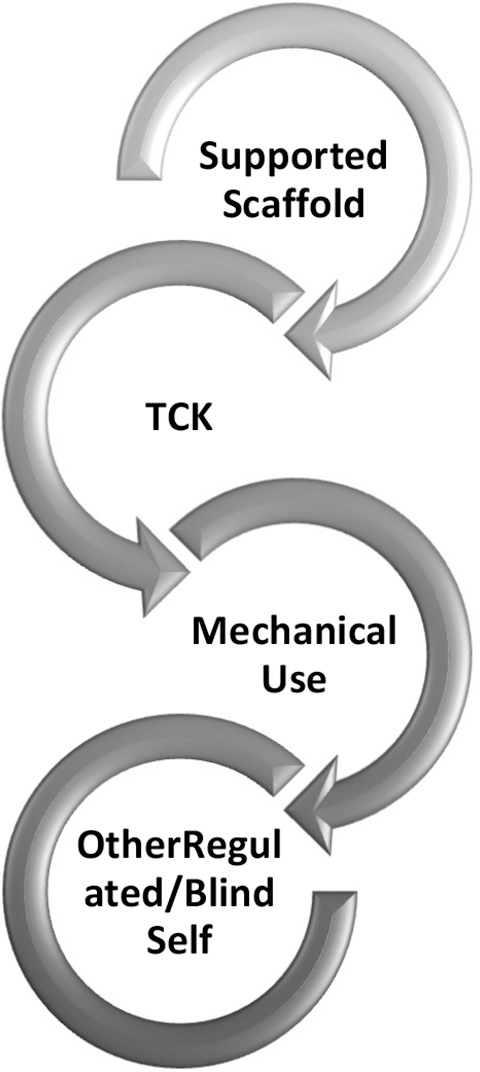
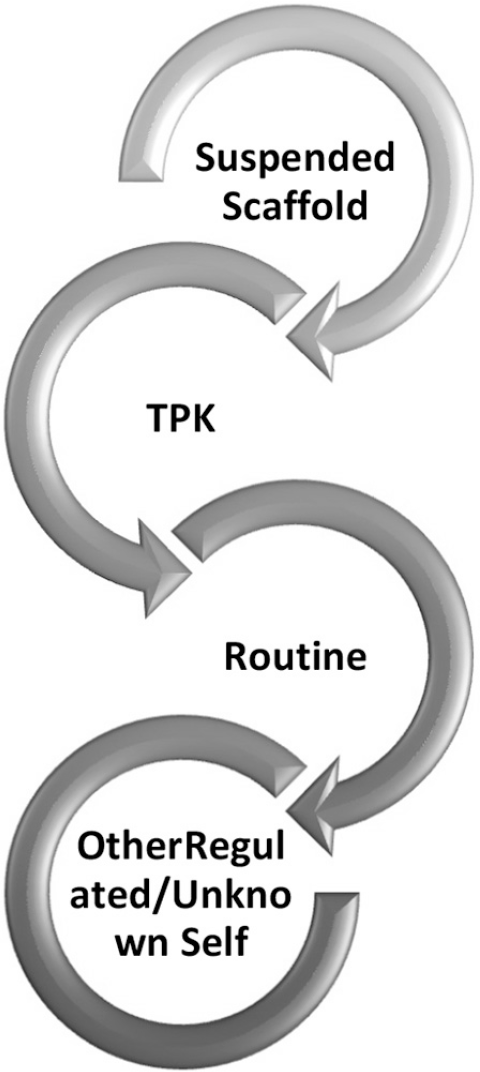
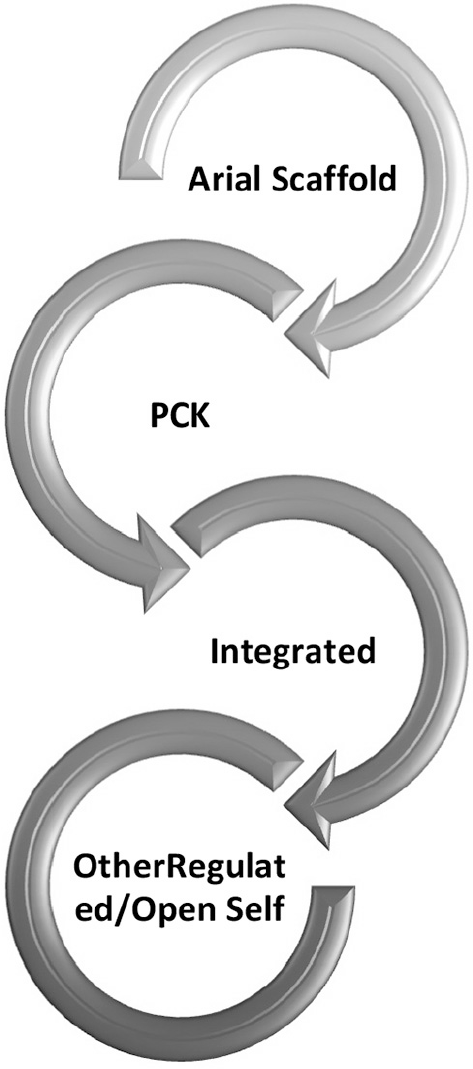
Finally, the following 10 best practice suggestions aligned with the proposed scaffolded TPACK/Johari self-regulation models act as a roadmap to facilitate teachers and learners as they navigate AI digitally sourced content to mitigate perception and proximity concerns:
Combine AI and non-AI content-specific resources.
Use a variety of AI and non-AI content-specific resources.
Refrain from saturating the learning environment with too many AI/XR digital resources.
Marry “old” and “new” digital resources to inform content.
Match higher order learning outcomes with existing technologies.
Consider the digital instructional modality—AI/XR technology may not be the best choice for the desired student learning outcome.
Identify AI/XR technology that can be paired with a specific content-based key assessment aligned with higher order student learning outcomes.
Ensure the selected technologies and resultant contentjj are secure, especially when working within meta platforms.
Align selected resources with a specific digital literacy skill or skill.
Enhance collaboration between teachers and learners to ensure clear and open communication to prevent breakdowns in the scaffolded constructs.
About the author