In online courses, much of the course communication occurs in public spaces. In synchronous courses, the video and audio channels represent a shared space, and although private chat messages are possible, they may not be substantial or frequent. In asynchronous courses, discussion boards are the allocated space for communication. In these discussion spaces, the underlying expectations are that messages are public, at least to those enrolled in the course, and focused on the learning topic. Students with personal needs must independently contact instructors via email or online office hours. Conversely, instructors may only reach out to individual students once they have concrete evidence of a problem, such as a length of time without activity or missed assignments. Instructors can leave brief messages via gradebook comments, such as, “No assignment submitted.”
This approach to course communication is mainly transactional. Instructors and students communicate about learning content in public course spaces, as prescribed by the course design. However, they only communicate about other topics—often problems—when one party feels there is sufficient reason to make an additional effort to reach out. Across these transactions, learners may experience varying levels of transactional distance, a psychological perception of the separation between instructor and learners (Moore, 1993). This transactional approach to teaching online is efficient and fulfills the teaching-learning contract’s baseline expectations. Still, it can mean that some learners experience the class with little sense of or contact with their instructor. This essay discusses how instructors can use well-timed, personalized check-in messages to shift their relationship with students from pedagogically transactional to humanized.
The Value of Check-in Messages
Check-in messages serve three critical functions by offering students an instructor-initiated personal dialogue about the course. First, check-in messages reinforce the instructor’s presence across all course elements. Online instructors perform roles in different areas (e.g., pedagogical, managerial, social, and technological; Berge, 1995; Dennen & Jones, 2022), and students may have needs or concerns in any of these areas. Check-in messages can connect to all these roles and support teaching presence beyond the facilitation and sensemaking interactions expected within the learning space (Richardson et al., 2015). For example, check-in messages allow instructors to connect with students about the course in general, its structure, and their progress within the course.
Second, check-in messages help build and support rapport between the instructor and individual students. Instructor communication supports the development of rapport, which is related to a lesser sense of loneliness (Kaufmann & Vallade, 2020) and higher participation levels (Frisby & Martin, 2010) in online courses. While establishing rapport at the start of the class is important, rapport continues to develop throughout the term (Flanigan et al., 2022). Check-in messages can be inserted into the middle of a term, allowing students to interact with instructors outside a discussion forum or synchronous session. Private communication can help engage students who struggle to communicate in online classes (Tang et al., 2021) but may require instructor initiation.
Third, check-in messages provide a non-confrontational opportunity for instructors to communicate with students whose course performance is concerning in some way. Check-in messages are not connected to a particular assignment or activity and are sent to all students simultaneously. Through a general discussion of the instructor’s perspective (e.g., what is working well in the class and what they want to see next), instructors may nudge students toward optimal behaviors. Nudging can occur by providing students with information against which they may benchmark their performance and make adjustments (Weijers et al., 2020). Private communication that shares the instructor’s perspective on the course serves as what Guzzardo and colleagues (2020) call “doing more than teaching,” (p. 51) which can motivate learners.
Planning and Executing a Check-in
Sending a personalized email to each student in a class may sound like a lot of work, but it takes surprisingly little time. For a class of 30, the entire task can be completed in under an hour. Moreover, many email tools allow users to schedule their messages so instructors can craft check-in messages to be sent periodically throughout their course term. For each additional student, the time needed to personalize and send a message is under a minute. To ensure an efficient process, start with a plan for timing, tone, and implementation, and use an outline to build a template for the personalized message.
Timing
Check-in messages are best sent to students once a class is well underway. If sent too early, there is little to communicate about. If sent too late, there is little opportunity for follow-up. Instructors can use check-in messages to punctuate a course at the halfway point. Alternatively, instructors might time check-in messages to coincide with a moment when students would benefit from interpersonal contact, encouragement, or a nudge, such as before an assignment is due or during a challenging unit.
Tone
Instructor tone influences how students perceive and perform in a class (Dickenson, 2017; Harnish & Bridges, 2011). The tone of check-in messages should be open and optimistic, inviting further communication. By being open, an instructor signals that they are willing to further dialogue with the students about the class and to hear about problems or things that are not working well. Optimism indicates that the situation can improve even if the course has not gone as planned or the student has struggled. Overall, the tone should communicate that a human being is at the helm, and they are willing to help.
Template
A check-in message can follow a predetermined outline, and a template message drafted from that outline will facilitate communication with each student. A lightly personalized version suffices for most students, addressing the student by name. As detailed in the next section, a few students may benefit from a slightly adjusted version. Once a template message has been drafted, it can be reused in subsequent terms with minor updating. Figure 1 is an example of a typical check-in message outline:
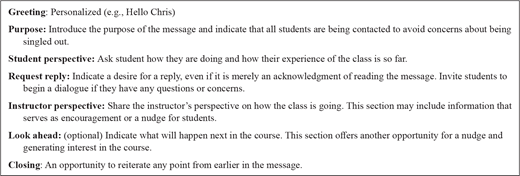
In the template message, none of these sections must be more than a few sentences long. The overarching goal of the message is simply to open a dialogue with students where needed.
Implementation and Follow-Up
Before sending out check-in messages, generate a roster of student names. Highlight the names of students for whom you might personalize the message before sending it. Reasons for additional personalization include:
Affirming a recent conversation. The personalization may read something like this, appended to the opening of the message: I know we just corresponded earlier this week, and I have a good sense of how you’re doing, but I’m sending a message to everyone in the class today and didn’t want to leave you out. Perhaps there is something else we need to discuss, and if so, you can let me know.
Addressing performance problems or absences. The personalization would go in the student perspective and request reply sections of the message and may read something like this: I’ve noticed that your participation has been waning in recent weeks. Is there anything I can do to help get you more involved and to ensure that you are learning the course material? Let’s talk.
Begin sending messages by starting with the minimally personalized ones. Send these out using the template, personalizing the name only. Check them off on the roster as you complete each one. Once those are completed, tackle the personalized ones. Keep the roster and check off students once again as they respond to the message. Most likely, students will respond simply by acknowledging that they are doing well and perhaps with appreciation for the message. However, the replies may also open dialogue with students who are performing well but feel insecure, are struggling and have given up, or have formative feedback about the class. Some of these replies may be surprising because students do not always share their experiences without being asked. Some students may not respond, and their non-response can serve as a data point for how that student is experiencing the class.
Check-in messages require extra effort on behalf of online instructors, but that small effort humanizes the student-instructor relationship in valuable ways. By investing a few hours of their time once or twice a semester, instructors can be confident that they have made explicit efforts to develop presence, establish rapport with their students, and reach students who may be quietly struggling. In turn, instructors benefit from this open exchange with students—supporting student success and receiving their compliments and helpful feedback about a class can be motivational and highly satisfying for instructors.
About the author