This article describes the development and impact of a faculty development program on improving the readiness of Indonesian educators to teach online. While online learning is seen as a potential solution to increasing access to higher education in Indonesia, most higher education faculty in Indonesia lack the necessary skills to teach online effectively. To address this need, faculty in Indonesia were recruited to participate in the “Online Teaching and Design Fellowship”—a faculty development program aimed at supporting instructors in designing high-quality, inclusive online courses. The design of the program was guided by the Community of Inquiry (Garrison et al., 2000) and Humanizing Online Learning (Pacansky-Brock et al., 2020) frameworks and included five modules focusing on foundational online teaching, course structure and design, online assessment, online engagement, and humanizing online courses. We also share some lessons learned from creating these modules.
Education is essential in helping Indonesia—the largest country in Southeast Asia—achieve its “Golden Indonesia” vision by 2045 (Puspa et al., 2023). However, achieving this vision is challenging, as the number of young Indonesians who attend college is low, primarily due to the high cost of higher education (Badan Pusat Statistik Indonesia, 2023). Online learning can provide affordable education in the country, yet few institutions offer such options and support their faculty with learning how to teach online (Diki, 2013; Larasati, 2019). Moreover, many faculty members’ experience in teaching online is limited to emergency remote teaching during the pandemic, which lacks the thorough preparation needed for quality online education (Hodges et al., 2020). This article outlines the rationale, development, and implementation of an online faculty development training program for instructors in Indonesia. The goal of the training program was to equip higher education faculty in Indonesia with competencies for effective online teaching.
Why Did We Design the Training Program?
Online learning has long been recognized for its potential to provide equal access to education (Appana, 2008). In Indonesia, where many young people cannot afford college, online learning offers a more affordable solution. Despite increased interest in teaching online, particularly due to the COVID-19 pandemic, the expansion of online programs at universities remains limited, and the opportunities for faculty to learn how to teach online remain lacking. For this reason, we initiated a faculty development program for online teaching, supported by a small research grant from University of Massachusetts Amherst Graduate School. I, Nanak Hikmatullah, served as the course designer and facilitator and my doctoral advisor, Dr. Torrey Trust, acted as the course advisor. Our long-term goal was to create a training program that could be expanded to support and train any faculty in Indonesia who wanted to learn how to teach effectively online.
Who Participated in the Training Program?
We advertised the program through social media and university contacts in Indonesia. We set selection criteria (e.g., a faculty member teaching at an Indonesian university who demonstrated a strong commitment to the program). Interested candidates submitted applications, and we chose those motivated and committed to the training, as evidenced by their application essays. Fourteen participants (12 female and 2 male) were selected based on the strength of their applications. They came from various universities across Indonesia, both public and private, and represented diverse fields of study. Successful participants received rewards, including a small stipend ($50 per participant; funded by the research grant) and a certificate of completion.
How Did We Design the Training Program?
During the analysis and design phase, we conducted a thorough needs analysis to understand the specific challenges and requirements of online instructors in Indonesia. The results from the analysis showed that most faculty began teaching online during the pandemic and faced significant challenges in course design and delivery.
We then reviewed existing literature on online teaching and course design to identify a framework that could guide the design of the training program. Based on the review, we adopted the Community of Inquiry (CoI) model, which focuses on three key aspects of online education: cognitive presence, social presence, and teaching presence (Garrison et al., 2000). CoI was chosen as it is widely recognized as one of the most extensively used online teaching and learning frameworks. Numerous studies have thoroughly examined and validated it for over 20 years, demonstrating its effectiveness and relevance in enhancing online education (Castellanos-Reyes, 2020). CoI also focuses on developing online teaching and learning in higher education settings. Most importantly, it is a collaborative-constructivist process model that prioritizes learner involvement and fosters a meaningful learning community (Castellanos-Reyes, 2020).
CoI became the foundation of our training program and guided the creation of the first four training modules: 1) Foundations of Online Teaching and Learning (the CoI framework), 2) Structure and Design (Teaching Presence), 3) Online Learning Assessments (Cognitive Presence), and 4) Online Learning Engagement (Social Presence).
While the CoI framework is foundational for effective online teaching and learning, additional components to support CoI are required for better online learning experiences (Castellanos-Reyes, 2020). For instance, with the growth of online learners, attention to cultural diversity has become crucial (Kumi-Yeboah, 2018). Research has shown that online learners benefit when their instructor is attentive to their sociocultural backgrounds, interests, and motivations (Sherry, 1995). Additionally, the pandemic revealed various issues with online learning, particularly that learners’ emotions are often overlooked due to physical distance (Dhawan, 2020). Emotional presence is important to learners’ wellbeing and contributes to their learning success (Cleveland-Innes & Campbell, 2012).
We looked for literature discussing strategies to address students’ sociocultural and emotional needs in online courses and settled on the “humanizing online learning” literature. Based on the review, humanizing online learning is about using technology to create virtual environments that resemble face-to-face instruction, aiming to bridge gaps in social presence and proximity (Gunawardena, 1995). It focuses on using technological tools, modalities, and curriculum design to foster feelings of closeness and connectedness among online learners (Parker et al., 2021). For instance, instructors can create a personalized course design and adopt friendly language and emojis in online texts (Weiss, 2000). Humanizing online learning is also about fostering cultural and emotional sensitivity in online learning and critically examining the impact of technology on learning. This view argues that technology is not neutral and can negatively affect the learning experience, especially for historically marginalized students (Pacansky-Brock et al., 2020). These students often feel alienated and experience stereotype threats (Pacansky-Brock et al., 2020). Instructors can create online courses that cater to students’ diverse cognitive abilities, cultural differences, learning needs, and emotional states (Heitner & Jennings, 2016). For example, in the first week of online course, instructors can create a space for students to share their sociocultural background (Kumi-Yeboah, 2018). Overall, humanizing online learning is about making learning online more socioculturally and emotionally responsive, where students feel seen, heard, and engaged (Coppola et al., 2002).
Humanizing online learning became our 5th module for the online training, which focused on strategies to accommodate learners’ cultural backgrounds and emotional presence. Table 1 outlines the design of the training program and how it was grounded in the CoI and humanizing online learning frameworks.
Outline for the Online Training Program
| Week/ Module | Competency | Learning Activity |
|---|---|---|
| Foundations of Online Teaching and Learning |
|
|
| Course Structure & Design (Teaching Presence) |
|
|
| Online Assessment (Cognitive Presence) |
|
|
| Online Engagement (Social Presence) |
|
|
| Humanizing Online Courses (Sociocultural and Emotional Presence) |
|
|
How Did We Implement the Training Program?
In the implementation phase, we reviewed the literature on training formats and decided on several key strategies. First, we named the training program “Online Teaching and Design Fellowship (OTDF),” where participants simultaneously learned online pedagogy and course design. We chose a fellowship format in which participants were selected, received a small stipend and were part of a cohort because we felt it would foster a stronger sense of community. Additionally, this format suits busy faculty members with competing commitments and helps maintain retention (Steinert et al., 2006).
Second, the training spanned seven weeks, including an orientation week, five training modules, and a closing week. Participants were expected to dedicate at least three hours per week to the training, consisting of two hours of self-paced, individual work on the learning management system (LMS) Canvas and a one hour Zoom session for collaboration and discussions. The training activities were designed to be thematic, collaborative, and reflective, incorporating various interactive and engaging activities. Participants were provided with a course sandbox (a course template for design practice). Every week, they were asked to complete design tasks using their course sandbox, and in the final week, they presented their final course design.
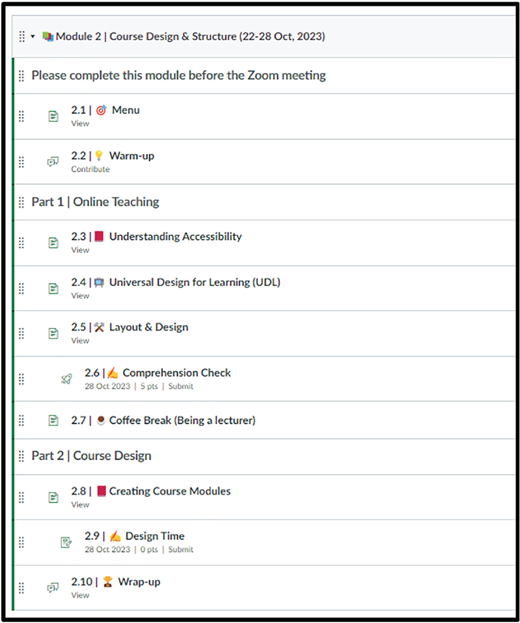
Third, we designed the training to model the humanizing online learning framework. For example, we introduced participants to #ThisIsMe, a private space for them to write everything about their sociocultural backgrounds and Coffee Break, a space for participants to take a break in completing modules where they could play games, watch funny videos or listen to music. We personalized the course design using friendly language, warm tones, color gradation, emojis, gifs, and motivational quotes. Figure 1 displays the design of the weekly modules.
Overall, combining effective online teaching practices and course design into one curriculum helped participants connect theory to practice (McQuiggan, 2012). Completing modules and attending synchronous sessions allowed participants to experience online learning from the learner’s perspective (Achen & Rutledge, 2022). Additionally, modeling humanizing online learning throughout the training program provided participants with real-time examples of its applications.
How Did We Evaluate the Outcomes of the Training Program?
We evaluated the outcomes of the training program by collecting pre- and post-training surveys and analyzing weekly reflection journals. In the pre-and post-training surveys, participants rated their readiness to teach online using the faculty readiness to teach online tool designed by Martin and colleagues (2019). This tool measures improvements in attitude scores (the perceived importance of online teaching competencies) and ability scores (confidence in performing online teaching competencies). Data analysis revealed that participants’ perceived attitudes and abilities improved after the training program.
Participants also completed weekly reflection journals, rating their readiness to teach online from 1 (not ready at all) to 5 (completely ready). Most participants showed improvement, with final ratings predominantly at 4 or 5, indicating a high level of readiness. However, the data revealed different paths toward readiness: some participants maintained stable ratings, others experienced fluctuations, and a few showed a decline. These variations highlighted the participants’ diverse experiences and learning curves, which allowed us to understand their readiness weekly and make necessary adjustments. For instance, we provided one-on-one consultation with those who rated their readiness low and needed more help with their course design.
Overall, there was a positive trend in participants’ readiness to teach online based on pre-and post-training surveys and weekly journals. Participants reported that the training program helped them become more confident in their online teaching abilities. One participant stated, “After learning through 5 modules, I am confident that I can develop online learning even better because I have understood the concepts” (Participant #2 Weekly Journal). Several participants also reported being able to immediately apply what they learned from the training to their online teaching, with one noting, “I am more than ready to implement all the knowledge and insights gained from this fellowship to my online teaching. I have started implementing some, and it’s really impactful. I can feel the difference” (Participant #13 Weekly Journal).
Additionally, as noted from entries in their final journals, participants valued the importance of humanizing online learning by saying:
“I gained this confidence by understanding the importance of humanizing online learning. I acknowledge that online education can often feel distant and disconnected, but I am convinced that adding a personal touch can significantly improve the experience.” (Participant #11).
“As an English lecturer in a rural area, the key idea of making online classes feel more personal and connected is important in places where students might feel alone or cut off from learning opportunities.” (Participant #9)
“Humanizing online learning re-opened my point of view that knowledge is essential, so it has to be accessible to everyone, including people from any background. We move forward as one, as mankind, yet in so many cases, a lot of people do not have the same access to an ideal standard of education.” (Participant #12).
What Do We Learn from the Whole Process?
From the process of designing and implementing the training program, we gathered several key insights:
The Importance of Humanizing Online Learning:
Grounding the training program in the CoI and humanizing online learning frameworks helped ensure that online teaching is not only effective and engaging, but also responsive to cultural differences and the emotional states of learners. We believe that in teaching, care for students should always come first.
Bringing the humanizing online learning framework to online training can be done by designing the training to respond to participants’ sociocultural backgrounds and emotional states. Simple activities such as providing a space to take breaks while completing self-paced modules can convey that their wellbeing is valued. Additionally, decorating the course with emojis or gifs can make the content more personal. For instance, using a thumbs-up emoji to acknowledge correct answers or a celebratory GIF to mark the completion of a module can add a fun and engaging element to make the learning experience feel more personal.
Feedback from the training shows that participants valued the humanizing online learning framework, which made them rethink their online teaching practices.
Training Design and Delivery:
Integrating pedagogy and design is crucial for participants to learn not only the pedagogical knowledge of online teaching but also the design principles of online courses.
Completing weekly modules and attending synchronous sessions helped participants experience online learning from the learners’ perspectives. They learned what it felt like to navigate online courses (e.g., logging into the LMS, completing modules, doing quizzes, and participating in discussion forums), enabling them to become more empathetic online instructors.
This article explored the rationale, design, and implementation of an online teaching training program for Indonesian faculty members. Our online teaching training program demonstrated significant potential in addressing the gaps in faculty support for online education in Indonesia. By equipping participants with essential competencies for designing and delivering affordable, socioculturally, and emotionally responsive online courses, we have taken a step toward supporting high quality online education in the country. Our training program’s focus on the CoI and humanizing online learning frameworks addressed both pedagogical and humanistic aspects of online teaching. Participants reported improved confidence and abilities in online teaching after the training. The training’s impact is also evident in the participants’ readiness to implement what they learned and their appreciation for the importance of humanizing online learning. With this initiative, we aimed to contribute to Indonesia’s educational goals, making higher education more accessible and inclusive for all.
About the author's