INTRODUCTION
The Western Governors University (WGU) graduation held on Saturday, February 10, 2007 in Salt Lake City, Utah, was truly inspiring. At this celebration, the university awarded 495 degrees, with over 57 diplomas handed to graduates who converged on the city from more than 20 states. WGU faculty members also gathered from across the United States and arrayed in their academic robes, were meeting with their distance students for the first time in person. However, their voices were familiar to them, having spoken by phone and e-mail to each student several times monthly over the years.
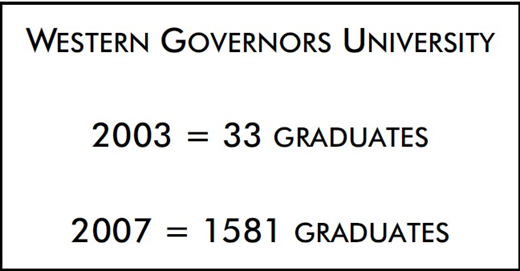
President Robert Mendenhall greeted the assembly of family, friends, and WGU staff in Abravanel Hall, a large auditorium and home of the Utah Symphony (WGU having outgrown previous venues). Mendenhall explained that those graduating during this most recent 6 months represented about a third of graduates from the rapidly expanding university. He reflected on WGU’s remarkable growth—from roughly 600 students in eight degree programs with 33 graduates at regional accreditation in 2003—to more than 7,500 students, more than 40 degree programs, and 1,581 graduates today.
Commencement speaker Bess Stephens, vice president of corporate philanthropy and education at Hewlett Packard and a WGU board member, exemplifies the struggles of an African American leader to advance her education and career. She boasts advanced degrees in chemistry and education, rising to her position as global director of HP’s Foundation. Stephens spoke on lifelong learning. Applauding WGU, she remarked, “Students can work school into the flexibility of their schedules. They aren’t limited by time and place but their own willingness to commit and meet the requirements” (McFarland, 2007).
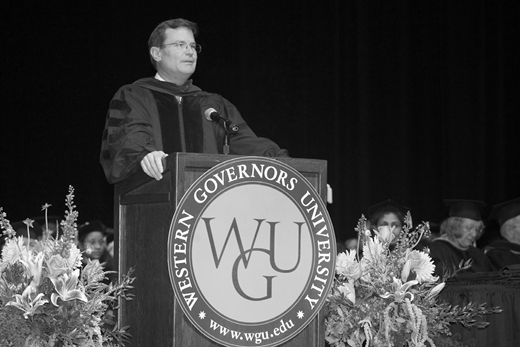
WGU President, Robert Mendenhall, addresses the February Commencement audience.
WGU President, Robert Mendenhall, addresses the February Commencement audience.
For me, the highlight was graduate speeches, particularly that of Joel Ellington. His father, a dirt-poor farmer in the Ozarks in Oklahoma, had no more than a third grade education. Joel, the sixth of 10 children, was one of the few to finish high school. A watershed experience happened in his senior year, when a high school counselor asked Joel whether his future plans included college. That possibility had never entered his mind. When he learned that it was doable, Joel improved his grades to enter and graduate with two associate’s degrees from a junior college in Idaho where he also met his wife. He entered the workforce, began raising a family of his own, and the years went by. In 2000, Joel enrolled at Missouri Western, earning a bachelor’s degree in education and was able to begin teaching, a lifelong dream.
Joel entered WGU a couple of years ago, meeting major requirements, taking learning resources and passing assessments to almost complete his degree. One hurdle, the capstone project, remained, and Joel’s situation had become particularly acute just then—as he had just rejoined the military full-time. Joel’s mentor, Jennifer Smolka, called him, saying, “Joel, I know you; you can do this!” During an early morning run while struggling up a particularly challenging hill, Joel planned to stop at a speed limit sign ahead, only to discover upon arrival another short 80-yard stretch to the summit. With Smolka’s words ringing in his mind, rather than walking, Joel picked it up and ran to the summit. From there he could see the whole valley and snowy tops of surrounding mountains. Similarly, girded with her faith and confidence in him, Joel found the power within to press on to the academic summit, completing the capstone requirement of his master’s degree. He soon received another call on a field phone from his mentor exclaiming, “Joel, you’ve done it!”
Here on the stage of this large auditorium far from Missouri, Joel Ellington shared his tale of how WGU kept its promise to him and made his dreams come true—a dream nurtured by his father, though his parents never had the means or circumstances to gain such education themselves. He declared, “Without the help of my mentor, it never would have happened…. [She] called and stayed with me.”
In September 2006, experts from higher education institutions, foundations, and accrediting bodies completed their investigations and deliberations about the future of American higher education, culminating in the Spellings Report (U.S. Department of Education, 2006). They concluded that higher education needs to become more accessible, affordable, outcomes-oriented, innovative, and accountable. WGU’s President, Robert Mendenhall (2007), a member of that commission stated, “Ideally, distance learning will help to move all of higher education to better measures of learning—what students know and can do—rather than focusing on measuring time” (p. 13). WGU sets a course to accomplish these objectives as a unique competency-based institution of higher education, firmly committed to providing quality educational opportunities that fit the needs of underserved Americans as well as the competitive workplace of the twenty-first century.
MISSION AND PROMISE
Western Governors University’s mission remains as originally conceived in 1996: “to improve quality and expand access to postsecondary educational opportunities by providing a means for individuals to learn independent of time or place and to earn competency-based degrees and other credentials that are credible to both institutions and employers.” Likewise, the university’s leadership formulated this “Promise” which it freely shares with students, setting an employee service standard: “We help our students achieve their dreams for a degree and career success by providing a personal, flexible, and affordable education based on real world competencies.” The university strives to build a culture quite contrary to that of traditional campuses—one that focuses on students first, is data driven to measure and improve performance, is innovative and nimble, is high quality with high performance expectations, and is responsive and supportive.
Several aspects of the university make it an especially attractive value proposition for students. WGU is affordable—its tuition ($2,790 per 6-month term) is far lower than most private institutions, and scholarships, financial aid, and tuition reimbursement programs are in place for a majority of students. WGU is flexible—as an online institution, students have tremendous independence and convenience to choose the time and place of their studies. Because WGU is competency-based, it is relevant to the career choices and workplace opportunities of its students, and the constant communication, support, and assistance of a mentor/progress manager make its education personal. WGU is credible—demonstrated through state approvals, accreditation, governors’ endorsement, corporate partners, and support from state and national government agencies (e.g., U.S. Department of Education, Congress, Veteran’s Administration, and Department of Defense). Finally, the university becomes a good choice for students who wish to accelerate their education—based on the extent of their prior competencies and their determination, commitment, and dedication to exert the effort to move faster through their programs.
THE FOUNDING OF A NEW INSTITUTION
WGU was conceived at a Western Governors Association meeting in Park City in 1995 (C. Johnstone, 2006). With the growing numbers of citizens in the West, the governors determined not to build new “brick and mortar” institutions, but rather to harness the new technology of the World Wide Web in providing quality distance education to underserved populations, especially those living in rural areas. They determined that this education needed to be geared to the workplace needs of employers. A year later, the governors drew up a charter with 10 sponsoring states, and in fall 1996 began seeking regional accreditation for WGU. With governors Mike Leavitt (Utah) and Roy Romer (Colorado) leading the initiative, the fledgling institution eventually received startup monies of $100,000 from each of 19 western states (the only direct state funding it would receive). Founding governor Roy Romer spoke of the vision he had for the institution:
We wanted a university that was available through modern communications, and we wanted it based on performance. And, that was the essence of the experiment…. We wanted to be sure that we created a system in which you didn’t get credit for a degree based just upon hours of exposure but based upon proven competence that you demonstrated. (Witkowsky, p. 1)
By 1998, the governors had worked with various corporate sponsors and higher education institutions to open the doors of the new private, nonprofit university. WGU initially did not offer its own degree programs—rather, it was a portal for students to choose distance courses and programs from dozens of participating postsecondary institutions and educational enterprises. After much hype about how the institution would remake the face of higher education and be swamped with enrollments, the initial results were disappointing. Very few students appeared at this nonaccredited upstart institution, as many students determined it was advantageous to go directly to colleges and universities in their locales that were launching their own distance education programs via the Internet. Institutions within states, likewise, banded together to form collaborative distance course and program sharing consortia as a counter response to the WGU initiative in an era ripe with innovation and the prosperous economy of the dot.com boom (Duin, Baer, & Starke-Meyerring, 2001).
ACCREDITATION AND GROWTH
WGU realized that its credibility and survival depended upon becoming an autonomous institution fulfilling an important alternative higher education niche by offering its own degree programs and achieving its own accreditation. The university began the accreditation process in 1996, but was instantly seen as an anomaly, since its footprint covered states accredited by several regions—a new situation for regional accrediting agencies that were geographically bound. To address accreditation needs of this new online competency-based university, the regional associations founded a special task force, the InterRegional Accrediting Committee (IRAC). It had representatives from the Northwest, North Central, Western Senior, and Western Junior regional accrediting commissions. C. Johnstone (2006) outlines the issues and events of the 6-year scrutiny of WGU by IRAC in its rigorous review process, progressing from eligibility (1998), to candidacy (2000), to initial accreditation (2003). Because of the need for more immediate credibility, the university sought national accreditation in 2001 and was awarded it a year later by the Distance Education and Training Council (DETC), a process that was “much shorter … but its standards were equally high and its evaluation every bit as probing and thorough” (p. 5). With initial regional accreditation in 2003, WGU received an unprecedented accreditation by four commissions simultaneously for a 2-year period, with responsibility shifting after that to the Northwest Association.
Some key milestones in its brief history follow. The university began offering degrees in 1999. In 2002, WGU became nationally accredited by the DETC, which was followed by regional accreditation in 2003. The U.S. Department of Education awarded the university a $10 million Star Schools grant in 2001 to develop teacher education programs in shortage areas, and in 2003 helped launch the university’s teachers college. The university began to flourish. Financial support shifted from corporate, foundation, and government assistance to the nonprofit, private university being funded almost entirely through tuition revenues. In 2006, the university launched its College of Health Professions.
Also in 2006, WGU’s Teachers College completed a multiyear review to achieve accreditation by the National Council for Accreditation of Teacher Education (NCATE). NCATE stated, “In 2001, NCATE modified its standards in part to anticipate the accreditation of non-traditional providers, and WGU is the first to engage the opportunity” (Castaldi, 2006, p. 1). WGU President Mendenhall stated, “WGU is rapidly becoming one of the largest teacher education programs in the country, and we have teacher education graduates seeking licensure in all 50 states.” Further, “Today, WGU graduates can apply directly to more than 40 states for teacher certification, and WGU students are eligible for reciprocity in most of the remaining states” (p. 1). The university has stated that what its teachers college “offers is no different from what teacher education programs at traditional institutions aim to provide: a solid foundation for beginning teachers to enter the classroom” (Honawar, 2006, p. 1).
WGU MODEL AND FEATURES
The learning experience at WGU is entirely at a distance wherever a student can access the telephone and Internet within the United States. Students start every month of the year, taking a short introductory course, “Education Without Boundaries (EWB)” before moving ahead on an individualized program of study. EWB prepares students for WGU’s model of education and develops their skills to use various tools, such as participating in learning communities or conducting searches for full-text articles at WGU’s virtual library. Students are expected to spend between 15 to 20 hours a week on their studies—and can move forward more quickly if they already possess many competencies of their degree program and are willing to devote more time and energy.
Competency-based education (CBE) rests on the premise that candidates should demonstrate their knowledge, skills, and abilities at the level of objective standards to receive the credentials, diplomas, or the licensure of a graduate. CBE particularly appeals to adult learners who already possess capabilities developed through prior work, education, or community experience—and to employers who want evidence that their workers possess the required abilities to perform in the workplace upon graduation.
A promise of CBE is that students won’t have to retake courses in subjects in which they are proficient, thus accelerating the time to degree completion (while reducing expenses). WGU allows applicants to transfer in higher education credits at the lower division level where there is a match with required competencies. Certifications they possess, likewise, if part of the degree (such as in information technology) waive requirements. However, WGU affirms most prior learning by determining students’ prior capabilities through preassessment, and then enables them to move rapidly to final, high-stakes assessments in their areas of competence.
From its inception, the university has been committed to using the latest technology to deliver quality distance education. Students entering WGU are expected to be adept at using telecommunications technologies, and WGU strives to incorporate technology into its competencies, assessment procedures, and learning resources to meet tweny-first century workplace demands. Not only are almost all of the university’s services delivered at a distance through technology, but there is a continual commitment to keep pace with the best appropriate instructional technology available.
WGU’s degrees are practical, career-oriented diplomas. The university seeks to produce graduates who meet the needs of employers for today’s competitive global economy; it constantly reviews degrees to ensure that competencies fit current workplace demands. The university received special funding to create programs in areas of teacher shortage—science and math education, elementary teaching, English language learning, and social science. Business, information technology, and health professions programs similarly seek to match graduates with the needs of these sectors of the economy.
WGU’s programs are tailored to address individual needs, suited to students’ abilities, schedules, and interests while maintaining academic rigor. WGU assigns a mentor to advise and support students throughout their degree program. A first task is developing an academic action plan (AAP) that schedules out the sequence and dates of assessments with associated learning resources for competency development. This online AAP dynamically allows students to enroll in learning resources, schedule assessments, and continually see their own progress. Mentors maintain constant communication with each student—by telephone and e-mail at a minimum of every 2 weeks, revising the AAP for every 6-month term. Of WGU’s roughly 350 employees, over 150 of them are mentors—the majority working throughout the country from home offices.
STUDENT ENROLLMENTS AND DEMOGRAPHICS
WGU President Mendenhall reported on the “skyrocketing” enrollment the university achieved after its 2003 accreditation, which increased more than tenfold from all states by 2006. “And enrollment is projected to double to 10,000 within the next 2 to 4 years, increasing to 15,000 by 2013” (Witkowsky, 2006, para. 23). With its expansion, WGU’s enrollments roughly follow national demographics with its students coming from the most populous states: California, Texas, Florida, Georgia and Illinois, while Utah and Nevada still have large numbers based on founding connections of government partners.
The university accepts most adult students, particularly focusing on working adults who have competencies derived from life experiences of the workplace, prior education, and through community service. Not of surprise, the average student age is 37 years old. WGU particularly targets underserved students and prides itself that approximately 83% of its student body come from one or more of these categories: minorities, rural, low income, and first-generation college students. More precisely, 41% of students have household incomes of less than $35,000 a year; 31.5 percent of students live in a rural community; 42% of students did not have either parent attend college; and 22% of students belong to an ethnic or racial minority group.
GOVERNMENT, FOUNDATION, AND CORPORATE SUPPORT
In its early years before regional accreditation, WGU was sustained through major corporate and foundation donations as well as government grants. The university’s nearly 25 member National Advisory Board (NAB), is comprised of corporations and foundations that contribute money and advice to WGU. NAB members (including AT&T, BearingPoint, Consonus, Convergys, Dell Computer, Farmers Insurance, Bill & Melinda Gates Foundation, Google, Hewlett-Packard, Hospital Corporation of America, J. Willard and Alice S. Marriott Foundation, Microsoft, Oracle, Qwest, Sallie Mae Fund, Simmons Media Group, Alfred P. Sloan Foundation, Sun Microsystems, SunGard Higher Education, Thomson Corporation, Wasatch Property Management, and Zions Bank) each made substantial initial contributions and have given yearly dues, also. Wasatch Property Management, upon joining the NAB, donated premium office space in a high rise with an extended, low-cost lease arrangement. The Bill and Melinda Gates foundation, another NAB member, matched a “T-Plus” grant from the State of Utah to prepare school administrators in the use of technology. The Federal Government contributed financial support through FIPSE grants and wrote the university into legislation to offer federal financial aid (FFA) to its distance students at a time when many institutions were hamstrung when using primarily distance delivery.
Perhaps the most significant of the early grants received by WGU came from the U.S. Department of Education. Besides USDOE’s award of a $10 million Star Schools grant to build out the curricular programs of WGU’s Teachers College for high needs teaching areas identified in the “No Child Left Behind” legislation, the USDOE offered an important scholarship grant. WGU applied for and was awarded a $3.7 million “Transition to Teaching” grant that enabled highly qualified paraprofessionals in the university’s partnering school districts (Clark County, Nevada, Region IV of Houston, Texas, and later El Paso, Texas) to receive half-tuition scholarships to gain teacher licensure through WGU’s new programs. These important curricular and enrollment supports enabled WGU to successfully mount its highly successful teachers college.

A national online institution, WGU’s administrative offices are in Salt Lake City, Utah.
A national online institution, WGU’s administrative offices are in Salt Lake City, Utah.
Since regional accreditation allowed WGU’s enrollments to burgeon, reliance on outside support has tapered off so that now more than 90% of operating expenses come directly from tuition revenues. It is worth noting that WGU has worked hard to maintain its FFA awarding status, to make its programs reimbursable to the employees of several companies (especially those on the NAB), and to become a player in Veterans Administration and Department of Defense (DOD) reimbursed postsecondary institutions. WGU also is able to award “Troops to Teachers” scholarships because of DOD and USDOE support. WGU estimates that 65 percent of its students are on FFA, and with another 18% receiving at least some assistance from their employer or the military.
Support in recent years has included: Hospital Corporation of America’s sizable contribution to the design and launch of WGU’s College of Health Professions; the Sorenson Legacy Foundation’s donation of $150,000 toward the new College; the Tenet Healthcare Foundation’s donation of $100,000 toward the new College; a major donation of 60 laptop computers from the HP Company Foundation (bringing total support to roughly $750,000); Sun Microsystems’s $500,000 in-kind contribution of IT equipment and services; and the sizeable donation of equipment, servers, and space in Salt Lake City from Consonus as WGU moved its IT operations from Sunnyvale, California. Also notable among the current grants was the award of $400,000 from the Lumina Foundation for the university to conduct research to improve its outreach to underserved populations—a major strength and vital part of its mission. Another was the Department of Labor’s award of a $3 million grant in February 2007 to award scholarships to rural teachers. This grant will also allow the university to conduct a study with the American Association of Colleges of Teacher Education (AACTE) to develop and disseminate a new model for addressing rural teacher workforce development. Obviously, many contributors throughout the years have made significant donations to WGU’s success.
GOVERNANCE, PROGRAM DEVELOPMENT, AND COUNCIL MODELS
Guiding the overall course of the university is the board of trustees, comprised of governors, educators, and industry leaders. Currently, the former governor of Wyoming, Jim Geringer—a moving force behind the founding of WGU—chairs; current governors Jon Huntsman, Jr. (Utah), and Janet Napolitano (Arizona) also serve. The university continues to garner support (though no monies) from governors of its founding states, and it often holds its meetings in conjunction with the Western Governors Association.
The university’s day-to-day operations rely on the decisions and initiatives of its senior leadership team. Very early on, WGU adopted an internal governance structure that is more akin to that of a corporate enterprise than most of higher education. It features: an executive management structure; promotion based on competency; the valuing of all employees equally; a single university structure; the solicitation and valuing of input from all employees, students, and other stakeholders; and academic program councils as major force behind curricular oversight.
WGU develops programs internally by both relying upon the expertise of senior qualified experts in each program area and relying on external standards. Nationally renowned academicians and corporate experts serve on program councils that oversee the development and maintenance of each program’s curriculum. However, in several programs, such as teacher education, state and national standards, as well as those from accrediting bodies, dictate program content and candidate qualifications.
Program councils have oversight responsibility for the quality, currency, and effectiveness of the programs within their charge. They consist of six to nine subject matter experts drawn from other academic institutions, private enterprise, school districts, and state or national government agencies, and are the university’s most senior faculty members. There is a council for each major curricular area—liberal arts, business, information technology, education, and health professions. They meet in person at WGU offices several times a year to monitor program effectiveness, evaluate learning resources, and provide advice on program planning issues. Speaking of the academic integrity created by councils in formulating competencies, former Provost Chip Johnstone wrote:
The coherence of the degree is ensured by … the comprehensive nature of degree competencies. These are not the result of a single faculty member’s point of view, nor are they derived from course equivalencies. They are designed as complete structures—the body of knowledge, skills, and abilities that a broad cross-section of experts judge necessary for a student at a given degree level to possess. (D. Johnstone, 2005, p. 28)
In addition to approving all new degree structures and competencies, Councils conduct formal reviews of program effectiveness at least every two years, and more frequently for newly launched programs. During program reviews they make sure that competencies still align with current academic and professional standards. They review assessment performance to be sure they effectively measure the competencies and learning resources to be sure that they properly align.
MARKETING AND STUDENT SERVICES
Appealing to the right audience who will especially benefit from WGU’s distance programs is the crux of marketing and recruitment efforts. As a nonprofit institution, the university does not have a large budget to spend on mass marketing. Word of mouth helps, but lead generation from interested applicants through Internet brokers—as well as through partnering organizations or grants—is WGU’s preferred source of applicants. It especially seeks working adult students from underrepresented populations—rurally located, first generation college, lower income, and ethnic minority students whose work experience has outpaced their credentials.
The university employs a cadre of enrollment counselors to respond by e-mail and telephone to those who express interest in attending the university. Counselors in some ways parallel the mentoring process that goes on once the student matriculates. Each prospect works with an enrollment counselor who specializes in the degree field that he or she has chosen; the counselor assists the prospective student through the entire admissions process (e.g., financial aid, application, admissions testing, and scheduling to attend the introductory course, “Education Without Boundaries”).
Given its missions of “expanding access,” WGU is more open-enrolled than its traditional counterparts; however, student selection is still important to winnow out those who will likely succeed at its model of distance education. WGU requires all applicants to complete an admissions test that measures academic competency, and considers each applicant’s situation, technology skills, and commitment toward their educational goals before allowing entry. Of course, a high school diploma or equivalent (and TOEFEL scores for nonnative English speakers) are required for entry into baccalaureate programs. A bachelor’s degree from an accredited institution is the minimal requirement for entrance into the university’s graduate programs.
WGU accepts lower-division undergraduate credits in transfer, waiving those relevant competencies. However, in upper-division or graduate work, transcripts will not suffice; the student must demonstrate those competencies through assessment (which should be expedited if there is successful prior college work in that area).
WGU’s own transcript is somewhat unique but readily accepted at other institutions. All competency assessments are taken as “pass/fail” with a “pass” meaning that “the student has demonstrated competency at a grade equivalent of B or better.” Transcripts also list the competencies by “courses of study” (assessments) with the number of competency units (credit equivalents) each one represents.
WGU has an office devoted to retention and student success. These employees contact “at-risk” students to see how the university can assist them to make it through each term. They may assist with minor purchases (e.g., textbooks) if that becomes a major obstacle. These counselors coordinate with various university offices to address any problems these students face. The liaison works with any student complaints in a like manner, also making arrangements for students with disabilities. The Student Success office organizes incentives for student achievement of milestones and administers scholarships for students in underrepresented populations to attend and succeed at WGU.
As its graduates multiply, WGU is committed to their ongoing success. Rather than ask for contributions back to the university, WGU affords them continued mentoring, peer-networking through a special portal, and career services. The university measures its own success by the success of its graduates—such things as their performance relative to others on standard tests and certification exams; their placement, promotion, and pay; employer evaluations; the relevance of the degree to their career; and their recommendation to others to attend WGU.
ASSESSMENT
Students demonstrate competency through assessments. WGU uses various measures in combination, relying on external graders to determine competency. For each domain (typically four to eight in each degree program) WGU has established multiple measures to ascertain competency. These typically include objective and essay exams in proctored testing centers, and performance tasks done online to apply skills and knowledge to realistic work requirements and portfolio development—turned in electronically for grading. For initial licensure, students in the Teachers College are also “observed,” during their student teaching experiences using a grading rubric administered by a qualified clinical supervisor and arranged for and trained in the student’s school district, wherever located across the nation. Degrees culminate in a capstone project that synthesizes the knowledge from several domains into a culminating product, usually written and presented online via Web and phone conference to graders.
Students occasionally must travel to proctored sites (such as test centers) that WGU arranges near their homes—the only site-based requirement for most programs. Also, WGU arranges for independent grading of its essays, performance tasks, portfolios, and capstones. (Online testing software automatically grades objective tests). The assessment department contracts with roughly 150 qualified graders, training them and continually monitoring their performance and interrater reliability. Graders also give important feedback on student work, especially if it must be reworked if “not passed.”
In addition to its program councils, the university established an assessment council, comprised of experts who oversee and advise on measuring the competencies in each program area. In cases where programs use industry-recognized assessments in their programs, such as Praxis, SHRM, CMBA, or IT certifications (e.g., MCSE, iNet+, Security+, MySQL, etc.), the university compares its students’ average scores with the industry average to achieve a standard of excellence above the mean. WGU builds most of its assessments in-house, through rigorous psychometric practices approved by the assessment council. In other cases, like its business and IT programs, WGU uses industry certifications as a component of the degree requirements. This practice assures that graduates from its programs have demonstrated competence within their fields as defined by the industry itself.
LEARNING RESOURCES
While enrolled at the university, students use a variety of learning resources (LRs) to brush up on existing competencies and develop new ones. From its inception, the university determined not to duplicate the online offerings of other institutions of higher education but instead to bring in suitable, aligned courses as needed to assist students. Since no students come fully competent, they spend the bulk of their time at the institution becoming proficient through interaction with a variety of LRs. These include textbooks, Web sites, Web-streamed e-learning, learning community discussions with peers and mentor experts, CDs and videos, virtual library resources, and online courses taken from other institutions. WGU makes sure that its LRs are available at any time or place, modular, low cost (since funding comes from student tuition revenues), open or available frequently, self-paced (especially for acceleration), interactive, and feedback-providing (Eastmond, 2006). Each course at WGU has an associated “course of study” (an annotated syllabus) that directs student learning.
WGU arranges for all of its LRs from third-party providers, through contract. These include online courses from accredited institutions of higher education, such as University of North Texas, Rio Salado College, and Chadron State College and nonaccredited enterprises, such as Abromitis Online Learning and Wasatch E-learning. Increasingly, however, the university arranges access to independent learning resources—e-learning, videos, simulations, and websites—through commercial providers such as NetG, SkillSoft, Teachscape, and MindEdge. All of these LRs are integrated into WGU’s catalog to automate the enrollment process and assure that students get immediate access to most LRs online. The university also has contracted for tutoring services in math, writing, and other content areas where students may struggle (Eastmond, 2006).
Students learn to use WGU’s virtual library, arranged by contract with the University of New Mexico, in their first introductory course at the university, “Education Without Boundaries.” Then they use various library services such as database searches for full-text articles, reference desk, e-reserves, and interlibrary loan throughout their study at the university. WGU’s librarian supplies most of these services directly while interfacing with the full services of the University of New Mexico library.
WGU has moved from operating a virtual bookstore through a third-party vendor toward getting more precise textbook content electronically. The university is working with several major publishers for specific chapters and sections of its adopted textbooks to be made directly available online for students—with e-reading capability to search, bookmark, highlight, and make individual notes in those copies. This e-content is integrated with other types of LRs within WGU’s “courses of study” so students can seamlessly move from one LR to another.
WGU GOALS AND FUTURE DIRECTIONS
The university’s provost and vice president of academic affairs, Craig Swenson, reflected recently about WGU’s role in American Higher Education:
I believe that WGU is the most innovative higher education institution in the United States, with a single-minded focus on improving the cost and quality of higher education…. Many people say that higher education is all about teaching, but it is really about learning—helping students become learners, gain competencies, and measuring and credentialing those competencies. That is what WGU does and it is why this institution is so important as a model to our higher education system. (Osmond, 2006, p. 2)
WGU considers itself successful through achievement of its purpose and mission. That is to develop and promote competency-based education; provide effective, high quality education programs; create a more efficient, lower-cost model for higher education; expand access to underserved populations; develop programs to anticipate and meet significant needs (public and private); and use technology to deliver more effective, efficient, and quality education.
Success really depends on the accomplishments of the university’s students and graduates. That means maintaining and constantly improving WGU’s retention rate, academic progress rate, graduation rate, and student satisfaction. These metrics are constantly monitored and have become performance objectives tied to compensation for everyone in the university. That success is captured in these recent vignettes:
Penny Allison, a parent and teacher, reported: “I am able to work when it is convenient for me … Sometimes that is 2 a.m., because I work three jobs and have a family” (Osmond, 2006, p. 2).
During Hurricane Katrina, an online group of student friends, one in Utah and another in Michigan, were able to give moral support and even recreate some of Sara Miller’s work. The student was living in Mississippi when her home (including textbooks, papers, and computer) was destroyed (Osmond, 2006, p. 2).
Angie Lambert, a 2006 graduate, stated “I loved the WGU program—It didn’t waste any of my time like other college classes have” (Witkowsky, 2006, para. 47). It saved her from a several-hour commute to the nearest university campus, and her degree landed her a new job, teaching fourth grade.
Western Governors University’s challenges include reaching out to adult and underrepresented populations who will benefit most from these credentials, and gaining recognition of the validity of this alternative education model. Having the endorsement of national, regional, and association accrediting bodies has substantiated the model within the higher education community. The university holds the promise of extending affordable, quality higher education to deserving adults in a manner convenient to their life situation, enabling them to realize their educational dreams and progress within the workplace or pursue further educational goals.
About the authors