INTRODUCTION
As a rich media technology, videoconferencing has moved forward significantly in recent years. The development of videoconferencing to utilize the Internet rather than telephone lines makes it possible to send and receive video and audio (Nokia, 2005a, pp. 5–8; Tandberg, 2006b; Videoconferencing Insight Newsletter, 2006b) nearing broadcast quality. Henceforth in this article, the current form of the technology will be referred to as Internet-based videoconferencing. This capability is the key factor enabling most previous criticisms of the medium to be challenged because the transmission speeds (number of kilobytes per second or kps) are vastly increased, thereby increasing picture and audio quality. While the capabilities of videoconferencing have been steadily increasing since the 1980s, the capacity of the technology to deliver high-quality video and audio has improved dramatically in the last few years.
What does this mean for teaching and learning? The enhanced technical capability has a number of positive implications for using Internet-based videoconferencing for teaching and learning:
First, the richness of the media can now be accessed and utilized for a broader range of teaching and learning activities (Smyth, 2005).
Second, the cost of using the technology is now minimal. It costs around $2.75 per hour to link from a university in Australia to the United States or the United Kingdom accessing the Internet at 768kps or better, whereas it previously cost on the order of $2,500 per hour using three telephone lines to achieve half that speed.
Third, Internet-based videoconferencing enables dual-stream video and multicasting without loss of bandwidth, providing that all sites have high-speed capability.
Fourth, the technical capability to link from Internet-based videoconferencing to mobile phones will enable videoconferencing anywhere, any time, around the globe.
These issues will be explored as the limitations of videoconferencing are challenged. We will examine videoconferencing from three perspectives: videoconferencing of the past, what it now is, and what its future might look like. We will specifically address the factors of cost effectiveness, connectivity, scalability, and inclusivity.
OVERCOMING THE PAST
Previous generations of videoconferencing that relied on using multiple lines of costly telephone connections were characterised as one-to-many presentation media useful for lectures and accessing remote experts. Student control was minimal, as in any large lecture, and the media was not considered to be particularly student friendly (Laurillard, 2002). In short, it was useful for didactic teaching and not much else; that is, the top left hand cell in Figure 1: Current and potential examples of practice. The inherent richness of the media was constrained by the cost and limited ability for effective interaction, and so its usefulness was often restricted (Fryer, 2005).
DEFINING THE PRESENT
Videoconferencing in education is no longer a novel idea. A recent Wainhouse Research report estimated that an overall average of 25% of U.S. primary and secondary schools have videoconferencing units installed, many of which have made the transition to Internet-based protocols (Greenberg, 2006). Educators are finding that Internet-based videoconferencing is easy to use, rapid, and approximates broadcast quality video and audio quality. Using a controller not much different from a television remote, any user can connect to anywhere in the world with two or three button pushes via a videoconferencing site, videophone, mobile phone, or personal computer (Bland, 2005; Fryer, 2005).
The current generation of videoconferencing technology relies on the Internet but can connect via ISDN lines if required. Transmission speeds of 768kps and greater are the norm. This alone is the source of the high definition video images, the insignificant audio lag, the ability to use dual streaming video and the potential for simultaneous multicasting (Tandberg, 2006b, 2006c).
Internet-based videoconferencing technology overcomes previous problems of cost, poor technical quality, and unreliability (Kirkpatrick, 2002). At the University of New England, we adopted the Internet technology in 2003 because it allows videoconferencing to support four key aspects of communication which were previously limited:
synchronous communication not affected by obvious audio delay
use of face-to-face interactive teaching and learning experiences at a distance
student control of learning, engagement in active learning
reliable teacher-to-student and student-to-student audio-visual communication.
Now, the range of teaching and learning interactions utilizing Internet-based videoconferencing are being expanded to include more learner-centred modes. As Figure 1 shows, the traditional lecture format (teacher to many students), which was the most cost effective use in the past, can be replaced by a range of small group activities (teacher to a few students) and student-initiated interaction (student to student) in undergraduate and postgraduate contexts.
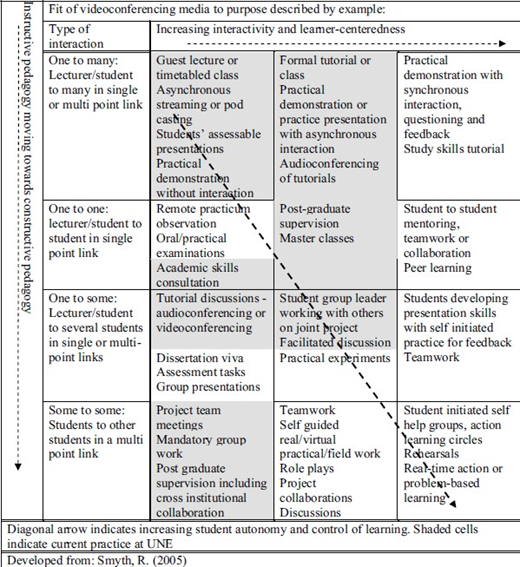
Current and potential examples of practice.
Current and potential examples of practice.
The inherent richness of Internet-based videoconferencing enables it to support visual aspects of teaching and learning not well supported in the print and audio media of previous generations of distance education (Taylor, 2001) or using other online technologies. While the reliability and high video and audio quality enables real-time support for students learning in a wide range of video and audio conferencing activities (Macadam, 2005; Smyth, Stein, & Shanahan, 2005), the capacity of the technology allows it to interface with other online media such as podcasting and presentation tools through dual video transmission and streaming. In addition, current Internet-based videoconferencing equipment has the capacity for high definition video transmissions, Web-based streaming and simultaneous multisite audio and video conferences.
In 2005, two studies (Macadam, 2005; Smyth, Stein, & Shanahan, 2005) confirmed that staff and students who are involved in successful videoconferences praise the technology, while those who experience technical difficulties are frustrated by it even if they were willing to acknowledge its potential. As more institutions update their equipment to Internet-based videoconferencing, this remaining frustration should disappear. It exists because a “latency” mode in most equipment means that Internet-based videoconferencing can appear to be of poor quality when connected to sites using older equipment only capable of low transmission speeds. This latency reduces the whole conference to the transmission speed of the lowest connected site.
CINDERELLA EMERGING: FUTURE POTENTIAL OF VIDEOCONFERENCING FOR TEACHING AND LEARNING
Elements of a rich media delivery have huge potential to enhance student learning, particularly for distance students as recent literature (Dennis & Kinney, 1997; Gilman & Turner, 2001; Kock, 2002) concerning information communication technologies shows. These benefits are emerging in the use of Internet-based videoconferencing (Bland, 2005; Fryer, 2005). The visual richness of Internet-based videoconferencing permits access to the multiple cues of natural language and its synchronicity makes it suitable for activities such as role plays, interactive group work, simulation games, and practical demonstrations as well as more traditional activities such as guest lectures and tutorials (Benbunan-Fich & Stelzer, 2002; Blake & Taji, 1997; Gilman & Turner, 2001). The immediacy, flexibility, and visual richness of Internet-based videoconferencing as well as its increasing reliability (Scanlon, 2002; Scanlon, 2003a; Scanlon, 2006) enhance possibilities for learner-centeredness and interactive learning.
These improvements in videoconferencing technology enable “virtual” interactions that more closely approximate regular face-to-face communication by supporting participants' access to synchronous verbal and nonverbal communication through the ability to see and hear multiple visual and aural cues in natural language communicated in real time, body language and intonation of speech, and immediate feedback, which increases the personalizing of learning.
The means by which academic and teaching staff utilize videoconferencing and integrate the technology appropriately into the curriculum design will define the opportunities available for students to engage effectively in learning via this improved medium. In addition, opportunities for student-to-student interaction also exist (Smyth, 2005) as shown in the central and right-hand columns of Figure 1.
Student-to-student interactions could include student directed group work, peer tutoring and buddy systems (Scanlon, 2002), practice situations such as peer feedback on presentation skills prior to assessment, practicum peer support, and peer mentoring for students developing academic, library skills, and spoken English.
Instructional design incorporating interactive videoconferencing at the primary/secondary level can support construction of learning through problem-based learning, project-based learning, team-based learning, simulations, and use of technology resources. To do this, learning activities must shift from passive to active and from de-contextualized tasks to authentic learning tasks (Heath, Holznagel, deFord, & Dimock, 2002). In a survey of 32 experts in the K-12 videoconferencing field, Hayden (1999) was able to identify several desirable characteristics of videoconferencing that support the constructivist learning environments described above:
connections—synchronous connections and links to remote people in remote locations;
questioning—students develop and ask questions to investigate topics, clarify meanings, and receive feedback;
learning—students use audio and video to listen, tell, observe, present, and interview; and
interaction—students work in collaborative groups using remote connections, sharing resources and tools, and participating in authentic activities.
In a distance education higher education model, Internet-based videoconferencing could provide for staff and student interaction during nonresidential school or face-to-face learning periods that would enhance learning at little or no additional cost. These applications could perhaps respond to the recent reports regarding attrition (Anderson & McCrea, 2005). Current and potential areas for trials and case studies within the University of New England Access Centres network and with international partners include:
moot court assessments in law
virtual rehearsals and specialist tuition in music (Scanlon, 2003b)
virtual field trips and practical demonstrations
practice situations such as for presentation skills prior to assessment
practicum support and remote supervision
examination preparation tutorials
tutoring for students developing academic and library skills and spoken English (Smyth, Stein, & Shanahan, 2005, p. 1).
New opportunities exist to reduce staff and student isolation and provide greater opportunities to enhance distance education teaching, supervision, and research. Videoconferencing systems can be regarded as learning tools that supplement other digital learning technologies such as learning management systems like WebCT and object repositories in libraries.
AN EXAMPLE: INTERNET-BASED VIDEOCONFERENCING MUSIC
The quality of the image and sound using Internet-based videoconferencing has been demonstrated frequently over the last two years at the University of New England (Scanlon, 2003b). Music master classes for students of woodwind and strings have been taught on a weekly basis between UNE and the Sydney Conservatorium of Music, 600 kilometres away and between regional centres 100–200 kilometres apart. In the case of the woodwind students, the teacher in Sydney instructs his students, listens to their playing, comments on their technique, and models appropriate wind, sound, intonation, and fingering. His ability to discern fine detail is reflected in comments such as “Your face is not red enough! I can hear that you are running out of breath at the third note” (M. Walton, personal communication, 2004).
Most importantly, person-to-person feedback and discussion is possible at minimum cost and inconvenience to many more students than was previously the case. In future, UNE aims to link regional conservatories, music teachers and students together for professional development, expert tuition, and examination.
As a test in 2003 proved (Scanlon, 2003c), transmission rates of 30 million bits a second can be sustained for many hours continuously over the Australian Academic research Network (AARNet) university research network in Australia. Using this amount of the Internet, a virtual orchestral recital was transmitted from the Sydney Conservatorium of Music to the University of New England in Armidale, 600km from Sydney, and the University of Western Australia in Perth, 3,974km away. Transmission rates of this quality will enable instantaneous, seamless interaction between world-class performers, educators, students, and their audiences around Australia and the world.
AN EXEMPLAR: SCHOOLS AND COLLEGES WORKING TOGETHER
As the “Around the World Videoconference” demonstrated (Scanlon, 2006), videoconferencing links can effectively be used to enhance bulletin board discussion and collaboration sharing of audio and video files and artifacts via WebCT or Blackboard. Similarly, K–12 schools are collaborating with universities in California (Videoconferencing Insight Newsletter, 2006a).
Colleagues in the United States are currently utilizing videoconferencing to successfully link schools with universities and their expertise. For example, the science and the cinema program uses a topical movie such as Jurassic Park as stimulus for discussion between school teachers, students, and a relevant academic who explore how close to the reality of scientific work are the ideas portrayed in the movie. Integration of IP videoconferencing for increased learner-to-learner interaction is emerging and its potential for improving outcomes of distance and other learners from kindergarten to higher education can only be surmised, at present (Ozkan, 2005).
COST EFFECTIVENESS
The main efficiencies result from the ability to connect to subject matter experts, colleagues, and students across the globe without time and travel costs.
For many years, academic staff have delivered conference presentations, provided occasional tutorials, lectures, and demonstrations and engaged in professional development via videoconferencing. The potential for these activities has not yet been tapped, but indications are that universities and educators in other sectors are increasingly delivering and engaging in teaching, learning, and professional development via Internet-based videoconferencing (Bossu, 2005; Videoconferencing Insight Newsletter, n.d.). For example:
attracting international scholars without the need for travel;
teaching to overseas locations;
providing additional contact and support for remote students and colleagues;
accessing and providing training anywhere anytime via synchronous transmission and/or archived asynchronous streaming;
collaborating in research projects without excessive time and travel costs (Bossu, 2005, p. 1);
attending meetings, tutorials, and virtual conferences;
participating in service activities, particularly nonfunded activities; and
delivering professional development to strategic partners and professional bodies (Bossu, 2005, p. 5).
Apart from the obvious savings from convenience and the cost of time wasted in travel and work productivity, many staff will discover that there are likely to be time savings in direct student assistance through the potential for this medium to contribute to timely interventions that enhance student satisfaction, competence, and confidence. In addition, time accrued through not traveling affords increased productivity. Some faculty are currently using both video and audio conferencing to run regular tutorials with students from their offices or homes.
CONNECTIVITY AND SCALABILITY
Wireless technology will make it possible to expand videoconferencing beyond the constraints of physical locations, particularly as 3G mobile telephony coverage is rolled out (Bland, 2005; Nokia, 2005b, 2005c; Tandberg, 2006a).
The advent of wireless transmission capability, third generation mobile phone connectivity, and the increasing roll out of bandwidth across the globe will enable Internet-based videoconferencing to reach individual students and staff in home, work, remote, and international locations. Any SIP-enabled or 3G mobile phone can link to existing videoconferencing equipment via the public Internet. Such videoconferencing over the public internet using high bandwidth equipment is of quite high quality, increasing the potential for links between various forms of videoconferencing technology. Similarly, streaming servers that have interoperability with existing videoconferencing equipment will increase the possibility for podcasting of regular lectures, tutorials, and videoconferencing classes and activities. Connectivity via personal computers will also increase with the development of equipment to ensure that firewall security cannot be breached (Tandberg, 2006b).
The telecommunications companies are currently promoting such possibilities (Nokia, 2005b, 2005c; Videoconferencing Insight Newsletter, 2006b). Regular, more widespread audio and videoconferencing between mobile phones and the current videoconferencing system is only limited by the roll out of 3G mobile phone connectivity. The efficacy of these developments was demonstrated by the mobile phone plan which allowed spectators to “watch” test cricket live for 1 month at a cost of AUS$10.00 , in Sydney, January 2006.
Current uses of Internet-based videoconferencing that demonstrate scalability include:
joint supervision between staff at the University of New England, Australia and overseas classes is currently conducted via NetMeeting and a Tandberg videoconferencing system when external institutions do not have videoconferencing systems;
audioconferencing of tutorials between university staff located in their offices and multiple students in their homes is a regular occurrence most week nights during term time;
increasing capacity of voice-over-IP (VoIP) for audioconferencing; and
supervision of student teachers at remote schools over Internet-based video connections (Fry & Bryant, 2006)
Research and development to trial scalability of Internet-based videoconferencing for supervision using VoIP and web cams where stand-alone systems are unavailable, will further demonstrate this potential.
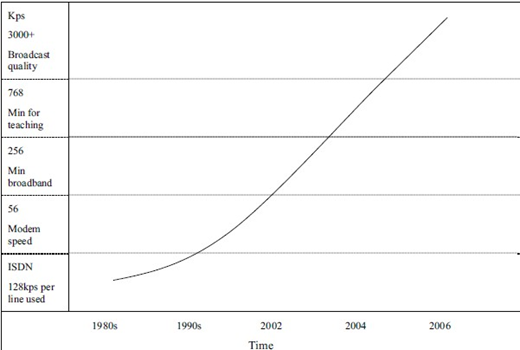
Commonly used transmission speeds in recent years.
Commonly used transmission speeds in recent years.
INCLUSIVITY
As personal videoconferencing capacity increases via 3G mobile and computer-based systems, inclusivity will increase for:
Rural or isolated students: Access to long distance/mobile call-plans that cap telephone costs to a few dollars per call make it affordable for students to audio conference if they cannot access videoconferencing or to link into the Internet videoconference via an audio-only connection where video connectivity is not available;
International students: Where student numbers are too small to support staff traveling to international locations or in times of concern such as the “SARS” influenza epidemic, staff can interact effectively with students on a regular basis at minimal cost;
Hearing Impaired students: The clarity of Internet-based videoconferencing enables lip reading so hearing impaired students can participate with or without the need for a signing interpreter;
Vision impaired and physically impaired students: For students who can access a videoconferencing facility or high-end webcam technology, there is no barrier to participation via audio-only mode;
At-risk students: Videoconferencing can increase personal and academic interactions with at-risk students with the potential to decrease attrition rates (Anderson & McCrea, 2005; Smyth & Gratton, 2001);
Research Staff: Internet-based videoconferencing provides an opportunity for staff and research students to work collaboratively with colleagues worldwide at little cost (Macadam, 2005); and
Preservice teachers and their university supervisors (Fry & Bryant, 2006).
Audience accessibility combined with ease-of-use makes Internet-based videoconferencing a useful addition to the distance educator's tool-kit.
CONCLUSION
Cinderella has emerged from the ashes! She has spent many years as the poor handmaiden earning income from administrative and “one-to-many” applications. Now that she has the Internet prince, she is showing how Internet-based videoconferencing enhances teaching and learning environments while promoting student interactions from kindergarten through higher education.
About the authors