The use of blockchain technology, in addition to technical issues, has always been associated with human and environmental challenges and the implementation of blockchain-based systems should be performed by considering various aspects of this technology. The main goal of this study is to evaluate the adoption of blockchain technology in the field of education and universities, by considering environmental issues.
The extended unified theory of acceptance and use of technology (UTAUT) model was used as a theoretical model. The research population included students and employees of Iranian universities, as a developing country.
The results of the research showed that environmental attitude, performance expectancy, social influence, effort expectancy and facilitating conditions are effective on the adoption and use of blockchain technology in the university. It was found that the environmental impact of blockchain is an effective factor in the adoption and use of this technology.
The results of this study are used by academic managers and policymakers in the field of education in the studied society to plan effective factors in the use of blockchain.
The theoretical contribution of this research is the use of the extended UTAUT model, including environmental attitude factors, in the assessment of blockchain adoption.
1. Introduction
The fourth industrial revolution, based on the use of disruptive technologies such as the Internet of Things (IoT), robotics and blockchain, are changing the way people live and work (Ronaghi & Forouharfar, 2024). Although blockchain technology was initially introduced by Satoshi Nakamoto as an infrastructure for cryptocurrency, it could affect various industries due to its special features (Yumna, Khan, Ikram, & Ilyas, 2019). Blockchain technology is a reliable and decentralized network that changes the way transactions are recorded. One of the advantages of blockchain is security, decentralization, transparency and immutability (Ronaghi & Fallahi, 2024). Blockchain technology remains a relatively nascent area on a global scale, even though it has garnered backing and funding from developed countries for research and development (Dbesan, Abdulmuhsin, & Alkhwaldi, 2025). The substantial impact of blockchain on society and industry is widely recognized (Bhat, Khan, Alkhwaldi, & Abdulmuhsin, 2025). Leveraging the capabilities of blockchain, this technology is applied across multiple sectors; it strengthens data security, ensures patient privacy and promotes interoperability by securely storing and sharing medical records, enhancing the traceability of pharmaceutical drugs and helping to fight against counterfeit medicines (Dbesan et al., 2025). Blockchain offers visibility and real-time monitoring of products from manufacturing to distribution, minimizing fraud and enhancing efficiency (Ronaghi, 2022). Businesses utilize smart contracts to streamline processes and optimize logistics. This technology aids in securing identity management, creating transparent and tamper-proof voting systems, managing public records and lowering administrative costs in services such as real estate registrations (Alkhwaldi & Aldhmour, 2022).
One of the applications of blockchain is in education. This technology changes the structure of recording and retrieving data at the network level. The use of blockchain in the education field creates a new revolution, but it seems that the education field needs to adapt to new developments (Hardini, Aini, Rahardja, Izatty, & Faturahman, 2020). The use of blockchain in the field of education is in the early stages of development and there is a need to perform extensive studies in this field. Blockchain in educational environments consists of a system that is used to issue, validate and share educational documents (Gräther et al., 2018). The individuals’ educational records and educational information as decentralized in the form of encrypted data blocks using blockchain technology (Han et al., 2018). Blockchain technology is generally used to issue and verify educational credentials such as academic degrees, transcripts, assessment of students’ abilities, achievements and professional ability of individuals, which can be applied by various employers around the world (Alammary, Alhazmi, Almasri, & Gillani, 2019). Blockchain reduces the administrative costs and bureaucratic procedures of universities (Jirgensons & Kapenieks, 2018). In their study, Bucea-Manea-Tonis et al. (2021) showed that the use of blockchain technology in the field of education, besides recording the information of students, professors and educational institutions in the form of a distributed network, can be effective on the interaction between organizations, fees, receiving rewards and finally lead to sustainable education.
Besides all the advantages, the use of blockchain in the field of education is also associated with some challenges, including the unavailability of data, scalability, immaturity, immutability, trust in the new system and the incompatibility of traditional systems (Alammary et al., 2019). Also, another challenge is that using blockchain technology is a costly project, which includes the infrastructure cost, the cost of large data management, the cost of slow processes and computing power cost (Saberi, Kouhizadeh, Sarkis, & Shen, 2019). In previous studies, the advantages of using blockchain technology in the field of education have been discussed, including data storage management (Sharples & Domingue, 2016), data security (Xu et al., 2017), trust (Skiba, 2017), formal assessment (Bore et al., 2017) and smart contracts (Chen, Xu, Lu, & Chen, 2018). In their study, Hardini et al. (2020) presented ontology of education using blockchain technology.
However, for the successful adoption of any technology, human dimensions play an important role and need to be analyzed (Ronaghi & Mahmoudi, 2015). Considering the importance of blockchain adoption in educational systems, the assessment of users’ behavioral dimensions and adoption of this technology is considered a research gap. On the other hand, it is necessary to include the environmental aspects of any technology in its adoption. Blockchain technology is no exception in this regard and should examine the environmental impacts. Also, high carbon emissions and environmental and health concerns, renewable and/or green technologies are turning into an attractive research area in technology development (Sharma, Kumar, & Park, 2019).
The effect of blockchain technology on the environment has advantages and drawbacks that can affect its adoption. The growth of networks based on traditional computing has a great effect on global energy systems and energy consumption. Many organizations use blockchain to participate in the development of green fuel economy. In the field of environmental management, blockchain can function as a mechanism to establish clear and verifiable records of activities impacting the environment, including waste disposal and carbon emissions monitoring (Nuryanto, Quraysin, & Pratiwi, 2024). Also, to create a green ecosystem, blockchain technology provides new and environmentally friendly business solutions by creating transparent, immutable and secure systems, especially when integrated with smart contracts (Sharma et al., 2019). Thus, due to the distribution of information in the blockchain network, the method of interaction between users, energy consumption and waste of resources are among the challenges of using this technology (Ronaghi, 2022).
Implementing blockchain technology requires extensive technical knowledge and effort to integrate it with current educational systems and infrastructures, guaranteeing interoperability among various platforms (Alkhwaldi, Alidarous, & Alharasis, 2024). Educational systems comprise millions of students and certificates, which can inundate blockchain networks that manage transactions on a peer-to-peer basis, resulting in decreased processing speeds as the amount of data increases. The cost associated with developing, operating and maintaining blockchain networks is substantial (Alammary et al., 2019). Numerous educational institutions find it challenging to justify the financial investment without clear and immediate advantages. On the other hand, the adoption level of a technology or an information system has a direct relationship with its effective implementation (Ronaghi, 2021). Considering the use of blockchain and its impact on the environment, the main problem of this research is to assess the behavior of users in the education field in adopting blockchain technology by considering their environmental attitude. The present study attempts to answer the following question:
What factors influence the adoption and use of blockchain technology in the field of education?
The theoretical contribution of this research is the use of the extended unified theory of acceptance and use of technology (UTAUT) model including environmental attitude factors in the assessment of blockchain adoption. The results of this study are used for academic managers and policymakers in the field of education in the studied society to plan effective factors in the use of blockchain.
2. Hypotheses development
Different models have been used to evaluate the success of a new technology. Davis (1989) presented one of the basic models in this field as technology acceptance model (TAM). Venkatesh, Morris, Davis, and Davis (2003) presented a completed model based on the previous models called UTAUT. The UTAUT is a commonly utilized framework in research on information technologies that seeks to forecast the acceptance and utilization of technology. This model presents alternative structures compared to the Davis model. According to the capabilities of this model, it has been used in various studies (Rasmi et al., 2018; Ronaghi & Forouharfar, 2020).
Chang, Walimuni, Kim, and Lim (2022) applied UTAUT model to accept blockchain in the tourism industry. Khazaei (2020) also used the UTAUT model to evaluate blockchain adoption among Malaysian businesses. Raffaghelli et al. (2022) applied the UTAUT model to evaluate the acceptance of the warning system in post-graduate education. Accordingly, in this study, the UTAUT model was used as a theoretical model.
UTAUT2 is an extension of the original UTAUT model developed by Venkatesh, Thong, and Xu (2012), specifically tailored to explain consumer technology acceptance and use. It extends the original UTAUT by adding three new constructs (hedonic motivation, price value and habit) that better predict consumer technology acceptance.
To evaluate the adoption of a technology, in addition to the technical dimensions, the human dimensions of the technology and the behavior of the users should also be analyzed. Due to the broad nature of UTAUT, numerous extensions have emerged to tackle specific scenarios or to integrate extra elements. These adaptations typically introduce new constructs or enhance current ones to provide a more accurate understanding of technology acceptance and utilization in certain contexts. The environmental impacts of technology can affect users’ opinions on its use. To perceive individual's behavior toward the environment, environmental attitude is considered as one of the most important predicting variables of people's behavior (Prete et al., 2017).
Researchers have combined UTAUT with additional theories, including the Diffusion of Innovations theory and the technology-organization-environment (TOE) framework, to create a comprehensive perspective on technology adoption. The research conducted by Bhat et al. (2025) addresses this need by employing the TOE framework to explore the technological, organizational and environmental factors that influence blockchain adoption among small- and medium-sized firms.
Saleh, Haris, and Bint Ahmad (2014) revealed that the Libyan context itself implies environmental factors influencing the adoption of solar water heaters. Factors like sunlight availability (a crucial environmental factor for solar energy) are implicitly considered within the constructs of the model, likely affecting performance expectancy (PE) and facilitating conditions (FC). Sabbagh and Gutierrez (2022) in their study provided a more explicit example of incorporating environmental variables into an extended UTAUT model. They directly include “farmers risk perception” as a key construct. This construct is directly influenced by environmental factors like water scarcity and climate change, which are explicitly discussed in the context of the Bekaa Valley.
Environmental attitude is a psychological tendency that leads to perceptions or beliefs related to the environment (Tan, 2011). In previous studies, they found that environmental attitudes were an effective factor on people's behavior toward the environment, including recycling (McCarty and Shrum, 2001). Nuryanto et al. (2024) highlighted the complex connections between environmental management systems and the implementation of blockchain technology in Indonesia. Issues related to the environment appear to pose a challenge, indicating that views on sustainability may hinder the adoption of blockchain (Bernardino, Cesário, J Costa, Aparicio, & Aparicio, 2025). Leonidou, Leonidou, and Kvasova (2010) indicated that two constructs, “Inward environmental attitude” and “Outward environmental attitude” can be used to evaluate people's environmental behavior.
In their study, Trivedi et al. (2018) indicated that inward environmental attitude and outward environmental attitude can influence people's environmental behavior and green purchasing. Blockchain technology significantly affects the environment primarily due to the considerable energy requirements for verifying transactions and creating blocks, especially in proof-of-work (PoW) systems such as Bitcoin. This energy consumption frequently depends on fossil fuels, leading to a notable increase in greenhouse gas emissions and contributing to climate change (Chamanara, Ghaffarizadeh, & Madani, 2023). This research presents a more advanced method for incorporating environmental considerations into the UTAUT framework. According to the impacts of users’ attitudes toward the environment on technology usage, the first and second hypotheses of the research are developed.
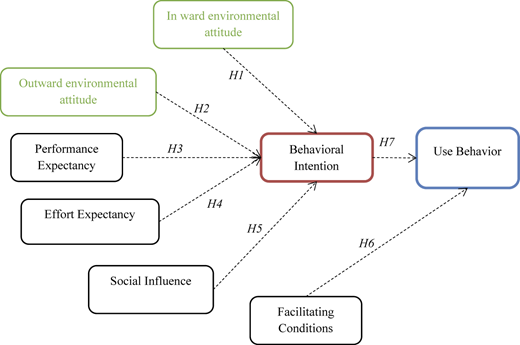
Inward environmental attitude has a positive influence on the intention to use blockchain technology.
Outward environmental attitude has a positive influence on the intention to use blockchain technology.
PE is considered as one of the influencing factors on behavioral intention (BI) (Ronaghi & Forouharfar, 2020). Blockchain facilitates the quick execution of accounting functions, improving the overall effectiveness of financial operations (Al-Dmour, Al-Dmour, Al-Dmour, & Al-Adwan, 2024). Hasan, Shiming, Islam, and Hossain (2020) studied the impact of operational efficiency on the implementation of blockchain in Chinese companies, discovering a positive relationship with enhanced profits. In their study, Salem and Ali (2019) also showed that the PE is an effective factor in the use of blockchain. This leads us to the formulation of the third hypothesis:
PE has a positive effect on the intention to use blockchain technology.
Several studies have suggested that effort expectancy (EE) affects the BI for technology adoption (Becker, 2016). Khazaei (2020) revealed that the EE is an effective factor in the adoption of blockchain among businesses. Therefore, we can state the fourth hypothesis:
EE has a positive effect on the intention to use blockchain technology.
In Rasmi et al.'s (2018) research, a significant relationship was observed between the social influence (SI) and the user's BI regarding information recording technology. Bernardino et al. (2025) revealed that leveraging SI is pivotal for accelerating blockchain adoption in small and medium-sized organizations. In their study, Chang et al. (2022) showed that SI is effective on the use of blockchain in the tourism industry. In line with this, the following hypothesis is proposed:
SI has a positive effect on the intention to use blockchain technology.
In the UTAUT model, the relationship between FC and the technology use is considered (Ronaghi & Forouharfar, 2020). In their research, AlShamsi, Al-Emran, and Shaalan (2022) indicated that FC were the significant determinants influencing several blockchain applications. Salem and Ali (2019) also referred to the role of this factor in blockchain acceptance. Hence, we present our sixth research hypothesis:
FC has a positive effect on the intention to use blockchain technology.
Finally, the BI shows one's mental readiness to encourage the use of technology. In various studies, they showed that there is a relationship between a person's BI and his actual use of technology (Rasmi et al., 2018; Cao & Niu, 2019). Hence, we propose the following hypothesis:
BI has a positive impact on the actual use of blockchain technology.
By considering the seven hypotheses above, the proposed conceptual model was presented in Figure 1.
3. Research method
This research is applied and its method is survey. The research approach is comparative and the strategy of positivism is used. The positivist researcher does not affect the research results and acts in a neutral way (Saunders et al., 2019). The data collection instrument is a questionnaire. The first part of the questionnaire includes research purpose and three demographic questions. The second part of the questionnaire is designed according to the research variables. Based on the study done by Terivedi et al. (2018), four questions were raised for inward environmental attitude and three questions for outward environmental attitude. Next, questions of the dimensions of the UTAUT model were designed as 18 questions. In order to verify the face validity of the questionnaire, the opinion of five faculty members with related expertise was used and the questionnaire was examined according to their opinion (Appendix). According to Fornell and Larcker (1981), it can be said that convergent reliability is acceptable. Cronbach's alpha and Dillon-Goldstein (DG) rho indices are used to evaluate reliability. Based on the values shown in Table 1, the values of these indicators are more than 0.7 and it can be said that the reliability of the research instrument is acceptable (Ronaghi, 2022).
The statistics of immigration from Iran in 2020 was 1,325,113, which is equal to 1.5% of the country's population (WorldPopulationReview, 2022) and most of these people need to present and determine the validity of their personal and educational documents. Also, blockchain technology has not been used in the educational system of Iran as a developing country. Thus, the technology acceptance by the users and stakeholders of that country is of great importance.
In their study, Kamišalić, Turkanović, Mrdović, and Heričko (2019), introduced two approaches related to the implementation of blockchain in the educational environment: the first one is a student-centered approach giving student to control the data related to him. The second approach is the institution-centric approach, with the primary goal to facilitate and streamline the activities of educational institutions. Iranian universities have shown significant advancement in the adoption of digital tools, even with obstacles related to infrastructure, opposition to innovative approaches and a lack of comprehensive integration of social, cultural and economic elements in their planning (Ronaghi, Ronaghi, & Boskabadi, 2024). Therefore, the statistical population of the research included two groups of people, i.e. students and employees of public universities in Iran. The information of individuals was obtained from the administrative and educational system of universities. The sampling method was simple random. For very large populations (approaching or exceeding 1,000,000), the Krejcie and Morgan table suggests a sample size of 384, which is a common benchmark (Ahmed, 2024). The questionnaire was sent via email to 500 students and 500 employees and faculty members of public universities in Iran and 743 questionnaires were received within 55 days. The research hypotheses were tested using SmartPLS software because of its capability to examine causal relationships between multiple variables.
4. Results
The demographic information of the statistical sample is illustrated in Table 2. Based on the obtained information, it was found that 45% of the individuals were women and 48% had higher than a bachelor's degree. Also, the participants were the majority in range of 20 to 40 years.
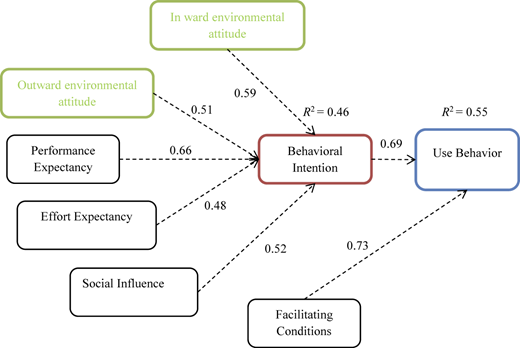
According to the obtained P-Value (<0.05) and t-statistic values in Table 3, all research hypotheses were accepted at 95% confidence level. Based on the results of the hypotheses' testing, it is clear that inward environment attitude, outward environment attitude, PE, EE and SI have a positive effect on BI of blockchain. Also, FC and BI have influence on blockchain using.
Figure 2 shows the research model along with the path coefficients. Model coefficients show that the environmental attitude, PE, EE, SI and FC have positive influence on blockchain acceptance in university education. Moreover, the structural model explained 46% of variance in BI (R2 = 0.46) and 55% of variance in use behavior (R2 = 0.55). To assess the structural model in PLS-SEM, Hair, Hult, Ringle, and Sarstedt (2021) suggested looking at results such as collinearity (variance inflation factor – VIF) issues, the model's variance explained (R2), the exogenous variable's incremental explanation of an endogenous variable (f2 effect size), the model predictive relevance (Q2). The assessment of the VIF values of all constructs are all below the threshold of 5 (Hair et al., 2021), therefore, the results did not indicate a multicollinearity problem. Moreover, the Q2 values are more than 0, which are BI (Q2 = 0.32) and use behavior (Q2 = 0.41) suggesting that the model has sufficient predictive relevance (Hair et al., 2021). The other test to evaluate the structural model is the F-value. It defines the effect of latent variables. If the F-value below or equal to 0.02 it indicates a small effect, if 0.15 medium effect and if equal or higher than 0.35 indicates a strong effect. In this research, F-value is medium level effect (BI > use behavior = 0.153). The result of the F-value indicates that all variables exert a medium influence on the model.
According to these findings, people's environmental attitude is effective on the use of blockchain technology, considering the impact of blockchain on the environment, this finding is verified. Also, other results of the research showed that the use of blockchain technology in the educational system of Iran has been accepted by users and they believed that blockchain can be effective in the way of doing work and facilitating affairs. Accordingly, the infrastructure conditions for the use of blockchain should be provided by educational centers and executive managers.
5. Discussion
This study examined the adoption of blockchain in the educational and academic system. According to the results of research hypotheses, it was determined that users and students in Iran at intended to use blockchain-based distributed systems and these systems can be introduced as a new generation to replace centralized information systems in universities to record educational information. The discussion of applications of blockchain technology in the field of higher education was investigated in different studies. In their study, Liu et al. (2018) presented Hyperledger Fabric-based architecture by which universities and employers can share transparent information about students and graduates. However, unlike researches including Liu et al. (2018), Xu et al. (2017) and Chen et al. (2018), which considered the technical and architectural dimensions of blockchain in the educational system, the human dimensions of communicating with new technology were evaluated in the present study. In the studies of Chang et al. (2022) and Khazaei (2020), the UTAUT model was used to evaluate the adoption of blockchain in different areas; however, the extended UTAUT model was used and the dimensions of individual's environmental attitudes were added to the classic model due to the importance of blockchain's effect on the environment. The results of the research, consistent with the results of Schinckus (2020) and Rana, Giungato, Tarabella, and Tricase (2019) discussed the effect of blockchain on the environment, also indicated that the environmental attitude of students and employees is effective on the adoption of this technology. The findings from this research indicate that the environmental consequences of blockchain significantly influence its acceptance and utilization within the university setting. However, some users and organizations may not possess comprehensive technical knowledge regarding the various blockchain technologies or the energy sources involved in mining (Bhatt & Emdad, 2025), which may result in oversimplified views – either assuming that all blockchains are equally damaging or believing that blockchain is primarily “green” because of its potential for enhancing transparency and sustainability in supply chains. In the following sections, the study's results will be explored from both theoretical and practical perspectives.
5.1 Theoretical contributions
The first hypothesis of the research showed that inward environmental attitude has a positive impact on the intention to use blockchain technology. This means that users' environmental concern and importance to sustainable development and how to use natural resources are effective factors in using blockchain technology. This result is in line with the results of the studies of Park and Li (2021) and Xu et al. (2017) about the relationship between blockchain and the environment.
In the second hypothesis, the effect of outward environmental attitude on the use of blockchain among the users of the educational system was verified. This result shows that macro-environmental concerns and attention to the political and social environment is an effective factor in using blockchain technology. This result shows the need for macro policy about using new technologies such as blockchain, so that their effects on the environment can be truly controlled. Also, users and stakeholders of blockchain technology should be aware of the positive and negative impacts of this technology on natural resources. In this regard, it was indicated in Blackstad and Allen's (2018) study that the use of blockchain technology and environmental policies interact with each other. Similarly, in the study of Schinckus (2020), the role of blockchain in achieving sustainability goals for countries determined by the United Nations (UN) was considered. Users often do not view all blockchain technologies as eco-friendly; their awareness regarding environmental effects can vary, typically shaped by the complexity and limited understanding of how blockchain functions and its energy usage (Bhatt & Emdad, 2025). Traditional PoW blockchains, such as Bitcoin, are frequently reported to have substantial environmental impacts due to their high energy demand, which is comparable to that of entire nations, resulting in considerable carbon emissions (Magdalena, Si Mohammed, Nassani, & Dascalu, 2025).
In the third hypothesis, it was found that PE is effective on the intention to use blockchain technology. Accordingly, it can be said that if users are familiar with the capabilities and benefits of distributed systems, it can lead to the adoption of this technology in the educational system. Blockchain enables more accurate evaluation of students, effective data management, educational development of individuals and transparency and accountability (Alammary et al., 2019). Therefore, the identification of the benefits such as transparency and information traceability can be a great contribution to the establishment and use of a decentralized educational system. This result is consistent with the results of the study done by Chang et al. (2022).
The result of the fourth hypothesis showed that EE is an effective factor in the use of blockchain in the educational system. Thus, knowing the way the distributed system works and learning how to verify and circulate information in this system can facilitate the adoption of technology. Blockchain facilitates the educational certification process and employers need to spend less time confirming educational results. Presenting a safe platform for sharing students' data, increasing trust, mitigating costs and creating transparency are among the benefits of this distributed technology in the education field (Bhaskar, Tiwari, & joshi, 2020). The statistical population in this research showed that the more the work with the distributed system is facilitated, the possibility of its use is increased. In their study, Chang et al. (2022) also showed that EE is effective on the adoption of blockchain in the tourism industry.
According to the result of the fifth hypothesis, it was found that SI is an effective factor on the use of blockchain-based educational system. Based on this, social interactions and confirming others can be effective on adopting blockchain technology. Blockchain technology allows less knowledgeable individuals to interact with more knowledgeable co-workers and mentors (Fenichel & Schweingruber, 2010). It can be said that in the student community, those who have the experience of using blockchain can be influential in the use of this technology by others. In this regard, Raffaghelli et al.'s (2022) study showed that SI is effective on the acceptance of the warning system in the education field.
The result of the sixth hypothesis showed that FC are effective on the use of blockchain technology in the educational system. Bhaskar et al. (2020) believed that the progress of blockchain in the field of education is slow, but it is required to provide the necessary infrastructure to develop this technology and create a revolution in the education sector. Thus, the existing software and hardware infrastructure in the educational system is an effective factor in the deployment of blockchain-based systems. Also, Khazaei (2020) and Salem and Ali (2019) showed that facilitating conditions is an effective factor in the acceptance of blockchain technology.
Finally, the result of the last hypothesis showed the effect of BI on the full use of blockchain technology. This result indicates the effect of mental and perceptual factors of educational system users and students on the actual use of blockchain and shows that people's mental preparation is effective on the success of adopting new technology. This finding is consistent with the research results of Chang et al. (2022) and Raffaghelli et al. (2022). Furthermore, Alkhwaldi et al. (2024) demonstrated that PE, SI, blockchain transparency and blockchain efficiency significantly impacted individuals' intentions to adopt blockchain-based systems and contributed to explaining its variance. Additionally, blockchain efficiency positively and significantly influenced PE.
5.2 Managerial implications
Given the effect of PE on the acceptance of blockchain in the field of education, it is recommended to hold educational workshops to introduce the capabilities of distributed systems for university users and stakeholders so that people can learn the advantages of decentralized information networks such as reliability, traceability and transparency. Also, launching pilot examples of blockchain-based information network is a suitable solution to solve the initial challenges of the decentralized system-based education system. Blockchain as a record keeper is also used in the field of education, including the documents security, credit verification, automatic credit identification and intellectual property management (Grech & Camilleri, 2017). Alkhwaldi and Aldhmour (2022) suggested that blockchain technology holds significant promise for implementation within government organizations, offering enhancements in transparency, fraud mitigation, data integrity and quality, safeguarding sensitive information, reducing corruption and boosting trust. These advantages have drawn the interest of the public sector in various nations with regard to eliminating corruption and enhancing transparency.
The effect of EE on the use of blockchain also indicates that users should be familiar with the method of using distributed systems, considering that the majority of users of educational systems are students. It is recommended that the educational managers of the university verify the topic of the blockchain course for students for learning more. Also, university employees need to receive specialized courses (educational workshops) and at-service training regarding transformative systems and blockchain. The design of the systems with an easy and enjoyable user environment, ignoring the technical complications for end users can be effective on the use of blockchain technology. Kamišalić, Turkanović, Mrdović, and Heričko (2019) believes that blockchain can be used as a disruptor in the field of education and universities. Receiving student payments, supply student funding and allocating educational awards are some of the applications of blockchain in university. Also, the facilitation of certificate approval and virtual lifelong learning are other advantages of blockchain as a disruptor.
It is recommended to use foreign consultants and knowledge-based companies active in the field of new technologies to launch blockchain-based training and certification systems. Also, creating motivating and reward systems for employee participation in the use of decentralized information systems is a suitable solution for blockchain implementation. The immutable data in the blockchain network makes it possible to use it to eliminate fake certificates in education (Shah, Patel, Adesara, Hingu, & Shah, 2021). In this type, a digital certificate is used and the electronic file of the certificate is stored in the blockchain system using Hash encryption functions (Cheng, Lee, Chi, & Chen, 2018). Blockchain can store a comprehensive and verified set of records of educational activities. It can also be effective in evaluating educational strategies and controlling their results (Shah et al., 2021).
Considering that the deployment of a blockchain-based educational system has different stakeholders, it is recommended to conclude a contract with employers and institutions active in the field of human resource management regarding the implementation of a decentralized information system, in order to create conditions that facilitate the use of a blockchain-based system. Another result of this research showed that the environmental attitude of users is an effective factor in choosing blockchain technology; thus, using decentralized systems with low energy consumption and green systems and reducing the delay of the information verification process is a suitable solution to mitigate the environmental risks of blockchain. The deployment of blockchain technology in Iran encounters a complicated environment influenced by regulatory controls, economic sanctions, energy limitations and a pursuit of digital advancement. Additionally, collaborations between academic institutions and the government can foster the establishment of new legal frameworks and interdisciplinary research initiatives (Ronaghi, 2023). To tackle issues related to scalability, energy use and sourcing of equipment, the Iranian government needs to promote the development of local blockchain solutions, innovation in energy-efficient consensus protocols and partnerships with domestic blockchain enterprises.
5.3 Limitations and future research
The present study only evaluated the students and employees of the educational system as blockchain users in the university, but other organizations and institutions also play a role in the adoption and use of this technology. Hence, it is suggested in future studies to investigate the adoption of blockchain technology among employers and companies hiring human resources or immigration institutions. In this study, an evaluation of the acceptance of blockchain technology in the educational system in the developing country of Iran was performed. Considering the emerging nature of blockchain in this field, it is recommended that, in future studies, a developed country be evaluated for the adoption of blockchain technology and the results obtained should be compared with the results of the present study. In future studies, other models of technology acceptance, such as the value-added model (VAM) can be used in the form of other constructs. In the present study, only the human dimensions of blockchain technology adoption at the university level were evaluated; therefore, the assessment of technical, hardware and software infrastructures and architectural design in this area can be examined for future studies.
6. Conclusion
Based on the results of this research, it was shown that PE, SI and EE are effective in the use of blockchain technology. This means that before designing any technical infrastructure, there is a need for education field managers to clarify the capabilities of blockchain technology and educational distributed systems so that users and stakeholders are aware of the benefits of this category of systems and the way information circulation occurs in decentralized systems. Also, FC are one of the other factors influencing the acceptance of blockchain by users. Therefore, policymakers in the field of education, employment affairs organizations and managers of immigration departments should provide hardware and software infrastructure based on blockchain technology to evaluate the documents of students and graduates. Other results of this study revealed that environmental attitude is effective in blockchain technology acceptance. This result shows the effect of individuals' awareness and responsibility towards the environment on the selection and use of technology. Thus, IT activists should pay attention to the technology used on the environment and its lack of harm. Finally, based on the novelty of using blockchain technology, especially in a developing country like Iran, the policymakers of the Ministry of Science and Technology in Iran, based on the blockchain technology acceptance by users in the field of education, should create the necessary infrastructure to record information based on a distributed system and provide the information traceability with the participation of interested companies so that, in addition to creating educational information transparency, tracking files, the possibility of proper management of human capital and individual's capabilities is possible.
The supplementary material for this article can be found online.