This study analyzes the impact of digitalization and smart government policies on economic growth in Islamic economies, focusing on six Gulf Cooperation Council (GCC) countries: Saudi Arabia, the UAE, Oman, Bahrain, Kuwait and Qatar. It investigates how digital transformation affects gross domestic product (GDP) growth and labor productivity, with specific attention to the moderating roles of governance and institutional frameworks within digital Islamic finance.
A mixed-methods research design was employed, combining quantitative panel regression with comparative case study analysis. Secondary data from 2008 to 2023 were sourced from the World Bank and Worldwide Governance Indicators (WGI). The Arellano-Bond dynamic panel model was used to measure the impact of digitalization, governance and oil dependence on economic outcomes, while comparative case studies assessed digitalization strategies, smart policy initiatives and the integration of digital Islamic finance across GCC countries.
Results indicate that digitalization positively influences labor productivity, with marginal significance (coef. = 0.083, p = 0.06), suggesting that countries with well-developed ICT infrastructure, including Saudi Arabia, UAE, Qatar and Kuwait can translate digital adoption into productivity gains. Labor productivity appeared insensitive to trade openness (coef. = 0.008, p = 0.871) and oil prices (coef. = 0.042, p = 0.493), reflecting structural reliance on oil and heterogeneous trade integration. Digitalization also had a positive, though not statistically significant, effect on GDP growth (coef. = 0.158, p = 0.172). While trade openness (coef. = 0.107, p = 0.386) and oil prices (coef. = 0.174, p = 0.187) were nonsignificant, the findings highlight the potential of digital policies in enhancing economic growth and labor productivity in technologically advanced GCC countries. Qualitative analysis highlights that while all GCC nations pursue digitalization initiatives, the integration with governance and Shariah-compliant finance is at an early stage, requiring strategic alignment to enhance economic diversification.
The study offers actionable insights for policymakers, emphasizing the need to align digital transformation priorities with economic diversification goals, particularly in FinTech, e-commerce and Islamic financial services. Digitalization in Islamic finance can improve financial inclusion and promote sustainable economic development, reinforcing the role of smart government policies in shaping future growth trajectories.
This article represents one of the first comparative empirical studies of digitalization and smart government policies in GCC Islamic economies. It advances understanding of the relationship between digital transformation, institutional efficiency and resource dependence, proposing a governance-performance framework that highlights country-level differentiation.
List of Abbreviations
- ICT:
Information and Communication Technology
- ARDL:
Autoregressive Distributed Lag
- GCC:
Gulf Cooperation Council
- WGI:
Worldwide Governance Indicators
- WBI:
World Bank Indicators
- TASMU:
Qatar Smart Transformation Initiative
- CAGR:
Compound Annual Growth
- GDP:
Gross Domestic Product
- CAIT:
Central Agency for Information Technology
- CITRA:
Communication and Information Technology Regulatory Authority
- SDAIA:
Saudi Data and AI Authority
1. Introduction
Digitalization has become a major driving engine of economic growth and transformation in the age of rapid technological advances (Matyushok, Vera Krasavina, Berezin, & Sendra García, 2021). Similarly, Islamic economies – characterized by unique financial frameworks and developmental goals are increasingly leveraging digital technologies to enhance financial efficiency, promote inclusion and support sustainable development (Alsaghir, 2023; Hassan, Muneeza, & Hasan, 2021; Zarrouk, El Ghak, & Abu Al Haija, 2017). Digital transformation has significantly catalyzed digital Islamic banking services, Islamic fintech solutions and digital sukuk platforms that comply with Sharia while meeting modern economic needs, especially in Islamic finance. Beyond finance, digitalization also contributes to e-government services, regulatory innovations and digital trade, forming a wider digital Islamic economic ecosystem. However, while consensus on the promise of digitalization has been reached, empirical evidence regarding the real-time impact of digitalization on digital Islamic finance in leading Islamic economies is still quite limited (Alam, Gupta, & Zameni, 2019).
This study focuses on six GCC countries – Saudi Arabia, UAE, Oman, Bahrain, Kuwait and Qatar and examines how their digitalization and smart government policies contribute to economic growth through enhanced digital Islamic finance and broader digital Islamic economics ecosystems. Smart government policies, including national strategies such as Saudi Vision 2030, Oman Vision 2040, Bahrain Vision 2030, Kuwait New Kuwait 2035, are considered key drivers in shaping digital infrastructure, regulatory frameworks and public service efficiency while promoting Sharia-compliant digital financial services.
Studies in recent years have shown the enormous effect of digitalization on the growth of the economy in Islamic economies. For example, in a research by El-Tahir (2024), they investigated the economics of digitalization in Organization of Islamic Cooperation (OIC) countries and reached the conclusion that digitalization has a positive impact on economic growth in all of this range of countries (El-Tahir, 2024). Emphasizing the investment in digital infrastructure to spur economic development, the research, which has lasted for twenty-one years, between 2000 and 2020, is noteworthy. A research made by Neffati (2025a, b), with regard to Saudi Arabia, studied the interaction of digitalization, along with the economic diversification and the economic growth (Neffati, 2025b). The findings confirmed that digitalized economy has significant role in the growth of the nonoil economic growth and serves as tools in sustainable economic development.
This research has thus emphasized the long-term relationship between economic growth, diversification and digitalization, of which digitalization expands the economic diversification through increasing of nonoil income and reducing oil sector's dominance. Within Islamic finance specifically, the digitalization also takes place in the Sharia sector and has contributed to increasing the financial inclusion and efficiency (Tlemsani, Zaman, Mohamed Hashim, & Matthews, 2023). Moreover, in GCC economies, smart policies link digital finance with wider institutional reforms, labor productivity improvements and innovation in Islamic economic activities.
Digital transformation is not only changing economic and institutional environments globally, but is also affecting the GCC countries at an uneven pace that has not been examined in terms of their digital Islamic finance policy effectiveness. Although there are ambitious national strategies like those of Bahrain (Vision, 2030), Oman (Vision, 2040) and Kuwait (New Kuwait, 2035), it remains unclear to what degree digitalization enabled sustainable economic growth and enhanced Islamic financial services, when structural dependence on oil rents and different institutional capacities are taken into consideration (Cigu, 2025). To address this gap, the present study employs a secondary quantitative approach, drawing on World Bank data and related sources spanning 19 years. The aim is to explore the connections between various digitalization initiatives in Islamic finance and wider Islamic economics, the quality of institutions as well as overall performance. The research provides a comprehensive benchmark among the small to medium-sized economies in the Gulf region, which differ in terms of resource availability and readiness for digital advancements in Islamic economic frameworks.
Despite the prominence of digital transformation policies across GCC countries, there is relatively little comparative empirical research on the effectiveness of digitalization and smart government policies on economic growth within the context of the Islamic economic framework. Most current studies are descriptive and limited to a single country context. They do not consider how governance quality, institutional maturity and oil dependence affect FDI behavior. Building on the above backdrop, this study intends to fill the gap through a mixed-methods approach that blends dynamic panel estimation with comparative case analysis across six GCC economies, following the following research questions:
How do smart government policies and digital government services enhance economic efficiency in GCC countries and support the development of digital Islamic financial services, including collaboration with the private sector?
To what extent do digital payment solutions (such as mobile banking, e-wallets and contactless payments) contribute to economic inclusion and productivity growth within Islamic finance in the GCC economies?
How do regulatory frameworks across GCC countries ensure Shariah compliance in digital financial services, and what does the comparison reveal about the effectiveness of smart government policies in building resilient digital Islamic finance ecosystems?
The period of study (2008–2023), encapsulating the post-global financial crisis era during which the GCC economies launched major digital transformation programs, including Saudi Vision 2030, the Bahrain Economic Vision 2030, and the Kuwait New Kuwait 2035. The time frame allows us to systematically examine how digitalization has progressed along with institutional development in diverse GCC contexts. Therefore, this research contributes to more effective regional economic integration by identifying successful strategies in digital Islamic finance development and wider digital Islamic economic practices as well as challenges faced by each country, and leading to policy reforms. This research overall tries to fill knowledge gap regarding digitalization and smart government policies' impact on economic growth through digital Islamic finance enhancement in GCC economies by providing potential for theoretical discussions and implementation of the practical policy-making process.
2. Literature review
2.1 Digital transformation and economic growth: theoretical foundations
Multiple frameworks have been theorized as complementary in linking digital transformation to economic growth. According to Verhoef et al. (2021), there is a distinction between three different but related concepts (Verhoef et al., 2021). The first is digitization, which refers to the process of converting analog information to digital information. The second is digitalization, which is the use of digital technologies to transform business processes. Meanwhile, digital transformation refers to the organizational and ecosystem-wide changes brought about by the use of digital technologies. This three-part understanding is key to breaking down why digital spending may not lead to productivity gains in certain institutional contexts.
The ways through which digitalization affects economic performance operate at different levels. At the level of a firm, digital technologies reduce transaction costs, improve information asymmetries and enable new business models (Plekhanov, 2023). Digitization at the sectoral level not only fosters knowledge spillovers but also enhances supply chain efficiency and creates network externalities for productivity enhancement. At a macroeconomic level, investment in digital infrastructure gives rise to total factor productivity growth, labor market efficiency and export competitiveness (Matyushok et al., 2021).
Countries display notably different outcomes from digitalization efforts on economic growth. Research conducted by the Organization of Islamic Cooperation Economic Report (2024) analyzed a sample of 57 OIC member states. Furthermore, an increase of 0.3–0.5% points was observed in their economic growth rates. In particular, these nations' digitalization index scores improved. However, these effects depended on the quality of governance, as countries with strong regulatory frameworks were able to harness benefits from digital adoption two to three times more (Al-Farsi, 2022). The economic impact of digitalization is neither automatic nor uniform; rather, it heavily relies on the corresponding complementary institutions.
The World Bank developed the GovTech Maturity Index (GTMI), which operates across four main dimensions to assess governments' digital capabilities (2023): their core governmental systems, public service delivery, citizen engagement and institutional enablers (World, 2023). It serves as a reference point for comparing smart governance maturity across different institutions. Countries with high GTMI scores demonstrate not only technological adoption but also integrated approaches that connect digital infrastructure with service delivery outcomes.
The GCC region features differences in the relationship between digitalization and economic performance that are conditioned by its resource-richness, governance, and development ambition. Mathew and Bangwal (2024) constructed a sixteen-indicator smart governance framework for Saudi Arabia, which showed its strength in the provision of e-services (Mathew & Bangwal, 2024). However, it exhibited weaknesses in citizen participation and organizational capabilities. Neffati and Jbir (2024) utilized ARDL integration analysis and found that digitization and structural economic diversification work together to support the growth of nonoil GDP in Saudi Arabia (Neffati & Jbir, 2024). This indicates the long-run interactions between the digitalization effort and structural economic changes.
Digital payment solutions represent a particularly dynamic field of digitalization. Mobile banking adoption rates differ widely in Islamic economies. For example, Indonesia's adoption exceeds 60%. Meanwhile, Turkey and Indonesia show 12–15% CAGR in mobile commerce (Rahman, 2024). Regulatory frameworks, financial infrastructure and consumer trust affect the use of digital payment technologies across countries and their resulting economic inclusion and productivity benefits.
2.2 Smart governance, institutional quality and economic performance
Smart government policies represent the institutionalization of digital transformation within public sector operations through data-driven policy-making and citizen-centric service delivery (OECD, 2024). The theoretical foundation for the effects of smart governance is based on insights from institutional economics, which contends that formal rules, enforcement and organizational norms determine transaction costs and influence economic incentives (North, 1990). Smart government initiatives can contribute to improved economic performance by reducing regulatory burdens, promoting regulatory predictability and enabling more efficient resource allocation.
There is a notable difference in how smart governance is implemented and its outcomes across the world. Finland uses artificial intelligence in its public services via the Skills Needs Compass. This AI tool matches individuals' qualifications and skills with labor market demands in real time. This reduction in structural unemployment is a significant achievement for Finland and its institutions (World Economic Forum, 2024). In Singapore, administrative processing times dropped by 50% due to AI-enabled permit processing. Through governance intelligence supported by appropriate institutional infrastructure, these examples drive efficiency enhancements.
The GCC region has surfaced as an experimental ground for smart governance with hefty investments in e-government, Artificial Intelligence and digital public services. The Absher platform of Saudi Arabia includes more than 500 e-government services. This has placed the country 11th in the world in the 2024 E-Government Development Index (EGDI) and has reduced administrative costs by 30% (Saudi Digital Government Authority, 2024). According to Alsakhnini and Almoaiad (2024), the UAE tops the Arab world in the EGDI rankings, witnessing citizen satisfaction rates of 85% on digital government services, as well as total smartphone adoption that allows full access to 6,000 services through the UAE Pass (Alsakhnini & Almoaiad, 2024).
The effectiveness of smart governance in the GCC demonstrates significant variations due to differences in institutional capacity and approaches. While 99% of the population has access to the internet, only 40% of residents are actively using digital feedback tools. This shows that there are still gaps in infrastructure availability and citizen engagement, per data from Saudi Digital Government Authority (2024). The TASMU Smart Qatar initiative of Qatar has invested a total of $1.6 billion in AI and IoT integration across various sectors. Although a notable achievement, Qatar just about ranks beyond position 20 as per the global EGDI measures, which indicates implementation challenges to convert investment into service delivery outcomes (Al Meraikhi, 2021; Weber, 2018).
Empirical evidence increasingly shows that the quality of governance has moderating effects on the relationship between digitalization and growth. Al-Farsi (2022) showed that stronger governance leads to stronger effects of digitalization on the economy (Al-Farsi, 2022). In well-governed countries, the effects of the same digital investment are two to three times stronger. This finding is consistent with the predictions of institutional theory, suggesting that complementary institutions are needed for investments in technology to be productive (Acemoglu & Robinson, 2012). The quality of governance may be more important in resource-dependent economies to ensure that digital investments help facilitate rather than lock in diversifications.
2.3 Digitalization in Islamic economic contexts
The digital transformation with Islamic economics will present opportunities as well as challenges. According to Rahman and Amin (2023), Islamic banking regulates the utilization and distribution of wealth based on normative, ethical and social principles (Rahman & Amin, 2023). This encourages benefit-sharing and forbids involvement in illegal benefits. Information technology can boost compliance with these principles while increasing operational and financial efficiency.
Islamic economy products of varying categories are fast acquiring a digital version. Sukuk (Islamic bonds) based on blockchain can help track the underlying asset and ensure compliance. Profit-sharing arrangements that mirror mudarabah and musharakah structures can also be automated with smart contracts. Digital payment solutions for Islamic contexts incorporate features like automatic zakat calculation and Shariah-compliant investment options (Tlemsani et al., 2023). UAE's consolidated Hayyakum platform, which is Shariah-compliant e-services increased SMEs' participation in Islamic finance by 22% (Nasir, Al-Saadi, & Yusuf, 2024).
Regulatory frameworks for digital Islamic finance are different. In controlled environments approved by the supervisory authority, the fintech regulatory sandbox in Saudi Arabia allows the testing of digital products that are compliant with Shariah regulations. The Central Bank of Bahrain was able to establish comprehensive frameworks that integrate blockchain technologies with Islamic banking (Abdulla, Ebrahim, & Kumaraswamy, 2020). Qatar's Financial Centre regulations integrate Shariah practices with financial innovation requirements (Nuri, 2025). The ability of this framework to reduce the risk of harm will depend on the steps taken for implementation.
There are still challenges in digital finance and Islamic finance. According to Asyiqin (2024), the Islamic finance principles of collateral-free lending and benevolent loan (qard hasan) offer alternative risk assessment methods that conflict with the conventional risk models of AI-based credit scoring systems. According to Hakim (2024), Islamic banks are 34% Adequate in cybersecurity, which enhances a sense of insecurity (Hakim, 2024). Overcoming these challenges requires the development of institutional frameworks that can embed Shariah compliance into digital system design.
The GCC countries are highly developed markets for digital Islamic finance due to high penetration of Islamic finance, high investments in digital infrastructure and good regulations. Nonetheless, smart government policies and Islamic finance are still in early stages of integration, which requires a strategic phase to ensure digitalization further Islamic economics (Alsaghir, 2023; Hassan et al., 2021).
2.4 Synthesis and research gap
The existing literature is represented by three streams, namely digital transformation and economic growth, smart governance and institutional quality, and digitalization in Islamic economic contexts; however, their intersection is limited. Most of the theory concentrates on a direct link between digitalization and growth, without adequately looking at the moderating role of governance quality. This is particularly pertinent for resource-dependent Islamic economies, which need institutional complementarities for technological investments to translate into productivity gains. Comparative cross-country evidence across the GCC economies is empirically sparse as most studies do a single-country analysis or descriptive policy reviews that do not provide a systematic framework to identify which configurations of conditions lead to superior outcomes.
This field of research methodologically lacks designs that are capable of capturing how factors interact to shape development trajectories. The combination of an estimation from a quantitative approach and a configurational analysis represents an underutilized methodological opportunity. Comparative case study analysis is particularly suited to study how combinations of conditions jointly produce an outcome within small-N samples. This study tries to fill these gaps by implementing dynamic panel estimation alongside a structured comparative case study framework for six GCC economies to examine how digitalization and smart government policies create the necessary conditions for economic growth and labor productivity. It also examines the moderating role of governance quality on them and their implications for the development of digital Islamic finance.
3. Theoretical framework and hypotheses
3.1 Conceptual model
This study's analytical framework integrates concepts from digital transformation, institutional economics and relevant resource curse literature to theorize relationships between digitalization, smart governance, and economic performance in GCC Islamic economies. The framework asserts that digitalization and smart government can impact economic outcomes directly, or via moderation. In addition, the quality of governance is the conditioning factor.
Mechanism 1: Digitalization and Economic Efficiency
Various Channels contribute toward enhancing Economic Efficacy. Digital technologies reduce transaction costs in three main ways: they speed up the transmission of information, they lower search costs, and they improve coordination across economic actors (Verhoef et al., 2021). Also, digitalization leads to better use of resources. It does that by giving real-time data so demand can be forecasted more accurately. Further, inventory management and production planning can also be done more accurately. Digital platforms generate network effects, which increase the returns to scale and facilitate new business models that would otherwise be economically infeasible of possible (Plekhanov, 2023).
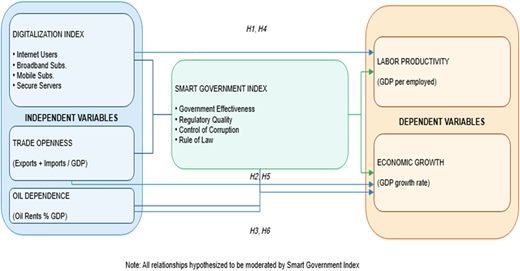
The Digitalization Index used in this research captures these mechanisms through indicators of penetration written in ICT infrastructure: internet users (information access); broadband subscriptions (connectivity quality); mobile subscriptions (accessibility) and secure internet servers (digital commerce). When numbers are bigger, we can carry out more economic activity through digital means.
Mechanism 2: Smart Governance as Moderator
The economic impact of digitalization is influenced by the quality of governance through institutional complementarities. As per North (1990), good institutions create more predictability, less risk, and lower transaction costs. In terms of digital transformation, strong governance can convert digital infrastructure into productivity gains by: (1) creating regulatory frameworks that reduce uncertainty over investment; (2) reducing the regulatory burden on businesses through transparency in government services; (3) developing the institutional capacity essential to implement and adapt policy and (4) getting accountability mechanisms that create a better match between public investments and citizen needs.
By means of Worldwide Governance Indicators, the Smart Government Index puts into action this moderating mechanism. The indicators track several application areas Government effectiveness, regulatory quality, control of corruption and rule of law. The capacity to translate digital investments into economic outcomes is captured by these dimensions.
Mechanism 3: Structural Factors as Conditioning Variables
Trade liberalization, along with reliance on oil, impacts relationships between digitalization and growth through structural economic attributes. Exposing the domestic economy to international competition, trade openness may put pressure on firms to adopt efficiency-enhancing digital technologies. It also provides for technology transfer and knowledge spillovers. While the case of GCC is that labor imports and oil-based trade balances may not deliver standard efficiency pressures.
Dependence on oil affects the economic impact of digitalization. Countries rich in resources can suffer from a few problems. First, the Dutch disease happens. This is when the real exchange rate appreciates. This undermines the nonoil sectors' competitiveness. Further, there are consumption subsidies. These reduce productivity-enhancing investment incentives. Finally, there are labor market distortions. These limit the development of human capital. This is necessary for one to participate in the digital economy. The quality of governance determines if oil rents sustain these dynamics or finance diversification efforts and institutional capacity building.
3.1.1 Conceptual framework summary
As shown in Figure 1, the framework specifies:
Independent Variables: Digitalization Index, Trade Openness, Oil Dependence (Oil Rents % GDP)
Dependent Variables: Labor Productivity, GDP Growth
Moderating Variable: Smart Government Index
The moderating specification states that as digitalization improved, its impact on the economic outcome also improved. However, the quality of the governance also matters. Digitalization and economic performance are likely to show stronger positive relationships in countries with stronger governance mechanisms. A governance weakness may attenuate or reverse the benefits of digitalization.
3.2 Hypotheses development
Based on the conceptual model, six hypotheses are derived examining direct and moderated relationships for two dependent variables:
3.2.1 Labor productivity hypotheses
Digitalization has a significant positive impact on labor productivity, moderated by smart governance quality.
Trade openness has a significant impact on labor productivity, moderated by smart governance quality.
Oil dependence has a significant impact on labor productivity, moderated by smart governance quality.
3.2.2 Economic growth hypotheses
Digitalization has a significant positive impact on economic growth, moderated by smart governance quality.
Trade openness has a significant impact on economic growth, moderated by smart governance quality.
Oil dependence has a significant impact on economic growth, moderated by smart governance quality.
4. Methodology
4.1 Research design
The current research used a mixed-methods approach where the econometric panel analysis is combined with structured comparative case study analysis (Geremew, Huang, & Hung, 2024). The multidimensional nature of digital transformation and smart governance, particularly in the context of digital Islamic finance and regulatory compliance frameworks and the need to supplement the statistical association with configurational explanation, justify such a combination. The quantitative aspect analyses the connection between digitalization and smart government maturity, economic growth and labor productivity, whereas the qualitative part explores the condition of institutions, economy and governance factors underlying the divergent results among the GCC countries (Abou Ltaif, Mihai-Yiannaki, & Thrassou, 2024). The approach specifically examines how digital payment solutions and public–private partnerships in Islamic finance contribute to varying economic outcomes across GCC economies. The quantitative aspect also uses panel data since it is able to realize variation between variables and their impact on the economic growth of GCC economies. Moreover, panel data is also able to include cross-country heterogeneity as it is able to identify the structural issues present in diversifying Islamic economies, respectively.
By incorporating quantitative panel estimation and comparative case study research, the study addresses the weaknesses of previous research that performed only descriptive statistics and elementary regression research. This mixed-methods design therefore strengthens the empirical basis of policy assertions and the interdisciplinary breadth as by adding a quantitatively robust foundation and admitting the very heterogeneous developmental paths of GCC economies in developing digital Islamic finance ecosystems.
4.2 Sample size
The data covers the period 2008–2023 of a selection of the GCC economies, yielding around 96 country-year data points after cleaning namely Saudi Arabia, Kuwait, UAE, Bahrain, Oman, and Qatar respectively. The major data sources are the World Bank's World Development Indicators (WDI) and the Worldwide Governance Indicators (WGI); there is a separate series of Brent crude oil prices acquired in the World Bank commodity database. Two outcome dependency variables are utilized: the real GDP growth (annual %) and labor productivity (GDP per person employed, PPP constant prices).
Three main reasons exist for selecting 2008 as the study time. To begin with, 2008 was the year of the global financial crisis, which prompted remarkable policy changes toward economic diversification across GCC economies. From this period, there was systematic availability of dependable ICT infrastructure data for all six countries from international sources. The third point is that several major national vision programs defining today's digital transformation pathways were launched in 2008–2010. This serves as an appropriate baseline for various subsequent developments. As of the year of analysis, which is the most current year for which fully validated data were available for all indicators. Global databases, such as World Bank indicators, usually carry publication lags of 12–18 months for validation and standardization of countries against one another. Though 2024 data would be useful if sometimes not entirely available, their lack of quality and comparability cannot validly estimate panels. We use 96 country-year observations (six countries across sixteen years) as our final analytical sample after excluding observations missing important variables.
The qualitative component employs a structured comparative case study approach across the same group of countries in the 2005–2023 horizon. The main explanatory dimensions, i.e. digitalization including digital payment infrastructure metrics, smart governance measuring regulatory framework effectiveness, human capital, openness to trade and dependence on oil, are comparatively assessed using thematic benchmarking across the six GCC economies. The outcome condition is defined as high growth, i.e. meeting the regional top-tier in multi-year average growth rates in GDP.
This comparative approach allows the identification of different configurations of conditions associated with high performance, revealing the multiple causal pathways that are obscured by econometric models (Haesebrouck, 2022). This approach is suitable especially in areas with complex interaction between oil dependence, institutional variety and policy priorities concerning digital Islamic finance development.
4.3 Data analysis techniques
To statically analyze the relationship between the independent, dependent and moderating variables, STATA has been utilized. The tests performed were descriptive analysis, correlation, and regression. STATA was adopted due to its strong statistical package with the ability to manipulate considerable amounts of data, as well as to perform complex econometric modeling, including descriptive statistics and Arellano-Bond dynamic panel-data estimation to obtain reliable and valid results (Jann, 2021). Arellano-Bond dynamic panel-data estimation is used to assess cross-country determinants related to both GCC countries' economic growth and labor productivity. Through this analysis, variations present between GCC countries can be assessed and can be linked with their macroeconomic performance and digital Islamic finance ecosystem development.
Two main explanatory measures, a Digitalization Index and a Smart Government Index are used. The Digitalization Index is calculated as principal components analysis (PCA) of four ICT penetration indices, i.e., internet users, fixed broadband subscriptions, mobile subscriptions and secure internet servers, all standardized to allow cross-time and cross-country comparisons with additional weighting for Islamic fintech adoption indicators. The Smart Government Index, which is also established by the use of PCA, includes 4 WGI indicators of government effectiveness and quality of public services with emphasis on digital service delivery capabilities and regulatory framework strength for Shariah-compliant financial services. In combination, these compound variables represent those of technology adoption and institutional capacity, which is a core component of models of digital economies.
The framework evaluates economic performance based on two proxies, labor productivity (employment rate) and economic growth (GDP growth and inflation). The Smart Government Index is the moderator that is evaluated through indicators like government transparency, quality of public services and regulatory effectiveness in digital financial services. The Digitalization Index (internet use, broadband subscriptions, secure servers and digital payment infrastructure penetration) being the first independent variable, the second variable is Trade Openness (imports and exports as a percentage of GDP), and the last variable is the Oil Prices (Oil rents of GDP). All these proxies represent the technological, economic and governance variables that determine the performance of a country.
The variables of this study are clearly defined in Table 1.
A principal component analysis of four ICT indicators was performed on the Digitalization Index, with all variables converted to z-scores prior to extraction. The score of the first principal component (which explains about 72% of total variance) is taken to be the composite index. Likewise, it applies PCA to the 4 Worldwide Governance Indicators. The first principal component explains about 81% of the variance. This shows that it captures the overall quality of institutions, useful for capacity for smart governance.
4.3.1 Regression equation
Model 1: Economic Growth
Model 2: Labor Productivity
The Arellano-Bond dynamic panel estimator deals with endogeneity by first-differencing to eliminate fixed effects and utilizing lagged levels of endogenous variables as instruments. Model validity necessitates: (1) absence of second-order serial correlation in first-differenced residuals (AR(2) test) and (2) validity of overidentifying restrictions (Sargan/Hansen test). Diagnostic statistics are reported with estimation results.
Panel data is immensely helpful, as it moves beyond a single snapshot or cross-section, allowing for an analysis of change over time. This means it is possible to see how digital Islamic finance policies and regulatory frameworks change and, importantly, how their cumulative effects produce a change in economic performance across various institutional contexts. Although this research is smaller in scope, it provides a basis for future research to expand on the usefulness of panel data in examining digital governance and economic development in Islamic economies.
5. Results
5.1 Descriptive statistics
As illustrated in Table 2, the heterogeneity of economic structures and the capacity of institutions are both highly variable among the six GCC countries. There is already a high level of trade openness (mean = 1.10 × 10¹¹) that is, at the same time, spread unevenly along with Kuwait, UAE, Qatar, and Saudi Arabia. For the Smart Government Index, there is a high level of variation (−1.52 to 3.90), while the Digitalization Index shown in Table 2 ranges from −2.48 to 3.70. Saudi Arabia, Qatar, Kuwait, and the UAE perform well with respect to governance capacity and ICT infrastructure, while Oman and Bahrain have lower government capacity and development in ICT and show signs of having significantly weaker institutional depth and pace of adoption of digitalization in their economic diversification strategies.
5.2 Arellano-Bond dynamic panel-data estimation
The results of the Arellano-Bond dynamic panel-data estimation controlling for endogeneity and persistence in economic performance are presented in Table 3. This information reveals small determinants of labor productivity and economic growth within the six GCC countries: digitalization, smart governance, trade openness and dependence on oil. Cross Country Digitalization growth patterns are shown in Table 4.
The stacked labor-productivity and GDP-growth equations reveal three distinct clusters of development in the GCC sample that are otherwise obscured by pooled averages. Qatar and the UAE appear as prominent cases of digital growth: in Qatar, the moderation-free labor productivity model indicates that a unit improvement in the Digitalization Index increases productivity by 0.33 units (p < 0.02), while the Oil Index has a negative productivity drag (−0.35, p < 0.01), confirming that hydrocarbon rents can crowd out productivity where governance or diversification pressures are weak. The DigiXSmartGov term for Qatar has a slight negative interaction with Smart Government, yet the direct Digitalization Index is still positive, suggesting that governance capacity has already reached a threshold where bureaucratic growth offers lower marginal utility than developing the nation's digital infrastructure.
The UAE is expressing a similar pattern. The Digitalization Index adds 0.39 additional units to labor productivity (p ≈ 0.04), and the DigiXSmartGov interaction term adds an additional 0.85 (p ≈ 0.05), representing the strongest governance–digitalization complementarity in the sample. Both countries also show negative lagged dependent coefficients, indicating the convergence toward a steady-state equilibrium attributed to cloud-first strategies, expatriate human capital and FinTech-friendly regulatory sandboxes.
In contrast, Saudi Arabia and Kuwait exhibit variable outcomes. Saudi labor productivity reveals substantial statistical evidence of autoregressive persistence (0.58–1.01, depending on specification), suggesting that lagged capital-deepening and saudization processes outweigh any changes in the current period. The Digitalization-index is a positive but statistically insignificant coefficient under moderation, while oil rents also indicate no meaningful effect, suggesting countercyclical fiscal rules are partly sterilizing the effect of oil shocks. In contrast to Saudi Arabia, Kuwait is demonstrating a persistent rentier effect; Oil Index is positive in all labor productivity specifications and nearly doubles (0.07 to 0.16) with the Smart Government interaction, which indicates governance mechanisms currently amplify, rather than dampen, dependency on oil revenue. There is also evidence, although negative in growth regressions, that broadband penetration displays similar tendencies regarding its historical rollout of this infrastructure, as it is still heavily based on consumption subsidies instead of smart productivity investments.
Both Bahrain and Oman are ranked toward the weaker side of the scale. In relation to labor-productivity regressions, Bahrain shows a statistically significant negative autoregressive coefficient (−0.66 in the moderated model), suggesting that the traditional sectors are losing jobs more rapidly than are the digital sectors creating jobs. None of the coefficients related to governance or digitalization reached statistical significance, indicating the cloud-first e-services reforms in Bahrain have yet to generate productivity improvements in private sector jobs. Oman demonstrates the greatest trade-off in my analysis of digital or governance use: Trade Openness reveals large positive coefficients (1.89–3.38) and the Digitalization Index is consistently negative (−0.38 without moderation; −0.61 with moderation). This indicates that the expansion of ICT has a negative relationship with productivity, which reflects the binary labor market structure, where small to medium enterprises are burdened with compliance obligations of digital adoption and larger organizations are using trade for logistics.
5.3 Comparative case study analysis
This section uses structured comparative case study logic to explore how configurations of conditions, digitalization infrastructure, governance quality, trade integration and oil dependence cause diverging outcomes across GCC countries. The analysis shows how conditions combine rather than estimating independent effects, which shows the different ways of achieving economic performance. Countries are grouped because of structural similarities to allow systematic comparison within-pair and between-pair.
5.3.1 Bahrain and Saudi Arabia
Both Bahrain and Saudi Arabia display policy ambition, with digital transformation becoming a strategic theme in national development agendas. Bahrain's migration to a cloud-first policy and e-government services, as a component of its roadmap for Digital-First, may create opportunities to modernize service delivery while improving financial inclusion. (Zygiaris & Maamari, 2023). Regression results, however, illustrate that while internet usage and secure servers contribute positively to GDP growth, governance-related variables that reflect transparency and service quality remain negative or not significant. These incongruities convey that while digital desire is advancing more quickly than institutional capacity, the benefits are uneven (Al Malki & Durugbo, 2023).
A comparable trend exists in Saudi Arabia under Vision 2030. The regressions demonstrate a positive and modest relationship between internet use, integration into trade, oil rents and growth, but overall significance remains limited. This suggests a process of partial decoupling, as the structural reforms are starting to take hold, but are still tightly bound by governance constraints (Bilal, Alawadh, Rafi, & Akhtar, 2024). However, as in Bahrain, the quality of services is cited as a limiting factor and this can only indicate governance bottlenecks contributing to failure to gain digital potential (Shaikh, Irfan, Nomran, & Ratnakaram, 2024). Taken together, both cases highlight the risk of policy outpacing institutional depth, where aggressive digital strategies create momentum but sustainability is questioned without simultaneous governance reform.
5.3.2 Kuwait and Oman
Cases of Kuwait and Oman bring out the issues of slow institutional reform of resource-dependent economies to adopt digitalization. In Kuwait, the regression results indicate that oil rents are the key growth determinant, followed by broadband penetration, which had a negative growth relation (Kwatra, AlNaimi, & ALGhunaimi, 2025). Such counterintuitive results suggest that, despite digital infrastructure being deployed inefficiently with high cost and slow diffusion limiting productivity impact, the digital road is still worth taking. Governance indicators also remain weakly rational, suggesting that institutional inertia still dilutes digital investment's transformative effect.
Oman represents a case in the middle ground. Regression results show that trade and oil are dominant drivers of growth, while digitalization possessed limited positive influence. This is consistent with Oman’s Vision 2040 and National Programme of Digital Economy, which maximizes focus on digital inclusion, but with slow implementation due to low internet adoption levels and modest broadband diffusion (Li, Bao, & Wang, 2025). Indicators of transparency – small but meaningful indicate only gradual improvement in transparency. This mixed performance highlights how policy intent has yet to transform into broad uptake and transformation, leaving Oman in a transitional phase of digital economy development.
5.3.3 Qatar and UAE
Qatar and the UAE are the front-runners in terms of digital economy in the GCC region as they are much more firmly established in development strategies (Asmyatullin & Glavina, 2025). The key drivers of the results in Qatar can be attributed to robust positive performance of trade, oil rents, broadband and government efficiency that indicates the strength of the smart infrastructure and reformation of government (Neffati, 2025a). But the negative relationship between service quality and labor force participation on the one hand and growth on the other hand indicates incompatibilities between infrastructural enhancement and employment of human capital (Hussain, Iqbal, Khan, Khan, & Arafat, 2022). This indicates that though Qatar's governance structures are enabling, in contrast are also focused on the alignment of the labor market and efficiency of services to ensure that it can gain the full advantage of digital dividends.
The UAE constitutes the most sophisticated model, where the concept of digitalization has been institutionalized and mainstreamed into longer-term competitiveness strategies. Regression results indicate that internet usage, trade, and oil rents were significant drivers of GDP, while governance and transparency variables showed limited incremental significance, which is prorated to the fact that institutional preparedness has been internalized. In other words, the UAE's growth is not dependent, as transitional states, on incremental improvements in governance, but rather on the strength of its digital infrastructure, diversification policies, and an integration of Islamic fintech ecosystems (Al Sulaity, Yourston, Khassawneh, & Darwish, 2025). This positions the UAE as a leader in shaping regional digital transformation and as a benchmark for future policy coherence in GCC digital economies (Crupi & Schiliro, 2023).
6. Discussion and conclusion
The results of the regression analysis show that the quality of governance is the principal variable in the economic and productivity trajectories of the GCC economies. The implications of this conclusion, notwithstanding that hypotheses were not statistically significant for most cases, are useful, both for theory and policy. There was only a weak statistical effect for the Digitalization Index as it related to labor productivity. This indicates that digitalization by itself does not necessarily lead to efficiency. But as indicated by the smart governance index, there was a positive & substantial moderating effect (p = 0.092), confirming that governance capacity is a key factor. This would therefore suggest that digital tools and platforms do not create efficiency, accountability and equal access unless they are situated within, and supported by, strong institutions.
The UAE's governance-digitalization complementarity (interaction coefficient 0.85) signifies positive institutional synergies: strong governance drives digital adoption and positively promotes the productivity effects of digitalization. In Kuwait and Oman, governance mechanisms amplify oil dependence instead of enabling diversification. The theoretical implication is that institutional quality does not act simply as a prerequisite but rather as an amplifier that can either enhance or negate the economic impact of digital transformation.
This governance-as-amplifier mechanism operates through several institutional channels specific to each country context. In the UAE, the integration of 6,000 digital services through UAE Pass, combined with 85% citizen satisfaction rates (Alsakhnini & Almoaiad, 2024), demonstrates how institutional depth converts digital infrastructure into measurable service delivery outcomes. The Saudi Absher platform, while processing over 500 e-government services, reveals that only 40% of residents actively use digital feedback tools despite 99% internet access, indicating that institutional capacity for citizen engagement – not technology availability – constrains the digitalization-productivity relationship. In Bahrain, the cloud-first e-services reforms have yet to generate private sector productivity improvements because the institutional framework for translating public-sector digital efficiency into private-sector adoption remains underdeveloped.
Similarly, trade openness reveals a subtle interaction between structural dependence and institutional quality. Trade openness alone produced a negative effect on labor productivity, reflecting GCC reliance on imported labor, foreign expertise and oil-dominated trade balances (Al Abri et al., 2023). However, when taken in conjunction with governance, it is deemed complicated. In economically stable countries like the UAE, Saudi Arabia, Kuwait and Qatar, trade openness has been augmented with regulatory controls and specific efforts in terms of diversification that could address the downsides. This implies that where trade reduces productivity in a poorly governed environment, there is a likelihood that well-established institutions will shift openness to achievements in competitiveness and efficiency.
The function of oil rents also lends support to the resource curse proposition. Economic growth has a negative correlation with oil dependence but is positively associated with labor productivity, and oil rents are marginally significant for growth (p = 0.059). Governance emerges as a key factor at this juncture: where governance is strong, oil rents are transformed into sovereign wealth funds, infrastructure, and diversification projects (like in Qatar and the UAE). Where governance is weaker, as in Bahrain and Oman, oil rents do not encourage structural transformation.
Concerning economic growth on a broader level, digitalization had a positive but statistically insignificant impact. This indicates a lag in the investment in technology along with the macroeconomic response to it. ICT infrastructure, innovative government platform, and digital financial system have been heavily invested in GCC countries, but are not reflected as growth drivers (Awad & Albaity, 2024). The openness to trade also presented weak power to explain, and this aspect is based on the structural truth that the GCC trade is very much oil-reliant and, as a result, oil is in a volatile state. Conversely, the impact of oil rents remains significant in the growth trends but reliance of the region on hydrocarbons.
Although the findings lack some inconsistencies to explain the sustainability of the proposed elements of the narrative of governance as a moderator, they are restricted by methodological and contextual aspects. The dataset of GCC countries is very limited (only six), and the statistics are only from 2005 to 2023, which limits statistical power. The between-effects regressions are based on the averages of countries, and thereby the variance is lower, and the ability to establish significance becomes low.
It further establishes whether large and small companies have regulatory loopholes and asymmetric digital adoptability, which explains why digitalization is not statistically relevant in our model. Correspondingly, case-based research conducted by van der Giessen and Bayerl (2022) on e-government in Saudi Arabia indicates that governance reform is one of the fundamental conditions for e-governing digital tools to become real and potentially have a real economic and social change and effect. Digitalization cannot be productive without a strong governance structure that makes digitalization more of a technological format rather than a form of productivity.
Concerning the labor market, Bousrih, Elhaj, and Hassan (2022) document that the digitalization of economies in the GCC is yielding a two-paced workforce, i.e. large firms and households capitalizing on the efficiency advantages, while small business leaders are experiencing delays (Song, Ngnouwal Eloundou, Bitoto Ewolo, & Ondoua Beyene, 2024). Case studies confirm our inference that governance has a moderating influence on the openness-productivity nexus.
The current research findings indicate that the GCC is at an institutional crossroads and findings affirm that digitalization and trade openness are not necessarily productivity/growth-enhancing without governance as a determining factor. The conclusion is further backed by evidence that states that whether hydrocarbons can translate to sustainable development is dependent on the quality of governance.
This synthesis is represented in hypothesis testing. H2 (trade openness and personnel output): H6 (oil rents and the economic growth): The results are conditional support, provided with effective governance regimes only. Intercepts: H1, H3, H4, and H5 are not statistically rejected and their coefficients are in the expected direction. This finding demonstrates the difference between statistical rejection and theoretical contribution: governance is the process that makes structural drivers fulfill their transformational role or expose attributes of vulnerability.
UAE and Qatar prove that governance and digitalization complement one another. Qatar must continue diversifying as oil productivity has a negative correlation. The policy-institution gap exists in both Saudi Arabia and Bahrain. In these two countries, infrastructure development has outrun institutional capacity. In order to succeed, we need governance reforms including regulatory effectiveness, citizen engagement, institutional accountability and continued investment. Kuwait and Oman have governance mechanisms serving to reinforce rather than transforming resource dependencies. To succeed at digital transformation, institutional frameworks must traverse from accommodating resource-based development to restructuring them.
The divergence between pooled insignificance and country-specific significance can be explained through institutional heterogeneity. In the pooled sample, the effects of digitalization, trade openness and oil dependence are averaged across six structurally different economies, which masks opposing directional effects. For instance, digitalization positively drives productivity in the UAE (coef. = +0.39, p < 0.05) and Qatar (coef. = +0.33, p < 0.02), where advanced ICT infrastructure is complemented by strong governance frameworks and diversified economic bases. In contrast, Oman exhibits a negative digitalization-productivity relationship (coef. = −0.38), reflecting a binary labor market where digital adoption burdens SMEs while larger firms rely on trade logistics. When these opposing effects are pooled, they cancel out, producing nonsignificant aggregate coefficients. Similarly, oil dependence shows a positive rentier effect in Kuwait but a negative productivity drag in Qatar, reflecting fundamentally different institutional responses to resource wealth. This pattern is consistent with institutional economics theory (North, 1990; Acemoglu & Robinson, 2012), which predicts that identical inputs yield divergent outputs depending on the quality and configuration of complementary institutions.
The three development pathways identified in this study – Digital Leaders (UAE and Qatar), Policy Pioneers (Saudi Arabia and Bahrain) and Transitional Economies (Kuwait and Oman) – emerge from distinct configurations of institutional capacity, governance quality and resource dependence. Digital Leaders are characterized by strong governance-digitalization complementarity: the UAE's interaction coefficient of 0.85 indicates that governance institutions actively amplify the productivity effects of digital investment, consistent with the institutional complementarity thesis (Acemoglu & Robinson, 2012). These countries have established regulatory sandboxes, FinTech-friendly frameworks and Shariah-compliant digital platforms that create self-reinforcing cycles of institutional and technological upgrading. Policy Pioneers, by contrast, exhibit a policy-institution gap: ambitious national visions (Saudi Vision 2030; Bahrain Vision 2030) have driven substantial digital infrastructure investment, but governance indicators – particularly regulatory effectiveness and citizen engagement – lag behind technological deployment. The mechanism here is one of institutional sequencing: digital infrastructure has been prioritized ahead of the governance reforms needed to translate it into broad-based productivity gains. Transitional Economies represent a distinct configuration where governance mechanisms reinforce rather than transform resource dependencies. In Kuwait, the Smart Government interaction doubles the oil rent coefficient (from 0.07 to 0.16), indicating that existing institutional frameworks channel digital investment toward sustaining the rentier economy rather than diversifying away from it. This is consistent with the resource curse literature, which identifies institutional lock-in as the primary mechanism through which resource wealth inhibits structural transformation.
6.1 Concluding remarks
The GCC Islamic economies were analyzed using mixed-methods research for their digitalization and smart government policies. A comparative case study analysis revealed three pathways: the UAE and Qatar as digital leaders, where governance and digitalization are complementary; Bahrain and Saudi Arabia as policy pioneers, where ambition overtakes institutional capacity; and transitional economies Kuwait and Oman, where the governance system reinforces oil dependency. The research confirms that digitalization is not enough for economic transformation, but the quality of governance is. Digital leaders should maintain complementary institutions. Policy leaders must prioritize the governance reform agenda alongside a digital investment agenda. Transitional economies must reroute governance to diversification, not resource reinforcement. These results are in line with the Islamic Economic Principles, which stress the importance of institutional justice and balanced development as the prerequisites for sustainable growth in a digital transformation architecture.
7. Implications, limitations and future research
Based on the empirical findings and comparative case study analysis, several actionable policy recommendations emerge that are explicitly linked to ongoing national strategies. For Digital Leaders, the UAE should leverage its strong governance-digitalization complementarity to expand the Abu Dhabi Global Market (ADGM) regulatory sandbox for Shariah-compliant FinTech, integrating AI-driven compliance monitoring as outlined in the UAE Centennial 2071 strategy. Qatar should address the negative oil-productivity relationship by accelerating TASMU Smart Qatar's third phase, specifically targeting labor market alignment through digital skills certification programs tied to the National Vision 2030 human capital pillar. For Policy Pioneers, Saudi Arabia should bridge the governance-digital gap by strengthening the Saudi Data and AI Authority (SDAIA)'s mandate to include institutional effectiveness audits of digital government services, ensuring that Vision 2030's digital objectives are matched by measurable governance outcomes such as regulatory response times and citizen feedback integration. Bahrain should complement its cloud-first e-government reforms with targeted capacity building for the Central Bank of Bahrain's FinTech Unit, establishing formal institutional mechanisms – such as a Digital Governance Coordination Committee – to bridge the gap between digital investment and governance capacity as envisioned in Bahrain's Economic Vision 2030. For Transitional Economies, Kuwait should restructure its New Kuwait 2035 implementation framework to decouple digital investment from oil-sector reinforcement, establishing an independent Digital Economy Authority with a mandate for nonoil productivity measurement. Oman should prioritize SME digital adoption support under Vision 2040's National Programme for Digital Economy, specifically addressing the compliance burden that currently makes ICT investment counterproductive for smaller enterprises.
The study adds to the literature on digitalization, smart government action and economic growth by analyzing their joint effects in the context of GCC countries. Distinct from the previous studies with a focus on the Western economies in general, or single-country analyses, this study attempts to do an across-country examination of GCC economies, showcasing how the institutional settings and macroeconomic conditions can moderate the relationship between digitalization and economic growth. Findings from this research present new evidence that is contradictory to the idea that digitalization will inherently promote economic performance, demonstrating instead that governance quality of states, regulatory framework and the maturity of an institution can all be considered moderating variables in the relationship.
In practical terms, the study provides useful advice for policymakers, industry leaders, and financial regulators related to GCC countries. The best economic results will happen when digitalization initiatives are matched with a solid regulatory environment, and individuals have the digital literacy and infrastructure support required. However, the experience of these countries is not homogeneous: countries with advanced infrastructure – UAE, Saudi Arabia, Kuwait and Qatar – can focus on both AI governance and scaling-up FinTech offerings, while Oman and Bahrain should concentrate on progressing digital literacy along with reinforcing regulatory systems. Such insight provides theoretical support and related practical policy recommendations within sustainable growth potential for the Islamic economic system.
7.1 Limitations and future research directions
Several limitations merit acknowledgment. To complete the analyzed datasets, future researchers should employ datasets from 2024 when these potential international packages are reported or delivered. The six-country sample, while appropriate for the regional focus, limits the statistical power of the study and its generalizability. Additional countries like Malaysia, Indonesia and Turkey would add to the ability to compare and enhance insights. The comparative case study analysis, thirdly, employs structured configurational logic rather than formal quantitative techniques such as fsQCA. Future studies with larger samples could implement formal fsQCA with the appropriate calibration to validate these configurational findings. Moreover, the composite indices, although methodologically grounded, may mask important differences in the dimensions; disaggregated analysis could show which capabilities affect the outcome most.