


This study investigates the factors influencing the trialability and behavioral intentions toward Digital Yuan, also known as e-CNY, which is the first central bank digital currency (CBDC) in China. The present research also examines the mediating effect of attitude and the moderating effects of perceived trust and self-efficacy in the model.
This paper is embedded in the diffusion of innovation (DOI) theory, which was again supplemented by the UTAUT2 and the theory of planned behavior (TPB). We collected data using a self-administered structured questionnaire and examined 289 valid samples using a structural equation model.
The results indicate that compatibility, observability and effort expectancy significantly influence trialability, which in turn significantly impacts the attitudes of e-CNY users. Together, price value and attitudes considerably impact behavioral intentions toward e-CNY. In addition, attitudes significantly mediate between trialability and behavioral intentions and the relationship between attitude and behavioral intention is moderated by perceived trust.
This study will help FinTech regulators and practitioners broaden their knowledge base around CBDCs, subsequently assisting them in crafting precise strategies for fostering e-CNY acceptance.
The uniqueness of this study lies in its simultaneous examination of the factors affecting trialability, attitude and behavioral intention about CBDCs.
1. Introduction
The landscape of financial transactions is swiftly evolving due to technological advancements. The surge in e-commerce has heightened the need for digital transactions (Auer et al., 2021). According to Nejad (2016), there are typically two main paths for developing digital currencies: cryptocurrencies and CBDCs. Digital payment systems like cryptocurrencies have risen due to blockchain technology (Nejad, 2016), and these events have prepared the ground for the remarkable rise of CBDC. CBDC signifies the digitized form of traditional currency issued by a central bank (Bijlsma, van der Cruijsen, Jonker, & Reijerink, 2024). In essence, CBDC functions as an electronic counterpart to cash, facilitating the purchase of goods and services.
CBDC is characterized as a legally recognized currency, which envisions a system that does not hold reserves as separate entities but are integrated into the CBDC framework (Kumhof & Noone, 2021). According to a survey on central banks, approximately 10% of the same plan to introduce a publicly accessible CBDC shortly, corresponding to about 20% of the global population (Boar, Holden, & Wadsworth, 2020). Aligning with this, the e-CNY is currently undergoing testing in various cities within China, positioning it as a strong contender to become the first significant CBDC available in the market. This empirical research, focusing on the e-CNY, investigates the complex interconnections between factors influencing stakeholders’ viewpoints and choices regarding its acceptance.
“Trialability” refers to the willingness of individuals and businesses to experiment with and evaluate the e-CNY as a substitute form of currency. “Attitude” encompasses the overall assessment of the perceived benefits and drawbacks of the e-CNY. At the same time, “behavioral intention” pertains to the inclination to incorporate and employ e-CNY for practical transactions. However, a significant knowledge gap exists concerning the precise determinants affecting trialability, attitude and behavioral intention toward the e-CNY. Although prior works addressed the general frameworks, technological facets and potential policy ramifications of CBDCs, only a limited number of empirical investigations have specifically delved into stakeholders’ perspectives and choices relating to the e-CNY. The existing research has yielded valuable insights into the broad factors shaping the adoption of digital currencies, including cryptocurrency and CBDC. Dyhrberg’s (2016) research, for instance, identified elements such as perceived advantages, trust and ease of use as crucial factors influencing individuals’ intention to embrace cryptocurrencies like Bitcoin. Moreover, past researchers explored the feasibility of the technology in promoting financial inclusivity and its potential impact on monetary policies for digital currencies, specifically for Bitcoin (Abramova, Böhme, Elsinger, Stix, & Summer, 2022). Roussou, Stiakakis, and Sifaleras (2019) stressed the role of perceived security, usefulness and compatibility in heightening cryptocurrency adoption.
A recent study by Ozili (2024) refuted the notion that the global demand for cryptocurrency use and sustainable development encourages individuals’ willingness to use CBDCs. Prior investigations on CBDCs particularly focused on how privacy issues, task–technology fit (TTF), government support and perceived behavioral control trigger the CBDC adoption intention among the prospective users (Tronnier & Qiu, 2024; Xia, Gao, & Zhang, 2023; Radic et al., 2022). Furthermore, prior research has yet to substantially investigate the potential mediating influence of attitude and the moderating roles of perceived trust and self-efficacy in shaping the intent to adopt CBDCs like e-CNY. For instance, Xia et al. (2023) used the TTF model and the push–pull–mooring framework (PPF) to show that TTF acts as a mediator in their research. Additionally, Söilen and Benhayoun (2022), utilizing the UTAUT and institutional trust theory, demonstrated the mediating effect of perceived trust within the context of CBDC. Also, Wu et al. (2022) looked at the UTAUT model and found that the perceived value that comes from using CBDCs acts as a mediator in the system. In contrast, Radic et al. (2022) did not incorporate any mediating variables in their model but identified that usage intention differs across various CBDCs, including the Digital US Dollar, Digital Won and e-CNY.
Given the aforementioned literature reviews in the CBDC domain, the following gaps have become apparent: (1) previous assessments failed to substantiate their arguments by deploying the DOI theory within the CBDC context; (2) they also overlooked how the DOI theory influences the CBDC trialability intention; (3) as far as we know, no prior research investigates how attitude might mediate the connection between trialability and behavioral intention and (4) how perceived trust and self-efficacy might moderate these connections. Therefore, to address the issues at hand, this empirical investigation aims to answer the following research questions:
What primary determinants impact the e-CNY trialability intentions?
How do trialability, attitude and behavioral intention mutually influence one another?
Does attitude play a mediating role in the relationship between trialability and behavioral intention toward the e-CNY?
How do trust and self-efficacy moderate the impact of trialability on behavioral intention?
The study bears significant implications for policymakers, financial institutions and proponents of digital currencies. Gaining insights into the factors shaping trialability, attitude and behavioral intention aids policymakers in crafting precise strategies for fostering e-CNY acceptance. Financial institutions can align their services accordingly, ensuring a seamless integration process. Additionally, this research advances the understanding of CBDCs, providing valuable insights into their impact on the global monetary system. Ultimately, this empirical study enriches our understanding of CBDC adoption dynamics, paving the path for a more inclusive and technologically advanced financial future.
2. Review of literature
2.1 Theoretical grounds and hypotheses development
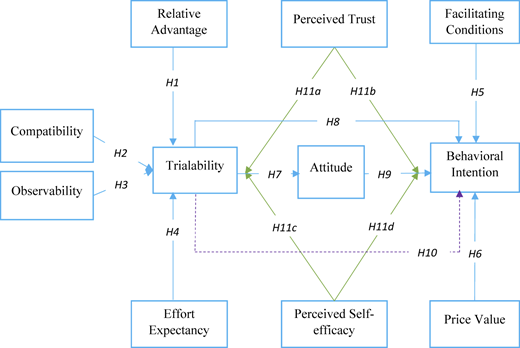
Viewing digital currency as an emerging innovation, the present framework endeavors to assess the interplay between perceived innovation characteristics, including the trialability and intention to use e-CNY. The current model also weighs the adopters’ behavioral intention via the intervening effects of attitude, perceived trust and self-efficacy. Multiple theoretical frameworks could be suitable for discerning the factors influencing successful adoption and intention to use e-CNY. For instance, the DOI theory postulates that five perceived innovation features, including relative advantage, compatibility, complexity, observability and trialability impel individuals to plan their adoption and usage patterns of an innovative idea (Rogers, 2003). Past reviews revealed that any functional outcomes emanated from assessing any innovative service to enhance potential users’ commitment and intention to adopt the full version of the same (Lin & Bautista, 2017; Rogers, 2003). Therefore, the present research considers relative advantage, compatibility, observability and effort expectancy as the entryways for the trialability of e-CNY to the behavioral intention among Chinese users. Table 1 encapsulates the current study’s assessment of recent research on CBDCs.
Comparison of the present study with the recent literature reviews on CBDCs
| Author (year) | Country | Theory used | Mediating mechanism(s) | Moderating condition(s) | Key findings |
|---|---|---|---|---|---|
| Tronnier and Qiu (2024) | China | APCO Model, TTF theory | N/A | N/A | Self-efficacy, perceived vulnerabilities and control affected privacy concerns, which, together with TTF and government participation, influenced e-CNY adoption |
| Ozili (2024) | China, Nigeria, Eastern Caribbean, Bahamas | Schumpeter’s Theory of Innovation, Romer’s Innovation-Growth Model | N/A | N/A | The global fascination with cryptocurrencies and sustainable development influences the worldwide interest in CBDCs, such as e-CNY, e-Naira, D-Cash, and Sand Dollar |
| Xia et al. (2023) | China | PPF, TTF | Relative advantage, TTF | N/A | Privacy issues, TTF, users’ payment preferences, and governmental support positively influence CBDC users’ adoption intention. Furthermore, TTF was confirmed as a mediating mechanism in the model |
| Söilen and Benhayoun (2022) | Asia, Europe, USA, Africa, Oceania | UTAUT, Institutional Trust Theory | Trust | Age, gender, experience | Performance expectancy and social influence significantly impact the behavioral intention. Trust was also recognized as a mediating tool in the model |
| Radic et al. (2022) | China, Korea, USA | TPB | N/A | Type of CBDCs (Digital US Dollar vs Digital Won vs e-CNY) | Attitude, perceived behavioral control, perceived risk, and relative advantage are the critical factors of CBDCs adoption intention. Besides, the usage intention changes across different types of CBDCs |
| Wu et al. (2022) | China | UTAUT | Perceived value | N/A | Financial knowledge, perceived value, perceived convenience, and openness to innovation are the significant predictors of intention to use CBDC. Perceived value is also a critical mediating mechanism in the model |
| The present study | China | DOI, UTAUT, TPB | Attitude | Trust, self-efficacy | Compatibility, observability, and effort expectancy drive trialability, which in turn significantly influences users’ attitudes and behavioral intentions towards e-CNY. Moreover, attitudes and perceived trust exert intervening effects within the model |
Note(s): APCO stands for Antecedent Privacy Concerns and Outcomes model and N/A refers to not applicable
Source(s): Authors’ own design based on literature reviews
Besides, we have extracted three constructs from the UTAUT2 for our integrated framework because UTAUT has turned up as a fundamental theory for adopting any innovative service (Venkatesh, Morris, Davis, & Davis, 2003). The original UTAUT framework came up with four constructs: performance expectancy, social influence, effort expectancy and facilitating conditions. Subsequently, following the continuous variation in innovations, Venkatesh, Thong, and Xin (2012) added three new variables (i.e. price value, habit and hedonic motivation) to the original UTAUT model. Among these seven constructs, we have added just three variables: effort expectancy, facilitating conditions and price value to our model. We have excluded the rest of the four variables from our model for the following reasons. Firstly, we choose relative advantage over performance expectancy because previous studies (e.g. Jilani, Moniruzzaman, Dey, Alam, & Uddin, 2022; Lin & Bautista, 2017) identified relative advantage as a key precursor to trialability, a vital component in the proposed model. Furthermore, while examining the elements of relative advantage and performance expectancy, we ascertain that these two ideas are analogous. Our primary emphasis on the DOI theory leads us to favor relative advantage over performance expectancy.
Secondly, we have omitted social influence from the present model because we think that self-awareness results in continuous adoption of innovative products like digital currency that genuinely align the users’ personal values and needs with their present lifestyles. Whereas, the products shaped by only social trends without self-awareness may be swiftly abandoned because social influence can sometimes compel the users to make decisions which perhaps misalign with their personal goals. Finally, we ignored habit and hedonic motivation because these are generally used for exploring social networking sites like Facebook and YouTube, which gratify the users’ entertainment needs. For instance, Hossain, Amin, and Jahan (2022) revealed that hedonic motivation and habit are the strong drivers of adopting Facebook. The final theory we have integrated into our model is theory of planned behavior (TPB), which was developed by Ajzen (1991), focusing on the theory of reasoned action. TPB centers on the influence of users’ attitudes on their behavioral intention toward any products or services. Correspondingly, TPB was validated in digital payment domains, such as cryptocurrencies (Yoo, Bae, Park, & Yang, 2020). Given the above discussions, we have propounded a hypothesized-based conceptual framework stated in Figure 1.
2.1.1 Trialability and its antecedents
Trialability is noticed as how an innovative product is examined with few consumers before fully introducing the same in the market (Rogers, 2003). It allows people to use a prototype of the innovation without incurring any upfront costs (Rogers, 2003). Some relevant studies (e.g. Lin and Bautista, 2017) revealed that people do not feel eager to fully adopt an innovation if they cannot use its trial version free of cost. Trialability experiences may stem from several innovation characteristics, including relative advantage, compatibility, observability and effort expectancy. Relative advantage refers to how the users of an innovative idea perceive it as more beneficial than the existing one in improving their lives (Rogers, 2003). Past studies indicated relative advantage to be a significant antecedent to innovation adoption (Lin & Bautista, 2017). e-CNY is grounded in a distributed ledger system, which does not need any intermediaries to carry out banking transactions, allowing the users to settle their daily transactions more efficiently (Kraiwanit & Limsakul, 2022). Overall, e-CNY might foster the economy of a country by bringing the historically underprivileged people under the umbrella of the banking system.
Compatibility is conceptualized as how a new technology is aligned with the values, needs and experiences of potential consumers (Rogers, 2003). Innovations with higher compatibility have a higher possibility of being fully adopted by the potential users (Lin & Bautista, 2017). For instance, people have adopted mobile phones so quickly because this technology is highly consistent with their personal values and lifestyles (Katz, 2008). Observability denotes to how the expected outcomes of an innovative product are perceptible to its potential users (Rogers, 2003). e-CNY and its enabling platforms like Alipay and WeChat Pay can be observed, downloaded and used on mobile phones, making the e-CNY relatively observable. High observability of digital platforms will certainly intrigue people to use them on a trial basis (Lin & Bautista, 2017).
Effort expectancy is defined as how consumers of an innovative idea perceive it as effortless (Venkatesh et al., 2003). Effort expectancy, in the domain of technology, also supports the concepts of ease of use and complexity. If the innovations are complex to use, the potential consumers will deter from adopting the trial version and continuing the same (Komenda et al., 2020). Lin and Bautista (2017) performed a study on 295 university students using mHealth apps in Singapore, revealing that observability significantly influences trialabilty. Another research by Jilani et al. (2022) recognized that compatibility, effort expectancy, relative advantage and observability influence the trialability intentions. Therefore, we can also expect the following hypotheses to be postulated:
Relative advantage will positively influence the trialability of e-CNY.
Compatibility will positively influence the trialability of e-CNY.
Observability will positively influence the trialability of e-CNY.
Effort expectancy will positively influence the trialability of e-CNY.
2.1.2 Facilitating conditions and behavioral intention
Behavioral intention toward e-CNY is defined as how consumers plan to use the services and continue the same. Behavioral intention to use e-CNY may be influenced by a bunch of individual and innovation characteristics. For example, facilitating conditions, defined as how consumers believe that their technical knowledge, skills and resources are available to aid them in using the service, positively affect the adoption of new technology (Venkatesh et al., 2003). Individuals’ knowledge about digital currencies like Facebook’s Libra will influence their acceptance of the services (Kraiwanit & Limsakul, 2022). Söilen and Benhayoun (2022) demonstrated that facilitating conditions significantly influence the usage behavior of CBDCs. Moreover, Tamphakdiphanit (2020) reported that facilitating conditions intrigue Thai people to use cryptocurrency services. Given the aforementioned investigations, the following hypothesis is propounded:
Facilitating conditions will positively influence the behavioral intention toward e-CNY.
2.1.3 Price value and behavioral intention
One important aspect influencing how consumers utilize new technology is price value. People evaluate the alleged advantages of CBDCs against the related expenses, including transaction fees, exchange rates and other hazards. Empirical evidence (e.g. Jilani et al., 2022; Octavius & Antonio, 2021) repeatedly indicated that customers are more inclined to adopt and continue utilizing technology services if they perceive them to be cost-effective. Venkatesh et al. (2003) found that perceived value for money was a significant predictor of users’ intention to adopt information technology. Therefore, based on the theoretical foundations and empirical evidence outlined above, it is hypothesized that
Price value positively influences behavioral intention toward the e-CNY.
2.1.4 Trialability and attitude
Trialability intention determines how an individual can test the e-CNY before fully committing to it. According to the DOI, individuals tend to adopt innovations that have received positive trials (Rogers, 2003). Positive experimental experiences with the e-CNY may enhance individual awareness and positive attitudes towards its use. Empirical research in the field of technology adoption has provided support for the relationship between trialability and attitude. For example, Chaouali, Souiden, and Ladhari (2017) found that positive trial experiences with mobile banking services led to more favorable attitudes toward the technology. Therefore, based on the DOI theory and empirical evidence, it is hypothesized that
Trialability positively influences attitude toward the e-CNY.
2.1.5 Trialability and behavioral intention
According to the DOI theory, individuals’ intentions to adopt an innovation are influenced by their experimental experience with it (Rogers, 2003). Positive trial experiences with the e-CNY may increase individuals’ confidence in its usability and benefits, leading to a greater intention to use it for future transactions. Empirical studies examining the link between trialability and usage intention have provided support for this hypothesis. For instance, Hasan et al. (2024) found that positive trial experiences with mobile payment services increased users’ intention to adopt the technology. Similarly, Jilani et al. (2022) demonstrated that trialability positively influenced users’ behavioral intention to use mHealth apps. Therefore, it is hypothesized that
Trialability positively influences behavioral intention towards the e-CNY.
2.1.6 Attitude and behavioral intention
Attitude toward the e-CNY depends on individuals’ perceived and real evaluations of the currency. In the process of having simple thoughts, actions are explained by the TPB (Ajzen, 1991) as an attitude factor having a greater impact on the consumers’ behavioral intentions. Recent research by Radic et al. (2022) has validated attitude as a critical driving factor of CBDC adoption intention. Moreover, several empirical studies examining the relationship between attitudes and behavioral intention have consistently found positive associations in various technology domains, including mobile banking (Sharma & Sharma, 2019), telemedicine services (Hossain et al., 2023) and artificial intelligence (Wang, Chen, Xiong, & Wang, 2023). The potential of acceptance of an innovative service is most broadly recognized by the consumers’ favorable attitudes toward the same (Hewavitharana, Nanayakkara, Perera, & Perera, 2021). Therefore, it is hypothesized that
Attitude toward the e-CNY positively influences behavioral intention.
2.1.7 Mediating effect of attitude
Attitude reflects positive or negative beliefs that impact one’s decision to adopt a behavior (Venkatesh et al., 2003). Jilani et al. (2022) claimed that when people have a positive attitude toward the relevant technology, they are more likely to engage in a behavior. Trialing new technologies, like CBDCs, allows individuals to experience their features, benefits and drawbacks, shaping their overall attitude towards the technology. Studies have shown that awareness, attitude and intention to use services, such as Islamic banking, are significantly interrelated (Ramdhony, 2013). Venkatesh et al.'s (2003) study on the UTAUT supports the mediating effect of attitudes between trialability and behavioral intention. Moon and Kim (2001) found that trialability positively influenced attitudes toward Internet banking. Thus, it is reasonable to expect attitudes to mediate the association between trialability and behavioral intention for CBDCs, such as the e-CNY. In order to add to the body of literature, we suggest the following assumption:
: The association between trialability and behavioral intention is mediated by attitudes.
2.1.8 Moderating effect of perceived trust
Perceived trust is an emotional state that arises from fulfilling actions and motivates individuals to place confidence in others (Singh & Sinha, 2020). Prior research has shown that perceived trust can serve as a significant moderating factor (Choi, Henry, Lehar, Reardon, & Safavi-Naini, 2021). Understanding the relationship between trust in cryptocurrency and the intention to use it is of great significance (Kabak & Çelik, 2020). In a study conducted by Gefen, Karahanna, and Straub (2003) that examined the acceptance of online banking services, it was shown that the association between attitudes and intent to act was moderated by trust. In the context of CBDCs, such as the e-CNY, the role of perceived trust is crucial in individuals’ decision-making process. Positive trial experiences with the CBDCs can potentially enhance individuals’ attitudes toward using the currency. The following ideas are put forward to add to the existing body of literature:
Trust moderates the association between trialability and attitudes.
Trust moderates the association between attitude and behavioral intention.
2.1.9 Moderating effect of perceived self-efficacy
Perceived self-efficacy, defined as how individuals believe in their abilities to demonstrate a certain behavior, is an influential factor in the interplay among trialability, attitudes and intention to act (Shiau, Yuan, Pu, Ray, & Chen, 2020). When users possess strong self-efficacy motivation, it can lead to an increase in their perceived usefulness and intention to adopt a technology in the future. For instance, Jilani et al. (2022) found an intervening impact of self-efficacy on the link between the usage intention and the trialability of mHealth apps. For another example, Venkatesh and Davis (2000) examined the adoption of information technology in the workplace and found that trialability positively influenced individuals’ attitudes. Similarly, Moon and Kim (2001) studied the adoption of mobile banking services. These findings displayed that the correlation between trialability, attitudes and intention to act is moderated by self-efficacy. The following assumptions are put forth to add to the body of literature:
Self-efficacy moderates the link between trialability and attitudes.
Self-efficacy moderates the association between attitude and behavioral intention.
3. Methodology
3.1 Instrument design
We used a multi-item questionnaire scale to measure the variables of our proposed model. To assure greater validity and reliability, every measuring question is taken from well-accepted literature. The measurement questions for relative advantage, compatibility, observability and trialability were collected from Moore and Benbasat (1991). This study uses existing literature for effort expectancy (Venkatesh & Thong, 2012; Moore & Benbasat, 1991), facilitating conditions (Venkatesh et al., 2003), price value (Venkatesh & Thong, 2012), perceived trust (Ajouz, Abdullah, & Kassim, 2019) and perceived self-efficacy (Johnston & Warkentin, 2010; Baudier, Kondrateva, Ammi, Chang, & Schiavone, 2021). In addition, the items of attitude were taken from past studies (i.e. McLean & Osei-Frimpong, 2019; Venkatesh et al., 2003; Oliver, 1980) and behavioral intention (Yan, Filieri, Raguseo, & Gorton, 2021; Venkatesh et al., 2012; Bhattacherjee, 2001). Likert scales with seven points were used to rate the measurement questions for our variables, which were then developed using a relfective construct.
3.2 Sample and data collection
The Chinese users of e-CNY were invited to take part in an online poll using a convenience and snowball sampling technique. This nonprobability sampling method, which is frequently employed in survey-based research (e.g. Söilen & Benhayoun, 2022; Shiau et al., 2020; Saif Almuraqab, 2020), is unquestionably suitable for the present study. The convenience sampling strategy is a practical and affordable method of gathering data (Etikan, Musa, & Alkassim, 2016) that enables researchers to quickly contact people however they choose. These methods give researchers the chance to speak with participants directly throughout the data collection process, which is essential for getting accurate answers. Furthermore, the usage of e-CNY is still in its infancy as a technology, and there is not a reliable database that would allow for the application of probabilistic sampling (Söilen & Benhayoun, 2022).
Participants were guaranteed the privacy of their information, and participation was completely optional. A self-operated online questionnaire was housed in Google Docs. Then, a letter outlining the study’s objective along with a special link was sent via social media and email. Only individuals who regularly made e-CNY transactions were eligible to participate. Subsequently, a study utilizing focus groups was carried out with three researchers and three e-CNY staff members who work in such fields to gain further insights into digital curriculum. Finally, the survey instrument was chosen following focus group discussion. Before being professionally translated into the Chinese language, the questionnaire was first written in English. After finishing the pilot study, the ultimate survey was operated on November 5, 2023. After doing elementary data screening, 289 samples were analyzed.
The current study used the Malhotra (2020) recommended criterion to estimate the sample size. The sample size and data collection strategy were adequately in line with the previous research by Saif Almuraqab (2020), Söilen and Benhayoun (2022), Roussou et al. (2019) and numerous other authors. To determine the household acceptance of CBDC, Söilen and Benhayoun (2022) performed a survey method with 282 samples. In order to predict the determinants of the use of CBDC, Saif Almuraqab (2020) only took into account a sample size of 181. Similar to this, Roussou et al. (2019) used an online survey with 254 respondents to look at the commercial adoption of digital currencies. Thus, this study claimed that the final sample size was adequate and that the data-gathering technique was legitimate.
We employed structural equation modeling. (SEM) technique, which is frequently employed in theoretical testing and validation, in our data analysis utilizing Amos-24 and SPSS. The SEM technique was utilized in this investigation because it improves parameter consistency over partial least squares and is better than parameter accuracy (Fornell & Larcker, 1981). The data analysis in this study also places a strong emphasis on inferential statistics to look at the relationship between the variables.
3.3 Data
Table 2 shows the participants’ demographic characteristics. There is a little skewed proportion of genders (41.17% male and 58.82% female). Individuals aged 14–21 (38%) and 22–28 (33) make up the majority of participants, with 9.6% of them falling into the latter age group. More than 47% of participants have completed their undergraduate degrees, 20% have obtained their master’s degrees, and 9% have completed their doctoral degrees. A variety of e-CNY apps are used by the respondents, such as the E-bank app (7%), WeChat Pay (40%), Alipay (11%) and e-CNY (25%). Furthermore, the individuals’ rates of e-CNY usage are as follows: once every month (22.14%), a few times per month (21%), once per week (4%) and a few times each day (23%).
Demographic features (n = 289)
| Content | Frequency (%) | Content | Frequency |
|---|---|---|---|
| Gender: | App use: | ||
| Male Female | 119 (41.17) 170 (58.82) | e-CNY Alipay WeChat Pay E-bank app | 72 (24.9) 32 (11.07) 117 (40.8) 21 (7.2) |
| Age range: | How often do you use e-CNY? | ||
| 14–21 22–28 29–36 37–43 Above 44 | 110 (38) 96 (33) 28 (9.6) 5 (1.7) 3 (1) | Once a month Few times a month Once a week Few times a week Once a day Few times a day | 64 (22.14) 62 (21.45) 12 (4.15) 34 (11.76) 2 (0.6) 68 (23.52) |
| Education: | |||
| Graduation | 138 (47.7) | ||
| Masters | 59 (20.4) | ||
| Doctorate | 25 (8.6) | ||
| Associate degree | 15 (5.1) | ||
| Other | 5 (1.7) | ||
Source(s): Authors’ own design
3.4 Method biases
Survey-based research provides a serious risk of method bias because the data are collected from one source at a time. To address method bias, we employed statistical measurements and methodical methods. In regard to ensuring psychological distance in responses, we used two different scales and randomization in the questionnaire, conducted focus groups and pilot studies on the intended population, and used measuring items from reputable sources. As statistical measures, correlation analysis, common latent factor testing, and Harman’s single-component test were employed. Harman’s single-factor test results showed that the first component fell short of the 50% cutoff mark, explaining just 31.69% of the variation. The findings of a common latent factor analysis show that no path difference between the standardized factor loads with and without a latent factor is bigger than 0.27 (Archimi, Reynaud, Yasin, & Bhatti, 2018). The correlation approach yields a maximum correlation value of 0.64 among the items, which is less than 0.90. The use of procedural approaches to demonstrate that method bias is not an issue in our investigation, which is supported overall by statistical measures.
4. Result and analysis
4.1 Measurement model test
A number of validity and reliability metrics, such as discriminant validity for the measurement model, convergent validity and scale reliability, were used in this investigation. Scale reliability was assessed using standardized factor loadings and Cronbach’s alpha; the computed values fall between 0.67 and 0.87 and 0.78 and 0.87, respectively, and are within their critical limits (see Figure 2 and Table 3) (Hair, Black, Babin, Anderson, & Tatham, 2010). The composite reliability (CR) and average variance extracted (AVE) were used to quantify convergent validity. The resulting values range from 0.55 to 0.76 and 0.79 to 0.90, respectively. All of these are over 0.70 and 0.50, respectively, demonstrating the convergent validity of the data (Hair et al., 2010).
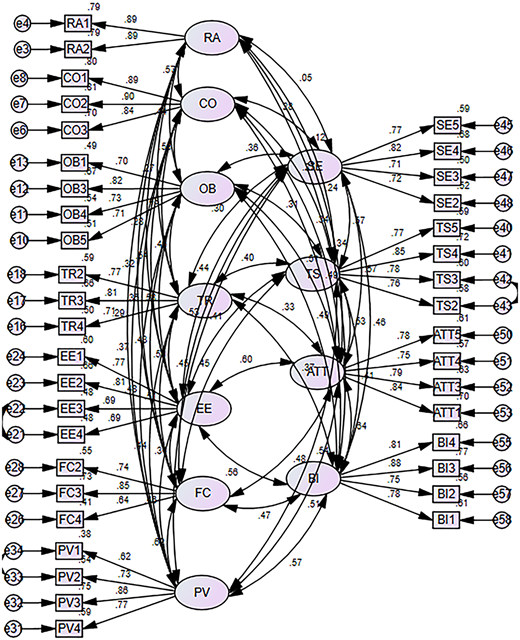
Measurement model validity statistics
| Factor | Estimate | S.E. | C.R. | p | Alpha values | ||
|---|---|---|---|---|---|---|---|
| RA2 | ← | RA | 0.887 | 0.881 | |||
| RA1 | ← | RA | 0.888 | 0.077 | 12.832 | *** | |
| CO3 | ← | CO | 0.839 | 0.907 | |||
| CO2 | ← | CO | 0.898 | 0.059 | 17.424 | *** | |
| CO1 | ← | CO | 0.893 | 0.058 | 17.315 | *** | |
| OB5 | ← | OB | 0.711 | 0.830 | |||
| OB4 | ← | OB | 0.734 | 0.104 | 10.224 | *** | |
| OB3 | ← | OB | 0.818 | 0.108 | 11.154 | *** | |
| OB1 | ← | OB | 0.703 | 0.104 | 9.837 | *** | |
| TR4 | ← | TR | 0.708 | 0.805 | |||
| TR3 | ← | TR | 0.813 | 0.126 | 10.445 | *** | |
| TR2 | ← | TR | 0.769 | 0.119 | 10.167 | *** | |
| EE4 | ← | EE | 0.694 | 0.848 | |||
| EE3 | ← | EE | 0.695 | 0.092 | 12.482 | *** | |
| EE2 | ← | EE | 0.811 | 0.114 | 10.604 | *** | |
| EE1 | ← | EE | 0.772 | 0.116 | 10.267 | *** | |
| FC4 | ← | FC | 0.644 | 0.784 | |||
| FC3 | ← | FC | 0.854 | 0.129 | 9.858 | *** | |
| FC2 | ← | FC | 0.740 | 0.121 | 9.230 | *** | |
| PV4 | ← | PV | 0.770 | 0.850 | |||
| PV3 | ← | PV | 0.864 | 0.083 | 12.902 | *** | |
| PV2 | ← | PV | 0.733 | 0.083 | 11.182 | *** | |
| PV1 | ← | PV | 0.616 | 0.099 | 9.201 | *** | |
| TS5 | ← | TS | 0.770 | 0.879 | |||
| TS4 | ← | TS | 0.849 | 0.082 | 12.927 | *** | |
| TS3 | ← | TS | 0.776 | 0.093 | 11.812 | *** | |
| TS2 | ← | TS | 0.761 | 0.098 | 11.543 | *** | |
| SE5 | ← | SE | 0.770 | 0.841 | |||
| SE4 | ← | SE | 0.824 | 0.099 | 12.491 | *** | |
| SE3 | ← | SE | 0.708 | 0.093 | 10.744 | *** | |
| SE2 | ← | SE | 0.722 | 0.087 | 10.965 | *** | |
| ATT5 | ← | ATT | 0.782 | 0.871 | |||
| ATT4 | ← | ATT | 0.755 | 0.082 | 12.101 | *** | |
| ATT3 | ← | ATT | 0.793 | 0.084 | 12.821 | *** | |
| ATT1 | ← | ATT | 0.839 | 0.077 | 13.641 | *** | |
| BI4 | ← | BI | 0.811 | 0.877 | |||
| BI3 | ← | BI | 0.879 | 0.073 | 15.387 | *** | |
| BI2 | ← | BI | 0.746 | 0.076 | 12.550 | *** | |
| BI1 | ← | BI | 0.781 | 0.069 | 13.312 | *** | |
Note(s): ***p < 0.001
Source(s): Authors’ own design
We looked at inter-item correlations between the constructs in terms of discriminant validity, and these should be below the square root of AVE values and within a reasonable range. Table 4 presents our calculated value, which indicates that the correlation value ranged from 0.124 to 0.64 and that the square roots of AVE values ranged from 0.74 to 0.88. These results corroborate the crucial thresholds and indicate that discriminant validity is not a problem (Hair et al., 2010). In addition, we evaluated a few significant model fit indices to guarantee overall model fitness. Common model fit indices (see Table 5), including ratio of chi-square/degrees of freedom (CMIN/DF = 1.503); goodness-of-fit index (GFI = 0.83); adjusted GFI (AGFI = 0.80); standardized root mean square residual (SRMR = 0.075); comparative fit index (CFI = 0.94); incremental fit index (IFI = 0.94); Tucker–Lewis index (TLI = 0.93); root mean square error of approximation (RMSEA = 0.046), and all are within their critical thresholds and achieved adequate validity and reliability, and the data can be used for additional hypothesis testing.
Discriminant validity
| Factor | CR | AVE | RA | CO | OB | TR | EE | FC | PV | TS | SE | AT | |
|---|---|---|---|---|---|---|---|---|---|---|---|---|---|
| RA | 0.868 | 0.688 | 0.83 | ||||||||||
| CO | 0.909 | 0.769 | 0.567 | 0.88 | |||||||||
| OB | 0.831 | 0.552 | 0.439 | 0.533 | 0.75 | ||||||||
| TR | 0.808 | 0.585 | 0.272 | 0.431 | 0.465 | 0.75 | |||||||
| EE | 0.832 | 0.555 | 0.280 | 0.539 | 0.581 | 0.498 | 0.74 | ||||||
| FC | 0.793 | 0.564 | 0.323 | 0.351 | 0.431 | 0.508 | 0.343 | 0.75 | |||||
| PV | 0.836 | 0.564 | 0.290 | 0.368 | 0.481 | 0.439 | 0.460 | 0.623 | 0.75 | ||||
| TS | 0.869 | 0.624 | 0.124 | 0.271 | 0.307 | 0.402 | 0.406 | 0.451 | 0.541 | 0.79 | |||
| SE | 0.843 | 0.574 | 0.054 | 0.275 | 0.355 | 0.299 | 0.435 | 0.527 | 0.451 | 0.567 | 0.75 | ||
| ATT | 0.871 | 0.629 | 0.238 | 0.344 | 0.508 | 0.328 | 0.598 | 0.476 | 0.511 | 0.533 | 0.567 | 0.79 | |
| BI | 0.881 | 0.649 | 0.339 | 0.486 | 0.491 | 0.369 | 0.563 | 0.472 | 0.574 | 0.409 | 0.459 | 0.644 | 0.80 |
Note(s): The italic diagonal values are the square root of the AVEs
Source(s): Authors’ own design
The results of model fit indices
| Model fit indices | Threshold values | Actual values from measurement model | Actual values from structural model |
|---|---|---|---|
| CMIN/DF | <3 | 1.503 | 2.459 |
| GFI | ≥0.80 | 0.835 | 0.754 |
| AGFI | ≥0.80 | 0.800 | 0.712 |
| SRMR | ≤0.08 | 0.075 | 0.350 |
| CFI | ≥0.90 | 0.940 | 0.851 |
| IFI | ≥0.90 | 0.941 | 0.853 |
| TLI | ≥0.90 | 0.931 | 0.837 |
| RMSEA | ≤0.08 | 0.046 | 0.078 |
Source(s): Authors’ own design
4.2 Structural model test
Having successful statistical reliability and validity supports, this study proceeded to test hypothetical relationships through a structural model. The structural model also shows sufficient fitness (see Table 5) and explained sufficient model prediction. Hypothesis test results showed (see Table 6) that compatibility (β = 0.20, t = 2.8), observability (β = 0.28, t = 3.64) and effort expectancy (β = 0.3, t = 4.3) were found to have significant positive influence on trialability, thus supporting H2, H3 and H4. Trialability (β = 0.38, t = 4.6) significantly impacted attitude toward e-CNY usage, thereby accepting H7. In addition, price value (β = 0.31, t = 4.63) and attitude (β = 0.48, t = 6.21) toward e-CNY significantly affect behavioral intention of e-CNY of the customers, thus accepting H6 and H9. However, few paths did not find statistically significant impacts, such as relative advantage to trialability, facilitating condition and trialability to behavioral condition of the use of e-CNY, which limits not accepting H1, H5 and H8.
Structural model results
| Paths | Estimate | SE | CR | P | Decision | ||
|---|---|---|---|---|---|---|---|
| RA | → | TR | 0.025 | 0.058 | 0.165 | n.s. | No |
| CO | → | TR | 0.207 | 0.054 | 2.877 | ** | Yes |
| OB | → | TR | 0.285 | 0.073 | 3.642 | *** | Yes |
| EE | → | TR | 0.359 | 0.087 | 4.371 | *** | Yes |
| TR | → | ATT | 0.381 | 0.091 | 4.639 | *** | Yes |
| FC | → | BI | 0.085 | 0.068 | 1.325 | n.s. | No |
| PV | → | BI | 0.310 | 0.061 | 4.635 | *** | Yes |
| TR | → | BI | 0.117 | 0.076 | 1.585 | n.s. | No |
| ATT | → | BI | 0.483 | 0.073 | 6.210 | *** | Yes |
Note(s): ***p < 0.001 and **p < 0.05, n.s. not significant
Source(s): Authors’ own design
Following the guidelines of Baron and Kenny (1986), we examined the mediating roles of attitudes about e-CNY in the link between trialability and behavioral intention (refer to Table 7). With no zero between the lower bound and upper bound in the bias-corrected model, the test result demonstrates that trialability (β = 0.38, t = 4.6) has a significant indirect influence on the stated relationship, thus supporting H10. In other words, the relationship between trialability and behavioral intention toward e-CNY usage is highly mediated by attitude about such usage.
Results of mediation analysis
| Variables | Estimate | SE | Bootstrapping | ||
|---|---|---|---|---|---|
| Bias-corrected percentile | |||||
| 95% CI | |||||
| Indirect effect | Lower | Upper | p-value | ||
| TR → ATT → BI | 0.190 | 0.064 | 0.088 | 0.342 | *** |
Note(s): CI = confidence interval, the process repeated 5,000 times
Source(s): Authors’ own design
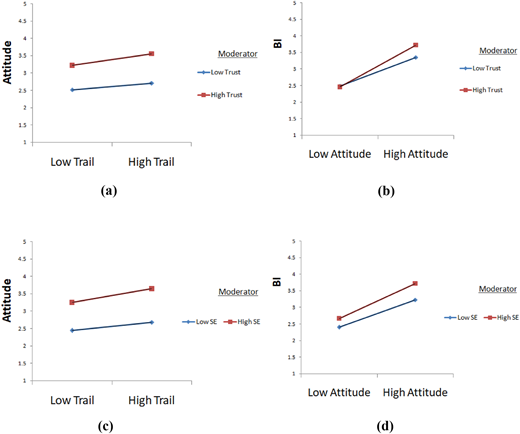
Additionally, we examined the moderating impact of perceived trust and self-efficacy inside our model by adhering to Bollen’s (1989) guidelines. Table 8 indicates that the connection between attitude and behavioral intention for e-CNY usage is strongly moderated by perceived trust, thereby accepting H11b. Demonstrating that a person’s attitude toward using e-CNY has a greater tendency to influence their behavioral intention when their perceived trust in the currency is higher. H11a, H11c and H11d were rejected because our examined variable, self-efficacy, did not show statistically significant moderation. An illustration of the moderating effects is also displayed in Figure 3.
Results of moderation analysis
| Moderating paths | Estimate | p-value | Results |
|---|---|---|---|
| Trialability*Trust → Attitude | 0.042 | n.s. | No |
| Attitude*Trust → Behavioral intention | 0.119 | ** | Yes |
| Trialability*Self-efficacy → Attitude | 0.048 | n.s. | No |
| Attitude*Self-efficacy → Behavioral intention | 0.062 | n.s. | No |
Note(s): **p < 0.05, n.s. not significant
Source(s): Authors’ own design
5. Discussions and conclusions
5.1 Major discussions
This study examined the determinants affecting individuals’ trialability and behavioral intentions to adopt e-CNY. This research revealed that relative advantage does not positively influence the trialability of e-CNY (H1), which deviates from the expectations of Lin and Bautista (2017). This suggests that potential users in this context prioritize other factors when deciding whether to use e-CNY, and this can happen for a number of reasons. Perhaps the perceived benefits of e-CNY (e.g. faster communication and anonymity) were not yet widely understood by the target population. In addition, H2 (compatibility will positively influence trialability) was found to be supported, and this finding is in line with the results of Lin and Bautista (2017). This suggests that if e-CNY seamlessly integrates with the users’ current financial ecosystem, it may increase the likelihood of some users trying it. Besides, observability, positively influencing trialability, was found to be statistically significant (H3), which is aligned with earlier research (e.g. Lin & Bautista, 2017; Rogers, 2003), suggesting that observing successful adoption by others increases the perceived appeal and reduces uncertainty about a new technology.
Furthermore, the H4 – effort expectancy positively influences trialability – was found statistically significant. This finding assimilates with Davis (1989) and Jilani et al. (2022), who emphasized that users are more likely to adopt technologies that they perceive as easy to learn and use. A user-friendly interface, clear instructions and readily available customer support can significantly influence a decision to experiment with the e-CNY. However, the study’s findings indicate that there is no significant positive effect of facilitating conditions on behavioral intention (H5), which deviates from the findings of Söilen and Benhayoun (2022). This can happen because the facilitating conditions used in the study were not adequately captured as key factors influencing user behavior.
The present analyses validated the H6, proposing that price value has a positive effect on behavioral intention, which is also consistent with the contention of Octavius and Antonio (2021). They suggested that individuals are more likely to embrace technology if they think utilizing it would result in more perceived advantages than costs (e.g. quicker and cheaper transactions, etc.). The result of this study also shows that H7 was supported, revealing that trialability positively influences attitude, and this result corroborates the findings of Chaouali et al. (2017). However, the H8, propounding that trialability intention will positively influence behavioral intention toward the e-CNY, was not confirmed. This result contravenes the findings of Jilani et al. (2022) and Hasan et al. (2024).
The results provided support for H9, indicating that positive attitudes toward the e-CNY significantly influence the behavioral intentions. This is consistent with the TPB (Ajzen, 1991) and Hewavitharana et al. (2021). The findings also supported H10 that attitudes mediate the relationship between trialability and behavioral intentions. This finding is consistent with Ajzen (1991), who focused on the role of positive attitudes in shaping behavioral intentions. It is likely that consumers’ positive experiences gained during the e-CNY testing phase make them feel good about it and will create a strong intention to use it in the future.
Furthermore, trust was shown to moderate the link between attitude and behavioral intention, but not the relationship between trialability and self-efficacy. This implies that the beneficial impact of a positive attitude on the desire to use e-CNY is strengthened by their faith in the organization issuing the CBDC. This is consistent with the study of Gefen et al. (2003), which highlighted the value of trust in the adoption of technology.
5.2 Implications of the study
5.2.1 Theoretical implications
The present study findings offer several solid theoretical contributions by discerning the determinants influencing the trialability and behavioral intentions toward e-CNY in China. First, this study adds to the digital currency research by looking at how the well-known theories, like the DOI theory (Rogers, 2003) and the UTAUT2 theory (Venkatesh et al., 2012), work when it comes to CBDC adoption. The present model confirmed that these theories are suitable for assessing customers’ experiences not only in wealthy nations but also in developing nations. Secondly, as past reviews remained inconclusive regarding the factors shaping users’ trialability intentions toward CBDCs like e-CNY, our findings have confirmed the significant impacts of compatibility, observability and effort expectancy on trialability intentions, thus supplementing the scopes of the DOI theory and the UTAUT2 in the CBDC domain.
Thirdly, the study also confirmed the indirect effect of attitudes in the relationship between trialability and behavioral intentions, which is also a novel insight into CDBC dynamics, thus reinforcing theories like the TPB in the digital currency field. This finding indicates that consumers’ experimentation intentions shape their favorable attitudes towards CBDCs, which in turn spurs them towards embracing them in full swing. Finally, the study also confirmed that perceived trust strongly moderates the relationship between attitude and behavioral intention for e-CNY usage, further extending the applicability of the TPB in the digital currency field.
5.2.2 Managerial, financial and social implications
From a managerial standpoint, the results of this study provide critical insights for policymakers, financial institutions and other stakeholders in the Digital Yuan (e-CNY) ecosystem. The study sheds light on the impact of CBDCs on the banking industry’s performance and their potential for improved regulation, policy planning and strategic decision-making. To begin with, the current analyses validated compatibility, observability and effort expectancy as the means to successfully launch the trial version of the CBDCs. To enhance e-CNY testing and adoption, policymakers and central banks should work closely with technology-driven institutions to develop platforms that are user-friendly, seamlessly integrated and functional for diverse user groups.
Also, the study shows that attitude is an important link between trialability and behavioral intention. This highlights that financial institutions, such as central and commercial banks, should work on improving consumer attitudes towards CBDCs. They can do this through focused communication efforts, launching education programs and incentives that promote trust and acceptance from users. Despite its enormous advantages, CBDC is susceptible to cyberattacks, which could erode confidence in these systems. Therefore, it is crucial to build trust and ensure transparency for the success of the CBDCs like e-CNY. Policymakers and central banks need to put in place strong security measures, clear regulatory policies and regular public engagement to tackle consumer worries and boost confidence in the system.
Adopting CBDCs even can promote entrepreneurship, open up new markets and create jobs by increasing access to financial services and lowering transaction costs. It would enable SMEs to reach a wider audience, so fostering international trade and commerce. Based on its lower transition costs, remittances will be more affordable and effective that will ultimately affect a country’s economy. Furthermore, our study offers comprehensive insights into the adoption of CBDC in building a more sustainable and equitable financial system, which should depend on how individuals, financial institutions and governments manage these tremendous opportunities and threats. Through CBDCs, banks can aid in shrinking the financial inclusion gap by providing access to those who lack or have inadequate banking services (e.g. low-income individuals, tribal populace, youth and women), especially in the developing nations. With digital currencies, one can bypass various expenses or geographical limitations while making purchases, saving money and even obtaining credit. Thus, policymakers and financial institutions can leverage CBDCs to create equitable participation in the digital economy.
5.3 Future research guidelines
This study only targets Chinese users, rendering it inadequate for generalizing its results to the worldwide banking sectors and CBDCs. Although the methods of convenience and snowball sampling were used and work fine, there are some limitations, including sampling bias and lack of representativeness due to lack of random selection among participants. Furthermore, detailed sampling techniques like stratified or random sampling should be employed in order to enhance the generalizability and correctness of the results. A potential expansion of this study is investigating the implementation of CBDCs in wider geographical areas, including Europe, Asia, Africa and Latin America, with more diverse populations, and then doing a comparative analysis. Further study might benefit from conducting longitudinal studies to evaluate the actual behavior of users about CBDCs. Additionally, investigating the impact of government laws, processes and societal influence on the adoption of CBDCs would also be an interesting area of exploration.
Informed consent is obtained from all stakeholders included in the study. Furthermore, the authors have decided to publish the manuscript in its current form, and it has not been submitted to any other journals for publication.
Data availability statement: The datasets generated during and/or analyzed during the current study are available from the corresponding author on reasonable request.
Funding statement: This research received no financial support from other sources.
Conflict of interest statement: The authors declare no conflicts of interest.
Authors’ contributions: All authors are acknowledged for their equal contribution to this research.

