The construction sector faces significant environmental and productivity challenges, increasing the need for more sustainable and efficient building methods such as prefabricated construction. However, its adoption in Australia has remained limited due to regulatory constraints and the dominance of traditional building codes. This study provides a systematic policy-focused review that maps the evolution of prefabrication governance across Australian jurisdictions over the past decade.
Using a systematic literature review methodology, this study compiled a multi-level dataset of 87 policy measures issued between 2015 and June 2025 from 19 official Commonwealth and state/territory sources. Each measure was coded into five instrument classes: Incentives, Initiatives, Laws/Regulations, Guidance and Standards. This study undertook a longitudinal analysis of policy sequencing and a cross-jurisdictional comparison of instrument mixes.
The analysis shows a clear policy trajectory over decade, progressing from foundational standards and code clarifications to regulatory and guidance consolidation and, ultimately, national coordination. Victoria, New South Wales, Queensland and Western Australia demonstrate the broadest and most active instrument portfolios.
The study contributes the first integrated map of Australia’s prefabrication policy architecture. It introduces a transferable taxonomy of instruments and proposes a phase model of policy sequencing that can support future causal evaluation and practice reform in public housing delivery. The value of this research lies in its potential to inform policymaking and its ability to facilitate the wider adoption of prefabricated construction in Australia. By analysing the regulatory development, this research will have the capability of developing a more sustainable and efficient construction industry within Australia.
1. Introduction
Traditional construction techniques and methods have long been associated with several prevalent issues, including longer project durations, higher costs and rising environmental impacts (Subramanya et al., 2020). Prefabricated construction, also known as off-site construction (Hosseini et al., 2018), modular construction (Subramanya et al., 2020), industrialised building (Kamar et al., 2011) and modern methods of construction (MMC) (Rahman, 2014), has emerged as a promising alternative to address these challenges. The key distinction of prefabrication is that parts of a building or even whole buildings are manufactured and processed in a factory-controlled environments away from the final construction site (Lu et al., 2018). This method of construction has gained substantial global attention due to its recognised benefits, including improved quality control (Liu et al., 2022), less environmental impact (Tumminia et al., 2018) and shorter construction time (Chen et al., 2023) etc.
In Australia, the government and industry bodies, such as the Australian Building Codes Board (ABCB), have been working intensively in recent years to stimulate innovation and promote growth across the construction sector. Although prefabrication currently comprises only 5% of the Australian construction market, new policies and actions are expected to increase this share to more than 15% by 2025 (Harrison, 2018). As the peak industry body representing Australia’s off-site construction industry, prefabAUS serves as the central hub for prefabrication technology and design, and industry advocacy. prefabAUS predicts that 10% of Australian homes will be prefabricated by 2030 (Mordor Intelligence, 2025). Despite these encouraging projections, the development of prefabrication in Australia has been described as being nearly 15 years behind the world leaders and has also not progressed as quickly as was being predicted 10 years ago (Daly et al., 2025).
Governments worldwide have increasingly relied on policy interventions to accelerate the uptake of prefabrication and modern construction technologies, recognising their potential to improve productivity, sustainability and housing delivery. International studies show that regulatory clarity, incentives, standardisation and planning frameworks are central to effective implementation (Gao and Tian, 2020; Gan et al., 2023; Lu et al., 2018). Jin et al. (2021) identified seven common policy orientations, including regulatory, promotional, technological and sustainability policies, illustrating the diverse instruments used to steer construction industrialisation. Evidence from China demonstrates that compulsory measures are influential in early adoption, whereas incentive-based policies support later market expansion (Han et al., 2024). In contrast, Yin et al. (2025) highlighted the persistent challenges of assessing policy effectiveness. Studies from Hong Kong and Europe similarly emphasise the importance of targeted regulations, certification frameworks and R&D investment for successful modular construction implementation (Jin et al., 2025; Ribeiro et al., 2022). This pattern is mirrored in broader international developments. For example, the United Kingdom is implementing a new MMC standard and strengthening third-party certification (Price et al., 2019). New Zealand has introduced the BuiltReady scheme to regulate factory certification (Lin et al., 2022a). And the United States continues to face significant regulatory fragmentation that limits offsite construction scalability (Smith et al., 2023).
These international insights underscore the policy dependence of prefabrication and highlight the need for coherent and well-designed regulatory frameworks. Therefore, with the pressures arising from the national housing affordability crisis, skilled labour shortages and sustainability goals, it is vital to gain a thorough understanding of the current prefabrication policies landscape in Australia. Recent studies have examined various aspects of Australia’s prefabricated construction sector. For example, Navaratnam et al. (2022) identified the constraints and success factors of prefabricated construction from the construction industry review. Zhang et al. (2022) investigated the implementation of prefabrication in the Australian context from industrial perspectives. Daly et al. (2025) explored the current status and understanding of sustainability in the Australian prefabricated construction industry.
Despite the increasing academic interest in prefabricated construction, existing research in Australia remains focused on the obstacles and constraints on cultural, economic, technical, sustainable and practical dimensions (Navaratnam et al., 2022; Daly et al., 2025; Zhang et al., 2022). While those studies provide valuate insights into adoption challenges, they pay little attention to the broader policy architecture that shapes these outcomes. To date, no systematic analysis has examined how prefabrication policies in Australia have emerged, evolved and shifted over time, nor how regulatory and non-regulatory instruments are deployed across jurisdictions to steer industry adoption.
This absence of a coherent, longitudinal and cross-jurisdictional policy analysis represents a critical knowledge gap, particularly as governments increasingly rely on prefabrication to address housing supply shortages, productivity constraints and sustainability pressures. Without a clear understanding of how policy mixes are structured and coordinated, it remains difficult to assess the governance conditions that enable scale-up, identify fragmentation or misalignment across jurisdictions or evaluate the strategic direction of national and state interventions.
Addressing this gap, this study provides the first integrated, decade-long systematic review of Australia’s prefabrication policy landscape from 2015 to 2025. By mapping the evolution of policy instruments across multiple jurisdictions and policy domains, the study advances policy-mix scholarship in the construction context and offers evidence-based insights to support policy coordination, regulatory refinement and strategic industry development. The findings contribute not only to academic understanding of construction policy governance but also offer practical value for policymakers and industry stakeholders seeking to accelerate prefabrication adoption in Australia and comparable construction markets.
This study is structured as follows. Section 2 provides an evaluation of the study’s Background and introduces the historical development of prefabrication in Australia. Section 3 outlines the research methodology. Section 4 presents the research results of the policy analysis in five-part taxonomy, while Section 5 evaluates the strength and weakness of current policies. Section 6 concludes with implication and future research direction.
2. The development of prefabrication in Australian construction industry
Prefabrication has contributed to the Australian building sector since the 1850s and has evolved into one of the most beneficial methods in the 21st century. The demand for housing within Australia through the mid to late 1850s rapidly increased as the population significantly doubled over the span of a decade (Stapledon, 2010). Despite the increasing population, the level of skilled labour and access to building materials were not proportionate, leading to the concept of prefabrication /offsite manufacturing from overseas. In 1853, building components were manufactured throughout the United Kingdom and Asia, shipped and then installed in Australia to construct cottages, grand villas, schools, churches and shopfronts (Li et al., 2017). Importation of materials and the use of prefabricated modular components allowed the Australian economy to cater for the increasing demand for housing, whilst also providing an evolutionary avenue for architects and construction professionals to design first-class structures in a relatively new country (Steinhardt et al., 2020).
As the Australian population grew to over ten million in the 1960s, there was a driving force for reduced construction timeframes to accommodate citizens. In the late 1960s, the concept of constructability was at the forefront of the industry and focused on integrating the optimum use of knowledge and experience in conceptual planning, engineering, procurement and ease of construction to develop standardisation (Griffith and Sidwell, 1997). This shift in mentality further developed the advancement of prefabrication, which led to modular construction flourishing in remote areas throughout the 1970s and 1980s (Szava et al., 2007).
The demand for infrastructure projects and housing has continued to grow into the 21st century. This growth is evident through the forecasted 205,000 new residential buildings annually that will be constructed between 2024 and 2050 (Housing Industry Association, 2024). Despite the rapid demand, Australian construction to date has failed to be innovative in sustainable measures, which has led to increased rates of contaminated soil, polluted waterways, drinking water and livelihood of wildlife and plants (Navaratnam et al., 2022). The leading factor of these threats derives from the twenty-seven million tonnes of construction waste that is generated each year, alarmingly accounting for 44% of all waste with only a recovery rate of less than 60% (Kabirifar et al., 2021). Further research has proven that prefabrication in Australia is the ideal solution to minimise waste as there is a 15.38% reduction in waste on a prefabricated site in comparison to conventional operations (Lu et al., 2018).
Recent studies in Australia reinforce this shift. Shooshtarian et al. (2025) highlighted the role of modular construction in strengthening resource circularity through products with recycled content derived from construction and demolition waste. Senaratne et al. (2025) similarly examined circular economy challenges in Australia’s modular construction sector, finding that while rethink and recycle principles are implemented, broader adoption of circular strategies is limited due to insufficient technical knowledge, low industry awareness and inadequate policy support. Their findings emphasise the need for stronger government initiatives and targeted regulatory settings. Further research identifies persistent industry-level barriers. Khan et al. (2024b) investigated volumetric modular construction constraints in Australia and identify stakeholder, cultural and regulatory barriers as the most significant impediments, calling for clearer policy direction and structured incentives. It is evident that the shift towards sustainability has enhanced the development in prefabrication over the 21st century and will continue to be at the forefront in assisting in sustainable construction (Daly et al., 2025). Now, the Australian Government and construction companies have placed significant importance on the continued development of prefabrication. The prefabrication Industry Roadmap 2023 to 2033 aims to increase the penetration of prefabrication to cover 80% of all building elements in new construction (prefabAUS, 2023).
Despite there being extravagant developments in prefabrication methods within Australia, there is a concern that the relevant Australian Standards, regulations and codes have not progressed at the same rate (Zhang et al., 2022; Steinhardt and Manley, 2016; Daly et al., 2025). To mitigate the fluctuation of new risks in safety, poor workmanship, and non-compliances, it is essential that the gaps in the development of prefabrication regulations be identified and addressed as a matter of urgency to reduce potential future burdens.
3. Research design
3.1 Data collection
This study adopted a structured research design to develop a comprehensive and authoritative dataset of Australian prefabrication policies and to analyse the types, sequencing and distribution of policy instruments used to support prefabrication across jurisdictions between 2015 and June 2025. To ensure accuracy and completeness, the dataset was compiled exclusively from official sources at both national (commonwealth)-level and state-level, include:
the Commonwealth agencies include (1) the Department of Industry, Science and Resources (DISR), it is the primary national body responsible for construction-related policies; (2) the Department of Infrastructure, Transport, Regional Development, Communications, Sport and the Arts (DITRDCSA), (3) the Treasury and (4) the Federal Parliament.
Government-supported research institutions include (1) Australia Research Council (ARC), (2) Cooperative Research Centres (CRC) and (3) Housing Industry Association (HIA).
State and Territory government sources representing all eight jurisdictions include New South Wales (NSW), Victoria (VIC), Queensland (QLD), South Australia (SA), Western Australia (WA), Tasmania (TAS), North Territory (NT) and Australia Capital Territory (ACT).
Government-funded national bodies include (1) the Australian Building Codes Board (ABCB), (2) prefabAUS and (3) Standards Australia
In total, the 19 official websites comprise the main sources of prefabricated construction policies. The initial data were collected by retrieving policies on the 19 official websites.
3.2 Screening and eligibility checking
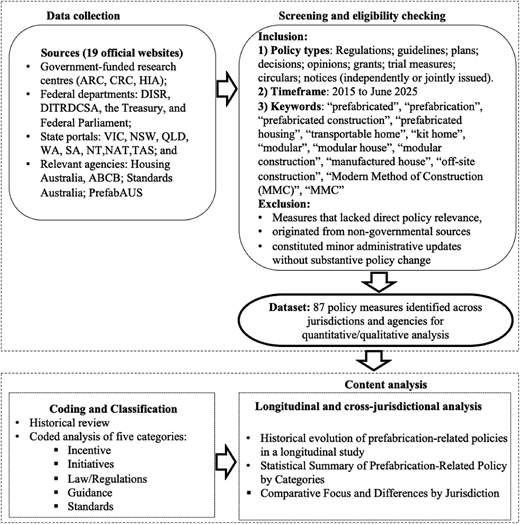
First, only measures that represented formal policy actions were eligible for inclusion. These consisted of regulations, standards, guidelines, planning instruments, strategic plans, ministerial announcements, funding programs, circulars and official notices that explicitly addressed prefabrication, modular construction, modern methods of construction, industrialised construction or offsite construction. Measures that lacked direct policy relevance, originated from non-governmental sources or constituted minor administrative updates without substantive policy change were excluded. This ensured that the analysis remained focused on genuine policy interventions.
Furthermore, according to the historical review in the prior section, this study focuses on the period from 2015 to June 2025 because this decade represents the first sustained phase of prefabrication policy development in Australia. Although prefabAUS was established in 2013, it was not until 2015 that formal policy interventions began to emerge, including the publication of the updated AS 3850–2015 standard, and early government-supported initiatives that recognised prefabrication as an industrial capability. The year 2016 marked the first explicit inclusion of prefabrication pathways in the National Construction Code, which in turn signalled the beginning of regulatory reform. From this point onward, state and federal governments introduced a growing number of incentives, guidance documents, programs and regulatory changes, culminating in national coordination efforts in 2024 and 2025. Therefore, the timeframe of 2015 to June 2025 captures the complete evolution of Australia’s prefabrication policy architecture, from its initial formation to its current stage of consolidation and national alignment.
Considering the variety of terminologies observed in the historical review, the search terms used to retrieve data related to prefabricated construction include: “prefabricated”, “prefabrication”, “prefabricated construction”, “prefabricated housing”, “transportable home”, “kit home”, “modular”, “modular house”, “modular construction”, “manufactured house”, “offsite construction”, “offsite manufacturing”, “Design for Manufacturing”, “DfMA”, “industrialised construction”, “Modern Method of Construction”, “MMC”. This inclusive approach ensured that variations in terminology did not prevent the capture of relevant policy measures. Using this expanded search strategy, 87 policy measures across all jurisdictions and agencies have been identified for further analysis.
3.3 Content analysis
Figure 1 illustrates the research framework, which comprises three sequential steps in the research design. The study employed content analysis to interpret and classify the collected policy measures. Content analysis is the research method widely used in social science to study the content of documentation (White et al., 2006; Krippendorff, 2018). It is recognised as an appropriate method for analysing qualitative policy texts because it allows symbolic, regulatory and contextual meaning to be systematically examined (Peng and Liu, 2016). Content analysis is regarded as an effective and extensively adopted method to conduct policy review research (Gan et al., 2023; Luo et al., 2021; Peng and Liu, 2016). It is extensively used in policy review research within construction and built environment studies (Gan et al., 2023; Luo et al., 2021). The manual approach was selected because automated text mining is limited in its ability to detect legal meaning, cross-agency implications and policy-specific terminology, which are central to accurate classification.
To enhance reliability and mitigate subjectivity, coding followed a structured codebook adapted from established policy classification frameworks (Luo et al., 2021). The classification includes five categories with each of which reflects a different policy instrument or emphasis. “Incentives” include funding programs, grants, and tax incentives; “Initiatives” refer to strategic plans, pilot programs or taskforces; “Law/Regulation” covers acts, regulations and mandatory code changes; “Guidance” includes non-mandatory guidelines or handbooks; “Standards” are formal technical standards or code provisions. All coded outputs were independently cross checked by a second researcher, and any inconsistencies were resolved through discussion to reach consensus. An audit trail documenting coding decisions and revisions was maintained to ensure transparency and replicability.
The analysis began by tracing the longitudinal trajectory of prefabrication-related policy actions to understand how regulatory attention intensified and diversified over time. Each policy measure was then classified into one of five instrument categories. This categorisation provided a structured basis for examining variation across jurisdictions, identifying emerging patterns and assessing shifts in policy emphasis.
The final stage of the study involved synthesising these findings to reveal broader patterns, including the emergence of national coordination and the relative focus of different states and territories. Through this approach, the study offers a robust and transparent examination of Australia’s evolving prefabrication policy landscape.
4. Research findings
4.1 The historical evolution of prefabrication policy
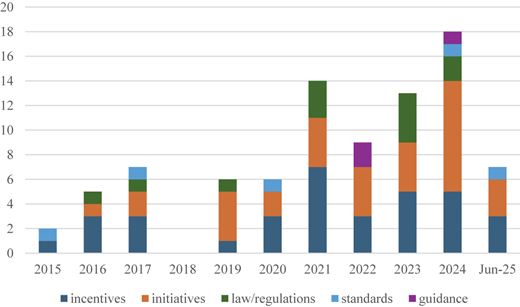
Figure 2 illustrates the distribution of collected policy measures published between 2015 to June 2025 and disaggregated by five instrument categories: Incentives, Initiatives, Law/Regulation, Standard and Guidance. The early years from 2015 to 2017 show modest activity concentrated mainly in incentives and initial regulatory clarifications, reflecting the exploratory phase in which governments began establishing basic policy foundations for prefabrication. There are no relevant policies published in 2018. Policy activity accelerates substantially from 2019 onwards, particularly through initiatives, such as pilot programs, strategic plans and taskforces. This stage indicates a growing institutional recognition of prefabrication. The peak in 2021 aligns with strong state-level housing programs and post-2019 stimulus strategies, resulting in the highest number of incentives (7) observed across the decade.
From 2022 to 2024, the data show a shift from early exploratory tools towards more structured governance. The notably high number of initiatives (9) in 2024 reflects state and federal coordination efforts, while increases in laws/regulations signal a movement towards formalising compliance pathways. Guidance documents and technical standards begin to appear more frequently from 2022 onwards, marking the transition towards harmonisation and industry-wide capability building.
Overall, the figure demonstrates that policy development did not evolve uniformly but occurred in waves that correspond with major regulatory milestones, economic conditions and coordinated government action.
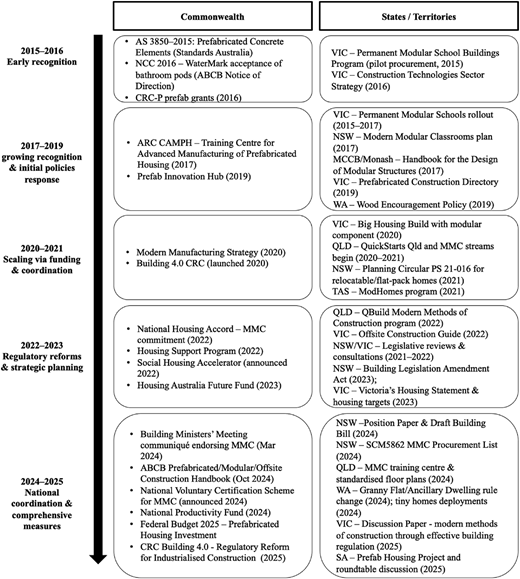
A comprehensive list of all identified measures, including jurisdiction, category and year is provided in Appendix A for detailed reference. The key policy milestones across these timeframes are illustrated in Figure 3 and elaborated below.
2015–2016: Early Recognition, Standards Development and NCC Integration. While prefabrication did not feature prominently in policy in the early 2010s, clear regulatory steps began emerging by 2015. One major development was that Standards Australia published an updated AS 3850–2015 for prefabricated concrete elements, which modernised safety and quality requirements for offsite-manufactured concrete panels (Stratford, 2015). A pivotal regulatory milestone followed in 2016, when the NCC introduced explicit provisions accommodating prefabrication for the first time. The ABCB issued a Notice of Direction confirming that prefabricated “bathroom pods” could be accepted as compliant under the NCC’s Plumbing Code of Australia via the WaterMark certification (ABCB, 2024a). This decision marked a shift towards regulatory clarity for prefabricated components and established a precedent for further integration of modular systems into the NCC framework.
During the same period, the federal government began to frame prefabrication as both an innovation and an industrial capability opportunity by funding research activities. Two Cooperative Research Centres Projects (CRC-P) grants were awarded for prefabricated housing research in 2016, signalling federal interest in scaling the sector.
Overall, 2015–2016 established the regulatory foundations that enable subsequent policy development and industry innovation.
2017–2019: Growing Recognition an Initial Policies Response. Government recognition of prefabrication expanded during 2017–2019. In 2017, the Australian Research Council (ARC) funded a dedicated Centre for Advanced Manufacturing of Prefabricated Housing. It signalled a growing government support (CAMP, 2015). Regulators also acknowledged gaps in how codes and licensing dealt with off-site work (Gad et al., 2022). In 2019, the Prefab Innovation Hub was created to investigate regulatory barriers and propose reforms for scaling up industrialised construction systems (Gad et al., 2022).
Following the federal efforts, state governments began testing prefabrication solutions during this period. Victoria’s Permanent Modular School Buildings Program (2015–2017) delivered rapid class replacements using modular construction (Victoria Government, 2017). In late 2017, NSW announced a plan to replace up to 4,000 demountable school classrooms with modern modular buildings (School Infrastructure, 2017). This marked one of the first large-scale government procurements of modular construction.
Victoria played a particular strong leadership role by releasing the Construction Technologies Sector Strategy in March 2016, aimed at strengthening off-site construction markets (Victoria Government, 2016). Under this strategy, the government co-funded the Modular Construction Codes Board (MCCB) project, which produced the world’s first Modular Construction Handbook in 2017 (MCCB, 2017). In 2019, Victoria published Victorian Prefabricated Construction Directory, the first dedicated prefabrication policy tool in Australia (Department of Jobs, 2019). During the same year, Western Australia (WA) adopted a Wood Encouragement Policy (2019) to promote the use of timber prefabrication in construction (FPC, 2019).
In summary, 2017–2019 marked a period of escalating policy activity, with states experimenting with modular procurement and introducing the first specialised prefabrication guidelines.
2020–2021: Scaling Up Through Funding and National Coordination. Entering 2020s, there were notable new initiatives that signalled a scaling-up. The Commonwealth’s Modern Manufacturing Strategy (2020) identified prefabricated construction as one of the priority areas under “Recycle and Clean Energy” for transforming Australian manufacturing (Australian Government, 2020). The Commonwealth government’s commitment deepened with another funding support for the Building 4.0 CRC with focused on digital and offsite construction innovation (Building 4.0 CRC, 2020).
States and territories integrated prefabrication into their housing strategies. Victoria’s Big Housing Build (2020) was dedicated to modular housing construction for the rapid delivery of social homes (Homes Victoria, 2020). Likewise, Queensland by 2020–2021 started its QuickStarts Qld and continued this program in round two in 2024 (Queensland Government, 2024a, b) and also established QBuild factories to produce modular homes (Queensland Government, 2021). WA in 2021 rolled out a Modular Social Housing Program, ordering factory-built homes to quickly provide regional housing and committing significant capital to prefabricated units (WA Government, 2021). Collectively, these initiatives marked a pivotal shift from isolated pilot projects to scaled-up programs. Governments used prefabrication as a tool for fast-tracking construction during the post-2019 economic stimulus wave.
2022–2023: Regulatory Reforms and Strategic Planning. From 2022 onwards, several jurisdictions formalised earlier learnings into regulations or official policy documents. NSW issued a Planning Circular (PS 21–016) in December 2021, which clarifies planning pathways for relocatable and manufactured homes and improving certainty for prefabricated construction in certain zones (NSW Government, 2021). Queensland strengthened its position by establishing QBuild’s MMC program to deliver modular housing at scale (Queensland Government, 2022). Victoria in 2022 published the Victorian Offsite Construction Guide to educate the industry on how to achieve code compliance with MMC (Office Of Projects Victoria, 2022). A major industry development occurred in late 2022 when prefabAUS published the “A Prefabrication Industry Roadmap 2023–2033”, outlining growth projections and calling for coherent national policy support (prefabAUS, 2023). This roadmap helped position prefabrication as a critical component of Australia’s construction future.
At the national level, 2022–2023 marked an inflection point in political commitment. The National Housing Accord (2022)explicitly highlighted MMC as part of the solution to the house shortage (Australian Government, 2022). This was the first time prefabrication was mentioned in a national housing policy agreement. While the Accord did not legislate prefabrication, it positioned MMC as a key enabler of productivity and scale in housing delivery. To back this, federal funding initiatives like the Social Housing Accelerator (Australian Government, 2022) encouraged the use of innovative construction to expedite housing delivery. The Housing Australia Future Fund (Australian Government, 2023) is committed to financing social and affordable housing with an implicit preference for proposals that incorporate modular or panelised construction.
There is also a legislative modernisation from this year. NSW launched a public consultation in 2022 on “Reforming Building Laws in NSW”, which included a dedicated discussion of prefabricated homes (NSW Government, 2022). The state subsequently created a cross-agency Modern Methods of Construction Taskforce (NSW Government, 2023a) and established a dedicated fund for prefabricated social housing projects (NSW Government, 2023b). Similarly, Victoria’s 2021 Expert Panel’s Comprehensive Review of Victoria’s Building System recommended a clearer and more robust legislative framework of prefabrication in construction (Better Regulation Victoria, 2021).
Together, these legislative and regulation milestones in the big states represent a significant policy shift. Prefabrication moved from being treated as an exception in building regulations to being explicitly addressed across mainstream policy instruments.
2024–June 2025: National Coordination and Comprehensive Policy Measures. In the most recent period, Australia’s prefabrication policy landscape has become more coordinated and ambitious. A pivotal moment occurred in March 2024, when federal and state Building Ministers jointly endorsed the expansion of MMC in the housing sector (Australian Government, 2024a). Ministers formally pledged to streamline existing regulations, develop a national certification scheme for prefabricated construction and integrate prefabrication into mainstream construction laws. This endorsement collectively marks the most comprehensive and coordinated policy support for prefabrication in Australia to date. In response, the ABCB published the Prefabricated, Modular and Offsite Construction Handbook in October 2024 (ABCB, 2024a). This national guidance document outlines compliance pathways for modular systems under the NCC. CRC Building 4.0 also published its research outcome of Regulatory Reform for Industrialised Construction in 2025.
Another major initiative followed in late 2024 with the announcement of a forthcoming Voluntary Certification Scheme for Manufacturers of Modern Methods of Construction (ABCB, 2024b). This scheme aims to simplify and standardise approvals for modular housing by allowing accredited systems to pre-qualify for NCC compliance. By shifting from project-by-project approval to a product-based certification model, the scheme addresses a long-standing industry concern about regulatory duplication and uncertainty.
At the same time, national funding programs further reinforced the role of MMC in addressing housing affordability. The federal government launched a National Productivity Fund (Australian Ministers Treasury, 2024) to incentivise states and territories that remove regulatory barriers and adopt prefab-enabling reforms (2025–26, 2024). The 2025 Federal Budget allocated $49.3 million to support state and territory programs in expanding the off-site construction industry (Australian Government, 2025).
Alongside national advances, state governments in 2024 and the first half of 2025 launched their most comprehensive prefabrication policies to date. The NSW Building Commissioner released a Draft Building Bill of position paper on regulating prefabrication buildings (Building Commission NSW, 2024). Victoria’s housing statement (2024–2034) further institutionalised prefabrication within state housing strategies (Victoria Government, 2023) and set prefabrication targets in its 2024 Economic Growth Statement as part of industrial policy (Victoria Government, 2024). Victoria further advanced policy dialogue by issuing a discussion paper, one enabling MMC through effective building regulation in June 2025 (Victoria Government, 2025a). South Australia (SA) also launched its own prefab housing project and hosted a government-led roundtable discussion in June 2025 to bring key voices to explore how SA can accelerate the adoption of modern, prefabricated building methods (Government of South Australia, 2025).
Collectively, 2024-June 2025 represents a convergence point in national prefabrication police. This period characterised by coordinated ministerial action, national certification strategies, regulatory modernisation and expanded funding. Prefabrication is no longer a peripheral innovation but a mainstream element of Australia’s housing and industrial policy.
In summary, the timeline from 2015 to June 2025 demonstrates a clear acceleration in Australia’s prefabrication policy landscape from early recognition and foundational standards, through experimental pilots and fragmented state initiatives, to scaled programs supported by targeted funding and regulatory refinement. The period culminating in 2024 to June 2025 marks a convergence point, where prefabrication has transitioned from a niche innovation to a nationally endorsed component of mainstream housing and industry policy. Therefore, prefabrication has evolved in both policy prominence and strategic importance, laying the groundwork for analysing the strengths, weakness and coherence of the current policy mix in the following sections.
4.2 An overview of prefabrication-related policy categories in Australian jurisdictions
4.2.1 Statistical summary of prefabrication-related policy by categories
Table 1 shows the distribution of prefabrication-related policy types across the Commonwealth and all eight state/territory jurisdictions from 2015 to June 2025. This breakdown is essential because prefabrication governance in Australia is highly decentralised. Therefore, the analysis of policy activity by jurisdiction provides critical insight into how different levels of government shape the development of the sector, which would not be visible from aggregated national totals alone.
An analysis of the compiled dataset of 87 policy measures across all jurisdictions reveals a heavy emphasis on incentives (34) and initiatives (33) and a significant number of regulatory measures (12), with fewer guidance (5) and formal standards (3) specifically addressing prefabrication. The preference for incentives and initiatives suggests that policy efforts have largely aimed to enable and encourage the prefabrication industry, as opposed to requiring or standardising it through legislation.
Several patterns emerge from the data. First, national policies skew strongly towards financial and research incentives. Out of 19 federal-level policy actions identified, over half were incentive-based, the highest of any single jurisdiction. This reflects the federal role in providing major funding levers and market enablers for prefabrication rather than regulating construction directly. These include multimillion-dollar research investments such as CRC-P and ARC grants, and the recent Housing Australia Future Fund. Second, one-quarter of national measures were high-level policy initiatives that set strategic direction, such as the National Housing Accord (2022)and the 2024 MMC Roundtable commitment. Third, only a couple of federal actions took the form of regulation or law, since the Commonwealth generally works through model codes adopted by states. For instance, the inclusion of prefab provisions in the NCC was a significant regulatory step. Prefab buildings in states and territories are approved under the statewide adoption of the NCC and the existing building permit system. Fourth, standards and guidance at the national level were also limited in number. In summary, the Commonwealth’s contribution from 2015 to June 2025 was primarily enabling funding and guiding rather than prescriptive.
By contrast, state and territory policies present a more balanced mix of types, though incentives and policy initiatives still dominate by count. Collectively, states/territories enacted 69 measures, of which roughly one quarter were incentives and another near half were initiative-based. Financial incentives at the state level often targeted social and affordable housing delivery via MMC. The remaining one quarter was split among regulations, guidance and standards. It’s notable that formal technical standards and guidance documents tailored to prefabrication were the least common categories. Most jurisdictions relied on the national standards and code. In summary, the numbers reflect that state and territory governments have so far leaned on incentives and pilot programs to promote prefabrication and have begun to adjust regulations to accommodate or require MMC in certain contexts. Hard mandates such as laws or standards remain relatively limited.
Taken together, these patterns demonstrate a clear division of policy function across governance levels. While the Commonwealth provides the enabling environment through funding and strategic signalling, states and territories act as the primary drivers of operational MMC adoption through incentives, pilot programs and selective regulatory adjustments. The limited use of hard mandates at both levels suggests that Australia’s prefabrication transition remains policy-enabled rather than policy-driven, with implications for the speed, consistency and scalability of industry uptake.
4.2.2 Comparative focus and differences by jurisdiction
While all Australian governments have come to support prefabrication to some degree, the focus and priorities of policies have varied by jurisdictions. Below is a comparative overview of the national versus state/territory policy focus areas, highlighting differences in emphasis.
The federal government’s policy focus has been on enabling and catalysing prefabrication rather than direct implementation. This includes a strong emphasis on financial incentives and policy initiatives. Another focus at the national level is standards and certification by using its capacity to coordinate uniform standards, such as NCC amendments, Australian Standards updates and now the voluntary certification scheme to reduce barriers for prefab across Australia. Conversely, the Commonwealth has not needed to pass specific prefab laws; instead, it works through model codes and funding agreements. It has also seen the national policy narrative linking prefabrication to macro-objectives of boosting advanced manufacturing (prefabAUS, 2023), improving housing affordability (Parliament of Australia, 2023; Australian Government, 2024b), and job creation (Chandler and Sunindijo, 2024). Overall, national policy is broad and supportive of providing resources, setting high-level direction and convening stakeholders, but leaves detailed execution to states.
The states and territories that are responsible for building regulation enforcement and planning laws have approached prefabrication from different angles. Major states like Victoria, NSW, QLD and WA have led notable policy and program initiatives, reflecting their unique priorities but also converged on common themes.
Victoria has been at the forefront of state-level prefab policy. Victoria balanced incentives (8) and initiatives (11), 1 guidance and 1 standard, and 2 prefab-specific laws/regulations. As noted, Victoria treated prefabrication as an economic opportunity. The Construction Technologies Sector Strategy (Victoria Government, 2016) identified prefab as a growth sector. Victoria created a prefab industry directory to connect government projects with local suppliers (Victoria Government, 2019). It explicitly embraced prefab as part of the solution to its social and affordable housing agenda (Department of Premier and Cabinet, 2023). The Melbourne Polytechnic Future of Housing Construction Centre of Excellence is Victoria’s notable approach to boost prefabrication development (Victoria Government, 2024). The 2025 discussion paper is part of Victoria’s 2024–25 Construction Reform program and explores changes to building codes, digital approvals and licensing that would facilitate prefab construction at scale (Victoria Government, 2025b). Victoria’s policies show a collaborative, enabling stance by partnering with industry, focusing on training, and using government procurement as a driver for prefabrication adoption. Regulatory change was not front-and-centre since prefab was accommodated under the existing performance-based code. The state frequently partnered with universities and industry, showing a focus on industry capacity building.
NSW focuses on regulatory instruments (4) and only a couple of initiatives, reflecting a more top-down compliance-driven approach via its Building Commissioner and legislation. A turning point was a comprehensive consultation on reforming building laws to accommodate prefabrication technologies in late 2022 (NSW Government, 2022). The consultation led to a position paper proposing new definitions and regulations for “Prefabricated and manufactured homes”, aiming to improve building quality and consumer protection in off-site construction (Building Commission NSW, 2024). In late 2023, NSW established a Modern Methods of Construction Taskforce with accelerating prefab housing delivery by cutting through red tape (NSW Government, 2023a). NSW’s notable approach is using policy and law to integrate prefab into building approval processes and government projects. This contrasts with Victoria’s more market-enablement focus, but ultimately both aim to integrate prefabrication as a normal way to build.
QLD had the balance on incentive (2), initiatives (6) and laws/regulations (3) by leveraging its public-sector capacity via QBuild MMC program to invested in its own modular construction facilities and programs. This state-driven approach not only provides financial backing but also streamlines procurement and standardise designs for modular homes. QLD has integrated modular builds into its government construction targets and is unique in running its own prefab production for housing. Under the Government’s Infrastructure Productivity and Workforce Action Plan, QLD has even set a target that 50% of government infrastructure projects incorporate modular or MMC by 2030 (Queensland Government, 2024a, b). QLD has distinguished itself by internalising modular construction within government projects to build confidence and showcase success.
WA focuses on incentives (8) and initiatives (4) of utilising prefabrication to resolve social housing issue. WA has aligned prefabrication with its regional development and housing affordability agenda by investing in hundreds of modular units to address housing shortages. WA has committed funds for modular social housing and embraced policies to spur demand for prefab timber construction, e.g. the Modular Build Program (WA Government, 2021), and the 2019 timber Wood Encouragement Policy (FPC, 2019). WA’s comparative approach demonstrates a preference for funding-led integration of prefabrication into social infrastructure delivery. It primarily through direct subsidies to modular manufacturers and procurement policies that favour modular solutions without overhauling existing legislation.
Smaller jurisdictions of SA, TAS, ACT, NT register fewer policies overall, which often adapting or leveraging on national schemes.SA, NT, and TAS each enacted around 1 to 3 measures over the decade, mainly small pilot initiatives or incentives.
The SA Housing Authority and Renewal SA have supported the use of modular units under the national Social Housing Accelerator project (Government of South Australia, 2024). SA is committed to growing the state’s advanced manufacturing capabilities and addressing the urgent need for more affordable, high-quality homes. But there was no dedicated program or regulatory framework specifically for MMC. This highlights a gap in state-led initiative, leaving SA somewhat lagging behind leading states.
TAS identified prefab primarily to address housing shortages and to develop its timber industry. A highlight was the “Homes Tasmania” ModHome Program (Tasmanian Government, 2022), which saw the state’s housing authority invest in off-site construction of dwellings to quickly expand social housing. Additionally, Tasmania was an early mover in Wood Encouragement Policy at a state level, aiming to prioritise timber construction in public projects (Tasmanisan Government, 2017). In summary, TAS’s focus was on using prefab to meet housing and regional development goals. It has an underpinning interest in timber prefabrication, but with limited dedicated policy instruments.
NT has 2 incentives, one is the NT’s ongoing HomeBuild NT program (2017–2027) employs off-site construction for some remote housing projects (Northern Territory, 2017). It also co-invested in modular construction through its Advanced Manufacturing Ecosystem Fund (Northern Territory, 2021).
However, SA, TAS, and NT did not enact prefab-specific regulations or standards. The states rely on the NCC and national standards with no separate building requirements for modular construction.
The ACT has 0 measure observed on prefabrication from 2015 to June 2025. However, the ACT Government did show interest through partnership with larger states like NSW and QLD to purchase modular housing to deliver affordable housing dwellings (ACT Labor Government, 2024). In summary, the ACT’s approach has been supportive, open to using prefab but not actively shaping the market with its own incentives or regulations.
Taken together, this comparative analysis reveals a differentiated and uneven prefabrication policy landscape across Australian jurisdictions. Larger states, particularly NSW, Victoria, QLD and WA, have emerged as the primary sites of policy experimentation and innovation, deploying distinct combinations of incentives, regulatory reforms and procurement-led strategies aligned with their institutional capacities and housing pressures. In contrast, smaller jurisdictions such as SA, TAS, NT and the ACT have largely adopted follower positions, relying on national frameworks and selective pilots rather than developing bespoke policy instruments. This divergence highlights the absence of a coherent, nationally coordinated prefabrication strategy. These findings demonstrate that prefabrication adoption in Australia is shaped less by uniform national direction than by jurisdiction-specific governance choices, reinforcing the value of a comparative, policy-mix lens for understanding construction innovation transitions.
5. Discussion
The longitudinal analysis revealed that Australia’s prefabrication policy environment has evolved from neglect and to a coordinated push for modernisation. The mid-2010s began viewing prefabrication through the lens of innovation for public infrastructure projects (Gunawardena et al., 2019; Newton et al., 2019), strength and challenges on performance (Navaratnam et al., 2019), and industry acceptance (Steinhardt and Manley, 2016). This stage has addressed the key regulatory barrier by accepting prefabricated bathroom pods in the NCC Watermark certification scheme.
Entering 2020s, researchers have highlighted the barriers of inadequate policies and regulations (Lin et al., 2022b), and the request of sufficient government incentives to promote prefabrication development in Australia (Navaratnam et al., 2022). This study has revealed that governments began explicitly promoting prefabrication and modular building since 2020s. The umbrella concept of Modern Methods of Construction, which includes prefabricated, modular and panelised techniques, has been widely accepted and used, such as the MMC programs initiated in QLD, NSW, and Victora. States have acted as lead clients to introduce modular procurement panels, standardised typologies and taskforces within housing agencies. The Commonwealth has provided system-level enablers, such as handbooks, impending certification, and fiscal support.
The result is a set of recurring themes of standardisation of practices (Zhang et al., 2022), improved regulatory clarity (Gad et al., 2022), supportive procurement (Lin et al., 2022b) and capacity-building (Pouraghajan et al., 2024), all of which reinforce each other in accelerating prefabrication use. These policies have already begun to influence the construction industry by increasing the uptake of off-site fabrication, improving productivity and opening the door for innovation (Daly et al., 2025).
The sequencing identified in the longitudinal analysis of early standards, regulatory clarification, incentive expansion and eventual national coordination corresponds closely with the major public housing programs rolled out over the decade. State initiatives such as Victoria’s Big Housing Build, QLD’s QuickStarts Qld, WA’s Modular Social Housing Program and SA’s recent MMC pilots all relied heavily on prefabrication as a mechanism for rapid housing delivery. The empirical pattern from the dataset indicates that Australian governments have increasingly instrumentalised prefabrication as a delivery mechanism for social, affordable and remote housing rather than treating it as a stand-alone technological end.
As shown in Table 2, there are 18 measures that have a direct link to social, affordable and remote housing since 2020. The alignment between prefabrication’s production characteristics and public objectives in housing explains the concentration of policy effort in this domain. First, the time to occupancy is a critical welfare parameter in social housing. Factory-based production of adopting prefabrication shortens delivery schedules while minimising on-site disruption (Dan and Liu, 2024). Second, labour substitution and logistics control mitigate skills scarcity in regional and remote contexts (Navaratnam et al., 2022). Third, standardisable typologies permit learning effects and stable factory utilisation, which are prerequisites for productivity gains in industrialised house building (Zohourian et al., 2025).
5.1 The strength and weakness of policies development in Australia
The distributional trends observed from 2015 to June 2025 carry important implications for Australia’s prefabrication sector and its future policy direction. There are clear strengths in the emerging framework. First, with the highest number of measures collected in the data, the heavy use of incentives signals that policy has been geared towards creating a market and demand for prefabrication. These incentives that range from innovation grants to procurement preferences have been the effective measures adopted by other leading prefab implementation countries such as Japan, Sweden, Singapore, the United States and the United Kingdom to promote prefabrication in construction (Wang et al., 2021). Second strength is the strong national-level initiative support and coordination. The fact that building ministers from all jurisdictions collectively endorsed MMC to tackle the housing shortfall in 2024 demonstrates strong political will. This top-level endorsement is crucial to provide a mandate for bureaucracies to prioritise prefabrication in building programs and encourages private sector confidence. The inclusion of prefabrication or MCC in national initiatives like the Housing Accord and Modern Manufacturing Strategy shows that governments now view offsite construction as part of the solution to national challenges such as housing supply, productivity, and climate goals (Daly et al., 2025). The predominance of incentives and initiatives suggests that governments have so far preferred to encourage prefabrication through market-driven. This approach has been useful in seeding early development by providing grants, showcasing successful modular projects and building networks without forcing the construction industry into unfamiliar practices too quickly (Wang et al., 2021).
Despite these strengths, significant weaknesses remain in Australia’s policy approach to prefabrication. One challenge is that the relatively low count of formal Standards and the lack of comprehensive regulations highlight a potential risk. The current data, with only 3 instances of standards-related policy, suggests that standard setting is still nascent. In 2024, the NCC is still largely written with traditional on-site construction assumptions that lack specific provisions for modular systems (ABCB, 2024a). This means that many prefab projects must seek case-by-case performance approvals, which can be onerous and subject to varying interpretation by different state or local regulators (Khan et al., 2024a). Khan et al. (2024a) have discussed the significant challenges caused by Building code discrepancies and compliance issues. The relatively few binding regulations or standards also imply that prefabrication has not yet been systematically embedded into Australia’s building and planning regimes. It is observed that traditional construction methods remain the default with prefab as an encouraged option rather than a requirement (Khan et al., 2024b). Government drivers and commitments are essential to a full transition to prefabricated construction, while the intervention has been insufficient to spur a major shift to date (Zhang et al., 2022; Daly et al., 2025). The implication is that developing robust standards should be a policy priority to support scaling up prefabrication safely (Zhang et al., 2022).
Another primary weakness is the uneven adoption across jurisdictions. As analysed in the previous section, some states remain ahead of others, for example, Victoria and NSW have institutionalised prefab in their housing agencies by 2024. Some states, like ACT, NT and SA, have done little to promote prefabrication, which means large parts of the country have seen no concerted effort to develop local prefab industries or capacities. Even though prefabrication or MMC has been seen as a key to boosting housing supply quickly, according to the Minister’s roundtable in 2024. The prefabrication’s development in states and territories has been influenced by how strongly governments link prefabrication or MMC to solving wider challenges.
5.2 Recommendations
Australia’s recent experience with prefabricated construction policy from 2015 to June 2025 reveals a patchwork of efforts across incentives, initiatives, regulations, guidance and standards. In contrast, prefabrication is promoted as a solution for improving productivity and alleviating housing shortages recently. However, it is concluded that the supporting policy framework remains underdeveloped based on the above analysis. This conclusion is also consistent with the research that government support and policy play a critical role in both enabling and hindering the adoption of MMC (Soltani et al., 2025). The following recommendations are proposed to strengthen and refine prefabrication policy in five categories in Australia.
Incentives: Financial incentives have been a primary tool for jump-starting prefabrication, yet their optimal design and impact remain poorly understood. Evidence from China shows that well-crafted incentive packages can overcome cost barriers, while poorly aligned ones may reduce efficiency (Yan et al., 2024). To address this issue, it is suggested that governments should continue and expand the use of financial levers to boost prefabrication. But Australia also should fill the knowledge gap regarding which incentive mechanisms can effectively accelerate prefabrication without unintended consequences (Jiang et al., 2019).
Initiatives: Australia’s policy landscape features various initiatives related to prefabrication. Some important initiatives, such as National Housing Accord, and Modular Housing Taskforce launched in NSW, are crucial for innovation. However, the landscape has been fragmented since states and industry bodies launched prefabrication programs without a unifying national strategy (Gad et al., 2022). Therefore, it is crucial to examine the coordination among various initiatives and their effectiveness.
Laws and regulations: The regulatory environment for prefabrication is a critical determinant of its adoption. Research has been undertaken to explore and identify regulatory barriers (Gad et al., 2022). Future studies can focus on evaluating the impact of recent regulatory changes and mapping out what specific laws, regulations or approval processes have impeded prefabrication systematically (Zhang et al., 2022).
Standard: Regulations set minimum requirements, while standards often provide the technical means to meet them. The development of technical standards for prefabricated construction is an area mature for research and critical for industry maturation (Navaratnam et al., 2019). In the data collected, formal standards for prefabrication were notably sparse until the very end of the period. Future research can thus focus on identifying where standardisation is most urgently needed and how to achieve it.
Guidance: The late emergence of guidance documents in the policy timeline signals that governments and industry bodies have only recently begun producing manuals and best-practice guides for prefabrication. However, guidance plays a crucial role in knowledge transfer by helping practitioners understand how to implement prefab projects within existing regulatory and technical constraints. Moving forward, research can address both the creation of better guidance and the methods of dissemination and education that accompany it (Yao and Gurmu, 2024).
6. Conclusion
Despite growing interest in prefabrication and MMC, there has been no systematic, policy-focused review that maps the breadth of prefabrication-related policies across the Commonwealth and all states/territories. This study advances the construction and public policy literatures by undertaking a structured, multi-level examination of the Australian policy environment governing prefabrication over a full decade. This study has harvested 87 measures from 19 official websites spanning national authorities and state/territory portals and coded them into five categories of Incentives, Initiatives, Laws/Regulations, Guidance and Standards. The analysis provides an integrated map of Australia’s prefabrication policy architecture by combining three layers of analysis: (1) a longitudinal milestone map tracing major national and state policy actions from 2015 to June 2025; (2) a distributional overview of policy instruments by category, illustrating how incentives, initiatives, regulations, standards and guidance evolved over time and (3) a cross-jurisdictional comparison highlighting the heterogeneity of policy efforts across Australian states and territories. Together, these layers form a cohesive representation of the governance landscape, revealing not only the breadth of policy activity but also the underlying structure through which different instruments interact to support prefabrication uptake. As listed below, the 2015 to June 2025 overview of prefabrication -related policies in Australia reveals a pattern of promotion.
longitudinal analysis: there is a phase model of policy sequencing (1) foundational standards/clarifications (2015–2016), (2) Research and pilot initiatives (2017–2019), (3) demand-pull via incentives/procurement (2020–2023) and (4) regulatory/guidance consolidation and national coordination (2024 to June 2025).
Multi-level roles: The Commonwealth provides an enabling system spine of handbook, impending certification, national funding. States/territories operationalise delivery of procurement panels, modular programs and planning levers.
Unbalanced development: Victoria, NSW, QLD, WA are the most active and diverse in instruments.
Social/affordable/remote housing as frontline: prefabrication is most systematically applied where speed, repeatability and logistics control generate high public value.
Emerging national alignment: Building Ministers’ commitment (2024), ABCB (2024a) handbook and a forthcoming national voluntary certification scheme signal movement towards type-approval and mutual recognition.
Australia’s prefabrication-related policies are characterised by ample incentives and initiatives, selective regulatory moves by a few leaders, and a growing but still small effort to provide guidelines and standards. This approach has helped nurture the prefabrication sector to a point where it is increasingly viable and recognised. However, it has also led to a faded policy landscape, where some regions forge ahead and others barely participate. The implications for the next decade of policy are clear that it should realise the full benefits of prefabricated construction in efficiency, quality and sustainability. The recommendations suggested that Australia needs to shift from this fragmented, largely voluntary phase to a more coordinated and directive policy framework.
The findings also specify the regulatory barriers that have historically constrained prefabrication, including inconsistent approval pathways prior to NCC amendments, limited state-level technical standards, fragmented certification processes and variable MMC treatment in planning systems. Recent policy measures, such as the ABCB’s 2024 Handbook and the proposed national certification scheme, directly address these gaps. Sustainability implications are also explicitly tied to policy instruments, such as recycled-content requirements, embodied carbon targets and waste-reduction initiatives embedded within MMC procurement programs.
More broadly, this study demonstrates the analytical value of a policy-mix perspective for advancing prefabrication research beyond technology or project-level explanations towards a governance-oriented understanding of construction innovation. By examining how incentives, initiatives, regulations, standards and guidance instruments interact across jurisdictions and over time, the policy-mix lens reveals not only whether governments support prefabrication, but how different combinations of instruments shape adoption pathways, industry behaviour and scalability outcomes. In the Australian context, this approach clarifies why incentive-led strategies have successfully stimulated early uptake while simultaneously exposing the limits of voluntary and fragmented policy arrangements in achieving systemic transformation. Importantly, the policy-mix framework provides a transferable tool for future policy design. This research enables policymakers to assess balance, sequencing and alignment across instruments and governance levels, rather than relying on isolated interventions. As such, the findings offer lessons for Australia’s next phase of prefabrication policy by highlighting the need for greater coordination, standardisation and regulatory certainty.
Also, this study has a limitation on data collection and performance review. First, the dataset relies exclusively on publicly available policy documents sourced from official government websites and policy archives. It assumes these repositories are complete and up to date. However, unpublished, internal or informal policy mechanisms may not be captured. Second, the analysis is based on document content rather than implementation outcomes, meaning the study maps policy intent rather than the effectiveness or real-world impact of specific measures. Third, differences in how jurisdictions publish and classify policies create variations in visibility and comparability across states and territories. Fourth, although manual content analysis was conducted using a structured codebook with cross-checking procedures, the interpretation of policy language remains inherently influenced by textual ambiguity and administrative context. Finally, the study focuses on policy development rather than industry performance indicators, and future research is needed to triangulate these findings with housing, productivity and sustainability metrics. These limitations define the scope of this study while also highlighting directions for further empirical investigation. Future research can be on collaborating with Government bodies to explore uniform building code provisions for prefabrication, certification schemes and effectiveness assessment of government procurement to mainstream modular building.
The authors would like to acknowledge the support of The International Clean Innovation Researcher Network for Decarbonising Building Industry Towards a Net Zero Future (RNDBI). This network has provided a valuable platform for interdisciplinary collaboration, knowledge exchange, and the advancement of innovative research addressing the challenges of decarbonising the building industry.
The supplementary material for this article can be found online.