Skip to article sections
Purpose

The question of “what works?” for organizational diversity and inclusion (D&I) has captivated practitioners and researchers for some time, but there is a lack of unifying knowledge on what interventions are effective. The purpose of this study was to investigate the impact, outcomes and quality of evidence relating to interventions used by organizations for workplace D&I to inform what works in practice and where there are still evidence gaps.

Design/methodology/approach

This multidisciplinary meta-review – a systematic review of reviews – summarized the effects of various practices, policies, programs and initiatives across dimensions of diversity and disciplines.

Findings

From 37 reviews over 13 years, we identified 12 categories of interventions (e.g. diversity training, de-biasing selection procedures and workplace accommodations) mapped to 22 outcomes. Workplace accommodations and job training were linked with positive outcomes in the age and disability dimensions of diversity. Diversity training was associated with comparatively higher-quality evidence, albeit its effects were largely limited to awareness and learning outcomes. The literature on recruitment, leave and compensation policies reported some mixed effects on D&I.

Originality/value

This meta-review provides a synthesis of the current state of evidence across multiple disciplines and diversity dimensions to guide future research and practical D&I actions. It has implications for research (e.g. greater attention needed for interventions to improve inclusion) and practice (e.g. setting realistic expectations about what change organizations can expect to achieve).

Organizational activities for diversity and inclusion (D&I) have come a long way since the late 1980s during which they have been shaped by global trends in migration, expansion of markets, and the momentum of civil and human rights movements (for a review see Roberson, 2019). Modern diversity practices have evolved into a broad set of activities aimed at various goals, with around 98% of large companies (those with over 1,000 staff) investing in some sort of diversity program (Krentz, 2019). However, knowledge of what practices are effective has not kept up with the investment by organizations in D&I (Guillaume et al., 2013). The effectiveness of many D&I efforts—training and grievance procedures in particular—have been increasingly called into question (Dobbin and Kalev, 2016; Kalev et al., 2006). Furthermore, what little known is poorly communicated to practitioners (Kulik and Roberson, 2008; Kulik, 2014). In their review of 60 years of discrimination and diversity research, Triana et al. (2021) highlighted the continued need to identify tangible steps that managers can carry out and evaluate the efficacy of these practices.

This meta-review—a systematic review of reviews (Biondi-Zoccai, 2016)—is a response to these calls. It synthesizes the evidence across multiple disciplines to examine the outcomes linked to different categories of D&I practices, policies, programs, initiatives, or other activities (collectively referred to as interventions). Below, we introduce some seminal studies and frameworks for categorizing D&I interventions, followed by a discussion of current limitations in translating knowledge to practice.

There are many frameworks for fostering diverse and inclusive workplaces, and extensive research has highlighted the systemic and multilevel aspects of D&I practices (e.g. Mor Barak, 2000; Shore et al., 2018). While many theoretical frameworks have painted a comprehensive picture of the components of diversity management, they translate less well in the practical context where organizations want to know what factors they can change, which is critical for practical guidance. One particular model that emphasizes practical relevance is Kulik’s (2014) five components of organizational diversity management systems, which reveals the gap between academic research and the informational needs of practitioners.

Kulik (2014) contends that three diversity system components are related to clear actions that leaders and managers can take: paradigms (an organization’s values, beliefs, and norms about diversity management), policies (organizational goals or objectives for managing diversity), programs (formal diversity management activities). The other two diversity system components—practices (the implementation of diversity programs by lower-level staff) and diversity climate (shared organizational perceptions of diversity paradigms, policies and programs)—are largely measured through micro-level employee perceptions and experiences. While HR research has concentrated heavily on the latter two components, Kulik’s (2014) model directs us to move beyond “measuring things that may be important but ‘that managers cannot manipulate’” (Kulik, 2014, p. 134).

We thus turn our attention to actions that organizations can take, some of which have already been standardized and categorized within existing frameworks in the diversity management literature. For example, Shen et al.’ (2009) diversity management framework is based on traditional categories of HR management practices, including recruitment and selection (e.g. affirmative action programs), training and development (e.g. diversity training), performance appraisal (e.g. objective performance-focused appraisal systems), and pay (e.g. individual-based remuneration systems). Other theoretical frameworks are based on the mechanisms through which activities are thought to achieve diversity, such as non-discrimination practices (e.g. merit-based or de-biased decision making, diversity training; Leslie, 2019). A common approach is categorizing “bundles” of policies and practices—interrelated and synergistic practices thought to bring about greater productivity when combined (MacDuffie, 1995; see also Boehm et al., 2021; Richard et al., 2013). Importantly, these frameworks—while conceptually useful—have limited practical applicability where they have stopped short of showing empirical links to D&I consequences. Shen et al. (2009, p. 237) noted that “there has been no empirically proven association of HRM diversity practices with increases in diversity and improved organizational performance”.

While there is no shortage of popular articles on “what works” with respect to organizational D&I activities, HR managers and organizational leaders wanting to draw on evidence-based practice may face several barriers. First, while many interventions have been put forward—diversity training, standardized tests, metrics, mentoring, and appointing diversity managers and taskforces (Bohnet, 2016; Dobbin and Kalev, 2015, 2016; Kalev et al., 2006; Kulik and Roberson, 2008; Pedulla, 2020; Roberson et al., 2020)—the maturity and rigor of the research is mixed. There has been little synthesis of knowledge to help time- and resource-limited practitioners weigh up the likely effectiveness and quality of evidence supporting the range of actions that they can take.

Second, the focus on theoretical and conceptual work has meant that less is known about empirical outcomes, with research dominated by diversity-specific outcomes (e.g. representation of women at recruitment; Dobbin and Kalev, 2016). As such, practitioners risk investing in initiatives under the broad umbrella of D&I with no clear goals and without knowing what positive (or negative) outcomes to expect (Nishii et al., 2018).

Finally, as Ayoko and Fujimoto (2023) note, there is “inequity” in how research has engaged with the different dimensions of diversity. Within the HR management, research over the last 60 years has largely concentrated on gender and racial discrimination (Triana et al., 2021). Procknow and Rocco (2016) reported that disability—particularly cognitive and mental—is often omitted from definitions and discussions around diversity. Research on workplace accommodations for age and disability inclusion largely sits within the domain of occupational rehabilitation and public health (e.g. Nevala et al., 2015). In reality, organizations often wish to improve D&I efforts across the spectrum of diversity dimensions—usually gender, race, age, and disability, but as many as 27 different dimensions based on corporate diversity statements (Point and Singh, 2003). The lack of cross-pollination between disciplines has meant that there is a shallow pool of research for comparisons on what interventions work best (Kulik, 2014). Pitts (2006) argued that the “fragmentation of diversity research is arguably its biggest problem” (p. 262). In sum, practitioners wishing to quickly access what actions are effective may find research locked in disciplinary siloes, with publications “driven by theoretical and discipline-specific concerns” (Kougiannou and Ridgway, 2022, p. 472).

This study aims to address the gaps identified in the previous section by providing a unifying summary of D&I interventions extending beyond the HR management literature and across multiple disciplines. It asks the following questions: (1) What types of organizational D&I interventions have been examined in the academic literature and how effective are they? (2) What outcomes are empirically linked to these interventions? (3) What diversity dimensions are targeted by these interventions?

Given the practical focus of this research, the broad and heterogeneous scale of the literature, and existing pockets of established research (some which have already produced several systematic reviews), a meta-review was selected (Hennessy et al., 2019). Researchers, policy-makers, and practitioners seeking to translate scientific findings for applied contexts encounter significant challenges and practical difficulties in synthesizing the large volume of research spanning multiple disciplines (Caird et al., 2015; Khangura et al., 2012). In light of these barriers to feasibility, the meta-review approach is designed to overcome limitations of traditional systematic reviews by providing a timely, succinct, and methodical summary for real-world decision making. In addition, meta-reviews “can have tremendous influence on research, practice, and policy; indeed, if conducted appropriately, synthesis literature is considered the strongest level of evidence, with meta-reviews atop the evidence pyramid” (Hennessy et al., 2019, p. 354).

In the following, this meta-review aggregates and synthesizes evidence from diverse bodies of literature on the impact, outcomes, and quality of evidence to guide organizations taking action for workplace D&I. We begin by outlining the methodology, followed by a presentation of findings categorized by intervention type, and conclude with a discussion of implications for both research and practice.

In this section we present our method based on the main stages of a meta-review (Biondi-Zoccai, 2016), starting with a search strategy followed by quality appraisal of articles. This is followed by a description of our data extraction and coding of information. For full methodological details, see the Online Supplementary Material.

A protocol consisting of search terms and inclusion/exclusion criteria for this review was developed a priori by the authors in consultation with an academic reference librarian. A comprehensive search was undertaken of five databases (PsycINFO, Business Source Complete, Web of Science, Cochrane Library, and Campbell Collaboration Library) in January 2019 and updated in November 2021, for all articles published after 1 January 2009. Inclusion criteria consisted of population and setting (employees in any organization and in any industry in developed countries that are practically comparable to Australia or similar contexts), study designs included in reviews (interventional or observational), and intervention type (activities designed with the goal of D&I).

Title and abstract screening and full-text review were carried out independently by the first two authors (KZ, WH) based on the inclusion/exclusion criteria in January 2019, with discrepancies resolved through discussion, and later by one author (KZ) in November 2021.

Quality appraisal was conducted in duplicate by two authors (KZ, WH) using AMSTAR (A MeaSurement Tool to Assess systematic Reviews; Shea et al., 2007), a critical appraisal instrument for evaluating the methodological rigor and quality of systematic reviews and meta-analyses. Not all included articles were systematic reviews and eligible for AMSTAR, so articles were also divided into a two-tiered system based on the hierarchy of evidence (Murad et al., 2016): (1) systematic reviews and meta-analyses, and (2) narrative reviews and scoping reviews.

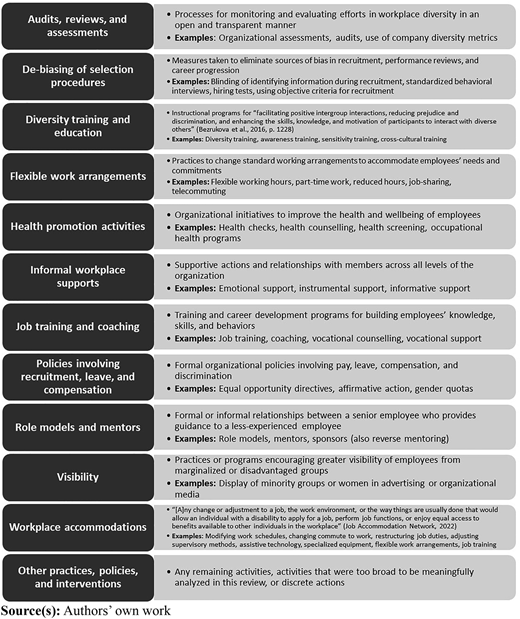
A number of fields were extracted and articles were coded according to the specific intervention for improving D&I. Where multiple interventions were mentioned, these were coded according to the narrowest distinct intervention reported and care was taken to separate the activities so that they were mutually exclusive. Interventions were then grouped into 12 broader categories for ease of interpretation (see Figure 1).

In addition, outcomes associated with each intervention were also recorded. For example, extending the working lives of older employees, increasing the share of women on boards, and career advancement of staff from minority backgrounds were coded to the outcome Diversity in recruitment, retention, or progression. Each intervention–outcome pairing was also coded according to whether the activity was reported by the review authors to have (1) evidence of being effective (or the authors recommended the intervention based on the evidence), (2) evidence of being weakly effective, (3) evidence of mixed positive and negative effects, (4) evidence of no effect, (5) an unknown effect, a lack of evidence, or the authors did not specify the direction of the effect.

In this section, we first present a summary of the search results, followed by findings organized by the three research questions, and for each of the D&I intervention categories.

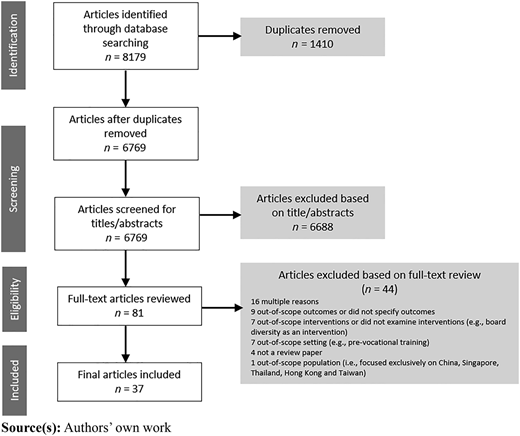
Figure 2 illustrates the search process using a PRISMA (Preferred Reporting Items for Systematic reviews and Meta-Analyses; Page et al., 2021) diagram. The PRISMA diagram depicts a transparent summary of the search process and is required to meet established standards for reporting in systematic reviews (Page et al., 2021). The initial search yielded a total of 6,769 citations, after removal of duplicates. Full-text review produced a final list of 37 accepted articles, comprising 4 meta-analyses, 17 systematic reviews, 7 scoping reviews, and 9 narrative reviews (see Table S1 in the Online Supplementary Material). Articles varied in quality, with only one meeting all eligible AMSTAR criteria (Gensby et al., 2014) and five meeting three or fewer criteria. Articles came from a range of fields including HR, organizational behavior, applied psychology, vocational rehabilitation, occupational health, and public health.

From the 37 articles, we identified a total of 60 specific practices, policies, programs, or initiatives for organizational D&I, which were grouped into 12 categories. We also identified 22 outcomes which were linked to one or more of these interventions (see Table S2 in the Online Supplementary Material).

RQ1.

What types of D&I interventions have been examined in the academic literature and how effective are they?

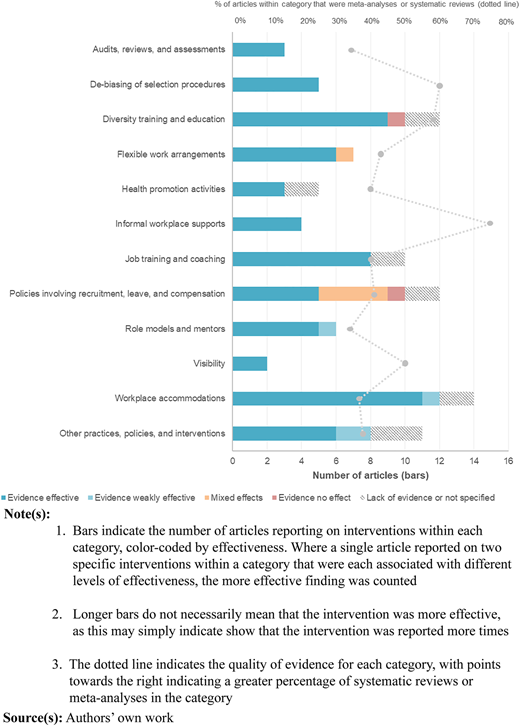
Figure 3 presents the number of articles that reported on D&I interventions across the 12 categories, broken down by the type of evidence presented. Diversity training and education, Policies involving recruitment, leave, and compensation, and Workplace accommodations were the categories with the most articles (12, 12, and 14 respectively). Longer bars in the figure do not necessarily mean that the category was more effective, rather that the interventions were examined more frequently. For example, more than half of the interventions belonging to Policies involving recruitment, leave, and compensation were reported to have mixed effects, evidence of no effect, or a lack of evidence. In contrast, Workplace accommodations were found to be more consistently positive, with 12 of 14 articles reporting them to be effective. The dotted line provides a basic indication of the hierarchy of evidence, showing the percentage of articles within the category that were systematic reviews or meta-analyses. Diversity training and education had relatively higher quality of evidence compared with other categories, with a higher number of articles and more than half of articles being meta-analyses or systematic reviews.

RQ2.

What outcomes are empirically linked to D&I interventions?

Due to the search criteria, Diversity in recruitment, retention, and progression was by far the most common outcome associated with D&I interventions, and was reported for all categories. Some categories of interventions—Diversity training and education, for example—were linked to a range of outcomes, such as learning and behavior, among others. In contrast, De-biasing of selection procedures was associated with only diversity outcomes.

RQ3.

What diversity dimensions are targeted by D&I interventions?

Age, disability, and gender were the most common specified dimensions of D&I, although ethnicity and race were examined in a number of general D&I articles, particularly those examining diversity training. In contrast, only one article exclusively focused on lesbian, gay, bisexual, and transgender (LGBT) D&I (Webster et al., 2018). Categories such as Workplace accommodations and Health promotion were limited to age- and disability-based diversity. In contrast, De-biasing of selection procedures were widely examined with respect to several dimensions of diversity. Specific findings and evidence quality for D&I intervention categories are reported below.

Audits, reviews, and assessments included mandatory organizational assessments on topics such as the age composition of the workforce (Dickson, 2015). The quality of the evidence for these interventions was average: they tended to be reported as recommendations and were associated with general D&I outcomes.

De-biasing of selection procedures included practices such as blinding gender information in the recruitment process and standardized behavioral interviews (Alonso et al., 2017; Boehm et al., 2021; Isaac et al., 2009; Schloemer-Jarvis et al., 2022; Yang and Konrad, 2011). Most interventions in this category were associated with outcomes promoting diversity in recruitment, retention, and progression, and generalized across a number of diversity dimensions. For example, Isaac et al. (2009) presented a number of effective interventions in their systematic review of approaches for eliminating gender bias during personnel selection, including focusing on job-related competence recruitment, ensuring that women comprised 25% or more of the candidate pool, and committing to job criteria before applicants were reviewed. The quality of evidence associated with this category was higher than others, with more than half of articles consisting of systematic reviews and meta-analyses.

Although diversity training has been criticized for having a theoretically-limited and methodologically-flawed evidence base (Alhejji et al., 2016; Kalinoski et al., 2013), the quality of evidence in this category was relatively higher than at least the other categories in this review. More than half of the articles were meta-analyses (Bezrukova et al., 2016; Kalinoski et al., 2013) and systematic reviews (Alhejji et al., 2016; Isaac et al., 2009; Metinyurt et al., 2021; Phillips et al., 2016; Schloemer-Jarvis et al., 2022), with an average AMSTAR score of 6.

Diversity training was typically linked to three major outcome categories: (1) changes in cognitive outcomes, such as knowledge and awareness, (2) changes in attitudes, emotions, and motivations, and (3) changes in behavioral skills and intentions, and to a lesser extent, changes in behavior (e.g. Alhejji et al., 2016). Beyond these, the evidence for training and education to promote diversity in recruitment, retention, and progression was weak. Three articles reported on a lack of evidence or no effect of diversity training on gender equity in hiring and employment-related outcomes for people with disability (Isaac et al., 2009; Phillips et al., 2016; Schloemer-Jarvis et al., 2022). However, some authors pointed to the importance of education as an enabler of disability inclusion. Cavanagh et al. (2017), McDowell and Fossey (2015), and Nevala et al. (2015) all noted the need for education to overcome employers’ lack of awareness of financial support, workplace accommodations, discrimination legislation, and intervention strategies.

Flexible work arrangements were investigated with respect to improving age (Boehm et al., 2021; Dickson, 2015; Edge et al., 2017; Mahon and Millar, 2014), disability (Nevala et al., 2015), and gender (Gabaldon et al., 2016; Hegewisch and Gornick, 2011) dimensions of diversity. However, some authors cautioned that these practices could backfire where they prevent progression of women to senior positions or increase reluctance among employers to hire women (Gabaldon et al., 2016). Other authors recommended that flexible working arrangements need to be accompanied by greater transparency and visibility to all employees, including how they may affect opportunities for promotion or salary increases (Lane and Flowers, 2015).

Health promotion activities refer to a range of initiatives involving health checks, health counseling, health screening (Söderbacka et al., 2020), occupational health programs (Wilson et al., 2020), and other activities to encourage healthy lifestyles (Boehm et al., 2021; Cloostermans et al., 2015; Edge et al., 2017). These activities have been recommended predominantly as a means of improving the health and work ability of older workers, preventing early retirement, and extending careers for age-based diversity. Although research samples in this category were limited, there was some agreement that they improved work outcomes for older adults (Söderbacka et al., 2020).

Workplace supports refer to supportive actions and relationships with managers and supervisors, along with co-workers (Boehm et al., 2021; Jansen et al., 2021; Nevala et al., 2015; Webster et al., 2018). Webster et al. (2018) and Beehr and McGrath (1992) distinguish between three types of social support: emotional (e.g. showing concern, empathizing), instrumental (e.g. intervening as a bystander, corroborating reports of harassment), and informative (e.g. providing advice on addressing workplace discrimination). There was reasonably strong evidence to link these practices with inclusion-relevant outcomes (e.g. improved work attitudes, reduced psychological strain) for LGBT employees.

Job training, coaching, and vocational counseling provided by employment support specialists were common initiatives for improving age and disability dimensions of diversity by facilitating employment (Boehm et al., 2021; Carlson et al., 2020; Cloostermans et al., 2015; Dickson, 2015; Khalifa et al., 2020; Mahon and Millar, 2014; McDowell and Fossey, 2015; Nevala et al., 2015; Procknow and Rocco, 2016; Schloemer-Jarvis et al., 2022). Lack of job-relevant investment in skills—especially in using technology and the changing demands of the workplace—was a major barrier to continued employment among the aging workforce (Dickson, 2015; Mahon and Millar, 2014). Procknow and Rocco (2016), for example, suggested that personalized training and career planning development can improve employees’ self-determination, self-confidence, and career satisfaction.

Although one of the larger categories in this review, more than half of the 12 articles involving formal organizational policies showed mixed effects, no effect, or a lack of evidence or specificity around known outcomes. Gabaldon et al. (2016) found that while gender quotas improved women’s access to more senior positions, they were also associated with unintended consequences such as an organization exiting into an organizational form that is not regulated by gender quotas. One review found that equal opportunity directives and statements increased organizational attractiveness to female and minority candidates (Yang and Konrad, 2011), although another suggested that they did not ensure gender equity in hiring and salary recommendations (Isaac et al., 2009). Webster et al. (2018) examined the effect of formal policies and practices which were weakly associated with outcomes among LGBT workers. The authors also pointed out the signaling role of formal policies, which can be a visible representation of organizational norms (Webster et al., 2018).

Mentoring refers to formal or informal relationships in an organization where a senior employee provides guidance in the form of knowledge, expertise, and skills to a less-experienced employee. Role models allow for professional identification and emulation among more junior workers from diverse backgrounds. This is especially important given evidence that minority workers report greater barriers at the advancement stage (vs. the career entry) where there is a lack of mentors and personal networks (Kilian et al., 2005).

Role models, mentoring, and sponsorship were recommended across a range of diversity dimensions (e.g. Gabaldon et al., 2016; Kapoor and Solomon, 2011; Procknow and Rocco, 2016). Gabaldon et al. (2016) noted the difficulty in measuring the role of mentoring given the small number of women in leadership and time lags in outcomes. More recently, the practice of reverse mentoring—whereby more experienced workers are in the roles of mentees paired with more junior workers—has shown some promise in educating about the experiences of minorities in biased systems (Chaudhuri et al., 2021).

Two articles recommended strategies involving greater visibility of employees from marginalized or disadvantaged groups. Gabaldon et al. (2016) discussed the importance of visibility of women in leadership positions—such as through online databases—to overcome barriers such as identification with gender role expectations. Visibility can also be implemented at the recruitment stage, such as pictorial displays of minority groups in advertising and involving demographically-similar recruiters (Yang and Konrad, 2011).

Workplace accommodations consist of modifying work schedules and work environments, restructuring job duties, adjusting supervisory methods, and acquiring specialized equipment (Job Accommodation Network, 2022). It was the largest category of interventions in this review, consisting of 14 articles, and the quality was among the highest (average AMSTAR score of 6.2). Nevala et al. (2015) found moderate evidence of specific workplace accommodations (e.g. vocational counseling, change to work schedules, education in self-advocacy) for promoting employment among workers with a physical disability. Among employees with a mental illness, however, McDowell and Fossey (2015) found limited evidence that workplace accommodations resulted in longer tenure.

This meta-review spans across disciplines and diversity dimensions to examine a range of D&I interventions and their associated outcomes. We identified 37 reviews published over 13 years, which included 12 categories of practices, policies, programs, initiatives, or other interventions. These interventions were mapped to 22 distinct outcomes and showed varying effectiveness and evidence quality (see Table S2 in the Online Supplementary Material).

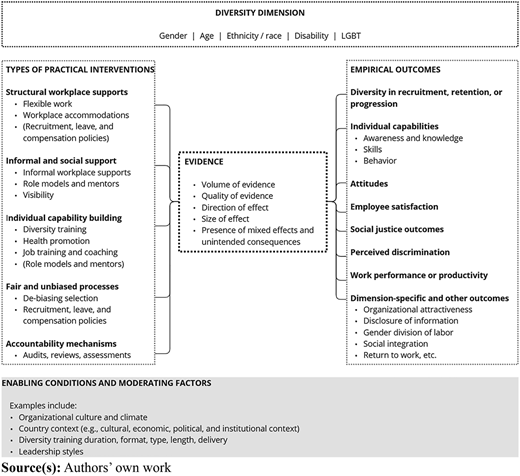
We bring these elements together in a practical framework for guiding the selection of organizational D&I interventions (Figure 4). While this framework shares some interventions with existing diversity management frameworks (e.g. Shen et al., 2009), it extends them by taking a multi-disciplinary approach that is developed bottom-up based on empirical links with D&I outcomes, producing a wider set of intervention categories and evidence-driven outcomes. In this framework, interventions are grouped into high-level categories and linked to empirical outcomes. These links are evaluated by a number of criteria: the volume and quality of evidence, direction and size of effects, and presence of mixed effects.

By overcoming conventional boundaries in discipline- and dimension-specific research, this meta-review has revealed varying levels of maturity in understanding workplace interventions for D&I. It also highlighted a number of influential studies in these respective areas. Kalinoski et al.’s (2013) meta-analysis of 65 studies examined the affective, cognitive, and skill-based outcomes of diversity training, along with their boundary conditions and moderators. Likewise, Bezrukova et al.’s (2016) broader meta-analysis analyzed 260 studies against a theoretical framework, revealing positive effects of diversity training particularly for reactions to training and learning, and under certain conditions or delivered in specific formats. Beyond diversity training, Hegewisch and Gornick’s (2011) narrative review is an example of the unintended consequences of D&I interventions, which highlighted inequalities in employment hours and pay between mothers and fathers, and the impact of long paid maternity leave policies that may reinforce this. Amid growing interest and research on sexual orientation diversity management, Webster et al.’s (2018) meta-analysis provided an early useful framework of interventions in the form of workplace contextual supports (e.g. formal policies) and outcomes (e.g. disclosure) for LGBT employees. More broadly, Yang and Konrad’s (2011) narrative review provides a higher-level summary of the antecedents and impacts of diversity management practices by drawing on institutional and resource-based theories.

From this broad evidence base, this meta-review has highlighted several key findings. No single category of intervention outperformed all others, but there were several tradeoffs across the quality of evidence, the range of D&I outcomes, the effectiveness of interventions, and the generalizability of results across diversity dimensions. While the volume of evidence was weighted towards some interventions—for example, workplace accommodations and diversity training and education—these interventions showed shortcomings in other respects. Research on diversity training and education, for example, tended to focus on circumscribed awareness, knowledge, and learning outcomes (e.g. learning about biases) rather than organizational change. The literature on recruitment, leave, and compensation policies showed mixed effects on D&I outcomes. Practical approaches such as workplace accommodations and job training that provided workers with resources and skills were more consistently associated with positive outcomes, but concentrated on age and disability diversity only.

Managers and leaders face considerable challenges in carrying out D&I initiatives, where the need for meaningful organizational change may be met with limited resources, as well as the risk of tokenism, inauthenticity, and backlash. This meta-review has identified directions where resources can be spent efficiently on actions that have the most effect. One major theme from this meta-review was the specificity of links between D&I interventions and over 20 outcomes ranging from learning, career satisfaction, health, and reduction of psychological strain. For example, diversity training was associated with proximal reactions and learning outcomes (Bezrukova et al., 2016; Kulik and Roberson, 2008) but there was little evidence that it translated to widespread diversity in recruitment (see also Kalev et al., 2006).

These findings explain why many organizations fall short of widespread change, as they are at odds with how D&I are often treated in practice. Operationally, diversity and inclusion are often used interchangeably and short-hand as a common banner for any policies or practices relating to aspects of D&I (Jonsen et al., 2021). Many D&I activities, such as education programs, are piecemeal and “band-aid” type actions without a clear connection to an overarching diversity management framework. The current findings help organizations investing in diversity training (or other interventions) set realistic expectations about what they can achieve, and encourage a suite of interventions targeting multiple aspects of diversity (see also Kulik, 2014; Stephens et al., 2020). The findings also help practitioners anticipate where unintended consequences and mixed effects may occur (for a theoretical review, see Leslie, 2019).

Finally, the findings provide insights on the conditions for effective interventions through moderating factors and enabling environments. In the case of diversity training, instructional method (e.g. active, such as roleplay vs. passive, such as reading) and the length of training (e.g. more than 4 h) were critical (Bezrukova et al., 2016; Kalinoski et al., 2013). For other intervention categories such as policies, cultural, political, and economic context were proposed key moderators (Alonso et al., 2017; Hegewisch and Gornick, 2011; Schloemer-Jarvis et al., 2022).

In assessing the state of the evidence on D&I interventions, this meta-review has revealed some gaps in the literature. Some categories (e.g. diversity training and education) were examined with meta-analyses over a hundred studies, and others had virtually no reviews despite compelling arguments from primary research, which would benefit from future tests of interventions (e.g. accountability; Dobbin and Kalev, 2015; Richard et al., 2013).

There is also a need to consider LGBT inclusion in particular (Webster et al., 2018), which has unique considerations (e.g. barriers relating to disclosure) that are not generalizable. Within the disability dimension of diversity, there were few studies investigating accommodations for “invisible” disabilities (i.e. cognitive and psychiatric disabilities; Prince, 2017; Sundar, 2017). It is also encouraging that a recent review has identified a range of activities—accommodations during recruitment, modified onboarding processes, job design practices, flexible working, training, and employee resource groups—for promoting neurodiversity (Hennekam and Follmer, 2024).

Finally, organizational practices have traditionally focused on diversity and, despite shifting interest to inclusion (Mor Barak et al., 2016), reviews have rarely examined inclusion-relevant outcomes, such as perceptions of belonging, uniqueness, authenticity, participation, and access to resources (Jansen et al., 2014; Mor Barak and Cherin, 1998; Roberson, 2006).

We used a rapid meta-review methodology (Khangura et al., 2012) because it is ideal for synthesizing broad bodies of literature in an efficient and methodical fashion. In covering the breadth of research, the tradeoff is depth on the myriad practices, outcomes, and diversity dimensions associated with organizational D&I. It is reassuring, however, that rapid reviews generally produce similar conclusions to systematic reviews and are a sufficiently reliable source for decision-making (Watt et al., 2008).

Nevertheless, the broad search strategy should be kept in mind when interpreting the findings. Effective D&I strategies that do not lend well to interventional study designs are at risk of being overlooked. Some promising approaches that are of practical significance are missing from this review, such as independent ombudspersons (Dobbin and Kalev, 2019), diversity task forces, manager accountability practices, embedding diversity goals into organizational strategy (Dobbin and Kalev, 2015; Richard et al., 2013), as well as initiatives such as bystander intervention and ally networks. These would be better captured through a review of the primary literature.

Contrary to earlier reviews (Colella et al., 2017; Triana et al., 2021), which raised concerns over an over-representation of research on race and ethnicity diversity, and an under-emphasis on disability, our findings revealed a paradox in the opposite direction. That is, disability (and to a lesser extent, age) dimensions of diversity were well represented among the included articles, and along with them, interventions such as workplace accommodations and health promotion activities.

This is unlikely to be due to the search terms, as we intentionally avoided searching based on diversity dimensions (e.g. “race”) to prevent biasing results towards one dimension. One possibility is that given that D&I policies had their starting point in race diversity, research on interventions for race diversity are the “default” and are studied less frequently in isolation to the exclusion of other diversity dimensions. This suggests that while the interventions for race diversity may generalize to other dimensions (e.g. diversity training, de-biasing selection procedures), the reverse may not be true and the findings may be less useful for organizations interested in only racial D&I.

One explanation for the over-representation of the disability dimension that may be related to our search strategy is that we purposefully targeted high-quality empirical reviews, including systematic reviews and meta-analyses. The results may reflect the greater use of these methods (along with intervention-focused research) for studying disability, versus other dimensions that tend to receive more attention in conceptual and theoretical papers. To illustrate, 12 of the 14 included articles mentioning disability in their title were systematic or scoping reviews, and 9 of these came from healthcare and rehabilitation journals—disciplines where systematic reviews are common given their origins in clinical medicine (Chalmers et al., 2002).

In their landmark study on the efficacy of corporate diversity policies, Kalev et al. (2006) cautioned against so-called best practices, noting that “[w]e know a lot about the disease of workplace inequality, but not much about the cure” (p. 590). This meta-review brings together intervention-focused research across multiple knowledge bases to answer “what works”. It is intended to serve as key reference to assess and compare the quality of evidence and empirical outcomes for a catalogue of D&I interventions. The results help bridge the research–practice gap described by Kulik (2014). We have provided evidence on the policies and programs components of diversity management systems and offer a decision-making resource and clear expectations for practitioners aiming to understand what interventions can be carried out for which diversity dimensions, and what outcomes to expect when implementing them. Although there is still much detail to fill in, we have provided a starting point in making the vast literature of D&I more accessible, relevant, and useful for practitioners.

Funding for this work was provided in part by Inclusive Australia (www.inclusiveaustralia.com.au), a not-for-profit organization seeking to promote change for social inclusion in Australia. Liam Smith is on the board of Inclusive Australia.

*Included in the meta-review

*
Alhejji
,
H.
,
Garavan
,
T.
,
Carbery
,
R.
,
O'Brien
,
F.
and
McGuire
,
D.
(
2016
), “
Diversity training programme outcomes: a systematic review
”,
Human Resource Development Quarterly
, Vol. 
27
No. 
1
, pp. 
95
-
149
, doi: .
*
Alonso
,
P.
,
Moscoso
,
S.
and
Salgado
,
J.F.
(
2017
), “
Structured behavioral interview as a legal guarantee for ensuring equal employment opportunities for women: a meta-analysis
”,
The European Journal of Psychology Applied to Legal Context
, Vol. 
9
No. 
1
, pp. 
15
-
23
, doi: .
Ayoko
,
O.B.
and
Fujimoto
,
Y.
(
2023
), “
Diversity, Inclusion, and human resource management: a call for more belongingness and intersectionality research
”,
Journal of Management & Organization
, Vol. 
29
No. 
6
, pp. 
983
-
990
, doi: .
Beehr
,
T.A.
and
McGrath
,
J.E.
(
1992
), “
Social support, occupational stress and anxiety
”,
Anxiety, Stress, and Coping
, Vol. 
5
No. 
1
, pp. 
7
-
19
, doi: .
*
Bezrukova
,
K.
,
Spell
,
C.S.
,
Perry
,
J.L.
and
Jehn
,
K.A.
(
2016
), “
A meta-analytical integration of over 40 years of research on diversity training evaluation
”,
Psychological Bulletin
, Vol. 
142
No. 
11
, pp. 
1227
-
1274
, doi: .
Biondi-Zoccai
,
G.
(
2016
),
Umbrella Reviews: Evidence Synthesis with Meta-Reviews of Reviews and Meta-Epidemiologic Studies
, (1st ed.) ,
Springer International Publishing
,
Basel
, doi: .
*
Boehm
,
S.A.
,
Schröder
,
H.
and
Bal
,
M.
(
2021
), “
Age-related human resource management policies and practices: antecedents, outcomes, and conceptualizations
”,
Work, Aging and Retirement
, Vol. 
7
No. 
4
, pp. 
257
-
272
, doi: .
Bohnet
,
I.
(
2016
),
What Works: Gender Equality by Design
,
Belknap Press of Harvard University Press
,
Cambridge, MA
.
Caird
,
J.
,
Sutcliffe
,
K.
,
Kwan
,
I.
,
Dickson
,
K.
and
Thomas
,
J.
(
2015
), “
Mediating policy-relevant evidence at speed: are systematic reviews of systematic reviews a useful approach?
”,
Evidence & Policy
, Vol. 
11
No. 
1
, pp. 
81
-
97
, doi: .
*
Carlson
,
S.R.
,
Morningstar
,
M.E.
and
Munandar
,
V.
(
2020
), “
Workplace supports for employees with intellectual disability: a systematic review of the intervention literature
”,
Journal of Vocational Rehabilitation
, Vol. 
52
No. 
3
, pp. 
251
-
265
, doi: .
*
Cavanagh
,
J.
,
Bartram
,
T.
,
Meacham
,
H.
,
Bigby
,
C.
,
Oakman
,
J.
and
Fossey
,
E.
(
2017
), “
Supporting workers with disabilities: a scoping review of the role of human resource management in contemporary organisations
”,
Asia Pacific Journal of Human Resources
, Vol. 
55
No. 
1
, pp. 
6
-
43
, doi: .
Chalmers
,
I.
,
Hedges
,
L.V.
and
Cooper
,
H.
(
2002
), “
A brief history of research synthesis
”,
Evaluation and the Health Professions
, Vol. 
25
No. 
1
, pp. 
12
-
37
, doi: .
*
Chaudhuri
,
S.
,
Park
,
S.
and
Johnson
,
K.R.
(
2021
), “
Engagement, inclusion, knowledge sharing, and talent development: is reverse mentoring a panacea to all? Findings from literature review
”,
European Journal of Training and Development
, Vol. 
46
Nos.
5/6
, pp. 
468
-
483
, doi: .
*
Cloostermans
,
L.
,
Bekkers
,
M.B.
,
Uiters
,
E.
and
Proper
,
K.I.
(
2015
), “
The effectiveness of interventions for ageing workers on (early) retirement, work ability and productivity: a systematic review
”,
International Archives of Occupational and Environmental Health
, Vol. 
88
No. 
5
, pp. 
521
-
532
, doi: .
Colella
,
A.
,
Hebl
,
M.
and
King
,
E.
(
2017
), “
One hundred years of discrimination research in the Journal of Applied Psychology: a sobering synopsis
”,
Journal of Applied Psychology
, Vol. 
102
No. 
3
, pp. 
500
-
513
, doi: .
*
Dickson
,
J.J.
(
2015
), “
Supporting a generationally diverse workforce: considerations for aging providers in the US healthcare system
”,
Journal of Best Practices in Health Professions Diversity
, Vol. 
8
No. 
2
, pp. 
1071
-
1086
,
available at:
 https://www.jstor.org/stable/26554219
Dobbin
,
F.
and
Kalev
,
A.
(
2015
), “Why firms need diversity managers and task forces”, in
Forsyth
,
A.
,
Sheikh
,
H.
and
F.
 
Sperotti
(Eds),
How Global Migration Changes the Workforce Diversity Equation
,
Cambridge Scholars Publishing
, pp. 
170
-
198
.
Dobbin
,
F.
and
Kalev
,
A.
(
2016
), “
Why diversity programs fail
”,
Harvard Business Review, available at:
 https://hbr.org/2016/07/why-diversity-programs-fail
Dobbin
,
F.
and
Kalev
,
A.
(
2019
), “
The promise and peril of sexual harassment programs
”,
Proceedings of the National Academy of Sciences
, Vol. 
116
No. 
25
, pp. 
12255
-
12260
, doi: .
*
Edge
,
C.E.
,
Cooper
,
A.M.
and
Coffey
,
M.
(
2017
), “
Barriers and facilitators to extended working lives in Europe: a gender focus
”,
Public Health Reviews
, Vol. 
38
No. 
2
, pp. 
1
-
27
, doi: .
*
Gabaldon
,
P.
,
Anca
,
C.
,
Mateos de Cabo
,
R.
and
Gimeno
,
R.
(
2016
), “
Searching for women on boards: an analysis from the supply and demand perspective
”,
Corporate Governance: An International Review
, Vol. 
24
No. 
3
, pp. 
371
-
385
, doi: .
*
Gensby
,
U.
,
Labriola
,
M.
,
Irvin
,
E.
,
Amick 3rd
,
B.C.
and
Lund
,
T.
(
2014
), “
A classification of components of workplace disability management programs: results from a systematic review
”,
Journal of Occupational Rehabilitation
, Vol. 
24
No. 
2
, pp. 
220
-
241
, doi: .
Guillaume
,
Y.R.
,
Dawson
,
J.F.
,
Woods
,
S.A.
,
Sacramento
,
C.A.
and
West
,
M.A.
(
2013
), “
Getting diversity at work to work: what we know and what we still don’t know
”,
Journal of Occupational and Organizational Psychology
, Vol. 
86
No. 
2
, pp. 
123
-
141
, doi: .
*
Hegewisch
,
A.
and
Gornick
,
J.C.
(
2011
), “
The impact of work-family policies on women’s employment: a review of research from OECD countries
”,
Community, Work and Family
, Vol. 
14
No. 
2
, pp. 
119
-
138
, doi: .
Hennekam
,
S.
and
Follmer
,
K.
(
2024
), “
Neurodiversity and HRM: a practice-based review and research agenda
”,
Equality, Diversity and Inclusion
, Vol. 
43
No. 
7
, pp. 
1119
-
1129
, doi: .
Hennessy
,
E.A.
,
Johnson
,
B.T.
and
Keenan
,
C.
(
2019
), “
Best practice guidelines and essential methodological steps to conduct rigorous and systematic meta-reviews
”,
Applied Psychology: Health and Well-Being
, Vol. 
11
No. 
3
, pp. 
353
-
381
, doi: .
*
Isaac
,
C.
,
Lee
,
B.
and
Carnes
,
M.
(
2009
), “
Interventions that affect gender bias in hiring: a systematic review
”,
Academic Medicine
, Vol. 
84
No. 
10
, pp. 
1440
-
1446
, doi: .
*
Jansen
,
J.
,
van Ooijen
,
R.
,
Koning
,
P.W.C.
,
Boot
,
C.R.L.
and
Brouwer
,
S.
(
2021
), “
The role of the employer in supporting work participation of workers with disabilities: a systematic literature review using an interdisciplinary approach
”,
Journal of Occupational Rehabilitation
, Vol. 
31
No. 
4
, pp. 
916
-
949
, doi: .
Jansen
,
W.S.
,
Otten
,
S.
,
van der Zee
,
K.I.
and
Jans
,
L.
(
2014
), “
Inclusion: conceptualization and measurement
”,
European Journal of Social Psychology
, Vol. 
44
No. 
4
, pp. 
370
-
385
, doi: .
Job Accommodation Network
(
2022
), “
The JAN workplace accommodation toolkit
”,
Job Accommodation Network, available at:
 https://askjan.org/toolkit
Jonsen
,
K.
,
Point
,
S.
,
Kelan
,
E.K.
and
Grieble
,
A.
(
2021
), “
Diversity and inclusion branding: a five-country comparison of corporate websites
”,
The International Journal of Human Resource Management
, Vol. 
32
No. 
3
, pp. 
616
-
649
, doi: .
Kalev
,
A.
,
Dobbin
,
F.
and
Kelly
,
E.
(
2006
), “
Best practices or best guesses? Assessing the efficacy of corporate affirmative action and diversity policies
”,
American Sociological Review
, Vol. 
71
No. 
4
, pp. 
589
-
617
, doi: .
*
Kalinoski
,
Z.T.
,
Steele-Johnson
,
D.
,
Peyton
,
E.J.
,
Leas
,
K.A.
,
Steinke
,
J.
and
Bowling
,
N.A.
(
2013
), “
A meta-analytic evaluation of diversity training outcomes
”,
Journal of Organizational Behavior
, Vol. 
34
No. 
8
, pp. 
1076
-
1104
, doi: .
*
Kapoor
,
C.
and
Solomon
,
N.
(
2011
), “
Understanding and managing generational differences in the workplace
”,
Worldwide Hospitality and Tourism Themes
, Vol. 
3
No. 
4
, pp. 
308
-
318
, doi: .
*
Khalifa
,
G.
,
Sharif
,
Z.
,
Sultan
,
M.
and
Rezze
,
B.Di.
(
2020
), “
Workplace accommodations for adults with autism spectrum disorder: a scoping review
”,
Disability and Rehabilitation
, Vol. 
42
No. 
9
, pp. 
1316
-
1331
, doi: .
Khangura
,
S.
,
Konnyu
,
K.
,
Cushman
,
R.
,
Grimshaw
,
J.
and
Moher
,
D.
(
2012
), “
Evidence summaries: the evolution of a rapid review approach
”,
Systematic Reviews
, Vol. 
1
, p.
10
, doi: .
Kilian
,
C.M.
,
Hukai
,
D.
and
McCarty
,
C.E.
(
2005
), “
Building diversity in the pipeline to corporate leadership
”,
Journal of Management Development
, Vol. 
24
No. 
2
, pp. 
155
-
168
, doi: .
Kougiannou
,
N.K.
and
Ridgway
,
M.
(
2022
), “
How is human resource management research (not) helping practice? In defence of practical implications
”,
Human Resource Management Journal
, Vol. 
32
No. 
2
, pp. 
470
-
484
, doi: .
Krentz
,
M.
(
2019
), “
Survey: what diversity and inclusion policies do employees actually want?
”,
Harvard Business Review, available at:
 https://hbr.org/2019/02/survey-what-diversity-and-inclusion-policies-do-employees-actually-want
Kulik
,
C.T.
(
2014
), “
Working below and above the line: the research–practice gap in diversity management
”,
Human Resource Management Journal
, Vol. 
24
No. 
2
, pp. 
129
-
144
, doi: .
Kulik
,
C.T.
and
Roberson
,
L.
(
2008
), “Diversity initiative effectiveness: what organizations can (and cannot) expect from diversity recruitment, diversity training, and formal mentoring programs”, in
Brief
,
A.P.
(Ed.),
Diversity at Work
,
Cambridge University Press
, pp. 
265
-
317
, doi: .
Lane
,
S.R.
and
Flowers
,
T.D.
(
2015
), “
Salary inequity in social work: a review of the knowledge and call to action
”,
Affilia
, Vol. 
30
No. 
3
, pp. 
363
-
379
, doi: .
Leslie
,
L.M.
(
2019
), “
Diversity initiative effectiveness: a typological theory of unintended consequences
”,
Academy of Management Review
, Vol. 
44
No. 
3
, pp. 
538
-
563
, doi: .
MacDuffie
,
J.P.
(
1995
), “
Human resource bundles and manufacturing performance: organizational logic and flexible production systems in the world auto industry
”,
ILR Review
, Vol. 
48
No. 
2
, pp. 
197
-
221
, doi: .
*
Mahon
,
J.F.
and
Millar
,
C.C.J.M.
(
2014
), “
ManAGEment: the challenges of global age diversity for corporations and governments
”,
Journal of Organizational Change Management
, Vol. 
27
No. 
4
, pp. 
553
-
568
, doi: .
*
McDowell
,
C.
and
Fossey
,
E.
(
2015
), “
Workplace accommodations for people with mental illness: a scoping review
”,
Journal of Occupational Rehabilitation
, Vol. 
25
No. 
1
, pp. 
197
-
206
, doi: .
*
Metinyurt
,
T.
,
Haynes-Baratz
,
M.C.
and
Bond
,
M.A.
(
2021
), “
A systematic review of interventions to address workplace bias: what we know, what we don’t, and lessons learned
”,
New Ideas in Psychology
, Vol. 
63
, 100879, doi: .
Mor Barak
,
M.E.
(
2000
), “
The inclusive workplace: an ecosystems approach to diversity management
”,
Social Work
, Vol. 
45
No. 
4
, pp. 
339
-
353
, doi: .
Mor Barak
,
M.E.
and
Cherin
,
D.A.
(
1998
), “
A tool to expand organizational understanding of workforce diversity: exploring a measure of inclusion-exclusion
”,
Administration in Social Work
, Vol. 
22
No. 
1
, pp. 
47
-
64
, doi: .
Mor Barak
,
M.E.
,
Lizano
,
E.L.
,
Kim
,
A.
,
Duan
,
L.
,
Rhee
,
M.-K.
,
Hsiao
,
H.-Y.
and
Brimhall
,
K.C.
(
2016
), “
The promise of diversity management for climate of inclusion: a state-of-the-art review and meta-analysis
”,
Human Service Organizations: Management, Leadership & Governance
, Vol. 
40
No. 
4
, pp. 
305
-
333
, doi: .
Murad
,
M.H.
,
Asi
,
N.
,
Alsawas
,
M.
and
Alahdab
,
F.
(
2016
), “
New evidence pyramid
”,
BMJ Evidence-Based Medicine
, Vol. 
21
No. 
4
, pp. 
125
-
127
, doi: .
Nishii
,
L.H.
,
Khattab
,
J.
,
Shemla
,
M.
and
Paluch
,
R.M.
(
2018
), “
A multi-level process model for understanding diversity practice effectiveness
”,
Academy of Management Annals
, Vol. 
12
No. 
1
, pp. 
37
-
82
, doi: .
*
Nevala
,
N.
,
Pehkonen
,
I.
,
Koskela
,
I.
,
Ruusuvuori
,
J.
and
Anttila
,
H.
(
2015
), “
Workplace accommodation among persons with disabilities: a systematic review of its effectiveness and barriers or facilitators
”,
Journal of Occupational Rehabilitation
, Vol. 
25
No. 
2
, pp. 
432
-
448
, doi: .
Page
,
M.J.
,
McKenzie
,
J.E.
,
Bossuyt
,
P.M.
,
Boutron
,
I.
,
Hoffmann
,
T.C.
,
Mulrow
,
C.D.
,
Shamseer
,
L.
,
Tetzlaff
,
J.M.
,
Akl
,
E.A.
,
Brennan
,
S.E.
,
Chou
,
R.
,
Glanville
,
J.
,
Grimshaw
,
J.M.
,
Hróbjartsson
,
A.
,
Lalu
,
M.M.
,
Li
,
T.
,
Loder
,
E.W.
,
Mayo-Wilson
,
E.
,
McDonald
,
S.
,
McGuinness
,
L.A.
,
Stewart
,
L.A.
,
Thomas
,
J.
,
Tricco
,
A.C.
,
Welch
,
V.A.
,
Whiting
,
P.
and
Moher
,
D.
(
2021
), “
The PRISMA 2020 statement: an updated guideline for reporting systematic reviews
”,
BMJ
, Vol. 
372
, n71, doi: .
Pedulla
,
D.
(
2020
), “
Diversity and inclusion efforts that really work
”,
Harvard Business Review, available at:
 https://hbr.org/2020/05/diversity-and-inclusion-efforts-that-really-work
*
Phillips
,
B.N.
,
Deiches
,
J.
,
Morrison
,
B.
,
Chan
,
F.
and
Bezyak
,
J.L.
(
2016
), “
Disability diversity training in the workplace: systematic review and future directions
”,
Journal of Occupational Rehabilitation
, Vol. 
26
No. 
3
, pp. 
264
-
275
, doi: .
Pitts
,
D.W.
(
2006
), “
Modeling the impact of diversity management
”,
Review of Public Personnel Administration
, Vol. 
26
No. 
3
, pp. 
245
-
268
, doi: .
Point
,
S.
and
Singh
,
V.
(
2003
), “
Defining and dimensionalising diversity: evidence from corporate websites across Europe
”,
European Management Journal
, Vol. 
21
No. 
6
, pp. 
750
-
761
, doi: .
*
Prince
,
M.J.
(
2017
), “
Persons with invisible disabilities and workplace accommodation: findings from a scoping literature review
”,
Journal of Vocational Rehabilitation
, Vol. 
46
No. 
1
, pp. 
75
-
86
, doi: .
*
Procknow
,
G.
and
Rocco
,
T.S.
(
2016
), “
The unheard, unseen, and often forgotten: an examination of disability in the human resource development literature
”,
Human Resource Development Review
, Vol. 
15
No. 
4
, pp. 
379
-
403
, doi: .
Richard
,
O.C.
,
Roh
,
H.
and
Pieper
,
J.R.
(
2013
), “
The link between diversity and equality management practice bundles and racial diversity in the managerial ranks: does firm size matter?
”,
Human Resource Management
, Vol. 
52
No. 
2
, pp. 
215
-
242
, doi: .
Roberson
,
Q.M.
,
King
,
E.
and
Hebl
,
M.
(
2020
), “
Designing more effective practices for reducing workplace inequality
”,
Behavioral Science & Policy
, Vol. 
6
No. 
1
, pp. 
39
-
49
, doi: .
Roberson
,
Q.M.
(
2006
), “
Disentangling the meanings of diversity and inclusion in organizations
”,
Group & Organization Management
, Vol. 
31
No. 
2
, pp. 
212
-
236
, doi: .
Roberson
,
Q.M.
(
2019
), “
Diversity in the workplace: a review, synthesis, and future research agenda
”,
Annual Review of Organizational Psychology and Organizational Behavior
, Vol. 
6
No. 
1
, pp. 
69
-
88
, doi: .
*
Schloemer-Jarvis
,
A.
,
Bader
,
B.
and
Böhm
,
S.A.
(
2022
), “
The role of human resource practices for including persons with disabilities in the workforce: a systematic literature review
”,
International Journal of Human Resource Management
, Vol. 
33
No. 
1
, pp. 
45
-
98
, doi: .
Shea
,
B.J.
,
Grimshaw
,
J.M.
,
Wells
,
G.A.
,
Boers
,
M.
,
Andersson
,
N.
,
Hamel
,
C.
,
Porter
,
A.C.
,
Tugwell
,
P.
,
Moher
,
D.
and
Bouter
,
L.M.
(
2007
), “
Development of AMSTAR: a measurement tool to assess the methodological quality of systematic reviews
”,
BMC Medical Research Methodology
, Vol. 
7
No. 
1
, p.
10
, doi: .
Shen
,
J.
,
Chanda
,
A.
,
D'Netto
,
B.
and
Monga
,
M.
(
2009
), “
Managing diversity through human resource management: an international perspective and conceptual framework
”,
International Journal of Human Resource Management
, Vol. 
20
No. 
2
, pp. 
235
-
251
, doi: .
Shore
,
L.M.
,
Cleveland
,
J.N.
and
Sanchez
,
D.
(
2018
), “
Inclusive workplaces: a review and model
”,
Human Resource Management Review
, Vol. 
28
No. 
2
, pp. 
176
-
189
, doi: .
*
Söderbacka
,
T.
,
Nyholm
,
L.
and
Fagerström
,
L.
(
2020
), “
Workplace interventions that support older employees’ health and work ability: a scoping review
”,
BMC Health Services Research
, Vol. 
20
No. 
1
, pp. 
1
-
9
, doi: .
Stephens
,
N.
,
Rivera
,
L.
and
Townsend
,
S.
(
2020
), “
What works to increase diversity? A multi-level approach
”,
Research in Organizational Behavior
, Vol. 
39
, pp. 
1
-
51
.
*
Sundar
,
V.
(
2017
), “
Operationalizing workplace accommodations for individuals with disabilities: a scoping review
”,
Work
, Vol. 
56
No. 
1
, pp. 
135
-
155
, doi: .
Triana
,
M.del C.
,
Gu
,
P.
,
Chapa
,
O.
,
Richard
,
O.
and
Colella
,
A.
(
2021
), “
Sixty years of discrimination and diversity research in human resource management: a review with suggestions for future research directions
”,
Human Resource Management
, Vol. 
60
No. 
1
, pp. 
145
-
204
, doi: .
Watt
,
A.
,
Cameron
,
A.
,
Sturm
,
L.
,
Lathlean
,
T.
,
Babidge
,
W.
,
Blamey
,
S.
,
Facey
,
K.
,
Hailey
,
D.
,
Norderhaug
,
I.
and
Maddern
,
G.
(
2008
), “
Rapid versus full systematic reviews: validity in clinical practice?
”,
ANZ Journal of Surgery
, Vol. 
78
No. 
11
, pp. 
1037
-
1040
, doi: .
*
Webster
,
J.R.
,
Adams
,
G.A.
,
Maranto
,
C.L.
,
Sawyer
,
K.
and
Thoroughgood
,
C.
(
2018
), “
Workplace contextual supports for LGBT employees: a review, meta-analysis, and agenda for future research
”,
Human Resource Management
, Vol. 
57
No. 
1
, pp. 
193
-
210
, doi: .
*
Wilson
,
D.M.
,
Errasti‐Ibarrondo
,
B.
,
Low
,
G.
,
O'Reilly
,
P.
,
Murphy
,
F.
,
Fahy
,
A.
and
Murphy
,
J.
(
2020
), “
Identifying contemporary early retirement factors and strategies to encourage and enable longer working lives: a scoping review
”,
International Journal of Older People Nursing
, Vol. 
15
No. 
3
, e12313, doi: .
*
Yang
,
Y.
and
Konrad
,
A.M.
(
2011
), “
Understanding diversity management practices: implications of institutional theory and resource-based theory
”,
Group & Organization Management
, Vol. 
36
No. 
1
, pp. 
6
-
38
, doi: .
*
Dearing
,
H.
(
2016
), “
Designing gender-equalizing parental leave schemes: what can we learn from recent empirical evidence from Europe?
”,
Journal of Family Research
, Vol. 
28
No. 
1
, pp. 
38
-
64
, doi: .
*
Furtado
,
J.V.
,
Moreira
,
A.C.
and
Mota
,
J.
(
2021
), “
Gender affirmative action and management: a systematic literature review on how diversity and inclusion management affect gender equity in organizations
”,
Behavioral Sciences
, Vol. 
11
No. 
2
, p.
21
, doi: .
*
House
,
A.
,
Dracup
,
N.
,
Burkinshaw
,
P.
,
Ward
,
V.
and
Bryant
,
L.D.
(
2021
), “
Mentoring as an intervention to promote gender equality in academic medicine: a systematic review
”,
BMJ Open
, Vol. 
11
No. 
1
, e040355, doi: .
*
Manoharan
,
A.
and
Singal
,
M.
(
2017
), “
A systematic literature review of research on diversity and diversity management in the hospitality literature
”,
International Journal of Hospitality Management
, Vol. 
66
, pp. 
77
-
91
, doi: .
*
Ruhindwa
,
A.
,
Randall
,
C.
and
Cartmel
,
J.
(
2016
), “
Exploring the challenges experienced by people with disabilities in the employment sector in Australia: advocating for inclusive practice-a review of literature
”,
Journal of Social Inclusion
, Vol. 
7
No. 
1
, pp. 
4
-
19
, doi: .
*
Wong
,
J.
,
Kallish
,
N.
,
Crown
,
D.
,
Capraro
,
P.
,
Trierweiler
,
R.
,
Wafford
,
Q.E.
,
Tiema
,
L.
,
Shahzeb
,
B.
,
Edeth
,
H.
,
Christina
,
E.
and
Allen
,
T.
(
2021
), “
Job accommodations, return to work, and job retention of people with physical disabilities: a systematic review
”,
Journal of Occupational Rehabilitation
, Vol. 
31
No. 
3
, pp. 
474
-
490
, doi: .

The Supplementary Material for this article can be found online.
Published by Emerald Publishing Limited. This article is published under the Creative Commons Attribution (CC BY 4.0) licence. Anyone may reproduce, distribute, translate and create derivative works of this article (for both commercial and non-commercial purposes), subject to full attribution to the original publication and authors. The full terms of this licence may be seen at http://creativecommons.org/licences/by/4.0/legalcode

Supplementary data

Data & Figures

Figure 1
A table shows categories of organizational diversity and inclusion interventions.The table has two columns: the left column lists the “Intervention Category,” and the right column provides a “Description” and “Examples” for each category. The categories and their corresponding descriptions or examples are as follows: Audits, reviews, and assessments: Description: Processes for monitoring and evaluating efforts in workplace diversity in an open and transparent manner. Examples: Organizational assessments, audits, use of company diversity metrics. De-biasing of selection procedures: Description: Measures taken to eliminate sources of bias in recruitment, performance reviews, and career progression. Examples: De-biasing of identifying information during recruitment, standardized behavioral interviews, hiring tests, using objective criteria for recruitment. Diversity training and education: Description: Instructional programs for “facilitating positive intergroup interactions, reducing prejudice and discrimination, and enhancing the skills, knowledge, and motivation of participants to interact with diverse others” (Bezuirkova et al., 2016, p. 1228). Examples: Diversity training, awareness training, sensitivity training, cross-cultural training. Flexible work arrangements: Description: Practices to change standard working arrangements to accommodate employees‘ needs and commitments. Examples: Flexible working hours, part-time work, reduced hours, job-sharing, telecommuting. Health promotion activities: Description: Organizational initiatives to improve the health and wellbeing of employees. Examples: Health checks, health counseling, health screening, occupational health programs. Informal workplace supports: Description: Supportive actions and relationships with members across all levels of the organization. Examples: Emotional support, instrumental support, informative support. Job training and coaching: Description: Training and career development programs for building employees' knowledge, skills, and behaviors. Examples: Job training, coaching, vocational counseling, vocational support. Policies involving recruitment, leave, and compensation: Description: Formal organizational policies involving pay, leave, compensation, and discrimination. Examples: Equal opportunity directives, affirmative action, gender quotas. Role models and mentors: Description: Formal or informal relationships between a senior employee who provides guidance to a less-experienced employee. Examples: Role models, mentors, sponsors (also reverse mentoring). Visibility: Description: Practices or programs encouraging greater visibility of employees from marginalized or disadvantaged groups. Examples: Display of minority groups or women in advertising or organizational media. Workplace accommodations: Description: Any change or adjustment to a job, the work environment, or the way things are usually done that would allow an individual with a disability to apply for a job, perform job functions, or enjoy equal access to benefits available to other individuals in the workplace“ (Job Accommodation Network, 2022). Examples: Modifying work schedules, changing commute to work, restructuring job duties, adjusting supervisory methods, assistive technology or specialized equipment, flexible work arrangements, job training. Other practices, policies, and interventions: Description: Any remaining activities, activities that were too broad to be meaningfully analyzed in this review, or discrete actions.

Categories of organizational diversity and inclusion interventions

Figure 1
A table shows categories of organizational diversity and inclusion interventions.The table has two columns: the left column lists the “Intervention Category,” and the right column provides a “Description” and “Examples” for each category. The categories and their corresponding descriptions or examples are as follows: Audits, reviews, and assessments: Description: Processes for monitoring and evaluating efforts in workplace diversity in an open and transparent manner. Examples: Organizational assessments, audits, use of company diversity metrics. De-biasing of selection procedures: Description: Measures taken to eliminate sources of bias in recruitment, performance reviews, and career progression. Examples: De-biasing of identifying information during recruitment, standardized behavioral interviews, hiring tests, using objective criteria for recruitment. Diversity training and education: Description: Instructional programs for “facilitating positive intergroup interactions, reducing prejudice and discrimination, and enhancing the skills, knowledge, and motivation of participants to interact with diverse others” (Bezuirkova et al., 2016, p. 1228). Examples: Diversity training, awareness training, sensitivity training, cross-cultural training. Flexible work arrangements: Description: Practices to change standard working arrangements to accommodate employees‘ needs and commitments. Examples: Flexible working hours, part-time work, reduced hours, job-sharing, telecommuting. Health promotion activities: Description: Organizational initiatives to improve the health and wellbeing of employees. Examples: Health checks, health counseling, health screening, occupational health programs. Informal workplace supports: Description: Supportive actions and relationships with members across all levels of the organization. Examples: Emotional support, instrumental support, informative support. Job training and coaching: Description: Training and career development programs for building employees' knowledge, skills, and behaviors. Examples: Job training, coaching, vocational counseling, vocational support. Policies involving recruitment, leave, and compensation: Description: Formal organizational policies involving pay, leave, compensation, and discrimination. Examples: Equal opportunity directives, affirmative action, gender quotas. Role models and mentors: Description: Formal or informal relationships between a senior employee who provides guidance to a less-experienced employee. Examples: Role models, mentors, sponsors (also reverse mentoring). Visibility: Description: Practices or programs encouraging greater visibility of employees from marginalized or disadvantaged groups. Examples: Display of minority groups or women in advertising or organizational media. Workplace accommodations: Description: Any change or adjustment to a job, the work environment, or the way things are usually done that would allow an individual with a disability to apply for a job, perform job functions, or enjoy equal access to benefits available to other individuals in the workplace“ (Job Accommodation Network, 2022). Examples: Modifying work schedules, changing commute to work, restructuring job duties, adjusting supervisory methods, assistive technology or specialized equipment, flexible work arrangements, job training. Other practices, policies, and interventions: Description: Any remaining activities, activities that were too broad to be meaningfully analyzed in this review, or discrete actions.

Categories of organizational diversity and inclusion interventions

Close Figure 1
Figure 2
A PRISMA flow diagram details the systematic selection process for articles in a review.The diagram is structured vertically into four main phases: “Identification,” “Screening,” “Eligibility,” and “Included.” In the “Identification” phase, a text box is labeled “Articles identified through database searching: n equals 8179.” An arrow points rightward to a text box labeled “Duplicates removed: n equals 1410.” In the “Screening” phase, the main text box is labeled “Articles after duplicates removed: n equals 6769.” An arrow points downward to a text box labeled “Articles screened for titles or abstracts: n equals 6769.” An arrow points rightward to a text box labeled “Articles excluded based on title or abstracts: n equals 6688.” In the “Eligibility” phase, a text box is labeled “Full-text articles reviewed: n equals 81.” An arrow points rightward to another text box labeled “Articles excluded based on full-text review (n equals 44).” This box contains the following details: “16 multiple reasons, 9 out-of-scope outcomes or did not specify outcomes, 7 out-of-scope interventions or did not examine interventions (for example, board diversity as an intervention), 7 out-of-scope setting (for example, pre-vocational training), 4 not a review paper, 1 out-of-scope population (for example, focused exclusively on China, Singapore, Thailand, Hong Kong, and Taiwan).” In the “Included” phase, the final text box is labeled “Final articles included: n equals 37.” Arrows lead downward from the top text box in the “Identification” phase to the bottom text box in the “Included” stage.

PRISMA diagram presenting the flow of articles through the review process

Figure 2
A PRISMA flow diagram details the systematic selection process for articles in a review.The diagram is structured vertically into four main phases: “Identification,” “Screening,” “Eligibility,” and “Included.” In the “Identification” phase, a text box is labeled “Articles identified through database searching: n equals 8179.” An arrow points rightward to a text box labeled “Duplicates removed: n equals 1410.” In the “Screening” phase, the main text box is labeled “Articles after duplicates removed: n equals 6769.” An arrow points downward to a text box labeled “Articles screened for titles or abstracts: n equals 6769.” An arrow points rightward to a text box labeled “Articles excluded based on title or abstracts: n equals 6688.” In the “Eligibility” phase, a text box is labeled “Full-text articles reviewed: n equals 81.” An arrow points rightward to another text box labeled “Articles excluded based on full-text review (n equals 44).” This box contains the following details: “16 multiple reasons, 9 out-of-scope outcomes or did not specify outcomes, 7 out-of-scope interventions or did not examine interventions (for example, board diversity as an intervention), 7 out-of-scope setting (for example, pre-vocational training), 4 not a review paper, 1 out-of-scope population (for example, focused exclusively on China, Singapore, Thailand, Hong Kong, and Taiwan).” In the “Included” phase, the final text box is labeled “Final articles included: n equals 37.” Arrows lead downward from the top text box in the “Identification” phase to the bottom text box in the “Included” stage.

PRISMA diagram presenting the flow of articles through the review process

Close Figure 2
Figure 3
A horizontal bar chart shows the number of articles for different categories of diversity and inclusion interventions.The vertical axis lists the 12 categories of interventions: “Audits, reviews, and assessments,” “De-biasing of selection procedures,” “Diversity training and education,” “Flexible work arrangements,” “Health promotion activities,” “Informal workplace supports,” “Job training and coaching,” “Policies involving recruitment, leave, and compensation,” “Role models and mentors,” “Visibility,” “Workplace accommodations,” and “Other practices, policies, and interventions.” There are two horizontal axes: The bottom horizontal axis ranges from 0 to 16 in increments of 2 units and corresponds to the “Number of articles (bars).” The top horizontal axis ranges from 0 percent to 80 percent in increments of 10 percent and corresponds to the “Percent of articles within the category that were meta-analyses or systematic reviews (dotted line).” The graph shows five stacked bars as indicated in the legend: “Evidence effective,” “Evidence weakly effective,” “Mixed effects,” “Evidence no effect,” and “Lack of evidence or not specified.” The data from the bars are as follows: Audits, reviews, and assessments: Evidence effective: 3. De-biasing of selection procedures: Evidence effective: 5. Diversity training and education: Evidence effective: 9. Evidence no effect: 9 to 10. Lack of evidence or not specified: 10 to 12. Flexible work arrangements: Evidence effective: 6. Mixed effects: 6 to 7. Health promotion activities: Evidence effective: 3. Lack of evidence or not specified: 3 to 5. Informal workplace supports: Evidence effective: 4. Job training and coaching: Evidence effective: 8. Lack of evidence or not specified: 8 to 10. Policies involving recruitment, leave, and compensation: Evidence effective: 5. Mixed effects: 5 to 9. Evidence no effect: 9 to 10. Lack of evidence or not specified: 10 to 12. Role models and mentors: Evidence effective: 5. Evidence weakly effective: 5 to 6. Visibility: Evidence effective: 2. Workplace accommodations: Evidence effective: 11. Evidence weakly effective: 11 to 12. Lack of evidence or not specified: 12 to 14. Other practices, policies, and interventions: Evidence effective: 6. Evidence weakly effective: 6 to 8. Lack of evidence or not specified: 8 to 11. The dotted line curve shows the following percentage for each category: Audits, reviews, and assessments: 34. De-biasing of selection procedures: 60. Diversity training and education: 58. Flexible work arrangements: 43. Health promotion activities: 40. Informal workplace supports: 75. Job training and coaching: 40. Policies involving recruitment, leave, and compensation: 41. Role models and mentors: 34. Visibility: 50. Workplace accommodations: 36. Other practices, policies, and interventions: 38. Note: All numerical values are approximated.

Number of articles by D&I intervention category

Figure 3
A horizontal bar chart shows the number of articles for different categories of diversity and inclusion interventions.The vertical axis lists the 12 categories of interventions: “Audits, reviews, and assessments,” “De-biasing of selection procedures,” “Diversity training and education,” “Flexible work arrangements,” “Health promotion activities,” “Informal workplace supports,” “Job training and coaching,” “Policies involving recruitment, leave, and compensation,” “Role models and mentors,” “Visibility,” “Workplace accommodations,” and “Other practices, policies, and interventions.” There are two horizontal axes: The bottom horizontal axis ranges from 0 to 16 in increments of 2 units and corresponds to the “Number of articles (bars).” The top horizontal axis ranges from 0 percent to 80 percent in increments of 10 percent and corresponds to the “Percent of articles within the category that were meta-analyses or systematic reviews (dotted line).” The graph shows five stacked bars as indicated in the legend: “Evidence effective,” “Evidence weakly effective,” “Mixed effects,” “Evidence no effect,” and “Lack of evidence or not specified.” The data from the bars are as follows: Audits, reviews, and assessments: Evidence effective: 3. De-biasing of selection procedures: Evidence effective: 5. Diversity training and education: Evidence effective: 9. Evidence no effect: 9 to 10. Lack of evidence or not specified: 10 to 12. Flexible work arrangements: Evidence effective: 6. Mixed effects: 6 to 7. Health promotion activities: Evidence effective: 3. Lack of evidence or not specified: 3 to 5. Informal workplace supports: Evidence effective: 4. Job training and coaching: Evidence effective: 8. Lack of evidence or not specified: 8 to 10. Policies involving recruitment, leave, and compensation: Evidence effective: 5. Mixed effects: 5 to 9. Evidence no effect: 9 to 10. Lack of evidence or not specified: 10 to 12. Role models and mentors: Evidence effective: 5. Evidence weakly effective: 5 to 6. Visibility: Evidence effective: 2. Workplace accommodations: Evidence effective: 11. Evidence weakly effective: 11 to 12. Lack of evidence or not specified: 12 to 14. Other practices, policies, and interventions: Evidence effective: 6. Evidence weakly effective: 6 to 8. Lack of evidence or not specified: 8 to 11. The dotted line curve shows the following percentage for each category: Audits, reviews, and assessments: 34. De-biasing of selection procedures: 60. Diversity training and education: 58. Flexible work arrangements: 43. Health promotion activities: 40. Informal workplace supports: 75. Job training and coaching: 40. Policies involving recruitment, leave, and compensation: 41. Role models and mentors: 34. Visibility: 50. Workplace accommodations: 36. Other practices, policies, and interventions: 38. Note: All numerical values are approximated.

Number of articles by D&I intervention category

Close Figure 3
Figure 4
A diagram shows a framework of elements guiding the selection of organizational D and I interventions.At the top, the “DIVERSITY DIMENSION” is enclosed within a dashed rectangle and includes “Gender,” “Age,” “Ethnicity or race,” “Disability,” and “L G B T.” Below, the diagram is structured with three main vertical boxes: “TYPES OF PRACTICAL INTERVENTIONS” (on the left): These are categorized into five types: “Structural workplace supports”: Includes “Flexible work,” “Workplace accommodations,” and “(Recruitment, leave, and compensation policies).” “Informal and social support”: Includes “Informal workplace supports,” “Role models and mentors,” and “Visibility.” “Individual capability building”: Includes “Diversity training,” “Health promotion,” “Job training and coaching,” and “(Role models and mentors).” “Fair and unbiased processes”: Includes “De-biasing selection,” “Recruitment, leave, and compensation policies.” “Accountability mechanisms”: Includes “Audits, reviews, assessments.” “EVIDENCE” (in the center, contained within a dashed box): This box describes the criteria used to assess the effectiveness of interventions: “Volume of evidence,” “Quality of evidence,” “Direction of effect,” “Size of effect,” and “Presence of mixed effects and unintended consequences.” “EMPIRICAL OUTCOMES” (on the right): These are the results measured after intervention, categorized into five groups: “Diversity in recruitment, retention, or progression.” “Individual capabilities”: Includes “Awareness and knowledge,” “Skills,” and “Behavior.” “Attitudes.” “Employee satisfaction.” “Social justice outcomes.” “Perceived discrimination.” “Work performance or productivity.” “Dimension-specific and other outcomes”: Includes “Organizational attractiveness,” “Disclosure of information,” “Gender division of labor,” “Social integration,” and “Return to work, et cetera.” Arrows indicate that “TYPES OF PRACTICAL INTERVENTIONS” are assessed based on “EVIDENCE,” which then links to the “EMPIRICAL OUTCOMES.” Below the main boxes is a section for “ENABLING CONDITIONS AND MODERATING FACTORS.” Examples include: “Organizational culture and climate,” “Country context (for example, cultural, economic, political, and institutional context),” “Diversity training duration, format, type, length, delivery,” and “Leadership styles.”

A framework of elements guiding the selection of organizational D&I interventions

Figure 4
A diagram shows a framework of elements guiding the selection of organizational D and I interventions.At the top, the “DIVERSITY DIMENSION” is enclosed within a dashed rectangle and includes “Gender,” “Age,” “Ethnicity or race,” “Disability,” and “L G B T.” Below, the diagram is structured with three main vertical boxes: “TYPES OF PRACTICAL INTERVENTIONS” (on the left): These are categorized into five types: “Structural workplace supports”: Includes “Flexible work,” “Workplace accommodations,” and “(Recruitment, leave, and compensation policies).” “Informal and social support”: Includes “Informal workplace supports,” “Role models and mentors,” and “Visibility.” “Individual capability building”: Includes “Diversity training,” “Health promotion,” “Job training and coaching,” and “(Role models and mentors).” “Fair and unbiased processes”: Includes “De-biasing selection,” “Recruitment, leave, and compensation policies.” “Accountability mechanisms”: Includes “Audits, reviews, assessments.” “EVIDENCE” (in the center, contained within a dashed box): This box describes the criteria used to assess the effectiveness of interventions: “Volume of evidence,” “Quality of evidence,” “Direction of effect,” “Size of effect,” and “Presence of mixed effects and unintended consequences.” “EMPIRICAL OUTCOMES” (on the right): These are the results measured after intervention, categorized into five groups: “Diversity in recruitment, retention, or progression.” “Individual capabilities”: Includes “Awareness and knowledge,” “Skills,” and “Behavior.” “Attitudes.” “Employee satisfaction.” “Social justice outcomes.” “Perceived discrimination.” “Work performance or productivity.” “Dimension-specific and other outcomes”: Includes “Organizational attractiveness,” “Disclosure of information,” “Gender division of labor,” “Social integration,” and “Return to work, et cetera.” Arrows indicate that “TYPES OF PRACTICAL INTERVENTIONS” are assessed based on “EVIDENCE,” which then links to the “EMPIRICAL OUTCOMES.” Below the main boxes is a section for “ENABLING CONDITIONS AND MODERATING FACTORS.” Examples include: “Organizational culture and climate,” “Country context (for example, cultural, economic, political, and institutional context),” “Diversity training duration, format, type, length, delivery,” and “Leadership styles.”

A framework of elements guiding the selection of organizational D&I interventions

Close Figure 4

Supplements

Supplementary data

References

*Included in the meta-review

*
Alhejji
,
H.
,
Garavan
,
T.
,
Carbery
,
R.
,
O'Brien
,
F.
and
McGuire
,
D.
(
2016
), “
Diversity training programme outcomes: a systematic review
”,
Human Resource Development Quarterly
, Vol. 
27
No. 
1
, pp. 
95
-
149
, doi: .
*
Alonso
,
P.
,
Moscoso
,
S.
and
Salgado
,
J.F.
(
2017
), “
Structured behavioral interview as a legal guarantee for ensuring equal employment opportunities for women: a meta-analysis
”,
The European Journal of Psychology Applied to Legal Context
, Vol. 
9
No. 
1
, pp. 
15
-
23
, doi: .
Ayoko
,
O.B.
and
Fujimoto
,
Y.
(
2023
), “
Diversity, Inclusion, and human resource management: a call for more belongingness and intersectionality research
”,
Journal of Management & Organization
, Vol. 
29
No. 
6
, pp. 
983
-
990
, doi: .
Beehr
,
T.A.
and
McGrath
,
J.E.
(
1992
), “
Social support, occupational stress and anxiety
”,
Anxiety, Stress, and Coping
, Vol. 
5
No. 
1
, pp. 
7
-
19
, doi: .
*
Bezrukova
,
K.
,
Spell
,
C.S.
,
Perry
,
J.L.
and
Jehn
,
K.A.
(
2016
), “
A meta-analytical integration of over 40 years of research on diversity training evaluation
”,
Psychological Bulletin
, Vol. 
142
No. 
11
, pp. 
1227
-
1274
, doi: .
Biondi-Zoccai
,
G.
(
2016
),
Umbrella Reviews: Evidence Synthesis with Meta-Reviews of Reviews and Meta-Epidemiologic Studies
, (1st ed.) ,
Springer International Publishing
,
Basel
, doi: .
*
Boehm
,
S.A.
,
Schröder
,
H.
and
Bal
,
M.
(
2021
), “
Age-related human resource management policies and practices: antecedents, outcomes, and conceptualizations
”,
Work, Aging and Retirement
, Vol. 
7
No. 
4
, pp. 
257
-
272
, doi: .
Bohnet
,
I.
(
2016
),
What Works: Gender Equality by Design
,
Belknap Press of Harvard University Press
,
Cambridge, MA
.
Caird
,
J.
,
Sutcliffe
,
K.
,
Kwan
,
I.
,
Dickson
,
K.
and
Thomas
,
J.
(
2015
), “
Mediating policy-relevant evidence at speed: are systematic reviews of systematic reviews a useful approach?
”,
Evidence & Policy
, Vol. 
11
No. 
1
, pp. 
81
-
97
, doi: .
*
Carlson
,
S.R.
,
Morningstar
,
M.E.
and
Munandar
,
V.
(
2020
), “
Workplace supports for employees with intellectual disability: a systematic review of the intervention literature
”,
Journal of Vocational Rehabilitation
, Vol. 
52
No. 
3
, pp. 
251
-
265
, doi: .
*
Cavanagh
,
J.
,
Bartram
,
T.
,
Meacham
,
H.
,
Bigby
,
C.
,
Oakman
,
J.
and
Fossey
,
E.
(
2017
), “
Supporting workers with disabilities: a scoping review of the role of human resource management in contemporary organisations
”,
Asia Pacific Journal of Human Resources
, Vol. 
55
No. 
1
, pp. 
6
-
43
, doi: .
Chalmers
,
I.
,
Hedges
,
L.V.
and
Cooper
,
H.
(
2002
), “
A brief history of research synthesis
”,
Evaluation and the Health Professions
, Vol. 
25
No. 
1
, pp. 
12
-
37
, doi: .
*
Chaudhuri
,
S.
,
Park
,
S.
and
Johnson
,
K.R.
(
2021
), “
Engagement, inclusion, knowledge sharing, and talent development: is reverse mentoring a panacea to all? Findings from literature review
”,
European Journal of Training and Development
, Vol. 
46
Nos.
5/6
, pp. 
468
-
483
, doi: .
*
Cloostermans
,
L.
,
Bekkers
,
M.B.
,
Uiters
,
E.
and
Proper
,
K.I.
(
2015
), “
The effectiveness of interventions for ageing workers on (early) retirement, work ability and productivity: a systematic review
”,
International Archives of Occupational and Environmental Health
, Vol. 
88
No. 
5
, pp. 
521
-
532
, doi: .
Colella
,
A.
,
Hebl
,
M.
and
King
,
E.
(
2017
), “
One hundred years of discrimination research in the Journal of Applied Psychology: a sobering synopsis
”,
Journal of Applied Psychology
, Vol. 
102
No. 
3
, pp. 
500
-
513
, doi: .
*
Dickson
,
J.J.
(
2015
), “
Supporting a generationally diverse workforce: considerations for aging providers in the US healthcare system
”,
Journal of Best Practices in Health Professions Diversity
, Vol. 
8
No. 
2
, pp. 
1071
-
1086
,
available at:
 https://www.jstor.org/stable/26554219
Dobbin
,
F.
and
Kalev
,
A.
(
2015
), “Why firms need diversity managers and task forces”, in
Forsyth
,
A.
,
Sheikh
,
H.
and
F.
 
Sperotti
(Eds),
How Global Migration Changes the Workforce Diversity Equation
,
Cambridge Scholars Publishing
, pp. 
170
-
198
.
Dobbin
,
F.
and
Kalev
,
A.
(
2016
), “
Why diversity programs fail
”,
Harvard Business Review, available at:
 https://hbr.org/2016/07/why-diversity-programs-fail
Dobbin
,
F.
and
Kalev
,
A.
(
2019
), “
The promise and peril of sexual harassment programs
”,
Proceedings of the National Academy of Sciences
, Vol. 
116
No. 
25
, pp. 
12255
-
12260
, doi: .
*
Edge
,
C.E.
,
Cooper
,
A.M.
and
Coffey
,
M.
(
2017
), “
Barriers and facilitators to extended working lives in Europe: a gender focus
”,
Public Health Reviews
, Vol. 
38
No. 
2
, pp. 
1
-
27
, doi: .
*
Gabaldon
,
P.
,
Anca
,
C.
,
Mateos de Cabo
,
R.
and
Gimeno
,
R.
(
2016
), “
Searching for women on boards: an analysis from the supply and demand perspective
”,
Corporate Governance: An International Review
, Vol. 
24
No. 
3
, pp. 
371
-
385
, doi: .
*
Gensby
,
U.
,
Labriola
,
M.
,
Irvin
,
E.
,
Amick 3rd
,
B.C.
and
Lund
,
T.
(
2014
), “
A classification of components of workplace disability management programs: results from a systematic review
”,
Journal of Occupational Rehabilitation
, Vol. 
24
No. 
2
, pp. 
220
-
241
, doi: .
Guillaume
,
Y.R.
,
Dawson
,
J.F.
,
Woods
,
S.A.
,
Sacramento
,
C.A.
and
West
,
M.A.
(
2013
), “
Getting diversity at work to work: what we know and what we still don’t know
”,
Journal of Occupational and Organizational Psychology
, Vol. 
86
No. 
2
, pp. 
123
-
141
, doi: .
*
Hegewisch
,
A.
and
Gornick
,
J.C.
(
2011
), “
The impact of work-family policies on women’s employment: a review of research from OECD countries
”,
Community, Work and Family
, Vol. 
14
No. 
2
, pp. 
119
-
138
, doi: .
Hennekam
,
S.
and
Follmer
,
K.
(
2024
), “
Neurodiversity and HRM: a practice-based review and research agenda
”,
Equality, Diversity and Inclusion
, Vol. 
43
No. 
7
, pp. 
1119
-
1129
, doi: .
Hennessy
,
E.A.
,
Johnson
,
B.T.
and
Keenan
,
C.
(
2019
), “
Best practice guidelines and essential methodological steps to conduct rigorous and systematic meta-reviews
”,
Applied Psychology: Health and Well-Being
, Vol. 
11
No. 
3
, pp. 
353
-
381
, doi: .
*
Isaac
,
C.
,
Lee
,
B.
and
Carnes
,
M.
(
2009
), “
Interventions that affect gender bias in hiring: a systematic review
”,
Academic Medicine
, Vol. 
84
No. 
10
, pp. 
1440
-
1446
, doi: .
*
Jansen
,
J.
,
van Ooijen
,
R.
,
Koning
,
P.W.C.
,
Boot
,
C.R.L.
and
Brouwer
,
S.
(
2021
), “
The role of the employer in supporting work participation of workers with disabilities: a systematic literature review using an interdisciplinary approach
”,
Journal of Occupational Rehabilitation
, Vol. 
31
No. 
4
, pp. 
916
-
949
, doi: .
Jansen
,
W.S.
,
Otten
,
S.
,
van der Zee
,
K.I.
and
Jans
,
L.
(
2014
), “
Inclusion: conceptualization and measurement
”,
European Journal of Social Psychology
, Vol. 
44
No. 
4
, pp. 
370
-
385
, doi: .
Job Accommodation Network
(
2022
), “
The JAN workplace accommodation toolkit
”,
Job Accommodation Network, available at:
 https://askjan.org/toolkit
Jonsen
,
K.
,
Point
,
S.
,
Kelan
,
E.K.
and
Grieble
,
A.
(
2021
), “
Diversity and inclusion branding: a five-country comparison of corporate websites
”,
The International Journal of Human Resource Management
, Vol. 
32
No. 
3
, pp. 
616
-
649
, doi: .
Kalev
,
A.
,
Dobbin
,
F.
and
Kelly
,
E.
(
2006
), “
Best practices or best guesses? Assessing the efficacy of corporate affirmative action and diversity policies
”,
American Sociological Review
, Vol. 
71
No. 
4
, pp. 
589
-
617
, doi: .
*
Kalinoski
,
Z.T.
,
Steele-Johnson
,
D.
,
Peyton
,
E.J.
,
Leas
,
K.A.
,
Steinke
,
J.
and
Bowling
,
N.A.
(
2013
), “
A meta-analytic evaluation of diversity training outcomes
”,
Journal of Organizational Behavior
, Vol. 
34
No. 
8
, pp. 
1076
-
1104
, doi: .
*
Kapoor
,
C.
and
Solomon
,
N.
(
2011
), “
Understanding and managing generational differences in the workplace
”,
Worldwide Hospitality and Tourism Themes
, Vol. 
3
No. 
4
, pp. 
308
-
318
, doi: .
*
Khalifa
,
G.
,
Sharif
,
Z.
,
Sultan
,
M.
and
Rezze
,
B.Di.
(
2020
), “
Workplace accommodations for adults with autism spectrum disorder: a scoping review
”,
Disability and Rehabilitation
, Vol. 
42
No. 
9
, pp. 
1316
-
1331
, doi: .
Khangura
,
S.
,
Konnyu
,
K.
,
Cushman
,
R.
,
Grimshaw
,
J.
and
Moher
,
D.
(
2012
), “
Evidence summaries: the evolution of a rapid review approach
”,
Systematic Reviews
, Vol. 
1
, p.
10
, doi: .
Kilian
,
C.M.
,
Hukai
,
D.
and
McCarty
,
C.E.
(
2005
), “
Building diversity in the pipeline to corporate leadership
”,
Journal of Management Development
, Vol. 
24
No. 
2
, pp. 
155
-
168
, doi: .
Kougiannou
,
N.K.
and
Ridgway
,
M.
(
2022
), “
How is human resource management research (not) helping practice? In defence of practical implications
”,
Human Resource Management Journal
, Vol. 
32
No. 
2
, pp. 
470
-
484
, doi: .
Krentz
,
M.
(
2019
), “
Survey: what diversity and inclusion policies do employees actually want?
”,
Harvard Business Review, available at:
 https://hbr.org/2019/02/survey-what-diversity-and-inclusion-policies-do-employees-actually-want
Kulik
,
C.T.
(
2014
), “
Working below and above the line: the research–practice gap in diversity management
”,
Human Resource Management Journal
, Vol. 
24
No. 
2
, pp. 
129
-
144
, doi: .
Kulik
,
C.T.
and
Roberson
,
L.
(
2008
), “Diversity initiative effectiveness: what organizations can (and cannot) expect from diversity recruitment, diversity training, and formal mentoring programs”, in
Brief
,
A.P.
(Ed.),
Diversity at Work
,
Cambridge University Press
, pp. 
265
-
317
, doi: .
Lane
,
S.R.
and
Flowers
,
T.D.
(
2015
), “
Salary inequity in social work: a review of the knowledge and call to action
”,
Affilia
, Vol. 
30
No. 
3
, pp. 
363
-
379
, doi: .
Leslie
,
L.M.
(
2019
), “
Diversity initiative effectiveness: a typological theory of unintended consequences
”,
Academy of Management Review
, Vol. 
44
No. 
3
, pp. 
538
-
563
, doi: .
MacDuffie
,
J.P.
(
1995
), “
Human resource bundles and manufacturing performance: organizational logic and flexible production systems in the world auto industry
”,
ILR Review
, Vol. 
48
No. 
2
, pp. 
197
-
221
, doi: .
*
Mahon
,
J.F.
and
Millar
,
C.C.J.M.
(
2014
), “
ManAGEment: the challenges of global age diversity for corporations and governments
”,
Journal of Organizational Change Management
, Vol. 
27
No. 
4
, pp. 
553
-
568
, doi: .
*
McDowell
,
C.
and
Fossey
,
E.
(
2015
), “
Workplace accommodations for people with mental illness: a scoping review
”,
Journal of Occupational Rehabilitation
, Vol. 
25
No. 
1
, pp. 
197
-
206
, doi: .
*
Metinyurt
,
T.
,
Haynes-Baratz
,
M.C.
and
Bond
,
M.A.
(
2021
), “
A systematic review of interventions to address workplace bias: what we know, what we don’t, and lessons learned
”,
New Ideas in Psychology
, Vol. 
63
, 100879, doi: .
Mor Barak
,
M.E.
(
2000
), “
The inclusive workplace: an ecosystems approach to diversity management
”,
Social Work
, Vol. 
45
No. 
4
, pp. 
339
-
353
, doi: .
Mor Barak
,
M.E.
and
Cherin
,
D.A.
(
1998
), “
A tool to expand organizational understanding of workforce diversity: exploring a measure of inclusion-exclusion
”,
Administration in Social Work
, Vol. 
22
No. 
1
, pp. 
47
-
64
, doi: .
Mor Barak
,
M.E.
,
Lizano
,
E.L.
,
Kim
,
A.
,
Duan
,
L.
,
Rhee
,
M.-K.
,
Hsiao
,
H.-Y.
and
Brimhall
,
K.C.
(
2016
), “
The promise of diversity management for climate of inclusion: a state-of-the-art review and meta-analysis
”,
Human Service Organizations: Management, Leadership & Governance
, Vol. 
40
No. 
4
, pp. 
305
-
333
, doi: .
Murad
,
M.H.
,
Asi
,
N.
,
Alsawas
,
M.
and
Alahdab
,
F.
(
2016
), “
New evidence pyramid
”,
BMJ Evidence-Based Medicine
, Vol. 
21
No. 
4
, pp. 
125
-
127
, doi: .
Nishii
,
L.H.
,
Khattab
,
J.
,
Shemla
,
M.
and
Paluch
,
R.M.
(
2018
), “
A multi-level process model for understanding diversity practice effectiveness
”,
Academy of Management Annals
, Vol. 
12
No. 
1
, pp. 
37
-
82
, doi: .
*
Nevala
,
N.
,
Pehkonen
,
I.
,
Koskela
,
I.
,
Ruusuvuori
,
J.
and
Anttila
,
H.
(
2015
), “
Workplace accommodation among persons with disabilities: a systematic review of its effectiveness and barriers or facilitators
”,
Journal of Occupational Rehabilitation
, Vol. 
25
No. 
2
, pp. 
432
-
448
, doi: .
Page
,
M.J.
,
McKenzie
,
J.E.
,
Bossuyt
,
P.M.
,
Boutron
,
I.
,
Hoffmann
,
T.C.
,
Mulrow
,
C.D.
,
Shamseer
,
L.
,
Tetzlaff
,
J.M.
,
Akl
,
E.A.
,
Brennan
,
S.E.
,
Chou
,
R.
,
Glanville
,
J.
,
Grimshaw
,
J.M.
,
Hróbjartsson
,
A.
,
Lalu
,
M.M.
,
Li
,
T.
,
Loder
,
E.W.
,
Mayo-Wilson
,
E.
,
McDonald
,
S.
,
McGuinness
,
L.A.
,
Stewart
,
L.A.
,
Thomas
,
J.
,
Tricco
,
A.C.
,
Welch
,
V.A.
,
Whiting
,
P.
and
Moher
,
D.
(
2021
), “
The PRISMA 2020 statement: an updated guideline for reporting systematic reviews
”,
BMJ
, Vol. 
372
, n71, doi: .
Pedulla
,
D.
(
2020
), “
Diversity and inclusion efforts that really work
”,
Harvard Business Review, available at:
 https://hbr.org/2020/05/diversity-and-inclusion-efforts-that-really-work
*
Phillips
,
B.N.
,
Deiches
,
J.
,
Morrison
,
B.
,
Chan
,
F.
and
Bezyak
,
J.L.
(
2016
), “
Disability diversity training in the workplace: systematic review and future directions
”,
Journal of Occupational Rehabilitation
, Vol. 
26
No. 
3
, pp. 
264
-
275
, doi: .
Pitts
,
D.W.
(
2006
), “
Modeling the impact of diversity management
”,
Review of Public Personnel Administration
, Vol. 
26
No. 
3
, pp. 
245
-
268
, doi: .
Point
,
S.
and
Singh
,
V.
(
2003
), “
Defining and dimensionalising diversity: evidence from corporate websites across Europe
”,
European Management Journal
, Vol. 
21
No. 
6
, pp. 
750
-
761
, doi: .
*
Prince
,
M.J.
(
2017
), “
Persons with invisible disabilities and workplace accommodation: findings from a scoping literature review
”,
Journal of Vocational Rehabilitation
, Vol. 
46
No. 
1
, pp. 
75
-
86
, doi: .
*
Procknow
,
G.
and
Rocco
,
T.S.
(
2016
), “
The unheard, unseen, and often forgotten: an examination of disability in the human resource development literature
”,
Human Resource Development Review
, Vol. 
15
No. 
4
, pp. 
379
-
403
, doi: .
Richard
,
O.C.
,
Roh
,
H.
and
Pieper
,
J.R.
(
2013
), “
The link between diversity and equality management practice bundles and racial diversity in the managerial ranks: does firm size matter?
”,
Human Resource Management
, Vol. 
52
No. 
2
, pp. 
215
-
242
, doi: .
Roberson
,
Q.M.
,
King
,
E.
and
Hebl
,
M.
(
2020
), “
Designing more effective practices for reducing workplace inequality
”,
Behavioral Science & Policy
, Vol. 
6
No. 
1
, pp. 
39
-
49
, doi: .
Roberson
,
Q.M.
(
2006
), “
Disentangling the meanings of diversity and inclusion in organizations
”,
Group & Organization Management
, Vol. 
31
No. 
2
, pp. 
212
-
236
, doi: .
Roberson
,
Q.M.
(
2019
), “
Diversity in the workplace: a review, synthesis, and future research agenda
”,
Annual Review of Organizational Psychology and Organizational Behavior
, Vol. 
6
No. 
1
, pp. 
69
-
88
, doi: .
*
Schloemer-Jarvis
,
A.
,
Bader
,
B.
and
Böhm
,
S.A.
(
2022
), “
The role of human resource practices for including persons with disabilities in the workforce: a systematic literature review
”,
International Journal of Human Resource Management
, Vol. 
33
No. 
1
, pp. 
45
-
98
, doi: .
Shea
,
B.J.
,
Grimshaw
,
J.M.
,
Wells
,
G.A.
,
Boers
,
M.
,
Andersson
,
N.
,
Hamel
,
C.
,
Porter
,
A.C.
,
Tugwell
,
P.
,
Moher
,
D.
and
Bouter
,
L.M.
(
2007
), “
Development of AMSTAR: a measurement tool to assess the methodological quality of systematic reviews
”,
BMC Medical Research Methodology
, Vol. 
7
No. 
1
, p.
10
, doi: .
Shen
,
J.
,
Chanda
,
A.
,
D'Netto
,
B.
and
Monga
,
M.
(
2009
), “
Managing diversity through human resource management: an international perspective and conceptual framework
”,
International Journal of Human Resource Management
, Vol. 
20
No. 
2
, pp. 
235
-
251
, doi: .
Shore
,
L.M.
,
Cleveland
,
J.N.
and
Sanchez
,
D.
(
2018
), “
Inclusive workplaces: a review and model
”,
Human Resource Management Review
, Vol. 
28
No. 
2
, pp. 
176
-
189
, doi: .
*
Söderbacka
,
T.
,
Nyholm
,
L.
and
Fagerström
,
L.
(
2020
), “
Workplace interventions that support older employees’ health and work ability: a scoping review
”,
BMC Health Services Research
, Vol. 
20
No. 
1
, pp. 
1
-
9
, doi: .
Stephens
,
N.
,
Rivera
,
L.
and
Townsend
,
S.
(
2020
), “
What works to increase diversity? A multi-level approach
”,
Research in Organizational Behavior
, Vol. 
39
, pp. 
1
-
51
.
*
Sundar
,
V.
(
2017
), “
Operationalizing workplace accommodations for individuals with disabilities: a scoping review
”,
Work
, Vol. 
56
No. 
1
, pp. 
135
-
155
, doi: .
Triana
,
M.del C.
,
Gu
,
P.
,
Chapa
,
O.
,
Richard
,
O.
and
Colella
,
A.
(
2021
), “
Sixty years of discrimination and diversity research in human resource management: a review with suggestions for future research directions
”,
Human Resource Management
, Vol. 
60
No. 
1
, pp. 
145
-
204
, doi: .
Watt
,
A.
,
Cameron
,
A.
,
Sturm
,
L.
,
Lathlean
,
T.
,
Babidge
,
W.
,
Blamey
,
S.
,
Facey
,
K.
,
Hailey
,
D.
,
Norderhaug
,
I.
and
Maddern
,
G.
(
2008
), “
Rapid versus full systematic reviews: validity in clinical practice?
”,
ANZ Journal of Surgery
, Vol. 
78
No. 
11
, pp. 
1037
-
1040
, doi: .
*
Webster
,
J.R.
,
Adams
,
G.A.
,
Maranto
,
C.L.
,
Sawyer
,
K.
and
Thoroughgood
,
C.
(
2018
), “
Workplace contextual supports for LGBT employees: a review, meta-analysis, and agenda for future research
”,
Human Resource Management
, Vol. 
57
No. 
1
, pp. 
193
-
210
, doi: .
*
Wilson
,
D.M.
,
Errasti‐Ibarrondo
,
B.
,
Low
,
G.
,
O'Reilly
,
P.
,
Murphy
,
F.
,
Fahy
,
A.
and
Murphy
,
J.
(
2020
), “
Identifying contemporary early retirement factors and strategies to encourage and enable longer working lives: a scoping review
”,
International Journal of Older People Nursing
, Vol. 
15
No. 
3
, e12313, doi: .
*
Yang
,
Y.
and
Konrad
,
A.M.
(
2011
), “
Understanding diversity management practices: implications of institutional theory and resource-based theory
”,
Group & Organization Management
, Vol. 
36
No. 
1
, pp. 
6
-
38
, doi: .
*
Dearing
,
H.
(
2016
), “
Designing gender-equalizing parental leave schemes: what can we learn from recent empirical evidence from Europe?
”,
Journal of Family Research
, Vol. 
28
No. 
1
, pp. 
38
-
64
, doi: .
*
Furtado
,
J.V.
,
Moreira
,
A.C.
and
Mota
,
J.
(
2021
), “
Gender affirmative action and management: a systematic literature review on how diversity and inclusion management affect gender equity in organizations
”,
Behavioral Sciences
, Vol. 
11
No. 
2
, p.
21
, doi: .
*
House
,
A.
,
Dracup
,
N.
,
Burkinshaw
,
P.
,
Ward
,
V.
and
Bryant
,
L.D.
(
2021
), “
Mentoring as an intervention to promote gender equality in academic medicine: a systematic review
”,
BMJ Open
, Vol. 
11
No. 
1
, e040355, doi: .
*
Manoharan
,
A.
and
Singal
,
M.
(
2017
), “
A systematic literature review of research on diversity and diversity management in the hospitality literature
”,
International Journal of Hospitality Management
, Vol. 
66
, pp. 
77
-
91
, doi: .
*
Ruhindwa
,
A.
,
Randall
,
C.
and
Cartmel
,
J.
(
2016
), “
Exploring the challenges experienced by people with disabilities in the employment sector in Australia: advocating for inclusive practice-a review of literature
”,
Journal of Social Inclusion
, Vol. 
7
No. 
1
, pp. 
4
-
19
, doi: .
*
Wong
,
J.
,
Kallish
,
N.
,
Crown
,
D.
,
Capraro
,
P.
,
Trierweiler
,
R.
,
Wafford
,
Q.E.
,
Tiema
,
L.
,
Shahzeb
,
B.
,
Edeth
,
H.
,
Christina
,
E.
and
Allen
,
T.
(
2021
), “
Job accommodations, return to work, and job retention of people with physical disabilities: a systematic review
”,
Journal of Occupational Rehabilitation
, Vol. 
31
No. 
3
, pp. 
474
-
490
, doi: .

Languages

or Create an Account

Close subscription notice
Close access options