Despite growing interest in antifragility as a driver of innovation in organizational settings, a significant gap exists in understanding the specific enablers that foster its development. This paper advances current knowledge by identifying and exploring the critical components of antifragility, focusing on public sector organizations. While much of the existing literature generally addresses antifragility, this study narrows the focus by introducing a comprehensive framework tailored to assess antifragility within public sector organizations. The framework identifies vital enablers and serves as a practical assessment tool, providing insights into how public sector organizations can leverage antifragility to drive innovation and resilience in disruption.
Data collected through a survey of 400 public sector organizations and analyzed using confirmatory factor analysis (CFA).
The findings of this study confirm that the identified components – redundancy, small stressor inducement, non-linear responses, diversity of responses, and capacity for emergent behavior – are significant enablers of antifragility. Through empirical analysis, the results show that these components are positively interrelated and contribute meaningfully to an organization’s ability to absorb disruptions and adapt to uncertainty. Furthermore, the study highlights the framework’s applicability in public sector organizations, demonstrating how these antifragility enablers can be leveraged to enhance innovation management. The results suggest that stimulating one component reinforces the others, creating a holistic approach to fostering organizational resilience and driving innovation in challenging environments.
This study explores the structural components that act as critical enablers in developing antifragile capabilities within public sector organizations. In addition, it introduces and validates a practical tool, i.e. a questionnaire designed to assess antifragility in organizational settings, with clear implications for enhancing organizational development. The study also provides empirical evidence of the direct and indirect interrelationships among the components that enable antifragility, contributing valuable insights into how these elements foster resilience and innovation during disruption.
1. Introduction
In the face of disorder, characterized by volatility, randomness, stressors, errors, variability, uncertainty, and imperfect and incomplete knowledge, it becomes imperative to perceive it as more than just occasional adversity but instead as a routine (Taleb, 2012). According to Corvello et al. (2023b), this situation requires exploring the potential of antifragile capabilities that help organizations identify opportunities and promote innovative outcomes by creating adaptable business models that thrive on volatility, uncertainty, and complexity.
Most recent studies suggest that antifragile organizations exhibit positive performance despite uncertainties (Aven, 2015; Ghasemi and Alizadeh, 2017). The existing literature indicates that antifragile organizations can benefit from disorder by embracing disruption, encouraging experimentation, and building adaptive capabilities (Derbyshire and Wright, 2014; Munoz et al., 2021). A comprehensive review of the existing literature shows that the fundamental principles of the phenomenon have been studied mainly from the perspective of private sector organizations. As a result, more exploration of how antifragility applies to public-sector organizations needs to be conducted. The growing instability in the economic landscape urges public organizations to develop innovations that enable them to tackle disruptions and ongoing challenges that threaten their ability to create value for society. Due to their unique characteristics, public sector organizations face heightened societal expectations to prove their effectiveness in meeting their responsibilities, regardless of the circumstances. This pressure intensifies in times of disorder (Butkus et al., 2023). As a result, there is an expectation that public sector managers will be drawn to the idea of emerging stronger after a crisis rather than merely returning to the pre-crisis state.
To extend the principles of antifragile organizations to the public sector, it is essential to gain a deeper understanding of the structural components that enable an organization to exhibit antifragile behaviors. This study also addresses a critical gap in the literature, focusing on the limited knowledge of the structural elements of antifragility that drive business innovation management by enhancing an organization’s adaptive capacity to transform and reinvent itself (Bajaba, 2022; Corvello et al., 2023a).
In addition to identifying the key components that define antifragility, a significant issue is the need for measurement frameworks in the management literature to assess it. This is likely due to the relative novelty of the concept and the greater focus in management studies on measuring resilience rather than antifragility, which stresses different perspectives of resilience. Efforts by Ghasemi and Alizadeh (2017) and Bajaba (2022) have incorporated tools like the Resilience Benchmark Tool, which is designed by Lee et al. (2013) to assess organizational resilience. However, given the distinct characteristics of resilience and antifragility, relying on the same measurement instruments may not provide adequate insights into antifragility. The absence of tools to evaluate the relationships between these components and their impact on innovation management has hindered a deeper understanding of antifragility’s potential to drive innovation during crises (Ramezani and Camarinha-Matos, 2020).
Various studies have acknowledged this limitation, suggesting that knowledge about the development of antifragility in organizations remains mainly theoretical and still requires validation in practical application (Reggiani, 2022; Botjes et al., 2021; Johnson and Gheorghe, 2013).
This paper builds on previous research by exploring the concept of antifragility in public organizations and aims to develop a comprehensive assessment framework. This framework integrates various dimensions of antifragility from management literature into a unified model, providing a tool to evaluate and guide organizational behavior in embracing uncertainty and crises as opportunities for innovation. The originality and novelty of this study stem from three key aspects: First, it introduces a conceptual framework that defines the essential structural components of organizational antifragility and outlines indicators for assessing it. Second, it proposes new hypotheses about the relationships between these components and their role in fostering antifragility. Lastly, the study presents a new instrument to measure antifragility levels in public sector organizations. The measurement tool consists of a 15-item questionnaire developed based on existing literature and tested through a pilot study within public-sector organizations. This tool was applied in Lithuanian public-sector organizations, providing fresh insights into the development of antifragility in this context. The Lithuanian public sector, having experienced significant disruptive changes in recent decades, offers a valuable setting for examining antifragile public organizations’ characteristics and development patterns.
From a conceptual standpoint, this study enhances the understanding of antifragility development in public sector organizations by examining how the coordinated empowerment of specific structural components fosters innovation. It reveals that the combined development of these components can drive antifragility more effectively than if they were developed independently. By incorporating insights from management literature, the study provides a deeper explanation of how public organizations can build innovation capacity by adapting to and thriving amidst uncertainty and crises.
From a practical point of view, this research equips public sector managers with a systematic framework that directly impacts innovation management by assessing and strengthening their organization’s antifragile capabilities. The proposed measurement tool enables managers to identify critical components of antifragility and use them to proactively respond to disruptions, turning challenges into opportunities for innovation. This framework positions public organizations to leverage crises as drivers of growth and innovation, integrating antifragility into their innovation management strategies. By doing so, the study bridges the gap between theory and practice, making a meaningful contribution to academic research and the real-world application of antifragility principles in fostering innovation within public sector organizations.
The paper is structured as follows: First, we present the analysis of the scientific literature and the hypotheses formed based on it. Second, we present the methodology. The third part of the paper delivers the empirical study. The fourth part reveals the results and initiates the discussion, while the fifth section concludes the paper and offers limitations and further directions.
2. Literature review
2.1 Structural components of organizational antifragility
Antifragility is a new concept that refers to an organization’s ability to thrive in unpredictable circumstances by absorbing and adapting to disorder. To be antifragile means to succeed in the face of randomness, uncertainty, and disorder, benefiting from various shocks, especially Black Swan events (Shermer, 2012). It includes an organization’s ability to adapt and be agile (Johnson and Gheorghe, 2013), acquire knowledge (Fulmer and Ostroff, 2016; Ghasemi and Alizadeh, 2017; Russo and Ciancarini, 2017), engage in strategic experimentation (Kennon et al., 2015), undergo transformative changes (Fulmer and Ostroff, 2016) and convert potential volatility into strategic opportunities (Ramezani and Camarinha-Matos, 2019). Antifragile organizations are uniquely positioned to adapt to technological, societal, and global changes rapidly, transforming potential threats into opportunities for innovation and growth (Fiorini, 2019). To foster this capability, it is crucial to understand the specific steps that contribute to antifragility development and examine the core structural components that enable it. This study seeks to identify and highlight the key elements that drive antifragility, focusing on their role in enhancing an organization’s innovation capacity. Doing so lays the groundwork for further investigation into how these components can be leveraged to turn disruption into a catalyst for innovation.
One of the key elements identified in the literature as distinguishing antifragility and directly fostering an organization’s innovation capacity is redundancy. A comprehensive literature review confirms that redundancy is vital in enhancing antifragile capabilities. It is linked to strategic resource planning, enabling organizations to create surplus system capacity, which acts as a proactive defense mechanism during disruptive events (Ghasemi and Alizadeh, 2017). By building in redundancy, organizations are better positioned to absorb shocks and leverage them as opportunities for innovation, thus having a significant impact on innovation management. Organizations can adopt various strategies to build redundancy, a key element in fostering antifragility and enhancing innovation management. Redundancy can be integrated through approaches such as stockpiling routines, which are essential for ensuring the continuation of public services during crises (Nowell et al., 2017). Organizations that adopt strategic stockpiling improve their scenario planning and forecasting and increase their ability to sustain performance in atypical circumstances by incorporating multiple responses to achieve the same objectives. In addition, having a surplus of resources gives organizations the flexibility to reconfigure their capabilities and align with opportunities that emerge during adverse situations (Munoz et al., 2021). As Ramezzani and Camarinha-Matos (2019) noted, redundancy can be facilitated by duplicating critical resources, including human resources. This can be achieved by cross-training personnel to perform various crucial tasks. Another effective strategy involves a rotation-based system, where staff members periodically switch roles, ensuring multiple individuals can fill essential positions rather than relying on one person.
However, while redundancy strengthens an organization’s ability to cope with disruptions, it carries risks if not managed properly (Guha, 2015). Redundancy stabilizes systems and enhances robustness (Kennon et al., 2015), allowing missing or failed components to be replaced without compromising overall performance (Munoz et al., 2021). Nevertheless, within the framework of antifragility, redundancy’s full potential is realized only when it works synergistically with other components, enabling organizations to withstand disruptions and leverage them for innovation and growth. Thus, while redundancy is critical, its effectiveness depends on its integration with other antifragility elements that push the organization beyond stability toward innovation.
Another crucial component influencing the development of antifragile capabilities, directly impacting innovation management, is the induction of small stressors. Ghasemi and Alizadeh (2017) suggest that regular exposure to minor stressors can strengthen an organization’s resilience and capacity for innovation. By introducing controlled stress through fault injection practices, such as deliberately increasing the number of errors in routine processes (Russo and Ciancarini, 2017), organizations can enhance their ability to learn, adapt, and innovate. Ramezani and Camarinha-Matos (2019) also found that small doses of stressors trigger positive responses within systems, strengthening their future resistance to more significant disruptions. Stress training enhances robustness and can lead to antifragility, where the system not only withstands challenges but also improves through controlled responses (Jaaron and Backhouse, 2014; Kennon et al., 2015). Conversely, shielding systems from stress can increase their fragility, making them more vulnerable to unexpected “Black Swan” events (Derbyshire and Wright, 2014). However, not all stressors are beneficial for fostering organizational resilience and innovation. Plummer et al. (2018) study found that specific stressors, such as job insecurity, unclear goals, and inter-agency collaboration, can undermine employee resilience and hinder innovation. On the other hand, resource constraints, when managed effectively, can encourage employees to develop creative solutions and adapt by doing more with less. Equihua et al. (2020) caution that while antifragility is desirable, misguided interventions, such as artificially suppressing stressors, may lead to fragility instead of resilience. Therefore, from the perspective of developing antifragility as a driver for innovation management, it is crucial to design stress-inducing situations thoughtfully. By creating conditions that challenge employees in a manageable way, organizations can foster an environment where individuals learn, propose innovative solutions, and transform in the face of adversity, ultimately driving organizational resilience and innovation.
Another element distinguishing antifragility, as identified in the management literature, is the adoption of non-monotonous behaviors. Organizations that embrace these behaviors are considered more antifragile because learning is not a straightforward path of continuous improvement but rather an adaptive process that includes setbacks, unlearning, and challenging previous thinking (Stenvall et al., 2018; Bartuseviciene et al., 2022; Munoz et al., 2021; Ghasemi and Alizadeh, 2017). This adaptive, non-monotonous learning is crucial for innovation management, as it fosters trial and error, which stimulates the generation of new knowledge (Alfarano et al., 2023; Frumkina, 2023; Dahal et al., 2023). During disruptive events, organizations accumulate knowledge and develop innovative ways of operating under constraints, driving new ideas and solutions for adapting to changing environments. From this perspective, unlearning becomes as important as learning, as novel information must replace outdated thinking and offer innovative solutions that ensure continued performance in a new normal (Kennon et al., 2015; Johnson and Gheorghe, 2013). While learning from setbacks is an effective strategy for handling stressors and fostering innovation (Ghasemi and Alizadeh, 2017) public sector organizations often face challenges such as bureaucratic barriers, rigid hierarchies, insufficient incentives, and low employee motivation, which can impede this process. Nonetheless, Coccia and Cadario’s (2015) study outlines fundamental public management mechanisms that can be adapted to overcome these obstacles, including leadership, team building, motivation, rewards, and personal development. Non-monotonous behaviors result in non-linear responses, enhancing the optionality of reactions to disruptions and boosting an organization’s innovation capacity (Blečić and Cecchini, 2020). By adopting this adaptive approach, organizations can turn disruptions into opportunities for innovation, using learning and unlearning to fuel growth and continuous progress.
Another critical element of antifragility highlighted in the management literature is empowering diversity of responses within organizations. While maintaining multiple options for responding to critical situations may involve additional costs, organizations are encouraged to prioritize diversity in their responses through self-management teams, self-adaptation mechanisms, self-reconfiguration, and autonomous systems for managing disruptions (Ramezani and Camarinha-Matos, 2019). Empowering these self-properties enhances the optionality of responses to disruptive events, enabling more precise and timely interventions. This adaptability is crucial for innovation management, as it allows organizations to swiftly reconfigure themselves in the face of challenges, transforming disruptions into opportunities for growth. In addition to fostering self-properties, maintaining collaborative networks plays a vital role in expanding the diversity of responses Sagala and Őri (2024). Collaboration enhances an organization’s ability to achieve common goals and manage disruptions by sharing risk-related information, pooling resources, and engaging in joint problem-solving (Bolivar et al., 2023). This approach creates new opportunities for collaborative innovation and resilience, allowing organizations to identify and pursue potential partnerships during crises (Ramezani and Camarinha-Matos, 2019). However, the success of these collaborative networks depends on factors such as interinstitutional trust, power sharing, leadership style, and formalized management strategies (Costumato, 2021). These elements are essential for creating compelling and resilient ecosystems that drive antifragility and innovation. That said, Giordino et al. (2024) study revealed that overreliance on external actors and collaborative networks during the COVID-19 pandemic negatively moderated the relationship between organizational slack, surplus resources that can be used to seize new opportunities, and the ability to overcome uncertainty. This finding suggests that while collaboration is valuable, it must be balanced with an organization’s internal capabilities to maintain flexibility and ensure that external partnerships do not hinder innovation and adaptability in the long term.
A final element of antifragility, crucial for fostering innovative outcomes, is the capacity for emergent behavior. This capacity enables organizations to reach a higher state of adaptability by combining key individual elements to produce collective outcomes. The interaction of these elements leads to new patterns of knowledge, behavior, and practices, which are critical for innovation (Gershenson, 2015). Emergence is significant in antifragile organizations because it drives the creation of solutions that were not initially planned, allowing the organization to respond dynamically to disruptions.
Fulmer and Ostroff (2016) argue that emergence can be cultivated in two primary ways. The first perspective emphasizes that emergence is context-dependent and influenced by organizational culture, where interaction between employees and systems fosters the development of innovative ideas. The second perspective suggests that emergence can occur even without frequent direct interactions. For example, when an organization communicates its commitment to diversity, dismantles siloed work structures, and promotes the sharing of tacit knowledge, it naturally signals support for behaviors that encourage innovation and collaboration. These signals can facilitate the spontaneous cultivation of an ecosystem that fosters emergence, driving the organization toward innovative outcomes. Harnessing emergent behaviors is invaluable in antifragility and innovation management. It enables organizations to go beyond planned responses and unlock new opportunities for growth and transformation. By encouraging emergent behavior, organizations can tap into collective intelligence and adaptability, allowing them to innovate more effectively in the face of uncertainty and change.
The literature analysis on the elements defining antifragility can be summarized in Table 1, which provides the conceptual pillars for developing a framework to assess organizational antifragility. The literature review allowed the identification of the vital components essential for cultivating antifragile capabilities that drive innovation during periods of uncertainty. These components form the basis of an organizational antifragility framework, which includes redundancy, small stressor inducement, non-linear responses, diversity of responses, and the capacity for emergent behavior (see Table 1).
This framework underscores the importance of each component in enhancing an organization’s innovation capacity and ability to manage innovation effectively. By embracing disruption as an opportunity, promoting experimentation, and enabling adaptive and transformative capabilities, organizations can leverage antifragility to survive and thrive in uncertain environments. The framework provides a structured approach for organizations to assess and strengthen their antifragile elements, ensuring they are better equipped to innovate and respond to future challenges.
2.2 Measuring organizational antifragility
2.2.1 Hypothesis development
Although the scientific literature highlights the significance of various enablers of antifragility, there needs to be a better understanding of how these elements interact, particularly from an empirical perspective. Few studies have explored the inner relationships among these components, leaving a critical gap in developing comprehensive measurement frameworks for antifragility.
One such study by Ghasemi and Alizadeh (2017) attempted to measure organizational antifragility using seven criteria across 31 questions. However, their instrument had some limitations. First, the items used to evaluate antifragility were adapted from the Resilience Benchmark Tool (RBT-53), specifically designed to measure organizational resilience. This creates challenges, as resilience and antifragility, though related, are distinct concepts, and applying a resilience-focused tool may not capture the full complexity of antifragility. Furthermore, the study needed more representativeness, as it only included 55 staff members from TAKAB, an Iranian manufacturer of banknotes and security papers, restricting the generalizability of the findings. Additionally, the study used the entropy technique to determine the weights of indicators, focusing on quantifying uncertainty rather than exploring the interrelations between antifragility components.
Another contribution by Corvello et al. (2023a) examined the antifragility of intangible resources, tangible surplus resources, and absorptive capacity across 181 innovative Italian start-ups. This study utilized an instrument adapted from Bajaba’s (2022) research but focused on individual antifragility rather than assessing it within an organizational context. While valuable, this individual-centered approach does not fully address the need for a robust framework to evaluate antifragility in organizations.
These existing contributions underscore the need for a comprehensive framework for measuring antifragility, particularly in organizational settings. A deeper exploration of how various antifragility components interact and influence innovation management is necessary to advance theoretical understanding and practical application. This gap calls for developing a dedicated measurement tool that accounts for the unique characteristics of antifragility and its role in driving innovation during periods of uncertainty.
While the extant studies contribute to our understanding of antifragility, they approach the phenomenon from varied perspectives and contain some limitations. These gaps have motivated us to address the issue further by formulating hypotheses to validate the theoretical framework outlined in the previous section. Consistent with the objectives of this study, we argue that developing each antifragility component in isolation from one another will fail to yield the innovative outcomes. An understanding of the interconnections among these components would yield a novel perspective on how public sector organizations can enhance their capacity to function effectively within a VUCA environment, as well as leverage uncertainty to create innovative strategies through the empowerment of adaptive capacity for transformation and reinvention (Bajaba, 2022; Corvello et al., 2023a).
This paper investigates and validates the relationships among the critical, structural, and enabling components that influence an organization’s antifragile capabilities in light of this need for deeper scientific scrutiny. It is essential to explore whether these components are interconnected and whether their combined contribution significantly enhances the development of antifragility. Understanding these interrelations will provide valuable insights into how organizations can foster antifragility in a way that meaningfully impacts their ability to innovate and adapt to disruptions.
To achieve this objective, this research study proposed the following hypothesis: H1 – The framework for evaluating antifragility in organizations includes the following factors that are endogenously and positively related: (1) redundancy, (2) introduction of small stressors, (3) non-linear responses, (4) diversity of responses, and (5) capacity for emergent behavior.
3. Methodology
3.1 Measurement instrument
Recognizing the lack of measurement tools designed to assess the structural aspects of organizational antifragility has driven us to propose a framework that provides valuable insights into how the interrelationships between critical components and their elements foster antifragility. This instrument offers a deeper understanding of how these interactions enhance an organization’s capacity for innovation management, enabling more informed strategies to navigate and thrive in disruptive environments.
The design of the measurement framework is based on Churchill’s (1979) procedure for developing practical measurement tools. Following this approach, the first step involved clearly defining the components of the antifragility construct. Next, we developed specific items to capture these components, ensuring each was adequately represented. After data collection, the framework underwent a purification process, where we calculated reliability coefficients and performed factor analysis to refine the measures. Only after achieving satisfactory reliability and validity results could the instrument be considered appropriate for accurately assessing organizational antifragility and its implications for innovation management.
Following Churchill’s procedure, we first delineated the domains identified as components of antifragility in our study. This was done in the previous section, where five core components were recognized as critical enablers of antifragile capabilities: (1) redundancy, (2) small stressor inducement, (3) non-linear responses, (4) diversity of responses, and (5) capacity for emergent behavior. These components, derived from the literature, are summarized in Table 2. It is worth noting that these components were drawn from the general antifragility literature, given the limited theoretical and empirical research specifically focused on antifragility within public sector organizations. Also, it is important to note that, aside from redundancy, we introduced original titles for each component after reviewing the existing research.
In the second step, we developed items to reflect each component. A literature review revealed that antifragility is not directly observable but can be measured indirectly through observable variables (items) representing each component. As discussed in section 2.2, previous studies attempting to explore antifragility were limited in scope, which prompted us to include novel items designed to measure each component more accurately. To ensure the items’ clarity, relevance, and reliability, a pilot study was conducted to verify that the developed items adequately captured the intended components and were well understood by respondents.
The pilot test was conducted with ten managers from public sector organizations using the judgment sampling method. The selection criteria focused primarily on the participants’ positions within their organizations, requiring them to hold managerial or similar positions with influence over strategic decision-making. The pilot study results indicated normal response patterns but highlighted some clarity issues. Specifically, it revealed a need to refine certain questions to make them more specific and more accessible for respondents to understand. These adjustments were made to improve the instrument’s clarity and enhance the quality of the data collected during the entire survey. For instance, instead of asking whether “our organization readily responds to changes in our business environment,” the question was reframed to inquire whether “emergency scenarios are regularly practiced in our organization.” The initial question is broad and more likely to result in a positive answer from a manager as it is not entirely clear what it refers to. The modified question demonstrated specificity as it also provided information on whether organizations have emergency scenario plans and whether they are being actively practiced.
Continuing the empirical validation of the measurement tool will provide a comprehensive understanding of how the interactions among different components improve antifragility in public sector organizations. To ensure greater granularity in data analysis, this study employed a 10-point Likert scale, with 10 representing strong agreement and 1 representing strong disagreement. Wu and Leung (2017) Suggest that a 7-point Likert scale is the minimum from which data can be treated as possessing sufficient intervals, with reservations. Moreover, Pearse (2011) argues that higher granularity levers are more likely to produce more meaningful results. Cronbach’s alpha was used to measure the reliability of items on a scale. Sampling adequacy was assessed by calculating the Kaiser–Meyer–Olkin (KMO) measure.
Following Churchill’s (1979) protocol, confirmatory factor analysis (CFA) was employed to ensure the purity and refinement of the measurement items included in the model. The application of the CFA ensured the examination of the proposed model structure, the evaluation of item loadings, and the assessment of the overall model fit. Foremost, the significance of the items was evaluated using their standardized factor loadings and p-values within the CFA. In line with the procedure, only significant loadings with the p-value (p < 0.05) can be considered meaningful to their respective construct. The results revealed that all the items included in the model were significant; none of them were removed from the model (see Appendix, column Model 1). Following that, the model’s goodness of fit was measured using several indices (see Table 4), at least two of which should support goodness of fit (Fan et al., 2016).
3.2 Sample
The data necessary to verify the structure of antifragility in organizations was collected by interviewing Lithuanian public sector organizations between November 2023 and January 2024. There are over 4,000 public sector organizations in Lithuania; thus, with a confidence level of 95% and a margin of error equal to 5%, our sample size (SS) was 385. The overall number of organizations from which data was collected was 400. The probabilistic stratified sampling method was applied to ensure the representativeness of the sample. Organizations were divided into the following homogeneous groups according to the number of employees working: micro, small, medium, large, and very large, with the proportions (quota) maintained by county (see Table 3). With Lithuania consisting of ten counties (NUTS3 level regions), each needed to be represented according to its size. Nevertheless, due to the relatively small sample sizes in certain counties, the decision was made to explore the data regionally according to the NUTS 2-level classification, which divides Lithuania into two regions: (1) the Capital region and (2) the Central and Western Lithuania region (see Table 3).
Quotas were fulfilled by interviewing the managers of organizations or the holders of equivalent positions with decision-making power. One organization manager represented one organization. Organizations were contacted by telephone or e-mail, depending on the availability of information about the organization. Following a brief presentation regarding the purpose of the survey and the data collection technique, the managers were asked to fill in an electronic questionnaire.
3.3 Models and estimation strategy
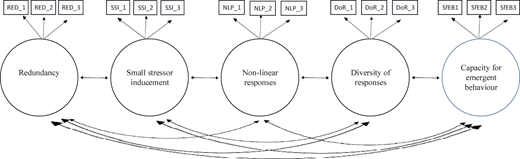
The Hypothesis (H1) states that the framework to assess organizational antifragility consists of (1) redundancy, (2) small stressor inducement, (3) non-linear responses, (4) diversity of responses, and (5) capacity for emergent behavior factors, which are endogenous and positively related. This was tested using confirmatory factor analysis (CFA), which examines whether the relationships between observed items and their underlying latent constructs align with theoretical expectations (Fan et al., 2016) (Figure 1).
Each latent variable – i.e. (1) redundancy, (2) small stressor inducement, (3) non-linear responses, (4) diversity of responses, and (5) capacity for emergent behavior – comprises observed variables gathered through questionnaire-based data collection.
Data distribution was tested by employing Skewness and Kurtosis measures, following the rule that distribution can be considered normal if Skewness and Kurtosis values fall within the intervals of (−2; 2) and (−7; 7), respectively. The model’s goodness of fit was measured using several indices (see Table 4), at least two of which should support goodness of fit. (Fan et al., 2016)
4. Results
The reliability of the survey data was assessed through Cronbach’s alpha. The findings revealed excellent reliability indices for the entire questionnaire and individual items across all five latent variables (see Table 5).
The KMO value of 0.910, exceeding the threshold of 0.6, confirms that the sample is suitable for confirmatory factor analysis. The descriptive statistics indicate that Skewness and Kurtosis fall within the ranges of (−2; 2) and (−7; 7), respectively, suggesting that all items are normally distributed; hence, the maximum likelihood estimator can be used to perform CFA.
The survey findings show that the averages of all items in the model are relatively similar, except for small stressor induction, which stands out as the component that received significantly lower averages (see Table 6). The standard deviation for all three items within this component was also the highest, indicating the significant dispersion of the results. The survey results also revealed that organizational managers scored highest for the items included in the non-linear responses component and regarding the capacity for emergent behavior.
Further, we tested our hypotheses by assessing goodness of fit statistics for Model 1 and Model 2 (Table 7).
The goodness of fit results for Model 1 indicates a rather acceptable CFA, where CMIN/DF is below three and RMSEA is below 0.08. The results of CFI and TLI are also above the threshold of 0.9. However, when analyzing goodness of fit results with the consideration of subgroups that fall under categories such as manager’s years of experience, manager’s gender, and regional aspects, the model’s goodness of fit increases (see Appendix, column 1_subgroups). CMIN/DF in Model 1_subgroups is lower compared to Model 1: 2.210 and 2.599, respectively. Although both are acceptable as representing a good fit, a lower CMIN/DF reveals a better fit between the observed data and the model. The same is true regarding RMSEA, which demonstrates a better goodness of fit result in Model 1_subgroups compared to Model 1: 0.025 and 0.045, respectively. Nevertheless, CFI and TLI are higher in Model 1 (see Appendix) compared to Model 1_subgroups. These results suggest that both Model 1 and Model 1_subgroups can be considered to possess a good fit.
5. Discussion
Despite the growing interest in antifragility as a critical driver for innovation in organizational settings, our understanding of the specific catalysts that promote its development still needs to be completed (Ramezani and Camarinha-Matos, 2020). Building on the assumption that antifragility should be viewed as an organizational capability (Corvello et al., 2023a; Ruiz-Martin et al., 2018) that drives innovative outcomes during times of disruption, this study has identified and examined the critical enablers of antifragility, particularly within public sector organizations. Focusing on five core components, redundancy, small stressor inducement, non-linear responses, diversity of responses and capacity for emergent behavior, this research hypothesized that these components are endogenous and positively related. This approach allowed us to gain a better understanding of how these elements interact to foster antifragile capabilities. It bridges a significant gap in theoretical and practical knowledge, offering valuable insights into enhancing innovation management by leveraging antifragility, particularly for public sector managers. Ultimately, this study contributes to the broader conversation on innovation management by addressing how public organizations can transform disruptions into opportunities for growth and innovation through the strategic development of antifragile capabilities. By investigating the interactions between these enablers and offering a practical measurement framework, this paper lays the foundation for future research and practical applications aimed at helping organizations thrive in increasingly uncertain environments.
Considering that it is more feasible to assess and enhance antifragility than to predict disruptive events (Ghasemi and Alizadeh, 2017), there remains a need for a greater understanding of its enablers within organizational settings. Kennon’s et al. (2015) framework for measuring antifragility offered a helpful starting point, enhancing our ability to assess the phenomenon. However, the specific criteria to measure the enablers of antifragility were left for future exploration. Studies by Sagala and Őri (2024), Reggiani (2022), Botjes et al. (2021), and Johnson and Gheorghe (2013) further emphasize the necessity for empirical evidence that recognizes the behavioral patterns associated with the development of antifragile capabilities.
Thus, this study addresses those gaps identified by identifying the critical components of antifragility that act as catalysts for innovation during times of uncertainty. It proposes to measure these elements using a new 15-item questionnaire aligned with the theoretical framework.
The application of CFA allowed us to robustly support our hypothesis (H1), confirming that redundancy, small stressor inducement, non-linear responses, diversity of responses, and capacity for emerging behavior are endogenous and positively related factors that form a unified antifragility framework. Moreover, all of the items included in the framework are meaningful; thus, the stimulation of each component will positively affect the others included in the model. This synergy is especially salient in public sector organizations and aligns with previous work by Ghasemi and Alizadeh (2017) on the necessity of interconnected facilitators.
This framework helps measure organizational antifragility and provides actionable insights for innovation management, enabling organizations to strengthen their resilience and foster innovation in the face of uncertainty. These research findings contribute to addressing constraints outlined in the study conducted by Munoz et al. (2021), which focused on conceptualizing the intersection between antifragility, uncertainty management, and organizational routines. The study reveals that organizational behaviors arise from the interplay between actions and risk mitigation strategies. Hence, recognizing the antecedent factors that activate these routines becomes essential. The study concludes that organizational routines are not fixed; they demonstrate complementary and substitutable interactions, where the interplay between two or more routines can influence antifragility (Munoz et al., 2021). This aligns with the argument that antifragility arises from multiple dimensions, as supported by Ramezani and Camarinha-Matos’ (2019) CRABE (Collaborative Resilience and Antifragility framework for Business Ecosystems) model, which highlights the critical role of collaboration, paired with effective governance strategies, in managing disruptions within business ecosystems. Ghasemi and Alizadeh (2017) also elaborate on the significance of the interconnectedness among different facilitators, illustrating that empowering redundancy, for instance, can be achieved through strategic resource planning, creating resource buffers, ensuring flexibilities that allow organizations to transform further and self-reinvent, capitalizing on the opportunities that arise during adverse situations. Conversely, low levels of redundancy can hinder the generation of innovative solutions in times of crisis, while excessive redundancy without sufficient organizational capacity for innovation may lead to unnecessary costs.
These discussions underscore the importance of decision-makers understanding the mechanisms of antifragility. As de Bruijn et al. (2020) suggests, it is critical for leaders to meet robustness requirements, allow for flexibility during disruptions, and ensure sufficient redundancy levels. This increases the likelihood of sustaining performance under atypical conditions by replacing missing or failed components without disrupting the system. Furthermore, fostering personal mastery within the organization enables it to turn negative fluctuations to its advantage, reducing the structural conflict between lowering immediate goals and pursuing a long-term vision. In this way, organizations can better leverage antifragility to enhance innovation management and performance in uncertain environments.
The proposed model, which identifies the enablers, or mechanisms, as de Bruijn et al. (2020) describe them, offers a holistic approach to understanding and empowering antifragility. Rather than focusing on individual elements in isolation, the model views the components of antifragility from a broader, more integrated perspective. This comprehensive approach allows for a deeper understanding of how these mechanisms interact to foster organizational resilience and innovation.
While the study’s outcomes confirm the significance of the components within the framework, and confirms our hypothesis (H1), it displayed nuances from different subgroup perspectives. The findings showed that the framework’s results were consistently significant and positive, regardless of whether males or females managed the organizations. Similarly, the results held across various regional contexts. However, specific subgroups, such as large organizations and organizations managed by individuals with less than one year of experience, revealed insignificant results. These findings suggest that while the model is broadly applicable, its effectiveness may vary in specific contexts, highlighting the need for further exploration of how organizational size and managerial experience influence the development of antifragility. These results underscore the framework’s limitations, suggesting that different enablers may be more effective in stimulating antifragility in large organizations or those managed by individuals with minimal experience. While these findings align with the future research directions highlighted by Yoon et al. (2022), who emphasized the importance of examining organizational antifragility through the lens of various sociodemographic factors, this area of research is still in its early stages. As such, it presents a promising avenue for future exploration, offering the potential to refine our understanding of how different organizational contexts and leadership profiles influence the development of antifragility.
6. Conclusion
Building on the assumption that antifragility is a capability for fostering innovation during disruptions, this study proposes a conceptual framework that defines the fundamental structural components of organizational antifragility – namely, redundancy, small stressor inducement, non-linear responses, diversity of responses, and capacity for emergent behavior – and outlines the indicators of an instrument to explore antifragility. The proposed framework identifies key enablers and provides a holistic approach to fostering organizational antifragility. It facilitates understanding the phenomenon from a broader perspective rather than focusing solely on individual elements. Based on data from 400 public sector organizations operating in Lithuania, empirical validation of the model confirmed positive interconnections among the proposed components. The findings demonstrated that positive growth in one area positively impacts the other components and items included in the model, reinforcing the synergy between these core enablers. These results are promising as they help to understand how antifragile organizations can effectively harness disorder to drive innovative outcomes, thereby coping with adversity faster and more strategically. By leveraging their ability to cope with disruptions, public sector organizations can navigate turbulence faster and more efficiently, thus ensuring the ability to respond quickly to sudden adversities and capitalize on unexpected turbulence to foster long-term innovation and cutting-edge strategies.
6.1 Theoretical and practical implications
This study contributes to the emerging theory of antifragility enablers, specifically in the context of public sector organizations, by highlighting how antifragility can catalyze innovation in disruptive environments. The empirical evidence gathered in this research demonstrates that the activation of various enablers positively impacts the development of antifragility, which drives innovative outcomes in times of uncertainty. In doing so, this study addresses critical research gaps identified in previous studies (Reggiani, 2022; Botjes et al., 2021; Johnson and Gheorghe, 2013), which have primarily focused on the theoretical aspects of antifragility without validating its practical applications within organizations.
From a practical standpoint, the implications of this study are both novel and significant, offering public sector managers a comprehensive framework to cultivate an environment that nurtures antifragile capabilities. This, in turn, enhances the organization’s ability to innovate and adapt in the face of disruption. This tool can guide public sector managers in allocating resources, designing small-scale stressor experiments, embrace diversity and non-linear response culture to solve problems. These actionable insights can enhance policy-making by embedding antifragility principles into policy-making – such as establishing adaptive resource allocations and cross-agency collaborations concerning constantly changing challenges. Moreover, after measuring the impact of antifragility on innovation practice outcomes, public sector managers will be able to account for and explain expenditure on antifragile practices.
However, it is essential for managers to carefully consider the limitations identified in this study before applying the proposed framework. Sociodemographic factors, such as organizational size and managerial experience, have been shown to play a critical role in developing antifragility, and understanding these nuances is vital to effectively leverage the framework to foster innovation management in public sector organizations. Nevertheless, these findings contribute to existing knowledge about innovation management strategies by revealing how antifragile capabilities can alter organizational routines and strategic thinking proactively. The study extends prior knowledge on the enablers of antifragile capability models by highlighting how public sector organizations can leverage volatility to adapt to the changed environments and discover new growth avenues, thereby changing innovation practices in complex and ever-changing environments.
6.2 Limitations and future research avenues
Although antifragility has been recognized as a driver for innovation management during disruption, its potential within public sector organizations still needs to be explored. As such, the conclusions drawn from this study should be considered with an awareness of their inherent limitations.
Firstly, the scholarly debates on antifragility and its emergence had to be drawn from existing literature focused on general organizational environments, which posed a limitation for sector-specific insights. To address this, we developed a measurement instrument that, while reflecting the general characteristics of organizations, was rigorously tested through a pilot study involving public sector professionals. As a result, the tool maintains a level of generality that makes it applicable across various sectors. Yet, it was carefully refined by excluding elements relevant only to specific industries, such as particular domains within the private sector.
The second limitation involves establishing measurement instruments to assess antifragility in organizational settings. This gap led us to identify the key components enabling antifragility and propose novel items to measure them. Using confirmatory factor analysis (CFA), we validated the proposed 15-item instrument as effective for assessing antifragility in public sector organizations. However, the instrument was tested in only one country. While Lithuanian public sector organizations, having experienced significant transformations in recent decades, provide a suitable context for validating the instrument, future research would benefit from applying the framework across a broader range of countries, particularly those with diverse geographical and socioeconomic contexts. Additionally, the scholarly debate surrounding the results could have been more robust, as existing research on antifragility is primarily theoretical, limiting the ability to interpret the findings in comparison to prior empirical studies fully.
The study’s empirical findings suggest several avenues for further research and framework refinement, particularly about large organizations and exploring antifragility-enabling components identified by less experienced managers. The lack of statistical significance within the subgroup of managers with over 21 years of experience also highlights the need to consider potential modifications to the framework for this group. Future research should not only focus on specific sectors but also consider organizations’ sociodemographic characteristics, as this study has shown these factors to be crucial in identifying the enablers of antifragile capability.
Additionally, while this study acknowledges antifragility as a driver for innovation management, its empirical connections have yet to be fully explored. Future research could delve into the potential of antifragility as a catalyst for innovation management, further expanding our understanding of how organizations can leverage antifragility to enhance their capacity for innovation in disruptive environments.
Funding: This research has received funding from the Research Council of Lithuania (LMTLT), agreement No. S-VIS-23-10.
Financial interests: The authors have no relevant financial or non-financial interests to disclose.
Competing interests: The authors have no competing interests relevant to the content of this article to declare.
Data availability: The datasets generated or analysed during the current study are available from the corresponding author upon reasonable request.