This study examines how innovators and AI work together during idea generation for product innovation. It examines how varying levels of reliance on AI impact cognitive engagement and, in turn, influence the quantity, originality and feasibility of ideas as well as innovators’ overconfidence. The study highlights AI’s role as a cognitive amplifier, showing how human intuition and AI's analytical power interact to support creativity and innovation.
A controlled experiment was conducted with 123 product innovators, testing three conditions: no AI, moderate AI assistance and high AI assistance, to measure cognitive engagement, number of ideas generated, originality, feasibility and innovator overconfidence. ANOVA, polynomial regression and mediation tests were performed to determine the effects of AI assistance on innovative idea generation.
The results reveal an inverted U relationship between AI assistance, cognitive engagement and the generation of ideas for product innovation. Moderate AI assistance optimally enhances cognitive engagement, producing the highest number of original and feasible ideas. In contrast, excessive AI assistance may foster automation bias, reducing originality and increasing overconfidence. At the same time, the absence of AI constrains idea generation due to cognitive limitations in relying only on human abilities.
The findings show that moderate AI use maximizes the quantity, originality and feasibility of ideas while minimizing overconfidence. Innovation managers should structure ideation sessions to cap AI interactions, promote critical evaluation of AI outputs and combine them with human insight. This balanced approach enables firms to optimize cognitive engagement and generate higher-quality product innovations.
This research uniquely contributes to product innovation literature by explicitly focusing on human–AI synergy, highlighting AI’s optimal role as a cognitive enhancer rather than a substitute. It elucidates conditions that maximize innovative outcomes through balanced human–AI collaboration, providing actionable managerial guidelines for structuring AI integration to amplify creativity and mitigate biases in idea generation for product innovation.
1. Introduction
Product innovation—the development of novel products or enhancements of existing ones through new features or improvements (Cote, 2022)—is fundamental to a firm's long-term competitiveness. It enables differentiation, allowing businesses to meet evolving customer demands and ensuring adaptability in dynamic markets (Friar, 1995). In pursuit of more efficient and effective innovation, firms increasingly integrate artificial intelligence (AI) into their product development processes (Gama and Magistretti, 2025) [1]. Empirical evidence shows that AI investment correlates with higher innovation productivity, including greater patenting and trademarking activity (Babina et al., 2024). Coca-Cola's “Y3000,” a beverage co-created with AI, exemplifies this shift, reinforcing debates on AI's role in product innovation (Truong and Papagiannidis, 2022; Gama and Magistretti, 2025).
However, enthusiasm about AI's potential often conceals its cognitive complexity. Integrating AI into human ideation produces non-linear effects that challenge the assumption that “more AI is better.” AI excels at processing vast data and identifying patterns that drive incremental innovation (Haefner et al., 2021; Pietronudo et al., 2022), yet its reliance on historical information constrains originality and reinforces dominant paradigms (Grashof and Kopka, 2023). Human cognition, by contrast, contributes intuition, abstraction, and contextual sensemaking (Garbuio and Lin, 2021) but remains limited by biases and bounded rationality (Eapen et al., 2023; Sedkaoui and Benaichouba, 2024). Innovation performance thus depends not on replacing human intelligence with AI but on how effectively the two systems interact to sustain creative engagement. This study situates its contribution within this human–AI interplay, proposing that AI's cognitive value follows a behavioral threshold rather than a linear progression.
From this perspective, the key determinant of innovative success is cognitive engagement—the deliberate activation of cognitive resources through which individuals focus attention, reflect, and reframe ideas to generate novel and feasible solutions (Wilms et al., 2019). Moderate AI assistance can heighten engagement by reducing routine load and freeing capacity for synthesis, whereas excessive reliance induces passivity and minimal support leads to overload. These dynamics suggest an inverted-U relationship between AI use and innovation outcomes, improving performance only up to an optimal threshold (Nguyen and Elbanna, 2025). Achieving this balance requires cognitive calibration – a dynamic alignment between human and machine contributions balancing analytical efficiency with creative depth (Magliocca et al., 2025). Viewed through Dual-Process Theory (Kahneman, 2011) and Cognitive Load Theory (Sweller, 1988), this calibration determines how cognitive resources are distributed within human–AI collaboration, shaping whether interaction enhances or inhibits idea generation. Consequently: How does the degree of human–AI synergy shape idea generation in product innovation?
To address this question, a controlled laboratory experiment was conducted with 123 product innovators from technology, manufacturing, and consumer-goods industries, retained from an initial 141 after screening. Participants were randomly assigned to three conditions—No-AI, Moderate-AI, and High-AI—representing increasing degrees of human–AI synergy. AI-assisted tasks were administered online, while the control group completed paper-based tasks; cross-mode comparisons were treated as secondary to ensure validity. Idea generation was assessed along four dimensions: (1) quantity, (2) originality, (3) feasibility, and (4) overconfidence. Cognitive engagement was proxied by task duration; expert evaluators rated idea quality and feasibility; and overconfidence was measured as the gap between self-assessment and expert evaluation. A pilot study with 36 innovators refined the manipulation thresholds distinguishing moderate and high AI use. ANOVA, polynomial regression, and mediation analyses were applied to test AI's effects on innovative idea generation.
Results reveal an inverted-U trajectory: moderate AI reliance produced the highest cognitive engagement, idea quantity, originality, and feasibility while minimizing overconfidence. Both excessive and minimal AI reliance constrained outcomes. High AI use increased idea count but reduced quality, as participants accepted AI-generated suggestions uncritically, fostering convergence and inflated confidence (Grashof and Kopka, 2023). Conversely, low AI reliance reduced idea generation and diversity due to human cognitive limits (Garbuio and Lin, 2021). Moderate engagement enabled participants to critically evaluate AI inputs while exploiting computational efficiency, balancing divergent and convergent thinking. This balance mitigated cognitive overload and automation bias, positioning AI as a complementary amplifier rather than a substitute for human insight.
While derived from a controlled setting, these findings establish a behavioral baseline for understanding how cognitive engagement mediates AI's influence on innovation. They indicate that the optimal degree of AI usage may vary across contexts depending on task complexity, innovation type, and organizational culture. In creativity-driven environments, moderate AI reliance may enhance ideation, whereas in compliance-intensive settings, even moderate use could induce overload if AI outputs are opaque or misaligned with expert reasoning (Sweller, 1988; Faraj et al., 2018).
This study advances debates on AI's strategic role in product innovation (Gama and Magistretti, 2025) and behavioral research in management (Cristofaro et al., 2024) by clarifying how and to what extent AI affects the cognitive mechanisms underlying innovation. Prior works have treated human and AI contributions as stable, complementary inputs (Truong and Papagiannidis, 2022). In contrast, we show that cognition is dynamically shaped by the degree of AI engagement. The inverted-U pattern demonstrates that moderate AI use optimizes originality, feasibility, and metacognitive calibration by sustaining engagement while preventing overload. Accordingly, this experiment provides an initial empirical test of a behavioral threshold model of human–AI synergy in early-stage innovation, identifying the cognitive conditions under which AI enhances rather than inhibits creative reasoning.
2. Literature review and hypotheses development
Idea generation in product innovation is a multidimensional cognitive process that combines the production, evaluation, and calibration of novel ideas. It integrates both divergent and convergent thinking (Runco and Jaeger, 2012): divergent thought drives idea fluency, while convergent reasoning refines originality and feasibility. A further layer, metacognitive calibration, concerns individuals' accuracy in judging their own creative output (Kaufman and Beghetto, 2013). This evaluative realism determines whether ideation yields viable innovation. Accordingly, idea generation is conceptualized here as the joint outcome of productive fluency, creative quality, and evaluative accuracy, providing a unified basis for interpreting AI's behavioral effects.
Metacognitive calibration is captured experimentally through the overconfidence index, measuring the gap between self- and expert evaluations. While overconfidence often signals bias, it here reflects evaluative alignment—how well subjective confidence tracks actual creative merit.
Cognitive engagement—the mental effort and attentional focus invested in ideation (Petrou et al., 2018)—explains how AI shapes these outcomes. Drawing on Dual-Process Theory (Kahneman, 2011) and Cognitive Load Theory (Sweller, 1988), engagement peaks when AI reduces routine load yet preserves deliberate reasoning. Moderate AI assistance thus optimizes reflection and synthesis (Makridakis, 2017; Cooper, 2024), whereas excessive reliance induces automation bias (Cramer-Petersen et al., 2019), and no AI overburdens cognition (Eapen et al., 2023; Garbuio and Lin, 2021). Hence, AI's cognitive effects are nonlinear: balanced synergy maximizes engagement, while under- or overreliance suppresses creativity (Felin and Holweg, 2024; Raisch and Fomina, 2024; Gama and Magistretti, 2025).
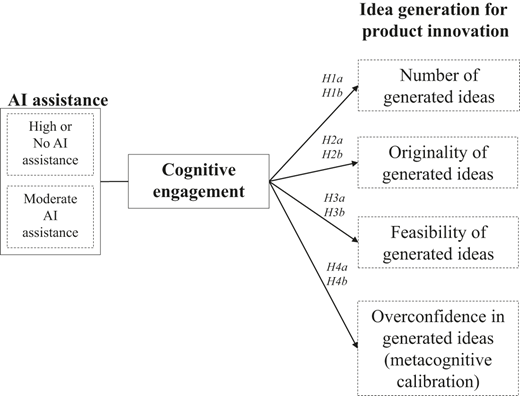
The model in Figure 1 differentiates between no, moderate, and high AI assistance, each of which shapes cognitive engagement in distinct ways. Excessive reliance on AI fosters automation bias and cognitive overload, diminishing both the originality and feasibility of ideas. Conversely, the absence of AI constrains ideation by amplifying cognitive fatigue and reducing fluency. Moderate AI assistance achieves the optimal balance, enhancing engagement and creative performance while maintaining evaluative accuracy. The following subsections examine AI's role across the dimensions of idea generation in product innovation—(2.1) quantity, (2.2) originality, (2.3) feasibility, and (2.4) metacognitive calibration (overconfidence)—across varying levels of AI assistance.
2.1 AI, cognitive engagement, and the number of generated ideas for product innovation
AI is transforming product innovation by analyzing vast datasets, identifying hidden patterns, and generating ideas that extend beyond human cognitive limitations (Cooper, 2024). Unlike traditional brainstorming, which depends on intuition and experience, AI-driven ideation leverages machine learning and natural language processing to enhance both the scope and precision of idea generation (Bouschery et al., 2023; Cooper, 2024). By processing extensive data and revealing latent relationships, AI broadens human cognition, enabling the discovery of innovative solutions that might not arise from human reasoning alone (Verganti et al., 2020; Pietronudo et al., 2022). However, excessive reliance on AI can create unbalanced synergy: the abundance of AI-generated ideas may exceed human processing capacity, leading to cognitive overload or automation bias and weakening evaluative judgment (Cramer-Petersen et al., 2019).
Conversely, in the absence of AI, innovation depends entirely on human cognition. While human intuition and contextual reasoning are uniquely capable of recognizing novel opportunities beyond historical data (Garbuio and Lin, 2021), they are limited by biases and bounded rationality that constrain ideational range (Eapen et al., 2023; Sedkaoui and Benaichouba, 2024). In such contexts, decision-makers rely primarily on System 1 thinking—fast, intuitive, and heuristic processes (Kahneman, 2011)—which, although efficient, can restrict divergent thinking and reduce idea diversity. Without AI's computational augmentation, innovators may remain anchored in familiar cognitive schemas, overlooking unconventional possibilities (Verganti et al., 2020).
Moderate AI assistance offers a balanced form of synergy. Drawing on Dual-Process Theory (Kahneman, 2011), this condition reflects the activation of System 2 thinking—deliberate, analytical, and effortful reasoning—supported rather than supplanted by AI. At this level, AI functions as a cognitive scaffold, extending the innovator's working memory and sustaining engagement within an optimal cognitive load zone (Sweller, 1988). When task demands match cognitive capacity, individuals remain attentive, motivated, and exploratory, leading to a higher number of ideas (Makridakis, 2017).
Hence, idea volume serves as a proximal indicator of cognitive engagement. Greater idea production reflects deeper processing, attentional investment, and sustained cognitive effort (Sweller, 1988; Kahneman, 2011).
No or high AI assistance reduces cognitive engagement, thus negatively mediating the relationship between AI reliance and the number of generated ideas for product innovation.
Moderate AI assistance enhances cognitive engagement, thus positively mediating the relationship between AI reliance and the number of generated ideas for product innovation.
2.2 AI, cognitive engagement, and the originality of generated ideas for product innovation
Originality is a hallmark of impactful product innovation, reflecting the ability to generate novel concepts that challenge established assumptions and open new strategic possibilities (Runco and Jaeger, 2012). While AI enhances ideation by revealing hidden relationships and generating diverse ideas, its influence on originality is nonlinear and contingent on the level of human cognitive engagement—namely, the deliberate effort invested in processing, evaluating, and extending ideas.
Drawing on Dual-Process Theory (Kahneman, 2011), originality stems primarily from System 2 thinking—slow, reflective, and effortful reasoning that enables individuals to question defaults, integrate perspectives, and develop breakthrough insights (Sadler-Smith, 2016). In contrast, System 1 processing—fast, automatic, and heuristic—facilitates efficient but conventional thinking. Cognitive Load Theory (Sweller, 1988) complements this view, suggesting that System 2 engagement requires an optimal cognitive load: excessive complexity leads to overload, while oversimplification induces disengagement and reversion to System 1 thinking (de Jong, 2010). Hence, originality flourishes when mental effort is high but manageable.
Moderate AI assistance provides these conditions for optimal engagement. Strategically used, AI broadens ideational scope by surfacing patterns across diverse knowledge domains and countering cognitive fixation (Garbuio and Lin, 2021; Sedkaoui and Benaichouba, 2024). It reduces extraneous load by automating low-level search and analysis tasks (Bilgram and Laarmann, 2023), allowing individuals to concentrate on creative synthesis and critical evaluation (Cooper, 2024; Füller et al., 2022). In this configuration, AI functions as a cognitive scaffold—stimulating System 2 engagement without overwhelming it—and thereby enhances originality through balanced human–AI synergy (Makridakis, 2017).
Excessive reliance on AI, however, risks displacing human reflection. Users may uncritically adopt AI-generated suggestions perceived as authoritative, leading to superficial acceptance rather than creative recombination (Cramer-Petersen et al., 2019; Haefner et al., 2021). Since AI draws on historical data, its outputs may reinforce existing design logics, narrowing ideational search and promoting convergence (von Krogh, 2018; Füller et al., 2022). Conversely, the absence of AI confines ideation to human cognition, which, although intuitive, is constrained by biases such as anchoring and functional fixedness (Eapen et al., 2023; Garbuio and Lin, 2021).
Moderate AI assistance thus offers the most productive balance, blending AI's analytical power with human creativity and contextual judgment (Bouschery et al., 2023). Thus, we propose:
No or high AI assistance reduces cognitive engagement, thus negatively mediating the relationship between AI reliance and the originality of generated ideas for product innovation.
Moderate AI assistance enhances cognitive engagement, thus positively mediating the relationship between AI reliance and the originality of generated ideas for product innovation.
2.3 AI, cognitive engagement, and the feasibility of generated ideas for product innovation
Alongside originality, feasibility is a critical dimension of product innovation, ensuring that ideas can be implemented within technological, resource, regulatory, and market constraints to generate real value (Runco and Jaeger, 2012; Verganti et al., 2020). AI plays a dual role in shaping feasibility: its analytical capabilities can strengthen evaluation, yet its influence depends on how it modulates human cognitive engagement during ideation.
According to Dual-Process Theory (Kahneman, 2011), assessing feasibility requires deliberate, analytical reasoning—System 2 thinking—through which innovators evaluate trade-offs, constraints, and contextual fit. Sustaining this reasoning demands significant effort, constrained by finite cognitive resources. Cognitive Load Theory (Sweller, 1988) posits that when intrinsic and extraneous load are optimally balanced, individuals remain analytically engaged; when misaligned, they disengage, relying instead on superficial or intuitive System 1 processes (de Jong, 2010). Thus, feasibility judgments depend on maintaining System 2 engagement without cognitive overload or under-stimulation.
High AI reliance disrupts this balance. Although AI can propose technically sophisticated ideas, these often arise from data-driven extrapolation rather than contextual understanding. When users defer to algorithmic outputs without critical scrutiny—a pattern linked to automation bias (Cramer-Petersen et al., 2019; Glikson and Woolley, 2020)—System 2 reasoning is bypassed. Ideas may appear viable in form but lack coherence with organizational resources or implementation realities (Cooper, 2024). Such uncritical acceptance erodes feasibility by weakening the evaluative effort needed to anchor creativity in practical constraints.
In contrast, the complete absence of AI limits evaluative capacity. Without computational tools to simulate constraints or assess trade-offs, individuals rely solely on bounded rationality (Simon, 1990), often producing conservative yet unimaginative solutions. High intrinsic load, particularly under uncertainty, strains cognitive resources and discourages deep analytical engagement (Eapen et al., 2023).
Moderate AI assistance achieves a more effective human–AI synergy. Here, AI functions as a cognitive amplifier—reducing extraneous load while enriching evaluative reasoning (Makridakis, 2017; Garbuio and Lin, 2021). By synthesizing information on costs, time, and resources, AI supports reflective judgment without displacing human control (Bilgram and Laarmann, 2023). Under these conditions, sustained System 2 engagement enables innovators to balance creativity with implementability (Logg et al., 2019; Bouschery et al., 2023). Thus, we propose:
No or high AI assistance reduces cognitive engagement, thus negatively mediating the relationship between AI reliance and the feasibility of generated ideas for product innovation.
Moderate AI assistance enhances cognitive engagement, thus positively mediating the relationship between AI reliance and the feasibility of generated ideas for product innovation.
2.4 AI and overconfidence about the generated ideas for product innovation
Idea generation in product innovation is inherently susceptible to cognitive biases, among which overconfidence is particularly consequential. Overconfidence leads individuals to overestimate the originality or feasibility of their ideas while overlooking flaws and competing alternatives (Tversky and Kahneman, 1974). In innovation contexts, this bias can cause premature idea selection, resistance to feedback, and insufficient evaluative rigor (Moore and Healy, 2008). The integration of AI into ideation can either amplify or mitigate such bias, depending on how it shapes cognitive engagement.
According to Dual-Process Theory (Kahneman, 2011), overconfidence arises when individuals rely primarily on intuitive, fast, System 1 thinking instead of deliberate, reflective System 2 reasoning. Excessive AI reliance promotes this tendency: when users perceive AI as neutral or authoritative, they often accept its outputs uncritically, displacing System 2 engagement (Glikson and Woolley, 2020; Cramer-Petersen et al., 2019). This unbalanced synergy fosters automation-induced overconfidence—users assume that algorithmic precision guarantees idea quality (Dong et al., 2016). Moreover, as Cognitive Load Theory (Sweller, 1988) explains, the abundance of AI-generated content can overwhelm working memory, encouraging reliance on heuristics and superficial judgments. In such conditions, decision-makers may equate output volume or sophistication with validity, reinforcing inflated confidence (Budhwar et al., 2023).
Conversely, when AI support is absent, decision-makers depend solely on personal intuition and experience. This can engender an illusion of control, where individuals overvalue self-generated ideas because they stem from autonomous effort (Simon, 1990). Under cognitive strain, they revert to familiar schemas and untested heuristics, further intensifying overconfidence (Eapen et al., 2023). In both extremes—AI overreliance or total absence—System 2 reasoning is underactivated, and critical self-evaluation deteriorates.
Moderate AI assistance establishes a more balanced cognitive configuration. Acting as a reflective partner, AI stimulates comparative judgment and counteracts both complacency and overload. It encourages users to question, refine, and contextualize AI outputs rather than merely accept or reject them (Makridakis, 2017; Garbuio and Lin, 2021). Within this balanced synergy, System 2 reasoning is sustained, extraneous load minimized, and evaluative humility strengthened. Such “humble confidence” (Logg et al., 2019) enhances metacognitive calibration—aligning subjective confidence with objective performance and reducing bias in idea assessment. Thus, we propose:
No or high AI assistance reduces cognitive engagement, thus increasing overconfidence in generated ideas for product innovation, irrespective of their actual relevance or feasibility.
Moderate AI assistance enhances cognitive engagement, thus reducing overconfidence and promoting critical evaluation of generated ideas for product innovation.
3. Design and methodology
In this study, we employ a between-groups experimental design to test the proposed hypotheses. This approach aligns with Derbyshire et al.’s (2023) argument that experimental methods are well suited to uncover causal mechanisms in contexts of innovation and uncertainty. The design allows manipulation of key variables and systematic isolation of their effects. Participants were randomly assigned to one of three conditions varying in AI assistance (see subsection 3.2): a control group with no AI use, a moderate AI assistance group, and a high AI assistance group. These conditions enabled examination of AI's effects on idea volume (H1a, H1b), originality (H2a, H2b), feasibility (H3a, H3b), and overconfidence (H4a, H4b).
The experiment was conducted at an Italian university in March 2025. ChatGPT (version 4) was selected as the AI tool for its advanced generative capabilities, ease of use, and widespread adoption (Cristofaro and Giardino, 2025). Participants in AI conditions completed an online task with access to ChatGPT, following standardized interaction guidelines defining each query–response sequence as a single exchange. The control group completed the same task on paper without AI or internet access. Researchers monitored compliance, clarified questions, and ensured procedural consistency across conditions.
3.1 Participants and procedures
Cochran's sample size formula (Cochran, 1977) determined a minimum of 120 participants (margin of error: 0.03; α = 0.01). We recruited 141 participants and randomly assigned them to three experimental conditions (No-AI, Low-AI, High-AI). After excluding incomplete or inattentive responses, the final sample comprised 123 participants (41 per group). Randomization yielded balanced groups with no significant differences in cognitive reflection (CRT), AI literacy, domain familiarity, or prior AI use (all p > 0.10).
To ensure ecological validity, the ideation task was based on a real product from Kickstarter, a global crowdfunding platform offering early-stage innovations. Kickstarter is ideal for experimental ideation because it (1) provides authentic, underdeveloped product concepts, (2) mirrors real-world innovation uncertainty and feedback loops, and (3) enhances engagement through entrepreneurial realism (Eisenbart et al., 2023; Peterson and Wu, 2021; Kornish and Ulrich, 2014). Participants worked with an anonymized description of the Skadu M1, a modular cleaning device by the startup Hyper Lychee. The home-appliance category was selected for accessibility, balance between design and function, and generalizability to broader consumer innovation contexts. To facilitate cultural familiarity, the product was presented as developed by an anonymized Italian startup “Company ABC.”
All participants completed a 90-min ideation task, instructed to propose innovative extensions or improvements to the product. The top ten participants received €20 vouchers to foster competitive engagement. Participants submitted textual ideas directly via the experimental platform, enabling standardized coding and expert evaluation.
Participants in AI-assisted conditions were required to document their ChatGPT interactions through screenshots showing start and end timestamps. This ensured transparency and compliance with task boundaries. They were explicitly instructed to use AI only for idea development, not for unrelated searches. The No-AI group was prohibited from using external tools, and compliance was monitored by three researchers. Of the 141 participants, data from 123 were retained after excluding irregular or non-compliant cases.
The sample comprised 55% males (n = 67) and 45% females (n = 56), with a mean age of 32.5 years (SD = 1.22) and an average of 5.8 years of product innovation experience (SD = 1.21). All respondents held decision-making roles in product development within their organizations. Participants represented 91 organizations across technology (56%), manufacturing (25%), and consumer goods (16%) sectors.
To standardize AI exposure, participants received identical step-by-step instructions for ChatGPT access, query structure, and interaction protocols. Experimenters verified comprehension and clarified procedures before task initiation. A pilot study with 36 product innovators refined the task and defined thresholds distinguishing moderate from high AI assistance. Participants performed the same ideation exercise with unrestricted AI use, enabling behavioral benchmarking. Using visual inspection (Fisch, 2001), two authors and two independent experts identified inflection points where performance patterns shifted. The interrater reliability was Cronbach's α = 0.95, and discrepancies were resolved by consensus. The pilot revealed that 15 total AI interactions (prompts or responses) marked the optimal boundary: beyond this, marginal idea gains declined while cognitive load and task duration increased. This empirical threshold was validated through a piecewise regression in the AI-assisted subsample, confirming a slope change between 14–16 interactions—consistent with the quadratic vertex in the main analysis.
The pilot phase also tested instruction clarity and trained the three expert evaluators responsible for assessing idea quantity, originality, and feasibility. Experts followed a detailed evaluation protocol adapted from prior innovation research (Eisenbart et al., 2023). Calibration sessions ensured consistency in interpretation before the main evaluation.
Overall, the experimental design balanced ecological validity, methodological rigor, and behavioral realism. By combining a real-world stimulus, randomized assignment, and transparent documentation of AI interactions, the study created a controlled yet authentic environment to examine how varying degrees of AI assistance influence cognitive engagement and idea generation in product innovation.
3.2 Measurements
The study measured AI assistance, cognitive engagement, idea quantity, idea quality (originality and feasibility), and overconfidence (metacognitive calibration). Each construct was operationalized according to established theoretical and empirical precedents to ensure validity and comparability with prior behavioral and innovation research.
AI assistance was experimentally manipulated through three conditions defining the intensity of interaction with ChatGPT. In the No-AI Assistance condition, participants relied entirely on their own reasoning and prior knowledge, with all external tools prohibited. In the Moderate AI Assistance condition, participants conducted between one and fifteen interactions, representing AI as a collaborative partner that stimulates ideation without inducing dependency. In the High AI Assistance condition, participants engaged in sixteen or more interactions, with no upper limit. These thresholds were derived from the pilot study, which revealed a behavioral inflection around fifteen interactions—the point at which additional exchanges stopped generating new ideas and instead prolonged task duration and cognitive load. This design operationalized the transition from balanced synergy to automation bias, providing an empirical basis for testing the nonlinear effects of AI intensity.
Cognitive engagement was measured objectively through time-on-task (in minutes), a validated proxy for sustained mental effort and attention. Unlike self-reported engagement, this behavioral measure reflects persistence and cognitive depth in processing complex information and evaluating ideas. In line with Cognitive Load Theory (Sweller, 1988), longer task durations indicate meaningful cognitive investment rather than overload. From the perspective of Dual-Process Theory (Kahneman, 2011), extended time suggests System 2 activation—deliberate and analytical reasoning—whereas short durations imply intuitive, heuristic processing. Prior studies confirm that longer task times correlate with deeper cognitive processing and improved ideation (Järvelä et al., 2008), validating this measure as a reliable indicator of cognitive engagement in AI-assisted innovation.
The number of generated ideas was measured as the count of distinct, self-contained ideas each participant produced during the task. Redundant or vague statements were excluded. Three expert evaluators independently coded all responses (Cronbach's α = 0.91), resolving discrepancies through discussion. A secondary analysis examined idea elaboration by counting causal explanations, supporting evidence, and market or technological considerations. This allowed assessment of whether AI-assisted participants generated more ideas overall or produced more deeply developed ones.
Idea quality was evaluated along two dimensions—originality and feasibility—adapted from Eisenbart et al. (2023). Originality captured the novelty of an idea, while feasibility reflected its implementability considering technological and market constraints. A panel of three experts (two management scholars and one external startup competition judge) independently rated each idea on both criteria using a 3-point scale (1 = low, 3 = high). For each participant, summed ratings represented total creative output, while mean scores reflected per-idea quality. Main analyses used summed scores to assess creative productivity; results were robust when replicated with mean scores, confirming consistency across measures.
Overconfidence, conceptualized as metacognitive miscalibration, was calculated as the discrepancy between participants' self-assessed and expert-rated idea quality. Participants rated their ideas on a 7-point scale, while expert scores were converted from a 3-point to a 7-point range (1 → 1, 2 → 4, 3 → 7) for comparability. The overconfidence index equaled self-rating minus expert rating, where positive values indicated overestimation (low calibration) and near-zero values indicated accurate self-assessment (high calibration). Robustness checks using standardized z-scores produced equivalent results. This metric captured the evaluative accuracy with which individuals aligned subjective confidence to objective performance, distinguishing genuine insight from inflated self-belief. The overconfidence index was formally computed as:
where:
C self, innovation, and C self, feasibility represent the participant's self-rated confidence in the originality and feasibility of their generated ideas.
C expert, innovation, and C expert, feasibility represent the expert panel's mean rating for the same criteria.
Together, these measures provide a multidimensional framework for understanding idea generation as a behavioral, cognitive, and metacognitive process. AI assistance captures the structural configuration of human–machine collaboration; cognitive engagement indexes mental effort; idea quantity and quality represent creative productivity; and overconfidence reflects evaluative realism. This comprehensive operationalization enables a precise examination of how varying degrees of AI involvement shape the cognitive mechanisms and behavioral outcomes underlying product innovation.
3.3 Group parity verification and control variables
Group comparability was verified through random assignment, assessment of cognitive abilities, and evaluation of AI literacy (Eisenbart et al., 2023). Participants were randomly assigned to conditions to minimize extraneous variables and ensure equivalent baseline characteristics, enhancing internal validity by isolating the causal effects of AI assistance. Cognitive abilities were measured using the Cognitive Reflection Test (CRT) to assess reflective thinking and causal reasoning (Frederick, 2005), distinguishing analytical from intuitive decision-makers (Pennycook et al., 2016).
A 12-item AI literacy scale (Wang et al., 2022; Cronbach's alpha = 0.83) assessed familiarity with AI on a 7-point Likert scale, alongside a single-item measure of ChatGPT familiarity (1 = Not at all familiar, 7 = Extremely familiar). Participants demonstrated solid AI literacy and ChatGPT familiarity, with mean scores of 5.2 (SD = 1.76) and 5.9 (SD = 0.80), respectively, indicating a generally competent user base across conditions. These controls ensured that prior exposure to AI tools did not bias experimental outcomes. Assumption checks confirmed normality and homogeneity of variance (Shapiro–Wilk and Levene's tests, p > 0.05); all analyses employed robust (HC3) standard errors where appropriate.
4. Results
4.1 Descriptive statistics and group comparisons
A one-way ANOVA was conducted to examine the effect of AI assistance (no AI, moderate AI, high AI) on the five studied variables: cognitive engagement, volume of generated ideas, originality and feasibility of such ideas, and overconfidence. Table 1 presents the descriptive statistics, while Table 2 summarizes the ANOVA results.
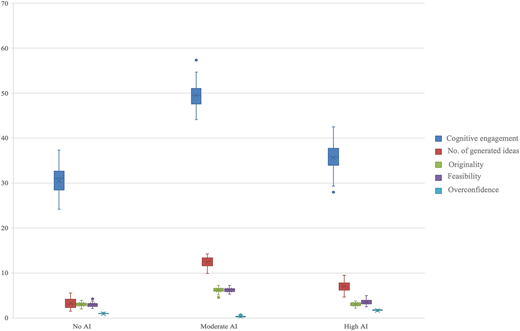
We first examined differences across the three experimental conditions (No-AI, Low-AI, High-AI) through one-way ANOVAs, while interpreting cross-mode contrasts (No-AI vs AI) as exploratory because the control task was paper-based. The results indicate a significant effect of AI assistance on cognitive engagement, F(2,120) = 18.42, p < 0.001, η2 = 0.53. Moderate AI assistance resulted in the highest cognitive engagement (M = 50.2, SD = 3.1), compared to both No AI (M = 30.3, SD = 3.2) and High AI (M = 35.5, SD = 3.4). Post-hoc Tukey's tests confirmed significant differences between Moderate AI and No AI (p < 0.001), as well as between Moderate AI and High AI (p < 0.001), and between No AI and High AI (p < 0.001). These results support Hypothesis 1b, indicating that moderate AI assistance optimally enhances cognitive processing, whereas excessive reliance on AI reduces engagement.
The ANOVA also revealed a significant effect of AI assistance on the volume of generated ideas, F(2, 120) = 22.677, p < 0.001, η2 = 0.58. Participants in the Moderate AI condition generated the highest volume of ideas (M = 12.3, SD = 1.2), followed by those in the High AI condition (M = 7.2, SD = 1.1). At the same time, the No AI group generated the lowest volume of ideas (M = 3.1, SD = 1.3). Post-hoc analyses indicated that Moderate AI significantly differed from both No AI (p < 0.001) and High AI (p < 0.001), whereas the difference between No AI and High AI was not significant (p = 0.10). These findings confirm Hypothesis 1b, showing that Moderate AI enhances ideas fluency. At the same time, Hypothesis 1a is also supported, as both High AI reliance and the absence of AI constrain the volume of generated ideas.
A significant effect of AI assistance was found on ideas originality, F(2, 120) = 15.89, p < 0.001, η2 = 0.49. Participants in the Moderate AI condition produced the most original ideas (M = 6.2, SD = 0.5), while originality scores were lower for both High AI (M = 3.2, SD = 0.5) and No AI (M = 3.0, SD = 0.5). Post-hoc analyses confirmed that Moderate AI differed significantly from both No AI (p < 0.001) and High AI (p < 0.001), while the difference between No AI and High AI was not significant. These findings support Hypothesis 2b, suggesting that Moderate AI fosters originality, whereas Hypothesis 2a is also validated, as excessive AI reliance limits novelty due to convergent thinking.
AI assistance significantly influenced the feasibility of ideas, F(2,120) = 13.75, p < 0.001, η2 = 0.46. Participants in the Moderate AI condition generated the most feasible creative ideas (M = 6.1, SD = 0.5), outperforming both the High AI (M = 3.4, SD = 0.5) and No AI (M = 3.0, SD = 0.5) groups. Post-hoc comparisons revealed that Moderate AI differed significantly from No AI (p < 0.001) and High AI (p < 0.001), while No AI and High AI did not differ significantly (p = 0.12). These results support Hypothesis 3b, indicating that Moderate AI assistance enhances feasibility by enabling decision-makers to refine and filter AI-generated insights into implementable ideas. To ensure that the quality effects were not driven by differences in idea quantity, we repeated the analyses using per-idea mean originality and feasibility (averaged across expert ratings). The pattern of results remained substantively unchanged, indicating that differences in creative quality were not an artifact of the number of ideas.
The analysis also found a significant effect of AI assistance on overconfidence, F(2,120) = 19.21, p < 0.001, η2 = 0.55. Participants in the High AI condition exhibited the greatest overconfidence (M = 1.7, SD = 0.1), while No AI resulted in moderate overconfidence (M = 1.0, SD = 0.1), and Moderate AI led to the lowest overconfidence (M = 0.3, SD = 0.1). Post-hoc comparisons confirmed that High AI differed significantly from both No AI (p < 0.001) and Moderate AI (p < 0.001), whereas No AI and Moderate AI did not differ significantly. These results support Hypothesis 4a, indicating that excessive AI reliance increases overconfidence, while Hypothesis 4b is also confirmed, showing that Moderate AI reduces overconfidence by encouraging critical evaluation. All effects remained consistent when the overconfidence index was computed using z-standardized self- and expert ratings instead of rescaled raw scores, confirming that results were not driven by scale differences.
Figure 2 regarding the box plots illustrates the differences in cognitive engagement, quantity of generated ideas, originality, feasibility, and overconfidence across varying levels of AI assistance (No AI, Moderate AI, High AI). Boxes represent interquartile ranges, lines inside boxes indicate medians, and whiskers show the range of observed values.
4.2 Testing the Inverted-U effect using polynomial regression
We conducted a hierarchical polynomial regression including a quadratic term for AI assistance to test whether moderate AI assistance provides an optimal balance in idea generation.
Given that AI assistance was operationalized as a continuous variable (based on interaction count), this approach is appropriate for detecting curvilinear effects. The regression equation included AI assistance as both a linear and squared predictor:
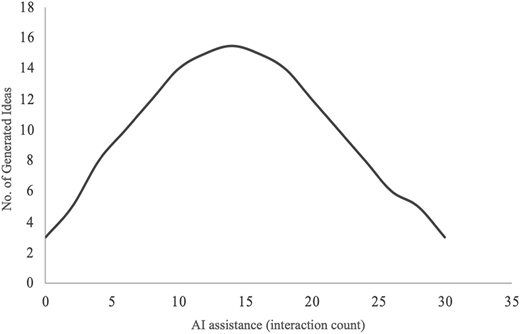
Results show a significant inverted-U effect, where AI assistance had a positive linear effect (β1 = 0.58, p < 0.001) and a negative quadratic effect (β2 = −0.31, p < 0.01), confirming that idea generation improves with moderate AI use but declines with excessive reliance; see Table 3. To verify that these effects were not driven by differences in administration mode, we re-ran the analyses within the subset of AI-assisted participants (Low-AI and High-AI conditions only), where administration mode was constant. The inverted-U relationship between AI assistance and idea quality remained substantively identical, indicating that the observed pattern reflects cognitive rather than modality-based mechanisms.
Figure 3 shows that the number of generated ideas increases with AI assistance up to a moderate level, then declines with excessive AI reliance. The quadratic regression curve highlights the optimal balance between human cognition and AI support. This finding further substantiates H1b. The behavioral inflection estimated from the quadratic model (≈15.2 interactions; 95% CI [13.6, 16.9]) closely aligned with the cutoff used to distinguish moderate from high AI assistance, providing empirical support for the categorization.
4.3 Mediation analysis and robustness checks
To examine whether cognitive engagement mediates the relationship between AI assistance and idea generation, we conducted a mediation analysis using Hayes' PROCESS Model 4 with 5,000 bootstrapped samples; see Table 4.
Results confirmed significant indirect effects for all tested mediation pathways. For the number of generated ideas, the indirect effect of AI assistance on idea generation through cognitive engagement was significant (95% CI [0.21, 0.57]), while the direct effect became nonsignificant once the mediator was included, indicating full mediation. For originality and feasibility, the indirect effects via cognitive engagement were also significant (95% CI [0.28, 0.63] and [0.23, 0.58], respectively); in both cases, the direct effects were substantially reduced, suggesting partial mediation. For overconfidence, cognitive engagement fully mediated the effect of AI assistance (95% CI [−0.55, −0.20]), consistent with the hypothesized inverse relationship. Collectively, these results demonstrate that cognitive engagement functions as the key psychological mechanism linking AI assistance to both the quantity and quality of ideas, thereby supporting all hypotheses advanced in this study.
To ensure the robustness of our results, we conducted an ANCOVA controlling for AI literacy and cognitive reflection scores. AI assistance remained a significant predictor of cognitive engagement, F(2, 120) = 17.91, p < 0.001, and idea generation, F(2, 120) = 21.45, p < 0.001, even after including control variables. These results confirm that the effects of AI assistance are not solely driven by individual differences in AI familiarity or cognitive reflection, strengthening the validity of our findings. We also considered participants' years of experience in product innovation roles as a potential covariate. However, descriptive analyses showed low variability across the sample (M = 5.8 years; SD = 1.21), and correlation tests indicated no significant association with our dependent variables (all p > 0.10). Given the lack of explanatory relevance and in the interest of model parsimony, experience was excluded from the ANCOVA analyses.
As a further robustness check, we assessed the complexity of the generated ideas. In this regard, we conducted a semantic complexity analysis using natural language processing, as shown in Table 5.
Ideas were analyzed based on lexical diversity, syntactic complexity, and the presence of causal reasoning elements. Results indicate that while moderate AI assistance led to significantly more complex ideas (M = 3.8, SD = 0.6) than both No AI (M = 2.3, SD = 0.5) and High AI (M = 2.5, SD = 0.5), the difference between No AI and High AI was not significant (p = 0.19). This suggests that while moderate AI assistance improves ideas depth, excessive AI reliance does not necessarily enhance cognitive complexity.
5. Discussion
This study offers novel insights into the behavioral dynamics of human–AI synergy in idea generation for product innovation. Our findings demonstrate that AI's effectiveness depends on its interaction with human cognitive engagement. Moderate AI assistance creates a balanced synergy between human intuition and algorithmic analysis, enhancing engagement and improving outcomes across idea quantity, originality, feasibility, and metacognitive calibration (reduced overconfidence). In contrast, both excessive reliance on AI (unbalanced synergy) and its absence (no synergy) diminish innovation outcomes, underscoring cognitive engagement as the pivotal mediating mechanism (Makridakis, 2017; Sweller, 1988).
Supporting H1a and H1b, moderate AI assistance significantly increased cognitive engagement, leading to higher idea generation. Participants used AI as a cognitive scaffold (Verganti et al., 2020), expanding their representational reach and exploring more innovation opportunities. Conversely, excessive AI reliance reduced engagement through automation bias, prompting uncritical acceptance of AI suggestions (Cramer-Petersen et al., 2019), while the no-AI condition constrained fluency due to bounded cognitive capacity and limited informational diversity (Garbuio and Lin, 2021).
Consistent with H2a, H2b, H3a, and H3b, moderate AI use also optimized originality and feasibility via heightened engagement. Participants in the balanced-synergy condition critically analyzed and recombined AI-generated insights, producing ideas that were both creative and viable (Garbuio and Lin, 2021). Excessive AI reliance reduced engagement, fostering convergent thinking and suppressing originality (Cramer-Petersen et al., 2019), whereas the absence of AI limited cognitive exploration and reinforced reliance on familiar schemas (Eapen et al., 2023; Sedkaoui and Benaichouba, 2024).
Findings further corroborate H4a and H4b, showing that cognitive engagement regulates metacognitive calibration, measured as overconfidence. High AI reliance increased overconfidence by inducing trust in AI outputs and reducing analytical engagement. This aligns with Dual-Process Theory (Kahneman, 2011): extensive AI use triggers intuitive System 1 processing and premature acceptance (Dong et al., 2016). Conversely, no-AI conditions slightly raised overconfidence through illusory control (Galasso and Simcoe, 2011). Only moderate AI assistance sustained deliberate reflection and critical validation of AI inputs, reducing overconfidence through improved metacognitive alignment.
Overall, results confirm that cognitive engagement is the central mechanism through which human–AI synergy influences innovation. AI's contribution is indirect and contingent on the extent to which it amplifies or dampens mental effort (Eisenbart et al., 2023; Sweller, 1988). Moderate AI fosters balanced synergy, enhancing analytical depth without fatigue; excessive use leads to overload, and absence to underload—both curbing creativity (Garbuio and Lin, 2021). Thus, AI should function as a complementary cognitive amplifier, not a substitute, preserving human creativity and judgment.
However, these effects are contextually contingent. In high-complexity innovation settings—such as systems integration, compliance, or safety-critical design—cognitive demands may shift the threshold at which AI complements versus displaces judgment. Even moderate AI use could induce disengagement if outputs are opaque or misaligned with expert schemas (Sweller, 1988; Faraj et al., 2018).
Organizational culture further shapes this relationship. In hierarchical or technocratic environments emphasizing efficiency and control, overreliance on AI may become institutionalized, discouraging critical reflection. By contrast, participatory or learning-oriented cultures that value experimentation and reflection sustain balanced synergy, treating AI as a dialogic partner rather than a deterministic authority (Garbuio and Lin, 2021; Savastano et al., 2024). These findings align with research linking psychological safety and iterative reflection to enhanced ideation (Füller et al., 2022; Raisch and Krakowski, 2021).
Finally, task framing and incentives can reinforce or erode engagement. Performance systems prioritizing speed or volume encourage shallow AI dependence (Crawford, 2021), while those rewarding reflective and feasibility-driven evaluation sustain balanced use.
Taken together, these boundary conditions confirm that the inverted-U relationship between AI assistance and engagement is context-dependent. Cultural, managerial, and structural factors jointly determine the cognitive threshold at which AI shifts from amplifier to substitute. Future research should examine how these elements reshape the slope and inflection point of the curve, advancing a contingency theory of human–AI synergy in innovation (Passarelli and Buongiorno, 2025).
6. Implications
6.1 Implications for theory
This study advances theoretical understanding of AI's role in product innovation by showing how human–AI synergy reshapes cognitive engagement and innovation outcomes. Four key contributions emerge.
First, we reframe the dominant “more-AI-is-better” narrative in innovation management by introducing a behavioral threshold perspective on human–AI synergy. Prior research has emphasized where AI can be deployed (Pietronudo et al., 2022) or what capabilities it enhances (Gama and Magistretti, 2025). We shift focus to identifying the optimal level of AI engagement that stimulates idea generation. Results reveal a non-linear, inverted-U relationship between AI reliance and idea quality: moderate AI use maximizes originality and feasibility, whereas excessive or minimal reliance suppresses engagement through automation bias or cognitive overload (Cramer-Petersen et al., 2019). This behavioral-threshold logic complements capability-based views by situating AI's value within human cognitive limits rather than technological potential. It positions human actors as cognitive regulators, maintaining equilibrium between algorithmic input and reflective reasoning (Garbuio and Lin, 2021). In doing so, it challenges deterministic models of AI-driven innovation and calls for structured ideation processes that preserve human reflection at the core of creativity (Verganti et al., 2020).
Second, this study deepens understanding of the AI–cognition nexus (Jiang et al., 2024). Rather than viewing AI as purely complementary or substitutive, findings indicate that moderate AI use enhances cognitive flexibility, knowledge recombination, and creative reasoning (Sedkaoui and Benaichouba, 2024), whereas excessive reliance fosters convergent thinking despite greater analytical capacity (Pennycook et al., 2016). We thus conceptualize AI as most effective when it strategically amplifies human cognition. By identifying the behavioral threshold where AI's benefits peak, this research formalizes contingent inflection points—conditions (e.g. task complexity, cognitive load, domain familiarity) that shift the slope and peak of the curve. As cognitive load or task complexity rises, optimal AI reliance decreases because automation undermines reflection and metacognitive monitoring. Under routine conditions, greater AI support raises the threshold by relieving redundant effort. These contingent inflection points delineate when and why AI's cognitive benefits change, offering a mid-range theoretical account of dynamic human–machine balance (Garbuio and Lin, 2021; Budhwar et al., 2023).
Third, our results refine Dual-Process Theory (Kahneman, 2011) and Cognitive Load Theory (Sweller, 1988) by demonstrating that AI functions as a dynamic cognitive moderator. Moderate AI assistance optimizes effort and fosters deliberation, while high reliance induces automation bias and overload, and absence constrains capacity. The behavioral threshold view implies that AI's inflection point is context-dependent: it rises when AI reduces routine load without eroding reflection and falls when automation replaces deliberation. This finding aligns with behavioral strategy research showing that technological tools alter metacognitive vigilance (Dong et al., 2016; Makridakis, 2017). Accordingly, AI's cognitive value is neither fixed nor uniformly beneficial (Budhwar et al., 2023). Its effectiveness depends on calibrated synergy that sustains engagement, challenging binary conceptions of AI as inherently empowering or detrimental. We thus advocate a theoretical recalibration that treats cognitive engagement not only as a mediator but as a core dimension structuring productive human–AI tension.
Fourth, this research extends ambidexterity theory (March, 1991) by revealing how AI enables individuals to balance exploration and exploitation dynamically. Moderate AI use supports this balance by enhancing divergent thinking through data-driven prompts while maintaining convergent judgment. Excessive AI reliance fosters overexploitation and convergence; low AI support limits exploration. These results position individual cognitive systems as loci of micro-cognitive ambidexterity—adaptive switching between divergent and convergent thought mediated by AI. Behavioral thresholds act as cognitive levers that determine when such switching is most productive: as AI reliance shifts, so does the ability to toggle between exploratory and evaluative modes. This reframes ambidexterity as an emergent property of technologically mediated cognition (Garbuio and Lin, 2021; Csaszar et al., 2024) rather than a static organizational trait.
In sum, this study situates human–AI synergy, not AI alone, at the center of innovation theory. It urges a move beyond linear models of AI-driven creativity toward context-sensitive frameworks that foreground cognitive engagement as the essential mechanism for unlocking innovation potential.
6.2 Implications for practice
This study offers important managerial implications for organizations seeking to effectively integrate AI into their innovation processes, emphasizing the centrality of human–AI synergy and its impact on cognitive engagement in idea generation.
First, organizations should position AI as a collaborative tool designed to augment—not replace—human decision-making (Cristofaro and Giardino, 2025). Moderate AI assistance enhances engagement by facilitating deeper exploration of ideas without eroding creativity or critical judgment. To achieve this balance, firms should embed structured workflows that require innovators to actively evaluate and refine AI-generated ideas. Oversight mechanisms such as innovation committees or structured pipelines can ensure rigorous evaluation and contextualization (Garbuio and Lin, 2021). Managers should be encouraged to justify, refine, and selectively adopt AI suggestions, maintaining cognitive engagement and strategic alignment.
Second, firms should cultivate AI literacy tailored to creative problem-solving. As results indicate, moderate AI interaction produces more original and feasible ideas, while excessive use promotes convergent thinking and overconfidence. Training should teach innovators how to: (a) use AI for expansive brainstorming, (b) compare AI and human solutions, and (c) evaluate feasibility in market contexts (Makridakis, 2017; Cristofaro and Giardino, 2025). Structured, interactive sessions sustain creativity while preventing cognitive disengagement or convergence toward familiar paths.
Third, to mitigate AI-induced overconfidence, managers should implement bias-awareness and validation frameworks. High AI reliance can shift innovators toward intuitive reasoning, amplifying overconfidence (Kahneman, 2011). Firms can counteract this by instituting iterative validation processes where interdisciplinary teams critically review AI-driven ideas (Cristofaro et al., 2025). Institutionalizing such review loops ensures ideas are refined through diverse expertise and remain strategically viable.
Fourth, organizations should operationalize the principle of “moderate” AI reliance through deliberate interaction design. Rather than leaving engagement levels to discretion, firms can define reflection checkpoints and staged protocols—for example, an AI-assisted divergent phase followed by a human-led convergence phase—to sustain breadth before evaluative depth. Such bounded interaction design strengthens analytical reflection and curbs automation bias.
Finally, firms should align evaluation and incentives with cognitive balance. Overemphasizing speed or output volume risks excessive automation. Instead, organizations can monitor indicators such as AI-to-human contribution ratios, novelty scores, and validation frequency. Rewarding reflective engagement, originality, and balanced reasoning helps maintain the productive “moderate zone” of human–AI coupling.
Collectively, these strategies enable organizations to exploit AI's generative potential while safeguarding human creativity and critical thought. Institutionalizing moderation through workflow design, validation, and governance transforms AI integration from intuitive experimentation into a behaviorally governable system, reframing AI as a cognitive amplifier whose effectiveness depends on how organizations structure, monitor, and reward engagement.
6.3 Limitations and future research
This study provides valuable insights into the role of human–AI synergy in product innovation; however, several limitations must be acknowledged, which also open promising directions for future research.
First, the No-AI condition was administered on paper, whereas AI-assisted tasks were completed online. This difference in administration mode may have influenced behavioral measures, such as the number of generated ideas, through input friction, editing ease, or perceived task affordances. Although our main inferences derive from within-mode comparisons among AI users—where administration mode is constant—we recognize that the modality of task execution may shape both effort and expressiveness. Future research should therefore harmonize administration modes or include explicit covariate or sensitivity analyses to fully isolate mode effects. Such design refinements would clarify whether the observed behavioral threshold truly reflects cognitive mechanisms rather than technological ergonomics.
Second, while the controlled experimental setting enabled clear causal identification, it may not fully capture the social and temporal complexities of real-world innovation. Organizational culture, hierarchy, and market pressure can modulate how individuals and teams engage with AI systems (Gui et al., 2024). Longitudinal or field-based research could trace how trust calibration, cognitive engagement, and automation bias evolve through multiple cycles of interaction. Embedding AI tools within live innovation projects or teams would reveal whether the behavioral threshold stabilizes, shifts, or dissipates as users develop experience and collective routines.
Third, industry- and innovation-type contingencies deserve closer scrutiny. Data-intensive industries such as software or advanced manufacturing may align more naturally with AI-supported ideation, whereas creative or design-driven sectors—where tacit and aesthetic judgments dominate—may experience a narrower or shifted optimal zone. Comparative research could test whether the inflection point of the inverted-U varies as a function of domain complexity, knowledge codifiability, or innovation radicalness. Building on this, subsequent studies could manipulate AI anthropomorphism (Dorigoni and Giardino, 2025) to examine whether cues such as name, voice, or agentive framing—by heightening trust or social presence—shift the curve's vertex, prompting earlier overreliance or sustained engagement.
Fourth, the study focused on one generative AI system (ChatGPT). Other forms of AI, such as predictive analytics, recommender engines, or image-generation models, differ in transparency and interactivity, which may alter the steepness or symmetry of the inverted-U. Feature-factorial designs varying feedback modality and system responsiveness could identify which affordances strengthen or weaken human cognitive engagement.
Finally, cognitive engagement was proxied through time-on-task—a robust but limited measure that does not distinguish deep reflection from distraction. Future work should triangulate behavioral and neurophysiological indicators (e.g. eye-tracking, EEG, pupillometry) to identify when automation bias emerges and when AI transitions from cognitive amplifier to cognitive substitute. Such triangulation would refine the construct validity of engagement and deepen theoretical integration between dual-process and cognitive load perspectives.
7. Conclusions
As artificial intelligence reshapes the landscape of innovation, this study highlights that progress depends not on replacing human creativity but on cultivating genuine human–AI synergy. The findings reveal that moderate AI assistance acts as a catalyst for cognitive engagement—stimulating curiosity, critical reflection, and imaginative exploration—while excessive reliance dulls these capacities and erodes originality. Conversely, when humans work without AI support, their creative reach narrows under cognitive limits. True innovation therefore arises not from technological intensity but from cognitive balance: a mindful partnership in which AI amplifies, rather than substitutes, human thought.
For organizations, this means reimagining AI as a collaborator that sharpens insight, broadens perspective, and anchors creativity in disciplined reflection. Managers must design processes that encourage dialogue between human judgment and machine intelligence, ensuring each complements the other's strengths. Training, evaluation, and incentives should all nurture this balance, guiding innovators to question, adapt, and refine AI-generated ideas. Ultimately, the future of product innovation will belong to those who master this equilibrium—where human curiosity and algorithmic precision merge into a shared intelligence capable of seeing further, imagining bolder, and creating more wisely.
Note
In this study, we focus specifically on Generative AI (GenAI) tools, such as large language models (i.e. GPT-4), which generate novel text-based outputs. For readability, we use the shorthand “AI” throughout the paper to refer to this class of GenAI systems, rather than artificial intelligence technologies more broadly.