This paper aims to investigate how the location of fast fashion brands’ environmental sustainability initiatives (domestic vs foreign) influences consumer reactions. It also aims to address the challenge fast fashion brands face in deciding where to focus sustainability efforts amid increasing pressure to address environmental issues.
The study uses six experimental studies to explore consumer responses to fast fashion brands’ environmental sustainability initiatives. It examines the moderating roles of brands’ sustainability performance and consumers’ local-global identity in shaping these responses.
The results demonstrate that domestic environmental sustainability initiatives lead to higher purchase intentions and increased word-of-mouth compared to foreign initiatives. This effect is stronger for fast fashion brands with poor sustainability performance, while for those with good records, the location of initiatives has minimal impact. In addition, consumers with a local identity prefer domestic initiatives, whereas consumers with a global identity react similarly regardless of location.
The study focuses on the fast fashion sector, which may limit generalizability to other industries. Future research could explore different retail contexts or longitudinal effects to deepen understanding of sustainability initiative impacts.
Fast fashion brands should prioritize domestic sustainability initiatives to enhance consumer perception, particularly if their sustainability record is weak. Tailoring strategies based on consumers’ local or global identities can further optimize engagement and brand loyalty.
This research provides novel insights into the strategic role of initiative location in fast fashion brands’ sustainability agendas. It highlights the importance of aligning sustainability efforts with consumers’ identities and brands’ prior performance, offering practical guidance for fast fashion brands, especially those new to sustainability investments.
Introduction
Companies are scaling up investment in environmental sustainability initiatives, in the wake of exponential societal concerns on climate change and other environmental grand challenges (Vadakkepatt et al., 2021). Sustainability can be defined as a collection of beliefs, attitudes, goals and actions that strategically consider available financial, environmental and social resources for the benefit of both present and future generations, while a sustainable brand considers factors other than immediate financial gain, such as the long-term impacts on the environment and society for both current and future generations (Vadakkepatt et al., 2021).
The environmental dimension is central to the overall concept of sustainability and focuses on maintaining and sustaining the quality of our natural environment (UN, 2015).
The fashion industry, however, is one of the worst industries in terms of environmental performance (Mathew and Spinelli, 2025; Pinnock, 2025; Tran and Bartsch, 2025), and its negative effects are often comparable to those of traditionally “dirty” industries such as petrochemicals and ore mining (Friedman, 2021). The fashion industry’s protracted and convoluted value chain has a colossal environmental impact. Starting from the production of a range of plant-based (e.g. cotton), animal-based (e.g. wool) and synthetic (e.g. polyester) raw materials, to the manufacturing of textiles and the logistics and retail of finished garments, each step adds to the environmental footprint of our stylish outfits due to the water, material, chemical and energy use involved. Such an impact has been further amplified with the advent of fast fashion, whose business model relies on cheap manufacturing, low prices, frequent consumption and short-lived product use, which is at odds with the very essence of environmental sustainability (Niinimäki et al., 2020). Consequently, it is not surprising that the public and consumers have become increasingly alarmed by these developments.
Previous research suggests that younger generations care not only about price and quality, but also about environmental sustainability (Gielens et al., 2021). It has also documented strong evidence on these positive impacts in the broader retail sector (Bolton and Mattila, 2015; Carter et al., 2021; Olsen et al., 2014). Yet these positive effects may not be uniform. Rather than being rewarded simply for engaging in sustainability, firms may be evaluated differently depending on how such initiatives are framed and implemented (Lee et al., 2024). In the context of multinational fast fashion brands, one strategically important but underexamined aspect is the location of the sustainability initiative. The geographic focus of such initiatives can shape how consumers interpret and evaluate a firm’s sustainability efforts, as it signals where the firm chooses to allocate its resources and attention. For instance, brands may implement domestic initiatives that are more visible and proximate to consumers, such as in-store garment recycling programs, renewable energy use in retail operations or partnerships with community organizations. In contrast, firms may pursue foreign initiatives within their global supply chains, such as improving environmental standards in overseas manufacturing facilities, investing in water-saving technologies in production or supporting sustainable sourcing practices in supplier regions. These differing locations not only reflect distinct operational priorities but may also influence consumer perceptions in different ways, highlighting the importance of understanding the role of initiative location in shaping responses to sustainability efforts.
Whether a brand directs its environmental efforts toward domestic or foreign contexts may shape how consumers interpret the initiative’s relevance, authenticity and reputational significance. This is particularly important in fast fashion, where brand image is highly salient, the placement of sustainability efforts can meaningfully influence how these initiatives are perceived and how effective they are. Examining initiative location therefore offers a way to better understand the nuanced conditions under which sustainability efforts enhance consumer perceptions of the firm, extending existing sustainability research beyond the assumption that such efforts are uniformly rewarded. Importantly, these effects are likely shaped by a firm’s sustainability record, that is, the cumulative history of its actions and policies demonstrating commitment to environmental and social responsibility, as well as by consumers’ local-global identity, or the extent to which individuals identify with local traditions and communities versus global culture and worldwide connections.
Drawing from attribution theory (Heider, 1958), coupled with local-global identity (Arnett, 2002) and self-congruity (Sirgy, 1986) theories, we argue that the decision on the location of a fast fashion brand’s environmental sustainability initiative should be informed by its existing sustainability reputation, as it influences how consumers perceive the motives of such an initiative and self-image congruence. Although in general, we expect that domestic (vs foreign) initiatives can generate more favorable responses, this effect is more prominent for brands with a poor record of existing sustainability performance. We anticipate that this is due to stronger perceived value-driven motive of the initiative. For brands with a good record, the impact of an environmental sustainability initiative is similar, regardless of its location. Furthermore, the location decision should also be informed by consumers’ local-global identity. We except that individuals with a predominately local identity react more favorably in response to a domestic (vs foreign) sustainability initiative. We anticipate that this due to stronger self-image congruence between the initiative and the consumer. Those with predominately local identity exhibit similar reactions regardless of the location of the initiative.
Fast fashion brands, face unique and unprecedented challenges and desperately need to scale up their sustainability agenda (Vadakkepatt et al., 2021). This is true for both incumbent brands investing more on environmental sustainability initiatives, and emergent ones with a unique sustainability positioning (e.g. TOMS and Patagonia; [de Kerviler et al., 2022]). Notably, the environmental footprint of the fast fashion industry is unique in that it is almost equally prevalent along its global supply chain. Although sustainability challenges related to global supply chains are not exclusive to fast fashion and can also characterize slow fashion brands, the fast fashion context is distinctive in the intensity of consumer attention it attracts. Relative to slow fashion, fast fashion is more commonly associated with accelerated production, short product life cycles, high-volume consumption and greater perceived disposability. These characteristics make the environmental consequences of fast fashion more visible and, potentially, more central to how consumers judge the brand Cao et al. (2024); Ramani et al. (2025). Consequently, consumers may approach fast fashion sustainability initiatives with greater skepticism, stronger expectations or heightened sensitivity to how and where such efforts are undertaken. Most fast fashion brands typically manufacture their products in less developed countries while selling their products mainly to the developed western market and while most environmental impacts occur in the textile- and garment-manufacturing countries, textile waste ends up in landfills around the globe (Beall, 2022). Understanding consumer reactions to fast fashion brands’ sustainability efforts is therefore particularly important, because the reputational effects of those initiatives may depend not only on whether a firm engages in sustainability, but also on how consumers interpret those efforts in a context already marked by elevated scrutiny.
This research makes several theoretical contributions to the extant literature. First, it contributes to the nascent but increasingly important literature on fast fashion sustainability by innovatively examining how and when fast fashion brands’ can have an impact through their environmental sustainability initiatives. Second, this research extends the literature on corporate environmental sustainability and social responsibility by revealing a more nuanced pattern of consumer response to sustainability initiatives. Rather than being rewarded uniformly, such initiatives are evaluated in part according to their location focus. It shows that consumer responses to such initiatives depend not simply on whether firms engage in sustainability, but also on where those efforts are focused. More specifically, it demonstrates such location effect by identifying the mechanisms of how (including favorable attribution and self-image congruency) and conditions of when (including a brand that only starts to invest in environmental sustainability and consumers with a stronger local identity) a domestic sustainability strategy, as compared to a foreign sustainability strategy, can lead to more favorable reactions (including purchase intention, positive word-of-mouth and willingness to contribute their ideas). Third, this research also contributes to the literature of consumer local-global identity by originally revealing that it interacts with a fast fashion brand’s location strategy in influencing reactions toward sustainability and corporate social responsibility (CSR) initiatives through a mechanism of self-image congruity.
Research background
Fast fashion sustainability
Fast fashion has been widespread and increasingly popular since the late 1990s. Brands such as Zara and H&M have been dominating the fashion industry in terms of sales volume enabled by a business model that releases new lines of outfits within weeks. Originally, fast fashion has attracted much praise for its agile responses to consumer trends, skilled application of just-in-time logistics and significantly shortened design-manufacturing-distribution cycles (Sull, 2008). Recently, however, fast fashion has attracted increasing amount of criticism over its unsustainable business model. Although their products are more affordable and make fashion accessible to the less wealthy, the price for fast fashion is much higher than it when the environmental and social costs are considered. The environmental costs are exorbitantly high, as more than 50 billion garments are discarded within a year of being made (Schumacher and Forster, 2022). Resultantly, the ethics and sustainability of fast fashion have become a critical debate in both the popular media and the academic community. It is also reported that fast fashion lovers (Gen Z) might be shifting their behavior and expect fast fashion brands to be more sustainable and socially responsible (Kale, 2021).
Surprisingly, the academic literature on fast fashion ethics and sustainability remains relatively thin. A few studies have examined how fast fashion is inherently unsustainable (McNeill and Moore, 2015), compared it with luxury fashion (Joy et al., 2012) and proposed potential solutions to mitigate its environmental impact (Binet et al., 2019). Existing research has largely focused on identifying the key elements of sustainable fashion, including practices such as collaborative consumption, effective waste management, fair and ethically produced garments, sustainable design techniques and production methods and custom-made or made-to-order products (Khandual and Pradhan, 2019). Fast fashion brands are increasingly subject to institutional pressures to act in a socially responsible manner (Pedersen and Gwozdz, 2014), and prior research suggests that companies with stronger business model innovation and organizational values characterized by flexibility and discretion are more likely to achieve higher corporate sustainability outcomes (Pedersen et al., 2018). From a consumer perspective, awareness of the sustainability issues associated with fast fashion is rising (Zhang et al., 2021), and some consumers are actively choosing to avoid fast fashion brands altogether (Kim et al., 2013). These developments highlight both the growing relevance of sustainability in fast fashion and the need for further academic inquiry into effective strategies and consumer responses.
To the best of our knowledge, no research has examined how fast fashion brands can influence consumer behavior through their sustainability initiatives. Given that many fast fashion brands are increasing their efforts and resources in sustainability and CSR initiatives, it is an urgent research endeavor to study this potential impact. Although the extant literature has documented extensively how a company’s sustainability initiatives can influence consumers in general, very few studies have focused on the fast fashion sector. Fast fashion is unique. While it has exaggerated the environmental impact of the broader fashion industry with fast fashion brands now producing almost twice the amount of clothing today compared with before the year 2000 (Niinimäki et al., 2020), fast fashion is considered neither a “dirty” sector (e.g. transport, travel and energy), nor an “evil” sector (e.g. tobacco, gambling). Therefore, it is particularly interesting and useful to examine how consumers react to the sustainability initiatives by brands in this sector. Yet the existing literature has mostly investigated the environmental impact of this sector (Caniato et al., 2012; Henninger et al., 2017; Thorisdottir and Johannsdottir, 2019), with limited attention being paid to consumer responses to their sustainability initiatives.
Sustainability and location strategy
Many fast fashion brands, such as Zara, H&M, Mango, Uniqlo and so on, are pioneers in developing novel, original and creative environmental sustainability initiatives. Indeed, it has been elucidated by Vadakkepatt et al. (2021) that sustainability offers fast fashion brands various benefits, including brand differentiation through improved brand equity and brand loyalty; mitigating business risks through compliance with increased environmental regulation particularly regarding their supply chain; attracting capital and investment though improved ESG rating; and increasing profit margin by cutting costs though waste reduction, energy savings, lower operational costs and so on.
Despite the increasing importance and prevalence of sustainability in the broader retailing sector, research in this field is still lagging. Our understanding of how fast fashion environmental sustainability affects customer behaviors is particularly limited. Although the literature on broader retailer sustainability is quite developed from a supply chain and operations research standpoint (de Brito et al., 2008; Tang et al., 2016) the literature on fast fashion environmental sustainability on consumer behavior is rather thin Vadakkepatt et al. (2021). Prior research has predominantly focused on some transactional initiatives, like cause-related marketing, which is primarily a marketing initiative that involves collaboration between firms and nonprofit organizations to promote the brand sales and link them to the donation to the nonprofit organizations or causes (Barone et al., 2007; Ellen et al., 2000; Folse et al., 2010; Gorton et al., 2013; Mimouni Chaabane and Parguel, 2016). Regarding environmental sustainability per se, a notable recent study (Carter et al., 2021) finds that the existing sustainability reputation can influence how consumers can choose equally sustainable products from different brands due to the difference in their existing sustainability reputation. Specifically, they find that consumers with a more abstract construal of sustainability (i.e. mental focus on why the sustainability initiative is being performed and/or its overall meaning) are more likely to choose sustainable products from a fast fashion brand whose sustainability reputation is higher than from competitors with a weaker sustainability reputation.
Although the insights from the general literature on sustainability and CSR can potentially be extended to the fast fashion sector, the broader literature fails to acknowledge the aforementioned specific challenges faced by fast fashion brands (e.g. global supply chain that renders location decision particularly salient). It is not surprising that location strategy has not yet received sufficient academic attention in the general sustainability literature it merits. Fast fashion brands, like other types of brands, have limited resources to invest in environmental sustainability initiatives and often sustainability and CSR budgets are tighter than most managers would hope for (White et al., 2019). To effectively allocate their resources to the most impactful sustainability initiatives, fast fashion brands often need to make a choice between domestic environmental sustainability strategies versus foreign ones. Such a location strategy is particularly salient for brands that rely on global supply chains, such as most in the fast fashion sector. The primary (but not the only) markets of such brands are consumers in wealthy, more developed countries. On the other hand, the production factories are typically located in less wealthy developing countries that normally have poor labor practices and environmental regulations (Barbier and Hochard, 2018). Therefore, such brands at times need to decide which locations/countries to focus their environmental sustainability initiatives on. To address this question, it is important to assess whether and how such a decision can influence consumer decision making.
Hypotheses development
Although no prior research has examined location strategies specifically in the fast fashion sector, evidence from CSR and consumer behavior research suggests strong reasons to expect that domestic sustainability initiatives outperform foreign ones when it comes to consumer reactions (Russell and Russell, 2010). Consumers often evaluate socially responsible initiatives not only on their objective merits, but also on perceived closeness. For example, studies show that CSR initiatives are more effective when they come from brands that are perceived as socially close and “in-group,” rather than distant or foreign, this is because social distance reduces credibility and dampens positive evaluations (Antonetti and Maklan, 2016; Morales, 2005; Reed et al., 2007). This pattern is amplified in contexts where information is uneven or difficult to verify: foreign sustainability initiatives may be seen as less transparent or harder to assess, prompting consumers to question the initiative’s substance or authenticity (Dang et al., 2020; Nguyen et al., 2023) Domestic initiatives, by contrast, benefit from greater perceived relevance and accessibility, making it easier for consumers to form more favorable judgments and engage in supportive behaviors such as purchase intentions and positive word-of-mouth (Cuesta-Valiño et al., 2024). Drawing on these insights, we expect that a fast fashion brand’s domestic environmental sustainability initiative will generate stronger positive consumer responses compared to a similar foreign initiative. These responses include higher purchase intentions, and increased positive word-of-mouth. Therefore, we hypothesize:
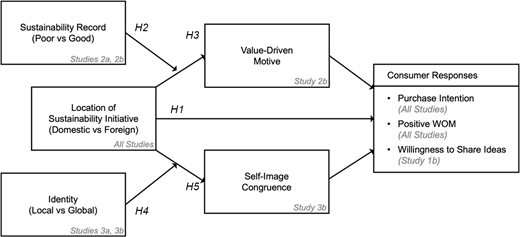
A fast fashion brand’s domestic environmental sustainability initiative leads to stronger positive consumer responses, including higher purchase intentions and increased word-of-mouth, compared to a similar initiative implemented in a foreign location.
The roles of existing sustainability performance and value-driven motive
We anticipate that the effect of the location of a fast fashion brand’s environmental sustainability initiative is contingent upon the brand’s existing sustainability performance record. Consumers may rely on such credentials to infer not only whether the focal brand have the disposition, experience and necessary resources to bring about results but also the motives behind their sustainability initiatives (Ham and Kim, 2019). Research finds that consumers, particularly those with more abstract mindset (a mental focus on why an activity is being performed and its overall meaningfulness), are more likely to choose a sustainable product from a brand with stronger (as opposed to weaker) sustainability reputation, even if the sustainable products are the same (Carter et al., 2021).
Attribution is a key cognitive process that consumers engage in when they are responding to fast fashion brands’ sustainability or other types of initiatives. Attribution theory posits that individuals make causal inferences on the motives for the behavior of others (Heider, 1958). Consumers’ positive attribution of corporate sustainability and CSR initiatives involves their perception of a value-driven motive of the focal brand, which refers to the brand’s moral and ethical obligations to the community and society at large (Ellen et al., 2006). Value-driven motives refer to consumers’ belief that a company engages in socially responsible actions out of genuine ethical commitment rather than self-interest. These motives are attributed when stakeholders perceive that the firm is guided by intrinsic values, such as fairness and social responsibility, and would act similarly even without direct economic or reputational benefits (Ellen et al., 2006). Previous research corroborates that a value-driven motive attributed to a brand’s CSR initiatives is positively related to some important consumer behavioral outcomes, including (re-)purchase intention (S. Kim and Choi, 2018; Ogunfowora et al., 2018), loyalty intention (Sipilä et al., 2021) and positive word-of-mouth (Vlachos et al., 2009).
Prior research has indicated that a brand’s existing sustainability record can have a positive impact on consumer’s perceived value-driven motive of their environmental sustainability initiatives (Ginder et al., 2021; Skarmeas and Leonidou, 2013) as well as on consumer brand choice (Carter et al., 2021). In this research, we argue that sustainability record not only directly influences consumer attribution of motives, but also plays a further important role in moderating how the domestic vs foreign environmental sustainability initiatives can influence consumer attribution (i.e. perceived value-driven motive) and subsequently behavioral responses.
As noted earlier, domestic initiatives (compared to foreign ones) can result in more favorable outcomes. We argue that such an effect exists primarily for brands with a poorer existing sustainability performance, but not for brands with a stronger sustainability record, due to the differential effects of domestic (vs foreign) initiatives on the perceived value-driven motive by the two types of fast fashion brands. When fast fashion brands invest in domestic environmental sustainability initiatives consumers are more likely to perceive their motives as intrinsic and being driven by the fast fashion brand’s values and their moral and ethical obligations to their local communities (Ellen et al., 2006). This occurs because these brand are likely to be seen as taking some first steps to address their environmental impact by commencing with a local effort. Such an approach is more inclined to align with the expectation of the domestic/primary consumers, given their general egocentric orientation. Therefore, when a fast fashion brand is investing in domestic and less distant (i.e. closer) initiatives that cater to consumers’ egocentric needs and expectations, there is a higher likelihood that consumers will attribute intrinsic and value-driven motives to a brand, especially if it has a limited or nascent track record of sustainability performance (Yoon et al., 2006). Moreover, a poor existing sustainability performance may also serve as a strong cue for the lack of experience and capacity to drive an environmental sustainability agenda at an international scale (Parguel et al., 2011). Therefore, we anticipate that when fast fashion brands with a poor sustainability record invest in foreign environmental sustainability initiatives, consumers will perceive their motives as less genuine and less driven by the brand’s moral and ethical obligations (Nyilasy et al., 2014).
In contrast, research in multiple disciplines has supported the notion that an actor’s moral credentials influence how perceivers morally judge and attribute the actor’s action and its motives. For example, it has been demonstrated that previous good deeds can build moral credential that allow the wrongdoers to be excused by perceivers (Monin and Miller, 2001). A brand’s existing CSR image and credentials can result in stronger consumer resistance to negative information about the focal brand Eisingerich et al. (2010), more favorable product evaluation (Chernev and Blair, 2015) and less negative consumer reactions when brands experience negative events such as product harm crisis Klein and Dawar, (2004). On the flip side, such a positive halo effect applies to those brands engaging in positive social initiatives, such as environmental sustainability initiatives, resulting in positive value-driven attribution. Therefore, we anticipate little difference in consumers’ behavioral reactions and attributions when comparing domestic and foreign environmental sustainability initiatives undertaken by brands with a long and proven track record of sustainability performance. This is because a good existing sustainability performance may serve as a strong cue for the willingness and capacity to drive an environmental sustainability agenda and deliver impact both domestically and internationally (Parguel et al., 2011). Consequently, consumers will likely recognize the initiatives of such brands as credible, effective and genuine efforts toward meeting their environmental sustainability goals irrespective of whether these are domestic or foreign. Thus, we predict:
A fast fashion brand’s domestic environmental sustainability initiative leads to higher purchase intentions and increased word-of-mouth, compared to a similar initiative implemented in a foreign location, particularly for brand’s with a weak sustainability record. For brands with a strong sustainability record, initiative location is expected to have little to no additional effect on these outcomes.
The moderated effect of the record of existing sustainability performance is mediated by the fast fashion brand’s value-driven motive.
The roles of local-global identity and self-image congruence
Consumers are likely to hold both a local and a global identity (Arnett, 2002). A local identity refers to consumers’ respect for local traditions and culture while also identifying with their local community. A global identity refers to consumers’ interest in global culture and connection with people around the world. Importantly, while consumers can simultaneously possess both identities (Arnett, 2002; Tu et al., 2012); one of these may be (or may become) more prominent and therefore more instrumental in guiding behavior (Ng et al., 2020; Yang et al., 2019).
Previous research has demonstrated the important role played by a congruence between consumers’ identities and those of the objects of their consumption. For example, consumers with a salient global identity prefer global products and brands, whereas those with a salient local identity prefer local products and brands (Ng et al., 2020; Tu et al., 2012; Zhang and Khare, 2009). More generally, self-congruity theory (Sirgy, 1986) suggests that marketing offerings, such as products, services, brands, tourist destinations and ideas, are assumed to have personal images, just as people do (Aw and Chuah, 2021; Li et al., 2022; Sirgy et al., 1997; Usakli and Baloglu, 2011). These images are found to interact with consumers’ self-concept (Das and Pingali, 2022) generating a subjective experience referred to self-image congruence that can result in a wide range of positive consumer experience and outcomes. Self-image congruence refers to the degree of match or consistency between a consumer’s self-concept (i.e. how they see themselves or wish to see themselves) and the image of a product, brand or user of that brand. The concept is grounded in the idea that consumers prefer products whose symbolic meanings are aligned with their own identity, leading to more favorable attitudes and stronger behavioral intentions when such congruence is high (Sirgy et al., 1997). We argue that self-image congruence can explain the process by which consumers’ local-global identity influences the effect of environmental sustainability location strategy on consumers downstream reactions (Badrinarayanan et al., 2012; Strandberg et al., 2020).
We anticipate that, since consumers with a predominately local identity, or “locals,” exhibit greater attachment to their local community and prefer not to move out of their local community (Arnett, 2002), they are susceptible to the favorable effects of domestic environmental sustainability initiatives. We expect these consumers to only find self-congruent those initiatives that affect and ultimately benefit their local community. In contrast, consumers with a predominately global identity, or “globals,” view the world as a “global village” and often travel outside their home country with greater ease (Ng et al., 2020; Steenkamp and de Jong, 2010). Individuals with a salient global identity have been found to be more likely to work for global organizations and in multicultural teams, speak multiple languages and live in more than one country than those with a salient local identity (Erez et al., 2013). These consumers are more cognizant of the global coexistence and interdependence of – in physical terms – distant and proximal communities and of the universal nature of environmental sustainability challenges. They should find self-image congruent not only initiatives that affect their local community but also initiatives with a foreign focus. Therefore, we anticipate these consumers to be susceptible to the favorable effects of both domestic- and foreign-focused environmental sustainability initiatives. More formally:
Consumers with a predominately local identity respond more favorably to a fast fashion brand’s domestic environmental sustainability initiative compared with a foreign environmental sustainability initiative. Consumers with a predominately global identity respond similarly regardless of the location of the initiative.
The moderated effect of the local-global identity is mediated by consumers’ self-image congruence.
Overview of studies
We test our predictions across a series of six experimental studies. Study 1a (n = 160) tests the effect of a domestic (vs foreign) environmental sustainability initiative on consumers’ purchase intention and positive word-of-mouth. Study 1 b (n = 202) replicates the effects of domestic versus foreign environmental sustainability initiative and investigates (and rules out) alternative mechanisms that might be at play. Specifically, we conceptualize the domestic versus foreign distinction in terms of spatial distance (close vs distant) and empirically distinguish it from alternative explanations (e.g. country development [developed vs developing] and facility type [retail stores vs manufacturing facilities]). Study 1 b further investigates the effect on the willingness of consumers to share ideas for the specific of the environmental sustainability initiative as a means for capturing consumers’ downstream behavioral consequences. Study 2a (n = 276) investigates the moderating role of the brand’s record of existing sustainability performance. Study 2 b (n = 302) further looks at the mediating role of a value-driven motive of the environmental sustainability initiative. Then, Study 3a (n = 400) investigates how consumers’ dominant identities (local vs global) influence the effect of the location of the initiative on consumers’ purchase intention and positive word-of-mouth. Finally, in Study 3 b (n = 384), we seek to provide a stronger replication of the moderating effect of consumers’ identities by manipulating consumers’ local vs global identities through an experimental priming procedure. We also look at the mediating role of consumers’ perceived self-image congruence with the environmental sustainability initiative. Figure 1 summarizes our conceptual model. Across all studies, to ensure data quality, we implemented an attention check midway through the experimental procedure (Oppenheimer et al., 2009). Participants were instructed to disregard the standard response options and instead select a specific checkbox.
Study 1A
The objective of Study 1a is to examine the effect of location of environmental sustainability initiative (domestic vs foreign) on purchase intention and word-of-mouth. Consistent with H1, we predict that consumers are more likely to exhibit increased intention to purchase and propensity of share positive word-of-mouth when the location of an environmental sustainability initiative is domestic (vs foreign).
Method
We recruited one-hundred sixty participants (Mage = 39.28; 56% female) from the Prolific platform. We randomly assigned participants to one of two conditions in a domestic vs foreign between-subjects experimental design. To ensure that the manipulation of location was meaningful, we restricted our sample to participants residing in the UK at the time of our data collection. Specifically, we applied Prolific’s prescreening filters by selecting the “Current country of residence” criterion and limiting participation to individuals based in the UK.
We asked participants to read an article about a new environmental sustainability initiative by a UK fast fashion company to achieve zero emissions (see Supplementary Appendix A). We told participants we were using a fictitious brand name to protect the actual identity of the company. Participants saw one randomly selected company name from a list of four (Aquaberry, Darnell, Marbie Lily and Suburban). The article cited that the company has more than 200 retail stores across the UK as well as manufacturing sites in an Asian country. To enhance the generalizability of the study, the participants saw a randomly selected country from a list of four (Bangladesh, Myanmar, Vietnam and Indonesia). To manipulate the location of the environmental sustainability initiative, the article further mentioned that the company announced significant investments to make all their stores in the UK (vs factories in Bangladesh/Myanmar/Vietnam/Indonesia) run 100% on renewable energy by the end of next year.
After participants read the article, we elicited their purchase intention and positive word-of-mouth (see Supplementary Appendix E for all items from all studies). Finally, the participants reported demographic information.
Results and discussion
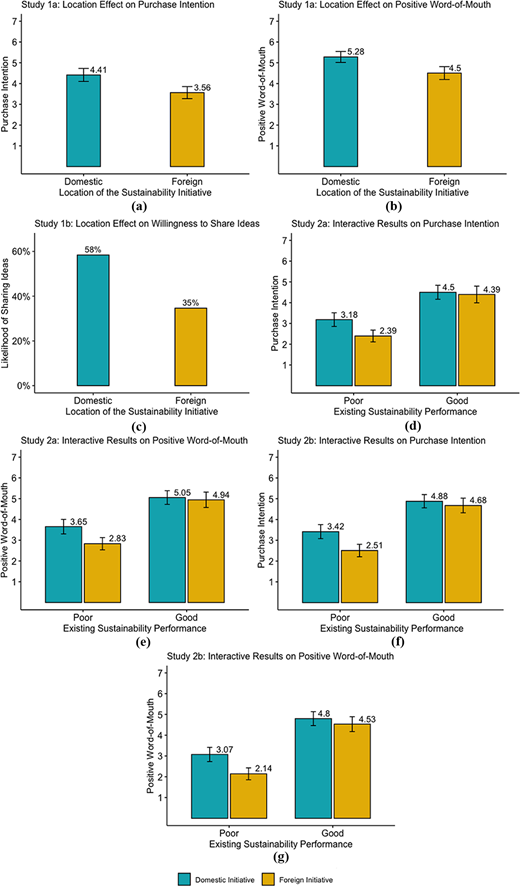
Purchase intention. We ran an ordinary least squares (OLS) regression on purchase intention with location of the environmental sustainability initiative (dummy coded: 0 for domestic; 1 for foreign) as independent variable [1]. The results suggest that a domestic (vs foreign) environmental sustainability initiative increases consumers’ purchase intention (Mdomestic = 4.41 vs Mforeign = 3.56, b = –0.85, p < 0.001; Figure 2 Panel A), lending support for H1.
Positive word-of-mouth. We also ran an OLS regression on positive word-of-mouth with location of the environmental sustainability initiative as independent variable [2]. The results also provide further support for H1 by suggesting that a domestic (vs foreign) environmental sustainability initiative increases consumers’ positive word-of-mouth (Mdomestic = 5.28 vs Mforeign = 4.50, b = –0.78, p < 0.001; Figure 2 Panel B).
The findings from Study 1a provide empirical evidence for the effect of the location of environmental sustainability initiatives (domestic vs foreign) on purchase intention and word-of-mouth. In Study 1 b, we consider alternative plausible mechanisms that might underlie the effect of the location of environmental sustainability initiative. Furthermore, we explore downstream behavioral consequences by measuring consumers’ willingness of consumers to share ideas for the specifics of the environmental sustainability initiative.
Study 1B
The location of environmental sustainability initiatives being domestic versus foreign is captured by the concept of proximity (close vs distant) both in previous (e.g. Russell and Russell, 2010) and in the present research. However, it is plausible that for fast fashion brands, the difference in the location of environmental sustainability initiatives is focused on developed versus developing countries or on retail stores versus manufacturing sites. These two additional angles to approach this phenomenon indicate that alternative theoretical underpinnings might be at play. This consequently can suggest that some additional psychological mechanisms need to be controlled for or ruled out in testing the focal mechanisms that are proposed in our conceptual framework. We conduct Study 1 b to achieve this purpose. Specifically, the proximity concept can be captured by the perceived spatial distance of the initiatives; the distinction between developed and developing countries can be represented by the perceived level of country development; and finally, the potential impact of the distinction between the retail stores and manufacturing facilities could be manifested by the perceived facility environmental impact. Although we believe that all three perspectives are plausible in describing the location of the environmental sustainability initiatives, their role as the psychological mechanism in explaining the consumer responses may differ. Therefore, in Study 1b, we test all three potential theoretical representations simultaneously. We also investigate the effect of the location of environmental sustainability on the willingness of consumers to share ideas.
Method
We recruited two-hundred and two participants (Mage = 42.7; 48% female) from the Prolific platform. Similarly to Study 1a, we applied the same restrictions with regards to the country participants reside, asked them to read the same article and randomly assigned them to one of two conditions in a domestic vs foreign environmental sustainability initiative between-subjects experimental design.
After participants read the article, we measured their perception of the environmental sustainability initiative’s spatial distance, country level of development and facility environmental impact using three items for each (see Supplementary Appendix E). We then used the same items as in Study 1a to measure consumers’ purchase intention and positive word-of-mouth. Subsequently, we asked demographic information. Finally, we told participants that our research team in working alongside the fast fashion brand to define the specifics of their environmental sustainability initiative, and that we would love them to share their ideas. We stressed that their participation is entirely optional and will not impact their regular (base) payment on the Prolific platform. Instead, by sharing their ideas, they will automatically be entered into a draw for a bonus payment. Participants then indicated whether they wished to share their ideas. We elicited the ideas of those willing to share via the means of an open-ended question.
Results and discussion
Purchase intention. We ran an OLS regression on purchase intention with location of the environmental sustainability initiative (dummy coded: 0 for domestic; 1 for foreign) as independent variable. The results suggest that a domestic (vs foreign) location of the environmental sustainability initiative increases consumers’ purchase intention (Mdomestic = 4.44 vs Mforeign = 3.79, b = –0.64, p < 0.01), replicating the results of Study 1a.
Positive word-of-mouth. An OLS regression on positive word-of-mouth with location of the initiative (dummy coded: 0 for domestic; 1 for foreign) as independent variable suggests that a domestic (vs foreign) location of the environmental sustainability initiative increases consumers’ positive word-of-mouth (Mdomestic = 4.33 vs Mforeign = 3.74, b = –0.59, p < 0.01), replicating the results of Study 1a.
Willingness to share ideas. We performed a logistic regression to ascertain the effect of the location of the environmental sustainability initiative (dummy coded: 0 for domestic; 1 for foreign) on the likelihood that consumers will be sharing their ideas about the specifics of the company’s initiative. The results suggest that consumers are more likely to contribute their ideas when the environmental sustainability initiative is domestic compared to when its foreign (odds ratio = 0.38, 95% CI [0.21, 0.67]; Figure 2 Panel C).
Mediation analyses. We conducted a mediation analysis using 10,000 bootstrapped samples, with location of the environmental sustainability initiative as the independent variable, purchase intention (positive word-of-mouth [willingness to share ideas]) as the dependent variable and three mediators, namely, the initiative’s spatial distance, county level of development and facility environmental impact, arranged in parallel (Hayes, 2022; PROCESS Model 4). The results indicate that the location of the initiative is a significant predictor of the initiative’s spatial distance (b = –0.66, p < 0.01), country level of development (b = 0.82, p < 0.001) and facility environmental impact (b = 0.63, p < 0.001). Furthermore, the initiative’s spatial distance is a significant predictor of consumer responses, significantly increasing purchase intentions (b = 0.98, p < 0.001), positive word-of-mouth (b = 0.79, p < 0.001) and willingness to share ideas (odds ratio = 2.93, p < 0.001). However, the initiative’s country-level development does not significantly predict purchase intentions (b = –0.03, p = 0.26), positive word-of-mouth (b = 0.07, p = 0.22) or willingness to share ideas (odds ratio = 0.97, p = 0.87). Likewise, the initiative’s facility environmental impact shows no significant effect on purchase intentions (b = 0.01, p = 0.68), positive word-of-mouth (b = –0.04, p = 0.42) or willingness to share ideas (odds ratio = 1.00, p = 0.99).
The location of the environmental sustainability initiative is no longer a significant predictor of purchase intention (b = 0.02, p = 0.77), positive word-of-mouth (b = –0.09, p = 0.50), or willingness to share ideas (odds ratio = 0.50, p = 0.07), consistent with full mediation (Zhao et al., 2010) . Indirect-effect tests further reveal a significant mediation pathway through spatial distance, with indirect coefficients of b = –0.65 for purchase intention (95% CI: −1.04, –0.24), b = –0.52 for positive word-of-mouth (95% CI: –0.85, –0.20), and an odds ratio of 0.49 for willingness to share ideas (95% CI: 0.26, 0.77). These effects hold even after controlling for the initiative’s country-level development and facility environmental impact. In summary, our results lend support to the hypothesis that the effect of the location of the environmental sustainability on purchase intention (positive word-of-mouth [willingness to share ideas]) is driven by the initiative’s spatial distance from consumers and rule out the alternative explanations that this effect is driven by the initiative’s country level of development (i.e. developing or developed country) and facility environmental impact (i.e. retail store vs manufacturing site).
In Study 1b we replicate the results of Study 1a and we extend these to consumers’ willingness to share ideas about the specifics of the environmental sustainability initiative. We also empirically demonstrate that the effect of the location of environmental sustainability initiatives being domestic versus foreign is captured by the concept of spatial distance (close vs distant) as opposed to country level of development (developed vs developing) and facility environmental impact (retail store vs manufacturing site). In Study 2a, we draw our attention to the moderating role of existing sustainability performance.
Study 2A
The purpose of Study 2a is to examine the moderating role of existing sustainability performance (poor vs good) on the effect of the location of the environmental sustainability initiative on purchase intention and word-of-mouth. Consistent with H2, we predict that the differential effect of a domestic versus a foreign environmental sustainability initiative is evident only in the case of companies with a poor record on environmental sustainability.
Method
We recruited two-hundred seventy-six participants (Mage = 38.65; 55% female) from an online panel from Prolific and applied the same restrictions with regards to the participants’ country of residence as well as the same study description and payment as previously. We randomly assigned participants to one of four conditions in a 2 (location of the sustainability initiative: domestic vs foreign) × 2 (record of existing sustainability performance: poor vs good) between-subjects experimental design. We manipulated the location of the environmental sustainability initiative using the same article as previously and included a paragraph mentioning that the company’s sustainability performance is rated as outstanding (5 out 5) [vs inadequate (1 out of 5)] by the world’s most influential sustainability ranking agency (see Supplementary Appendix B). We used the same items as previously to measure consumers’ purchase intention, positive word-of-mouth and included a manipulation check for the record of existing sustainability performance.
Results and discussion
Manipulation check. Participants in the good sustainability performance condition rated the extent to which the company’s sustainability performance is rated by the ranking agency as outstanding, higher than those in the poor condition (Mpoor = 1.22 vs Mgood = 6.69, b = 5.48, t(274) = −53.39, p < 0.001).
Purchase intention. We ran an OLS regression on purchase intention with location of the initiative (dummy coded: 0 for domestic; 1 for foreign) and record of existing sustainability performance (dummy coded: 0 for poor 1; for good) as independent variables. The results suggest that a domestic (vs foreign) location of the sustainability initiative increases consumers’ purchase intention (Mdomestic = 3.83 vs Mforeign = 3.36, b = –0.47, p < 0.05), replicating earlier the results. The results also suggest that good (vs poor) record of existing sustainability performance increases consumers’ purchase intention (Mpoor = 2.79 vs Mgood = 4.45, b = 1.66, p < 0.001).
Next, we ran an OLS regression on purchase intention with location of the initiative, existing sustainability performance and their interaction as independent variables. Figure 2 Panel D demonstrates the resulting interaction (blocation × record = 0.68, p < 0.05). The results lend support to H2, that is, in the poor sustainability record condition, a domestic environmental sustainability initiative (M = 3.18) results in increased purchase intention compared with a foreign initiative (M = 2.39, b = –0.78, p < 0.001). However, in the good record condition, the difference between a domestic and foreign initiative is not significant (b = –0.11, p = 0.66).
Positive word-of-mouth. We ran an OLS regression on positive word-of-mouth with location of the initiative and record of existing sustainability as independent variables. The results suggest that a domestic (vs foreign) location of the sustainability initiative increases consumers’ positive word-of-mouth (Mdomestic = 4.34 vs Mforeign = 3.85, b = –0.49, p < 0.05), replicating earlier results. The results also suggest that good (vs poor) record of existing sustainability performance increases consumers’ positive word-of-mouth (Mpoor = 3.24 vs Mgood = 5.00, b = 1.76, p < 0.001).
Next, we ran OLS regressions on positive word-of-mouth with location of the initiative, existing sustainability performance and their interaction as independent variables. Figure 2 Panel E demonstrates the resulting interaction (blocation × record = 0.71, p < 0.05). The results lend further support to H2, that is, in the poor sustainability record condition, a domestic initiative (M = 3.65) results in increased positive word-of-mouth compared with a foreign initiative (M = 2.83, b = –0.82, p < 0.001). However, in the good record sustainability condition, the difference between a domestic and foreign initiative is not significant (b = –0.11, p = 0.65).
The findings from Study 2a suggest that the effect of the location of environmental sustainability initiatives is contingent upon fast fashion brands’ existing record of sustainability performance. While the differential effect of a domestic versus a foreign environmental sustainability initiative is evident only in the case of brands with poor record on environmental sustainability, for brands with good record of existing sustainability performance, the impact of an environmental sustainability initiative is similar, regardless of its location. In Study 2 b, we explore whether this effect is driven by companies’ value-driven motives.
Study 2B
In Study 2b we examine the underlying role of value-driven motive. In particular, we assess whether the moderated effect of the record of existing sustainability performance on the effect of a domestic (vs foreign) environmental sustainability location strategy is mediated by the company’s inferred value-driven motive.
Method
We recruited three-hundred and two participants (Mage = 40.64; 61% female) from an online panel from Prolific and randomly assigned them to one of four conditions in a 2 (location of the environmental sustainability initiative: domestic vs foreign) × 2 (record of existing sustainability performance: poor vs good) between-subjects experimental design. We manipulated the location of the sustainability initiative as well as the record of existing sustainability performance as in Study 2a. For generalizability, in this study we used a different environmental sustainability initiative, namely, “free from single-use plastics by the end of next year” (see Supplementary Appendix C).
We used the same items as in previous studies to measure consumers’ purchase intention and positive word-of-mouth. We also measured consumer’s attribution of the environmental sustainability initiate to a value-driven motive using five items from Ellen et al. (2006). Finally, we asked demographic information, and the same manipulation check item as in Study 2a.
Results and discussion
Manipulation check. Participants in the good sustainability performance condition rated the extent to which the company’s sustainability performance is rated by the ranking agency as outstanding, lower than those in the poor condition (Mpoor = 1.39 vs Mgood = 6.66, b = 5.28, t(300) = 44.58, p < 0.001).
Purchase intention and positive word-of-mouth. OLS regressions on purchase intention (positive word-of-mouth) with location of the initiative and record of existing sustainability performance as independent variables (encoded as in previous studies) without and with an interaction term replicate the results of Study 2a.
Supporting H1, the model without the interaction term shows that a domestic (vs foreign) environmental sustainability initiative increases consumers’ purchase intention (Mdomestic = 4.14 vs Mforeign = 3.62, b = –0.52, p < 0.01) and positive word-of-mouth (Mdomestic = 3.93 vs Mforeign = 3.37, b = –0.56, p < 0.01). Supporting H2, the model including the interaction term indicates that in the poor-record condition, a domestic initiative (M = 3.42; positive word-of-mouth: M = 3.07) leads to higher purchase intention than a foreign initiative (M = 2.51, b = –0.91, p < 0.001; positive word-of-mouth: M = 2.14, b = –0.93, p < 0.001). In contrast, in the good-record condition, the difference between domestic and foreign initiatives is not significant (purchase intention: b = –0.20, p = 0.38; Figure 2, Panel F; positive word-of-mouth: b = –0.27, p = 0.26; Figure 2, Panel G).
Moderated mediation. We conducted a moderated mediation analysis using 10,000 bootstrapped samples (Hayes, 2022; PROCESS Model 7), with location of the environmental sustainability initiative as the independent variable, value-driven motive as a mediator, existing record of sustainability performance as a moderator and purchase intention (positive word-of-mouth) as the dependent variable. The index of moderated mediation was significant for both purchase intention (index = 0.72, 95% CI [0.12, 1.33]) and positive word-of-mouth (index = 0.65, 95% CI [0.11, 1.21]). In the poor-record condition, the indirect effect of a foreign (vs domestic) environmental sustainability initiative through value-driven motive was significant (purchase intention: b = –0.94, 95% CI [−1.34, –0.53]; positive word-of-mouth: b = –0.85, 95% CI [−1.22, –0.47]), indicating that stronger responses to domestic initiatives are explained by higher inferred value-driven motives. In contrast, in the good-record condition, the corresponding indirect effects were not significant (purchase intention: b = –0.22, 95% CI [–0.65, 0.23]; positive word-of-mouth: b = –0.20, 95% CI [–0.59, 0.21]).
The findings from Study 2b lend support to H3, that is, the existing record of sustainability performance affects the inferred value-driven motive process of domestic versus foreign sustainability initiatives, thereby leading to divergent consumer reactions to sustainability initiatives. In the subsequent studies, we shift our attention to the role of that consumers’ local-global identity play as a boundary condition on how and when the location of environmental sustainability initiatives influences consumer reactions.
Study 3A
Study 3a assesses the moderating role of consumers’ local-global identity on the effect of the location of the environmental sustainability initiative on purchase intention and word-of-mouth. In line with H4, we predict that the differential effect of a domestic versus a foreign environmental sustainability initiative is substantial only for consumers with a predominately local identity. For consumers with a predominately global identity, the effect of an environmental sustainability initiative is the same regardless of its location.
Method
We recruited four-hundred participants (Mage = 37.84; 58% female) from an online panel from Prolific and randomly assigned them to one of two conditions in a location of the environmental sustainability initiative (domestic vs foreign) between-subjects experimental design. We manipulated the location of the environmental sustainability initiative as in Study 1a. Prior to exposing participants to the manipulation of the location of the initiative, we measured participants’ consumers’ local-global identity using an eight-item scale (Tu et al., 2012). We used four items for measuring local identity and four items for measuring global identity. We averaged both local and global items to create the corresponding scales and produced an overall local-global identity measure by subtracting the local scale from the global one. We used the same items as in previous studies to measure consumers’ purchase intention and positive word-of-mouth. Finally, we asked demographic information.
Results and discussion
Moderation analysis. We first regressed location of the sustainability initiative (dummy coded: 0 for domestic; 1 for foreign) and local-global identity on purchase intention (positive word-of-mouth). The full model was significant (purchase intention: R2 = 0.08; F(2, 397) = 17.05, p < 0.001; positive word-of-mouth: R2 = 0.07; F(2, 397) = 14.03, p < 0.001). We also find significant main effects of both location of the environmental sustainability initiative (purchase intention: b = –0.83, t(397) = −5.01, p < 0.001; positive word-of-mouth: b = –0.75, t(397) = −4.40, p < 0.001) and local-global identity (purchase intention: –0.25, t(397) = −4.89, p < 0.01; positive word-of-mouth: b = –0.25, t(397) = −4.85, p < 0.01). We also ran an OLS regression that also included the location of the sustainability initiative and local-global identity interaction term. The interaction term was significant (purchase intention: b = 0.60, t(396) = 3.73, p < 0.001; positive word-of-mouth: b = 0.61, t(396) = 3.73, p < 0.001).
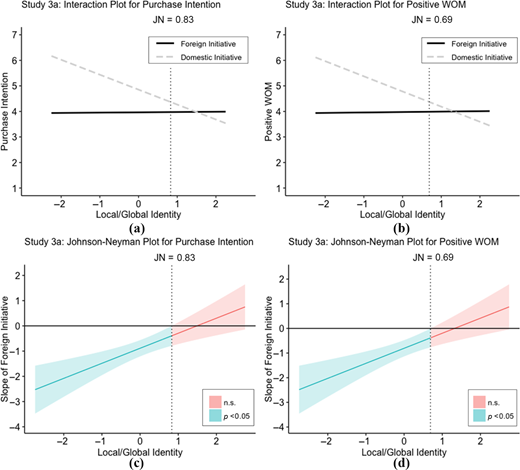
To decompose the interaction term, we used the Johnson-Neyman (JN) technique (i.e. floodlight analyses per Spiller et al., 2013) to identify the range of local-global identity for which the simple effect of the location of the environmental sustainability initiative was significant. This analysis revealed that as local-global identity (i.e. global minus local identity) increases, the effect of domestic initiative diminishes. In support of our H4, we found that a domestic initiative results in increased purchase intention and positive word-of-mouth compared to a foreign initiative for respondents with a predominately local identity or for those indifferent between the two identities (see Figure 3 Panels A and C for purchase intention and Figure 3 Panel B and D for positive word-of-mouth). For those with a predominately global identity the effect of a domestic initiative is not significant. In particular, the JN point for local-global identity (above which the effect becomes insignificant) is 0.83 for purchase intention (bJN = –0.39, t(396) = 1.96, p = 0.05) and 0.69 for positive word-of-mouth (bJN = –0.38, t(396) = 1.96, p = 0.05). The interaction is driven by the fact that for consumers with a predominately local identity and for consumers with a relatively increased global identity (i.e. local-global identity values up to 0.83 and 0.69 when the range of observed values of is [−2.25, 2.25]) a domestic environmental sustainability initiative results in more favorable outcomes than a foreign one.
The findings from Study 3a suggest that the effect of the location of environmental sustainability initiatives is also dependent on consumers’ identity. While the differential effect of a domestic versus a foreign environmental sustainability initiative is evident only in the case of consumers with a predominately local identity, for consumers where the global identity is more salient, the impact of an environmental sustainability initiative is similar, regardless of its location. In Study 3b, we consider whether this effect is driven by consumers’ self-image congruence.
Study 3B
In Study 3b we examine the intermediary role of consumers’ self-image congruence. We assess whether the moderated effect of the consumers’ local-global identity on the effect of a domestic (vs foreign) environmental sustainability location strategy is mediated by consumers’ self-image congruence.
Method
We recruited three hundred eighty-four participants (Mage = 37.32; 60% female) from an online panel from Prolific and randomly assigned them to one of four conditions in a 2 (location of the sustainability initiative: domestic vs foreign) × 2 (local-global identity: local vs global) between-subjects experimental design. First, to manipulate the consumers’ local-global identity we used a priming scenario adapted from Gao et al. (2017) and Nie et al. (2022). In particular, we primed local-global identity through either a “Think Local Movement” or a “Think Global Movement” campaign (see Supplementary Appendix D). The “Think Local Movement” focused on local news and about the preservation of local traditions. Conversely, the “Think Global Movement” focused on global news and highlights cultures from other parts of the world. Participants were asked to write their initials under the campaign to show their support for the specific movement. We then manipulated the location of the sustainability initiative using the same article as in Study 1a.
We used the same items as in previous studies to measure consumers’ purchase intention and positive word-of-mouth. We also measured consumer’s self-image congruence with the company’s sustainability initiative using three items adapted from Sirgy et al. (1997). We then asked demographic information. Finally, to check the manipulation of the local-global identity we used three items from Zhang and Khare (2009).
Results and discussion
Manipulation check. Participants in the local identity condition indicated that they identified as a global citizen less than those in the global condition (Mlocal = 2.89 vs Mglobal = 5.06, t(382) = 2.18, p < 0.001).
Purchase intention and positive word-of-mouth. We ran OLS regression models on purchase intention and on positive word-of-mouth with location of the initiative and local-global identity as independent variables without and with an interaction term. Our results are similar to the ones from the previous studies and provide further support H1 as well as to H4. We do not report the results here for brevity.
Moderated mediation. We conducted a moderated mediation analysis using 10,000 bootstrapped samples (Hayes, 2022; PROCESS Model 7), with location of the sustainability initiative as the independent variable, self-image congruence as a mediator, local-global identity as a moderator and purchase intention (positive word-of-mouth) as the dependent variable. The index of moderated mediation was significant (purchase intention: index = 0.59, CI95% = [0.06–1.14]; positive word-of-mouth: index = 0.48, CI95% = [0.05–0.94). For consumers with a local identity, the indirect effect of the location of the environmental sustainability initiative through self-image congruence was significant (purchase intention: b = –0.49, CI95% = [−0.87, −0.12]; positive word-of-mouth: b = –0.40, CI95% = [−0.72, −0.10]), suggesting that the more positive reaction to company when the sustainability initiative is domestic (vs foreign) was driven by consumers’ perceived self-image congruence with the company’s sustainability initiative. For consumers with a global identity, however, the corresponding indirect effect was not significant (purchase intention: b = –0.09, CI95% = [−0.28, 0.48]; positive word-of-mouth: b = –0.07, CI95% = [−0.23, 0.39]).
Study 3 b results lend support to H5, that is, consumers’ local-global identity affects the perceived self-image congruence process of domestic versus foreign sustainability initiatives. This in turn, leads to divergent consumer reactions to companies’ environmental sustainability initiatives.
General discussion
This research examines the effectiveness of the location of environmental sustainability initiatives. Our initial results suggest that a domestic environmental sustainability initiative can increase purchase intention and positive word-of-mouth (Study 1a) and willingness to share ideas (Study 1 b) compared to a foreign initiative. Notably, we also find that the effect of the location of a sustainability initiative is contingent upon the fast fashion brand’s existing sustainability performance (Study 2a). Specifically, we find that the effect of the location sustainability initiative is more pronounced for brands with a poor record of existing sustainability performance, while for brands with a good record, the impact of a sustainability initiative is similar, regardless of its location. We find evidence that this effect is driven by value-driven motive (Study 2 b). Our research further reveals that the impact of the location of an environmental sustainability initiative also depends on the consumers’ local-global identity (Study 3a). We observe that the effect of the location of an environmental sustainability initiative is significant only for consumers with a predominately local identity. Conversely, for consumers where the global identity is more salient, the impact of an environmental sustainability initiative remains consistent, regardless of its location. We demonstrate that is effect driven by consumers’ perceived self-image congruence (Study 3 b). Our findings have important theoretical and practical implications.
Theoretical implications
This research offers several important theoretical contributions to the existing literature. First, this research contributes to the nascent but increasingly important literature on the sustainability of fast fashion brands. Originally, fast fashion has attracted much praise for its agile responses to consumer trends, skilled application of just-in-time logistics and significantly shortened design-manufacturing-distribution cycles (Sull and Turconi, 2008). Recently, however, fast fashion brands have attracted increasing amount of criticism over their inherently unsustainable business model. To reduce and mitigate its negative social and environmental impact, it is of paramount importance for fast fashion brands to shift their business model and invest in sustainability initiatives. Yet the existing literature has mostly investigated the environmental impact of this sector (Caniato et al., 2012; Henninger et al., 2017; Thorisdottir and Johannsdottir, 2019) with limited attention being paid to reactions their sustainability initiatives. This research addresses this gap by offering a novel investigation into the mechanisms and boundary conditions through which fast fashion brands’ environmental sustainability initiatives shape consumer responses. In doing so, it illuminates strategic pathways by which environmentally responsible actions can yield meaningful impact in a sector frequently criticized for its environmental footprint.
Second, this research extends the sustainability literature by demonstrating that the reputational benefits of fast fashion brands’ sustainability initiatives are not uniform, but depend in part on where those efforts are focused. Location strategy is a highly pertinent dimension of sustainability strategy, particularly for fast fashion brands that operate across global markets and rely on internationally dispersed supply chains. Prior research has provided initial evidence that, due to consumer egocentrism, locally focused CSR initiatives can have a stronger personal impact on consumers (Russell and Russell, 2010). However, this early work did not examine the underlying psychological mechanisms driving these effects. Our work provides a more nuanced framework identifying the mechanisms of how (incl. favorable attribution and self-image congruency) and conditions of when (including a brand that only starts to invest in sustainability, and consumers with a stronger local identity) a domestic sustainability strategy, as compared to a foreign sustainability strategy, can lead to more favorable reactions (including purchase intention, positive word-of-mouth and willingness to share ideas). Although these effects are demonstrated in the fast fashion domain, the underlying processes, such as perceived proximity, value-based attributions and identity alignment, are not unique to this industry. It is therefore plausible that similar dynamics may emerge in other sectors where sustainability initiatives vary in geographic location. In this way, our findings contribute to the broader understanding of location strategy in sustainability communication.
Third, this research also contributes to the literature of consumer local-global identity. Prior studies have investigated the role of consumers’ local-global identity with regards to their preference for local or global products and brands (Ng et al., 2020; Tu et al., 2012; Zhang and Khare, 2009), openness and receptiveness to new forms of consumption (Nie et al., 2022) and price sensitivity (Gao et al., 2017). However, the interplay between consumers’ local-global identity and the location a fast fashion brand’s location strategy has been largely overlooked. A recent notable exception is the work of Salnikova et al. (2022), which explores how a consumer’s local-global identity can affect consumer engagement with a sustainability initiative. However, this research exclusively focuses on initiatives of global brands and does not consider the location dimension of these initiatives. Our work contributes to this literature by originally revealing that consumers’ local-global identity interacts with a fast fashion brand’s location strategy in influencing reactions toward environmental sustainability initiatives through a mechanism of self-image congruence.
Practical implications
This research offers important managerial implications for fast fashion brands as they design and implement sustainability strategies. Fast fashion brands are under increasing pressure to act sustainably and demonstrate social responsibility. Our findings suggest that investing in environmental sustainability initiatives can help brands reconnect with consumers and elicit more favorable reactions.
Our results suggests that fast fashion brands should consider prioritizing domestic initiatives when aiming to build trust and engagement with sustainability efforts. Importantly, our results indicate that these effects are primarily driven by perceived spatial proximity rather than broader country-level characteristics or facility-specific environmental impact. Therefore, communicating the closeness or accessibility of sustainability initiatives can be an effective strategy, even when initiatives are implemented abroad. Importantly, our analyses show that perceived spatial proximity is the primary driver of consumer responses, rather than broader country-level or facility-level factors. This suggests that communicating the accessibility or “closeness” of sustainability initiatives can be effective, even when initiatives are implemented abroad.
For many international and global brands, one of the main areas of decision-making regarding sustainability investment is the location. Our findings also reveal that the benefits of domestic initiatives are particularly pronounced for fast fashion brands with weaker sustainability records. For these brands, prioritizing domestic initiatives can help build trust and favorable consumer perceptions. For brands with strong sustainability records, domestic versus foreign initiatives generate similar consumer responses, likely because these consumers already perceive the brand as responsible and trustworthy; location plays a less central role once a strong sustainability reputation is established.
The effectiveness of location strategies also depends on consumers’ social identity. Our results highlight a self-image congruence effect: consumers with a local identity respond more favorably to domestic initiatives, whereas those with a global identity respond similarly regardless of location. Managers can leverage this insight in two ways. First, they can assess the local-global identities of their core customer base and design location strategies accordingly. Second, if a location strategy has already been decided, brands can tailor communications to prime either local or global identity to enhance alignment with the initiative and maximize desirable consumer reactions.
Finally, an important ethical consideration arises from the strategic choice of location for sustainability initiatives. While our research demonstrates that domestic initiatives can generate stronger positive consumer responses due to perceived proximity and credibility, prioritizing locations primarily for communicative impact may conflict with the goal of maximizing actual environmental or social benefits. Initiatives aimed at enhancing visibility or consumer perception might not align with regions or activities where environmental need is greatest, raising questions about the authenticity and responsibility of corporate sustainability efforts. By highlighting how consumer responses are shaped by perceived initiative location, our findings can help managers strike a balance between effectiveness in communication and genuine impact. Fast fashion brands can use these insights to design sustainability strategies that are both credible to consumers and aligned with broader environmental priorities, ensuring that initiatives are meaningful, transparent and ethically responsible rather than purely promotional.
Limitations and directions for future research
This research has several limitations that point to promising avenues for future investigation. First, our focus is primarily on environmental sustainability initiatives, leaving open the question of how other types of initiatives, such as social or governance-focused efforts, might influence consumer responses. Future research could also explore the relative effectiveness of different forms of environmental sustainability initiatives. Second, while we examine consumer outcomes, public legitimacy is increasingly critical for fast fashion brands. It would be valuable to investigate how sustainability initiatives shape broader public attitudes and behaviors, which are fundamental to the legitimacy of their business model. Third, environmental sustainability initiatives represent only one approach among many potential solutions for multinational companies, including circular economy practices, collaborative consumption, waste management, ethical production and sustainable design techniques. Future work could assess the impact of these alternative strategies.
Although our effects are observed in the fast fashion sector, it remains an open question how generalizable they are to other industries. Fast fashion’s highly visible global supply chains and heightened sustainability scrutiny may amplify consumers’ sensitivity to initiative location. Thus, the observed effects may be less pronounced in contexts where sustainability concerns are less salient. However, the underlying mechanisms are likely to extend to other industries with global operations and reputational considerations, such as consumer electronics or hospitality. Future studies could examine whether similar patterns hold in sectors with different consumer engagement levels, product characteristics, or supply chain structures. In addition, the long-term effects of sustainability initiatives are not yet known. Future research could investigate not only the enduring impact on the focal brand but also potential spillover effects across the sector. While our findings suggest that domestic initiatives are particularly effective for fast fashion brands with weaker sustainability records, it remains unclear whether these can be successfully followed by foreign initiatives over time, an issue suited for longitudinal study. Finally, our studies were conducted with UK participants using short article-style stimuli and fictitious brand names to maintain experimental control. Future research could extend these findings by examining diverse cultural contexts, using real brands and using more naturalistic communication formats.
Notes
To assess the robustness of our findings, we conducted two additional OLS regressions: one including country brand fixed effects and another additionally controlling for participants’ age and sex fixed effects. In both models, the results remained consistent (b = –0.81, p < 0.001 and b = –0.83, p < 0.001, respectively).
To assess the robustness of our findings, we conducted two additional OLS regressions: one including country brand fixed effects and another additionally controlling for participants’ age and sex fixed effects. In both models, the results remained consistent (b = –0.73, p < 0.001 and b = –0.74, p < 0.001, respectively).
References
Supplementary material
The supplementary material for this article can be found online.