The aim of the research is to identify the factors that create an authentic company's corporate social responsibility (CSR) engagement and to investigate whether an authentic CSR engagement influences the purchase intention. In addition, the study attempts to provide insights into the mediation role of attitude toward the company and frequency of purchase on purchase intention.
In this study, a theoretical framework is developed in which major antecedents of authentic CSR are identified. A specific example of a brand and its corporate social responsibility activities was used for the study. An online questionnaire was used to collect the data. To verify the hypothesis, structural equation modeling with the partial least squares method was used. A total of 240 people participated in the study.
The results of the study confirmed that CSR authenticity positively influences consumer purchase intention. Furthermore, the hypothesized impact of CSR authenticity on attitudes toward the company and frequency of purchase could be verified.
Although there is research on the antecedents influencing the consumer's perceived authenticity of CSR, it has not addressed differences in impact and has not presented a full picture of influencing antecedents. In addition, CSR proof as a new antecedent is investigated in the study. Moreover, research on outcomes of perceived CSR authenticity still lacks depth. The study therefore addresses this research gap by providing an extensive research framework including antecedents influencing CSR authenticity and outcomes of CSR authenticity.
1. Introduction
Corporate social responsibility (CSR) has become a major issue for organizations around the globe. Indeed, CSR is becoming an increasingly important part of companies' strategic agendas, leading to a general shift from acting in CSR as pure charity to an approach of implementing CSR effectively in a strategic manner. Companies need to be aware that stakeholders have expectations regarding CSR activities and those expectations should be considered in decision-making processes (Bruhn and Zimmermann, 2017; Carroll, 2016). CSR has become a central aspect for consumers when evaluating companies. Companies therefore strive to communicate their CSR activities because these activities can have a significant impact on their performance (Bhattacharya and Sen, 2004; Porter and Kramer, 2011). However, even if companies increasingly engage in CSR, this does not automatically mean they are being perceived to act in a socially responsible manner. Skepticism among consumers has been aroused because of inconsistency between corporate statements and actual actions taken in CSR. This situation is known as corporate hypocrisy, and results in perceived greenwashing (Gunawan et al., 2020; Jarolimek and Weder, 2017). Recent research has shown that consumers have a dismissive attitude against companies whose CSR engagement is perceived as inauthentic and thus fails in terms of credibility (Alhouti et al., 2016; Gunawan et al., 2020; Jose et al., 2018). Corporate hypocrisy becomes even more relevant when a crisis or scandal occurs in areas where the company is actively involved with CSR actions (Santos and Casais, 2019). According to Santos and Casais (2019, p. 112), this situation can have “…a destructive effect on brands, since it can trigger the perception of corporate hypocrisy, […] and generate negative attitudes toward brands.” Although there is research on factors influencing consumer's perceived authenticity of CSR, it has not addressed differences in impact and has not presented a full picture of significantly influencing antecedents. Moreover, research on outcomes of perceived CSR authenticity still lacks depth, because it did not address the different antecedents of CSR authenticity which play an important role in consumer assessment (Alhouti et al., 2016; Jeon and An, 2019). Outcomes include ,for example, brand-related factors (e.g. brand attitude) (Kim and Lee, 2020), purchase intention (Becker-Olsen et al., 2006), corporate evaluation (Afzali and Kim, 2021) and boycott behavior (Alhouti et al., 2016). The study focuses on purchase intention as an outcome.
In accordance with the discussion above, the present study attempts to assess the impact of different antecedents on CSR authenticity in order to understand consumers' perception of authenticity due to a company's CSR engagement. Furthermore, the study provides insights into the effects of CSR authenticity on consumer purchase intentions. The study thereby provides insights for practitioners on how to act authentically and in a socially responsible manner, while at the same time generating added value for the company in a win-win situation.
2. Theoretical framework and hypotheses
2.1 Research model
Recent studies investigated the construct of authenticity in CSR with special regard to antecedents influencing its perception and ultimately the degree of perceived authenticity among consumers (Becker-Olsen et al., 2006; Alhouti et al., 2016; Joo et al., 2019; Jeon and An, 2019; Liu and Jung, 2021). The following table provides an overview of the antecedents of CSR authenticity (see Table 1).
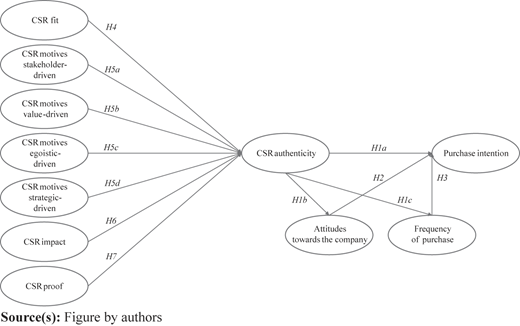
For example, Joo et al. (2019) identified in their research seven relevant antecedents of CSR authenticity (community link, reliability, commitment, congruence, benevolence, transparency, broad impact). Mazutis and Slawinski (2015) connected distinctiveness (the extent to which a company's CSR engagements are true to their mission, vision and values) and social connectedness (the extent to which a company's CSR efforts are embedded in a larger social context) as attributes of CSR authenticity and found evidence for CSR efforts being perceived as inauthentic without both attributes. Becker-Olsen et al. (2006) and Alhouti et al. (2016) introduced a theoretical framework where fit, impact and self-serving motives serve as major antecedents of CSR authenticity. In our study, we adopt fit and impact as antecedents of CSR to better understand whether high fit between a company's CSR activities and its core business and corporate image as well as the impact on the addressed social cause leads to perceived high authenticity (Alhouti et al., 2016; Becker-Olsen et al., 2006). Fit and impact were chosen as they are part of nearly all recent studies investigating the construct of CSR authenticity. Besides that, consumers more often question company motives behind the CSR engagement and have a general mistrust in companies' CSR activities. In accordance with the findings of Du et al. (2010), Bhattacharya and Sen (2004) and Jeon and An (2019), this study includes stakeholder-driven motives, value-driven motives, egoist-driven motives and strategic-driven motives to better understand which company motives positively or negatively influence perceptions of CSR authenticity. The mentioned antecedents were chosen, because studies found inconsistent results regarding the influence of the different types of motives (Alhouti et al., 2016; Ellen et al., 2006; Jeon and An, 2019). Moreover, this study includes CSR proof as a new antecedent to investigate its influence on CSR authenticity, addressing the assumption of a general mistrust in CSR activities caused by often observed inconsistency between corporate statements and actual actions taken, as well as hidden motives and low-fit scenarios (Gunawan et al., 2020; Jarolimek and Weder, 2017). Proof is included as new possible antecedent of CSR authenticity as it has never been investigated. Since numerous studies have found an influence of CSR authenticity on the purchase intention, but also an influence on other relevant outcomes such as corporate reputation or corporate image, the study includes attitudes toward the company and frequency of purchase as mediator variables (Afzali and Kim, 2021; Bhattacharya and Sen, 2004; Gunawan et al., 2020; Kim and Lee, 2020). This is done in an attempt to examine whether CSR authenticity has a direct or indirect influence on the purchase intention via the aforementioned factors. This study is focusing on (1) the influence of antecedents on CSR authenticity and (2) direct as well as indirect influences of CSR authenticity on purchase intention. The model is not investigating the mediation role of CSR authenticity between antecedents and purchase intention. Figure 1 shows the research model proposed in this study.
2.2 CSR authenticity
The construct of authenticity is a research subject in various disciplines (e.g. psychology and management) and has been defined in multiple, occasionally conflicting ways (Newman, 2016; Joo et al., 2019; Alhouti et al., 2016; Mazutis and Slawinski, 2015; Beckman et al., 2009). However, there is consensus that it describes a verification process concerning something that is true or considered as a fact (Newman, 2016). The term “authenticity” is used to express qualities such as credible, certain, true and unadulterated, which is why credibility is often used when talking about authenticity. It should therefore be noted that authenticity and credibility are mutually dependent. Therefore, what is evaluated as authentic is considered to be credible, trustworthy or even desirable (Gonçalves et al., 2010). Or as Beverland and Farelly (2010, p. 839) stated, “despite the multiplicity of terms and interpretations applied to authenticity, ultimately what is consistent across literature is that authenticity encapsulates what is genuine, real and/or true.” The application of the construct of authenticity into the CSR context is defined as CSR authenticity (Afzali and Kim, 2021). It refers to the fact that a company's CSR engagement is not primarily aimed at generating corporate profits, but rather is an act that is seen as genuine (Kim and Lee, 2020). Alhouti et al. (2016, p. 1243) describe CSR authenticity as “the perception of a company's CSR actions as a genuine and true expression of the company's beliefs and behavior toward society that extend beyond legal requirements.”
Several studies have shown that CSR authenticity has an influence on factors such as attitudes toward the company, corporate image and the company's products (Beverland and Farrelly, 2010; Jeon and An, 2019; Yoon et al., 2006; Kim and Lee, 2020) and consumer purchase intention (Afzali and Kim, 2021; Beckman et al., 2009). Becker-Olsen et al. (2006) investigated the impact of perceived fit (similarity between corporate mission and social initiative), corporate motives (other-centered vs profit-centered) and timing of CSR initiatives announcements (reactive vs proactive) on consumer behavior and outcomes of CSR (firm reputation and purchase intention). They found that promotion of high fit and socially motivated initiatives improves consumers' responses to firms, while promotion of low fit and profit-motivated initiatives has the opposite effect. Furthermore, proactive initiatives have a positive influence on corporate credibility, corporate image and purchase intention (Becker-Olsen et al., 2006). Beckman et al. (2009) found evidence that CSR authenticity plays a significant role in the success of CSR engagements. They did this by identifying seven attributes that influence consumer judgment of CSR authenticity (motive, holisticness, tailoredness, transparency, consistency, embeddedness and commitment) (Beckman et al., 2009).
Furthermore, several studies have shown that attitudes toward a company or brand also influence consumer purchase intention (Goldsmith et al., 2000; Sallam and Algammash, 2016; Spears and Singh, 2004). Also, frequency of purchase, which can be seen as an indicator of brand loyalty, was found to have a direct effect on consumer purchase intention (Danish and Humayon, 2018). Considering the mentioned findings, we assume that a higher level of CSR authenticity results in a more positive attitude toward the brand, which, in turn, affects consumer purchase intention. Likewise, a higher level of CSR authenticity positively affects consumer frequency of purchase, which, in turn, leads to purchase intentions resulting in consumers continuing to shop with the brand. The proposed hypotheses are as follows:
CSR authenticity has a positive impact on consumer purchase intention.
CSR authenticity has a positive impact on attitudes toward the company.
CSR authenticity has a positive impact on frequency of purchase.
Attitudes toward the company have an impact on purchase intention.
Frequency of purchase has an impact on purchase intention.
2.3 CSR fit
CSR fit refers to the perceived relevancy between characteristics of a company and its CSR activities (Yoo and Lee, 2018). Fit can be evaluated through different reference objects, for example, fit between CSR activities and the core business, competence, product portfolio, company image or corporate culture (Becker-Olsen et al., 2006). To ensure authenticity regarding the CSR commitment and to positively influence consumer behavior, the linkage between the company CSR activities and the company corporate culture, identity and its core business represents an important aspect. High fit is normally associated with a positive impact on attitudes toward the company, brand or other outcomes (Brunner and Langner, 2017). Most researchers argue that high fit positively influences consumer outcomes, for example, purchase intention and attitudes toward the company (Becker-Olsen et al., 2006; Kim and Lee, 2020; Liu and Jung, 2021). However, there is also evidence that consumers connect high fit with economic benefits and self-serving motives and therefore judge those CSR activities negatively. In general, most researchers agree that generating economic benefits through CSR in the form of high fit scenarios could be seen as a win-win situation (Brunner and Langner, 2017; Hartmann et al., 2017; Schreck, 2015). Especially when CSR activities are not directly related to the company's core business, the activities are often perceived as pure marketing activities (greenwashing), resulting in a lack of credibility (Kim and Lee, 2020). Thus, in low fit scenarios, where CSR activities have no connection to the corporate culture, image, products or services of the company, stakeholders assume there are hidden motives behind the CSR activities, causing suspicion (Drumwright, 1996; Ellen et al., 2006). Taking into account the results of the above-mentioned studies, and that generating economic benefits through CSR in the form of high fit scenarios is seen as a win-win situation, we propose the following hypothesis:
CSR fit has a positive impact on CSR authenticity.
2.4 CSR motives
Companies use CSR activities because of different motives and with different goals. These goals include, for example, ensuring a license to operate, increasing brand reputation, generating goodwill in public opinion, improving consumers' attitudes toward the brand, fostering brand loyalty and strengthening consumers' purchase intention (Brunner and Langner, 2017). Consumers on the other hand are increasingly interested in the motives behind a company's CSR activities. The motives become an important factor influencing consumers' behavior and their evaluation of the company. Thus, clear communication of the motives behind a company's CSR activities becomes the basis for a credible and authentic CSR commitment. Companies appear particularly authentic regarding their CSR engagement if a clear purpose statement clarifies a company's motives, answering the question of why a company engages in CSR (Becker-Olsen and Guzmán, 2017). Becker-Olsen et al. (2006) investigated the influence of social-motivated vs profit-motivated CSR activities in this context. They found out that profit-focused motives in comparison to social-focused motives lead to more negative attitudes toward the company, less credibility as well as a lower likelihood of consumer purchase intention. Alcañiz et al. (2010) also found evidence that while the attribution of primarily egoistic motives has a negative influence on brand reputation, altruistic motives attributed to a brand's CSR engagement enhance authenticity and credibility. Ellen et al. (2006) identified four main motives behind a company's CSR engagement that drive consumer behavior and evaluation of the CSR engagement: egoistic-driven (CSR engagement aiming to exploit the cause for own benefits rather than to support the cause), values-driven (CSR engagement because of own moral, ethical and social standards), strategic-driven (CSR engagement and activities carried out for strategic purposes to achieve business objectives) and stakeholder-driven (CSR engagement mainly striving to satisfy the expectations of stakeholders) motives (Jeon and An, 2019). Jeon and An (2019) found evidence for a positive impact of value-driven and stakeholder-driven motives on CSR authenticity. Ellen et al. (2006) found proof for an impact of strategic-driven and egoistic-driven motives on consumers’ responses to CSR efforts. Furthermore, proof of a negative impact of egoistic motives on CSR authenticity was found (Jeon and An, 2019). Alhouti et al. (2016) found no significant relation between self-serving motives and CSR authenticity. Therefore, the following hypotheses are formulated:
Stakeholder-driven motives have a positive impact on CSR authenticity.
Value-driven motives have a positive impact on CSR authenticity.
Egoistic motives have a negative impact on CSR authenticity.
Strategic-driven motives have a negative impact on CSR authenticity.
2.5 CSR impact
CSR impact refers to whether the CSR engagement and specific activities are seen as making a real and meaningful difference to the addressed social, societal or environmental issue and whether or not the company is perceived to give enough, relative to its size and profits (Alhouti et al., 2016; Du et al., 2010; Liu and Jung, 2021). In other words, CSR impact refers to the extent to which a company can contribute through their CSR activities to the resolution of CSR-specific issues (Du et al., 2010; Liu and Jung, 2021). Evaluation of whether a CSR activity makes a meaningful difference and contributes to the resolution of the addressed issue is influenced by consumers' knowledge about the company's economic key figures as well as knowledge about the cause itself and what it takes to solve the issue (Alhouti et al., 2016).
The impact of CSR activities has been found to be an important factor concerning CSR authenticity (Pomering, 2017) as it is an indicator of how seriously and genuinely a company engages in their CSR activities. Multiple and long-term CSR activities are indicators for high-impact and authentic CSR engagement as they enhance the contribution to and resolution of the addressed issue. Ineffective CSR activities, in turn, cause a perception of inauthenticity (Alhouti et al., 2016). According to Jose et al. (2018), companies with CSR actions that have a high impact are perceived as socially responsible in general. Others studies found evidence for CSR impact having a positive influence on CSR authenticity directly (Jose et al., 2018; Liu and Jung, 2021). Based on the supporting evidence, the following hypothesis is proposed:
CSR impact has a positive influence on CSR authenticity.
2.6 CSR proof
It is important for companies to inform all relevant stakeholders as well as society in the broadest sense about their economic, social, ethical and ecological activities (Carroll, 2016). Thus, by communicating about their CSR activities, companies raise awareness of these activities and allow the different stakeholders to evaluate them (Andersen et al., 2017; Ettinger et al., 2017). The communication of CSR activities allows companies to show that they are part of society and are willing to contribute to a positive development of society (Weder and Karmasin, 2017). However, the communication has to be perceived as credible and authentic by the different stakeholders. Therefore, a true, factual and proven CSR reporting becomes indispensable. Even established companies with implemented CSR strategies struggle in CSR communication in terms of credibility, authenticity and trust, because of inconsistency between corporate statements and actual actions taken in CSR (Gunawan et al., 2020; Jarolimek and Weder, 2017). Authenticity regarding CSR activities and the communication of these activities can be reinforced by clearly verifiable statements and key economic figures in reporting. A company therefore should strive to guarantee the factual correctness of communicated CSR content (Bruhn and Zimmermann, 2017). A CSR proof can be defined as a “an action taken by the company or other institutions to ensure the credibility and authenticity of their CSR actions and respective communication.” Even established frameworks like the Global Reporting Initiative only recommend external verification regarding credibility and authenticity (Sethi et al., 2017). The CSR Directive Implementation Act (CSR-RUG) in Germany only asks companies to verify that a CSR report exists. A review of the report's content regarding key figures, strategy, motives and so forth is only done by the company's supervisory board. While the motives behind a CSR engagement, the durability and impact of engagement, as well as the fit of CSR engagement and company characteristics influence the above-mentioned key challenges, confirmation of these factors through independent organizations as well as proof of the communication itself by independent organizations could reduce skepticism toward the CSR engagement and communication (Hartmann et al., 2017). NGOs can take on the regulatory, independent audit role regarding companies' CSR engagement. By involving NGOs in proof of CSR engagement and communication, the credibility and authenticity of companies' CSR engagement can be drastically increased. NGOs are often characterized by their credibility and independence, as they have no economic interest behind the engagement and communication of a company's CSR (Moldovan et al., 2016). The findings regarding the necessity and impact of proof as a possible central factor for perceived authenticity and credibility in a company's CSR commitment lead to the following hypothesis:
CSR proof has a positive impact on CSR authenticity.
2.7 Attitude toward the company and frequency of purchase as mediators
As already mentioned, a positive relationship between CSR authenticity and attitudes toward the company as well as frequency of purchase has been found in studies (Jeon and An, 2019). For example, Jeon and An (2019) found in their study a positive influence of perceived CSR authenticity on consumer attitudes toward a company. In addition, they found a relationship between perceived CSR motives, authenticity and company attitudes. Moreover, Spears and Singh (2004) found an impact of attitudes toward the company on consumer purchase intention. Alhouti et al. (2016) proved that CSR authenticity also negatively influences consumers' boycott behavior and positively influences loyalty toward the brand, which, in turn, can be transferred to and shown by the construct of frequency of purchase. Thus, we can hypothesize the following:
CSR authenticity indirectly but positively influences purchase intention through the attitude toward the company.
CSR authenticity indirectly but positively influences purchase intention through the frequency of purchase.
3. Research methodology
3.1 Data collection and measures
Data for the study were collected using an online survey which ran for four weeks, from April to May 2022. A convenience sample was used in the study. Participants were recruited by using an email invitation to the survey, which was sent to three mailing lists (consisting of students and employees) of German universities.
In a first part of the survey, the participants were asked to answer some demographic questions. Due to the fact that it is difficult for participants to evaluate CSR activities in general, we introduced in the main part of the survey a specific example of an existing brand. In the first step, we provided some general information about the brand and its products. As an example, we chose the brand NIVEA. NIVEA was chosen because it is a top brand in the fast-moving consumer goods sector in Germany, meaning that participants had probably interacted with the brand (Statista, 2022). In the second step, we presented examples of the CSR engagement of NIVEA. As CSR examples, a NIVEA recycling campaign, a project to support shea collectors, an ecosystem initiative and a project for sustainable palm oil production were presented besides various other initiatives. After presenting the brand example and the CSR initiatives, participants were asked to evaluate the questions on the topic of CSR based on the information they had been given.
A total of 240 participants took part in the survey. After removing incomplete questionnaires, the final sample had 188 participants, which was an acceptable sample size for the construct and measurement model on a 95% significance level (Hair et al., 2022). The sample consisted of 46.81% male, 52.66% female and 0.51% gender diverse participants.
The majority of scales used in the study were adapted from existing scales and had a seven-point Likert format ranging from totally disagree to totally agree (1 – totally disagree, 2 disagree, 3 – partially disagree, 4 – undecided, 5 – partially agree, 6 – agree, 7 – totally agree). Scales were presented in the same sequence for every participant, and respondents were assured of data anonymity.
3.2 Measurement validation
Partial least squares structural equation modeling (PLS-SEM) was applied using SmartPLS 3.0. PLS is specifically useful in situations where the cause-effect model is exploratory and presents novel relationships unexamined in previous empirical studies (Hair et al., 2022).
As part of the measurement model evaluation, 11 items were removed from the analysis because of low factor loadings (<0.400) (Hair et al., 2011). Furthermore, nine items with acceptable factor loadings (0.400–0.700) were kept because of content relevance, and removing the items has not led to higher composite reliability. To test the reliability of the constructs, the study used Cronbach's alpha and composite reliability (CR). All the CR values were higher than the recommended value of 0.700. The Cronbach's alpha of each construct exceeded the 0.700 threshold as well. Convergent validity was acceptable, because the average variance extracted (AVE) was over 0.500 (Hair et al., 2022). The results for reliability and validity along with the factor loadings for the items are presented in Table 2. For an overview of the deleted items please see Table A1 in Appendix.
Discriminant validity was assessed by using the Fornell-Larcker criterion. Table 3 shows that the square root of AVE for the construct was greater than the inter-construct correlation. Discriminant validity was also assessed by the heterotrait-monotrait ratio of correlations, with values below the threshold of 0.900 (Henseler et al., 2015). Hence, discriminant validity is given (see Table 3.).
4. Results
4.1 Structural model
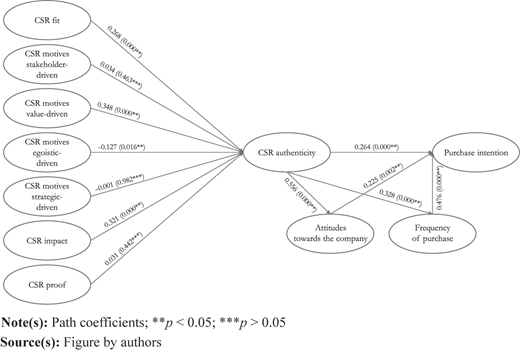
The structural model reflects the paths hypothesized in the research framework (see Figure 2). To prove that collinearity is not a problem in the data, the variance inflation factors (VIF) were calculated. The VIF values range from 1.000 to 1.920, which is under the threshold of 5.000, indicating that collinearity is not a problem (Hair et al., 2022). Furthermore, the structural model was assessed based on the R2, Q2 and significance of paths. The goodness of the model is determined by the strength of each structural path determined by the R2 value for the dependent variable. The value for R2 should be equal to or over 0.250, 0.500 and 0.750 for weak, moderate and substantial effects (Hair et al., 2011; Henseler et al., 2009). All R2 values are over 0.100. Hence, the predictive capability is established. Furthermore, Q2 establishes the predictive relevance of the endogenous constructs. A Q2 above 0 shows that the model has predictive relevance (Hair et al., 2022). The results show that there is significance in the prediction of the constructs. Furthermore, the model fit was assessed using standardized root mean squared residual (SRMR). The value of SRMR was 0.076; this is below the threshold of 0.080, indicating acceptable model fit (Hair et al., 2022).
The path coefficients were analyzed to verify the research hypotheses. The strength of the path coefficients was determined using the PLS algorithm, whereas the significance of the path coefficients had to be determined using the bootstrapping procedure. To determine significance, the bootstrapping method (5,000 subsamples) was used, which confirmed the significance of all path coefficients. Hypotheses testing results are summarized in Table 4. H1a evaluates whether CSR authenticity has a significant impact on purchase intention. The results show that CSR authenticity has a significant impact on purchase intention (β = 0.264; t = 4.196; p = 0.000). Hence, H1a was supported. CSR authenticity was also found to have a significant impact on attitude toward the company (β = 0.556; t = 9.853; p = 0.000) and frequency of purchase (β = 0.328; t = 5.188; p = 0.000), supporting H1b and H1c. H2 and H3 stated that attitude toward the company and frequency of purchase have a significant impact on purchase intention. The results show that H2 (β = 0.225; t = 3.065; p = 0.002) and H3 (β = 0.476; t = 8.099; p = 0.000) are supported. H4 investigates the impact of CSR fit on CSR authenticity. H4 is supported since the results show a significant positive impact (β = 0.268; t = 5.194; p = 0.000). Hypotheses testing also showed that CSR motives stakeholder-driven (β = 0.034; t = 0.735; p = 0.463) and CSR motives strategic-driven (β = −0.001; t = 0.023; p = 0.982) have no significant impact on CSR authenticity, while CSR motive value-driven (β = 0.348; t = 5.084; p = 0.000) has a significant positive influence on CSR authenticity, and CSR motive egoistic-driven (β = −0.127; t = 2.413; p = 0.016) has a significant negative influence on CSR authenticity. Thus, hypotheses H5b and H5c are supported and hypotheses H5a and H5d are not supported. The results further revealed that CSR impact has a significant positive effect on CSR authenticity (β = 0.321; t = 5.132; p = 0.000), supporting H6. For CSR proof, hypotheses testing showed that there is no significant influence of CSR proof on CSR authenticity (β = 0.031; t = 0.769; p = 0.442), thus H7 is rejected.
4.2 Mediation analysis
Mediation analysis was performed to assess the mediating role of attitudes toward the company and frequency of purchase. The results (see Table 5.) revealed significant (p < 0.05) mediation roles of attitude toward the company (H7: β = 0.125; t = 3.066; p = 0.002) and frequency of purchase (H8: β = 0.156; t = 4.532; p = 0.000). The results show a partial mediation effect in the form of a complementary mediation role for attitude toward the company as well as a role for frequency of purchase in the relationship between CSR authenticity and purchase intention, supporting hypotheses H8 and H9.
5. Discussion
The aim of the research was to identify the factors that create an authentic perception of a company's CSR engagement by consumers, and to investigate whether an authentic perceived CSR engagement influences the purchase intention. The results of the study confirmed that CSR authenticity positively influences consumer purchase intention. Furthermore, the hypothesized impact of CSR authenticity on attitudes toward the company and frequency of purchase could be verified. These findings are consistent with other studies regarding the influence of perceived CSR authenticity on marketing-relevant consumer outcomes (Alhouti et al., 2016; Becker-Olsen et al., 2006; Gunawan et al., 2020; Kim and Lee, 2020). Concerning antecedents that lead to perceived authenticity of a company's CSR engagement, the study found a significant impact of CSR fit on CSR authenticity. Consumers that perceive a company's CSR engagement and specific CSR activities as appropriate to its core business and corporate image tend to evaluate the engagement as authentic, which is consistent with the results of other studies (Alhouti et al., 2016; Kim and Lee, 2020; Liu and Jung, 2021). Recent studies have also stated that the motives behind a company's CSR engagement are considered to be crucial determinants concerning the evaluation of CSR authenticity (Alhouti et al., 2016; Ellen et al., 2006; Jeon and An, 2019). Our study found an impact of value-driven and egoistic-driven motives on the perceived authenticity of a company's CSR engagement, but no impact of stakeholder-driven and strategic-driven motives on CSR authenticity. These findings on different types of CSR motives and their influence on CSR authenticity coincide partly with previous studies but also generate new insights. Jeon and An (2019) also found value-driven motives positively influenced CSR authenticity, while egoistic-driven motives negatively influenced CSR authenticity. They also found that strategic-driven motives did not significantly influence CSR authenticity. In our study, we found no evidence for stakeholder-driven motives influencing CSR authenticity, which Jeon and An (2019) also supported in their study. Alhouti et al. (2016) found self-serving motives in general did not significantly influence CSR authenticity. This study proved that egoistic-driven motives represented a significantly influencing antecedent of CSR authenticity. The results in this study on the investigation of CSR impact on CSR authenticity showed a significant influence, and therefore consistency with results from previous studies (Alhouti et al., 2016; Jose et al., 2018; Liu and Jung, 2021). Although recent literature implies that a proof of a company's CSR engagement including a proof of its specific taken actions in CSR context will ensure authenticity and credibility, respectively, this study was not able to support a significant influence of CSR proof on CSR authenticity (Andersen et al., 2017; Ettinger et al., 2017; Jarolimek and Weder, 2017). A possible explanation of why proof was not found to be significantly influencing CSR authenticity is that a common and in-depth understanding of the necessity and the possibilities of proof might be missing among the participants.
The results of investigating attitudes toward the company and frequency of purchase as mediator variables on the above-mentioned relationship showed partial mediation in the form of a complementary mediation role for both variables, attitudes toward the company and frequency of purchase. CSR authenticity therefore has a positive direct impact on consumers' purchase intention and also directly and positively impacts attitudes toward the company and frequency of purchase, which, in turn, directly and positively impact purchase intention. These results indicate that consumers that have already bought the products of a company regularly will be strengthened in their future purchase intention based on the authentic CSR engagement. Similarly, perceived CSR authenticity will lead to more positive attitudes toward the company, and these positive attitudes, in turn, impact the consumer's purchase intention.
5.1 Managerial implications
This study provides guidance to practitioners who want to achieve win-win situations by simultaneously acting authentically in the context of CSR and positively influencing consumers' purchase intentions as a relevant outcome of their authentic CSR engagement. Or, in other words, companies that want to create added value for the environment and society and at the same time create company-related added value in the form of consumer purchase intentions by acting authentically in their CSR engagement. As engagement in CSR has become common practice in today's business, skepticism among consumers due to such engagement has risen simultaneously, as consumers question motives, impact and other factors behind the engagement and specific activities (Becker-Olsen and Guzmán, 2017; Pomering, 2017). The present study has given proof for practitioners that authenticity concerning a company's CSR engagement can address and counteract the increasing skepticism and leads to the aforementioned win-win situation, generating a marketing-relevant outcome, besides creating added value for the environment and society.
To gain perceived authenticity in CSR engagements, the results of this study have shown that the impact and fit of a company's CSR engagement are the most relevant determinants. Practitioners should strive to make sure that their CSR engagement will have a meaningful impact on the addressed issues by spending an appropriate amount of money and ensuring the engagement is perceived as serious by transparent communication. Furthermore, CSR actions should be thoughtfully planned so they fit with the company's core business, its products and services as well as with the corporate image. The study has also shown that CSR authenticity not only impacts consumer purchase intention, but also attitudes toward the company. This result implies that authentic CSR engagement can influence the reputation of a company, lead to purchase intentions among consumers and thus generate a competitive advantage over other companies.
5.2 Limitations and directions for future research
Regarding the investigated antecedents of perceived CSR authenticity, further antecedents could be the subject of future studies. Moreover, the identified antecedent CSR proof concerning a company's CSR engagement including reporting and communication on specific activities is an avenue for future research. Although CSR proof has no significant influence on CSR authenticity, possible mediation effects on relationships between antecedents of CSR authenticity and the construct itself may lead to new insights. Apart from opportunities in exploring determinants of CSR authenticity, investigation of possible marketing-relevant outcomes in terms of perceived high or low CSR authenticity could be the subject of future studies. Moreover, the present study can be extended by exploring differences in the perception of CSR authenticity and possible outcomes among different sociodemographic groups, for example, different regions, countries, income ratios, genders. Although the brand for our study was carefully chosen, it might have some influence on the participants and their evaluation of the CSR actions. Therefore, the results of the paper cannot be directly transferred to any other brand. In future research, different company or brand examples from other industries could shed more light onto the investigation of CSR authenticity and contribute to the validation of previous research results.