Skip to article sections
Purpose

The study aims to analyze the influence of perceived attributes of artificial intelligence (AI) on consumer purchase intention; it also examines the moderating effect of technology readiness (TR) on the link between AI related attitudes and consumer purchase intention for fast-moving consumer goods (FMCGs) in AI powered retail outlets.

Design/methodology/approach

Drawing from the literature, we developed a conceptual model and empirically tested the model by administering a survey questionnaire to a sample of 354 retail consumers, using Smart PLS-SEM.

Findings

Empirical findings suggest that perceived AI technology attributes, namely, perceived usefulness, ease of use, anthropomorphism, intelligence, animacy and attitudes toward AI have a significant positive influence on consumer purchase intention for FMCGs. Furthermore, TR positively moderated the influence of the AI-related attitudes on consumer purchase intention for FMCGs in an AI-powered retail space.

Practical implications

The study highlights several pathways for retail strategy development both in global and local retail industries that can be beneficial to retail professionals as well as international marketing scholars. Finally, theoretical and practical suggestions and future research directions are also discussed.

Originality/value

The study advances the literature on AI and consumer behavior by providing an integrated view of the technology acceptance model (TAM) with a set of complementary intrinsic technology cues and TR from a personality trait perspective in predicting the relationships between perceived AI attributes and consumer purchase intention in an AI powered retail space.

The retail industry is just one of many industries that has seen a transformation and ongoing reconfiguration due to recent technological improvements (Shankar et al., 2021; Arachchi and Samarasinghe, 2023a, b, c, d, e). The retail sector is undergoing rapid change and a large portion of this development is due to retail technology that interacts with customers. Unquestionably, emerging technologies are revolutionizing the retail industry and will do so well into 2020 (George, 2023; Roggeveen and Sethuraman, 2020) and beyond. These technologies include big data, mobile apps, virtual reality (hereafter VR), artificial intelligence ((hereafter AI), deep learning (hereafter DL), machine learning (hereafter ML) (Sohn, 2024) and augmented reality (hereafter AR) (Erensoy et al., 2024), among other applications (Bughin et al., 2022). These elements have played a part in the retail industry’s remarkable recent progress. AI can help in retail by aiding price optimization, consumer interaction, automation of shop operations and demand prediction. Moreover, shops utilizing AI technology solutions have seen a 30% rise in sales, a 20% reduction in stock and a 50% increase in assortment efficiency (Bughin et al., 2022; Scarpi and Pantano, 2024). Pillai et al. (2020) predict that by 2022, global retailer AI spending would amount to $7.3 Bn, and by 2024, retail spending is expected to reach $8 billion and Aelbrecht and Mojsilovic (2024) predicted AI retail market size at $55.55 Bn by 2030, expecting growing at a CAGR of 34.1% between 2022 and 2030. Moreover, Jain and Gandhi’s Retail 4.0 evolution from 2021 is built on AI technology and creates distinctive retail experiences for customers. Retail powered by AI is still growing, but only a few scholars are exploring how AI is actually impacting consumer buying behavior in retail (Kim et al., 2020; Lu et al., 2023) and Lu et al. (2023) predicted $100 billion in retail AI applications by 2032 and indicated that a retail AI roadmap is needed in future.

The current retail environment is undergoing rapid evolution, but AI-related technical advancements have changed this and caused considerable disruptions (Shankar et al., 2021; Hajishirzi et al., 2022; Arachchi and Samarasinghe, 2023a, b, c, d, e; Sohn, 2024). While adopting AI is seen as a profitable prospect for businesses, customers are also looking for ways to make purchases using AI surroundings (Mclean and Osei-Frimpong, 2019; Scarpi and Pantano, 2024). Retailers have already begun implementing AI-enhanced technology to increase brand loyalty and customer retention (Jain and Gandhi, 2021). Current AI technologies can influence customer purchasing choices and encourage hurried purchases (Mantur and Borgaon, 2020; Scarpi and Pantano, 2024). Additionally, consumers are becoming more positive about their intentions to make purchases thanks to AI (Balakrishnan and Dwivedi, 2021) and data tools related to AI (Wilson and Daugherty, 2019). In the retail sector, the principal instruments that mediate attitudes and intentions to make system acceptance, use and final purchase are perceived usefulness (PU) and perceived ease of use (PEU) which are the key extrinsic stimuli in the technology acceptance model (TAM). However, it is frequently criticized that TAM has a limited explanatory power in predicting intention since it excludes a significant number of intrinsic stimuli and cues especially in a new technology context. More important, modern technology adoption such as AI based applications, humanoid based attributes of technology which include perceived anthropomorphism (PAN) (Ashraf et al., 2016) perceived intelligence (PI) and perceived animacy (PA) (Balakrishnan and Dwivedi, 2021) are complementary to better predict AI based technology adoption. Indeed, AI agents are becoming more and more helpful, user-friendly and humanlike – not just in terms of how they look, but also in terms of how well they replicate the psychological features and emotions of humans (Alabed et al., 2022). Hence, the study add these humanoid based elements in AI technology into the TAM to improve its explanatory power. This is a significant contribution in the study.

Several empirical behavioral models have been developed in information systems (IS) to explain/predict consumer purchase intention and IT adoption and use (Balakrishnan and Dwivedi, 2021) (referee Appendix 02). The adoption and diffusion of technological innovation have been studied using the TAM (Choung et al., 2023; Davis, 1989; Kelly et al., 2023; Marotta, 2023), the theory of planned behavior (TPB) (Ajzen, 1991) and the diffusion of innovation (DoI) theory (Rogers, 2003; Williams et al., 2009). The TAM is the main theory applied in this investigation among them. In the retail sector, consumer intention to purchase is significantly enhanced by PEU, PU, PAN, PI and PA, since these are the major determinants of the TAM (Rehman et al., 2019; Blut et al., 2021). TAM based studies, however, make less emphasis on how consumer’s technological innovation influences consumer purchase intentions or predicts consumer purchase behavior. This is a major weakness of TAM and limited empirical evidence addresses this theoretical gap. Accordingly, the present study establishes an argument that consumer’s technology innovativeness as personality trait expressed in the light of his or her technology readiness (TR) reflecting consumer’s optimism determining the level of technology adoption when it comes to more innovative technology such as AI based applications.

The TR concept was employed in this study to fill in the TAM gap mentioned above. However, since smart technologies are a recent breakthrough, customers’ technological proficiency and optimism may be required in order to make purchases from smart stores. One theory attributes TR to individual tendencies to absorb innovations and new technology (Chang and Chen, 2021). Most pertinent studies have focused on the direct effects of technological readiness on the information technology domain, treating it as an independent variable (Chang and Chen, 2021). As far as we are aware, not many studies have been undertaken on how TR moderates the relationships between motivations and behavioral intentions. As a result, TR is included in this study’s research model as a moderator.

However, AI-based application development and research are still in their infancy. Liang et al. (2019). Furthermore, few empirical studies have examined and developed knowledge on consumers’ acceptance of AI technology in retail sector (Pillai et al., 2020). Therefore, the current study endeavors to fulfill this knowledge and empirical gap by exploring the effect of AI technology-explicit characters on consumer shopping behavior and purchase intention.

Based on current information, the following objectives were developed to address the above knowledge gaps and research issue:

RO1.

To examine the effects of perceived AI technology related attributes including perceived AI technology usefulness, perceived AI technology ease of use, perceived anthropomorphism, PI and PA on consumer attitudes to AI powered retail industry.

RO2.

To explain the impact of consumer attitudes toward AI, on consumer purchase intentions in the AI powered retail industry.

RO3.

To explain the moderating role of TR on the effects that attitudes toward AI have on purchase intention in an AI powered retail space.

The literature on the connections between customer purchase intention in the retail sector and PU, PEU, PAN, PI, PA, attitudes toward AI-technology and consumer purchase intention in the retail industry will be reviewed first in this article. The research presents the theoretical basis of the model before proposing its hypotheses. Next, the methodology and results are explained. Finally, the results are discussed with an emphasis on the study’s theoretical, practical contributions and future research opportunities.

AI is being used in many different industries, one of which is retail, with the primary goal of utilizing this technology to aid customers in making more informed purchase choices (Jain and Gandhi, 2021).

As retailers look for more innovative and attractive ways to use their physical shopping areas, the integration of consumer-facing AI and digital humans into frontline retail settings is accelerating (Reis et al., 2020). Thus, consumer service relationships are changing rapidly. In particular, researchers have tried comprehensive literature evaluations of AI technology in business (Loureiro et al., 2021; Petrescu et al., 2024).

AI start-ups raised $ 1.8 billion in 374 retails between 2013 and 2018 and it is expected that they will reach $79.2 billion in 2022, which is more than double the amount spent in 2019 (George, 2023) and it will arise $15.7 trillion in 2030 (Ouliel, 2021; Petrescu et al., 2024). Most firms are looking to AI as a way to automate mundane operations and boost productivity in order to stay competitive. According to a recent study, only 26% of retail AI/ML solutions deal with customers directly, while 74% are designed for back-end operations (Ouliel, 2021). Retailers looking to stay competitive have come to the right place at Al in Retail. It is anticipated that 85% of retailers will use AI by 2020, and those that do not are at risk of losing a very large share of the market to their competitors (Marotta, 2023). This is where retail business leaders think AI will have the biggest effects on the industry over the next two years: (1) customer service and experience, (2) consumer intelligence and (3) keep track of your inventory (Petrescu et al., 2024).

Occupying omni-channel retail, Retail 4.0 is the outcome of the implementation of Industry 4.0 technology within the retail sector (Haque et al., 2024; Sakrabani et al., 2019). However, even in the most advanced developing countries, retail has yet to adapt to Retail 4.0 (Har et al., 2022). Prior to the introduction of Retail 4.0, retailers and consumers had to cope with price discrepancies, stock outs and long line-ups. The success of traditional brick-and-mortar retailers has decreased as a result of consumers’ preference shifting toward online buying (Mantur and Borgaon, 2020). Adopting cutting-edge technologies is crucial to drawing more customers into retail. Retail 4.0 has made it possible for businesses to operate more efficiently, offer more individualized services to clients and stock a larger number of SKUs (Sakrabani et al., 2019; Jain and Gandhi, 2021; Haque et al., 2024). Since Retail 4.0 is still in its early stages, researchers have the opportunity to examine how artificial intelligent is interrelated with retail (Har et al., 2022).

AI is fast changing people’s lives and finding its way into more and more domains. The goal of AI is to improve consumer’s lives and help them in a range of circumstances (Gansser and Reich, 2021). Retailers can use AI to personalize customer experiences and consumer purchase behavior through chatbots, smart technologies, virtual personal assistants, in-store technologies, sensors and ML algorithms (Choung et al., 2023; Petrescu et al., 2024). Since its initial focus on individual technology adoption, TAM has extended to encompass several technologies, such as point-of-sale systems, facial recognition and the metaverse (Choung et al., 2023; Mogaji et al., 2024). The study examines AI-powered retail technology with a particular emphasis on consumer purchase intent. An established method for examining how new technology is accepted is the TAM (Gansser and Reich, 2021). This is because the TAM, is a recognized and commonly used model in the field of technology adoption research that looks into consumers’ inclinations to utilize technology (Pillai et al., 2020). Put differently, as noted by Pookulangara et al. (2021), the TAM hypothesis investigates the “impact of existing advances in technology and its stimulus on consumer behaviors and attitudes”.

The “theory of reasoned action” (TRA) and the “theory of planned behaviour” (TPB) were found to be empirically inferior to TAM when the three theories were compared side by side. Two of the most researched intention models are the theory of planned behavior (TPB) (Ajzen, 1991) and the theory of reasoned action (TRA) (Ajzen and Fishbein, 1975; Mogaji et al., 2024). Both theories have been shown to be helpful in both understanding and predicting behavior in a wide range of areas (Mogaji et al., 2024). The field of social psychology research has led to the development of the TAM (Davis, 1989). An effective and economical approach to describing the antecedents to technology adoption has been demonstrated through the adaption of this model. The TAM needs to be rationalized both economically and philosophically in order to understand the factors impacting computer acceptance across a wide spectrum of end-user computing technologies and user groups. According to Ajzen (1991), the TAM serves as a framework for monitoring how internal beliefs, attitudes and intentions are influenced by external circumstances.

According to Pillai et al. (2020), users’ intentions to shape a novel technology are influenced by consumer perceptions of its PU and PEU. PU is defined as “the degree to which a person believes that utilizing a specific system would improve his or her work performance,” as opposed to “the degree to which a person believes that adopting a specific system would be free of effort.” In this study, we will examine, using the TAM, how the deployment of AI influences retail consumers’ inclination to create a purchase. The TAM was chosen for this study, since of its adaptability as an outline for empirical research in a range of applications and its ability to offer an analysis of a wide range of technological options (Al-Emran and Granić, 2021). The analysis of the adoption of new technologies in retail environments has made extensive use of the TAM (Pillai et al., 2020). As a result, the main theory underlying this study is the TAM. However, due to the limited explanatory power of the original TAM, we integrated other intrinsic drivers/cues of technology which are not in the original TAM, with the backing of humanoid based literature and DoI theory in order to better explain AI based applications.

How humans embrace new technology is addressed in detail using the TAM. According to the TAM, PU and PEU are two fundamental characteristics that explain numerous processes connected to technology adoption (Choung et al., 2023; Kelly et al., 2023; Marotta, 2023). The PU of a technology is concerned with how practical it is seen to be in daily encounters. Additionally, empirical data has shown the importance of PU in that it is closely tied to an individual’s sentiments about a particular technology (Choung et al., 2023; Davis, 1989). To be more specific, PU has been shown to have greater linkages to the numerous processes that drive technological adoption in a variety of situations (Marotta, 2023), when compared to other technology-related perceptions such as PEU (Choung et al., 2023).

Every industry in business, including retail, has been infiltrated by AI, which is designed to assist customers in making purchase choices (Chopra, 2019). Chatbots, voice assistants, facial recognition devices, VR, AR, MX, ML, DL, computer vision, cognitive conversation commerce and the Internet of things (IoT) are some of the AI tools that consumers use when shopping (Levy, 2009; Pillai et al., 2020; Hajishirzi et al., 2022). The IoT is changing the physical and the AR realms. This technology provides consumers with greater flexibility, increases productivity and gives them greater control over the tasks they perform in their retail consumer lives (Chaturvedi and Verma, 2023; Parasuraman and Colby, 2014), as well as improving the PU of consumer decision-making (Pillai et al., 2020) and assisting consumers in making purchasing decisions (Chopra, 2019; Elmashhara et al., 2023). In the future, AI-based responses could have a significant positive impact on consumers’ shopping experiences, whether in-store or online. AI abilities include obtaining information about the physical placement of items in a shop, providing answers to queries about what a product accomplishes and making recommendations about what other things could work well in conjunction with the bought item (El Abed and Castro-Lopez, 2024; Grewala et al., 2017). As a result, consumers see their PU as increasing (Pillai et al., 2020) because they are under less time pressure or even as increasing consumer confidence and happiness with their purchases (Grewala et al., 2017) through AI-powered devices. As AI becomes more fused into daily life, consumer attitudes toward AI and perceptions are vital for their development, adoption and regulation (Grassini, 2023). Thus we propose the following hypothesis:

H1.

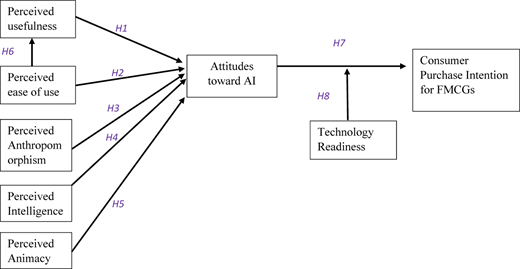
PU will positively influence consumers’ attitude toward AI.

PEU is defined as a “level of consumer effort as a usability parameter” in TAM (Panagoulias et al., 2024, p. 3) and the TAM emphasizes the importance of PEU due to the influence that a bad user interface has on IT system rejection (Nakod, 2019). PEU in the TAM is “the degree to which a person believes that using a particular system would be free of effort” (Davis, 1989). However, Venkatesh et al. (2003) argue that using the opposite concept of effort expectation makes more sense, especially when first encountering difficulties with a new product or technology. PEU is frequently employed in a diversity of situations and technological research are being done to better understand its relationship with technology acceptance (Balakrishnan et al., 2021; Panagoulias et al., 2024).

PEU is the degree to which people feel that using a technology will be easy. Recent research has shown that AI devices can minimize user effort, enhance the consumer accessible, subsequently and amplifying (Hengstler et al., 2016; Panagoulias et al., 2024) and can still foster a positive attitude among consumers (Balakrishnan et al., 2021; Schiavo et al., 2024). Many AI devices now take in data in the form of text, audio, images and even faces, which they then analyze, such as, (1) IPSoft, which employs words spoken to customer agents to interpret what clients want, for example, (2) Cloverleaf’s shelf Point, which is mounted on retail store shelves and analyzes customers’ facial expressions to determine their emotional responses at the point of purchase (Davenport et al., 2019). This can significantly influence customers’ purchasing decisions (Hoffman and Novak, 2017). Meanwhile, AI devices are autonomous, with ramifications in their evaluations and choices. The consumer is motivated by the ease of use and adoption of artificial intelligent devices in retail (Davenport et al., 2019). Previous empirical studies show a significant relationship between PEU and consumer’ attitudes toward AI-technology both in the context of this study’s purpose (Schiavo et al., 2024) and in e-commerce (Wang et al., 2023). But, limited empirical evidence in retail industry of technological attitude influences both consumer purchase intention and consumer purchase decisions. Hence we propose the following hypothesis:

H2.

PEU will positively influence consumers’ attitude toward AI.

As a result of its capacity to operate intelligently, AI exists in a variety of forms and has been utilized in a vast array of situations. Shankar (2018, p. 6) defines AI as “the programs, algorithms, systems and machines that display intelligence,” but Huang and Rust (2020) provide more precise classifications of AI, including mechanical, thinking and feeling AI. Specifically, mechanical AI is utilized to substitute human intelligence and execute transactional duties. However, anthropomorphism is the cognitive process of assigning human traits to non-human creatures, such as physical appearance or behavior (Fiestas Lopez Guido et al., 2024, p. 14). There is consensus that anthropomorphism is a crucial distinction between AI and non-AI applications. It depicts the imposition of human capabilities on non-human agents and reveals that AI applications are capable of motivating consumer intent to use the technology. Furthermore, according to research, anthropomorphism improves user attachment to a certain extent, after which it induces discomfort (Alabed et al., 2022).

Thinking AI is employed to supplement human intellect with utilitarian services like analytics and diagnosis. Last but not least, AI may be utilized for experience-based and emotional jobs, where AI agents such as chatbots can connect with consumers and express empathy and social interaction components useful in customer care (Huang and Rust, 2020). This sensation of AI is notably distinct from self-service technologies with mechanical and cognitive applications (Alabed et al., 2022). Furthermore, anthropomorphized consumer robots make consumers feel warm (Huang and Rust, 2020). AI devices that enhance anthropomorphization increase positive consumer attitudes toward their use (such as voice assistants and other AI devices) (Pham Thi and Duong, 2022). Moreover, PAN is increased the consumer favorable attitude toward to AI-system (Chakraborty et al., 2024). In light of these considerations, we formulated our hypothesis as follows.

H3.

PAN will positively influence consumers’ attitude toward AI.

Recent developments in intelligent systems and other AI devices and many more, which use series of connected algorithms and data predictions to exhibit more humanlike intelligence (Balakrishnan and Dwivedi, 2021; Agarwal et al., 2024). Nevertheless, since the cognitive and reasoning capacity in processing data has become an integral part of any AI algorithms, intelligence has become an important identity for any AI-powered systems. Current advancements in intelligent systems, various AI devices and many more employ a network of interconnected algorithms and data forecasts to demonstrate intelligence that is increasingly akin to that of humans. However, intelligence has grown to be a crucial characteristic of any AI-powered system since the ability to reason and think through data processing has become a fundamental component of all AI algorithms. From a business standpoint, intelligence influences how users perceive an object, particularly when it imbues it with humanlike qualities (Balakrishnan and Dwivedi, 2021).

PI of AI devices are shown positive attitude and it is improving the consumer daily work and efficiency (Fritsch et al., 2022). Digital and voice assistants were first presented by Moussawi et al. (2021) as personal intelligent agents (PIA), which use conversation data to make intelligent decisions about how best to respond to and help users. Because of their ability to answer questions for humans and their intellectual architecture, personal intelligent assistants or PIAs, are classified as intelligent systems. But how do consumers or users respond when they recognize its higher order intelligence stays undiscovered? There is little evidence in the literature to suggest that users’ attitudes and intention to purchase can be influenced by the PI of digital assistants, AI assistant and AI-devices (Balakrishnan and Dwivedi, 2021). So as to enhance the cognitive abilities of AI-assistants, developers are constantly creating new algorithms. However, marketers and developers also need to be aware of how this fosters a positive user experience. Therefore, following hypothesis is proposed based on the above discussion.

H4.

PI will positively influence consumers’ attitude toward AI.

Animacy is defined as the belief that objects are living entities capable of interaction and self-determination. According to Michotte (1963), social perception is the essential source of both this notion and the phenomenon connected with animacy. Aggarwal and McGill (2012) state that, anthropomorphism accurately imports humanlike traits and personality, whereas animacy gives an object lifelike form that is primarily connected to movement and graphic texture, even though it may not necessarily represent human form. Most studies have confirmed the existence of animacy in shapes and the idea that humans perceive animacy in shapes (Galvez and Hanonom, 2024).

Although the majority of the literature on animacy comes from the field of psychology, IS research has been the principal application of animacy in recent years. Humanistic traits and antagonistic engagement are becoming more and more prevalent in AI-focused apps as they evolve daily. One such example would be digital assistants; whose designers combine human-implied traits with multifunctional AI attributes to create an environment that appears hostile. An excellent illustration is the well-known digital assistant Amazon-Alexa, which mimics human speech and uses sophisticated algorithms to simulate human-to-human interaction as opposed to human-machine interaction. Based on these ideas and real-world examples, this study makes the assumption that users’ views of animacy are shaped by digital assistants (Balakrishnan and Dwivedi.2021). Very few studies examined the AI-PA and attitude toward AI. Therefore, following hypothesis is proposed based on the above discussion.

H5.

PA will positively influence consumers’ attitude toward AI.

Two crucial cognitive factors in the acceptability of information technology (IT) are the PU of the technology and the PEU of its application (Davis, 1989). People’s perception of a technology’s usefulness is determined by how much they believe it would help them perform better at work. Perceptions indicate that the PEU of AI-technology denotes to how convenient it is to learn, compared to the levels of physical and mental work needed. Perceived utility has been demonstrated to be a crucial component in the decision to use or update current information technologies (Bonn et al., 2015). As said by Adams et al. (1992), few study have claimed that PEU significantly influences technology use and some scholars have claimed that PEU significantly influences technology use, more so than PU (Igbaria et al., 1997). Furthermore, PU of AI was determined based on perceived ease of use in behavior intention of consumers (Zhang et al., 2023). Customers are inclined to use AI technology since it saves them from having to stand in line for long periods of time at the cash register (Baltazar, 2019). As a result, consumers benefit greatly from it. AI technologies and Walmart customers have a positive relationship. This is because AI technology is beneficial to consumers and easy to use and since it safeguards that Walmart customers receive the next best (Venkatesan, 2021). Consequently, we propose the following hypothesis:

H6.

PEU of AI will have a positive influence on PU of AI.

In the course of conducting a review of the literature on customers’ satisfaction with new technology, a variety of conclusions were reached. Novel retail technologies may affect consumer behavior in stores, according to some experts. However, some empirical evidence pointed to the negative effects of consumers’ attitudes toward using technology (such as AI) and toward the retail store (Renko and Druzijanic, 2014). AI sometimes altered customer attitudes toward increased levels of enthusiasm, leading to higher buying intent and stronger assessments of how pleasant the store atmosphere was (Cui et al., 2022). Additionally, when it comes to buying, people view AI-enabled technology more favorably and are more likely to make a purchase (Esch et al., 2020). Customers are interacting with evolving technology in retail environments more and more, and thus, it is critical to understand their perceptions of this as it influences their propensity to make a purchase (Inman and Nikolova, 2017; Adapa et al., 2020; Cicek et al., 2024). In order to help retail store managers better understand consumer behavior when shopping with AI, it is necessary to look into consumers’ intentions to shop at retail (Pillai et al., 2020). This will enable them to develop more effective strategies to help customers using AI adopt retail more smoothly. The findings show that consumers respect smart retail technology and are more likely to use it. As the number of things available to consumers grows, so too does the amount of information about those items that must be processed. Customers’ purchasing experience might be impacted by new technology as well. Novel AI embedded retail technologies that allow consumers to self-serve are leading to an increase in the use of artificial intelligent technology based self-service by customers. It is noteworthy that research indicates that individuals who enjoy their purchasing encounters spend more money (Renko and Druzijanic, 2014). Hence the following hypothesis is proposed:

H7.

Consumer attitudes toward AI will have a significant positive impact on consumer purchase intention for fast-moving consumer goods (FMCGs) in an AI powered retail environment.

TR is defined as the inclination of individuals to adopt and utilize new technologies for achieving personal or professional goals (Parasuraman, 2000). The concept examines a mix of mental enhancers and inhibitors to determine a consumer’s propensity to adopt new technology (Damerji and Salimi, 2021). According to Damerji and Salimi (2021), this suggests that a person’s impressions of a certain technology may contain good and/or negative features, which together influence that person’s readiness to accept a technology. Negative attitudes will push people away from new technology, while favorable views will attract them (Parasuraman and Colby, 2014). These beliefs, according to Parasuraman (2000) and Parasuraman and Colby (2014), may be split into several dimensions such as optimism, innovativeness, discomfort and insecurity. While optimism and innovativeness might be viewed as positive characteristics (contributors), discomfort and insecurity are viewed as negative characteristics (inhibitors). Since AI technologies are of many kinds, different technologies exist at different stages of readiness and may pose different challenges to adopters (Uren and Edwards, 2023). Accordingly, this research will examine whether TR capability has an impact on consumer purchase intention.

To test the above expectation, the following hypothesis was proposed:

H8.

The impact of attitudes toward AI on purchase intention will be moderated by technological readiness

As a result, the study develops the conceptual framework shown in Figure 1 to expound on the relationships hypothesized above.

With the aim of empirically validate the conceptual model, the study adopted a quantitative methodology via a survey research strategy, which is an effective way to capture current attitudes and perceptions toward the purchase behavior of a cross section of retail consumers more efficiently (Arachchi and Samarasinghe, 2023a, b, c, d, e).

The measurement scale items were pre-tested to be relevant to the target respondents and small phrasing changes were made in response to respondents’ feedback during the pre-testing stage (Casidy and Wymer, 2015). However, these measurement scales have never been adopted and used in the Sri Lankan context. The PU variable depends on 06 indicators and all the indicators are measured in the questionnaire by items PFL1 to PFL6 (Pillai et al., 2020). The PEU variable depends on 05 indicators and all indicators are measured by PEE1 to PEE5 (Pillai et al., 2020). Moreover, PAN is measured under 03 indicators, namely, PAN1 to PAN3 (Han, 2021). The PI, PA are measured by PI1 to PI3 and PA1 to PA3 (Balakrishnan and Dwivedi.2021). Furthermore, attitudes to AI variable is measured by AA1 to AAI6 (Liang et al., 2019). The TR variable is measured by TR1 to TR6 (Parasuraman and Colby, 2014) and the Consumer Purchase Intention variable is measured by CP1 to CP3 (Balakrishnan and Dwivedi, 2021). All item statements adopted a seven-point Likert type scale anchored on “strongly disagree” and “strongly agree” at the endpoints and modified from those taken from previous literature. All the measurement constructs were reflectively measured based on the previous literature (Arachchi and Samarasinghe, 2023a, b, c, d, e) and were operationalized as first order constructs.

A structured self-administered questionnaire was employed to collect the responses from a representative sample of modern trade retail consumers in Sri Lanka from May to August 2023. The geographical domain of the study was Sri Lanka representing the south Asian region as it was considered interesting and important to investigate consumer purchase behavior specific technology attitudes in such an emerging economy context with special reference to AI related retailing trends.

Retail consumers aged between 18 and 65 and used to transact at modern trade retail outlets in Sri Lanka were defined as the target population whilst the individual retail consumer was taken as the unit of analysis. We deployed a quota sampling strategy by targeting an approximation of “stratified random sampling” in which an attempt was made to draw representative quotas in terms of gender, occupation and education following the recommendations of Gschwend (2005). Further, we covered both urban and suburban areas of Sri Lanka choosing eight districts with the highest population density (Arachchi and Samarasinghe, 2023a, b, c, d, e). We ensured that customers with some understanding of AI and automated service experience in purchasing FMCGs were included in the survey by inserting a filtering question at the beginning of the questionnaire to assess their appropriateness for this study. Those who were not familiar with this sort of service did not qualify for the study. We shared over 500 surveys with the target respondents via various social media. We received 392 complete questionnaires, making an effective response rate of 78.4%. After handling the data for missing values and treating for outliers (Saunders et al., 2011), the study had an effective sample size of 354, which warrants the final analysis as it satisfies the threshold sample size suggested by Krejcie and Morgan (1970) at a confidence level of 95% and a margin of error of 5%. First, the demographic profiles of the respondents were examined, as per Table 1.

We initially used SPSS for data purification, testing statistical assumptions and descriptive analysis of data. Since the distribution of data did not comply with the parametric assumptions, for testing the final empirical model covering both measurement and structural models, Smart PLS (4) was used to assess the measurement and structural models. The data distribution does not have to follow a normal distribution for Smart PLS to function. While a small sample size, like 150–200 respondents, can be used for structural equation modeling, larger samples give better outcomes (Hair et al., 2014) and the sample size of this study exceeded the advised threshold (Mubushar et al., 2020). Furthermore, testing the conceptual framework from the standpoint of prediction was our primary goal. Hair et al. (2019) state that variance-based SEM techniques, such SMART PLS, are more appropriate than covariance-based SEM techniques when the primary goal of a study is to anticipate connections.

The study’s empirical findings are examined here. It first tests the measurement model, then the structural model, to test hypotheses.

Reliability and validity

The Appendix-01 depicts the reliability coefficients, factor loadings and AVE values as the criteria of measurement model assessment. Since all Cronbach Alpha and composite reliability coefficients exceed the threshold of 0.6, all the constructs have an acceptable level of construct reliability (Nunnally, 1978). All factor loadings, except the items PFL4 which were removed in the final analysis due to their poor loadings less than 0.05 (Hair et al., 2019), have values above 0.5. All the factors were maintained for the final analysis. Thus, this partially supports the existence of construct validity (Churchill, 1979). Further, the AVE values of all constructs had a minimum of 0.5 or above, implying the existence of construct validity. Furthermore, since all the measures were adapted from prior studies in indexed journals, we argue that all the measures have acceptable levels of construct validity and reliability (Sekaran and Bougie, 2017). Finally, we establish the discriminant validity of the constructs. Following the rule of Fornell and Larcker (1981), Table 2 provides evidence that the square root of the AVE value of each construct is higher than its respective correlations with other constructs.

Descriptive analysis and model quality criteria

The Appendix-01 shows the mean and standard deviation values of the constructs. As a way of ensuring the quality of the model, we report the standardized root mean square residuals (SRMR) of the model. The SRMR of the observed model was 0.085, indicating an acceptable level of quality (Byrne and Hilbert, 2008). Further, we performed Harman’s single source bias test to ensure that there was no common factor dominating the majority of the variance of the model, as the same respondent responded to the measures of both independent and dependent variables (Podsakoff et al., 2003). The results of the test revealed that no single factor accounted for a variance of 50% or higher, indicating no single source biasness. As additional measures of model quality, we also calculated R2, Q2 and F2 values, which communicate, respectively, the model’s explanatory power, predictive validity and effect size. The values had moderate levels of coefficients and hence, were satisfactory. Now the model was ready for assessing its structural paths related to the hypotheses, as presented in the next section.

Test of hypotheses

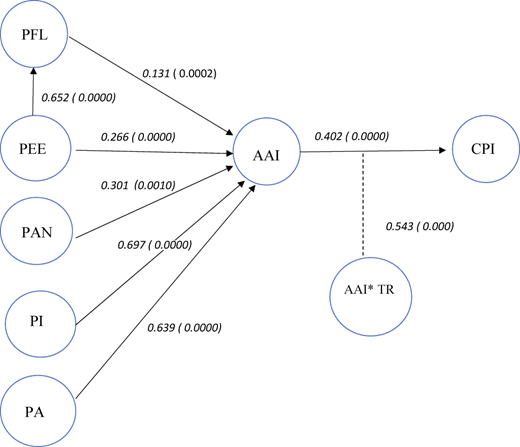
Significant path models are in Table 3 and Figure 2. Hypotheses can be tested using the structural model.

As per Table 3 and Figure 2, path values of hypotheses H1, H2, H3, H4, H5, H6, H7 and H8 have p-values that are less than 0.05. Therefore, all hypotheses are accepted. These results confirm that AI technology directly influences consumer PI in retail. Further, TR significantly and positively moderates the relationship between AAI and PI in the retail industry.

The first objective was to observe the effects of perceived AI technology attributes on consumer attitudes toward AI in a modern trade retail space. This study discovered that PU of consumer attitudes toward AI is significantly positive. AI technology is a potent instrument for corporate communication. AI applications are more engaging when the message is about how to use a product rather than why to use it, since AI devices are more adept at giving consumers messages. This helps with consumer decision-making when it comes to marketing (Davenport et al., 2019). Customers are presented with a wider variety of products, the data regarding which needs to be processed and their experience in shopping may be impacted by emerging technology. New retail technologies that incentivize customers to engage in self-service are driving more and more customers toward technology-based self-services. Interestingly, studies show that consumers who enjoy their shopping experience make larger purchases (Renko and Druzijanic, 2014). It has been discovered that attitudes toward utilizing technology are significantly influenced by one’s perception of the TAM’s utility (Nakod, 2019).

Additionally, the study found that consumers’ perceptions of AI’s ease are overwhelmingly positive. Many contextual and technological studies use PEU to better understand its relationship to AI-technology acceptability (Balakrishnan et al., 2021). Adoption of technologies or systems is significantly predicted by how simple people believe them to be to use (Liang et al., 2019). PEU and the effect of a subpar user interface on IT technology rejection are two components of the TAM (Liang et al., 2019). Previous empirical research has demonstrated a favorable correlation between consumers’ attitudes toward technology and PEU, which in turn influences consumers’ intentions and decisions to make purchases (Al-Emrann and Grani, 2021). AI sentiments are positively impacted by voice assistants (VAs), robotic technologies and AI sensors because of their usability and perceived value (Acikgoz and Vega, 2021). In other words, because AI devices are easy to use, there is a willingness to accept these devices (Gursoy et al., 2019).

Thirdly, anthropomorphism is considered a fundamental psychological process of inductive reasoning that can promote social relationships between humans and non-humans (Blut et al., 2021). In general, anthropomorphism makes individuals feel more connected to the anthropomorphized items, increases user engagement, promotes intriguing interactions and impacts consumer decision-making behaviors and attitudes. Research demonstrates that consumers view items as more trustworthy when they exhibit humanlike characteristics. Thus, items are frequently endowed with human features to make them more attractive and likable, as are brand identities and attitudes (Han, 2021). AI devices such as voice assistants are enhanced, anthropomorphized and increase consumer attitudes toward their use (Pham Thi and Duong, 2022).

High levels of animacy and intelligence can be attributed to digital assistants and AI-devices, particularly when combined with AI characteristics that allow their humanlike qualities to respond to stimuli and intelligent situations. Emerging technology formats have been shown in prior research to facilitate attitude and purchase intention through digital channels (Balakrishnan and Dwivedi, 2021). With the rise of AI-devices, there is a growing chance that people are beginning to use them for business. Psychology theories make sense in that animated cues and stimuli delivered by artificial agents are the foundation upon which PA is constructed (Shultz and McCarthy, 2014). Voice and speech cues with human characteristics are provided by digital assistants to add humanlike traits. Examining how these animacy and intelligence qualities impact attitude toward AI in retail will be worthwhile and fascinating. It was interesting to discover that PI, PA and PAN respectively make a higher impact in forming attitudes toward AI than PU and ease of use in an AI powered retail environment. Although we have emphasized equal weight on each on these factors in the conceptual model, it is confirmed that intrinsic motives based on humanlike attributes of technology are more active in influencing retail consumers than traditional extrinsic factors in modern AI supported retail environment.

The second objective was to examine the impact of consumer attitudes toward AI on consumer purchase intentions in an AI powered retrial context. This study found this relationship to be significant and positive. Attitudes toward AI, have opened up a lot of commercial alternatives for consumers recently. However, a lot of technology has failed since the user did not see any value in them (Gursoy et al., 2019). Numerous earlier research works have demonstrated a positive correlation between favorable attitudes or a readiness to adopt a product and positive opinions about technology in general. It is also possible to argue that AI is increasingly becoming a general tool in consumers’ lives regardless of the country or region due to rapid spread industry 4.0 technology. A person is more likely to have positive opinions about new technology products or to be ready to purchase them if they have a positive general attitudes towards-AI (Lin and Hsieh, 2006). Thus, positive perceptions about AI-technology as a whole can lead to positive opinions about a new technical product, which can improve purchase intention (Liang et al., 2019). Technology-savvy consumers have more subjective thoughts and feelings regarding devices. When they purchase, the system interface is what worries them the most. As a result, more customers at textile retail stores plan to employ AI technology and some have openly expressed their opinions about the brands they need and their plans to make purchases (Stoyanova et al., 2015).

The study’s third and final objective was to investigate the moderating impact of TR on the effects that consumer attitudes toward AI have on consumer purchase in an AI powered retailed context. Moderating impact of TR was significantly positive on the relationship between attitude toward AI and purchase intention in a modern retail space. It is notable that TR significantly moderates the effects that consumer attitudes toward AI specific technologies as well as (general) technology have on consumer purchase intention. Domain-specific indicators have been found to be more predictive of new product purchases than worldwide innovativeness in a number of inventions, including technical preparedness (Goldsmith et al., 2005). Utilization of the technology-readiness idea is prevalent in business marketing, particularly for identifying market segments likely to embrace new technologies (Wiese and Humbani, 2019). Consequently, technological readiness in information technology preparedness positively affects buying decisions (Thakur and Srivastava, 2015). Especially, consumers’ level innovativeness as a personality trait can be crucial in motivating themselves towards adoption of emerging technologies and whereby enhance their tendency to buy products and services. Although past empirical data have produced some contradicting results about the association between technological readiness and purchase intention (Thakur and Srivastava, 2015), current research confirms this relationship in an AI enabled context. Therefore, most consumers and retailers are searching for AI that can evaluate consumer attitudes and retail locations regarding the purchase of a certain good or service via text and voice. Additionally, there has been a significant impact of AI advancements on the payment processing sector. AI reduces fraud by speeding up transactions and decreasing the likelihood of fraud (Mahmoud et al., 2020).

The findings provide important outcomes in the present study setting. First it establishes that intrinsic motives of consumers exceed the traditional role played by extrinsic motives in the TAM in forming AI related attitudes in a modern retail space. Further, it reveals that consumers’ AI supportive attitudes in a retail environment can generate purchase intentions. Furthermore, as an important personality trait, consumers’ readiness for adopting innovative technology applications can enhance the AI attitude–purchase intention linkage in a retail space. Table 4 summarizes the research conclusions and their implications.

Because it offers a thorough framework for examining AI and consumer purchase intentions in the retail sector, this study has theoretical ramifications. This study looks at AI technology first and its relationship to the TAM. The conversation above suggests that TAM and AI technologies complement one other in the retail sector. Consequently, new AI technology improves the ease of use, usefulness and attitude toward utilizing AI tools. Checkout automation, chatbots, humanoid, ASR, online product recommendations (Hungryroot), virtual fitting rooms, visual product search, Amazon: A True Grab-and-Go, Lowe’s: A Helpful Robot, etc. Intention to use retail technologies consistently affects this impulse. The current study is aware of several empirical findings that explain and overcome this theoretical gap. Furthermore, PAN, PI, PA enhances consumer attitudes toward AI. AI technology mimics humanlike behavior, but there are very few studies on PAN related to the retail industry, and therefore, this study is able to address the above empirical gap.

Secondly, this study is underpinned by the TAM linked to attitudes towards-AI. Accordingly, TAM elements and attitudes towards-AI show a positive relationship. However, traditional TAM based extrinsic motives, namely PU and ease of use of AI retail space cannot fully explain how AI attitudes are formed in modern retail space. It was discovered that humanoid based psychological and intrinsic motives such as PI, PA and PAN reflected in AI technology applications can enhance the TAM’s predictability in modern retail space. Few empirical studies address this theoretical gap and there is limited evidence available. Additionally, AI supportive attitudes of retail consumers justify the validity of the traditional attitude-behavior linkage in an AI powered modern retail environment as well. Therefore, the current study fills in some void under explained in TAM and attitude-behavior frameworks in an AI based environment. As a result of this research, the TAM is linked to technology. Thus, in future, researchers will be able to address and analyze this theoretical syndrome.

Finally, this study addresses the theoretical gap between the TAM and TR. According to the findings, TAM displays a moderate level of technological readiness. Hence, TR is identified as an important consumer personality trait dimension that can predict the consumer responsiveness to innovative and emerging technologies such as AI combined with consumers’ retail purchase decision-making process. According to this study, attitudes toward AI technology can change the purchase intention depending on consumer innovativeness. This explains attitudes toward technology and behavioral intention depends on consumer innovativeness even in industry 4.0 and 5.0 technologies. This sheds some insights into the need to dig deeper into consumer psychological and personality models and their relevance in new technology contexts as well.

The retail industry has been significantly disrupted over the previous ten years. Various variables, such as evolving technology, increased customer expectations, changing dietary preferences and the cultural impact of expatriates, have shaped the way global retailers do business and differentiate their offerings with augmentation. Given the circumstances, our research brings managerial and strategic value to the global retail industry in delivering more of an emotional value proposition.

AI technology is a potent instrument for corporate communication. AI applications are more engaging when the message is about how to use a product rather than why to use it, since AI gadgets are more adept at giving consumers messages. This helps with consumer decision-making when it comes to marketing (Davenport et al., 2019), such as self-checking checkout kiosks, speech recognition, virtual assistants, virtual changing rooms, visual search, an assisting robot at Lowe’s, a real grab-and-go experience at Amazon, etc. Consumers today are increasingly concerned with time saving and meeting their expectations on time because they are busy and have no time to waste. These imply the opportunity for user experience (UX) designers to apply human touch and appeal in AI powered retail space, e.g. more precise and reliable customer services and complaint handing.

International retail markets can incorporate user-friendly and simple-to-use AI products into their operations. Products such as VR, Amazon: A true grab-and-go experience and automated checkout systems are more user-friendly and easier to use. Retail consumers have a strong, positive attitude toward AI technology. As a result, this strategic implementation is more appealing to retail and fashion customers.

Furthermore, retailers will be able to implant sensing and camera technology and identify consumer buying patterns. Based on these cameras and sensors, a consumer product can be taken from the shelf and the customer can use a smartphone to pay for the selected products using an app’s account or a payment card. In addition, fashionable retail stores can use virtual dressing rooms. Customers are not required to spend an extended period of time in the shop. It is easy to analyze and deliver the correct fit for the customer through the dress code and so enhance the consumer purchasing process and customer experience.

Finally, this would be a good way for retailers to identify potential customers who are innovative and have a positive attitude toward technology and are more likely to try new technology and products over those who are less innovative and have negative attitudes toward technology. It is easy to recognize the AI-technology based segment and then, be able to carry out marketing communication strategies targeting this particular group’s consumer innovativeness and technology preferences. To this end, firms must educate and advise consumers on technology-based products and services to improve their shopping experience and compete in the market (Mukerjee et al., 2018).

This study is only linked to perceived artificial intelligent and consumer purchase intention in a Sri Lankan context, the research outcomes may not mirror global consumer behaviour. This research is based on quantitative methods and can be expanded to include a mixed method and qualitative methods to explain the results, strengthening the conclusions. The vast majority of Sri Lankans are unaware of AI devices. When we delivered the surveys, we had haphazardly asked some of the respondents about their current experience on AI technology. Only a few customers were familiar with AI technology; there is a severe lack of information, even within academic communities. This highlights the need to explore more into AI awareness and knowledge among customers, which current study explain little about. With the expansion of product knowledge and technology, major purchase determinants and their effect on customer choice making will be modified correspondingly.

This study provides some future insights for further discussion. AI and purchase intention among multi-generational cohorts is an interesting field of study and little empirical evidence is available on it. As well, researchers are able to examine the relationship between AI technology and demographic characteristics. Researchers also consider factors such as gender, education level and civil statutes (Nouraldeen, 2023). Extant literature has a serious omission on the role of customer awareness and knowledge on the effect on AI attitudes on purchase decision-making. Thus, it is also possible to undertake further studies that compare AI based attitudes and purchase intention in retail by generation cohorts and other demographics of customers as AI usage and awareness may be different from customers’ demographics especially in an emerging economy context. Further, it is important to complement the findings by having some insights from qualitative interviews with retail technocrats such as UX designers. Furthermore, researchers can examine AI retail implementation and brand value/brand reputation, which will also yield favorable insights to the retail industry. Moreover, limited empirical evidence exists related to AI technology implementation in fashion retail and luxury fashion retail.

In addition, researchers will be able to further address the relationship between the TAM and the Innovation Attitude model. This will extend to the study of low and high consumer innovativeness in relation to the TAM. Finally, another research opportunity is the comprehension of consumer behavior in the presence and absence of digital retail.

The authors are grateful to the anonymous referees and the editorial team of the journal for their extremely useful suggestions to improve the quality of the article. Usual disclaimers apply.

The supplementary material for this article can be found online.
Acikgoz
,
F.
and
Vega
,
R.P.
(
2021
), “
The role of privacy cynicism in consumer habits with voice assistants: a technology acceptance model perspective
”,
International Journal of Human-Computer Interaction
, Vol. 
38
No. 
12
, pp. 
1138
-
1152
, doi: .
Adams
,
D.A.
,
Nelson
,
R.R.
and
Todd
,
P.A.
(
1992
), “
Perceived usefulness, ease of use, and usage of information technology: a replication
”,
MIS Quarterly
, Vol. 
16
No. 
2
, p.
227
, doi: .
Adapa
,
S.
,
Fazal-e-Hasan
,
S.M.
,
Makam
,
S.B.
,
Azeem
,
M.M.
and
Mortimer
,
G.
(
2020
), “
Examining the antecedents and consequences of perceived shopping value through smart retail technology
”,
Journal of Retailing and Consumer Services
, Vol. 
52
, 101901, doi: .
Aelbrecht
,
B.
and
Mojsilovic
,
J.
(
2024
), “
How ai is transforming the wholesale and Retail Trade Landscape
”,
Numalis
,
6 February, available at:
 https://numalis.com/publications-129-how_ai_is_transforming_the_wholesale_and_retail_trade_landscape.php (
accessed
 15 October 2024).
Agarwal
,
P.
,
Swami
,
S.
and
Malhotra
,
S.K.
(
2024
), “
Artificial intelligence adoption in the post COVID-19 new-normal and role of smart technologies in transforming business: a review
”,
Journal of Science and Technology Policy Management
, Vol. 
15
No. 
3
, pp. 
506
-
529
, doi: .
Aggarwal
,
P.
and
McGill
,
A.L.
(
2012
), “
When brands seem human, do humans act like brands? Automatic behavioral priming effects of brand anthropomorphism
”,
Journal of Consumer Research
, Vol. 
39
No. 
2
, pp.
307
-
323
, doi: .
Ajzen
,
I.
(
1991
), “
The theory of planned behavior
”,
Organizational Behavior and Human Decision Processes
, Vol. 
50
No. 
2
, pp. 
179
-
211
, doi: .
Ajzen
,
I.
and
Fishbein
,
M.
(
1975
), “
A bayesian analysis of attribution processes
”,
Psychological Bulletin
, Vol. 
82
No. 
2
, pp. 
261
-
277
, doi: .
Al-Emran
,
M.
and
Granić
,
A.
(
2021
), “
Is it still valid or outdated? A bibliometric analysis of the technology acceptance model and its applications from 2010 to 2020
”,
Studies in Systems, Decision and Control
, pp. 
1
-
12
, doi: .
Alabed
,
A.
,
Javornik
,
A.
and
Gregory-Smith
,
D.
(
2022
), “
AI anthropomorphism and its effect on users’ self-congruence and self–AI integration: a theoretical framework and research agenda
”,
Technological Forecasting and Social Change
, Vol. 
182
, 121786, doi: .
Arachchi
,
H.A.D.M.
and
Samarasinghe
,
G.D.
(
2023a
), “
Intention to adopt intelligent clothing in the fashion retail industry: extending the Hisam Model with Technology Readiness
”,
International Journal of Human-Computer Interaction
, Vol. 
40
No. 
20
, pp. 
1
-
15
, doi: .
Arachchi
,
H.D.M.
and
Samarasinghe
,
G.D.
(
2023b
), “
Impact of personal intelligent agent’s anthropomorphism on Gen-Z consumers’ intention in the retail sector
”,
2023 7th SLAAI International Conference on Artificial Intelligence (SLAAI-ICAI)
,
IEEE
, pp. 
1
-
6
.
Arachchi
,
H.D.M.
and
Samarasinghe
,
G.D.
(
2023c
), “
Consumers’ intention to use of the retail service robots: a humanoid perspective
”,
2023 Moratuwa Engineering Research Conference (MERCon)
,
IEEE
, pp. 
485
-
490
.
Arachchi
,
H.A.
and
Samarasinghe
,
G.D.
(
2023d
), “
Impulse purchase intention in an AI-mediated retail environment: extending the TAM with attitudes towards technology and Innovativeness
”,
Global Business Review
. doi: .
Arachchi
,
H.A.D.
and
Samarasinghe
,
G.D.
(
2023e
), “
Impact of embedded AI Mobile smart speech recognition on consumer attitudes towards AI and purchase intention across Generations X and Y
”,
European Journal of Management Studies
, Vol. 
29
No. 
1
, pp. 
3
-
29
, doi: .
Ashraf
,
A.R.
,
Thongpapanl
,
N.(T.)
and
Spyropoulou
,
S.
(
2016
), “
The connection and disconnection between e-commerce businesses and their customers: exploring the role of engagement, perceived usefulness, and perceived ease-of-use
”,
Electronic Commerce Research and Applications
, Vol. 
20
, pp. 
69
-
86
, doi: .
Balakrishnan
,
J.
and
Dwivedi
,
Y.K.
(
2021
), “
Conversational commerce: entering the next stage of AI-Powered Digital assistants
”,
Annals of Operations Research
, Vol. 
333
Nos
2-3
, pp. 
1
-
35
, doi: .
Balakrishnan
,
J.
,
Dwivedi
,
Y.K.
,
Hughes
,
L.
and
Boy
,
F.
(
2021
), “
Enablers and inhibitors of AI-powered voice assistants: a dual-factor approach by integrating the status quo bias and technology acceptance model
”,
Information Systems Frontiers
, Vol. 
26
No. 
3
, pp. 
1
-
22
, doi: .
Baltazar
,
A.
(
2019
), “
How grocers are reimagining the future with ai
”,
Grocery Business
,
Grocery Business, 28 January, available at:
 https://www.winsightgrocerybusiness.com/technology/how-grocers-are-reimagining-future-ai (
accessed
 22 March 2023).
Blut
,
M.
,
Wang
,
C.
,
Wünderlich
,
N.V.
and
Brock
,
C.
(
2021
), “
Understanding anthropomorphism in service provision: a meta-analysis of physical robots, Chatbots, and other AI
”,
Journal of the Academy of Marketing Science
, Vol. 
49
No. 
4
, pp. 
632
-
658
, doi: .
Bonn
,
M.A.
,
Kim
,
W.G.
,
Kang
,
S.
and
Cho
,
M.
(
2015
), “
Purchasing wine online: the effects of social influence, perceived usefulness, perceived ease of use, and wine involvement
”,
Journal of Hospitality Marketing and Management
, Vol. 
25
No. 
7
, pp. 
841
-
869
, doi: .
Bughin
,
J.
,
Hazan
,
E.
,
Ramaswamy
,
S.
,
Chui
,
M.
,
Allas
,
T.
,
Dahlström
,
P.
and
Trench
,
M.
(
2022
),
Artificial Intelligence the Next Digital Frontier? June 2017
,
McKinsey Global Institute
.
Byrne
,
A.
and
Hilbert
,
D.
(
2008
), “
Basic sensible qualities and the structure of appearance
”,
Philosophical Issues
, Vol. 
18
No. 
1
, pp. 
385
-
405
, doi: .
Casidy
,
R.
and
Wymer
,
W.
(
2015
), “
The impact of brand strength on satisfaction, loyalty and WOM: an empirical examination in the Higher Education Sector
”,
Journal of Brand Management
, Vol. 
22
No. 
2
, pp. 
117
-
135
, doi: .
Chakraborty
,
D.
,
Kumar Kar
,
A.
,
Patre
,
S.
and
Gupta
,
S.
(
2024
), “
Enhancing trust in online grocery shopping through Generative AI Chatbots
”,
Journal of Business Research
, Vol. 
180
, 114737, doi: .
Chang
,
Y.-W.
and
Chen
,
J.
(
2021
), “
What motivates customers to shop in smart shops? The impacts of Smart Technology and Technology readiness
”,
Journal of Retailing and Consumer Services
, Vol. 
58
, 102325, doi: .
Chaturvedi
,
R.
and
Verma
,
S.
(
2023
), “
Opportunities and challenges of AI-driven customer service
”,
Artificial Intelligence in Customer Service
, pp. 
33
-
71
, doi: .
Chopra
,
K.
(
2019
), “
Indian shopper motivation to use Artificial Intelligence
”,
International Journal of Retail and Distribution Management
, Vol. 
47
No. 
3
, pp. 
331
-
347
, doi: .
Choung
,
H.
,
David
,
P.
and
Ross
,
A.
(
2023
), “
Trust in AI and its role in the acceptance of AI Technologies
”,
International Journal of Human-Computer Interaction
, Vol. 
39
No. 
9
, pp. 
1727
-
1739
, doi: .
Churchill
,
G.A.
(
1979
), “
A paradigm for developing better measures of marketing constructs
”,
Journal of Marketing Research
, Vol. 
16
No. 
1
, pp. 
64
-
73
, doi: .
Cicek
,
M.
,
Gursoy
,
D.
and
Lu
,
L.
(
2024
), “
Adverse impacts of revealing the presence of ‘artificial intelligence (AI)’ technology in product and service descriptions on purchase intentions: the mediating role of emotional trust and the moderating role of perceived risk
”,
Journal of Hospitality Marketing and Management
, Vol. 
34
, pp. 
1
-
23
, doi: .
Cui
,
Y.(G.).
,
van Esch
,
P.
and
Jain
,
S.P.
(
2022
), “
Just walk out: the effect of AI-enabled checkouts
”,
European Journal of Marketing
, Vol. 
56
No. 
6
, pp. 
1650
-
1683
.
Damerji
,
H.
and
Salimi
,
A.
(
2021
), “
Mediating effect of use perceptions on technology readiness and adoption of artificial intelligence in accounting
”,
Accounting Education
, Vol. 
30
No. 
2
, pp. 
107
-
130
, doi: .
Davenport
,
T.
,
Guha
,
A.
,
Grewal
,
D.
and
Bressgott
,
T.
(
2019
), “
How artificial intelligence will change the future of marketing
”,
Journal of the Academy of Marketing Science
, Vol. 
48
No. 
1
, pp. 
24
-
42
, doi: .
Davis
,
F.D.
(
1989
), “
Perceived usefulness, perceived ease of use, and user acceptance of Information Technology
”,
MIS Quarterly
, Vol. 
13
No. 
3
, p.
319
, doi: .
El Abed
,
M.
and
Castro-Lopez
,
A.
(
2024
), “
The impact of AI-powered technologies on aesthetic, cognitive and affective experience dimensions: a connected store experiment
”,
Asia Pacific Journal of Marketing and Logistics
, Vol. 
36
No. 
3
, pp. 
715
-
735
, doi: .
Elmashhara
,
M.G.
,
De Cicco
,
R.
,
Silva
,
S.C.
,
Hammerschmidt
,
M.
and
Silva
,
M.L.
(
2023
), “
How gamifying AI shapes customer motivation, engagement, and purchase behavior
”,
Psychology and Marketing
, Vol. 
41
No. 
1
, pp. 
134
-
150
, doi: .
Erensoy
,
A.
,
Mathrani
,
A.
,
Schnack
,
A.
,
Elms
,
J.
and
Baghaei
,
N.
(
2024
), “
Consumer behavior in immersive virtual reality retail environments: a systematic literature review using the stimuli‐organisms‐responses (S‐O‐r) model
”,
Journal of Consumer Behaviour
, Vol. 
23
No. 
6
, pp.
2781
-
2811
, doi: .
Esch
,
P.van
,
Cui
,
Y.(G.)
and
Jain
,
S.P.
(
2020
), “
Stimulating or intimidating: the effect of AI-enabled in-store communication on consumer patronage likelihood
”,
Journal of Advertising
, Vol. 
50
No. 
1
, pp. 
63
-
80
, doi: .
Fiestas Lopez Guido
,
J.C.
,
Kim
,
J.W.
,
Popkowski Leszczyc
,
P.T.L.
,
Pontes
,
N.
and
Tuzovic
,
S.
(
2024
), “
Retail robots as sales assistants: how speciesism moderates the effect of robot intelligence on customer perceptions and behaviour
”,
Journal of Service Theory and Practice
, Vol. 
34
No. 
1
, pp. 
127
-
154
, doi: .
Fornell
,
C.
and
Larker
,
D.
(
1981
), “
Structural equation modeling and regression: guidelines for research practice
”,
Journal of Marketing Research
, Vol. 
18
No. 
1
, pp. 
39
-
50
.
Fritsch
,
S.J.
,
Blankenheim
,
A.
,
Wahl
,
A.
,
Hetfeld
,
P.
,
Maassen
,
O.
,
Deffge
,
S.
,
Kunze
,
J.
,
Rossaint
,
R.
,
Riedel
,
M.
,
Marx
,
G.
and
Bickenbach
,
J.
(
2022
), “
Attitudes and perception of artificial intelligence in healthcare: a cross-sectional survey among patients
”,
Digital Health
, Vol. 
8
.
Galvez
,
V.
and
Hanono
,
E.
(
2024
), “
What does it mean to measure mind perception toward robots? A critical review of the main self-report instruments
”,
International Journal of Social Robotics
, Vol. 
16
No. 
3
, pp. 
501
-
511
, doi: .
Gansser
,
O.A.
and
Reich
,
C.S.
(
2021
), “
A new acceptance model for artificial intelligence with extensions to UTAUT2: an empirical study in three segments of application
”,
Technology in Society
, Vol. 
65
, 101535, doi: .
George
,
T.
(
2023
), “
Artificial Intelligence (AI) use cases for the retail industry
”,
Data Ideology
,
4 December, available at:
 https://www.dataideology.com/artificial-intelligence-use-cases-retail-industry/ (
accessed
 30 May 2023).
Goldsmith
,
R.E.
,
Kim
,
D.
,
Flynn
,
L.R.
and
Kim
,
W.-M.
(
2005
), “
Price sensitivity and innovativeness for fashion among Korean consumers
”,
The Journal of Social Psychology
, Vol. 
145
No. 
5
, pp. 
501
-
508
, doi: .
Grassini
,
S.
(
2023
), “
Development and validation of the AI attitude scale (Aias-4): a brief measure of general attitude toward artificial intelligence
”,
Frontiers in Psychology
, Vol. 
14
, doi: .
Grewala
,
D.
,
Roggeveena
,
A.L.
and
Nordfältb
,
J.
(
2017
), “
The future of retailing
”,
Journal of Retailing
, Vol. 
93
No. 
1
, pp. 
1
-
6
, doi: .
Gschwend
,
T.
(
2005
), “
Analyzing quota sample data and the peer-review process
”,
French Politics
, Vol. 
03
No. 
1
, pp. 
88
-
91
, doi: .
Gursoy
,
D.
,
Chi
,
O.H.
,
Lu
,
L.
and
Nunkoo
,
R.
(
2019
), “
Consumers acceptance of artificially intelligent (AI) device use in service delivery
”,
International Journal of Information Management
, Vol. 
49
, pp. 
157
-
169
, doi: .
Hair
,
J. F.
 Jr
,
Sarstedt
,
M.
,
Hopkins
,
L.
and
G Kuppelwieser
,
V.
(
2014
), “
Partial least squares structural equation modeling (PLS-SEM)
”,
European Business Review
, Vol. 
26
No. 
2
, pp. 
106
-
121
, doi: .
Hair
,
J.F.
,
Risher
,
J.J.
,
Sarstedt
,
M.
and
Ringle
,
C.M.
(
2019
), “
When to use and how to report the results of PLS-SEM
”,
European Business Review
, Vol. 
31
No. 
1
, pp. 
2
-
24
, doi: .
Hajishirzi
,
R.
,
Costa
,
C.J.
and
Aparicio
,
M.
(
2022a
), “
The impact of Technology and change management on Value Proposition Innovation: an Iranian study
”,
IEEE Transactions on Engineering Management
, pp. 
1
-
11
.
Hajishirzi
,
R.
,
Costa
,
C.J.
and
Aparicio
,
M.
(
2022b
), “
Boosting sustainability through digital transformation’s domains and resilience
”,
Sustainability
, Vol. 
14
No. 
3
, p.
1822
, doi: .
Han
,
M.C.
(
2021
), “
The impact of anthropomorphism on consumers’ purchase decision in Chatbot Commerce
”,
Journal of Internet Commerce
, Vol. 
20
No. 
1
, pp. 
46
-
65
, doi: .
Haque
,
A.
,
Akther
,
N.
,
Khan
,
I.
,
Agarwal
,
K.
and
Uddin
,
N.
(
2024
), “
Artificial Intelligence in retail marketing: research agenda based on Bibliometric Reflection and content analysis (2000-2023)
”,
Informatics
, Vol. 
11
No. 
4
, p.
74
, doi: .
Har
,
L.L.
,
Rashid
,
U.K.
,
Te Chuan
,
L.
,
Sen
,
S.C.
and
Xia
,
L.Y.
(
2022
), “
Revolution of retail industry: from perspective of retail 1.0 to 4.0
”,
Procedia Computer Science
, Vol. 
200
, pp.
1615
-
1625
, doi: .
Hengstler
,
M.
,
Enkel
,
E.
and
Duelli
,
S.
(
2016
), “
Applied Artificial Intelligence and Trust—the case of autonomous vehicles and medical assistance devices
”,
Technological Forecasting and Social Change
, Vol. 
105
, pp. 
105
-
120
, doi: .
Hoffman
,
D.L.
and
Novak
,
T.P.
(
2017
), “
Consumer and object experience in the internet of things: an assemblage theory approach
”,
Journal of Consumer Research
, Vol. 
44
No. 
6
, pp. 
1178
-
1204
, doi: .
Huang
,
M.-H.
and
Rust
,
R.T.
(
2020
), “
Engaged to a robot? The role of AI in Service
”,
Journal of Service Research
, Vol. 
24
No. 
1
, pp. 
30
-
41
, doi: .
Igbaria
,
M.
,
Zinatelli
,
N.
,
Cragg
,
P.
and
Cavaye
,
A.L.
(
1997
), “
Personal computing acceptance factors in small firms: a structural equation model
”,
MIS Quarterly
, Vol. 
21
No. 
3
, p.
279
, doi: .
Inman
,
J.J.
and
Nikolova
,
H.
(
2017
), “
Shopper-facing retail technology: a retailer adoption decision framework incorporating shopper attitudes and privacy concerns
”,
Journal of Retailing
, Vol. 
93
No. 
1
, pp. 
7
-
28
, doi: .
Jain
,
S.
and
Gandhi
,
A.V.
(
2021
), “
Impact of artificial intelligence on impulse buying behaviour of Indian shoppers in fashion retail outlets
”,
International Journal of Innovation Science
, Vol. 
13
No. 
2
, pp. 
193
-
204
, doi: .
Kelly
,
S.
,
Kaye
,
S.-A.
and
Oviedo-Trespalacios
,
O.
(
2023
), “
What factors contribute to the acceptance of artificial intelligence? A systematic review
”,
Telematics and Informatics
, Vol. 
77
, 101925, doi: .
Kim
,
H.Y.
,
Lee
,
Y.
,
Cho
,
E.
and
Jung
,
Y.J.
(
2020
), “
Digital atmosphere of fashion retail stores
”,
Fashion and Textiles
, Vol. 
7
No. 
1
, 30, doi: .
Krejcie
,
R.V.
and
Morgan
,
D.W.
(
1970
), “
Determining sample size for research activities
”,
Educational and Psychological Measurement
, Vol. 
30
No. 
3
, pp. 
607
-
610
, doi: .
Levy
,
M.
(
2009
), “
Technologies in use for Second language learning
”,
The Modern Language Journal
, Vol. 
93
No. 
s1
, pp. 
769
-
782
, doi: .
Liang
,
Y.
,
Lee
,
S.-H.
and
Workman
,
J.E.
(
2019
), “
Implementation of artificial intelligence in fashion: are consumers ready?
”,
Clothing and Textiles Research Journal
, Vol. 
38
No. 
1
, pp. 
3
-
18
, doi: .
Lin
,
J.C.
and
Hsieh
,
P.
(
2006
), “
The role of technology readiness in customers’ perception and adoption of self-Service Technologies
”,
International Journal of Service Industry Management
, Vol. 
17
No. 
5
, pp. 
497
-
517
, doi: .
Loureiro
,
S.M.
,
Guerreiro
,
J.
and
Tussyadiah
,
I.
(
2021
), “
Artificial intelligence in business: state of the art and future research agenda
”,
Journal of Business Research
, Vol. 
129
, pp. 
911
-
926
, doi: .
Lu
,
H.-P.
,
Cheng
,
H.-L.
,
Tzou
,
J.-C.
and
Chen
,
C.-S.
(
2023
), “
Technology roadmap of AI applications in the retail industry
”,
Technological Forecasting and Social Change
, Vol. 
195
, 122778, doi: .
Mahmoud
,
A.B.
,
Tehseen
,
S.
and
Fuxman
,
L.
(
2020
), “
The dark side of artificial intelligence in retail innovation
”,
Retail Futures
, pp. 
165
-
180
, doi: .
Mantur
,
S.T.
and
Borgaon
,
H.
(
2020
), “
Influence of visual merchandising on impulse buying behaviour of customers in sports retail outlet in Hubli city
”,
Studies in Indian Place Names
, Vol. 
40
No. 
6
, pp. 
3326
-
3336
.
Marotta
,
D.
(
2023
), “
Artificial Intelligence: how ai is changing retail
”,
Hitachi Solutions
,
2 June, available at:
 https://global.hitachi-solutions.com/blog/ai-in-retail (
accessed
 22 July 2023).
McLean
,
G.
and
Osei-Frimpong
,
K.
(
2019
), “
Hey Alexa … examine the variables influencing the use of artificial intelligent in-home voice assistants
”,
Computers in Human Behavior
, Vol. 
99
, pp. 
28
-
37
, doi: .
Michotte
,
A.
(
1963
),
The Perception of Causality
,
Basic Books
.
Mogaji
,
E.
,
Viglia
,
G.
,
Srivastava
,
P.
and
Dwivedi
,
Y.K.
(
2024
), “
Is it the end of the technology acceptance model in the era of generative artificial intelligence?
”,
International Journal of Contemporary Hospitality Management
, Vol. 
36
No. 
10
, pp. 
3324
-
3339
, doi: .
Moussawi
,
S.
,
Koufaris
,
M.
and
Benbunan-Fich
,
R.
(
2021
), “
How perceptions of intelligence and anthropomorphism affect adoption of personal intelligent agents
”,
Electronic Markets
, Vol. 
31
No. 
2
, pp.
343
-
364
, doi: .
Mubushar
,
M.
,
Jaafar
,
N.B.
and
Rahim
,
R.A.
(
2020
), “
The influence of corporate social responsibility activities on customer value co-creation: the mediating role of Relationship Marketing Orientation
”,
Spanish Journal of Marketing – ESIC
, Vol. 
24
No. 
3
, pp. 
309
-
330
, doi: .
Nakod
,
R.
(
2019
), “
5 ways to utilize artificial intelligence in retail for enhancing in-store customer experience
”,
Product Engineering Services
,
11 December, available at:
 https://www.einfochips.com/blog/5-ways-to-utilize-artificial-intelligence-in-retail-for-enhancing-in-store-customer-experience/ (
accessed
 7 April 2023).
Nouraldeen
,
R.M.
(
2023
), “
The impact of technology readiness and use perceptions on students’ adoption of Artificial Intelligence: the moderating role of gender
”,
Development and Learning in Organizations: An International Journal
, Vol. 
37
No. 
3
, pp. 
7
-
10
, doi: .
Nunnally
,
J.C.
(
1978
),
Psychometric Theory
( (2nd ed.) ).
New York
:
McGraw-Hill
.
Ouliel
,
M.
(
2021
), “
How AI will revolutionize the retail customer experience
”,
31 March, available at:
 https://www.retailcustomerexperience.com/blogs/how-ai-will-revolutionize-the-retail-customer-experience/ (
accessed
 14 September 2023).
Panagoulias
,
D.P.
,
Virvou
,
M.
and
Tsihrintzis
,
G.A.
(
2024
), “
A novel framework for artificial intelligence explainability via the technology acceptance model and rapid estimate of adult literacy in medicine using machine learning
”,
Expert Systems with Applications
, Vol. 
248
, 123375, doi: .
Parasuraman
,
A.
(
2000
), “
Technology readiness index (TRI)
”,
Journal of Service Research
, Vol. 
2
No. 
4
, pp. 
307
-
320
, doi: .
Parasuraman
,
A.
and
Colby
,
C.L.
(
2014
), “
An updated and streamlined technology readiness index
”,
Journal of Service Research
, Vol. 
18
No. 
1
, pp. 
59
-
74
, doi: .
Petrescu
,
M.
,
Krishen
,
A.S.
,
Gironda
,
J.T.
and
Fergurson
,
J.R.
(
2024
), “
Exploring ai technology and consumer behavior in retail interactions
”,
Journal of Consumer Behaviour
, Vol. 
23
No. 
6
, pp. 
3132
-
3151
, doi: .
Pham Thi
,
T.D.
and
Duong
,
N.T.
(
2022
), “
Do people intend to use AI voice assistants? An empirical study in Vietnam
”,
Journal of Human Behavior in the Social Environment
, Vol. 
33
No. 
6
, pp. 
859
-
878
, doi: .
Pillai
,
R.
,
Sivathanu
,
B.
and
Dwivedi
,
Y.K.
(
2020
), “
Shopping intention at AI-powered automated retail stores (AIPARS)
”,
Journal of Retailing and Consumer Services
, Vol. 
57
, 102207, doi: .
Podsakoff
,
P.M.
,
MacKenzie
,
S.B.
,
Lee
,
J.Y.
and
Podsakoff
,
N.P.
(
2003
), “
Common method biases in behavioral research: a critical review of the literature and recommended remedies
”,
Journal of Applied Psychology
, Vol. 
88
No. 
5
, pp. 
879
-
903
, doi: .
Pookulangara
,
S.
,
Parr
,
J.
,
Kinley
,
T.
and
Josiam
,
B.M.
(
2021
), “
Online sizing: examining true fit® technology using adapted TAM model
”,
International Journal of Fashion Design, Technology and Education
, Vol. 
14
No. 
3
, pp. 
348
-
357
, doi: .
Rehman
,
S.U.
,
Bhatti
,
A.
,
Mohamed
,
R.
and
Ayoup
,
H.
(
2019
), “
The moderating role of trust and commitment between consumer purchase intention and online shopping behavior in the context of Pakistan
”,
Journal of Global Entrepreneurship Research
, Vol. 
9
No. 
1
, 43, doi: .
Reis
,
J.
,
Amorim
,
M.
,
Cohen
,
Y.
and
Rodrigues
,
M.
(
2020
), “Artificial intelligence in service delivery systems: a systematic literature review”, in
Trends and Innovations in Information Systems and Technologies
, pp. 
222
-
233
.
Renko
,
S.
and
Druzijanic
,
M.
(
2014
), “
Perceived usefulness of innovative technology in retailing: consumers׳ and retailers׳ point of view
”,
Journal of Retailing and Consumer Services
, Vol. 
21
No. 
5
, pp. 
836
-
843
, doi: .
Rogers
,
E.M.
(
2003
),
Diffusion of Innovations
, (5th ed.) ,
Free Press
,
New York
.
Roggeveen
,
A.L.
and
Sethuraman
,
R.
(
2020
), “
Customer-interfacing retail technologies in 2020 and beyond: an integrative framework and research directions
”,
Journal of Retailing
, Vol. 
96
No. 
3
, pp. 
299
-
309
.
Sakrabani
,
P.
,
Teoh
,
A.P.
and
Amran
,
A.
(
2019
), “
Strategic impact of retail 4.0 on retailers’ performance in Malaysia
”,
Strategic Direction
, Vol. 
35
No. 
11
, pp. 
1
-
3
, doi: .
Saunders
,
J.
,
Wong
,
V.
and
Saunders
,
C.
(
2011
), “
The research evaluation and globalization of Business Research
”,
British Journal of Management
, Vol. 
22
No. 
3
, pp. 
401
-
419
, doi: .
Scarpi
,
D.
and
Pantano
,
E.
(
2024
), “
‘With great power comes great responsibility’: exploring the role of corporate digital responsibility (CDR) for artificial intelligence responsibility in retail service automation (AIRRSA)
”,
Organizational Dynamics
, Vol. 
53
No. 
2
, doi: .
Schiavo
,
G.
,
Businaro
,
S.
and
Zancanaro
,
M.
(
2024
), “
Comprehension, apprehension, and acceptance: understanding the influence of literacy and anxiety on acceptance of Artificial Intelligence
”,
Technology in Society
, Vol. 
77
, 102537, doi: .
Sekaran
,
U.
and
Bourgie
,
R.
(
2017
),
Research Methods for Business: A Skill-Building Approach
,
Wiley
,
Chichester, West Sussex
.
Shankar
,
V.
(
2018
), “
How artificial intelligence (AI) is reshaping retailing
”,
Journal of Retailing
, Vol. 
94
No. 
4
, pp. 
vi
-
xi
, doi: .
Shankar
,
V.
,
Kalyanam
,
K.
,
Setia
,
P.
,
Golmohammadi
,
A.
,
Tirunillai
,
S.
,
Douglass
,
T.
,
Hennessey
,
J.
,
Bull
,
J.
and
Waddoups
,
R.
(
2021
), “
How technology is changing retail
”,
Journal of Retailing
, Vol. 
97
No. 
1
, pp. 
13
-
27
, doi: .
Shultz
,
S.
and
McCarthy
,
G.
(
2014
), “
Perceived animacy influences the processing of human-like surface features in the fusiform gyrus
”,
Neuropsychologia
, Vol. 
60
, pp.
115
-
120
, doi: .
Sohn
,
S.
(
2024
), “
Consumer perceived risk of using autonomous retail technology
”,
Journal of Business Research
, Vol. 
171
, doi: .
Stoyanova
,
J.
,
Brito
,
P.Q.
,
Georgieva
,
P.
and
Milanova
,
M.
(
2015
), “
Comparison of consumer purchase intention between interactive and augmented reality shopping platforms through statistical analyses
”,
2015 International Symposium on Innovations in Intelligent SysTems and Applications (INISTA)
, pp. 
1
-
8
, doi: .
Thakur
,
R.
and
Srivastava
,
M.
(
2015
), “
A study on the impact of consumer risk perception and innovativeness on online shopping in India
”,
International Journal of Retail and Distribution Management
, Vol. 
43
No. 
2
, pp. 
148
-
166
, doi: .
Uren
,
V.
and
Edwards
,
J.S.
(
2023
), “
Technology readiness and the organizational journey towards AI adoption: an empirical study
”,
International Journal of Information Management
, Vol. 
68
, 102588, doi: .
Venkatesan
,
S.
(
2021
), “
How walmart is using A.I. to make smarter substitutions in online grocery orders
”,
Walmart Corporate News and Information
,
24 June, available at:
 https://corporate.walmart.com/news/2021/06/24/headline-how-walmart-is-using-a-i-to-make-smarter-substitutions-in-online-grocery-orders (
accessed
 18 July 2023).
Venkatesh
,
M.
,
Davis
,
Davis
and
Davis
,
(
2003
), “
User acceptance of information technology: toward a unified view
”,
MIS Quarterly
, Vol. 
27
No. 
3
, p.
425
, doi: .
Wang
,
C.
,
Ahmad
,
S.F.
,
Bani Ahmad Ayassrah
,
A.Y.A.
,
Awwad
,
E.M.
,
Irshad
,
M.
,
Ali
,
Y.A.
,
Al-Razgan
,
M.
,
Khan
,
Y.
and
Han
,
H.
(
2023
), “
An empirical evaluation of technology acceptance model for artificial intelligence in e-commerce
”,
Heliyon
, Vol. 
9
No. 
8
, e18349, doi: .
Wiese
,
M.
and
Humbani
,
M.
(
2019
), “
Exploring technology readiness for mobile payment app users
”,
International Review of Retail Distribution and Consumer Research
, Vol. 
30
No. 
2
, pp. 
123
-
142
, doi: .
Williams
,
M.D.
,
Dwivedi
,
Y.K.
,
Lal
,
B.
and
Schwarz
,
A.
(
2009
), “
Contemporary trends and issues in it adoption and Diffusion Research
”,
Journal of Information Technology
, Vol. 
24
No. 
1
, pp. 
1
-
10
, doi: .
Wilson
,
J.
and
Daugherty
,
P.R.
(
2019
), “
How humans and ai are working together in 1,500 companies
”,
Harvard Business Review
,
19 November, available at:
 https://hbr.org/2018/07/collaborative-intelligence-humans-and-ai-are-joining-forces (
accessed
 14 September 2023).
Zhang
,
C.
,
Schießl
,
J.
,
Plößl
,
L.
,
Hofmann
,
F.
and
Gläser-Zikuda
,
M.
(
2023
), “
Acceptance of artificial intelligence among pre-service teachers: a Multigroup analysis
”,
International Journal of Educational Technology in Higher Education
, Vol. 
20
No. 
1
, 49, doi: .
Bhagat
,
R.
,
Chauhan
,
V.
and
Bhagat
,
P.
(
2023
), “
Investigating the impact of artificial intelligence on consumer’s purchase intention in e-retailing
”,
Foresight
, Vol. 
25
No. 
2
, pp. 
249
-
263
, doi: .
Bilal
,
M.
,
Zhang
,
Y.
,
Cai
,
S.
,
Akram
,
U.
and
Halibas
,
A.
(
2024
), “
Artificial Intelligence is the magic wand making customer-centric a reality! an investigation into the relationship between consumer purchase intention and consumer engagement through Affective Attachment
”,
Journal of Retailing and Consumer Services
, Vol. 
77
, 103674, doi: .
Calvo
,
A.V.
,
Franco
,
A.D.
and
Frasquet
,
M.
(
2023
), “
The role of artificial intelligence in improving the omnichannel customer experience
”,
International Journal of Retail and Distribution Management
, Vol. 
51
Nos
9/10
, pp. 
1174
-
1194
, doi: .
Gao
,
J.
,
Zhao
,
X.
,
Zhai
,
M.
,
Zhang
,
D.
and
Li
,
G.
(
2024
), “
Ai or human? The effect of streamer types on consumer purchase intention in live streaming
”,
International Journal of Human-Computer Interaction
, Vol. 
41
, pp. 
1
-
13
, doi: .
Kang
,
J.-Y.M.
and
Choi
,
D.
(
2023
), “
Artificial Intelligence-powered digital solutions in the fashion industry: a mixed-methods study on AI-based Customer Services
”,
International Journal of Fashion Design, Technology and Education
, Vol. 
17
No. 
2
, pp. 
162
-
176
, doi: .
Kerschner
,
C.
and
Ehlers
,
M.-H.
(
2016
), “
A framework of attitudes towards technology in theory and Practice
”,
Ecological Economics
, Vol. 
126
, pp. 
139
-
151
, doi: .
Malhotra
,
G.
and
Ramalingam
,
M.
(
2023
), “
Perceived anthropomorphism and purchase intention using artificial intelligence technology: examining the moderated effect of trust
”,
Journal of Enterprise Information Management
, Vol. 
38
No. 
2
, pp. 
401
-
423
, doi: .
Mpinganjira
,
M.
,
Dlodlo
,
N.
and
Idemudia
,
E.C.
(
2024
), “
Perceived experiential value and continued use intention of e-retail Chatbots
”,
International Journal of Retail and Distribution Management
, Vol. 
52
No. 
13
, pp. 
121
-
135
, doi: .
Myin
,
M.T.
and
Watchravesringkan
,
K.
(
2024
), “
Investigating consumers’ adoption of AI chatbots for apparel shopping
”,
Journal of Consumer Marketing
, Vol. 
41
No. 
3
, pp. 
314
-
327
, doi: .
Sindermann
,
C.
,
Sha
,
P.
,
Zhou
,
M.
,
Wernicke
,
J.
,
Schmitt
,
H.S.
,
Li
,
M.
,
Sariyska
,
R.
,
Stavrou
,
M.
,
Becker
,
B.
and
Montag
,
C.
(
2020
), “
Assessing the attitude towards Artificial Intelligence: introduction of a short measure in German, Chinese, and English language
”,
KI - Künstliche Intelligenz
, Vol. 
35
No. 
1
, pp. 
109
-
118
, doi: .
Yen
,
C.
and
Chiang
,
M.-C.
(
2020
), “
Trust me, if you can: a study on the factors that influence consumers’ purchase intention triggered by Chatbots based on brain image evidence and self-reported assessments
”,
Behaviour and Information Technology
, Vol. 
40
No. 
11
, pp. 
1177
-
1194
, doi: .
Published in European Journal of Management Studies. Published by Emerald Publishing Limited. This article is published under the Creative Commons Attribution (CC BY 4.0) licence. Anyone may reproduce, distribute, translate and create derivative works of this article (for both commercial and non-commercial purposes), subject to full attribution to the original publication and authors. The full terms of this licence maybe seen at Link to the terms of the CC BY 4.0 licence.

Supplementary data

Data & Figures

Figure 1
A diagram showing factors influencing attitudes toward A I and consumer purchase intention.The diagram shows five text boxes arranged vertically on the left. From top to bottom, they are labeled: “Perceived usefulness,” “Perceived ease of use,” “Perceived Anthropomorphism,” “Perceived Intelligence,” and “Perceived Animacy.” In the center, a box labeled “Attitude towards A I” is placed in a horizontal line with “Perceived ease of use.” A diagonal right-pointing arrow labeled “H 1” from “Perceived usefulness,” a right-pointing arrow labeled “H 2” from “Perceived ease of use,” a diagonal right-pointing arrow labeled “H 3” from “Perceived Anthropomorphism,” a diagonal right-pointing arrow labeled “H 4” from “Perceived Intelligence,” and a diagonal right-pointing arrow labeled “H 5” from “Perceived Animacy” lead to “Attitudes toward A I.” A text box labeled “Consumer Purchase Intention for F M C G s,” is placed in a horizontal line with “Attitudes toward AI.” A right-pointing arrow labeled “H 7” from “Attitude towards A I” leads to “Consumer Purchase Intention for F M C G s,” A text box labeled “Technology Readiness” is placed below the arrow “H 7.” An upward arrow labeled “H 8” from “Technology Readiness” leads to the arrow “H 7.” Additionally, an upward-pointing arrow labeled “H 6” connects “Perceived ease of use” to “Perceived usefulness.”

Conceptual framework of the study, Source: Authors

Figure 1
A diagram showing factors influencing attitudes toward A I and consumer purchase intention.The diagram shows five text boxes arranged vertically on the left. From top to bottom, they are labeled: “Perceived usefulness,” “Perceived ease of use,” “Perceived Anthropomorphism,” “Perceived Intelligence,” and “Perceived Animacy.” In the center, a box labeled “Attitude towards A I” is placed in a horizontal line with “Perceived ease of use.” A diagonal right-pointing arrow labeled “H 1” from “Perceived usefulness,” a right-pointing arrow labeled “H 2” from “Perceived ease of use,” a diagonal right-pointing arrow labeled “H 3” from “Perceived Anthropomorphism,” a diagonal right-pointing arrow labeled “H 4” from “Perceived Intelligence,” and a diagonal right-pointing arrow labeled “H 5” from “Perceived Animacy” lead to “Attitudes toward A I.” A text box labeled “Consumer Purchase Intention for F M C G s,” is placed in a horizontal line with “Attitudes toward AI.” A right-pointing arrow labeled “H 7” from “Attitude towards A I” leads to “Consumer Purchase Intention for F M C G s,” A text box labeled “Technology Readiness” is placed below the arrow “H 7.” An upward arrow labeled “H 8” from “Technology Readiness” leads to the arrow “H 7.” Additionally, an upward-pointing arrow labeled “H 6” connects “Perceived ease of use” to “Perceived usefulness.”

Conceptual framework of the study, Source: Authors

Close Figure 1
Figure 2
A diagram showing factors influencing attitudes toward A I and consumer purchase intention, with path coefficients.The diagram shows five circles arranged vertically on the left, labeled from top to bottom as: “P F L,” “P E E,” “P A N,” “P I,” and “P A.” In the center, there is a circle labeled “A A I,” placed in a horizontal line with “P E E.” From all the circles on the left, five individual rightward arrows connect to “A A I.” The arrow from “P F L” to “A A I” is labeled “0.131 (0.0002).” The arrow from “P E E” to “A A I” is labeled “0.266 (0.0000).” The arrow from “P A N” to “A A I” is labeled “0.301 (0.0010).” The arrow from “P I” to “A A I” is labeled “0.697 (0.0000).” The arrow from “P A” to “A A I” is labeled “0.639 (0.0000).” Additionally, an upward arrow from “P E E” to “P F L” is labeled “0.652 (0.0000).” To the right of “A A I,” there is a circle labeled “C P I.” A right-pointing arrow labeled “0.402 (0.0000)” from A A I points to C P I. Below this arrow, there is another circle labeled “A A I asterisk T R.” A dashed line connects this circle to the arrow labeled “0.543 (0.000).”

Factor loading, Source: Survey data

Figure 2
A diagram showing factors influencing attitudes toward A I and consumer purchase intention, with path coefficients.The diagram shows five circles arranged vertically on the left, labeled from top to bottom as: “P F L,” “P E E,” “P A N,” “P I,” and “P A.” In the center, there is a circle labeled “A A I,” placed in a horizontal line with “P E E.” From all the circles on the left, five individual rightward arrows connect to “A A I.” The arrow from “P F L” to “A A I” is labeled “0.131 (0.0002).” The arrow from “P E E” to “A A I” is labeled “0.266 (0.0000).” The arrow from “P A N” to “A A I” is labeled “0.301 (0.0010).” The arrow from “P I” to “A A I” is labeled “0.697 (0.0000).” The arrow from “P A” to “A A I” is labeled “0.639 (0.0000).” Additionally, an upward arrow from “P E E” to “P F L” is labeled “0.652 (0.0000).” To the right of “A A I,” there is a circle labeled “C P I.” A right-pointing arrow labeled “0.402 (0.0000)” from A A I points to C P I. Below this arrow, there is another circle labeled “A A I asterisk T R.” A dashed line connects this circle to the arrow labeled “0.543 (0.000).”

Factor loading, Source: Survey data

Close Figure 2
Table 1

Demographic profiles of the survey sample

VariablesFrequency%Cumulative (%)
Gender
Male15444%44%
Female20056%100%
 354  
Civil Status
Married20758%59%
single14742%100%
 354  
Employment status
Employed34196%96%
Unemployed134%100%
 354  
Last level of educational attainment
Primary103%3%
Secondary9326%29%
Tertiary25171%100%
 354  
Occupation
Managerial8725%25%
Professional7521%46%
Technicians and associate professional10129%74%
Clerical, sales, service and support worker4914%88%
Other4212%100%
 354  
Income Level per month
Less than Rs. 50000.003610%10%
Rs. 51000.00–Rs. 150000.0015143%53%
Rs. 151000.00–Rs. 250000.0014942%95%
Rs. 251000.00–Rs. 500000.00144%99%
More than 500000.0041%100%
 354  
Source(s): Authors
Table 2

AVE and Fornell and Larcker criterion

TRAAICPIPIPAPANPEEPFL
TR0.7170.3490.3670.4350.5650.5910.4330.519
AAI 0.718      
CPI 0.2660.807     
PI 0.3310.8120.857    
PA 0.4830.6620.7140.864   
PAN 0.4650.5790.6550.7080.847  
PEE 0.3920.4830.5810.6170.7220.841 
PFL 0.4060.4390.5210.680.6340.57400.769

Note(s): (1) PFL- Perceived Usefulness; (2) PEE- Perceived ease of use; (3) PI – Perceived Intelligence; (4) PA – Perceived Animacy (5) AAI – Attitudes toward AI; (6) PAN-Perceived Anthropomorphism (7) CPI-Consumer Purchase Intention

Source(s): Authors
Table 3

Path coefficients of the research hypotheses

HypothesisRelationshipOriginal sample (O)Sample mean (M)Standard deviation (STDEV)T statistics (|O/STDEV|)p valuesDecision
H1PFL → AAI0.1310.130.0423.0890.0002*Supported
H2PEE → AAI0.2660.2670.0465.7390.0000*Supported
H3PAN → AAI0.3010.2990.0883.4180.0010*Supported
H4PI- > AAI0.6970.6950.04316.3690.0000*Supported
H5PA → AAI0.6390.6410.0897.1820.0000*Supported
H6PEE → PFL0.6520.6530.00321.4910.0000*Supported
H7AAI → CPI0.4020.4040.0814.9890.0000*Supported
H8AAI*TR → CPI0.5430.5440.0628.7230.0000*Supported

Note(s): (1) PFL – Perceived Usefulness; (2) PEE – Perceived ease of use; (3) PI – Perceived Intelligence; (4) PA – Perceived Animacy (5) AAI – Attitudes toward AI; (6) PAN – Perceived Anthropomorphism (7) CPI – Consumer Purchase Intention

Source(s): Authors
Table 4

Conclusions, theoretical and managerial implications

ConclusionsImplications
  • Humanoid based intrinsic factors override the influence of extrinsic factors in the traditional TAM in forming attitudes toward AI in a modern AI powered retail space

  • AI supportive attitudes of consumers can enhance purchase intention in a retail space

  • Consumers’ readiness for adopting innovative technologies is an impactful personality trait that intensifies AI attitudes–purchase intention linkage

  • Humanoid based PAN, intelligence and animacy are mimic elements that enhance humanlike attributes of AI powered retail space, which are complementary to enhance predictive ability in the traditional TAM framework

  • Retail industry can enhance customer engagement and emotional value proposition by implementing AI driven integrated marketing communication strategies, enhanced UX design in retail space

  • Attitudes-behavior linkage is still applicable in predicting purchase intention in emerging new technologies such as AI applications

  • AI embedded retail service encounter can be more appealing and drive purchase decisions in retail

  • Consumer psychology related determinants such as personality traits can be incorporated in better explaining differences in purchase decisions for AI related products

  • Consumer innovativeness can be a strong criterion in market targeting and promoting AI driven new services in retail services

Source(s): Authors

Supplements

Supplementary data

References

Acikgoz
,
F.
and
Vega
,
R.P.
(
2021
), “
The role of privacy cynicism in consumer habits with voice assistants: a technology acceptance model perspective
”,
International Journal of Human-Computer Interaction
, Vol. 
38
No. 
12
, pp. 
1138
-
1152
, doi: .
Adams
,
D.A.
,
Nelson
,
R.R.
and
Todd
,
P.A.
(
1992
), “
Perceived usefulness, ease of use, and usage of information technology: a replication
”,
MIS Quarterly
, Vol. 
16
No. 
2
, p.
227
, doi: .
Adapa
,
S.
,
Fazal-e-Hasan
,
S.M.
,
Makam
,
S.B.
,
Azeem
,
M.M.
and
Mortimer
,
G.
(
2020
), “
Examining the antecedents and consequences of perceived shopping value through smart retail technology
”,
Journal of Retailing and Consumer Services
, Vol. 
52
, 101901, doi: .
Aelbrecht
,
B.
and
Mojsilovic
,
J.
(
2024
), “
How ai is transforming the wholesale and Retail Trade Landscape
”,
Numalis
,
6 February, available at:
 https://numalis.com/publications-129-how_ai_is_transforming_the_wholesale_and_retail_trade_landscape.php (
accessed
 15 October 2024).
Agarwal
,
P.
,
Swami
,
S.
and
Malhotra
,
S.K.
(
2024
), “
Artificial intelligence adoption in the post COVID-19 new-normal and role of smart technologies in transforming business: a review
”,
Journal of Science and Technology Policy Management
, Vol. 
15
No. 
3
, pp. 
506
-
529
, doi: .
Aggarwal
,
P.
and
McGill
,
A.L.
(
2012
), “
When brands seem human, do humans act like brands? Automatic behavioral priming effects of brand anthropomorphism
”,
Journal of Consumer Research
, Vol. 
39
No. 
2
, pp.
307
-
323
, doi: .
Ajzen
,
I.
(
1991
), “
The theory of planned behavior
”,
Organizational Behavior and Human Decision Processes
, Vol. 
50
No. 
2
, pp. 
179
-
211
, doi: .
Ajzen
,
I.
and
Fishbein
,
M.
(
1975
), “
A bayesian analysis of attribution processes
”,
Psychological Bulletin
, Vol. 
82
No. 
2
, pp. 
261
-
277
, doi: .
Al-Emran
,
M.
and
Granić
,
A.
(
2021
), “
Is it still valid or outdated? A bibliometric analysis of the technology acceptance model and its applications from 2010 to 2020
”,
Studies in Systems, Decision and Control
, pp. 
1
-
12
, doi: .
Alabed
,
A.
,
Javornik
,
A.
and
Gregory-Smith
,
D.
(
2022
), “
AI anthropomorphism and its effect on users’ self-congruence and self–AI integration: a theoretical framework and research agenda
”,
Technological Forecasting and Social Change
, Vol. 
182
, 121786, doi: .
Arachchi
,
H.A.D.M.
and
Samarasinghe
,
G.D.
(
2023a
), “
Intention to adopt intelligent clothing in the fashion retail industry: extending the Hisam Model with Technology Readiness
”,
International Journal of Human-Computer Interaction
, Vol. 
40
No. 
20
, pp. 
1
-
15
, doi: .
Arachchi
,
H.D.M.
and
Samarasinghe
,
G.D.
(
2023b
), “
Impact of personal intelligent agent’s anthropomorphism on Gen-Z consumers’ intention in the retail sector
”,
2023 7th SLAAI International Conference on Artificial Intelligence (SLAAI-ICAI)
,
IEEE
, pp. 
1
-
6
.
Arachchi
,
H.D.M.
and
Samarasinghe
,
G.D.
(
2023c
), “
Consumers’ intention to use of the retail service robots: a humanoid perspective
”,
2023 Moratuwa Engineering Research Conference (MERCon)
,
IEEE
, pp. 
485
-
490
.
Arachchi
,
H.A.
and
Samarasinghe
,
G.D.
(
2023d
), “
Impulse purchase intention in an AI-mediated retail environment: extending the TAM with attitudes towards technology and Innovativeness
”,
Global Business Review
. doi: .
Arachchi
,
H.A.D.
and
Samarasinghe
,
G.D.
(
2023e
), “
Impact of embedded AI Mobile smart speech recognition on consumer attitudes towards AI and purchase intention across Generations X and Y
”,
European Journal of Management Studies
, Vol. 
29
No. 
1
, pp. 
3
-
29
, doi: .
Ashraf
,
A.R.
,
Thongpapanl
,
N.(T.)
and
Spyropoulou
,
S.
(
2016
), “
The connection and disconnection between e-commerce businesses and their customers: exploring the role of engagement, perceived usefulness, and perceived ease-of-use
”,
Electronic Commerce Research and Applications
, Vol. 
20
, pp. 
69
-
86
, doi: .
Balakrishnan
,
J.
and
Dwivedi
,
Y.K.
(
2021
), “
Conversational commerce: entering the next stage of AI-Powered Digital assistants
”,
Annals of Operations Research
, Vol. 
333
Nos
2-3
, pp. 
1
-
35
, doi: .
Balakrishnan
,
J.
,
Dwivedi
,
Y.K.
,
Hughes
,
L.
and
Boy
,
F.
(
2021
), “
Enablers and inhibitors of AI-powered voice assistants: a dual-factor approach by integrating the status quo bias and technology acceptance model
”,
Information Systems Frontiers
, Vol. 
26
No. 
3
, pp. 
1
-
22
, doi: .
Baltazar
,
A.
(
2019
), “
How grocers are reimagining the future with ai
”,
Grocery Business
,
Grocery Business, 28 January, available at:
 https://www.winsightgrocerybusiness.com/technology/how-grocers-are-reimagining-future-ai (
accessed
 22 March 2023).
Blut
,
M.
,
Wang
,
C.
,
Wünderlich
,
N.V.
and
Brock
,
C.
(
2021
), “
Understanding anthropomorphism in service provision: a meta-analysis of physical robots, Chatbots, and other AI
”,
Journal of the Academy of Marketing Science
, Vol. 
49
No. 
4
, pp. 
632
-
658
, doi: .
Bonn
,
M.A.
,
Kim
,
W.G.
,
Kang
,
S.
and
Cho
,
M.
(
2015
), “
Purchasing wine online: the effects of social influence, perceived usefulness, perceived ease of use, and wine involvement
”,
Journal of Hospitality Marketing and Management
, Vol. 
25
No. 
7
, pp. 
841
-
869
, doi: .
Bughin
,
J.
,
Hazan
,
E.
,
Ramaswamy
,
S.
,
Chui
,
M.
,
Allas
,
T.
,
Dahlström
,
P.
and
Trench
,
M.
(
2022
),
Artificial Intelligence the Next Digital Frontier? June 2017
,
McKinsey Global Institute
.
Byrne
,
A.
and
Hilbert
,
D.
(
2008
), “
Basic sensible qualities and the structure of appearance
”,
Philosophical Issues
, Vol. 
18
No. 
1
, pp. 
385
-
405
, doi: .
Casidy
,
R.
and
Wymer
,
W.
(
2015
), “
The impact of brand strength on satisfaction, loyalty and WOM: an empirical examination in the Higher Education Sector
”,
Journal of Brand Management
, Vol. 
22
No. 
2
, pp. 
117
-
135
, doi: .
Chakraborty
,
D.
,
Kumar Kar
,
A.
,
Patre
,
S.
and
Gupta
,
S.
(
2024
), “
Enhancing trust in online grocery shopping through Generative AI Chatbots
”,
Journal of Business Research
, Vol. 
180
, 114737, doi: .
Chang
,
Y.-W.
and
Chen
,
J.
(
2021
), “
What motivates customers to shop in smart shops? The impacts of Smart Technology and Technology readiness
”,
Journal of Retailing and Consumer Services
, Vol. 
58
, 102325, doi: .
Chaturvedi
,
R.
and
Verma
,
S.
(
2023
), “
Opportunities and challenges of AI-driven customer service
”,
Artificial Intelligence in Customer Service
, pp. 
33
-
71
, doi: .
Chopra
,
K.
(
2019
), “
Indian shopper motivation to use Artificial Intelligence
”,
International Journal of Retail and Distribution Management
, Vol. 
47
No. 
3
, pp. 
331
-
347
, doi: .
Choung
,
H.
,
David
,
P.
and
Ross
,
A.
(
2023
), “
Trust in AI and its role in the acceptance of AI Technologies
”,
International Journal of Human-Computer Interaction
, Vol. 
39
No. 
9
, pp. 
1727
-
1739
, doi: .
Churchill
,
G.A.
(
1979
), “
A paradigm for developing better measures of marketing constructs
”,
Journal of Marketing Research
, Vol. 
16
No. 
1
, pp. 
64
-
73
, doi: .
Cicek
,
M.
,
Gursoy
,
D.
and
Lu
,
L.
(
2024
), “
Adverse impacts of revealing the presence of ‘artificial intelligence (AI)’ technology in product and service descriptions on purchase intentions: the mediating role of emotional trust and the moderating role of perceived risk
”,
Journal of Hospitality Marketing and Management
, Vol. 
34
, pp. 
1
-
23
, doi: .
Cui
,
Y.(G.).
,
van Esch
,
P.
and
Jain
,
S.P.
(
2022
), “
Just walk out: the effect of AI-enabled checkouts
”,
European Journal of Marketing
, Vol. 
56
No. 
6
, pp. 
1650
-
1683
.
Damerji
,
H.
and
Salimi
,
A.
(
2021
), “
Mediating effect of use perceptions on technology readiness and adoption of artificial intelligence in accounting
”,
Accounting Education
, Vol. 
30
No. 
2
, pp. 
107
-
130
, doi: .
Davenport
,
T.
,
Guha
,
A.
,
Grewal
,
D.
and
Bressgott
,
T.
(
2019
), “
How artificial intelligence will change the future of marketing
”,
Journal of the Academy of Marketing Science
, Vol. 
48
No. 
1
, pp. 
24
-
42
, doi: .
Davis
,
F.D.
(
1989
), “
Perceived usefulness, perceived ease of use, and user acceptance of Information Technology
”,
MIS Quarterly
, Vol. 
13
No. 
3
, p.
319
, doi: .
El Abed
,
M.
and
Castro-Lopez
,
A.
(
2024
), “
The impact of AI-powered technologies on aesthetic, cognitive and affective experience dimensions: a connected store experiment
”,
Asia Pacific Journal of Marketing and Logistics
, Vol. 
36
No. 
3
, pp. 
715
-
735
, doi: .
Elmashhara
,
M.G.
,
De Cicco
,
R.
,
Silva
,
S.C.
,
Hammerschmidt
,
M.
and
Silva
,
M.L.
(
2023
), “
How gamifying AI shapes customer motivation, engagement, and purchase behavior
”,
Psychology and Marketing
, Vol. 
41
No. 
1
, pp. 
134
-
150
, doi: .
Erensoy
,
A.
,
Mathrani
,
A.
,
Schnack
,
A.
,
Elms
,
J.
and
Baghaei
,
N.
(
2024
), “
Consumer behavior in immersive virtual reality retail environments: a systematic literature review using the stimuli‐organisms‐responses (S‐O‐r) model
”,
Journal of Consumer Behaviour
, Vol. 
23
No. 
6
, pp.
2781
-
2811
, doi: .
Esch
,
P.van
,
Cui
,
Y.(G.)
and
Jain
,
S.P.
(
2020
), “
Stimulating or intimidating: the effect of AI-enabled in-store communication on consumer patronage likelihood
”,
Journal of Advertising
, Vol. 
50
No. 
1
, pp. 
63
-
80
, doi: .
Fiestas Lopez Guido
,
J.C.
,
Kim
,
J.W.
,
Popkowski Leszczyc
,
P.T.L.
,
Pontes
,
N.
and
Tuzovic
,
S.
(
2024
), “
Retail robots as sales assistants: how speciesism moderates the effect of robot intelligence on customer perceptions and behaviour
”,
Journal of Service Theory and Practice
, Vol. 
34
No. 
1
, pp. 
127
-
154
, doi: .
Fornell
,
C.
and
Larker
,
D.
(
1981
), “
Structural equation modeling and regression: guidelines for research practice
”,
Journal of Marketing Research
, Vol. 
18
No. 
1
, pp. 
39
-
50
.
Fritsch
,
S.J.
,
Blankenheim
,
A.
,
Wahl
,
A.
,
Hetfeld
,
P.
,
Maassen
,
O.
,
Deffge
,
S.
,
Kunze
,
J.
,
Rossaint
,
R.
,
Riedel
,
M.
,
Marx
,
G.
and
Bickenbach
,
J.
(
2022
), “
Attitudes and perception of artificial intelligence in healthcare: a cross-sectional survey among patients
”,
Digital Health
, Vol. 
8
.
Galvez
,
V.
and
Hanono
,
E.
(
2024
), “
What does it mean to measure mind perception toward robots? A critical review of the main self-report instruments
”,
International Journal of Social Robotics
, Vol. 
16
No. 
3
, pp. 
501
-
511
, doi: .
Gansser
,
O.A.
and
Reich
,
C.S.
(
2021
), “
A new acceptance model for artificial intelligence with extensions to UTAUT2: an empirical study in three segments of application
”,
Technology in Society
, Vol. 
65
, 101535, doi: .
George
,
T.
(
2023
), “
Artificial Intelligence (AI) use cases for the retail industry
”,
Data Ideology
,
4 December, available at:
 https://www.dataideology.com/artificial-intelligence-use-cases-retail-industry/ (
accessed
 30 May 2023).
Goldsmith
,
R.E.
,
Kim
,
D.
,
Flynn
,
L.R.
and
Kim
,
W.-M.
(
2005
), “
Price sensitivity and innovativeness for fashion among Korean consumers
”,
The Journal of Social Psychology
, Vol. 
145
No. 
5
, pp. 
501
-
508
, doi: .
Grassini
,
S.
(
2023
), “
Development and validation of the AI attitude scale (Aias-4): a brief measure of general attitude toward artificial intelligence
”,
Frontiers in Psychology
, Vol. 
14
, doi: .
Grewala
,
D.
,
Roggeveena
,
A.L.
and
Nordfältb
,
J.
(
2017
), “
The future of retailing
”,
Journal of Retailing
, Vol. 
93
No. 
1
, pp. 
1
-
6
, doi: .
Gschwend
,
T.
(
2005
), “
Analyzing quota sample data and the peer-review process
”,
French Politics
, Vol. 
03
No. 
1
, pp. 
88
-
91
, doi: .
Gursoy
,
D.
,
Chi
,
O.H.
,
Lu
,
L.
and
Nunkoo
,
R.
(
2019
), “
Consumers acceptance of artificially intelligent (AI) device use in service delivery
”,
International Journal of Information Management
, Vol. 
49
, pp. 
157
-
169
, doi: .
Hair
,
J. F.
 Jr
,
Sarstedt
,
M.
,
Hopkins
,
L.
and
G Kuppelwieser
,
V.
(
2014
), “
Partial least squares structural equation modeling (PLS-SEM)
”,
European Business Review
, Vol. 
26
No. 
2
, pp. 
106
-
121
, doi: .
Hair
,
J.F.
,
Risher
,
J.J.
,
Sarstedt
,
M.
and
Ringle
,
C.M.
(
2019
), “
When to use and how to report the results of PLS-SEM
”,
European Business Review
, Vol. 
31
No. 
1
, pp. 
2
-
24
, doi: .
Hajishirzi
,
R.
,
Costa
,
C.J.
and
Aparicio
,
M.
(
2022a
), “
The impact of Technology and change management on Value Proposition Innovation: an Iranian study
”,
IEEE Transactions on Engineering Management
, pp. 
1
-
11
.
Hajishirzi
,
R.
,
Costa
,
C.J.
and
Aparicio
,
M.
(
2022b
), “
Boosting sustainability through digital transformation’s domains and resilience
”,
Sustainability
, Vol. 
14
No. 
3
, p.
1822
, doi: .
Han
,
M.C.
(
2021
), “
The impact of anthropomorphism on consumers’ purchase decision in Chatbot Commerce
”,
Journal of Internet Commerce
, Vol. 
20
No. 
1
, pp. 
46
-
65
, doi: .
Haque
,
A.
,
Akther
,
N.
,
Khan
,
I.
,
Agarwal
,
K.
and
Uddin
,
N.
(
2024
), “
Artificial Intelligence in retail marketing: research agenda based on Bibliometric Reflection and content analysis (2000-2023)
”,
Informatics
, Vol. 
11
No. 
4
, p.
74
, doi: .
Har
,
L.L.
,
Rashid
,
U.K.
,
Te Chuan
,
L.
,
Sen
,
S.C.
and
Xia
,
L.Y.
(
2022
), “
Revolution of retail industry: from perspective of retail 1.0 to 4.0
”,
Procedia Computer Science
, Vol. 
200
, pp.
1615
-
1625
, doi: .
Hengstler
,
M.
,
Enkel
,
E.
and
Duelli
,
S.
(
2016
), “
Applied Artificial Intelligence and Trust—the case of autonomous vehicles and medical assistance devices
”,
Technological Forecasting and Social Change
, Vol. 
105
, pp. 
105
-
120
, doi: .
Hoffman
,
D.L.
and
Novak
,
T.P.
(
2017
), “
Consumer and object experience in the internet of things: an assemblage theory approach
”,
Journal of Consumer Research
, Vol. 
44
No. 
6
, pp. 
1178
-
1204
, doi: .
Huang
,
M.-H.
and
Rust
,
R.T.
(
2020
), “
Engaged to a robot? The role of AI in Service
”,
Journal of Service Research
, Vol. 
24
No. 
1
, pp. 
30
-
41
, doi: .
Igbaria
,
M.
,
Zinatelli
,
N.
,
Cragg
,
P.
and
Cavaye
,
A.L.
(
1997
), “
Personal computing acceptance factors in small firms: a structural equation model
”,
MIS Quarterly
, Vol. 
21
No. 
3
, p.
279
, doi: .
Inman
,
J.J.
and
Nikolova
,
H.
(
2017
), “
Shopper-facing retail technology: a retailer adoption decision framework incorporating shopper attitudes and privacy concerns
”,
Journal of Retailing
, Vol. 
93
No. 
1
, pp. 
7
-
28
, doi: .
Jain
,
S.
and
Gandhi
,
A.V.
(
2021
), “
Impact of artificial intelligence on impulse buying behaviour of Indian shoppers in fashion retail outlets
”,
International Journal of Innovation Science
, Vol. 
13
No. 
2
, pp. 
193
-
204
, doi: .
Kelly
,
S.
,
Kaye
,
S.-A.
and
Oviedo-Trespalacios
,
O.
(
2023
), “
What factors contribute to the acceptance of artificial intelligence? A systematic review
”,
Telematics and Informatics
, Vol. 
77
, 101925, doi: .
Kim
,
H.Y.
,
Lee
,
Y.
,
Cho
,
E.
and
Jung
,
Y.J.
(
2020
), “
Digital atmosphere of fashion retail stores
”,
Fashion and Textiles
, Vol. 
7
No. 
1
, 30, doi: .
Krejcie
,
R.V.
and
Morgan
,
D.W.
(
1970
), “
Determining sample size for research activities
”,
Educational and Psychological Measurement
, Vol. 
30
No. 
3
, pp. 
607
-
610
, doi: .
Levy
,
M.
(
2009
), “
Technologies in use for Second language learning
”,
The Modern Language Journal
, Vol. 
93
No. 
s1
, pp. 
769
-
782
, doi: .
Liang
,
Y.
,
Lee
,
S.-H.
and
Workman
,
J.E.
(
2019
), “
Implementation of artificial intelligence in fashion: are consumers ready?
”,
Clothing and Textiles Research Journal
, Vol. 
38
No. 
1
, pp. 
3
-
18
, doi: .
Lin
,
J.C.
and
Hsieh
,
P.
(
2006
), “
The role of technology readiness in customers’ perception and adoption of self-Service Technologies
”,
International Journal of Service Industry Management
, Vol. 
17
No. 
5
, pp. 
497
-
517
, doi: .
Loureiro
,
S.M.
,
Guerreiro
,
J.
and
Tussyadiah
,
I.
(
2021
), “
Artificial intelligence in business: state of the art and future research agenda
”,
Journal of Business Research
, Vol. 
129
, pp. 
911
-
926
, doi: .
Lu
,
H.-P.
,
Cheng
,
H.-L.
,
Tzou
,
J.-C.
and
Chen
,
C.-S.
(
2023
), “
Technology roadmap of AI applications in the retail industry
”,
Technological Forecasting and Social Change
, Vol. 
195
, 122778, doi: .
Mahmoud
,
A.B.
,
Tehseen
,
S.
and
Fuxman
,
L.
(
2020
), “
The dark side of artificial intelligence in retail innovation
”,
Retail Futures
, pp. 
165
-
180
, doi: .
Mantur
,
S.T.
and
Borgaon
,
H.
(
2020
), “
Influence of visual merchandising on impulse buying behaviour of customers in sports retail outlet in Hubli city
”,
Studies in Indian Place Names
, Vol. 
40
No. 
6
, pp. 
3326
-
3336
.
Marotta
,
D.
(
2023
), “
Artificial Intelligence: how ai is changing retail
”,
Hitachi Solutions
,
2 June, available at:
 https://global.hitachi-solutions.com/blog/ai-in-retail (
accessed
 22 July 2023).
McLean
,
G.
and
Osei-Frimpong
,
K.
(
2019
), “
Hey Alexa … examine the variables influencing the use of artificial intelligent in-home voice assistants
”,
Computers in Human Behavior
, Vol. 
99
, pp. 
28
-
37
, doi: .
Michotte
,
A.
(
1963
),
The Perception of Causality
,
Basic Books
.
Mogaji
,
E.
,
Viglia
,
G.
,
Srivastava
,
P.
and
Dwivedi
,
Y.K.
(
2024
), “
Is it the end of the technology acceptance model in the era of generative artificial intelligence?
”,
International Journal of Contemporary Hospitality Management
, Vol. 
36
No. 
10
, pp. 
3324
-
3339
, doi: .
Moussawi
,
S.
,
Koufaris
,
M.
and
Benbunan-Fich
,
R.
(
2021
), “
How perceptions of intelligence and anthropomorphism affect adoption of personal intelligent agents
”,
Electronic Markets
, Vol. 
31
No. 
2
, pp.
343
-
364
, doi: .
Mubushar
,
M.
,
Jaafar
,
N.B.
and
Rahim
,
R.A.
(
2020
), “
The influence of corporate social responsibility activities on customer value co-creation: the mediating role of Relationship Marketing Orientation
”,
Spanish Journal of Marketing – ESIC
, Vol. 
24
No. 
3
, pp. 
309
-
330
, doi: .
Nakod
,
R.
(
2019
), “
5 ways to utilize artificial intelligence in retail for enhancing in-store customer experience
”,
Product Engineering Services
,
11 December, available at:
 https://www.einfochips.com/blog/5-ways-to-utilize-artificial-intelligence-in-retail-for-enhancing-in-store-customer-experience/ (
accessed
 7 April 2023).
Nouraldeen
,
R.M.
(
2023
), “
The impact of technology readiness and use perceptions on students’ adoption of Artificial Intelligence: the moderating role of gender
”,
Development and Learning in Organizations: An International Journal
, Vol. 
37
No. 
3
, pp. 
7
-
10
, doi: .
Nunnally
,
J.C.
(
1978
),
Psychometric Theory
( (2nd ed.) ).
New York
:
McGraw-Hill
.
Ouliel
,
M.
(
2021
), “
How AI will revolutionize the retail customer experience
”,
31 March, available at:
 https://www.retailcustomerexperience.com/blogs/how-ai-will-revolutionize-the-retail-customer-experience/ (
accessed
 14 September 2023).
Panagoulias
,
D.P.
,
Virvou
,
M.
and
Tsihrintzis
,
G.A.
(
2024
), “
A novel framework for artificial intelligence explainability via the technology acceptance model and rapid estimate of adult literacy in medicine using machine learning
”,
Expert Systems with Applications
, Vol. 
248
, 123375, doi: .
Parasuraman
,
A.
(
2000
), “
Technology readiness index (TRI)
”,
Journal of Service Research
, Vol. 
2
No. 
4
, pp. 
307
-
320
, doi: .
Parasuraman
,
A.
and
Colby
,
C.L.
(
2014
), “
An updated and streamlined technology readiness index
”,
Journal of Service Research
, Vol. 
18
No. 
1
, pp. 
59
-
74
, doi: .
Petrescu
,
M.
,
Krishen
,
A.S.
,
Gironda
,
J.T.
and
Fergurson
,
J.R.
(
2024
), “
Exploring ai technology and consumer behavior in retail interactions
”,
Journal of Consumer Behaviour
, Vol. 
23
No. 
6
, pp. 
3132
-
3151
, doi: .
Pham Thi
,
T.D.
and
Duong
,
N.T.
(
2022
), “
Do people intend to use AI voice assistants? An empirical study in Vietnam
”,
Journal of Human Behavior in the Social Environment
, Vol. 
33
No. 
6
, pp. 
859
-
878
, doi: .
Pillai
,
R.
,
Sivathanu
,
B.
and
Dwivedi
,
Y.K.
(
2020
), “
Shopping intention at AI-powered automated retail stores (AIPARS)
”,
Journal of Retailing and Consumer Services
, Vol. 
57
, 102207, doi: .
Podsakoff
,
P.M.
,
MacKenzie
,
S.B.
,
Lee
,
J.Y.
and
Podsakoff
,
N.P.
(
2003
), “
Common method biases in behavioral research: a critical review of the literature and recommended remedies
”,
Journal of Applied Psychology
, Vol. 
88
No. 
5
, pp. 
879
-
903
, doi: .
Pookulangara
,
S.
,
Parr
,
J.
,
Kinley
,
T.
and
Josiam
,
B.M.
(
2021
), “
Online sizing: examining true fit® technology using adapted TAM model
”,
International Journal of Fashion Design, Technology and Education
, Vol. 
14
No. 
3
, pp. 
348
-
357
, doi: .
Rehman
,
S.U.
,
Bhatti
,
A.
,
Mohamed
,
R.
and
Ayoup
,
H.
(
2019
), “
The moderating role of trust and commitment between consumer purchase intention and online shopping behavior in the context of Pakistan
”,
Journal of Global Entrepreneurship Research
, Vol. 
9
No. 
1
, 43, doi: .
Reis
,
J.
,
Amorim
,
M.
,
Cohen
,
Y.
and
Rodrigues
,
M.
(
2020
), “Artificial intelligence in service delivery systems: a systematic literature review”, in
Trends and Innovations in Information Systems and Technologies
, pp. 
222
-
233
.
Renko
,
S.
and
Druzijanic
,
M.
(
2014
), “
Perceived usefulness of innovative technology in retailing: consumers׳ and retailers׳ point of view
”,
Journal of Retailing and Consumer Services
, Vol. 
21
No. 
5
, pp. 
836
-
843
, doi: .
Rogers
,
E.M.
(
2003
),
Diffusion of Innovations
, (5th ed.) ,
Free Press
,
New York
.
Roggeveen
,
A.L.
and
Sethuraman
,
R.
(
2020
), “
Customer-interfacing retail technologies in 2020 and beyond: an integrative framework and research directions
”,
Journal of Retailing
, Vol. 
96
No. 
3
, pp. 
299
-
309
.
Sakrabani
,
P.
,
Teoh
,
A.P.
and
Amran
,
A.
(
2019
), “
Strategic impact of retail 4.0 on retailers’ performance in Malaysia
”,
Strategic Direction
, Vol. 
35
No. 
11
, pp. 
1
-
3
, doi: .
Saunders
,
J.
,
Wong
,
V.
and
Saunders
,
C.
(
2011
), “
The research evaluation and globalization of Business Research
”,
British Journal of Management
, Vol. 
22
No. 
3
, pp. 
401
-
419
, doi: .
Scarpi
,
D.
and
Pantano
,
E.
(
2024
), “
‘With great power comes great responsibility’: exploring the role of corporate digital responsibility (CDR) for artificial intelligence responsibility in retail service automation (AIRRSA)
”,
Organizational Dynamics
, Vol. 
53
No. 
2
, doi: .
Schiavo
,
G.
,
Businaro
,
S.
and
Zancanaro
,
M.
(
2024
), “
Comprehension, apprehension, and acceptance: understanding the influence of literacy and anxiety on acceptance of Artificial Intelligence
”,
Technology in Society
, Vol. 
77
, 102537, doi: .
Sekaran
,
U.
and
Bourgie
,
R.
(
2017
),
Research Methods for Business: A Skill-Building Approach
,
Wiley
,
Chichester, West Sussex
.
Shankar
,
V.
(
2018
), “
How artificial intelligence (AI) is reshaping retailing
”,
Journal of Retailing
, Vol. 
94
No. 
4
, pp. 
vi
-
xi
, doi: .
Shankar
,
V.
,
Kalyanam
,
K.
,
Setia
,
P.
,
Golmohammadi
,
A.
,
Tirunillai
,
S.
,
Douglass
,
T.
,
Hennessey
,
J.
,
Bull
,
J.
and
Waddoups
,
R.
(
2021
), “
How technology is changing retail
”,
Journal of Retailing
, Vol. 
97
No. 
1
, pp. 
13
-
27
, doi: .
Shultz
,
S.
and
McCarthy
,
G.
(
2014
), “
Perceived animacy influences the processing of human-like surface features in the fusiform gyrus
”,
Neuropsychologia
, Vol. 
60
, pp.
115
-
120
, doi: .
Sohn
,
S.
(
2024
), “
Consumer perceived risk of using autonomous retail technology
”,
Journal of Business Research
, Vol. 
171
, doi: .
Stoyanova
,
J.
,
Brito
,
P.Q.
,
Georgieva
,
P.
and
Milanova
,
M.
(
2015
), “
Comparison of consumer purchase intention between interactive and augmented reality shopping platforms through statistical analyses
”,
2015 International Symposium on Innovations in Intelligent SysTems and Applications (INISTA)
, pp. 
1
-
8
, doi: .
Thakur
,
R.
and
Srivastava
,
M.
(
2015
), “
A study on the impact of consumer risk perception and innovativeness on online shopping in India
”,
International Journal of Retail and Distribution Management
, Vol. 
43
No. 
2
, pp. 
148
-
166
, doi: .
Uren
,
V.
and
Edwards
,
J.S.
(
2023
), “
Technology readiness and the organizational journey towards AI adoption: an empirical study
”,
International Journal of Information Management
, Vol. 
68
, 102588, doi: .
Venkatesan
,
S.
(
2021
), “
How walmart is using A.I. to make smarter substitutions in online grocery orders
”,
Walmart Corporate News and Information
,
24 June, available at:
 https://corporate.walmart.com/news/2021/06/24/headline-how-walmart-is-using-a-i-to-make-smarter-substitutions-in-online-grocery-orders (
accessed
 18 July 2023).
Venkatesh
,
M.
,
Davis
,
Davis
and
Davis
,
(
2003
), “
User acceptance of information technology: toward a unified view
”,
MIS Quarterly
, Vol. 
27
No. 
3
, p.
425
, doi: .
Wang
,
C.
,
Ahmad
,
S.F.
,
Bani Ahmad Ayassrah
,
A.Y.A.
,
Awwad
,
E.M.
,
Irshad
,
M.
,
Ali
,
Y.A.
,
Al-Razgan
,
M.
,
Khan
,
Y.
and
Han
,
H.
(
2023
), “
An empirical evaluation of technology acceptance model for artificial intelligence in e-commerce
”,
Heliyon
, Vol. 
9
No. 
8
, e18349, doi: .
Wiese
,
M.
and
Humbani
,
M.
(
2019
), “
Exploring technology readiness for mobile payment app users
”,
International Review of Retail Distribution and Consumer Research
, Vol. 
30
No. 
2
, pp. 
123
-
142
, doi: .
Williams
,
M.D.
,
Dwivedi
,
Y.K.
,
Lal
,
B.
and
Schwarz
,
A.
(
2009
), “
Contemporary trends and issues in it adoption and Diffusion Research
”,
Journal of Information Technology
, Vol. 
24
No. 
1
, pp. 
1
-
10
, doi: .
Wilson
,
J.
and
Daugherty
,
P.R.
(
2019
), “
How humans and ai are working together in 1,500 companies
”,
Harvard Business Review
,
19 November, available at:
 https://hbr.org/2018/07/collaborative-intelligence-humans-and-ai-are-joining-forces (
accessed
 14 September 2023).
Zhang
,
C.
,
Schießl
,
J.
,
Plößl
,
L.
,
Hofmann
,
F.
and
Gläser-Zikuda
,
M.
(
2023
), “
Acceptance of artificial intelligence among pre-service teachers: a Multigroup analysis
”,
International Journal of Educational Technology in Higher Education
, Vol. 
20
No. 
1
, 49, doi: .
Bhagat
,
R.
,
Chauhan
,
V.
and
Bhagat
,
P.
(
2023
), “
Investigating the impact of artificial intelligence on consumer’s purchase intention in e-retailing
”,
Foresight
, Vol. 
25
No. 
2
, pp. 
249
-
263
, doi: .
Bilal
,
M.
,
Zhang
,
Y.
,
Cai
,
S.
,
Akram
,
U.
and
Halibas
,
A.
(
2024
), “
Artificial Intelligence is the magic wand making customer-centric a reality! an investigation into the relationship between consumer purchase intention and consumer engagement through Affective Attachment
”,
Journal of Retailing and Consumer Services
, Vol. 
77
, 103674, doi: .
Calvo
,
A.V.
,
Franco
,
A.D.
and
Frasquet
,
M.
(
2023
), “
The role of artificial intelligence in improving the omnichannel customer experience
”,
International Journal of Retail and Distribution Management
, Vol. 
51
Nos
9/10
, pp. 
1174
-
1194
, doi: .
Gao
,
J.
,
Zhao
,
X.
,
Zhai
,
M.
,
Zhang
,
D.
and
Li
,
G.
(
2024
), “
Ai or human? The effect of streamer types on consumer purchase intention in live streaming
”,
International Journal of Human-Computer Interaction
, Vol. 
41
, pp. 
1
-
13
, doi: .
Kang
,
J.-Y.M.
and
Choi
,
D.
(
2023
), “
Artificial Intelligence-powered digital solutions in the fashion industry: a mixed-methods study on AI-based Customer Services
”,
International Journal of Fashion Design, Technology and Education
, Vol. 
17
No. 
2
, pp. 
162
-
176
, doi: .
Kerschner
,
C.
and
Ehlers
,
M.-H.
(
2016
), “
A framework of attitudes towards technology in theory and Practice
”,
Ecological Economics
, Vol. 
126
, pp. 
139
-
151
, doi: .
Malhotra
,
G.
and
Ramalingam
,
M.
(
2023
), “
Perceived anthropomorphism and purchase intention using artificial intelligence technology: examining the moderated effect of trust
”,
Journal of Enterprise Information Management
, Vol. 
38
No. 
2
, pp. 
401
-
423
, doi: .
Mpinganjira
,
M.
,
Dlodlo
,
N.
and
Idemudia
,
E.C.
(
2024
), “
Perceived experiential value and continued use intention of e-retail Chatbots
”,
International Journal of Retail and Distribution Management
, Vol. 
52
No. 
13
, pp. 
121
-
135
, doi: .
Myin
,
M.T.
and
Watchravesringkan
,
K.
(
2024
), “
Investigating consumers’ adoption of AI chatbots for apparel shopping
”,
Journal of Consumer Marketing
, Vol. 
41
No. 
3
, pp. 
314
-
327
, doi: .
Sindermann
,
C.
,
Sha
,
P.
,
Zhou
,
M.
,
Wernicke
,
J.
,
Schmitt
,
H.S.
,
Li
,
M.
,
Sariyska
,
R.
,
Stavrou
,
M.
,
Becker
,
B.
and
Montag
,
C.
(
2020
), “
Assessing the attitude towards Artificial Intelligence: introduction of a short measure in German, Chinese, and English language
”,
KI - Künstliche Intelligenz
, Vol. 
35
No. 
1
, pp. 
109
-
118
, doi: .
Yen
,
C.
and
Chiang
,
M.-C.
(
2020
), “
Trust me, if you can: a study on the factors that influence consumers’ purchase intention triggered by Chatbots based on brain image evidence and self-reported assessments
”,
Behaviour and Information Technology
, Vol. 
40
No. 
11
, pp. 
1177
-
1194
, doi: .

Languages

or Create an Account

Close subscription notice
Close access options