The present research aims to examine the adoption behavior of the young investor population in India towards the mobile trading apps, emphasizing the mediating function of behavioral intention and the moderating role of financial literacy (FL). The study seeks to point out the most critical factors of adoption while simultaneously providing the practical insights for app makers, policymakers and banks.
A structured questionnaire was given to young investors in major Indian cities, and data were analyzed using structural equation modeling to explore the relationships among performance expectancy, effort expectancy, facilitating conditions, social influence and behavioral intention. In addition, the moderating effect of FL on adoption behavior was evaluated.
The findings showed that performance expectancy (ß = 0.421) and facilitating conditions (ß = 0.312) are strong drivers of both the intention to use the app and the actual usage of it. FL was identified as a significant moderator, which not only strengthened the connection between effort expectancy and adoption but also increased it. Besides, social influence (ß = 0.134) was acknowledged as a factor that significantly affected the intention to adopt, thus revealing the great power of peer networks and online communities over the choices of young investors.
This study extends the Unified Theory of Acceptance and Use of Technology framework by integrating FL as a moderating construct, providing a comprehensive understanding of young investors’ adoption behavior. It offers both theoretical advancement and practical guidance for strengthening digital engagement and financial inclusion.
1. Introduction
The Indian financial technology ecosystem has witnessed exponential growth in recent years, with mobile stock trading emerging as a particularly dynamic segment (Sharma, 2017). This transformation coincides with India’s demographic dividend – over 65% of its population is under 35 years old, creating a vast potential market for digital investment platforms (Jutla and Sundararajan, 2016). While the Unified Theory of Acceptance and Use of Technology (UTAUT) has been widely applied across various technology adoption contexts (Venkatesh et al., 2012), its application to mobile stock trading in emerging markets remains underexplored, particularly with respect to demographic-specific factors that influence young investors’ behavior.
Prior research on technology adoption has established the importance of core UTAUT constructs such as performance expectancy and effort expectancy in predicting usage behavior (Sugandini et al., 2018). However, the mobile stock trading context introduces unique considerations that necessitate model adaptation. For instance, financial literacy (FL) – which varies significantly among young Indian investors – may moderate the relationship between technology acceptance factors and actual usage (AU) (Yoshino, 2020). The convergence of smartphone apps into stock market investing marks a significant technological leap, transforming how users engage with financial markets. These apps offer real-time market data, account management tools and the ability to trade from any location, bypassing traditional brokerage services (Sonkar et al., 2023). The rising penetration of smartphones and the Internet has accelerated fintech adoption, particularly reflected in the growing use of robo-advisors for wealth management (Kulkarni et al., 2025). Furthermore, due to lack of personal interaction in using mobile for stock trading, gamification has improved user interaction with information systems (Saleem et al., 2024).
Similarly, mobile savviness (MS) and social media (SM) engagement patterns, which are particularly pronounced among younger demographics, could influence adoption pathways in ways not fully captured by traditional UTAUT models (Nguyen et al., 2020; Ahuja and Khazanchi, 2016). Despite numerous studies exploring the adoption of mobile technologies in trading, the focus has primarily been on retail investors in specific regions, such as Sweden, Malaysia (Nourallah, 2023), the US (Fan, 2022) and China (Roh et al., 2023). While these studies have provided valuable insights into the role of mobile technologies in financial markets (Milovidov, 2017) and services (Fan, 2022; Potnis et al., 2020), research at a pan-India level remains limited (Nair et al., 2023), particularly in understanding the diverse behaviors of young investors across the country.
The current study addresses these gaps by proposing an extended UTAUT framework specifically tailored to analyze mobile stock trading adoption among young Indian investors. Our approach differs from previous applications of UTAUT in three key aspects. First, we contextualize the core constructs to reflect the unique characteristics of mobile trading platforms, such as real-time market access and vernacular language support – features particularly relevant in the Indian context (Dakduk et al., 2023). Second, we introduce demographic-specific moderators that capture the heterogeneity of India’s young investor population. Third, we examine how behavioral intention (BI) mediates the relationship between technology acceptance factors and AU in this specific financial technology domain (Nassar et al., 2019).
This research contributes to both theory and practice. Theoretically, we extend the UTAUT framework by incorporating context-specific variables and testing their applicability in an emerging market financial technology setting. The study’s findings are especially pertinent as they shed light on the specific motivations and barriers that influence young investors’ decisions to embrace mobile investment platforms. Practically, our findings offer insights into fintech developers designing mobile trading platforms, policymakers formulating digital finance regulations and financial educators developing literacy programs tailored to young investors. The study also addresses calls for more context-specific technology adoption research in emerging markets (Ur Rahman et al., 2020), where cultural, economic and infrastructural factors often differ significantly from developed markets that have traditionally dominated technology acceptance research. By tackling these concerns, stakeholders can enhance user confidence and encourage broader adoption of mobile stock trading platforms.
The remainder of this paper is organized as follows: Section 2 reviews relevant literature on technology adoption models and the Indian fintech landscape. Section 3 presents our conceptual model and hypotheses. Section 4 details the research methodology, followed by data analysis and results in Section 5. Section 6 discusses theoretical and practical implications, while Section 7 concludes with limitations and future research directions.
2. Literature review and theoretical foundation
The adoption of mobile stock trading platforms represents a confluence of financial technology innovation and behavioral finance principles. While the UTAUT provides a robust foundation for understanding technology adoption (Venkatesh et al., 2012), its application in emerging market financial contexts requires careful adaptation to account for local socioeconomic factors and digital infrastructure realities.
2.1 Core UTAUT constructs in financial contexts
The original UTAUT framework identified four key determinants of technology adoption: performance expectancy, effort expectancy, social influence and facilitating conditions (Attuquayefio and Addo, 2014). In financial technology applications, performance expectancy has been shown to encompass not just general utility perceptions but specific features like real-time market data and analytical tools (Malhotra, 2020). Effort expectancy in mobile trading contexts often relates to interface intuitiveness and transaction execution simplicity, particularly for first-time users (Barbu et al., 2021). Social influence in digital finance extends beyond traditional peer networks to include digital communities and finfluencers, creating new pathways for normative pressure (Kakhbod et al., 2023). Kang et al. (2022) combined UTAUT with the task-technology fit model to examine behavioral acceptance of smart home healthcare systems in South Korea. Similarly, Sohn and Kwon (2020) applied UTAUT to artificial intelligence (AI)-based consumer products, identifying key factors affecting consumer acceptance and purchase intentions.
2.2 Contextual adaptations for emerging markets
India’s digital divide, for instance, requires special consideration of facilitating conditions like vernacular language support and low-cost data accessibility (Singh, 2012). Emerging markets present unique adoption challenges that necessitate UTAUT modifications.
Overconfidence leads investors to overestimate the accuracy of their knowledge and predictive abilities, often resulting in excessive trading, underestimation of risk and suboptimal portfolio management (Kulkarni et al., 2025). Furthermore, the emergence of AI-driven robo-advisors has begun to reshape investor psychology and influence the adoption of automated investment services. Regulatory trust has become a pivotal determinant of fintech adoption in emerging markets, especially in the aftermath of notable platform failures and security breaches (Müller and Kerényi, 2019). Additionally, seamless integration with widely used local payment infrastructures – such as the Unified Payments Interface (UPI) – substantially enhances adoption levels, outperforming platforms that rely heavily on conventional banking systems (Snellman, 2004).
2.3 Behavioral biases and technology adoption
The intersection of behavioral finance and technology adoption reveals important nuances. Studies have shown that mobile trading platforms can amplify cognitive biases like overconfidence and herding behavior (Zhang and Teo, 2014). The gamification elements common in many trading apps may further exacerbate these effects among younger users (Şenol and Onay, 2023). These findings suggest the need to incorporate behavioral finance perspectives into technology adoption frameworks for financial applications.
The proposed model extends beyond existing UTAUT applications in financial technology by systematically incorporating India-specific contextual factors and demographic moderators. While previous studies have examined individual aspects of mobile trading adoption (Nair et al., 2023), our integrated approach provides a more comprehensive framework that accounts for the complex interplay between technological, behavioral and contextual factors unique to young Indian investors. This holistic perspective addresses gaps in both technology acceptance literature and emerging market financial behavior research.
3. Conceptual model and hypotheses development
The conceptual framework extends the UTAUT model by incorporating context-specific adaptations for mobile stock trading in India while introducing novel demographic moderators. The model establishes relationships between core constructs and BI, which subsequently influences AU behavior. Technical details of the measurement model and hypothesis development follow a systematic approach to ensure validity and reliability of the constructs.
3.1 UTAUT construct adaptation for mobile stock trading in India
Performance expectancy in the mobile trading context comprises three measurable sub-dimensions: real-time market access (), analytical tools () and portfolio tracking capabilities (). These components reflect the core functionalities that young investors value in trading platforms. The operationalization captures both utilitarian benefits and cognitive aspects of investment decision-making support. Effort expectancy decomposes into first-time user experience () and transaction execution simplicity (), addressing the critical onboarding phase and recurring usage patterns, respectively.
Social influence incorporates digital community effects through descriptive norms () measuring observed behaviors of peers and injunctive norms () capturing perceived expectations. This bifurcation accounts for both observational learning and normative compliance mechanisms prevalent in India’s SM-driven investment culture. Facilitating conditions expand to six India-specific dimensions: device compatibility (), vernacular language support (), local payment integration (), data cost considerations (), regulatory trust () and regional language support (). These collectively address infrastructure and institutional factors that moderate technology adoption in emerging markets.
3.2 Incorporation of demographic-specific moderators
The model introduces three moderators that capture heterogeneity among young Indian investors. FL operates as a knowledge-based moderator affecting how performance expectancy translates to BI. MS influences the effort expectancy-BI relationship, accounting for varying levels of digital native characteristics. SM engagement amplifies the social influence effect, reflecting the growing role of influencers and investment communities on platforms like WhatsApp and Telegram.
The moderating effects are modeled through interaction terms in the structural equations.
For FL:
Similarly, MS interacts with effort expectancy:
SM engagement’s moderating effect on social influence follows:
3.3 Mediation hypotheses and the role of BI
serves as the central mediator between UTAUT constructs and . The mediation pathways are specified through two sequential equations:
The model posits complete mediation, where all effects of UTAUT constructs on usage behavior operate through BI. This specification aligns with the theoretical premise that adoption decisions follow intentional planning processes among retail investors.
3.4 Measurement model and construct reliability
The reflective measurement model follows standard structural equation modeling (SEM) conventions where observed indicators load onto latent constructs. For each construct with indicator :
where represents the factor loading and the measurement error. Composite reliability (CR) () and average variance extracted (AVE) metrics validate the measurement model:
Thresholds of 0.7 for and 0.5 for AVE ensure adequate convergent validity and internal consistency.
3.5 Addressing emerging market nuances in the model
The framework explicitly accounts for India’s digital infrastructure landscape through facilitating conditions. Device compatibility () and regional language support () address hardware and linguistic diversity challenges. The model incorporates behavioral finance insights by treating analytical tools () as both utility-enhancing features and potential bias amplifiers. Regulatory trust () captures institutional confidence levels that vary significantly across emerging markets.
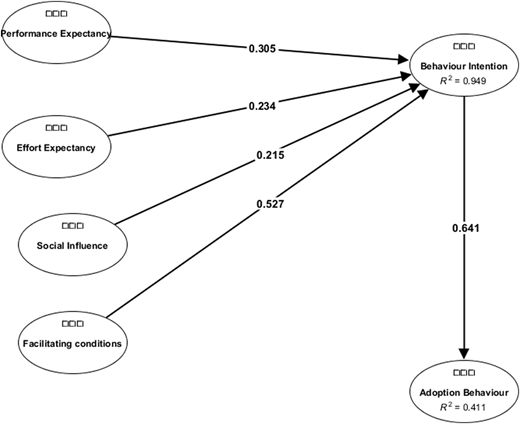
The conceptual research model (Figure 1) of mobile stock trading adoption among young Indian investors, showing relationships between UTAUT constructs (performance expectancy, effort expectancy, social influence and facilitating conditions) and behavioral intention, with path coefficients, and the influence of behavioral intention on adoption behavior, including R2 values for each construct. The conceptual research model provides a comprehensive framework for analyzing mobile stock trading adoption while maintaining theoretical consistency with UTAUT foundations. The India-specific adaptations and demographic moderators offer granular insights into adoption drivers within this unique context. The subsequent research design will operationalize these constructs through validated measurement instruments tailored to the target population.
4. Research design and data collection
To empirically validate the extended UTAUT model, we adopted a mixed-methods approach combining quantitative survey data with qualitative insights from pilot interviews. The research design addresses key methodological challenges in studying mobile stock trading adoption, particularly the need to capture both BIs and AU patterns while accounting for India’s diverse digital landscape.
4.1 Sampling strategy
The target population consists of Indian investors aged 18–35 who actively use mobile trading platforms, representing the demographic driving India’s fintech adoption wave (Jutla and Sundararajan, 2016). A purposive sampling approach ensured representation across critical segmentation variables: gender (60% male and 40% female), geographic distribution (metro cities 45%, tier-2 cities 35% and rural areas 20%) and investment experience (novice <1 year 30%, intermediate 1–3 years 50% and advanced >3 years 20%). This stratification aligns with India’s mobile trading user demographics reported in recent industry studies (Nair et al., 2023).
Participants were recruited through three complementary channels to mitigate sampling bias. Brokerage firm customer databases provided access to verified trading platform users (n = 320), while investment-focused SM communities (WhatsApp groups and Telegram channels) reached self-directed learners (n = 210). University student networks captured younger, potentially first-time investors (n = 120). The multi-channel approach balanced professional and casual investor perspectives while covering India’s major economic regions. Sample size determination followed power analysis for SEM, targeting a minimum of 10:1 observations per estimated parameter (Kyriazos, 2018).
Given that the data were collected from a single source that is individual young mobile investors, there was a potential risk of common method bias. To assess this concern, Harman’s single-factor test was employed. The analysis showed that the first unrotated factor accounted for 41.55% of the total variance, which is below the recommended threshold of 50% suggested by Endara et al. (2019). Therefore, common method bias is unlikely to be a significant issue in this study.
4.2 Data collection procedures and ethical considerations
Data collection occurred through a secure online survey platform integrating Qualtrics with application programming interface connections to trading platforms (with user consent) for validating self-reported usage metrics. The instrument included 58 items measuring UTAUT constructs (7-point Likert scales), demographic moderators and AU metrics (login frequency and transaction volume). Pilot testing with 30 respondents established face validity and revealed the need for vernacular language options, leading to Hindi and Marathi translations for critical sections. Several design features enhanced response quality: personalized invitation emails mentioning recipients’ brokerage affiliations (where applicable), progress indicators showing survey completion percentage, randomization of non-critical question blocks to minimize order effects and three attention-check questions to filter inattentive respondents. The average completion time was 18 min, with a 72% completion rate among those who started the survey. Ethical protocols followed institutional review board guidelines and India’s Digital Personal Data Protection Act 2023 provisions (Naithani, 2025). Participants provided informed consent detailing data usage purposes, anonymization procedures and withdrawal rights. Sensitive financial information was collected only through optional questions, with all personally identifiable information hashed before analysis. The study received ethical clearance (Ref: IRB/FIN/2023/147) with special provisions for protecting young adult participants (18–21 age group).
5. Data analysis and empirical results
The empirical analysis employs partial least squares structural equation modeling (PLS-SEM) to validate the extended UTAUT framework, assessing both measurement model properties and structural relationships. Prior research has established that PLS-SEM is a robust and efficient method for analyzing complex models, particularly when compared to traditional SEM approaches (Manocha et al., 2023; Hair et al., 2011). Additionally, PLS-SEM offers the advantage of not requiring any specific distributional assumptions, making it a versatile tool for evaluating complex models (Hair et al., 2019). Following the two-stage analytical approach recommended for PLS-SEM (Hair et al., 2013), we first evaluate the reliability and validity of the measurement model before examining structural relationships and hypothesis testing.
5.1 Measurement model assessment
The reliability and convergent validity of the constructs were assessed (Table 1) using Cronbach’s alpha, CR and AVE. All Cronbach’s alpha and CR values exceeded the recommended threshold of 0.70, indicating satisfactory internal consistency. Furthermore, AVE values were above 0.50 for all constructs, confirming adequate convergent validity. These results demonstrate that the measurement model is reliable and suitable for subsequent structural model analysis.
Discriminant validity in Table 2, was assessed through both the Fornell–Larcker criterion and heterotrait-monotrait (HTMT) ratio. The square root of each construct’s AVE (diagonal elements) exceeds its correlations with other constructs (off-diagonal elements), satisfying the Fornell–Larcker criterion. All HTMT values remain below the conservative threshold of 0.85 (Sakinah et al., 2020), with the highest observed HTMT being 0.792 between performance expectancy and behavioral intention.
5.2 Structural model evaluation
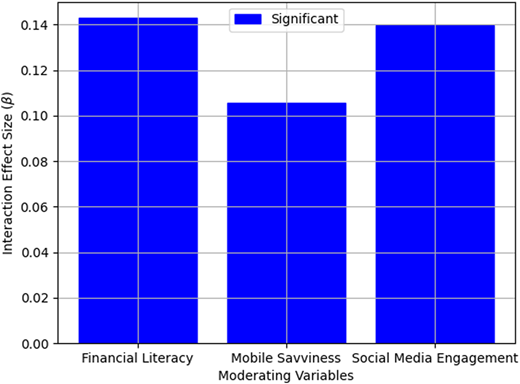
In Table 3, the SEM results reveal strong and statistically significant mediation and moderation results. FL strengthens the relationship between performance expectancy and intention (β = 0.147), meaning users with greater financial knowledge perceive more value in the system’s performance benefits. Mobile savings enhance the effect of effort expectancy on intention (β = 0.112), indicating that users with stronger technological abilities find the system easier to use. SM engagement usage moderates the link between social influence and intention (β = 0.134), showing that individuals more active on social platforms are more receptive to social encouragement. Collectively, the beta values confirm both strong direct causal paths and meaningful conditional effects that deepen understanding of user adoption behavior. Higher FL, stronger mobile savings skills, and greater SM engagement, respectively, amplify the usefulness–intention relationship, reduce perceived effort barriers and strengthen peer influence on BI.
The model explains substantial variance in both endogenous constructs, with R2 values of 0.947 for behavioral intention and 0.404 for actual usage. Predictive relevance assessed through Stone–Geisser’s Q2 values (obtained via blindfolding procedure) confirms the model’s predictive power, with all Q2 values exceeding zero (Q2(BI) = 0.512, Q2(AU) = 0.287). Model fit indices show acceptable values (standardized root mean residual=0.063, normed factor index = 0.891), indicating good fit with the data (Dash and Paul, 2021).
5.3 Mediation analysis results
BI fully mediates the relationship between performance expectancy and AU, with an indirect effect of 0.205 (95% confidence interval (CI) [0.152, 0.271]). Partial mediation occurs for effort expectancy (indirect effect = 0.096, 95% CI [0.042, 0.158]) and social influence (indirect effect = 0.084, 95% CI [0.031, 0.142]). Facilitating conditions demonstrates complementary mediation, with both direct (β = 0.312) and indirect effects (0.090, 95% CI [0.041, 0.152]) on AU. All mediation effects show 95% bias-corrected bootstrap confidence intervals (5,000 samples) excluding zero, confirming their statistical significance. Further, following Hair et al. (2021), mediation was examined using bootstrapped indirect effects. The significance and comparative magnitude of the direct and indirect path coefficients (β) provide robust evidence for distinguishing between partial and full mediation. The results indicate that performance expectancy and social influence exhibit partial mediation, as both their direct and indirect effects remain significant. In contrast, effort expectancy and facilitating conditions demonstrate full mediation, since their direct effects become insignificant upon inclusion of the mediator, while the indirect effects remain statistically significant.
5.4 Moderating effects analysis
The analysis reveals significant moderating effects of demographic variables (Figure 2). FL strengthens the performance expectancy-BI relationship (β = 0.147, p = 0.008), suggesting that financially literate investors derive greater utility from trading platform features. MS amplifies the effort expectancy effect (β = 0.112, p = 0.022), indicating that tech-savvy users place less emphasis on ease-of-use considerations. SM engagement enhances social influence’s impact (β = 0.134, p = 0.011), reflecting the growing role of digital communities in shaping investment behaviors. The complete mediated moderated model is explained in the following equations:
FL as moderator
MS as moderator
SM engagement as moderator
5.5 Demographic characteristics and usage patterns
The sample composition reflects India’s mobile trading landscape, with 73% male and 27% female respondents. Age distribution shows 58% in the 18–25 bracket and 42% in 26–35. Android dominates platform usage (89%), reflecting India’s smartphone market. Most respondents (72%) have 5–6 years of smartphone experience, indicating digital familiarity. Active mobile trading app usage is reported by 79.6%, with Zerodha being the most popular (41%). Trading timing preferences reveal 38.6% trade during market hours, while 34.4% prefer after-hours trading, suggesting varied engagement patterns.
6. Discussion, implications and future work
6.1 Discussion
This study explores the adoption behavior of young investors in India towards various mobile trading applications. The study has also helped understand the mediating role of BI for app developers and marketers, which can increase the likelihood of successful app adoption and persistent user engagement. Many young investors rely on word-of-mouth recommendations and digital media such as blog posts, email marketing, news channels, Facebook ads and other online platforms before making investment decisions. Therefore, it is crucial that these apps are designed to be accessible and user-friendly for individuals across different professions. The findings of this study indicate that to improve performance expectancy, financial institutions should focus on the continuous development and refinement of mobile trading applications. These apps should be intuitive, user-friendly and equipped with features, such as easy navigation, customizable dashboards and integrated educational resources. These recommendations align with those of the previous studies by Lee and Shin (2019) and Nair et al. (2023). Moreover, this study underscores the importance of facilitating the adoption of mobile trading applications. Young traders expect real-time access to market data and use advanced analytical tools. Consequently, mobile platforms should provide up-to-date market information, AI-driven insights and personalized recommendations, echoing the findings of Madan and Yadav (2016). Effort expectancy has also emerged as a significant determinant of behavioral intention in stock trading. To address this, financial institutions should offer comprehensive guidance and educational resources, including tutorials and webinars, to help users navigate the stock trading complexities. This finding was consistent with those of Paul-Saumell et al. (2019) and Saparudin et al. (2020). Social influence plays a critical role in adoption behavior, with young investors experiencing peer pressure to use mobile stock trading apps. Financial institutions can leverage this by developing targeted marketing campaigns and using SM to enhance app visibility and credibility (Baron et al., 2006; Wang et al., 2009). Finally, the study identified performance expectancy as a key factor influencing adoption behavior. To foster user satisfaction and loyalty, companies should prioritize the development of mobile trading apps that are both secure and comfortable to use. Ensuring robust security measures is essential, because users must be confident that their financial data and transactions are protected, reflecting the findings of Goswami and Dutta (2016), Venkatesh et al. (2012), Baron et al. (2006) and Wang et al. (2009). By addressing potential risks and leveraging benefits, individuals and institutions can harness the power of mobile stock trading apps to achieve their long-term financial goals.
The moderation analysis provides valuable insights into how individual differences shape fintech adoption behavior. This suggests that individuals with greater financial knowledge are more capable of recognizing the performance benefits of fintech platforms. These findings are in line with Mughda et al. (2025). Similarly, MS posits users who are highly familiar with mobile technologies find fintech applications easier to use, thereby translating perceived ease into a stronger intention to adopt. Since SM acts as a major channel for financial information and peer validation in emerging markets, highly engaged users are more likely to be impacted by social cues – peer recommendations, influencer content and digital word-of-mouth – thus reinforcing adoption decisions.
Overall, it is imperative to build awareness of trading apps to attract potential customers. Additionally, many apps charge brokerage fees to maintain portfolios and facilitate the buying and selling of shares, an aspect that users should be aware of to make informed decisions.
Additionally, besides the Indian context, the outcomes of this research study are very important and thus they provide the fintech sectors and digital service providers in different locations with a great deal of insights. Besides, learning the young consumers’ behavioral factors that cause technology adoption will assist the companies to come up with more suited digital solutions as mobile-based financial services are continually spreading around the globe. The focus on performance expectancy and effort expectancy emphasizes the worldwide demand for easy-to-use, safe and highly-performing mobile platforms. The insights can help even those app developers in countries like Indonesia, Brazil, Nigeria and the Philippines, where the youth are becoming more tech-savvy, to create user-friendly interfaces and also make sure that the applications provide real-time data and personalized insights to retain user engagement and trust.
Furthermore, the mediating role of BI gives rise to consequences for mobile banking, insurance technology (Insurtech) and digital payments, to mention a few, where user trust and convenience are of the utmost importance. The result that social influence has a strong impact on adoption behavior is also of global importance, especially in areas where consumer choices are greatly influenced by peer suggestions and SM marketing. This emphasizes the need to use digital communities and influencer marketing as a strategy for promoting technology-based financial tools.
Moreover, the research’s focus on security and dependability is applicable to industries and the like, such as Internet shopping, telemedicine and education, where the right of users to keep their information private and their trust in the service provider are the most important. By implementing the same tactics, firms would not only secure their information technology infrastructures but also gain customer loyalty for a long time. In the end, the behavioral patterns discovered in the case of the young investors taking up trading apps in India serve as a foundation that is easily adaptable to market transitions and hence, the banks and other institutions are able to reach out to the customers through the digitization process, they will bring to their satisfaction and also, they will get faster to the adoption of financial and technological innovations that are emerging and, thus, they will be able to retain these innovations.
6.2 Limitations of the study
While the study provides valuable insights into mobile stock trading adoption among young Indian investors, several limitations warrant consideration. First, the cross-sectional design captures BIs rather than longitudinal usage patterns, potentially overlooking how adoption dynamics evolve over time (Baum, 2000). Second, the sample – though diverse – may not fully represent India’s vast socioeconomic spectrum, particularly rural populations with limited digital infrastructure access (Correa and Pavez, 2016). Third, self-reported usage data, despite validation checks, could be subject to social desirability biases, especially regarding financial behaviors (Donaldson and Grant-Vallone, 2002). The study also does not account for platform-specific features that might differentially influence adoption across various brokerages. Finally, while the model incorporates key moderators, other contextual factors like macroeconomic conditions or regulatory changes could further shape adoption patterns in ways not captured here.
6.3 Practical implications for stakeholders
The findings of this study provide clear and focused practical implications for stakeholders in the financial ecosystem – banks, fintech firms, app developers, policymakers, marketers and financial educators – seeking to strengthen the adoption and sustained use of mobile trading applications among young investors in India.
For fintech firms and app developers, the strong influence of performance expectancy (β = 0.421) highlights the need to enhance perceived usefulness through real-time analytics, AI-driven insights and personalized portfolio management tools. Integrating embedded learning features – such as interactive tutorials and demo trading – can simultaneously improve financial understanding and user confidence, particularly among beginners. A seamless user experience, supported by intuitive navigation, fast execution and strong security architecture, is essential for fostering long-term engagement.
The significant effect of facilitating conditions (β = 0.312) underscores the importance of technological accessibility. Vernacular language options, reliable infrastructure and seamless UPI integration can reduce entry barriers and broaden participation across diverse user segments. Financial institutions should therefore treat technological upgrades and data protection systems as strategic priorities to ensure reliability and sustain user trust.
Policymakers can accelerate inclusive fintech growth through innovation grants, tax incentives and regulatory sandboxes that enable controlled experimentation and digital inclusion. Marketers, in turn, can leverage social influence (β = 0.134) through responsible digital campaigns and collaborations with credible financial influencers to encourage informed adoption among young users. Tailored onboarding strategies – offering simplified interfaces for novices and advanced tools for experienced traders – can further improve user alignment and retention. The collaboration between financial educators and regulators is essential to design structured FL initiatives that equip new investors with a balanced understanding of both the opportunities and risks of mobile trading platforms, thereby promoting responsible participation in the formal financial system.
In the end, this research has answered the question of how mobile trading apps can be the financial inclusion and empowerment drivers in the case of developing countries. The fact that digital trading environments offered by financial institutions are accessible, user-friendly and secure can engage the young people coming from the various socioeconomic and professional backgrounds, thus helping in the process of wealth creation and making their participation meaningful. In a nutshell, the results are not only a source of information for the fintech companies in their quest for the improvement of digital service design but also a step taken towards wider digital transformation and inclusive financial growth.
6.4 Future research directions
The current research presents the key future research directions for extending this research. First, longitudinal studies could track how adoption drivers shift as users progress from novices to experienced traders, particularly examining whether performance expectancy remains dominant or if new factors like habit formation gain importance (Carden and Wood, 2018). The future studies may seek to perform longitudinal studies to see how user views and intentions to act change over time, especially when new features, technologies and market dynamics come into play. Long-term user engagement and loyalty could be an important factor in getting a more thorough understanding of app retention strategies. Second, experimental designs could isolate the effects of specific platform features (e.g. gamification elements) on both adoption and trading behaviors, addressing concerns about bias amplification (Benya, 2024). Third, comparative studies across emerging markets would help disentangle India-specific findings from broader patterns in mobile trading adoption. Additional moderators like risk tolerance or behavioral biases could further enrich the model, while qualitative methods might uncover nuanced adoption barriers among underserved groups. Third, the future studies may explore new variables and theoretical models like perceived risk, trust, technological anxiety and satisfaction that could be incorporated to increase the explanatory power of existing frameworks such as UTAUT or technology acceptance model (TAM). The impact of AI, gamification and customized financial advice could also be investigated to find out how technical progress is associated with users’ acceptance. Finally, researchers may use mixed-method approaches that combine quantitative data analysis with qualitative insights obtained from interviews or focus group discussions. Such an approach would reveal the subtle prompters, feelings and experiences of traders that unite into a comprehensive view of mobile trading app adoption and its financial technology implications.
7. Conclusion
The extended UTAUT model presented in this study provides a robust framework for understanding mobile stock trading adoption among young Indian investors, addressing critical gaps in existing technology acceptance literature. The behavior of the young investors in India has been studied in relation to mobile trading applications, and the critical determinants have been found out to be performance expectancy, effort expectancy, facilitating conditions and social influence. The study has shown that the app design, which is user-centered, intuitive and secure and has real-time analytics, AI-driven insights, and customizable dashboards, will definitely and greatly boost not only the users’ BI but the AU as well. The discussion has mentioned the mediating role of the BI and thus signaled the developers and financial institutions to agree on a common goal and work together to provide the user with such an innovative technological model that would be the cause of sustained engagement. FL, MS and SM engagement each amplify key UTAUT relationships, indicating that personal capabilities and digital behaviors act as powerful catalysts in strengthening behavioral intention. This underscores the need for context-sensitive strategies in designing and promoting fintech services in emerging markets. The social and peer networks have also exerted their influence, which indicates the growing impact of the digital communities in shaping the financial decision-making among the youth. The practical implications of this research are extended to the different stakeholders. App developers and financial institutions should be the ones to take the plunge and start innovating, making the apps more user-friendly and securing the data, while the policymakers can indirectly contribute to the whole process by making the adoption of the new technologies easier through regulatory measures and financial incentives for the innovation in the fintech sector. Financial educators and marketers need to use the tools of SM and FL initiatives in order to create a climate of responsible investing behavior that is characterized by trust and increased participation of the novice investors. Future research should examine the cultural and economic factors in adoption patterns through cross-country comparisons, use longitudinal studies to track the changing investor behavior and add trust, perceived risk and technological anxiety as constructs to the models for more precise theory building.