The aim of this paper is to explore whether the use of an active learning methodology implemented through a mobile phone can help future teachers to develop more effective reading promotion activities than those based on traditional learning methodologies.
A study was conducted based on the comparison of perceptions of two groups of teacher training students. The experimental group was trained in an active methodology to promote reading on mobile phones, whilst the control group was trained in a classical methodology also using the same devices. Variables were observed using a self-administered questionnaire, and the scores obtained were analysed from their descriptive statistics of the comparison of means of Kruskal–Wallis H test.
The results showed that students perceived significant improvements associated with active learning methodology. The variables with the most remarkable results were those related to better use of the class, participation and satisfaction. However, the ubiquitous variable obtained the fewest differences, maybe because both learning methodologies were applied using mobile devices.
The conclusions of this study clearly suggest that combining active learning methodologies and the use of mobile phones to promote reading could lead to better results than applying traditional learning methodologies. The value of this study paves the way for future research to move forward in the discovery of effective teaching strategies based on active methods and mobile devices.
Introduction
This research focusses on a didactic method based on project work. For this purpose, it performs an empirical analysis of a teaching and learning experience on the development of reading promotion processes through mobile devices.
The didactic method we analyse is our own creation based on a much consolidated proposal among teachers: Project-Based Learning (PBL), which is a didactic method that takes advantage of the students' experience in the classroom through a process of teacher-guided research. The main phases of the method are as follows: (1) identification of the focus and the project goal; (2) design of the project and research for development; and (3) construction of a learning product for presentation (Vergara, 2015). These phases constitute the starting point for the design of the didactic experience under study.
Another important aspect to consider in the design of our didactic proposal is the pedagogical philosophy of PBL. It is an active learning method, since as it proposes a didactic situation in which the teacher takes on the role of mediator or organiser of didactic situations and the students take on an active role in their learning process. In addition, it promotes aspects such as: cooperation, horizontal communication and peer learning (Trujillo, 2016). This active character, through the pedagogical elements, is present in our didactic design.
The approach to the researched situation is conducted from the perspective of students of the bachelor's degree in Primary School Education, whose professional career is teaching at the basic levels of the educational system. In line with González López (2009), students' perception is considered a representative indicator of the quality of university teaching. Previous studies on active learning methodologies in the university concluded that students perceive significant improvements in different components of didactics (Allsop et al., 2020; González-Fernández et al., 2013).
In this study, PBL is adapted adding the contributions made by neuroscience to learn from narratives (Cable et al., 2013; Rizzolatti et al., 1996; Small et al., 2007; Stephens et al., 2010; Zak, 2015). The adaptations to the original method result in a new variant of PBL, which we have named Narrative-Based Learning (NBL). We define NBL as an active learning methodology that promotes research based on a narrative (story, novel, or film). It starts creating an emotional bond towards the narrative and finishes applying the learning product on the creation of own narratives.
When reviewing the literature, a large number of empirical studies on PBL can be found. The lines of research opened on this active methodology focus on the perception of the agents involved in its implementation (students and teachers); and, to a lesser extent, on its impact on the learning processes and products. Due to their impact, the works of Amante et al. (2010), Jollands et al. (2012), Kanigolla et al. (2014), Lee et al. (2017) and Wurdinger and Qureshi (2015) must be outlined.
All reviewed papers show that PBL promotes a more effective learning than traditional methods (Almulla, 2020; Granado-Alcón et al., 2020; Maros et al., 2021; Nóbile et al., 2021). In addition, the use of educational technology significantly improves motivation and ubiquitous learning (Almenara et al., 2017; Ashour, 2020; Hassoun, 2015). In this study we aim to find out whether such improvements over traditional methods can also be attributed to NBL in our reference context.
The literature review on NBL shows that this is a new method. The publications are recent, and the number of empirical investigations is significantly lower in relation to the PBL. In addition, most of the studies are prospective. The purpose of NBL research focusses on the identification of preconditions, possibilities, and difficulties regarding the implementation of the method. The studies by Serna-Rodrigo (2020) and Shinas and Wen (2022) can be included in this line of research.
To implement NBL in the teaching experience under study, we have made use of the students' own mobile devices in an m-learning process (also known as mobile learning). Thus, following Brazuelo and Gallego (2011, p. 17), “the construction of knowledge, the resolution of learning problems and the development of different skills or abilities in an autonomous and ubiquitous way is facilitated”. Research on the prospects of the use of ICT in education highlights that mobile technology has the highest rates of impact on students (Klimova, 2019).
Based on an experimental class designed combining m-learning and active learning methodologies, our observation is focussed on the student's perception in relation to different teaching aspects that have a direct impact on the teaching and learning quality. Then, we compare with an ordinary class in our context, where m-learning is implemented through a traditional teaching method.
In the framework of Educational Sciences, the principles of traditional pedagogy are as follows: one-way communication in the classroom; directive teaching, in which the teacher presents the knowledge that students must acquire; a passive learning role of students; and a rigid and closed definition of tasks and expected results (Sarramona and López, 2008). The method used to compare NBL is in line with these pedagogical principles.
This paper aims to produce knowledge that contributes to the evolution towards innovative pedagogical models at university. To this end, the objective is to contribute to understand the perception of university students on the application of NBL teaching method through mobile devices. To this end, we have observed variables related to the perception of the teaching process, such as: better use of the teaching experience, participation in learning and ubiquity; and variables more related to the perception of learning, such as: motivation, performance, and satisfaction. In previous researches, these variables have already been proven to be useful for observing the position of students and teachers in a given didactic situation (Colomo-Magaña et al., 2020; Sánchez-Rivas et al., 2019).
Considering the objectives and the reference context of the study, the following research question is asked: Does NBL method through m-learning improve students' perception of teaching and learning over a method based on traditional teaching principles?
Based on this question, the conjectural answer is specified through the following hypothesis (H) and its corresponding dependent variables (DV) and independent variables (IV):
NBL (IV) improves the student's perception of better use of the teaching experience (DV1), classroom participation (DV2), motivation (DV3), performance (DV4), ubiquity of learning (DV5) and satisfaction (DV6) over a method based on the principles of traditional pedagogy.
Methodology
Experimental design
This study was designed as an initial approach to the teaching situation researched.
From a methodological point of view, the purpose and the nature of the proposed objectives led us to formulate a comparative survey study for two groups (control and experimental), using a questionnaire as a data collection tool.
Taking as a reference the proposal of Cohen and Manion (1990) to conduct a survey study, and in order to organise the research actions, the three sequential stages were established as follows: approach; intervention and data collection and data analysis and reflection.
The approach was the initial research stage, where the teaching methodology was designed, and the classroom intervention was planned, following the sequence: emotional bond, research, and creation.
Emotional bond was the first teaching phase, which guided the students in an initial approach to the narrative, prior to reading. It sought to arouse interest in the subject matter, characters, and their experiences; and to grow an emotional bond between the narrative and the future readers. This phase was developed by promoting the discovery of the context, the approach to vocabulary and the formulation of a reading-driving question.
Narrative research was the second teaching phase. Whilst reading the narrative, the students conducted a guided research process, which oriented learning towards the proposed objectives. Locations, characters, and evolution of the argument plot were analysed.
The creation phase was developed based on the knowledge from the previous phases: personal emotions, narrative context, locations, characters, learning, etc. The task for the students consisted in creating their own narratives to publish them using their smartphones.
The experimental part of this research was conducted in a context of official university teaching. In some groups, the teachers taught the concerned core theme as in previous courses, using, for comparative purposes, a so-called “traditional” method. In other groups, the teachers developed an alternative teaching experience based on NBL method. In both cases, the students' own smartphone devices were used (see Table 1).
Data analysis and reflection
Once the core theme was given in the participating groups, the questionnaire was shared. Data analysis delivered results that are also addressed in this paper. Reflective practice sessions, where all members of the research team took part, were conducted to draw conclusions based on the results obtained. The most significant interpretations made possible to draw up the conclusions set out below.
Participants
The key element of our research is the description of the variables defined for the total reference population (N = n): the students enrolled in the subject “Information and Communication Technologies applied to education” within the bachelor's degree in Primary School Education of the University of Malaga (Spain). This is an academic course taught as basic training for all groups of the first academic year. An overall of 298 students from five different groups participated in the research. Two groups (n1 = 120) followed NBL methodology for the core theme “Encouraging Reading with Technology”, and the other three groups (n2 = 178) followed the traditional method for the same core theme.
With regard to the sample, it should be noted that all participants had their personal smartphones. This was a great advantage since the knowledge and skills level on the device was remarkably high. The students had no issues on installing reading or content creation apps (presentations, podcast, comics, etc.). Thanks to the university's WIFI connection, there were no navigation difficulties on the different resources designed for the NBL application.
Instrument
The design of the data collection instrument was based on a qualitative strategy: the focus group (León and Montero, 2003). In view of the nature of the study, we considered that the most appropriate instrument was a five point Likert-type scale questionnaire (5 = always, 4 = often, 3 = sometimes, 2 = hardly ever and 1 = never).
In its design process, the questionnaire was subject to a content validity test, by an expert judgement, based on the assessment of a group of fifteen university teachers. Each expert evaluated the items and classified them as “unnecessary”, “useful” or “essential”. From the experts' scores, the Content Validity Index (CVI) was determined. As a result of this review process, and in accordance with the recommendations (Lawshe, 1975), items under a validity ratio of 0.49 on the CVI were removed. The resulting questionnaire included 24 items. The group of experts also provided a qualitative assessment through the comments section proposed for each item and for the questionnaire as a whole. Based on these contributions, some wordings were reformulated and the items were structured in six blocks of questions: better use of the teaching experience, classroom participation, motivation, performance, ubiquity and satisfaction. Each of these blocks corresponds to a dependent variable (Table 2).
The expert-validated version of the questionnaire was tested in a pilot, conducted through our university's Moodle platform. The data obtained in the pilot allowed to determine the degree of internal consistency of the questionnaire, with Cronbach's alpha coefficient. The results were assessed based on the criterion proposed by (Mateo, 2012). Thus, values above 0.7 were considered acceptable. According to this reference, the results of Cronbach's alpha (Table 2) allow us to ensure the reliability of the instrument. Nevertheless, it is important to note that this instrument is not exempt from the influence of validity threat elements, which may come from the research team itself (given its status as implementer) and from the previous experiences of the participants in pedagogical innovation processes.
Data analysis
The data obtained were analysed using the SPSS statistical software (version 25). As required for hypothesis verification, data analysis focussed on descriptive statistics, followed by further comparison of the mean scores achieved by each of the methods on the dependent variables.
The first phase of data analysis was an initial data discovery, for descriptive purposes. This action resulted in a univariate descriptive analysis and the cleaning of the data matrix for grouping the mean scores associated with each variable. Based on the sample mean for each item, the mean of the dimensions of each observed methodological scope (comprising the seven dependent variables) was calculated.
The second phase of data analysis consisted of a bivariate analysis. The first task was to determine the significance of the variance between the two methods. For this purpose, the sample parametric assumptions were analysed applying the Kruskal–Wallis H test.
Results
The results of the initial data discovery analysis (Table 3) focussed on the mean scores of the subjects in the control group (traditional method) and the experimental group (NBL method) in each item of the questionnaire.
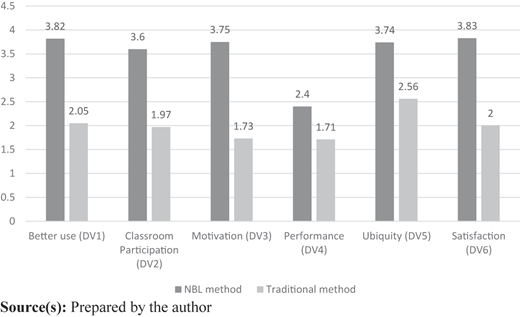
Comparison of mean scores showed that NBL method generally yields higher scores than traditional method. In items 15 and 16, related to performance (DV4), scores were significantly lower than the mean of the other items (x– = 3.52). Subjects in the experimental group perceived that NBL does not improve the traditional method on the possibility of applying the acquired knowledge (item 15) or on the proportionality between effort and learning results (item 16).
The scores of the control group following traditional method showed a lower mean (x– = 2.00) than NBL in all dimensions of the variables, except for those related to ubiquity (DV5). The scores obtained in items 17, 18 and 19 showed that subjects perceive that the traditional method using their smartphone had given them the possibility to access the narrative when needed (item 17); it allowed them to check the planned phases and tasks through the teaching and learning process when needed (item 18); and learning had extended beyond the classroom (item 19).
Drilling down into the descriptive level, the bar chart shows the differences between NBL and traditional method that were already showed by the measures of central tendency (Figure 1).
The differences between NBL and traditional method showed by descriptive statistics led to a comparison of the scores of the dependent variables using inferential statistics, so as to determine the significance in variance. Prior to the comparison of means, the parametric assumptions regarding homoscedasticity and normality of the sample were checked.
The values obtained through Kolmogorov–Smirnov goodness of fit test (applying Lillierfors significance correction) are below the significance level , so we accepted that the variables observed were not normally distributed (Table 4).
With regard to the homogeneity of the sampling variance, Levene's statistic test resulted in a significance in two variables (DV3 and DV5), and values lower in the others (Table 4). This led us to accept that there was no homogeneity in variance.
The results obtained proved that the parametric assumptions regarding the sampling were not met. On that basis and considering that we had two different groups (experimental and control), and a subject is not at more than one level of the independent variable, we chose to perform the comparison of means using the Kruskal–Wallis H test.
The results of the Kruskal–Wallis H test were within significance parameters , which confirmed the existence of statistical significance in the differences found between NBL and traditional method in all variables analysed (Table 4).
Discussion
In this study we have focussed on the university students' perception on two teaching methods to promote the development of reading competence: NBL method and the so-called “traditional” method, for comparative purposes. Overall, it is confirmed that a teaching method based on an active position of the student in the learning process, such as NBL, has significant advantages from the student's perspective versus teaching methods based on the reception of knowledge. These conclusions are in line with other studies on the use of active learning methodologies in the classroom (Lugosi and Uribe, 2022; Miller and Metz, 2014).
Both methods have been implemented through educational technology and the students' own smartphone devices have been used as the main resource. We believe that this fact has decisively influenced the teaching and learning process beyond the classroom, measured as “Ubiquity”. This is the only variable reported with similar values in both methods, what suggests that, rather than the method, the use of a technological resource was the decisive factor for the results. Previous work on the use of the smartphone as a teaching resource has also found advantages linked to ubiquity (Brazuelo and Gallego, 2011; Uther, 2019).
The incorporation of educational technology is also linked in previous work to increased motivation (Boyce et al., 2014). In our case, we cannot confirm that relationship. Although we have observed an increase in motivation, we consider that it cannot be attributed to the technological resource, but to the combination between the NBL and the use of the Smartphone. In this sense, we agree with Cabero Almenara (1994), who argues that technology by itself does not improve teaching; it is the binomial formed by technology and pedagogy that achieves significant improvements.
More specifically, some of the advantages directly related to didactics and attributed to active methods (Baepler et al., 2014; Caesar et al., 2016) have also been found in NBL in our reference context. The learning aspects perceived by the students as improvement over the traditional method are better use of the class and participation in the learning process. This is an expected result, as NBL complies with the principles of active learning and the reviewed research on the implementation of storytelling and creativity in the classroom shows that these competences not only add value to learning but also to the organisation of learning situations (Daouk et al., 2016; Di Blas, 2022; Katuščáková and Katuščák, 2013; Linds et al., 2021).
With regard to the most associated variable to personal willingness to learn, the greatest differences were found between both methods. As expected, NBL improves the perceptions on the motivation to learn. This is a proven effect of active learning methodologies (Powell et al., 2012). However, it was not expected that the subjects in the control group suffered from low motivation on an established didactic situation in our context, also based on m-learning. All reviewed researches identify an increase in the student motivation due to technology implementation (Lindquist and Long, 2011; Mujico and Herrarte, 2019; Rosas et al., 2003; Stockwell, 2013; Tang et al., 2022). Our results do not follow this research line, and it can only be explained if we considered that the teaching actions of the traditional method are far from what our students consider an interesting and motivating teaching.
On the assessment of the variable related to the learning impact on the student, also called performance, it is noticed that NBL improves important aspects for deep learning such as access and understanding of new knowledge. This is another advantage found in active learning methods: engagement in the teaching process directly affects to the quality of acquired learnings (McQuiggan et al., 2008). However, the students do not perceive NBL favours the application of new knowledge. This impairs the possibility of meaningful learning from NBL, as applying acquired knowledge is a key to achieve it (Ausubel, 1968). From a pedagogical design perspective, this finding suggests a review of the method in order to increase the application of acquired learnings.
The perception of effort is in line with the performance results. Our students considered that there is no relationship between the effort invested and the learning acquired. This relationship is balanced in other studies on active methods (Carreira and Marzábal, 2018; Hmelo-Silver, 2004; O'Brocta and Swigart, 2013). In our opinion, that NBL is not likewise perceived as other active methods is due to the fact that it proposes tasks that involve great effort and dedication by the students, such as research on a novel or creation of a narrative. We believe that the learning acquired is not deficient, but the effort needed is high. Besides, we also identified it as a component of the method to be reviewed for future applications.
According to Rios et al. (2018), we understand that teaching improvements have a direct impact on satisfaction. In this regard, the satisfaction variable has a dual function. Firstly, it captures students' perception of a personal position on the process experienced. It makes us reflect and evaluate it from a holistic perspective. Secondly, satisfaction should be consistent with the results obtained in the other variables. For example, a high satisfaction value together with low values in the considered teaching dimensions could not be explained.
The good results obtained by satisfaction in all its dimensions lead us to conclude that, in general, subjects have a positive perception of NBL as a whole, even though some components of the method can be improved.
Other studies have also found high values on participants' satisfaction when assessing learning situations based on the principles of active learning methodologies (Hyun et al., 2017; Pelletreau et al., 2018) or through technology, especially mobile devices (Mao, 2014).
In conclusion, and taking as a reference the formulated hypothesis, the results obtained allow us to state that NBL, implemented by using mobile devices, is perceived by the student as a better methodological alternative than the method applied by the teacher of the subject “Information and Communication Technologies applied to education” for the core theme “Encouraging Reading with Technology”.
NBL has enabled better personal use of the teaching experience, greater participation of students in their learning processes and a significant degree of ubiquity of learning, related with the use of students' mobile devices as the main learning resource (rather than NBL).
The improvements perceived in NBL also extend to the introspective perspective. Students are much more motivated to face their learning process than in the previous method. They identify better access and understanding of the new knowledge, although opportunities for its application are not found. And they understand that NBL has very high levels of demand in terms of time and effort investment. Nevertheless, students who have experienced NBL are much more satisfied with the teaching experience than those under the traditional method.
This study has important limitations due to its own nature. The situation of the university students' object of the research is heterogeneous and changing. Each classroom is different, and this fact affects the study described in this paper. In this regard, choosing a population limited to university students suggests avoiding extrapolation of results beyond its context. However, these limitations related to sampling size and research context location have not been an obstacle to decisions aimed at improving teaching in our faculty, so the planned initial objective is met.
In order to further enhance university teaching quality in other contexts, research processes following this paper are advisable. We are convinced to suggest the scientific community to develop new researches that further study teaching approaches. It would be interesting to conduct studies that expand the population and include students from several universities. Concurrently, and considering the great complexity of education, the variables studied should be increased. We agree with Bisquerra Alzina (2004) on the suitability of using data analysis procedures that correlate more than two variables. The complexity of educational phenomena shows limitations if few variables or only bivariate analysis are considered. A large number of variables are involved in education, and they should be much deeper and globally analysed following a multivariate approach.
With regard with limitations, it should be noted that the personal variable associated with the teacher who conducts the subject has a huge impact. Undoubtedly, the referenced professional paradigm, the teacher's personality or the way of interacting with the students greatly determines satisfaction to a teaching methodology. This should be considered if the study involves different professionals as in this study. Similarly, the content of the subject could also influence satisfaction to the teaching method. Attractive content, at the students' interest and motivation, could report higher levels of satisfaction with the teaching method. In our case, even in similar core themes, the development of the contents may be slightly different as two different professionals have undertaken their programming.
This study is part of an open line of research that has the potential to improve didactics in university contexts. Active learning methods bring considerable advantages for university teaching (Anaya, 1996). These methods are not perfect, as our students perceive in relation to NBL. As they are new and rebuilt in each context, they require constant observation of their development. Therefore, we recommend the scientific community to generate knowledge on active methods in order to contrast, improve, and adapt them to their reference context. This is not a new recommendation, other studies have pronounced in the same sense (Andres, 2019; Duţă and Rafailă, 2014; Holdsworth and Maynes, 2017).
More specifically, we encourage the scientific community to elaborate on a question that has arisen in our research. In our study, smartphone use following a traditional learning method did not report high levels of motivation. We cannot predict how the “motivation” variable would have behaved outside of m-learning, but we consider that technology without following an active methodology does not represent a great improvement in terms of student motivation either. This conviction does not allow the assertion, and we invite the scientific community to work on this hypothesis.