Skip to article sections
Purpose

With the increase of hybrid working, it is important to understand workers’ choices between remote and onsite working. Yet, few studies have investigated remote working and user experiences of offices together. The purpose of this study is to profile hybrid workers in terms of the factors in remote and onsite working that are perceived as important for work location choices. The other aim is to explore the role of office design in perceiving onsite working as attractive.

Design/methodology/approach

This cross-sectional mixed-methods study involves four Finnish organizations. Data was collected in 2023–2024. Survey data (n = 533) was analyzed using cluster analysis to identify profiles of work location choices. Theme interviews (n = 71) were analyzed qualitatively.

Findings

Five profiles of work location choices are identified, showing that most workers combine remote and onsite working flexibly, although with different emphasis. Two profiles prefer either remote or onsite working. Interviews reveal that agreements and practices concerning meeting arrangements are important for work location choices. Having better conditions for work requiring concentration at the office and certainty that colleagues will be present increase willingness to work onsite.

Practical implications

Hybrid work models, the meeting culture and office design should be developed together, with the recognition of the variety of needs and behavioral patterns among employees.

Originality/value

This study provides novel evidence and perspectives on work location choices and the role of the office in hybrid work.

Following the increased remote working during the COVID-19 pandemic, many organizations are facing new challenges (Razzetti, 2023). The proportion of workers who work more remotely than at the workplace has increased in many countries (Eurofound and European Commission Joint Research Centre, 2024; Eurostat, 2024). Remote working is, thus, no longer only an individual flexible arrangement but can have wider effects in organizations where the individual choices lead, collectively, to low presence rates at the office. This phenomenon could affect, for example, the amount of office space and the types of workspaces needed, the role of the office, organizational tasks that rely on communication, employee well-being and the leadership and management of work – all relevant to organizational productivity (Lindeberg et al., 2024; Ruiz de Castañeda Altuna et al., 2025). On the other hand, optimal models of hybrid work (work combining remote and onsite working) can also support organization’s success (Razzetti, 2023). Consequently, the work location choices and motives of hybrid workers pose a new question for research as well as for organizations, with various potential implications on hybrid work models and strategies, leadership and office design.

Remote working and the user perceptions of offices have long been separate topics of research, although their interconnections have been noted in, for example, studies on multilocational work (Vartiainen et al., 2007), and more widely following the COVID-19 pandemic (Bergefurt et al., 2024; Haapakangas et al., 2025; Yang et al., 2023; Appel-Meulenbroek et al., 2022). With regard to reasons to work remotely, studies show both work-related and nonwork-related motives (Thompson et al., 2022). Common reasons include better productivity, work–life balance, such as tending to family and other nonwork demands (Stephens and Szajna, 1998), and avoiding commute (Bloom et al., 2015; Wang et al., 2024; Thompson et al., 2022; Borzikowsky et al., 2023). Remote working can also reflect attempts to cope with negative experiences at the workplace, such as office distractions (Kaarlela-Tuomaala et al., 2009) and psychosocial stress (Shao et al., 2021; Fonner and Roloff, 2010). Most employees have more than one motive for working remotely but, on the other hand, remote work is not favored by all (Thompson et al., 2022). Remote work also has risks, such as isolation (Gajendran et al., 2024) and the blurring of boundaries between work and personal life (Palumbo et al., 2022). Thus, the existing knowledge on remote work points to the importance of understanding individual differences in remote work motives.

Another line of research that can shed light on potentially important factors in hybrid work choices has focused on workspace choices at the workplace (Haapakangas et al., 2023; Appel‐Meulenbroek et al., 2011; Hoendervanger et al., 2019). Contemporary office design often relies on the assumption that workers choose a workspace depending on their activity, e.g. concentration or communication (Masoudinejad and Veitch, 2023). Empirical findings, however, show a more complex reality as a reluctance to switch workspace (Appel‐Meulenbroek et al., 2011; Haapakangas et al., 2023) and a mismatch between activity and workspace type are also common (Hoendervanger et al., 2019). Practical difficulties in moving to a suitable workspace, indoor climate (Kim et al., 2016; Appel‐Meulenbroek et al., 2011), social relations (Bäcklander et al., 2021) and psychological needs (Gaudiino et al., 2024) also affect workspace choice. Furthermore, worker’s own behavior in choosing workspaces to meet his/her needs is a key in explaining the benefits of the work environmental design (Hoendervanger et al., 2019; Gerdenitsch et al., 2018). These various motives and behaviors suggest that workspace choices are likely also complex when they extend to remote work options.

Several studies have explored work location preferences in hybrid work in recent years, focusing mostly on task-related needs (Shao et al., 2021; Rücker et al., 2024; Bergefurt et al., 2024; Appel-Meulenbroek et al., 2022). These studies show that the office is generally preferred over remote working for interactive needs and activities (Shao et al., 2021; Yang et al,. 2023; Appel-Meulenbroek et al., 2022; Rücker et al., 2024). Although the locations preferred for focused work are less clear (Bergefurt et al., 2024; Yang et al., 2023), distractions are generally an important determinant of work location choices (Appel-Meulenbroek et al., 2022; Asmussen et al., 2023), and sufficient privacy at the office may make onsite working more appealing (Haapakangas et al., 2025). Services near the office, such as restaurants and exercise facilities, might be another reason to favor onsite work (Castellum, 2023). Daily stress factors also affect the choice of work location (Shao et al., 2021). Thus, various types of motives appear to regulate hybrid working.

Taken together, the literature on work location choices lacks a balanced perspective that encompasses both work- and non-work-related motives across remote and office environments. Another gap concerns individual differences in hybrid working. Appel-Meulenbroek et al. (2022) identified two employee segments that differed in preferences of office- and home-based working, but this investigation was limited to work tasks and workplace conditions. Wang et al. (2024) found five profiles of remote work motives, but did not cover motives to work onsite. Both studies were also conducted during the COVID-19 pandemic meaning that they may not apply to post-pandemic hybrid work.

Theoretically, the concept of job crafting can be applied to work location choices, viewing them as a self-regulation strategy in hybrid work (Biron et al., 2023; Demerouti, 2025). Job crafting refers to individuals’ proactive behaviors to “balance their job demands and job resources with their personal abilities and needs” (Tims et al., 2012). Work environments include resources that help achieving work goals and demands that require sustained effort leading to physiological and/or psychological costs (Demerouti et al., 2001). Thus, hybrid work can enable individuals to regulate the resources and conditions relevant to their daily work and non-work goals across remote and onsite work environments (Demerouti, 2025). Although the majority of literature on job crafting concerns psychosocial work environment, several concepts extend it to the choice of physical workspace or location, including time-spatial job crafting (Wessels et al., 2019), environmental crafting (Roskams and Haynes, 2021), physical or spatial job crafting (Randel et al., 2024) and task-environment crafting (Bäcklander et al., 2021). As most of these concepts have focused on crafting within the office, job crafting of the hybrid work environment represents a new avenue of research.

To address the gaps identified above, our aim is to explore individual differences in work location choices with a balanced approach that includes work- and non-work-related reasons related to both remote and onsite working and to identify factors related to office design that are perceived to make onsite work more attractive. The aims were addressed using survey and interview data from four organizations.

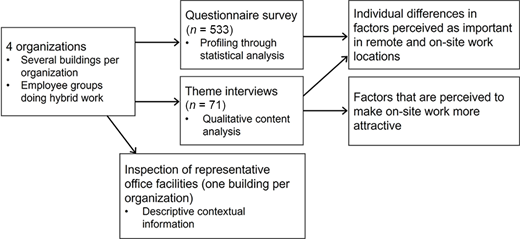
This cross-sectional mixed-methods study involved four Finnish organizations (Figure 1). The study was a part of a larger project concerning the best practices, opportunities and risks in hybrid work. Each organization had facilities in multiple locations in Finland and one included also a branch office in Sweden. Two of the organizations were city organizations and two IT companies. The organizations participated in the project because of their interests to learn from research data and each other and to develop their hybrid work models.

Survey data was collected electronically between November 2023 and February 2024 (n = 533, response rate 59%) (Table 1). We also conducted semi-structured theme interviews (n = 71) between May and September 2023. The survey and interviews targeted the same groups of employees in each organization. As selection criteria, we included employees who did hybrid work and could decide their work location independently. We also gathered documents on workspaces (e.g. layout drawings, workplace guidelines), and a systematic inspection was conducted to a representative sample of the workspaces of the target groups in each organization’s headquarters in Finland.

The study was approved by the Ethics Review Board of the Finnish Institute of Occupational Health, Helsinki, Finland on April 14, 2023, and followed the guidelines of the Finnish National Board on Research Integrity TENK. All participants provided their written or recorded informed consent to participation.

Most organizations (A, B and C) had very flexible telework arrangements with no compulsory organization-wide minimum for working onsite. One organization (D) had a policy of a maximum of 12 remote working day per month.

All the organizations had facilities in multiple locations, in different cities or within the same city. The inspected workspaces in each organization’s Finnish headquarters were environments for knowledge work. All offices included break rooms or working cafés, support spaces (printing, mail, etc.) and meeting rooms for internal and external meetings. Organizations A, B and C had activity-based offices (ABOs) with mainly unassigned workstations. Organization D’s office consisted of a combination of open-plan office and private and team rooms with assigned workstations. This office included only a few meeting rooms or enclosed workspaces for those working in the open-plan office. The ABOs in turn had a varying amount of enclosed non-assigned rooms for individual work, project or team rooms or areas and informal collaboration spaces or areas. In Organizations B and C, the ABOs also had separate silent working areas.

Three of the organizations (B, C and D) also had some special-purpose facilities (e.g. production and machine facilities) or customer service functions onsite. Organization A’s office had a strong emphasis on social and meeting spaces, as many employees also worked regularly at their customers’ premises.

Organization C’s inspected office had been built entirely very recently (2023). Organization A and B’s offices had been largely renewed in the 2010s. Organization D’s office was visually close to its original 1990’s condition, but furniture and equipment at the premises were relatively new. In all the facilities, at least some improvements or changes (technical, functional, general comfort and coziness, use of space) had been made in recent years before the study. The design of the ABOs was mostly modern and of good quality.

The questionnaire, covering several themes in hybrid working, was developed based on previous findings (Thompson et al., 2022; Stephens and Szajna, 1998; Appel-Meulenbroek et al., 2022; Yang et al., 2023; Asmussen et al., 2023; Wang et al., 2024), recent commercial reports (Castellum, 2023) and the preliminary interviews of the study. For this study, we analyzed two questions on work location choices. Of remote work, respondents were asked “At the moment, how important do you find the following pull factors in terms of drawing you to work remotely,” followed by nine items which were separately rated (see Table 2). Of onsite working, respondents were asked to rate ten items with a similar question in which “work remotely” was replaced with “work at your primary onsite location” (see Table 2). The response scale was 1 = Not at all important, 2 = Not particularly important, 3 = Fairly important and 4 = Very important.

In addition to the general selection criteria (Section 2.1), the organizations were asked to find interviewees, including both women and men, different ages and including also managers. These pre-set criteria were filled quite well in the final group of interviewees. The researchers emailed invitations for the interviews to a target group agreed with each organization. Volunteers from this group could reserve an interview time online until the desired participant number was reached in each organization.

The structure of the interviews followed an agreed protocol, starting with basic background information and followed by main themes (personal and work community remote work practices; office work environment and remote work environment; digital tools and digital support; wishes and good practices). The main themes were divided into sub-themes and guiding questions. For this study, we limited the interview material to the sub-themes and questions that were related to the choice of work location (work or private life factors) and factors that might encourage the interviewees to work more at the office, including improvement wishes for the office environment (see Supplementary material). Qualitative content analysis was used to analyze the interviews.

Sixty-nine of the interviews were conducted in Finnish and two in English. Most of them were conducted remotely via Teams, but six were conducted face-to-face. The interviews lasted on average approximately one hour each and were audio-recorded and transcribed in the full.

To analyze survey data, we used K-means clustering to categorize various work location motives. K-means clustering is an unsupervised machine learning technique that is especially useful when researchers want to classify variables into groups that are as similar as possible without prior knowledge of the group division (Ikotun et al., 2023). Before cluster analysis, variables were standardized to make the interpretation of cluster centers easier. When assessing the total number of clusters, we compared solutions ranging from two to ten clusters. Based on Akaike (AIC) and Bayesian (BIC) information criteria, adding clusters continuously improved the model up to ten clusters, but interpretation became increasingly challenging after five clusters, leading us to choose the five-cluster solution. Based on the variance analysis, group differences between clusters in work location choice variables were statistically significant (p <0.001). Tamhane’s T2 test was used to analyze paired differences between clusters since the assumption of equal variances was rejected. Analyses were performed using IBM SPSS version 27.0 and RStudio.

The purpose of the qualitative analysis of interviews was to produce more detailed and practical information on factors related to onsite working. Thus, we used the same items of remote and onsite working as in the survey to code and categorize interviewees’ answers that described the factors affecting their work location choices. Answers that did not fit any of these categories were sorted under “other: remote” and “other: office.” The answers describing factors that might encourage the interviewees to work more at the office were coded and categorized into work-environment-related and other factors. The categories were then compared quantitatively to see, which categories were mentioned the most by different interviewees. The most-often-mentioned categories were also analyzed for re-occurring themes within one category.

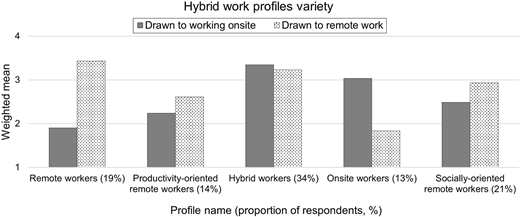
Table 2 illustrates cluster centers for the five-cluster solution of different workspace motivations based on survey results. Descriptive statistics, including means and standard deviations, are presented in Table 3. Figure 2 shows the variety between clusters in how strongly remote and onsite work are favored, averaged across different motives of remote and onsite working.

The first cluster (n = 86, 19%) represents those who were least motivated by the office work items and most motivated by nearly all remote work items. They were named as “remote workers.” The second cluster (n = 63, 14%) represents those who were drawn to remote work because of its efficiency and ability to focus, but not as much as the first group by day-to-day running activities, hobbies or care responsibilities. They were named as “productivity-oriented remote workers.” The third cluster (n = 158, 34%) represents those who were most motivated by office facilities, such as ergonomics, technological equipment, opportunities to concentrate, better efficiency and nutrition. On the other hand, they also valued most of the benefits of remote work. They were named as “hybrid workers.” The fourth cluster (n = 60, 13%) describes employees who were least motivated by remote work and most of all by onsite opportunities for joint ideation, ease of information exchange, spontaneous encounters with colleagues and greater efficiency at the office. They were named as “onsite workers.” The last cluster (n = 95, 21%) represents those who were motivated by all aspects of remote work to some extent, but most of all by meetings with colleagues in the onsite premises. Other aspects of onsite work, such as efficiency or technological equipment, were not that important for them. They were named as “socially-oriented remote workers.”

Most interviewees reported that they were able to choose very independently whether to work remotely or onsite at the office. Some restrictions were set by the organizations’ general remote work policies and the requirements for customer service at the office or working together with customers at their premises.

When asked about how the interviewees chose the location where they work at any given time (work- or private life-related factors), they described a large variety of factors relating to workplace agreements, work task-related needs and work conditions at home or at the office. The reasons for work location choices are summarized in Table 4 in more detail (see column “Simple expression”).

Well over half (n = 46) of the interviewees mentioned at least one reason for coming to the office that was related to meeting colleagues. Many of these reasons were connected to established practices or agreements within the workplace community. Although meeting others and meetings in general was a common factor to choose to work at the office, a large number of remote meetings was also mentioned as a reason to work remotely by several interviewees (n = 11).

Common reasons for choosing remote work included personal life considerations, such as savings from time spent commuting (n = 21) and everyday convenience in taking care of day-to day running (n = 22), as well as opportunity to concentrate on individual work (n = 17) when working remotely.

Some described either working remotely or working at the office as a clear basic setting, where choosing another setting requires a specific reason. Others described the choice as flexible depending on work tasks. Going to the office for a specific reason could also mean working there the whole day, for half a day or a small part of the day (e.g. going there for a specific task or meeting and then returning home). Some interviewees did not identify a particular reason to choose one or the other location. Going to the office or staying at home was simply a habit or the easier option.

The factors described in the interviews that could motivate the interviewees to work more at the office are described in detail in Table 5. Other development wishes for the work environment and hybrid working policies were also described in the interviews, but only the ones that the interviewees stated could affect their choice of location, if changed, are included in the table.

More than half (n = 39) of the interviewees recognized factors in which certain changes could motivate them to come to the office more often. Several (n = 18) also said that the presence of other people at the office would motivate them to come there more often. Some found value in just meeting people in general, but others wished also for more pre-planned activities together.

Close to half of the interviewees (n = 28) found that changes to the physical environment at the office would motivate them to come there more often. Sixteen interviewees found that improvements (or in a few cases deterioration) on the conditions for concentrated work would affect their motivation. They brought up the need to have more peaceful and disturbance-free workspaces at the office but also shared office rules to reduce disturbances. Twelve interviewees stated that having more enclosed spaces available for virtual or face to face meetings, teamwork or concentrated work would motivate them to come to the office more. Several interviewees (n = 18) also reported having very good office spaces currently. Some already worked at the office almost daily.

This study provided new insights into work location choices in hybrid work. Our balanced approach covered both work- and non-work-related issues in remote and onsite working. Thus, these results capture the reasons regulating hybrid work choices more comprehensively compared with recent studies that have emphasized either remote work (Wang et al., 2024) or the office (Haapakangas et al., 2025; Appel-Meulenbroek et al., 2022). The results also highlight individual differences in the resources of remote and onsite working employees are drawn to (Wang et al., 2024). Such differences are important to consider in organizations’ hybrid work models because, to be successful, hybrid work should combine benefits for both the organization and individuals (cf.Gohoungodji et al., 2023).

Most survey respondents appeared flexible in combining remote and onsite working, although with different emphasis (Figure 2). This is compatible with the assumption that work location choices reflect job crafting (Wessels et al., 2019; Demerouti, 2025) where workers actively take advantage of the resources of different environments to create work conditions that match their daily needs. Interestingly, only “hybrid workers” appeared to value various resources in both the office and remote work environment and found both locations to support their productivity. On the other hand, two profiles suggest a general preference of one location over the other, namely, “remote workers” and “onsite workers.” The interviews suggest that such employees might perceive work conditions as unsuitable at the other location, for example, due to having small children or no workspace at home or being dissatisfied with the office environment. These observations are in line with previous studies (Haapakangas et al., 2025; Gohoungodji et al., 2023; Wang et al., 2024). In addition to the actual resources available at different locations, the differences between profiles may also reflect individual skills in flexible working or factors constraining the choice, e.g. remote work policies, job characteristics or conditions in personal life (Gohoungodji et al., 2023). Further research on individual differences and their significance to successful hybrid working is, thus, warranted. Future studies could also address differences between managers’ and employees’ profiles as managers may be less drawn to remote work (Borzikowsky et al., 2023).

Our results also contribute to the complex questions regarding hybrid workers’ productivity (Bergefurt et al., 2024; Razzetti, 2023; Bloom et al., 2024). As in previous research (Wang et al., 2024; Thompson et al., 2022), remote working was valued for multiple reasons (better productivity, the possibility to concentrate, saving from commuting time and day-to-day running), whereas the main reasons for coming to the office were social (Tables 3 and 4). Work location choices appear to provide means for job crafting that enables employees to meet their daily work and non-work goals, supporting their work engagement and productivity in hybrid work (Demerouti, 2025; Wessels et al., 2019). The finding that most participants are attracted to the office by social encounters and collaborative work is in interesting contrast with the result that most survey respondents did not find working at the office to support their productivity. Thus, while collaboration is seen as key for organizational productivity in knowledge work (Haas and Hansen, 2007), the workers perceive their productivity as more closely related to their individual focused work (Bergefurt et al., 2024). On the other hand, the social motives of coming to the office demonstrate that employees also recognize the importance of connectedness and communication, which is in line with companies’ interests in pursuing a successful hybrid workplace (Razzetti, 2023). Although hybrid work does not appear to be a general risk to work performance (Bloom et al., 2024; Demerouti, 2025), future studies should investigate whether different profiles of hybrid working are more beneficial or detrimental to important employee outcomes, such as productivity and well-being.

Our study also contributes to understanding the changing role of office design. Both the survey profiles and interviews show that workers differ in whether and how much they value workspaces for focused work, ergonomics and equipment, social encounters and activities and services at the workplace (e.g. restaurant, gym). Thus, offices should be designed to support various tasks and needs (Bergefurt et al., 2024; Leesman, 2023), even when the main objective of the organization is to facilitate onsite activities relying on social interaction. In particular, many workers perceived that having better conditions for concentration at the workplace would increase their office attendance, which is in line with the recent studies (Appel-Meulenbroek et al., 2022; Asmussen et al., 2023; Haapakangas et al., 2025). The offices of the study were mainly activity-based or even open-plan offices, in which distractions and lack of privacy are often an issue (Masoudinejad and Veitch, 2023). Thus, improvements in privacy might be decisive in attracting workers to come to the office also for interaction and collaboration. It is also possible that office design is more important for workers whose location choices are task-based, but this would require further research.

In addition, the interviews revealed that meeting arrangements were important for the perceived value of working onsite. Agreements on onsite presence (e.g. for meeting or office days) were an important prerequisite for the appeal of the office as a place of social encounters because employees preferred certainty that they would meet colleagues if going to the office. Likewise, having many online meetings during the day was perceived to decrease the benefits of going to the office. These results highlight the role of office facilities as an integral part of the organizational system that need to be considered in relation to the organizational structure, culture and strategy (Ruiz de Castañeda Altuna et al., 2025; Haapakangas et al., 2025; Razzetti, 2023).

As limitations, we could not link survey responses with interviews which might have provided more insight into the importance of office design for location choices among different profiles. We also did not inspect all facilities of the organizations and could not link survey and interview results directly to specific buildings and workspace designs. The study was conducted in Finland, meaning that differences in work cultures, remote work policies and office design may limit generalization to other contexts.

Hybrid work practices and workplace design should be developed side by side in organizations, considering the needs and preferences of different employee groups. Organizations should consider the role of onsite encounters and factors that promote and hinder them, including the office design and meeting culture. Identifying similar hybrid worker profiles in organizations or dominating motives of work location choices may be useful in recognizing issues needing improvement and in developing hybrid work policies and office design. Organizations and employees could also benefit from training programs that increase job crafting skills in hybrid work (Demerouti, 2025).

To accommodate both meetings with colleagues and individual and concentrated work at the office, it is important to ensure both activities are acoustically separated. Enclosed spaces of different sizes are also needed to accommodate virtual and hybrid meetings. Technological solutions that help track occupancy, view space availability and even colleagues’ presence at the office could also be useful to help employees make informed choices on coming to the office and give the certainty that the people and spaces they need are available. Effortless switches between workspaces can enhance the experience of the office. Attention should be paid to user-friendly and unified technology and easily adjustable furniture and environment (lighting, etc.). Visible instructions and jointly agreed office rules can also accommodate a fluent experience.

This study contributed to understanding individual variety in the factors of remote and onsite work that hybrid workers are drawn to when making work location choices. Among the five profiles that were identified, remote working is generally popular and preferred for various reasons, whereas onsite working is preferred dominantly for social reasons and perceived to support work efficiency less. While most employees combine remote and onsite work flexibly, some have a more categorical preference of either remote or onsite work. The results are in line with the assumption that work location choices provide means for job crafting in hybrid work. Hence, the results also contribute to the theoretical development of this area of research, particularly in applying the concept of job crafting and, more specifically, time-spatial job crafting (Demerouti, 2025).

The study also provides novel insights into the role of office design in hybrid work, supporting the need to consider the office as an integral part of the whole organizational system. In practice, the general meeting culture of the organization includes both hindering and facilitating factors for the willingness to come to the office. A large number of online meetings can decrease the perceived value of onsite work while having certainty that colleagues will also be present at the office increases the appeal of the office. Office design should support various tasks and include appropriate workspaces for individual and quiet work, even when the main goal is to increase face-to-face encounters, in order to meet different individual needs related to workspaces.

Appel‐Meulenbroek
,
R.
,
Groenen
,
P.
and
Janssen
,
I.
(
2011
), “
An end‐user’s perspective on activity‐based office concepts
”,
Journal of Corporate Real Estate
, Vol.
13
No.
2
, pp.
122
-
135
.
Appel-Meulenbroek
,
R.
,
Kemperman
,
A.
,
van de Water
,
A.
,
Weijs-Perrée
,
M.
and
Verhaegh
,
J.
(
2022
), “
How to attract employees back to the office? A stated choice study on hybrid working preferences
”,
Journal of Environmental Psychology
, Vol.
81
, doi: .
Asmussen
,
K.E.
,
Mondal
,
A.
,
Bhat
,
C.R.
and
Pendyala
,
R.M.
(
2023
), “
On modeling future workplace location decisions: an analysis of Texas employees
”,
Transportation Research Part A: Policy and Practice
, Vol.
172
, p.
103671
.
Bergefurt
,
L.
,
van den Boogert
,
P.F.
,
Appel-Meulenbroek
,
R.
and
Kemperman
,
A.
(
2024
), “
The interplay of workplace satisfaction, activity support, and productivity support in the hybrid work context
”,
Building and Environment
, Vol.
261
, doi: .
Biron
,
M.
,
Casper
,
W.J.
and
Raghuram
,
S.
(
2023
), “
Crafting telework: a process model of need satisfaction to foster telework outcomes
”,
Personnel Review
, Vol.
52
No.
3
, pp.
671
-
686
.
Bloom
,
N.
,
Han
,
R.
and
Liang
,
J.
(
2024
), “
Hybrid working from home improves retention without damaging performance
”,
Nature
, Vol.
630
No.
8018
, pp.
920
-
925
.
Bloom
,
N.
,
Liang
,
J.
,
Roberts
,
J.
and
Ying
,
Z.J.
(
2015
), “
Does working from home work? Evidence from a Chinese experiment
”,
The Quarterly Journal of Economics
, Vol.
130
No.
1
, pp.
165
-
218
.
Borzikowsky
,
C.
,
Raimer
,
S.
and
Kowalski
,
J.
(
2023
), “
New work in modern times: predicting employees’ choice to work from home
”,
Facilities
, Vol.
41
Nos
13-14
, pp.
855
-
867
, doi: .
Bäcklander
,
G.
,
Fältén
,
R.
,
Bodin Danielsson
,
C.
,
Toivanen
,
S.
and
Richter
,
A.
(
2021
), “
Development and validation of a multi-dimensional measure of activity-based working behaviors
”,
Frontiers in Psychology
, Vol.
12
, p.
655881
.
Castellum
(
2023
), “
Framtidens arbetsliv 2023 (working life of the future 2023, in Swedish)
”,
available at:
Link to Framtidens arbetsliv 2023 (working life of the future 2023, in Swedish)Link to the cited article. (
accessed
20 March 2024).
Demerouti
,
E.
(
2025
), “
Time-Spatial job crafting and other self-regulation strategies in hybrid work: the impact of a self-training intervention
”,
Journal of Business and Psychology
, pp.
1
-
18
.
Demerouti
,
E.
,
Bakker
,
A.B.
,
Nachreiner
,
F.
and
Schaufeli
,
W.B.
(
2001
), “
The job demands-resources model of burnout
”,
Journal of Applied Psychology
, Vol.
86
No.
3
, pp.
499
-
512
,
available at:
Link to The job demands-resources model of burnoutLink to the cited article.
Eurofound and European Commission Joint Research Centre
(
2024
),
Regional Employment Change and the Geography of Telework in Europe
,
Publications Office of the European Union
,
Luxembourg
.
Eurostat
(
2024
), ” “
Percentage of employed people usually working from home in Europe 2023, by country
”,
Eurostat, September 2024
,
available at:
Link to Percentage of employed people usually working from home in Europe 2023, by countryLink to the cited article. (
accessed
19 November 2024).
Fonner
,
K.L.
and
Roloff
,
M.E.
(
2010
), “
Why teleworkers are more satisfied with their jobs than are office-based workers: when less contact is beneficial
”,
Journal of Applied Communication Research
, Vol.
38
No.
4
, pp.
336
-
361
.
Gajendran
,
R.S.
,
Ponnapalli
,
A.R.
,
Wang
,
C.
and
Javalagi
,
A.A.
(
2024
), “
A dual pathway model of remote work intensity: a meta‐analysis of its simultaneous positive and negative effects
”,
Personnel Psychology
, Vol.
77
No.
4
, pp.
1351
-
1386
.
Gaudiino
,
M.
,
Van den Broeck
,
A.
and
Verbruggen
,
M.
(
2024
),
From Office Spaces to Office Places: A Psychological Perspective on Employees’ Experience of the Physical Work Environment
,
KU Leuven
.
Gerdenitsch
,
C.
,
Korunka
,
C.
and
Hertel
,
G.
(
2018
), “
Need–supply fit in an activity-based flexible office: a longitudinal study during relocation
”,
Environment and Behavior
, Vol.
50
No.
3
, pp.
273
-
297
, doi: .
Gohoungodji
,
P.
,
N”Dri
,
A.B.
and
Matos
,
A.L.B.
(
2023
), “
What makes telework work? Evidence of success factors across two decades of empirical research: a systematic and critical review
”,
The International Journal of Human Resource Management
, Vol.
34
No.
3
, pp.
605
-
649
.
Haapakangas
,
A.
,
Sirola
,
P.
and
Ruohomäki
,
V.
(
2023
), “
Understanding user behaviour in activity-based offices
”,
Ergonomics
, Vol.
66
No.
4
, pp.
419
-
431
, doi: .
Haapakangas
,
A.
,
Hirvonen
,
S.
,
Airaksinen
,
J.
,
Tulenheimo-Eklund
,
E.
and
Ruohomäki
,
V.
(
2025
), “
Workplace experiences as push and pull factors – how are perceived office conditions associated with teleworking preferences?
”,
Journal of Corporate Real Estate
, Vol.
27
No.
2
, doi: .
Haas
,
M.R.
and
Hansen
,
M.T.
(
2007
), “
Different knowledge, different benefits: toward a productivity perspective on knowledge sharing in organizations
”,
Strategic Management Journal
, Vol.
28
No.
11
, pp.
1133
-
1153
, doi: .
Hoendervanger
,
J.G.
,
Van Yperen
,
N.W.
,
Mobach
,
M.P.
and
Albers
,
C.J.
(
2019
), “
Perceived fit in activity-based work environments and its impact on satisfaction and performance
”,
Journal of Environmental Psychology
, Vol.
65
, doi: .
Ikotun
,
A.M.
,
Ezugwu
,
A.E.
,
Abualigah
,
L.
,
Abuhaija
,
B.
and
Heming
,
J.
(
2023
), “
K-means clustering algorithms: a comprehensive review, variants analysis, and advances in the era of big data
”,
Information Sciences
, Vol.
622
, pp.
178
-
210
.
Kaarlela-Tuomaala
,
A.
,
Helenius
,
R.
,
Keskinen
,
E.
and
Hongisto
,
V.
(
2009
), “
Effects of acoustic environment on work in private office rooms and open-plan offices – longitudinal study during relocation
”,
Ergonomics
, Vol.
52
No.
11
, pp.
1423
-
1444
, doi: .
Kim
,
J.
,
Candido
,
C.
,
Thomas
,
L.
and
de Dear
,
R.
(
2016
), “
Desk ownership in the workplace: the effect of non-territorial working on employee workplace satisfaction, perceived productivity and health
”,
Building and Environment
, Vol.
103
, pp.
203
-
214
, doi: .
Leesman
(
2023
), “
The workplace reset. A minimum viable office
”,
available at:
Link to The workplace reset. A minimum viable officeLink to the cited article. (
accessed
13 March 2024).
Lindeberg
,
P.
,
Saunila
,
M.
,
Lappalainen
,
P.
,
Ukko
,
J.
and
Rantanen
,
H.
(
2024
), “
The relationship between various social work environment elements and hybrid worker well-being
”,
Facilities
, Vol.
42
Nos
15-16
, pp.
1
-
16
.
Masoudinejad
,
S.
and
Veitch
,
J.A.
(
2023
), “
The effects of activity-based workplaces on contributors to organizational productivity: a systematic review
”,
Journal of Environmental Psychology
, Vol.
86
, p.
101920
.
Palumbo
,
R.
,
Flamini
,
G.
,
Gnan
,
L.
,
Pellegrini
,
M.M.
,
Petrolo
,
D.
and
Fakhar Manesh
,
M.
(
2022
), “
Disentangling the implications of teleworking on work–life balance: a serial mediation analysis through motivation and satisfaction
”,
Journal of Organizational Effectiveness: People and Performance
, Vol.
9
No.
1
, pp.
68
-
88
.
Randel
,
A.E.
,
Galvin
,
B.M.
and
Alves
,
T. D C. L.
(
2024
), “
Job crafting to ensure a balance between focus and connection
”,
Applied Psychology
, Vol.
73
No.
1
, pp.
296
-
322
, doi: .
Razzetti
,
G.
(
2023
),
Remote Not Distant: Design a Company Culture That Will Help You Thrive in a Hybrid Workplace
,
Tantor Media, Inc
.
Roskams
,
M.
and
Haynes
,
B.
(
2021
), “
Environmental demands and resources: a framework for understanding the physical environment for work
”,
Facilities
, Vol.
39
Nos
9-10
, pp.
652
-
666
.
Ruiz de Castañeda Altuna
,
B.
,
Appel-Meulenbroek
,
R.
and
Azasu
,
S.
(
2025
), “
Aligning organisational structure and office layout for different workplace strategies in hybrid environments
”,
Facilities
, Vol.
43
Nos
5-6
, pp.
300
-
319
.
Rücker
,
M.
,
Pakos
,
O.
,
Windschiegl
,
S.
and
Voigt
,
K.-I.
(
2024
), “
Working in the office or working from home: where are employees most creative?
”,
Creativity and Innovation Management
, Vol.
33
No.
3
, pp.
518
-
529
, doi: .
Shao
,
Y.D.
,
Fang
,
Y.R.
,
Wang
,
M.
,
Chang
,
C.H.
and
Wang
,
L.
(
2021
), “
Making daily decisions to work from home or to work in the office: the impacts of daily work- and COVID-related stressors on next-day work location
”,
Journal of Applied Psychology
, Vol.
106
No.
6
, pp.
825
-
838
, doi: .
Stephens
,
G.K.
and
Szajna
,
B.
(
1998
), “
Perceptions and expectations: why people choose a telecommuting work style
”,
International Journal of Electronic Commerce
, Vol.
3
No.
1
, pp.
70
-
85
, doi: .
Thompson
,
R.J.
,
Payne
,
S.C.
,
Alexander
,
A.L.
,
Gaskins
,
V.A.
and
Henning
,
J.B.
(
2022
), “
A taxonomy of employee motives for telework
”,
Occupational Health Science
, Vol.
6
No.
2
, pp.
1
-
32
.
Tims
,
M.
,
Bakker
,
A.B.
and
Derks
,
D.
(
2012
), “
Development and validation of the job crafting scale
”,
Journal of Vocational Behavior
, Vol.
80
No.
1
, pp.
173
-
186
, doi: .
Vartiainen
,
M.
,
Hakonen
,
M.
,
Koivisto
,
S.
,
Mannonen
,
P.
,
Nieminen
,
M.P.
,
Ruohomäki
,
V.
, and
Vartola
,
A.
(
2007
),
Distributed and Mobile Work – Places, People and Technology
,
University Press
,
Helsinki
.
Wang
,
X.
,
Kim
,
S.H.
and
Mokhtarian
,
P.L.
(
2024
), “
Identifying teleworking-related motives and comparing telework frequency expectations in the post-pandemic world: a latent class choice modeling approach
”,
Transportation Research Part A: Policy and Practice
, Vol.
186
, p.
104070
.
Wessels
,
C.
,
Schippers
,
M.C.
,
Stegmann
,
S.
,
Bakker
,
A.B.
,
van Baalen
,
P.J.
and
Proper
,
K.I.
(
2019
), “
Fostering flexibility in the new world of work: a model of Time-Spatial job crafting [conceptual analysis]
”,
Frontiers in Psychology
, Vol.
10
, doi: .
Yang
,
E.
,
Kim
,
Y.
and
Hong
,
S.
(
2023
), “
Does working from home work? Experience of working from home and the value of hybrid workplace post-COVID-19
”,
Journal of Corporate Real Estate
, Vol.
25
No.
1
, pp.
50
-
76
.

The supplementary material for this article can be found online.
Published by Emerald Publishing Limited. This article is published under the Creative Commons Attribution (CC BY 4.0) licence. Anyone may reproduce, distribute, translate and create derivative works of this article (for both commercial and non-commercial purposes), subject to full attribution to the original publication and authors. The full terms of this licence may be seen at Link to the terms of the CC BY 4.0 licenceLink to the terms of the CC BY 4.0 licence.

Supplementary data

Data & Figures

Figure 1.
A research process diagram summarises data collection from four organisations through surveys, interviews, and office inspections to identify factors influencing hybrid work preferences.The diagram outlines a three-part research design involving four organisations with multiple buildings and hybrid employee groups. Data were gathered through three methods: a questionnaire survey of 533 participants for statistical profiling, theme interviews with 71 participants for qualitative analysis, and inspections of representative office buildings for contextual insights. The survey identified individual differences in factors important to remote and on-site work, while interviews explored what makes on-site work more attractive. The inspection provided background context linking employee perspectives to workplace environments.

Overview of data sources and methods of the study

Source: Authors’ own work

Figure 1.
A research process diagram summarises data collection from four organisations through surveys, interviews, and office inspections to identify factors influencing hybrid work preferences.The diagram outlines a three-part research design involving four organisations with multiple buildings and hybrid employee groups. Data were gathered through three methods: a questionnaire survey of 533 participants for statistical profiling, theme interviews with 71 participants for qualitative analysis, and inspections of representative office buildings for contextual insights. The survey identified individual differences in factors important to remote and on-site work, while interviews explored what makes on-site work more attractive. The inspection provided background context linking employee perspectives to workplace environments.

Overview of data sources and methods of the study

Source: Authors’ own work

Close modal
Figure 2.
A bar chart compares hybrid work profiles showing differences between preference for on-site and remote work across five employee groups.The chart presents five hybrid work profiles: remote workers (19 percent), productivity-oriented remote workers (14 percent), hybrid workers (34 percent), on-site workers (13 percent), and socially-oriented remote workers (21 percent). Weighted mean scores are displayed for attraction to working on-site and to remote work. Remote and socially-oriented remote workers are more inclined toward remote work, while on-site and hybrid workers show a stronger balance or preference for on-site work. The data highlight diverse hybrid work patterns reflecting individual motivation and role-based differences in work location preferences.

The average appeal of remote and onsite work locations in different profiles across different motives of remote and onsite working. The mean is weighted to account for varying number of items per type of motive. Scale: 1 = not at all important – 4 = very important

Source: Authors’ own work

Figure 2.
A bar chart compares hybrid work profiles showing differences between preference for on-site and remote work across five employee groups.The chart presents five hybrid work profiles: remote workers (19 percent), productivity-oriented remote workers (14 percent), hybrid workers (34 percent), on-site workers (13 percent), and socially-oriented remote workers (21 percent). Weighted mean scores are displayed for attraction to working on-site and to remote work. Remote and socially-oriented remote workers are more inclined toward remote work, while on-site and hybrid workers show a stronger balance or preference for on-site work. The data highlight diverse hybrid work patterns reflecting individual motivation and role-based differences in work location preferences.

The average appeal of remote and onsite work locations in different profiles across different motives of remote and onsite working. The mean is weighted to account for varying number of items per type of motive. Scale: 1 = not at all important – 4 = very important

Source: Authors’ own work

Close modal
Table 1.

Percentage (%) distributions for gender, age and supervisory position in the survey and interview data

Variable Category Survey (n = 533)Interviews (n = 71)
GenderMale4951
Female5149
AgeUnder 3519
35–4952
5029
Supervisory positionNo7880
Yes2220
Source(s): Authors’ own work
Table 2.

Final cluster centers for five cluster solutions (survey data). Clusters are presented using standardized variables to ease the interpretation

Variables Cluster1Cluster2Cluster3Cluster4Cluster5
Questions related to working remotely
Savings from the time spent commuting0.51−0.220.06−1.070.14
Various care responsibilities0.26−0.430.09−0.28−0.02
Other day-to-day running0.45−1.030.27−0.660.19
My hobbies0.50−0.770.18−0.52−0.01
Maintaining my well-being at work0.59−0.520.39−1.47−0.03
Good work ergonomics and environment0.75−0.250.43−1.60−0.32
Good technological equipment0.56−0.200.57−1.50−0.54
Good opportunity to concentrate on work0.410.070.41−1.98−0.03
Greater efficiency0.52−0.020.37−1.79−0.12
Many members of my work communities work in different locations0.32−0.600.16−0.700.14
Questions related to working onsite
Meeting with colleagues−1.14−0.690.370.500.52
Joint ideation and getting support in problem situations−1.00−0.760.360.550.34
Ease of learning and information exchange−1.05−0.670.400.540.37
Spontaneous encounters−0.99−0.670.310.560.40
Good work ergonomics and environment−0.94−0.420.790.34−0.48
Good technological equipment−0.84−0.350.800.18−0.59
Good opportunity to concentrate on work−0.69−0.390.770.12−0.54
Greater efficiency−0.78−0.430.670.58−0.51
Good nutrition, exercise, etc., well-being services−0.72−0.520.580.16−0.19
Source(s): Authors’ own work
Table 3.

Means, standard deviations (SD) and F-statistics for clusters in each location choice variable (survey data). Clusters are presented using original scales of the variables (1 = not at all important – 4 = very important)

Variables AllCluster 1 (n = 86)Cluster 2 (n = 63)Cluster 3 (n = 158)Cluster 4 (n = 60)Cluster 5 (n = 95)F-testTamhane’s T2 test
Mean (SD)Mean (SD)Mean (SD)Mean (SD)Mean (SD)Mean (SD)F (p-value)Paired comparisons between clusters at significance level (p < 0.05)
Items related to working remotely
Savings from the time spent commuting3.38 (0.92)3.85 (0.47)3.17 (0.89)3.44 (0.88)2.38 (1.18)3.51 (0.74)29.32 (<0.001)1 > 2,3,4,5; 2 < 1 and 2 > 4; 3 < 1 and 3 > 4; 4 < 1,2,3,5; 5 < 1 and 5 > 4
Various care responsibilities2.21 (1.24)2.53 (1.29)1.68 (1.08)2.32 (1.26)1.87 (1.11)2.19 (1.16)6.12 (<0.001)1 > 2,4; 2 < 1,3; 3 > 2; 4 < 1
Other day-to-day running2.87 (0.98)3.31 (0.83)1.87 (0.83)3.13 (0.89)2.23 (0.87)3.06 (0.78)41.21 (<0.001)1 > 2,4; 2 < 1,3,5; 3 > 2,4; 4 < 1,3,5; 5 > 2,4
My hobbies2.55 (1.07)3.08 (1.10)1.71 (0.77)2.73 (1.02)1.98 (1.03)2.54 (0.92)23.67 (<0.001)1 > 2,4,5; 2 < 1,3,5; 3 > 2,4; 4 < 1,3,5; 5 < 1 and 5 > 2,4
Maintaining my well-being at work3.27 (0.91)3.80 (0.46)2.79 (0.95)3.62 (0.57)1.93 (0.86)3.24 (0.80)82.57 (<0.001)1 > 2,4,5; 2 < 1,3,5 and 2 > 5; 3 > 2,4,5; 4 < 1,2,3,5; 5 < 1,3 and 5 > 2,4
Good work ergonomics and environment2.93 (0.99)3.66 (0.57)2.68 (0.88)3.35 (0.68)1.35 (0.55)2.61 (0.84)117.45 (<0.001)1 > 2,3,4,5; 2 < 1,3 and 2 > 4; 3 < 1 and 3 > 2,4,5; 4 < 1,2,3,5; 5 < 1,3 and 5 > 4
Good technological equipment3.01 (1.03)3.59 (0.62)2.81 (0.95)3.61 (0.62)1.47 (0.68)2.45 (0.92)116.76 (<0.001)1 > 2,4,5; 2 < 1,3 and 2 > 4; 3 > 2,4,5; 4 < 1,2,3,5; 5 < 1,3 and 5 > 4
Good opportunity to concentrate on work3.50 (0.82)3.84 (0.43)3.56 (0.64)3.84 (0.40)1.88 (0.80)3.47 (0.60)151.56 (<0.001)1 > 2,4,5; 2 < 1,3 and 2 > 4; 3 > 2,4,5; 4 < 1,2,3,5; 5 < 1,3 and 5 > 4
Greater efficiency3.29 (0.88)3.74 (0.54)3.27 (0.70)3.62 (0.59)1.72 (0.74)3.19 (0.69)112.59 (<0.001)1 > 2,4,5; 2 < 1,3 and 2 > 4; 3 > 2,4,5; 4 < 1,2,3,5; 5 < 1,3 and 5 > 4
Many members of my work communities work in different locations2.37 (1.10)2.72 (1.12)1.71 (0.85)2.55 (1.07)1.60 (0.79)2.53 (1.05)19.47 (<0.001)1 > 2,4; 2 < 1,3,5; 3 > 2,4; 4 < 1,3,5; 5 > 2,4
Items related to working onsite
Meeting with colleagues3.47 (0.72)2.64 (0.78)2.97 (0.72)3.73 (0.50)3.83 (0.38)3.84 (0.37)85.34 (<0.001)1 > 3,4,5; 2 < 3,4,5; 3 > 1,2; 4 > 1,2; 5 > 1,2
Joint ideation and getting support in problem situations3.17 (0.85)2.31 (0.72)2.52 (0.78)3.47 (0.67)3.63 (0.52)3.45 (0.65)67.85 (<0.001)1 < 3,4,5; 2 < 3,4,5; 3 > 1,2; 4 > 1,2; 5 > 1,2
Ease of learning and information exchange3.02 (0.86)2.12 (0.69)2.44 (0.76)3.36 (0.69)3.48 (0.60)3.34 (0.61)72.77 (<0.001)1 < 3,4,5; 2 < 3,4,5; 3 > 1,2; 4 > 1,2; 5 > 1,2
Spontaneous encounters3.06 (0.90)2.17 (0.81)2.46 (0.67)3.34 (0.76)3.57 (0.59)3.42 (0.75)59.71 (<0.001)1 < 3,4,5; 2 < 3,4,5; 3 > 1,2; 4 > 1,2; 5 > 1,2
Good work ergonomics and environment2.82 (1.03)1.85 (0.79)2.38 (0.79)3.63 (0.55)3.17 (0.87)2.33 (0.92)99.43 (<0.001)1 < 2,3,4,5; 2 > 1 and 2 < 3,4,5; 3 > 1,2,4,5; 4 > 1,2,5 and 4 < 3; 5 > 1 and 5 < 3,4
Good technological equipment2.79 (1.04)1.92 (0.75)2.43 (0.95)3.63 (0.55)2.98 (1.00)2.18 (0.86)91.52 (<0.001)1 < 2,3,4; 2 > 1 and 2 < 3,4; 3 > 1,2,4,5; 4 > 1,2,5 and 4 < 3; 5 < 3,4
Good opportunity to concentrate on work2.47 (1.09)1.72 (0.90)2.05 (0.99)3.30 (0.79)2.60 (1.01)1.88 (0.76)67.33 (<0.001)1 < 3,4; 2 < 3,4; 3 > 1,2,4,5; 4 > 1,2,3,5; 5 < 3,4
Greater efficiency2.42 (1.00)1.64 (0.70)1.98 (0.92)3.09 (0.75)3.00 (0.92)1.91 (0.73)72.61 (<0.001)1 < 3,4; 2 < 3,4; 3 > 1,2,5; 4 > 1,2,5; 5 < 3,4
Good nutrition, exercise, etc., well-being services2.48 (1.05)1.73 (0.87)1.94 (0.93)3.09 (0.85)2.65 (0.97)2.28 (0.93)40.20 (<0.001)1 < 3,4,5; 2 < 3,4; 3 > 1,2,4,5; 4 > 1,2 and 4 < 3; 5 > 1 and 5 < 3
Note(s):

Italics indicate the highest and lowest average for each variable

Source(s): Authors’ own work
Table 4.

Remote work and office-related reasons for work location choices (from interviews). The numbers in the subcategory field indicate the number of interviewees whose responses included the subcategory theme

Main categorySubcategorySimple expressionExcerpts
RemoteSavings from the time spent commuting 21The extra time is valuable Long commute Faster morning routine Time commuting cannot be used for working With early morning meetings the time saving is extra beneficial“That time is very valuable to me. I cannot measure that in monetary terms. That’s the primary and I would say only reason why I’m working from home”
Various care responsibilities 9Keeping company to and caring for a pet In everyday life with children remote work gives extra flexibility and time Being there for kids when they leave for or return from school“Depending on when my wife is on a business trip, I’m at home taking care of the cat”
Other day-to-day running 22Taking care of doctor’s visits or home maintenance needs, etc. is easier Fitting household chores into the daily schedule is more flexible Going to after work activities right after the workday is easier or more relaxed“If my son needs to be picked up or needs a lift somewhere or something like that. Or if there’s workmen coming to the house or something”
My hobbies 5Going to hobbies right after the workday is easier or more relaxed“I coach sports and the practices are weekly. I like to work remotely then, so I can leave quickly, since they start at five”
Maintaining my well-being at work 8Possibility to sleep longer Making a busy timetable a bit more relaxed Possibility to work a part of the day in case of temporary inability to work (e.g. migraine)“If I can’t get to bed at a decent time, I set my alarm so that I can get eight hours of sleep. Then I don’t always make it to the office by nine, which is my personal deadline to start working”
Good work ergonomics and environment in remote work 4Ergonomic workstation that is better or equal to the office setup“During corona, I bought all kinds of ergonomic products, so I have the same setup at home as I do at the workplace”
Good technological equipment 3Work equipment is set up and ready to use Technological equipment required for work is personal, and therefore more easily accessible Collaboration virtually, via screen-sharing, feels easier than working together in a shared space“All the equipment is connected and ready there”
Good opportunity to concentrate on work 17Easier to concentrate, because there are interruptions at the office (noise in open areas, people asking questions) No need to be in an enclosed space like at the office, but relax on a sofa at home, etc.“Of course, if there’s a situation where I need to fully concentrate on something, then I prefer to do it at home. There aren’t as many interruptions that way”
Greater efficiency 17Multitasking during remote meetings A ready workstation setup at home Work runs smoothly When it is busy, it feels easier to get a lot done Interacting with others at the office makes working there less efficient than remote work“In a remote meeting, it’s easy to also do other tasks when possible while I’m participating in the meeting, as I’m already at the computer”
Many members of my work communities work in different locations 1Everyone being remote in meetings instead of a hybrid setup feels more equal to all participants“And now that we’ve kind of switched to fully remote work, it has actually balanced and equalized the work for those working in other locations”
Other: remote 34Large amount of virtual meetings Remote working has become a habit Going to the office requires an effort Work-related events that are easier to organize Bad experience from working at the office when there was no-one thereConvenience“If you have a schedule packed with meetings all day long; it’s just the same to be at home remotely as trying to go through these meeting rooms here at the office”
OfficeMeeting with colleagues 46Agreed or recommended onsite meetings or workshops Training activities Interaction that benefits from being face-to-face Agreed or recommended office days Getting to know colleagues as a new employee Meeting people outside own team Knowing there will be other people there“Sometimes we might have some workshops that we’ve agreed with the team are better done in person, so then we come to the office”
Joint ideation and getting support in problem situations 9Sparring and talking face-to-face with colleagues is easier, especially as a new person Ideation and planning are easier in person“Sometimes I need help with brainstorming and stuff, and I prefer doing that face to face, although of course, I end up doing a lot of it remotely too”
Ease of learning and information exchange 8Informal and spontaneous interaction face-to-face are needed for easy information exchange Information exchange especially outside one’s own team“I primarily come to the office to meet people. When there’s no low-threshold chitchat, the flow of information in general slows down”
Spontaneous encounters 8Spontaneous conversations that might not happen online Spontaneous encounters outside own team at enable information flow Encounters with other people make work more efficient Spontaneous encounters contribute to mental well-being Getting to know other people and networking“It’s easier at the office to grab a coworker by the sleeve. Sometimes you have conversations that might not have happened if you’d only worked remotely. You wouldn’t have bumped into the person and spontaneously talked about something”
Good work ergonomics and environment 12Ergonomics is good, or at least better than at home The spaces at the office are overall good“The other thing is that I don’t have any ergonomic setup at home… I just don’t have room for it”
Good technological equipment 6Better or more screens at the office than at home Better or more stable network connection than at home (no need to worry in meetings)“My facilities here at the workplace are better. I have two screens, and I work nine times faster here”
Good opportunity to concentrate on work 5It is easier to concentrate at the office, when there is disturbance at home It is easier to stay on task and concentrate for longer periods It is in general easy to concentrate due to having a private office or a quiet work area“If the kids come home from school at noon, and my husband is also working remotely, the quiet space at the office can be more peaceful”
Greater efficiency 6Better overall facilities and/or equipment make working at the office more efficient Other people around make work more efficient“I have a large screen here and all the people nearby whom I can ask things, so work goes much faster”
Good nutrition, exercise, etc., well-being services 4Food served at the office Sports or well-being program at the office“Usually on Fridays, people are kind of enticed to come to the office. There is breakfast provided by the company at the office”
Other: office 49Compulsory office days Customer service tasks where someone must always be reachable Physical material or tools that the work requires For work-related events that are easier to organize onsite For meeting interest groups As needed, for a specific reason Hobbies that are easier to reach from the office Other day-to-day running that is easier to take care of from the office When own schedule is roomier Easier to have breaks at the office Separating work and free time Being an example to others Routine or habit or to change routine Convenience“I go to the gym with a friend downtown, so since we have our office there, it’s easy to go from there”
Source(s): Authors’ own work
Table 5.

Factors that could motivate to work more at the office (from interviews). The numbers in the subcategory field indicate the number of interviewees whose responses included the subcategory theme

Main categorySubcategorySimple expressionExcerpts
Work environmentInteraction 9More enclosed spaces available for meetings: face to face, virtual or hybrid; planned or ad hoc“Getting meeting rooms can be challenging at times. There should be more of them. Enough rooms so that I could just take a room ad hoc with a colleague and go discuss a topic”
More enclosed spaces available for working together as a team“I don’t miss having a private office, I have one at home. But having more team rooms could be a good. You’d have your coworkers around, but without all the extra noise”
More dynamic environment to accommodate gatherings
More enclosed spaces for phone calls or ease of taking phone calls in general“If a call or something else comes up quickly, there might not necessarily be a place to go”
Concentrated work 16More spaces for quiet work with less interruptions or disturbances“Probably the development of the workstation. Eliminating those distractions Otherwise, I am satisfied with my work. That’s the biggest factor”
Private enclosed room
Better sound insulation or acoustics
FunctionalityBetter technical equipment“Having better tools and workstations at the office than at home would definitely motivate me to come”
10Workstation or general conditions at the office than at home
More workspace in general Better ergonomics in meeting rooms
Use of space 9Assigned personal workstation or team home base“Sharing tables, it’s not ideal, because people like me, we’d like to have our setting, I like my settings I don’t like to rearrange things”
Office rules that everyone follows“So that everyone would appreciate each other, and there would be common ground rules that everyone should follow”
Other 6Other physical location of the office – shorter commute or other reason
Better access to amenities
More cozy environment
More space with natural light
Other factorsInteraction and community 19Seeing other people or my team members at the at the office (knowing they will be there)“The more the people I work with are at the workplace, the more likely I am to be there at the office as well”
A new person starting in my team
More sense of community Activities together“Of course, if there is even more community spirit and some activities there”
Specific work-related activity“Work-related activities. When there is something like that, I’m quite happy to participate”
Someone else wishing for your presence“If someone feels like they want to have the group there in person, then I’m happy to go and be present”
Other 14(Changes in) work tasks
Lower risk of catching an illness at the office
Services on site, such as a gym Free meals and beverages“For example, a gym in the same building, or some other kind of activity like that”
A specific reason Something extra“More often, it’s just a choice of where it’s comfortable to work or if there’s some reason to come to the office other than just to work”
Source(s): Authors’ own work

Supplements

Supplementary data

References

Appel‐Meulenbroek
,
R.
,
Groenen
,
P.
and
Janssen
,
I.
(
2011
), “
An end‐user’s perspective on activity‐based office concepts
”,
Journal of Corporate Real Estate
, Vol.
13
No.
2
, pp.
122
-
135
.
Appel-Meulenbroek
,
R.
,
Kemperman
,
A.
,
van de Water
,
A.
,
Weijs-Perrée
,
M.
and
Verhaegh
,
J.
(
2022
), “
How to attract employees back to the office? A stated choice study on hybrid working preferences
”,
Journal of Environmental Psychology
, Vol.
81
, doi: .
Asmussen
,
K.E.
,
Mondal
,
A.
,
Bhat
,
C.R.
and
Pendyala
,
R.M.
(
2023
), “
On modeling future workplace location decisions: an analysis of Texas employees
”,
Transportation Research Part A: Policy and Practice
, Vol.
172
, p.
103671
.
Bergefurt
,
L.
,
van den Boogert
,
P.F.
,
Appel-Meulenbroek
,
R.
and
Kemperman
,
A.
(
2024
), “
The interplay of workplace satisfaction, activity support, and productivity support in the hybrid work context
”,
Building and Environment
, Vol.
261
, doi: .
Biron
,
M.
,
Casper
,
W.J.
and
Raghuram
,
S.
(
2023
), “
Crafting telework: a process model of need satisfaction to foster telework outcomes
”,
Personnel Review
, Vol.
52
No.
3
, pp.
671
-
686
.
Bloom
,
N.
,
Han
,
R.
and
Liang
,
J.
(
2024
), “
Hybrid working from home improves retention without damaging performance
”,
Nature
, Vol.
630
No.
8018
, pp.
920
-
925
.
Bloom
,
N.
,
Liang
,
J.
,
Roberts
,
J.
and
Ying
,
Z.J.
(
2015
), “
Does working from home work? Evidence from a Chinese experiment
”,
The Quarterly Journal of Economics
, Vol.
130
No.
1
, pp.
165
-
218
.
Borzikowsky
,
C.
,
Raimer
,
S.
and
Kowalski
,
J.
(
2023
), “
New work in modern times: predicting employees’ choice to work from home
”,
Facilities
, Vol.
41
Nos
13-14
, pp.
855
-
867
, doi: .
Bäcklander
,
G.
,
Fältén
,
R.
,
Bodin Danielsson
,
C.
,
Toivanen
,
S.
and
Richter
,
A.
(
2021
), “
Development and validation of a multi-dimensional measure of activity-based working behaviors
”,
Frontiers in Psychology
, Vol.
12
, p.
655881
.
Castellum
(
2023
), “
Framtidens arbetsliv 2023 (working life of the future 2023, in Swedish)
”,
available at:
Link to Framtidens arbetsliv 2023 (working life of the future 2023, in Swedish)Link to the cited article. (
accessed
20 March 2024).
Demerouti
,
E.
(
2025
), “
Time-Spatial job crafting and other self-regulation strategies in hybrid work: the impact of a self-training intervention
”,
Journal of Business and Psychology
, pp.
1
-
18
.
Demerouti
,
E.
,
Bakker
,
A.B.
,
Nachreiner
,
F.
and
Schaufeli
,
W.B.
(
2001
), “
The job demands-resources model of burnout
”,
Journal of Applied Psychology
, Vol.
86
No.
3
, pp.
499
-
512
,
available at:
Link to The job demands-resources model of burnoutLink to the cited article.
Eurofound and European Commission Joint Research Centre
(
2024
),
Regional Employment Change and the Geography of Telework in Europe
,
Publications Office of the European Union
,
Luxembourg
.
Eurostat
(
2024
), ” “
Percentage of employed people usually working from home in Europe 2023, by country
”,
Eurostat, September 2024
,
available at:
Link to Percentage of employed people usually working from home in Europe 2023, by countryLink to the cited article. (
accessed
19 November 2024).
Fonner
,
K.L.
and
Roloff
,
M.E.
(
2010
), “
Why teleworkers are more satisfied with their jobs than are office-based workers: when less contact is beneficial
”,
Journal of Applied Communication Research
, Vol.
38
No.
4
, pp.
336
-
361
.
Gajendran
,
R.S.
,
Ponnapalli
,
A.R.
,
Wang
,
C.
and
Javalagi
,
A.A.
(
2024
), “
A dual pathway model of remote work intensity: a meta‐analysis of its simultaneous positive and negative effects
”,
Personnel Psychology
, Vol.
77
No.
4
, pp.
1351
-
1386
.
Gaudiino
,
M.
,
Van den Broeck
,
A.
and
Verbruggen
,
M.
(
2024
),
From Office Spaces to Office Places: A Psychological Perspective on Employees’ Experience of the Physical Work Environment
,
KU Leuven
.
Gerdenitsch
,
C.
,
Korunka
,
C.
and
Hertel
,
G.
(
2018
), “
Need–supply fit in an activity-based flexible office: a longitudinal study during relocation
”,
Environment and Behavior
, Vol.
50
No.
3
, pp.
273
-
297
, doi: .
Gohoungodji
,
P.
,
N”Dri
,
A.B.
and
Matos
,
A.L.B.
(
2023
), “
What makes telework work? Evidence of success factors across two decades of empirical research: a systematic and critical review
”,
The International Journal of Human Resource Management
, Vol.
34
No.
3
, pp.
605
-
649
.
Haapakangas
,
A.
,
Sirola
,
P.
and
Ruohomäki
,
V.
(
2023
), “
Understanding user behaviour in activity-based offices
”,
Ergonomics
, Vol.
66
No.
4
, pp.
419
-
431
, doi: .
Haapakangas
,
A.
,
Hirvonen
,
S.
,
Airaksinen
,
J.
,
Tulenheimo-Eklund
,
E.
and
Ruohomäki
,
V.
(
2025
), “
Workplace experiences as push and pull factors – how are perceived office conditions associated with teleworking preferences?
”,
Journal of Corporate Real Estate
, Vol.
27
No.
2
, doi: .
Haas
,
M.R.
and
Hansen
,
M.T.
(
2007
), “
Different knowledge, different benefits: toward a productivity perspective on knowledge sharing in organizations
”,
Strategic Management Journal
, Vol.
28
No.
11
, pp.
1133
-
1153
, doi: .
Hoendervanger
,
J.G.
,
Van Yperen
,
N.W.
,
Mobach
,
M.P.
and
Albers
,
C.J.
(
2019
), “
Perceived fit in activity-based work environments and its impact on satisfaction and performance
”,
Journal of Environmental Psychology
, Vol.
65
, doi: .
Ikotun
,
A.M.
,
Ezugwu
,
A.E.
,
Abualigah
,
L.
,
Abuhaija
,
B.
and
Heming
,
J.
(
2023
), “
K-means clustering algorithms: a comprehensive review, variants analysis, and advances in the era of big data
”,
Information Sciences
, Vol.
622
, pp.
178
-
210
.
Kaarlela-Tuomaala
,
A.
,
Helenius
,
R.
,
Keskinen
,
E.
and
Hongisto
,
V.
(
2009
), “
Effects of acoustic environment on work in private office rooms and open-plan offices – longitudinal study during relocation
”,
Ergonomics
, Vol.
52
No.
11
, pp.
1423
-
1444
, doi: .
Kim
,
J.
,
Candido
,
C.
,
Thomas
,
L.
and
de Dear
,
R.
(
2016
), “
Desk ownership in the workplace: the effect of non-territorial working on employee workplace satisfaction, perceived productivity and health
”,
Building and Environment
, Vol.
103
, pp.
203
-
214
, doi: .
Leesman
(
2023
), “
The workplace reset. A minimum viable office
”,
available at:
Link to The workplace reset. A minimum viable officeLink to the cited article. (
accessed
13 March 2024).
Lindeberg
,
P.
,
Saunila
,
M.
,
Lappalainen
,
P.
,
Ukko
,
J.
and
Rantanen
,
H.
(
2024
), “
The relationship between various social work environment elements and hybrid worker well-being
”,
Facilities
, Vol.
42
Nos
15-16
, pp.
1
-
16
.
Masoudinejad
,
S.
and
Veitch
,
J.A.
(
2023
), “
The effects of activity-based workplaces on contributors to organizational productivity: a systematic review
”,
Journal of Environmental Psychology
, Vol.
86
, p.
101920
.
Palumbo
,
R.
,
Flamini
,
G.
,
Gnan
,
L.
,
Pellegrini
,
M.M.
,
Petrolo
,
D.
and
Fakhar Manesh
,
M.
(
2022
), “
Disentangling the implications of teleworking on work–life balance: a serial mediation analysis through motivation and satisfaction
”,
Journal of Organizational Effectiveness: People and Performance
, Vol.
9
No.
1
, pp.
68
-
88
.
Randel
,
A.E.
,
Galvin
,
B.M.
and
Alves
,
T. D C. L.
(
2024
), “
Job crafting to ensure a balance between focus and connection
”,
Applied Psychology
, Vol.
73
No.
1
, pp.
296
-
322
, doi: .
Razzetti
,
G.
(
2023
),
Remote Not Distant: Design a Company Culture That Will Help You Thrive in a Hybrid Workplace
,
Tantor Media, Inc
.
Roskams
,
M.
and
Haynes
,
B.
(
2021
), “
Environmental demands and resources: a framework for understanding the physical environment for work
”,
Facilities
, Vol.
39
Nos
9-10
, pp.
652
-
666
.
Ruiz de Castañeda Altuna
,
B.
,
Appel-Meulenbroek
,
R.
and
Azasu
,
S.
(
2025
), “
Aligning organisational structure and office layout for different workplace strategies in hybrid environments
”,
Facilities
, Vol.
43
Nos
5-6
, pp.
300
-
319
.
Rücker
,
M.
,
Pakos
,
O.
,
Windschiegl
,
S.
and
Voigt
,
K.-I.
(
2024
), “
Working in the office or working from home: where are employees most creative?
”,
Creativity and Innovation Management
, Vol.
33
No.
3
, pp.
518
-
529
, doi: .
Shao
,
Y.D.
,
Fang
,
Y.R.
,
Wang
,
M.
,
Chang
,
C.H.
and
Wang
,
L.
(
2021
), “
Making daily decisions to work from home or to work in the office: the impacts of daily work- and COVID-related stressors on next-day work location
”,
Journal of Applied Psychology
, Vol.
106
No.
6
, pp.
825
-
838
, doi: .
Stephens
,
G.K.
and
Szajna
,
B.
(
1998
), “
Perceptions and expectations: why people choose a telecommuting work style
”,
International Journal of Electronic Commerce
, Vol.
3
No.
1
, pp.
70
-
85
, doi: .
Thompson
,
R.J.
,
Payne
,
S.C.
,
Alexander
,
A.L.
,
Gaskins
,
V.A.
and
Henning
,
J.B.
(
2022
), “
A taxonomy of employee motives for telework
”,
Occupational Health Science
, Vol.
6
No.
2
, pp.
1
-
32
.
Tims
,
M.
,
Bakker
,
A.B.
and
Derks
,
D.
(
2012
), “
Development and validation of the job crafting scale
”,
Journal of Vocational Behavior
, Vol.
80
No.
1
, pp.
173
-
186
, doi: .
Vartiainen
,
M.
,
Hakonen
,
M.
,
Koivisto
,
S.
,
Mannonen
,
P.
,
Nieminen
,
M.P.
,
Ruohomäki
,
V.
, and
Vartola
,
A.
(
2007
),
Distributed and Mobile Work – Places, People and Technology
,
University Press
,
Helsinki
.
Wang
,
X.
,
Kim
,
S.H.
and
Mokhtarian
,
P.L.
(
2024
), “
Identifying teleworking-related motives and comparing telework frequency expectations in the post-pandemic world: a latent class choice modeling approach
”,
Transportation Research Part A: Policy and Practice
, Vol.
186
, p.
104070
.
Wessels
,
C.
,
Schippers
,
M.C.
,
Stegmann
,
S.
,
Bakker
,
A.B.
,
van Baalen
,
P.J.
and
Proper
,
K.I.
(
2019
), “
Fostering flexibility in the new world of work: a model of Time-Spatial job crafting [conceptual analysis]
”,
Frontiers in Psychology
, Vol.
10
, doi: .
Yang
,
E.
,
Kim
,
Y.
and
Hong
,
S.
(
2023
), “
Does working from home work? Experience of working from home and the value of hybrid workplace post-COVID-19
”,
Journal of Corporate Real Estate
, Vol.
25
No.
1
, pp.
50
-
76
.

Languages

or Create an Account

Close Modal
Close Modal