


This study aims to develop a comprehensive conceptual framework that serves as a foundation for identifying most critical delay risk drivers for Building Information Modelling (BIM)-based construction projects.
A systematic review was conducted using Preferred Reporting Items for Systematic Reviews and Meta-Analyses (PRISMA) to identify key delay risk drivers in BIM-based construction projects that have significant impact on the performance of delay risk predictive modelling techniques.
The results show that contractor related driver and external related driver are the most important delay driver categories to be considered when developing delay risk predictive models for BIM-based construction projects.
This study contributes to the body of knowledge by filling the gap in lack of a conceptual framework for selecting key delay risk drivers for BIM-based construction projects, which has hampered scientific progress toward development of extremely effective delay risk predictive models for BIM-based construction projects. Furthermore, this study's analyses further confirmed a positive effect of BIM on construction project delay.
1. Introduction
Construction projects are one-of-a-kind and are seen to be inherently risky owing to the involvement of many parties with competing interests. The risks associated with construction projects are many and have the potential to result in negative outcomes. One of such risks is delay risk as construction industry rarely completes projects in time due to its complex nature – vagaries of project type, scope, location and size (Egwim et al., 2021a, b). Risk management methods that are systematic and realistic are required to handle and control delay risks so that project success may be assured. As a result of the detrimental impact of such construction projects delay on the economy and society in general, researchers have recently used delay risk predictive modelling as a major risk management method for developing construction project delay risk predictive models. For instance, Owolabi et al. (2018) developed a big data analytics-based predictive model for estimating delays in public-private partnership projects between 1992 and 2015 across Europe. Also, Yaseen et al. (2020) developed a hybrid artificial intelligence predictive model to mitigate construction projects delay in Diyala city, Iraq. Furthermore, Egwim et al. (2021a, b) developed a multilayer high-performance ensemble of ensembles predictive model utilising hyper parameter optimised ensemble machine learning techniques for construction projects in Nigeria among many others.
Prior to the use of delay risk predictive models to mitigate delay, numerous investigations on causes of construction project delay by several researchers exists as evident in vast body of international literature, e.g. planning and scheduling deficiencies in Australia, delay in payment certificates in Ghana and poor site management in Malaysia by Shah (2016); ground problems and inefficient structural connections for prefabricated components in both the UK and India by Agyekum-Mensah and Knight (2017) and Ji et al. (2018), respectively and finally shortage of adequate equipment and poor communication among contracting parties in China by Chen et al. (2019) etc. Sequel to these studies, a few literature-reviews/systematic-reviews studies (Derakhshanfar et al., 2019) (Sanni-Anibire et al., 2020) (Tafesse, 2021) were conducted to identify key drivers that causes construction project delay in the construction industry. These drivers put together forms the variables that inform construction project delay. However, a structured model of data that represents building elements with its usage spanning beyond the pre-construction phase to the post-construction phase known as Building Information Modelling (BIM) in Architecture, Engineering and Construction (AEC) industry has been introduced for a while now (Ameziane, 2000; Egwim et al., 2021a, b, 2022).
Surprisingly, researches (Al-Mohammad et al., 2021; Cooney et al., 2021; Evans et al., 2021; Gharouni Jafari et al., 2021; Saka and Chan, 2021; Silverio and Suresh, 2021; Tai et al., 2021) have revealed that the delay drivers that impact non-BIM-based and BIM-based construction projects are not necessarily the same. This is due to a variety of reasons, including the adoption of BIM for accurate geometric model development within the continuum modelling strategy (Kassotakis and Sarhosis, 2021), ability to integrate BIM with emerging radio frequency identification technologies in structural engineering (Duan and Cao, 2020), use of BIM to control the geometry of arch pylon as it is being built while taking into account seasonal temperature fluctuations (Wang et al., 2022), or since BIM now allows for the storage of modularisation data from past projects (Tidhar et al., 2021), and as argued by Johnston et al. (2018) the weights of various structural forms are more readily available as a result of the increased usage of BIM and structural analysis models, and may be used to swiftly compute embodied carbon etc.
Major delay risk factors for BIM-based projects have been identified by several researchers as evident in vast body of international literature. For instance, lack of software compatibility by (Migilinskas et al., 2013; Porwal and Hewage, 2013), inadequate top management commitment by (Migilinskas et al., 2013; Won et al., 2013), increase in short-term workload and rise in short-term costs by (Eadie et al., 2013; Egwim et al., 2021a, b), inefficient data interoperability and model management difficulties by (Bryde et al., 2013; Won et al., 2013) among many others. Consequently, in examining whether BIM might help with mitigating adverse delay risk factors, Mohd and Latiffi (2013) reported that the employment of BIM tools by construction players aids the mitigation of delay in construction projects through project scheduling. Examples of such BIM tool include Autodesk Revit, Autodesk NavisWorks, AutoCAD Civil 3D, Digital Project, Bentley, Vectorworks, Tekla and Vico (Jones et al., 2008). Project scheduling is known to generate an overall project duration by using logic and mathematical calculations to sequence all the activities needed to complete the works (CIOB, 2011). According to Gibbs et al. (2013) a critical path on the schedule is used to represent the major activities necessary to finish a project with the shortest time possible and an overlap on these activities will signify an extension in project time hence resulting to project delay.
Thus, since BIM offers a way of coordinating all project activities throughout its lifecycle stored in a common data environment and linked to a 3D model plus time (4D), these BIM tools are able to offer support for project control against delay(s) (Gibbs et al., 2013; Hartmann et al., 2012). The hypothesis of BIM was established in 1970 by Professor Charles Eastman at the Georgia Tech School of Architecture as building description systems (BDS) (Young et al., 2008). Undeterred by its long-time existence, interest in BIM only took off few years ago. This present-day construction industry is predisposed by the wariness about BIM. Varying concerns around what exactly BIM is, whether BIM is only meant for large projects with complex geometries, how to change from the traditional design process to BIM among many others. BIM involves the creation and use of a three-dimensional (3D) virtual model that replicates the design, construction and operation of a building. Also, BIM is perceived by facility managers as a tool used to improve building's performance and manage operations more efficiently throughout a building's life (Abbasnejad and Moud, 2013).
The practical adoption of BIM by the AEC industry for construction project started around the mid-2000s (Mohd and Latiffi, 2013). BIM was first implemented by the United States of America (USA) with example BIM-based construction projects seen in Sutter Medical Centre, Castro Valley California USA (Davis, 2007). Presently, BIM-based construction projects have been implemented in several countries such as “Sydney Opera House”, in Australia; “One Island East Office Tower”, in Hong Kong; “Crussel Bridge”, in Helsinki, Finland; “National Cancer Institute (NCI)”, in Putrajaya, Malaysia; “Barking Riverside Extension and Rail Station”, in London, UK etc (Young et al., 2008; Latiffi et al., 2013). The rate of adoption of BIM differs between countries. For instance, according to a report by Cassino (2010) 50% adoption rate amidst contractors was reached in North America compared to 24% of the counterparts in Western Europe, while Western Europe has higher percentage of BIM user rate (approximately 34%) compared to North American counterpart (18%).
With reference to House (House et al., 2007) the major benefit of BIM is its accurate geometrical representation of building parts in an integrated data. Some research (Johansen, 2015; Jones et al., 2008; Mohd and Latiffi, 2013) indicated that BIM is generally used during pre-construction, construction and post construction stages to produce better project design; aid in decision making process; improve collaboration and communication among stakeholders; centralise data administration in a common data environment; reduce changes during construction; reduce conflict during construction; minimise risks in execution period; visualise design solution in 3D; reduce project delay; improve overall project quality and achieve better cost control/predictability. Undeterred by these BIM-based delay analysis studies with corresponding benefits of BIM to construction projects, there is no amalgamating study that has consolidated key drivers that affect BIM-based construction projects. As a result, using delay risk drivers from BIM-based construction projects is crucial and has been actively promoted in AEC to accomplish early prediction, which is necessary in any robust predictive modelling to provide adequate time for correction (Narlawar et al., 2019) (Amany et al., 2020). Consequently, this study aims to develop a comprehensive conceptual framework that serves as a foundation for identifying the most critical delay risk drivers for BIM-based construction projects. To accomplish this aim, the following objectives will be used:
To identify key delay risk drivers in BIM-based construction projects that have significant impact on the performance of delay risk predictive modelling via systematic review of literature.
To examine the systematic review's summary of findings and rank the discovered delay drivers to determine which are the most critical.
The contribution of this study is therefore to fill the gap in lack of a conceptual framework for selecting key delay risk drivers for BIM-based construction projects, which has hampered scientific progress toward development of extremely effective delay risk predictive models for BIM-based construction projects. Furthermore, this study will solve the challenge of analysing variables under all existing drivers to find the most critical ones before developing delay risk predictive models for BIM-based construction projects in future research. As such, only variables that fall under the selected categories will be examined, thus significantly enhance the efficiency of delay risk predictive modelling for BIM-based construction projects. The next section details the research methodology, which begins with an explanation of the systematic review methods. The data analysis section follows afterwards (section 3), explaining the systematic review's data analysis step by step. The analysis' findings are then presented discussed in section 4. The discussion part examines how the findings connect to existing theories, while the conclusion summarises the findings in section 5.
2. Methodology
Pragmatism is the philosophical paradigm used in this study. This is because it focuses on practical applied research using several viewpoints to aid in data interpretation such that depending on the research question, either observable occurrences or subjective meanings might give acceptable knowledge (Saunders et al., 2019). This systematic review is conducted in line with the Preferred Reporting Items for Systematic Reviews and Meta-Analyses (PRISMA) (Page et al., 2021). PRISMA is a protocol for conducting systematic reviews and meta-analyses that includes a 27-item checklist and a four-phase flow diagram. It was created by a consortium of twenty-nine professors in the medical community with the aim of improving the clarity and consistency of literature reviews. PRISMA was therefore, chosen over other existing guidelines because of its comprehensiveness, its use in a variety of disciplines around the world outside of medicine, and its ability to improve accuracy through articles (Pahlevan Sharif et al., 2019).
In order to record the research process and inclusion criteria, a protocol was created in advance. A thorough literature search was conducted to find articles for this study. More precisely, only articles published until 1st of August 2021 in Scopus and American Society of Civil Engineers (ASCE) databases were used as its primary source of information for the search. These databases were chosen because the formal is the “largest abstract and citation database of peer-reviewed literature” (Cantú-Ortiz and Fangmeyer, 2017) while the latter is the “world's largest publisher of civil engineering content” (ASCE, 2010). The abstract, title and keywords of publications in these databases were searched using the following search terms: (“BIM” OR “Building Information Model*” OR “Building Information Manage*” AND (“Delay*” OR “Schedule Overrun*”)) with no date, language and article type restrictions. The eligibility criteria are thus, all articles stored in these databases whose title, abstract or keywords matched the search terms. This is because titles, abstracts and keywords serve as cues for article search.
A total of three hundred and eighty-eight articles were identified (see supplementary Figure (Figure S1)). The author's name, author's affiliation, articles title, articles abstract, authors keywords, publication year and source title were exported to a Comma-Separated Values (CSV) file. At first, two different authors of this study screened each title and abstract in the exported CSV file independently. Full text of articles from the file that fell within the eligibility criteria (mentioned above) were subsequently accessed and evaluated. The bibliographic information for the included articles, as well as the necessary elements from the PRISMA checklist (with a few changes), were added to the data management CSV file. Meta-analysis study findings (items 12–16 and 19–23 from the PRISMA checklist) were excluded because they were related to meta-analyses only, outside the scope of this research. Finally, all articles used were thoroughly examined for data extraction (research aim, project type, country/region, research method(s), tool(s), etc.) and coding by one author as summarised in Figure S1. This figure displays the flow diagram of the research selection process. It details the total number of articles identified through database search, total number of articles screened based on eligibility criteria and total number of these articles whose full text were access and finally total number of these articles that were used for analysis in this study.
3. Result and analysis
Performing the search terms on the electronic databases yielded a total of three hundred and eighty-eight articles (see Figure S1). A total of three hundred articles which either despite meeting the eligibility criteria, does not relate to the objective of this study or due to limited access of the authors to subscription-based articles were excluded from this research (For example, Yan et al., 2008, Studebaker, 2014; Egwim, 2017; Surendhra Babu and Hayath Babu, 2018; Moselhi et al., 2020; Balogun et al., 2021 etc) were not relevant to the effect of BIM on construction projects delay; thus, remaining a total of eighty-eight articles. Furthermore, each author read the full-length of the remaining articles carefully to ensure that they were relevant. Thirty-eight of these were further discarded because they did not satisfy the eligibility criteria. Consequently, a total of fifty articles – thirty-one journals, seventeen conference proceedings, and two books remained and were used for this research. Supplementary Table (Table S1) summarises the extracted variables and information as the main characteristics of all the reviewed articles towards the discovery of key delay risk drivers for BIM-based construction projects.
Furthermore, exploratory analysis of the data from Table S1 revealed seventeen different types of construction projects (see Figure 1) from the articles reviewed in this study, demonstrating the validity of the proposed conceptual framework as being capable of working in a variety of construction projects. In addition, a count of research methods per project revealed that the most commonly used research method, quantitative research, was most prevalent in the general construction project category as shown in Figure 1. Quantitative research method is based on objectivity and is especially useful when it is possible to obtain empirical measures of variables and findings from population samples. For the purpose of gathering numerical data, quantitative research uses formal tools and systematic processes. The numerical data is gathered methodically and objectively and often analysed through statistical tools such as Statistical Package for Social Sciences (SPSS), Python, R, Stata or Scikit-Learn etc. Additionally, Figure 2 displays a count of published articles by delay drivers revealed that at least one delay driver was present in the final fifty articles selected for this systematic review. This is in line with the findings of Egwim et al. (2021a, b) who made an important point by arguing that delay persists in the construction industry despite all these contributing drivers and recommendations for alleviating it.
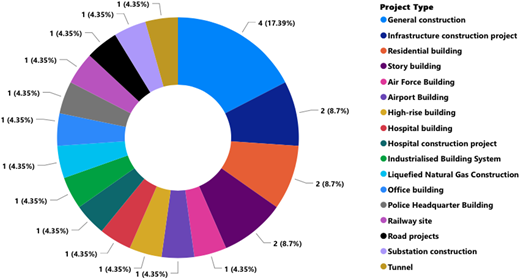
A count of research methods by construction project type
A count of research methods by construction project type
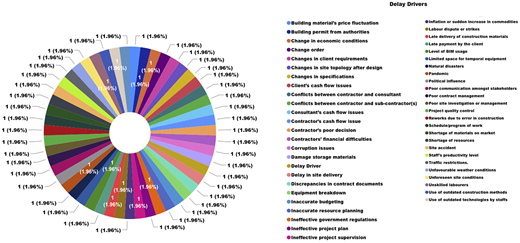
A count of published articles by delay drivers
A count of published articles by delay drivers
By observation (see Table 1), it appears that the global construction industry has only paid more attention on the effect of BIM to its project delay in the continent of Asia (in terms of number of publications by researchers and practitioners used in this study) when compared to other continents of the world. This can further suggest the possible increase in the rate of adoption of BIM and a lesser number of delayed projects in that region as was evidently demonstrated in the construction of a 1,000-bed Huoshenshan and 1500-beds Leishenshan Hospitals for COVID-19 patients in Wuhan, China between the 23rd of January and 2nd of February 2020.
List of research articles used and their respective countries/continents
| SN | Continent | Countries (# of research articles) | Total countries | Total articles |
|---|---|---|---|---|
| 1 | Africa | Zambia (1), Egypt (2) | 2 | 3 |
| 2 | North America | Canada (2), USA (2) | 2 | 4 |
| South America | Peru (1) | 1 | 1 | |
| 3 | Asia | India (3), Malaysia (7), Korea (4), China (5), Thailand (1), Taiwan (2), Jordan (1), Singapore (1), Slovenia (1), Indonesia (1), Hong Kong (1) | 11 | 27 |
| 4 | Europe | Italy (2), Spain (1), Germany (1) | 3 | 4 |
| 5 | Oceania | Australia (1) | 1 | 1 |
| 6 | Multi-continental | Multi-national (10) | n/a | 10 |
To obtain the key delay risk drivers necessary for development of delay risk predictive models for BIM-based construction projects (as part of the objective of this research) we extracted the top drivers each from the fifty research articles used in this systematic review and grouped them into nine delay categories: owners related driver, contractor related driver, consultant related driver, design related driver, labour related driver, equipment related driver, project related driver, suppliers related driver and external related driver. These delay drivers were categorised based on the outcome of existing body of knowledge by Gündüz et al. (2013) who extracted these nine categories via a thorough analysis of the literature and interviews with construction industry professionals and demonstrated them using the Ishikawa (fishbone) diagram – a framework that can indicate drivers, interrelationships between different groups of drivers and repercussions resulting from the drivers. Furthermore, we ranked them based on these categories (i.e. for each category according to number of times each driver occurred in the fifty articles used) and used the outcome of the ranking to propose a conceptual framework necessary for developing delay risk predictive models for BIM-based construction projects as shown in supplementary Table (Table S2) and Figure 3 below respectively. Quite notably among these categories is the labour related driver in which the slow rate of technology adoption as evidently caused by the constant use of outdated technologies and/the use of outdated construction methods (e.g. pre-cast twin wall technology, 2D drawing etc.) by labourers during construction was widely reported by vast body of literature (Teng et al., 2013; Btoush and Harun, 2017; Tahir et al., 2018; Ibrahim et al., 2019). This is important because fundamental advances in construction technology will enable good construction project management via efficient use of labour, resources and equipment.
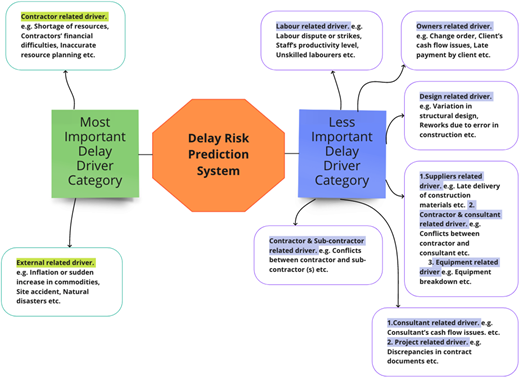
Conceptual framework of delay drivers necessary for developing delay risk predictive models for BIM-based construction projects
Conceptual framework of delay drivers necessary for developing delay risk predictive models for BIM-based construction projects
This conceptual framework details contractor related driver and external related driver as the most important delay driver categories (see Figure 3) to be considered when developing delay risk predictive models for BIM-based construction projects. This is justified based on citation frequency. More precisely, these categories had the highest number of citations from research articles used in this study. Conversely, labour related driver, owner's related driver; design related driver; suppliers related driver; consultant related driver; contractor and consultant related driver; equipment related driver, project related driver; and contractor and sub-contractor related driver were considered less important delay driver categories based on their respective low citation frequencies. Suppliers related driver, contractor and consultant related driver, and equipment related driver were grouped together because they all had equal number of citation (see Table S2). Similarly, because they all received the same number of citations, consultant related driver and project related driver were grouped together.
4. Conclusion
Various attempts at mapping and synthesising the current body of information have emerged in the literature since BIM in AEC (as an area of inquiry) has increasingly grown and supposedly reached intellectual and analytical sophistication in decades. Systematic analyses have emerged as one of the key methods for assessing the key delay risk drivers necessary for development of delay risk predictive models for BIM-based construction projects among the various forms of research undertaken by scholars. Undeterred by these BIM-based delay analysis studies with corresponding benefits of BIM to construction projects, there is no amalgamating study that has consolidated key drivers that affect BIM-based construction projects. As a result, using delay risk drivers from BIM-based construction projects is crucial and has been actively promoted in AEC to accomplish early prediction, which is necessary in any robust predictive modelling to provide adequate time for correction; thus, led to the development of a comprehensive conceptual framework that serves as a foundation for identifying the most critical delay risk drivers for BIM-based construction projects. This was accomplished by first identifying key delay risk drivers in BIM-based construction projects that have significant impact on the performance of delay risk predictive modelling via systematic review of literature. Secondly, by examining the systematic review's summary of findings and ranking the discovered delay drivers to determine which are the most critical. Consequently, this study therefore filled the gap in lack of a conceptual framework for selecting key delay risk drivers for BIM-based construction projects, which has hampered scientific progress toward development of extremely effective delay risk predictive models for BIM-based construction projects. Secondly, this study's analyses further confirmed a positive effect of BIM on construction project delay risk even though the studies used for its analyses implemented BIM differently on different construction projects across different regions of the world.
This is highly incredible as the novel BIM is said to have the potential to be regarded as a disruptive technology by the AEC across the globe which this study's analyses is further confirming. Also, the BIM mandate required from contractors/consultant by policy makers or government agencies across regions will be realised there by reducing conflicts or law orders between project stakeholders as construction projects achieves timely completion of its projects. Evidently, a systematic review approach served as the foundation for the study's conclusions. The potential limitation of this study strategy may be bias in publication selection because the research article keywords were subject-specific. As a consequence, it's probable that some crucial research articles solely indexed in other databases such as Web of Science, Google Scholar etc. were missed in the course of the search. Also, the identification of delay drivers has no immediate impact on practise or research. Making it worthwhile may be as easy as creating a framework for identifying delays in construction projects. This may be achieved by documenting the construction process for various project types, identifying the various delay reasons at each step and their significance and outlining potential solutions that may be implemented by different stakeholders. Future work may also consider making an effort to identify new drivers that forms the factors that informs construction project delay. More so, future work should conduct comprehensive systematic review on other pertinent issues common to the construction industry.
The Doctoral Scholarship of the University of Hertfordshire, United Kingdom, provided funding for the completion of this study as a component of the first author's Ph.D. research.
References
Further reading
Supplementary material
The supplementary material for this article can be found online.

