This study aims to explore how small and medium-sized enterprise (SME) hotel managers in Greece perceive the integration of Generative AI (GenAI)-based services into various aspects of hotel operations. It seeks to identify both the perceived opportunities and challenges of adopting GenAI in the hospitality context, offering a comprehensive understanding of its strategic value and implications for service delivery, guest engagement and operational efficiency.
Using a qualitative methodology, this study draws on in-depth interviews with hotel owner-managers in a prominent Greek tourism destination. Thematic analysis was employed to identify key patterns in managerial attitudes, usage practices and strategic considerations concerning ChatGPT.
The research reveals six key themes highlighting how managers view GenAI as a tool for enhancing operational efficiency, personalization and sales through automation and tailored communication. However, concerns have been raised regarding implementation costs, training requirements, ethical implications and diminished human interaction. A recurring recommendation was the adoption of a hybrid model that balances AI capabilities with authentic human engagement to optimize customer experience.
This study offers novel insights into the early-stage adoption of GenAI-based services in SME hotel environments, contributing to a growing body of knowledge on AI integration in tourism. By focusing on sector-specific personal selling, this study addresses a gap in the literature and provides practical implications for technology adoption strategies in hospitality.
Introduction
Rapid advancements in artificial intelligence and its applications throughout several sectors and industries have forced the adaptation of numerical service professionals, such as hotel employees (Kang, Shin, & Kang, 2024; Li, Justin, Bonn, & Ye, 2019) and sales professionals (Singh et al., 2019), to a new state of work activities and operational digitization. Although digital transformation is not a new concept, and smart systems exist in key service industries over the last decade, AI-based solutions have been far from being integrated into these sectors (Campos Zabala, 2023; Kamoonpuri & Sengar, 2023). While the incorporation of artificial intelligence systems into guest service operations is presumed to have a positive influence on operational effectiveness and efficiency, especially in the hotel industry (Sharma, Bathla, Kaushik, Rohit, & Rana, 2023), mainly economic and technical barriers have significantly delayed the adoption of this technology by organizations (Cubric, 2020).
With the growing popularity of Generative AI (GenAI)-based chatbot technology following the launch of OpenAI's ChatGPT, however, AI-powered virtual conversational agents are now more capable, cost-efficient and user-friendly than ever, making them well-suited for supporting a wide range of organizational activities (Mich & Garigliano, 2023). Nevertheless, most companies in the hospitality and tourism (HT) sector still present resistance to the adoption of new technologies (i.e., chatbots), even though the benefits from their use – alongside a human-to-human interaction option – can strengthen relationships with consumers and brand loyalty (Pereira, Limberger, Minasi, & Buhalis, 2024). Krishnan, Gupta, Gupta, and Singh (2022) assert that almost every aspect of customer service can be handled by human-like AI chatbots. Furthermore, taking into consideration the positive effects of personalization in services (Piccoli, Lui, & Grün, 2017), Sidlauskiene, Joye, and Auruskeviciene (2023) highlight the impact of anthropomorphic AI chatbots on positively affecting perceived product personalization. Particularly in sales, Dickie, Groysberg, Shapiro, and Trailer (2022) argue that in the future, AI will be part of every sales form, from the simplest to the most complex ones. Nevertheless, this integration addresses a plethora of challenges for organizations, such as workforce adaptation, as well as potential impacts on creativity and sustainability (Durach & Gutierrez, 2024), and ethical issues (Campos Zabala, 2023).
The HT sector has not been unaffected by these technological changes. In particular, HT is considered one of the industries that can benefit significantly from GenAI-based applications such as ChatGPT (Singh & Singh, 2023). Fischer, Seidenstricker, and Poeppelbuss (2023) emphasize that understanding customer needs and leveraging technologies to meet evolving relationship requirements are critical for maintaining a competitive advantage. Following the significant opportunities that GenAI can bring to the service sector, Sigala et al. (2024a, b) call for further research on identifying the value human workers can add to AI-augmented workplaces. Similarly, while the existing body of literature highlights the increasing recognition of GenAI's transformative potential in the HT industry (Sigala et al., 2024a), the existing body of research is primarily focused on broad and generalized impacts, such as enhancing customer service, streamlining operations and innovating marketing strategies.
Thus, despite growing recognition of AI's transformative potential in HT, existing research has largely focused on broad, sector-wide impacts (e.g., customer service, operations, marketing), while offering limited insights into the specific, context-driven adoption and application of GenAI in small and medium-sized enterprise (SME) hotels. Moreover, there is insufficient understanding of how AI-powered conversational agents reshape personal selling processes, as well as the organizational, workforce and ethical challenges that accompany their integration. Another notable gap in current SME research is the role of GenAI in hotel revenue management. While large chains utilize sophisticated AI for dynamic pricing, SME managers often perceive these tools as inaccessible. However, LLMs (Large Language Models) offer a low-barrier entry for demand forecasting and competitor price analysis, representing an untapped opportunity for independent hotels to achieve pricing parity. These gaps highlight the need for research that explores the value GenAI can create in SME hotel sales contexts, how it interacts with human-to-human service provision and what factors influence its successful adoption and implementation.
Furthermore, despite growing recognition of GenAI's transformative potential in HT, existing research has concentrated mainly on broad sectoral effects such as automation, customer service, marketing support and educational use. Less is known about how decision-makers in SME hotels evaluate GenAI in the context of day-to-day operations and, more specifically, in relation to personal selling, guest communication and relationship-building activities. That is important because those hotels differ from larger chains in terms of resource constraints, organizational informality and reliance on personalized service encounters, all of which are likely to shape how new technologies are assessed and adopted.
This study addresses this gap by analyzing qualitative data gathered from managers and owners of small and medium hotels in Nafplio, Greece. Nafplio, the first capital of modern Greece from 1823 to 1834, is characterized by its unique natural beauty and archaeological interest (Konstantopoulou, Spanou, & Kontogianni, 2015), as well as its exceptional performance in hospitality and service (Booking.com, 2022a, b). Rather than focusing on post-adoption outcomes, the study investigates the expectation stage of adoption: how managers interpret potential value, anticipate risks and imagine realistic use scenarios before implementation takes place. This perspective is especially relevant in the case of GenAI because adoption decisions in hospitality are not driven solely by technical functionality, but also by questions of service authenticity, trust, employee readiness and fit with the human-centered logic of hospitality delivery.
The study contributes to the ascending body of literature on GenAI-based services in tourism (Altinay, Altinay, Tlili, & Vatankhah, 2024) by providing insights from a managerial perspective. To the best of the authors' knowledge, no current research focuses on GenAI's application in sales processes, particularly within the HT industry and SME context. This underscores the importance of the study in advancing the understanding of this emerging technology. Overall, this research enriches the emerging literature on GenAI in hospitality by providing context-sensitive evidence from SME hotels, a segment that remains underrepresented in current research. In addition, it shows that managerial evaluations of GenAI are structured by a hybrid service logic: managers are open to AI for routine, scalable and information-rich tasks, yet remain cautious about delegating emotionally nuanced and relationship-dependent interactions to technology.
Literature review and research questions
GenAI in HT
Since its initial release from OpenAI in November 2022, ChatGPT became a buzzword, not only for individuals and organizations interested in state-of-the-art artificial intelligence applications, but also among people with no prior experience with this technology. The capability to support multiple languages and the ease of use made it immediately accessible throughout the globe, with the number of monthly uses in the first months surpassing those of other popular applications. ChatGPT has already gained the interest of academics and practitioners in the HT industry, motivating research across various aspects of the field (Altinay et al., 2024). Most of the first studies published after the public release of ChatGPT, however, focused on educational aspects within the context of HT, outlining the positive and negative impacts of ChatGPT (Ali & OpenAI, 2023).
In this context, Ivanov and Soliman (2023) recognize the value of LLMs such as ChatGPT in the progress of tourism education and research, suggesting that their use can potentially revolutionize the industry. In a similar vein, Skavronskaya, Hadinejad, and Cotterell (2023), examining the potential of ChatGPT in tourism education from a cognitive science perspective, address ethical issues that potentially arise from its use. Leaning toward a more practical aspect on the use of ChatGPT, Keiper (2023) conducted an in-class “event planning and execution” project supported by ChatGPT, concluding that the use of GenAI-based tools such as ChatGPT, Dall-E2 and beautiful.ai can act as a means for more efficient experiential learning experiences, both for HT students and faculty. Additionally, Wang's (2024) research on personalizing guest experiences with ChatGPT in the hotel industry concluded that while GenAI offers numerous benefits such as cost savings, increased work efficiency and the ability to cater to specific social group demands, significant concerns remain. These include challenges in managing complex interactions, reflecting local cultural elements, responding effectively to service contingency events, ensuring data privacy and addressing the diverse generational preferences of guests.
Examining LLMs from a more practical perspective, Carvalho and Ivanov (2023) highlight the potential that ChatGPT has to increase efficiency across several business processes in tourism. Specifically, they position their findings both in front-of-house and in back-of-house operations, for customer service and productivity matters, respectively. Singh and Singh (2024) regard ChatGPT as a valuable tool for providing 24/7 visitor support, serving as a recommendation system for nearby attractions and efficiently handling reservation requests. ChatGPT can also be considered a valuable tool, addressing customer reviews and complaints (Carvalho & Ivanov, 2023; Tan, Liu, & Litvin, 2025). Koc, Hatipoglu, Kivrak, Celik, and Koc (2023), exploring the potential applications of ChatGPT in the HT industry, highlighted several practical implications, such as ChatGPT-4's capability to provide management responses to customer reviews on TripAdvisor, which was evaluated to be as efficient and effective as responses crafted by a human manager.
Impact on tourist experience and decision-making
Already from the first version of ChatGPT (GPT-3), its benefits in certain aspects in the HT industry (i.e., personalized services, content creation) have been acknowledged (Iskender, 2023). Moreover, Chu (2023, p. 76427) suggests that future versions of ChatGPT “may play a significant role in enhancing long-term organizational performance.” According to Wong, Lian, and Sun (2023), ChatGPT and other GenAI-based applications have the potential to be used by tourists in the pre-trip, en-route and post-trip stages to enhance the decision-making process, leading to an improved tourists' experience. Additionally, by integrating persuasive techniques, ChatGPT showcased its capabilities in influencing user decision-making and encouraging desired actions (i.e., upgrading the user's room, booking a specific hotel) in the HT industry (Remountakis, Kotis, Kourtzis, & Tsekouras, 2023). Nevertheless, Shi, Lee, Girish, Xiao, and Lee (2024) found that tourists are concerned about the potential risks linked to using GenAI for tourism-related information, particularly regarding privacy, accuracy and the danger of becoming overly dependent on that technology.
Conceptualizing several aspects of generative pre-trained transformers, a stream of eight future research directions for GenAI utilization in the HT industry is proposed by Gursoy, Li, and Song (2023), pinpointing the necessity for studies pertinent to the field. Some of these directions include the exploration of the impact of GenAI on the HT industry and AI's role in enhancing the tourism experience. In the same direction, Sigala et al. (2024a, b) research on GenAI in tourism and hospitality, and services in general, draw critical research directions and a notable research agenda.
Technology adoption in non-European SME's hotels
While extensive research on technology adoption has been conducted in European hotel SMEs (Pappas, Caputo, Pellegrini, Marzi, & Michopoulou, 2021; Romero, Fernández-Serrano, & Cáceres-Carrasco, 2023), it is equally important to acknowledge relevant studies carried out in non-European contexts. For instance, Soares, Mendes-Filho, and Gretzel (2020), through semi-structured interviews with hotel managers in Natal, Brazil, examined the influence of mimetic, coercive and normative pressures on technology adoption. Their findings revealed that mimetic and normative forces strongly contribute to institutional isomorphism, whereas coercive pressures play a limited role, with consumers emerging as the primary drivers of adoption. Similarly, Ezzaouia and Bulchand-Gidumal (2023) investigated the impact of IT adoption on hotel performance in Morocco, demonstrating that its most significant effect lies in improving employee performance, which subsequently enhances financial performance, while the direct impact on financial outcomes is less substantial.
Furthermore, Shahadat, Nekmahmud, Ebrahimi, and Fekete-Farkas (2023) explored the technological, organizational and environmental factors influencing information and communication technology adoption in SMEs in Bangladesh, identifying relative advantage, cost, top management support, innovativeness, competitive pressure and government support as significant drivers of adoption, while compatibility, trialability and organizational readiness were found to have limited influence. Collectively, such research enriches the technology adoption literature by offering valuable insights into the drivers, barriers and performance outcomes of digital innovation in non-European hotel SMEs, thereby extending understanding beyond the European context.
Theoretical perspectives on GenAI adoption
To better understand managerial perceptions of GenAI, this study draws on three complementary perspectives on technology adoption. The Technology Acceptance Model (TAM) argues that adoption intentions are mainly shaped by perceived usefulness and perceived ease of use (Davis, 1989), meaning that managers are more likely to accept a system when they believe it can improve performance and can be learned and operated with minimal effort. In the hospitality context, this is especially relevant because ChatGPT-like tools may be seen as valuable for accelerating response times, supporting multilingual communication, improving marketing efficiency and assisting sales-related tasks. At the same time, their user-friendly interfaces may help reduce the barriers that often discourage adoption of more complex enterprise systems. Nevertheless, TAM alone may not fully capture hospitality adoption decisions, since managers may also weigh symbolic concerns such as guest experience quality, trust and the preservation of human warmth in service delivery.
The Technology–Organization–Environment (TOE) framework provides a broader explanation by situating adoption within three interacting dimensions: technological, organizational and environmental (Tornatzky & Fleischer, 1990). Technological factors include relative advantage, compatibility and complexity; organizational factors involve resources, leadership, skills and readiness; and environmental factors refer to competition, regulation and customer pressure. This framework is particularly useful for SME hotels, where owner-managers must assess GenAI not only in terms of its technical merits but also in relation to practical constraints within the organization. Even low-cost AI solutions may be rejected if staff lack the capability to use them effectively, useful tools may be postponed if integration is perceived as disruptive and adoption may accelerate when competitors begin implementing similar systems. Accordingly, GenAI adoption should be understood not simply as a question of technological value, but as a function of organizational preparedness and market conditions.
Diffusion of Innovations (DOI) further helps explain how new technologies spread over time by highlighting five attributes: relative advantage, compatibility, complexity, trialability and observability (Rogers, Singhal, & Quinlan, 2019). This perspective is especially relevant in settings where adoption is still emerging, as many SME hotels appear to be in an early stage of observing GenAI rather than fully implementing it. Managers may recognize its potential benefits but remain cautious until those benefits become more visible through competitor use or peer examples. In this sense, many hospitality SMEs may currently occupy an early-adopter threshold in which awareness is relatively high, yet confidence in the technology remains incomplete.
GenAI in sales and personal selling
From the sales perspective, research specifically on GenAI and sales or personal selling remains scarce. In the case of online stores, Orzoł and Szopik-Depczyńska (2023) concluded that ChatGPT is an innovative tool that can present advanced properties, such as personalized recommendations and promotions, and virtual customer service. Sliż (2024, p. 1) investigates the use of ChatGPT in the automotive after-sales sector, highlighting “its potential to contribute to heightened customer satisfaction within the after-sales domain.” Additionally, Remountakis et al. (2023) explore the use of ChatGPT as a persuasive technology for recommendation messages in hotel upselling, showcasing significant benefits. Finally, from the lens of teaching practice in sales, ChatGPT can present several benefits, such as its versatility, to help students and practitioners enhance sales skills through role-playing procedures (Milovic, Das Gyomlai, Spaid, & Dingus, 2024). Finally, Dwivedi et al.’s (2023, p. 8) novel research agenda includes the following research question: “How can ChatGPT be used as a nudging tool for cross-selling in the hospitality and tourism industry?”
The reviewed literature establishes that GenAI can support hospitality operations, personalization, customer communication and sales-related activities, while also raising concerns about privacy, bias, workforce change and service quality. However, prior research has generally treated these benefits and risks at a broad sectoral level, leaving open the question of how managers in SME hotels interpret them in context and translate them into adoption intentions. This is especially relevant for personal selling, where the promise of automated persuasion and recommendation intersects with the hospitality sector's dependence on trust, empathy and long-term guest relationships.
For this reason, the present study is informed by technology-adoption thinking and human–AI collaboration perspectives without attempting to test a formal model. Concepts associated with perceived usefulness, organizational readiness, environmental constraints and complementarity between AI and employees are particularly relevant for interpreting how managers assess GenAI in SME settings. This framing helps move the study beyond a descriptive inventory of benefits and barriers toward a more interpretive analysis of why managers favor selective and hybrid adoption rather than full substitution.
Based on these research insights, the following research questions are formulated:
RQ1. Do SME's hotel managers/owners consider GenAI-based services as part of their business operations in the future?
RQ2. Do SME's hotel managers/owners consider GenAI in the role of a salesperson?
Methodology
Exploratory research is the most appropriate method when there is limited existing knowledge about the phenomenon being studied (Bougie & Sekaran, 2019). Considering the aim of this research to gain a deeper and richer understanding of SME hotel managers' and owners' perspectives on GenAI's potential integration into their business operations and its role in the personal selling process, a qualitative research approach, utilizing semi-structured interviews, was employed. By conducting a qualitative study, the contextual setting and viewpoints of SME hotel managers/owners are better understood, capturing subtleties that may not be easily discernible through other research methods (Bell, Bryman, & Harley, 2022, p. 427).
Research design
The researchers selected eight hotels from the city of Nafplio, Greece. Nafplio was chosen not only because it stands as one of the major tourism destinations in Greece (Apergis, Hayat, & Saeed, 2020), but also due to the prevalence of small and medium-sized hotel businesses and the absence of large hotel chains. Furthermore, Nafplio was ranked as the fourth most welcoming city in the world in the “Traveler Review Awards” for 2022, published by Booking.com (Booking.com, 2022). Finally, it should also be noted that one of the authors of the present study is a co-owner of an SME hotel located in the city of Nafplio. However, the authors' hotel was not included in the sample of interviewed businesses, ensuring that the data collection and analysis remained independent of their own operations.
Initially, small and medium-sized hotels were identified on the TripAdvisor platform, based on popularity. Managers/owners of these hotels were then contacted. During the initial outreach via telephone, the purpose of the study was explained, and an in-person appointment was subsequently scheduled. Taking into consideration the aforementioned review of the literature and staying in line with the research purposes, a total of seven questions were formed (Appendix A), adapted from Yağmur, Demirel, and Kılıç (2023) research on managers' perspectives on smart technologies. Next, an academic who is an expert in new technologies and simultaneously serves as an SME hotel owner/manager for over a decade examined the interview protocol and guidelines. The induction, deduction, adaptation and final selection of the reported questions were based οn the relevance of the research in the context of the HT industry (Ullrich & Poß-Doering, 2023). Finally, a pilot test of the interview guide was performed with two academics (Kallio, Pietilä, Johnson, & Kangasniemi, 2016).
Nafplio was selected not only because of its tourism importance and concentration of SME hotels, but also because it offers a suitable setting for exploring how smaller, independently managed accommodation businesses evaluate emerging service technologies under real operational constraints. The intention was not to produce statistically generalizable findings, but to generate context-rich insights into managerial reasoning in a segment where decisions about technology adoption are often shaped by owner involvement, limited staffing and close guest contact.
The study did not require prior implementation of GenAI by participants, because its analytical focus was on early-stage managerial perceptions and adoption intentions rather than post-adoption performance evaluation. This distinction is important: in emerging technology contexts, non-adopters can still provide valuable evidence about perceived utility, legitimacy, barriers and acceptable use boundaries, all of which influence whether implementation is considered at all. At the same time, the absence of implemented cases necessarily limits the study's ability to compare expectations with actual outcomes, and this limitation is acknowledged explicitly in the revised discussion and limitations sections.
Data collection and sample
Data were collected through one-to-one semi-structured interviews with small/medium hotel owners/managers, and the interviews lasted between 30 and 40 min. Participants' involvement was voluntary. The recording of the interviews was done with the permission of the participants, and the anonymity of their identity was kept confidential. To prevent bias, we refrained from providing definitions for terms like ChatGPT, AI and chatbots, and we also did not provide any case examples relevant to the use of GenAI in the HT industry procedures. Nevertheless, a fundamental presentation of the updated version (August 3 Version) was given at the beginning of the interview, exhibiting the latest updates for ChatGPT.
The participants in the interviews were nine in total, reaching the minimum sample size of interviews needed to identify a high number of themes, as suggested by Wutich, Beresford, and Bernard (2024) for theme data saturation. Additionally, Harvey (2011) emphasizes that in elite interviewing, the quality and depth of insight gained from each respondent are more critical than achieving a large sample size, noting that access constraints often make smaller but information-rich samples both appropriate and methodologically robust. The semi-structured interviews were conducted during the months of August and October 2023 using a 10-item questionnaire as an interview guide. Apart from three questions (demographics), the remaining seven were open-ended. Table 1 presents the demographics of the participants.
Interviews were conducted in Greek, the native language of both the interviewer and the interviewees. The interviews were recorded and transcribed by the author, A.K., verbatim. Participants were given a consent form to inform them about the study's objectives, their voluntary involvement, the anonymity, the confidentiality and the intended academic use of the interview transcriptions. The interviews were conducted respectfully, avoiding any inquiries into sensitive personal information.
Data analysis
For the analysis of the transcripts, the computer-assisted qualitative data analysis software Atlas.ti (Version 24.2.1) was used (Paulus & Lester, 2016). The inserted data were analyzed thematically. Thematic analysis is a qualitative research method used to identify, analyze and interpret patterns or themes within data. It provides a systematic approach to organizing and describing data in detail while allowing for the exploration of underlying meanings (Braun & Clarke, 2006). Since the introduction of GenAI, researchers have explored perceptions across diverse populations through thematic analysis. For example, Shoufan (2023) investigated students' perceptions of ChatGPT, while Monib, Qazi, and Mahmud (2024) examined learners' experiences and perceptions of ChatGPT as a learning tool in higher education.
Recent studies have also explored the application of ChatGPT in qualitative data analysis (Friedman, Owen, & VanPuymbrouck, 2024; Tai et al., 2024), with findings suggesting that ChatGPT demonstrates notable efficacy, particularly in its ability to reproduce concrete and descriptive themes (Tai et al., 2024). Initially, the researchers read the interviews to familiarize themselves with the data, and afterward, they started coding the interview data to identify and label topics, similarities and differences in the quotes of the interviewees (Adeoye-Olatunde & Olenik, 2021).
To enhance the trustworthiness and rigor of the analytic process, several validation procedures were employed. First, following Braun and Clarke's (2006) guidelines, coding was conducted iteratively and reflexively. To strengthen reliability, a second researcher independently reviewed a subset of the interview transcripts using the initial codebook. Differences in coding were discussed until consensus was reached, ensuring intercoder agreement through negotiated consensus. Additionally, to strengthen analytical rigor, the research team engaged in investigator triangulation by jointly examining emerging themes, challenging interpretations and ensuring that the final thematic structure was grounded in the data rather than in individual bias. Finally, a form of member validation was conducted by sharing preliminary thematic summaries with two participating managers, who confirmed that the findings accurately reflected their views.
Findings and discussion
The main focus of the research is to shed light on managers' perceptions, attitudes and intentions regarding the potential integration of GenAI-based services into SME hotel operations, particularly its role in personal selling and customer engagement. Revealing these internal dimensions is crucial because managers and owners are the key decision-makers who determine the adoption and implementation of new technologies within their businesses. Understanding their views provides valuable insights into the barriers, opportunities and conditions that shape technological integration in the HT industry. This knowledge is essential not only for tailoring GenAI-based solutions to meet the specific needs of SME hotels but also for identifying strategies to overcome resistance and foster a smoother transition to GenAI-augmented operations, always keeping in mind the dilemma regarding the optimum human-technology blending (Vrechopoulos, Lazaris, & Doukidis, 2022).
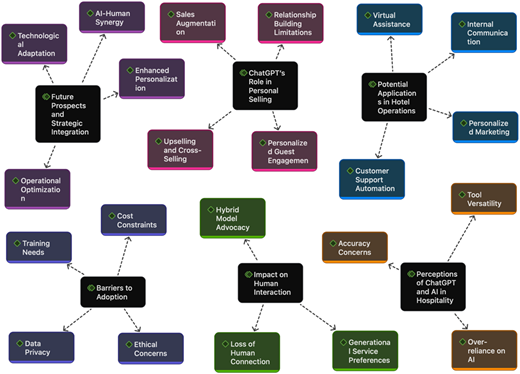
The data analysis revealed six major themes. Figure 1 illustrates the network diagram exported from Atlas.ti, depicting the six identified themes along with the corresponding codes associated with each theme.
The findings indicate that managers' views of GenAI are neither uncritically optimistic nor uniformly resistant. Instead, the interviews reveal a conditional openness shaped by a recurring evaluative logic: GenAI is seen as useful when it reduces routine workload, improves responsiveness and supports personalization or sales, but problematic when it threatens the emotional, relational and trust-based dimensions of hospitality service. Read together, the six themes therefore point to more than a list of opportunities and barriers. They suggest an emerging hybrid service logic in which managers are willing to integrate GenAI selectively, as long as human staff remains central in high-touch interactions and final judgment.
This pattern is important from a conceptual standpoint. In the SME hotel context, adoption is not judged only through efficiency or technological novelty, but through perceived fit with the identity of hospitality work itself. Managers are attracted to GenAI for tasks such as late-night support, repetitive guest communication, review responses, multilingual information provision and upselling prompts, because these uses promise scalability without necessarily displacing the interpersonal core of service. By contrast, they remain cautious about overextending GenAI into emotionally sensitive encounters, complaint handling and relationship-building processes that depend on empathy, intuition and authentic human presence.
Last but not least, it should be noted that the six themes are treated not as isolated categories, but as interrelated dimensions of managerial sensemaking around GenAI adoption. This shift allows the findings to be interpreted at a higher level of abstraction, particularly in relation to the recurring tension between efficiency and human-centered service, and between technological opportunity and organizational caution.
Perceptions of ChatGPT and GenAI in HT
Participants highlighted ChatGPT as an innovative and highly efficient tool capable of revolutionizing the HT industry. This view supports the work of Gursoy et al. (2023), who state that ChatGPT is likely to revolutionize the operational processes in the HT industry. Its ability to process vast amounts of information, provide rapid responses and operate continuously was a recurring theme. One manager stated:
[…] ChatGPT represents a significant innovation in customer service and information management. It’s like having a highly informed assistant available 24/7 […]. (P7, Male, 42)
This analogy emphasizes how ChatGPT can act as a reliable and knowledgeable support system, enhancing both guest interactions and internal processes (Singh & Singh, 2024). Additionally, the flexibility and versatility of ChatGPT were frequently noted. Participants suggested that it could be integrated into various aspects of hotel operations, such as handling customer inquiries, managing reservations and even supporting decision-making through data analysis. These capabilities were seen as particularly valuable for small and medium-sized hotels, which often operate with limited staff and resources. Another respondent remarked on its potential to bridge operational gaps, ensuring consistent service delivery during peak times or outside standard operating hours. Such attributes position GenAI as a vital technology for enhancing operational efficiency in the HT sector.
While many participants were optimistic about ChatGPT's capabilities, concerns about its limitations were equally prominent. These findings are in line with the work of Temash et al. (2023) on healthcare professionals' perceptions and expectations of ChatGPT. A recurring theme was the tool's accuracy, with several respondents expressing doubts about its reliability in delivering precise and contextually appropriate responses. One participant shared:
[…] It’s not always accurate, and because it’s not human, there’s a risk of it being misused or delivering the wrong outcomes […]. (P9, Female, 35)
This sentiment reflects the apprehension that reliance on GenAI could result in errors that may negatively impact guest experiences or operational outcomes (Shaalan, Tourky, & Ibrahim, 2024). Beyond accuracy, participants voiced concerns about the broader implications of GenAI integration. Some feared that over-reliance on ChatGPT might lead to a loss of the personal and empathetic touch that characterizes high-quality guest service. This perspective aligns with the findings of Shaalan et al. (2024), who highlight the potential negative effects of Agentic AI on customer relationship management. One manager noted that:
[…] while ChatGPT can handle routine tasks, it might struggle with the emotional aspects of guest interactions […]. (P1, Male, 39)
Moreover, there were apprehensions about potential misuse or over-dependence on the technology, highlighting the importance of human oversight and strategic implementation to mitigate risks. Also, several managers noted that small hotels often operate with lean staffing structures, especially during peak periods. In this context, even modest automation was perceived as valuable. Therefore, managers view GenAI primarily through a capacity extension lens rather than a labor replacement lens. For SMEs, efficiency gains were valued less as cost-cutting and more as a means of coping with limited manpower. This finding indicates that GenAI may be especially attractive where staffing shortages and multitasking are common. However, participants also emphasized that efficiency alone would not justify adoption unless service quality remained stable.
Potential applications in hotel operations
Participants frequently identified ChatGPT's potential to enhance customer service, describing it as a virtual assistant capable of streamlining guest interactions. One interviewee remarked:
[…] It could be used for tasks like self-check-in for late arrivals when there is no night reception available […]. (P9, Female, 35)
This highlights GenAI's ability to address gaps in service availability, particularly for smaller hotels that may not have staff present during late hours. By enabling self-service options such as check-ins, GenAI-based services can ensure a seamless guest experience, even outside standard operating hours (Zarezadeh, Benckendorff, & Gretzel, 2023). Beyond check-ins, ChatGPT was seen as a tool for responding to guest inquiries, providing information about hotel amenities and assisting with booking modifications. Its ability to operate 24/7 ensures that guests can access information and support whenever needed, contributing to a more convenient and satisfying customer journey. This feature is especially beneficial for international guests in different time zones, as GenAI in the form of a chatbot, or even a voice-enabled agent, eliminates delays in communication and ensures prompt responses.
Participants also recognized ChatGPT's value in improving internal and external communication. One respondent stated:
[…] ChatGPT could streamline internal communication and external messaging through platforms like Booking.com […]. (P5, Female, 43)
This points to its potential role in automating routine tasks such as responding to guest reviews, managing booking confirmations and addressing common queries. By reducing the time spent on repetitive communication tasks, GenAI-based services can free up staff to focus on more complex, creative and strategic responsibilities. Internally, GenAI can act as a centralized communication tool across every channel, facilitating seamless information sharing between departments. For instance, it could help synchronize housekeeping schedules with front desk operations or notify maintenance teams of reported issues. This integration can reduce miscommunication and improve overall operational efficiency, leading to a more coordinated and responsive hotel environment.
Furthermore, the potential of ChatGPT in marketing and sales was another key theme highlighted by participants. One manager noted:
[…] ChatGPT could create personalized offers and marketing campaigns tailored to customer preferences […]. (P7, Male, 42)
This capability underscores GenAI-based services’ potential to enhance revenue generation through targeted marketing strategies. By analyzing guest data and behavior, intelligent services can craft customized promotions, such as discounted room upgrades or activity packages, that align with individual preferences. GenAI's ability to analyze guest feedback and reviews can further inform marketing strategies, helping hotels refine their offerings and address areas of improvement (Moncarz & Moreo, 2024). By leveraging LLM analysis and automation capabilities, hotels can adopt a more proactive and personalized approach to attracting and retaining customers.
Although none of the interviewees had implemented ChatGPT, they outlined clear scenarios for its use. Examples included late-night self-check-in, automated replies on Booking.com, multilingual frequently asked questions (FAQs) for international guests and upselling offers during booking (e.g., room upgrades, transfers or packages). These practical cases show how GenAI could ease routine tasks and support revenue generation in SME hotels.
Impact on human interaction
One of the most significant concerns raised by participants was the potential loss of human interaction due to the adoption of GenAI-based services in hospitality settings. A respondent noted:
[…] Using ChatGPT for interactions removes the human element that often builds guest loyalty, especially in boutique hotels […]. (P5, Female, 43)
This perspective highlights the emotional and relational aspects of hospitality, which are central to creating memorable guest experiences. Boutique hotels, in particular, thrive on their ability to offer personalized and heartfelt service, often fostering a sense of connection and familiarity between staff and guests. Respondents emphasized that over-reliance on GenAI could jeopardize this unique characteristic by replacing human warmth with algorithm-driven responses. They feared that while ChatGPT can handle transactional interactions effectively, it may struggle with the emotional details of conversations, such as empathizing with a frustrated guest or intuitively understanding unspoken needs. This could result in a depersonalized service experience, diminishing the unique charm and competitive advantage of smaller hotels.
Moreover, some interviewees were concerned that the erosion of human interaction might alienate guests who value personal connections during their stay. For instance, a returning guest who feels recognized and appreciated by hotel staff is likely to develop loyalty to the property. Replacing these personal touchpoints with GenAI-driven interactions could lead to a transactional and impersonal atmosphere, potentially reducing repeat bookings and long-term guest relationships. Participants stated:
[…] The personal connection is what makes guests return to the same hotel. Some clients have been coming back for 20 years because of the trust and relationship they built with the staff […]. (P8, Female, 51)
[…] For us, maintaining the human element and direct contact with guests is essential. It’s this interaction that ensures repeat visits and word-of-mouth promotion […]. (P4, Female, 48)
These quotes directly support the concerns mentioned and emphasize the importance of preserving personal connections for loyalty and a unique guest experience.
In contrast to the fears of losing human interaction, several participants advocated for a balanced, hybrid approach to integrating GenAI into hotel operations. One manager emphasized:
[…] The balance between AI and human interaction will be key to maintaining guest satisfaction […]. (P7, Male, 42)
This view suggests that rather than replacing human staff, GenAI should be positioned as a complementary technology to enhance service delivery. A hybrid approach allows GenAI to handle routine tasks, such as answering frequently asked questions, managing reservations or processing payments, while reserving complex, high-touch interactions for human staff. Additionally, participants highlighted that GenAI could serve as a support system for staff rather than a replacement. By providing real-time access to information, such as guest preferences or booking history, GenAI can empower employees to deliver more personalized and informed service. This collaboration between AI and humans creates a dynamic synergy where technology enhances, rather than detracts from, the guest experience. In fact, recent literature emphasizes on that collaboration in the form of AI agents and agentic AI systems (Hughes et al., 2025).
Another interesting point raised by participants was the evolving expectations of different guest demographics. Younger, tech-savvy travelers might be more receptive to GenAI-driven interactions, viewing them as convenient and modern (Femenia-Serra, Perles-Ribes, & Ivars-Baidal, 2019). In contrast, senior guests or those seeking a more traditional hospitality experience may place greater value on human interaction (Traboulsi, Frau, & Cabiddu, 2018). Striking the right balance between GenAI and human engagement is therefore essential to cater to a diverse clientele. In particular, two interviewees stated:
[…] Younger generations seem to prefer faster, more impersonal service that aligns with their lifestyle, while older generations value human interaction and personalized service […]. (P4, Female, 48)
[…] Younger guests tend to use online platforms like Booking.com for reservations without much direct contact, while older guests often prefer calling and interacting with the staff […]. (P6, Male, 21)
These quotes emphasize how generational differences influence preferences for GenAI or human interaction in the hospitality industry. Managers repeatedly argued that while AI may improve efficiency, it cannot replicate warmth, empathy, spontaneity or authentic welcome. This concern was particularly strong for boutique and relationship-driven hotels, where owner presence and personal attention are part of brand identity. Participants feared that excessive automation could weaken differentiation. This finding suggests that resistance to full AI adoption is not necessarily technological conservatism. Rather, it may represent protection of a service philosophy rooted in human connection.
Barriers to adoption
One of the key challenges identified by participants regarding the adoption of GenAI-based services in SME hotels is the cost associated with its implementation and the training required for staff. As one manager explained:
[…] The cost of implementation and staff training might be a challenge for smaller hotels like ours […]. (P3, Male, 69)
This concern highlights the financial strain that GenAI technologies can place on SMEs, which often operate with limited budgets and resources. Unlike larger hotel chains with dedicated budgets for innovation, SMEs may struggle to allocate the funds necessary to integrate new technologies while ensuring that staff receive adequate training to use them effectively. Without proper training, even the most advanced GenAI systems may fail to deliver their promised benefits, further compounding the perceived risks of adoption. Therefore, “cost” often referred not only to subscription fees, but also to hidden implementation costs such as training, integration, mistakes and management time. While participants frequently cited high implementation costs as a barrier, a comparison with industry use cases reveals an information gap. Many GenAI tools are now freemium or API-based; thus, the barrier is not the financial outlay but a lack of organizational digital literacy.
Another significant barrier is the ethical concerns surrounding the use of GenAI-based services in HT. One participant expressed this apprehension, stating:
[…] There are issues with data privacy and the risk of job displacement, which can create resistance to adopting AI […]. (P9, Female, 35)
This reflects broader concerns within the industry about safeguarding sensitive customer information, as GenAI systems often require access to vast amounts of personal data to function effectively. Compliance with data protection regulations, such as General Data Protection Regulation, adds another layer of complexity and cost to the adoption process. Additionally, fears of job displacement due to automation create internal resistance among staff, who may feel threatened by the introduction of GenAI tools like ChatGPT. Such concerns highlight the need for clear communication and strategies that emphasize GenAI's role as a complement to human efforts rather than a replacement. This result partially answers Pan and Fu's (2024) RQ18, calling for exploration of “How can AI systems seamlessly integrate into hotel workflows to enhance human productivity and decision-making while maintaining a positive work environment?”
Future prospects and strategic integration
A key future prospect for GenAI-based services in SME hotels lies in their ability to deliver enhanced personalization, a feature that can significantly elevate guest experiences. One respondent observed:
[…] ChatGPT can offer highly personalized suggestions for activities, dining, and itineraries based on individual guest preferences […]. (P2, Male, 55)
By leveraging data from past stays, preferences and even real-time inquiries, GenAI can create tailored recommendations that align closely with guests' interests. This ability to customize recommendations not only improves guest satisfaction but also positions hotels as attentive to their clientele's unique needs. Additionally, personalized suggestions can be seamlessly integrated into pre-arrival communications or during a guest's stay, creating a proactive and welcoming experience. In a competitive industry where differentiation is critical, this level of personalization could be a deciding factor for guests choosing between properties.
Another transformative potential of GenAI-based services lies in its capacity to optimize hotel operations by automating routine tasks. A manager remarked:
[…] Automating repetitive tasks and improving response times will be a major advantage […]. (P4, Female, 48)
Tasks such as responding to frequently asked questions, managing booking confirmations and processing payment requests can be handled efficiently by GenAI, freeing up human staff to focus on higher-value activities. This automation not only reduces response times but also ensures consistent accuracy and availability, enhancing the overall operational flow of the hotel. Moreover, GenAI's integration into back-office functions can further improve efficiency. By reducing the workload on staff, GenAI-based services can contribute to better resource allocation and cost savings, which are particularly valuable for SME hotels operating on tighter budgets (Wang, 2024).
The adoption of GenAI-based services also aligns with the shifting expectations of different guest demographics. One interviewee noted:
[…] Younger guests seem more comfortable with technology and less focused on personal interactions […]. (P6, Male, 21)
This reflects an important generational divide in how guests perceive and interact with technology in hospitality settings. Younger, tech-savvy travelers often value efficiency and convenience (Femenia-Serra et al., 2019), which GenAI can deliver through fast and seamless digital interactions. Features like automated check-ins, digital concierge services and instant messaging are particularly appealing to this demographic. However, while younger guests may embrace GenAI-driven services, it is important to recognize that older generations may still prefer more traditional, human-centered approaches (Traboulsi et al., 2018). Hotels aiming for strategic integration of GenAI-based services must therefore adopt a hybrid model that caters to diverse preferences. This could involve offering GenAI-driven solutions as a complement to human interactions rather than a replacement, ensuring that guests have the option to choose the type of service that best suits their needs (Koukopoulos, Vrechopoulos, & Lazaris, 2024).
Looking ahead, the strategic integration of GenAI-based services into SME hotels requires a balanced approach that aligns with both operational goals and guest expectations. Enhanced personalization can serve as a key differentiator, fostering loyalty and repeat visits. Operational optimization can drive efficiency and cost-effectiveness, ensuring that hotels remain competitive in a challenging market. At the same time, acknowledging and addressing generational preferences ensures that GenAI-based services enhance the guest experience across all demographics. To achieve this, such hotels must invest in thoughtful implementation strategies, including staff training and continuous monitoring of GenAI performance. In this way, they can maximize the benefits of GenAI-based services while maintaining the human touch that remains central to hospitality.
To sum up, managers widely recognized the potential of GenAI to improve speed, availability and multilingual communication. This was particularly important given the international profile of guests and the expectation of immediate digital responses. Beyond responsiveness, several managers viewed personalization as commercially valuable. They believed GenAI could support better targeting of offers, room upgrades and tailored recommendations. This reveals that managers associate GenAI not only with automation, but with micro-personalization at scale, something traditionally difficult for small hotels to achieve consistently. Yet participants also questioned whether algorithmic personalization could fully replicate the emotional nuance of personalized human hospitality.
GenAI's role in personal selling
GenAI has significant potential to enhance sales processes in SME hotels by complementing staff efforts and filling operational gaps. One participant noted:
[…] It could generate personalized recommendations and handle follow-ups more efficiently than staff alone […]. (P4, Female, 48)
This highlights how GenAI can act as an intelligent assistant, analyzing guest preferences, booking histories and real-time inquiries to provide tailored suggestions. For instance, during the booking process, GenAI can recommend suitable room types, highlight exclusive packages or propose add-ons such as spa services or dining reservations, all based on the guest's profile and stated preferences. In addition to personalizing the sales journey, GenAI can automate routine follow-ups, such as confirming reservations, sending reminders or checking on guest satisfaction after their stay. By ensuring consistent and timely communication, GenAI-based services can help maintain guest engagement throughout their journey while reducing the workload for human staff. This automation not only gives the ability to save time but also increases the likelihood of converting inquiries into bookings, as guests receive prompt and relevant responses.
Another key role GenAI can play in personal selling is its ability to facilitate upselling and cross-selling. A respondent remarked:
[…] It can assist with upselling room upgrades and additional services through persuasive communication […]. (P7, Male, 42)
This capability positions GenAI as a valuable tool for increasing revenue, particularly for SME hotels seeking to maximize their profit margins. By using data-driven insights and persuasive language, GenAI can encourage guests to upgrade to premium rooms, extend their stays or add services such as airport transfers, guided tours, dining services or wellness packages. Moreover, GenAI's ability to operate in real time allows it to present these offers at the most opportune moments, such as when a guest is finalizing their booking or during pre-arrival communications. This strategic timing enhances the effectiveness of upselling and cross-selling efforts.
Despite its many advantages, participants expressed concerns about GenAI's limitations in personal selling, particularly in its ability to foster long-term guest relationships. A manager stated:
[…] It may lack the emotional intelligence needed to build long-term relationships, which is essential for personal selling in SME hotels […]. (P9, Female, 35)
This sentiment underscores the unique role of human interactions in creating trust and loyalty, especially in boutique hotels where personalized service is often a key differentiator (Buhagiar, Pace, & Dingli, 2024). While GenAI can excel in providing efficient and data-driven responses, it lacks the capacity to read subtle emotional cues, empathize with guests or adapt dynamically to complex interpersonal situations (at least to the extent humans can). For example, a human staff member might recognize when a guest is stressed or dissatisfied and adjust their approach to provide reassurance and personalized care. GenAI, in contrast, operates within the constraints of pre-programmed responses and may struggle to address such situations effectively.
This limitation reinforces the importance of adopting a hybrid approach to personal selling. GenAI should be seen as a tool that enhances and supports human efforts rather than replacing them (Koukopoulos et al., 2024). By automating repetitive tasks and providing data-driven insights, GenAI-based services can free up staff to focus on building the personal connections and emotional rapport that are critical for long-term guest loyalty.
All in all, participants drew a clear distinction between transactional selling and relational selling. They felt GenAI could support simple conversions, but not fully replace the emotional intelligence involved in trust-building, understanding hesitation, reading tone or handling complex requests. This distinction is conceptually important. It suggests that in hospitality, sales effectiveness depends not only on persuasion content, but on interpersonal reassurance and emotional credibility.
Thus, managers did not perceive GenAI as an autonomous salesperson, but as a sales assistant embedded within human-led relationship selling.
To consolidate the key insights, Table 2 summarizes the six themes identified, their practical implications for SME hotel operations and supporting references. Taken together, the themes show that the central issue is not whether GenAI is viewed as beneficial or risky in the abstract, but under what conditions it is considered appropriate in SME hospitality settings. The interviewees consistently positioned GenAI as legitimate in standardized, information-heavy and time-sensitive tasks, while assigning humans the lead role in situations requiring reassurance, emotional intelligence, tacit judgment and guest bonding. This means that the study's most important insight is not simply that managers prefer a balance between AI and people, but that they define value through complementarity: GenAI creates value when it augments staff capacity, yet loses legitimacy when it appears to dilute the relational foundations of hospitality.
The findings also refine discussion of personal selling in SME hotels. Managers did not reject GenAI's sales potential; on the contrary, they recognized its utility in generating personalized offers, follow-up communication and timely upselling suggestions. However, they did not regard GenAI as a complete salesperson. Instead, they treated it as a sales-support mechanism suited to transactional and data-driven elements of the selling process, while reserving trust-building, persuasion in ambiguous situations and long-term relationship management for human actors. This distinction strengthens the paper's contribution by showing that GenAI in hospitality selling is perceived less as a substitute sales agent and more as an enabling layer within a broader human-led service system.
Finally, beyond the six themes, the data reveal three broader tensions that shape managerial perceptions of GenAI. First, managers valued the speed and automation offered by the technology, yet they were also concerned that increased reliance on AI could diminish the authenticity of hospitality service (Efficiency vs. Authenticity). Second, participants did not support full substitution of employees by AI; instead, they favored a model in which AI serves to support and enhance employee performance (Automation vs. Augmentation). Third, although managers recognized the potential value of innovation, they remained hesitant because of cost, limited capability and uncertainty surrounding implementation (Innovation Interest vs. SME Constraints). Together, these tensions help explain why GenAI adoption in SME hotels is likely to proceed cautiously rather than rapidly.
Conclusions, implications and future research
Conclusions
This study examined how managers and owner-managers of SME hotels in Nafplio, Greece, perceive the potential integration of GenAI-based services into hotel operations and personal selling. It underscores the transformative potential of GenAI-based services in revolutionizing operational and sales processes in SME hotels. Beyond its role in automating routine tasks and improving efficiency, GenAI's ability to provide tailored recommendations positions it as a valuable tool for enhancing guest satisfaction and streamlining operations. However, the findings also highlight that the integration of GenAI technologies like ChatGPT must be viewed as complementary to the irreplaceable value of human intelligence in hospitality. The personal connection, emotional understanding and cultural sensitivity that humans bring to guest interactions remain critical for delivering memorable experiences. Addressing practical barriers such as the financial cost of adoption, workforce training and ethical concerns like data privacy and job displacement is essential. Findings also suggest that successful implementation depends on combining GenAI-driven innovations with strategies that retain the personalized, human-centric service valued by guests.
GenAI-based services' role in personal selling offers both opportunities and challenges for SME hotels. Its ability to augment sales efforts and drive upselling and cross-selling can significantly boost efficiency and revenue. However, its limitations in emotional intelligence and relationship building highlight the need for a balanced integration that leverages its strengths while preserving the human touch. The study emphasizes that personal selling is not just about transactional efficiency but also about fostering authentic relationships, a domain where human engagement plays a crucial role. By adopting this hybrid approach, SME hotels can enhance their sales processes without compromising the personal connections that define exceptional hospitality.
Regarding research question one (RQ1), which examines whether SME hotel managers and owners consider GenAI-based services as part of their business operations in the future, the findings indicate a measured interest. Participants recognized GenAI's potential to streamline processes, such as managing reservations, responding to guest inquiries and enhancing marketing efforts through automation and personalization. These capabilities were viewed as particularly advantageous for smaller hotels operating with limited staff and resources. However, several challenges, including financial costs, the need for workforce training and concerns about depersonalization of guest interactions, were highlighted as significant barriers to adoption. While these limitations moderate enthusiasm, managers and owners expressed a general willingness to incorporate GenAI-based services into their operations, provided these challenges are addressed and the technology is used to complement, rather than replace, human staff. To sum up, managers generally do consider GenAI-based services as part of future business operations, especially for communication, guest support, marketing assistance and administrative efficiency. However, this willingness is conditional on manageable cost, adequate training, ethical safeguards and implementation strategies that preserve the human character of hospitality service.
Regarding research question two (RQ2), which explores whether SME hotel managers and owners consider GenAI in the role of a salesperson, the findings reveal a complex perspective. GenAI was acknowledged for its ability to analyze guest preferences, generate personalized recommendations and facilitate upselling and cross-selling initiatives, making it a valuable tool for supporting human sales efforts. However, participants emphasized that GenAI lacks the emotional intelligence and relational skills required to build trust and loyalty, which are critical in personal selling. Consequently, while managers and owners recognized ChatGPT's utility in handling transactional aspects of sales, they stressed the importance of maintaining human involvement to ensure the authenticity and emotional connection valued by guests. ChatGPT, therefore, is perceived as a complementary tool rather than a standalone salesperson. In sum, managers do consider GenAI relevant to personal selling, but mainly as a support tool rather than a standalone salesperson. Its value lies in personalization, timely recommendation and automated sales communication, whereas trust-building and emotionally intelligent persuasion remain firmly associated with human staff.
Finally, based on the three broader tensions that stemmed from the six themes, the study provides early evidence of managerial sensemaking in the pre-adoption stage, when perceptions strongly influence future technology investment decisions. Second, it extends hospitality technology research by focusing specifically on SME hotels, where resource constraints and relational service logic shape adoption choices. Third, it contributes to debates on AI and service work by showing that managers generally favor augmentation rather than replacement, supporting hybrid human–AI service models. Fourth, it reconceptualizes GenAI adoption in hospitality as a strategic balancing act between efficiency and authenticity, particularly in customer-facing and personal selling contexts.
Looking ahead, the adoption of GenAI-based services in SME hotels will likely evolve alongside advancements in GenAI technology and shifting guest expectations. Future iterations of GenAI may address current limitations, such as emotional intelligence, allowing for more accurate and empathetic interactions. Additionally, as younger, tech-savvy travelers continue to influence the industry, hotels that effectively integrate ChatGPT and other GenAI tools into their operations stand to gain a competitive edge. However, this progress must be tempered with ongoing evaluation and adaptation to ensure that technology remains a complement to, rather than a substitute for, the human element in hospitality.
Implications
The findings of this study offer several important implications for the HT industry, particularly for SME hotel managers and owners seeking to integrate GenAI-based services into their business operations. Several practical implications emerge that are more specific than generic calls for AI adoption. For SME hotel managers, the most realistic entry strategy is phased and low risk: begin with bounded use cases such as multilingual FAQs, automated replies on booking platforms, review–response drafting, late-night guest assistance and pre-arrival upselling messages. These applications correspond directly to the scenarios raised by participants and can deliver visible efficiency gains without removing staff from high-contact service moments.
A second implication is organizational rather than technical. Because cost, training and employee resistance emerged as major barriers, successful adoption in SMEs will depend on modest implementation pathways, role clarity and staff preparation that frame GenAI as a support mechanism rather than a replacement threat. This is particularly important in smaller hotels where role overlap is common and technological change is experienced directly by a small workforce. For technology developers, the findings imply demand for affordable, easy-to-integrate tools designed specifically for SME hospitality needs, including multilingual communication, booking-platform compatibility, personalization support and manager oversight functions.
For the broader hospitality field, the study suggests that competitive advantage will not come from automation alone, but from how effectively hotels combine AI-enabled efficiency with visible human care. In that sense, the strategic issue is not whether to automate, but where to automate and where to preserve human discretion, empathy and relationship-building. More specifically, regarding the analysis, the implications can be categorized into four groups: for SME hotel management, for the HT industry, for technology developers and for future research and policy.
For SME hotel management
Managers and owners of SME hotels can leverage the insights provided to better understand the practical applications of GenAI-based services in various aspects of hotel operations, including personal selling, customer engagement and operational efficiency. The study underscores the potential of GenAI to act as a valuable tool in augmenting human efforts rather than replacing them. The findings also stress the importance of maintaining human involvement in critical areas where emotional intelligence, adaptability and personal rapport are essential for building long-term guest loyalty.
Additionally, the findings highlight that GenAI can significantly enhance personal selling activities by providing personalized recommendations and persuasive communication strategies. This positions GenAI as an enabler for SME hotels to compete more effectively with larger hotel chains by offering tailored guest experiences. To facilitate GenAI-based services' adoption, SME hotel managers must focus on workforce training and address resistance to GenAI technologies. Clear strategies should be developed to ensure employees understand and embrace the collaborative potential of GenAI tools. Even without current adoption, SMEs can start with low-risk applications such as automating review responses, sending pre-arrival messages with upgrade options or offering instant multilingual chat support. Such small-scale uses reduce staff workload and enhance guest experience, allowing hotels to test GenAI's value before larger investments.
For the HT industry
This study emphasizes the need for the HT industry to strategically integrate ChatGPT and similar GenAI tools into daily operations. Industry stakeholders should consider the development of GenAI policies that address ethical concerns and data privacy while maximizing technological benefits. GenAI's ability to handle customer queries, personalize interactions and assist in upselling positions it as a key differentiator for SME hotels in highly competitive markets. The industry must prioritize balancing technological innovations with the irreplaceable human attributes of empathy, cultural awareness and relationship building to ensure high-quality guest experiences. This can help such hotels build stronger customer loyalty and brand recognition.
For technology developers
Developers of GenAI tools like ChatGPT should consider creating customized solutions tailored specifically to the needs of SME hotels. These solutions should focus on affordability, user-friendliness and integration with existing systems. Furthermore, technology developers are encouraged to design features that complement human capabilities, enabling AI systems to support, rather than supplant, the human workforce.
Practical interpretation for the industry
From a managerial standpoint, the findings suggest that successful GenAI adoption in SME hotels is more likely to emerge through phased implementation than through abrupt or radical transformation. In the early stages, the most appropriate applications are likely to include multilingual messaging, review drafting, frequently asked questions automation, upsell recommendations, pre-arrival communication and administrative text generation.
By contrast, immediate deployment appears less suitable for tasks that require emotional sensitivity, such as complaint handling, luxury consultative selling, complex dispute resolution and fully autonomous guest relationship management. Accordingly, strategic sequencing is essential, as the timing and scope of implementation may significantly affect both managerial acceptance and service outcomes.
Managers should prioritize low-risk, high-value applications of GenAI that can deliver immediate operational benefits without undermining the hotel's service identity. These uses include FAQ automation, multilingual guest messaging, review–response drafting, reservation inquiry handling, pre-arrival communication and internal content creation, all of which can improve efficiency while preserving managerial oversight.
At the same time, hotels should maintain human control over interactions that require empathy, judgment or discretion. Full automation should be avoided in areas such as complaint recovery, special requests, high-value guest negotiations, loyalty relationship management and conflict resolution, as these remain critical human touchpoints in the service experience.
GenAI may also be used to support upselling efforts rather than replace sales staff. In this role, it can recommend room upgrades, suggest add-ons, present packages and segment offers more effectively. However, staff should remain directly involved in premium sales and relationship-based conversions to ensure that the interaction remains personalized and contextually appropriate.
Theoretical implications
The findings provide partial support for the TAM. Participants strongly recognized the usefulness of GenAI in improving faster responses, supporting multilingual communication, assisting marketing activities, handling reservations and reducing workload. These functions were seen as directly enhancing operational performance, thereby aligning closely with TAM's usefulness dimension. In addition, several managers implied that tools such as ChatGPT may be more accessible than traditional enterprise technologies because they rely on natural language interaction and do not necessarily require advanced technical expertise, which may reduce entry barriers for SMEs. However, the findings also indicate important limitations of TAM in hospitality settings. Even when managers perceived clear usefulness, their intentions to adopt remained contingent on concerns related to guest trust, emotional quality, privacy, reputational risk and the possible loss of human warmth. This suggests that utility alone is not sufficient to explain adoption in hospitality, where symbolic and experiential considerations are equally influential. Accordingly, hospitality AI adoption models should extend beyond a purely functional view of acceptance.
The findings also strongly align with the TOE framework. At the technological level, managers evaluated GenAI in terms of accuracy, reliability, compatibility with hotel operations and communication capabilities. At the organizational level, participants repeatedly referred to limited budgets, lack of expertise, staff readiness, managerial time constraints and training needs, often treating these as more decisive than the technology itself. At the environmental level, managers noted changing guest expectations, competitive pressure and the growing norm of instant digital communication. This indicates that external adoption pressure may increase even when internal readiness remains incomplete. The study therefore reinforces the value of TOE in explaining why SMEs may appreciate innovation conceptually while delaying implementation in practice.
The data also reflect an early-stage diffusion pattern. Participants were generally aware of GenAI and could identify possible applications, yet most had not progressed to active implementation. This behavior suggests a stage marked by curiosity, observational learning, cautious experimentation, selective interest and uncertainty about outcomes. Such patterns are consistent with DOI theory, which holds that perceived advantage may exist before trialability and observability are fully established. For many SME hotels, adoption may accelerate only when peer hotels demonstrate success, low-risk templates become available, trusted vendors simplify deployment and benefits become visible and measurable. In this sense, diffusion in hospitality SMEs may depend less on technological novelty than on practical evidence of value.
For future research and policy
Policymakers can use these findings to guide regulations on the ethical use of AI in the hospitality sector, ensuring equitable access to technology for SMEs. The insights from this study can also inform other segments of the HT industry, highlighting the broader potential of GenAI-based tools in improving service delivery and customer satisfaction.
Future research on GenAI adoption in SME hotels would also benefit from longitudinal research designs to capture how managerial perceptions, implementation processes and human–technology interactions evolve over time. Integrating the TAM, the TOE framework and DOI methodological approaches would help advance a more cumulative and robust understanding of GenAI integration in hospitality.
Limitations and future research
This study has several limitations. First, the sample was limited to nine participants from a single city (Nafplio, Greece). While sufficient to identify themes, the findings may not be generalizable to all SME hotels, particularly in other socio-economic and cultural contexts. Still, the issues raised resonate broadly across hospitality, offering insights for other SME-dominated destinations reliant on experiential guest engagement. Although this scale is appropriate for exploratory qualitative inquiry, the findings should be understood as context-bound insights into managerial sensemaking rather than broadly generalizable claims about all hotel SMEs. Future research should include larger, more diverse samples and comparative cross-regional studies to test transferability. Future studies should also adopt longitudinal designs to track how GenAI integration evolves over time and conduct cross-regional comparisons to reveal contextual differences in SME hotel adoption.
Second, the study relied solely on qualitative interviews. Although this provided in-depth perspectives, it cannot quantify the prevalence of views. This allows for depth and contextual interpretation, but it does not establish the prevalence of specific attitudes across the wider SME hotel population. Future studies could therefore combine interviews with surveys, comparative case studies or longitudinal designs to examine how perceptions change during and after implementation. Research would also benefit from examining hotels that have already adopted GenAI, incorporating additional technology-adoption frameworks more explicitly and comparing different tools or models in relation to sales performance, employee roles and guest experience outcomes. Also, mixed-methods research combining qualitative and quantitative data could offer more comprehensive insights. Third, the focus on ChatGPT as the only LLM limits comparisons with alternatives such as Gemini, LLaMA, DeepSeek, Grok or Claude. Future studies should examine different LLMs, as well as the integration of GenAI with other hotel technologies (e.g., CRM systems, customer-facing platforms) to explore synergies and challenges in a broader ecosystem. Investigating how GenAI can best support, rather than replace, staff would further clarify hybrid operational models. Fourth, research should also address emerging forms of AI, such as Agentic AI, which can autonomously perform tasks and decisions, potentially transforming human–AI collaboration in hospitality.
Moreover, none of the participating hotels had implemented GenAI at the time of data collection. As a result, the study captures anticipatory perceptions rather than post-adoption evaluations. This is analytically useful because adoption intentions are formed before implementation and can reveal perceived legitimacy, barriers and imagined use boundaries. However, it also means that the study cannot compare expected benefits and risks with actual organizational outcomes, employee adaptation, guest reactions or financial performance effects.
Finally, as this study focused on ChatGPT's August 3 version, future advancements may alter its functionality and adoption. Longitudinal research is needed to track the evolution of GenAI tools and their long-term implications for SME hotels, including how the balance between AI systems and human roles affects guest experience and operational outcomes.
The supplementary material for this article can be found online.