


The travel and hospitality industry is undergoing an unprecedented digital transformation driven by the convergence of artificial intelligence, blockchain, the Internet of Things and platform-based ecosystems. Existing literature treats these forces in isolation, leaving a theoretical gap in understanding their integrated impact across airlines, airports and hotels.
This study employs a systematic qualitative literature review complemented by a multiple case study analysis. Cases were selected purposively across developed and emerging markets to ensure geographic representativeness and theoretical diversity. Primary data sources include peer-reviewed journals (2017–2024), industry reports from World Economic Forum, International Air Transport Association (IATA) and Amadeus, and organisational case disclosures.
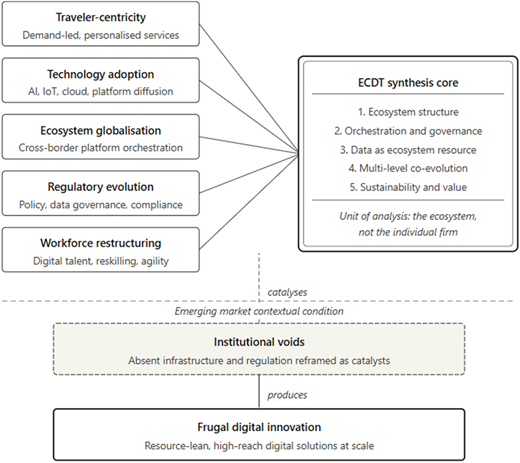
Five interconnected transformation themes are identified – traveller-centricity, technology adoption, ecosystem globalisation, regulatory evolution and workforce restructuring. These are synthesised into the Ecosystem-Centric Digital Transformation (ECDT) framework. Emerging market cases reveal that institutional voids, far from being barriers, are catalysts for frugal digital innovation.
Businesses must adopt tiered digital strategies (strategic, operational, regulatory), while policymakers need harmonised international frameworks. The ECDT framework provides practitioners with a diagnostic tool for navigating digital transformation complexity.
1. Introduction
In the era of an expanding digital economy that permeates every facet of society, there arises an imperative for collective contemplation on the formulation of a well-structured framework. Such a framework becomes crucial in guiding the trajectory of the economy as it navigates the complexities of the digital age. Digital technology, once a mere incremental innovation for broadening channels, has now assumed a pivotal role, serving as the primary catalyst for core platform innovation (Şahin, 2024). This transformative innovation is poised to propel the future growth of enterprises and consumers alike, marking a paradigmatic shift in the economic landscape.
Recognising the profound impact of digital transformation, the World Economic Forum (WEF) acknowledged the imperative for a comprehensive digital transformation initiative in 2015. This initiative expanded its scope in 2016 to include an additional seven industry sectors, notably the Aviation, Travel and Tourism sectors. The WEF report highlights a projected shift of USD 100 billion to new players within these industries, accompanied by a substantial USD 700 billion in consumer benefits expected to accrue between 2016 and 2025 (WEF report, 2015).
The travel industry, characterised by the symbiotic relationship between airlines, airports and hotels, is witnessing a significant metamorphosis driven by digitalisation and changing consumer expectations (Şahin, 2024). Traditionally, these sectors primarily functioned as providers of inventory and assets. However, contemporary trends as given in Table 1 underscore a fundamental shift towards becoming purveyors of services and immersive experiences (Brown & Jones, 2020).
Comparison of traditional and digital model
| Aspect | Traditional model | Digital-first model | Case study |
|---|---|---|---|
| Customer interaction | In-person check-ins, phone bookings | AI chatbots, mobile self-service | Hilton: Reduced front-desk staff by 30% after deploying “Connie,” an AI concierge, while Marriott uses mobile check-in for 60% of guests |
| Revenue streams | Room bookings, ancillary services | Dynamic pricing, blockchain loyalty | LockTrip: Zero-commission blockchain bookings increased margins by 20% versus Expedia’s 15% OTA fees |
| Data security | Centralised databases | Decentralised blockchain systems | Post-2018 breach, Marriott adopted zero-trust frameworks, while Winding Tree uses blockchain to eliminate single points of failure |
1.1 Theoretical contribution and positioning
This study makes two principal theoretical contributions. First, it synthesises the hitherto fragmented literature on digital transformation in travel and hospitality into a unified conceptual model – the Ecosystem-Centric Digital Transformation (ECDT) framework. While scholars such as Bharadwaj, El Sawy, Pavlou, and Venkatraman (2013) have theorised digital transformation at the enterprise level, and Verhoef et al. (2021) have mapped its customer experience dimensions, no existing framework integrates platform ecosystem dynamics, regulatory imperatives and traveller-centricity into a single analytical lens applicable to the aviation–hotel nexus. The ECDT framework addresses this gap.
Second, by systematically applying this framework across both developed and emerging market contexts, this study contributes to the nascent literature on frugal digital innovation in travel (Zhang & Szabó, 2024). The emerging market cases – including mobile-first online travel agencies (OTAs) in sub-Saharan Africa and localised home-sharing in China – reveal how institutional voids (Khanna & Palepu, 1997) may function as catalysts for novel platform models rather than as structural barriers.
2. Research methodology
This study adopts a systematic qualitative literature review methodology (Tranfield, Denyer, & Smart, 2003) complemented by a purposive multiple case study analysis (Yin, 2018). This combination is appropriate given the study’s aim: to synthesise an emerging and multi-disciplinary body of knowledge and to derive context-rich insights that statistical methods cannot adequately capture.
Literature search and selection: A systematic search was conducted across databases including Scopus, Web of Science and Google Scholar. Search terms combined “digital transformation,” “travel and hospitality,” “platform ecosystems,” “AI in tourism,” “blockchain travel” and “emerging market tourism.” The search was bounded between 2015 and 2024 to capture post-WEF-initiative literature. A total of 112 peer-reviewed articles and 24 industry reports were screened; 58 academic sources and 16 industry reports met the inclusion criteria of direct relevance to the research themes.
Cases were selected using four criteria: (1) geographic diversity (covering Africa, Asia, Europe and North America), (2) market significance (each case represents a meaningful share of regional digital travel activity), (3) data availability (sufficient public documentation exists for analysis) and (4) innovation relevance (each case exemplifies a distinct dimension of the ECDT framework). Cases include Travelstart (mobile-first OTA, sub-Saharan Africa), Tujia (localised home-sharing, China), Delta Air Lines (hybrid workforce digitalisation, USA), LockTrip (blockchain-based booking, Europe) and Dubai TravelTech Lab (regulatory sandbox, Middle East).
Data analysis: Data were analysed using thematic synthesis (Thomas & Harden, 2008). Themes were inductively derived from the literature and deductively validated against the ECDT framework. Findings were triangulated across academic sources, industry reports and case study evidence to enhance validity.
3. Key trends and transformations
3.1 Theoretical anchoring
The trends identified in this section are analysed through three complementary theoretical lenses: (1) Platform Ecosystem Theory (Eisenmann, Parker, & Van Alstyne, 2006), which explains how multi-sided platforms mediate between traveller demand and service supply; (2) Dynamic Capabilities Theory (Teece, 2007), which frames the organisational capacity to sense, seize and reconfigure resources in response to digital disruption; and (3) Institutional Theory (DiMaggio & Powell, 1983), which illuminates how regulatory environments and social norms shape adoption patterns across diverse markets. Together, these frameworks provide the theoretical scaffolding for the ECDT framework presented in Figure 1.
3.2 Asset-centric to traveller-centric
One of the foremost trends disrupting the travel industry is the transition from an asset-centric model to a traveller-centric paradigm (Brown & Jones, 2020; Nabila, 2023). This transformation is largely instigated by the advent of digital natives, including OTAs, vertical search engines, discovery platforms and conversational agents like chatbots (Zeqiri, 2024). These disruptors have pressured traditional players to reevaluate their business models to remain competitive in the digital era.
From a dynamic capabilities perspective (Teece, 2007), incumbents that successfully pivot to traveller-centricity – such as Marriott’s adoption of AI-driven concierge services and Emirates’ personalised fare bundling – demonstrate the “reconfiguration” capability that distinguishes digital leaders from laggards. The traditional classification of businesses based on physical assets has given way to a data-driven service model, wherein customer insights constitute the most valuable organisational resource (Mich, 2020; Şahin, 2024).
3.3 Leveraging technology for transformation
Technology stands at the forefront of the travel industry’s evolution. To adapt to the changing landscape, businesses are harnessing a range of cutting-edge technologies including artificial intelligence (AI), Internet of Things (IoT), blockchain and Augmented/Virtual Reality (Chen & Wang, 2019; Halkiopoulos, Antonopoulou, & Kostopoulos, 2022). Within Platform Ecosystem Theory (Eisenmann et al., 2006), these technologies function as “enabling infrastructure” – reducing transaction costs and increasing the value exchanged between platform participants.
3.4 Globalisation and the emergence of ecosystems
The globalisation of travel and the ascendancy of Asian markets as pivotal drivers of volume and technology adoption have given rise to a diverse and multifaceted digital platform ecosystem (Zhang & Szabó, 2024). Emerging players, characterised by asset-light but service-intensive models, are gaining acceptance within the traditionally inventory-centric landscape (Kim & Lee, 2018). Airbnb has disrupted the traditional hotel industry (Barron, Kung, & Proserpio, 2021); Uber and Lyft have similarly transformed transportation (Ward et al., 2021).
3.5 Emerging markets: institutional voids as innovation catalysts
A distinctive contribution of this study lies in its systematic examination of emerging market innovation, which has been undertheorised in mainstream travel-tech literature (Zhang & Szabó, 2024). Drawing on Khanna and Palepu’s (1997) theory of institutional voids – defined as the absence of efficient market intermediaries common in advanced economies – this study argues that such voids in emerging markets have catalysed frugal digital innovation rather than inhibiting it.
Travelstart (South Africa) exemplifies this dynamic: operating in a market where credit card penetration is low and desktop internet access limited, Travelstart engineered a mobile-first platform integrated with M-Pesa mobile payments and vernacular language interfaces. This platform architecture, driven by necessity rather than preference, ultimately produced a more inclusive model than those adopted in data-rich Western markets (Travelstart Case Study, 2022). Similarly, Tujia (China) addressed institutional voids in property verification by partnering with government authentication systems – an institutional co-creation strategy unavailable to platforms operating in markets with established credit bureaus (Dolnicar, 2017).
In South-East Asia, super-apps such as Grab and Gojek have integrated travel booking, accommodation and local experiences into single platforms – an ecosystem architecture responding to fragmented regulatory environments across Association of Southeast Asian Nations (ASEAN) member states. In India, the adoption of the Unified Payments Interface has enabled a new generation of travel start-ups to offer seamless mobile booking without requiring conventional banking infrastructure (Taneja, 2023). These cases collectively suggest that emerging market platforms are not merely scaled-down versions of Western models; they represent institutionally distinct innovations with significant implications for global platform strategy.
4. Framing the challenges of the future
4.1 Theoretical framing of challenges
Each challenge identified below is mapped to one or more of the three theoretical anchors (Platform Ecosystem Theory, Dynamic Capabilities, Institutional Theory) to strengthen the linkage between empirical findings and existing literature.
4.1.1 Cybersecurity imperatives
As digital touchpoints proliferate, cybersecurity has become a cornerstone of consumer trust. High-profile breaches, such as the 2018 Marriott International incident compromising 500 million guest records, underscore vulnerabilities in centralised data systems (Marriott Data Breach Settlement, 2021). Emerging threats like ransomware targeting hotel reservation platforms highlight the need for robust encryption and zero-trust architectures.
Through the lens of Dynamic Capabilities Theory, cybersecurity resilience represents a “sensing” capability – the ability to detect and respond to environmental threats before they compromise platform integrity (Teece, 2007). Platforms that have embedded zero-trust architectures (e.g. LockTrip’s decentralised ledger) demonstrate superior threat-sensing capabilities compared to incumbents reliant on centralised data warehouses (PhocusWire, 2023).
4.1.2 Regulatory fragmentation across markets
Within this evolving landscape, regulatory frameworks play an indispensable role (Shandilya, Datta, Kartik, & Nagar, 2024). The General Data Protection Regulation (GDPR) exemplifies the convergence of consumer-centric digital models and regulatory imperatives (Mandani, 2024). However, fragmented regulations across markets – from Europe’s GDPR to India’s Personal Data Protection Bill – create compliance asymmetries that disadvantage smaller players.
Institutional Theory (DiMaggio & Powell, 1983) frames regulatory fragmentation as a form of “coercive isomorphism,” wherein platforms are pressured to adopt market-specific compliance architectures that may conflict with globally standardised platform designs. The Dubai TravelTech Lab’s regulatory sandbox model represents an institutional innovation that temporarily suspends coercive pressures, enabling experimentation while preserving accountability.
4.1.3 Workforce restructuring and employment shifts
Automation and AI are reshaping workforce dynamics (IATA Future Workforce Report, 2022). While self-service kiosks reduce front-desk staffing needs, roles in cybersecurity, AI ethics and data analytics are surging (PhocusWire, 2023).
Delta Air Lines’ “digital ambassador” programme illustrates a dynamic capabilities response to workforce disruption – reconfiguring human capital rather than replacing it. From an institutional perspective, Marriott’s “Pathways to Hospitality” programme responds to coercive regulatory and social pressures around equitable employment in the gig economy. The IATA estimate that 25% of aviation jobs will require advanced digital skills by 2030, underscoring the urgency of public–private reskilling partnerships (Kabashkin, Misnevs, & Zervina, 2023).
5. Future preparedness: a tiered action framework
5.1 Restructured three-tier framework
Based on the synthesis of findings and theoretical anchors, this study proposes a tiered actionable framework organised by actor type and implementation horizon. This structure addresses the reviewer’s concern that prior recommendations lacked actionable specificity.
5.1.1 Tier 1: strategic-level actions (business leaders, 1–3 year horizon)
Establish a digital transformation steering group with cross-functional expertise spanning AI, blockchain, IoT, consumer behaviour and regulatory compliance (Rahimi, Kiani, & Tavakoli, 2024). This group should commission a digital maturity assessment benchmarked against the ECDT framework within the first six months.
Commission ethical AI audits on all algorithmic pricing and recommendation systems. Audits should evaluate bias across demographic segments, with findings reported at board level annually. This operationalises the recommendation to “prioritise ethical AI” with a concrete governance mechanism.
Develop a five-year Emerging Market Entry Strategy informed by institutional void mapping. Prioritise markets where mobile penetration exceeds 70% but desktop penetration remains below 40% – the profile under which mobile-first models (e.g. Travelstart) have demonstrated superior user acquisition economics.
5.1.2 Tier 2: operational-level actions (technology and operations teams, 6–24 month horizon)
Implement a hybrid blockchain-cloud security architecture to balance decentralisation benefits with real-time processing efficiency. A phased roadmap is recommended: (1) audit existing centralised data assets, (2) migrate non-transactional loyalty data to a private blockchain and (3) pilot real-time booking data on a permissioned chain. This directly operationalises “invest in decentralised security” with a staged implementation pathway.
Deploy a structured Application Programming Interface (API) Governance Protocol. Partner system integrations should be governed by tiered access controls, standardised data schemas and quarterly interoperability audits to mitigate distributed system failure risks (Smith et al., 2021).
Launch holistic workforce reskilling programmes that address both technical competencies (AI tools, data analytics, IoT maintenance) and soft skills (empathy, cross-cultural communication, digital facilitation). Programmes should be co-designed with vocational institutions to ensure labour market relevance.
5.1.3 Tier 3: regulatory and policy-level actions (policymakers, 2–5 year horizon)
Establish an International Travel Data Harmonisation Treaty modelled on GDPR principles but adapted for travel’s cross-jurisdictional nature. Regulatory sandboxes (e.g. Dubai TravelTech Lab) should be institutionalised as permanent innovation corridors rather than time-limited experiments.
Create a Cross-Border Digital Skills Fund, co-funded by IATA, WEF and national governments, to finance reskilling programmes in regions where skill gaps are most acute – particularly sub-Saharan Africa and South-East Asia. Fund allocation criteria should prioritise programmes that bridge formal and informal employment pathways.
Mandate platform accountability frameworks requiring OTAs and super-apps to publish annual algorithmic impact assessments, covering dynamic pricing equity, demographic bias metrics and accessibility compliance.
6. Conclusions
The travel and hospitality industry’s transformation is defined by a shift to traveller-centric models powered by AI, blockchain and IoT, with emerging markets driving institutionally distinctive innovation. This study has synthesised these forces into the ECDT framework, which integrates Platform Ecosystem Theory, Dynamic Capabilities and Institutional Theory into a unified analytical lens for the aviation–hotel nexus.
Three overarching conclusions emerge. First, digital transformation in travel is not a uniform global process; it is institutionally mediated, with emerging markets generating platform innovations that challenge assumptions embedded in Western-derived frameworks. Second, the most significant challenges – cybersecurity, regulatory fragmentation and workforce restructuring – are interconnected systemic risks that require cross-sector governance rather than firm-level technical fixes. Third, ethical AI and inclusive design are not optional considerations; they are structural prerequisites for the long-term legitimacy of platform-based travel ecosystems.
The tiered action framework presented in Section 4 provides practitioners with a context-sensitive roadmap rather than a generic prescription. Future research should empirically test the ECDT framework using survey-based or experimental methods across multiple market contexts and should further examine the mechanisms through which regulatory sandboxes translate experimental innovation into durable institutional change.
7. Limitations and implications
Proposed digital strategies face important limitations. Blockchain’s scalability hinders real-time booking efficiency; AI risks demographic bias without systematic auditing; IoT implementation depends on infrastructure reliability that varies significantly across emerging markets. Regulatory sandboxes offer temporary innovation windows but lack durable long-term frameworks, while reskilling programmes often neglect the soft skills essential for human-centred service delivery.
This study’s limitations include its reliance on publicly available case study data, which may not fully capture proprietary transformation strategies. The ECDT framework, while grounded in established theory, has not yet been empirically validated through primary survey or experimental research – a priority for future inquiry. Additionally, the rapidly evolving nature of AI and blockchain means that specific technical recommendations may require updating as the technology landscape matures.
Despite these limitations, this study makes a meaningful contribution by providing the first integrated theoretical framework for digital transformation in the travel and hospitality sector, with particular attention to emerging market dynamics. Future empirical work should test the ECDT framework’s predictive validity across diverse organisational and institutional contexts.

