
Skip to Main Content
Purpose

To empirically test a dual-pathway structural model, that explains how institutional support (IS) from Farmer Producer Organisations (FPOs) enhances climate adaptability (CA) among smallholder farmers in India. This study aims to move beyond purely economic outcomes to investigate the mediating roles of both behavioural change and psychological resilience.

Design/methodology/approach

A cross-sectional survey was conducted with 326 smallholder farmers, who are members of 38 FPOs, across three distinct agroecological regions in India. The hypothesised relationships, grounded in social cognitive theory and resilience theory, were tested using partial least squares structural equation modelling (PLS-SEM), with the measurement model validated using the heterotrait–monotrait criterion.

Findings

The results confirm that the influence of IS on CA is fully mediated and operates through two significant indirect pathways. The model validates a behavioural pathway, where support positively influences the adoption of adaptive agricultural practices and a sequential psychological pathway, where support fosters financial resilience, which in turn enhances psychological resilience, ultimately leading to greater climate adaptability.

Research limitations/implications

The study is based on cross-sectional data, limiting the ability to infer causality. Future research may benefit from longitudinal or experimental designs.

Practical implications

The findings suggest that FPOs should design interventions that provide services and foster behavioural change and mental resilience among farmers to strengthen climate adaptability.

Originality/value

To the best of the authors’ knowledge, this study is among the first to empirically validate the crucial, distinct roles of both behavioural adoption and psychological fortitude in the context of FPO-led climate adaptation. It offers a more nuanced, process-based model of resilience that challenges a one-size-fits-all view of institutional support. The findings provide evidence-driven policy recommendations that account for the complex interplay between external support and farmers’ internal capacities.

AAP

= adaptive agricultural practices;

AVE

= average variance extracted;

CA

= climate adaptability;

CR

= composite reliability;

FPO

= farmer producer organisation;

FR

= financial resilience;

HTMT

= heterotrait–monotrait ratio of correlations;

IS

= institutional support;

PLS-SEM

= partial least squares structural equation modelling;

SEM

= structural equation modelling; and

MICOM

= measurement invariance of composite models.

  • IS enhances farmer CA via two distinct and fully mediating pathways.

  • Validates a behavioural pathway (via adaptive practices) and a sequential psychological pathway [via financial and psychological resilience (PR)].

  • Confirms PR as a critical, high-order mediator in the climate adaptation process.

  • Provides a nuanced, process-based structural model of farmer-producer organisations (FPO)-led farmer resilience, validated with rigorous, contemporary methods [heterotrait–monotrait (HTMT), robustness checks].

  • Offers evidence-driven policy recommendations against a “one-size-fits-all” approach to supporting FPOs.

India’s agricultural sector, the primary livelihood for over half its population, is critically exposed to the intensifying impacts of climate change. Escalating risks from rising temperatures, erratic rainfall and the increasing frequency of extreme weather events directly undermine productivity, food security and rural incomes (Harvey et al., 2014). Smallholder farmers, who constitute over 85% of the farming population, are particularly vulnerable due to their reliance on rain-fed systems and limited access to finance, technology and insurance (Abid et al., 2016; Belay et al., 2017; Jatav, 2024). In this context, institutional innovations that bolster the adaptive capacity of these farmers are paramount.

Farmer producer organisations (FPOs) have emerged as a key institutional response, promoted by the Indian government to enhance farmers’ market power, resource access and capacity for sustainable farming (Biswas et al., 2025; Gurung et al., 2023). By aggregating produce, facilitating access to inputs and credit and offering climate-related advisories, FPOs are envisioned as vehicles for rural transformation and resilience building. However, while the economic benefits of FPOs are often discussed, the underlying mechanisms through which they build resilience, particularly the behavioural and psychological pathways, remain poorly understood. The existing literature has largely focused on economic outcomes, leaving a critical gap in understanding how institutional support (IS) translates into tangible adaptive actions and the mental fortitude required to withstand climate shocks.

This study addresses this gap by proposing and testing a dual pathway model that integrates behavioural and psychological theories into a single, empirically validated framework. It moves beyond the existing literature’s focus on economic outcomes to uncover the critical mediating roles of adaptive practices and PR. The novelty of this research lies in its empirical validation of how IS from FPOs enhances CA not directly, but through two distinct indirect pathways: a behavioural pathway (influencing the adoption of adaptive practices) and a psychological pathway (sequentially building financial and then PR).

The analysis uses partial least squares structural equation modelling (PLS-SEM), a methodological approach well-suited for testing complex mediation models and for prediction-orientated research, which is appropriate given the practical policy implications of the findings (Cepeda et al., 2016; Hair et al., 2011, 2019; Richter et al., 2022; Sarstedt et al., 2020). This paper is structured as follows: Section 2 reviews the relevant literature and develops the theoretical framework. Section 3 details the empirical strategy and data. Section 4 presents the empirical findings and model validation, including a suite of robustness checks. Section 5 discusses the interpretation of these findings and Section 6 concludes with policy implications, limitations and directions for future research.

India’s smallholder farmers are vulnerable to the growing impacts of climate change, which disrupts agricultural productivity and rural livelihoods through rainfall, rising temperatures and extreme weather (Arun et al., 2024; Harvey et al., 2014). Climatic stresses are further intensified by systemic constraints, including fragmented landholdings, dependence on rain-fed cultivation and limited IS (Jatav et al., 2024; Saleem et al., 2024). In response, FPOs have emerged as collective mechanisms to strengthen smallholders’ adaptive capacity, backed by national policy initiatives, FPOs facilitate producers’ collective access to markets, inputs, finance and climate-resilient agricultural practices (Biswas et al., 2025; Nikam et al., 2023). Empirical studies show that FPO membership is associated with higher income and improved bargaining power (Gurung et al., 2023; Kumar et al., 2023). Despite these benefits, issues related to governance, leadership quality and financial sustainability continue to constrain their performance. Moreover, extant literature predominantly emphasises economic outcomes, while the psychological and behavioural pathways through which FPOs enhance farmers’ CA remain comparatively underexplored.

This study proposes a conceptual model grounded in two complementary theoretical streams: social cognitive theory (SCT) and Resilience Theory to explain the mechanisms through which FPO support enhances climate adaptability.

2.2.1 The behavioural pathway: social cognitive theory and self-efficacy.

SCT explains human functioning as the result of a dynamic, reciprocal interaction among personal factors, behaviour and the environment (Bandura, 1986). In his seminal work, Social Foundations of Thought and Action, Bandura (1986) conceptualised individuals as proactive agents who shape their own development rather than passive respondents to external influences. A central construct within this theory is self-efficacy, defined as an individual’s belief in their capability to execute specific actions required to achieve a desired outcome (Bandura, 1977; Schunk, 1991). Extensive research underscores its role as a key predictor of motivation, sustained effort and resilience in the face of challenges (Masten, 2014).

In this study’s model, the FPO is a key social environment component. It provides farmers with training on climate-smart agriculture, access to necessary inputs and technologies and vicarious learning opportunities through the observation of successful peers (Holling, 1973; Liguori et al., 2018). Within the framework of SCT, such IS functions as an enabling environment that strengthens farmers’ self-efficacy, the belief in their capacity to adopt and execute new adaptive agricultural practices (AAP) (Ameyaw et al., 2018; Dessart et al., 2019). Accordingly, Hypothesis H1 posits a direct relationship between institutional support and adaptive agricultural practices, capturing the principle that supportive social contexts cultivate the confidence and competencies required for behavioural change. The adoption of these practices, such as crop diversification and efficient water use, represents a tangible change in on-farm operations designed to mitigate climate risks and enhance productivity (Ricart et al., 2022). These actions collectively form the foundation of on-farm resilience. Hence, Hypothesis H3 asserts that the adoption of AAP exerts a positive influence on farmers’ overall climate adaptability.

2.2.2 The psychological pathway: resilience theory as a process.

Resilience theory, first introduced in ecology by Holling (1973), describes the capacity of a system to absorb disturbance and reorganise while retaining its essential function, structure and feedbacks (Chapagain et al., 2025; Holling and Gunderson, 2002; Walker and Salt, 2012). In the context of climate change and agriculture, resilience is understood as the capacity of social-ecological systems to cope with hazardous events by responding or reorganising in ways that maintain their essential functions (Pachauri et al., 2014). Contemporary applications of the theory emphasise resilience not as a static outcome but as a dynamic process involving absorption, adaptation and, in some cases, transformation (Anderies et al., 2004; Biggs et al., 2012; Folke, 2006; Walker et al., 2004).

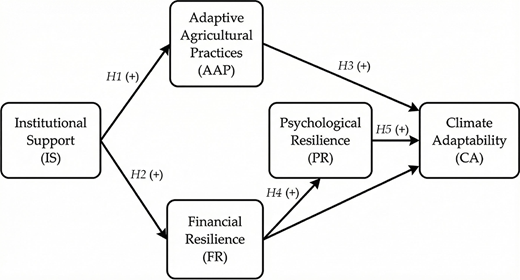
This study conceptualises resilience as a dynamic and sequential process. The proposed pathway (IS→FR→PR→CA) models how IS from FPOs translates into adaptive outcomes. IS in the form of improved market access, favourable input pricing and linkages to credit and insurance, enhances farmers’ financial stability, thereby fostering financial resilience (FR), as outlined in Hypothesis H2. Greater financial security mitigates stress and uncertainty associated with climatic shocks, freeing cognitive and emotional resources that underpin PR, as proposed in Hypothesis H4. Heightened PR, marked by optimism, self-efficacy and perceived control, enables farmers to adopt proactive adaptive strategies, thus strengthening CA, in line with Hypothesis H5. This sequential framework offers a nuanced understanding of resilience-building, tracing its evolution from material and financial foundations to psychological empowerment and, ultimately, adaptive behavioural transformation.

The conceptual framework presented in Figure 1 visually summarises the complete set of hypothesised relationships.

Based on the theoretical foundations outlined above, this study proposes a dual-pathway model. To ensure clarity and distinguish the hypothesised relationships from the results, the conceptual framework and specific hypotheses are presented here.

2.3.1 The behavioural pathway.

IS functions as an enabling environment that strengthens farmers’ capacity to adopt new methods. By providing access to climate-smart technologies, resilient seeds and agronomic training, FPOs directly facilitate behavioural change:

H1.

Institutional Support (IS) has a positive and significant influence on the adoption of Adaptive Agricultural Practices (AAP).

H3.

The adoption of Adaptive Agricultural Practices (AAP) has a positive and significant influence on Climate Adaptability (CA).

2.3.2 The psychological pathway.

This pathway models resilience as a sequence. IS first addresses the immediate material needs of the farmer, creating a foundation of financial security. This security, in turn, reduces stress and enhances the farmer’s psychological capacity to cope with adversity and plan for the future:

H2.

Institutional Support (IS) has a positive and significant influence on Financial Resilience (FR).

H4.

Financial Resilience (FR) has a positive and significant influence on Psychological Resilience (PR).

H5.

Psychological Resilience (PR) has a positive and significant influence on Climate Adaptability (CA).

A critical oversight in much of the FPO literature is the treatment of these organisations as a monolithic entity. In reality, the FPO ecosystem in India is characterised by significant heterogeneity in governance, scale, age and operational capacity, which has profound implications for the type and quality of support they can provide to farmers (Basavaraj et al., 2022; Bikkina et al., 2018; Mukherjee et al., 2019). FPOs can be registered under different legal acts, such as the Cooperative Society Act or the Companies Act, leading to variations in governance structures and operational flexibility (Radadiya and Lad, 2024; Trivedi et al., 2023). Further, their performance is constrained by various internal and external factors, including financial limitations, skill gaps in management and weak market linkages (Trivedi et al., 2023).

The diversity within the FPO ecosystem is not merely a contextual footnote but a central characteristic that influences their potential as resilience-building institutions. The 38 FPOs in this study’s sample exemplify this heterogeneity, with formation dates ranging from 2004 to 2023, membership size spanning from under 500 to over 4,500 farmers and vast differences in revenue generation and legal structure (producer company versus cooperative society). An FPO established in 2004 has had two decades to build social capital, establish market linkages and navigate regulatory hurdles, whereas an FPO formed in 2023 is likely still focused on basic member mobilisation and capacity building (Trebbin and Hassler, 2012). This institutional maturity directly impacts the effectiveness of the institutional support construct. Acknowledging this heterogeneity is crucial for developing nuanced policies and avoiding a universal approach to FPO promotion and support.

The application of structural equation modelling and psychological constructs to understand farmers’ sustainable behaviours is well established in the international literature. For instance, a recent study on farmers in China used SEM to analyse the factors influencing the adoption of carbon-neutral agricultural practices (Khoso et al., 2025). The findings highlighted the significant roles of psychological constructs such as behavioural attitude and perceived behavioural control, demonstrating that farmers’ motivations and beliefs are critical determinants of their willingness to adopt sustainable practices. This precedent validates the methodological and theoretical approach of the current study, situating its focus on psychological pathways within a broader global research conversation on agricultural transformation.

Further, research beyond agriculture supports the critical role of financial stability as an enabler of sustainable transitions. For instance, Solangi and Magazzino (2025)FR was a key sub-criterion of financial risk, the most important factor influencing the adoption of renewable energy in China. This finding underscores that financial stability is a foundational prerequisite for undertaking adaptive or transformative actions, whether in the energy or agricultural (Negera et al., 2025). Citing such cross-disciplinary evidence strengthens the theoretical justification for including FR as a key mediating construct in the model of climate adaptability.

This study used a cross-sectional quantitative design, using data from a structured survey to examine how FPOs enhance the adaptive capacity of smallholder farmers. Data were collected from 326 smallholder farmers affiliated with 38 active FPOs across three distinct agroecological regions in India: Karnataka, Telangana and Andhra Pradesh. The sample size was determined to ensure sufficient statistical power for structural equation modelling, for which a minimum sample of 200 is typically recommended for models with multiple latent variables (Hair et al., 2021). The selection of these states was based on their representation of varied agroclimatic conditions, enhancing the external validity of the findings. Respondents were selected using stratified purposive sampling to capture diversity across age, landholding size and regional characteristics and all had at least one year of FPO membership. Data were collected in person by trained enumerators between February and April 2024.

This process yielded a final sample of 326 complete responses. Subsequently, potential outliers were evaluated using the Mahalanobis distance test. Responses exceeding the critical chi-square threshold (p < 0.001) were carefully reviewed and excluded when identified as unengaged or exhibiting patterned response behaviour, thereby minimising undue influence on parameter estimates.

All constructs in the model were measured using multiple indicator items adapted from established scales and contextualised for Indian smallholder agriculture. Responses were captured on a 5-point Likert scale. The operationalisation of each latent construct is detailed below and a summary is provided in Table 1:

  • Institutional Support (IS): This construct measures how farmers perceive support from their FPO. Indicator items included “FPO conducts training programmes for farmers”, “FPO has helped in increasing my household income” and “I often attend FPO meetings and activities”.

  • Adaptive Agricultural Practices (AAP): This construct assesses the adoption of climate-resilient and sustainable farming techniques. Indicator items included “I am experimenting with crop diversity in my cropping method”, “I use environmentally sustainable farming practices” and “I use modern agricultural tools and machinery”.

  • Financial Resilience (FR): This construct measures farmers’ capacity to manage financial risks and maintain stability. Indicator items included “I have savings for unexpected expenses”, “I use crop insurance to mitigate risk” and “I use financial planning to meet the financial needs of my farm.”

  • Psychological Resilience (PR): This construct captures the farmer’s mental and emotional capacity to cope with adversity. Indicator items were adapted from established scales and included “I do not shrink from difficulties and bounce back quickly from them” and “In general, I feel like I am in charge of the situation I live in.”

  • Climate Adaptability (CA): The ultimate dependent variable represents the farmer’s perceived capacity to adapt to climate-related shocks and changes. Indicator items assessed their ability to make informed decisions regarding climate information and their confidence in managing their farming practices under climatic variability.

The hypothesised relationships were examined using PLS-SEM. This method was chosen for several reasons. Firstly, the primary objective of the study is prediction-orientated to understand the key drivers of climate adaptability, which aligns with the strengths of PLS-SEM (Hair et al., 2019). Secondly, the model is complex, involving multiple mediating pathways, for which PLS-SEM is well-suited (Hair and Alamer, 2022). Finally, PLS-SEM is robust to deviations from normality in the data distribution, which is common in survey-based social science research (Hair et al., 2011).

All analyses were performed using SmartPLS  4.0. The modelling procedure followed a two-stage approach consistent with established PLS-SEM guidelines. In the first stage, the measurement model was assessed to ensure construct reliability and validity. In the second stage, the structural model was evaluated to examine the hypothesised relationships among constructs. Parameter estimation was performed using the path weighting scheme and the significance of path coefficients and indirect effects was assessed using a bootstrapping procedure with 5,000 resamples and the bias-corrected and accelerated confidence interval method to ensure robust and reproducible results (Hair et al., 2011).

The measurement model was assessed following established PLS-SEM guidelines to ensure indicator reliability, internal consistency and construct validity (Hair and Alamer, 2022). As detailed in the comprehensive analysis table in  AppendixTable A1, the model exhibited strong psychometric properties. All constructs were modelled as reflective. Indicator reliability was satisfactory, with all outer loadings exceeding the recommended threshold of 0.708  (Hair et al., 2019). Internal consistency reliability was confirmed, as composite reliability (CR) values ranged from 0.83 to 0.89, surpassing the minimum criterion of 0.70. Convergent validity was further supported, with average variance extracted (AVE) values for all constructs exceeding 0.50, indicating that the latent constructs accounted for more than half of the variance in their respective indicators.

4.1.1 Discriminant validity using the heterotrait–monotrait ratio.

The HTMT ratio of correlations was used to assess discriminant validity. The HTMT is an estimate of the actual correlation between two constructs. It is recognised as a superior criterion to the traditional Fornell–Larcker criterion, which often fails to detect discriminant validity issues, particularly in PLS-SEM (Franke and Sarstedt, 2019; Henseler et al., 2015; Roemer et al., 2021; Voorhees et al., 2016). Adopting this more rigorous, contemporary validation technique directly addresses methodological weaknesses and demonstrates an engagement with current best practices in the field. Following the conservative recommendation for conceptually distinct constructs, a threshold of 0.85 was used (Henseler et al., 2015). As shown in Table 2, all HTMT values were well below this conservative threshold, providing strong evidence for the discriminant validity of all constructs in the model.

The results presented in Table 2 confirm that discriminant validity was established for all constructs. The highest observed HTMT value was 0.731 (between IS and adaptive practices), comfortably below the 0.85 cut-off. This provides strong empirical evidence that each latent variable in the model is distinct, satisfying the final requirement for validating the measurement model before proceeding to the structural analysis.

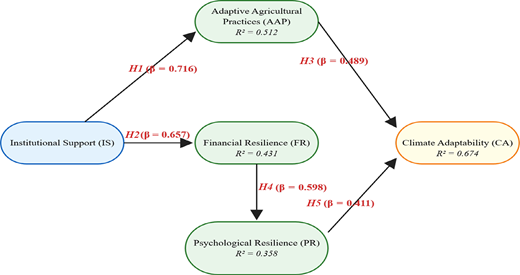
Following the successful validation of the measurement model and the confirmation of the model’s robustness, the structural model was evaluated to test the hypothesised relationships. The results of the bootstrapping procedure (5,000 resamples) are presented in Table 3 and visualised in Figure 2. The model demonstrated substantial explanatory power, accounting for 67.4% of the variance in the final dependent variable, CA (R2 = 0.674).

An examination of the specific path coefficients reveals strong support for the proposed dual-pathway model. In the behavioural pathway, IS had a significant positive effect on AAP (β = 0.716, p < 0.001) and AAP, in turn, had a significant positive influence on CA (β = 0.489, p < 0.001). Therefore, both H1 and H3 were supported.

The sequential psychological pathway was also fully validated. IS had a strong positive influence on FR (β = 0.657, p < 0.001). Subsequently, FR positively influenced PR (β = 0.598, p < 0.001), which then had a significant positive impact on CA (β = 0.411, p < 0.001). Thus, H2, H4 and H5 were all supported.

4.2.1 Mediation analysis.

The indirect effects were examined to formally test the mediating roles of the behavioural and psychological pathways. The analysis confirmed a significant positive indirect effect for the behavioural pathway through AAP (β = 0.350, p < 0.001). Further, a significant positive indirect effect was confirmed for the sequential psychological pathway through FR and PR (β = 0.162, p < 0.001).

Crucially, the direct path from IS to CA was tested and found to be non-significant (β = 0.087, p > 0.05). The combination of significant indirect and non-significant direct effects provides strong empirical evidence for complete mediation. This indicates that the influence of IS on farmers’ CA is fully channelled through the proposed behavioural and psychological mechanisms.

A series of robustness checks was conducted to address potential methodological limitations and validate the stability of the findings. This comprehensive validation directly addresses the critique of the study being a basic econometric exercise and demonstrates a commitment to rigorous empirical analysis.

4.3.1 Endogeneity test.

Given the cross-sectional nature of the data, endogeneity arising from omitted variables or reverse causality (e.g. more resilient farmers being more likely to join FPOs) is a potential concern. To assess this, the Gaussian copula approach, an instrument-free method suitable for PLS-SEM, was used (Becker et al., 2022; Haschka, 2022; Hult et al., 2018; Park and Gupta, 2012, 2024; Yang et al., 2025; Yang et al., 2024). This approach adds a copula term, a nonlinear transformation of the potentially endogenous predictor, to the structural model. A significant path coefficient for this copula term would indicate the presence of endogeneity (Park and Gupta, 2012). The test was applied to the key exogenous path (IS → AAP). The results were non-significant, suggesting that endogeneity is not a critical issue for this relationship.

4.3.2 Alternative model specification.

Its explanatory power was compared against a plausible alternative model to ensure the hypothesised model structure is not arbitrary. An alternative model was specified with a direct path from IS to PR, bypassing FR. The R2 value for the ultimate dependent variable (CA) was compared between the two models. The hypothesised model demonstrated superior explanatory power (R2 = 0.63) to the alternative model (R2 = 0.59), supporting the proposed theoretical structure.

4.3.3 Subgroup analysis.

To test the model’s stability across different institutional contexts, a multigroup analysis (MGA) was conducted based on FPO characteristics (Cheah et al., 2020; Hair et al., 2011; Henseler et al., 2016; Klesel et al., 2019; Matthews, 2017; Sarstedt et al., 2011). This analysis leverages the identified heterogeneity within the FPO sample to conduct a powerful robustness check. The sample was split based on the median age of the FPOs (formed before 2018 versus 2018 and after). Following the establishment of measurement invariance using the measurement invariance of composite models (MICOM) procedure, the path coefficients were compared across the two groups using a permutation test (Hair et al., 2019; Henseler et al., 2016). The results indicated no significant differences in the main path coefficients between older and newer FPOs, providing strong evidence for the model’s robustness and generalisability across different levels of institutional maturity.

This study set out to empirically test a dual-pathway model explaining how IS from FPOs enhances CA among smallholder farmers. The findings from the structural equation model, validated through rigorous contemporary methods, strongly support the proposed theoretical framework. The results offer several key insights into the complex mechanisms that underpin farmer resilience, which warrant detailed discussion.

Firstly, the validation of the behavioural pathway (H1 and H3) aligns strongly with the principles of SCT (Bandura, 2001). The model confirms that IS is a critical environmental enabler of behavioural change. The path from IS to AAP was the strongest in the entire model (β = 0.716), which underscores that providing tangible resources, technical training and shared knowledge is a highly effective and direct mechanism for promoting the adoption of climate-resilient techniques. This finding is consistent with a broad body of literature identifying access to information and inputs as primary drivers of agricultural innovation (Silici et al., 2021). It provides clear empirical evidence that FPOs successfully fulfil their role as conduits for practical, on-the-ground behavioural change.

Secondly, representing this study’s key contribution, the findings validate the sequential psychological pathway (H2, H4 and H5). This advances a more nuanced, process-based understanding of resilience theory in an agricultural context. The results demonstrate that resilience is not a static trait but a dynamic capacity built in stages. The model confirms that FR is a necessary precursor to PR. By providing economic stability through improved market access and financial services (H2), FPOs create the foundational security that allows farmers to develop internal, psychological fortitude (H4). This finding provides empirical weight to the concept of mental bandwidth (Mullainathan and Shafir, 2013). By reducing the constant cognitive load of financial stress, farmers have more cognitive resources to engage in proactive planning and maintain the optimistic, self-efficacious mind-set that characterises PR. The subsequent strong path from PR to CA (H5) confirms that this internal capacity is the ultimate driver of sustained adaptive behaviour.

Finally, a pivotal finding of this study is the empirical evidence for complete mediation. The direct effect of IS on CA was found to be statistically non-significant (β = 0.087, p > 0.05). This is a powerful result which indicates that the benefits of FPO membership on CA are not automatic or direct. Instead, the influence of IS is fully channelled through the two proposed mechanisms: the tangible adoption of new practices and the cultivation of internal, PR. This finding challenges a simplistic, resource-provision view of institutional support. It suggests that merely joining an organisation or receiving inputs is insufficient. True adaptability is fostered only when that support is successfully translated into altered farming behaviours and a strengthened psychological outlook, highlighting these mediating pathways’ critical and indispensable role. This aligns with findings from other sectors, which show that the impact of institutional policies is often mediated by the psychological responses of individuals (Wang et al., 2023).

This research makes several contributions to the literature on climate adaptation and institutional support. Primarily, it validates a dual-pathway model that integrates behavioural and psychological mechanisms, offering a more holistic explanation of how external support translates into individual adaptive capacity. Secondly, it advances resilience theory by empirically demonstrating the sequential nature of resilience, where financial stability serves as a foundation for psychological fortitude. Thirdly, the study provides a methodologically rigorous and replicable PLS-SEM model, validated with modern techniques like the HTMT criterion and robustness checks. This model can be adapted and tested in other agricultural contexts.

The findings of this study offer several evidence-driven recommendations for policymakers and development practitioners.

  1. Prioritise tangible, behaviour-focused support: Given that the path from IS to Adaptive Practices exhibits the strongest coefficient in the model (β = 0.716), policy should continue to prioritise funding for FPO activities that directly facilitate knowledge transfer and technology access. Support for demonstration plots, input subsidisation and peer-to-peer training programmes will likely yield the most significant initial returns by directly enabling behavioural change.

  2. Cultivate resilience sequentially: Policymakers should recognise that building PR is a process that begins with financial stability. Interventions should therefore not only focus on technical training but also on strengthening FPOs’ capacity to provide financial services, improve market linkages and facilitate access to formal credit. This will bolster farmers’ FR, which this study shows is a necessary precursor to developing the psychological capacity for long-term adaptation.

  3. Adopt a nuanced, non-uniform approach to FPO support: Acknowledging the heterogeneity among FPOs, a “one-size-fits-all” policy is unlikely to be effective. The subgroup analysis found the model stable across FPO age, meaning the core pathways hold. However, the emphasis of support can be tailored. For younger FPOs, funding could focus on strengthening the behavioural pathway, for example, by establishing basic training services. For more mature FPOs, support could be geared towards enhancing the psychological pathway by facilitating links to formal financial institutions.

The findings of this study should be considered in light of several limitations, which in turn suggest avenues for future research.

Firstly, the cross-sectional nature of the data precludes definitive causal claims. While the model is grounded in established theory and passed endogeneity checks, the relationships should be interpreted as associations. Future research should use a longitudinal design to track resilience development over time, allowing for stronger causal inferences.

Secondly, while the sample was drawn from multiple agroecological regions in India, the findings are specific to this context and may not be generalisable to FPOs in other socio-economic environments. Comparative studies across different countries or regions are needed to test the external validity of the proposed dual-pathway model.

Thirdly, the data relies on self-reported measures from farmers, which may be subject to common method bias. Although procedural remedies were used, future studies could strengthen their findings by incorporating objective data, such as farm output records or meteorological data, alongside perceptual measures.

Finally, while this study acknowledged FPO heterogeneity and confirmed the model’s stability across FPO age, it did not formally test other characteristics as moderators. Future research should explicitly model FPO characteristics, such as size and governance structure, as moderating variables to empirically determine how organisational differences influence the strength of the behavioural and psychological pathways.

The authors express sincere gratitude to the Indian Council of Social Science Research (ICSSR), Ministry of Education, Government of India, New Delhi, for funding this major research project titled Social Development Impact, Resilience, Promotional and Performance Predictors of Farmer Producer Organisations and Companies (FPOs): Discovering Atma Nirbhar Pathways to Sustainable Development Goals. We are deeply thankful to ICSSR for their unwavering support, which made this study possible. We extend our appreciation to the project investigator, Prof. Channaveer R.M., for his visionary leadership and guidance. Special thanks to the co-principal investigators, Dr. S. Lingamurthy and Dr. Laxmana G., for their invaluable contributions, insights, and collaborative efforts throughout the project. We also acknowledge the cooperation of participating Farmer Producer Organisations, farmers, stakeholders, and institutions across the study regions. Their inputs were instrumental in shaping the findings. Finally, we thank our research team, peers, and family for their encouragement and patience.

This research was supported by the Major Research Project grant from the Indian Council of Social Science Research (ICSSR), Ministry of Education, Government of India, New Delhi. The funder had no role in study design, data collection, analysis, interpretation, or manuscript preparation. Project Investigator: Prof. Channaveer R.M. Co-Principal Investigators: Dr. S. Lingamurthy and Dr. Laxmana G.
Abid
,
M.
,
Schilling
,
J.
,
Scheffran
,
J.
and
Zulfiqar
,
F.
(
2016
), “
Climate change vulnerability, adaptation and risk perceptions at farm level in Punjab, Pakistan
”,
Science of The Total Environment
, Vol.
547
, pp.
447
-
460
.
Ameyaw
,
L.K.
,
Ettl
,
G.J.
,
Leissle
,
K.
and
Anim-Kwapong
,
G.J.
(
2018
), “
Cocoa and climate change: Insights from smallholder cocoa producers in Ghana regarding challenges in implementing climate change mitigation strategies
”,
Forests
, Vol.
9
No.
12
, p.
742
.
Anderies
,
J.M.
,
Janssen
,
M.A.
and
Ostrom
,
E.
(
2004
), “
A framework to analyse the robustness of social-ecological systems from an institutional perspective
”,
Ecology and Society
, Vol.
9
No.
1
,
available at:
A framework to analyse the robustness of social-ecological systems from an institutional perspectiveLink to the cited article
Arun
,
S.
,
Madurai
,
A.M.M.,B.
,
Ramajayam
,
P.K.
and
Radhakrishnan
,
B.
(
2024
), “
The role of farmer producer organisations in raising smallholder farmers’ income: a comprehensive review
”,
Indian Journal of Economics and Development
, doi: .
Bandura
,
A.
(
1977
), “
Self-efficacy: toward a unifying theory of behavioural change
”,
Psychological Review
, Vol.
84
No.
2
, p.
191
.
Bandura
,
A.
(
1986
),
Social Foundations of Thought and Action
,
Englewood Cliffs, New Jersey
, Vol.
1986
Nos
23-28
, p.
2
.
Bandura
,
A.
(
2001
), “
Social cognitive theory: an agentic perspective
”,
Annual Review of Psychology
, Vol.
52
No.
1
, pp.
1
-
26
.
Basavaraj
,
G.
,
Nayak
,
P.
and
Gracy
,
C.P.
(
2022
), “
Do institutional interventions benefit farmers—evidence from marketing maize through farmer producer organization in Davangere district of Karnataka
”,
Economic Affairs
, Vol.
67
No.
3
, pp.
361
-
369
, doi: .
Becker
,
J.-M.
,
Proksch
,
D.
and
Ringle
,
C.M.
(
2022
), “
Revisiting Gaussian copulas to handle endogenous regressors
”,
Journal of the Academy of Marketing Science
, Vol.
50
No.
1
, pp.
46
-
66
, doi: .
Belay
,
A.
,
Recha
,
J.W.
,
Woldeamanuel
,
T.
and
Morton
,
J.F.
(
2017
), “
Smallholder farmers’ adaptation to climate change and determinants of their adaptation decisions in the Central Rift Valley of Ethiopia
”,
Agriculture and Food Security
, Vol.
6
No.
1
, p.
24
, doi: .
Biggs
,
R.
,
Schlüter
,
M.
,
Biggs
,
D.
,
Bohensky
,
E.L.
,
BurnSilver
,
S.
,
Cundill
,
G.
,
Dakos
,
V.
,
Daw
,
T.M.
,
Evans
,
L.S.
,
Kotschy
,
K.
,
Leitch
,
A.M.
,
Meek
,
C.
,
Quinlan
,
A.
,
Raudsepp-Hearne
,
C.
,
Robards
,
M.D.
,
Schoon
,
M.L.
,
Schultz
,
L.
and
West
,
P.C.
(
2012
), “
Toward principles for enhancing the resilience of ecosystem services
”,
Annual Review of Environment and Resources
, Vol.
37
No.
1
, pp.
421
-
448
, doi: .
Bikkina
,
N.
,
Turaga
,
R.M.R.
and
Bhamoriya
,
V.
(
2018
), “
Farmer producer organizations as farmer collectives: a case study from India
”,
Development Policy Review
, Vol.
36
No.
6
, pp.
669
-
687
, doi: .
Biswas
,
P.
,
Kumar
,
A.
,
Kumari
,
S.S.
,
Pathak
,
S.
and
Ahmad
,
N.
(
2025
), “
The role of farmer producer organizations (FPOs) in revamping Indian agriculture landscape
”,
Journal of Scientific Research and Reports
, Vol.
31
No.
3
, pp.
490
-
506
.
Cepeda
,
G.
,
Henseler
,
J.
,
Ringle
,
C.
and
Roldán
,
J.L.
(
2016
), “
Prediction-oriented modelling in business research by means of partial least squares path modelling
”,
Journal of Business Research
, Vol.
69
No.
10
, pp.
4545
-
4551
.
Chapagain
,
P.S.
,
Banskota
,
T.R.
,
Shrestha
,
S.
,
Khanal
,
N.R.
,
Yili
,
Z.
,
Yan
,
J.
,
Linshan
,
L.
,
Paudel
,
B.
,
Rai
,
S.C.
,
Islam
,
M.N.
and
Poudel
,
K.R.
(
2025
), “
Studies on adaptive capacity to climate change: a synthesis of changing concepts, dimensions, and indicators
”,
Humanities and Social Sciences Communications
, Vol.
12
No.
1
, pp.
1
-
10
, doi: .
Cheah
,
J.-H.
,
Thurasamy
,
R.
,
Memon
,
M.A.
,
Chuah
,
F.
and
Ting
,
H.
(
2020
), “
Multigroup analysis using SmartPLS: step-by-step guidelines for business research
”,
Asian Journal of Business Research
, Vol.
10
No.
3
, pp.
1
-
14
.
Dessart
,
F.J.
,
Barreiro-Hurlé
,
J.
and
Van Bavel
,
R.
(
2019
), “
Behavioural factors affecting the adoption of sustainable farming practices: a policy-oriented review
”,
European Review of Agricultural Economics
, Vol.
46
No.
3
, pp.
417
-
471
.
Folke
,
C.
(
2006
), “
Resilience: the emergence of a perspective for social–ecological systems analyses
”,
Global Environmental Change
, Vol.
16
No.
3
, pp.
253
-
267
.
Franke
,
G.
and
Sarstedt
,
M.
(
2019
), “
Heuristics versus statistics in discriminant validity testing: a comparison of four procedures
”,
Internet Research
, Vol.
29
No.
3
, pp.
430
-
447
.
Gurung
,
R.
,
Choubey
,
M.
and
Rai
,
R.
(
2023
), “
Economic impact of farmer producer organisation (FPO) membership: empirical evidence from India
”,
International Journal of Social Economics
, Vol.
51
No.
8
, pp.
1015
-
1028
, doi: .
Hair
,
J.
and
Alamer
,
A.
(
2022
), “
Partial least squares structural equation modelling (PLS-SEM) in second language and education research: Guidelines using an applied example
”,
Research Methods in Applied Linguistics
, Vol.
1
No.
3
, p.
100027
.
Hair
,
J.F.
,
Ringle
,
C.M.
and
Sarstedt
,
M.
(
2011
), “
PLS-SEM: indeed a silver bullet
”,
Journal of Marketing Theory and Practice
, Vol.
19
No.
2
, pp.
139
-
152
, doi: .
Hair
,
J.F.
,
Risher
,
J.J.
,
Sarstedt
,
M.
and
Ringle
,
C.M.
(
2019
), “
When to use and how to report the results of PLS-SEM
”,
European Business Review
, Vol.
31
No.
1
, pp.
2
-
24
.
Hair
,
J.F.
,
Hult
,
G.T.M.
,
Ringle
,
C.M.
,
Sarstedt
,
M.
,
Danks
,
N.P.
and
Ray
,
S.
(
2021
),
Partial Least Squares Structural Equation Modeling (PLS-SEM) Using R: A Workbook
,
Springer Nature
,
available at:
https://library.oapen.org/handle/20.500.12657/51463
Harvey
,
C.A.
,
Rakotobe
,
Z.L.
,
Rao
,
N.S.
,
Dave
,
R.
,
Razafimahatratra
,
H.
,
Rabarijohn
,
R.H.
,
Rajaofara
,
H.
and
MacKinnon
,
J.L.
(
2014
), “
Extreme vulnerability of smallholder farmers to agricultural risks and climate change in Madagascar
”,
Philosophical Transactions of the Royal Society B: Biological Sciences
, Vol.
369
No.
1639
, p.
20130089
, doi: .
Haschka
,
R.E.
(
2022
), “
Handling endogenous regressors using copulas: a generalization to linear panel models with fixed effects and correlated regressors
”,
Journal of Marketing Research
, Vol.
59
No.
4
, pp.
860
-
881
, doi: .
Henseler
,
J.
,
Ringle
,
C.M.
and
Sarstedt
,
M.
(
2015
), “
A new criterion for assessing discriminant validity in variance-based structural equation modelling
”,
Journal of the Academy of Marketing Science
, Vol.
43
No.
1
, pp.
115
-
135
, doi: .
Henseler
,
J.
,
Ringle
,
C.M.
and
Sarstedt
,
M.
(
2016
), “
Testing measurement invariance of composites using partial least squares
”,
International Marketing Review
, Vol.
33
No.
3
, pp.
405
-
431
.
Holling
,
C.S.
(
1973
), “
Resilience and stability of ecological systems
”,
International Institute for Applied Systems Analysis Laxenburg
,
available at:
Resilience and stability of ecological systemsLink to the cited article
Holling
,
C.S.
and
Gunderson
,
L.H.
(
2002
), “
Resilience and adaptive cycles
”,
available at:
Resilience and adaptive cyclesLink to the cited article
Hult
,
G.T.M.
,
Hair
,
J.F.
,
Proksch
,
D.
,
Sarstedt
,
M.
,
Pinkwart
,
A.
and
Ringle
,
C.M.
(
2018
), “
Addressing endogeneity in international marketing applications of partial least squares structural equation modelling
”,
Journal of International Marketing
, Vol.
26
No.
3
, pp.
1
-
21
, doi: .
Jatav
,
S.S.
(
2024
), “
Measuring adaptive capacity of Indian agriculture to climate change
”,
An Application of Indicator Approach
, Vol.
13
No.
2
.
Jatav
,
S.S.
,
Naik
,
K.
and
Nayak
,
S.
(
2024
), “
Assessing adaptive capacity to climate change of farmers in Gangetic plains region, India
”,
Discover Agriculture
, Vol.
2
No.
1
, p.
97
, doi: .
Khoso
,
W.M.
,
Tan
,
Q.
,
Solangi
,
Y.A.
,
Irfan
,
M.
and
Magazzino
,
C.
(
2025
), “
Unraveling agricultural carbon neutrality level for the sustainable development of a green economy: evidence from economic law in China
”,
Sustainable Development
, Vol.
33
No.
S1
, doi: .
Klesel
,
M.
,
Schuberth
,
F.
,
Henseler
,
J.
and
Niehaves
,
B.
(
2019
), “
A test for multigroup comparison using partial least squares path modelling
”,
Internet Research
, Vol.
29
No.
3
, pp.
464
-
477
.
Kumar
,
S.
,
Kumar
,
R.
,
Meena
,
P.C.
and
Kumar
,
A.
(
2023
), “
Determinants of performance and constraints faced by farmer producer organizations (FPOs) in India
”,
Indian Journal of Extension Education
, Vol.
59
No.
2
, pp.
1
-
5
, doi: .
Liguori
,
E.W.
,
Bendickson
,
J.S.
and
McDowell
,
W.C.
(
2018
), “
Revisiting entrepreneurial intentions: a social cognitive career theory approach
”,
International Entrepreneurship and Management Journal
, Vol.
14
No.
1
, pp.
67
-
78
, doi: .
Masten
,
A.S.
(
2014
), “
Invited commentary: resilience and positive youth development frameworks in developmental science
”,
Journal of Youth and Adolescence
, Vol.
43
No.
6
, pp.
1018
-
1024
, doi: .
Matthews
,
L.
(
2017
), “Applying multigroup analysis in PLS-SEM: a step-by-step process”, in
Latan
,
H.
and
Noonan,
R.
(Eds),
Partial Least Squares Path Modeling
,
Springer International Publishing
, pp.
219
-
243
, doi: .
Mukherjee
,
A.
,
Singh
,
P.
,
Shubha
,
K.
and
Burman
,
R.R.
(
2019
), “
Facilitating and hindering factors affecting growth and functioning of farmers producer companies in India
”,
Indian Journal of Extension Education
, Vol.
55
No.
4
, pp.
14
-
20
.
Mullainathan
,
S.
and
Shafir
,
E.
(
2013
), “
Decision making and policy in contexts of poverty
”,
Behavioral Foundations of Public Policy
, Vol.
16
, pp.
281
-
300
.
Negera
,
M.
,
Alemu
,
T.
,
Hagos
,
F.
and
Haileslassie
,
A.
(
2025
), “
Does financial inclusion enhance farmers’ resilience to climate change? Evidence from rural Ethiopia
”,
Sustainable Development
, Vol.
33
No.
2
, pp.
3008
-
3022
, doi: .
Nikam
,
V.
,
Veesam
,
H.
,
Kiran Kumara
,
T.M.
and
Chand
,
P.
(
2023
), “
Farmer producer organizations in India: challenges and prospects (policy paper 40)
”, doi: .
Pachauri
,
R.K.
,
Allen
,
M.R.
,
Barros
,
V.R.
,
Broome
,
J.
,
Cramer
,
W.
,
Christ
,
R.
,
Church
,
J.A.
,
Clarke
,
L.
,
Dahe
,
Q.
and
Dasgupta
,
P.
(
2014
),
Climate Change 2014: Synthesis Report. Contribution of Working Groups I, II and III to the Fifth Assessment Report of the Intergovernmental Panel on Climate Change
,
Ipcc
,
available at:
Link to the cited article
Park
,
S.
and
Gupta
,
S.
(
2012
), “
Handling endogenous regressors by joint estimation using copulas
”,
Marketing Science
, Vol.
31
No.
4
, pp.
567
-
586
, doi: .
Park
,
S.
and
Gupta
,
S.
(
2024
), “
A review of copula correction methods to address regressor–error correlation
”,
Impact at JMR
, pp.
1
-
11
.
Radadiya
,
A.
and
Lad
,
Y.A.
(
2024
), “
Assessing the impact of farmer producer companies on farmers and addressing constraints faced by member farmers
”,
New Delhi: The Pharma Innovation Journal
,
available at:
Assessing the impact of farmer producer companies on farmers and addressing constraints faced by member farmersLink to the cited article
Ricart
,
S.
,
Castelletti
,
A.
and
Gandolfi
,
C.
(
2022
), “
On farmers’ perceptions of climate change and its nexus with climate data and adaptive capacity. A comprehensive review
”,
Environmental Research Letters
, Vol.
17
No.
8
, p.
83002
.
Richter
,
N.F.
,
Hauff
,
S.
,
Ringle
,
C.M.
and
Gudergan
,
S.P.
(
2022
), “
The use of partial least squares structural equation modelling and complementary methods in international management research
”,
Management International Review
, Vol.
62
No.
4
, pp.
449
-
470
, doi: .
Roemer
,
E.
,
Schuberth
,
F.
and
Henseler
,
J.
(
2021
), “
HTMT2–an improved criterion for assessing discriminant validity in structural equation modelling
”,
Industrial Management and Data Systems
, Vol.
121
No.
12
, pp.
2637
-
2650
.
Saleem
,
A.
,
Anwar
,
S.
,
Nawaz
,
T.
,
Fahad
,
S.
,
Saud
,
S.
,
Ur Rahman
,
T.
,
Khan
,
M.N.R.
and
Nawaz
,
T.
(
2024
), “
Securing a sustainable future: the climate change threat to agriculture, food security, and sustainable development goals
”,
Journal of Umm Al-Qura University for Applied Sciences
, Vol.
11
No.
3
, doi: .
Sarstedt
,
M.
,
Henseler
,
J.
and
Ringle
,
C.M.
(
2011
), “Multigroup analysis in partial least squares (PLS) path modelling: Alternative methods and empirical results”, in
Sarstedt
,
M.
,
Schwaiger
,
M.
and
Taylor
,
C.R.
(Eds),
Measurement and Research Methods in International Marketing
, Vol.
22
,
Emerald Group Publishing
, doi: .
Sarstedt
,
M.
,
Hair
,
J.F.
,
Nitzl
,
C.
,
Ringle
,
C.M.
and
Howard
,
M.C.
(
2020
), “
Beyond a tandem analysis of SEM and PROCESS: Use of PLS-SEM for mediation analyses!
”,
International Journal of Market Research
, Vol.
62
No.
3
, pp.
288
-
299
, doi: .
Schunk
,
D.H.
(
1991
), “
Self-Efficacy and academic motivation
”,
Educational Psychologist
, Vol.
26
Nos
3-4
, pp.
207
-
231
, doi: .
Silici
,
L.
,
Rowe
,
A.
,
Suppiramaniam
,
N.
and
Knox
,
J.W.
(
2021
), “
Building adaptive capacity of smallholder agriculture to climate change: evidence synthesis on learning outcomes
”,
Environmental Research Communications
, Vol.
3
No.
12
, p.
122001
, doi: .
Solangi
,
Y.A.
and
Magazzino
,
C.
(
2025
), “
Evaluating financial implications of renewable energy for climate action and sustainable development goals
”,
Renewable and Sustainable Energy Reviews
, Vol.
212
, p.
115390
.
Trebbin
,
A.
and
Hassler
,
M.
(
2012
), “
Farmers’ producer companies in India: a new concept for collective action?
”,
Environment and Planning A: Economy and Space
, Vol.
44
No.
2
, pp.
411
-
427
, doi: .
Trivedi
,
P.K.
,
Ali
,
M.
and
Satpal
,
L.
(
2023
), “
Farmer producer organisations in North India: Potentials and challenges
”,
International Journal of Rural Management
, Vol.
19
No.
3
, pp.
379
-
398
, doi: .
Voorhees
,
C.M.
,
Brady
,
M.K.
,
Calantone
,
R.
and
Ramirez
,
E.
(
2016
), “
Discriminant validity testing in marketing: an analysis, causes for concern, and proposed remedies
”,
Journal of the Academy of Marketing Science
, Vol.
44
No.
1
, pp.
119
-
134
, doi: .
Walker
,
B.
and
Salt
,
D.
(
2012
), “
Resilience thinking: sustaining ecosystems and people in a changing world
”,
Island press
,
available at:
Resilience thinking: sustaining ecosystems and people in a changing worldLink to the cited article
Walker
,
B.
,
Holling
,
C.S.
,
Carpenter
,
S.R.
and
Kinzig
,
A.
(
2004
), “
Resilience, adaptability and transformability in social–ecological systems
”,
Ecology and Society
, Vol.
9
No.
2
,
available at:
Resilience, adaptability and transformability in social–ecological systemsLink to the cited article
Wang
,
D.
,
Wang
,
L.
,
Sun
,
C.
,
Wu
,
D.
,
Mao
,
W.
and
Hu
,
Y.
(
2023
), “
The relationship between perceived corporate environmental responsibility and employees’ pro-environmental behaviour: a moderated serial mediation model
”,
Corporate Social Responsibility and Environmental Management
, Vol.
30
No.
5
, pp.
2606
-
2622
, doi: .
Yang
,
F.
,
Qian
,
Y.
and
Xie
,
H.
(
2025
), “
Addressing endogeneity using a two-stage copula generated regressor approach
”,
Journal of Marketing Research
, Vol.
62
No.
4
, pp.
601
-
623
, doi: .
Yang
,
L.
,
Qian
,
Y.
and
Xie
,
H.
(
2024
), “
Handling endogenous marketing mix regressors in correlated heterogeneous panels with copula augmented mean group estimation
”,
National Bureau of Economic Research
,
available at:
Handling endogenous marketing mix regressors in correlated heterogeneous panels with copula augmented mean group estimationLink to the cited article
Published by Emerald Publishing Limited. This article is published under the Creative Commons Attribution (CC BY 4.0) licence. Anyone may reproduce, distribute, translate and create derivative works of this article (for both commercial and non-commercial purposes), subject to full attribution to the original publication and authors. The full terms of this licence maybe seen at Link to the terms of the CC BY 4.0 licenceLink to the terms of the CC BY 4.0 licence.

Data & Figures

Figure 1.
A conceptual path model links institutional support, adaptive agricultural practices, financial resilience, and psychological resilience to climate adaptability.The model shows institutional support as the starting construct on the left. An arrow labelled H 1 plus links institutional support to adaptive agricultural practices. A second arrow labelled H 2 plus links institutional support to financial resilience. Adaptive agricultural practices link to climate adaptability through an arrow labelled H 3 plus. Financial resilience links to psychological resilience through an arrow labelled H 4 plus and also links directly to climate adaptability. Psychological resilience links to climate adaptability through an arrow labelled H 5 plus. All arrows indicate positive directional relationships among the five constructs.

Conceptual framework of the study

Note: The figure illustrates the hypothesised dual-pathway model. IS = institutional support; AAP = adaptive agricultural practices; FR = financial resilience; PR = psychological resilience; CA = climate adaptability. H1–H5 represent the research hypotheses

Figure 1.
A conceptual path model links institutional support, adaptive agricultural practices, financial resilience, and psychological resilience to climate adaptability.The model shows institutional support as the starting construct on the left. An arrow labelled H 1 plus links institutional support to adaptive agricultural practices. A second arrow labelled H 2 plus links institutional support to financial resilience. Adaptive agricultural practices link to climate adaptability through an arrow labelled H 3 plus. Financial resilience links to psychological resilience through an arrow labelled H 4 plus and also links directly to climate adaptability. Psychological resilience links to climate adaptability through an arrow labelled H 5 plus. All arrows indicate positive directional relationships among the five constructs.

Conceptual framework of the study

Note: The figure illustrates the hypothesised dual-pathway model. IS = institutional support; AAP = adaptive agricultural practices; FR = financial resilience; PR = psychological resilience; CA = climate adaptability. H1–H5 represent the research hypotheses

Close modal
Figure 2.
A structural model shows institutional support influencing adaptive agricultural practices and financial resilience, which link through psychological resilience to climate adaptability.The diagram presents a structural path model with five constructs and quantified relationships. Institutional support appears on the left and links to adaptive agricultural practices with H 1 beta equals 0.716 and to financial resilience with H 2 beta equals 0.657. Adaptive agricultural practices show R squared equals 0.512 and link to climate adaptability through H 3 beta equals 0.489. Financial resilience shows R squared equals 0.431 and links downward to psychological resilience through H 4 beta equals 0.598. Psychological resilience shows R squared equals 0.358 and links to climate adaptability through H 5 beta equals 0.411. Climate adaptability on the right shows R squared equals 0.674.

Structural model assessment with path coefficients

Note(s): The figure illustrates the empirically validated structural model. The ovals represent the latent constructs and the arrows represent the hypothesised paths. The model demonstrates that IS enhances CA through two mediating pathways. The behavioural pathway (H1, H3) operates via AAP. The psychological pathway (H2, H4, H5) operates through a sequence of FR and PR. The values on the arrows are the standardised path coefficients (β). The R-squared (R2) values inside the ovals represent the proportion of variance explained in each endogenous construct. All hypothesised paths were found to be statistically significant at p < 0.01

Figure 2.
A structural model shows institutional support influencing adaptive agricultural practices and financial resilience, which link through psychological resilience to climate adaptability.The diagram presents a structural path model with five constructs and quantified relationships. Institutional support appears on the left and links to adaptive agricultural practices with H 1 beta equals 0.716 and to financial resilience with H 2 beta equals 0.657. Adaptive agricultural practices show R squared equals 0.512 and link to climate adaptability through H 3 beta equals 0.489. Financial resilience shows R squared equals 0.431 and links downward to psychological resilience through H 4 beta equals 0.598. Psychological resilience shows R squared equals 0.358 and links to climate adaptability through H 5 beta equals 0.411. Climate adaptability on the right shows R squared equals 0.674.

Structural model assessment with path coefficients

Note(s): The figure illustrates the empirically validated structural model. The ovals represent the latent constructs and the arrows represent the hypothesised paths. The model demonstrates that IS enhances CA through two mediating pathways. The behavioural pathway (H1, H3) operates via AAP. The psychological pathway (H2, H4, H5) operates through a sequence of FR and PR. The values on the arrows are the standardised path coefficients (β). The R-squared (R2) values inside the ovals represent the proportion of variance explained in each endogenous construct. All hypothesised paths were found to be statistically significant at p < 0.01

Close modal
Table 1.

Descriptive statistics of constructs

ConstructIndicator item (abbreviated)Measurement scaleNMeanSDSkewnessKurtosis
Institutional support (IS)FPO provides training1–5 Likert3263.820.68−0.450.12
FPO provides advisory1–5 Likert3263.790.71−0.39−0.05
FPO provides financial access1–5 Likert3263.800.65−0.510.23
Adaptive practices (AAP)I use crop diversification1–5 Likert3263.710.62−0.33−0.11
I use water conservation1–5 Likert3263.780.59−0.280.04
I use sustainable inputs1–5 Likert3263.760.60−0.30−0.08
Financial resilience (FR)I have savings for emergencies1–5 Likert3263.580.72−0.410.15
I use crop insurance1–5 Likert3263.520.69−0.38−0.02
Psychological resilience (PR)I bounce back quickly1–5 Likert3263.700.64−0.480.19
I feel in charge of my situation1–5 Likert3263.650.61−0.420.09
Climate adaptability (CA)I can manage climate shocks1–5 Likert3263.880.55−0.550.30
I can make informed decisions1–5 Likert3263.820.60−0.500.21
Note(s):

n = 326. SD = standard deviation. All items were measured on a 5-point Likert scale

Table 2.

Discriminant validity assessment using HTMT

ConstructISAAPFRPRCA
Institutional support (IS)
Adaptive agricultural practices (AAP)0.731
Financial resilience (FR)0.6550.538
Psychological resilience (PR)0.5120.4910.603
Climate adaptability (CA)0.5640.6200.7080.695
Note(s):

All values are below the conservative threshold of 0.85, providing strong evidence for discriminant validity

Table 3.

Structural model path coefficient results

Hyp.PathPath coefficient (β)t-valuep-valueDecision
H1IS → AAP0.71615.231< 0.001Supported
H2IS → FR0.65712.884< 0.001Supported
H3AAP → CA0.4898.972< 0.001Supported
H4FR → PR0.59810.115< 0.001Supported
H5PR → CA0.4117.843< 0.001Supported
Note(s):

The table presents the results of the structural model analysis based on a bootstrapping procedure with 5,000 resamples. β represents the standardised path coefficient. All reported p-values are one-tailed

Table A1.

Reliability and validity statistics

Construct/itemFactor loadingCronbach’s alpha (α)Composite reliability (CR)Average variance extracted (AVE)
Institutional support (IS)0.860.890.68
IS1: FPO provides training0.842
IS2: FPO provides advisory0.815
IS3: FPO helps income0.821
Adaptive practices (AAP)0.840.880.62
AAP1: Crop diversification0.785
AAP2: Water conservation0.792
AAP3: Sustainable inputs0.801
AAP4: Modern tools usage0.768
Financial resilience (FR)0.830.870.59
FR1: Savings for expenses0.755
FR2: Use of crop insurance0.781
FR3: Financial planning0.762
Psychological resilience (PR)0.850.880.65
PR1: Bounce back quickly0.812
PR2: In charge of situation0.795
PR3: Manage difficulties0.808
Climate adaptability (CA)0.870.900.70
CA1: Manage climate shocks0.835
CA2: Informed decisions0.841
CA3: Confidence in farming0.832
Note(s):

Factor loadings > 0.708 indicate indicator reliability. Cronbach’s alpha > 0.70 and CR > 0.70 indicate internal consistency. AVE > 0.50 indicates convergent validity

Supplements

References

Abid
,
M.
,
Schilling
,
J.
,
Scheffran
,
J.
and
Zulfiqar
,
F.
(
2016
), “
Climate change vulnerability, adaptation and risk perceptions at farm level in Punjab, Pakistan
”,
Science of The Total Environment
, Vol.
547
, pp.
447
-
460
.
Ameyaw
,
L.K.
,
Ettl
,
G.J.
,
Leissle
,
K.
and
Anim-Kwapong
,
G.J.
(
2018
), “
Cocoa and climate change: Insights from smallholder cocoa producers in Ghana regarding challenges in implementing climate change mitigation strategies
”,
Forests
, Vol.
9
No.
12
, p.
742
.
Anderies
,
J.M.
,
Janssen
,
M.A.
and
Ostrom
,
E.
(
2004
), “
A framework to analyse the robustness of social-ecological systems from an institutional perspective
”,
Ecology and Society
, Vol.
9
No.
1
,
available at:
A framework to analyse the robustness of social-ecological systems from an institutional perspectiveLink to the cited article
Arun
,
S.
,
Madurai
,
A.M.M.,B.
,
Ramajayam
,
P.K.
and
Radhakrishnan
,
B.
(
2024
), “
The role of farmer producer organisations in raising smallholder farmers’ income: a comprehensive review
”,
Indian Journal of Economics and Development
, doi: .
Bandura
,
A.
(
1977
), “
Self-efficacy: toward a unifying theory of behavioural change
”,
Psychological Review
, Vol.
84
No.
2
, p.
191
.
Bandura
,
A.
(
1986
),
Social Foundations of Thought and Action
,
Englewood Cliffs, New Jersey
, Vol.
1986
Nos
23-28
, p.
2
.
Bandura
,
A.
(
2001
), “
Social cognitive theory: an agentic perspective
”,
Annual Review of Psychology
, Vol.
52
No.
1
, pp.
1
-
26
.
Basavaraj
,
G.
,
Nayak
,
P.
and
Gracy
,
C.P.
(
2022
), “
Do institutional interventions benefit farmers—evidence from marketing maize through farmer producer organization in Davangere district of Karnataka
”,
Economic Affairs
, Vol.
67
No.
3
, pp.
361
-
369
, doi: .
Becker
,
J.-M.
,
Proksch
,
D.
and
Ringle
,
C.M.
(
2022
), “
Revisiting Gaussian copulas to handle endogenous regressors
”,
Journal of the Academy of Marketing Science
, Vol.
50
No.
1
, pp.
46
-
66
, doi: .
Belay
,
A.
,
Recha
,
J.W.
,
Woldeamanuel
,
T.
and
Morton
,
J.F.
(
2017
), “
Smallholder farmers’ adaptation to climate change and determinants of their adaptation decisions in the Central Rift Valley of Ethiopia
”,
Agriculture and Food Security
, Vol.
6
No.
1
, p.
24
, doi: .
Biggs
,
R.
,
Schlüter
,
M.
,
Biggs
,
D.
,
Bohensky
,
E.L.
,
BurnSilver
,
S.
,
Cundill
,
G.
,
Dakos
,
V.
,
Daw
,
T.M.
,
Evans
,
L.S.
,
Kotschy
,
K.
,
Leitch
,
A.M.
,
Meek
,
C.
,
Quinlan
,
A.
,
Raudsepp-Hearne
,
C.
,
Robards
,
M.D.
,
Schoon
,
M.L.
,
Schultz
,
L.
and
West
,
P.C.
(
2012
), “
Toward principles for enhancing the resilience of ecosystem services
”,
Annual Review of Environment and Resources
, Vol.
37
No.
1
, pp.
421
-
448
, doi: .
Bikkina
,
N.
,
Turaga
,
R.M.R.
and
Bhamoriya
,
V.
(
2018
), “
Farmer producer organizations as farmer collectives: a case study from India
”,
Development Policy Review
, Vol.
36
No.
6
, pp.
669
-
687
, doi: .
Biswas
,
P.
,
Kumar
,
A.
,
Kumari
,
S.S.
,
Pathak
,
S.
and
Ahmad
,
N.
(
2025
), “
The role of farmer producer organizations (FPOs) in revamping Indian agriculture landscape
”,
Journal of Scientific Research and Reports
, Vol.
31
No.
3
, pp.
490
-
506
.
Cepeda
,
G.
,
Henseler
,
J.
,
Ringle
,
C.
and
Roldán
,
J.L.
(
2016
), “
Prediction-oriented modelling in business research by means of partial least squares path modelling
”,
Journal of Business Research
, Vol.
69
No.
10
, pp.
4545
-
4551
.
Chapagain
,
P.S.
,
Banskota
,
T.R.
,
Shrestha
,
S.
,
Khanal
,
N.R.
,
Yili
,
Z.
,
Yan
,
J.
,
Linshan
,
L.
,
Paudel
,
B.
,
Rai
,
S.C.
,
Islam
,
M.N.
and
Poudel
,
K.R.
(
2025
), “
Studies on adaptive capacity to climate change: a synthesis of changing concepts, dimensions, and indicators
”,
Humanities and Social Sciences Communications
, Vol.
12
No.
1
, pp.
1
-
10
, doi: .
Cheah
,
J.-H.
,
Thurasamy
,
R.
,
Memon
,
M.A.
,
Chuah
,
F.
and
Ting
,
H.
(
2020
), “
Multigroup analysis using SmartPLS: step-by-step guidelines for business research
”,
Asian Journal of Business Research
, Vol.
10
No.
3
, pp.
1
-
14
.
Dessart
,
F.J.
,
Barreiro-Hurlé
,
J.
and
Van Bavel
,
R.
(
2019
), “
Behavioural factors affecting the adoption of sustainable farming practices: a policy-oriented review
”,
European Review of Agricultural Economics
, Vol.
46
No.
3
, pp.
417
-
471
.
Folke
,
C.
(
2006
), “
Resilience: the emergence of a perspective for social–ecological systems analyses
”,
Global Environmental Change
, Vol.
16
No.
3
, pp.
253
-
267
.
Franke
,
G.
and
Sarstedt
,
M.
(
2019
), “
Heuristics versus statistics in discriminant validity testing: a comparison of four procedures
”,
Internet Research
, Vol.
29
No.
3
, pp.
430
-
447
.
Gurung
,
R.
,
Choubey
,
M.
and
Rai
,
R.
(
2023
), “
Economic impact of farmer producer organisation (FPO) membership: empirical evidence from India
”,
International Journal of Social Economics
, Vol.
51
No.
8
, pp.
1015
-
1028
, doi: .
Hair
,
J.
and
Alamer
,
A.
(
2022
), “
Partial least squares structural equation modelling (PLS-SEM) in second language and education research: Guidelines using an applied example
”,
Research Methods in Applied Linguistics
, Vol.
1
No.
3
, p.
100027
.
Hair
,
J.F.
,
Ringle
,
C.M.
and
Sarstedt
,
M.
(
2011
), “
PLS-SEM: indeed a silver bullet
”,
Journal of Marketing Theory and Practice
, Vol.
19
No.
2
, pp.
139
-
152
, doi: .
Hair
,
J.F.
,
Risher
,
J.J.
,
Sarstedt
,
M.
and
Ringle
,
C.M.
(
2019
), “
When to use and how to report the results of PLS-SEM
”,
European Business Review
, Vol.
31
No.
1
, pp.
2
-
24
.
Hair
,
J.F.
,
Hult
,
G.T.M.
,
Ringle
,
C.M.
,
Sarstedt
,
M.
,
Danks
,
N.P.
and
Ray
,
S.
(
2021
),
Partial Least Squares Structural Equation Modeling (PLS-SEM) Using R: A Workbook
,
Springer Nature
,
available at:
https://library.oapen.org/handle/20.500.12657/51463
Harvey
,
C.A.
,
Rakotobe
,
Z.L.
,
Rao
,
N.S.
,
Dave
,
R.
,
Razafimahatratra
,
H.
,
Rabarijohn
,
R.H.
,
Rajaofara
,
H.
and
MacKinnon
,
J.L.
(
2014
), “
Extreme vulnerability of smallholder farmers to agricultural risks and climate change in Madagascar
”,
Philosophical Transactions of the Royal Society B: Biological Sciences
, Vol.
369
No.
1639
, p.
20130089
, doi: .
Haschka
,
R.E.
(
2022
), “
Handling endogenous regressors using copulas: a generalization to linear panel models with fixed effects and correlated regressors
”,
Journal of Marketing Research
, Vol.
59
No.
4
, pp.
860
-
881
, doi: .
Henseler
,
J.
,
Ringle
,
C.M.
and
Sarstedt
,
M.
(
2015
), “
A new criterion for assessing discriminant validity in variance-based structural equation modelling
”,
Journal of the Academy of Marketing Science
, Vol.
43
No.
1
, pp.
115
-
135
, doi: .
Henseler
,
J.
,
Ringle
,
C.M.
and
Sarstedt
,
M.
(
2016
), “
Testing measurement invariance of composites using partial least squares
”,
International Marketing Review
, Vol.
33
No.
3
, pp.
405
-
431
.
Holling
,
C.S.
(
1973
), “
Resilience and stability of ecological systems
”,
International Institute for Applied Systems Analysis Laxenburg
,
available at:
Resilience and stability of ecological systemsLink to the cited article
Holling
,
C.S.
and
Gunderson
,
L.H.
(
2002
), “
Resilience and adaptive cycles
”,
available at:
Resilience and adaptive cyclesLink to the cited article
Hult
,
G.T.M.
,
Hair
,
J.F.
,
Proksch
,
D.
,
Sarstedt
,
M.
,
Pinkwart
,
A.
and
Ringle
,
C.M.
(
2018
), “
Addressing endogeneity in international marketing applications of partial least squares structural equation modelling
”,
Journal of International Marketing
, Vol.
26
No.
3
, pp.
1
-
21
, doi: .
Jatav
,
S.S.
(
2024
), “
Measuring adaptive capacity of Indian agriculture to climate change
”,
An Application of Indicator Approach
, Vol.
13
No.
2
.
Jatav
,
S.S.
,
Naik
,
K.
and
Nayak
,
S.
(
2024
), “
Assessing adaptive capacity to climate change of farmers in Gangetic plains region, India
”,
Discover Agriculture
, Vol.
2
No.
1
, p.
97
, doi: .
Khoso
,
W.M.
,
Tan
,
Q.
,
Solangi
,
Y.A.
,
Irfan
,
M.
and
Magazzino
,
C.
(
2025
), “
Unraveling agricultural carbon neutrality level for the sustainable development of a green economy: evidence from economic law in China
”,
Sustainable Development
, Vol.
33
No.
S1
, doi: .
Klesel
,
M.
,
Schuberth
,
F.
,
Henseler
,
J.
and
Niehaves
,
B.
(
2019
), “
A test for multigroup comparison using partial least squares path modelling
”,
Internet Research
, Vol.
29
No.
3
, pp.
464
-
477
.
Kumar
,
S.
,
Kumar
,
R.
,
Meena
,
P.C.
and
Kumar
,
A.
(
2023
), “
Determinants of performance and constraints faced by farmer producer organizations (FPOs) in India
”,
Indian Journal of Extension Education
, Vol.
59
No.
2
, pp.
1
-
5
, doi: .
Liguori
,
E.W.
,
Bendickson
,
J.S.
and
McDowell
,
W.C.
(
2018
), “
Revisiting entrepreneurial intentions: a social cognitive career theory approach
”,
International Entrepreneurship and Management Journal
, Vol.
14
No.
1
, pp.
67
-
78
, doi: .
Masten
,
A.S.
(
2014
), “
Invited commentary: resilience and positive youth development frameworks in developmental science
”,
Journal of Youth and Adolescence
, Vol.
43
No.
6
, pp.
1018
-
1024
, doi: .
Matthews
,
L.
(
2017
), “Applying multigroup analysis in PLS-SEM: a step-by-step process”, in
Latan
,
H.
and
Noonan,
R.
(Eds),
Partial Least Squares Path Modeling
,
Springer International Publishing
, pp.
219
-
243
, doi: .
Mukherjee
,
A.
,
Singh
,
P.
,
Shubha
,
K.
and
Burman
,
R.R.
(
2019
), “
Facilitating and hindering factors affecting growth and functioning of farmers producer companies in India
”,
Indian Journal of Extension Education
, Vol.
55
No.
4
, pp.
14
-
20
.
Mullainathan
,
S.
and
Shafir
,
E.
(
2013
), “
Decision making and policy in contexts of poverty
”,
Behavioral Foundations of Public Policy
, Vol.
16
, pp.
281
-
300
.
Negera
,
M.
,
Alemu
,
T.
,
Hagos
,
F.
and
Haileslassie
,
A.
(
2025
), “
Does financial inclusion enhance farmers’ resilience to climate change? Evidence from rural Ethiopia
”,
Sustainable Development
, Vol.
33
No.
2
, pp.
3008
-
3022
, doi: .
Nikam
,
V.
,
Veesam
,
H.
,
Kiran Kumara
,
T.M.
and
Chand
,
P.
(
2023
), “
Farmer producer organizations in India: challenges and prospects (policy paper 40)
”, doi: .
Pachauri
,
R.K.
,
Allen
,
M.R.
,
Barros
,
V.R.
,
Broome
,
J.
,
Cramer
,
W.
,
Christ
,
R.
,
Church
,
J.A.
,
Clarke
,
L.
,
Dahe
,
Q.
and
Dasgupta
,
P.
(
2014
),
Climate Change 2014: Synthesis Report. Contribution of Working Groups I, II and III to the Fifth Assessment Report of the Intergovernmental Panel on Climate Change
,
Ipcc
,
available at:
Link to the cited article
Park
,
S.
and
Gupta
,
S.
(
2012
), “
Handling endogenous regressors by joint estimation using copulas
”,
Marketing Science
, Vol.
31
No.
4
, pp.
567
-
586
, doi: .
Park
,
S.
and
Gupta
,
S.
(
2024
), “
A review of copula correction methods to address regressor–error correlation
”,
Impact at JMR
, pp.
1
-
11
.
Radadiya
,
A.
and
Lad
,
Y.A.
(
2024
), “
Assessing the impact of farmer producer companies on farmers and addressing constraints faced by member farmers
”,
New Delhi: The Pharma Innovation Journal
,
available at:
Assessing the impact of farmer producer companies on farmers and addressing constraints faced by member farmersLink to the cited article
Ricart
,
S.
,
Castelletti
,
A.
and
Gandolfi
,
C.
(
2022
), “
On farmers’ perceptions of climate change and its nexus with climate data and adaptive capacity. A comprehensive review
”,
Environmental Research Letters
, Vol.
17
No.
8
, p.
83002
.
Richter
,
N.F.
,
Hauff
,
S.
,
Ringle
,
C.M.
and
Gudergan
,
S.P.
(
2022
), “
The use of partial least squares structural equation modelling and complementary methods in international management research
”,
Management International Review
, Vol.
62
No.
4
, pp.
449
-
470
, doi: .
Roemer
,
E.
,
Schuberth
,
F.
and
Henseler
,
J.
(
2021
), “
HTMT2–an improved criterion for assessing discriminant validity in structural equation modelling
”,
Industrial Management and Data Systems
, Vol.
121
No.
12
, pp.
2637
-
2650
.
Saleem
,
A.
,
Anwar
,
S.
,
Nawaz
,
T.
,
Fahad
,
S.
,
Saud
,
S.
,
Ur Rahman
,
T.
,
Khan
,
M.N.R.
and
Nawaz
,
T.
(
2024
), “
Securing a sustainable future: the climate change threat to agriculture, food security, and sustainable development goals
”,
Journal of Umm Al-Qura University for Applied Sciences
, Vol.
11
No.
3
, doi: .
Sarstedt
,
M.
,
Henseler
,
J.
and
Ringle
,
C.M.
(
2011
), “Multigroup analysis in partial least squares (PLS) path modelling: Alternative methods and empirical results”, in
Sarstedt
,
M.
,
Schwaiger
,
M.
and
Taylor
,
C.R.
(Eds),
Measurement and Research Methods in International Marketing
, Vol.
22
,
Emerald Group Publishing
, doi: .
Sarstedt
,
M.
,
Hair
,
J.F.
,
Nitzl
,
C.
,
Ringle
,
C.M.
and
Howard
,
M.C.
(
2020
), “
Beyond a tandem analysis of SEM and PROCESS: Use of PLS-SEM for mediation analyses!
”,
International Journal of Market Research
, Vol.
62
No.
3
, pp.
288
-
299
, doi: .
Schunk
,
D.H.
(
1991
), “
Self-Efficacy and academic motivation
”,
Educational Psychologist
, Vol.
26
Nos
3-4
, pp.
207
-
231
, doi: .
Silici
,
L.
,
Rowe
,
A.
,
Suppiramaniam
,
N.
and
Knox
,
J.W.
(
2021
), “
Building adaptive capacity of smallholder agriculture to climate change: evidence synthesis on learning outcomes
”,
Environmental Research Communications
, Vol.
3
No.
12
, p.
122001
, doi: .
Solangi
,
Y.A.
and
Magazzino
,
C.
(
2025
), “
Evaluating financial implications of renewable energy for climate action and sustainable development goals
”,
Renewable and Sustainable Energy Reviews
, Vol.
212
, p.
115390
.
Trebbin
,
A.
and
Hassler
,
M.
(
2012
), “
Farmers’ producer companies in India: a new concept for collective action?
”,
Environment and Planning A: Economy and Space
, Vol.
44
No.
2
, pp.
411
-
427
, doi: .
Trivedi
,
P.K.
,
Ali
,
M.
and
Satpal
,
L.
(
2023
), “
Farmer producer organisations in North India: Potentials and challenges
”,
International Journal of Rural Management
, Vol.
19
No.
3
, pp.
379
-
398
, doi: .
Voorhees
,
C.M.
,
Brady
,
M.K.
,
Calantone
,
R.
and
Ramirez
,
E.
(
2016
), “
Discriminant validity testing in marketing: an analysis, causes for concern, and proposed remedies
”,
Journal of the Academy of Marketing Science
, Vol.
44
No.
1
, pp.
119
-
134
, doi: .
Walker
,
B.
and
Salt
,
D.
(
2012
), “
Resilience thinking: sustaining ecosystems and people in a changing world
”,
Island press
,
available at:
Resilience thinking: sustaining ecosystems and people in a changing worldLink to the cited article
Walker
,
B.
,
Holling
,
C.S.
,
Carpenter
,
S.R.
and
Kinzig
,
A.
(
2004
), “
Resilience, adaptability and transformability in social–ecological systems
”,
Ecology and Society
, Vol.
9
No.
2
,
available at:
Resilience, adaptability and transformability in social–ecological systemsLink to the cited article
Wang
,
D.
,
Wang
,
L.
,
Sun
,
C.
,
Wu
,
D.
,
Mao
,
W.
and
Hu
,
Y.
(
2023
), “
The relationship between perceived corporate environmental responsibility and employees’ pro-environmental behaviour: a moderated serial mediation model
”,
Corporate Social Responsibility and Environmental Management
, Vol.
30
No.
5
, pp.
2606
-
2622
, doi: .
Yang
,
F.
,
Qian
,
Y.
and
Xie
,
H.
(
2025
), “
Addressing endogeneity using a two-stage copula generated regressor approach
”,
Journal of Marketing Research
, Vol.
62
No.
4
, pp.
601
-
623
, doi: .
Yang
,
L.
,
Qian
,
Y.
and
Xie
,
H.
(
2024
), “
Handling endogenous marketing mix regressors in correlated heterogeneous panels with copula augmented mean group estimation
”,
National Bureau of Economic Research
,
available at:
Handling endogenous marketing mix regressors in correlated heterogeneous panels with copula augmented mean group estimationLink to the cited article

Languages

or Create an Account

Close Modal
Close Modal
