This paper aims to assesses impacts of perceived weather changes (i.e. temperature, wind and rainfall) at the farm household level on income, poverty, wheat yield and use of timber and non-timber forest products in Pakistan’s Himalayan region. Mountains are fragile ecosystems – particularly for farming and in the context of climate change. Yet for many such geographies, there is limited empirical understanding of the potential impacts of climate change.
It uses a comprehensive field survey of 500 farmers from the Gilgit-Baltistan territory (comprising seven districts Ghizer, Gilgit, Diamer, Astore, Skardu, Ghance and Hunza-Nagar). A multivariate probit model first assesses the factors associated with perceived weather changes by farm households and a propensity score matching (PSM) approach then estimates the impacts of the perceived changes in temperature, wind and rainfall.
The empirical results show that an overwhelming majority of the farmers experience climate change, which primarily has adverse impacts on household income, poverty levels and wheat yields and increases dependence on both timber and non-timber forest products.
This paper contributes to the scanty literature on the climate change in the Himalayan region of Pakistan.
1. Introduction
Climate change poses an enormous threat to humanity in the twentieth century and will have increasingly profound impacts across economic sectors like food production, health, energy and security. Global warming is already manifesting itself in the form of extreme weather events like floods, droughts and tornados (Fischer and Knutti, 2015). The world is now already suffering 400-500 natural disasters per year, up from 125 in the 1980s (Maskrey et al., 2007). Increasing temperatures and changes in rainfall threaten crop yields (Aggarwal, 2008; Ahmad et al., 2013; Kaiser and Drennen, 1993; Kalra et al., 2007; Mendelsohn and Dinar, 1999; Reilly and Schimmelpfennig, 1999; Shakoor et al., 2011; Aggarwal and Sivakumar, 2011; Aggarwal, 2003). Most vulnerable to climate change are the developing countries, although they only contribute 10 per cent to the annual global carbon dioxide emission (Maskrey et al., 2007).
Climate change affects rainfall patterns (Rodó, 2003) and thereby the water, energy and agriculture sectors, including irrigation (Döll, 2002). By 2050, over 1 billion people are projected to suffer from increased fresh water scarcity (IPCC, 2007). Water resources in mountainous areas are set to be particularly affected (Buytaert and De Bièvre, 2012) due to increases in temperature and effects on the cryosphere (Eriksson et al., 2009). In the Himalayan range, glaciers have lost mass and are receding, albeit that in the more humid eastern Himalayas, they only marginally contribute to the annual river discharges, 75-80 per cent of which is made up of monsoon rainfall (Bookhagen and Burbank, 2010), whereas their contribution is more substantial in the drier western Himalayas. Weather variability poses particular challenges in such drier fragile environments, including increased “gullying” and natural hazards (Fort, 2015).
Climate change affects temperatures, and the severity of heat waves has been predicted to increase in the future. This directly challenges the production of agricultural commodities (Naheed and Mahmood, 2009), but also disturbs the supply and demand of agricultural goods, profitability, trade and prices (Kaiser and Drennen, 1993). Agricultural production in developing countries will be particularly affected (Kurukulasuriya et al., 2008), relying more on labor-intensive technologies (Mendelsohn et al., 2001). Global temperatures have been increasing gradually because of the production of greenhouse gasses. The USA and China are the top producers of carbon emissions with 5.3 and 9 million metric tons, respectively, for 2011-2015 (Smadja et al., 2015). Pakistan only produced 0.2 million metric tons during the same period, yet is one of the countries most affected by global warming, whereas Pakistan’s policy response has remained subdued (Smadja et al., 2015).
Agriculture still contributes a large share to the Pakistani economy and its food security. Yet more than half of Pakistan’s land area is (semi-)arid, acerbating climate change effects on its food security and the well-being of millions of its people (Mustafa, 2011). One study concluded that an increase in temperature by 1 per cent reduces net farm income by Pakistani rupees 4,180 per year in an arid Pakistan region (Shakoor et al., 2011). The agricultural base is further threatened by its increasing population, with decreasing per capita land resources. Pakistan has limited resources along with poor physical and institutional infrastructure to deal with the negative impacts of climate change, which include high economic costs in terms of damage to property and infrastructure, losses in agricultural productivity, rehabilitation and rebuilding costs of those areas distressed by environmental disasters (Husain, 2015). In Pakistan, the incidence and magnitude of extreme climatic shocks reportedly increased during the past two decades and about 40 per cent of the country is vulnerable to fluctuations in rainfall patterns, storms, floods and droughts (Hussain et al., 2010). In most areas of the country, rainfall patterns are becoming more unreliable and unpredictable, making it difficult for people to develop the necessary safety measures (Salma et al., 2012).
The literature clearly shows that the climate has been changing, and these changes have adversely affected the well-being of the global population and particularly those living in developing and rural areas. Against the backdrop of the changing climate and its adverse consequences, it is critical to better understand its impacts on the vulnerable people living in fragile ecosystems. Therefore, this study uses primary data from the Himalayan region of Pakistan’s Gilgit-Baltistan territory to first explore the factors associated with perceived weather changes in this fragile ecosystem and then estimate the impacts of perceived changes in temperature, wind and rainfall on the well-being of the rural farm households. The rest of the paper is organized as follows: in Section 2, we provide a literature review; in Section 3, the conceptual framework along with the empirical model is presented; in Section 4, data and the description of variables is presented; Section 5 deals with the empirical results; and the paper concludes in Section 6 with some policy implications.
2. Literature review
Farmers living in remote, marginal lands such as mountains and deserts, with limited resources, are most vulnerable due to changes in the climate. Of the 500 million rural poor in Asia, the majority of them are subsistent farmers who depend on less-favored rain-fed land (Ashraf and Iftikhar, 2013), and climate change endangers their livelihoods. Rising temperature, limited resources, lack of knowledge on climate adaptation and mitigation strategies increase water shortages and aggravate poverty.
The consequences of climate change are of particular interest for the Himalayas, both in relation to the fragile mountain range itself as well as in relation to the current and future water availability for the population masses in the underlying plains. Around 50 per cent of the Indus irrigation system gets its water from glacier and snow melts from the western Himalayas, eastern Hindu Kush and Karakorum ranges (Winiger et al., 2005). River flow from glacial areas in the Himalayas is influenced both by intra-annual variations in precipitation and the changes in the temperature, with the rise in temperature expected to be higher than the world average (Smadja et al., 2015). The result of receding glaciers on river flow will be higher in drier areas where rainfall is scanty (Rees and Collins, 2006). Based on crop and economic modeling, it is presumed that in 2080 around 1.3 billion people could be in danger of hunger under the most severe climate scenarios (Parry et al., 2004). Earlier research anticipated an increase in drought mainly due to a gradual drying of the mid-continental areas with increasing carbon dioxide (Rind et al., 1990). A study using a meteorological dataset from 1976 to 2005 from different parts of Pakistan showed a declining trend in rainfall (−1.18 mm/decade), which could be linked to prolonged drought from 1998-2001 (Salma et al., 2012). The same study shows that stations located in the north, northwest, west and coastal areas show a significant overall decrease in rainfall; on the other hand, the plain areas and the southwest part of the country did not show any significant decrease.
The Himalayas have many plant species which are expected not to endure or respond to climate change (Salick and Ross, 2009), threatening the extinction of important species in the alpine ecosystems. Nonetheless, the response of natural vegetation to climate change will be complex, as some species will decline while others will extend, and new ones may emerge like weeds and exotic species from lower altitudes (Williams et al., 2007).
Effective human adaptation to climate change hinges on adaptive capacity, knowledge, governance and the adaptation itself (Mirza, 2011). Indeed, farmers’ selection of climate change coping mechanisms without apprehending the actual causes have affected their ability to manage risk and has reduced their resilience in dealing with natural disasters (Maskrey et al., 2007). Climate-change induced risks at the rate and scale projected in the greater Himalayas, cannot be offset by a natural process of gradual adaptation (Byg and Salick, 2009). People must strive to reduce future adverse consequences. Floods, for example, are caused by rainfall, but riverbank retaining walls and terracing fields can lessen the impact of moderate floods, damage from landslides, rock falls and mudflows. People living in the hilly areas can cope with natural hazards using traditional ecological knowledge and customs (Byg and Salick, 2009).
Although there is much literature on the (bio-physical) effects of climate change, few studies report on empirical impacts of climate change on poverty and livelihoods, particularly for the farm households living in the Himalayas. Climate risk evaluation and mapping across the greater Himalayas would help government and policymakers to choose appropriate strategies for mitigating and coping with climate changes (Xu et al., 2009). Against the backdrop of limited literature on climate change experiences of the rural and marginal farm households in the Himalayan region, this study contributes to start filling the research gap. In particular, this paper provides quantitative evidence on the factors associated with the perceived weather changes by those living in this fragile ecosystem and the impacts on their livelihoods and well-being.
3. Conceptual framework
We consider a household H growing a set of crops W. Changes in climatic conditions such as temperature rises and the unpredictability and variation in rainfall and wind is denoted by C. The household income is represented by I, while food security is represented by F and poverty levels are represented by P.
We assume that climate change reduces crops yields, household income and food security and increases poverty levels. We, therefore, assume that households experiencing climate change have lower utility levels (U) compared to households not experiencing climate change:
3.1 Propensity score matching
In propensity score matching (PSM), the expected treatment effect for the treated population is of primary importance. This effect may be given as:
where τ is the average treatment effect for the treated (ATT), R1 denotes the value of the outcome for households experiencing climate change and R0 is the value of the same variable for those not experiencing climate change. As highlighted above, the main problem is that we do not observe E (R0|I = 1). Although the difference can be computed, it is potentially a biased estimate.
In the absence of experimental data, the PSM model can be applied to account for the sample selection bias (Dehejia and Wahba, 2002). The PSM is described as the conditional probability that a household experience climate change, given pre-climate-change experience characteristics (Rosenbaum and Rubin, 1983). To formulate the condition of a randomized experiment, the PSM employs the unconfoundedness assumption, also known as the conditional independence assumption (CIA), which implies that once Z is controlled for, the climate change experience is random and uncorrelated with the outcome variables. The PSM can be expressed as:
where I = {0, 1} is the indicator for adoption and Z is the vector of pre-climate change experience characteristics. The conditional distribution of Z, given p(Z) is similar in both groups of households experiencing climate change and those not experiencing climate change.
After estimating the propensity scores, the average treatment effect for the treated (ATT) can then be estimated as:
Several techniques have been developed to match households experiencing climate change and those not experiencing it with similar propensity scores. The CIA and the common support condition are two strong assumptions of PSM. A number of matching algorithms may be used to estimate the PSM[1], and the methods used in the current analysis are nearest-neighbor matching (NNM) and kernel-based matching (KBM). The NNM matches with the nearest neighbor only[2], while the KBM takes the weighted average of all the non-participants and then matches them[3]. After matching, the matching quality has to be assessed and the standard errors and treatment effects have to be estimated. Various indicators are contrasted before and after matching to further evaluate the quality of matching (Becker and Ichino, 2002; Caliendo and Kopeinig, 2008), and here we use the absolute median bias, the value of R2, the joint significance of covariates and the p-value of joint significance of covariates.
4. Data and description of variables
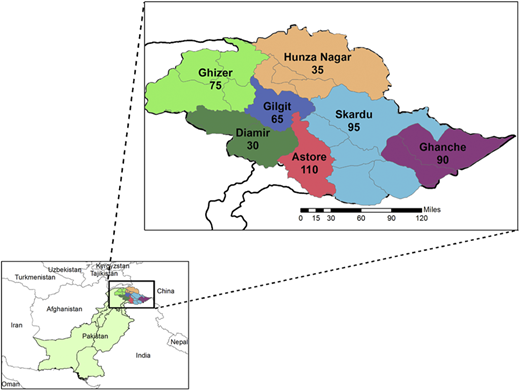
The current study is based on a primary dataset collected from 500 rural households from Gilgit-Baltistan, Pakistan’s Himalayan region, from September to December 2015. The study covers all seven districts of Gilgit-Baltistan: Ghizer, Gilgit, Diamer, Astore, Skardu, Ghance and Hunza-Nagar (see Figure 1), an area of over 100,000 km2 and a population over 1.15 million (Table I). The data were collected using stratified random sampling – in the first stage, we selected Gilgit-Baltistan; in the second stage, we selected seven districts located in the region; and in the third stage, we randomly selected the farm households.
The description of variables used in the paper is presented in Table II. The mean age of the farmer was 52 years with an education level of about six years of schooling. The farmers’ average years of farming experience was 33 years. The average number of males and females in the households are four each. An overwhelming majority of the farmers, i.e. 82 per cent, owned land, and the rest were tenants. About 46 per cent of the farmers belong to an organization.
As Gilgit-Baltistan is a mountainous area and the farmers have small land holdings, the most popular unit used for the land measurement is the kanal[4]. On average farmers owned 30 kanals (1.5 ha) about equally split between operational farmland and wasteland. Sixty per cent of the farmers were satisfied with the level of soil fertility. The average number of livestock owned by the households is about six cattle (both small and large ruminants). Only 13 per cent of the households have access to a metal road[5].
The majority of the respondents (83 per cent) perceived climate change. Most (93 per cent) of the interviewees perceived temperature changes, 68 per cent perceived wind changes and 72 per cent perceived rainfall changes (including increasingly erratic rainfall and onset of rains/monsoon). To cope with the climate challenges, farmers adopted a number of practices like drought-tolerant varieties, participation in the non-farm sector, adjustment in the sowing time as well as tree planting. Some 41 per cent reported forest-based livelihoods (i.e. were mainly dependent on the forests for their livelihood), but most families collected both timber and non-timber products from the forests. Timber products mostly require the harvesting (logging) of trees. Non-timber products include honey, wax, fodder (foliage and forage), fruit and vegetables (including nuts, seeds, berries and mushrooms), game (birds, animals and fish), fuel (peat and fuel wood) as well as medicinal plants/spices/oils.
Information on household assets indicates that 41 per cent own a television, 6 per cent own a tractor, 10 per cent own a trolley, 3 per cent have a thresher, 83 per cent have a kasola (Hand implement used for land preparation and hoeing operations), 99 per cent have a sickle, 36 per cent own a refrigerator and 86 per cent own a fan. About 18 per cent of the households had access to credit, and 22 per cent had access to agricultural extension services.
5. Empirical results
5.1 Factors associated with perceived weather changes
The majority of the surveyed farmers (83 per cent) perceived climate change, which in the mountainous study area includes weather changes such as changes in (winter) snowfall, rainfall (decline, erratic and drought) and wind. As these events overlap or take place simultaneously, a multivariate probit model is estimated. The cross-equation correlations are positive and significant, indicating the robustness of the model estimated. The dependent variables are perceived changes in temperature, rainfall and winds, as these are major events potentially influencing farmer livelihoods in the Himalayan region. Based on literature review, a set of independent variables are included in the model. The result of the multivariate probit model is presented in Table III.
The farmers’ age was positively associated with (perceived changes in) temperature, rainfall and wind, likely reflecting the longer lifespan and associated reference timeframe of older farmers. Agricultural extension was also positively associated with all three perceived weather changes, indicating the importance of extension agents in disseminating climate-change information and understanding. The farmer’s education was positively associated with temperature and rainfall (but negatively with wind), demonstrating that more educated farmers were more (but less for wind) likely to observe these weather occurrences than less educated farmers, probably associated with the level of awareness and knowledge about weather events.
Asset indicators associated with the wealth of the household (television and tractor) were positively associated with temperature and rainfall, whereas television also with wind. Land ownership (dummy) was positively associated with temperature and wind but negatively with rainfall, probably associated with locational aspects of the land owned (rented) and resource availability for coping with the weather changes (e.g. availability of irrigation is more likely for land owners and enables better coping with rainfall change, which may make a land owning farmer less likely to perceive rainfall change than a tenant). Land holding, a sliding indicator of farmer wealth, was, however, not associated with any of the perceived weather changes. Access to a credit facility was positively associated with rainfall and wind.
To control for the locational fixed effect, the district dummies were included in the model and many were positively associated with a weather change compared to the base district (Astore). For instance, temperature and rainfall change was more commonly reported in Gilgit. Other indicators were less conclusive – including adult males (positive with temperature); membership of an organization (negatively with temperature); and road access (negative with rainfall). The cross-equation correlations are positive and highly significant at the 1 per cent level of significance, indicating the robustness of the model estimated.
5.2 Impacts of perceived weather changes
PSM was used to estimate the impacts of the perceived weather changes (Table IV) using two different matching estimators, i.e. NNM and KBM, which generally yielded similarly robust results. The average treatment effect for the treated (ATT) indicates the difference in the outcome of households perceiving a specific weather change compared to similar households that do not. The impacts of perceived changes in temperature, wind and rainfall were estimated for various outcome indicators, including household income (estimated in Pakistani rupees, US$ 1 equal to Pak Rs 106), poverty (headcount ratio)[6], wheat yield and use of timber and non-timber forest products.
(The perceived) temperature change negatively impacts household income, indicating that where farmers perceived a change in temperature, their household incomes decreased over the years. Similarly, temperature change increased the poverty headcount index. Increasing temperatures thereby undermine efforts to fight poverty in these marginal areas. As wheat is the main staple food in the study area, wheat yield was included as one of the outcome variables. Temperature change negatively impacts wheat yield by 8-10 kg per ha. Increasing temperatures increase the use of timber and non-timber forest products, reflecting increased dependence on forest resources to cope with the declining incomes and agricultural yields resulting from climate change.
Similarly, (the perceived) rainfall change negatively impacted household income, increased poverty and increased use of non-timber forest products, with less pronounced effects (with only NNM being significant) on decreased wheat yields and use of timber forest products. Household income levels are markedly lower (in the range of Pak Rs 11,000-15,000 pa) with perceived rainfall changes, albeit of a similar magnitude as temperature change. Interestingly, the use of non-timber forest products increases with perceived rainfall change, again likely reflecting increased dependence on such forest products to cope with the loss of income and crop yields[7], whereas use of timber forest products actually declines.
Perceived wind changes generally had limited impacts, primarily through an increased use of timber forest products and less pronounced effects on the use of non-timber forest products (with only KBM being significant). Interestingly, the increased use of forest products is most pronounced for timber, likely indicating the increased ease of logging with increased tree fall. Wind changes did not significantly impact household income, poverty and wheat yields.
The critical level of hidden bias provides a sensitivity analysis (Table IV): it indicates the level up to which two groups (i.e. treated and control) vary from each other because of unobserved factors and confirm the robustness of the results.
PSM balances the covariates before and after matching, and Table V presents various test indicators. The median absolute bias is quite high before matching (17-25) and is quite low after matching (4-7). The percentage bias reduction ranges 71-82 per cent which is considerable. The value of R2 is quite high before matching and is quite low after matching, pointing out that after matching the underlying characteristics of the groups perceiving weather changes and those that do not are very similar to each other. Similarly, the LR χ2 value is quite low before matching and is quite high after matching, indicating that after matching the groups are very similar to each other, and there are no systematic differences between them.
6. Conclusion
Climate change is increasingly evident with wide-ranging pervasive effects. Rural farm households in developing countries and particularly those living in fragile ecosystems are most vulnerable to adverse climate change effects due to limited resources and a generally limited ability to adapt. The current study first assesses the factors associated with the perceived weather changes by rural farm households in the Himalayan region of northern Pakistan, and then assesses the impact of these perceived weather changes on the population’s well-being using PSM.
The present study quantified the impacts of three perceived weather changes (temperature, rainfall and wind) on household income, poverty, wheat yields and the use of timber and non-timber forest products. The results establish that the perceived weather changes severely affect local livelihoods: household incomes and wheat yields decline while poverty increases in already challenging and fragile ecosystems. Owing to the climate change, these farmers are increasingly dependent on timber and non-timber forest products to cope with the loss of agricultural income.
Based on the findings, some policy implications can be drawn. Farmers increasingly perceive weather changes associated with climate change in the Himalayas yet lack resources to adapt to these changes while being increasingly vulnerable to its adverse effects. Hence, the farming community, particularly in fragile ecosystems, should be provided with support, training and awareness to cope with climate change and to mitigate risk. In addition, the extension services need to be more effective. Electronic mass media need to create awareness among the farming community around climate risk management options and needs. Government support to the farming community in the light of climate change is essential to facilitate the resource-poor farming communities to cope with the changing scenario. Effective mitigation and adaptation to global climate change will eventually contribute to food security, economic development and reduced poverty while helping preserve fragile ecosystems.
Notes
It’s always better to use more than one matching algorithm to check the robustness of the results across different matching algorithms.
This can be with a replacement or without a replacement. With a replacement, one non-matcher can be used more than once, while for “without a replacement”, it is matched only once.
In case of NNM calipers and in case of KBM, the band widths were used.
Generally in Pakistan, the unit used for land measurement is acres. In 1 acre, there are 8 kanals, and in 1 hectare, there are 20 kanals.
Owing to the hilly areas and scattered establishments, only a few households have road access in the hilly areas.
The number of people living below the poverty line divided by total population; in the current analysis, US$1 per person per day is used as the poverty line.
While implementing propensity score matching, the trim option was included to improve the matching quality.
This study was made possible through the support provided by the US Agency for International Development (USAID)-funded Agricultural Innovation Program (AIP) for Pakistan. The authors would also like to thank the Consortium Research Program (CRP) on WHEAT for supporting this study. The contents and opinions expressed herein are those of the author(s) and do not necessarily reflect the views of USAID, or the authors’ institution, and shall not be used for advertising or product endorsement purposes. The usual disclaimer applies.