


Teachers can be regarded as key figures in climate change education (CCE). Therefore, the purpose of this study is assessment of Iranian lower secondary teachers? level of knowledge, attitudes and practices toward CCE in a less-touched-upon context.
The present study used a cross-sectional survey design, which used a specially designed questionnaire administered in ten high schools (five boys’ and five girls’ lower secondary schools). A sample of 108 lower secondary school teachers was selected through a multistage stratified random sampling technique. The gender structure of the sample was 48.1 per cent male and 51.9 per cent female subjects. To determine the status of teachers’ knowledge, attitudes and practices, the obtained quantitative data were classified into three categories on a scale of 100 per cent: good status (more than 75 per cent), moderate status (50-75 per cent) and weak status (less than 50 per cent).
The findings revealed that the involved teachers were equipped with an appropriate knowledge, i.e. 22.2 per cent good and 52.8 per cent moderate levels of knowledge. Furthermore, the subjects’ level of attitude was moderate (44.5 per cent); however, their level of practice was weak (52.8 per cent). In terms of gender, male subjects’ knowledge and attitude levels were higher than those of female subjects. However, female subjects reported higher levels of practice in comparison with male subjects. Overall, the results of this study highlighted the necessity of improving lower secondary teachers’ CCE in general and of the level of their attitudes and practices in particular.
The present study sheds more light on the change management and environmental education within the Iranian context. The results of this study accentuate the necessity of presenting more CCE programs for teachers. Furthermore, curriculum planners can take advantage of the obtained results to carry out curriculum reforms.
Introduction
The average temperature of the planet has increased approximately 1°C since 1970. This global warming can be considered as causally related to climate change. The rise in sea level in coastal regions, severe storms, hurricanes and destructive floods are classified as serious problems (Curry, 2011; Finnis et al., 2015; Hannah, 2015). Iran and surrounding countries have recorded eight years of drought in the past decade (UNAIRAN Report, 2008), which has affected the cultivation of grains and cereals (Trenberth, 2011).
Currently, climate change has become a primary concern of many scholars, particularly climatologists and the environmentalists, in the natural sciences (Azizi, 2002; Paoletti et al., 2007; Roshan et al., 2009).
In the field of climate change, the influential Stern Report identified three key elements in response to climate change. Two of the specified elements, i.e. technological transfer and behavioral change, have clear implications for education (Stern, 2007; Bangay and Blum, 2010). Hence, climate change can be considered as a complex issue, which reveals the significance of educating future generations to be capable of critically engaging with the flood of information and perspectives presented in this field (Hung, 2014).
Education is an essential element of the global response to climate change (Teodorescu and Oros, 2010; Gumucio et al., 2011; Tasquiera et al., 2013). Climate change education (CCE) helps young people comprehend and address the impact of global warming. Furthermore, it encourages changes in their attitudes and behavior and helps them adapt to the climate change-related trends (UNESCO, 2015; Heidari and Heidari, 2015; Wang et al., 2015; Oversby, 2015).
Inadequate public understanding of climate change is partly the result of four critical challenges that have hindered development and delivery of effective CCE. First, the research conducted over the past 15 years has demonstrated that the underlying science of climate change is inherently difficult for most learners to comprehend (Boyes and Stanisstreet, 2001; Coyle, 2005) and for educators or schools to competently teach (Abbasi, 2006; National Research Council, 2007). Furthermore, the relationship between science and society, which is implied in CCE and aims at changing people’s behavior, makes the task of teaching and learning more difficult (Gardner and Stern, 2008; Heimlich and Ardoin, 2008). Second, achieving the broad range of goals specified in CCE requires a cross-disciplinary approach, which integrates education with learning, social, behavioral and economic sciences, as well as earth systems science. Third, the myriad of federal agencies, non-governmental organizations and businesses devoted to CCE may duplicate efforts and waste limited resources without a forum for coordination, cooperation and alignment of overall education strategies. Fourth, like evolution, climate change has become a highly politicized topic in the policy arena and in education. Moreover, people’s willingness to be educated depends on their attitudes toward the issue itself (Leiserowitz and Smith, 2010; Forrest and Feder, 2011). Therefore, as children in general and students in particular can be considered as key figures while dealing with climate change, they should be educated and trained to develop intrinsic environmental awareness in the process of adaptation to the effects of climate change. Hence, teachers are the main stakeholders in the climate change discourse. Recently, teaching secondary students about climate change has received due attention (Shepardson et al., 2011).
The studies conducted in various contexts have revealed a remarkable number of students not being provided with an adequate and accurate education on climate change and a noticeable number of teachers not knowing how or what to teach about these issues (Hung, 2014). Furthermore, the studies carried out to assess the knowledge of trainee teachers on climate change demonstrated that future classroom teachers themselves hold the same erroneous understandings as those of secondary school students (Khalid, 2003; Ocal et al., 2011; Ikonomidis et al., 2012; Karami et al., 2016). It has been reported that students basically trust their teachers’ knowledge authority on the topics they teach (Gowda et al., 1997; Hung, 2014). Hence, examination of teachers’ knowledge, attitudes and practices seems to be of great value:
A range of studies has been conducted on Climate Change Education which demonstrate its importance. In an American context, Sterman and Sweeney (2002) found the level of public understanding low, even among highly educated populations. While they recognised the connection between CO2 emissions and global warning, they believed that reductions in emissions led to immediate drops in temperature and that a stabilisation of emissions at current levels would be sufficient to halt climate change, views which support a conservative, ‘wait and see’ policy response to the threat of global warming.
A survey conducted by UNICEF and UNDP (2011) assessed children’s knowledge, attitudes and practices on climate change. In total, 349 students drawn from Grades 7, 8 and 9 in 25 primary schools were interviewed for this survey. The sample was 46 per cent male and 54 per cent female, with 59 per cent of students from urban schools, while the remaining 41 per cent were from rural schools. In addition, 317 individuals including male and female students of Grades 1, 2 and 3 in 21 secondary schools were interviewed. The result of the survey showed that the level of knowledge about climate change or global warming and its impact was lower than their self-estimations and that there were no gender differences’
Knowledge and attitudes of university students and government officials about the causes, effects and priorities given to climate change were evaluated in Nigeria by Ojomo et al. (2015). In total, 375 individuals from Akwa Ibom and Lagos states were questioned in this survey. Findings showed that approximately 90 per cent of the participants thought that human activities are the significant cause of climate change; likewise, there was no significant difference between ministry officials’ and students’ responses. Awareness of participants about the effects of climate change on Nigeria was low as a whole, although, their knowledge of the impacts relevant to Southern Nigeria, where study sites were located, was higher. It seems that personal experiences have an important role in specifying the knowledge and attitudes of responders.
Kumar et al. (2015) determined the knowledge and tendency of high school students about global warming. A community-based cross-sectional investigation was performed among 400 students of three different medium schools. According to results, only 16.5 per cent of students showed good knowledge, while most of them (70.5 per cent) had average knowledge and 13 per cent had poor knowledge toward global warming. In addition, it was revealed that a higher proportion of students (78.5 per cent) had average attitude levels, while for 21.5 per cent, the levels were low. Significant differences (p < 0.05) based on age, gender, class/grade and medium of instruction were observed in levels of knowledge and attitude; however, no significant differences were observed based on location or religion.
Moreover, previous studies presented that the level of teachers’ knowledge, attitudes and practices about CCE are divergent in different countries. Papadimitriou (2004) focused on prospective primary teachers’ understanding of climate change, greenhouse effect and ozone layer depletion in Greece. The obtained results revealed that teachers believe that climate change was underway. Furthermore, it was found that the involved subjects based their beliefs on their personal experiences. In addition, they reported unawareness of the proper actions to be taken for slowing down the climate change. The subjects also hold the misconception that ozone depletion, acid rain and pollution in general were conducive to climate change. Moreover, they confused greenhouse effect with ozone depletion as far as the causal compounds and the mechanisms through which they occur were concerned (Papadimitriou, 2004). Bozdogan (2009) investigated Turkish prospective primary school teachers’ perceptions about global warming. The researcher stated that more than one-third of teacher candidates hold misconceptions and had insufficient knowledge about global warming. “Climate Confusion among USA Teachers” was a survey of CCE in the USA, which was conducted by researchers in National Center for Science Education and Pennsylvania State University. The results of this study showed that although most US science teachers included climate science in their courses, their insufficient grasp of the science may hinder effective teaching. Moreover, it was found that many teachers repeated scientifically unsupported claims in their class while they were mirroring some actors in the societal debate over climate change. It seems that greater attention should be devoted to teachers’ knowledge and values about climate change (Plutzer et al., 2016).
With consideration of the significance of studies addressing CCE, the present study was conducted to assess Iranian lower secondary teachers’ level of knowledge, attitudes and practices toward CCE in a less-touched-upon context.
Materials and method
The study
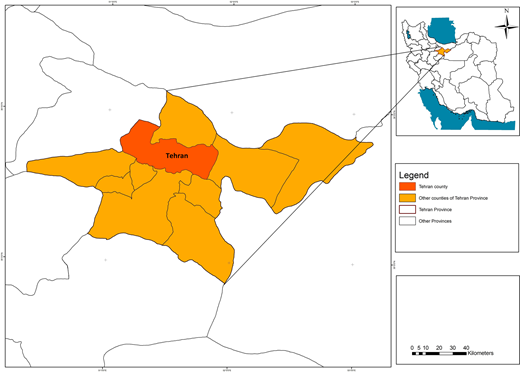
This case study was carried out in Tehran, which is the capital of Iran and is located in Tehran Province. The most recent statistics indicate that population of the city exceeds eight million. Moreover, its area is reported to be about 730 km2, and it enjoys temperate climate. Tehran has 35.6833° N, 51.4167° E coordinates with an elevation of 1,200 to 1,980 m (3,900 to 6,470 ft). above the sea level (Karami and Larijani, 2015). The city is surrounded by Alborz mountain range in the northeast. One of the most important environmental phenomena occurring in Tehran is its local climate changes (Roshan et al., 2010) (Figure 1).
Method
The present descriptive survey study enjoys a cross-sectional design. Lower secondary teachers’ population from Tehran, Iran, was targeted to take part in the study. The study questionnaire was distributed at ten lower secondary schools (five boys’ and five girls’ schools). Teachers were requested to provide their responses on the printed questionnaires, which were subsequently collected.
Schools were selected based on the proportional allocation technique. Single-gender schools (five girls’ and five boys’ lower secondary schools) were selected with consideration of their geographic districts, i.e. north, south, center, east and west. Teachers’ sample was selected using the multistage stratified random sampling method. In total, 108 teachers, who were present in the data-gathering session and declared their agreement to participate in the study, filled out the questionnaires.
The questionnaire was adopted from Hung’s (2014) study and had four parts consisting of 34 closed items. The first part of the questionnaire addressed respondents’ personal background. Subjects’ knowledge, attitudes and practices on CCE were questioned in the second, third, and fourth sections of the questionnaire, respectively. With respect to knowledge, attitudes and practices on CCE, teachers were asked to respond to 14, 10 and 10 items, respectively. The items of the questionnaire were presented in a five-point bipolar response format.
The reliability and validity of the questionnaire were assessed. To address the reliability of the questionnaire, it was piloted on 30 respondents. The estimated Cronbach’s alpha (α = 0.812) indicated that the questionnaire enjoyed a good degree of reliability (Santos, 1999). Furthermore, validity of the questionnaire was approved by five leading climate experts and two pedagogic specialists before its application in the study.
Descriptive statistics were used to give a clear picture of background variables like age, sex and education variables. Categorical variables were presented as percentages, while continuous variables were expressed as mean ± standard deviation.
To determine the status of knowledge, attitudes and practices, the obtained quantitative scores were used. The scores were categorized into three groups on the scale of 100 per cent: good (more than 75 per cent), moderate (50-75 per cent) and weak (less than 50 per cent).
Results and discussion
Demographic characteristics
In this research, 108 respondents consisting of 52 males and 56 females were interviewed. Table I presents distribution of the teachers by age, gender, education level and years of teaching experience.
Demographic characteristics of survey respondents
| Variables | Categories | No. of respondents | (%) of respondents |
|---|---|---|---|
| Age | 20-30 | 12 | 11.1 |
| 31-40 | 58 | 53.7 | |
| 41< | 35 | 32.4 | |
| No answer | 3 | 2.8 | |
| Gender | Man | 52 | 48.1 |
| Woman | 56 | 51.9 | |
| Education level | Associate's degree | 3 | 2.8 |
| Bachelor's degree | 83 | 76.8 | |
| Master's degree | 22 | 20.4 | |
| No. of years of teaching | <2 | 4 | 3.7 |
| 2–5 | 11 | 10.2 | |
| 6–10 | 32 | 29.6 | |
| 11–15 | 30 | 27.8 | |
| >15 | 31 | 28.7 |
Teachers’ knowledge of climate change education
With respect to CCE framework, the teachers considered CCE as part of environmental education (95.4 per cent for both males and females). Table II indicates that 51.4 per cent of respondents believed that climate change was the result of human activities, while 41.7 per cent considered it a natural process. Only 26.8 per cent of the teachers believed in differences between natural and enhanced greenhouse effects. Table II provides teachers’ responses about knowledge of CCE in detail.
Survey items about teachers’ knowledge of CCE
| Items | Strongly disagree (%) | Disagree (%) | Neutral (%) | Agree (%) | Strongly agree (%) | Mean score |
|---|---|---|---|---|---|---|
| CCE is a part of environmental education | 0.0 | 0.9 | 3.7 | 38.0 | 57.4 | 4.52 |
| Climate change is a natural process | 16.7 | 26.8 | 14.8 | 28.7 | 13.0 | 2.94 |
| Average global temperatures have increased by 0.8°C over the past 160 years | 0.9 | 7.4 | 5.6 | 52.8 | 33.3 | 4.10 |
| Climate change caused by human activities | 5.6 | 15.7 | 24.1 | 33.3 | 21.3 | 3.49 |
| There is a difference between the natural and enhanced greenhouse effect | 13.0 | 16.7 | 43.5 | 25.0 | 1.8 | 2.86 |
| These factors have caused Earth’s climate to change | ||||||
| Burning fossil fuels such as coal, oil, natural gas | 0.0 | 7.4 | 5.5 | 49.1 | 38.0 | 4.17 |
| Transportation, such as driving a car, bus or … | 11.1 | 15.7 | 14.8 | 38.0 | 20.4 | 3.41 |
| Land clearing (e.g. deforestation) | 10.2 | 19.4 | 16.7 | 35.2 | 18.5 | 3.32 |
| Poor industrial practices (e.g. factory emissions) | 2.8 | 8.3 | 13.0 | 44.4 | 31.5 | 3.93 |
| These items are associated with climate change | ||||||
| Increase in temperature | 5.5 | 17.6 | 28.7 | 31.5 | 16.7 | 3.36 |
| Sea level rise | 4.6 | 15.8 | 29.6 | 30.6 | 19.4 | 3.40 |
| Economic losses | 10.2 | 19.5 | 40.7 | 22.2 | 7.4 | 2.97 |
| Health epidemics | 11.1 | 25.9 | 42.6 | 16.7 | 3.7 | 2.76 |
| Floods and droughts | 5.6 | 19.4 | 35.2 | 28.7 | 11.1 | 3.20 |
Assessment of the items addressing the causes and effects of climate change revealed that teachers are more acquainted with the causes of climate change (3.71 per cent) in comparison to its effects and impacts (3.14 per cent).
According to the survey, teachers were equipped with an appropriate level of knowledge about CCE (22.2 per cent good level and 52.8 per cent moderate level). Additionally, male teachers tended to correctly answer most of the knowledge items than did their female counterparts. Table III presents the summary of the results obtained from knowledge questions with specific focus on teachers’ gender.
Teacher’s attitudes toward climate change education
The results of the survey revealed that 50.9 per cent of the respondents considered teaching the facts for CCE well to be crucial, while only 20.4 per cent expressed their disagreement in this regard. Furthermore, it was found that 28.7 per cent of the respondents had no ideas in this respect. The teachers were also asked to provide their opinions about the importance of teaching the “concepts”, “skills” and “attitudes and values” for CCE. The results showed the mean scores of 3.23, 2.80 and 2.91, respectively. The mentioned results are indicative of inadequate attitudes toward CCE among teachers because the facts, concepts, skills, attitudes and values for CCE that are taught are all associated with each other. Table IV shows teachers’ detailed responses about attitudes toward CCE.
Survey items about teachers’ attitude toward CCE
| Items | Strongly disagree (%) | Disagree (%) | Neutral (%) | Agree (%) | Strongly agree (%) | Mean score |
|---|---|---|---|---|---|---|
| It is important to teach the facts for CCE well, e.g. average global temperatures have increased by 0.8°C over the past 160 years | 6.5 | 13.9 | 28.7 | 35.2 | 15.7 | 3.30 |
| It is important to teach the concepts of CCE well, e.g. there is a difference between the natural and enhanced greenhouse effect | 10.2 | 15.7 | 29.6 | 29.6 | 14.8 | 3.23 |
| It is important to teach the skills for CCE well, e.g. the ability to interpret graphs and tables in the IPCC report | 15.8 | 25.9 | 28.7 | 22.2 | 7.4 | 2.80 |
| It is important to teach the attitudes and values for CCE well, e.g. behavioral changes in students showing that they have understood the need to mitigate climate change | 13.9 | 23.2 | 32.4 | 19.4 | 11.1 | 2.91 |
| It is important for students to be able to discern and critique reports on climate change | 16.6 | 25.0 | 38.0 | 17.6 | 2.8 | 2.65 |
| It is important for students to raise questions about issues in climate change | 14.8 | 24.1 | 38.9 | 13.9 | 8.3 | 2.77 |
| I hate teaching CCE | 21.3 | 33.3 | 22.2 | 16.7 | 6.5 | 2.54 |
| I think CCE can be infused more effectively in our curriculum | 10.2 | 19.4 | 38.9 | 23.2 | 8.3 | 3.00 |
| I think CCE should be infused across all subjects in the curriculum | 15.8 | 36.1 | 28.7 | 14.8 | 4.6 | 2.56 |
| I believe teaching CCE will make my students better global citizens | 11.1 | 17.6 | 38.0 | 23.1 | 10.2 | 3.04 |
Consideration of the presented responses revealed that teachers’ level of attitude toward CCE was moderate (44.5 per cent). As shown in Table V, male respondents indicated higher levels of attitudes (17.3 per cent good level and 48.1 per cent moderate level) in comparison with female subjects.
Teachers’ practices in climate change education
With regard to the practices in CCE, 45.4 per cent of teachers mentioned that topics on CCE were not included in school textbooks, and 45.3 per cent stated that CCE was not explicitly included in the curriculum of their schools. However, the teachers thought that they were not supported by any professional development courses in CCE (57.4 per cent). Moreover, more than half of the teachers (55.6 per cent) felt they needed more support in designing lessons on CCE. The item addressing assessment of students’ understanding of climate change issues at exam sessions elicited only 8.3 per cent of teachers’ satisfaction in this regard. Teachers’ detailed responses about their practices in CCE are shown in Table VI.
Survey items about teachers’ practices in CCE
| Items | Strongly disagree (%) | Disagree (%) | Neutral (%) | Agree (%) | Strongly agree (%) | Mean score |
|---|---|---|---|---|---|---|
| Topics on CCE are included in school textbooks | 16.7 | 28.7 | 40.7 | 11.1 | 2.8 | 2.55 |
| CCE is explicitly taught in my school’s curriculum | 15.7 | 29.6 | 39.8 | 13.0 | 1.9 | 2.56 |
| CCE is infused into existing curriculum | 16.7 | 29.6 | 40.8 | 12.0 | 0.9 | 2.51 |
| There are sufficient resources in textbooks, workbooks, teachers’ guides, CD-ROMs for CCE | 11.1 | 25.9 | 42.6 | 14.8 | 5.6 | 2.78 |
| There are professional development courses to support me in CCE | 19.4 | 38.0 | 39.8 | 2.8 | 0.0 | 2.26 |
| There are professional platforms to support me in discussing CCE with fellow teachers | 21.3 | 37.0 | 35.2 | 6.5 | 0.0 | 2.27 |
| I feel that I need more support in designing lessons on CCE | 3.7 | 14.8 | 25.9 | 38.0 | 17.6 | 3.51 |
| Students are assessed at exams for their understanding of climate change issues | 13.0 | 33.3 | 45.4 | 8.3 | 0.0 | 2.57 |
| Climate change issues are included in school summative assessments | 13.9 | 36.1 | 47.2 | 2.8 | 0.0 | 2.39 |
| Climate change issues are included in classroom formative and continual assessments | 12.0 | 35.2 | 44.5 | 7.4 | 0.9 | 2.50 |
The elicited responses are indicative of teachers’ weak level of practice in CCE (52.8 per cent). In contrast to the obtained levels of knowledge and attitudes, the practice level among female subjects was higher than that of male respondents. As presented in Table VII, 54.3 per cent of female subjects reported appropriate practice (good level and moderate level), while this value was 38.5 per cent for their male counterparts.
Conclusion
The motive behind conducting the present study was Hung’s (2014) study addressing teachers’ readiness for CCE in Singapore, which showed that teachers are the key figures in holding climate change courses. Also the background of this research in the field of teachers’ knowledge, attitudes and practices was provided by Saad and BouJaoude (2012) and Wilkins (2008), whose studies were about the relationship between teachers’ knowledge, attitudes, beliefs and practices. Moreover, studies have shown that one of the most significant barriers to CCE in formal education is teachers’ levels of enthusiasm (Bozdogan, 2009; Forrest and Feder, 2011; Ocal et al., 2011). Therefore, it is essential to initially determine teachers’ present knowledge about climate change. Then, teachers’ attitudes and practices should be specified in this regard. Hence, the present study was conducted to assess the level of knowledge, attitudes and practices with respect to CCE among Iranian lower secondary teachers.
Based on the obtained results, it can be concluded that Iranian lower secondary teachers had a certain degree of knowledge about climate change. The majority of teachers were familiar with the basic science and causes of climate change. In terms of effects and impacts, teachers knew that climate change negatively affected sea level, temperature, floods and droughts; however, its negative effects on economy and public health had not been recognized.
The respondents’ scores in the attitudes section were lower than their knowledge scores. However, most of the scores were close to 3.0, which was indicative of respondents’ moderate level of attitude toward CCE. Furthermore, lower secondary teachers revealed lower mean scores in the practice section of the CCE questionnaire. In other words, it can be inferred that teachers had inadequate practices about topics on CCE, which were included in their curriculum and school textbooks. In line with this finding, teachers expressed their concern on the shortage of resources such as textbooks, workbooks, teachers’ guides, CD-ROMs for CCE. Moreover, from teachers’ perspective, more professional development courses were required to support them in CCE.
In terms of gender, minor differences were noticed in the proportions of knowledge between male and female subjects. This difference was slightly higher for the approach. In fact, male subjects’ level of knowledge and attitudes was higher than that of female subjects. However, male subjects’ practice level was lower than that of female respondents.
Marzit et al. (2013) found that the information obtained from climate education of students can be used as a basis for improving educational quality and effectiveness of teaching and learning in the classroom. Also, the results of this research shows the assessment of knowledge, attitudes and practices of teachers toward CCE can improve it.
Emeh (1990) and Nwankwo and Unachukwu (2012) stated that because teachers do not have the basic knowledge on climate change, the students’ performances could not be monitored and the teacher could not collaborate with other people in the process of achieving educational goals and objectives. In this study, the lack of teachers’ practice also gave the same result, showing that teacher education is critical to the development of effective CCE.
In the new global world of information and the explosion of knowledge, it is the responsibility of teachers to provide students with the skills to understand and use climate change knowledge and practice effectively, rather than simple to accumulate knowledge (Simmons, 2011; Toyin Dolapo, 2013). Yet, as this study reveals, teachers’ own readiness for CCE is low. Recognizing that teacher education is crucial, it is important to note that medium-term professional development of at least 40 h is required if teacher readiness is to be improved sufficiently (Oversby, 2015; Teacher Development Trust, 2012).
In conclusion, the result of this study highlighted the necessity of presenting more CCE programs for lower secondary teachers, especially with a focus on attitudes and practices in this regard. Hence, further studies should be conducted on assessment of teachers’ readiness for taking CCE courses. Furthermore, due attention should be devoted to preparation of teachers for CCE adjustment and development of educational management strategies in CCE, and development of a practical model for CCE in formal education system. Besides, assessment of the role of NGOs, social communities and the media in supporting teachers in CCE will be illuminative in this field.

