The third mission mandate is a significant mission evolution for universities and is being driven by environmental and stakeholder pressures to deliver economic and social impact through research commercialisation, knowledge and technology transfer. It also challenges the traditional institutional logics of universities. Drawing on institutional theory, specifically institutional pressures and competing logics, this paper examines how university leaders interpret their third mission mandate and explores the initiatives they prioritise to advance it.
Set in an Irish context, this study adopted grounded theory using phenomenological interviews with 15 senior university leaders in Ireland.
The study finds that university leaders' interpretations of institutional pressures and competing logics generate an analytically derived range of four strategic postures: Reactive Responders, Cultural Champions, Infrastructure Builders and Ecosystem Orchestrators. These postures differ in the scope of intrapreneurial response, the extent to which academic and entrepreneurial logics are integrated and the degree of external orientation. The findings explain how leadership interpretation and institutional work contribute to heterogeneous university responses to the third mission.
A key limitation is the reliance on a single informant per institution. While the senior leaders interviewed occupy strategic roles and positions of significant influence there is an acknowledgement that their views may not fully capture the potential variation or the middle-management gap where strategic intent often meets operational resistance. Secondly, the study is situated within the Irish higher education context, and thus, its results may not be generalisable. Finally, the methodological combination of grounded theory and phenomenology prioritises depth over breadth.
This study provides some guiding insights for university leaders as they make strategic prioritisation decisions to progress the development of the third mission agenda.
This research highlights how university leaders' interpretations of third mission pressures shape intrapreneurial initiatives that influence wider society. By tracing a continuum from reactive to ecosystem-oriented responses, it shows how leadership agency affects the depth and inclusiveness of socio-economic engagement. The findings suggest that universities which move beyond minimal compliance can foster richer regional innovation ecosystems, more equitable access to entrepreneurial opportunities and stronger knowledge transfer to communities. Conversely, purely symbolic or narrow interpretations risk reinforcing existing inequalities and underutilising universities' potential as anchors of sustainable and socially responsible development.
Through the unique perspective of university leaders, this study illuminates how university leaders interpret institutional pressures, prioritise competing logics and translate these into differentiated forms of institutional work and intrapreneurial response. We present an analytically derived range of four strategic postures and intrapreneurial responses to the third-mission mandate.
1. Introduction: the entrepreneurial university and institutional tensions
The modern university has undergone a significant evolution, marked by the expansion of its “third mission” beyond traditional teaching and research to encompass the transfer of knowledge and technology for socio-economic development (Etzkowitz and Klofsten, 2005; Agasisti and Bertoletti, 2022). Conceptualised through the entrepreneurial university model (EUM), higher education institutions are increasingly viewed as vital engines of regional and national economic growth (Etzkowitz et al., 2000; Marozau et al., 2021). This structural shift is driven by policy expectations, public funding models that require universities to commercialise (Demircioglu and Audretsch, 2019), accountability systems, performance measurement, rankings, regional innovation agendas (such as the abolition of Professor's Privilege in Finland: Ejermo and Toivanen, 2018), industry collaboration imperatives and broader societal expectations regarding the economic and social utility of universities (Miller et al., 2021; Henry and Lahikainen, 2024). Historically, such pressures have been reinforced by policy interventions that incentivise university commercialisation and knowledge transfer, most notably the Bayh–Dole Act in the USA, which is frequently identified as a catalyst for the entrepreneurial university movement (Shane, 2004; Gores and Link, 2021).
At the supranational level, European policy frameworks and competitive funding streams such as Horizon Europe act as powerful normative incentives for entrepreneurial activity within universities. Domestically, resource dependencies managed by national agencies, including UKRI, Research Ireland, Research England, ANR (see Appendix 1), further penalise inertia, linking institutional funding and reputation directly to demonstrable third mission engagement (Lahikainen et al., 2019). In response, universities are systematically amending mission statements to more precisely articulate their commitment to the third mission (Breznik and Law, 2019; Brown, 2021). They are altering allocations, and reconfiguring core structures (Audretsch and Belitski, 2022; Romero et al., 2021). Such external institutional pressures challenge well-established traditional academic logics within universities and their communities.
While the adoption of the EUM is widely heralded as a necessary strategic evolution (Meek and Gianiodis, 2023), operationalising this mandate generates profound institutional logic tensions. These competing institutional logic tensions manifest at the macro-level as fundamental misalignments between teaching, research and commercialisation priorities (Abreu and Grinevich, 2024), and at the micro-level as disruptions to the deeply embedded roles, identities and daily practices of faculty and professional staff (Garomssa, 2025). For university leaders, translating such entrepreneurial mandates into practice is notoriously complex (Teece, 2018). While top-down management initiatives are intended to drive change to respond to institutional pressures, they can, paradoxically, reduce entrepreneurial activity (Philpott et al., 2011). Additionally, an institutional move away from traditional academic logics can exacerbate historical academic skepticism toward commercialisation (Kuckertz and Scheu, 2024) and provoke deep internal resistance if university leaders fail to clearly signal how entrepreneurial activities align with traditional academic logics with respect to academic values (Johnson et al., 2017; Taylor, 2012).
Navigating this institutional complexity places an unprecedented premium on senior university leadership, which is widely recognised as a pivotal organisational capability within the EUM (Leih and Teece, 2016; Stolze and Sailer, 2021). Executive agency, cascading from presidents and rectors down through deans and department heads, actively moulds institutional performance and survival (Breakwell and Tytherleigh, 2010; Cleverley-Thompson, 2016; Gaspar Pacheco et al., 2024). Yet, despite its acknowledged importance, empirical exploration of the unique interpretive role of senior university leaders remains distinctly limited (Guerrero et al., 2018; Henry and Lahikainen, 2024). Leadership is notably absent from major bibliometric mappings of the entrepreneurial university domain (Forliano et al., 2021), leading to explicit calls for empirical accounts of how university leaders orchestrate these transformations (Guerrero and Urbano, 2021). This empirical void is conceptually significant as an over-emphasis on macro-level field analyses has historically diminished attention on the comparative study of individual organisations, replacing an appreciation for organisational differentiation with a mistaken presumption of structural similarity (Kalar and Antoncic, 2015; Rubens et al., 2017).
To address both the empirical gap and longstanding calls for more organisation-level analysis within institutional theory, this study positions university-based intrapreneurship within an institutional logics' framework, moving beyond the treatment of institutions as a static backdrop to organisational action and instead viewing them as constitutive of leadership interpretation and response (Scott, 2009). While classical institutional theory predicts that coercive, normative and mimetic pressures generate convergence among organisations through processes of isomorphism (DiMaggio and Powell, 1983), such accounts provide limited insight into why similarly situated universities pursue markedly different approaches to the third mission. Drawing on the institutional logics' perspective, we focus on how senior university leaders make sense of and respond to competing institutional demands. Specifically, we examine the interaction between a traditional academic logic centred on scholarly autonomy, collegiality and disciplinary excellence and an entrepreneurial logic that prioritises innovation, commercialisation and societal impact (Thornton et al., 2012). Universities constitute a particularly salient context for such analysis because they operate under conditions of institutional complexity, where multiple logics coexist, compete and require ongoing reconciliation by organisational actors (Engzell et al., 2024).
Sitting at the intersection of these institutional pressures and competing logics, senior university leaders act as critical institutional brokers (Seo and Creed, 2002; Glynn and D'Aunno, 2023). Although their interpretations are shaped by historically embedded norms and organisational traditions, they retain the agency to mobilise resources, challenge entrenched practices and create new organisational arrangements (Battilana and D'Aunno, 2009). We conceptualise university-based intrapreneurship as the micro-level mechanism through which such institutional work is enacted. Specifically, intrapreneurial initiatives represent the material and symbolic practices through which leaders navigate institutional complexity, reconcile competing academic and entrepreneurial logics and build legitimacy for the expansion of the university's third mission (Lawrence and Suddaby, 2006).
By analysing the third-mission mandate through the empirical lens of 15 senior Irish university leaders, this paper explains why universities exposed to broadly similar institutional pressures; nevertheless, develop heterogeneous responses to entrepreneurial transformation. We show that university leaders act as interpretive agents who selectively make sense of coercive, normative and mimetic pressures. They prioritise and reconcile competing academic and entrepreneurial logics and translate these interpretations into differentiated forms of institutional work enacted through intrapreneurial initiatives. The study therefore identifies a mechanism linking field-level institutional pressures to heterogeneous organisational responses: institutional pressures are mediated through leadership interpretation, logic prioritisation and institutional work. Empirically, this mechanism is manifested in an analytically derived range of four strategic postures: Reactive Responders, Cultural Champions, Infrastructure Builders and Ecosystem Orchestrators – which differ in the scope of their intrapreneurial responses, the extent of logic integration and their degree of external orientation. Rather than constituting a universal developmental sequence, these postures illuminate different ways in which university leaders navigate institutional complexity and enact the third mission.
2. Literature review
2.1 University leaders and entrepreneurial universities
The focus on university leaders and leadership is growing within the higher education field (Middlehurst, 2004; Blaschke et al., 2014; Bowen and Shapiro, 2016; Anthony and Anthony, 2017) but has received little attention among entrepreneurial university scholars. Interest in university entrepreneurial leadership dates back over 40 years, with Peck (1984) suggesting it enhances institutional success. For example, Fisher and Koch (2004) found four traits of effective American college presidents: successful ones were entrepreneurial, non-conformists, challengers of the status quo and partnership builders (Cleverley-Thompson, 2016). University leaders have a dramatic impact on their universities, either positive or negative. For it to be positive, above all, they must understand the unique nature of the academic enterprise (Ekman et al., 2018). University outcomes are complex and sometimes conflicting: universities are instruments of economic development, but their role as both curators and challengers of tradition and culture does not easily lend itself to a cost-benefit measurement (Trachtenberg, 2013). Nevertheless, such an analysis is implicit in university rankings (Bekhradnia, 2016; Talebzadehhosseini et al., 2021).
Consequently, the effectiveness of a university leader can be judged by the extent to which they embrace and support the university's mission (Bender and Lawrence, 2021). Entrepreneurship university scholars also acknowledge the vital role that university leaders play particularly with respect to institutionally embedding the third mission (see Heaton et al., 2020; Leih and Teece, 2016; O'Reilly et al., 2019). However, as universities expand their missions, particularly this third mission of socio-economic engagement, the role of university leadership has become increasingly pivotal in encouraging and enabling academic communities to align with these evolving mandates (Harrington and Walsh, 2017; Watson et al., 2011). The success of the entrepreneurial university increasingly depends on its leaders' ability to identify and respond effectively to institutional pressures, manage the institutional logic tensions and initiate intrapreneurial responses that embed the third-mission agenda.
The expansion of the third mission creates significant organisational tensions that university leaders must navigate. Securing faculty engagement remains especially challenging because academics often enjoy considerable autonomy and are likely to resist centrally driven change initiatives (Morris, 1981). Barriers to third mission implementation arise at individual, organisational and external partnership levels (Guerrero and Urbano, 2012; Rossoni et al., 2024), influencing how academics allocate their efforts across teaching, research and engagement activities (Karlsdottir et al., 2023; Link et al., 2008). Consequently, university leaders must continually reconcile traditional academic priorities with the entrepreneurial demands associated with the third mission (De Keyser and Vandenbempt, 2023).
Beyond these internal tensions, university leaders must also respond to external institutional pressures and stakeholder expectations (Miller et al., 2021). Strategic posture provides a useful lens for understanding these responses, reflecting the degree to which leaders adopt proactive or reactive approaches to environmental demands, innovation and change (Covin and Slevin, 1990). Yet despite growing interest in entrepreneurial universities, little is known about how university leaders interpret competing institutional pressures and logics, or how these interpretations shape the intrapreneurial initiatives they prioritise to advance the third mission (Cunningham and Menter, 2021).
2.2 Entrepreneurial universities and institutional theory: pressures and logic
University missions are shaped by a confluence of multiple stakeholder expectations, both external and internal compounded by academic governance structures, distinct disciplinary identities and norms. IT provides an appropriate interpretive lens for understanding universities as complex social organisations embedded within regulative, normative and cultural-cognitive systems (Scott, 2001; Ng'ang'a et al., 2024). According to Lammers and Barbour (2006, p. 357), institutions can be conceptualised as “constellations of established practices guided by enduring, formalised, rational beliefs that transcend particular organisations and situations” (p. 357). Choosing IT, as a lens to scrutinise developments in higher education, has been growing to such a degree that in their recent study of scholarly research on third level, Cai and Mountford (2022) reviewed 59 papers that used it as a theoretical approach. Although IT is frequently associated with stability and isomorphic pressures, it also foregrounds the role of agency in how actors interpret and respond to institutional demands. This emphasis aligns closely with institutional entrepreneurship, which examines how embedded actors leverage institutional structures to advance purposeful change (Battilana et al., 2009). Therefore, to better understand how university leaders interpret and respond to third mission expansion amid evolving external pressures and competing logics within IT we specifically draw on institutional pressures, institutional logics and institutional work.
Institutional Pressures: IT provides a useful approach for understanding leaders' strategic response to their third-mission mandate as universities operate within environments shaped by regulatory (coercive), cultural (normative) and competitive (mimetic) pressures (DiMaggio and Powell, 1983). Leaders respond to these institutional dynamics by adopting strategic postures that either reinforce or challenge prevailing norms. Coercive pressures are especially salient in higher education; they stem from government policies, accountability frameworks and performance-based funding mandates that compel universities to demonstrate economic and societal contributions (De Jong and Del Junco, 2024). Normative pressures arise from professionalisation within academia and shared conceptions of “good” leadership and institutional legitimacy. Mimetic pressures, in turn, reflect the tendency of universities to benchmark against high-status peers, replicating perceived successful models of entrepreneurial activity and engagement (Pitsakis and Giachetti, 2020). Mimetic isomorphism has proven particularly influential in shaping the trajectory of higher education institutions (Ostenson et al., 2017). Faced with intensified global competition, universities often imitate practices that are seen to enhance legitimacy, improve rankings or secure funding advantages. This imitation serves not only symbolic purposes but also reduces the search costs associated with identifying effective managerial and entrepreneurial practices (Feller, 1990; Caplin et al., 2011). A prominent and apposite illustration is found in the diffusion of the EUM itself: the early commercialisation successes of pioneering institutions inspired others to adopt similar strategies, resulting in the formation of an “industry recipe” (Spender, 1989) for intrapreneurial and innovation-oriented responses to the expanding third mission (Pitsakis and Giachetti, 2020).
Institutional Logics: A further refinement to this IT framing is offered by institutional logics, which helps to specify the competing meaning systems that university leaders must navigate when responding to the third-mission mandate. Institutional logics are useful in higher education because universities are not governed by a single logic but by multiple, often competing, institutional orders that shape what is considered legitimate, valuable and appropriate action (Cai and Mountford, 2022; Thornton et al., 2012). Third mission expansion challenges the traditional academic logics of universities and the most salient competing logic is between the traditional academic and entrepreneurial. The traditional academic logic privileges disciplinary autonomy, scholarly excellence and collegial governance, and an entrepreneurial logic that emphasises innovation, external engagement, commercialisation and socio-economic impact (Etzkowitz et al., 2000; Etzkowitz and Klofsten, 2005; Henry and Lahikainen, 2024). Institutional logics therefore provide a more fine-grained explanation of why universities facing similar coercive, normative and mimetic pressures may nevertheless respond differently to the entrepreneurial university agenda, because leaders must interpret and reconcile competing logics rather than merely comply with an external mandate (Scott, 2009; Greenwood et al., 2008). In this sense, university leaders can be understood as mediators of institutional complexity, translating field-level pressures into organisational priorities and intrapreneurial responses that either preserve, adapt or reconfigure the existing balance between academic and entrepreneurial values (Battilana and D'Aunno, 2009; Glynn and D'Aunno, 2023; Lawrence and Suddaby, 2006).
2.3 Institutional work and intrapreneurship in the entrepreneurial university
Institutional work – “the purposive action of individuals and organizations aimed at creating, maintaining or disrupting institutions” (Lawrence and Suddaby, 2006, p. 215) – has rapidly become an important area of investigation in new institutional theory (Gawer and Phillips, 2013). To embed the third-mission mandate, the institutional work of universities comprise two distinct elements. The first element is creating the conditions to support the third-mission mandate as posited by Guerrero and Urbano (2012). The second element is initiating appropriate intrapreneurial responses designed to tangibly affirm and legitimise the third-mission mandate. Creating the conditions involves proactively overcoming traditional organisational and regulatory barriers, alongside pervasive cultural inertia (Nicotra et al., 2021; Granqvist and Gustafsson, 2016). The second element is mobilising internal resources and fostering this change through intrapreneurship, defined as “entrepreneurship within existing organisations” (Antoncic and Hisrich, 2003). The concept has been of interest to scholars and practitioners since the 1980s (Pinchot, 1985), notably emerging around the same time as the first introduction of the entrepreneurial university (Etzkowitz, 1983).
Intrapreneurship, which is often viewed synonymously with corporate entrepreneurship (Kuratko et al., 1990) and emphasises organisational transformation through innovation (Guth and Ginsberg, 1990), is fundamentally a process where employees identify and exploit opportunities. This is achieved through innovative behaviour, proactivity and a willingness to take risks to create new products, services or initiate self-renewal and business ventures that ultimately enhance organisational competitiveness (Neessen et al., 2019). For academics, intrapreneurship offers appeal due to its perceived lower risk and higher institutional support compared to launching an independent venture (Henry and Lahikainen, 2024). Leveraging intrapreneurship can therefore enhance a university's competitive advantage by actively fostering innovation and proactivity across its core functions (Guerrero et al., 2024).
However, successfully encouraging academic intrapreneurship is difficult due to the inherent organisational complexity and bureaucracy of universities (Fayolle and Redford, 2014). From an EUM perspective, driving greater levels of intrapreneurship requires more than just administrative changes; it necessitates strong entrepreneurial leadership (Liu and van der Sijde, 2021) and the cultivation of specific entrepreneurial skills (Klofsten et al., 2019). University leaders must actively foster a supportive environment for experimentation, innovation and interdisciplinary collaborations (Flores et al., 2024) and practically champion intrapreneurial responses such as establishing a university accelerator (Masucci et al., 2024). It is thus essential for leaders to adopt an intrapreneurial mindset, demonstrating the agility, flexibility and receptiveness needed to pursue novel methods of value creation (Klofsten et al., 2021, 2024; Teece, 2018). University leaders therefore perform institutional work by building the internal conditions for third mission activity while also legitimising that activity to external audiences, and this dual work shapes the different intrapreneurial responses observed in our data.
2.4 Entrepreneurial universities: intrapreneurial responses to the third-mission agenda
The third-mission mandate has most often materialised through three categories of intrapreneurial responses that exemplify institutional pressures toward isomorphism (DiMaggio and Powell, 1983) that is designed to reinforce institutional legitimacy. The first response is the creation of new entrepreneurial architecture and infrastructure. This structural change represents a powerful mimetic and coercive response, where universities emulate high-status entrepreneurial university peers to gain legitimacy, often while also complying with government mandates (e.g. funding policies). This has resulted in the widespread creation of specialised organisational units: Technology Transfer Offices (TTOs), incubators, accelerators and dedicated research centres or institutes (often built around domains and disciplines of established institutional strength or in response to government policies such as the German Excellence Initiative), to support the exploitation and commercialisation of new knowledge (Cunningham et al., 2022; Lehmann and Stockinger, 2019).
The second response centres on human capital development among faculty, students and professional support staff. This is largely a normative response, aimed at professionalising the administration and shifting the shared beliefs about the academic role itself (Reymert and Thune, 2023). This includes the growth of professional staff supporting research, technology and knowledge transfer (Harman, 2010) and increasing expectations for academics to participate in third mission activities (Abel and Deitz, 2012; Perkmann et al., 2013). From an EUM perspective, driving greater levels of intrapreneurship requires more than just administrative changes; it necessitates strong entrepreneurial leadership (Liu and van der Sijde, 2021) and the cultivation of specific entrepreneurial skills (Klofsten et al., 2019). University leaders must actively foster a supportive environment for experimentation, innovation and interdisciplinary collaborations (Flores et al., 2024) and practically champion intrapreneurial responses including initiatives like establishing a university accelerator (Masucci et al., 2024). It is thus essential for university leaders to adopt an intrapreneurial mindset, demonstrating the agility, flexibility and receptiveness needed for novel methods of value creation (Klofsten et al., 2021, 2024; Teece, 2018).
A third response centres on entrepreneurial education (EE). This effort, aimed at integrating entrepreneurship and innovation programs and modules across undergraduate, postgraduate and executive markets, is a primary mimetic strategy. EE has twin purposes. Firstly, to foster an enterprising mentality that equips students with the motivation and practical skills to imagine, design and establish their own businesses, and to then nurture their new ventures and connect them to the wider world (Crammond, 2020). By developing supports like business plan competitions and university venture creation supports, universities copy the successful offerings of competing institutions to attract students and demonstrate market relevance (Gianiodis and Meek, 2020; Kariv et al., 2019; Watson and McGowan, 2019). Implicit in all three of these responses is the underlying necessity for the entrepreneurial university to be inherently intrapreneurial (Miller et al., 2021).
It is important, however, to distinguish entrepreneurial education as a teaching activity from entrepreneurial education as a mechanism of the third mission (Vaičekauskaitė and Valackienė, 2018) The provision of entrepreneurship modules within the formal curriculum remains primarily associated with the university's teaching mission. Entrepreneurial education assumes a third-mission function when it connects teaching and learning to external engagement and value creation, for example, through venture creation and incubation, live industry collaboration, knowledge exchange, community entrepreneurship, accelerator participation (Pinelli et al., 2025) or programmes that connect students and staff with regional entrepreneurial ecosystems. As Etzkowitz et al. (2018) point out, some universities develop entrepreneurial training as an extension of their teaching mission, while others use it to develop technology transfer.
In summary, the literature suggests that universities operate within a complex institutional environment characterised by competing academic and entrepreneurial logics, increasing external expectations and growing demands to demonstrate societal and economic impact. While existing research has highlighted both the institutional pressures shaping the entrepreneurial university and the importance of leadership in advancing the third mission, considerably less attention has been paid to how university leaders themselves interpret these pressures and translate them into organisational action. This omission is important because leaders are not passive recipients of institutional demands; rather, they exercise agency in framing challenges, prioritising responses and mobilising resources. Consequently, universities facing similar institutional conditions may pursue very different pathways towards entrepreneurial transformation. To address this gap, we examine how university leaders interpret institutional pressures associated with the third mission and how these interpretations shape the intrapreneurial responses adopted within their institutions. Our research aim is to uncover how senior university leaders interpret their third-mission mandate, reconcile competing institutional logics and prioritise intrapreneurial initiatives in response to institutional pressures to steer their institutions toward the entrepreneurial university model (EUM)?
3. Methodology
To address this question, we adopted a qualitative approach, combining Gioia's methodology (Gioia et al., 2013) and phenomenology (Conz et al., 2020). We chose grounded theory because, according to Holton (2009), as a generative and evolving approach, it allows the insights of those actively engaged, in the area of interest, to guide the emergence of the core issues. Moreover, Wurth et al. (2024) also use grounded theory and Gioia methodology for studying entrepreneurial universities. It allows researchers to move beyond simply describing individual activities and instead uncover the complex interdependencies between different activities, capabilities and the wider ecosystem in which universities operate.
In grounded theory, researchers set out to gather data and then systematically develop a theory derived directly from the data (Walker and Myrick, 2006). It offers the opportunity to create rich descriptions and a deeper understanding of social phenomena (Cresswell and Brown, 2020). As Gioia et al. (2013, p. 17) note, grounded theory assumes that “people in organisations know what they are trying to do and can explain their thoughts, intentions and actions”. Moreover, Glaser (1978) neatly sums up grounded theory by saying it allows us “to discover what is going on”. Phenomenology is an interpretive process aimed at revealing the heterogeneity of managerial mindsets and practices. “Phenomenology” is the study of that which can be experienced (Williams, 2021, p. 367). Phenomenology has been used in recent studies looking at innovation failure (Bargoni et al., 2024) and university-industry collaborations (Puliga et al., 2020). In choosing phenomenology, we are responding to calls from Miller et al. (2021), who identified an urgent need for the use of different methodological approaches in the analysis of the university's third-mission agenda.
3.1 Preparation
Experts suggest (Gioia et al., 2013; Nassaji, 2020) that good qualitative research depends on a clearly defined, if rather general, research question. Ours was: how do senior university leaders interpret their third-mission mandate, reconcile competing institutional logics and prioritise intrapreneurial initiatives in response to institutional pressures to steer their institutions toward the entrepreneurial university model (EUM)?
Most studies of senior university leadership adopt a qualitative approach, with interviews being the most common (Badillo-Vega et al., 2021). While we also adopted a qualitative approach, we chose to use phenomenological interviews (see Appendix 2) supplemented by published strategy documents from each institution. The acknowledged lack of empirical focus on the level of university president or senior executive leader made taking a phenomenological approach for this study appropriate because, in this tradition, the researcher wants to “see what it is like from the participant's view” (Smith et al., 2021, p. 37) to undergo different experiences (Smith et al., 2021). We employed semi-structured phenomenological interview questions using open-ended inquiries, enabling participants to express themselves in their own terms. This approach encouraged them to guide the conversation toward topics and ideas they believed most accurately reflected their experiences in this context (Tindall et al., 2009). For the selection of entrepreneurial universities in this study we drew on the seminal definition of Etzkowitz (1998, p. 883) that highlighted the economic focus on universities alongside teaching and research activities as; “The entrepreneurial university integrates economic development into the university as an academic function along with teaching and research”.
3.2 Study context and data collection
This study is set in the Irish third-level sector, which has gone through significant change and each of its institutions are embracing the third mission with varying levels of maturity using Etzkowitz (1998) definition of an entrepreneurial university. There has been a significant investment in enhancing the research capacity within the Irish third-level sector through such programmes as the Programme for Third Level Institutions (PRTLI) (see Khoo et al., 2007; O'Sullivan, 2005) the creation of funding agencies such as Science Foundation Ireland, the Irish Research Council (see Grimes and Collins, 2009; Harris, 2010; OECD, 2005) and Knowledge Transfer Ireland which supports technology transfer activities across the third level sector (see Cunningham et al., 2020).
Within Irish universities, this prompted the establishment of TTOs, dedicated research institutes or centres to underpin and encourage deeper levels of collaborative engagement with industry (Flanagan, 2017; O'Kane et al., 2015; Boehm and Hogan, 2013; Geoghegan and Pontikakis, 2008).
3.3 Data collection and analysis
Against the contextual background, the target population for this study was identified as the senior leadership within 15 research-producing universities, including all 9 universities across the island of Ireland (but not including stand-alone research institutes). Fifteen members of the senior university leadership team, many at the level of university president were interviewed (see Table 1). In the case where we were unable to secure an interview with the university president, we managed to secure one with a member of the senior executive team. Solarino and Aguinis (2021) note that elite informants (those in the upper echelon of organisations) are a key data source for building and testing theories in management research. Interest in elite interviews lies in the power of these individuals to influence strategy and outcomes in their organisations (Bergh et al., 2016; Carpenter et al., 2004; Hambrick and Mason, 1984). We were able to access the entire population of universities and the majority of technical universities in Ireland, so our sample is close to a census of the target group. In a review of sampling practices in phenomenological studies in education, Guetterman (2015) recommended the average sample size to be 15 participants. Before each interview, the interviewer read the published strategy for each institution.
Fifteen participants were interviewed with an interview duration of between 34 and 64 min and an average output of 6,790 words per interview (see Table 1). Alvesson (2003) recommends qualitative interviews to be relatively loosely structured and open to allow the interviewee the freedom to speak about their experiences, ideas and impressions in the most comfortable or natural way for them. Multiple layers of meaning characterise every interview, and these layers have, according to Alvesson (2003), several major elements, not least the physical setting of the interview itself. Mindful of the importance of this, all interviews were conducted in the offices of our interviewees, on their campus. As we only had one informant per organisation, we asked all interviewees to speak as the representative voice of the collective (i.e. as the voice of their institution). To maintain consistency, the same author conducted all interviews, which is one of the measures advocated by Corley and Gioia (2004).
During data gathering, we upheld the conventions of interviewing and qualitative data handling (Spradley, 1979; Groenewald, 2004; Yin, 2009). Firstly, we audio-recorded all interviews and transcribed them, immediately afterwards, verbatim. Secondly, we discussed the interviews and notes and did preliminary analyses in accordance with a “24-h rule” to capitalise on the immediacy of the data (Gioia and Thomas, 1996). Separately, we wrote up notes taken during the interview which captured any emphasis made by the interviewee (Hycner, 1985). The initial analysis of the data followed standard processes for analysing qualitative data (Miles and Huberman, 1994, 2009). The coding phase involved extracting statements deemed especially illuminating and clustering them in patterns so that themes begin to emerge. Themes are theoretical constructs that emerge from recurring patterns, such as “conversation topics, vocabulary, recurring activities, meanings, feelings, or folk sayings and proverbs” (Taylor and Bogdan, 1984, p. 131). To enhance the validity of our findings, we supplemented interview data with an analysis of strategic documents and mission statements from the participating universities, enabling us to cross-check leaders' perspectives against institutional practices and mitigate potential bias.
Consistent with the Gioia methodology's emphasis on transparency and methodological rigour (Gioia et al., 2013), we acknowledge our roles as researchers with professional and academic experience in innovation and higher education leadership. While this background provided valuable contextual understanding, it also risked shaping our interpretations. To address this, we engaged in ongoing reflexive discussions during data collection and analysis, critically examining our assumptions and interpretive choices. This reflexive stance ensured the resulting range of strategic postures was truly grounded in the empirical evidence.
3.4 Emergence of the core category
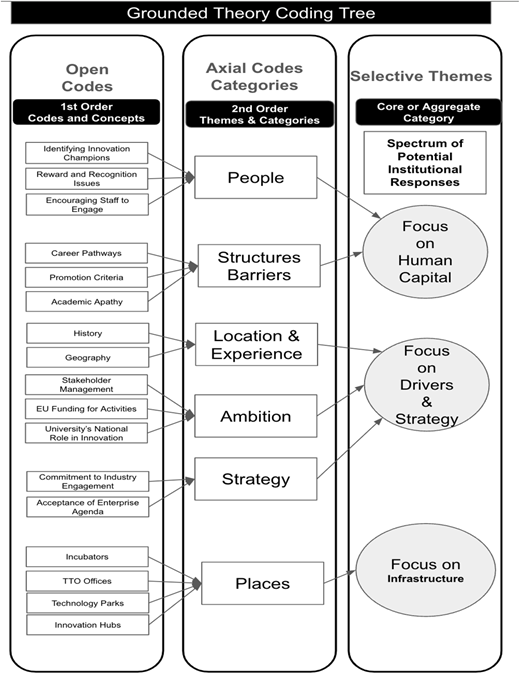
We began the analysis by singling out initial concepts, phrases and ideas in the data and arranging them in categories (open coding). Our open or first-order codes spanned 17 codes (see Figure 1) or concepts and included issues such as academic apathy to the third mission: the absence of the third mission from academic promotion criteria. They also included issues of history, in terms of how the institution has historically been associated with industry and geography, which seemed especially significant where the university is located close to a large enterprise. We then undertook the process of axial coding. In this phase, we searched for relationships and linkages between and among these categories, which helped cluster them into higher-order themes. These second-order themes are usually quite abstract and can therefore be difficult to identify. “Such themes may be beneath the surface of the interviews but, once identified, appear obvious” (Morse and Field, 1996: p. 118). The second-order categories linked similar first-order concepts and include categories, such as People, Places, Strategy. Finally, we gathered similar themes into several overarching dimensions that make up the basis of our emerging framework (Corley and Gioia, 2004).
As we proceeded with constant comparison, a core category began to emerge. We also grouped leaders' similar responses to the third-mission mandate in terms of the step or initiative they began with, the procedures they went through and some situational factors. In doing so, we identified a pattern of four potential responses. The objective of selective coding is to bring together the various codes and themes that have been created, detailed and developed during the prior axial coding phase into a singular core category (Belgrave and Seide, 2019). In a grounded theory study, the criteria for defining this core or aggregate category include its centrality and relevance to as many other categories and their attributes as feasible (Holton, 2009). As Teppo (2015), with reference to Corbin and Strauss (2014), p. 14) points out, the questions that have to be answered are “what is the research all about?” and “what seems to be going on here?”. This core category can be any kind of theoretical code: a process, a typology, a continuum or a range (Glaser and Holton, 2004). Our core category is a range which we describe as a spectrum of institutional initiatives and responses. Having established the core category, we knew the central phenomenon of the research and then began to build out our conceptual framework or theory, grounded in the data (Hallberg, 2006). Figure 1 summarises the resulting conceptual framework, comprising open codes, axial codes and the selective themes that depict the range of intrapreneurial responses and their underlying strategic postures.
4. Findings
This section presents the empirical findings generated through the systematic, grounded theory analysis of the interview data collected. Our analysis of the qualitative data reveals a nuanced picture of how university leaders interpret and enact their third mission activities. While there is broad consensus on the growing strategic importance of engagement beyond teaching and research, the ways in which these activities are embedded, resourced and measured vary considerably across institutions in this study. Our analysis reveals a dynamic and occasionally overlapping, pattern of responses that reflect distinct university leaders' interpretations of their key drivers and main challenges. We distilled these into a range of four distinct strategic postures adopted by leaders to interpret and enact the third-mission agenda based on specific pressures: Reactive Responders, Cultural Champions, Infrastructure Builders and Ecosystem Orchestrators. These categories are defined not merely by the volume of activity, but by their fundamental strategic intent, scope and commitment to the third mission. Following the principles of systematic qualitative analysis (Gioia et al., 2013), we first introduce the range as a whole (see Table 2) and then delve into a detailed description of each strategic posture, supported by illustrative quotes from the interview transcripts to demonstrate the connection between the executive's cognitive frame and the prioritised intrapreneurial actions within the institution. We also include the dominant leadership role and organisational context evident in each strategic posture.
4.1 Reactive Responders
Universities in this category are characterised by high path dependence, limited spare resources and a low starting level for third mission activity. For leaders of these universities, new revenue streams are their top priority. Hence, their main interpretation of the third mission expansion is focused on the provision of additional educational offerings about entrepreneurship to respond to either industry or student needs based on a commitment to building university-industry engagement. As one university leader (IA) describes this as responding, “to the need for academic education and professional training in an agile and responsive fashion” to both “meet a learner or market need” and thus “identifying new funding streams”. This manifests as a minimal level of engagement and an adopted reactive strategic posture to the third-mission mandate. Another interviewee (ID) described it thus: “We provide modules in entrepreneurship, start-up competitions etc”. Furthermore, interpreting this mission mandate university leaders acknowledged the need to be able to anticipate what these industry needs are; as another (UF) noted: “Anticipating emerging trends and requirements for academic education and professional training and rapidly getting programmes to the market that will match those trends”.
When it came to initiating intrapreneurial responses to the third-mission agenda, university leaders acknowledge the barriers that they face as participant UI described: “a lot of what you're doing in managing higher education is creating and resourcing the appropriate environment for things to happen”. A key issue is the need to reward third-mission activities “Academics are still generally judged on academic activity and the lack of reward and recognition for entrepreneurial activity is a barrier to increased entrepreneurial engagement by academics”.
The main prioritised intrapreneurial responses to the agenda of third-mission activities, in these institutions, is focused on the presence of an on-campus TTO and the provision of additional entrepreneurial training. This is a minimal response to the third-mission mandate because the activities are mostly cost-neutral to the university and are funded by the state development agency. Others, such as, programme development and training delivery are all responsive to the emerging needs of local industry and involve merely the repurposing of existing resources and redesigning modules that are likely already in place, often in the business school.
4.2 Cultural Champions
Universities in this category have a strong collegial culture built on faculty autonomy and thus need to secure internal buy-in. University leaders in this category took a proactive strategic posture with their key driver being the identification of innovation champions to drive the third-mission agenda. We found two very distinct interpretations among these university leaders. Some university leaders' interpretations focused on extending the role of the entrepreneurial university beyond simply teaching about entrepreneurship. These university leaders focused more on the development of entrepreneurially minded graduates – teaching for entrepreneurship. One interviewee (Participant UD) viewed the third mission as “inspiring creative and entrepreneurial graduates at the University”. Another (UB) described the third mission as “not so much creating the graduate entrepreneur but creating the entrepreneurial graduate, with technical skill in their discipline” and “entrepreneurial attributes, behaviours and traits such as problem-solving, communication skills, negotiation skills and team building”. Another interviewee (IB) further highlighted the “the posture of the institution” in developing “higher-order thinking skills” as crucial to “stimulate entrepreneurial action in the student body”.
Other university leaders' interpretations focused on the need for the institution to “move its internal structures and work practices” and develop the agile capabilities to act, itself, intrapreneurially through rapidly co-developing bespoke educational offerings with specific companies or market sectors. For this to become a reality, university leaders highlighted that there is a need for wider institutional buy-in. As one interviewee (Participant UD) explained: “The degree of buy-in of the deans and, I suppose, their translation of the strategy locally into their faculty is a crucially important part of how the [enterprise] strategy permeates the university”. A core challenge that university leaders highlighted was the need to break down silos within the organisation and between the university and external stakeholders as another interviewee (IB) noted. “We need to discourage academics from being territorial and siloed with industry contacts and instead encourage a true collaboration and sharing mindset”.
The main prioritised intrapreneurial responses of this category reflected their proactive and engaging focused strategic posture through a commitment to the third-mission agenda that includes communication, shared values, leadership and rewards. For entrepreneurial architecture and infrastructure, the main prioritised intrapreneurial response focused on the creation of enterprise hubs, incubators and accelerators with associated programmes of activities. For human capital and organisational development, a key focus for university leaders was on developing a strong institutional culture that supports third-mission activities. This culture change is underpinned by the development of reward and recognition schemes for academic and administrative staff. As one interviewee (Participant UB) explained: “An entrepreneurial university is an institution with an appetite and capacity for strategic action. Centred around the culture of the institution and its capacity for action – the university stimulates entrepreneurial action in its student and faculty body”. To support this agenda, innovation champions were identified from academic and administrative staff. They were recruited and became the change agents and intrapreneurs of the institution. “The role of academic deans is vital in this regard as the conveyors of the entrepreneurial strategy from senior management to the university community”. This response includes the provision of a comprehensive and contemporary programme of enterprise activities and the allocation of physical spaces for incubators and accelerators for students and staff.
4.3 Infrastructure Builders
Universities in this category are often larger, more research–intensive, with the capacity and the capital to invest in dedicated structural units. The proactive strategic posture is reflected in investments and integration of the third mission across the teaching mission, as highlighted by one of our interviewees Participant TA) as: “The investment in an incubation space has been a positive development because even the physicality of the space on a campus creates an awareness and increasingly an engagement with many of the [academic] programmes”. To address potential challenges, university leaders concentrated on tangible actions that affirm an organisational-wide commitment to the third-mission agenda through changes in conventional policies and processes around promotion, as one of our interviewees (Participant UE) highlights: “If you want to drive an entrepreneurial institution it needs to be clear to the academic staff that in terms of promotion, in terms of their respect internally, that the time that they spend on this type of activity - engaging with an entrepreneur in the region or starting up a company and if that affects their own publication output - will pay back”. Furthermore, university leaders highlighted specific pressures of competitive intensity and from governments and other stakeholders to expand their third missions that shaped their interpretation and the prioritised intrapreneurial responses which were designed to gain an institutional competitive advantage. As one interviewee (Participant UG) noted: “Universities are amplifiers of the quality of human capital and our competitive advantage comes from entrepreneurial agility where we work tighter together to develop intrapreneurial policies with rapid execution”.
The prioritised intrapreneurial response included investing in its physical entrepreneurial architecture in innovation hubs and incubation centres, as well as engaging more closely with the venture capital community to help secure sustainable funding for its spin-outs. Additional entrepreneurial architecture and infrastructure response were also through the provision of enhanced expertise on IP to its community of start-ups along with securing government funding to develop and enhance the enterprise agenda and wider third mission activities. For human capital development, the main intrapreneurial responses focused on empowerment through processes and the creation and or enhancement of entrepreneurial architecture and infrastructure that demonstrated action with respect to entrepreneurship. It was noted by one interviewee (Participant UH) that the “Development of a campus centre for entrepreneurship provides a vital focus for the agenda and for the message, from providing an infrastructure supportive of creative and entrepreneurial learning right through to commercialisation and external engagement”. This action was further reflected in the agenda of university metrics that captured entrepreneurial impact. Moreover, we found that part of the intrapreneurial response placed a higher emphasis on organisational performance monitoring through key performance indicators. One such indicator is investment in start-ups, as interviewee (UH) highlighted “The measure of how quickly external parties are prepared to invest is a measure of the quality of the start-up”. He continued, “universities are increasingly involved in the funding or investment effort”. Another interviewee proposed that the “engagement and involvement of TTOs with various academic programmes is a measure of their cross-disciplinary impact”.
4.4 Ecosystem Orchestrators
Characterised by high external connectivity and a more mature understanding of their institutional ecosystem, being entrepreneurial is the key driver for leaders in universities in this category. These are typically well-established institutions operating in a highly competitive and interconnected national and international context, often driven by high societal expectations. For university leaders' engagement with the broader community and industry emerged as a major theme with one university leader highlighting the additional pillar of “stakeholder engagement” to the traditional pillars of teaching and research, noting that “by definition, the entrepreneurial university should be very externally facing”. University leaders took a proactive strategic posture focused on progressing breakthrough innovation, as one interviewee (Participant IC) described: “We have a two-pronged approach to develop an innovation culture and to drive breakthrough innovation activity”.
The second interpretation element that university leaders highlighted directly linked to engagement was about realising different types of impact. As one university leader (UC) described succinctly: “The entrepreneurial university is a university with culture and awareness of entrepreneurship and innovation, which also fosters innovative mindsets in our students and staff but also focuses on translating knowledge into societal and economic benefit and engages proactively with enterprise, local and central government, and civil society”. They highlighted that being open to engagement extends to various stakeholders and that a variety of outcomes and impacts – economic, societal, technological, etc. As one university leader (Participant UC) noted: “The entrepreneurial and innovative HEI is designed to empower students and staff to demonstrate creativity, innovation and enterprise in education, research and societal engagement. Its activities are directed to enhance learning, knowledge production, translation, that's translation of knowledge and transformation in a highly complex and changing societal environment. It is dedicated to creating public value via processes of open engagement”. In realising such an interpretation, this interviewee identified internal and external challenges. Internally, the key challenge identified was engaging their leadership team and diversifying their funding base through identification of non-exchequer funding. Externally, key challenges focused on selling the university vision to stakeholders and getting them engaged and excited about this mission.
The main prioritised intrapreneurial initiatives for this category were the most extensive, and the focus was on building entrepreneurial communities. For entrepreneurial architecture and infrastructure, we found they engaged in activities outside the university, such as science and technology parks, business incubators and corporate consulting, along with wider collaborations beyond the local/regional context with national and international stakeholders. They create co-working hubs for spin-ins and spin-outs and alumni whose work patterns suit this type of work. In some instances, their business incubators, due to the successful scaling of spin-out firms, are moved to locations off-campus to allow them to grow and thrive. To support this capacity building, university leaders looked beyond funding opportunities from the Irish government, and they engaged far more in entrepreneurial projects and sought additional funding for such activities through EU funding. For human capital development, there was an enhancement with respect to knowledge exchange, along with wider collaborations beyond university boundaries, including national and international organisations that stretch beyond the physical boundaries of the university. As one interviewee (Participant IC) described: “We have a clear commitment to innovation with a societal benefit, and we focus on being permeable at the boundaries to ensure the knowledge we generate gets used”. We also found that university leaders were committed to changing the culture and processes of the institution itself as a key hallmark of this intrapreneurial response. One interviewee (Participant UC) highlighted, “We want to create a culture of entrepreneurship and we'll do it both top-down and bottom-up. We don't want it to feel like an initiative or a project which has an endpoint”. This leader said, “It's more than an initiative, it's an attitude”.
5. Discussion
5.1 University leaders' third mission interpretations
Universities operate within increasingly complex institutional environments characterised by growing stakeholder expectations, resource dependencies, policy mandates, accountability mechanisms and competing organisational priorities. The expansion of the third mission intensifies this complexity by challenging long-established academic assumptions regarding the purpose of the university and introducing expectations associated with innovation, commercialisation and societal impact. Consequently, universities cannot be understood as a singular institutional form governed by a unified logic; rather, they represent organisational arenas in which multiple institutional logics coexist and compete.
Drawing on institutional theory, and specifically institutional pressures (DiMaggio and Powell, 1983), institutional logics (Thornton et al., 2012) and institutional work (Lawrence and Suddaby, 2006), this study examined how university leaders interpret the third-mission mandate and how these interpretations shape the intrapreneurial responses adopted within their institutions. Our findings demonstrate that university leaders occupy a critical interpretive position between external institutional pressures and organisational action. While universities may face broadly similar coercive, normative and mimetic pressures, leaders differ substantially in how they make sense of these demands, the institutional logics they prioritise and the forms of institutional work they undertake to legitimise and embed third mission activity. The findings reveal four distinct leadership postures – Reactive Responders, Cultural Champions, Infrastructure Builders and Ecosystem Orchestrators – which together form a range of strategic postures of entrepreneurial transformation. Rather than representing discrete organisational categories, these postures illustrate varying degrees of movement from traditional academic logics towards increasingly embedded entrepreneurial logics. The range of four strategic postures therefore provides insight into how leadership agency shapes heterogeneous journeys towards entrepreneurial transformation under conditions of institutional complexity. The central explanatory insight is that field-level institutional pressures do not translate directly into organisational action. Rather, senior leaders interpret the salience of these pressures, prioritise and reconcile competing institutional logics and undertake forms of institutional work that get enacted through differentiated intrapreneurial responses. The four postures represent empirically derived configurations of this mechanism.
We now elaborate this explanatory mechanism in two stages. Firstly, we examine how leaders' interpretations of institutional pressures shape the logics they prioritise and seek to reconcile. Secondly, we explain how these interpretations are translated through institutional work into differentiated intrapreneurial responses.
5.2 University leaders' interpretations of institutional pressures and logics
A central contribution of this study is the demonstration that university leaders do not simply respond to institutional pressures; rather, they actively interpret them and construct organisational responses that reflect their understanding of the university's strategic priorities and identity. While previous research has highlighted the importance of leadership within entrepreneurial universities (Guerrero et al., 2016; Henry and Lahikainen, 2024), less attention has been devoted to understanding how leaders themselves make sense of the pressures associated with third mission expansion.
Our findings reveal considerable variation in how leaders interpret institutional demands. For Reactive Responders, coercive pressures associated with funding requirements, policy mandates and institutional survival dominate their interpretation of the third mission. Their responses are therefore largely compliance-oriented and reflect only a limited departure from traditional academic logics. Entrepreneurial activity is viewed primarily as a means of securing resources and maintaining organisational viability rather than as a transformative institutional objective.
In contrast, Cultural Champions and Infrastructure Builders interpret the third mission through a more developmental lens. While recognising external pressures, these university leaders focus primarily on reshaping internal conditions for entrepreneurial activity. Their attention centres on changing academic mindsets, legitimising entrepreneurial behaviour, developing organisational capabilities and removing institutional barriers that constrain engagement. In institutional logics terms, these leaders are engaged in constructing hybrid arrangements that seek to reconcile traditional academic values with emerging entrepreneurial expectations. Rather than replacing academic logics, they attempt to integrate entrepreneurial priorities into existing institutional structures and norms.
The most distinctive interpretation emerges among Ecosystem Orchestrators. Although these leaders remain cognisant of coercive, normative and mimetic pressures, they are not primarily driven by them. Instead, they embrace an entrepreneurial logic as a strategic organising principle for the university. Consistent with the notion of institutional entrepreneurship (Battilana et al., 2009), these leaders actively seek to reshape institutional arrangements, mobilise stakeholders and redefine organisational boundaries in pursuit of broader societal and economic impact. Their focus extends beyond organisational adaptation towards institutional transformation.
These findings extend institutional logics research by illustrating how leadership agency mediates the relationship between external institutional pressures and organisational responses. Universities facing similar environmental conditions do not necessarily converge on similar strategic trajectories. Instead, leaders selectively interpret institutional pressures, prioritise particular concerns and construct different pathways towards entrepreneurial transformation. The entrepreneurial university therefore emerges not as a uniform organisational model, but as the outcome of ongoing interpretive processes through which leaders seek to reconcile competing academic and entrepreneurial logics.
Importantly, our findings suggest that the dominant concern identified by leaders functions as a unifying interpretive logic through which competing institutional demands are reconciled. Whether the emphasis is organisational survival, cultural change, capability building or ecosystem leadership, these focal concerns provide leaders with a mechanism for managing institutional complexity and aligning organisational action around a coherent strategic direction. In this sense, leadership agency becomes central to understanding how universities navigate the tensions inherent in third mission expansion.
5.3 Institutional work and intrapreneurial responses
Our second contribution lies in explaining how university leaders translate their interpretations of institutional pressures into organisational action. While prior research has highlighted the importance of entrepreneurial structures, capabilities and cultures within entrepreneurial universities (Nelles and Vorley, 2010; Rocha et al., 2022; Cunningham et al., 2022), considerably less attention has been paid to the mechanisms through which leaders actively embed and legitimise the third mission within institutions characterised by competing logics. Drawing on institutional work theory (Lawrence and Suddaby, 2006), our findings suggest that university leaders act as institutional brokers who connect external pressures, organisational meanings and practical interventions. In doing so, they undertake institutional work aimed at shifting, stabilising and legitimising entrepreneurial logics within the university.
The findings demonstrate that intrapreneurial responses constitute the principal mechanism through which this institutional work is enacted. Rather than viewing intrapreneurship solely as entrepreneurial activity occurring within universities, we show how it functions as a vehicle through which leaders materialise institutional change. Intrapreneurial initiatives make emerging entrepreneurial logics visible, tangible and legitimate within organisational settings. They therefore provide the practical means through which abstract strategic aspirations become embedded in everyday organisational life. Viewed through this lens, the four leadership postures represent a range of strategic postures of institutional work. Reactive Responders undertake relatively limited institutional work, focusing primarily on compliance and organisational survival. Their intrapreneurial responses remain narrow in scope and are largely directed towards satisfying external expectations with minimal disruption to existing academic logics. The result is only a modest shift in the institutional meaning system of the university.
In contrast, Cultural Champions and Infrastructure Builders engage in more extensive forms of institutional work designed to reconcile academic and entrepreneurial logics. Their efforts focus on reshaping organisational norms, legitimising entrepreneurial behaviour and creating supportive conditions for wider participation in third mission activity. This work extends beyond structural change and includes cultural interventions such as reward systems, recognition mechanisms, leadership advocacy and the cultivation of entrepreneurial mindsets. In this respect, our findings reinforce calls to move beyond structural accounts of entrepreneurial universities and recognise the importance of cultural and symbolic dimensions in institutional transformation (Guerrero and Urbano, 2014).
The most externally-oriented form of institutional work is evident among Ecosystem Orchestrators. These leaders seek not merely to support entrepreneurial activity but to redefine the role of the university within wider innovation ecosystems. Their institutional work extends beyond organisational boundaries and focuses on creating new relationships, mobilising external stakeholders and generating broader societal and economic value. In doing so, they move from managing institutional complexity towards actively reshaping it. Consistent with institutional entrepreneurship, these leaders seek to create new arrangements that reinforce entrepreneurial logics as a dominant organising principle of the university (Battilana et al., 2009).
A particularly important insight emerging from the study concerns the role of organisational structures and entrepreneurial architecture within these processes. Existing research has highlighted the importance of technology transfer offices, incubators, accelerators, science parks and entrepreneurship centres in supporting third mission activity (Nelles and Vorley, 2010; Bronstein and Reihlen, 2014; Cunningham et al., 2022). Our findings suggest that these structures serve a broader institutional purpose. They operate as tangible manifestations of institutional work, signalling that entrepreneurial activity is legitimate, valued and increasingly central to the university's identity. In Friedland's (2017) terms, such structures function as institutional “objects” that make evolving logics visible and credible to internal and external stakeholders.
Interestingly, despite substantial differences in leadership interpretations and strategic postures, many of the intrapreneurial responses identified in this study resemble what Spender (1989) termed an “industry recipe”. Across the analytically derived range of four strategic postures, leaders frequently drew upon familiar organisational forms, including technology transfer offices, incubators, entrepreneurship centres, innovation hubs and science parks. This suggests that mimetic processes remain highly influential within entrepreneurial universities. Such structures provide not only legitimacy but also a degree of organisational certainty by reducing the risks associated with institutional change and providing visible evidence of commitment to the third-mission agenda.
At the same time, our findings reveal a potential tension within entrepreneurial university development. While mimicry may facilitate legitimacy and accelerate institutional adoption, it may also contribute to increasing organisational homogeneity. Universities seeking to establish entrepreneurial identities frequently adopt similar structures, practices and narratives, potentially limiting opportunities for genuine differentiation and innovation. This raises an important question for future research: whether entrepreneurial universities can simultaneously pursue legitimacy through conformity while maintaining distinctive institutional identities capable of generating transformative societal impact.
Overall, the findings suggest that institutional work and intrapreneurial responses form the critical bridge between competing institutional logics and entrepreneurial transformation. Leadership agency matters not simply because leaders interpret institutional pressures differently, but because they mobilise different forms of institutional work and intrapreneurial action to embed, legitimise and sustain entrepreneurial logics within their universities. The entrepreneurial university therefore emerges not from the presence of institutional pressures alone, but from the capacity of leaders to translate those pressures into meaningful organisational change.
6. Conclusions: implications and future avenues for research
6.1 Conclusions
This study set out to explain why universities exposed to broadly similar institutional pressures nevertheless enact the third mission in different ways. Drawing on institutional theory, institutional logics and institutional work, we show that institutional pressures do not translate directly or uniformly into organisational responses. University leaders function as institutional brokers who interpret the relative salience of external pressures, selectively prioritise and reconcile competing academic and entrepreneurial logics and translate these interpretations into institutional work enacted through differentiated intrapreneurial responses. The study therefore identifies leadership interpretation and enactment as the mechanism connecting common field-level pressures with heterogeneous organisational responses. The four strategic postures identified – Reactive Responders, Cultural Champions, Infrastructure Builders and Ecosystem Orchestrators –provide an empirically grounded representation of variation in this mechanism rather than a universal model of institutional development.
The study contributes theoretically by extending IT beyond its traditional emphasis on isomorphism and constraint, illustrating how leadership agency operates as a mechanism for institutional change. In doing so, it advances understanding of institutional entrepreneurship in higher education by showing how leaders mobilise internal structures, practices and cultural elements to reconcile competing academic and entrepreneurial logics. Rather than converging on a single model of the entrepreneurial university, institutions enact the third mission in heterogeneous ways, shaped by leadership priorities, organisational histories and ecosystem positioning.
IT provides the broad explanation of field-level pressure and legitimacy, while institutional logics provide the micro-foundation for understanding how leaders interpret competing university identities and translate them into differentiated intrapreneurial responses. The entrepreneurial university is not a singular institutional form, but a contested organisational arena characterised by competing institutional logics. University leaders play a critical interpretive role in selectively reconciling academic, entrepreneurial, managerial and societal logics through differentiated intrapreneurial responses. The study therefore advances institutional logics research by demonstrating how university leaders interpret institutional pressures, prioritise competing logics and translate these into differentiated forms of institutional work and intrapreneurial response.
6.2 Practical and policy implications
For university leaders, the following implications may be particularly relevant. Our four-fold range of strategic postures offers a valuable reflective, diagnostic and prescriptive tool for current and aspiring university leaders to better understand how they are using their leadership agency to support the third mission for economic and societal value creation. With growing societal and economic pressure, our model enables them to reflect on their default strategic posture and its alignment with institutional goals and contextual pressures. For effective third mission implementation, the findings highlight the need for strategic posture alignment and integration.
Critically, the analytically derived range of four strategic postures suggests that university leaders may benefit from a clearer understanding of the dominant coercive, normative and mimetic pressures shaping their specific interpretation of the third mission. To support this, it necessitates a robust, institutional-level strategic planning capacity that constantly identifies, assesses and evaluates environmental pressures. Such strategic planning capacity may help university leaders are best positioned to use their leadership role effectively, crafting appropriate intrapreneurship strategies that align external demands, economic and societal, with the evolving needs of academics and graduates. Ultimately, successful university leaders must simultaneously uphold the university's traditional cultural values as a knowledge-creating environment while intermeshing new meanings and norms: new institutional logics that support the third-mission mandate. It is essential for university leaders to be able to integrate and intermesh these institutional logics with their own interpretation of salient key drivers and challenges that they are seeking to address given the increasing demands among stakeholders to contribute to economic and social value creation. In addition, university leaders need to consider how this is interpreted internally by faculty – the meaning – (Friedland, 2009) and how such an evolution of institutional logics shapes the lived experiences of faculty and how they navigate institutional logics.
For policymakers, our findings suggest that reliance on coercive mechanisms, such as short-term output metrics, may encourage bounded, compliance-oriented responses, whereas support for long-term capability development, external engagement and relationship building may enable broader third-mission activity. These effects are not deterministic but are mediated by leadership interpretation and institutional context. Policy frameworks should therefore recognise institutional heterogeneity, allowing universities to develop responses aligned with their missions, resources and ecosystem positions, while supporting leaders in addressing participation barriers and fostering cultures that value economic and societal contribution.
6.3 Limitations and future research avenues
While this study offers a novel typology of intrapreneurial responses, it is important to acknowledge its limitations. Firstly, a primary limitation is the reliance on a single informant per institution (Ernst and Teichert, 1998). While the senior leaders interviewed occupy strategic roles and occupy positions of significant influence (see Harvey, 2011) there is an acknowledgement that their views may not fully capture the potential variation or the “middle-management gap” where strategic intent often meets operational resistance. While the study did use other sources beyond elite interviews, we do acknowledge that relying on a single narrative risks social desirability bias, where leaders may engage in self-presentation that overstates institutional coherence or underplays internal friction. Future research should adopt multi-level, multi-actor designs, incorporating perspectives from deans, department heads, technology transfer managers, professional service staff, students, graduates and alumni to triangulate how these intrapreneurial responses are enacted across different organisational layers.
Secondly, the study is situated within the Irish higher education context, characterised by specific national funding mechanisms such as Knowledge Transfer Ireland and a particular historical evolution of the “third mission”. While these policy-driven incentives represent significant coercive pressures within the Irish context, the specific institutional structures may limit the generalisability of the findings to different regulatory environments. However, the study offers theoretical transferability, as the four-fold range of strategic postures, rooted in IT, provides a conceptual scaffold that can be tested in other jurisdictions. Subsequent studies could pursue comparative cross-country research to examine how different national third-mission mandates influence the prevalence, configuration and evolution of strategic postures across institutional contexts.
Finally, the methodological combination of grounded theory and phenomenology prioritises depth over breadth. While this approach was essential for uncovering the nuanced, idiosyncratic interpretations university leaders have of institutional pressures, it precludes the quantification of the typology's prevalence. There is a clear need for quantitative testing of the typology through large-scale surveys to validate the characteristics of “Reactive Responders” versus “Ecosystem Orchestrators” across a broader sample of Higher Education Institutions (HEIs). Such research could further investigate the performance implications of each response pattern, determining if specific configurations of intrapreneurial activity led to higher levels of research commercialisation or regional economic impact.
This paper opens several promising avenues for future research, some of which are mentioned above. Future studies could employ comparative or longitudinal designs across national higher education systems to examine how leadership postures evolve over time and under varying institutional regimes. Such studies could be framed using Friedman's institutional logics to examine how this influences the shaping of meaning and value among university leaders. Furthermore, future studies could examine how leaders utilise their leadership agency in different contexts to manage institutional logic conflicts. Secondly, the focus on senior university leadership necessarily foregrounds strategic intent and interpretation, but potentially underrepresenting the perspectives of middle managers, academic staff and external ecosystem actors who also shape intrapreneurial outcomes; future research could therefore adopt multi-level or relational approaches to capture these dynamics. Finally, while this study conceptualises leadership postures as mechanisms of institutional entrepreneurship, further research is needed to understand the relationship between different leadership orientations, specific third mission outcomes and societal impact. Finally, there is a need for more studies of university leaders' praxis used to decipher institutional pressures drawing and their resultant strategic activities through the lens of strategy as practice (Seidl et al., 2024).
The authors would like to thank the interviewees who took part in the study as well as the Special Issue editor and anonymous reviewers who helped us develop this paper.
The supplementary material for this article can be found online.