We aim to investigate the relationship between gender and financial literacy, hypothesizing that a gender gap in attitude, knowledge and behavior might exist among university students, but it disappears at higher levels of financial education, particularly due to a talent management program in financial mathematics.
We analyze survey data from 229 Hungarian undergraduate university students specializing in finance. In the multivariate regression models, the independent variables are proxies for financial literacy and the key variables of interest are gender and participation in a talent management program, controlling for various socio-economic, psychological and behavioral variables.
We do not observe any gender gap in financial knowledge and attitudes among undergraduate finance students. However, female students are approximately 10% less likely than males to explore highly advantageous financial opportunities, even when all other characteristics like lifestyle, study performance, psychological traits, attitudes and knowledge are equal. This behavioral gender gap persists even among students who participate in the talent management program.
We propose that university program designers and finance educators place particular emphasis on addressing the behavioral aspects of financial literacy through gender-sensitive educational programs.
We contribute to the literature by comparing finance students’ financial literacy across knowledge, attitudes and behavior dimensions according to their gender and in a talent management program participation. Contrary to previous studies, we do not find a gender difference in the first two components, knowledge and attitudes. However, we provide evidence of a significant behavioral gender gap related to a long-lasting arbitrage opportunity.
1. Introduction
Consumers navigate a complex financial landscape shaped by deregulation, product innovation, and expanded choices. This complexity requires advanced financial literacy to make informed decisions on credit, borrowing, pension savings, and purchases. Enhanced financial literacy empowers individuals and supports financial system stability (Fernandes et al., 2014; Hastings et al., 2013). A recent study of Klapper and Lusardi (2020) spanning 140 countries found that only one-third of adults could be considered financially literate. A significant gender gap persisted after controlling for age, country, education, and income.
In this paper, we investigate the gender gap in financial literacy within the context of high-level financial education, focusing on the potential effects of a talent management program in financial mathematics. Our empirical study covers 229 university students specializing in finance in Hungary and examines various dimensions (knowledge, attitudes, and behaviors) of financial literacy. We hypothesize that high-level financial education improves financial literacy and reduces the gender gap.
In 2019–2022, Hungary’s student loan system presented a unique arbitrage opportunity. Students could borrow at a 2% interest rate and invest in government bonds yielding 5%. This risk-free strategy was widely known, easily accessible, and simple to execute. It created a quasi-natural experiment, allowing analysis of finance students’ knowledge, attitudes, and real-world financial behavior.
We can assess whether participation in a talent management program in financial mathematics influenced students’ decisions in this context. Admission requirements to this three-year program assure that only top performers are selected. Participants strengthen their skills in mathematics, methodology, and finance beyond the standard curriculum. This may have enhanced their ability to identify and exploit the arbitrage opportunity.
This study addresses several research gaps. First, while most studies on financial literacy have primarily focused on financial knowledge (e.g. Klapper et al., 2015; Klapper and Lusardi, 2020; Luksander et al., 2014; Van Rooij et al., 2011), they often overlook other critical dimensions such as attitudes and behaviors (Atkinson and Messy, 2012). We address this limitation by conducting a comprehensive analysis across all these dimensions.
Second, financial literacy is typically evaluated in the context of budgeting, saving, borrowing, and investing (e.g. Brown et al., 2016; Klapper et al., 2015). Few studies addressed more complex strategies like portfolio optimization and risk management (Van Rooij et al., 2011). We analyze financial literacy in the context of a student loan arbitrage opportunity involving budgeting, saving, borrowing, investing, portfolio optimization, and risk management strategies.
Third, while several previous studies analyzed the impact of education on financial literacy (e.g. Kaiser and Menkhoff, 2020), only a limited number focused on the effects of advanced financial education (Chmelíková, 2015). We address this gap by analyzing the financial behavior of finance majors and assessing the impact of the specialized talent management program in financial mathematics.
Finally, there is limited empirical evidence regarding gender differences among university students (Rasoaisi and Kalebe, 2015) and finance students in particular (Moon et al., 2014). In examining gender differences within this context, our findings indicate no evidence that higher levels of financial education reduce gender gaps across any dimensions of financial literacy.
We contribute to the literature by comparing university students’ financial literacy across knowledge, attitude, and behavior based on their gender and participation in a talent management program. While no gender gaps in knowledge and attitudes are found in our sample, we identify a persistent and robust gender gap in the behavioral component. Female students, even those with advanced levels of financial knowledge, are significantly less likely to apply this knowledge to enhance their well-being. Thus, we conclude that the talent management program in finance, on its own, is insufficient to bridge the gender gap. To address this issue, the program should be redesigned or supplemented with gender-specific components that specifically target the behavioral aspects.
In the following sections, we summarize the existing literature on financial literacy and develop our research hypotheses. Then, we introduce data collection methods, descriptive statistics, and the results of multivariate analyses. Finally, we discuss the findings, derive conclusions, and formulate policy recommendations.
2. Literature review
The term “financial literacy” generally refers to “people’s ability to process economic information and make informed decisions about financial planning, wealth accumulation, debt, and pensions” (Lusardi and Mitchell, 2014, p. 6). According to OECD (2020), “financial literacy is a combination of awareness, knowledge, skills, attitudes, and behaviors necessary to make sound financial decisions and ultimately achieve individual financial well-being”. It acknowledges the multiple dimensions of financial literacy and determines the ultimate objective of policymakers.
2.1 Theoretical background
Theories behind financial literacy encompass a variety of frameworks that emphasize the role of knowledge, cognitive abilities, and behavioral influences in financial decision-making. “Human capital theory” posits that financial literacy, as a form of human capital, enhances individuals’ ability to make informed financial decisions for better economic outcomes (Lusardi and Mitchell, 2014). Moreover, “Cognitive ability theory” suggests that individuals with higher cognitive skills are better equipped to understand and apply financial concepts (Agarwal and Mazumder, 2013). “Behavioral finance theory” incorporates psychological factors influencing financial decisions, such as attitudes toward risk and time preferences (Falk et al., 2018; Fernandes et al., 2014). The study of Atkinson and Messy (2012) integrated these aspects, recognizing that besides knowledge, effective financial decision-making requires also positive financial attitudes and sound financial behaviors. “Theory of Planned Behavior” (TPB) developed by Ajzen (1991) asserts that an individual’s intention to perform a behavior is influenced by their attitudes toward the behavior, subjective norms, and perceived behavioral control. It suggests that financial behaviors are driven by positive or negative evaluations of financial activities, social pressures or influences from peers and family, and the individual’s confidence in their ability (Atkinson and Messy, 2012).
The TPB framework highlights the importance of financial education programs that go beyond knowledge, fostering positive attitudes and enhancing perceived behavioral control. Empirical studies confirm TPB’s relevance, showing that individuals with supportive social environments and strong financial control are more likely to make sound financial decisions (Fernandes et al., 2014; Lusardi and Mitchell, 2014). Integrating TPB into financial education can improve financial capability and encourage desirable financial behaviors (Kaiser and Menkhoff, 2020).
2.2 Empirical literature and hypotheses development
From empirical perspective, financial literacy is usually measured through surveys assessing the knowledge of basic financial concepts, skills in managing personal finances, and attitudes toward financial decision-making in budgeting, saving, borrowing, and investing (Atkinson and Messy, 2012).
Although studies on financial literacy typically focused on financial knowledge (Fernandes et al., 2014; Klapper et al., 2015; Van Rooij et al., 2011), it encompassed a broader range of psychological and behavioral aspects. According to the OECD definition (OECD, 2020), financial literacy included five dimensions such as awareness, knowledge, skills, attitudes, and behaviors. However, OECD empirical studies measure only three of these: knowledge, attitude, and behavior (Atkinson and Messy, 2012; OECD/INFE, 2023). Financial knowledge is generally assessed through multiple-choice basic financial questions. Financial attitude involves individuals’ perspectives towards money, saving, and financial decisions, influencing their likelihood to undertake or avoid certain behaviors in planning. Finally, financial behavior examines how individuals manage their money, including their spending and saving habits and the degree to which they monitor their finances.
Empirical research consistently revealed significant disparities in financial literacy across various demographic groups. Studies suggested that limited financial knowledge and cognitive abilities contributed to significant welfare loss. Individuals with lower cognitive abilities tended to exhibit suboptimal financial behavior (Agarwal and Mazumder, 2013), and less sophisticated investors, lacking in financial knowledge, were more prone to making financial mistakes, resulting in higher transaction costs, elevated interest rates, excessive borrowing, inadequate saving, and a lack of retirement planning (Bajo and Barbi, 2018; Brown et al., 2016;, Klapper et al., 2015; Lusardi and Mitchell, 2007). It was also demonstrated that a higher degree of financial literacy yields clear beneficial effects, a higher level of financial inclusion (Grohman et al., 2018), and financial knowledge better equipped individuals to handle macroeconomic shocks (Klapper et al., 2013).
The impact of gender on financial literacy was widely researched and a persistent gender gap was documented in the literature. Most of these studies focused only on the knowledge component in specific geographical regions such as Switzerland (Brown and Graf, 2013), the USA, the Netherlands, Germany, and Switzerland (Lusardi and Mitchell, 2014), China (Moon et al., 2014), Lesotho (Rasoaisi and Kalebe, 2015). While these studies conclude that women lag in financial literacy, Wagland and Taylor (2009) examined gender’s impact on financial literacy among Australian undergraduates but found no conclusive evidence.
Atkinson and Messy (2012) expanded research on financial literacy by incorporating attitudinal and behavioral dimensions in 14 countries. In the knowledge dimension, males outperformed females in all countries except Hungary, where no significant gender differences emerged. In the behavioral dimension, the gender gap narrowed in most countries, as women scored higher in the attitudinal dimension.
The results of other studies adopting the three-component approach of financial literacy are mixed. Espinoza-Delgado and Silber (2024) found statistically significant gender differences in financial knowledge in Argentina and Paraguay, whereas Herdjiono et al. (2018) found no gender gap in any of the three dimensions in Indonesia.
Researchers explored potential explanations for gender gaps in financial literacy. Agnew and Cameron-Agnew (2015) argued that financial socialization within the home might be influenced by gender bias, which over time contributes to differences in financial knowledge levels. Hospido et al. (2021) discussed the influence of socio-demographic characteristics, generic skills, interest in or attitudes toward finance, and social norms. Brown and Graf (2013) found differences in attitudes, as men are usually more interested in finance than women. Other studies confirmed differences not in knowledge but in behavior, presenting that women were more risk-averse, less likely to own stocks, and more likely to own fixed-income securities (Almenberg and Dreber, 2015). Moreover, women were also more financially fragile and less confident in handling unexpected expenses (Hasler and Lusardi, 2017) and there was a confidence gap between men and women (Blaschke, 2022). Gender differences in academic performance could significantly impact financial literacy Females and students with weaker academic performance were more likely to have lower scores (Barboza et al., 2014). These findings suggested that a complex interplay of factors underlies gender disparities.
In financial literacy tests, there is usually an option to answer “I do not know.” It was demonstrated that women chose this option more frequently. However, if we estimate a counterfactual distribution of answers assuming random answers instead of “I do not know”, the gender gap in knowledge disappears (Tranfaglia et al., 2024).
Based on these findings, our first hypothesis is as follows:
Female students have a lower level of financial literacy in terms of attitude, knowledge, and behavior.
It is widely believed that education plays a pivotal role in enhancing financial literacy. Numerous studies demonstrated that financial education programs significantly improve individuals’ financial knowledge and behaviors (Kaiser and Menkhoff, 2020), higher academic status and business education positively correlated with financial literacy (Fatoki, 2014; Luksander et al., 2014; Ergün, 2018; Corsini and Giannelli, 2021). Chmelíková (2015) concluded that university students scored higher in financial knowledge but also in behavior, and attitudes than adult population. Atkinson and Messy (2012) highlighted that individuals with higher education levels were more likely to demonstrate advanced knowledge alongside positive financial behaviors and attitudes. Yuen et al. (2012) found that a major curriculum reform in Hong Kong schools created a moderate progress in students’ overall performance in skills, positive values, and attitudes. The study of Ho and Lee (2023) reported on the positive effects of foreign language studies on financial literacy.
However, some studies found that more financial education not necessarily led to a higher level of financial literacy. Mandell (2008) demonstrated that high-school students who studied personal finance did not have a higher level of financial literacy. Zhu et al. (2019) found that the level of multidimensional financial literacy among secondary school youth in Hong Kong was unsatisfactory, financial education programs significantly improved financial literacy but did not have effects on short-term financial behavior. Zhu and Chou (2020) concluded that financial literacy among adolescents is influenced mostly by parental financial behaviors. Parental financial socialization has significant effects on children’s future wellbeing in Hong Kong (Khan et al., 2023; Lee and Law, 2011; Zhu, 2018).
In line with a vast body of literature, our second hypothesis, which addresses the role of financial education in financial literacy, is as follows:
A higher level of financial education (participation in a talent management program) is associated with a higher level of financial literacy in terms of attitude, knowledge, and behavior.
The question of whether financial education reduces the gender gap has been significantly less researched. Bae et al. (2022) showed that early financial education could improve women’s financial knowledge and participation in investment, saving activities. Moreover, tailored financial education programs could enhance women’s financial literacy (Adiandari, 2023; Grohmann et al., 2018). Closing the gender gap in financial literacy required a combination of theoretical knowledge and confidence-building measures (Blaschke, 2022).
Thus, our third hypothesis, which focuses on the role of financial education in mitigating the gender gap, is as follows:
A higher level of financial education (participation in a talent management program) is associated with a smaller gender gap in financial literacy in terms of attitude, knowledge, and behavior.
In our analysis, we assume that the three dimensions of financial literacy we investigate are mutually self-reinforcing. Consequently, we hypothesize a positive correlation among these dimensions, whereby improvements in one aspect are likely to enhance the others, creating a virtuous cycle of financial literacy development.
2.3 The research model
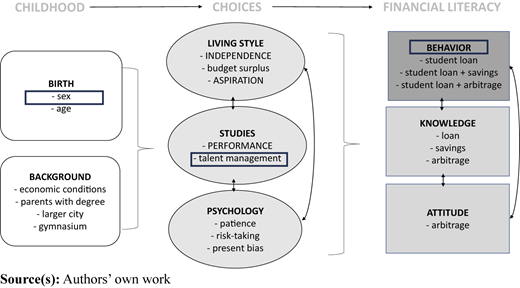
Aligned with cognitive and behavioral theories, we assume financial literacy stems from individual choices shaped by both rational decision-making and behavioral factors. These choices originate in childhood, influenced by variables such as age, sex, and family background, which can have lasting effects. Figure 1 illustrates key factors and their potential interactions.
Childhood variables (first column) are exogenously given, while choices (second column) and financial literacy (third column) are endogenous, evolving as the individual matures. Individual choices, reflected in lifestyle, studies, and psychological traits, serve as mediators that alter the effects of childhood determinants. The components of financial literacy—namely, attitude, knowledge, and behavior—are the final outcome variables of interest. According to TPB, financial literacy elements interact, with attitude and knowledge shaping behavior, which then feeds back to influence both. Since behavior directly impacts an individual’s life, taking financial opportunities requires action. Thus, in our research model, behavior holds the highest position in the financial literacy hierarchy.
Aligned with our research hypotheses, we focus on two key explanatory variables: sex and participation in a talent management program. These variables, highlighted in Figure 1, help examine their potential impact on the financial literacy of finance students.
3. Data and method
To examine the relationship between gender, education, and the components of financial literacy, we focus on a specific subgroup: third-year undergraduate students majoring in finance and accounting specializing in Finance at a top university of economics and business in Hungary. In 2021 and 2022, all finance students were required to fill out a detailed online survey at the end of a major course as part of an optional exercise incentivized by bonus points. More than 95% of the students completed the survey, resulting in a representative sample of 229 respondents (131 in 2021 and 98 in 2022). The research was approved by the university’s ethical committee, and students consented to the use of their anonymous responses for research. The survey included binary and multiple-choice questions on respondents’ socio-economic and educational background, open-ended questions to measure their financial knowledge, Likert-scale questions to measure their attitudes, and binary questions on their behavior. After data cleaning, variables were defined, and analyses were performed in xlstat.
In line with H1 and H2, our key variables of interest are sex, participation in a talent management program in financial mathematics, and financial behavior related to borrowing, investment, and arbitrage (highlighted in Figure 1). We expect that participation in a talent management program helps to eliminate or mitigate the gender gap in financial literacy, including attitude, knowledge, and behavior.
The knowledge component of financial literacy is increasingly measured through standardized questionnaires, especially in cross-country comparisons. However, other dimensions (e.g. attitudes, behavior) vary widely in empirical research, allowing for innovation and culturally specific approaches. Following this path, we developed tailored measurement methods for the Hungarian context, focusing on finance students’ behavior regarding a highly subsidized student loan opportunity.
All Hungarian university students were eligible for a free-of-use student loan at an interest rate well below the treasury bond rate. The monthly loan amount is roughly twice the official minimum wage, enabling an arbitrage strategy where students could borrow and invest in risk-free sovereign bonds for substantial arbitrage profit. Upon graduation, they could either repay the loan immediately to realize the profit or use an income-contingent repayment plan while leveraging their capital for other purposes, such as homeownership, entrepreneurship, or further education. Despite these benefits, only 28.1% of students in our sample took out a loan, with just 14% investing part of it in stocks, bonds, cryptocurrencies, or other financial assets. Only 6.9% invested in Hungarian government bonds, qualifying as arbitrageurs. We assign the highest financial literacy score to arbitrageurs, followed by investors and borrowers. Most students did not utilize the subsidized loan, likely due to gaps in the behavioral dimension of financial literacy.
Based on the literature, we hypothesize that female students are less prone to explore financial opportunities. Individual choices such as participation in a talent management program might be influenced not only by biological sex but also by broader societal factors related to gender identity and roles. Although the questionnaire offered several options (female, male, non-binary, and prefer not to answer), all respondents identified as either female (41.6%) or male (58.4%). Therefore, throughout the paper, we use “gender” and “sex” interchangeably.
Students in the financial mathematics talent management program underwent a highly competitive selection process at the start of the three-year program. They then received advanced training in finance, mathematics, programming, and data analysis in small, interactive groups led by selected instructors. The program’s impact is shaped by two key factors: the initial selection of students and the value added by the program itself. However, distinguishing these effects is inherently challenging. In our sample, about one-fourth of finance students participated in the program.
The relationship between gender and financial behavior is influenced by multiple factors. As shown in Figure 1, our multivariate analysis incorporates additional variables. Financial behavior is shaped by financial knowledge and attitude, both key components of financial literacy.
To measure knowledge, we adapt the methodology of Atkinson and Messy (2012) with modifications. Knowledge is assessed separately for savings, loans/student loans, and arbitrage through multiple-choice questions. Each knowledge variable is scaled on a 0–1 interval, where higher values indicate greater knowledge. An overall knowledge indicator is then created by averaging the three knowledge scores.
Financial attitude is also a complex and multidimensional latent variable. To measure students’ attitudes toward arbitrage, we developed a novel method. We presented an old story on a specific compensation note arbitrage to students, who were then asked to assess various statements on a four-graded Likert scale. Responses saying “rather agree” and “strongly agree” were coded as 1, while responses saying “rather not agree” and “not agree” were coded as zero. Then, the indices were calculated by averaging the scores obtained for each question. A higher score indicates a more negative attitude toward arbitrage in general.
Control variables affecting financial literacy are either singular variables or composite indices capturing important socio-demographic or other personal characteristics related to childhood or adult life. Singular variables are age, expressed in years, and budget surplus, calculated as the difference between monthly incomes and expenditures and expressed in Hungarian Forint (HUF). Variables related to time and risk preferences are calculated in line with Falk et al. (2018) and Horn and Kiss (2020). Patience is the one-month-ahead subjective discount factor representing time preferences. Risk-taking is measured as the willingness to play a risky fair game, expressed in HUF, where the maximum amount was 10,000, so a higher value indicates a higher willingness to take risks. Present biasedness is calculated as the ratio of the current subjective discount factor to a future subjective discount factor. If this ratio is lower than one, it indicates present biasedness and, consequently, a tendency to procrastinate.
The background index reflects key socio-economic characteristics of a student’s upbringing, with higher values indicating more favorable conditions. The independence index evaluates students based on whether they live separately from parents, have good financial conditions, and work. Study performance is measured through an index aggregating grades from two core finance courses.
Aspirations are higher for students planning to pursue a master’s degree, live abroad, earn a high income relative to peers, and have more children. A higher aspiration index indicates a larger planned family budget in the long run. Aggregate background, independence, and aspiration variables are calculated as the arithmetic average of their components.
4. Results
In this section, first, we present univariate comparisons, then summarize the results of multivariate regressions complemented with robustness checks.
4.1 Univariate comparisons
To gain insight into the differences based on gender and participation in a talent management program (TMP) in financial mathematics, we first compare students based on their gender and involvement in the talent management program. The results of this are summarized in Table 1.
Female students are significantly less financially active than males, being less likely to take out student loans or invest. However, no differences in attitude and knowledge are observed between genders. Female students tend to be younger, come from less advantaged socio-economic backgrounds, and have lower aspirations. They also participate less in the talent management program and show less patience but exhibit lower levels of procrastination (i.e. showing no present bias).
Most talent management program participants are male, exhibiting greater knowledge of student loans, higher aspirations, better academic performance, and more patience. However, participation does not appear to lead to more active financial behavior.
4.2 Multivariate regressions
To analyze the relationship between gender and financial literacy in a multivariate model, we estimate the following linear regression model:
where represents a component of financial literacy (attitude, knowledge, or behavior) for the ith student, is a female dummy variable, is a binary variable indicating participation in the talent management program, controls are other relevant confounders, and is a dummy variable controlling for the year cohort (2021 or 2022). The coefficients and show the linear relationship between the key variables of interest. Regression results are presented in Table 2.
Behavioral financial literacy is correlated with age and sex, with older male students demonstrating a greater willingness to take out student loans and make investments. Further, knowledge is positively associated with aspirations and participation in the talent management program. Attitude is also linked to aspirations, so the higher the aspirations, the less negative the attitudes.
4.3 Robustness checks
To investigate our hypotheses in more detail, we conduct robustness checks for taking out student loans (see Table 3).
When solely exogenous childhood variables are introduced in the model, female students exhibit an 11.7% lower likelihood of taking out student loans (Table 3). As additional variables related to lifestyle, higher education studies (including participation in the talent management program), and psychological traits are controlled for, the statistical significance of the sex variable diminishes. However, upon further control for attitude and knowledge, the sex coefficient reemerges as significant (−10.2%). Therefore, the gender gap remains robust and cannot be explained by the observed confounders.
Taking student loans for investment purposes indicates even higher financial literacy than merely taking out a student loan. Table 4 presents regression results when the dependent variable is making investments from student loans, and confounder variables are involved gradually.
As Table 4 shows, the gender gap remains robust, with a difference of around 10% in each specification. Thus, at this elevated level of financial literacy, female students are approximately 10% less likely than males to explore highly advantageous financial opportunities, even when all other characteristics (lifestyle, study performance, psychological traits, attitudes, and knowledge) are equal.
Table 4 shows a strong positive association between knowledge of treasury bond conditions and taking out student loans for investment. This relationship may be bidirectional, as knowledge can influence behavior, while behavior also shapes knowledge.
5. Discussions
Concerning H1, we examine financial literacy in terms of attitudes, knowledge, and behaviors among university students specializing in finance. Our multivariate regression models reveal no significant gender gap in financial attitudes and knowledge (Table 2). These results are in contrast to a substantial body of literature (Lusardi and Mitchell, 2014; Luksander et al., 2014; Rasoaisi and Kalebe, 2015; Ergün, 2018; Klapper and Lusardi, 2020; Espinoza-Delgado and Silber, 2024; Moon et al., 2014; Barboza et al., 2014), reporting significant differences in financial knowledge and attitudes. Exceptions are Wagland and Tylor (2009) in the Australian context and Atkinson and Messy (2012), who identified Hungary as the only country where no gender gap was observed. Therefore, further research should explore the extent to which this result is due to the unique social, institutional, or cultural characteristics of the country. Consistent with Tranfaglia et al. (2024), the lack of a significant gender gap in knowledge in our study can be because we did not offer the option to answer “I do not know” in our questionnaire. Thus, even less confident women were forced to select an answer they deemed the best.
While no gender gap in attitude or knowledge was identified, we observed a significant gender disparity in behavior, with female students being about 10% less likely to explore highly subsidized student loans (Tables 3 and 4). These findings echo several empirical studies (Brown and Graf, 2013; Almenberg and Dreber, 2015; Hasler and Lusardi, 2017), now validated within a specific sample of highly educated finance students. Interestingly, our results contradict Okamoto and Komamura (2021), who found that financial behavior and attitudes among men were less premeditated. Overall, H1 is supported in the behavioral dimension. Even after controlling for a wide range of confounding variables, the behavioral gender gap remains robust in multivariate models. Consequently, the behavioral component of students’ financial literacy may be influenced by some non-observed factors, for example, other psychological traits, cultural influences, or societal norms. Further research is needed to explore why female students remain passive in financial decision-making and actions despite having similar attitudes and knowledge as their male counterparts.
Regarding H2, participation in the talent management program in financial mathematics is strongly and positively associated with financial knowledge related to loans, but not to savings and arbitrage (see Table 2). This association persists even after controlling for various student characteristics, which supports to the validation of H2. This is also consistent with numerous empirical studies (Fatoki, 2014; Luksander et al., 2014; Chmelíková, 2015; Ergün, 2018; Corsini and Giannelli, 2021), concluding that financial education, higher schooling, university education, and economics education are associated with higher financial knowledge and financial literacy. Hence, we provide new evidence on the role of education for finance students right before graduation in relation to a talent management program.
We do not find a significant association between the talent management participation and the behavioral or attitudinal components of financial literacy. In this regard, H2 is not supported. This result contradicts the findings of Chmelíková (2015) but aligns with the conclusions of Mittelstaedt and Wiepcke (2014), who emphasized the importance of behavioral aspects of financial literacy in financial education. Our findings are also consistent with Zhu et al. (2019), who reported that financial education programs did not significantly impact financial behavior.
The behavioral gender gap remains significant even after controlling for variables related to childhood, current lifestyle, studies, psychological traits, attitudes, and knowledge (Tables 3 and 4). Notably, the gender gap persists even when the dummy variable for participation in the talent management program is included in the regression model. This indicates that the talent management program was not effective in mitigating gender differences, thereby contradicting H3. Our findings align with the recommendations of Grohmann et al. (2018), Adiandari (2023), and Blaschke (2022), who emphasized the need for tailored educational approaches and methods to close the gender gap. However, our results partly contradict the conclusions of Bae et al. (2022), as we observed a persistent behavioral gap. Unlike Bae et al. (2022), we focus on the behavioral gap itself without analyzing other potential improvements in women’s behavioral components.
The aggregate aspiration index, reflecting students’ future plans and expectations, is significantly lower for female students and those not participating in the talent management program (Table 1). Aspiration is associated with attitudes and knowledge even after including control variables, whereas it is insignificant for behavior in any setting (Table 2). Those with higher aspirations are more likely to participate in the talent management program, exhibit less negative attitudes toward arbitrage, and possess greater knowledge. Several authors documented women’s lower aspirations related to education (Riegle-Crumb et al., 2012), career choices (Diekman et al., 2011), and leadership (Ely et al., 2011). However, in our sample, the gender gap in aspirations does not explain the gender gap in financial behavior (Tables 3 and 4).
This research has limitations. First, only one-fourth of students participated in the talent management program, with female students underrepresented, making gender-program interactions difficult to assess. Additionally, only 28% of students took out loans, and just 15% did so for investment, suggesting surprisingly low financial literacy among finance students.
Second, despite controlling for various student characteristics, omitted variables may exist. Factors like parenting style and parental or peer pressure, which we lack data on, could have influenced financial behaviors and warrant future exploration. Third, our proxy variables may not fully capture complex latent factors such as family background, independence, aspirations, and financial literacy. Future research should refine measurement methods and examine diverse samples.
6. Conclusion
Hungary’s highly subsidized, free-of-use student loans offered a significant arbitrage opportunity, especially for finance students who extensively studied financial markets and arbitrage strategies. This could have enhanced their financial well-being with minimal barriers. However, we find that few finance students take advantage of student lending, with female students being even more reluctant to participate.
Although we could not detect any gender gap in financial knowledge or attitudes at this high level of financial education, women lag significantly behind men in taking action. Female students are approximately 10% less likely than males to explore highly advantageous financial opportunities. Surprisingly, this passivity cannot be explained by differences in personal characteristics like risk attitude, aspiration, or additional education provided through participation in a special talent management program in finance. The reasons for the behavioral gender gap need further investigation but are likely influenced by various non-observed factors such as social or cultural differences, parenting style, or educational methods.
Our findings support gender-sensitive personal finance education. Policymakers should prioritize financial education programs that go beyond knowledge-based approaches, incorporating behavioral training to address psychological and social barriers limiting women’s financial engagement. Educators can foster inclusive learning through active, collaborative methods. Policies should also ensure equal access to talent management and financial literacy programs, enhancing women’s financial skills and confidence. Collaboration between financial institutions and educational bodies can create supportive environments that encourage positive financial behaviors. These efforts contribute to a more inclusive financial ecosystem, equipping both men and women to make informed financial decisions and supporting economic stability and growth.
This research was funded by the National Research, Development and Innovation Office (No: NKFIH, K-138826). Edina Berlinger acknowledges support from the Chair and Research Program in Sustainable Finance at the University of Luxembourg, sponsored by the Ministry of the Environment, Climate and Sustainable Development.