


Our aim in this paper is to develop new knowledge about the creation of educational offers amidst competing schools. Turning to sociological theorizing on “menus”, we pose the following research question: How do school leaders navigate tensions between innovation and standardization when creating educational offers in competitive situations?
We examine our aim using rich qualitative data, consisting of 17 interview instances with principals at publicly and privately owned upper secondary schools in a Swedish municipality context. In addition, we use 790 document pages from political motions and education board proceedings at the municipal level to triangulate various events that principals retrospectively raised during interviews.
Our data analysis first shows that innovation expectations and standardization requirements turned the creation of educational offers into balancing exercises for principals. Our analysis then shows how peer schools, structural aspects and marketing-related activities engendered three uncertainty types that also transformed the creation of educational offers into distressing exercises. These uncertainties were acknowledged—although not entirely comprehended—by principals, who added different profiles to standardized programs in processes within which imitative dynamics became more prevalent than innovative endeavors.
We propose our findings contribute to school leadership literature, which has become growingly concerned with supply-side issues in competitive situations, many of them sprung from market-inspired reforms. Studying principals as supply-side representatives, we show how they navigated tensions between expectations, requirements and uncertainties to create educational offers in balancing and distressing exercises.
Introduction: creating educational offers after market-inspired reforms
Researchers studying competition in the educational sector have devoted ample attention to demand-side issues, including investigations about how students choose schools (Thelin and Niedomysl, 2015), and how these choices shape learning and segregation patterns (Forsberg, 2018). Supply-side issues have instead received comparatively sparse attention (Klein and Shimoni-Hershkoviz, 2016), perhaps because researchers studying competition often picture schools as commanding weak agentic capabilities to shape the educational landscape (Bomark et al., 2021). Researchers have highlighted how school leaders perceive competition (Reimann et al., 2021), and how they may respond to it by crafting strategies as part of supply-side initiatives (Ho and Lu, 2019). Yet fundamental supply-side issues remain largely unexamined, such as the ways that leaders perceive their schools’ and other schools’ educational offers [1] (Dieude and Prøitz, 2024). Emergent findings indicate school leaders perceive they create offers in a context of “regulated autonomy” (Lundström, 2015) featuring various—and, at times, contradicting—policy and market pressures.
Supply-side issues are important because many politicians and regulators—in contrast to researchers—nowadays picture schools as commanding strong agentic capabilities, assuming competition for students among schools will—almost by default—augment the innovativeness of educational offers (Le Grand, 2009). This assumed connection between competition and innovation has been fueled through market-inspired reforms (often labeled as New Public Management (Christensen and Lægreid, 2002)) in several European countries from the 1990s onward. Such reforms have sought a transformation of institutions with weak agentic capabilities—denoting actors that must follow rather detailed orders (from the state)—into organizations with strong agentic capabilities—denoting actors that can make quite autonomous decisions (in relation to the state) (Brunsson and Sahlin-Andersson, 2000). This transformation has, for instance, afforded schools across Europe certain autonomy to make decisions about what educational offers will be provided (Román et al., 2015). Making autonomous decisions will allegedly enhance competition by improving the responsiveness—and, by extension, the quality and efficiency—of schools facing heterogenous student populations with diverse educational preferences (Le Grand, 2009). Achieving such responsiveness, however, seems rather complex in European countries where reforms at various levels partly contradict one another. A notable example of this complexity can be seen in Sweden, where school leaders are not only expected to represent decision-making organizations by creating innovative educational offers at the municipal level, but where these leaders are also required to represent order-following institutions by creating offers based on certain standardized educational programs mandated from the national level (Lundström, 2015). Swedish school leaders creating offers in competitive situations appear to be walking a tightrope between innovation and standardization.
Our aim in this paper is to develop new insights about the creation of educational offers within schools. We thus pose an accompanying research question: How do school leaders navigate tensions between innovation and standardization when creating offers in competitive situations? Approaching our aim through Korczynski and Ott’s (2006) “menu in society” theory as well as with rich qualitative data from a Swedish municipality context, we first find that principals leading publicly or privately owned upper secondary schools [2] perceived how expectations for innovation and requirements for standardization transformed the creation of offers into balancing exercises. We then also find how peer schools, structural aspects, and marketing-related activities generated three uncertainty types among principals that—perhaps more than anything else—turned the creation of offers into distressing exercises. The effects of these uncertainties were not fully comprehended among principals, who ultimately created offers by attaching various profiles to standardized programs in processes within which imitative dynamics took precedence over innovative endeavors. Our findings contribute to a growing literature on supply-side issues of competition in the educational sector (e.g. Dieude and Prøitz, 2024; Ho and Lu, 2019; Lundström, 2015; Reimann et al., 2021) by highlighting how principals navigate tensions among uncertainties, expectations and requirements when creating offers.
Theory and literature: writing menus amidst expectations and requirements
Politicians and regulators across Europe have promoted competition among public sector service providers, believing the latter will be forced to improve their quality and efficiency if citizens can choose among competing providers (Le Grand, 2009). This belief in competition builds on two important assumptions. One assumption is that citizens regard themselves as informed consumers making choices to maximize personal returns. Another assumption is—perhaps most importantly for our aim—that providers perceive themselves as informed competitors creating offers to fulfil consumer desires (Fotaki, 2009). Although both assumptions overlook complicating evidence, we concentrate on public sector service providers, including schools. Evidence concerning providers suggests their employees may approach competition as a secondary matter in public sector contexts within which other logics—for instance, standardization—have historically taken precedence (Arora-Jonsson and Edlund, 2024). And such an approach to competition can result in the creation of service offers that no citizens desire (Nilsson et al., 2018).
Despite complicating evidence, politicians and regulators continue to believe in competition as a useful mechanism for the provision of public sector services (Werron, 2015). This belief is fueled by market-inspired discourses suggesting that, if private sector service providers can compete successfully, public providers should likewise be able to. The belief in competition has, by extension, become an ideal about how organizations should operate (Fotaki, 2009). Neoinstitutional theorists (e.g. Bromley and Powell, 2012; Meyer and Rowan, 1977) would largely predict an ideal—such as competition—to only generate loose adherence among organizational members in practice. Although ideal need not foster more than loose adherence, inhabited institutionalism (e.g. Hallett, 2010; Hallett and Hawbaker, 2021) nonetheless highlights how ideal and practice may become linked over time. Hallett (2010), for instance, studied a US school where an ideal of accountability was gradually linked to organizational practice when output measures were launched. This linkage was fraught with uncertainty—or “epistemic distress” (Hallett, 2010, p. 53)—as teachers lacked clear information about what outcomes were being measured, and how these unknown outcomes were being measured.
Public sector contexts in Europe not only highlight that ideal and practice can become linked; they also highlight that the linkage may adopt highly material dimensions. After market-inspired reforms in Sweden, for example, upper secondary schools are financed based on their capacity to attract students amidst competing schools (Böhlmark and Lindahl, 2015). When financial resources become associated with performances in competitive situations, the linkage between ideal and practice obliges service providers to pay more than loose adherence (Hallett, 2010; Hallett and Hawbaker, 2021). On paper, Swedish reforms have associated the resources of schools with the performances of schools in competitive situations. These reforms have also equipped principals with agentic possibilities to make relatively autonomous decisions through municipal decentralization policies that generate expectations about the creation of innovative educational offers in competitive situations (Román et al., 2015). Studies from Sweden reveal that school leaders generally perceive themselves as quite autonomous when it comes to deciding the pedagogical direction of their schools (Nordholm et al., 2022, 2023). That said, national curricula policies simultaneously imply significant decision-making remains centralized beyond the control of principals. National centralization is particularly clear in terms of requirements mandating schools to provide certain standardized educational programs (Lundström, 2015).
To explore how school principals in Sweden navigate this intersection of reforms, agentic possibilities, competition-associated resources, and—most importantly here—contradicting expectations for innovative offers and requirements for standardized programs, we leverage Korczynski and Ott’s (2006) sociological theorizing on “the menu in society”. This theorizing indicates that choices among consumers as well offers among providers are, literally, constrained by the limits of menus. Our approach lies in leveraging Korczynski and Ott’s theorizing on menus as a perspective through which we can “look at, grasp, and represent” (Abend, 2008, p. 179) how principals navigate tensions between innovation and standardization when creating educational offers to attract students.
Korczynski and Ott originally used restaurant menus to theorize how appealing notions of freedom (e.g. guests choosing among multiple meat-based and fish-based dishes) co-habit with constraining structures of power (e.g. managers dismissing plant-based dishes) in generating appealing yet constraining versions of sovereignty among consumers throughout market-inspired societies. Although Korczynski and Ott’s theorizing initially focused on menus as platforms mediating between notions of freedom and structures of power among consumers, Korczynski and Ott subsequently suggested that researchers must also study the processes through which menus are created (e.g. managers conferring with chefs and waiters over what dishes to include and exclude) in specific societal sectors. “The menu draws attention to the substance of the choices that it offers”; however, it also “forces us to … ask who has written the menu”, as doing “otherwise is to lapse into the laziness of functionalist analysis” (Korczynski and Ott, 2006, pp. 923–924).
Striving to avoid such a lapse, we examine how principals (i.e. managers) approach the process of creating educational offers (i.e. writing menus) that can attract students (i.e. guests) as educational consumers after market-inspired reforms in Sweden. Just as the purported sovereignty engendered by these reforms may appeal yet constrain students when choosing among offers, principals can also be appealed yet constrained when creating offers.
This indicates menus not only account for how principals—in terms of ideal—may be appealed to create innovative educational offers that can attract students and, thus, financial resources amidst competing schools at the municipal level. This indicates menus also account for how principals—in terms of practice—can be constrained to engage in loose adherence, as innovative offers are partly contradicted by certain standardized educational programs mandated from the national level.
Background: reforming the educational system in Sweden
All schooling in the Swedish system [3] is publicly funded. Our specific empirical setting is upper secondary schooling after Sweden’s 1992 “Freedom of Choice Reform” (Swe. Valfrihetsreformen).
Before 1992, upper secondary school students attended their most proximate schools through the so-called “proximity principle.” These were all publicly owned, bar a few religious schools. In 1992, the Swedish choice reform introduced publicly funded vouchers, and it also allowed privately owned schools to operate on a broad scale. After 1992, students could utilize their vouchers to choose among a growing range of publicly and privately owned schools, most often without regard for the proximity principle (Holmlund et al., 2014). Key to our paper is that, with the introduction of vouchers, upper secondary schools (both publicly and privately owned) became responsible for their own financial resources by attracting students through innovative educational offers amidst competing schools (Böhlmark and Lindahl, 2015).
The 1992 choice reform formed part of a wide reform agenda in Sweden, as this reform was connected to other reforms that, throughout the late 1980s and early 1990s, affected upper secondary schooling. During the late 1980s, several reforms shifted much public service provision from being nationally centralized to becoming municipally decentralized, with politicians and regulators deciding that all schooling would soon become decentralized as well (Pierre, 2001). In 1991, the “Municipalization Law” (Swe. Kommunallagen) thus decentralized responsibility for all schooling provision to the municipal level (Holmlund et al., 2014). Yet important educational aspects for upper secondary schools, such as curricula matters, remained centralized at the national level. Whereas Swedish upper secondary schooling features a long tradition of national curricula dating back to the 1970s (Malmström, 2016), upper secondary schools were specifically affected by an updated “Curriculum for the Voluntary Schooling Forms” (Swe. Läroplan för de frivilliga skolformerna) through which 17 standardized educational programs with predefined course packages were delineated in 1994. Providing some of these educational programs became mandatory for upper secondary schools in Sweden, although principals could customize the programs by adding profiles to them (Adolfsson, 2024). This possibility to customize standardized educational programs through profiles, however, disappeared when yet another updated national curriculum—the “Curriculum, Degree Goal, and Overarching Courses for Upper Secondary Schooling” (Swe. Läroplan, examensmål och gymnasiegemensamma ämnen för gymnasieskola)—was introduced in 2011 (Sundberg and Wahlström, 2012).
Swedish upper secondary schooling as our specific empirical setting has, since the late 1980s, thus been characterized by recurring reforms that have generated intermittent policy shifts toward both municipal decentralization of educational control—allowing principals to create innovative offers—and national centralization of educational control—requiring principals to provide certain standardized programs (Adolfsson, 2024; Sundberg and Wahlström, 2012). Such shifts may imply that “the predominant mode of operation [in upper secondary schools] is geared toward maintaining the status quo”, as “the daily working life of principals places so many demands on them that there is scant time for exploration” (Pietsch et al., 2022, p. 587).
Methods: studying the creation of educational offers in a Swedish municipality
We studied a municipality in Sweden’s upper range of mid-sized municipalities (i.e. 50,000–250,000 inhabitants). In 2024, 57% of Swedish municipalities had less than two upper secondary schools, and 65% had no privately owned schools (Skolverket, 2025). Our focal municipality featured 25 upper secondary schools—out of which 11 were publicly owned and 14 were privately owned—during 2018/19, which is when we collected data for this paper.
Data collection
Our main data sources are cross-sectional, semi-structured interviews with upper secondary school principals. We initially contacted all 25 principals by e-mail during fall 2018, driven by an interest in studying the dynamics of competition among schools operating throughout our focal municipality. Upon first contact, all potential interviewees were informed about the study as well as about their right to remain anonymous. Eight principals failed to respond or declined to participate. However, 17 principals—out of which 10 represented publicly owned schools and 7 represented privately owned schools—agreed to be interviewed and tape-recorded. Table 1 contains an overview of the interview data we collected.
Overview of interview data
| Interviewee group | Interview number | Professional background of interviewee | Interviewee experience as principal | Temporal extension of interview |
|---|---|---|---|---|
| 10 principals at publicly owned upper secondary schools | 1 | Upper secondary school teacher | 19 years | 78 min |
| 2 | Upper secondary school teacher | 10 years | 75 min | |
| 3 | Upper secondary school teacher | 8 years | 80 min | |
| 4 | Junior high school teacher | 2 years | 74 min | |
| 5 | Upper secondary school teacher | 15 years | 52 min | |
| 6 | Elementary and middle school teacher | 20 years | 55 min | |
| 7 | Upper secondary school teacher | 21 years | 63 min | |
| 8 | Adult education teacher | 3 years | 72 min | |
| 9 | Upper secondary school teacher | 11 years | 73 min | |
| 10 | Adult education teacher | 7 years | 87 min | |
| 7 principals at privately owned upper secondary schools | 11 | Upper secondary school teacher | 5 years | 39 min |
| 12 | Upper secondary school teacher | 8 years | 54 min | |
| 13 | Nurse and junior high school teacher | 4 years | 59 min | |
| 14 | Upper secondary school teacher | 15 years | 44 min | |
| 15 | Elementary and middle school teacher | 11 years | 78 min | |
| 16 | Special education teacher | 12 years | 46 min | |
| 17 | Store owner and middle school teacher | 14 years | 58 min | |
| Total = 17 principals | N/A | Mode = Upper secondary school teacher | Average = 11 years | Average = 64 min |
Source(s): Authors’ own work
Throughout our interviews, we posed general queries concerning the ways that school principals approach competition as well as specific queries concerning how educational offers are created in competitive situations characterized by expectations for innovation and requirements for standardization. All individual and organizational identities were anonymized throughout our verbatim interview transcriptions.
As complementary data sources, we gathered 790 pages of archival documents from political motions and education board proceedings in our studied municipality. When scouring municipal archives for documents, we selected all motions and proceedings dealing with competition among upper secondary schools, innovation among educational offers, and/or standardization among educational programs between 1992 (i.e. representing the introduction of Sweden’s choice reform) and 2019 (i.e. representing the conclusion of our interview data collection). We did not include these select motions and proceedings in our subsequent data analysis; they were only meant as a means to triangulate various events that principals retrospectively raised during interviews.
Data analysis
We coded all our interviews through an abductive procedure that consisted of repeated iterations between data and theory to identify recurring themes at different abstraction levels (Tavory and Timmermans, 2014). The procedure followed three steps.
First, we engaged in open exploration, broadly scanning our interview data for terms, sentences and passages that could be assembled into different themes dealing with educational offers and competitive situations. This step generated multiple first-order codes reflecting how principals tended to approach the creation of offers as processes riddled with expectations (e.g. “Choice emphasized as democratic right”), requirements (e.g. “Maintaining relevance of educational content”), and uncertainties (e.g. “Speculating about role of incumbent schools”). Second, we relied on constant contrasting to group connected themes among our first-order codes. This step rendered a reduced number of second-order codes (e.g. “Standardized programs”). We devised three such codes to group the types of uncertainty principals emphasized when they described how educational offers were created amidst innovation expectations and standardization requirements. Approaching educational offers through Korczynski and Ott’s (2006) restaurant menus highlighted the uncertainty principals faced in targeting offers to students without having much information about them. Finally, we engaged in additional contrasting to search for general themes running through our second-order codes. This step ultimately engendered a set of third-order codes (e.g. “Distressing exercises”). Figure 1 contains our Gioia et al. (2013)-inspired coding structure.
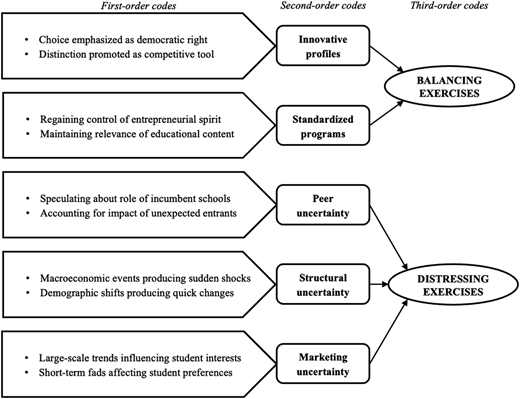
The creation of educational offers as balancing and distressing exercises (source: authors’ own work)
The creation of educational offers as balancing and distressing exercises (source: authors’ own work)
Findings: balancing and distressing exercises during the creation of educational offers
We arrange our findings as follows. First, we show the ways that upper secondary school principals sought to balance between innovation expectations and standardization requirements when creating offers. Then, we also show how this balancing was further complicated by three uncertainty types that generated distress because principals lacked crucial information to create attractive offers.
In general, our findings suggest the creation of offers was a complex affair for school principals who were active 3 decades after Sweden’s choice reform. Principals knew they were surrounded by expectations to create innovative offers that could attract students amidst competing schools. And, reminiscent of inhabited institutionalism (e.g. Hallett, 2010; Hallett and Hawbaker, 2021), principals knew student attraction had become linked to school financing after the choice reform. Yet most principals did—succinctly put—not know how to make offers attractive. Hovering above the Swedish choice reform was an ideal of competing schools that principals saw as difficult to follow in practice—like neoinstitutional theorists (Bromley and Powell, 2012; Meyer and Rowan, 1977) would party predict. These difficulties arose because the creation of offers was not only surrounded by innovation expectations, but also by standardization requirements. Resembling restaurant managers facing constraints when writing menus—as theorized by Korczynski and Ott (2006)—school principals experienced how notions of freedom co-habited with structures of power when creating offers after the Swedish choice reform.
Balancing exercises
Principals creating offers particularly perceived they needed to balance between expectations for innovation and requirements for standardization that were simultaneously emphasized by Swedish politicians and regulators. Innovation expectations and standardization requirements rendered a vaguely defined framework within which principals moved as they attempted to gain information about demand-side issues that could form the basis for offers catered toward students.
Innovative profiles
The framework within which principals created offers was partly defined by innovation. Principals emphasized how politicians at various levels—but perhaps particularly at the municipal—had since long stressed that imaginative schools would generate a palette of innovative educational offers—such as programs with profiles—to enable choice among students. Enabling choice was not only a core aspect of the 1992 reform affecting schools, but—like many principals suggested—also an aspect that politicians elevated as a fundamental right characterizing democratic societies. This could also be seen in documents as municipal politicians claimed that “customer choice is central for democracies”, and that such choice “should also encompass educational offers” (Political motion, 2002).
Besides innovation, the framework within which principals created offers was also partly defined by competition. Indeed, several principals stressed how politicians, since the early 1990s, had emphasized that innovation among schools would be facilitated by generating competition among them. Competition was thus understood as a governance tool to facilitate the creation of innovative offers that could distinguish schools from one another (Böhlmark and Lindahl, 2015). Here, documents similarly show how, by 1992, municipal politicians indicated that “the educational sector shall be submitted to competition” and that schools could compete “by striving for high quality … and by having different profiles” (Educational board proceeding, 1992). As a means of differentiation, principals would allegedly devise local courses to “clarify the singularity of a school”, and to “separate it from the rest” (Educational board proceeding, 2002). Principals reminisced about this early 1990s emphasis on profiling through local courses with a mix of appreciation and consternation:
At first, you could compose your own local courses, and just call the Swedish Schools Agency to register them … There was this entrepreneurial spirit … Before 2011, there were something like 9,000 local courses in Sweden … The courses were all over; it was crazy (Interview 14—Principal at privately owned school).
2011 is an important year, as it became a tipping point for the creation of offers. Principals had supposedly been driven by an “entrepreneurial spirit” up until 2011, leading them to devise a “crazy” number of local courses through which schools could differentiate themselves. This so-called spirit suggested principals during the 1990 and 2000s acted as if they were restaurant managers freely writing menus according to an ideal of schools that competed against one another with no major constraints.
Standardized programs
Although principals reminisced about the freedom they had allegedly enjoyed when creating offers, principals never seemed to have been fully free in practice. Principals themselves highlighted how politicians also attempted to control the creation of offers by 1994 through an updated national curriculum, which featured 17 programs with standardized courses. Certain principals thus perceived they began engaging in balancing exercises by the mid-1990s, as principals were increasingly expected to create innovative offers at the municipal level, while simultaneously being required to provide certain standardized programs mandated from the national level. Looking back, principals sensed the standardization requirements were sharpened when another updated national curriculum was launched in 2011:
The Swedish Schools Agency decided in 2011 that local courses would be trimmed down to 800–900, and that they would become part of the earlier 17 programs … Nowadays, you primarily work with profiles that go on top of your programs (Interview 2—Principal at publicly owned school).
In balancing between innovation and standardization, principals currently believed they could not do much more than to layer profiles on top of programs. Such layering seemed straightforward at first sight, but the combination of innovative profiles and standardized programs engendered uncertainty that was distressing for principals. It was clear that it was unclear for principals how innovative profiles could be layered on top of standardized programs to produce attractive offers.
Distressing exercises
Although educational offers were created within a framework, school principals largely resembled restaurant managers and chefs seeking to write menus with little information and much uncertainty about nearby restaurants, gastronomy trends, and possible guests. In this sense, principals described experiences akin to Hallett’s (2010, p. 53) “epistemic distress,” as they created programs and profiles without any substantial insights into the operations of competing schools, the needs of labor market stakeholders, and the preferences of potential students. The distress was specifically driven by three uncertainty types: peer uncertainty, structural uncertainty and marketing uncertainty.
Peer uncertainty
One notable type of uncertainty concerned the challenges principals perceived in monitoring and understanding how peer schools impacted one another through their offers. Below, a principal reflected on the vast municipal landscape of upper secondary schools, emphasizing how national programs were customized through myriad profiles:
On the public side, Northern School and Southern School have gigantic social sciences programs with behavioral profiles … And, then, on the private side, Eastern School has a business profile for its social sciences program, and Western School has a media and a computer science profile … There is a lot to consider when we try to profile our programs (Interview 16—Principal at privately owned school).
In scanning and interpreting the surrounding landscape, principals often focused on incumbent schools that had recently undergone major organizational changes. Such changes were perceived to impact the profiling of other schools, although principals could not tell with certainty how and when this impact would be felt:
Northern School has just been renovated, and students in its natural sciences program now have access to modern labs and all that … In two or three years ahead, this renovation may not influence students, but it probably does now … At the same time, some students just want to go to Northern School because of its traditions … We need to take all this into consideration when profiling our natural sciences program (Interview 10—Principal at publicly owned school).
Principals thus expected that—although they did not entirely grasp how and when—the operations of incumbent schools would affect other schools. However, principals also suggested that unexpected entrants were even more challenging to grasp than incumbent schools. Unexpected entrants included newly founded schools that made successful inroads into Swedish municipalities with attractive offers, often devised by adding innovative profiles to the large social, natural, or physical sciences and engineering programs. Such inroads were a significant source of uncertainty, as emphasized in what follows:
For long, it felt like we had the engineering program in our hands … But we are now in a completely different situation, as Western School [a newly founded school] has moved its positions forward during the past few years … So, creating programs, profiles, and so on is a lot about scouting your environment (Interview 7—Principal at publicly owned school).
Incumbents and entrants posed different—but similarly pressing—challenges for principals who attempted to monitor and understand the municipal landscape of educational offers. Depending on the numbers and mixes of incumbents and entrants, their associated challenges concomitantly varied across municipalities. Other challenges were, however, largely present as structural aspects across municipalities.
Structural uncertainty
Another important uncertainty type was thus associated with constraints imposed by macroeconomic and demographic factors as structural aspects that produced considerable distress when principals created offers. In terms of macroeconomy, principals claimed they were regularly contacted by companies, business associations, and other labor market stakeholders, expressing a need for upper secondary school graduates with certain skills and competences. Sudden macroeconomic events, however, made it difficult for principals to create offers based on the needs expressed by labor market stakeholders:
So, we look at regions around us, and what the major employers need … For instance, there have been several large construction projects lately, and this suggests we should have rapidly launched a construction program with an industrial profile … But we see that certain student segments are quite affected by macroeconomic fluctuations. A construction boom in Sweden obviously brings students to construction programs, but there is always the risk of a dip. And what happens then? (Interview 12—Principal at privately owned school).
In comparing macroeconomic and demographic factors, principals sensed that macroeconomic fluctuations were more uncertain than demographic shifts. Birth rates and migration patterns were demographic factors that most often impacted Swedish municipalities in a relatively steady manner over time. This did not mean demography as a structural aspect was devoid of uncertainty when it came to creating programs with profiles:
In 2016, the demographic curve reached a bottom, but now it is going up again … This [demography] is stuff we can plan for … The difficult thing is obviously to know what kids want to study [in the future]. What are their educational preferences? What programs and profiles should we focus on? (Interview 10—Principal at publicly owned school).
The preferences of adolescents approaching upper secondary schooling age constituted a topic that principals repeatedly returned to. These preferences were difficult to predict, however, and principals appeared distressed about how various trends, beliefs and interests among adolescents should be leveraged into updated educational offers that could be understood as the equivalent of seasonal restaurant menus.
Marketing uncertainty
A final type of uncertainty thereby concerned the powerlessness principals experienced when they attempted to market offers toward what were perceived as students with continuously and haphazardly changing preferences. This was indeed the most notable uncertainty type among principals. In emphasizing the challenges associated with creating timely offers, principals volunteered comparisons that juxtaposed ideas about a simple past with notions of a complex present:
When I was young, there were punks, synth rockers, and leftists with Palestinian scarves, or nerds. There was not much more than that to choose from. Today, there are so many hobbies, so many openings and possibilities, and so many areas in which to express beliefs among 15–16 year olds … When devising programs and profiles, we try to look at society, but it is challenging to grasp what they [adolescents] are interested in (Interview 5—Principal at publicly owned school).
Principals struggled to track student preferences, which were regarded as moving targets that not only changed over time, but also “all the time”. Addressing such targets with marketing-related activities was thus inherently uncertain:
Media and communications programs were hyped during the late 90s, but those programs have fallen off … Instead, arts programs have made a turnaround, and social science programs with behavioral profiles have become popular today … But marketing our education is difficult when the preferences of students shift all the time … What will they [students] be interested in tomorrow? This is a swinging pendulum (Interview 12—Principal at privately owned school).
Seeking to understand the preferences of students, a principal claimed that “my colleagues and I ask students what they are interested in when they come to open houses at our school …”, but “it is still difficult to get a grasp of how students choose programs” (Interview 7—Principal at publicly owned school). Similar difficulties were voiced by several other principals, as “knowing how students make choices feels like an impossible thing … You would need a fortune teller” (Interview 14—Principal at privately owned school). That said, certain principals claimed they were able to grasp student preferences in a fairly accurate manner. These principals nonetheless faced the difficulty of operationalizing and integrating student preferences into educational offers. The quote below comes from a principal that delineated current and future preferences, yet grappled with how to create programs and profiles based on these preferences:
What are students interested in? Sustainability will remain important. Globalization also. Digitalization will continue being important … But these are broad themes, and turning them into something concrete is not easy … I cannot say exactly how to do that (Interview 14—Principal at privately owned school).
We have by now examined three uncertainty types that, altogether, engendered considerable distress among principals as they attempted to create attractive offers. Principals acknowledged—but did not fully comprehend—the role of peer schools, structural aspects, and marketing-related activities when creating offers. The uncertainty surrounding educational offers meant principals often departed from standardized programs, which were then profiled through processes featuring more imitation than innovation:
For us, it was a matter of copy and paste … There were social science programs with international relations profiles in southern Sweden, and we started a very similar program here because it seemed to work over there (Interview 11—Principal at privately owned school).
Launching programs and profiles because they “seemed to work over there” regularly surfaced as a way for principals to handle the uncertainty surrounding how students made educational choices. Principals ultimately needed to fill classrooms with students.
Discussion: understanding educational offers as supply-side responses to competition
Our aim in this paper has been to advance new knowledge about the creation of educational offers, and we approached them as supply-side responses by schools facing competitive situations. Leveraging Korczynski and Ott’s (2006) theorizing on menus as well as qualitative data from a municipal context with publicly and privately owned schools in Sweden, our findings first suggest that innovation expectations and standardization requirements turned the creation of offers into balancing exercises for principals. Our findings then indicate how peer schools, structural aspects and marketing-related activities engendered three uncertainty types that also transformed the creation of offers into distressing exercises for principals. These uncertainties were acknowledged—although not entirely comprehended—by principals, who added different profiles to standardized programs in processes displaying more imitative than innovative tendencies.
Principals creating offers between ideal and practice
We propose our paper contributes to school leadership literature, which has become growingly concerned with supply-side issues in competition (e.g. Dieude and Prøitz, 2024; Ho and Lu, 2019; Lundström, 2015; Reimann et al., 2021). Studying school principals as supply-side representatives, we showed how they navigated tensions between expectations, requirements and uncertainties to create educational offers in balancing and distressing exercises. Our study evinces just how cognizant principals were of the ideal that schools should compete against one another through offers to students after Sweden’s market-inspired reforms. And our findings also evince just how cognizant principals were of an association between school financing and student attraction that essentially linked the competition ideal to organizational practice. With the proximity principle gone, principals knew they had to fill classrooms with students on the basis of attractive offers (Holmlund et al., 2014). In this strict sense, principals did not differ much from airline managers seeking to fill flights with passengers (Hochschild, 1983) or hotel managers seeking to fill rooms with guests (Sherman, 2007).
Although principals were aware of a competition ideal as well as of its linkage to organizational practice (Hallett, 2010; Hallett and Hawbaker, 2021), they seemed notably disoriented when attempting to create offers. Principals understood that—but not how—peer schools, structural aspects, and marketing-related activities affected the attractiveness of programs and, thus, the choices of students. In being disoriented, principals could not fully adhere to the idea of creating offers and competing against other schools. However, uncertainties surrounding program attractiveness and student choice indicate that principals were not actively striving for loose adherence to the competition ideal (Bromley and Powell, 2012; Meyer and Rowan, 1977). Principals engaged in Geiger’s (1941, p. 20) competitive “side glances,” albeit without being able to make complete sense of what they saw. The uncertainties surrounding program attractiveness and student choice meant that instead of creating offers, principals tended to imitate offers from schools perceived as successful. In line with our case of Swedish upper secondary schools, neoinstitutional theorists have since long devoted attention to imitation processes (e.g. Boxenbaum and Arora-Jonsson, 2017; DiMaggio and Powell, 1983), showing that such processes are common among organizations operating in contexts characterized by uncertain conditions. Through imitation, organizations attempt to enhance their attractiveness by adopting aspects of other organizations that are regarded as successful. Successful organizations, as such, become cues for organizations seeking to navigate uncertainty.
We have focused on supply-side issues concerning how principals create educational offers, and—although this focus does not include the ways that students ultimately choose among offers—our focus encompasses how principals think of and deal with demand-side issues among students. Marketing scholars have suggested that preferences among adolescents are particularly volatile (e.g. Kumar and Shah, 2004; Parment, 2013), and this presumably contributed to the uncertainties perceived by principals in terms of continuously and haphazardly changing preferences among students. These uncertainties were perhaps only exacerbated by the vague connections that tend to exist between preferences and choices (Brunsson and Brunsson, 2017; March, 2009). Whereas principals perceived student preferences as volatile—and, thus, challenging when creating offers—Korczynski and Ott’s (2006, p. 922) menus suggest that students—if nothing else—may have experienced “an enchanting sense of individual autonomy through the process of choice itself”. Indeed, one core argument behind Sweden’s 1992 Freedom of Choice Reform was—as its name essentially reveals—to have students choose among educational offers. Another argument behind this reform was, however, that principals would also experience an “enchanting autonomy” to create attractive offers and, by extension, enable student choices at the municipal level. Principals generally perceive themselves as rather autonomous (Nordholm et al., 2022, 2023), yet our paper indicates they could not fully leverage this autonomy due to uncertainties concerning peer schools, structural aspects and marketing-related activities, which eventually turned the creation of offers into distressing exercises.
In any event, principals were far from autonomous when creating offers. Just as students were ultimately restricted to choose among available offers, principals were ultimately restricted to create offers by adding local courses or profiles on top of standardized programs mandated from the national level (Adolfsson, 2024; Lundström, 2015; Sundberg and Wahlström, 2012). Principals could therefore only innovative within bounds, and offers could not be more than “special in ordinary ways” (or ordinary in special ways) (Blomgren et al., 2016). This is, by extension, what Korczynski and Ott (2006) mean when they suggest that notions of freedom co-habit with structures of power to render an enchanting yet restricted autonomy in market-inspired societies, such as Sweden from the 1980s and early 1990s onward.
We recognize that public sector researchers examining supply-side issues after market-inspired reforms have implicitly asked “who writes the menus” (Anell, 2011; Moberg, 2023; Nilsson et al., 2018), albeit without adopting Korczynski and Ott’s (2006) terminology. These public sector researchers have, for instance, shown that healthcare and eldercare providers as actors “writing menus” seldom possess a comprehensive understanding of demand-side issues among patients and older persons. In Swedish research focusing on eldercare nursing homes with “lifestyle” profiles, Nilsson et al. (2018, p. 60) stressed that
When asked about demands, interviewees [mostly nursing home managers] mentioned that politicians had shown an increased interest in nursing homes with lifestyle profiles, but the obvious motive within a market discourse—demand among those in need of care—was not there. Why, then, do nursing homes with lifestyle profiles exist at all? What is the purpose of having different types of care facilities in a system where demand is speculative and few are able to choose?
Nilsson et al.’s sentiments are largely echoed in our findings from education providers, as we showed that demand also appeared “speculative” among upper secondary school principals who did not know much about the preferences and choices of students. If demand is speculative, the purpose of competing for students by creating various educational offers raises important questions that we elaborate on below.
Offers in search of preferences
Looking forward, competition and choice seem to be firmly positioned as policy arguments for continued market-inspired reforms that will allegedly heighten the quality and efficiency of education providers in Sweden and across Europe. Yet menus, as theorized by Korczynski and Ott (2006), urge politicians and regulators to ask several supply-side questions about the responses of schools operating in competitive situations. What educational programs are being offered to students? Why are these programs being offered? And how are they being created? If disoriented and speculative principals create offers in competitive situations without knowing much about the preferences of students (Nilsson et al., 2018), what role does choice play for principals? Put differently, what role would menus play for restaurant managers if they did not know what their guests liked? These questions should perhaps not only be asked by politicians and regulators, but also by researchers, as our queries provide important avenues for future work on supply-side issues in competition throughout the educational sector.
We would like to thank Tine Prøitz, Daniel Nordholm, Ema Kristina Demir, and Justine Grønbæk Pors as well as our anonymous reviewers at the International Journal of Educational Management for constructive comments that undoubtedly improved this paper in many important ways.
Funding: This work was funded by grants from the Jan Wallander and Tom Hedelius Foundation to Peter Edlund (grant number W18-0053) and Jakob Westergren (grant number H23-0018).
Notes
Educational offers constitute more or less differentiated bundles of programs and courses (Thelin and Niedomysl, 2015).
Although nonpublic schools in Sweden tend to be labeled “independent schools,” we suggest this label generates unfortunate associations with actors making wholly autonomous decisions through full agentic capabilities. Strictly speaking, nonpublic schools do not command such autonomy and agency. Just like public schools have commanded varying autonomy and agency in relation to the Swedish state as an owner, nonpublic schools command varying autonomy and agency in relation to companies, foundations or other private entities as owners. Nonpublic schools have also commanded varying autonomy and agency in relation to the state, particularly considering Sweden’s entire schooling system is publicly funded. We thus label Swedish upper secondary schools as publicly or privately owned to reflect their ownership without saying much about their respective autonomy and agency.
Sweden’s educational system consists of preschools, compulsory elementary, middle and junior high schools (grades 1–9), and voluntary upper secondary schools (grades 10–13).
Ethical statement: Ethics review board clearance was not required in Sweden when our interviews were conducted during 2018/2019. That said, upon first contact, we informed all potential interviewees about our study as well as about their right to remain anonymous. Seventeen interviewees (out of 25 contacted) agreed to be interviewed and tape-recorded. We have subsequently anonymized all individual and organizational identities throughout our verbatim interview transcriptions.

