This paper addresses the persistent intention-implementation gap in Industry 4.0 adoption by introducing the concept of Organisational Implementation Intentions (OIIs) and examining how OIIs and firms' technological capabilities jointly determine whether strategic intent converts into implementation, use, and outcomes.
Using a Straussian grounded-theory approach, we conducted 13 semi-structured interviews with senior managers and consultants in the Moroccan manufacturing sector.
Our analysis shows that intention alone is insufficient; organisations need comprehensive pre-actional planning that specifies responsibilities, timelines, scope, procedural steps and contingencies to translate intentions into reliable implementation. OIIs narrow the intention-implementation gap, but their effectiveness depends critically on firms' technological capabilities. When aligned, OIIs and technological capabilities produce operational, strategic, and financial benefits.
By applying the implementation-intention concept at the organisational level, the study offers a testable, processual framework explaining how organisations can bridge the intention-implementation gap in Industry 4.0 settings.
1. Introduction
Organisations are increasingly deploying advanced information technologies to respond to rapidly shifting customer demands and rising operational complexity. Industry 4.0 -characterised by cyber-physical systems, Internet of Things, analytics, and autonomous robotics - has become central to discussions of digital transformation and industrial upgrading (Al-Talib et al., 2024; Singh et al., 2025; Tortorella et al., 2020). While the strategic appeal of Industry 4.0 is widely acknowledged, organisations frequently struggle not with deciding whether to adopt these technologies, but rather with translating declared intentions into sustained implementation and use (Antony et al., 2023; Sony et al., 2022).
Existing technology-adoption theories, including the Technology-Organisation-Environment (TOE) framework, Diffusion of Innovation (DOI), the Technology Acceptance Model (TAM), the Theory of Planned Behaviour (TPB), and the Unified Theory of Acceptance and Use of Technology (UTAUT), have substantially advanced the understanding of the antecedents of adoption intention (Rogers Everett, 1995; Tornatzky and Fleischer, 1990; Venkatesh et al., 2003). These models emphasise perceived usefulness, social influence, organisational readiness, and environmental pressures as predictors of adoption decisions. However, they tend to assume a relatively direct pathway from intention to implementation and under-specify the procedural mechanisms through which strategic intentions are operationalised in complex organisational settings (Bagozzi, 2007).
Empirical evidence suggests that commonly studied adoption predictors explain only a modest share of implementation variance (Friedman and Ronen, 2015; Tawde et al., 2023). This gap is particularly pronounced within Industry 4.0, wherein socio-technical complexity, cross-functional governance, deployment lifecycle, and capabilities heterogeneity are particularly associated with considerable execution challenges, such that many organisations have yet to move past the pilot phase of experimentation. Though previous research has identified the challenges and facilitators of the adoption of Industry 4.0 (Al-Talib et al., 2024; Antony et al., 2023; Gallab et al., 2021; Sony et al., 2021; Yüksel, 2022), the process through which organisations move from intention to action is not yet well documented.
This study fills the crucial void of the absence of a theoretically conceptualized mechanism to explain the process of converting Industry 4.0 adoption intentions into actualized implementation and outcomes, especially within resource-constrained and developing country contexts. In this direction, we propose the concept of Organisational Implementation Intentions (OIIs) as a sensitising concept at the meso-level to conceptualise the process of converting strategic intent into implementation. The analysis focuses on the manufacturing industry within the context of the Moroccan economy, which represents a theoretically rich context characterised by a strong policy drive towards Industry 4.0 adoption, combined with a heterogeneous base of firm readiness and capability constraints (Auktor, 2022), thereby enabling observation of how firms operationalize intentions under institutional pressure and resource limitations. Accordingly, this study addresses the following research questions:
How do organisations in a developing-country context translate intentions to adopt Industry 4.0 technologies into sustained implementation and use?
How are Organisational Implementation Intentions formed within manufacturing organisations?
What organisational and performance outcomes are associated with Industry 4.0 implementation in a developing-country context such as Morocco?
To address these research questions, this study has three interconnected objectives. Firstly, it aims to develop a process model that explains the mechanism through which Industry 4.0 intentions are implemented. Secondly, it aims to conceptualise and empirically describe Organisational Implementation Intentions. Finally, it aims to establish the organisational conditions and outcomes that are linked with the implementation of Industry 4.0. In doing so, the paper contributes theoretically by introducing OIIs as a construct that extends existing conceptualisations of technology adoption and by advancing a multi-stage, capability-sensitive conceptualisation of Industry 4.0 implementation. From a managerial and practical perspective, the paper contributes a structured decision-support framework that should help guide managers in their efforts to improve implementation outcomes.
The remainder of the paper is structured as follows. Section 2 reviews the relevant literature and theoretical foundations. Section 3 details the research methodology. Section 4 presents the empirical findings. Section 5 develops the discussion and propositions. Section 6 outlines the theoretical and managerial implications. Finally, Section 7 concludes with limitations and directions for future research.
2. Theoretical background
2.1 Technology adoption models
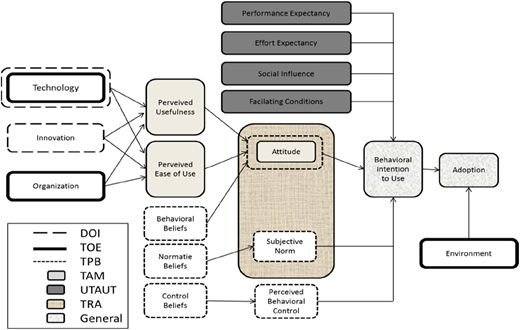
The swift proliferation of digital technologies has generated widespread scholarship into the drivers of organisational decision-making concerning technology adoption and implementation (Yüksel, 2022). Much of this scholarship has more recently blended together multiple theoretical perspectives to inform insights into organisational behaviour around technology adoption. The most influential frameworks and theories are presented in Figure 1.
At the organisational level, adoption research is primarily grounded in the Technology-Organisation-Environment framework (Tornatzky and Fleischer, 1990) and Diffusion of Innovations theory (Rogers Everett, 1995). TOE emphasises technological, organisational, and environmental contingencies shaping adoption, while DOI highlights innovation attributes such as relative advantage and compatibility that influence diffusion dynamics. Many Industry 4.0 studies combine these perspectives to capture contextual drivers and diffusion mechanisms. At the individual level, the Technology Acceptance Model, based on the Theory of Reasoned Action, suggests that perceived usefulness and ease of use drive technology adoption, though it has been challenged as an oversimplified approach to technology adoption, especially in complex organisational contexts. The Unified Theory of Acceptance and Use of Technology is an aggregation of earlier models, and it found that performance expectancy, effort expectancy, social influence, and facilitating conditions were the most important predictors of technology adoption (Venkatesh et al., 2003). However, recent studies have found that such models fail to account for the socio-technical complexity, governance, and heterogeneity of capabilities involved in large-scale digital programmes (Bagozzi, 2007).
Despite the significant contributions of these models in terms of explanation, a limitation has been identified in the intention-implementation relationship. Most of these models have been based on the idea that positive intentions will lead to adoption and actual use, as depicted in Figure 1. However, as has been evidenced in the context of digital transformation and Industry 4.0 initiatives, intentions do not always translate into actual implementation, especially in a context of structural constraints and time lag (Bagozzi, 2007; Marikyan and Papagiannidis, 2021). This unresolved intention-implementation gap motivates the present study.
2.2 Intention-implementation gap
Although technology-adoption models have significantly advanced the understanding of the antecedents to adoption intention, recent Industry 4.0 and digital transformation research indicates that many organisations struggle to convert strategic intent into sustained implementation and value creation (Marikyan and Papagiannidis, 2021; Matthias et al., 2021; Sony et al., 2022). Empirical studies suggest that digital initiatives may be limited to pilot projects, may not scale across organisational units, or may fail to perform in relation to expectations, particularly in socio-technical systems characterised by legacy systems, cross-functional interdependencies, and capability limitations (Matthias et al., 2021; Oguntegbe et al., 2022; Yüksel, 2022). These findings suggest that intentions may not provide a sufficient explanation for the outcomes of initiatives.
The persistence of stalled initiatives in practice echoes earlier behavioural research on the intention-behaviour gap. Foundational studies have shown that intentions often do not lead to action if time constraints, competing demands, or situational constraints intervene (Ajzen et al., 2009; Gollwitzer, 1999; Van Hooft et al., 2005). To bridge the intention-behaviour gap, behavioural theorists have proposed implementation intentions, which are “if-then” plans that connect situational cues with intended actions, as an approach to enhancing goal achievement. Empirical research has shown that the formation of pre-action plans is effective in the initiation and persistence of complex, multiple-step behaviours (Ajzen et al., 2009; Armitage et al., 2004).
While these insights were developed at the individual level, they illuminate an unresolved organisational question: what procedural mechanisms enable firms to convert strategic adoption intentions into implementation and deployment? This issue is particularly relevant in the context of developing countries, where firms are under strong institutional pressure to digitalise. Despite the growing research on the barriers to, and facilitators of, the implementation of Industry 4.0, few studies have addressed the processual explanation of the intention-implementation gap.
To address this gap, we introduce Organisational Implementation Intentions (OIIs) as a sensitising concept for analysing how firms formalise pre-actional planning at the organisational level. In the present study, OIIs serve as an initial conceptual lens that our grounded-theory analysis refines and elaborates to develop a framework of Industry 4.0 implementation.
3. Research methodology
3.1 Grounded theory
This study adopts an interpretive qualitative design informed by Straussian Grounded Theory (Corbin and Strauss, 1990, 2008). Unlike classical Glaserian grounded theory, which emphasises minimal prior conceptualisation of contexts (Glaser and Strauss, 1967), the Straussian approach permits the use of sensitising concepts and structured coding procedures while maintaining inductive category development. In this study, existing literature informed the inquiry as a sensitising background rather than as a source of predefined hypotheses (Charmaz, 2015). Consistent with an interpretivist orientation, organisational realities are understood as socially constructed, and knowledge is co-produced between researchers and participants. The objective is to develop an empirically grounded explanatory model of how organisations move from intention to effective Industry 4.0 implementation.
3.2 Research context
This research was carried out in the Moroccan manufacturing industry, an expanding and export-oriented industry, has experienced a significant degree of digitisation and improvement over time. Industry 4.0 poses both an opportunity and a threat for the Moroccan industry. Advanced technologies can enhance Moroccan industrial output by increasing its overall competitiveness, providing new ways to create innovative goods and services, as well as opening up new avenues for integration into global value chains. However, there are many significant barriers, including the cost of entry into these markets, and the potential loss of the traditional benefits associated with low-cost labour (Auktor, 2022). In addition, the presence of multinational and local companies in the manufacturing industry of Morocco offers heterogeneity in strategic alignment and implementation. This variation provides fertile ground for grounded-theory development, as it allows systematic comparison across organisations facing similar external pressures but differing internal capabilities.
Manufacturing firms in Morocco have shown a wide range of heterogeneity in terms of readiness, prior experience, and progression in adoption, particularly in the automotive, cables, electronics, and mining sectors (Gallab et al., 2021). Moreover, high external pressures to adopt these technologies and structural constraints create a unique context to study how to form and carry out organisational implementation intentions. The empirical context of this study is Morocco, but the objective is to derive mid-range theoretical insights that can be applied to other middle-income and developing economies seeking to upgrade their industrial base.
3.3 Research strategy
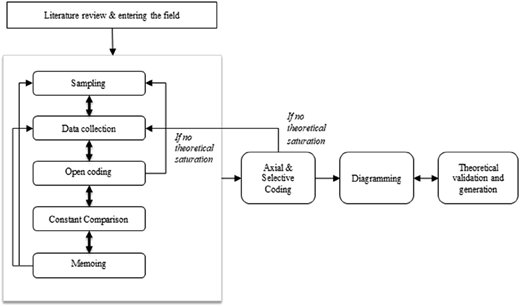
The present research design adopted a multiple-case study design based on Straussian Grounded Theory (Corbin and Strauss, 1990). This approach was selected for its structured and transparent coding procedures, which enable engagement with existing literature without constraining emergent theory. An exploratory review was conducted to identify the research gap in Industry 4.0 implementation research, which highlighted the intention-implementation gap as a critical area for inductive investigation. Data collection and analysis proceeded iteratively, supported by constant comparison and memoing, in order to integrate and refine emerging categories. This cyclical process continued until theoretical saturation was reached. Figure 2 summarises the analytical sequence.
3.3.1 Sampling strategy
Following Glaser and Strauss, (1967a)'s theoretical sampling logic, participants were selected based on their ability to provide rich, experience-based insights into Industry 4.0 implementation processes. Criterion-based sampling was used to ensure that interviewees met three inclusion criteria: (1) direct involvement in Industry 4.0 adoption or implementation activities, (2) decision-making or operational responsibility related to digital transformation initiatives, and (3) a minimum of three years of professional experience in Industry 4.0 -related projects. Accordingly, we interviewed senior managers, engineers, project managers, and digital transformation consultants working with manufacturing firms that had already initiated Industry 4.0 adoption. Consultants were included to capture cross-organisational perspectives and implementation practices across multiple firms. Initial participants were identified via professional networks (LinkedIn), and further informants were selected iteratively as data analysis progressed, following emerging theoretical categories.
In total, thirteen semi-structured interviews were conducted. While grounded theory does not prescribe sample size ex ante, prior qualitative studies suggest that samples of this size are sufficient for in-depth, theory-building analysis (Sony et al., 2022). Table 1 summarises participant roles, industry sectors, and experience profiles.
3.3.2 Data collection procedures
We followed grounded theory's iterative logic (Charmaz, 2015; Strauss and Corbin, 1998), collecting and analysing data in tandem via semi-structured interviews. Interviews lasted between 60–120 min, were held online through Google Meet and Microsoft Teams during the period from July to December 2023. Participants gave informed consent and were assured anonymity. The interview guide evolved with emerging insights (Glaser, 1978), whereby early interviews explored broad adoption trajectories, opportunities, barriers, and readiness, while later interviews probed developing categories, particularly how organisations translated intention into the actual implementation. We asked iterative and probing questions (e.g. Why? How? Who? What happened?) across the interviews to evoke rich and processual data. All interviews were transcribed, stored and coded in MAXQDA (Kuckartz and Rädiker, 2019), and reflexive memos were kept throughout to document analytic decisions and enhance transparency.
3.3.3 Data analysis and coding procedures
Data analysis followed (Corbin and Strauss, 2008)'s grounded-theory procedures and proceeded iteratively alongside data collection using constant comparison. Interviews were transcribed verbatim and imported into MAXQDA for systematic coding, retrieval, and cross-case comparison.
Open coding. Transcripts were examined line-by-line and initial (first-order) codes were created as short, action-oriented phrases to maintain a process focus (e.g. “prioritising value-adding functions”, “appointing digital ambassadors”). In total, 406 first-order codes were produced during open coding. Analytical memos were recorded in MAXQDA's Memo Manager to capture emergent ideas and coding rationales.
Axial coding. First-order codes were systematically compared within and across interviews and grouped into second-order conceptual categories using constant comparison. We examined similarities and differences across firms, adoption stages, and participant roles (e.g. senior managers, developers, consultants) to identify recurring patterns as well as contrasting viewpoints. Where divergent interpretations emerged (for example, symbolic versus operational commitment to digital transformation), these were analytically incorporated to refine category properties rather than eliminated. Categories were retained when supported by multiple instances across cases, while deviant cases were used to clarify category boundaries and specify the conditions under which patterns held.
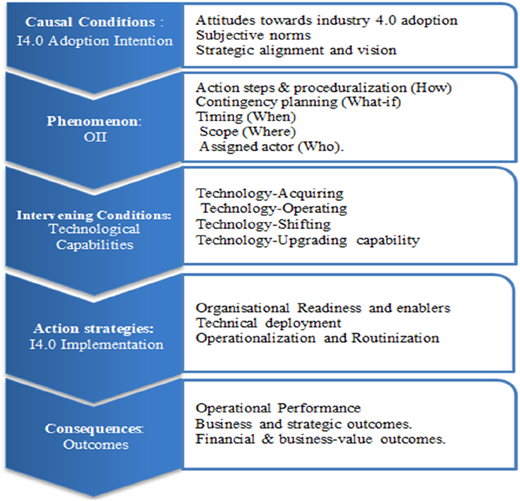
We used MAXQDA's Code System to organise the coding hierarchy and the Code Matrix Browser to assess the distribution of codes across documents. The Code Relations Browser and MAXMaps visualisations were employed to explore co-occurrence patterns and relational linkages among categories. During axial coding we specified properties and dimensions of categories (for example, the causal condition Intention to adopt Industry 4.0 was decomposed into strategic alignment and vision, subjective norms, and attitudes toward adoption). Categories were then positioned within the Strauss and Corbin paradigm (causal conditions; phenomenon; intervening conditions; action strategies; consequences).
To enhance transparency, Table S1 (Supplementary Material) provides representative coding traces illustrating the analytic progression from raw interview excerpts to first-order codes, second-order conceptual categories, and their placement within dimensions and paradigm-level categories.
Selective coding. Core categories were integrated into an explanatory paradigm model, with Organisational Implementation Intentions as the central phenomenon linking intentions, capabilities, and outcomes.
3.4 Trustworthiness
To address concerns about researcher judgement and enhance methodological rigor, we applied Lincoln and Guba (1985)'s trustworthiness criteria. Credibility was supported through prolonged engagement, iterative data collection, member-checking of preliminary interpretations, and an independent audit of coding by the third author, who did not conduct primary interviews. Transferability was aided by rich contextual description of the Moroccan manufacturing setting, the sampled firms and participant roles (Table 1), and by comparing emergent concepts with extant literature. Dependability was assured via a comprehensive audit trail and iterative coding tracked in MAXQDA. Confirmability was achieved through reflexive memos and the archival of all analytic materials (transcripts, codes, memos) in MAXQDA.
4. Analysis and results
This results section reports the analysis that identified five core categories: (1) Intention to adopt I4.0, (2) Organisational Implementation Intentions, (3) Technological capabilities, (4) Industry 4.0 implementation, and (5) Outcomes. We present the findings using the Strauss-Corbin axial coding paradigm, as summarised in Figure 3.
4.1 Industry 4.0 adoption intention – causal conditions
Industry 4.0 adoption intention is an organisational-level, declarative commitment to pursue and integrate Industry 4.0 technologies. Empirically, we operationalise adoption intention as a composite of three components: (a) attitudes towards Industry 4.0 adoption, (b) subjective norms, and (c) strategic alignment.
Attitudes towards Industry 4.0 adoption. The majority of participants highlighted instrumental beliefs (i.e. perceived usefulness and anticipated performance gains) as being pivotal in the formation of adoption intent, frequently associated with expectations of enhanced profitability. For instance, Participant 10 stated, “As a company investing in cutting-edge technologies, we aim to maximise profits and improve our current performance.” Furthermore, many interviewees reported that affective responses (enthusiasm or scepticism) influenced commitment: enthusiasm tended to strengthen intentions, while scepticism tended to temper them. In addition, several participants posited that an enhanced comprehension of technical components on the part of managerial personnel was conducive to an increased perception of attainability. As Participant 11 observed, “ It is important to understand what Industry 4.0 is, its components, and what it can bring to businesses.” Consequently, enhanced domain knowledge frequently reinforced instrumental evaluations and collective self-efficacy, thereby engendering a shift in attitudes that favoured adoption.
Subjective norms. The majority of participants reported that collective perceptions of internal and external expectations strongly shape organisational decisions to adopt Industry 4.0. The confluence of internal pressures (exerted by senior leaders, boards, and employees) with external forces (market shifts, customer demands, competition and regulation) engenders a sense of urgency and opportunity. As explained by Participant 7, “ Today, we already live in a very, very variable world, economy, and industry; things are constantly changing. Connecting the different stages of a company allows us to be flexible and respond quickly to the market without spending a lot of time anticipating what will happen in the market.” However, several respondents cautioned against uncritical imitation of industry trends, with Participant 7 warning, “You shouldn't go out and buy a virtual reality headset just because your neighbour has one. You need to consider your actual needs”. In other words, normative pressure often motivates action, but organisations that do not align technology choices with organisational needs risk superficial, “front-stage” adoption. Participants from sectors with greater financial resources or more stringent regulatory frameworks (for example, certain automotive and electronics firms) reported higher levels of preparation for digitalisation, suggesting that sector-specific differences exist in terms of readiness. For instance, Participant 11 noted, “Some industries are more prepared and mature than others, as they have greater funding than others”.
Strategic alignment and vision. Most participants emphasised that strategic alignment and a clear vision are vital prerequisites for Industry 4.0 adoption. A well-defined, long-term vision legitimises the transition and guides technology choices: as Participant 2 put it, “The vision justifies the transition to Industry 4.0. So if the company doesn't have a vision or strategies, it can't move on to the adoption stage, and even the choice of tool or technology will be biased from the outset”. ” Many interviewees also argued that vision must be translated into a practical roadmap specifying scope, milestones, responsibilities, and success criteria; Participant 11 noted the importance of “a realistic assessment of the company's situation and its preparedness, so that the action plan is better suited to their circumstances.”
At the same time, respondents widely recognised that intention alone is insufficient. Several participants highlighted the gap between ambition and execution. Participant 9 observed, “We are still far away; there is a big difference between the dream and its realisation,” and Participant 13 stressed that ““Everyone has the intention, and every company wants to implement Industry 4.0. But decision-making and implementation are quite different from intention, because there are other dimensions to consider at this level, as it is a process that can take years to complete and requires consistency over time”, signalling the need for sustained commitment. Consequently, many interviewees argued for an explicit transition phase - Organisational Implementation Intentions - where organisations specify who, when, what, how, and contingency plans before moving to implementation.
4.2 Organisational implementation intention- phenomenon
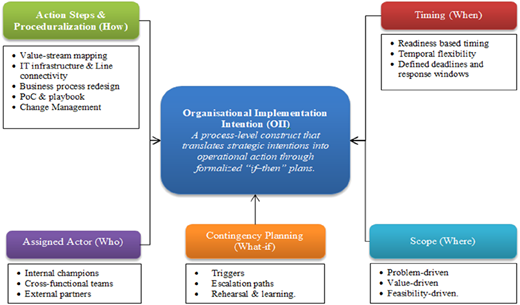
Organisational Implementation Intention (OII) represents a process-level concept to clarify the process of turning intentions into actions within the context of implementing Industry 4.0. In essence, OIIs represent formal if-then rules, procedures, and contingency planning in the form of linking observable actions to delegated actions and specific time frames (Tawde et al., 2023). Empirically, OIIs in our dataset have been represented along five dimensions: assigned actor, scope, timing, contingency planning, and action steps and proceduralisation, as represented in Figure 4.
Assigned Actor, Who. Most firms reported that clear assignment of responsibility is critical for moving from intent to action. Common practices included forming cross-functional teams (IT, automation, operations, maintenance) to reduce silos and improve coordination, as Participant 4 noted, “A factory planning to undergo digital transformation must first bring together the IT department and the automation department … a single manager promotes teamwork, communication, and builds trust.” Many organisations also appointed a dedicated digital champion or ambassador to provide day-to-day support and knowledge transfer: “We took one person, trained them in the technology … digital ambassadors help with deployment and communication” (Participant 7). Where internal capacity was limited, several firms engaged external consultants to accelerate learning and fill capability gaps, as Participant 11 observed, many “cannot embark on this path alone; external support is crucial in determining how to proceed.” A minority of cases, however, relied on very diffuse responsibility structures, which correlated with stalled pilots and limited follow-through.
Scope, Where. It defines the spatial and organisational boundaries to which an Industry 4.0 initiative applies (e.g. a single machine, a production line, a plant/site). Most participants, across roles and sectors, described three pragmatic scoping logics that are often combined in practice. First, problem-driven scoping, in which firms target processes that create the most immediate bottleneck or delay. Participant 2 described a common example: “Currently, data is collected manually, either on spreadsheets or simple applications, etc. This process is extremely time-consuming and does not allow for real-time data, as it must go through the stages of entry into an Excel file, analysis, discussion, and then decision-making.” Second, value-driven scoping, where firms prioritise functions that most directly contribute to core business value. As Participant 1 put it, “SWOT analyses must be carried out to prioritize the functions that add value … and then target the 4.0 technologies to be integrated.” Third, several participants highlighted feasibility and strategic scoping, where formal project criteria such as management approval, resource availability and expected return shape priorities; Participant 10 explained that initiatives are selected based on “Since we work on a project basis, these are the ones that have been approved by management in terms of feasibility, resource availability, and profitability.” Overall, participants indicated that effective scoping typically combines these logics before scaling enterprise-wide, whereas unclear scoping, mentioned by a minority, tends to lead to fragmented efforts.
Timing, when. Timing denotes the temporal windows, deadlines, and response deadlines that determine when actions in an Industry 4.0 initiative should be executed. Most participants reported three practical lessons. First, firms should allow sufficient time for diagnostic work and staged learning. As Participant 2 advised, “Take your time. We spent a year and a half researching online to select the tools.” Second, project timelines must be resilient to foreseeable internal and external disruptions. Participant 11 explained, “In terms of project planning, we always plan the start date of the transformation project, but in reality, it is difficult to meet this deadline given internal and external uncertainties.” Third, according to respondents good timing combines strategic ambition with evidence of readiness and built-in flexibility. As Participant 1 put it, “It requires advance planning and choosing the right moment. By the right moment, I mean organisational preparation or when the company is ready.” Consequently, participants indicated that timing should follow a calibrated sequence of staged actions with predefined fallback mechanisms to ensure the robustness of OIIs in practice.
Contingency plan, what if. A good contingency plan also considers alternative responses, escalation, and fallbacks for failures or disruptions such as cyber-attacks, data losses, vendor failures, or staff resistance. According to the participants, the contingency plans varied. Some firms had an explicit contingency logic, which helped the firms learn fast from the early sub-projects, while others had an ad hoc approach, which slowed down or stopped the implementation. As Participant 7 explained, “From the first sub-projects, we learned what the obstacles would be and how we would respond to overcome them.” By contrast, Participant 3 recalled a severe data loss: “In 2017, we had a crash and the entire database was deleted … Right now, we have a lot of security threats,” and Participant 10 described the common default: “When a problem arises, we generally slow down the implementation and take a step back to fully understand the obstacle and find solutions before completing the implementation process.” In the Moroccan manufacturing context, this reactive posture was relatively common, exposing firms to business-continuity risks and value erosion when setbacks were not anticipated or rehearsed.
Action Steps and Proceduralization, how. Across participants, respondents described a common sequential framework for translating intentions into implementation. First, (1) value-stream mapping and gap identification, in which firms commonly begin by mapping end-to-end processes to locate bottlenecks and time-consuming manual tasks. As Participant 2 explained, “The first step is value stream mapping for all areas from receipt to delivery in order to identify manual, semi-automatic, and automatic tasks.… It is these gaps that we need to work on.” Second, (2) data infrastructure and line connectivity is treated as an essential early step. Participants stressed upgrading networks, defining scalable data architectures and preparing machines for intelligent operation. Participant 2 emphasised, “One of the most important steps is IT infrastructure … Data architecture, machine upgrades, and infrastructure upgrades.” Third, (3) business-process redesign is needed to ensure that digitalisation changes how data, decisions, and responsibilities flow rather than merely codifying inefficient practices. Participant 1 urged that “The company's business processes must be redefined so that they are adapted to integrate 4.0 technologies in order to achieve a successful transformation.” Fourth, (4) firms deploy pilots and proofs of concept to validate assumptions and learn before scaling: several participants described running multiple sub-projects and converting validated artefacts into a reusable playbook. According to participant 7: “Based on the 17 sub-projects, we decided to move on to the second stage, which is to carry out what we call pilot projects, taking a factory or site and turning it into a smart factory without actually rolling it out across the whole organisation. Some of them were successful, so the organisation accepted them, and now we can roll them out”. Finally, change management (training, ambassadors, communication) was widely reported as essential to routinise new practices. As asserted by participant 6: “Change management is essential, and everything depends on the age of the organisation. In our case, it was easier because that's how we've been working since the beginning”. A considerable number of participants in the study reported that high-performing firms systematically capture pilot learnings in the form of playbooks, with the result that future rollouts are shortened.
Building on these findings, OIIs provide the procedural backbone for Industry 4.0 implementation; however, technological capabilities determine the firm's ability to integrate, operate, and scale Industry 4.0 effectively.
4.3 Technological capabilities –intervening conditions
Technological capability emerged as a critical intervening condition that shapes how Organisational Implementation Intentions are converted into actual Industry 4.0 deployment. At the firm level this composite capacity combines skills, knowledge, equipment, systems, and procedures (Al-Mamary et al., 2020; Sony et al., 2022) and operates across four mutually reinforcing dimensions:
Technology-Acquiring Capability is a firm's ability to identify, source, and procure appropriate technologies through structured procurement, strategic partnerships, and licensing agreements (Al-Mamary et al., 2020). Most participants emphasised the importance of deliberate technology selection and testing as a first-order acquisition capability. Several interviewees described lengthy research and pilot phases before procurement: “We have already spent a year and a half researching to select the tools and two years to take action” (Participant 2), and “Research and testing is being carried out at several plants in order to select the technologies that are best suited to our business” (Participant 10). Participants also noted variation in practice: some firms develop internal procurement expertise, while others rely heavily on external integrators or suppliers, particularly when legacy machinery requires replacement or retrofitting, highlighting that acquiring capability is both time-consuming and contingent on existing assets and external partnerships.
Technology-Operating Capability is the ability to operate and monitor technologies to ensure continued production. Most participants emphasised a dual challenge: (1) integrating new technologies with legacy systems and (2) exploiting the resulting data for operational control. As Participant 7 summarised, “The first step is how we can create and implement technologies in our industries in order to connect what is happening on the ground. The second part is digitization and data, which is how we can use the data collected from the technology to effectively manage our operations.” Several participants described pragmatic solutions for legacy equipment such as contacting suppliers for software retrofits, adding hardware, or replacing machines, as Participant 2 explained: “There are older machines that cannot undergo this digital transformation … some machines will only need software to become smart, or the installation of automated hardware, or a complete change of machine.” The participants explained that this capability is socio-technical, whereby technology implementation requires horizontal decision-making processes, role delineation, and employee training to avoid implementation failures.
Technology-Shifting Capability denotes a firm's ability to reconfigure or recombine deployed technologies and processes rapidly in response to changing market or process conditions. Most participants emphasised flexibility and real-time visibility as essential for coping with volatility, frequently referencing disruptions such as the COVID-era semiconductor shortage as evidence of this need. Across interviews, respondents consistently linked connected systems and integrated data flows to faster adaptation. As Participant 7 explained, “If I have all my production machines, a connected production plant, and there is a fluctuation in the market, I can adapt because I simply have a real view of what is happening.” Participants were in agreement that the ability to change would be a dynamic competency, bringing together the modular technical architecture with agile operations. This would allow the firm to minimize downtime and quickly adapt to changing markets.
Technology-upgrading capability. The majority of participants describe it as a continuous, evolutionary process to avoid degradation and obsolescence due to software, model, and condition changes. In all responses, participants treat Industry 4.0 components as “living systems” that need to be continuously enhanced: “What matters to us is not the implementation of technologies, but rather an evolutionary approach where we gradually improve our capabilities in order to enhance performance and reap greater benefits” (Participant 12). In practice, strong upgrading capability reduces technical debt, enables scaling, accelerates learning cycles and sustains performance gains over time.
Consequently, participants converged on the view that technological capabilities, acquiring, operating, shifting and upgrading, form the enabling link that converts Organisational Implementation Intentions into actual Industry 4.0 implementation.
4.4 Industry 4.0 implementation – action strategies
Industry 4.0 Implementation denotes the transition period during which the organisation translates the adoption decision into operational reality. The implementation encompasses the stage of technical deployment, indicating how advanced or complete the project is, the organisational readiness and enablers, as well as how effectively it will be operationalised and used within the organisation.
Organisational readiness and enablers. Most participants described organisational readiness as a multidimensional bundle of structural, technical, human and governance conditions that together enable firms to initiate and scale Industry 4.0. Across roles, respondents agreed that strong continuous-improvement foundations (e.g. Lean, Six Sigma) provide the necessary stability for digitalisation: “For me, Industry 4.0 is just one pillar of continuous improvement … Lean and Six Sigma are a very good foundation on which to build Industry 4.0” (Participant 7). Participants also widely emphasised the need to develop both technical and soft skills to cultivate a digital mindset and reduce resistance, and many identified effective project management and governance as essential to maintain momentum and protect investments. As Participant 10 noted, “There are other more important factors such as the availability and training of skills, as well as effective project management, which will ensure the continuity of the projects we start and prevent us from losing our investments.”
Technical deployment. It refers to the actual implementation of the innovations of Industry 4.0. It is noted that the deployment is varied, with some at the more advanced stages, while the majority still remain at the early stages of deployment, which include ERP system upgrade. For example, Participant 7 described a broad programme: “We are working on different fronts and trying to do a lot of things at once. We are working on the embedded system part of the machines so that we can monitor their status. We are also exploring and working on the Cloud and Data Link aspects. We are trying to see what robotics can bring to our industry. And then there's the automation part.” By contrast, several firms reported more limited progress: “For Industry 4.0, we have been able to achieve 30% in terms of robotics, but we have not yet reached IoT, the Cloud, and so on. We have not yet achieved a smart factory … There are many security threats” (Participant 3). Sectoral characteristics shaped these patterns, for instance Participant 2 noted that high human intensity in some activities (e.g. cabling assembly) constrains full robotic substitution and favours gradual interventions: “Human beings are at the heart of our industry … our profession does not allow for a transition to robotics.” Thus, participants converged on the view that technical deployment is necessary but not sufficient, recurring performance gains emerge only when technologies are embedded into everyday work practices.
Operationalisation and routinisation. This stage assesses how effectively deployed technologies are used as intended and integrated into daily operations. Several participants reported progress beyond pilots toward routinised use, often following staged rollouts: “Currently, embedded systems are already implemented. At the beginning, we started with the factories, where we conducted workshops, value stream mapping, and implementation of embedded systems, etc.” (Participant 2). Across cases, respondents emphasised the need for KPIs to monitor routinisation and inform reinvestment: “It is therefore important for us to establish KPIs to measure improvements in manufacturing performance and return on investment, so that we can continue to invest and strive to complete projects.” (Participant 10). Overall, participants agreed that operationalisation and routinisation are critical for long-term results. Without KPI systems and phased deployment, results are limited and/or temporary.
4.5 Outcomes. consequences
Our findings indicate that organisations implementing Industry 4.0 components realise measurable benefits across three interlinked domains: operational, business and strategic, and financial performance.
Operational performance. Most participants agreed that Industry 4.0 offers significant operational benefits through two interrelated channels. First, the ability to monitor equipment condition, identify problems at an early stage, and move from reactive to predictive maintenance is seen as a key benefit. As Participant 4 noted, “it allows us to keep an eye on production at every stage of the process in order to improve quality and reduce or even eliminate downtime. In our case, thanks to Industry 4.0, we can monitor the status of a motor by observing its current in order to avoid the loss of 33 windshields.” Second, automation removes redundant, low-value tasks and standardises operations, increasing throughput while improving quality and workplace safety. Participant 8 explained: “Robotics and automation play a crucial role in most modern manufacturing facilities. They help speed up manufacturing processes while ensuring consistent quality … they can help make production sites safer and more efficient.” Across cases, participants converged on the view that these capabilities reduce manual workarounds and produce more efficient, reliable production processes.
Business and strategic outcomes. Most participants highlighted two interconnected strategic advantages of Industry 4.0 adoption. First, it improves the quality and speed of decision-making by enabling near-real-time visibility and streamlined KPI monitoring. As Participant 6 explained, “We monitor, we track data, we know where we want to go, and we can interpret the data in a simplified way. This enables managers to make the right decisions … keeping an eye on whether KPIs are improving or not.” Participant 13 similarly stressed that decisions previously delayed by data gaps can now be taken immediately: “Decisions that we used to make at the end of the day … can now be made as soon as they arise with Industry 4.0.” Second, participants widely viewed Industry 4.0 as a catalyst for practical, data-driven innovation that enhances performance and supports product and process improvements. As Participant 6 noted, “Industry 4.0 is not something we do just for the sake of doing it … is there to provide innovative solutions to improve performance.” In summary, respondents concurred that strategic benefits arise when operational data is translated into actionable insights and continuous innovation.
Financial outcomes. The participants defined the adoption of Industry 4.0 on financial grounds, with the economic benefits being the main drivers. Respondents commonly linked implementation to reduced resource consumption (energy, materials, labour), lower unit costs, and improved productivity, as well as the potential for new revenue streams. As Participant 1 observed, “Industry 4.0 is an opportunity to grow business and be more productive while relieving or reducing the burden on agents and staff.” Participant 10 similarly emphasised profitability: “In terms of profit, as a company that invests in the implementation of cutting-edge technologies, we seek to maximise our profits and improve our current performance” However, participants also noted heterogeneity in realised returns: while a minority of early adopters reported measurable financial gains, many firms indicated that payback is expected only once pilots are scaled and routinised.
5. Discussion
This study develops a processual explanation of how organisations bridge the gap between Industry 4.0 adoption intention and sustained implementation. Our analysis identifies five interrelated categories, adoption intentions, Organisational Implementation Intentions, implementation, technological capabilities, and outcomes—that together explain implementation dynamics and extend existing adoption research beyond predictor-oriented models. Below we derive a set of propositions that follow from these findings.
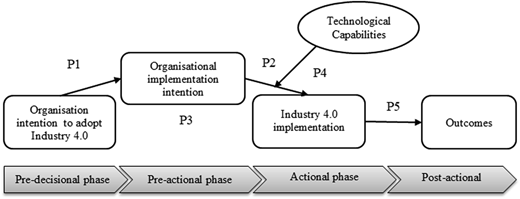
Adoption intention is conceptualised as collective attitudes, subjective norms, and strategic alignment. Previous research on Industry 4.0 has addressed adoption drivers such as perceived usefulness, organisational readiness, and environmental pressure. However, it has been largely taken for granted that adoption intention will lead to adoption. Our findings challenge this assumption by showing that intention alone does not ensure execution. Instead, intentions must be translated into structured, documented plans specifying responsibilities, timing, scope and contingencies (Ajzen et al., 2009; Friedman and Ronen, 2015; Gollwitzer and Schaal, 1998; Van Hooft et al., 2005). In practice, this translation occurs through Organisational Implementation Intentions, formalised “if-then” procedural commitments that convert strategic priority into implementation. We therefore propose:
Stronger, strategically aligned intentions to adopt Industry 4.0 increase the likelihood that firms will formulate formal organisational implementation intentions.
Second, OIIs function as the organisational-level mechanism that closes the intention–implementation gap. As demonstrated in previous research, implementation intentions have been shown to enhance the attainment of goals by establishing a connection between situational cues and specific responses (Armitage et al., 2004; Friedman and Ronen, 2015; Greenan, 2023; Tawde et al., 2023). Individuals who set ambitious goals and utilised implementation intentions were found to have a 62% success rate in completing the task, in contrast to the 22% success rate observed among those without implementation intentions (Greenan, 2023). Extending this logic to the organisational level, our findings reveal five interconnected OII dimensions, assigned actors, scope, timing, contingency planning, and action steps —that institutionalise accountability and reduce ambiguity in complex socio-technical environments. Unlike static adoption constructs, OIIs embed execution logic within governance structures, thereby increasing implementation reliability. We therefore suggest:
Greater specificity in OIIs, including clear action steps, assigned actors, timing, scope and contingencies, is positively associated with Industry 4.0 implementation.
Third, while much Industry 4.0 research focuses on the direct relationship between adoption intention and implementation, our results indicate that OIIs serve as the critical translation mechanism. Intentions lead to implementation primarily when they are converted into structured and documented procedural commitments. Earlier studies have established the significant mediating role of implementation intentions to convert intention into action. For example, Tawde et al. (2023) demonstrate that if consumers have an intention to purchase green, they will only actualise such behaviours if they plan for the sustainable implementation intention. Without planning ahead, situational constraints at the point of purchase, including time, availability of products, and complexity of choice will be greater than intentions (Tawde et al., 2023). In this sense, OIIs reduce uncertainty, coordinate cross-functional actors, and accelerate execution in technologically complex and socially embedded contexts (Friedman and Ronen, 2015). We therefore propose:
Organisational Implementation Intentions serve as the translation mechanism between the intent to adopt and concrete implementation: Industry 4.0 adoption intentions are likely to lead to Industry 4.0 implementation mainly when they are converted into specific, documented OIIs.
Fourth, technological capabilities emerge as a pivotal intervening condition shaping whether OIIs can be effectively enacted. While prior research identifies capabilities as enablers of digital transformation, our findings refine this view by distinguishing four interconnected capability dimensions, acquiring, operating, shifting and upgrading. These capabilities exert stage-specific and interactional effects: acquiring and operating capabilities enable early deployment, shifting capability supports adaptation under volatility, and upgrading capability sustains long-term routinisation (Al-Mamary et al., 2020; Sony et al., 2022). Thus, capabilities do not merely enable adoption; they condition the strength of the OII–implementation relationship. We therefore suggest:
The positive effect of organisational implementation intention on Industry 4.0 implementation is stronger when firms possess higher technological capabilities of acquiring, operating, shifting, and upgrading.
Finally, our findings indicate that Industry 4.0 value realisation follows a staged trajectory. Based on our findings, the operational benefits are increased uptime, response time, and reduced workaround of processes. Once the routine becomes established, then strategic benefits build such as increased agility for changes to the process, enhanced decision-making capacity, and it gives rise to new business models. Financial benefits typically occur last, as the operational and strategic benefits become established, the financial benefits will follow with outcomes like cost savings, increased revenue, and ROI. This cumulative sequence aligns with capability maturation perspectives and refines prior performance studies by clarifying the temporal ordering of outcomes (Dalenogare et al., 2018). Therefore, we propose:
Successful implementation of Industry 4.0 is expected to generate positive financial, operational and strategic outcomes.
Figure 5 distils our discussion into a compact process view of industry 4.0 implementation. Organisations progress from strategic intent to the OIIs, and on to the actual implementation process. By shifting the analytical focus from static adoption predictors to dynamic translation mechanisms and capability alignment, the model offers a more comprehensive explanation of Industry 4.0 implementation success.
6. Theoretical and practical implications
6.1 Theoretical implications
This study advances theory on Industry 4.0 adoption by linking organisational-level planning to established technology-adoption models. First, we introduce OII as the meso-level analogue of individual implementation intentions. While TRA, TPB, TAM and UTAUT emphasise perceived usefulness, performance expectancy, and social influence as antecedents of intention, they commonly assume a relatively direct pathway to implementation. Our findings corroborate prior critiques that intention alone is an insufficient predictor of implementation in complex organisational settings (Ajzen et al., 2009; Bagozzi, 2007; Marikyan and Papagiannidis, 2021; Tawde et al., 2023) and extend these models by identifying OIIs as the missing procedural mechanism that converts intent into structured action.
Second, consistent with capability and resource-based perspectives (Al-Mamary et al., 2020), we reconceptualise facilitating conditions of UTAUT and the organisational dimension of TOE as a decomposable capability bundle, acquiring, operating, shifting and upgrading, that enables different OII components and exerts heterogeneous effects across implementation stages. Third, we posit adoption as a multi-stage, processual phenomenon rather than a single decision event. Whereas existing adoption models are often predictor-oriented and cross-sectional, our results show that weak intention-behaviour links in organisational settings reflect missing pre-actional planning and uneven capability accumulation rather than mere lack of motivation.
Fourth, the study reinforces socio-technical perspectives by demonstrating that successful Industry 4.0 implementation emerges from the co-evolution of technological artefacts, governance arrangements and human capabilities (Sony et al., 2022). Finally, propositions P1–P5 translate these linkages into testable claims suitable for quantitative, longitudinal or mixed-method follow-ups, thereby opening avenues to validate OIIs as a multi-dimensional construct and to examine how decomposed capabilities moderate the intention-implementation pathway.
6.2 Managerial implications
Our findings are synthesised into a structured decision-support framework (see Table S2 (Supplementary Material)) that guides managers from intention to implementation. Rather than treating adoption as a single decision, the framework specifies a sequence of interdependent managerial decisions aligned with Organisational Implementation Intentions. First, at the strategic level, leaders should formalise adoption intentions into a documented roadmap anchored in a long-term vision and a project charter that defines objectives, scope, budget and success metrics. Second, organisations should institutionalise OIIs by explicitly specifying: (1) assigned actors, (2) scope, (3) timing, (4) action steps, and (5) contingency planning. Third, firms must align OIIs with technological capability development: in early pilot phases, acquiring and operating capabilities are critical; during scaling, upgrading capability sustains performance; under volatility, shifting capability ensures adaptability. Fourth, implementation should be managed as a staged transition from technical deployment to routinisation, supported by KPI dashboards, governance gates, playbooks and continuous-improvement practices. By structuring implementation around explicit decision points and capability alignment, managers can reduce procedural ambiguity and increase the likelihood that Industry 4.0 initiatives generate sustained operational and financial returns.
6.3 Practical implications for Moroccan manufacturing sector
Our findings indicate that many Moroccan manufacturers remain at early stages of Industry 4.0 adoption, characterised by capability gaps, partial deployment, and reactive problem-solving. In this context the decision-support framework (Table S2 (Supplementary Material)) is particularly valuable because it supplies procedural clarity where cumulative experience is limited. First, formalised OIIs convert aspirational visions into actionable plans, reducing reliance on informal coordination, and ad hoc experimentation. Second, the frequent absence of structured contingency planning in our sample highlights the need to embed explicit risk scenarios and fallback mechanisms within implementation roadmaps, especially in contexts exposed to cybersecurity risks and supply volatility. Third, capability development must be deliberately sequenced: without targeted investments in acquiring, operating, shifting and upgrading capabilities, OIIs risk remaining symbolic rather than operational. Finally, given structural resource constraints, firms should leverage external ecosystems (consultants, suppliers, industry networks) to accelerate learning and capability accumulation. In capability-constrained settings, disciplined proceduralisation, not technological sophistication alone, is the critical determinant of implementation success.
The findings also offer insights for industry associations and policymakers. At the industry level, support initiatives should prioritise capability-building, governance training, and knowledge diffusion rather than focusing solely on technology acquisition incentives. At the policy level, digital transformation strategies should integrate structured implementation support, workforce development, and ecosystem coordination mechanisms to enhance the effectiveness of public investments in Industry 4.0. Such initiatives can contribute to productivity growth, industrial resilience, and sustainable competitiveness in developing economies.
7. Conclusion, limitations and future research
The present research reveals that the persistent disconnect between intentions to implement Industry 4.0 and actual implementation is not primarily motivational but rather procedural in nature. By using Straussian grounded theory research on thirteen manufacturing firms in Morocco, we reveal five interrelated categories that describe the process from intentions to implementation: adoption intentions, organisational implementation intentions, implementation, technological capabilities, and outcomes.
The study makes three principal theoretical contributions. First, it introduces Organisational Implementation Intentions as a meso-level concept that extends established technology-adoption models by specifying the procedural mechanism linking strategic intent to execution. Second, it advances a multi-stage, processual explanation of Industry 4.0 implementation, shifting the analytical focus from static predictors of adoption to dynamic translation and routinisation processes. Third, it refines capability-based explanations by distinguishing acquiring, operating, shifting, and upgrading capabilities as stage-sensitive conditioning mechanisms shaping implementation success. The study also offers a clear practical contribution. By translating empirical findings into a structured decision-support framework, it provides firms with a governance blueprint for aligning strategic intent, procedural planning, and capability development. This framework is particularly relevant for organisations operating under resource constraints.
We note three limitations. First, the empirical material is drawn from Moroccan manufacturing firms; institutional arrangements, sectoral composition and resource availability may therefore shape implementation dynamics. Second, grounded theory emphasises depth and theory generation rather than statistical generalisability. Third, the cross-sectional design captures perceptions at a single point in time and cannot trace the long-term evolution of capabilities and outcomes.
Therefore, future research should extend and test the suggested process model across methods, contexts, and levels of analysis. First, quantitative work is needed to operationalise and validate OII as a multi-dimensional construct and to test the proposed propositions with survey-based and longitudinal designs. Second, longitudinal and process-tracing studies could examine how OIIs evolve, how capabilities accumulate, and how routinisation unfolds in practice. Third, cross-country and cross-sector comparative research would identify boundary conditions, such as firm size, ownership, institutional support and industry characteristics, and evaluate ecosystem and policy levers that can accelerate capability building in resource-constrained settings.
The supplementary material for this article can be found online.