This research paper aims to examine how companies are preparing to adopt Industry 6.0 (I6.0) and Lean Culture by identifying challenges, best practices, and the maturity of their integration with Knowledge Management (KM). It proposes the concept of Lean 6.0, which integrates Lean principles with advanced and sustainable I6.0 technologies to promote the creation, preservation, and dissemination of organisational knowledge.
Data were collected through a questionnaire survey. Based on 103 valid responses, Covariance-Based Structural Equation Modelling (CB-SEM) was used to test four hypothesised relationships among Lean, I6.0, and KM.
The findings suggest that companies with higher Lean maturity are more likely to successfully adopt I6.0 practices, which support knowledge preservation and dissemination through technologies such as Artificial Intelligence, the Internet of Things, and Digital Twins.
The findings integrate human and technological dimensions within I6.0, demonstrating that the synergy between Lean and I6.0 strengthens knowledge management and fosters sustainable innovation in organisations.
This study provides an integrated investigation of Lean Culture and I6.0, highlighting their combined effects on Knowledge Management.
1. Introduction
Throughout history, gradual updates have been pursued to achieve efficient production and quick responses to customer demand (Duggal et al., 2022). Industry 4.0 introduced smart and interconnected technologies (Pandey et al., 2023; Hansen et al., 2024; Emon and Khan, 2025) to reduce manufacturing lead times (Kaswan et al., 2024), including cyber-physical systems (CPS), AI, machine learning (ML), IoT, Big Data, among other technologies (Khan et al., 2023; Zheng et al., 2023). Expanding on this concept, Industry 5.0 (I5.0) emerged, bringing human centrality (Passalacqua et al., 2025; Tengblad et al., 2026) and social and environmental considerations, along with greater flexibility and adaptability to improve the efficiency and effectiveness of organisational processes (Xu et al., 2021a, b; Ivanov et al., 2019; Hansen et al., 2024; Kaswan et al., 2026).
More recently, the need for deeper integration between human factors and technologies, such as robots, has given rise to Industry 6.0 (I6.0), an advancement of I5.0 characterised by hyper-automation and near-complete machine autonomy (Singh et al., 2023). While I5.0 already considered automated processes with significant technological support, the Era of I6.0 will be characterised by machines' complete independence (Duggal et al., 2022). In this context, I6.0 can be defined as the combination of human-centred concepts, established by I5.0, with the introduction of hyper-automation of activities and human-robot collaboration (Anandraj, 2024), employing technologies such as generative AI and quantum computing (Shahin et al., 2026), with a renewed focus on sustainability (Xuan, 2025; Shahin et al., 2026).
In line with I6.0 definitions, Lean Culture (LC) is a key enabler of the practical application of I6.0, as it creates value and eliminates waste through initiatives led by trained and motivated employees (Womack et al., 1990; Gatell and Avella, 2024), embedding organisational values in daily practices and aligning with I6.0's human-centred orientation (House et al., 2004).
Previous studies have examined I6.0 through hyper-automation, sustainability, and human-centred manufacturing (Singh et al., 2023; Anandraj, 2024; Shahin et al., 2026). Likewise, LC is recognised as a philosophy for continuous improvement (CI) and employee engagement (Womack et al., 1990; Gatell and Avella, 2024), while KM is a strategic capability for organisational competitiveness (Demir et al., 2021; Meher et al., 2023). However, these research streams have largely evolved independently, with limited empirical evidence on how LC supports KM in I6.0 environments. Thus, the relationships among these concepts remain poorly understood, representing a theoretical and practical gap.
Based on this gap, the following research question is proposed: How does Lean Culture, in combination with Industry 6.0 practices, shape organisational knowledge management in contexts of volatile and fast-moving information? In pursuing this question, the study analyses how organisations are preparing to implement I6.0 alongside LC by identifying the challenges, best practices, and organisational maturity associated with KM. It proposes the concept of Lean 6.0 (L6.0), the integration of Lean principles with advanced I6.0 technologies to support the creation, preservation, and dissemination of organisational knowledge (Araújo et al., 2024; Gatell and Avella, 2024).
Theoretically, this study contributes by proposing and empirically testing an integrated framework linking I6.0, LC, and KM, which prior research has largely examined separately (Singh et al., 2023; Gatell and Avella, 2024; Demir et al., 2021). By modelling these constructs as interrelated, the study clarifies how Lean culture and I6.0 technologies jointly shape knowledge outcomes and whether they operate as complementary or substitutive mechanisms. This extends the I6.0 literature beyond its technological and sustainability focus toward its human and organisational dimensions.
Practically, the findings help organisations preparing for I6.0 adoption to understand which capabilities, cultural or technological, most reliably sustain knowledge management under increasing automation, informing workforce development and knowledge-preservation strategies before significant investments are made in digital transformation. This contributes to United Nations SDG 9 (Industry, Innovation, and Infrastructure) by demonstrating how Lean and I6.0 support sustainable industrial development and aligns with SDG 12 (Responsible Consumption and Production) by promoting waste reduction and resource efficiency.
This article is organised into six sections. Section 1 introduces the research question and context; Section 2 reviews the theoretical framework and relevant literature; Section 3 describes the research methodology; Section 4 presents the Structural Equation Modelling results; Section 5 discusses the theoretical and empirical findings; and Section 6 outlines the conclusions, limitations, implications, and directions for future research.
2. Theoretical background and hypothesis development
In this section, we develop the theoretical framework, divided into four units: “Lean Culture”, “Industry 6.0”, “Lean 6.0”, and “Knowledge Management”.
2.1 Lean culture
Lean culture is grounded in the principles of Respect for People (RP) and CI. The RP principle enables individuals to develop and contribute their knowledge by actively participating in the development, standardisation, and improvement of the tasks they perform, as well as in decision-making. The CI principle forms the foundation of Lean processes, requiring individuals to apply their skills in problem identification and to use routines based on scientific evidence to solve problems (Goodridge et al., 2015; Snyder et al., 2016; Zarbo, 2012; Araújo et al., 2024; Gatell and Avella, 2024).
Implementing Lean requires the engagement and commitment of all employees across the production chain. It involves the interplay between soft practices, which consider people and their relationships, and hard practices, which rely on technical and analytical tools. Organisations often prioritise hard tools over soft practices, focusing their efforts exclusively on technical tools (Hines et al., 2011; Bortolotti et al., 2015). According to Mann (2015), LC emerges as leaders become attuned to the mindset needed to solve current problems and address organisational challenges.
From this perspective, the establishment of an organisational culture becomes essential for the sharing of characteristics such as beliefs, values, norms, customs, rituals, and ways of making sense of the activities performed (Abdalla et al., 2020), so that everyone perceives the organisation through the same lens of CI (Bagga et al., 2022; Alves and Alves, 2015). Among studies addressing LC, many discuss the pillars of RP and CI (Fadnavis et al., 2020; Araújo et al., 2024). Another way in which LC has been characterised is through the principles of Lean Thinking, as seen in the works of Amaro et al. (2020) and Araújo et al. (2024).
Given that Lean focuses on developing products, processes, technologies, and associated means in a lean manner, there is also a need to develop people, thereby highlighting the formation of a system focused on the human element (Medeiros et al., 2025). LC can therefore be regarded as the application of Lean principles and tools to operationalise and sustain improvement within the work environment by providing a structure that supports process standardisation, training, leadership, and a unified culture (Gatell and Avella, 2024; Al-Balushi et al., 2014; Bhasin, 2013; Jadhav et al., 2014). This makes the application of Lean practices more consistent and replicable across organisations. Consequently, LC enhances understanding of organisational processes and outcomes, enabling the assessment of Lean practices and organisational orientation towards results (Bortolotti et al., 2015).
Studies by Chen et al. (2020), for example, have shown that organisational engagement with “green” practices that promote sustainability is achievable only through approaches such as LC, as these involve organisational culture in meeting sustainability plan targets. Although LC is emphasised as a key factor in organisational transformation and the maintenance of improvements, studies describing it often offer differing or superficial characterisations (Dorval et al., 2019; Werner, 2021).
2.2 Industry 6.0
While I5.0 emphasises social and environmental concerns within a technological context, prioritising employee well-being and sustainable practices to preserve human-centricity (Passalacqua et al., 2025; Hammad et al., 2025; Tengblad et al., 2026), I6.0 emerges as a revolution that encompasses all previous industrial versions, using advanced technologies that work together to enhance processes, improve customer satisfaction, and create increasingly autonomous, intelligent manufacturing systems (Chourasia et al., 2022; Jain, 2024). The human-centric collaboration introduced in I5.0 (Huang et al., 2022) continues to be explored in I6.0 (Shahin et al., 2026), as human creativity remains essential for designing tools that enable the effective application of I6.0's innovations (Chourasia et al., 2022), even as these systems increasingly operate with little or no human involvement (Yadav et al., 2022; Business Finland, 2022). By integrating human knowledge and AI, I6.0 enables collaboration between humans and robots in applying and interpreting concepts emerging from new technologies, such as big data (Almusaed et al., 2023; Biesdorf et al., 2026).
As autonomous tools become more advanced, the premise of I6.0 is to achieve high efficiency and continuous improvement (Allawadi et al., 2024), impacting various organisational sectors, from optimising logistics processes to supporting more accurate management decisions and improving workplace health and safety conditions (Arputharaj et al., 2024). I6.0 also extends beyond production improvements by placing strong emphasis on environmental sustainability, including renewable and carbon-neutral energy sources (Jain, 2024) and organic materials in manufacturing (Almusaed et al., 2023). Overall, I6.0 represents the convergence of hyper-advanced technologies with environmental and social considerations, while maintaining human centrality at the core of the industrial landscape (Deliu and Olariu, 2024; Verma et al., 2025).
For I6.0 to be adopted successfully, however, it requires a well-structured organisational culture (Wiengarten et al., 2015; Solaimani et al., 2019). In such a culture, CI and waste elimination become embedded in organisational routines and employee behaviour, supporting the systematic and collaborative implementation of I6.0 (Chourasia et al., 2022). Because I6.0 relies on autonomous tools driven by the pursuit of efficiency and CI (Allawadi et al., 2024), its value depends not on the technology alone but on how it is integrated into organisational routines. Organisations with greater Lean maturity are better positioned to leverage advanced technologies by combining them with employees' knowledge, experience, and problem-solving capabilities (Anandraj, 2024). This reasoning leads to the study's first hypothesis:
Organisations with higher Lean with Technologies maturity tend to adopt Industry 6.0 practices more successfully.
2.3 Lean 6.0 (L6.0)
If the initial concepts defining I6.0 already embody the pursuit of operational efficiency through hyper-automation combined with cutting-edge technologies (Almusaed et al., 2023), integrating LC may provide a more assertive and results-oriented organisational perspective (Bortolotti et al., 2015). According to Machado and Nogueira (2025), implementing I6.0 requires commitment from organisational leaders to adopt a mindset, mission, and vision aligned with its objectives; without this alignment, adoption may be compromised, as it involves financial risks that require careful management and strong leadership to sustain Lean practices.
Building on this reasoning, this study introduces the concept of Lean 6.0 (L6.0) as a means of aligning people towards these results. Beyond the need for a strong organisational culture (Wiengarten et al., 2015; Solaimani et al., 2019), achieving the sixth industrial revolution will be possible only through systematic work and collaborative effort by the people who constitute the industrial environment (Chourasia et al., 2022).
2.4 Knowledge management (KM)
Implementing and maintaining I6.0 practices, when combined with LC, may create an ecosystem that enables effective management of organisational change (Gatell and Avella, 2024). However, such an ecosystem can only remain alive within organisations if it coexists with effective KM (Song and Sun, 2018), since knowledge is directly linked to innovation management, quality, and competitive advantage (Klein et al., 2023).
Thus, knowledge waste is an important factor to consider, particularly as KM is regarded as a strategic resource for organisational performance (Nakash, 2026). In times of volatile and fast-moving information, a constant challenge for industries is to preserve the skills acquired over the years regarding daily operations (Storey, 2025). The combination, transfer, and sharing of knowledge within and between organisations constitute essential steps towards the construction of Lean Thinking (LeMahieu et al., 2017), making KM a critical factor for companies to innovate and compete (Alavi et al., 2024).
I6.0 technologies contribute to preserving and disseminating this organisational knowledge, as observed through digital twins and augmented reality, which facilitate knowledge sharing and help reduce knowledge loss resulting from employee turnover and retirement, since knowledge can be systematically captured and stored in organisational databases (Zahariev et al., 2024; Duggal et al., 2022). In this sense, I6.0 can also support converting tacit knowledge into explicit knowledge through documentation technologies such as augmented reality, while AI, ML, and IoT support data processing and management, helping transform data into strategic information for decision-making (Pattanaik et al., 2024).
Collaborative robots illustrate this further: preliminary laboratory experiments on training operators in assembly processes found positive effects on process quality (Gervasi et al., 2024), showing how I6.0 technologies enable interactive learning, reduce training time, and preserve operational expertise. Because the objective of I6.0 is the interaction between machines and human beings (Chourasia et al., 2022), and because the creators of organisational knowledge remain the humans who possess process-execution expertise (Tariq et al., 2024), I6.0 technologies function as tools that complement, rather than replace, human capabilities in supporting KM. This leads to the study's second hypothesis:
Industry 6.0 contributes to the preservation and dissemination of organisational knowledge.
Independent of technology, higher levels of Lean maturity favour knowledge sharing among employees by promoting more robust processes, institutionalised CI practices, and a stronger LC. These characteristics encourage employees to share experiences, learn from mistakes, and continuously improve processes, thereby reinforcing organisational learning and the flow of tacit and explicit knowledge (Balle et al., 2019; Kaswan and Rathi, 2020). This aligns with studies identifying Lean as a facilitator of KM, since its principles encourage collaborative problem-solving, communication, and continuous learning (Pearce et al., 2021; Netland and Fredriksson, 2019), and with the broader perspective that lean organisations exhibit greater capacity for learning and innovation (Bortolotti et al., 2015). Accordingly:
Lean with Technologies maturity facilitates knowledge creation and sharing.
Finally, prior studies suggest that I6.0 technologies play a central role in facilitating organisational KM by improving collaboration, information accessibility, and intelligent decision-making (Chourasia, 2025; Osmani et al., 2023), raising the possibility that I6.0 does not merely co-occur with the Lean–KM relationship but actively channels part of it. If organisations with mature Lean cultures rely on I6.0 technologies to translate their cultural strengths into documented, shareable knowledge, then I6.0 should account for part of the effect of Lean with Technologies on KM, rather than the two constructs affecting KM through fully independent paths. This motivates a partial mediation hypothesis:
I6.0 mediates part of the relationship between Lean with Technologies and Knowledge Management.
3. Methodological procedures
The data collection instrument was developed in Google Forms based on the literature, with questions aligned to the research objectives. The questionnaire initially comprised three dimensions: Lean with Technologies, I6.0, and KM. These constructs were derived from an exploratory literature search identifying studies that addressed these dimensions from an initial and limited perspective, highlighting opportunities for further research (Duggal et al., 2022; Heilala and Parchegani, 2023; Carayannis et al., 2024).
Nine specialists validated the questionnaire by assessing the clarity and objectivity of the questions; the instrument was refined based on their feedback before distribution. After content validation, the final questionnaire comprised 15 closed-ended questions using a five-point Likert scale (strongly agree to strongly disagree), along with a section collecting respondents' demographic information. Identical versions were prepared in English and Portuguese.
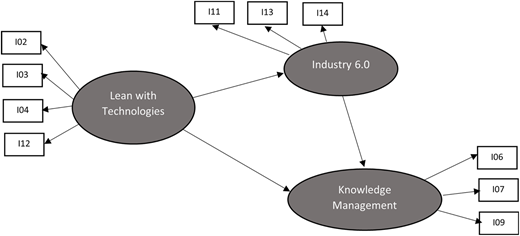
The instrument included question 01, which was not linked to any specific construct and was intended to assess the respondent's prior understanding of L6.0. Questions 02, 03, 04, and 12 were designed to address the construct Lean with Technologies and originate from questions asking whether current industrial management aligns with the L6.0 approach (I2), whether L6.0 improves organisational processes and employee engagement (I3), whether L6.0 facilitates value co-creation among stakeholders (I4), and whether LC can promote human–machine collaboration (I12).
Questions 05, 06, 07, 08, and 09 were developed with the KM construct in mind; the retained questions ask whether LC is preserved during employee turnover once I6.0 is implemented (I06), whether I6.0 technologies help preserve organisational knowledge during high turnover (I07), and whether LC can be dispersed or lost with I6.0 adoption (I09), reflecting concerns, grounded in Storey (2025), about preserving organisational and process-related knowledge under volatile information conditions.
Questions 10, 11, 13, 14, and 15 were constructed to evaluate the I6.0 construct; the retained questions ask whether I6.0 implementation may face barriers related to collaboration within the organisation (I11), whether I6.0 enables greater collaborative effort in developing LC (I13), and whether increasing systems autonomy will sustain Lean culture's involvement in I6.0 in the long term (I14), drawing on Almusaed et al. (2023), who argue that I6.0 combines human knowledge with AI so both can jointly apply and give meaning to emerging technological concepts, and on Machado and Nogueira (2025), who stresses that effective I6.0 implementation requires engaged leadership and strong team management to sustain Lean practices. Table 1 presents the full instrument.
Regarding respondents, population, and sample, we searched for published studies on I6.0 in February 2025, yielding 190 publications. After reviewing the abstracts and introductions, 107 studies were excluded, along with 27 duplicates, resulting in a final sample of 56 studies. We identified all authors of these 56 studies and collected their contact information (email or LinkedIn) to distribute the questionnaire. Additionally, individuals with expertise in Lean, I4.0, I5.0, and I6.0 were identified on LinkedIn and invited to participate.
3.1 Respondents' profile
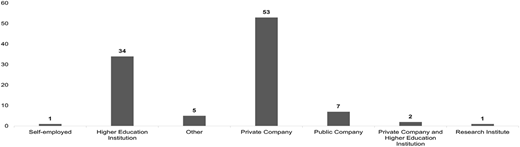
The questionnaire received 103 valid responses. Most respondents (53.8%) are employed in the private sector (see Figure 1).
3.2 Analysis
For the initial analysis of the constructs, Exploratory Factor Analysis (EFA) was employed, conducted in R using the psych package. Three factor analyses were performed considering the 14 questions corresponding to the three proposed dimensions (item 01 was excluded, as it was only an initial probe on respondent familiarity with the topic). Four questions were excluded due to factor loadings below 0.400: I05 (whether I6.0 applications facilitate KM), I08 (whether a fully developed LC facilitates I6.0 implementation), I10 (whether an operational-excellence-oriented culture positively impacts I6.0 technology implementation), and I15 (whether leaders are prepared to conduct I6.0 implementation).
Following this exploratory step, the structural model was developed, and the hypotheses formulated in Section 2 were tested using Structural Equation Modelling (SEM), as shown in Figure 2. This step was performed in R using the lavaan package. Based on the responses obtained, the Covariance-Based SEM (SEM-CB) method was employed to test the four hypothesised relationships among Lean with Technologies, I6.0, and KM; this method is part of a family of statistical models aimed at explaining the relationships among multiple variables (Hair et al., 2019) by examining the structure of interrelationships expressed in a series of equations describing all relationships between the dependent and independent variables involved.
Model adequacy was evaluated using the Goodness-of-Fit Index (GFI), Comparative Fit Index (CFI), Tucker–Lewis Index (TLI), Root Mean Square Error of Approximation (RMSEA), and Standardised Root Mean Square Residual (SRMR).
4. Results
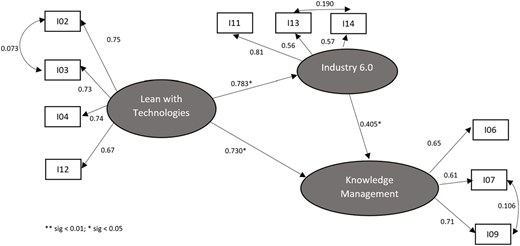
This section presents the results of the Structural Equation Modelling (SEM) analysis. Figure 3 illustrates the final structural model, while Table 2 summarises the estimated path coefficients and the statistical significance of the proposed hypotheses. The goodness-of-fit indices indicated that the proposed model achieved an acceptable fit to the observed data (GFI = 0.91; CFI = 0.95; TLI = 0.92; RMSEA = 0.08; SRMR = 0.06). According to Hair et al. (2019), CFI and TLI values above 0.90 and RMSEA and SRMR values equal to or below 0.08 indicate an adequate model fit; the obtained indices therefore support the validity of the proposed structural model. The average variance extracted (AVE) was close to 0.50, as shown in Table 3, and a larger sample size in a subsequent application of the model is likely to improve this index. Composite reliability showed very satisfactory results, with values of 0.70 or higher.
Hypothesis 1, which examined the relationship between Lean with Technologies and I6.0, was supported (β = 0.783; p < 0.001), indicating that companies applying Lean with Technologies are more likely to adopt I6.0 practices successfully. Hypothesis 2, examining the relationship between I6.0 and KM, was also supported (β = 0.405; p = 0.029), showing that I6.0 contributes to the preservation and dissemination of organisational knowledge. Hypothesis 3, concerning Lean with Technologies and KM, was also supported (β = 0.730; p < 0.001), indicating that Lean maturity facilitates knowledge creation and sharing.
However, Hypothesis 4 was not supported: the indirect effect of Lean with Technologies on KM through I6.0 (β_indirect ≈ 0.783 × 0.405 = 0.317) was smaller than, and statistically distinct from, the direct effect of Lean with Technologies on KM (β = 0.730). This indicates that I6.0 does not mediate the relationship between Lean with Technologies and KM in this sample.
L6.0 was treated as a latent construct, measured by indicators I02, I03, I04, and I12. Factor loadings were 0.756 for I02, 0.736 for I03, 0.749 for I04, and 0.572 for I12, indicating adequate convergent validity per Hair et al. (2019). The construct exhibited a direct and significant influence on both I6.0 (coefficient = 0.783; p < 0.01) and KM (coefficient = 0.730; p < 0.01), confirming its central role in the model.
Correlations between measurement errors (I07 and I09, I13 and I14, and I02 and I03) were observed, which are expected in empirical models and contribute to improved overall model fit (Hair et al., 2019). Taken together, the fit indices reported in Section 3 (CFI = 0.95; TLI = 0.92; RMSEA = 0.08; SRMR = 0.06) and the path coefficients above confirm the robustness of the proposed relationships: KM is strongly influenced by Lean with Technologies maturity, while I6.0 exerts a positive but comparatively smaller direct effect on KM and does not act as a mediating mechanism between the two.
5. Discussion
The SEM results provide empirical evidence of the relationships among Lean with Technologies, Industry 6.0 (I6.0), and Knowledge Management (KM). Three of the four proposed hypotheses were supported, indicating that Lean maturity constitutes the primary organisational capability driving both the adoption of I6.0 practices and the effectiveness of KM. At the same time, I6.0 operates as a complementary technological enabler rather than the mechanism through which Lean influences KM.
This section discusses the findings, explaining not only what was found but also why each relationship behaved as it did and how it advances existing theory.
5.1 Lean as an organisational capability
The results demonstrated a strong positive relationship between Lean with Technologies and I6.0 (β = 0.783; p < 0.001), supporting H1. This suggests that Lean functions not only as a set of practices but as an organisational capability that enables the effective integration of advanced technologies into organisational processes and converts them into operational value. Lean-developed routines, particularly CI, waste elimination, collaboration, and problem-solving, may provide the foundation for implementing and operationalising hyper-automation (Chourasia et al., 2022; Wiengarten et al., 2015; Solaimani et al., 2019). Thus, Lean's contribution to I6.0 lies not simply in using Lean practices alongside technology, but in the organisational routines and behaviours that enable technologies to generate operational value (Allawadi et al., 2024).
This interpretation reinforces the view of Lean as an organisational capability rather than merely a set of operational tools. Lean routines support organisational learning and innovation by enabling problems to be identified, addressed, and transformed into improvement opportunities (Bortolotti et al., 2015; Balle et al., 2019; Kaswan and Rathi, 2020). This is particularly relevant to I6.0, where technologies generate large amounts of data and enable autonomous processes but require organisational capabilities to interpret information and translate it into improvements. Thus, Lean maturity may provide an organisational foundation for I6.0 by supporting problem identification, information interpretation, and continuous adaptation, positioning Lean as an antecedent of technological integration.
Lean's role as an organisational capability also extends to KM. The positive and statistically significant relationship between Lean with Technologies and KM (β = 0.730; p < 0.001) supports H3 and represents the strongest relationship with KM in the model, exceeding the direct effect of I6.0 on KM (β = 0.405). This difference suggests that knowledge creation and sharing may be more strongly associated with organisational routines than with technological infrastructure alone. Institutionalised CI and a robust LC enable employees to exchange experiences, learn from mistakes, engage in collaborative problem-solving, and standardise improvements (Balle et al., 2019; Kaswan and Rathi, 2020). These mechanisms can operate independently of specific digital technologies, providing conditions for knowledge creation and circulation (Pearce et al., 2021; Netland and Fredriksson, 2019).
The stronger relationship between Lean with Technologies and KM therefore suggests that Lean contributes to KM through behavioural and operational mechanisms. While technologies can facilitate the capture, processing, and dissemination of information (Zahariev et al., 2024; Duggal et al., 2022), Lean routines create an organisational context in which knowledge can be generated, shared, and embedded in everyday practices. Thus, Lean not only supports the technological infrastructure required for KM, but also establishes routines through which individual experiences and problem-solving activities can become part of organisational practices (Balle et al., 2019; Kaswan and Rathi, 2020). This finding extends the understanding of Lean as an organisational capability, showing that its contribution goes beyond process efficiency and technological readiness to include organisational conditions that support learning and knowledge circulation.
Taken together, the findings indicate that Lean has a dual role in the relationship between organisational capabilities, I6.0, and KM. Lean maturity is strongly associated with I6.0, suggesting that Lean routines provide conditions for integrating advanced technologies (Chourasia et al., 2022; Wiengarten et al., 2015; Solaimani et al., 2019). At the same time, Lean has a stronger direct relationship with KM than I6.0, indicating that knowledge processes are more rooted in organisational practices than technology alone. Thus, digitalisation should not replace Lean maturity, but rather complement the organisational capabilities developed through Lean (Antony et al., 2021; Buer et al., 2018). These findings position Lean as an organisational capability supporting both technological integration and knowledge-related processes.
5.2 Industry 6.0 as a technological enabler
I6.0 showed a significant, positive effect on KM (β = 0.405; p = 0.029) supporting H2, consistent with the premise that technologies such as digital twins, augmented reality, AI, ML, and IoT support the documentation, storage, and retrieval of organisational knowledge (Zahariev et al., 2024; Pattanaik et al., 2024) and help convert tacit knowledge into explicit, transferable formats (Duggal et al., 2022; Nonaka and Takeuchi, 1995; Dombrowski and Mielke, 2014). By recording and making information available through digital systems, these technologies reduce the dependence of organisational knowledge on individual employees and facilitate its retrieval and transfer across the organisation, which is particularly relevant for tacit knowledge that would otherwise remain with individuals and be lost through employee turnover (Duggal et al., 2022; Pattanaik et al., 2024).
Theoretically, this effect was significant but smaller than the direct effect of Lean with Technologies on KM (β = 0.730, H3). This suggests that I6.0 is more strongly associated with capturing, preserving, and disseminating existing knowledge than with its initial creation. In other words, technology does not generate knowledge alone but helps capture and preserve knowledge already developed through Lean routines. This distinction is relevant in practice, as I6.0 technologies may underperform without collaborative routines for knowledge creation and may also involve risks such as tacit-knowledge loss, technological dependence, and organisational resistance (Sony and Naik, 2020; Sony, 2022).
The mediation analysis confirms this division of labour. Contrary to the study's hypothesis, and to prior studies suggesting that I6.0 technologies play a central role in facilitating KM through improved collaboration, information accessibility, and intelligent decision-making (Chourasia, 2025; Osmani et al., 2023), the mediation test did not support H4, the indirect effect of Lean with Technologies on KM through I6.0 (0.783 × 0.405 = 0.317) was smaller than, and statistically distinct from, the direct effect of Lean with Technologies on KM (0.730). This is a theoretically informative null result rather than a weak one: if I6.0 were the principal mechanism through which Lean practices generate knowledge outcomes, the indirect path would be expected to approach or exceed the direct path; instead, the direct path remains dominant, indicating that Lean maturity affects KM largely independently of whether organisations have adopted I6.0 technologies.
A plausible explanation is that mature Lean cultures already have established routines for knowledge creation and sharing, reducing the additional contribution of individual technologies. This aligns with the view that Lean provides the cultural and operational foundations for intelligent digitalisation through process stability and continuous human engagement (Antony et al., 2021; Buer et al., 2018). Rather than substituting or mediating Lean's effect on KM, I6.0 should be seen as a complementary capability: Lean enables collaboration and continuous learning, while I6.0 supports the capture and dissemination of knowledge that might otherwise remain tacit or be lost through employee turnover (Storey, 2025).
5.3 Human-centred knowledge management
Taken together, H1 to H4 show a consistent pattern: Lean maturity is the dominant organisational capability shaping both I6.0 adoption and KM; I6.0 makes a real but secondary contribution to KM; and this contribution operates in parallel with, rather than through, Lean's own effect on KM. This pattern reinforces a human-centred reading of I6.0 that is often underdeveloped in accounts emphasising hyper-automation and machine autonomy (Almusaed et al., 2023; Chourasia et al., 2022).
Although I6.0 technologies can support the preservation and dissemination of organisational knowledge, knowledge creation and application still depend on employees who possess process-execution expertise (Tariq et al., 2024), a distinction consistent with the human-centred premise of I6.0, in which the interaction between humans and machines, not the replacement of one by the other, remains central to the use of advanced technologies (Chourasia et al., 2022). Collaborative robots, for instance, support interactive learning and reduce training time (Gervasi et al., 2024). Still, the knowledge being disseminated originates from, and is validated by, people embedded in Lean problem-solving and standardisation routines.
From this perspective, the non-support of H4 is reassuring rather than negative: it indicates that organisational knowledge under I6.0 does not become dependent on technology to the point of displacing the human and cultural mechanisms that generate it in the first place. This reading is consistent with Lean thinking's emphasis on converting tacit into explicit knowledge as a human-driven process that technology can support but not originate (Nonaka and Takeuchi, 1995; Dombrowski and Mielke, 2014) and reinforces that the sustainability of KM under I6.0 depends on preserving, rather than automating away, the cultural mechanisms through which employees generate and share knowledge, technological infrastructure can support KM. Still, it does not replace the human and organisational processes through which knowledge is created and applied.
5.4 Structural relationships
The four hypotheses depict a consistent pattern: Lean maturity is the dominant organisational capability shaping both I6.0 adoption (H1) and KM (H3); I6.0 makes a real but secondary contribution to KM (H2); and this contribution operates in parallel with, rather than through, Lean's own effect on KM (H4, not supported). This pattern reinforces a human-centred reading of I6.0 that is often underdeveloped in accounts emphasising hyper-automation and machine autonomy (Almusaed et al., 2023; Chourasia et al., 2022). Because the creators of organisational knowledge remain the humans who possess process-execution expertise (Tariq et al., 2024), I6.0 technologies function as a complement to human capability rather than a substitute for it. Collaborative robots, for instance, support interactive learning and reduce training time (Gervasi et al., 2024), but the knowledge being disseminated originates from, and is validated by, people embedded in Lean routines of problem-solving and standardisation.
5.5 Theoretical implications
From a theoretical perspective, this study extends the I6.0 literature, which has so far emphasised hyper-automation, sustainability, and human-centred manufacturing largely as technological phenomena (Singh et al., 2023; Anandraj, 2024; Shahin et al., 2026), by demonstrating that its human and organisational dimensions are not peripheral but foundational.
By showing that Lean with Technologies exerts a stronger direct effect on KM (β = 0.730) than I6.0 itself (β = 0.405), and that I6.0 does not mediate Lean's effect on KM, the findings challenge the implicit assumption in much of the digital transformation literature that advanced technology is the primary driver of organisational knowledge outcomes (Chourasia, 2025; Osmani et al., 2023). Instead, they support a capability-based reading in which Lean culture conditions the return an organisation can extract from I6.0 technologies, positioning L6.0 as a theoretical bridge between Lean management theory and the emerging I6.0 paradigm.
5.6 Practical implications
From a practical perspective, the findings translate into recommendations for organisations preparing to adopt I6.0. First, investment should be sequenced, not merely budgeted: before allocating capital to I6.0 technologies (digital twins, AI-driven analytics, collaborative robots), organisations should assess their Lean maturity, for example, through an internal audit of the extent to which CI routines, standardised problem-solving, and employee-led process ownership are already institutionalised, since the results indicate that technology adoption without this foundation yields a smaller return on KM (β = 0.405 versus 0.730).
Second, every I6.0 deployment should be paired with an explicit knowledge-capture protocol: because I6.0 technologies preserve knowledge that Lean routines generate rather than generating it themselves, any new digital twin, AR, or IoT deployment should be accompanied by a structured process for documenting the tacit knowledge of the employees whose work it digitises, such as process-mapping sessions before automating a task, not after.
Third, responsibility for knowledge preservation during I6.0 rollout should sit with operational and Lean leadership rather than IT, since Lean maturity, not technology, was the dominant driver of KM outcomes in this study. Fourth, organisations should review and expand their current KPIs to ensure that they can measure the benefits and requirements associated with I6.0. These may include the proportion of critical processes with documented and accessible knowledge records, allowing organisations to assess whether digital transformation is effectively contributing to the preservation and dissemination of organisational knowledge or merely automating tasks without capturing the expertise that underpins them.
Furthermore, this study contributes to the advancement of United Nations SDG 9 (Industry, Innovation, and Infrastructure) by showing that sustainable industrial innovation depends on sequencing cultural and technological investment rather than treating them as substitutes, and SDG 12 (Responsible Consumption and Production), as embedding knowledge-preservation protocols reduces the waste of re-learning or re-developing expertise lost during automation. They further imply that engineering education and professional training programmes should teach I6.0 technologies alongside Lean problem-solving methods, rather than as a separate digital curriculum, since the two are complementary rather than substitutable capabilities.
6. Conclusions
This research makes three contributions that advance the emerging literature on Industry 6.0. Theoretically, it is the first study to model Lean maturity, I6.0 adoption, and Knowledge Management as interrelated constructs, clarifying that Lean culture is the primary organisational capability underpinning both I6.0 adoption and KM effectiveness. At the same time, I6.0 operates as a complementary, non-mediating enabler.
Methodologically, it introduces and empirically validates the L6.0 construct through Covariance-Based Structural Equation Modelling, providing a psychometrically tested instrument (Table 1) that future studies can replicate, extend, or apply across sectors and geographies. Practically, it offers organisations preparing for I6.0 adoption an evidence-based sequence of priorities: Lean maturity should be treated as a precondition for, not a parallel track to, digital transformation investment.
This study has some limitations. First, the limited literature on L6.0 restricts broader theoretical comparisons. Additionally, the emerging nature of I6.0 limited the availability of specialists, resulting in a relatively small sample (103). Future research should examine organisations with mature implementations of I4.0, I5.0, Lean 4.0, and Lean 5.0, using larger, more diverse samples to enhance the robustness and generalisability of the findings.
Although the sample was sufficient for the statistical analyses conducted, future studies should also combine perceptual data with objective organisational performance indicators, such as documented knowledge-retention rates or time-to-productivity after employee turnover, to provide a more comprehensive, less self-reported assessment of the relationships between Lean, I6.0, and KM.
The authors would like to thank the Operations Management Research Centre (OMReC/UFSC) for its scientific support.