


This study examines how Moroccan organizations integrate Industry 4.0 technologies and Six Sigma practices to improve operational performance, sustainability, and traffic management. It also explores how organizational and human factors influence the effectiveness of this integration in resource-constrained and heterogeneous operational environments.
A qualitative research design was adopted using semi-structured interviews with 37 managers, engineers, analysts, and municipal coordinators in Morocco. Data were collected through purposive sampling and analyzed using thematic analysis to identify patterns related to digital transformation, Six Sigma implementation, organizational dynamics, and sustainability practices.
The findings show that Industry 4.0 enhances real-time monitoring and predictive capability, while Six Sigma transforms digital data into structured continuous improvement. Leadership, workforce skills, organizational culture and digital maturity significantly influence implementation success. The integration also improves sustainability performance and traffic management optimization.
The study is limited by its qualitative design and focus on Moroccan organizations, which may reduce generalizability. The findings are based mainly on participant experiences rather than longitudinal operational data, and sectoral differences may have influenced the results.
The study provides guidance for managers and policymakers by showing that Industry 4.0 technologies are more effective when integrated with Six Sigma practices. It also highlights the importance of leadership, employee training, and digital infrastructure development for sustainable operational improvement and traffic optimization.
This study develops a socio-technical understanding of Industry 4.0 and Six Sigma integration in an emerging economy context. It extends prior research by linking digital transformation not only to operational performance but also to sustainability and urban traffic optimization, while highlighting the moderating role of organizational and human factors.
1. Introduction
The digital transformation of industries and urban systems has become a central priority for organizations seeking to enhance efficiency, resilience, and sustainability. The rise of Industry 4.0—driven by advanced technologies such as the Internet of Things (IoT), artificial intelligence (AI), and real-time data analytics—has fundamentally altered the ways in which organizations operate and make decisions (Zong and Guan, 2025). Unlike previous automation approaches, Industry 4.0 allows processes to be continuously monitored, analyzed, and adjusted, enabling predictive and data-driven management (Czvetkó et al., 2022). At the same time, structured process improvement methodologies, particularly Six Sigma, offer systematic approaches for identifying process inefficiencies, reducing variability, and sustaining long-term performance gains (Ndrecaj et al., 2023; Sakib et al., 2025). Together, these frameworks hold the potential to transform operational management by not only providing richer insights through digital data but also ensuring that improvements are rigorously implemented and controlled.
However, despite the growing body of literature on Industry 4.0 and Six Sigma independently, limited research has examined how these two approaches can be effectively integrated in practice, particularly in contexts characterized by heterogeneous technological maturity and organizational constraints.
The integration of Industry 4.0 technologies with Six Sigma practices remains uneven and underexplored, especially in emerging economies. In Morocco, organizations differ widely in terms of technological infrastructure, workforce skills, and organizational maturity, ranging from global multinational subsidiaries to small and medium-sized enterprises (SMEs) and municipal authorities with limited digital resources (Touijer and Elabjani, 2025). While advanced firms can leverage real-time analytics and interconnected systems to strengthen process monitoring and decision-making, smaller organizations often rely on fragmented data or manual records, limiting their capacity to apply structured process improvement effectively (Kallmuenzer et al., 2025). As a result, a clear gap exists in understanding how digital transformation initiatives (Industry 4.0) can be aligned with quality management methodologies (Six Sigma) under conditions of unequal resource availability, organizational maturity, and human capability development.
More specifically, the literature lacks empirical evidence explaining (1) how Industry 4.0 and Six Sigma are jointly implemented in heterogeneous organizational contexts, (2) how human and organizational factors shape this integration process, and (3) how such integration extends beyond operational performance to sustainability and urban traffic management outcomes.
To guide this investigation, the study addresses three central research questions:
How do Moroccan organizations integrate Industry 4.0 technologies into operational processes alongside Six Sigma practices?
In what ways do organizational and human factors facilitate or constrain the effective implementation of these combined approaches?
How does the integration of Industry 4.0 and Six Sigma influence operational performance, environmental sustainability, and traffic management optimization?
This research seeks to investigate the mechanisms through which Moroccan organizations implement Industry 4.0 and Six Sigma in combination and to understand how this integration affects operational efficiency, sustainability outcomes, and traffic management optimization. While prior studies have largely treated Industry 4.0 and Six Sigma as separate streams of research, there is limited empirical evidence explaining how their interaction operates within real organizational settings, particularly in developing country contexts. By examining both technological adoption and methodological discipline within their organizational and human contexts, the study aims to capture the complex, socio-technical processes that influence performance. The focus on Morocco provides a particularly valuable lens, as the country's mix of organizational scales, sectors, and technological readiness offers insights into how these approaches function under resource constraints and infrastructural variability. This approach enables the study to move beyond theoretical discussions of Industry 4.0 or Six Sigma in isolation, providing empirical evidence of how their integration shapes tangible outcomes in real-world operational settings.
This paper contributes to the literature in several ways. From a theoretical perspective, it extends existing research by developing a socio-technical understanding of the integration between Industry 4.0 and Six Sigma, highlighting the role of human and organizational factors as central mechanisms rather than peripheral conditions. It also broadens the scope of analysis by linking this integration not only to operational performance but also to sustainability and urban traffic optimization outcomes. From a practical perspective, the study provides actionable insights for managers, engineers, and policymakers by identifying key enablers, constraints, and implementation dynamics in resource-constrained environments, particularly in emerging economies such as Morocco.
The structure of this paper reflects this research focus. Section 2 reviews the relevant literature on Industry 4.0, Six Sigma, operational performance, sustainability, and traffic management, identifying existing gaps and highlighting the need for context-specific studies. Section 3 details the qualitative research methodology, including the sampling strategy, data collection, and analysis techniques. Section 4 presents the analysis and results of the study, while Section 5 provides a discussion of the findings, including their theoretical and practical implications. Finally, the paper concludes by outlining the main contributions, limitations, and directions for future research.
2. Literature review
The emergence of Industry 4.0 represents a transformative shift in how industrial and urban systems operate, integrating advanced digital technologies to enable smart, interconnected processes (Zhao et al., 2025). From a theoretical perspective, Industry 4.0 can be understood through a socio-technical systems lens, where value creation emerges from the interaction between digital infrastructures, organizational processes, and human actors. This perspective highlights that technological advancement alone does not guarantee performance improvement unless it is embedded within appropriate organizational and human configurations. This technological paradigm encompasses IoT-enabled devices, cyber-physical systems, cloud computing, big data analytics, and artificial intelligence, which collectively provide unprecedented levels of visibility, control, and predictive capability across operational environments (Magade and Sharma, 2024). Industry 4.0 technologies facilitate real-time monitoring of production processes, logistics flows, and urban traffic systems, allowing managers and operators to respond rapidly to anomalies, optimize resource allocation, and enhance overall efficiency (Yüksel, 2022; Nancy et al., 2024; El Moussaoui et al., 2025a, b). In this sense, Industry 4.0 is not only a technological shift but also an organizational transformation requiring alignment between digital tools and decision-making structures. (Khan and Emon, 2025) have shown that the adoption of Industry 4.0 is associated with reduced production downtime, improved supply chain responsiveness, and enhanced decision-making quality. However, its effectiveness depends on organizational readiness, workforce capabilities, and the alignment of technology with operational and strategic objectives. In emerging economies like Morocco, where technological adoption varies widely across firm sizes and sectors, understanding how Industry 4.0 is implemented in practice is essential for assessing its real operational and environmental impact.
Alongside digital transformation, structured process management methodologies such as Six Sigma have been widely recognized as essential mechanisms for improving quality, reducing process variability, and achieving operational excellence (De Mast et al., 2022). Six Sigma is grounded in statistical thinking and continuous improvement theory, and provides a disciplined data-driven framework that systematically addresses inefficiencies through the DMAIC cycle (Define, Measure, Analyze, Improve, Control). From a theoretical standpoint, Six Sigma aligns with quality management and operational excellence paradigms, emphasizing process stability, defect reduction, and performance consistency. It reflects a continuous improvement logic rooted in systems thinking, where processes are understood as interconnected and dynamic rather than isolated activities. In manufacturing contexts, Six Sigma has been shown to improve defect reduction, enhance cycle-time performance, and stabilize processes by institutionalizing continuous improvement practices (Gomaa, 2025). Similarly, in urban management contexts, Six Sigma principles can be applied to optimize traffic flow, treat congestion as a measurable process defect, and implement iterative improvements based on systematic data analysis (El Moussaoui et al., 2022; Sardarzehi et al., 2025). The research conducted by (Singh an Ram, 2025) highlights that Six Sigma's effectiveness is closely linked to the availability of accurate and timely data, managerial commitment, and the organizational culture supporting cross-functional collaboration. However, in many developing countries, challenges such as fragmented data systems, limited analytical skills, and hierarchical decision-making often constrain the successful implementation of Six Sigma initiatives (McDermott et al., 2022; Vinodh and Shimray, 2023; Salman et al., 2024).
The integration of Industry 4.0 and Six Sigma represents an emerging research stream that combines digital intelligence with structured process improvement logic. From a conceptual perspective, this integration can be viewed as a hybrid socio-technical framework where Industry 4.0 provides real-time data intelligence, while Six Sigma ensures methodological discipline for translating data into continuous improvement actions (Elmarzouki and Jiuhe, 2025). This integration also reflects a contingency-based logic, where performance depends on the alignment between technological capabilities, analytical methodologies, and organizational context. While Industry 4.0 provides high-resolution, real-time data and predictive insights, Six Sigma offers the analytical and procedural framework to transform this data into actionable improvements. (Tissir et al., 2023; El Moussaoui et al., 2025a, b; Wankhede et al., 2025) indicate that organizations combining these approaches achieve superior operational outcomes compared to those applying either approach independently. For example, real-time digital monitoring enhances the Measure and Control phases of Six Sigma by providing accurate, continuous, and granular process data, while Six Sigma structures ensure that digital insights are systematically acted upon to reduce variability, improve quality, and sustain process improvements over time. Furthermore, (Nour and Arbussà, 2025) demonstrate that this integration mitigates risks of digital complexity and fragmented decision-making, reinforcing the need for structured governance of digital transformation initiatives. In urban traffic systems, the integration enables data-driven congestion management and continuous mobility optimization (Siddiqui et al., 2024).
A critical dimension highlighted in the literature is the role of human and organizational factors in shaping the effectiveness of Industry 4.0 and Six Sigma integration. Leadership commitment, workforce competencies, and organizational culture are consistently identified as key determinants of successful adoption (Nguyen et al., 2024; Kareem et al., 2025). These factors do not merely facilitate implementation but actively shape the transformation process by influencing how technologies and methodologies are interpreted and used in practice. Leaders play a central role in aligning digital initiatives with operational objectives, securing resources, and sustaining improvement projects over time (Sacavém et al., 2025). Employees' analytical skills, comfort with data transparency, and capacity for cross-functional collaboration directly influence the ability to implement Six Sigma methodologies effectively in data-rich environments. Resistance to change, fear of performance monitoring, or insufficient training can significantly reduce the potential benefits of technological investments (Tanjung et al., 2025). In contexts such as Morocco, where organizational maturity and digital literacy vary significantly, these socio-technical dynamics become even more critical in shaping implementation outcomes.
Beyond operational performance, (Ibrahim and Kumar, 2025) emphasize that the integration of Industry 4.0 and Six Sigma can enhance sustainability outcomes by providing precise measurement, control, and process improvement mechanisms for energy efficiency, waste reduction, and emissions management. In industrial contexts, IoT-based monitoring, predictive maintenance, and energy analytics allow organizations to treat environmental inefficiencies as measurable defects that can be systematically addressed through Six Sigma improvement cycles (Almomani ET AL, 2025). In urban traffic management, digital traffic intelligence combined with structured Six Sigma analysis reduces congestion and idle times, resulting in lower fuel consumption and greenhouse gas emissions (Hajji et al., 2025). Importantly, sustainability performance depends on the depth of integration between digital technologies and process management systems, rather than on standalone technological adoption. This emphasizes the shift from technology-centric to integrated socio-technical approaches in understanding sustainability outcomes.
Despite these contributions, several important research gaps remain. First, existing studies remain largely conceptual or sector-specific, and there is limited empirical understanding of how Industry 4.0 and Six Sigma are jointly implemented in heterogeneous organizational environments, particularly in emerging economies. Most existing models assume relatively stable and digitally mature environments, which limits their explanatory power in contexts characterized by uneven technological adoption and resource constraints. Second, the literature lacks a comprehensive socio-technical explanation of how human and organizational factors actively shape, enable, or constrain the integration process rather than merely acting as external conditions. In particular, the dynamic interaction between leadership, organizational culture, and employee competencies during digital-process integration remains under-theorized. Third, the extension of this integration beyond manufacturing performance to domains such as sustainability and urban traffic optimization remains underdeveloped, with very limited empirical evidence from African or North African contexts such as Morocco. Fourth, there is also a geographical and contextual bias in the literature, as most empirical studies focus on developed economies and large industrial firms, while SMEs and public-sector organizations remain underexplored despite their importance in emerging economies. Finally, a methodological gap persists, as most studies rely on quantitative or conceptual approaches, with limited qualitative insights into how actors experience and operationalize integration in practice. This limits understanding of micro-level implementation processes, including learning dynamics, adaptation mechanisms, and decision-making behaviors.
Overall, these gaps highlight the need for a holistic, context-sensitive, and empirically grounded approach that captures the interaction between technology, methodology, human capital, and organizational structures. Addressing these gaps will allow for a deeper understanding of how Industry 4.0 and Six Sigma integration operates in real-world settings and how it contributes to operational efficiency, sustainability, and urban system optimization.
3. Research methodology
3.1 Research design and rationale
This study adopted a qualitative research design to investigate how organizations in Morocco integrate Industry 4.0 technologies and structured process management practices, including Six Sigma principles, to enhance operational performance, sustainability outcomes, and traffic management efficiency. The choice of a qualitative approach was driven by the exploratory nature of the research, which sought to uncover the practical mechanisms, organizational conditions, and human factors that shape technology adoption and process optimization. Unlike quantitative methods that rely on predefined variables and metrics, qualitative research enables a holistic understanding of complex, socio-technical phenomena and provides access to contextually grounded insights that are often overlooked in standardized surveys or experimental designs.
Industry 4.0 adoption involves more than the installation of digital tools; it encompasses organizational transformation, workflow reengineering, and human capacity development. Similarly, the implementation of process management practices such as Six Sigma is embedded within organizational routines and requires managerial oversight, cross-functional collaboration, and a culture of continuous improvement. In this context, a qualitative approach allowed for the exploration of both technological and organizational dimensions in tandem, capturing how these elements interact to shape operational outcomes. Furthermore, Morocco presents a unique setting for this investigation due to the heterogeneity in firm sizes, technological readiness, and infrastructure availability, ranging from advanced multinational subsidiaries to small and medium-sized enterprises (SMEs) and municipal authorities with varying access to digital tools. By employing a qualitative methodology, the study could investigate practitioner experiences, barriers, and enabling factors across these diverse contexts, providing insights that are both practically relevant and theoretically informative.
Another rationale for the qualitative design was its suitability for developing a conceptual model grounded in empirical evidence. Since the relationships among Industry 4.0 adoption, process management practices, operational performance, sustainability outcomes, and traffic optimization were not fully established in the Moroccan context, qualitative research provided a foundation for mapping patterns and relationships before formal hypothesis testing. This approach also allowed for the identification of context-specific moderators, such as organizational and human factors, which can influence the effectiveness of digital adoption and process practices. Overall, the design ensured that the research captured the complex interplay between technology, processes, and organizational dynamics, providing a robust empirical base for subsequent model development and quantitative analysis.
The methodological design was also aligned with the study's research questions, which required an in-depth understanding of organizational practices, managerial perceptions, implementation dynamics, and socio-technical interactions. Because the study aimed to explain “how” organizations integrate Industry 4.0 and Six Sigma practices and “why” certain organizational conditions facilitate or constrain this integration, qualitative inquiry was considered the most suitable methodological approach. The design enabled the researcher to capture detailed experiential and contextual evidence that could not be sufficiently explored through purely quantitative methods or standardized survey instruments.
To enhance methodological clarity and transparency, the research process was organized into sequential stages including research design, participant selection, data collection, and thematic analysis. Each stage was designed to address specific objectives and to ensure coherence between the research questions, data collection procedures, and analytical strategy. Figure 1 presents the overall research process and methodological stages adopted in the study.
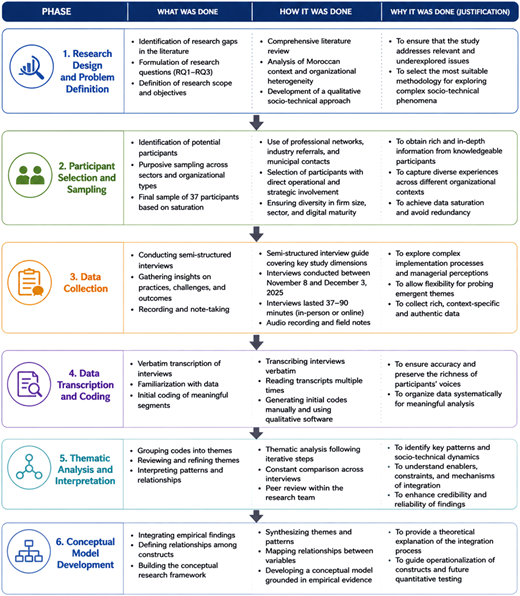 Icon: A magnifying glass over a document, symbolizing the research process.
Research process
Icon: A magnifying glass over a document, symbolizing the research process.Research process
3.2 Sampling strategy and participant selection
A purposive sampling strategy was employed to select participants who could provide rich, in-depth insights into the study's focus areas. Initially, a larger pool of potential participants was identified to ensure diversity across organizational type, sector, size, and digital maturity. This pool included managers, operations supervisors, quality engineers from manufacturing firms, and traffic coordinators from municipal authorities. Following the principle of saturation, the final sample was limited to 37 participants, which was deemed sufficient to capture a comprehensive range of perspectives without redundancy. Saturation was determined by the point at which additional interviews no longer produced new, meaningful insights, confirming that the sample adequately represented the key dimensions of technological adoption, process management practices, and organizational factors.
The purposive approach was justified because it allowed the selection of individuals with direct operational experience and strategic responsibilities, ensuring the relevance and depth of the data. Participants were chosen based on their involvement in digital transformation projects, process standardization initiatives, or traffic management operations, making them capable of providing informed perspectives on organizational practices, technological challenges, and process improvement strategies. Efforts were made to include participants from different organizational scales, from multinational firms with advanced digital infrastructures to SMEs and municipal authorities with limited technological resources. This diversity ensured that the study could capture variations in experiences, strategies, and outcomes, providing a comprehensive understanding of organizational practices across different contexts. The sampling strategy is briefly presented in Figure 2.
 The diagram illustrates a sampling strategy divided into three main sections. The top section, labeled 'Purposive Sampling,' includes three roles: Managers, Engineers, and Traffic Coordinators. The middle section, labeled 'Diverse Organizations,' features icons representing Multinationals, SMEs, and Municipal Authorities. The bottom section highlights 'Data Saturation,' leading to a 'Final Sample: 37 Participants,' and concludes with 'Rich & Informed Perspectives.'
Sampling strategy
The diagram illustrates a sampling strategy divided into three main sections. The top section, labeled 'Purposive Sampling,' includes three roles: Managers, Engineers, and Traffic Coordinators. The middle section, labeled 'Diverse Organizations,' features icons representing Multinationals, SMEs, and Municipal Authorities. The bottom section highlights 'Data Saturation,' leading to a 'Final Sample: 37 Participants,' and concludes with 'Rich & Informed Perspectives.'Sampling strategy
Participant identification relied on a combination of professional networks, industry referrals, and municipal office contacts. Selection criteria emphasized individuals who were actively engaged in decision-making or operational roles, rather than peripheral staff, to ensure that the insights collected were relevant, accurate, and actionable. This approach also facilitated the exploration of organizational enablers and constraints, such as leadership commitment, workforce skills, resource availability, and technological readiness, which were later reflected in the thematic analysis and informed the conceptual model. By targeting participants with firsthand knowledge and experience, the study maximized the richness and credibility of the qualitative data.
The sampling strategy was particularly appropriate for this study because the research objectives required access to participants with specialized experiential knowledge rather than statistically representative respondents. Since the study focused on understanding implementation mechanisms, organizational practices, and managerial interpretations of Industry 4.0 and Six Sigma integration, selecting participants directly involved in these processes was essential for generating relevant and information-rich qualitative evidence.
The profiles of the participants, including their age, professional experience, function, type of enterprise, and interview duration, are summarized in Table 1 below.
Profiles of participants
| ID | Age | Experience | Function | Type of organization | Length of interview |
|---|---|---|---|---|---|
| A.N | 42 y | 18 y | Operations Manager | Multinational Manufacturing Firm | 75 min |
| D.S | 29 y | 05 y | Process Improvement Specialist | SME – Technology Solutions | 53 min |
| K.X | 33 y | 09 y | Process Engineer | SME – Manufacturing | 47 min |
| B.M | 35 y | 04 y | Logistics Coordinator | SME – Industrial Sector | 69 min |
| L.Y | 48 y | 22 y | Production Director | Large Manufacturing Firm | 81 min |
| F.R | 45 y | 20 y | Traffic Operations Manager | Municipal Traffic Authority | 74 min |
| J.W | 39 y | 14 y | Operations Supervisor | Municipal Transport Authority | 65 min |
| C.T | 50 y | 21 y | IT Director | Large Public Transport Authority | 90 min |
| G.L | 32 v | 08 y | Supply Chain Analyst | Mid-sized Logistics Company | 58 min |
| O.B | 37 y | 13 y | Traffic Planner | Municipal Traffic Authority | 60 min |
| L.Z | 34 y | 11 y | Process Analyst | SME–Manufacturing | 79 min |
| F.T | 33 y | 09 y | IT Coordinator | SME – Technology Solutions | 55 min |
| P.C | 40 y | 16 y | Supply Chain Manager | Automotive Manufacturing Plant | 70 min |
| E.K | 38 y | 15 y | Plant Manager | Multinational Manufacturing Firm | 84 min |
| H.P | 41 y | 17 y | Production Manager | Multinational Industrial Firm | 69 min |
| M.Z | 31 y | 06 y | Logistics Analyst | Mid-sized Logistics Company | 41 min |
| I.Q | 36 y | 12 y | Quality Assurance Specialist | SME – Industrial Sector | 59 min |
| U.H | 28 y | 02 y | Junior Analyst | SME – Technology Solutions | 37 min |
| X.K | 32 y | 08 y | Production planner | SME–Industrial Sector | 66 min |
| N.A | 44 y | 19 y | IT Manager | Multinational Manufacturing Firm | 82 min |
| Q.D | 34 y | 11 y | Operations Coordinator | SME – Industrial Sector | 55 min |
| Z.M | 38 y | 15 y | IT Systems Analyst | Large Manufacturing Firm | 75 min |
| S.F | 30 y | 07 y | Production Supervisor | SME – Manufacturing | 49 min |
| V.I | 43 y | 18 y | Traffic Operations Supervisor | Municipal Traffic Authority | 83 min |
| T.G | 49 y | 23 y | Operations Director | Multinational Industrial Firm | 45 min |
| Y.L | 41 y | 17 y | Supply Chain Director | Multinational Industrial Firm | 51 min |
| R.E | 46 y | 21 y | Process Improvement Manager | Large Manufacturing Firm | 85 min |
| W.J | 56 y | 29 y | Quality Manager | Mid-sized Manufacturing Firm | 62 min |
| BP | 41 y | 10 y | Operations Manager | Multinational Manufacturing Firm | 49 min |
| X.K | 32 y | 08 y | Production Manager | SME–Industrial Sector | 72 min |
| C.Q | 29 y | 06 y | Traffic Analyst | Municipal Traffic Authority | 54 min |
| I.W | 45 y | 21 y | Traffic Director | Municipal Traffic Authority | 90 min |
| D.R | 39 y | 14 y | Process Improvement Specialist | Mid-sized Manufacturing Firm | 68 min |
| Y.L | 41 y | 17 y | Supply Chain Director | Multinational Industrial Firm | 41 min |
| G.U | 44 y | 19 y | Supply Chain Supervisor | Large Manufacturing Firm | 45 min |
| H.V | 31 y | 7 y | Production Engineer | Mid-sized Manufacturing Firm | 62 min |
| K.Y | 40 y | 11 y | Logistics Director | Multinational Industrial Firm | 87 min |
3.3 Data collection
Data were collected through semi-structured interviews, conducted between November 8 and December 3, 2025. Semi-structured interviews were selected for their ability to combine structured inquiry with flexibility, allowing participants to elaborate on relevant topics while enabling the researcher to probe emergent issues. The interview guide was carefully designed to address the core dimensions of the study: adoption and application of Industry 4.0 technologies, process management practices including Six Sigma, operational performance, sustainability initiatives, and traffic management practices. Questions were open-ended, enabling participants to describe their experiences, challenges, decision-making processes, and organizational practices in detail.
The use of semi-structured interviews was considered particularly suitable because the study aimed to explore complex organizational experiences and socio-technical interactions that cannot be adequately captured through closed-ended questionnaires. This method enabled participants to explain implementation processes, organizational constraints, managerial decisions, and operational practices using their own perspectives and professional experiences, thereby generating nuanced and context-sensitive insights.
Interviews ranged from 37 to 90 min, allowing sufficient time for participants to provide comprehensive responses and for the researcher to explore complex organizational and technological dynamics. Interviews were conducted either in-person or via secure virtual platforms, depending on participant availability and logistical considerations. Each session was audio-recorded with consent and transcribed verbatim to ensure that the nuances of participant responses were fully captured. Additionally, field notes were maintained during interviews to document contextual information, non-verbal cues, and observations regarding organizational environments, which provided additional depth for analysis. The data collection process is presented in Figure 3.
 Panel A: A man in a suit holding a tablet and clipboard with a checklist titled 'Interview Guide'. A box lists topics: 1- Industry 4.0 technologies, 2- Six sigma, 3- Operational performance, 4- Sustainability initiatives, 5- Traffic management. Panel B: An arrow points to a box showing in-person and virtual interviews with icons of a handshake, microphone, and secure laptop. Panel C: An arrow points to a box indicating that audio is recorded and transcribed, with an icon of a stack of papers. Panel D: A calendar icon shows dates from November 8 to December 3, 2025, with a microphone icon indicating interview duration of 37 to 90 minutes.
Data collection process
Panel A: A man in a suit holding a tablet and clipboard with a checklist titled 'Interview Guide'. A box lists topics: 1- Industry 4.0 technologies, 2- Six sigma, 3- Operational performance, 4- Sustainability initiatives, 5- Traffic management. Panel B: An arrow points to a box showing in-person and virtual interviews with icons of a handshake, microphone, and secure laptop. Panel C: An arrow points to a box indicating that audio is recorded and transcribed, with an icon of a stack of papers. Panel D: A calendar icon shows dates from November 8 to December 3, 2025, with a microphone icon indicating interview duration of 37 to 90 minutes.Data collection process
The iterative nature of the data collection process allowed the researcher to refine the interview guide based on emerging themes and insights from early interviews, ensuring that later interviews explored relevant issues in greater depth. This adaptive approach was particularly important given the heterogeneity of organizational contexts in the sample, enabling the researcher to capture both common patterns and context-specific differences in technology adoption, process management, and operational practices. By combining structured and exploratory questioning, the study ensured a balance between consistency across participants and depth of contextual understanding, producing a rich and nuanced dataset.
Furthermore, the iterative and flexible nature of the interviews enhanced the credibility of the research process by allowing the exploration of emerging themes that were not initially anticipated in the interview protocol. This was particularly important for identifying context-specific organizational dynamics, human factors, and operational constraints associated with digital transformation and process improvement initiatives in Moroccan organizations.
3.4 Data analysis
Data analysis was conducted using thematic analysis, which provided a systematic method for identifying, interpreting, and synthesizing patterns across the qualitative dataset. The process followed multiple iterative stages. First, the researcher became deeply familiar with the transcripts, reading them repeatedly to understand participant narratives and the contextual background of each organization. Second, initial codes were generated for text segments that captured meaningful insights related to technology adoption, process practices, organizational dynamics, operational performance, sustainability initiatives, and traffic management practices. Third, codes were aggregated into higher-order themes, reflecting patterns and recurrent ideas across the dataset. These themes were further refined through iterative review to ensure clarity, consistency, and alignment with the study's objectives.
Thematic analysis was selected because it is particularly effective for examining complex qualitative data involving organizational experiences, managerial interpretations, and socio-technical interactions. This analytical approach enabled the researcher to systematically identify recurring patterns while preserving the contextual richness of participant narratives. Moreover, thematic analysis was appropriate for addressing the exploratory objectives of the study and for linking empirical observations to broader theoretical dimensions related to Industry 4.0, Six Sigma, operational performance, sustainability, and organizational transformation.
The thematic analysis focused on understanding patterns of digital adoption, process management practices, operational routines, and organizational enablers and constraints, while highlighting variations across different organizational types and maturity levels. Particular attention was given to how organizations integrate digital tools into daily operations, how they structure process improvement initiatives, and how leadership and human factors influence these practices, reflecting the organizational realities uncovered in the results section. Verbatim quotations were systematically incorporated to illustrate findings, providing empirical grounding and maintaining the authenticity of participant perspectives.
Coding and theme development were conducted manually and supported by qualitative data management software, ensuring consistency and traceability of analytical decisions. Themes were also peer-reviewed within the research team to enhance credibility and reliability. This process allowed the study to identify both common patterns and context-specific variations, providing a detailed understanding of the mechanisms, challenges, and strategies that organizations use to adopt Industry 4.0 technologies and implement structured process management practices.
To further strengthen methodological rigor, analytical interpretations were continuously compared across interviews to verify thematic consistency and reduce subjective bias. The combination of iterative coding, peer review, and constant comparison enhanced the trustworthiness, dependability, and analytical transparency of the findings.
The insights derived from this analysis directly informed the conceptual model, guiding the operationalization of constructs and providing a foundation for subsequent quantitative investigation.
4. Analysis and results
4.1 Overview of the analytical framework
The qualitative analysis revealed that the integration of Industry 4.0 technologies and Six Sigma practices in Moroccan organizations follows a socio-technical logic in which digital infrastructures, methodological discipline, organizational leadership, and human capabilities interact dynamically to shape operational outcomes. Thematic analysis identified five major analytical dimensions: (1) Industry 4.0 adoption and Six Sigma readiness, (2) process optimization in digital environments, (3) organizational and human moderating factors, (4) sustainability performance, and (5) traffic management optimization.
To strengthen the analytical interpretation of the qualitative evidence, the study developed a conceptual integration framework synthesizing the relationships identified across interviews. The framework illustrates how Industry 4.0 technologies generate real-time operational intelligence, while Six Sigma practices transform this intelligence into structured continuous improvement mechanisms. Organizational and human factors emerged as moderating variables influencing the effectiveness of this integration process.
Figure 4 presents the conceptual model derived from the qualitative findings.
 The diagram illustrates the integration of Industry 4.0 technologies and Six Sigma practices for operational excellence in Morocco. It is divided into five main sections: Industry 4.0 adoption and Six Sigma readiness, process optimization in digital environments, organizational and human moderating factors, sustainability performance, and traffic management optimization. Industry 4.0 adoption includes elements like IoT and smart sensors, real-time data acquisition, cloud computing, big data analytics, AI and machine learning, digital dashboards, and cybersecurity. Six Sigma readiness involves awareness and knowledge, infrastructure and data quality, process standardization, top management support, and analytical capability. Process optimization in digital environments uses the Six Sigma DMAIC framework enabled by Industry 4.0, which includes defining problems, measuring data, analyzing root causes, improving solutions, and controlling processes.
Conceptual model
The diagram illustrates the integration of Industry 4.0 technologies and Six Sigma practices for operational excellence in Morocco. It is divided into five main sections: Industry 4.0 adoption and Six Sigma readiness, process optimization in digital environments, organizational and human moderating factors, sustainability performance, and traffic management optimization. Industry 4.0 adoption includes elements like IoT and smart sensors, real-time data acquisition, cloud computing, big data analytics, AI and machine learning, digital dashboards, and cybersecurity. Six Sigma readiness involves awareness and knowledge, infrastructure and data quality, process standardization, top management support, and analytical capability. Process optimization in digital environments uses the Six Sigma DMAIC framework enabled by Industry 4.0, which includes defining problems, measuring data, analyzing root causes, improving solutions, and controlling processes.Conceptual model
4.2 Industry 4.0 adoption and six sigma readiness under operational constraints
The qualitative evidence highlights pronounced disparities in Industry 4.0 adoption across Moroccan manufacturing firms and urban traffic institutions, with direct consequences for Six Sigma readiness and effectiveness. Large industrial organizations and multinational subsidiaries reported advanced digital infrastructures, including interconnected production equipment, real-time monitoring systems, and AI-supported analytics platforms. These technologies enabled continuous data capture and reduced measurement error, thereby reinforcing the statistical foundations required for Six Sigma deployment. Respondents emphasized that process variation became more visible and traceable once digital systems were operational. As one manufacturing executive explained, “Industry 4.0 transformed our quality management because Six Sigma is now based on live data rather than delayed reports.” This observation illustrates how digitalization strengthens the Measure and Control phases of Six Sigma by improving data reliability and temporal accuracy.
From an analytical perspective, these findings suggest that Industry 4.0 functions as a structural enabler rather than a standalone performance driver. In the Moroccan context, Six Sigma effectiveness depends less on formal certification or methodological awareness than on the availability of reliable, real-time data generated by digital systems. Where Industry 4.0 adoption remained partial, organizations compensated through procedural discipline and experiential knowledge, yet these substitutes were insufficient to sustain long-term process stability. The results therefore reinforce a socio-technical interpretation of operational excellence, in which digital infrastructure, methodological rigor, and contextual constraints interact dynamically.
The qualitative evidence also revealed a progressive relationship between digital maturity and Six Sigma operationalization. Organizations with advanced data integration capabilities demonstrated stronger process monitoring, faster anomaly detection, and more effective corrective actions compared to organizations relying on fragmented operational information. This confirms that the effectiveness of Six Sigma practices in emerging economies is highly dependent on digital infrastructure quality and data accessibility.
4.3 Six Sigma–Driven process optimization in industry 4.0 environments
The interviews revealed that process optimization outcomes were significantly stronger in organizations where Industry 4.0 technologies were embedded within a Six Sigma governance structure rather than applied as isolated digital solutions. Manufacturing firms that combined real-time data acquisition with DMAIC-based improvement cycles demonstrated greater control over process variability, defect rates, and cycle-time fluctuations. Respondents emphasized that digital dashboards and predictive analytics only became operationally meaningful when linked to Six Sigma performance indicators and control thresholds. One quality manager observed that “Industry 4.0 shows us where the deviation occurs, but Six Sigma explains why it occurs and how to eliminate it permanently.” This reinforces the view that Industry 4.0 enhances the diagnostic capacity of Six Sigma, while Six Sigma ensures disciplined decision-making in data-rich environments.
In Moroccan manufacturing settings characterized by resource constraints, Six Sigma also played a stabilizing role by preventing digital complexity from overwhelming operational teams. Several interviewees noted that the proliferation of sensors and analytics tools initially increased uncertainty and cognitive load. The introduction of standardized Six Sigma routines—such as structured problem definition, statistical validation, and corrective action review—helped organizations regain process clarity. A production engineer stated, “Without Six Sigma, digitalization creates more questions than answers; with it, data becomes structured knowledge.” This finding suggests that Six Sigma acts as an organizational filter that transforms raw Industry 4.0 data into actionable insights, particularly in contexts where digital maturity is uneven.
From a theoretical standpoint, these results support a complementary, rather than substitutive, relationship between Industry 4.0 and Six Sigma. While digital technologies increase responsiveness and predictive accuracy, Six Sigma institutionalizes learning and ensures that improvements are sustained over time. In the Moroccan context, firms that relied exclusively on automation experienced short-term gains but struggled with long-term process stability. Conversely, those integrating Six Sigma principles were better able to translate digital investments into continuous improvement trajectories.
The analysis further revealed that organizations integrating Six Sigma routines into digital environments achieved greater consistency in decision-making processes and operational standardization. This integration reduced ambiguity in interpreting digital signals and strengthened organizational learning mechanisms, particularly in manufacturing environments characterized by operational complexity and resource limitations.
4.4 Organizational leadership, human capital, and the industry 4.0–Six sigma nexus
Organizational and human factors emerged as decisive mediators of Industry 4.0 and Six Sigma integration. Leadership commitment was consistently identified as a prerequisite for aligning digital initiatives with Six Sigma objectives and protecting improvement projects from short-term operational pressures. Interviewees emphasized that digital transformation often progresses faster than organizational learning, creating misalignment unless guided by strategic leadership. A municipal executive remarked, “Technology can be purchased quickly, but Six Sigma requires time, training, and cultural change; leadership must sustain this effort.” This observation highlights the role of leadership in embedding Six Sigma logic within digital transformation strategies rather than treating it as a parallel initiative.
Human capital limitations also constrained the effective use of Industry 4.0 within Six Sigma frameworks. While digital platforms expanded data availability, many employees lacked the analytical competencies necessary to interpret statistical outputs or apply Six Sigma tools rigorously. Resistance to transparency and fear of performance measurement further slowed adoption, particularly in SMEs and public-sector institutions. One quality coordinator explained, “Six Sigma makes problems visible, and not everyone is comfortable with that level of exposure.” These insights suggest that Industry 4.0 amplifies existing organizational tensions by increasing data visibility, thereby making cultural readiness a critical success factor.
Analytically, the findings confirm that the Industry 4.0–Six Sigma nexus is fundamentally socio-technical. Technological capability alone does not guarantee performance improvement unless supported by skills development, change management, and cultural alignment. In the Moroccan context, where hierarchical decision-making and risk aversion remain prevalent, organizations that invested in training and cross-functional Six Sigma teams achieved more sustainable outcomes.
The findings additionally indicate that leadership acted as a strategic coordination mechanism linking technological investment, workforce adaptation, and process discipline. Organizations characterized by participative leadership and continuous training programs demonstrated greater resilience during digital transformation and stronger employee engagement in Six Sigma initiatives.
4.5 Sustainability performance through industry 4.0–Enabled six sigma practices
A central contribution of the qualitative findings lies in demonstrating how the integration of Industry 4.0 and Six Sigma enhances sustainability performance beyond symbolic environmental commitments. Participants reported that digital monitoring systems enabled precise measurement of energy consumption, emissions, and material waste, allowing Six Sigma teams to redefine environmental inefficiencies as process defects. In manufacturing contexts, predictive maintenance and real-time energy analytics reduced variability in equipment performance, leading to systematic reductions in waste. One sustainability officer noted, “Six Sigma helped us translate environmental goals into measurable operational targets supported by Industry 4.0 data.” This reframing positioned sustainability as a core operational concern rather than an external compliance requirement.
In urban traffic management, similar dynamics were observed, with digital traffic intelligence enabling Six Sigma-inspired variance reduction in congestion and idle time. Traffic authorities treated excessive delays as non-value-adding activities, applying structured improvement cycles to stabilize traffic flows. A city planner explained, “When congestion is analyzed statistically, emission reduction becomes an operational outcome, not just a policy ambition.” This illustrates how Industry 4.0 expands the environmental scope of Six Sigma by enabling continuous measurement and control of sustainability indicators.
From a broader analytical perspective, these results indicate that sustainability gains are contingent on the degree of integration between digital technologies and Six Sigma discipline. In the Moroccan context, where environmental regulation enforcement varies, internally driven operational logic becomes particularly important.
The qualitative evidence further demonstrated that organizations integrating sustainability indicators within digital dashboards and Six Sigma monitoring systems achieved more consistent environmental performance improvements than organizations relying on isolated sustainability initiatives. This suggests that environmental sustainability becomes operationally effective when embedded within continuous improvement systems supported by real-time data intelligence.
4.6 Traffic management optimization under industry 4.0 and six sigma logic
The qualitative analysis revealed that traffic management optimization improved significantly when Industry 4.0 technologies were governed by Six Sigma principles rather than used as standalone smart-city tools. Real-time traffic sensors, GPS-enabled fleets, and predictive analytics enhanced situational awareness, while Six Sigma logic provided structured mechanisms for reducing variability in response times and traffic flow. One traffic systems engineer remarked, “We now manage congestion like a quality defect, with clear thresholds and corrective actions.” This illustrates a shift toward statistically grounded traffic governance, where operational decisions are driven by data stability rather than reactive judgment.
Despite these advances, participants emphasized that digital traffic systems alone were insufficient to ensure sustained performance improvement. Inconsistent sensor coverage, fragmented institutional responsibilities, and skill gaps limited the effective application of Six Sigma tools. A traffic coordinator stated, “Data exists, but without standardized procedures, each incident is handled differently.” These constraints reduced the capacity to institutionalize learning and control variability across time and locations, highlighting the importance of process standardization.
Analytically, these findings extend smart-city research by demonstrating that traffic optimization is fundamentally a process management challenge. Industry 4.0 provides the technological infrastructure for real-time insight, but Six Sigma ensures consistency, learning, and long-term control.
The findings also indicate that integrating digital traffic intelligence with structured process management approaches can simultaneously improve urban mobility, reduce congestion-related emissions, and strengthen logistics reliability. This demonstrates the multidimensional operational value of Industry 4.0–enabled Six Sigma governance in urban environments.
5. Discussion
5.1 Interpretation of findings and theoretical implications
The findings of this study demonstrate that Industry 4.0 and Six Sigma should not be understood as independent operational approaches, but rather as mutually reinforcing socio-technical systems whose effectiveness depends on the interaction between technological capability, methodological discipline, organizational leadership, and human capital. The qualitative evidence revealed that Industry 4.0 technologies primarily function as data-generation and visibility mechanisms, whereas Six Sigma provides the analytical and organizational structure necessary to convert digital information into sustainable operational improvements.
These findings strongly corroborate prior studies emphasizing the complementary relationship between Industry 4.0 and process improvement methodologies (Tissir et al., 2023; Wankhede et al., 2025). However, unlike research conducted in technologically mature environments, the Moroccan context revealed that uneven digital maturity significantly moderates the operational effectiveness of Six Sigma practices. This extends the literature by demonstrating that digital infrastructure quality and organizational readiness are not peripheral conditions but central determinants of process optimization outcomes in emerging economies.
The results also reinforce the socio-technical systems perspective discussed in the literature review. Technological adoption alone was insufficient to ensure operational excellence unless supported by leadership commitment, analytical competencies, organizational learning, and cultural alignment. Organizations characterized by strong cross-functional collaboration and continuous training demonstrated greater capacity to institutionalize Six Sigma routines within digital environments.
This finding is consistent with Nguyen et al. (2024) and Kareem et al. (2025), who identified leadership and workforce capabilities as critical enablers of digital transformation. Nevertheless, the present study advances existing knowledge by showing that these human and organizational dimensions actively mediate the relationship between Industry 4.0 and operational performance rather than merely facilitating implementation. The Moroccan context revealed that resistance to transparency, hierarchical decision-making structures, and uneven analytical capabilities significantly shape the outcomes of digital-process integration initiatives.
The study further contributes to the literature by extending the scope of Industry 4.0–Six Sigma integration beyond manufacturing performance to sustainability and traffic management optimization. Existing studies have generally focused on industrial productivity and quality improvement, whereas the present findings demonstrate that digital-process integration can also support environmental efficiency and urban operational governance.
The findings particularly support Ibrahim and Kumar (2025), who argued that Industry 4.0 technologies enable more precise environmental monitoring and waste reduction mechanisms. However, the present study extends this perspective by demonstrating that sustainability gains are more consistent when environmental indicators are embedded within structured Six Sigma improvement cycles rather than treated as isolated sustainability initiatives. Similarly, the study contributes to smart-city research by conceptualizing traffic congestion as a measurable operational defect that can be systematically managed through Six Sigma logic supported by real-time digital intelligence.
Another important theoretical contribution lies in the contextualization of digital transformation research within an emerging economy setting. Much of the existing literature assumes relatively stable institutional conditions, advanced digital infrastructures, and homogeneous organizational maturity. In contrast, the Moroccan context revealed substantial heterogeneity in technological readiness, managerial capabilities, and operational resources across organizations.
This contextual variability demonstrates that Industry 4.0 adoption and Six Sigma implementation follow contingent and non-linear trajectories in emerging economies. Consequently, the study contributes to contingency-based and socio-technical theories by highlighting how contextual constraints shape the interaction between technology, organizational processes, and performance outcomes.
5.2 Practical and managerial implications
The findings of this study generate several important implications for managers, industrial organizations, municipal authorities, and policymakers involved in digital transformation and operational improvement initiatives.
First, the results demonstrate that Industry 4.0 investments alone are insufficient to guarantee sustained operational performance improvements. Organizations that implemented digital technologies without structured process management frameworks often experienced fragmented decision-making and unstable operational outcomes. Managers should therefore integrate Industry 4.0 technologies within formal continuous improvement systems such as Six Sigma to ensure that digital information is translated into structured operational actions, process standardization, and long-term learning mechanisms.
Second, the study highlights the critical importance of human capital development during digital transformation processes. Analytical skills, cross-functional collaboration, and organizational culture emerged as central determinants of implementation success. Organizations should prioritize employee training programs, analytical capability development, and change management strategies to reduce resistance and strengthen workforce readiness for data-driven operational environments. Leadership commitment is also essential for sustaining digital-process integration initiatives over time and aligning technological investments with organizational objectives.
Third, the findings provide practical insights for sustainability management and urban traffic governance. The integration of Industry 4.0 and Six Sigma enabled organizations to monitor environmental indicators continuously, reduce operational waste, and optimize congestion management processes. Municipal authorities and industrial managers can therefore use digital monitoring systems combined with Six Sigma logic to improve urban mobility, reduce emissions, enhance logistics reliability, and strengthen environmental performance simultaneously.
Finally, the study has implications for policymakers in emerging economies. The results reveal that unequal digital maturity and infrastructural disparities significantly influence the effectiveness of digital transformation initiatives. Public policies supporting digital infrastructure development, workforce upskilling, and organizational digital readiness could significantly improve the capacity of SMEs and public institutions to adopt Industry 4.0 and process improvement methodologies effectively. Policymakers should also encourage collaborative ecosystems linking industry, universities, and public authorities to accelerate knowledge transfer and operational innovation.
6. Conclusion
This study investigated how Moroccan organizations integrate Industry 4.0 technologies and Six Sigma practices to improve operational performance, sustainability outcomes, and traffic management optimization. Drawing on a qualitative research design based on semi-structured interviews with managers, engineers, analysts, and municipal coordinators, the study explored the socio-technical mechanisms through which digital technologies and structured process management approaches interact within heterogeneous organizational environments. The findings demonstrated that Industry 4.0 technologies enhance operational visibility, real-time monitoring, and predictive capability, while Six Sigma provides the methodological discipline necessary to transform digital information into sustained operational improvement. The results also highlighted the central role of organizational leadership, workforce competencies, and cultural readiness in shaping the effectiveness of this integration process.
From a theoretical contribution perspective, this study extends the existing literature by developing a socio-technical and contingency-oriented understanding of the Industry 4.0–Six Sigma relationship within an emerging economy context. Unlike prior studies that often examine Industry 4.0 or Six Sigma independently, the present research demonstrates that operational excellence emerges from the dynamic interaction between digital infrastructures, methodological discipline, organizational conditions, and human capabilities. The study therefore contributes to the literature by conceptualizing Industry 4.0 as a structural enabler of Six Sigma effectiveness rather than as an isolated technological driver of performance.
The research also contributes theoretically by broadening the analytical scope of Industry 4.0–Six Sigma integration beyond manufacturing productivity toward sustainability performance and traffic management optimization. The findings demonstrate that environmental inefficiencies and urban congestion can be operationalized as measurable process defects and systematically addressed through digitally enabled Six Sigma practices. This contribution enriches both sustainability management literature and smart-city research by linking digital intelligence, process management, and urban operational governance within a unified conceptual perspective.
Another important contribution lies in the contextualization of digital transformation research within Morocco and, more broadly, emerging economies. The study highlights how uneven technological maturity, resource constraints, and organizational heterogeneity shape the implementation trajectories and outcomes of Industry 4.0 and Six Sigma integration. By doing so, the research addresses an important geographical and contextual gap in the literature, which has been largely dominated by studies conducted in technologically mature economies and large industrial organizations.
From a practical contribution perspective, the study provides actionable insights for managers, policymakers, and operational decision-makers. The findings show that organizations achieve stronger operational and sustainability outcomes when Industry 4.0 technologies are embedded within structured continuous improvement systems such as Six Sigma. The study therefore provides practical guidance for integrating real-time digital monitoring with process optimization routines, particularly in environments characterized by operational complexity and resource constraints.
The research further contributes practically by emphasizing the importance of leadership commitment, employee training, and analytical capability development during digital transformation initiatives. For industrial firms and municipal authorities, the study demonstrates how digitally enabled Six Sigma practices can simultaneously improve operational efficiency, environmental sustainability, logistics reliability, and urban traffic governance. For policymakers, the findings highlight the necessity of strengthening digital infrastructure, workforce upskilling, and collaborative innovation ecosystems to support sustainable digital transformation in emerging economies.
Despite these contributions, the study presents several limitations. First, the research adopted a qualitative design focused on Moroccan organizations, which may limit the generalizability of the findings to other national or institutional contexts. Second, the study relied primarily on participant perceptions and organizational experiences rather than longitudinal operational performance data. Third, although the sample included diverse organizations, differences in sectoral characteristics and digital maturity may have influenced the depth of insights obtained across contexts.
Future research could address these limitations by conducting large-scale quantitative investigations to statistically validate the relationships identified in the conceptual model. Longitudinal studies would also be valuable for examining how Industry 4.0–Six Sigma integration evolves over time and how organizational learning influences long-term performance outcomes. Comparative cross-country studies involving other African and emerging economies could further enhance understanding of contextual contingencies affecting digital transformation and process improvement initiatives. Additionally, future research may explore the integration of emerging technologies such as generative artificial intelligence, digital twins, and autonomous decision-support systems within Six Sigma environments, particularly in sustainability and smart-city applications.
Overall, this study demonstrates that Industry 4.0 and Six Sigma are most effective when implemented as complementary socio-technical systems rather than isolated operational initiatives. In emerging economies such as Morocco, sustainable operational transformation depends not only on technological sophistication but also on the organizational and human capacities required to convert digital intelligence into structured, continuous, and measurable improvement.

