


This study examines how individuals and organisations make sense of supply chain disruptions and how enacted learning shapes dynamic capabilities (DC) that strengthen supply chain resilience (SCR) during recovery and mitigation phases. While SCR research identifies structural resilience attributes, it insufficiently explains the interpretive mechanisms through which resilience-oriented capabilities are mobilised under uncertainty.
Adopting an abductive qualitative design, the study develops an interpretive explanation of how disruption experiences are translated into resilience-oriented capability development. Twenty-one semi-structured interviews were conducted with experts from Swedish organisations operating in globally interconnected supply chains between 2021 and 2024.
The findings show that resilience emerges through enacted learning structured around commitment, capacity and expectations. These interpretive dimensions function as micro-foundations that shape how organisations mobilise dynamic capabilities – such as collaboration, flexibility, digitalisation competence and strategic monitoring – during recovery and mitigation phases. Dynamic capabilities are therefore not automatically mobilised in crises but are interpretively enacted through sensemaking processes.
By integrating sensemaking theory with dynamic capabilities and supply chain resilience research, this study identifies enacted learning as the interpretive mechanism linking disruption experience to capability mobilisation. The findings extend SCR theory beyond structural configurations and contribute to dynamic capability research by clarifying how resilience-oriented capabilities are socially and cognitively enacted in overlapping crisis contexts.
1. Introduction
Supply chains are increasingly exposed to overlapping and prolonged disruptions, including pandemics, geopolitical conflicts, cyber-attacks, and energy crises (Craighead et al., 2020; Herburger et al., 2024). These events challenge not only operational continuity but also organisations’ ability to interpret and respond to uncertainty over time. As such, supply chain resilience (SCR) has emerged as a central concern in logistics and operations research (Wieland and Durach, 2021).
SCR research has made significant progress in identifying capabilities associated with resilience, such as flexibility, redundancy, visibility, and collaboration (Pettit et al., 2010; Scholten et al., 2019). However, much of this literature remains outcome-oriented, focussing on what resilient supply chains look like rather than how resilience-building capabilities emerge. In parallel, dynamic capabilities (DC) theory explains how firms integrate, build, and reconfigure resources in changing environments (Teece et al., 1997; Eisenhardt and Martin, 2000). Yet DC research tends to conceptualise learning as a structural or procedural process, paying little attention to the interpretive mechanisms through which individuals and organisations make sense of disruption before reconfiguration.
This reveals a critical gap. While SCR depends on the development and mobilisation of DC, we lack a clear understanding of the microfoundations through which these capabilities are enacted in disruptive contexts. Sensemaking theory (Weick, 1988) offers a promising lens to address this gap. It conceptualises learning as a socially constructed and interpretive process shaped by commitment, capacity, and expectations. Although sensemaking has been applied to supply disruption research (Ellis et al., 2011), its integration with DC theory in the context of SCR—particularly in recovery and mitigation phases—remains underdeveloped.
Accordingly, this study examines how individuals and organisations make sense of disruptions and translate those interpretations into dynamic capabilities that strengthen supply chain resilience during recovery and mitigation phases. Specifically, we address the following research questions:
How do individuals and organisations make sense of disruptions in their supply chains?
Which dynamic capabilities, shaped through learning and sensemaking, enable organisations to build SCR in recovery and mitigation phases?
Drawing on 21 in-depth interviews with Swedish industry experts operating in global supply chains, this qualitative study develops an interpretive explanation of how disruption experiences are translated into resilience-oriented capability development. The study contributes to supply chain and resilience research in three ways.
First, it advances SCR theory by addressing a central limitation: while prior research identifies structural attributes of resilience, it insufficiently explains how organisations interpret disruption before mobilising resilience-oriented capabilities. By foregrounding enacted learning, this study uncovers the interpretive micro-foundations through which resilience emerges during recovery and mitigation phases.
Second, the study extends DC theory by demonstrating that capability reconfiguration is not merely procedural but socially enacted. We show that DC are mobilised through commitment, capacity, and expectations—interpretive dimensions that shape how organisations recognise vulnerability, justify investments, and prioritise reconfiguration under uncertainty.
Third, by integrating sensemaking with SCR and DC, the study offers a unified framework explaining how disruption experiences evolve into resilience-oriented strategies. This integration clarifies how interpretive processes influence whether organisations pursue persistence, adaptation, or transformation in overlapping crisis contexts.
2. Theoretical framework
This study integrates supply chain resilience (SCR), dynamic capabilities (DC), and sensemaking through enacted learning (Weick, 1988). While SCR research identifies attributes associated with resilient supply chains and DC theory explains how firms reconfigure resources in turbulent environments, neither perspective sufficiently explains how organisations interpret disruption before capability reconfiguration occurs. We argue that enacted learning provides the missing interpretive mechanism linking disruption experience to the mobilisation of DC for recovery and mitigation phases.
Instead of treating SCR, DC, and sensemaking as parallel perspectives, this study positions enacted learning as the interpretive micro-foundational mechanism through which resilience-oriented capabilities are socially and cognitively enacted.
2.1 Supply chain resilience: structural outcomes without interpretive foundations
Supply chain resilience (SCR) refers to the ability to prepare for, respond to, recover from, and mitigate disruptions (Ponomarov and Holcomb, 2009; Wieland and Durach, 2021). The literature has advanced significantly in identifying resilience-enhancing attributes such as flexibility, redundancy, collaboration, visibility, and agility (Christopher and Peck, 2004; Pettit et al., 2010; Scholten et al., 2019).
More recent research conceptualises resilience trajectories as persistence, adaptation, or transformation (Wieland et al., 2023). However, the SCR literature predominantly treats resilience as a structural or configurational outcome. It explains what resilient supply chains look like but offers limited insight into how organisations recognise the need for resilience investments in ambiguous and evolving crisis contexts.
Recovery and mitigation phases—often examined through humanitarian logistics frameworks (Altay and Green, 2006; Kovács and Spens, 2007)—assume that organisations can assess disruption rationally and reconfigure accordingly. Yet overlapping crises, such as pandemics and geopolitical instability, generate ambiguity, conflicting signals, and uncertainty about future threats. Under such conditions, resilience-building depends not only on structural capabilities but also on interpretive processes.
Thus, a central gap remains: SCR research under-theorises the interpretive mechanisms through which disruption experiences are translated into capability development.
2.2 Dynamic capabilities: reconfiguration without interpretation
Dynamic capabilities (DC) theory conceptualises firms as able to integrate, build, and reconfigure resources in response to environmental change (Teece et al., 1997; Eisenhardt and Martin, 2000; Winter, 2003). In supply chains, DC are associated with flexibility, coordination, digitalisation, collaboration, and agility (Jüttner and Maklan, 2011; Wieland and Durach, 2021).
DC research acknowledges learning as central to reconfiguration processes and increasingly emphasises micro-foundations (Teece, 2007; Wang and Ahmed, 2007). However, learning is often conceptualised procedurally—as routines, sensing mechanisms, or structured processes—rather than as socially enacted interpretation.
In disruption contexts characterised by ambiguity, the recognition of threats and the decision to reconfigure resources are not automatic. Organisations must interpret whether a disruption represents a temporary disturbance, a systemic vulnerability, or a transformative turning point. DC mobilisation, therefore, depends on how actors frame uncertainty.
While DC theory explains how reconfiguration can occur, it insufficiently explains how actors come to perceive the need for reconfiguration under uncertainty. This interpretive dimension is particularly critical in recovery and mitigation phases, where decisions about investments, regionalisation, digitalisation, and redundancy must be made without complete information.
Thus, another gap emerges: DC theory lacks an explicit account of the interpretive processes that precede capability mobilisation in ambiguous crisis environments.
2.3 Sensemaking and enacted learning: the missing interpretive layer
Sensemaking theory (Weick, 1988) conceptualises organisational learning as an enacted process through which actors construct meaning in ambiguous situations. Rather than assuming objective threat assessment, sensemaking emphasises that individuals and organisations actively frame events through enactment, selection, and retention.
Weick (1988) identifies three interrelated dimensions of enacted learning:
Commitment: the positions and justifications that actors adopt under uncertainty
Capacity: perceptions of available resources and ability to act
Expectations: anticipations about future developments and likely scenarios
These dimensions shape whether disruptions are framed as manageable disturbances or systemic crises, whether organisations emphasise persistence or transformation, and which capabilities are legitimised for investment.
Although sensemaking has been applied in supply disruption research (Ellis et al., 2011), its integration with DC and SCR remains limited. Existing work rarely positions enacted learning as the mechanism through which dynamic capabilities are mobilised for resilience in recovery and mitigation phases.
By foregrounding enacted learning, this study addresses the interpretive gap in both SCR and DC literature.
2.4 Integrating enacted learning, dynamic capabilities, and SCR
Building on the identified gaps, we conceptualise enacted learning as the interpretive mechanism linking disruption experience to dynamic capability mobilisation in recovery and mitigation.
Commitment shapes strategic orientation and willingness to invest in collaboration, transparency, and long-term resilience initiatives. Capacity influences how organisations assess and reconfigure resources, competencies, and network relationships. Expectations guide anticipatory investments in digitalisation, regionalisation, monitoring systems, and redundancy.
Through these enacted learning dimensions, organisations mobilise dynamic capabilities—such as flexibility, collaboration, communication, and visibility—that strengthen SCR. Resilience is therefore not merely a structural configuration but an outcome of interpretive processes that shape capability development over time.
Table 1 summarises this theoretical integration. The table presents the conceptual linkage between sensemaking dimensions, enacted learning provides the missing interpretative mechanism linking disruption experience to capability development, and resilience outcomes. It represents a theoretical synthesis rather than empirical findings.
Theoretical integration of sensemaking, enacted learning, DC, and SCR
| Sensemaking | |
|---|---|
| Enacted Learning | DC, and SCR |
| Commitment | Recognising and interpreting volatile, uncertain, and ambiguous environments
|
| Capacity | Understanding changes in capacity in response to uncertainty during recovery and mitigation efforts
|
| Expectations | Interpreting the outside world and the threats to securing resources and capabilities
|
3. Methodology
Empirically, this study adopts an exploratory qualitative design suited to investigating under-theorised micro-foundational mechanisms linking DC and SCR (Chowdhury et al., 2021; Van Hoek, 2020). The research followed an abductive logic, iteratively moving between empirical observations and theoretical interpretation. First-order coding was conducted inductively to allow patterns concerning disruption experiences, learning processes, and capability development to emerge from the data. These emergent insights were subsequently interpreted through the theoretical lens of enacted learning (Weick, 1988), enabling systematic theoretical integration while remaining grounded in the empirical material.
To address the research questions concerning interpretation and sensemaking in disruption contexts, semi-structured in-depth interviews were conducted to generate rich, contextualised accounts of organisational responses. This approach facilitated close engagement with respondents and enabled exploration of both operational and strategic dimensions of resilience-oriented capabilities (Eisenhardt and Graebner, 2007). Respondents were selected through purposive and snowball sampling based on established professional networks. Such sampling strategies are appropriate in supply chain and resilience research, where expert knowledge and network positions are central to understanding organisational responses to complex crises (Wieland and Durach, 2021; Adobor, 2020; Besiou and Van Wassenhove, 2020; Gupta et al., 2019).
3.1 Sample
The sample was designed to capture variation in organisational size, industry position, and international exposure within the Swedish context. Organisations were selected to represent large, medium-sized, and small enterprises, based on reported revenue, number of employees, and sector classification. This variation enabled comparison across different structural conditions and resource configurations within supply chains.
To identify organisations with significant international engagement and network involvement, we consulted publicly available data from Statistics Sweden (2024) and financial and ownership information from the Amadeus database, which provides comparable financial data for public and private companies across Europe. These sources were complemented by company websites and secondary materials to assess network participation, supply chain roles, and cross-border activities.
Attention was given to organisations operating within or coordinating critical industry networks, including manufacturing, logistics, transportation, technology, services, procurement, and security. The relevance and positioning of selected organisations were validated during interviews through discussions with experienced professionals across these domains. When additional clarification was required, follow-up interviews were conducted with senior executives to ensure accurate contextual understanding.
This structured selection process ensured diversity in organisational characteristics while maintaining relevance to the study’s focus on SC and SCR in complex crisis environments.
3.2 Data collection
A total of 21 semi-structured interviews were conducted with representatives from Swedish organisations operating in globally interconnected supply chains. The semi-structured format allowed flexibility in probing respondents’ experiences while ensuring coverage of key themes related to disruption, learning, and capability development (Döringer, 2021). Interview questions focused on how organisations interpreted disruption experiences and how such learning shaped DC for SCR in recovery and mitigation phases (see Appendix 1).
Data collection occurred in three waves between 2021 and 2024, reflecting different stages of overlapping crises. The first wave (R1) captured experiences primarily related to the COVID-19 pandemic (2021–2022). The second (R2) and third (R3) waves extended the inquiry to include geopolitical instability, the Ukraine invasion, and energy-related disruptions (2023–2024). This temporal layering enabled cross-validation of emerging themes across different crisis contexts.
Interviews were conducted in Swedish, either online or in person, and lasted between one and two hours. All interviews were audio-recorded with informed consent (Riege, 2003) and transcribed verbatim. Transcripts were translated into English by bilingual researchers where necessary, and translations were cross-checked to ensure semantic consistency.
Respondents represented diverse industries and network positions, including manufacturing, logistics, transportation, defence, technology, and stakeholder organisations. More than half held senior executive roles (e.g. CEO, General Director, Regional Director), providing strategic-level insights into organisational responses. Table 2 summarises the characteristics of the participating organisations, including industry classification (Eurostat, 2008), network involvement, and supply chain capacity.
Summary of experts and their networks
| CODE | Networks | Type of capacity | Role | Length |
|---|---|---|---|---|
| R1.1 | 40 organisations | Manufacturing and Logistics | Customer Service Manager | 1.5 |
| R1.2 | Logistics Services | Business Developer | 1.5 | |
| R1.3 | Third-Party Logistics | Warehouse Manager | 2 | |
| R1.4 | 200 organisations | Defence and Security | Secretary-General | 2 |
| R1.5 | Manufacturing | Flight Engineer | 2 | |
| R1.6 | 150 organisations | Manufacturing and Services | Customer Service | 2 |
| R1.7 | 500 organisations | Procurement and Logistics | Responsibility for Material Staff | 2 |
| R1.8 | 18 organisations | Transportation and Services | Head of National Logistics | 1.5 |
| R1.9 | 23 organisations | Stakeholders and Network | Market and Sales Director | 2 |
| R1.10 | Stakeholders and Network | Regional Coordinator | 2 | |
| R1.11 | 10 organisations | Transportation and Logistics | Sales Director | 2 |
| R1.12 | 10 organisations | Transportation and Logistics | Regional Coordinator | 1.5 |
| 50 joint ventures | ||||
| R2.13 | Manufacturing | Customer Service | 2 | |
| R2.14 | Logistics | Responsibility for Material Staff | 1 | |
| R2.15 | 35 organisations | Transportation | Head Planning Strategy | 1.5 |
| R2.16 | Stakeholders and Network | Regional Director | 2 | |
| R2.17 | Stakeholders and Network | Regional Manager | 2 | |
| R2.18 | Transportation and Logistics | Sales Director | 1.5 | |
| R3.19 | 383 organisations | Stakeholders and Network | Regional Coordinator | 1.5 |
| R3.20 | Technology Communication | Regional Coordinator | 1.5 | |
| R3.21 | 10 organisations | Transport Support | General Director | 1 |
| 50 joint ventures | ||||
| 36 h |
Secondary sources—such as company reports, public documents, and industry publications—were used for contextual triangulation and to enhance credibility. Data collection continued until theoretical saturation was reached at the second-order (L2) coding stage, when additional interviews no longer generated new insights into the enacted learning dimensions of commitment, capacity, and expectations.
3.3 Data analysis
The data analysis followed an abductive and iterative process, combining inductive coding with subsequent theoretical interpretation (Miles et al., 2020; Schreier, 2014). The analytical procedure unfolded in three structured stages (visualised in Figure 1).
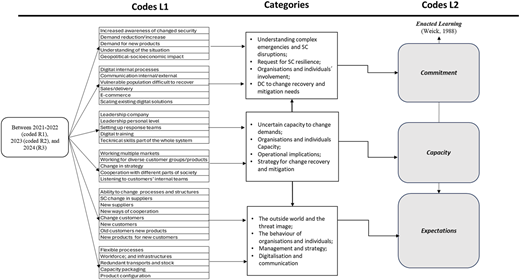
In the first stage, open coding (L1) was conducted inductively. Interview transcripts were systematically reviewed to identify meaningful units related to disruption experience, organisational learning, recovery practices, and capability development. This process generated 34 first-order categories capturing operational adjustments, collaboration patterns, digitalisation initiatives, workforce flexibility, strategic repositioning, and risk awareness. The aim at this stage was to remain close to the empirical material and avoid premature theoretical categorisation.
In the second stage, axial coding was applied to identify relationships among the first-order categories. The 34 categories were consolidated into six broader empirical patterns reflecting recurring responses to complex emergencies and supply chain disruptions. These patterns represented cross-case similarities in how organisations described their reactions, adaptations, and strategic reflections.
In the third stage, the analysis moved abductively from empirical patterns to theoretical integration. The six empirical patterns were interpreted through the lens of enacted learning (Weick, 1988). This step identified three second-order themes—commitment, capacity, and expectations—that captured how respondents interpreted disruption and translated those interpretations into action. Rather than imposing theory a priori, enacted learning served as an analytical framework to explain the mechanisms underlying the observed empirical patterns.
Throughout the analysis, constant comparison was applied across interviews and coding levels to ensure conceptual consistency and to identify convergence and divergence across cases. Data collection and analysis proceeded iteratively, and theoretical saturation was reached when additional interviews yielded no new insights into the second-order themes.
To enhance analytical reliability, two researchers independently conducted the first-level coding, while a third researcher reviewed and validated the development of second-order themes. Coding discrepancies were discussed until consensus was reached, strengthening dependability and confirmability (Pagell and Krause, 2005; Guba and Lincoln, 1994). An audit trail documenting coding decisions, theme development, and theoretical integration was maintained throughout the process.
3.4 Research quality and trustworthiness
The study follows Guba and Lincoln’s (1994) criteria for ensuring quality in interpretive research, emphasising credibility, transferability, dependability, and confirmability. Rather than relying solely on traditional validity and reliability measures (Creswell, 2014), the study adopts qualitative trustworthiness principles appropriate for abductive inquiry.
Credibility was strengthened through data triangulation across three interview waves and complementary secondary sources. The temporal layering of interviews (R1–R3) enabled cross-validation of emerging themes across different crisis contexts, enhancing internal coherence. Transferability was supported by providing detailed descriptions of respondents’ organisational contexts, industry positions, and supply chain roles (Table 2), allowing readers to assess applicability to other settings.
Dependability was reinforced through a structured and transparent coding process. Two researchers independently conducted first-level coding, while a third researcher independently reviewed and developed second-order themes. Coding discrepancies were systematically discussed until consensus was reached, ensuring analytical consistency (Pagell and Krause, 2005). An audit trail documenting coding decisions and theoretical integration was maintained throughout the research process.
Confirmability was supported by iterative team discussions and explicit documentation of the abductive movement between empirical data and theoretical interpretation. By grounding second-order themes in verbatim transcripts and systematically linking them to enacted learning constructs, the study reduces the risk of researcher-driven bias and enhances analytical transparency.
4. Empirical findings
This section presents the empirical findings illustrating how individuals and organisations interpreted overlapping crises and translated these interpretations into capability development within their supply chains. Drawing on the abductive analysis, the findings are structured around the three enacted learning dimensions identified in the data—commitment, capacity, and expectations—corresponding to Weick’s (1988) framework (see Figure 1).
Rather than viewing these dimensions as separate categories, they represent interconnected mechanisms through which respondents interpret disruption and activate DC to support recovery and mitigation phases. The subsections below, therefore, shift from empirical examples to interpretive explanation, showing how enacted learning influenced resilience-oriented capability development across different crisis contexts.
4.1 Commitment
Commitment reflects how organisations interpreted disruptions as requiring shared responsibility and strategic repositioning. Respondents described geopolitical, socioeconomic, and environmental uncertainties as systemic rather than temporary challenges, shaping which capabilities were prioritised for recovery and mitigation phases.
A transport-sector respondent emphasised that timely delivery during disruption was not only operational but part of a wider societal function:
Yes, I feel that transporting supplies […] on time is a very important technical skill in our work as part of the whole system […] we are working with a vulnerable share of the population during recovery. Swedish society has a high sense of security with little direct experience of threats and risks. (R1.6)
This quote illustrates how commitment extended beyond firm-level priorities into system-level meaning. Respondents often linked resilience to the ability to meet changing customer demands and maintain relationships under uncertainty. Several described how resilience-oriented supply chain design depends on industry, region, customer involvement, technology, and service complexity (R1.2; R1.5). Learning was interpreted as a driver of competitiveness in changed markets, and commitment was expressed through the willingness to maintain relationships and adjust offerings beyond the immediate crisis period (R1.7; R1.8).
One respondent captured the shift from peace-time assumptions toward broader societal cooperation:
I also think that Swedish industry has operated in a time of peace and has had it very good for many years. […] However, it is different now with the invasion. So, a change for the future requires cooperation with different parts of society and flexibility as a broader competence to stay resilient. (R1.2)
Here, commitment is enacted by redefining what resilience requires, moving from efficiency-based expectations toward flexibility and cross-sector cooperation. Respondents described commitment as demanding increased involvement with suppliers and stakeholders, and they often framed collaboration and resource integration as necessary for recovery and mitigation (e.g. R1.7; R1.9). The integration of external actors was also presented as challenging, particularly when commitment across organisations was uncertain or uneven. Respondents emphasised that coordination across interorganisational resources required shared engagement rather than purely contractual alignment (R2.14).
A respondent described how crisis experiences expanded collaboration beyond traditional boundaries:
The crises changed how we collaborate because it also had implications for our strategy […] However, we reached for a broader network for coping with our SC disruptions involving municipalities, politicians, police, schools, social authorities, and industry infrastructures tied to the community, but also from our competitors. (R1.10)
This illustrates the enacted learning mechanism: commitment is not simply a preference for collaboration, but a socially constructed interpretation that makes broader cooperation strategically necessary. Respondents also described transparency as enabling operational adjustments and resource use, particularly in logistics contexts (R1.11; R2.16). However, rather than repeating multiple similar transparency quotations, the key analytical insight is that transparency functioned as a capability justified through commitment: organisations framed open information-sharing as essential to manage uncertainty and coordinate scarce capacity.
Finally, respondents described how commitment translated into behavioural orientations relevant for recovery and mitigation, such as flexibility in employment, increased coordination, and faster responsiveness (R1.9; R3.18). These descriptions indicate that commitment shaped which dynamic capabilities were prioritised and legitimised during uncertainty. In summary, commitment operated as an enacted learning dimension through which organisations framed disruption as systemic, justified capability investments, and expanded collaboration to support recovery and mitigation.
4.2 Capacity
Capacity captures how organisations interpreted their ability to act and reconfigure resources under uncertainty. Respondents described how learning from crises led them to reassess internal skills, operational structures, and network relationships. These reinterpretations shaped the dynamic capabilities mobilised during recovery and mitigation.
Respondents described learning challenges associated with external risks, including complex emergencies and warfare, and emphasised that capability development required reassessing internal skills, coordination arrangements, and technological infrastructure (R1.8). Capacity was therefore enacted through how limitations and possibilities were interpreted, rather than treated as fixed conditions.
One respondent linked capacity to competence development and workforce renewal in technical environments:
The teams are collaborating on platforms working on software and hardware, and most people on the teams these days are young. […] Hiring engineers interested in robotics, who are apt to prepare for the future, wherein there will be closer cooperation with suppliers, will also result in better strategies. (R2.14)
Respondents often expressed trust in Swedish and European authorities and expected governmental support in crises (R1.7), but they also acknowledged that organisational capacity—particularly dynamic skills—had sometimes been underestimated until disruptions revealed their importance (R1.12). In this context, capacity was discussed in relation to the ability to adjust internal processes, strengthen technical skills, and create operational flexibility that could support recovery.
A recurring theme concerned the capacity to respond to changed demand and working conditions. Respondents described how pandemic experiences led to new arrangements in work practices, spatial organisation, and collaboration, and they framed these adjustments as learning processes that enable future preparedness. For example, one respondent explained how organisational design and work-from-home practices required new capacity configurations:
When designing our centres, everyone was part of almost everything, as many people wanted to work from home a couple of days per week. In future collaborations, employees will have greater flexibility, and we will need fewer desks. Employees may need a designated workspace close to the teams they work with, such as sales and marketing. It is nice to integrate and mingle when presenting a new thing. (R2.13)
Capacity was also framed as a network-level issue. Respondents argued that supply chain relationships would need to prioritise critical contacts and deepen cooperation with fewer partners to reduce complexity and increase responsiveness (R1.10; R1.12). They described uncertainty early in crises as creating planning challenges, where misinterpretation of demand trends could lead to capacity decisions that later became problematic:
Learning from our growth has been largely due to e-commerce. It has doubled and now accounts for 20% of the total turnover. […] Owing to uncertainty early in the pandemic, the purchasing department wanted to wait and stop part of the production. They are part owners of some supplying factories. This became a problem since it turned into growth. (R2.14)
Operationally, respondents described efforts to reduce supply chain complexity and improve responsiveness by accelerating learning processes and enhancing transparency across integrated operations. They also noted that formal risk management systems can be slow, creating friction during disruptions (R2.14; R2.16). The resulting capacity constraints were illustrated through examples where service activities and technical interventions were delayed due to restrictions, reducing operational speed and adaptability:
Our companies handle services on the automated cranes, robots, lifts, repairing trucks, and suppliers needing technical skills for repacking their goods when visiting the warehouse. Nevertheless, they were trying to limit visits, slowing down the process (during COVID-19). (R3.17)
Respondents additionally discussed flexibility as central to capacity in recovery and mitigation but also highlighted vulnerabilities created by complex global sourcing structures, particularly when sub-supplier dependencies were difficult to control (R1.1; R1.5). One respondent summarised flexibility as the ability to manage production, relationships, and resources under uncertainty:
SC flexibility consists of the ability to control production, relations, and resources in the face of uncertainties and to endure different customers’ demands. (R2.13)
Overall, the data reflect enacted learning through reinterpretations of what organisations can do, how quickly they can adjust, and which competencies and relationships enable reconfiguration during recovery and mitigation.
4.3 Expectations
Expectations reflect how respondents reconstructed future threat images and aligned capability development accordingly. The findings show that anticipatory interpretations of geopolitical risk, energy instability, and technological change influenced long-term investments and strategic repositioning.
While commitment related to how disruptions were framed as requiring responsibility and action, and capacity related to perceived ability to reconfigure resources, expectations captured an anticipatory orientation: respondents’ interpretations of which kinds of crises would shape their future operations and which capabilities would therefore be necessary (R3.21; R3.19).
Respondents emphasised the importance of collaborating with external partners to monitor behavioural changes and adapt purchasing, innovation, and strategic planning processes (R3.21). They described scenario planning and mitigation discussions as increasingly integrated into business plans, providing reasons to coordinate with suppliers on upstream processes (R3.19). One respondent described security planning as involving responsibility allocation and critical function identification across actors:
Companies make their security plans, which include deciding who is responsible, which functions are critical, and which communication is essential. Companies also ensure that all actors take responsibility […]. (R3.21)
Respondents described COVID-19 as accelerating efforts to build resilient systems and increasing emphasis on information-sharing across supply chains (R1.5; R2.14; R2.15). At the same time, they expressed that resilience investments were shaped by management behaviours and perceptions of uncertainty, and that vulnerability remained persistent even when capabilities improved:
Uncertainty is great; warfare disrupts all flows regardless of whether we try to mitigate irrational risks. But when we have come through these crises, we may have a better position and tools to face the next crises, but we are still very vulnerable. (R3.21)
Expectations are also related to how behavioural changes affected organisational practices and the organisation’s capability needs. Respondents highlighted how e-commerce growth required hiring, operational expansion, and new digital competencies, and how training and recruitment processes shifted to digital formats to address skills gaps (R1.6; R1.8). They described innovation and new market development as part of post-crisis repositioning:
Effects on organisations and individuals’ behaviour arise during and after the COVID-19 crisis. For example, we found new customers, markets, segments, and ideas about entrepreneurship. (R3.18)
Several respondents argued that collaborative environments enabled strategic learning, especially when organisations could discuss investments and plans without competitive pressure (R3.16). This was linked to expectations concerning sustainability and technological development, which respondents described as increasingly embedded in strategic agendas:
The management of companies has also developed new ways to create strategic agendas. […] Sustainability has reached new levels and can now be incorporated into the management of strategic plans. For example, cars powered by biogas can be implemented with the goal of making the logistics chain green. (R3.18)
Respondents also emphasised energy security and infrastructure dependencies as shaping future investments. They described how energy disruptions constrained the use of digital tools and automation, motivating investment in alternatives such as solar energy systems (R2.6). In addition, respondents linked expectations to geographic reconfiguration and regionalisation strategies, especially through increased focus on Europe and reduced dependence on distant supply bases:
Purchasing regionalisation and increased focus on Europe means bringing back production and stock from China. […] Exporters of e-commerce in Europe, hospital-related materials for the home (the staff visited patient homes), and logistic systems are pushing development among, e.g. a manufacturer of secure doors, which is a global example with warehouses in over 33 countries. (R3.18)
Finally, respondents stressed that networks remained essential for coordinating capabilities and expanding resilience, particularly as digitalisation and communication became intertwined with maintaining responsiveness to changed demand and innovation needs (R1.4; R3.21). Taken together, expectations in the data illustrate how enacted learning extended beyond immediate recovery to anticipatory positioning, influencing investment decisions and longer-term capability development in mitigation.
5. Discussion
This study examined how individuals and organisations make sense of supply chain disruptions and how such enacted learning shapes dynamic capabilities (DC) that strengthen supply chain resilience (SCR) during recovery and mitigation phases. The findings demonstrate that resilience is not merely a structural property of supply chains but emerges through interpretive processes that influence how capabilities are mobilised and reconfigured. By integrating enacted learning (Weick, 1988) with DC and SCR, the study shows that commitment, capacity, and expectations function as interpretive micro-foundational mechanisms through which organisations translate disruption experience into resilience-building action.
The discussion addresses the two research questions guiding this study.
5.1 Addressing RQ1: how do individuals and organisations make sense of disruptions?
The findings reveal that sensemaking unfolds through three enacted learning dimensions: commitment, capacity, and expectations (Weick, 1988). In line with enactment theory applied in supply disruption research (Ellis et al., 2011), disruptions are not passively observed but actively interpreted and framed. Actors construct meaning around uncertainty and, through that meaning-making, shape organisational responses.
Commitment reflects how organisations frame responsibility and strategic direction in the face of disruption. The COVID-19 pandemic, geopolitical instability, and energy crises were increasingly interpreted not as temporary disturbances but as systemic vulnerabilities requiring broader engagement and long-term adjustment. This interpretive shift resulted in expanded cooperation with municipalities, authorities, and logistics actors, strengthened transparency across supply chain networks, and a greater willingness to invest in resilience-related initiatives. Commitment, therefore, influenced which issues were prioritised and which capabilities were considered necessary for recovery and mitigation phases.
Capacity concerns how organisations reassess their resources and operational flexibility in the face of uncertainty. The findings show that capacity was not treated as fixed but as something to be interpreted, evaluated, and reconfigured. Organisations reconsidered workforce arrangements, supplier dependencies, digital infrastructure, and logistics integration. Digitalisation and communication capabilities became central mechanisms for enabling rapid adjustment. Thus, sensemaking at the capacity level shaped how organisations perceived their room for manoeuvre and how they reallocated resources during recovery and mitigation phases.
Expectations relate to how organisations interpret the future threat landscape and anticipate further disruptions. Respondents described forward-looking reflections on geopolitical risks, cyber threats, energy instability, and shifting demand patterns. These expectations influenced strategic choices, including regionalisation, redundancy investments, digital upgrades, and sustainability initiatives. Expectations, therefore, connected crisis experience to anticipatory action and repositioning.
In response to RQ1, individuals and organisations make sense of disruptions through enacted learning processes that shape how crises are framed, how internal and external resources are interpreted, and how future risks are anticipated. Sensemaking is thus a foundational mechanism to resilience-building rather than a peripheral activity.
5.2 Addressing RQ2: which dynamic capabilities enable SCR in recovery and mitigation?
The findings further indicate that DC are not automatically mobilised during crises. Instead, they are interpretively mobilised through enacted learning. This complements DC theory, which conceptualises reconfiguration as a strategic process (Eisenhardt and Martin, 2000; Teece, 2007), by demonstrating that such processes are socially and psychologically enacted.
Table 3 provides a systematic synthesis of how commitment, capacity, and expectations translate into specific resilience-oriented capabilities development. Commitment shaped capabilities such as enhanced collaboration, improved transparency, employment flexibility, and knowledge development for new products and markets. These results align with research positioning DC as central to SCR (Wieland and Durach, 2021; Kaneberg et al., 2025), yet they extend prior work by showing that capability mobilisation is grounded in interpretive commitments formed through crisis experience.
Summary of findings
| Sensemaking | |
|---|---|
| Learnt subjects | DC to SCR |
| Commitment Creates greater motivation to solve problems | Understanding complex emergencies and SC disruptions
|
| Capacity Individuals and organisations believe they have the capacity to take action | Uncertain capacity to change demands
|
| Expectations Expect to get more resources and tend to prepare better | The outside world and the threat image
|
Capacity-related sensemaking influenced organisational reconfiguration processes, including internal team restructuring, IT integration, knowledge sharing, and supplier coordination. Balancing capacity, often conceptualised as a DC (Eisenhardt and Martin, 2000), was not merely a technical adjustment but a socially interpreted process shaped by perceived vulnerability and trust in networks. Digitalisation competence and communication flexibility emerged as particularly critical enablers of rapid adaptation.
Expectations shaped long-term strategic adjustments, including regional sourcing, redundancy decisions, and investments in monitoring and digital systems. These developments reflect sensing and transforming processes within DC theory (Teece, 2007), but the findings show that such processes are rooted in enacted interpretations of future uncertainty. Expectations, therefore, function as a bridge between crisis learning and forward-looking resilience-building.
In response to RQ2, the DC that strengthen SCR in recovery and mitigation phases are those mobilised through enacted learning. Flexibility, collaboration, visibility, digitalisation competence, and strategic monitoring become resilience-enabling when organisations interpret disruptions as requiring resource reconfiguration.
This table summarises the second-order thematic synthesis linking enacted learning dimensions to DC.
5.3 From enacted learning to supply chain resilience
Taken together, the findings suggest a micro-foundational mechanism: enacted learning shapes DC, which, in turn, strengthens SCR. Resilience trajectories of persistence, adaptation, or transformation (Wieland et al., 2023) depend on how organisations interpret disruptions. Where commitment is strong and expectations shift significantly, transformation becomes more likely. Where capacity reassessment emphasises continuity and risk containment, persistence or incremental adaptation prevails.
SCR outcomes are therefore contingent upon interpretive processes rather than solely structural configurations. Resilience is not simply the possession of flexibility or redundancy but the enacted mobilisation of capabilities shaped through commitment, capacity, and expectations.
5.4 Theoretical implications
This study refines the theoretical understanding of SCR by positioning enacted learning as the interpretive mechanism linking disruption experience to DC mobilisation. While prior research has identified structural attributes of resilience such as flexibility, redundancy, and collaboration (Ponomarov and Holcomb, 2009; Pettit et al., 2010), this study demonstrates that the effectiveness of such attributes depends on how organisations interpret uncertainty through commitment, capacity, and expectations (Weick, 1988).
By integrating enacted learning with DC theory (Eisenhardt and Martin, 2000; Teece, 2007), the study clarifies how capability reconfiguration is grounded in social and psychological processes. DC are not simply organisational routines but are mobilised through interpretive processes that shape strategic orientation, resource allocation, and anticipatory positioning. This perspective contributes to the discussion of micro-foundational mechanisms in DC research by identifying enacted learning as a key explanatory mechanism in disruption contexts.
Furthermore, the findings extend sensemaking research in supply chain management beyond risk perception (Ellis et al., 2011) by demonstrating how learning from crises influences long-term strategic adaptation and resilience trajectories. The integration of commercial and humanitarian perspectives on recovery and mitigation phases also highlights the relevance of interpretive processes across different operational logics, suggesting that resilience-building in both contexts depends on how actors collectively frame uncertainty and reconfigure capabilities accordingly.
Overall, the study presents a unified theoretical explanation in which enacted learning influences DC, which, in turn, facilitates SCR during recovery and mitigation phases.
5.5 Implications for recovery and mitigation phases practice
The findings suggest that strengthening SCR requires more than structural redundancy or buffer investments. Organisations benefit from institutionalising structured crisis reflection and learning processes, fostering cross-network collaboration that broadens interpretive perspectives, investing in digital and communication competencies as enabling capabilities, and continuously monitoring geopolitical and systemic risks. Resilience is therefore both structural and interpretive. Organisations that actively engage in enacted learning are better positioned to mobilise DC effectively in uncertain environments.
5.5.1 Policy implications
Drawing on the Swedish context examined in this study and extending beyond firm-level managerial implications, this study also offers insights for policymakers and public authorities seeking to strengthen systemic SCR. The findings indicate that resilience in recovery and mitigation phases depends not only on organisational capabilities but also on the broader institutional and regulatory environment that shapes enacted learning processes across networks.
First, the results highlight the importance of structured public–private coordination. Respondents described closer collaboration with municipalities, authorities, and societal actors during crises, suggesting that resilience-building extends beyond individual firms. Policymakers can facilitate such coordination by institutionalising cross-sector resilience forums, joint scenario planning exercises, and information-sharing platforms that support collective sensemaking under uncertainty. When public actors provide clear communication channels and shared threat assessments, organisations are better able to align commitment, capacity, and expectations across networks.
Second, the findings point to the need for policy frameworks that support transparency and digital integration. Digitalisation and communication capabilities emerged as central enablers of recovery and mitigation phases. Governments can strengthen systemic resilience by promoting interoperable digital infrastructure, supporting cybersecurity standards, and encouraging data-sharing among supply chain actors. Regulatory clarity in areas such as cyber risk management and cross-border information exchange may reduce uncertainty and enhance anticipatory capability development.
Third, the study underscores the relevance of regionalisation and strategic autonomy debates in policy contexts. As organisations reassessed sourcing strategies and supply dependencies in response to geopolitical instability, expectations regarding future threats influenced investments in regional production and redundancy. Policymakers should therefore consider how industrial policy, trade agreements, and infrastructure investments shape firms’ ability to reconfigure supply networks. Supporting critical sectors through targeted incentives or resilience audits may enhance preparedness without undermining market efficiency.
Finally, integrating commercial and humanitarian perspectives suggests that resilience policy cannot be confined to the emergency response phase alone. Recovery and mitigation phases require long-term capability development and learning across sectors. Policymakers may benefit from embedding resilience considerations into civil defence planning, sustainability strategies, and industrial development programmes to ensure that enacted learning processes are supported institutionally.
Overall, the findings suggest that effective resilience policy must recognise the interpretive dimension of supply chain adaptation. By enabling coordinated sensemaking, strengthening digital and institutional infrastructures, and aligning strategic incentives, public actors can enhance the systemic conditions for mobilising DC for recovery and mitigation phases.
6. Conclusions
This study examined how individuals and organisations make sense of supply chain disruptions and how enacted learning shapes dynamic capabilities. In doing so, the study clarifies how resilience emerges through interpretive processes rather than solely through structural configurations. Addressing RQ1 and RQ2, the findings demonstrate that resilience-building is not merely a matter of structural design but is grounded in interpretive processes through which actors frame uncertainty, reassess resources, and anticipate future risks.
In response to RQ1, the study shows that individuals and organisations make sense of disruptions through enacted learning processes structured around commitment, capacity, and expectations (Weick, 1988). Commitment shapes how responsibility and strategic direction are framed in the face of uncertainty. Capacity influences how organisations interpret their ability to act and reconfigure resources. Expectations guide forward-looking strategic adjustments in response to evolving threat pictures. These dimensions collectively determine how disruption experience is translated into organisational action.
In response to RQ2, the findings reveal that DC are not automatically deployed in crisis contexts but are interpretively mobilised. Flexibility, collaboration, visibility, digitalisation competence, and strategic monitoring become resilience-enabling when organisations interpret disruptions as requiring reconfiguration. Through enacted learning, these capabilities are aligned with recovery and mitigation needs, shaping whether organisations pursue persistence, adaptation, or transformation (Wieland et al., 2023).
The study, therefore, contributes to SCR research by demonstrating that resilience emerges from the enacted mobilisation of capabilities rather than from their mere existence. It extends DC theory by clarifying the interpretive processes that underpin capability reconfiguration in disruption contexts. Furthermore, it advances sensemaking research in supply chain management by showing how enacted learning connects crisis experience to long-term capability development and strategic repositioning.
Empirically, the study provides evidence from Swedish organisations operating in globally interconnected supply chains, illustrating how overlapping crises reshape learning processes, inter-organisational collaboration, and strategic priorities. The findings underline that resilience is simultaneously structural and interpretive, requiring both resource configuration and continuous meaning-making across organisational and network levels.
While the study is grounded in a specific regional and industrial context, it opens avenues for future research. Further studies could examine enacted learning processes across different institutional environments, explore longitudinal dynamics of capability mobilisation, and investigate how digitalisation and communication infrastructures reshape sensemaking in global supply chains.
Taken together, this research demonstrates that SCR in recovery and mitigation phases is best understood as an enacted process. Through commitment, capacity, and expectations, organisations interpret disruption, mobilise DC, and strengthen their ability to withstand and adapt to complex emergencies.
Appendix
Interview questions
Operations for responding to complex emergencies
Which operations were most affected by COVID-19 and subsequent disruptions, and which processes were impacted?
How did you adapt to the new situation (operationally, administratively, regarding the use of technical tools, and regarding the acquisition of new skills)?
Changing the capabilities of the organisation
What processes, resources or organisational aspects have changed to respond to pandemic disruptions?
What solutions were implemented, and what processes were impacted by the pandemic at your organisation?
Which areas needed investment or upgrades to meet the changes in requirements caused by the pandemic?
Will your strategy need changes to be prepared for future emergencies/crises?
COVID-19 affects work at that strategy level, e.g. the routines around the number of meetings, type of meetings, which participants are there, and which issues are raised.
Focus on the strategic level changed – How?
Management developments in skills/competencies after COVID-19
COVID-19 effects on the company at the operational level
Effects at the strategic level influence the operational level.
Networks essential to meet disruptions
Has cooperation with business actors been affected? Where has the effect been most substantial – most positive/negative?
What has been the impact on customer satisfaction?
How have suppliers been impacted, and what has been the impact on your organisation?
Have you developed networks/relations? If so, with whom and how? To what extent and in what areas?
What is the impact of COVID-19 disruptions on new business opportunities, e.g. new services, new ideas, and new products/combinations?
Cooperation within the firm networks and other networks
With respect to supply chain networks, industry networks, and total network changes
number and type of cooperation.
change in position, degree of integration in the networks
finding new cooperation partners/networks
Recovery and mitigation
What has your organisation learnt to recover from future crises—planning, business opportunities, new strategies, etc.?
How can you be better prepared to recover quickly?
How do working networks/relationships prepare and mitigate the effects of complex crises?
Was the recovery of businesses impacted by the COVID-19 pandemic?
Was the recovery of impacted processes and operations affected?
Were there any effects on the business model?
What learning approaches were used to interpret the crisis and its effect on the business?
Learnings to better prepare for another complex crisis
What did the company and individuals learn after the crisis?
What did the organisation and individuals learn about the crisis?
What did they learn about supporting strategies to improve their ability to recover from and mitigate threats?
How was learning implemented—formal/informal, strategic/operational, stated/unstated/document or guidelines?
Did the organisation and individuals learn about necessary investments to manage future crises better?
Were there any changes in business/strategy/daily operations to respond to a significant crisis in the future?
Did you notice any resistance to learning due to changes that were implemented to deal with the crisis?
Learnings from disruptions (such as COVID-19) not only to recover but also to deal with future crises
What knowledge, competence and skills were gained or developed—general, specific?
How are these reflected in your firm/business, and in what ways have they changed?
management/processes/systems
routines and behaviour
With respect to the learning impact on operations
marketing/sales/operation/production/logistics
HR and handling personnel,
planning strategically
communications and IT
product or service development
Individuals and organisations’ decisions/actions to recover from the current crisis and deal with future crises (e.g. the Russian/Ukrainian war or energy crises and a disrupted food supply chain because of sanctions)
How do you prepare for the future? How has your preparation for a future crisis changed/improved
With respect to developing/finding new resources, and investments
addressing risks and/or uncertainty?
buffering or non-buffering,
changing position in the market or supply chains now?
IT for addressing cyberattacks.

