


This study investigates how dynamic capability (DC) relationships and deployment patterns enable firms to transition from sustainable supply chain management to circular supply chains (CSC).
A mixed-methods, exploratory sequential design combined a multiple case analysis of four multinational manufacturing firms with quantitative validation. The qualitative phase analyzed semi-structured interviews and corporate documents to identify DCs and their deployment patterns. The quantitative phase employed Ward's hierarchical clustering on academic expert evaluations to examine relationships among capabilities, refining case-derived patterns into generalizable configurations that enable CSC transitions.
This research identifies Circular DCs into three groups, with their relationships facilitating the adoption of circularity. Foundational Innovation DCs (Technology Management, Product Design Management, Process Innovation) establish an internal infrastructure to enable circularity. Transitional Collaboration DCs (Supply Chain Collaboration, Supply Market Orientation) facilitate integration across the supply chain partners. Scaling Enablement capabilities (Human Resource Management, Marketing) support ongoing transformation. These groups enable firms to progress through three practice types supporting circularity strategies. Foundational practices emerge from complementary relationships among Foundational Innovation DCs deployed at balanced levels of reconfiguring and seizing. Transitional practices emerge when Transitional Collaboration DCs form integrative relationships with established Foundational Innovation DCs. Scaling practices require reconfiguring the dominant deployment of both Foundational Innovation and Transitional Collaboration DCs, with support from Scaling Enablement capabilities.
The limited longitudinal analysis and sample size suggest caution in generalization. Future research should examine DCs across diverse contexts and timeframes.
The framework directs the sequencing of capability development, starting with establishing Foundational Innovation DCs through balanced deployment, then adding Transitional Collaboration DCs once the foundations are in place, and finally developing Scaling Enablement capabilities for ongoing transformation.
The research highlights ways to improve societal well-being by emphasizing collaboration among supply chain partners. These findings support sustainable employment and shape public attitudes toward circular practices.
This study advances DC theory by showing that adopting circularity depends on specific relational configurations and deployment patterns rather than individual capability strength. It reveals how complementary, integrative, and enabling relationships across deployment levels facilitate collaborative transitions to CSC practices.
1. Introduction
Despite 2 decades of sustainability initiatives, manufacturing supply chains struggle to reach “zero-waste”; even those implementing closed-loop systems and reverse logistics remain constrained by their conventional supply chain relationships and within existing supply chain boundaries (Geissdoerfer et al., 2017; Guide and Van Wassenhove, 2006). Sustainable supply chain management (SSCM) approaches, including reverse logistics, green supply chains, and closed-loop systems, have successfully mitigated environmental impacts within these boundaries (Seuring and Müller, 2008; Srivastava, 2007). However, they cannot overcome this fundamental limitation; for instance, closed-loop systems rarely consider adopting reuse or remanufacturing of end-of-life products within their original supply chains, leaving substantial value unrecovered (Allen et al., 2021; Weetman, 2017).
The circular economy (CE) paradigm provides a different proposition by introducing the circular supply chain (CSC), enabling value recovery across supply chains through collaborations with firms in the same or different industrial sectors (Genovese et al., 2017; Bocken et al., 2016). This cross-chain, cross-sectoral approach to adopting CE requires engaging diverse actors, including remanufacturers operating across multiple industries, reverse logistics providers facilitating inter-chain flows, and circular service intermediaries connecting supply chain actors (Farooque et al., 2019; De Angelis et al., 2018). Such multi-actor, cross-boundary networks create complex collaboration challenges that extend far beyond conventional supply chain relationships. Consequently, firms must develop and deploy dynamic capabilities (DCs) that enable them to sense opportunities for circularity, seize collaborative implementation pathways with different partners, and reconfigure operations through collaborative multi-actor interactions (Eisenhardt and Martin, 2000; Teece, 2007). The critical question facing researchers and practitioners is not whether DCs matter for circularity, but how these capabilities must interrelate to enable collaborative transitions across supply chain actors operating in complex, cross-sectoral networks.
Managing this multi-actor, cross-chain complexity requires capabilities that collaborate rather than operate in isolation. The DC theory describes three fundamental categorization processes through which organizations adapt: sensing opportunities and threats, seizing opportunities through resource mobilization, and reconfiguring organizational assets and structures (Teece, 2007). However, existing research usually examines these capabilities separately, overlooking how they need to connect to facilitate collaboration among unfamiliar actors and across sector boundaries (Schilke et al., 2018; Warner and Wäger, 2019). While separate DCs enable firms to overcome organizational inertia during sustainability transitions (Ambrosini and Bowman, 2009), the effectiveness of cross-chain circularity adoption may depend on specific relational patterns among capabilities rather than individual capability strength alone. This relational gap becomes particularly critical when firms must orchestrate value recovery networks across multiple supply chains and industrial sectors (Geissdoerfer et al., 2017; Hazen et al., 2021).
This relational perspective remains absent in existing DC research on circularity. Prior studies have examined the role of DCs in the evolution of sustainability within linear supply chains (Beske et al., 2014; Li et al., 2024), environmental management (Scarpellini et al., 2020), quality management (Gutierrez-Gutierrez et al., 2018), and firm-level CE adoption (Khan et al., 2020; Allen et al., 2021). These studies establish that individual DCs enable sustainability outcomes within bounded organizational contexts. However, they do not address how capabilities must interrelate when firms collaborate with different partners across supply chain and sectoral boundaries—a fundamental requirement for cross-chain circularity (Eisenhardt and Martin, 2000; Pieroni et al., 2019; Teece, 2018).
To the best of our knowledge, evidence remains limited on two critical aspects: first, the relational configurations among DCs that enable multi-actor collaboration across supply chain boundaries; and second, the deployment patterns across sensing, seizing, and reconfiguring categories that facilitate the adoption of collaborative circularity practices across multiple supply chains and industrial sectors. In this study, “circularity practices” refer to organizational activities and operational routines that firms implement to advance CE approaches. These practices (e.g. remanufacturing) aim to recover functional and material values by prolonging product lifecycles, reducing consumption of virgin raw materials, and minimizing waste within and across supply chain boundaries (Kumar et al., 2007; Farooque et al., 2019). Heavy manufacturing industries provide an ideal context for investigating how DCs interrelate and deploy. Their complex multi-tier supply chains and cross-sectoral value recovery opportunities make collaboration challenges both visible and empirically accessible (Bozarth et al., 2009; Najjar and Yasin, 2023). Consequently, this study explores DC relational configurations and deployment patterns that enable manufacturing firms to adopt circularity practices and transition toward CSC. The main research question guiding this investigation is.
How do DC relationships and multi-category deployment patterns enable manufacturing firms to adopt circularity practices and transition to CSC?
This question explores two interconnected aspects addressing the identified gaps. First, DC relationships: how capabilities collaborate through complementary, integrative, or enabling patterns across supply chain and sector boundaries. Second, deployment patterns: how firms deploy capabilities across sensing, seizing, and reconfiguring categories rather than single-category approaches. To illustrate this relational perspective and provide a clear conceptual roadmap for the study, Figure 1 presents the framework used in our research. The framework illustrates how firms transition from SSCM to CSC through three groups of DCs. Group 1 (Foundational Innovation DCs) establishes internal circular infrastructure through foundational practices. Group 2 (Transitional Collaboration DCs) integrates supply chain partners through transitional practices, creating integrative relationships with Group 1 capabilities. Group 3 (Scaling Enablement Capabilities) supports sustained transformation through scaling practices, working in collaborative and enabling relationships with the other groups. The arrows indicate that these capability groups do not operate in isolation; rather, their effectiveness emerges from specific relational configurations and balanced deployment across sensing, seizing, and reconfiguring categories. This relational perspective represents the novel contribution of this study, shifting the focus from examining individual capabilities to understanding how capabilities must interrelate and be deployed in collaborative patterns to enable simultaneous adoption of circularity across the supply chain.
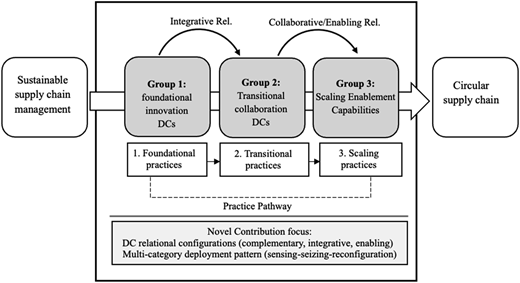
Framework of DC relationships and practice pathways for transition toward CSC; Rel: relationship
Framework of DC relationships and practice pathways for transition toward CSC; Rel: relationship
To address this, we employ an exploratory sequential mixed-methods design, combining multiple case studies of four multinational manufacturing firms with expert validation using Ward's hierarchical clustering. This approach enables both in-depth examinations of how capabilities evolve within organizations and how relational patterns can be generalized across broader expert groups. As a result, this study refines DC theory by shifting the focus from individual capabilities to understanding relational configurations. We establish a framework that outlines how capabilities relate, complement, and integrate to facilitate circularity transitions. This relational view explains why firms with similar capabilities reach different achievement levels of value recovery after circularity. This view highlights both theoretical insights into capability implementation and practical guidance for initiating CSC across industries. Consequently, this paper is structured as follows: the second section presents the theoretical background; the third section outlines the methodology; the fourth section details the results; the fifth section discusses the findings and propositions; the sixth section provides the implications; and the final section presents the conclusion.
2. Literature background
2.1 From sustainable to circular supply chain
Sustainable supply chain management (SSCM) integrates economic, environmental, and societal considerations (the triple bottom line) into materials, information, and capital flows throughout supply chains (Carter et al., 2020). Companies use this framework to identify practices addressing sustainability dimensions within traditional linear production-consumption models (Malhotra, 2023; Shekarian et al., 2024). However, SSCM remains constrained by linear economic assumptions that limit the recovery value from end-of-life products and the potential for waste reduction (Allen et al., 2021).
CSC management represents a fundamental departure from this linear model. CSC integrates circular thinking into supply chain management and related industrial ecosystems. It systematically recovers functional and material values (Kumar et al., 2007; Ayati et al., 2020), as well as biological materials, toward zero-waste visions through system-wide innovation spanning from product design to end-of-life management (Batista et al., 2018; Farooque et al., 2019; Ayati and Aminoff, 2026). While SSCM focuses on mitigating negative impacts within linear flows, CSC creates regenerative and cyclical material and energy flows across supply chain networks (Batista et al., 2023).
This transition from SSCM to CSC presents considerable organizational challenges. Firms must reconfigure resource bases and operational routines while simultaneously managing sustainability requirements and implementing circular practices at scale (Geissdoerfer et al., 2017; Hazen et al., 2021; Ayati et al., 2024). The transition requires developing new capabilities that extend beyond individual firm boundaries to enable coordinated circularity across supply chain partners (Farooque et al., 2019; Pal and Sandberg, 2024). Understanding how organizations develop and deploy these capabilities during SSCM-to-CSC transitions remains a critical research need.
2.2 Positioning dynamic capabilities for circular supply chain transitions
Dynamic capability (DC) theory provides a framework for understanding organizational adaptation by enabling the “integrate, build, and reconfigure internal and external competences to address rapidly changing environments” (Teece et al., 1997). Teece's (2007) framework identifies three fundamental processes: sensing opportunities and threats, seizing opportunities, and reconfiguring assets and capabilities. These processes enable organizations to maintain competitive advantage in dynamic environments by continuously adapting resource bases and operational routines. DC applications to sustainability contexts have gained considerable attention. Beske et al. (2014) demonstrated how DCs enable sustainable supply chain practices in the food industry, while subsequent studies explored their roles in environmental management (Scarpellini et al., 2020) and corporate sustainability (Wu et al., 2013). Siems et al. (2021) emphasized the importance of DC for implementing practices that establish sustainable competitive advantages in manufacturing supply chains. However, these studies primarily focus on linear supply chain models and general sustainability practices, rather than circular transitions.
Recent research has begun to explore DCs in the context of CE. Kabongo and Boiral (2017) provided case evidence of capability development for eco-efficiency, while Khan et al. (2020) identified organizational routines enabling CE implementation at the firm level, demonstrating that sensing, seizing, and reconfiguring capabilities facilitate CE adoption, with reconfiguring showing the strongest effects. The literature emphasizes firms' adaptability when facing circularity transition uncertainties (Belhadi et al., 2022; Bocken and Konietzko, 2022; Chari et al., 2022), responding to emerging circular business models (Dwivedi et al., 2023), shifting consumer preferences (Hunka et al., 2021), and evolving regulatory frameworks (Bag and Rahman, 2023).
2.2.1 Understanding capability relationships through synergistic effects
While DC theory posits sensing, seizing, and reconfiguring as core processes, understanding how these capabilities interconnect requires consideration of synergistic effects. Organizational synergy occurs when combined elements produce effects that exceed their individual contributions (Goold and Campbell, 1998). This concept, recognized in strategic management, applies to how capabilities interact, where complementarities and co-specialization create value (Teece, 2007). Research shows that capabilities become effective through coordinated use rather than isolated efforts (Eisenhardt and Martin, 2000; Teece, 2007). When combined, capabilities can deliver better results than when used alone, as their interactions create reinforcing effects that enhance organizational adaptability (Helfat and Peteraf, 2003; Land et al., 2022). This relational perspective suggests that understanding which capabilities to deploy is insufficient; organizations must also understand how these capabilities connect and what deployment patterns lead to effective configurations. However, there is limited empirical research on these capability relationships, especially regarding which relational patterns enable specific organizational outcomes such as circularity adoption. In CSC contexts, synergy suggests that the effectiveness of capabilities depends on both their individual strength and how well they complement and reinforce each other. Successful circularity transitions likely require specific configurations where capabilities work together synergistically rather than in isolation.
2.2.2 DC relationships and deployment patterns
Despite these contributions, existing research examines individual DCs without exploring DC relationships. The current literature identifies which DCs are crucial for sustainability (Beske et al., 2014) or firm-level circularity (Khan et al., 2020) but does not address how these capabilities must relate to one another. To the best of our knowledge, empirical evidence on DC relationships remains limited. Furthermore, the deployment levels across the sensing, seizing, and reconfiguring categories that enable the adoption of circularity practices during SSCM-to-CSC transitions remain underexplored. The distinction between firm-level circular adoption and supply chain-level circular transitions is essential. While firm-level circularity focuses on developing internal capabilities, CSC transitions involve coordinating direct relationships across multiple organizations, requiring complex inter-organizational arrangements to identify opportunities, make collaborative investments, and reconfigure supply chain relationships for circular flows (e.g. Calzolari et al., 2023). This study addresses this gap by examining DC relationships and deployment patterns that enable the adoption of circularity practices and CSC transitions.
3. Methodology
This study employed a mixed-methods, exploratory sequential design, in which an initial qualitative phase explores a phenomenon to inform a subsequent quantitative phase (Creswell and Clark, 2017; Golicic and Davis, 2012). As illustrated in Figure 2, the design consists of two phases. The qualitative phase (Phase 1) involved purposively selecting four multinational manufacturing companies, conducting semi-structured interviews with key participants, and collecting data through case studies using established protocols. Qualitative data were analyzed using MAXQDA software with a three-order coding procedure to identify DCs (see Appendix 1 for their definitions), their deployment patterns across sensing, seizing, and reconfiguring categories, and relationships among capabilities that enable circularity adoption. The quantitative phase (Phase 2) was built on qualitative findings by developing an expert evaluation protocol. This involved constructing a 6-point Likert scale assessment informed by identified DCs and circularity strategies, conducting an academic workshop for validation, and surveying academic experts across multiple countries via the Webropol platform. Data were analyzed using Ward's hierarchical clustering method in Python to examine DC relationships and groupings. Integrating qualitative case insights with quantitative clustering outcomes enabled refinement of the theoretical framework, revealing how DC relational configurations facilitate CSC transitions (Grant et al., 2023). The rationale for this design is based on three methodological considerations. First, a theoretical understanding of DC relationships in circularity contexts necessitated qualitative exploration to identify relevant constructs and deployment patterns (Khan et al., 2020). Second, the variables were unknown regarding how DCs cluster, how they interrelate, and which deployment patterns enable circularity, which made qualitative exploration essential before quantitative testing. Third, establishing refined theoretical frameworks required quantitative validation of qualitative insights across academic expert populations (Eisenhardt and Martin, 2000; Voss et al., 2002).
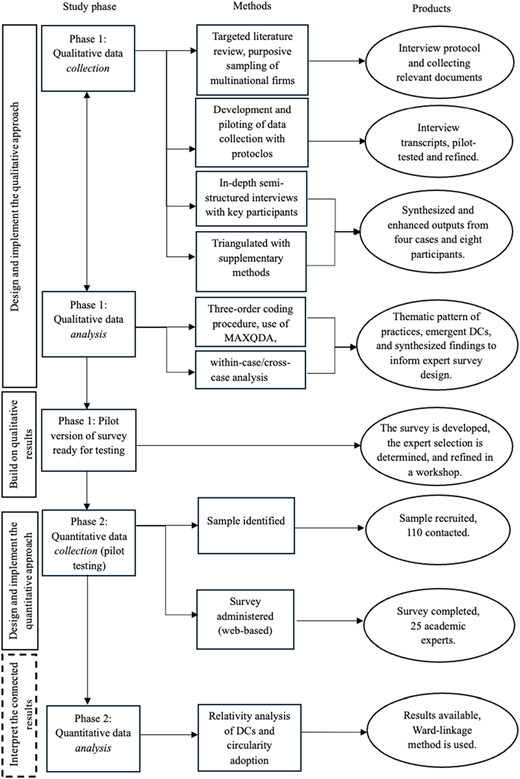
3.1 Qualitative research phase
Building on Creswell and Clark (2017), this part of the study incorporates the processes for conducting rigorous case study research: (1) case selection, (2) data collection, and (3) data analysis.
3.1.1 Case selection
Heavy manufacturing industries were selected as the empirical setting for three reasons. First, their complex multi-tier supply chains make multi-actor collaboration dynamics highly observable. Second, extended product lifecycles enable examination of DC deployment across multiple phases of circular practice. Third, cross-sectoral value recovery opportunities exemplify the cross-boundary coordination central to this study (Guide and Van Wassenhove, 2006; Bozarth et al., 2009; Ayati et al., 2022; Genovese et al., 2017).
To this end, this study employed purposive sampling to select cases that provided rich insights into how organizational routines enable DCs' development during transitions to circularity (Patton, 2014).
The case selection criteria were specifically designed to address the research question by ensuring access to firms with observable processes for capability development. Cases needed to meet the following theoretically informed criteria: (1) Transition evidence: Each case firm demonstrated SSCM implementation with varying degrees of circular practice adoption, enabling observation of capability deployment patterns across different transition stages. This criterion ensured access to firms where DC deployment for circular implementation was actively observable. (2) Manufacturing complexity: Selected firms operated in multinational, complex manufacturing processes involving multiple production stages and supplier relationships, creating contexts where sensing, seizing, and reconfiguring capabilities were especially critical and observable during circular transitions. (3) Accessibility and transparency: Firms demonstrated a willingness to provide comprehensive access to management personnel involved in circular initiatives and to relevant documentation, facilitating thorough data collection across multiple sources. Considering these criteria, four manufacturing firms (Alpha, Beta, Gamma, and Delta) were selected through consultation with industry associations and CE networks in Nordic countries, followed by initial contact to confirm their suitability. This approach ensured theoretical relevance while maintaining practical feasibility for in-depth investigation. Table 1 presents the key features of these cases, based on 2022 statistics.
Key features of case studies
| Firm | Age (year) | Characteristics | Future sustainability and circularity goals | Revenue and employees |
|---|---|---|---|---|
| Alpha | 30 | Heavy manufacturer, specialising in cargo handling solutions, provides a comprehensive range of products, services, and support in both the land and maritime sectors | Reducing CO2 emissions by achieving over 50% electricity production from renewable sources. Implementation of fully online training for code of conduct | 3 billion euros |
| 10,000 people in 100 countries | ||||
| Beta | 30 | Heavy equipment manufacturer specialising in lifting and port solutions for the discrete and process manufacturing industries | Implementing a circular business model and continuously developing it. This includes defining key performance indicators specific to CE to effectively measure and monitor progress | 3 billion euros |
| 15,000 people in 50 countries | ||||
| Gamma | 40 | Operates in the heavy manufacturing and technology sector within the industrial equipment industry. The company offers products for both discrete and process manufacturing industries. Additionally, the company provides various services, including smart solutions and software | An emphasis on utilising end-of-life materials to enhance circularity, seeking to expand its knowledge base and find solutions via which to close the loop and generate value. Committed to improve and continuously reduce customer emissions and fuel consumption through its products, contributing to environmentally friendly practices | 10 billion euros |
| 40,000 people in 150 countries | ||||
| Delta | 20 | The heavy machining and equipment industry, specifically focusing on underground applications, encompasses a comprehensive range of offerings, including products, components, services, and support | Seeking to design and enhance a roadmap that will establish clear goals and effectively reduce negative impacts on their business. This roadmap will serve as a strategic framework to guide their sustainability initiatives and drive continuous improvement, ensuring the mitigation of adverse environmental, societal and economic effects associated with their operations | 400 million euros |
| 1,500 people in 33 countries |
3.1.2 Data collection
Data collection employed a systematic approach designed to capture practices, capability deployment patterns, and relationships that emerged across multiple evidence sources. The primary data collection method was semi-structured interviews with senior management personnel directly involved in SSCM and CE initiatives at each case firm. Interview participants were purposively selected based on their direct involvement in procurement, supply chain, production, and sustainability departments, as well as their comprehensive knowledge of capability deployment processes.
Interview protocols were developed to explore firms' experiences with adopting sustainability at the firm and supply chain levels, and with implementing circularity strategies. Interviews captured participants' accounts of their sustainability and circularity journeys, including the challenges they encountered, the enabling factors, and the organizational changes they implemented. This approach revealed specific practices, capability deployment patterns, and DC relationships that emerged during circular transitions. Interviews revealed: (1) organizational challenges and how firms addressed them, (2) factors enabling sustainability and circularity implementation, and (3) organizational adaptations and new practices emerging during transition. Each interview lasted approximately 60–90 min and was audio-recorded with participant consent. All interviews were conducted in English, using a flexible structure that allowed participants to elaborate on their experiences while naturally revealing practices and the deployment of capabilities during circular transitions. Secondary data collection involved triangulating across multiple documentary sources to validate and extend insights from interviews. Data sources included corporate sustainability reports (2018–2022), annual financial statements (2015–2022), press releases, media interviews, and company website materials. Documentary analysis aimed to identify evidence of practices, capability deployment initiatives, and circular implementation processes mentioned during interviews. Data triangulation involved systematic cross-referencing between interview accounts and documentary evidence to verify claims about practices and capability deployment, helping identify discrepancies between stated intentions and actual implementation and providing temporal context for capability deployment processes. All participants provided informed consent to participate and to be audio recorded. Firms were assured anonymity in research outputs, leading to the use of pseudonyms (Alpha, Beta, Gamma, Delta) throughout analysis. Interview transcripts and documentary materials were stored securely with access limited to the research team.
3.1.3 Data analysis
Data analysis employed within- and cross-case analyses using MAXQDA for qualitative data (Kuckartz and Rädiker, 2019). A hybrid deductive-inductive reasoning approach guided the research team, with DC theory as the foundational theoretical framework for data interpretation. Initial data analysis involved scanning interview transcripts and archival documents to identify preliminary categories, relationships, and patterns provided by informants. Teece's (2007) DC framework of sensing, seizing, and reconfiguring provided an analytical structure by focusing on specific types of practices that theory suggests should enable capability deployment, while maintaining openness to empirical patterns that might extend theoretical understanding. DC identification was conducted through both explicit statements and inferred evidence within corporate disclosures (Mayring, 2014). This dual-evidence approach was essential because informants may not explicitly report all strategic capabilities, particularly those contributing to competitive advantage, or may not clearly distinguish between dynamic and operational capabilities (Ellram et al., 2016). Explicit evidence included direct corporate statements about circularity strategies and capability deployment. For instance, Beta's informant stated: “We saw that the trend of sustainability became really substantial, and I must say it is a need if you want to survive in the long-term … when we started to consider the move to this model [CE], we tried to understand what kind of technologies were available to implement [circularity] to get there.” An example of inferred evidence appears in Alpha's corporate report: “To reduce material consumption and CO2 emissions, the company has shifted its focus to mitigating steel consumption and implementing a revised purchasing strategy for products.” This relates to deploying the circularity strategy through process innovation capability, in which the firm uses resources to modify manufacturing processes, incorporating design for disassembly and reassembly to create remanufacturable products.
First-order coding identified specific practices mentioned by interviewees and documented in archival sources. Codes focused on relevant, observable activities firms engaged in during sustainability and circularity implementation, such as “equipment modification procedures,” “supplier collaboration protocols,” and “employee training programs.” Second-order categories used pattern matching through explanation-building and logic-model approaches to organizational change and capability deployment (Yin, 2018, p. 179). This analytical stage connected specific practices to underlying capability deployment processes, such as how training programs and equipment modifications together created technology deployment capabilities. Analysis focused on understanding circularity-related strategies and sustainability practices by examining: (1) how firms accumulated knowledge through learning processes, (2) how they developed response capabilities during environmental pressures, and (3) how they built strategic positioning through systematic capability deployment (Teece, 2023). Third-order analysis transitioned from descriptive accounts to theoretical insights by systematically connecting empirical findings to DC constructs while identifying circularity strategy patterns and relationships among capabilities that enable supply chain integration with circularity principles.
Table 2 presents the coding strategy, demonstrating how theoretical constructs were empirically analyzed while enabling context-specific insights to emerge from data. Cross-case analysis employed systematic comparison of patterns across four case firms, identifying DC relationships, different deployment approaches (sensing, seizing, reconfiguring), and circularity strategies or adopted practices.
Coding strategy with categories, themes, and examples
| Code categories | Descriptions | Examples (Evidence from multiple sources) | Reference | |
|---|---|---|---|---|
| 1st order | Supplier risk management routines | Managing complexity in supplier relationships and resource shortages | Alpha (Interview): “The company faced challenges of complexity and volatility in terms of organising suppliers, assessing potential risks, addressing resource shortages …” |
|
| Purchasing strategy revision | Systematic changes to procurement approaches for sustainability | Alpha (Corporate report): “To reduce material consumption and CO2 emissions, the company has shifted its focus to mitigating steel consumption and implementing a revised purchasing strategy for products” | ||
| Strategic focus alignment | Integrating multiple sustainability dimensions into operations | Alpha (YouTube): “Aligning the focus of a company involves considering climate change and the economic and societal aspects” | ||
| Environmental monitoring tool development | Creating systems for real-time environmental tracking | Beta (Corporate report): “[…]They can visualize collected data and calculate the process of environmental indicators in real-time” | ||
| Equipment installation and modification | Physical infrastructure changes for circular processes | Beta (Corporate report): “Installation of compressors, heat recovery system, automation, IT system etc.” | ||
| Training program implementation | Systematic employee skill development for new processes | Delta (Interview): “Yes, of course they had to learn how to work with the new equipment” | ||
| Standard operating procedure revision | Updating operational protocols for circular practices | Gamma (Corporate report): “Revised protocols, e.g. analytical methods, testing parameters, sampling frequencies etc.” | ||
| 2nd | Supply chain risk sensing | Capability to identify and assess supplier-related risks and opportunities | Evidence (Alpha): Ability to sense complexity and volatility in supplier networks while identifying circular material opportunities | |
| Strategic integration capability | Ability to align multiple sustainability dimensions with business operations | Evidence (Alpha): Capability to integrate climate, economic, and societal aspects into coherent business approach | ||
| Technology deployment capability | Ability to implement and utilize monitoring and automation technologies | Evidence (Alpha&Beta): Systematic capability to deploy IT systems for real-time environmental tracking | ||
| Process optimization capability | Ability to systematically improve operational procedures and methods | Evidence (Beta, Gamma, Delta): Capability to redesign processes and train employees for circular operations | ||
| Organizational learning capability | Ability to develop employee skills and organizational knowledge for circular practices | Evidence (Beta, Gamma, Delta): Systematic capability to build internal competencies for new circular processes | ||
| 3rd | Sensing | Higher-order capability to identify circular opportunities and risks across supply chains | Result: Systematic ability to identify circular economy opportunities in complex supply chain environments | |
| Seizing | Higher-order capability to mobilize resources and implement circular initiatives | Result: Systematic ability to implement circular solutions through coordinated technological and organizational changes | ||
| Reconfiguring | Higher-order capability to transform operations and structures for circularity | Result: Systematic ability to fundamentally restructure operations and build new organizational capabilities for circular supply chains |
3.2 Quantitative research phase
This phase (Phase 2, Figure 2) was developed to establish a refinement framework for DC relationships, enabling firms and supply chain partners to adopt CSC. The objective was to conduct theoretical interpretation and refinement through expert refinement. This required shifting from industrial case-based insights to academic perspectives knowledgeable in DC theory, supply chain management, and CE adoption. Quantitative data from experts enable researchers to refine empirical patterns identified in qualitative analyses. This approach aligns with assertions that gathering expert opinions is crucial in logistics and supply chain management research (Seuring, 2011). Detailed explanations for the survey-based expert validation approach, including survey design, operationalization of circularity strategies, expert selection criteria, and the survey structure, are provided in Appendix 2.
3.2.1 Survey design and expert selection
After assessing qualitative findings, researchers presented preliminary data and insights at a research workshop as part of the validation process. The workshop included participants from universities and business schools in Finland and Poland, consisting of professors, postdoctoral researchers, and doctoral researchers whose research focused on sustainability and circularity. This interdisciplinary workshop helped gather valuable insights, ensured clarity in research procedures, and provided feedback from experts across diverse fields. The workshop also supported refinement of expert selection criteria, survey instrument design, sampling requirements, and measurement scales for each construct.
Academic experts were chosen as survey respondents because, in an exploratory sequential design, the quantitative phase refines qualitative insights rather than statistically validating trends across a whole industry (Creswell and Clark, 2017). Refining case-derived capability relationships requires deep knowledge of underlying constructs and their interactions. Respondents should therefore possess expertise closely aligned with the evaluated domain (Saunders et al., 2009; Hallowell and Gambatese, 2010). To this end, the research requires academic experts well-equipped to assess the relationships among DCs, supply chain processes, and CE. Industry practitioners, while valuable for implementation insights, may emphasize firm-specific constraints, introducing contextual biases that limit refinement (Langfeldt, 2004). Expert selection criteria required respondents to meet at least two of the following conditions: (1) doctoral-level education or candidacy in operations management, supply chain management, sustainability, or CE; (2) proven research expertise through peer-reviewed publications in CE, supply chain management, sustainability, or DCs; or (3) at least three years of professional or academic experience directly involved in CE or sustainable operations practices. The sample included individuals with varying levels of academic experience, such as professionals identified via LinkedIn, workshop participants, and researchers from the Industrial Engineering and Business departments. Researchers designed systematic follow-up procedures to reduce nonresponse errors (Zikmund et al., 2013).
The survey questionnaire was designed to be concise and manageable within limited timeframes (Ornstein, 2013), ensuring respondents could easily comprehend the content (Gobo and Mauceri, 2014). The questionnaire utilized a 6-point Likert-type scale ranging from 1 (not important at all/not applicable) to 5 (very important), with an option of 0 (not sure/no opinion). The primary objective was to assess relationships among DCs and their relevance in implementing practices that facilitate CSC transitions. To avoid systematic measurement and random sampling errors, the survey employed a four-stage cognitive process model to generate high-quality information (Thiessen and Blasius, 2012). Respondents must: (1) comprehend questions, (2) obtain necessary information, (3) integrate obtained information into concise assessments, and (4) select response options best aligned with their summarized evaluations. The survey was conducted using Webropol Survey and Reporting to enhance data processing accuracy by minimizing errors in data entry, coding, and editing (Zikmund et al., 2013). The questionnaire was distributed to 110 identified experts, yielding 25 responses. Respondent profiles confirm alignment with the selection criteria: 80% held established academic positions (Professor through Assistant Professor) in nine countries across four continents. Primary expertise included supply chain management (52%), sustainable operations (48%), CE (36%), and DCs (24%), with percentages exceeding 100% reflecting cross-domain expertise. Detailed survey structure and respondent profiles are provided in Appendix 2.
3.2.2 Quantitative data analysis
The research employed Ward's hierarchical clustering to systematically analyze relationships among DCs. This analysis depended on data from academic experts who evaluated the functional importance of each capability on a 6-point Likert-type scale. The median of expert responses was used as input for the Ward linkage method, which identifies similarity patterns. This technique is especially effective at minimizing within-group variance (Strauss and von Maltitz, 2017).
Notably, sample size adequacy depends on the analytical goal and the nature of the clustering method (Henry et al., 2015). In this research, Ward's hierarchical clustering analyzes relationships among variables (capabilities) rather than among respondents. The DCs constitute the units being clustered; the experts provide the rating data to calculate capability distances. Experts evaluated the degree of similarity in how capabilities function across circularity strategies, specifically whether capabilities are given similar importance ratings when supporting the same strategies. By using median responses, individual rating variations are aggregated into stable central tendencies, reducing the influence of any single respondent on the distance matrix. The clustering algorithm then identifies which capabilities show similar functional patterns. Methodological research confirms that hierarchical clustering with Ward's method provides interpretable solutions even with small samples, as adequacy depends on pattern clarity rather than on sample-size conventions from inferential statistics (Henry et al., 2015).
This analytical approach addresses sample-size considerations in two ways. First, the analysis clusters capabilities based on rating-similarity patterns rather than estimating population parameters; therefore, conventional sample-size thresholds do not apply. Second, cluster validity in exploratory research is evaluated through structural clarity and convergence with independently derived findings (Ullmann et al., 2022). When independent experts produce capability groupings that align with patterns identified through qualitative case analysis, this convergence confirms the reliability of those patterns. Alignment between expert-derived clusters and case-study evidence demonstrates that these relationships reflect generalizable configurations rather than case-specific phenomena (Ullmann et al., 2022).
4. Results
This section presents findings from the mixed-methods analysis examining DC relationships and deployment patterns related to circularity. The “qualitative findings” (Subsection 4.1) detail how case companies deployed specific DCs, including (1) Technology Management, (2) Product Design Management, (3) Process Innovation, (4) Supply Chain Collaboration, and (5) Supply Market Orientation, within the categories of sensing, seizing, and reconfiguring to adopt circularity practices. These findings reveal three thematic patterns of practices: foundational practices that establish internal circular infrastructure, transitional practices that integrate supply chain partners into circularity adoption, and scaling practices that enable profitable circular operations across supply chain networks. The “quantitative findings” (Subsection 4.2) present a dendrogram clustering analysis that validates the DC relationships identified in the qualitative study, revealing three DC groups: Foundational Innovation DCs (Group 1), Transitional Collaboration DCs (Group 2), and Scaling Enablement capabilities (Group 3). The “integration of qualitative and quantitative findings” (Subsection 4.3) shows that deployment patterns across these DC groups facilitate progression through practice types, providing empirical evidence of the relational configurations that facilitate CSC transitions.
4.1 Qualitative findings
4.1.1 Dynamic capability deployment for circularity practice adoption
Findings across cases show that two DCs have been deployed multiple times to design or innovate technologies: (1) Technology Management and (2) Product Design Management. Technology Management contains a range of innovation-related activities, including seizing and reconfiguring capabilities. In addition, Product Design Management involves a learning-based DC that enables firms to leverage organizational learning from SSCM implementation. These practices allow firms to adopt circularity. For instance, Alpha deployed these two DCs through seizing activities that designed eco-friendly hybrid products for landside operations. This responded to regulatory restrictions on diesel-powered equipment, creating market pressures for alternative solutions. These seizing activities enabled practices aligned with circularity design strategies, specifically “design for standardization and compatibility.” Technology Management seizing involved “the company has strategically prioritised the development of software and the implementation of digitalisation initiatives to enhance operational efficiency and effectiveness in the land-side aspects of its products” (Interview, Alpha). Product Design Management seizing coordinated design skills and knowledge, as the firm “adapted its current practices by incorporating electrification and increasing automation in its operations” (Interview, Alpha). Reconfiguring activities emerged through the development of maritime products and digitalization capabilities. Technology Management's reconfiguring approach involved external knowledge acquisition through “accelerated development [CE] through the acquisition of a company” (Archival Source, Alpha). These reconfiguring activities resulted in “many modifications [for CE objectives], e.g. energy-efficient motors, compressors, heat recovery system, distributed control system/quality control system, enterprise resource planning, and information communications technology system” (Interview, Alpha). These findings illustrate synergistic effects: Technology Management and Product Design Management, when deployed together at balanced levels, produced circular outcomes exceeding what either capability could achieve in isolation. Product Design Management's reconfiguring activities resulted in “establishing a new plant [to manufacture eco-friendly products]” (Interview, Alpha). These activities also developed software and digitalization capabilities that enable “design for technological cycles,” facilitating “ease of maintenance and repair.” The design of modular components enabled practices aligned with “design for disassembly and reassembly,” supporting “life extension strategies” that produce remanufacturable products. Beta's Technology Management operated predominantly through seizing activities. These included adding eco-efficiency to equipment and products, implementing preventive maintenance systems, and designing products with circularity features. The seizing approach involved extensive market research and technology acquisition. Beta's strategic approach demonstrated technology assessment: “We saw that the trend of sustainability and circular economy become really substantial, and I must say it is a need if you want to survive in the long-term … when we started to consider the move to a this model [CE] we tried to understand what kind of technologies were available to implement to get there” (Interview, Beta). These seizing activities enabled practices that reduce sources through eco-efficiency integration and support “ease of maintenance and repair” through preventive maintenance systems. The implementation resulted in “installation of compressors, heat recovery systems, automation, and information communications technology systems” (Archival source, Beta), creating real-time monitoring systems where “each plant can access the tool … They can visualize collected data and calculate the process of environmental indicators in real-time” (Corporate report, Beta). Beta deployed Product Design Management through seizing activities that integrated eco-efficiency into equipment and products, enabling practices aligned with “reducing resource” consumption. The firm developed preventive maintenance systems that facilitate maintenance and repair as circularity strategies. Product Design Management coordinated design skills to create products with circularity features, specifically “designing for reliability and durability.” These products incorporated intelligent maintenance systems that enable preventive maintenance, slowing resource loops by extending product lifecycles and maintaining operational reliability. These patterns demonstrate synergistic effects similar to those of Alpha: Technology Management and Product Design Management, deployed together at seizing levels, producing integrated eco-efficiency outcomes that neither capability could achieve in isolation. Gamma's Product Design Management operated through sensing activities that identified market opportunities requiring product development related to the adoption of circularity practices. For instance, “Our customers are interested in using a better quality of recovered batteries, because customers know the environmental message embedded in the use of recovered batteries” (Interview, Gamma). These sensing activities enabled the firm to initiate practices aligned with design for standardization and compatibility by developing new hybrid products. Gamma deployed Technology Management and Product Design Management by seizing opportunities to add new tools that extended the range of eco-friendly products. These seizing activities enabled practices aligned with “design for upgradability and adaptability,” slowing resource loops by allowing products to be modified and upgraded over time. Technology Management seizing involved in conducting market research to identify opportunities for energy optimization and conducting in-house R&D for the development of circular products. Reconfiguring activities emerged from the provision of effective technology that minimized waste. Technology Management and Product Design Management at the reconfiguring level enabled practices that “reduce sources.” The reconfiguring approach involved developing “modular product designs” supporting component replacement and creating material recovery systems compatible with circular material flows. Gamma's deployment illustrates synergistic effects at the reconfiguration level, enabled by the deployment together of two DCs, Technology Management, and Product Design Management, to minimize waste while extending product lifecycles, which outcomes require the simultaneous contribution of both capabilities. Delta's Technology Management operated through sensing activities that initiated decarbonization practices. The sensing activities identified market shifts toward reducing emissions and resource consumption. Delta's deployment of Technology Management and Product Design Management, at the seizing level, also demonstrates the establishment of electrical models for a range of products. Technology Management seizing involved “We decided to make an investment to buy a new plant, specialized for manufacturing this product [a product]” (Interview, Delta). Product Design Management also operated at a seizing level, as the firm coordinated design skills to create electrified products. Together, Technology Management and Product Design Management at the seizing level enabled practices focused on emissions reduction and energy optimization. However, these practices remained oriented toward environmental sustainability rather than circularity, reflecting Delta's early-stage transition. Reconfiguring activities emerged as the firm developed smart-driven vehicles, shifting deployment toward structural transformation. In addition, Delta referred to capability-building enablers, such as human resource management. This capability enabled employees to transform manufacturing processes: “[we] had to comprehensively learn how to work with the new plant” (Interview, Delta). These reconfiguration activities enabled practices that prioritized environmental performance through electrification. Unlike Alpha and Gamma, Delta's deployment patterns reveal limited synergistic effects. While Technology Management and Product Design Management were deployed together at seizing levels, the absence of balanced reconfiguring deployment and minimal integration with Supply Chain Collaboration constrained the synergistic potential. Delta achieved foundational practices but could not advance to transitional or scaling practices. It shows that partial capability deployment, without synergistic configurations across DC groups, limits the adoption of circularity and outcomes to internal firm-level improvements. (3) Process Innovation emerged as the critical DC that enabled firms to transform how they create and deliver products, serving as the link between innovation activities and circularity performance outcomes. This capability worked in coordination with Product Design Management and Technology Management to reconfigure internal organizational processes, making product development related to circularity and delivery operationally feasible. The Alpha's findings showed that Process Innovation at the reconfiguring level transformed internal processes to support the development of electrified products. This capability worked synergistically with Technology Management, which identified technologies, Product Design Management, which coordinated design knowledge, and Process Innovation, which translated these inputs into operational changes. In addition to restructuring maritime product development processes, the company improved software and digitalization processes, as well as key performance indicator measurement systems. Alpha's process reconfiguration “created an internal organizational focused on CE... developing new ideas and researching significant competitive advantages” (Archival Source, Alpha), demonstrating how process changes enabled product development capabilities. Beta operated through extensive seizing activities, capturing opportunities to optimize production efficiency and implement eco-management systems. For instance, the firm seized the opportunity by integrating diesel-driven technology with intelligent maintenance systems, developing machines to initiate circularity, and implementing preventive maintenance programs. Beta's systematic approach involved “[a] number of modifications were made [for CE objectives], e.g. installation of compressors, heat recovery system, automation, information communications technology system” (Archival Source, Beta). The firm reconfigured an emerging automation solution that transformed manufacturing processes, enabling precise material control and waste reduction, both essential to adopting circular practices. Beta demonstrates synergistic effects through integrating diesel-driven technology with intelligent maintenance systems. Technology Management enabled technology acquisition, Product Design Management contributed design features, and Process Innovation transformed manufacturing procedures. Together, these capabilities produced outcomes exceeding what each could achieve alone. Gamma focused on seizing opportunities and partially reconfiguring its resources to realign them, which enabled the implementation of reverse logistics and sustainability auditing processes. Gamma's Process Innovation operated in synergy with Technology Management and Product Design Management at both the seizing and reconfiguring levels. The take-back system for carbide inserts required Process Innovation to establish reverse logistics procedures, Technology Management to provide tracking systems, and Product Design Management to ensure that products could be recovered efficiently. This synergistic configuration enabled Gamma to improve the recycling of steel used in new products. Delta operated through seizing activities that transformed manufacturing processes to support smart-driven vehicle development. The comprehensive process transformation involved systematic capability building: “we decided to make an investment to buy a new plant, specialized for manufacturing this product” (Interview, Delta), enabling employee development and process effectiveness by deploying the capability of human resource management: “Yes, of course they had to learn how to work with the new plant” (Interview, Delta). Delta's Process Innovation demonstrated partial synergistic effects with Technology Management and Product Design Management. Developing smart-driven vehicles required Process Innovation to transform manufacturing procedures, while Technology Management and Product Design Management provided technological and design contributions. However, unlike Alpha and Gamma, Delta's synergistic effects remained limited by seizing-dominant deployment patterns.
(4) Supply Chain Collaboration and (5) Supply Market Orientation emerged as two DCs that enabled firms to integrate “circularity” with “supply chain management configuration.” These DCs laid the foundation for CSC development rather than merely enhancing linear (traditional) collaboration. Supply Market Orientation enabled case firms to identify circularity-related opportunities through marketing activities such as market research and analysis. Supply Chain Collaboration facilitated implementation through strategic partnerships and a take-back system to material or product recovery sites. Their synergistic combination enables supply chain-level circular practices that are unattainable with either capability alone. Findings related to these two DCs highlight the importance of developing and deploying specific capabilities as “enablers” once firms deploy the DCs. However, the evidence for these enablers is more clearly inferred by analyzing these two DCs. The case studies referred to enablers as “Information Technology,”“Information Sharing Culture,” and “Marketing” capabilities. For instance, Alpha provides evidence that sensing and seizing activities for product-level changes are supported by Information Technology and Information Sharing Culture capabilities. These capabilities involve “incorporating information systems among supply chain partners to coordinate electrification projects” (Archival sources, Alpha). Supply Market Orientation was enabled by deploying Marketing, which focused on developing and designing products for the maritime sector to facilitate “disassembly and reassembly” in accordance with specific “standards.” Additionally, the synergistic effects between these two DCs are as follows: Supply Market Orientation identifies partner requirements for maritime product development, while Supply Chain Collaboration establishes information systems among partners. Beta demonstrated the initial deployment of Supply Market Orientation-guided circular material sourcing: “We considered purchasing it [recyclable materials] from the existing operators … we invested to make sure that we could have a continuous supply” (Interview, Beta). In addition, Beta, by deploying the Information Sharing Culture capability, created early-stage circularity through audit programs in which “creating on-site audit information, shared it with other partners to ensure that the company focused on sustainable circularity” (Interview, Beta). Beta shows synergistic effects as follows: Supply Market Orientation guided circular material sourcing decisions, while Supply Chain Collaboration implemented audit programs and information sharing with partners. Together, these capabilities enabled early-stage circularity through coordinated supplier engagement. Gamma achieved the most advanced integration by seizing and reconfiguring activities and implementing a reverse supply chain that “recycling steel used in the production of new products” (Corporate Report, Gamma). The firm's deployment of Supply Market Orientation shows that it understands its customers' demand: “Our customers are interested in using a better quality of recovered batteries, because customers know the environmental message embedded in the use of recovered batteries” (Interview, Gamma). Supply Chain Collaboration enabled systematic material recovery, where “Code of conduct, information transparency, and information technology that are created improved the auditing and selecting suppliers” (Interview, Gamma). Information Technology systems tracked bidirectional material flows, while Information Sharing Culture facilitated transparent communication about material specifications. Gamma achieved the strongest synergistic effects between Supply Chain Collaboration and Supply Market Orientation. Supply Market Orientation sensed customer demand for recovered batteries, while Supply Chain Collaboration enabled the reverse supply chain for steel recycling. Delta exhibited minimal deployment, with efforts focused on individual product improvements rather than on integrating the supply chain system. The firm demonstrated limited capabilities in decarbonization and reconfiguration for smart vehicle development but lacked any initiative to move toward CSC. To this end, the Delta's synergistic effects between Supply Chain Collaboration and Supply Market Orientation are minimal. Efforts focused on internal product improvements rather than supply chain integration.
Table 3 presents DCs deployment across case companies, showing the aforementioned practices that were enabled by Technology Management (TM), Product Design Management (PDM), Process Innovation (PI), Supply Chain Collaboration (SCC), and Supply Market Orientation (SMO) at sensing (SS), seizing (SZ), or reconfiguring (RE) levels. Case studies also deployed enabler capabilities, such as Information Technology, Information Sharing Culture, Human Resource Management, and Marketing, that supported operational DC effectiveness. These enablers create organizational and technological conditions that enable operational DCs to function effectively rather than operate through sensing-seizing-reconfiguring categories.
Dynamic capabilities, deployment categories, and practices related to circularity adoption in companies Alpha, Beta, Gamma, and Delta
| Practice | PDM | PI | SCC | SMO | TM | |
|---|---|---|---|---|---|---|
| Company Alpha | Designing eco-friendly (hybrid) products on the landside | SZ | SZ | |||
| Developing maritime products | RE | RE | RE | RE | ||
| Developing software and digitalisation to improve products | RE | RE | RE | RE | RE | |
| Extending the brand to the design of eco-friendly products | ||||||
| Gathering risk factor data from SC partners | SS | |||||
| Implementing a regular key performance indicator system to measure environmental and societal concers | SZ | |||||
| Incorporating an information system among SC partners | SZ | SZ | ||||
| Establishing a marketing strategy consistent with automation | ||||||
| Redesigning a group of products based on electricity consumption | SZ | SZ | ||||
| Training employees and customers | SS | |||||
| Upgrading information technology | ||||||
| Designing modular components | RE | |||||
| Company Beta | Adding eco-efficiency to equipment and products | SZ | SZ | SZ | ||
| Developing automation solutions | RE | RE | ||||
| Implementing an information system to gather LCA and LCCA** indices | SZ | |||||
| Implementing a preventive maintenance system | SZ | SZ | ||||
| Integrating diesel-driven technolgy with an intelligent maintenance system | SZ | SZ | SZ | SZ | ||
| Marketing for initiating digitalisation | ||||||
| Ordering products from green suppliers | SZ | SZ | ||||
| Providing an audit program and defining sustainability-related KPIs | RE | |||||
| Providing a training system for employees and customers | ||||||
| Designing a product with circularity features | SZ | SZ | ||||
| Developing machines to initiate circularity | RE | |||||
| Gathering data through an information system for initiating circularity | ||||||
| Reusing products with remaining useful life | SS | SS | ||||
| Company Gamma | Adding new tools to extend the range of eco-friendly products | SZ | SZ | |||
| Auditing a sustainability-related program and developing a code of conduct | RE | RE | ||||
| Developing a new hybrid product | RE | RE | ||||
| Developing digitalisation among organisations | SZ | SZ | SZ | |||
| Developing a market orientation that encourages the use of batteries | ||||||
| Gathering data related to triple-bottom-line parameters inside the company | ||||||
| Including a health well-being program | SZ | |||||
| Providing effective technology to minimise waste | RE | RE | ||||
| Recruiting senior specialists related to products | ||||||
| Developing ideas about reverse-forward SC collaboration | SZ | |||||
| Initiating the launch of a new product based on circularity | SS | SS | SZ | |||
| Company Delta | Developing a training system | SZ | ||||
| Developing internal information system | SZ | |||||
| Developing new products | SZ | SZ | SZ | |||
| Developing new research and development | SZ | |||||
| Establishing electrical models for a range of products | SZ | SZ | SZ | SZ | ||
| Implementing digitalisation scan technology to decrease injuries | SZ | SZ | SZ | |||
| Initiating practices related to decarbonisation | SS | SS | ||||
| Smart-driven vehicles | RE | RE |
Note(s): SCM: supply chain management; PDM: product design management, PI: process innovation, SCC: supply chain collaboration, SMO: supply market orientation, TM: technology management, RE: reconfiguring, SS: sensing, SZ: seizing ** LCA: life cycle assessment, LCCA: life cycle cost analysis
4.1.2 Thematic patterns: from foundational to scaling circularity practices
Analyses of qualitative data across cases show that firms achieve circular practices through synergistic deployment of DCs across multiple categories—sensing, seizing, and reconfiguring. These synergistic patterns, where combined capabilities result in outcomes exceeding those of individual DCs in isolation, thereby enabled the identification of three “thematic practice patterns” based on their scope and level of integration. (1) Foundational practices establish basic internal circular infrastructure (e.g. transitioning to electrical products, implementing digitalization for eco-efficiency). (2) Transitional practices integrate supply chain partners in early-stage circularity adoption (e.g. reverse flows, eco-design for lifecycle extension. (3) Scaling practices enable the CSC through collaborative circular practices across partners (e.g. take-back systems, integrated recycling, economies of scale). Table 4 illustrates how DC groups (Foundational Innovation, Transitional Collaboration, Scaling Enablement) support these practice types through specific deployment patterns, enabling progression toward CSC.
Thematic pattern of practice types, adopted circularity practices, and supporting dynamic capability groups
| Description | Practices related to circularity | Deployed DCs and groups | Evidence from cases | ||
|---|---|---|---|---|---|
| Thematic pattern of practices | Foundational | Practices that build awareness and basic infrastructure, sensing market/regulatory shifts toward circularity. Often internal-focused, initiating adoption by identifying gaps (e.g. in material flows) | Transition to electric products (Alpha), digitalization for eco-efficiency (Beta), employee training on sustainability (Beta, Gamma) | Primarily deployed technology management, product design management deployed at seizing level | Firms sense market shifts (e.g. electric transition in Alpha/Delta). Synergistic pattern: Technology Management and Product Design Management deployed together at seizing levels produce foundational infrastructure exceeding what either capability achieves independently. Without this synergy, circularity remains isolated firm-level action |
| Transitional | Practices that seize circular opportunities through experimentation, integrating reverse flows, or eco-design. Partner collaboration begins here, transitioning from linear to nexus | Product reusability and reverse flow (Beta), modular product designs for disassembly (Gamma), Eco-design for lifecycle extension (Alpha, Beta), eco-management audits and reverse flows (Beta), modular product designs for disassembly (Gamma), process innovation for resource efficiency (Delta) | Primarily deploying process innovation as seizing; blends sensing/reconfiguring to deploy supply chain collaboration and supply market orientation | Seizing via adopting changes in procedures, initiating collaboration to enable eco-design/reverse flows (Beta/Gamma). Synergistic pattern: Integrating Technology Management and Product Design Management with Supply Chain Collaboration enabled supply chain partners to coordinate circular practices. These outcomes are unattainable through internal innovation alone. Relation: e.g. Beta's audits depend on SCC* at seizing to integrate partners, initiating nexus transition. Without this, practices remain linear | |
| Scaling | The integration of circularity across the supply chain for regenerative, profitable results, the reconfiguration of networks with closed loops and economies of scale across partners (e.g. achieving maturity through sustained restructuring | Take-back system, including the adopting of reverse logistics initiated the recycling improvements on steel (Gamma) | Deployed at reconfiguring-dominant; some seizing by deploying capabilities as enablers such as Human resource management, Marketing | To scale CE, firms must reconfigure their supply chains (e.g. implementing reverse logistics to take back products), reallocate resources for profitability (e.g. Gamma partnering led them to achieve recycling integrated partners); reconfiguring via capabilities developing such as HRM*/MK* scales take-backs (Gamma). Synergistic pattern: All DCs operating together produce scaling outcomes. Relation: Gamma's improving recycling related with reconfiguring of SCC enabled with HRM for workforce skills, marketing circular value. Initiates CSC for one of the cases but still at need time to gain maturity |
Note(s): *SCC: supply chain collaboration, HRM: human resource management, MK: marketing
Across all cases, the qualitative evidence shows that once firms reach a certain level, effectiveness results from synergistic configurations of DCs rather than isolated deployment. Foundational practices require synergistic complementary relationships within DCs, such as Technology Management and Product Design Management. Transitional practices develop from synergistic integrative relationships among DCs, such as Process Innovation, Technology Management, and Supply Chain Collaboration. Scaling practices depend on synergistic enabling relationships across all DCs.
4.2 Quantitative findings: dynamic capability relationships and groupings
Building on DC relationships identified through qualitative cross-case analysis, we validated and extended these patterns using quantitative methods. The qualitative findings revealed how case studies progressed from sensing circular opportunities to seizing implementation and reconfiguring operations for scaling. To generalize these findings, we examined responses from academic experts in CSC management. 25 experts participated and evaluated DC relevance for circularity adoption based on our emerging theoretical framework. Using hierarchical clustering with Ward's method, the dendrogram analysis grouped DCs into clusters that support progression toward CSC maturity.
Figure 3 presents three DC groups from the clustering. Foundational innovation DCs (Group 1), represented by the red cluster, establish core DCs that show the greatest similarities in adopting circularity practices. This group encompasses “Technology Management,” “Product Design Management,” and “Process Innovation,” exhibiting the highest degree of similarity. The clustering pattern shows synergistic relationships among these capabilities; their similar functional roles across circularity strategies indicate that they function as mutually reinforcing elements rather than as independent contributors. Qualitative analysis revealed that deploying Group 1 DCs primarily supports foundational and transitional circular practices (see Table 4), positioning them as core capabilities for firms initiating circularity implementation. Although Process Innovation initially appeared in case studies as supporting both foundational and transitional practices, expert validation confirmed its alignment with foundational DCs, thereby justifying its placement in Group 1. In Figure 3, Transitional collaborative DCs (Group 2), represented by the green cluster, facilitate the transition from firm-level circularity to supply chain-level integration. This group of DCs comprises “Supply Chain Collaboration” and “Supply Market Orientation,” which are similar to Group 1 but retain distinct collaborative characteristics. These DCs are externally facing, enabling firms to reconfigure supply chain relationships and market strategies to achieve circularity. In Figure 3, Scaling enablement DCs (Group 3), represented by the blue cluster, show capabilities that enable circularity for long-term maturity.
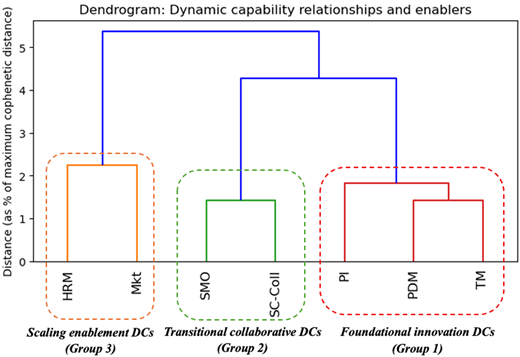
Ward's hierarchical clustering identifies three groups of dynamic capabilities based on relationships among circularity implementation roles. Note: TM: technology management, PDM: product design management, PI: process innovation, SC-Coll: supply chain collaboration, SMO: supply market orientation, Mkt: marketing, HRM: human resource management
Ward's hierarchical clustering identifies three groups of dynamic capabilities based on relationships among circularity implementation roles. Note: TM: technology management, PDM: product design management, PI: process innovation, SC-Coll: supply chain collaboration, SMO: supply market orientation, Mkt: marketing, HRM: human resource management
Scaling enablement DCs (Group 3) include “Human Resource Management” and “Marketing,” which primarily function as enablers. Qualitative evidence revealed that Human Resource Management possesses rare and difficult-to-replicate characteristics, making it particularly valuable for scaling circular practices across the supply chain. Case studies have shown that deploying Human Resource Management establishes organizational routines essential to implementing circularity. Successfully scaling circular transitions requires firms to develop and leverage these enabling capabilities alongside the operational DCs in Groups 1 and 2.
4.3 Integrated findings: patterns of dynamic capability deployment and types of practices
These synergistic patterns show differently across practice types: complementary synergies within Group 1 enable foundational practices; integrative synergies between Groups 1 and 2 enable transitional practices; and cross-group synergies involving all three groups enable scaling practices. Table 5 illustrates how relative emphases across three DC categories, including sensing, seizing, and reconfiguring, enable firms to progress through practices related to circularity. Stronger reconfiguration and seizing deployments correlate with higher practice maturity, while seizing-dominant patterns constrain advancement. Table 5 is structured as a comparative matrix. The top row benchmarks each case's practice status. DC Group rows quantify deployments within Foundational Innovation (Group 1), Transitional Collaboration (Group 2), and Scaling Enablement (Group 3). Entries show descriptive patterns (e.g. “emphasis on reconfiguration and seizing”) with frequency notations (e.g. RE > SZ >> SS), where “>” denotes stronger emphasis. The bottom row synthesizes the overall patterns for each case.
Comparative analysis of deployment patterns and practice types across cases
| Case studies | Alpha | Beta | Gamma | Delta | |
|---|---|---|---|---|---|
| Dominant thematic pattern of practices | Transitional/scaling | Foundational-transitional | Initiation scaling | Foundational | |
| DCs and enabler groups | Foundational innovation (Group1) | Emphasis on reconfiguration and seizing | Predominant seizing with reconfiguration | Reconfiguration leading seizing | Predominant seizing with reconfiguration |
| RE > SZ >> SS * | SZ >> RE >> SS | RE > SZ > SS | SZ >> RE > SS | ||
| Transitional collaboration (Group2) | Reconfiguration leading seizing | Primarily seizing | Seizing leading reconfiguration | Primarily seizing | |
| RE > SZ > SS | SZ | SZ > RE | SZ | ||
| Scaling enablement (Group3) | Deployed (enabling G1/G2) | Deployed (enabling G1/G2) | Deployed (enabling G1/G2) | Minimal deployment | |
| Overall frequency patterns | Reconfiguration dominant with seizing | Seizing dominant with reconfiguration | Balanced reconfiguration and capture | Emphasis on seizing | |
| RE > SZ > SS | SZ > RE >> SS | RE ≈ SZ >> SS | SZ >> RE ≈ SS | ||
Note(s): * SS: sensing, SZ: seizing, RE: reconfiguring
5. Discussion: propositions on circular DCs and transition pathways
This research refines the understanding of DC theory by showing that adopting circularity depends on synergistic configurations among capabilities. While prior research has identified the capabilities that enable sustainability (Beske et al., 2014) or CE adoption at the firm level (Khan et al., 2020), how these capabilities interrelate synergistically to facilitate CSC transitions remains unclear. Our research reveals three distinct relational patterns, “complementary, integrative, and enabling,” each representing a different form of synergy that requires balanced deployment across the categories of sensing, seizing, and reconfiguring. We term capabilities displaying these patterns “Circular DCs.” Based on these findings, three propositions explain how these relational patterns help progress through circularity practice types.
Foundational circular practices require complementary relationships among Foundational Innovation DCs (Group 1) through balanced “reconfiguring-seizing” deployment.
This proposition refines Collis's (1994) capability typology by specifying the relational mechanism that enables structural-functional change for circularity. Firms deploying Foundational Innovation DCs with a balanced emphasis on “reconfiguring and seizing” create complementary relationships among these capabilities. Balanced deployment creates synergistic configurations among Technology Management, Product Design Management, and Process Innovation. Together, these DCs reinforce one another and produce stronger effects on the adoption of foundational practice than any single capability. “Seizing-dominant” patterns may undermine the adoption of foundational practices, as resource mobilization without structural transformation creates capability imbalances. Firms achieve greater success in adopting foundational practices when they deploy DCs at balanced levels of reconfiguring and seizing. Balanced deployment allows capabilities to reinforce one another, whereas uneven deployment across different levels creates capability imbalances that limit the adoption of foundational practices.
Transitional circular practices emerge when firms combine Foundational Innovation DCs with Transitional Collaboration DCs, where effective integration requires that internal innovation capabilities are already deployed at balanced or reconfiguring-dominant levels.
This proposition specifies integration mechanisms for circularity. Clifford Defee et al. (2009) proposed that supply chain orientation requires cross-functional integration; however, the capability configuration that enables this integration remains unclear. Our findings show that adopting transitional practices requires combining two DC groups: foundational innovation capabilities (Group 1) and transitional capabilities for supply chain collaboration (Group 2). The key insight is that, initially, Group 1 must be established with a balanced “reconfiguring-seizing” or “reconfiguring-dominant” deployment. Once Group 1 is established, adding Group 2 capabilities leads to integrative relationships. These integrative relationships represent a distinct form of synergy: capabilities from different groups combine to produce supply chain integration outcomes that neither group could achieve alone. These relationships enable two key outcomes: 1) the adoption of transitional practices at the focal firm and 2) the facilitation of foundational practices among supply chain partners. DCs, Supply Chain Collaboration, and Supply Market Orientation function as bridges, facilitating knowledge transfer and coordination with partners. This explains why firms with strong internal capabilities for adopting circularity often fail to reconfigure their supply chains when attempting to integrate CE (Koberg and Longoni, 2019). Firms cannot successfully deploy Group 2 without first establishing adequate Group 1 deployment. Conversely, firms with only Group 1 remain limited to internal circularity. The combination of dominance in reconfiguration within the Group 1 foundation and the addition of Group 2 enables the emergence of transitional practice.
Scaling circular practices and CSC transitions emerge when firms deploy Foundational Innovation and Transitional Collaboration DCs at reconfiguring-dominant levels, supported by Scaling Enablement capabilities that build workforce and market acceptance.
This proposition explores how circular practices can scale to achieve maturity and profitability at the supply chain level. Firms need to deploy Groups 1 and 2 and develop essential enabling capabilities, such as Human Resource Management and Marketing, that support sustained transformation. These capabilities as enablers differ from DCs in that they do not directly enable circularity. Instead, they establish organizational and market conditions that enable synergistic interactions across all three DC groups. By developing workforce capabilities and building market acceptance, these enablers support operational DCs in achieving scaling outcomes that exceed what any single group could achieve alone. The mechanism operates as follows: Human Resource Management builds the workforce skills, knowledge, and mindsets necessary for circularity adoption and operation, enabling production, design, and collaboration teams to sustain reconfiguring-level transformations. Marketing creates market acceptance and demand for circular products, thereby enabling firms to rationalize investments in reconfiguration activities and achieve profitable returns. Without these enablers, firms deploying Groups 1 and 2 face barriers, such as worker reluctance and market uncertainty, that hinder their ability to achieve and sustain a reconfiguring-dominant deployment. Evidence indicates that firms that achieve scaling deploy enabling capabilities alongside DCs. These enablers supported Groups 1 and 2 in reaching a “reconfiguring-dominant” deployment necessary for profitable circular operations across supply chain networks. Firms that deploy operational capabilities without adequate enablers cannot sustain transformation beyond pilot projects, as they lack both workforces buy-in and market validation. Firms developing enablers without strong operational capabilities lacked circular practices to support enablers. The proposition specifies that CSC transitions require this enabling architecture, in which Human Resource Management and Marketing support DCs in achieving the reconfiguring dominance necessary for ecosystem-level circular operations involving multiple supply chain partners.
6. Implications
6.1 Theoretical implications
This study refines DC theory by demonstrating that the adoption of circularity depends on synergistic configurations of capabilities rather than on the strength of individual capabilities. Four theoretical contributions emerge from this research. First, the study establishes a relational perspective on DCs for circularity transitions. While prior research identified which DCs enable sustainability (Beske et al., 2014) or firm-level CE adoption (Khan et al., 2020), this study reveals how these capabilities must interrelate synergistically. Drawing on organizational synergy concepts (Goold and Campbell, 1998), the findings demonstrate that capabilities deployed in combination generate superior outcomes to isolated deployment. The three relational patterns identified, complementary, integrative, and enabling, specify the synergistic mechanisms through which Circular DCs facilitate CSC transitions. This relational view explains that firms with similar individual capabilities can yield different circularity outcomes. It shows that effectiveness results from capability configurations rather than from capability sets. Second, the research introduces deployment balance as a theoretical framework determining synergistic effectiveness. Prior DC research examined the presence or absence of capabilities; this study demonstrates that the balance among the sensing, seizing, and reconfiguring categories determines whether synergistic relationships form. Balanced reconfiguring-seizing deployment creates stable, mutually reinforcing configurations that enable the adoption of foundational practices. Seizing-dominant patterns limit synergy by using resources without structural transformation. This contribution extends Teece's (2007) framework by proposing that balanced deployment across multiple categories, particularly reconfiguring and seizing, rather than single-category dominance, enables synergistic interactions among capabilities. The finding suggests that reconfiguring the dominant pattern will help firms reach circularity maturity over time. It also illustrates how deployment patterns can either enable or limit synergistic effects. Third, the three-group DC framework (Foundational Innovation, Transitional Collaboration, Scaling Enablement) provides a framework for understanding the development of progressive synergy. The research demonstrates that synergistic effects build sequentially: complementary relationships within Group 1 establish an internal circular infrastructure; integrative relationships between Groups 1 and 2 enable engagement with supply chain partners; and synergistic relationships across all three groups facilitate scaling. This framework aligns with the literature that emphasizes integrative engagement and organizational learning as enablers of circularity (Subramanian and Suresh, 2022; De Angelis, 2022) and specifies the capability configurations that underlie these enablers. The framework addresses the call for research on the specific DCs required for CE transitions (Lahane et al., 2020; Meier et al., 2023) by identifying not only which capabilities are critical but also how their synergistic coordination enables progression toward CSC maturity. Fourth, the study bridges CE and supply chain management literature by specifying synergistic mechanisms underlying CSC transitions. Prior research examined firm-level circular business models or sustainable supply chains as separate domains, leaving unclear how internal capabilities connect to supply chain-level outcomes. The framework developed here explains how synergistic configurations among capability groups enable the progression of circularity from internal practices to inter-organizational collaboration. Specifically, it indicates that firms cannot achieve CSC transitions through internal capability development alone. It shows an integrative relationship between Foundational Innovation DCs and Transitional Collaboration DCs, creating the synergistic mechanisms necessary for cross-boundary circular flows. This contribution responds to calls for research connecting SSCM and CE principles (Batista et al., 2023).
6.2 Practical implications
The relational framework offers practitioners a developmental tool for managing transitions to circularity. It outlines relationships that support capability development, and the framework helps managers assess existing DC relationship patterns and identify imbalances that hinder progress.
Assessing current relational configurations: Practitioners should begin by identifying their organization's current DC deployment patterns across the three groups. This assessment determines whether synergistic complementary relationships exist within Group 1, whether synergistic integrative relationships exist between Groups 1 and 2, and whether cross-group synergies extend across all three groups.
Creating complementary relationships for foundational practices: To establish foundational circularity, managers must ensure that Technology Management, Product Design Management, and Process Innovation work in complementary ways. This requires a balanced approach to reconfiguring and seizing deployment, where technology identification (seizing) connects with structural transformation (reconfiguring). Practical actions include establishing cross-functional teams that link R&D, design, and operations; implementing collaboration mechanisms that enable information flow among these functions; and investing in both opportunity identification capabilities (such as market research and technology scanning) and transformation capabilities (including process redesign and infrastructure upgrades). The goal is to create synergistic capability configurations in which mutual reinforcement amplifies the adoption of circularity beyond what isolated capability development could achieve.
Building integrative relationships for transitional practices: Progressing to transitional circularity requires bridging internal capabilities (Group 1) with external coordination capabilities (Group 2). Managers should develop Supply Chain Collaboration and Supply Market Orientation with a balanced deployment that connects to existing Group 1 capabilities. This involves establishing joint planning mechanisms with key suppliers and customers, creating transparent information-sharing platforms revealing circular opportunities across the supply chain, and implementing collaborative decision-making structures for circularity investments. The critical insight is that collaboration capabilities must be deployed at similar balance levels as innovation capabilities; if internal capabilities operate at reconfiguring levels, while collaboration remains at seizing, integrative relationships cannot form.
Establishing synergistic relationships for scaling practices: To achieve economies of scale through circularity, firms must establish synergistic relationships in which all three DC groups operate simultaneously, producing combined transformation effects that exceed what any single group or pair of groups could achieve independently. Managers must develop Human Resource Management and Marketing capabilities (Group 3) while sustaining balanced deployment in Groups 1 and 2. This involves developing workforce training programs, building circular skill sets across the organization, developing marketing strategies, sharing circular value propositions with partners, and creating organizational cultures that support circular practices. Importantly, Group 3 development occurs simultaneously with, rather than after, Groups 1 and 2, thereby advancing the adoption of circularity.
Stakeholder implications: Policymakers can use this framework to design incentive structures that support balanced DC development rather than isolated capability-building. Regulations encouraging collaboration between firms and supply chain partners, tax incentives for workforce circular training, and subsidies for transformation infrastructure all support balanced deployment patterns. Investors can assess a firm's circularity potential by evaluating DC relationship patterns. For instance, firms that demonstrate balanced deployment across multiple groups are stronger candidates for circular transition than those with extensive but imbalanced capabilities.
6.3 Societal implications
This research demonstrates that transitions to circularity generate societal benefits through specific DC configurations, particularly those involving Scaling Enablement capabilities (Group 3). The findings reveal three pathways through which Circular DCs contribute to societal well-being. First, Human Resource Management, as an enabler of Circular DC, creates societal value through workforce development, as firms deploy this capability to build circular skill sets. In this way, they create job opportunities that require specialized knowledge of circular practices, such as remanufacturing or material recovery. This aligns with research showing that CE transitions generate net employment growth while changing job skill demands (Subramanian and Suresh, 2022; Mies and Gold, 2021). Our framework specifies the mechanism: synergistic relationships among all three DC groups enable profitable scaling, which in turn justifies workforce investments. Without synergistic relationships, firms cannot sustain the employment created through circular practices, as practices remain unprofitable pilot projects. This suggests that societal employment advantages from circularity rely on firms effectively establishing synergistic DC relationships. Second, Supply Chain Collaboration as a Circular DC facilitates societal inclusion through stakeholder engagement. Our findings show that integrative relationships between internal innovation and external synergistic capabilities enable the implementation of partner-level circularity. This integration necessarily involves engaging diverse stakeholders, such as suppliers, customers, and community organizations, to initiate circular practices. Such engagement fosters societal ties essential for the adoption of circularity (Liu et al., 2023; Fobbe and Hilletofth, 2023). For instance, establishing take-back systems requires collaboration with various collection networks, and adopting a circular practice involves training local technicians. Implementing designs for disassembly necessitates knowledge sharing with recycling partners. These collaborative activities create opportunities for marginalized individuals and groups to participate in circular value chains, generating both economic inclusion and skill development. Third, Marketing as a Circular DC shapes consumer behavior and societal norms around circularity. When deployed within synergistic relationships alongside innovation and collaboration capabilities, marketing promotes circular value propositions, educates consumers about circular practices, and builds demand for circular products. This capability extends beyond commercial benefit to societal norm transformation. As consumers engage with circular offerings, they develop awareness of resource flows, product lifecycles, and environmental impacts. This educational dimension represents a societal contribution distinct from environmental benefits alone. The framework highlights that societal benefits of circularity arise from specific DC relationship patterns rather than from circularity adoption per se. Firms that establish synergistic relationships among all three groups generate employment, inclusion, and normative transformation effects. Firms with incomplete relational configurations, such as those deploying innovation capabilities without collaboration or scaling enablement, cannot achieve these synergistic effects and thus produce limited societal benefits despite implementing circular practices.
7. Conclusion
This study addressed a gap in understanding how DCs enable the transition from SSCm to CSC. While existing research has identified DCs that contribute to sustainability and circularity, limited attention has been paid to how these DCs interrelate and how deployment patterns enable their development. Using a mixed-methods approach, this research demonstrates that successful adoption of circularity depends on relational configurations among capabilities rather than on individual capability strength.
The findings reveal that three DC groups form Circular DCs, functioning through complementary, integrative, and enabling relationships. Foundational Innovation DCs (Technology Management, Product Design Management, Process Innovation) establish internal circular infrastructure through balanced reconfiguring-seizing deployment. Transitional Collaboration DCs (Supply Chain Collaboration, Supply Market Orientation) facilitate supply chain integration by coordinating deployment across sensing, seizing, and reconfiguring categories. Scaling Enablement capabilities (Human Resource Management, Marketing) create the organizational and market conditions that enable operational DCs to sustain transformation.
Three propositions emerged from this research, forming a progressive pathway toward CSC transitions. Foundational practices require complementary relationships among Foundational Innovation DCs through balanced deployment. Transitional practices emerge when firms integrate Transitional Collaboration DCs with already-established Foundational Innovation capabilities. Scaling practices and CSC transitions occur when all three DC groups operate at reconfiguring-dominant levels. Scaling Enablement capabilities support workforce development and market acceptance. This sequence demonstrates that capability effectiveness emerges from relational configurations that build sequentially rather than from isolated capability development.
The study contributes to refining DC theory by shifting the focus from the presence of individual capabilities to their interrelation. This relational perspective bridges the literature on DC theory, sustainable supply chain management, and CE by specifying the capability configurations that facilitate CSC transitions.
The study has limitations requiring consideration. The qualitative phase examined four multinational manufacturing firms, which may limit the applicability of the findings to diverse geographical and industrial settings. The quantitative validation involved 25 academic experts, which is appropriate for exploratory clustering but limits broader generalization. Future research should address these limitations through longitudinal studies examining capability relationship dynamics, expanded samples including diverse contexts and sectors, and investigations of how capability configurations vary across different stages of circular maturity and regional policy environments.
This study has limitations that suggest directions for future research. A qualitative study examined four multinational manufacturers in the heavy manufacturing industry. It is important to consider geographic areas where CE and sustainability are not yet mandated. To this end, future research may extend the investigation to include small- and medium-sized enterprises and examine how circular DCs develop in regions with differing policy environments, such as Asia and North America. Longitudinal studies are particularly needed to understand how DC relationships evolve as firms progress through different stages of circular maturity. Although quantitative validation is appropriate for exploring capability relationships, it limits broader generalization. Expanding expert samples across diverse regions and incorporating industry practitioner perspectives could strengthen the external validity of the identified DC groupings. Additionally, future studies may investigate synergistic interactions among different types of DCs and how these interactions contribute to CSC formation, potentially employing mixed-methods approaches that combine qualitative insights with quantitative validation to develop a more comprehensive understanding of capability dynamics during circular transitions.
The authors declare that they have no known competing financial interests or personal relationships that could have appeared to influence the work reported in this paper.
Appendix 1 Definitions of dynamic capabilities and enabling capabilities
Dynamic capabilities and definitions
| Name of DC and enablers | Definition | References |
|---|---|---|
| Product design management | Integrating learning, coordination and skills during the design stage contributes to the skills and knowledge required for effective design management | Santos et al. (2018) |
| SC collaboration | Refers to enhanced connectivity, which enables companies to exchange information, increase transparency, and analyze data in real time among various partners in the supply chain, contributing to the organization's overall agility and responsiveness | Cao and Zhang (2011), Fawcett et al. (2011) |
| Information sharing culture-capability | A level of absorptive capability that exploits the know-how gained by companies to increase the willingness to share information. This DC improved the technology deployment level and increased case companies' value creation | Zacharia et al. (2011) |
| Marketing-capability | Involves the development, release and integration of market knowledge aimed at helping firms evolve and adapt. This capability focuses on enhancing the organisation's marketing strategies and tactics to effectively meet its target customers' changing needs and preferences | Kozlenkova et al. (2014) |
| Supply market orientation | Involves a collaborative approach among upstream supply chain partners to increase transparency and improve environmental impacts in logistics, quality, productivity and innovation. This capability promotes sustainable and responsible sourcing practices, improves supplier relationships, reduces costs, and enhances organisational performance | Fugate et al. (2008), Foerstl et al. (2020) |
| Process innovation | Involves deploying any organisational activities to change how things are done, resulting in improved outcomes | Piening and Salge (2015) |
| Technology management | Involves developing and exploiting technological capabilities, including a range of scientific and technological knowledge and financial activities both within and outside of an organisation. This capability also includes knowledge related to services that create value, encompassing the know-how and know-why aspects of technology management | Cetindamar et al. (2009), De Arroyabe et al. (2021) |
| Human resource management-capability | Involves deliberately designing and managing employees' knowledge, skills, and abilities to address changes in business environments. This capability encompasses employee well-being, performance and adaptability and focuses on building, integrating and reconfiguring these factors to meet an organisation's evolving needs | Kabongo and Boiral (2017), Apascaritei and Elvira (2022) |
Appendix 2 Quantitative survey design and expert validation
Survey design rationale
The quantitative phase was designed to generalize qualitative findings through expert assessment. While qualitative analysis identified the dynamic capabilities that firms deployed during circularity transitions, quantitative validation was necessary to examine the relationships among these capabilities and establish generalizable patterns across broader contexts. Survey-based expert validation was selected over alternative approaches (e.g. Delphi method) for three reasons: (1) the study required assessment of DC relationships rather than collaboration on future predictions; (2) expert evaluation of capability relationships benefits from diverse theoretical perspectives rather than iterative convergence; and (3) the research aimed to validate empirically derived patterns rather than develop new theoretical constructs requiring multiple rounds of refinement.
From qualitative findings to survey operationalization
Qualitative analysis identified eight capabilities that firms deployed during circularity transitions: Product Design Management, Human Resource Management, Technology Management, Supply Market Orientation, Supply Chain Collaboration, Process Innovation, Information Technology, and Marketing. These capabilities were subsequently classified into three groups based on their functional roles: Foundational Innovation capabilities (Product Design Management, Technology Management, Process Innovation, Information Technology), Transitional Collaboration capabilities (Supply Chain Collaboration, Supply Market Orientation), and Scaling Enablement capabilities (Human Resource Management, Marketing).
To operationalize these findings into survey items, the research team identified seven circularity strategies based on circular economy literature (Bocken et al., 2016) and empirical evidence from case studies. These strategies represent specific implementation approaches that firms must adopt to facilitate circularity, including sharing information, developing collaborative approaches, joint decision-making, designing for durability and reliability, designing for maintenance/disassembly/reassembly/repair, designing products for future expansion and modification, and designing for standardization and compatibility. Each strategy was defined to ensure respondent comprehension (Table A2).
Circularity strategies and definitions
| Circularity strategies for designing products | Description |
|---|---|
| Developing collaborative approaches | Establishing mutually beneficial relationships with key suppliers/customers in supply chains, working together to achieve common goals through building trust and communication channels |
| Design for durability and reliability | Creating products that withstand wear and tear, as well as unexpected challenges, over extended periods of use |
| Design for maintenance, disassembly, reassembly and repair | Considering the ease and efficiency of maintenance, disassembly, reassembly, and repair when designing products or systems |
| Designing products to allow for future expansion and modification | Creating flexible and scalable products that can be easily modified or upgraded over time without significant changes to core design |
| Joint decision-making | Collaborative approach where decisions are made with key suppliers/customers about product design/modifications, process design/modifications, quality improvement, and cost control affecting the entire supply chain |
| Sharing information | Transmitting or exchanging important data with key suppliers/customers involves providing them with essential details about sales projections, production plans, order tracking and tracing, delivery status and stock level |
| Design for standardization and compatibility | Designing products or systems to meet industry standards and promote interoperability, reducing costs, improving efficiency, and enabling seamless collaboration between different products or systems |
Expert respondent profiles
The questionnaire was distributed to 110 identified experts, yielding 25 responses (22.7% response rate). Tables A3–A5 present detailed respondent characteristics that confirm alignment with the expert selection criteria specified in Section 3.2.1.
Respondent academic positions
| Academic position | n | % |
|---|---|---|
| Professor | 2 | 8% |
| Associate Professor | 6 | 24% |
| Assistant Professor/Senior Researcher | 8 | 32% |
| Adjunct Professor/Lecturer | 4 | 16% |
| Postdoctoral Researcher | 2 | 8% |
| Doctoral Researcher/Candidate | 3 | 12% |
| Total | 25 | 100% |
Respondent geographic distribution
| Geographic region | n | % |
|---|---|---|
| Europe (Finland, Sweden, Denmark, UK, Italy, the Netherlands) | 18 | 72% |
| Asia (India, Pakistan) | 4 | 16% |
| North America (US) | 2 | 8% |
| South America (Brazil) | 1 | 4% |
| Total | 25 | 100% |
Respondent primary research domains*
| Primary research domain | n | % |
|---|---|---|
| Supply Chain Management | 13 | 52% |
| Sustainable Operations | 12 | 48% |
| Circular Economy | 9 | 36% |
| Manufacturing/Industrial Engineering | 8 | 32% |
| Dynamic Capabilities/Strategy | 6 | 24% |
| Product Design/Development | 3 | 12% |
| Quality/Process Management | 4 | 16% |
Note(s): *Percentages exceed 100% as respondents indicated multiple research domains, reflecting cross-domain expertise essential for evaluating capability-strategy relationships
The respondent composition reflects the interdisciplinary context of circular supply chain research, combining expertise in supply chain management, sustainability, and strategic capabilities. The distribution confirms that 80% of respondents held established academic positions (Professor through Assistant Professor), providing the theoretical depth necessary for evaluating dynamic capability relationships in circularity contexts.
Survey instrument structure
The survey instrument was structured to assess relationships between capabilities and circularity strategies. The survey used Webropol Survey and Reporting to enhance data processing accuracy by minimizing errors related to data input, coding, and editing (Zikmund et al., 2013). For each of the seven circularity strategies, respondents evaluated the importance of each capability in enabling implementation of that strategy. To avoid systematic measurement error and random sampling error, the survey considered a four-stage cognitive process model for generating high-quality information (Thiessen and Blasius, 2012). The respondents must (1) comprehend the question, (2) obtain the necessary information, (3) integrate the obtained information into a concise assessment, and (4) select a response option that best aligns with their summarised assessment.
The instrument employed a 6-point Likert scale (0 = not sure/no opinion, 1 = not important at all/not applicable, 2 = slightly important, 3 = moderately important, 4 = important, 5 = very important). The 6-point scale was selected to force differentiation while providing adequate response granularity.
Survey structure example
| Capability | Rating scale (0 = not sure/no opinion; 1 = not important at all; 5 = very important) |
|---|---|
| As part of this questionnaire, you will be asked to rate (on a scale of 0–5) the importance of each capability from the perspective of its functional role in enabling a manufacturing industry to implement circularity | |
| The circularity strategy that you will express your opinion about is Developing collaborative approaches: it means a mutually beneficial relationship with key suppliers/customers in a supply chain, where they work together to achieve common goals through building trust and communication channels | |
| Please rate each capability | |
| Likert scale of 6 points |
| Likert scale of 6 points |
| Likert scale of 6 points |
| Likert scale of 6 points |
| Likert scale of 6 points |
| Likert scale of 6 points |
| Likert scale of 6 points |
Data analysis approach
Survey responses were analyzed using Ward's hierarchical clustering method to examine relationships among capabilities. This analytical approach was selected because: (1) the research question focused on identifying which capabilities demonstrate relational patterns rather than testing predetermined hypotheses; (2) hierarchical clustering reveals naturally occurring groupings without imposing a priori structures; and (3) Ward's method specifically minimizes within-cluster variance, making it appropriate for identifying capabilities with similar functional roles (Strauss and von Maltitz, 2017). Analysis used median expert ratings as input data, acknowledging that expert consensus (median) provides more robust indicators of capability relationships than individual ratings. The resulting dendrogram visualization revealed three distinct capability groups, validating qualitative findings while refining the theoretical understanding of capability relationships (Blashfield, 1976).

