The purpose of the study was to detect trends in human resource management (HRM) research presented in journals during the 2000–2020 timeframe. The research question is: How are the interests of researchers changing in the field of HRM and which topics have gained popularity in recent years?
The approach adopted in this study was designed to overcome all the limitations specific to the systematic literature reviews and bibliometric studies presented in the Introduction. The full texts of papers were analyzed. The text-mining tools detected first clusters and then trends, moreover, which limited the impact of a researcher's bias. The approach applied is consistent with the general rules of systematic literature reviews.
The article makes a threefold contribution to academic knowledge. First, it uses modern methodology to gather and synthesize HRM research topics. The proposed approach was designed to allow early detection of nascent, non-obvious trends in research, which will help researchers address topics of high value for both theory and practice. Second, the results of our study highlight shifts in focus in HRM over the past 19 years. Third, the article suggests further directions of research.
In this study, the approach designed to overcome the limitations of using systematic literature review was presented. The analysis was done on the basis of the full text of the articles and the categories were discovered directly from the articles rather than predetermined. The study's findings may, however, potentially be limited by the following issues. First, the eligibility criteria included only papers indexed in the Scopus and WoS database and excluded conference proceedings, book chapters, and non-English papers. Second, only full-text articles were included in the study, which could narrow down the research area. As a consequence, important information regarding the research presented in the excluded documents is potentially lost. Third, most of the papers in our database were published in the International Journal of Human Resource Management, and therefore such trends as “challenges for international HRM” can be considered significant (long-lasting). Another – the fourth – limitation of the study is the lack of estimation of the proportion between searches in HRM journals and articles published in other journals. Future research may overcome the above-presented limitations. Although the authors used valuable techniques such as TF-IDF and HDBSCAN, the fifth limitation is that, after trends were discovered, it was necessary to evaluate and interpret them. That could have induced researchers' bias even if – as in this study – researchers from different areas of experience were involved. Finally, this study covers the 2000–2020 timeframe. Since HRM is a rapidly developing field, in a few years from now academics will probably begin to move into exciting new research areas. As a consequence, it might be worthwhile conducting similar analyses to those presented in this study and compare their results.
The present study provides an analysis of HRM journals with the aim of establishing trends in HRM research. It makes contributions to the field by providing a more comprehensive and objective review than analyses resulting from systematic literature reviews. It fills the gap in literature studies on HRM with a novel research approach – a methodology based on full-text mining and a big data toolset. As a consequence, this study can be considered as providing an adequate reflection of all the articles published in journals strictly devoted to HRM issues and which may serve as an important source of reference for both researchers and practitioners. This study can help them identify the core journals focused on HRM research as well as topics which are of particular interest and importance.
1. Introduction
The human resource (HR) function has evolved over the years from serving a purely administrative role into one that is more strategic in character. Today it is believed that the mission of human resource management (HRM) is to support the organization in achieving its objectives by developing and implementing HR strategies that are integrated with a company's business strategy, promote staff development, foster a positive employment relationship, promote an ethical approach to people management, and care about the environment (social and natural) (Ehnert, 2009; Braga et al., 2021).
In practice, HRM means providing continuous solutions to a wide array of problems occurring in employee-employer, line worker-manager, and employee-employee relations and also in contacts with, e.g. trade unions. Human behaviors, feelings and attitudes are determined both by the personal characteristics of individuals and by the impact of the environment. The shape of HRM is significantly influenced by such factors as, e.g. the demographic and technological transformations (Greiling, 2011; Silva and Lima, 2018), and globalization (Gerhart and Fang, 2005).
HRM has evolved as a professional and academic discipline in parallel with both planned shifts in global considerations and unplanned phenomena such as, e.g. epidemics. For researchers it is crucial to identify, define, explain, and help practitioners understand the key factors which have an impact on HRM. Another of the researchers' roles is to formulate practical guidelines on how to manage people in different circumstances and outline areas of future research. HRM thrives on the contributions made in other fields that it assimilates and applies in practice. It unscrupulously builds on theoretical developments made earlier in related disciplines (Boxall et al., 2009). Finally, the researcher endeavors to provide an overview, comparisons, analyses and syntheses of previously published findings (Paul and Criado, 2020).
The theme of trends in HRM has been addressed in numerous publications (e.g. Cooper et al., 2020; Madera et al., 2017). Their authors have employed various approaches to identify such phenomena, including systematic literature reviews. Articles offering a traditional overview provide a quantity-oriented (i.e. meta-analytical, systematic) approach together with descriptive or qualitative elements. Jointly, they develop a theoretical background, highlight irregularities in existing findings, integrate the findings of a wide variety of publications and in general provide other researchers with an up-to-date understanding of the discipline, frequently prepared by leading specialists (Palmatier et al., 2018). In most cases, the documents selected for analysis were based on titles, keywords and abstracts only. Unfortunately, they contain only around 8% of all research findings (Blake, 2010). In order to gain a deeper insight into such a body of knowledge authors have often turned to the by-hand review method (e.g. Cooper et al., 2020).
Conventional systematic by-hand literature reviews are sometimes characterized by errors in article selection, possible simplifications and potentially incomplete and not universal results (subjective, impressionistic descriptions), In response to these shortcomings, in recent years a number of new alternatives have emerged. One new approach that has attracted increasing attention is bibliometric studies. This method applies dedicated IT tools to gauge trends in articles. They examine academic material from both an objective and qualitative perspective for the purposes of identifying, organizing, and analyzing information in a specific research field (Capobianco-Uriarte et al., 2019). As far as trends in HRM are concerned, Markoulli et al. (2017) presented a summary of previously published traditional and narrative reviews and on its basis created a science map and defined clusters based on keyword co-occurrence analysis and the VOSviewer software tool.
Bibliometric analyses can be treated as a platform for writing an entire article or can be used only as preparation for the groundwork for further in-depth content analysis and qualitative descriptions. In turn, a text mining toolset can help identify research trends and select papers which are in line with a particular trend. Moreover, a full-text analysis of publications using a text mining toolset enables researchers to obtain higher-quality results than when using only keywords, such as in the case of VOSviewer analyses (Kobayashi et al., 2018). As a consequence we decided that it was worth adopting a methodology based on full-text mining and a big data toolset in order to identify trends in HRM research. We believe that big data and analytics help not only companies function but also researchers in a highly data-driven world (Kobayashi et al., 2018).
The purpose of the study was to detect trends in HRM research presented in journals during the 2000–2020 timeframe. The following research question was asked: how are the interests of researchers changing in the field of HRM and which topics have gained in popularity in recent years?
The paper is organized as follows. In the second section we describe the HRM research trends identified in previous studies. Here the focus is on the context in which authors were operating when analyzing HRM issues. The third section is devoted to the research method employed for the purpose of this study. Then we present the results and discussion. The article ends with conclusions, including limitations and areas of future research.
The article makes a threefold contribution to academic knowledge. First, it uses modern methodology to gather and synthesize HRM research topics. The proposed approach was designed to allow early detection of nascent, non-obvious trends in research, which will help researchers address topics of high value for both theory and practice. Second, the results of our study highlight shifts in focus in HRM over the past 20 years. Third, the article suggests further directions of research.
2. Trends in the HRM research identified in previous studies
In their search for HRM research trends authors of this study firstly used the Scopus database and a search strategy based on such terms as: trends in human resource management/HRM, trends in research on human resource management/HRM, human resource management/HRM trends, intellectual structure of human resource management/HRM. The searching process covered titles, abstracts and keywords and was limited to articles written in English. The search produced 37 documents. Then the authors also searched for additional articles in Google Scholar.
Most of the articles were devoted to the trends identified in HR practices in companies (e.g. Dubravska and Solankova, 2015). One of such trends is HRM digitalization (Ashbaugh and Miranda, 2002). Table 1 presents a list of HRM trends identified in the research (related to academic work) conducted by different authors.
It can be concluded from the above that researchers employed different approaches to defining and identifying these trends. Research trends may be associated with research topics (e.g. Özlen, 2014), research methods (e.g. Pietersen, 2018) and the general characteristics of the academic domain (e.g. Sanders and De Cieri, 2020). Although a number of authors have provided traditional literature reviews of trends in HRM, Chae et al. (2020), for example, focused only on the local (Korean) research trends and used only keyword analyses. Others focused on a specific sector (Cooper et al., 2020), industry (Madera et al., 2017) or region (Wood and Bischoff, 2020). There are also articles that outline the evolution of research in particular journals (e.g. Pietersen, 2018). Others address specific problems, such as international HRM (e.g. Sanders and De Cieri, 2020) or green HRM (Yong et al., 2020). The most visible trends identified in previous studies and associated with research topics were strategic HRM, HR performance and employment/industrial relations. The first topic was addressed in eight works while the remaining was the subject of five publications.
3. Material and methods
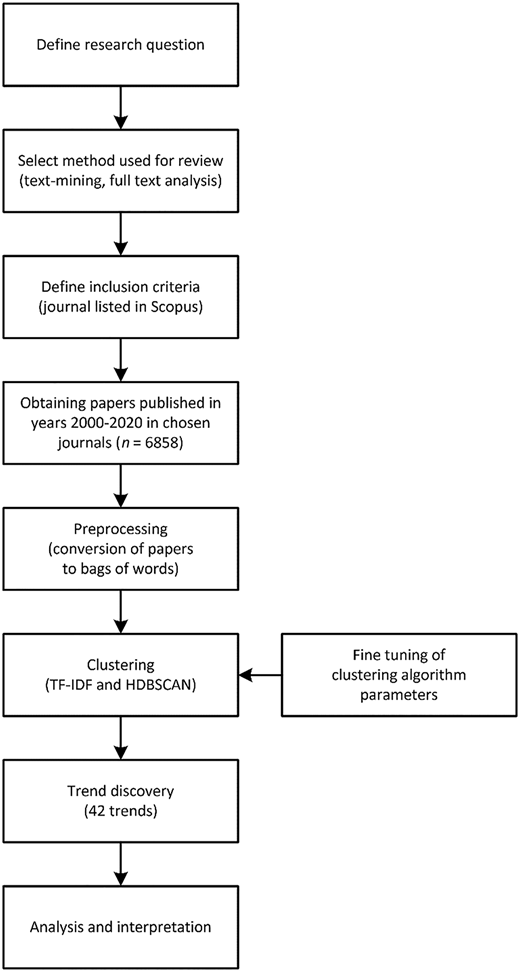
The approach adopted in this study was designed to overcome all the limitations specific to the systematic literature reviews and bibliometric studies as presented in the Introduction. The full texts of papers were analyzed. The approach applied is consistent with the general rules of systematic literature reviews (Tranfield et al., 2003) and consists of several steps, which are presented in Figure 1.
3.1 Selection of journals
Thousands of articles covering HRM can be found on both Scopus and the Web of Science. For the sake of the present analysis, it was necessary to define inclusion criteria in the meta-analysis.
Due to the limitations affecting the reliability of keywords in the analysis, we decided to single out journals devoted to HRM. The following criteria were set:
The main topic of the journal was related to HRM,
The journals were indexed in Scopus and WoS,
The journals have a high SNIP index value (the limit value is set at 1 - status for 2020; full values are presented in Table 2),
Full versions of the article were available,
The articles were published in the years 2000–2020.
A total of 8 journals met the above criteria (Table 2). The full texts of the papers were downloaded from academic databases. No duplicates were found. Only research papers were included, while editorials, calls for papers, errata and book reviews were excluded.
All the metadata were removed from the papers. The titles and abstracts often contain catchwords designed to increase readership. As a consequence, only the texts of papers minus their titles, keywords, abstracts and references were analyzed in this study. Additional bibliographic information that could be useful in the analytical process was downloaded from the Crossref database. Each paper was converted into a text file and then into a bag-of-words model for the needs of automatic analysis using computer algorithms. The algorithms were created using Python libraries, such as grobid, nltk, scikit-learn, hdbscan, and scipy (Pedregosa et al., 2011).
3.2 Search for the most important terms
One of the key objectives of this study was to search for those keywords that could describe the content of papers. The most common approach would be to find the most frequent words they contain. However, this would have required extensive filtering, as the most common English words are “the” and “of”, which do not themselves describe content. As a consequence, we used the Term Frequency – Inverted Document Frequency (TF-IDF) method. TF-IDF compares two parameters: the frequency of a phrase in one paper and its frequency in the corpus as a whole. The most important phrases are those which occur in groups of papers. The words occurring in all the papers or one paper only are less important. Many thousands of words were analyzed in the corpus as a whole, which made it possible to identify groups of similar papers, clusters and then trends (Cong et al., 2016).The following TF-IDF formula was used:
where,
– result for term i in document j,
– number of occurrences of i in j,
– number of documents containing i,
– number of documents in the corpus (set of documents).
The TF-IDF method is not a mathematical model. It requires extensive computation, cannot be used to discover synonyms and ignores multiple meanings of words (Zhang et al., 2011). However, in the case of research papers, these problems have a minimal impact due to the more precise language used by researchers.
3.3 Identification of thematic groups (clusters)
The TF-IDF model presents each paper as a multidimensional vector. The number of dimensions is equal to the number of keywords used in the analysis. In the next step, all the vectors were compared to each other, which led to the discovery of clusters.
As mentioned in section 3.2, the TF-IDF model does not analyse synonyms and ignores multiple meanings of words and phrases. In scholarly texts, it is rarely a problem. Even in HRM, where the number of synonyms can be perceived as higher than in other areas of management, the impact on the results should be negligible.
There are two main approaches to clustering: partitioning and hierarchical clustering. The former can be applied when all the corpus elements must be included in one of the groups. This induces data noise, as not even similar elements have to be included. The latter allows some elements to remain outside the clusters. The clusters become much more homogenous. This constitutes a better approach when it comes to identifying trends. Multiple hierarchical clustering methods are available, e.g. meanshift, DBSCAN, Optics and HDBSCAN (Hierarchical Density-Based Spatial Clustering of Applications with Noise) (McInnes et al., 2017). HDBSCAN is characterized by the least number of limitations. It takes each paper (vector) and checks at what distance it can find similar publications. Then it compares the results, and the densest areas are detected as clusters. Unlike some other methods, the clusters lack permanent density or a fixed number of elements. The only parameter that the researcher needs to establish is the minimum cluster size. The best value can be determined through a series of experiments.
In the present study, the authors carried out a set of experiments using different minimum cluster sizes. The highest value detected was 20. Lower values lead to a much higher number of clusters. Moreover, general phrases not directly related to HRM played a significant role in the discovery of these clusters. With the minimum cluster size set to values greater than 20, the number of clusters was significantly lower. That led to general results based on the most popular phrases only.
The entire sample was divided into groups of papers published in 5-year overlapping periods starting with 2000–2004 and ending with 2016–2020. Each paper was assigned to all the groups into which it fitted. Cluster analysis was performed for every group separately, and the results were used to identify trends.
Cluster analysis was performed on each group separately, and the results were used to discover trends. Approximately 30 clusters on average were identified for each five-year period. However, for a trend to be identified at least two similar clusters had to be discovered in successive periods Therefore, many unrelated clusters were excluded by the algorithm. Such behaviour is expected, as it removes noise from data. Usually, only one-third of clusters meet the conditions to form trends.
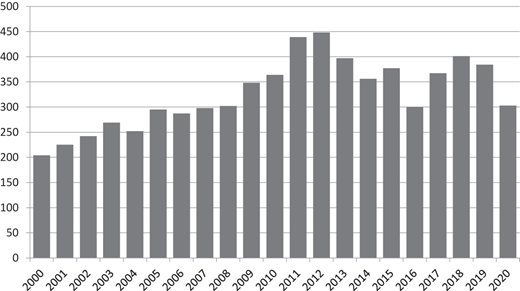
The number of papers published in each year is presented in Figure 2. A slight decrease in the number of articles can be observed compared to 2018–19, which may have been a result of the Covid-19 pandemic.
3.4 Identification of trends
As the 5-year periods overlapped, the algorithm was able to identify similar trends based on the papers included in the clusters. If a paper is included in clusters identified in subsequent periods, we can assume that those clusters are similar. In the present study, the assumptions were based on multiple papers. The number of papers used to discover similarities between clusters ranged from 20 to 140, depending on the cluster size. An additional expert evaluation was performed in the next step using cluster keywords. The process was automatised using Python scripts. The outcome was the discovery of four types of trends
Long-lasting trends that existed and evolved during the studied period,
Declining trends which came to an end during the studied period,
Emerging trends which began during the studied period,
Ephemeris trends that began and ended during the studied period.
3.5 Interpretation of trends
The results delivered by the algorithm must be checked through further studies. The algorithm can detect mergers or splits in trends. We decided, however, that the final decision should be left to researchers. At this stage, trends should also be named, interpreted and described. The interpretation phase should help highlight changes within trends and try to predict their future evolution.
4. Results and discussion
The analyses, performed by researchers using automatic algorithms and further verification, led to the discovery of 42 trends presented in Table 3. These trends are ordered according to the year of their first occurrence and their duration. It is worth emphasizing that the year in which a trend was observed does not indicate that the idea behind it emerged at the same time. Rather, it shows when a subject began to increase in popularity among researchers. Furthermore, the number of identified trends is much higher than the results from previous studies presented in Section 2.1Table 4.
The use of tracking revealed the evolution of clusters, and made it possible to identify trends. The analysis led to the discovery of the types of trends presented in Section 3.4. Of the 42 trends, 4 were long-lasting, 5 declining, 17 emerging and 16 ephemeris in character. One possible fact to note is that “strategic HRM”, which was a prevailing trend in previous studies, is not directly presented in the results obtained using text-mining analyses. However, it is included in the “architecture and changing role of HRM” trend.
At this point it is worth emphasizing that sociologists of science have examined the principles governing the selection of topics analysed by researchers, and noticed that it may result from a trade-off between conservative production and risky innovation (Bourdieu, 1975). The main problem when choosing research topics is deciding whether to continue topics fixed in the literature or take the risk of exploring new, hitherto unknown themes. Trend a analysis offers an indirect solution based on strategic ambidexterity. This is not only because it allows us to observe disappearing themes that continue to be exploited, but also to identify those topics, in which there is a growing interest (exploration).
Long-lasting trends are not homogenous and change over time. The evolution of trends can be tracked using keywords of considerable importance in subsequent years. The importance of keywords was evaluated using the TF-IDF algorithm and averaged for each cluster. The TF-IDF formula was presented in the Methodology section. It should be noted that the TF-IDF score has to be calculated for each phrase in each paper. In this study, over 150,000 phrases were identified in over 6 thousand papers. That resulted in a significant number of calculations made by the algorithm, which cannot be presented in the paper. A comparison of cluster keywords reveals new topics within trends. The evolution of trends may lead to the disappearance of earlier topics or to their parallel development. Declining and ephemeris trends are associated with issues that are of less interest to researchers, have been resolved or were eclipsed by changes in a researcher's approach to the object of their study. The disappearance of certain trends is a normal phenomenon in science. Such a disappearance can be predicted to a certain degree when the average number of papers decreases.
Since we identified many trends, only a few examples will be described below. One example of a long-lasting trend is “Diversity Management”, which covered the entire 2000–2020 timeframe. The articles that discussed this trend focused on effective diversity management, its impact on organizational performance (e.g. Choi et al., 2017), team performance (Roberge and van Dick, 2010), knowledge sharing (Shen et al., 2014), innovation (Peretz et al., 2015), and the various factors which impact upon its effectiveness. Some papers discussed only one form of diversity in the workplace, e.g. age diversity (Li et al., 2011), gender diversity (e.g. Gould et al., 2018) or ethnic diversity (e.g. Singh, 2007).
One sub-trend that can be observed within the above-discussed trend is age management', which falls within the 2005–2018 time range. The papers assigned to this sub-trend focus on HR practices towards older employees (e.g. Kooij et al., 2014).
One example of a declining trend is “new and traditional career models”. This trend, which was observed in the years 2000–2019, highlights the fact that the weakening of organizational boundaries has increased career freedom and independence from previously constraining factors. The papers which examined this issue provide conceptual knowledge of different career dimensions. For example, a shift has taken place from objective to subjective careers. Individuals have to make sense of their careers, because they can no longer depend on their employers (Walton and Mallon, 2004). Individual cultural, social and economic capital builds a field of opportunities for pursuing a career (Iellatchitch et al., 2003). Simultaneously, two major kinds of boundaries to the “boundaryless career” have been identified: the competence-based boundary (industry boundary) and the relation-based boundary (social capital boundary) (Baghdadli et al., 2003).
In the last two decades, increasing environmental awareness has pushed researchers towards addressing the issue of HRM as a strategic tool for making companies sustainability-driven organizations (e.g. Podgorodnichenko et al., 2020). One of the emerging trends identified in our study is “Green and sustainable HRM”. This trend focuses on the environmental responsibility of companies (e.g. DuBois and Dubois, 2012) or/and achieving simultaneously social and economic goals (if the triple bottom line concept is discussed) (e.g. Ren and Jackson, 2020). The results, in the form of behavioral changes, have also been examined (e.g. Dumont et al., 2017) and the contribution of HRM to company sustainability has been discussed in the context of different countries (e.g. Alcaraz et al., 2019).
Finally, one example of an ephemeris trend is “HR certification”. The discussion on this trend was initiated by Lengnick-Hall and Aguinis (2012). They applied a multi-level theory-based approach to investigating HR certification. They tried to assess the value of HR certification for individual HR specialists, their organizations as well as for the HR profession as a whole. The main topic addressed in later articles devoted to this trend was the value of HR certification (e.g. Aguinis and Lengnick-Hall, 2012). The value of HR certification has been linked with shareholder value (Paxton, 2012). The link between organizational values and HR certification is another issue that has been addressed. Organizational values are treated as a key antecedent to the use and pursuit of HR certification (Garza and Morgeson, 2012).
Table 3 presents only those periods during which specific trends were active, but provides no information on their dynamics. This can be observed by looking at the average number of papers per year (ANPY) in consecutive periods. Table 4 presents all the trends active during the last year of the study. They were divided into three groups according to whether the ANPY was decreasing, increasing or stable in recent years. To depict the relative strength of these trends, table shows the average number of papers published in the final 5-year period.
It can be concluded that trends with an increasing dynamic coincide with the trends defined in the literature. For example, “flexible employment from the perspective of HRM” corresponds with “employment relations” distinguished by Markoulli et al. (2017) and “the HRM process, the changing nature of HRM, and precarious employment relations” in the typology developed by Cooper et al. (2020). “Diversity Management” is related to “organizational culture” (Özlen, 2014). “Employee participation” may be associated with “employment relations” (Cooke et al., 2019) and “organizational commitment” (García-Lillo et al., 2017). The latter occurs both in the presented typology and in previous ones. “leader–member exchange” should be included in “behavioral issues” (Özlen, 2014). Finally, a trend characterized by an increasing dynamic is “green and sustainable HRM”. Green HRM was an independent subject of analysis in a study by Yong et al. (2020).
5. Conclusions
5.1 Contributions and implications
The present study provides an analysis of HRM journals with the aim of identifying trends in HRM research. It makes contributions to the field by providing a more comprehensive and objective review than analyses resulting from conventional systematic literature reviews as well as by identifying 42 different trends. It fills an existing gap in literature studies on HRM with a novel research approach – a methodology based on full-text mining and a big data toolset. As a consequence, this study can be considered as providing an adequate reflection of all the articles published in journals strictly devoted to HRM issues and which may serve as an important source of reference for both researchers and practitioners. It can also help them identify the core journals focused on HRM research as well as those topics which are of particular interest and importance.
As the study covers a period of over 20 years it should come as no surprise that some trends emerged and declined over this time. However, our study creates an opportunity for reviving research topics which combine old trends with new ones, and at the same time take into account the interdisciplinary nature of HRM as a field of research. Some researchers have observed that success can often be achieved by adopting a tool from another research area or through a new way of analyzing old problems that brings new insights and solutions (Adali et al., 2018).
Finally, we observed the emergence of a number of trends during the studied period that are still active. In particular, green and sustainable HRM is not only an emerging trend but also developing rapidly. It is worth mentioning here that while many articles have focused on green HRM issues, they have not been published in journals that specialize in HRM but in journals devoted to environmental issues. One possible future challenge for researchers may be to estimate the proportions between HRM articles published in HRM journals and those featured in other journals.
Practitioners interested in the evolution of the field can find in this paper areas of HRM that require improving in their own businesses or which can be treated as a platform for introducing innovations in HRM (emerging trends). The information contained in this paper can also be utilized as a source for evaluating the performance of sub-fields in a HRM research domain and for adjusting research policies with regard to funding allocations and comparing research input and output (Gu, 2004). The editors of journals may take into account the results presented in this paper when making decisions regarding the direction, scope, and themes of their journals.
5.2 Limitations
In this study, the approach designed to overcome the limitations of using systematic literature review was presented. The analysis was done on the basis of the full text of the articles and the categories were discovered directly from the articles rather than predetermined. The study's findings may, however, potentially be limited by the following issues.
First, our eligibility criteria included only papers indexed in the Scopus and WoS database and excluded conference proceedings, book chapters, and non-English papers. Second, only full-text articles were included in the study, which could narrow down the research area. As a consequence, important information regarding the research presented in the excluded documents is potentially lost. Third, most of the papers in our database were published in the International Journal of Human Resource Management, and therefore such trends as “challenges for international HRM” can be considered significant (long-lasting). Another – the fourth – limitation of the study is the lack of estimation of the proportion between searches in HRM journals and articles published in other journals. Future research may overcome the above-presented limitations. Although we used valuable techniques such as TF-IDF and HDBSCAN, the fifth limitation is that, after trends were discovered, it was necessary to evaluate and interpret them. That could have induced researchers' bias even if – as in this study – researchers from different areas of experience were involved. Finally, this study covers the 2000–2020 timeframe. Since HRM is a rapidly developing field, in a few years from now academics will probably begin to move into exciting new research areas. As a consequence, it might be worthwhile conducting similar analyses to those presented in this study and compare their results.