The study examines how employees' perceptions of innovation-oriented employer branding relate to innovative work behaviour (IWB) in small and medium-sized enterprises (SMEs). Drawing on signalling theory, this study investigates how this relationship operates through two workplace mechanisms: open communication and job crafting opportunities.
Survey data were collected from 524 employees across Greek SMEs. Partial Least Squares Structural Equation Modelling (PLS-SEM) was used to test a model linking innovation-oriented employer branding to IWB via open communication and job crafting opportunities.
The relationship between innovation-oriented employer branding and IWB is partially explained by perceived open communication and job crafting opportunities, which help explain the link between employer branding perceptions and employee IWB.
The study advances employer branding research by conceptualising innovation-oriented employer branding as an internal employee perception associated with IWB. It further identifies perceived open communication and job crafting opportunities as key pathways through which employer branding signals are associated with employee IWB.
1. Introduction
Innovation is widely recognised as a key driver of organisational competitiveness and long-term performance. At the employee level, innovative work behaviour (IWB), defined as the generation, promotion and implementation of new ideas, plays a key role in organisational innovation processes (de Jong and Den Hartog, 2007; Devloo et al., 2015). Consequently, understanding the conditions that stimulate employee innovation remains an important focus in management and human resource management (HRM) research (Afsar et al., 2019).
Prior research has identified several organisational conditions that facilitate innovation. Practices such as empowerment, participative decision-making and employee voice encourage employees to express ideas, challenge existing practices, and contribute to organisational improvements (Rumila and Jun, 2020). Evidence from small entrepreneurial firms also suggests that more comprehensive decision-making processes and stronger internal connectivity can stimulate IWB among employees (Friedman and Carmeli, 2018). Similarly, open communication and knowledge sharing support collaboration and engagement, which have been shown to foster innovation in organisations (Nyfoudi et al., 2022; Della Torre et al., 2021). Beyond communication, IWB is also shaped by relational and job design factors, such as leader–member exchange, work engagement and job autonomy, which create conditions that enable employees to generate and implement new ideas (Garg and Dhar, 2017). Job design processes that enable employees to adapt and shape their tasks, often conceptualised as job crafting, can stimulate proactive behaviours, experimentation and creative problem-solving (Petrou et al., 2012; Bae and Kim, 2024). While these studies highlight workplace conditions that support innovation, less attention has been paid to how employees' perceptions of their organisation as an employer, shaped through employer branding, relate to these conditions and ultimately to IWB.
At the same time, attracting and retaining skilled employees is becoming increasingly challenging, as individuals with innovative capabilities are often selective when evaluating professional opportunities (Ek Styvén et al., 2022), prompting organisations to invest in strong employer brands (Shafiee and Goodarzi, 2025). Consequently, employer branding has emerged as a strategic approach for organisations to attract, engage and retain talent (Rodrigues and Sousa, 2025). It encompasses the functional, economic and psychological benefits associated with working for a particular organisation (Ambler and Barrow, 1996) and it is conceptualised as a strategy to develop a distinctive employer identity (Moroko and Uncles, 2008). Accordingly, while employer branding represents a strategic process, the employer brand itself reflects employees' perceptions of the benefits associated with working for a particular organisation (Backhaus and Tikoo, 2004).
A large body of research has focused on the role of employer branding in shaping external recruitment outcomes (Theurer et al., 2016). However, employer branding also entails an internal dimension: employees develop perceptions about their organisation's identity and values as an employer (Edwards, 2010), which may shape their attitudes and behavioural intentions toward the organisation, such as retention and advocacy (Tai et al., 2025). Thus, organisations increasingly use employer branding not only to attract talent but also to influence employee attitudes and workplace behaviours.
Employer attractiveness reflects the attributes and benefits that make an organisation appealing as a place to work (Berthon et al., 2005). One dimension of employer attractiveness particularly relevant for innovation is the interest value, which captures perceptions that an organisation offers exciting work, values creativity and encourages novel thinking (Berthon et al., 2005). In the present study, this dimension captures employees' perceptions of innovation-oriented employer branding. For current employees, such attributes reflect lived perceptions of the employer brand rather than attractiveness judgments (Ek Styvén et al., 2022). When organisations emphasise creativity, experimentation and stimulating work, such signals may shape how employees interpret organisational expectations and which behaviours are valued and encouraged within the organisation. However, despite the growing interest in innovation-related employer perceptions (Ek Styvén et al., 2022; Sommer et al., 2017), research examining how perceptions of innovation-oriented employer branding relate to employee innovation remains limited.
Building on signalling theory (Spence, 1973; Connelly et al., 2011), this study proposes that perceived open communication and job crafting opportunities represent two key workplace mechanisms through which innovation-oriented employer branding relates to IWB. Signalling theory is therefore appropriate for the present study as it fits the IMPACT criteria for theory selection (Hollebeek et al., 2025). In terms of interestingness, the theory enables the study to shift employer branding from an external attraction logic to an internal employee interpretation logic. With respect to matching, innovation-oriented employer branding operates as the organisational signal, employees serve as signal receivers, open communication and job crafting opportunities represent signal enactment mechanisms, and IWB reflects the behavioural response. Concerning parsimony, the theory explains the proposed model without introducing unnecessary constructs. In terms of applicability, the theory helps small and medium-sized enterprise (SME) managers understand why employer brand claims must be reinforced through everyday work practices. Regarding conceptual rigor, signalling theory clarifies the information asymmetry and interpretation process that connects branding cues to employee behaviour. In relation to testability, the hypothesised paths allow the signal–mechanism–behaviour sequence to be examined empirically.
To examine these propositions, we use survey data from 524 employees across Greek SMEs. SMEs play a vital role in economic growth and employment (European Commission, 2023), yet often operate under resource constraints, relying heavily on employee initiative and creativity to remain competitive (Knezović and Drkić, 2021). At the same time, their typically flatter organisational structures and closer interpersonal relationships facilitate communication and role flexibility (Della Torre et al., 2021), making them a particularly relevant context for this inquiry.
The theoretical gap in this paper is not simply that innovation-oriented employer branding has received limited empirical attention. Rather, the deeper problem is that employer branding research often treats employer brand perceptions as attraction or attitudinal judgments, which leaves undertheorised how these perceptions relate to day-to-day workplace conditions that support innovative behaviour. Such a framing creates a disconnect (Lim, 2026) between what employer brands claim and how employees experience those claims at work, especially in SMEs where innovation depends less on formal systems and more on communication, discretion and role flexibility. The present study addresses this disconnect by extending signalling theory from an external attraction setting to an internal enactment setting. Its theoretical novelty is adequately incremental (Lim, 2026), as it adapts a familiar theory to a less examined employee innovation context. Its theoretical interestingness is noteworthy (Lim, 2026), as it shows that employer branding can work less as a reputational promise and more as a behavioural signal that gains force only when employees experience open communication and job crafting opportunities.
2. Theoretical background and hypotheses development
Organisations communicate signals about the values and behaviours they prioritise. When organisations emphasise innovation, creativity and stimulating work environments as part of their employer brand, employees may interpret such signals as indications that idea generation, experimentation and proactive behaviour are encouraged. Understanding how employees interpret such organisational signals is therefore important for explaining how employer branding may influence workplace behaviours. Signalling theory suggests that organisations communicate signals that help individuals infer values and expectations under conditions of information asymmetry (Connelly et al., 2011). Current employees interpret these signals through organisational practices, communication patterns and employer branding messages (Guest et al., 2021). Consequently, employer branding serves not only as an external attraction mechanism but also as an internal signal that shapes how employees interpret organisational values, expectations, and their role within the organisation.
Research highlights the importance of aligning internal and external employer brand perceptions (Rita et al., 2025). This involves ensuring consistency between employees' internal perceptions of the organisation and the perceptions held by external stakeholders, such as jobseekers. When employee experiences match external expectations, employer brand credibility is enhanced (Collins and Martinez-Moreno, 2022), strengthening employee engagement and pride in organisational affiliation (Edwards, 2010). Such perceptions may, in turn, influence employee attitudes and behaviours, including contributions to organisational performance and innovation.
Innovation-related employer perceptions have received increasing attention in employer branding research (Ek Styvén et al., 2022). Organisations perceived as stimulating, creative and forward-looking are more likely to attract and motivate employees who value opportunities for idea generation and experimentation. Such perceptions can signal that creativity and innovation are encouraged within the organisation, shaping how employees view communication, collaboration and approaches to work. Open communication and collaborative cultures promote knowledge sharing, learning and innovation within organisations, whereas rigid hierarchical structures may constrain flexibility and inhibit the development of innovative ideas (Sadegh Sharifirad and Ataei, 2012). Similarly, job crafting opportunities reflect a proactive and empowering work environment that supports role flexibility and creativity (Afsar et al., 2019). When employees perceive their organisation as innovation-oriented, these signals may reinforce the view that open communication and job flexibility are encouraged, making both key mechanisms through which employer branding relates to innovative work behaviour (IWB).
These dynamics may be particularly relevant in SMEs, which often rely on close interpersonal relationships and informal communication to support employee initiative (Della Torre et al., 2021), thereby fostering open dialogue and flexibility in shaping work roles. As a result, perceived open communication and job crafting opportunities may play an important role in translating organisational signals into behaviours that support innovation.
2.1 Innovation-oriented employer branding and open communication
Employer branding refers to the functional, economic and psychological benefits associated with employment in a particular organisation (Ambler and Barrow, 1996). It represents a long-term strategy through which organisations communicate distinctive characteristics that position them as employers of choice (Tanwar and Kumar, 2019). Research increasingly highlights how organisational identity, image, and reputation shape employee perceptions, attitudes and workplace behaviours (Tumasjan et al., 2020).
Within the employer branding literature, employer attractiveness is one of the main ways in which employer brand perceptions are conceptualised and assessed (Berthon et al., 2005; Ek Styvén et al., 2022). Employer attractiveness encompasses five dimensions, including economic (e.g. remuneration and job security), development (recognition and self-esteem), application (skill utilisation), social (positive work environment), and interest value (creativity and production of innovative products and services) (Berthon et al., 2005). Among these dimensions, interest value is the only dimension explicitly concerned with creativity and novel thinking, making it particularly relevant for understanding employees' perceptions of innovation-oriented workplaces (Berthon et al., 2005).
The role of innovation within employer branding remains relatively underexplored. Prior research has largely focused on external employer perceptions and applicant attraction, while employees' perceptions of innovation orientation and associated behavioural effects have received limited attention (Ek Styvén et al., 2022; Sommer et al., 2017). This gap may be particularly relevant for SMEs, which often face constraints in resources and visibility when competing for talent. For such organisations, employer branding can serve as an important mechanism for communicating their value proposition and differentiating themselves in the labour market (Harney and Alkhalaf, 2020; Rodrigues and Sousa, 2025). Understanding how employees perceive innovation-oriented employer branding signals may therefore provide valuable insights into how organisations attract and engage employees in innovative SME environments (Ek Styvén et al., 2022).
From a signalling perspective, employees interpret organisational cues to infer underlying values and behavioural expectations (Connelly et al., 2011; Guest et al., 2021). Accordingly, when organisations communicate innovation through their employer brand, employees may interpret these signals as indicating that idea sharing and open dialogue are valued and encouraged. Such signals may shape how employees communicate and interact with colleagues and supervisors.
In the present study, open communication refers to employees' perceptions of the extent to which information, ideas and opinions can be exchanged across hierarchical levels (Heyden et al., 2017), thereby facilitating knowledge sharing and collaborative learning that support innovation (Sadegh Sharifirad and Ataei, 2012). Accordingly, employees who perceive their employer brand as innovation-oriented may also experience greater openness in communication and idea exchange. Accordingly, we hypothesise that:
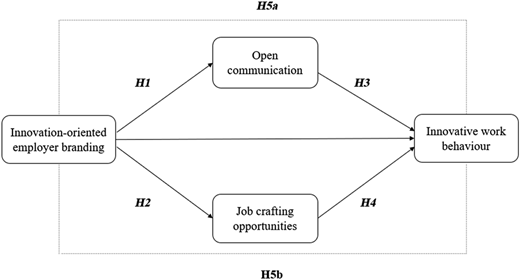
Innovation-oriented employer branding is positively related to open communication.
2.2 Innovation-oriented employer branding and job crafting opportunities
Innovation-oriented employer branding may also relate to employees' perceptions of the opportunities available to them to craft their jobs. Job crafting refers to the proactive adjustments employees make to their tasks, relationships and work boundaries in order to better align their roles with their skills, interests and motivations (Petrou et al., 2012). Through job crafting, employees actively shape the way they perform their work, which can increase task ownership, engagement and flexibility in the workplace (Afsar et al., 2019). Such proactive role adjustments have been associated with greater learning, adaptability and IWB (Li et al., 2025). In the present study, the focus is not on employees' actual job crafting behaviour but on their perceptions of the opportunities available to engage in such adjustments (Petrou et al., 2017).
As employees increasingly value autonomy and self-expression (Ek Styvén et al., 2022), perceptions of an organisation's innovation orientation may influence employees' perceptions of job crafting opportunities, as well as their willingness to engage in such proactive behaviours. When employees perceive their employer as fostering creativity and innovation, they may feel encouraged to explore new approaches and adapt their tasks accordingly. In organisational environments where initiative and creative problem-solving are valued, employees may feel more empowered to adjust how they perform their roles and experiment with new ways of accomplishing their tasks. In this sense, job crafting can reflect adaptability and innovative work practices within the organisation (Guo et al., 2023).
Therefore, employees who perceive their employer brand as innovation-oriented may also identify greater opportunities to shape their work roles through job crafting. Accordingly, we propose that:
Innovation-oriented employer branding is positively related to job crafting opportunities.
2.3 Open communication and innovative work behaviour
IWB refers to employees' efforts to generate, promote and implement new ideas that improve work processes, products or organisational performance (Devloo et al., 2015; Afsar et al., 2019). It encompasses activities such as identifying opportunities for improvement, proposing novel ideas and solutions and implementing new approaches within one's role, team or organisation (de Jong and Den Hartog, 2007, 2010).
Innovative employees contribute to organisational competitiveness by solving complex problems, improving performance and generating novel ideas (Hon and Lui, 2016). Engaging in such behaviours may also produce positive outcomes for employees, including higher levels of loyalty, job satisfaction and performance (Ek Styvén et al., 2022).
Open communication facilitates the exchange of information, ideas and feedback across the chain of command, thereby supporting knowledge sharing and collaborative problem-solving (Heyden et al., 2017). Communication climates characterised by openness can stimulate creativity and innovation by facilitating feedback, idea exchange and collective learning (Sadegh Sharifirad and Ataei, 2012; Della Torre et al., 2021). Recent studies also confirm that employees who can communicate through both top-down and bottom-up channels develop stronger workplace solidarity and engagement (Nyfoudi et al., 2022). Therefore, in environments where employees feel comfortable sharing ideas and discussing potential improvements, they may be more likely to generate and implement innovative ideas.
Research on SMEs highlights the importance of employee innovation for both individual and organisational performance (e.g. Della Torre et al., 2021; Knezović and Drkić, 2021). In such contexts, communication processes that facilitate collaboration and the exchange of ideas may encourage employees to propose improvements, introduce new approaches and actively participate in innovation processes.
Therefore, employees who perceive higher levels of open communication may be more willing and able to engage in IWB. Accordingly, we hypothesise that:
Open communication is positively related to IWB.
2.4 Job crafting opportunities and IWB
Job crafting enables employees to proactively modify aspects of their work to better align their roles with their skills, interests and motivations (Petrou et al., 2012). Through such adjustments, employees may modify the scope of their tasks, interactions with colleagues, or approaches to work, thereby enhancing engagement and flexibility. These proactive behaviours allow individuals to take greater ownership of their roles and actively shape how work is performed (Afsar et al., 2019).
Such proactive role adjustments may also facilitate IWB (Teng and Cheng, 2025). When employees craft their jobs, they may explore new ways of performing tasks, experiment with alternative and creative solutions and identify opportunities for improvement in their work processes. By adapting their roles and work practices, employees may generate and implement novel ideas, fostering adaptability and innovative work practices (Li et al., 2025; Guo et al., 2023).
Therefore, employees who perceive greater job crafting opportunities may be more willing and able to engage in IWB. Accordingly, we hypothesise that:
Job crafting opportunities are positively related to IWB.
2.5 The mediating roles of open communication and job crafting opportunities
While innovation-oriented employer branding may directly influence IWB, its effects may also operate through workplace mechanisms that shape how employees interact and perform their roles. Building on signalling theory, organisational signals help employees interpret the values and priorities of their employer (Connelly et al., 2011; Guest et al., 2021). Signals communicated through employer branding may shape employees' perceptions of their day-to-day work experiences and workplace conditions, which in turn influence their engagement in IWB. In this context, open communication and job crafting opportunities represent workplace mechanisms through which employees interpret and respond to employer branding signals. When employees perceive their organisation as innovation-oriented, they may infer that creativity, initiative and idea sharing are encouraged within the workplace. Such perceptions may influence both how employees communicate with colleagues and how they approach and structure their work tasks.
Open communication represents one mechanism through which these signals may translate into IWB. When employees feel able to exchange ideas, discuss challenges and provide feedback openly, they are more likely to collaborate and develop novel solutions to work-related problems (Heyden et al., 2017). Through such interactions, employees may be better able to generate and implement new ideas.
Similarly, job crafting opportunities may represent another mechanism linking employer brand perceptions to IWB. When employees perceive that creativity and initiative are valued, they may feel more empowered to adjust their tasks, explore alternative approaches and take greater ownership of their roles. Such proactive role adjustments may create conditions that support learning, experimentation and the development of new ideas.
Taken together, open communication and job crafting opportunities may serve as mechanisms explaining the relationship between innovation-oriented employer branding and IWB. Therefore, we hypothesise that:
Open communication mediates the relationship between innovation-oriented employer branding and IWB.
Job crafting opportunities mediate the relationship between innovation-oriented employer branding and IWB.
Figure 1 presents the conceptual model of this study.
3. Methodology
3.1 Research procedure and participants
The study focused on employees from Greek SMEs, covering all size categories based on the Eurostat methodology (European Commission, 2023), i.e. micro (<10 employees), small (<50 employees), and medium-sized (<250 employees). In collaboration with the Hellenic Ministry of Development and Investments, we accessed a list of private-sector SMEs. 76.40% of these firms operate in the tertiary sector. This list focuses on SMEs that have received business development funding in the past three years, independent of their sector. To broaden coverage, the ICAP Data Prisma 2021 database (ICAP CRIF, 2021) was also used to identify additional SMEs.
Employees were invited via email to participate in an online survey conducted using Qualtrics XM between May 2021 and January 2022. Out of 852 contacted employees from 310 SMEs, we received 524 valid responses from 55 firms. Table 1 summarises the sample characteristics. We tested our model and hypotheses using SmartPLS v.4.1.1.7.
Sample size adequacy was assessed against recommended benchmarks for PLS-SEM analysis. The achieved sample of 524 employees exceeds commonly recommended minimum sample size requirements based on rule-of-thumb and model complexity considerations, supporting the adequacy of the sample for estimating the proposed mediation model (Lim, 2025). In addition, multiple forms of validity were considered (Lim, 2024). Content and face validity were supported through the adoption of established measures and their contextual review. Convergent validity was assessed through standardised loadings, average variance extracted, and composite reliability, while discriminant validity was examined using the heterotrait–monotrait ratio (HTMT) criterion. Nomological validity was assessed through the theoretically expected relationships among innovation-oriented employer branding, open communication, job crafting opportunities, and IWB. Predictive validity can be inferred more cautiously from the model's explained variance. Given that several items were removed, the retained measures are treated as contextual scale adaptations, while still covering the intended construct domains (Lim et al., 2026).
3.2 Measures
IWB: Innovative work behaviour was measured using the 4-item Innovative Role subscale of the Role-Based Performance Scale (Welbourne et al., 1998), including items: “coming up with new ideas” and “creating better processes and routines”. Responses ranged from 1 (needs much improvement) to 5 (excellent). The present study employed the Innovative Role subscale as it captures innovation-related role performance through behaviours involving the generation, development, and implementation of workplace improvements, which is consistent with established conceptualisations of IWB (e.g. de Jong and Den Hartog, 2010). Its prior application in innovation-related research (e.g. Li and Tang, 2022) further supports its suitability for the present study, while its conceptual distinctiveness from job crafting opportunities makes it particularly appropriate for this context.
Innovation-oriented employer branding: We used the Interest dimension of the Employer Attractiveness (EmpAt) scale (Berthon et al., 2005), which captures aspects of creativity and innovation. Items such as “working in an exciting environment” and “the organisation both values and makes use of people's creativity” were rated on a 5-point Likert scale (1 = does not characterise my organisation; 5 = fully characterises it). Among the five EmpAt dimensions, interest value is the only dimension explicitly concerned with creativity and novel thinking. The economic, development, application, and social value dimensions capture remuneration, career advancement, skill utilisation, and workplace relationships, none of which reflect innovation-related employer brand signals. It should be noted that the present study does not develop or validate a new innovation-oriented employer branding construct, but utilises this established dimension for that purpose, consistent with prior research applying it to study employee-level innovation perceptions (Ek Styvén et al., 2022). Also, while originally designed for jobseekers, this scale is suitable for assessing current employee perceptions (Ek Styvén et al., 2022). Thus, in the present study, the scale is used as a measure of employees' perceptions of innovation-oriented employer branding rather than as a direct measure of employer attractiveness.
Open communication: We employed a 5-item scale by Kitchell (1995), capturing employees' perceptions of communication openness and information sharing within the organisation. Representative items include “communication between peers in this company is excellent” and “supervisors in this company are willing to share all relevant information with subordinates”. Responses were captured on a 5-point Likert scale (1 = strongly disagree; 5 = strongly agree).
Job crafting opportunities: We used the 7-item scale by Petrou et al. (2017) to assess perceived organisational support for job crafting. This scale captures employees' perceived opportunities to craft their jobs, rather than their actual job crafting behaviour. Representative items of the scale include “if I want, I can change the number of tasks I carry out at work”, and “if I want, I can change the type of tasks I carry out at work”. Employees were asked to rate the job crafting opportunities in their organisation using a 5-point Likert scale, ranging from 1 (never) to 5 (always).
Control variables: We controlled for education level, assessed using the International Standard Classification of Education (ISCED) developed by Eurostat (2013), and hierarchical position, determined by dividing employee's positions within the organisational hierarchy by the total number of hierarchy levels, following Guan et al. (2014).
We applied the translation-back translation technique to ensure linguistic accuracy. Three researchers participated: one translated the scales into Greek, another back into English, and a third reconciled both versions. More than 90% of the items were initially identical across versions.
4. Results
4.1 Measurement issues and robustness checks
We tested our model and hypotheses using SmartPLS v.4.1.1.7. The analysis proceeded in two stages. First, we focused on the robustness of the measures included in our research model (innovation-oriented employer branding, job crafting opportunities, open communication, IWB). Due to low factor loadings, we removed three items from the variable “open communication” and two from the variable “job crafting opportunities”. Consistent with Lim et al. (2026), item retention was based on both statistical performance and construct representation. Following item removal, standardised factor loadings for our latent variables were satisfactory (see Table 2). As a next step, the measurement model was assessed to evaluate reliability and validity (see Table 2). Internal consistency reliability was confirmed, with Cronbach's alpha values ranging from 0.740 to 0.891, exceeding the recommended threshold of 0.70 (Hair et al., 1992). Similarly, composite reliability (CR) values ranged from 0.838 to 0.925, indicating satisfactory reliability (Fornell and Larcker, 1981). Convergent validity was supported, with the average variance extracted (AVE) values ranging from 0.510 to 0.793, surpassing the recommended threshold of 0.50 (Hair et al., 2019).
Discriminant validity was examined using the heterotrait–monotrait ratio (HTMT). All HTMT values were below the recommended threshold of 0.90, indicating that the constructs are empirically distinct (see Table 3). Based on the above, we may conclude that the measurement model demonstrates adequate reliability, convergent validity, and discriminant validity.
Collinearity diagnostics were also examined using the variance inflation factor (VIF). The results showed that all VIF values were below the recommended threshold of 3.3, suggesting that multicollinearity is not a concern. Furthermore, following the full collinearity assessment approach, these results indicate that common method bias is unlikely to affect the findings of this study. Finally, Harman's single-factor test was conducted to assess the potential for common method bias. The results indicated that the first unrotated factor accounted for 27.97% of the total variance, which is below the recommended threshold of 50% (Podsakoff et al., 2003). Therefore, common method bias is unlikely to be a serious concern in this study.
4.2 Hypotheses testing
Before testing the research hypotheses, we examined the predictive power of our model. The R2 values for job crafting opportunities (R2 = 0.139), open communication (R2 = 0.329) and IWB (R2 = 0.314) showed satisfactory predictive power. Especially for the dependent variable and in line with commonly used PLS-SEM benchmarks (Hair et al., 2011), the R2 value for IWB (0.314) reflects moderate explanatory power. This indicates that while the proposed workplace mechanisms account for a meaningful share of variance in IWB, a significant portion remains attributable to other individual, team, or organisational factors that are not included in the present model. Next, bootstrapping was conducted to assess the significance of the hypothesised relationships. Table 4 summarises the SEM results.
Among control variables, only hierarchical position showed a significant positive relationship with IWB (β = 0.085, p < 0.05), indicating that employees in higher positions demonstrate more innovative behaviours in terms of ideation and implementation. Education (β = −0.048, p > 0.05) was not a significant predictor, suggesting that SME employees exhibit similar levels of IWB, regardless of educational background.
Regarding the effects of the independent variable on the mediators, innovation-oriented employer branding was positively and significantly related to both open communication (β = 0.574, p < 0.01) and job crafting opportunities (β = 0.373, p < 0.01), supporting H1 and H2. The findings indicate that when SME employees perceive their organisation as innovative, this perception is associated with greater perceived opportunities to tailor their job and engage in open communication with colleagues and managers. In addition, the perceptions of open communication and job crafting opportunities were positively associated with IWB (β = 0.123, p < 0.05; β = 0.088, p < 0.05), supporting H3 and H4. These findings show that when employees experience opportunities for open communication and job crafting, they are more likely to demonstrate increased levels of IWB.
Regarding the mediating effects, the indirect effects of innovation-oriented employer branding on IWB through open communication indicate that open communication significantly mediates the relationship between innovation-oriented employer branding and IWB (β = 0.071, p < 0.05). Similarly, job crafting opportunities significantly mediate this relationship (β = 0.033, p < 0.05). The mediation effects were positive and statistically significant, as the 95% bias-corrected confidence intervals (BCCIs) do not include zero, thereby supporting H5a and H5b. While statistically significant, the relatively small effect sizes of these indirect effects, and especially the path through job crafting opportunities, should be interpreted with caution rather than as evidence of a substantively strong pathway. Additionally, given that innovation-oriented employer branding had a significant direct effect on IWB (β = 0.423, p < 0.01), we can conclude that there is a partial mediation in both cases. Overall, the findings show that when employees perceive their organisation as innovative, they are more likely to experience greater open communication and may also perceive greater opportunities to shape their work roles through job crafting. Such perceptions are associated with increased levels of IWB.
5. Discussion and theoretical implications
This study examined how employees' perceptions of innovation-oriented employer branding relate to IWB in SMEs, and more specifically, whether this relationship operates through employees' perceptions of open communication and job crafting opportunities. Drawing on signalling theory, the findings suggest that perceptions of innovation-oriented employer branding are positively associated with IWB, with this relationship partially explained by open communication and job crafting opportunities.
Signalling theory suggests that individuals interpret organisational cues to infer underlying values and priorities (Guest et al., 2021; Connelly et al., 2011). When employees perceive their organisation as innovation-oriented, they interpret this as an indication that creativity, initiative and idea sharing are encouraged. Such perceptions may be associated with how employees interact with colleagues and approach their work. A key theoretical contribution of this study is to extend the application of signalling theory in employer branding from the predominant focus on prospective employees and attraction-related judgments to the experiences of incumbent employees. Whereas prospective employees interpret employer brand signals from outside the organisation, incumbent employees interpret these signals in relation to their ongoing workplace experiences. In this sense, the theoretical question is not only whether an innovation-oriented employer brand signal is communicated, but also how that signal is interpreted in light of employees' day-to-day experiences within the organisation. The partial mediation through open communication and job crafting opportunities suggests that these workplace conditions form part of this internal interpretation process, helping to explain how innovation-oriented employer branding is associated with IWB. This positions incumbent employees as active interpreters of employer brand signals and extends the application of signalling theory beyond the attraction context that has predominantly characterised employer branding research.
The study also contributes to the employer branding literature by addressing the limited attention given to how innovation-oriented employer branding perceptions relate to IWB. Prior research has primarily focused on employee attitudes, behavioural intentions or performance (e.g. Tumasjan et al., 2020; Ek Styvén et al., 2022). The findings also contribute to the HRM literature by linking employer branding perceptions with employees' perceptions of open communication and job crafting opportunities, workplace conditions associated with employee initiative and innovative behaviour.
The study further extends the SME management literature. While much of the employer branding literature has focused on large organisations and attracting jobseekers, this study highlights how employer branding perceptions are associated with employees' behaviour within SMEs. Due to their typically flatter structures and closer interpersonal relationships, SMEs often rely heavily on communication and employee initiative to support innovation (Della Torre et al., 2021; Knezović and Drkić, 2021). The findings provide insights into how employer branding perceptions may link to IWB in organisational contexts where informal communication and role flexibility are particularly salient.
From a methodological perspective, this study applies the interest value dimension of the EmpAt scale (Berthon et al., 2005) to examine employees' perceptions of innovation-oriented employer branding, an aspect not always central in employer branding research. In addition, by focusing on innovation-oriented employer branding and its relationship with IWB, the study extends the use of this scale to an internal behavioural context.
6. Practical implications
The findings offer several practical implications for organisations seeking to foster innovation through their employer branding. The results suggest that employer branding should also be viewed as an internal mechanism shaping employees' work perceptions (Edwards, 2010). By emphasising values related to idea sharing and experimentation, organisations may reinforce perceptions that innovation is encouraged, prompting employees to contribute ideas and engage more actively in IWB.
SME managers should treat innovation-oriented employer branding as a promise that requires internal proof. A claim that the organisation values creativity will carry little weight when employees cannot speak openly, exchange ideas, or adjust how work is done. Instead, managers should align brand messages with routine practices, such as forums for upward voice, supervisor information sharing, task autonomy, and flexible role boundaries. Such alignment should, in turn, strengthen the credibility of the employer brand and create conditions under which employees can translate innovation cues into innovative work behaviour. In practice, this may require a more employee-centric management approach that encourages participation, decentralised decision-making, employee voice, and flexibility in how work is organised. These practices may be particularly suitable for SMEs, which they rely more on managerial behaviour and communication processes than on resource-intensive HR systems. Moreover, the flatter organisational structures often found in SMEs may facilitate the alignment between employer brand signals and everyday work practices.
Beyond shaping employees' perceptions and behaviour, employer branding can support organisational differentiation by emphasising innovation-related attributes that appeal to the target workforce (Ek Styvén et al., 2022). The findings suggest that such attributes may be more credible when reinforced internally through workplace practices that support open communication and job crafting opportunities.
7. Limitations and future research
Given the cross-sectional and single-source design, the findings should be interpreted as evidence of theoretically expected associations rather than definitive causal effects, as alternative causal directions cannot be ruled out. Future research can strengthen causal inference through longitudinal designs that establish temporal ordering, multisource data such as supervisor-rated IWB, and experimental or quasi-experimental designs that test whether innovation-oriented employer brand signals change communication climates, job crafting opportunities and innovative behaviour over time. Future studies could also examine alternative mediating and moderating mechanisms that capture both the positive and the potential negative consequences of innovation-oriented employer brand signals. These may include psychological states such as perceived organisational support and psychological safety, negative consequences such as role overload and creative exhaustion, and contextual factors such as leadership styles and organisational characteristics.
The study also relies on self-reported measures, which may introduce potential biases such as common method variance. However, the focal constructs reflect employee perceptions and experiences that are appropriately captured through self-reports. Future research could incorporate supervisor-rated IWB or organisational-level innovation indicators.
Relatedly, open communication was operationalised using two items following the exclusion of three low-loading items. Although the retained items showed adequate reliability, this abbreviated measure may not fully capture the construct's conceptual breadth. Future research could therefore employ a more comprehensive measurement approach.
In addition, the empirical context of Greek SMEs may limit the generalisability to other national or organisational settings. SMEs differ considerably in size, structure and resource availability, which may influence how employer branding perceptions relate to employee innovation. Moreover, organisations that participate in research initiatives may differ from other firms in terms of their engagement with innovation or organisational development activities. Future research could extend this work to larger organisations or conduct cross-national comparisons.
Finally, while this study focuses on perceptions of innovation-oriented employer branding, future research could examine how other employer-related perceptions, such as development opportunities, economic rewards, social relationships, or work-life balance, relate to employee behaviour and organisational outcomes.