Understanding antecedents to employees' participation in organizations' environmental initiatives (EIs) is essential to increasing their EI engagement and achieving organizations' pro-environmental goals. This study tested an extended theory of planned behavior model exploring whether employees' (1) values, (2) ecological worldview and (3) perceptions of the costs and benefits of an EI predict their attitudes to EI participation and intentions to participate more.
A survey was completed by 209 US employees who had taken part in an EI at their organization. Measures included cost and benefit perceptions of EIs, theory of planned behavior constructs, values and ecological worldview. Structural equation modeling, including confirmatory factor analysis, was used in the analysis.
The proposed measurement and structural equations model fit the data. Key findings show that employees' perceptions of EI benefits positively predicted attitudes to participation, while costs negatively predicted attitudes to participation. Costs also negatively predicted perceived behavioral control. Benefits had positive effects on subjective norms and indirect effects on intentions to increase participation. The effects of values and ecological worldview in the model were insignificant or weak. Values explained minimal additional variance.
This study addresses a gap in research on employees' values and perceptions of the costs and benefits of EI participation as antecedents to their attitudes to participating in an EI and intentions to participate more. The findings demonstrate the potential importance of employees' cost-benefit perceptions over values for organizations seeking to enhance employees' EI participation through green human resource management, such as internally marketing EI participation.
Introduction
Employees play an essential role in initiating and sustaining environmental initiatives (EIs) in organizations (Paillé and Valéau, 2021). It is important for organizations that are aiming to reduce their negative environmental impact to understand antecedents to employees' EI participation, including what motivates participation (Tang et al., 2023). Knowledge of such antecedents to pro-environmental behaviors (PEBs) has implications for green human resource management (GHRM) in areas such as hiring, training and rewards (Paillé and Valéau, 2021; Shah and Soomro, 2023).
Values and cost-benefit perceptions are two variables that may compete in influencing PEBs (do Canto et al., 2023). For example, an EI's contribution to society may appeal to employees' values, but its personal costs may repel them (e.g. time demands). The present study addresses a gap in the understanding of factors that influence workplace PEBs (Khalid et al., 2022) by testing an extended theory of planned behavior (TPB) model (Ajzen, 1991). Our model uniquely predicts employees' intentions to increase EI participation based upon their values, ecological worldview (EW), and perceptions of the costs and benefits of EI participation to themselves, their organization and society. This study advances the literature by contrasting the effects of employees' values and of employees' perceptions of EIs' costs and benefits when predicting EI participation intentions. These variables do not appear to have been explicitly tested together in prior TPB workplace models (e.g. Fatoki, 2022; Meng et al., 2022). This study's findings may also have practical value for organizations designing GHRM activities and strategies to promote EI participation, as well as for researchers focused on workplace PEB antecedents.
Various theories have been applied in studying why employees engage in workplace PEBs, including the TPB, values theory, norm activation model (NAM), value-belief-norm theory (VBN) and goal-framing theory (Ateş, 2020; Meng et al., 2022; Ruepert et al., 2015; Tang et al., 2023; Zulkepeli et al., 2024). The present study builds upon the TPB. This theory examines three antecedents to employees' intentions to engage in a behavior (Fishbein and Ajzen, 2010): (1) the costs and benefits of the behavior (attitude), (2) situation-specific social pressures to engage in a behavior such as peer expectations (subjective norms [SN]) and (3) the ability to participate in the behavior, including having the necessary competencies (perceived behavioral control [PBC]). The TPB was selected as it is the most commonly used theory in this area of study and has a substantial evidence base (Katz et al., 2022; Klöckner, 2013; Mehmood et al., 2023; Meng et al., 2022; Yuriev et al., 2020b). In addition, the TPB has an indirect focus on an action's costs and benefits, aiding the identification of opportunities to influence EI participation by highlighting benefits or reducing cost perceptions.
The TPB has been criticized for its rational orientation, failure to account for other factors influencing behavior and overlooking employees' moral concerns evident in their values and EW (Mehmood et al., 2023; Yuriev et al., 2020b; Wells et al., 2024). Ajzen (2020) notes that in the TPB, values indirectly influence behavioral beliefs about outcomes like costs and benefits, but values are not explicitly measured. Hybrid models of multiple theories are increasingly used for additional explanatory power (Katz et al., 2022; Mehmood et al., 2023; Meng et al., 2022; Zulkepeli et al., 2024). We add to the TPB literature by explicitly incorporating values into our model, which enables us to contrast the effect of values, as a stable employee characteristic, with the effects of cost-benefit perceptions, which are more easily influenced (Ruepert et al., 2017; Yuriev et al., 2020b). This approach may provide insights into GHRM strategies to promote EI participation, such as hiring for biospheric values (e.g. Hooi et al., 2022), versus attempts to influence cost-benefit perceptions by expanding awareness, relationship building, peer influence, nudges or incentives (Gregory-Smith et al., 2015; Grilli and Curtis, 2021; Wells et al., 2024).
Our model includes two additional features, strengthening its contribution. Firstly, we integrate goal-framing theory's proposition that individuals reflect on both their own goals and their group's goals when thinking about an action's costs and benefits (Lindenberg, 2001; Lindenberg and Steg, 2007). The influence of employees' multiple goals in a situation is often overlooked (do Canto et al., 2023). This study, therefore, examined costs and benefits to the employee, their organization and society (as different frames), moving beyond prior studies' reliance on employees' global attitudes to EI participation. As a result, our study adds a more intentional and theoretically grounded approach to considering how different frames influence cost and benefit perceptions. Secondly, we included EWs in our model, which addresses employees' views on humans' role in harming or unbalancing nature (Dunlap et al., 2000; Donmez-Tura and Kiliclar, 2021). Consistent with VBN theory (Stern et al., 1999), EW examines an alternative path for employees' values to influence intentions through moral obligation (Ateş, 2020), meaning that individuals may act proenvironmentally despite an action's costs and benefits. While EW has been included in prior workplace studies (e.g. De Groot et al., 2008), our model's novel combination of values, costs and benefits, and EW aids understanding of the mechanisms of values' influence on PEBs.
This study's objective was, therefore, to test an extended TPB model examining the effects of employees' perceptions of the costs and benefits of EI participation and of EW on both attitudes to EI participation and BI to increase EI participation, where values are antecedents to costs, benefits, and EW. This allowed us to contrast how values, and costs and benefits, directly or indirectly predicted positive attitudes to EI participation and intentions to participate. Therefore, the findings contribute to a greater understanding of whether values or costs and benefits are more essential in models, with implications for organizations' actions to increase EI participation.
Literature review
Organizations' EIs have been described as, “organizational level programs, actions, and interventions that enhance environmental sustainability” (Ones et al., 2015, p. 82). Similarly, workplace PEBs encompass, “all types of voluntary or prescribed activity undertaken by individuals at work that aim to protect the natural environment or improve organizational practices in this area” (Boiral et al., 2015, p. 21). The voluntary emphasis is important as workplace PEBs are often discretionary extra-role behaviors which organizations can influence (Francoeur et al., 2021; Mehmood et al., 2023). To include a range of PEBs, EIs are defined as “all types of efforts or programs (formal and informal, voluntary and required) in and by organizations that protect or benefit the natural environment” (Allen, 2023, p. 788). Ones et al. (2015) provide categories of PEB activities, including conserving resources (e.g. recycling), avoiding environmental harm (e.g. reducing pollution), working sustainably (e.g. redesigning work for sustainability), influencing others (e.g. teaching others) and taking initiative (e.g. changing policies). EIs can be formal and managerially mandated or be small-scale and informal initiatives by individuals or small groups (Boiral et al., 2015).
Theory of planned behavior
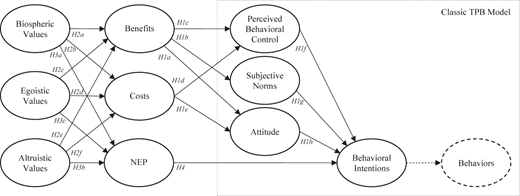
The TPB (Figure 1, right dashed rectangle) proposes that attitudes to a behavior (e.g. EI participation) are formed through an unconscious process of weighing a behavior's costs and benefits. The TPB is not intended to examine general attitudes to a behavior (e.g. attitudes to all PEBs) but rather focuses on singular actions in a specific situation or domain (e.g. workplace recycling), as influences like costs and benefits are situation- and behavior-specific. While TPB models vary in the specificity of behavior examined, focusing on classes of behaviors (Fishbein and Ajzen, 2010) increases theoretical significance by avoiding a model that focuses too narrowly on one type of behavior. In the present study, PEBs are a class of workplace behaviors where participants selected and rated their experiences of participating in specific workplace EIs.
Some TPB studies restrict their focus to measuring overall attitudes toward a behavior (favorable or unfavorable) rather than adopting a more detailed approach that examines the costs and benefits of engaging in PEBs in the form of beliefs about the behavior's outcomes (e.g. Meng et al., 2022; Yuriev et al., 2020b). Yuriev et al. note that only 14.2% of the 126 articles they examined included indirect predictors of attitudes, SN or PBC, such as behavioral, control, or normative beliefs. An attitude-only approach is limited as it does not identify specific antecedent costs and benefits that may be targeted to increase EI participation (Meng et al., 2022; Yuriev et al., 2020b; Zulkepeli et al., 2024). Few studies appear to consider specific advantages and disadvantages employees might see for themselves and the groups to which they belong (their organization and community), as suggested by goal-framing theory (Allen, 2023; Fatoki, 2022; Lindenberg, 2001; Yuriev et al., 2020b).
In a previous study on employee cost-benefit perceptions of EI participation, Allen (2023) created a detailed taxonomy of personal, organizational and societal costs and benefits. Fatoki (2022) applied a similar approach by examining intrinsic, extrinsic, organizational, social and environmental benefits but did not include costs, SN and PBC in their TPB model. Fatoki found that intrinsic, organizational, social and environmental benefits predicted employees' energy-saving behaviors. Allen et al. (2026) found that costs and benefits of EI participation significantly predicted attitudes to EI participation, BI to increase EI participation and increases in EI participation after two months. In a tourism industry study, Meng et al. (2022) focused on reasons for a PEB, including social, environmental and economic benefits, and reasons against a PEB, including costs, workload increase and lack of support. Their TPB model found significant direct and indirect effects on TPB constructs (SN, attitude, PBC and BI), with only reasons against a PEB not predicting PBC. This suggests that costs and benefits that employees consider can be identified and used in attempts to influence their EI participation. Allen et al. (2026) reported that most participants intended to participate in EIs and therefore focused on intentions to increase participation, or going beyond role expectations (Mehmood et al., 2023), an approach we adopted.
Along with attitudes, the TPB considers SN, or social and normative pressures from others (e.g. peers) to engage in a behavior, and PBC, or perceptions of one's ability to perform the behavior based upon having the necessary skills, resources, and opportunities (Ajzen, 1991). Together, attitudes, SN and PBC determine an individual's intentions to engage in a behavior. The effects of each of these antecedents on BIs may vary with different behaviors and situations (Fishbein and Ajzen, 2010; Yuriev et al., 2020b). BI is differentiated from actual behavior, as even if an individual intends to behave in a specific way, situational constraints or actual control might cause an intention-behavior gap (Ajzen, 2020; Yuriev et al., 2020b). While BI and behavior are positively correlated, Yuriev et al.’s (2020b) review states that 27.3% more variance was explained in workplace TPB models for intentions than behavior. As a foundational step, we proposed the following hypotheses (Figure 1) to confirm the relationships proposed by the original TPB model:
PBC will have a positive effect on BI.
SN will have a positive effect on BI.
Attitudes will have a positive effect on BI.
Previous studies have added moral concerns (self-transcendent values, such as biospheric and altruistic values, and EW), as well as self-enhancing values, as independent predictors in TPB models focused on PEBs (Ateş, 2020; Mehmood et al., 2023; Yuriev et al., 2020b), but without explicitly including costs and benefits. The TPB model can be extended with nonredundant and significant predictors (Ajzen, 2020; Fishbein and Ajzen, 2010; Zulkepeli et al., 2024). Moral concerns add a broader and less rational influence in models in addition to the immediate, situational, rational and deliberate focus of the TPB. While Fishbein and Ajzen (2010) assert that moral concerns exert their influence via attitudes in TPB models, models may not fully capture moral concerns' influence on PEBs and they can, therefore, be included as independent predictors (Ajzen, 2020; Lo, 2015; Klöckner, 2013), as explored in the Values and Ecological Worldview section below. Hence, an individual can form a negative attitude to a PEB, based on costs and benefits, but still have a positive intention to engage in the PEB because of moral obligations.
Goal-framing theory
Goal-framing theory (Lindenberg, 2001; Lindenberg and Steg, 2007) proposes that different situations prompt specific goals and frame the way information is accessed and applied in determining behaviors, including PEBs (Donmez-Turan and Kiliclar, 2021). Hedonic, gain and normative goal frames simplify human information processing based on situational cues that determine which goal frame is relevant. Hedonic goals emphasize maximizing immediate feelings such as pleasure, reducing anxiety or discomfort, or enhancing self-esteem, which includes the warm glow associated with PEBs (Kanojia and Dhiman, 2025). Gain goals focus on intermediate to long-term personal resources, such as money or income security, where immediate feelings are overlooked for a gain. Normative goals address acting for the good of the group–working together to gain collective goods. Hence, when considering a behavior's costs and benefits, individuals will consider not only what is pleasurable or good for them but also for their group, such as their organization or community (Tosti-Kharas et al., 2017; Paillé and Valéau, 2021). Values within a particular goal frame can compete with situational cues such as costs and benefits in determining how an individual ultimately behaves (do Canto et al., 2023), although we observe that this issue appears to be unstudied in the workplace, adding to the need for the present study.
Allen (2023) and Allen et al. (2026), summarized above, applied goal frames in workplace PEB studies. Fatoki (2022) and Meng et al. (2022) included benefits or costs in their study, without using goal framing theory. The present study included a balanced approach using employees' perceptions of costs and benefits as latent factors, which included the personal, organizational and societal frames. Therefore, additional hypotheses propose that:
Benefits will have a positive effect on attitudes.
Benefits will have a positive effect on SN.
Benefits will have a positive effect on PBC.
Costs will have a negative effect on PBC.
Costs will have a negative effect on attitudes.
Costs' effects on SN were excluded given previously insignificant effects Allen et al. (2026), avoiding a saturated model (Kline, 2023).
Values and ecological worldview
Altruistic, biospheric and egoistic values are identified as the most relevant values to the study of PEBs (Ruepert et al., 2017; Wells et al., 2024), with altruistic and biospheric values being self-transcendent (considerations beyond self) and egoistic values being self-enhancing. Hedonic values are sometimes included in models as a self-enhancing value (Yasir et al., 2021). De Groot et al. (2008) found that egoistic values (personal power, wealth, authority and influence) were inversely related to acceptance of a new ecological paradigm (NEP) or EW. Already introduced, the NEP addresses a broad pro-environmental orientation, general EW or ecological concern (Lo, 2015). In the TPB (Ajzen, 1991), costs and benefits would mediate values' effects on attitudes.
After searching the literature and considering reviews by Francoeur et al. (2021), Yuriev et al. (2020b), and Tang et al. (2023), we noted a lack of recent workplace PEB studies that combined values into TPB models with two exceptions. Yuriev et al. (2020b) identify three workplace studies including environmental values, two of which are older (<2006). Ateş’s (2020) tested a model using the TPB and the identity personal norm model and found support for biospheric values' role in PEBs. Blok et al. (2015) included altruistic and environmental values in a TPB model, tested through regression and found that values did not predict workplace PEBs or BIs. Our model proposes that biospheric and altruistic values negatively impact cost perceptions and positively impact benefit perceptions, meaning that those with biospheric and altruistic values will see greater benefits and lower costs to EIs:
Biospheric values will have positive effects on benefits.
Biospheric values will have negative effects on costs.
Altruistic values will have positive effects on benefits.
Altruistic values will have negative effects on costs.
In contrast, given egoistic values focus upon self and potential costs to self, it was anticipated that:
Egoistic values will have negative effects on benefits.
Egoistic values will have positive effects on costs.
The contribution of values and an EW to PEBs has been addressed using various theories (Donmez-Turan and Kiliclar, 2021; Yuriev et al., 2020b). The NAM aims to explain prosocial behavior (including PEBs) and proposes that when individuals are aware of the consequences of not acting pro-environmentally, feel responsible for outcomes, and perceive they can make a difference (having both self-efficacy and outcomes-efficacy), they form a personal norm of behaving pro-environmentally, which influences their PEBs (De Groot et al., 2008). VBN theory (Stern et al., 1999) extended on the NAM to suggest that biospheric and altruistic values contribute to the acceptance of a NEP or EW (Dunlap et al., 2000). An EW, when combined with awareness of consequences and ascription of responsibility, creates a personal norm that encourages PEBs.
With regards to EW we expected that:
Biospheric values will have positive effects on EW.
Altruistic values will have positive effects on EW.
Egoistic values will have negative effects on EW.
Despite focusing on nonworkplace studies, due to its larger evidence base, we chose Klöckner's (2013) meta-analysis of PEB models to guide our model's configuration of the NAM and TPB variables, including assuming that EW influences BI. Values and EW were applied in a simplified version of the VBN model, excluding personal norms (De Groot et al., 2008), to reduce the number of variables measured while gaining insight into values' and EW's effects in the model. As suggested by Klöckner's (2013) meta-analysis and VBN theory:
EW will have positive effects on BI.
It is important to note from the above hypotheses that altruistic, biospheric and egoistic values can influence BI via both EW and costs and benefits in the model.
In summary, employees' perceptions of EI participation's costs and benefits have received limited consideration in workplace studies, especially in terms of their relationship to values. Past workplace TPB studies have not directly examined values' role as antecedents to cost and benefit perceptions. This study also considers the effects of employees' values on their EW and how their EW affects intentions to increase EI participation. This study, therefore, integrates multiple theories to clarify potential targets for GHRM policies and practices to increase EI participation.
Methodology
A cross-sectional survey design was applied as it enables an estimation of the patterns of association between variables in the model at a point in time for a large sample through quantification of variables in a naturally occurring, nonexperimental context (Bell et al., 2022). This approach allows a snapshot of the relationships of interest suited to exploratory research but precludes determinations of causality. Participants were employees who had participated in at least one EI, ensuring the sample had experiences with EIs and that their attitudes to EI participation were not based only on generalized attitudes to environmental issues.
Instrumentation
Items adapted from Allen et al. (2026) were used to measure personal, organizational, and societal costs and benefits, SN, PBC, and BI (α > 0.70 for scales with three or more items). Items and scales are listed in Table 1. All items used scale anchors of 1 “Strongly Agree” to 7 “Strongly Disagree”, except the semantic differential items (see items and anchors in Table 1). A CFA of the measurement model reported by Allen et al. suggested good fit to the data (CFI 0.96, RMSEA 0.05, TLI 0.94, SRMR 0.04). However, given reported cross-loading of some items, two items (a personal benefit and personal cost item) were replaced, and one SN item was split into two (separating managers' and employees' expectations), as shown in Table 1. We conducted a pilot study (N = 109) using the same sampling as the main study and excluded pilot participants from recruitment for the main study, as described below. The pilot study clarified that replacement items were functioning adequately (e.g., cross-loadings, psychometric properties, alphas).
After confirming the reliability of the personal, organizational and societal benefit, items were averaged within each scale to produce three indicators of the benefits latent factor, with the same done for costs. This parceling allowed a balanced representation of personal, organizational and societal costs and benefits with fewer parameters to estimate (Kline, 2023). All other scales were represented through latent factors loading to the scale items. Five items from Allen et al. (2026) were included in the final and pilot survey to compare replacement items' functioning with the original items, but these items were excluded once the new items were adopted.
A five-item version of the NEP scale (α = 0.73) was used with a five-anchor rating scale (“Strongly agree” to “Strongly Disagree”) to measure EW (Stern et al., 1999). An example item is “Humans are seriously abusing the environment” (Dunlap et al., 2000, p. 433). De Groot et al. (2008) shortened versions of Schwartz's value scales were used to measure biospheric (α = 0.83), altruistic (α = 0.75) and egoistic values (α = 0.65) (four items per scale) on a 9-point scale from “-1 Opposed to my values” and “0 Not important” to “7 Extremely important” (De Groot et al., 2008, p. 336). An example ecological value item was “Protecting the environment: preserving nature” (p. 337), where the value is rated as a guiding principle in participants' lives.
The survey began with two open-ended questions asking participants to describe the EI they participated in and the role they played in the EI. In addition to providing descriptive information about the sample, this question was used to ensure participants had relevant experience and replied authentically and attentively. Participants were asked to focus on the EI they described above to ensure they addressed a specific action and context. The NEP and values scales were presented last to minimize priming of responses to the TPB and cost and benefit items.
Sample
Our sampling criteria included working adult US residents who participated in an EI at work in the last six months. We observed Kline's (2023) sample size recommendation of over 200 for CFA and SEM analysis. After ethics board approval, anonymous and voluntary samples were recruited for both the pilot (N = 109) and main study (N = 209) from Amazon Turks (MTurks) following Aguinis et al.’s (2021) best practices for MTurks samples. MTurks provided a suitable sampling frame as we needed at least 200 employees of companies that had EI programs who met the sampling criteria and included a diverse range of industries and EI types. Heterogenous samples are useful for testing theory and generalizing, but may contain many sources of variance and need a large sample (Bell et al., 2022).
Participation was compensated at twice the US Federal minimum hourly wage. Participants were vetted before the study using a paid screening survey that included a Captcha (preventing nonhuman responses), two questions confirming US residency, three comprehension questions and three open-ended questions where participants described the EI, their role in the EI, and the nature of the organization. MTurk's filters for participants' location and previous MTurk work quality were used. Responses were reviewed to ensure consistency between questions, relevance of responses and fit to sampling criteria. Sample demographics are listed in Table 2.
Analyses
Descriptive statistics (M, SD), scale reliabilities (alphas) and Pearson's correlations were calculated in SPSS 28. Analysis began with a CFA in AMOS 28 to confirm the measurement model. QMeasure (Cheung et al., 2024) was used to confirm reliability and convergent and divergent validity. Next, SEM was used to test the model in Figure 1 and all hypotheses. Effects and correlations are labeled weak (<0.30), moderate (>0.30, <0.50) and strong (>0.50) in the findings and discussion. CFA and SEM fit standards were applied from Little (2024) with a RMSEA and SRMR of ≤ 0.05 indicating close fit and 0.05 to 0.08 indicating acceptable fit, and with a CFI and TLI of ≥ 0.95 indicating very good fit and 0.90 to 0.95 indicating acceptable fit.
Findings
A CFA with all latent variables correlated was used to test if the factor structure aligned with the observed data, yielding a χ2 of 572.856 (df = 389, p = 0.000) with fit indices of CFI 0.949, TLI 0.939, RMSEA 0.048 and SRMR 0.057, suggesting an adequate to good fit to the data (Little, 2024). All standardized loadings of the latent factor to the items or composites (Table 1) were above 0.50 (Nunan et al., 2020). Cronbach alphas were above 0.70 (Table 1) for scales and composites with three or more items (Nunan et al., 2020). Cronbach alphas for the parceled costs and benefits scales (with three or more items) were also above 0.70. QMeasure (Cheung et al., 2024) was used to assess construct reliability (CR) and convergent and discriminant validity. Cheung et al. critique classical approaches to psychometric scale quality (e.g. AVE, HTMT and Cronbach's alpha), especially for ignoring sampling error, and propose the best practices implemented in QMeasure. The findings are presented in Table 3. QMeasure relies on CIs from bootstrapping and identifies problematic findings: AVE is significantly lower than 0.50 (p < 0.05) using the 90% CI; construct reliability is significantly lower than 0.70; latent correlation coefficients are significantly larger than 0.70; or AVE is significantly less than squared-correlations (p < 0.05). None of these issues were identified. Costs' AVE was 0.47 but not significantly less than 0.50 for the 90% CI (0.40, 0.54). Nunan et al. (2020) also state that CR (>0.70 for costs) determines convergent validity regardless of AVE. Two construct reliabilities were significantly lower than the 0.80 ideal (p < 0.05), but were still above the required 0.70 noted above. We ran 2000 bootstraps. CRs exceeded 0.70. Convergent validity was adequate, based upon CRs, standardized factor loadings (>0.50 is required), and acceptable AVEs. Cheung et al.‘s discriminant validity criteria were met, which require the measurement model fit the data (reported above), AVE is significantly below r2, and correlations between constructs must be lower than 0.7.
As this study used single-source survey data, steps were taken to reduce common method bias (CMB). We followed Podsakoff et al.’s (2003) guidance including limiting participants' knowledge of the relationships studied, anonymity, scale ordering, thorough item development and pilot testing, and varying scale and item formats (reverse scoring, semantic differential, Likert scale anchors and mixed item order were used). To estimate CMB, Harman's single-factor test was applied using exploratory factor analysis. A minority of the measure's covariance was accounted for by a single factor (29.77%), applying the threshold of <50% (Aguirre-Urreta and Hu, 2019; Podsakoff et al., 2003). A CFA with and without a common latent factor (with equalized loadings to the indicators) was also conducted (Podsakoff et al., 2003). This showed minimal change (<0.08) in item regression weights, applying Gaskin (2022) recommendation of a change of < 0.20. While these analyses do not suggest CMB, post-hoc measurement-based approaches to detecting CMB may not detect bias (Guide et al., 2015). Analysis of the demographic and EI variables as controls using linear regression did not reveal significant effects (p < 0.05) on relationships.
With potential for employees' and supervisors' perspectives to differ, independent sample t-tests and Levene's tests for homogeneity of variance were calculated for modelled constructs. Nonsignificant differences in means and variance (p > 0.05, p > 0.005 with Bonferroni correction) indicated that analysis on the total sample could proceed. A significant difference (p < 0.005, with Bonferroni correction) in egoistic value means for employees (M = 4.45) and managers (M = 5.18), but not variance (Levene's test), was not examined further due to egoistic values' lack of effects. Tolerances were greater than 0.5 and variance inflation factors less than 2 for the study variables and demographics, which does not suggest multicollinearity (Kline, 2023).
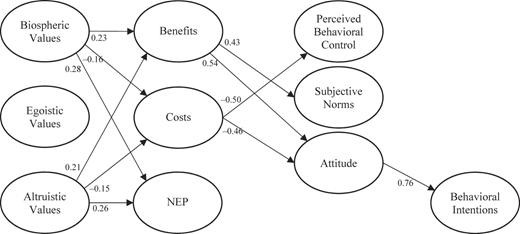
The proposed SEM model (Figure 1) was tested. Figure 2 shows the standardized regression weights with nonsignificant paths hidden for easier viewing. Model-data fit was good (Little, 2024) with a χ2 of 614.800 (df = 409, p = 0.000) and CFI 0.943, TLI 0.935, RMSEA 0.049 (90% CI[0.041-0.057]) and SRMR 0.063. MIs were not used. No modification indices or correlations of error terms were applied. Observing the strong covariance between biospheric and altruistic values (standardized 0.73), a negative suppressor effect was considered where effects on benefits, costs, and NEP may be unbalanced due to biospheric and altruistic values' relationship (Kline, 2023). Only biospheric values had a significant standardized effect on benefits (0.50); altruistic values effect on benefits was weak and negative (−0.07).
Testing the SEM by zeroing alternate paths between altruistic and biospheric values to benefits, costs and NEP confirmed a skewed common variance distribution. The initial finding seemed inconsistent with theory and previous studies regarding altruistic values' role (De Groot et al., 2008). A revised model with equalized regression weights for paths between biospheric and altruistic values and benefits, costs and NEP yielded a χ2 of 621.775 (df = 412, p = 0.000) with fit indices of CFI 0.942, TLI 0.935, RMSEA 0.049 (90% CI[0.041-0.057]), and SRMR 0.064, suggesting a good fit (Little, 2024). A chi-square difference test reported a nonsignificant difference (p > 0.05) between the models, supporting the use of the revised model (Figure 2).
Table 4 displays Pearson's correlation coefficients for all variables (correlations between latent variables used in the model are displayed in Table 3). Table 5 displays total indirect effects for the revised model with bias-corrected significance levels (5,000 bootstrap samples, 95% CI). Individual hypotheses (p < 0.001) are discussed using the SEM model findings. Starting with the classic TPB model, the findings support H1h with a standardized direct effect of 0.76 for attitudes on BI. For H1f and H1g, PBC's and SN's direct effects on BI were not significant. Examining the effects of benefits and costs on attitudes, PBC, and SN: a) H1b and H1a were supported with benefits having a standardized effect of 0.43 on SN and 0.54 on attitude but no significant effect on PBC (H1c); and b) costs having an effect of −0.50 on PBC and −0.46 on attitude, supporting H1d and H1e. Significant but weak positive effects were found for biospheric and altruistic values on benefits and NEP (H2a, H2e, H3a and H3b). Significant but weak negative effects were found for biospheric and altruistic values on costs (H2b and H2f). In contrast, egoistic values had nonsignificant effects on benefits, costs and NEP (H2c, H2d, H3c). NEP had no significant effect on BI (H4). Indirect effects show weak significant (p < 0.05) effects of biospheric and altruistic values on SN, PBC, attitude and BI. Egoistic values had a weak significant effect on PBC. Benefits and costs had significant indirect effects of 0.38 and −0.21 on BI.
Squared multiple correlations (R2) for the revised model versus a model without values and EW revealed that the revised model explained 0.2% additional variance in attitude (65.9% versus 65.7%) and 2.3% additional variance in BI (42.5% versus 40.2%), with minimal changes in SN (18.8% versus 18.8%) or PBC (3.20% versus 3.19%). The three values explained 27% of the variance in EW, 13% in costs and 18% in benefits.
Discussion
The TPB has been criticized for overlooking values' and EW's effects (Khalid et al., 2022). Our study, which included values and EW, found that costs and benefits were more useful than values and EW in predicting BIs. There are few studies to compare our findings to as previous studies such as Allen et al. (2026), Fatoki (2022), Meng et al. (2022), and Yuriev et al. (2020a) did not include equivalent model elements such as both costs and benefits, goal frames or values and EW, and most addressed singular behaviors over a class of behaviors. Our model, therefore, contributes unique insights to the TPB literature on useful constructs that can be added to the TPB when modeling workplace PEBs' antecedents.
Comparing our findings to the classic TPB model (Ajzen, 1991), where attitudes, SN, and PBC are antecedents to BI, and similar to Allen et al.‘s (2026) findings, only attitudes had a significant effect on BI. Other workplace TPB studies (Ateş, 2020; Blok et al., 2015; Li et al., 2018; Meng et al., 2022; Yuriev et al., 2020a) report varying effects of attitudes, SN, and PBC on BI, which agrees with the TPB's assertion that these relationships may vary with different behaviors and contexts (Fishbein and Ajzen, 2010). Our context and behavior was similar to Allen et al., which may explain the similar findings. Attitude's strong effect on BI reinforces the importance of attitudes in influencing workplace PEBs (Yuriev et al., 2020b), but also points to the need to understand attitude's antecedents, such as costs, benefits and values.
Our study's novel approach to including goal frames ensured that costs and benefits were considered more globally, rather than just personally. Examining do Canto et al.‘s (2023) review of 25 almost exclusively nonworkplace studies that used goal-framing theory (including one workplace study), we argue that our model and study further highlight the value of including multiple goal frames when using costs and benefits to predict workplace PEB-related attitudes and BI. We could not locate specific comparable TPB studies. Meng et al.’s (2022) study includes aspects of the personal, organizational and societal frames in their reasons for and against a behavior, but it does not follow a goal-framing approach. Dissimilarities in their approach and ours prevent direct comparison; however, both demonstrate the value of considering costs and benefits from an individual, organizational and societal perspective. Such broad considerations of costs and benefits that might influence employees' EI-related behaviors seem likely to account for more of the variance in cost-benefit considerations that underpin attitudes and BI.
Questions regarding values' role in enhancing TPB models persist (Yuriev et al., 2020b). The present study attempted to clarify how much values add to a workplace PEB model. With the abstract nature of values (Ruepert et al., 2015), their weak but significant effects are understandable. Klöckner (2013) states that values' effects on PEBs are indirect, where multiple interceding variables influence values' effects on behavior. Attempts to add moral concerns to TPB models have produced mixed results (Lo, 2015), where variations in findings may depend on how attitudes are measured. When attitude semantic-differential scales include normative elements (e.g. good-bad), correlations between values and attitudes can be exaggerated. The present study's more experiential (e.g. unpleasant-enjoyable) approach to measuring attitudes avoided this problem, but still did not find a strong role for values. Klöckner (2013) adds that personal values' effects may be entirely captured through measured attitudes (common variance), potentially masking values' effects. Ajzen (2020) makes a similar suggestion. The moderate correlation between biospheric values and benefits we identified might align with this reasoning, where values' effects are captured through employees forming cost and benefit perceptions. However, the squared multiple correlations and path coefficients for our model show that only a small percentage of variance in costs, benefits and attitudes is shared with values, and that costs and benefits explain further variance in attitudes. Hence, our study contributes evidence to the literature that the included values' role may be modest and that costs and benefits are more useful predictors.
Only two comparable workplace studies that used values to predict PEBs were found. Ateş (2020) study reported that biospheric values predicted attitudes and PEBs (indirectly) but did not include other values. Blok et al. (2015) did not find that values had any significant direct role in predicting PEBs and explained this by stating that values, while affecting personal norms, seemed likely to have a greater role in the household PEBs given that workplace rules and routines might override personal values. Later, we discuss our suggestions for further values research.
Our finding that biospheric and altruistic values weakly predict EW, while egoistic values do not, is consistent with De Groot et al. (2008) findings and modestly supports VBN theory, where NEP is influenced by values. Valuing the environment does not imply an endorsement of a strong EW (NEP) where humans are seen as responsible for environmental damage. NEP was hypothesized to predict BI to increase engagement in PEBs, assuming that those with higher NEP scores would support any EI. However, Lo (2015) notes that NEP may not be related to specific PEBs due to the study context. High-NEP employees may not experience higher motivation to engage in an EI if that initiative is not perceived to fundamentally address environmental problems. Given the varied EIs rated by our study participants, not all EIs may be seen to address environmental problems, but may rather be seen as organizationally-focused programs benefiting the organization through improving its reputation (Tosti-Kharas et al., 2017). This study's lack of support for values' influence via NEP on BI suggests that conditions for influence by this route require more investigation.
Theoretical implications
Our findings contribute evidence to the literature regarding costs' and benefits' important role as antecedents to attitudes and BIs in building more complete and predictive workplace TPB models. As Fatoki (2022), Meng et al. (2022), Yuriev et al. (2020b), and Zulkepeli et al. (2024) note, antecedents to attitudes and BIs need to be understood as they are potential targets for organizational intervention and enable better prediction of EI participation intentions. We, therefore, encourage the generation and testing of TPB models with costs and benefits included that identify specific levers to influence attitudes to EI participation. This approach is preferable to relying solely on the resulting attitude to EI participation, which does not provide insight into the mechanisms through which attitudes are generated.
The literature has queried the lack of consideration of values in the TPB and we attempted to account for values' effects, while being respectful of Ajzen's (2020) claims about how values' effects impact TPB models. Altruistic and biospheric values' significant but weak effects in our model suggest that values' effects can be accounted for in an extended TPB model through costs and benefits. Our findings represent a single attempt to include specific values in an extended TPB model with costs and benefits. Other values, especially hedonic values, may account for employees' considerations like inconvenience (e.g. extra effort) or financial or status rewards, which may have a greater role. Costs and benefits seem likely to represent more immediate or short-term concerns about EI participation, aligning with hedonic values and goals (e.g. status) which result in emotions like pleasure and excitement (Donmez-Turan and Kiliclar, 2021; Kanojia and Dhiman, 2025). Costs and benefits appear to be more useful than altruistic, biospheric and egoistic values in understanding antecedents to attitudes to EI participation and BI to participate.
Practical implications
Given the prominent role of costs and benefits in predicting employees' attitudes and BI demonstrated in this study's model, relative to value's and EW's weak effects, we suggest that organizations and managers focus attention on costs and benefits when selecting or designing GHRM strategies (e.g. training, reward, communication) to increase EI participation. As the costs-benefits we measured were intended to apply to a broad range of EIs and contexts, organizations might identify the specific costs and benefits that their employees perceive for their organization's EIs and contrast those with the costs and benefits known to the organization or EI leaders. This comparison may reveal informational or perceptual gaps in how employees perceive the EIs. These gaps create opportunities for organizations to design communication strategies or interventions to improve employees' awareness of EIs' benefits and encourage engagement and participation. Increasing actual benefits, such as through rewards (e.g. recognition, status, compensation, training, advancement), might be needed if the benefits are seen to be low. Equally, employees might perceive costs (e.g. time demands) to EIs that dissuade them from participating, whether accurate or inaccurate, which might be corrected by the organization's communications or interventions. For example, employees' lack of time, competence, or resources could be corrected, reducing actual or perceived costs and barriers to participation.
A practical step toward identifying gaps in employees' knowledge or perceptual biases would be to survey employees or include them in focus groups. This is an economical way to gather information that supports the organization in designing interventions to improve cost-benefit perceptions. We suggest that organizations should consider employees' cost-benefit perceptions in the personal, organizational, and societal frames, to enable interventions to address all possible contributors to employees' attitudes to participation. From our discussion of the findings, some employees may not perceive that their organization's EI really addresses a fundamental environmental problem or its causes, believing that the EI exists more for the organization's benefit. This issue may also be probed in surveys or focus groups to identify who is seen to benefit from the EI. Strategic communication efforts might then be needed to ensure EIs are not seen as greenwashing or attempts to look environmentally responsible (Wells et al., 2024).
Based upon information gathered about employees' perceptions of their organization's EIs, strategic communications and interventions, including GHRM strategies, can be selected and designed to improve attitudes to EIs. These may include: expanding employees' awareness or addressing gaps in awareness through providing additional information (e.g. marketing positive societal impacts internally and on social media); relationship building between EI leaders and employees to support trust and engagement; peer influence to encourage joining in; nudges to make choosing to participate easy; and incentives or rewards that encourage new and ongoing participation (Grilli and Curtis, 2021).
Employees' values have been suggested to be a factor to consider in GHRM practices such as hiring, selection and reward (Hooi et al., 2022). The present study identified that values had a small effect on employees' intentions to increase EI participation, with cost and benefit's effects being stronger. Values may deserve some consideration in designing interventions to increase EI participation as their effects may be greater in some organizations and contexts (Yuriev et al., 2020b). However, since cost-benefit perceptions include values' influence, addressing employees' cost and benefit perceptions seems more likely to improve EI participation as such messages may address employees' moral norm and cost-benefit considerations in participation decisions.
Limitations and future research
One of this study's limitations is the general nature of the costs and benefits measured, which was suitable to our aim of testing a model with a class of behaviors. These scales may exclude costs and benefits that are behavior-, context- or EI-specific and could account for further variance. Future studies can identify additional context-specific and broadly applicable personal, organizational and societal costs and benefits to develop an understanding of predictors of EI participation in varied contexts. The present study focused on the US context and included a varied range of EIs and organizations. Heterogenous samples may include multiple sources of variance requiring larger samples (Bell et al., 2022) and so our model would benefit from replication with larger samples or more homogenous samples in different contexts and cultures (e.g. single organizations, industries, or EI types). Including Stern et al.’s (1999) full VBN model in future studies may clarify the extent to which employees' personal norms were activated by various EI types, as the relationship between EW and behavioral intentions may be stronger for specific types. Larger samples will also enable the model to be tested without relying on parceling the cost and benefit factors and could include the full VBN model. Future studies might also reproduce our model, replacing egoistic with hedonic values (Yasir et al., 2021). Finally, additional data collection methods (e.g. recycling volume) should be considered to overcome limitations from relying on single-source data and cross-sectional surveys (Guide et al., 2015).
Conclusion
This study addressed a gap in the literature on the effects of employees' values on their perceptions of the costs and benefits of EI participation with the goal of better understanding the importance of values and cost-benefit perceptions when attempting to increase EI participation. Overall, our model suggests that costs and benefits exert more influence on attitudes to and BIs to increase EI participation, whether directly or indirectly. Cost and benefit perceptions seem likely to be more impactful and easier to influence than values when employing GHRM strategies to increase EI participation. Therefore, organizations may benefit from focusing influence attempts on employees' cost and benefit perceptions to maximize EI participation.