This study aims to investigate how university students' basic psychological needs (autonomy, competence and relatedness) determine whether coaching or training is more supportive for them.
Real-life coaching (N1 = 110) and training (N2 = 176) processes with students as clients were examined, measuring the students' needs before the coaching/training, their need fulfilment after the coaching/training and their satisfaction and goal attainment/intrinsic motivation after the coaching/training.
The results show that university students with a higher autonomy need had this need fulfilled to a greater extent through coaching, while university students with a higher competence need had this need fulfilled to a greater extent through training.
The research focused on university students and was conducted at German-speaking universities, so it is unclear to what extent the findings are transferable to other contexts. In addition, future research is needed to further compare other personal development tools, such as mentoring or consulting.
The results depict the relevance of the most appropriate personal development tool (coaching or training) depending on students' needs. Furthermore, coaches should be autonomy-supportive, while trainers should be competence-supportive.
Supporting students with the most appropriate personal development tool is essential for the effectiveness of this tool. Thus, the personal development tool used should reflect students' needs: students with a high autonomy need should receive coaching, while students with a high competence need should receive training.
Theoretical framework
In education, students should not only gain knowledge and skills but also receive personal development addressing values, dreams or personality (Van Niewerburgh, 2018). Both coaching and training are effective tools that support personal development (Grover and Furnham, 2016; Winfred et al., 2003): Coaching, on the one hand, can support students to attain their personal academic goals in terms of study progress, academic performance, scholarship attainment or class entrance (Bettinger and Baker, 2014; Godskesen and Kobayashi, 2016; Kenny and Faunce, 2004). On the other hand, training can be effective in improving students' academic skills and intrinsic motivation (Salas et al., 2015). Intrinsic motivation is an essential attribute for students, as intrinsically motivated students are more likely to perceive learning content more constructively, as well as demonstrate higher levels of persistence in acquiring the content of the learning setting (Deci and Ryan, 2000). Although coaching and training are effective development tools (Grant et al., 2010; Winfred et al., 2003) that help to maximise one's personal potential in a thought-provoking and creative interaction process (Bachkirova et al., 2014; International Coaching Federation (ICF), 2018; Salas and Cannon-Bowers, 2001), it is unclear how the effectiveness of these two tools differ. Put differently, how can we decide whether coaching or training is more effective for the student in need?
The difference between coaching and training
While coaching is a non-directive and non-consulting approach without offering solutions, training involves gaining competencies with the help of advice (De Haan et al., 2009; Grover and Furnham, 2016; Joo, 2005; Passmore and Fillery-Travis, 2011). In other words, a trainer should develop their clients' skills and competencies with the help of advice (Kruglanski et al., 2012), while a coach should empower clients to pursue their own goals in their own way (Crowe, 2017). More precisely, training revolves around learning specific skills on the advice, guidance or feedback from another person (Rauen, 2014; Salas and Cannon-Bowers, 2001) and focusses on gaining competencies, such as learnt skills and new behaviour (Winfred et al., 2003). In coaching, however, clients gain something as they attain goals (Green et al., 2006; Grover and Furnham, 2016; Spence and Grant, 2007), but it evolves around how clients want to attain their goals in their self-determined way (Bachkirova and Smith, 2015). Moreover, the client's coaching goals should be goals that are valued by the client and congruent with the client (De Haan et al., 2009; Grant et al., 2010; Jones et al., 2015; Myers, 2017). In coaching, the client self-reflects about their self-valued goals, defining problems and goals that are congruent or incongruent with their self-concept and self-valued goal attainment (Grant et al., 2010). This self-congruency and self-determination of the client are core distinctions of coaching from other personal development tools like training (Greif, 2008; Greif et al., 2018). In sum, training guides the client to (further) develop new competencies, while coaching helps the client to attain self-congruent goals self-determinedly. These two different foci on competence or self-congruency raise the question of whether coaching versus training may address the different needs students may have.
A needs-based approach to choosing the right support
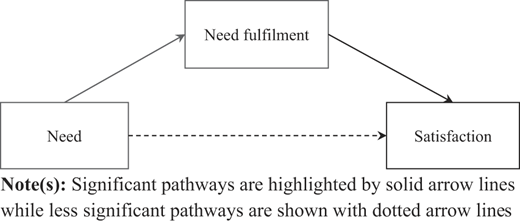
Needs are defined as “nutriments that must be procured to maintain growth, integrity, and health” (Deci and Ryan, 2000, p. 252). Thus, the fulfilment of these needs leads to greater satisfaction, growth and well-being, while their non-fulfilment has the opposite effect (Deci and Ryan, 2000, 2017). For instance, daily need fulfilment leads to higher daily emotional well-being (Reis et al., 2000). By contrast, need-thwarting situations lead to negative psychological well-being (Uysal et al., 2010). Each behaviour is, therefore, evaluated on whether it was need-fulfilling (and may thus be repeated) or need-unfulfilling (and another behaviour is chosen the next time) (Kelley et al., 2003). Moreover, needs are not only passive satisfaction indicators but also active motivators: needs drive people's behaviour as they “specif[y] the content of motivation and provid[e] a substantive basis for the energization and direction of action” (Deci and Ryan, 2000, p. 227) [1]. In other words, such needs are the core of our motivation, thoughts and behaviours (Storch and Kuhl, 2013). For instance, thirst (need) leads to the motivation to drink something, guiding thoughts and behaviour to get something to drink. And the more the need is thwarted, the stronger the striving to fulfil this need will be (Sheldon and Gunz, 2009). In other words, the more dehydrated a person is, the more they will strive to get something to drink. In sum, needs are our inner motors for need fulfilment to get satisfaction. However, needs do not automatically lead to more satisfaction: if a person is thirsty (need), this does not make the person more satisfied (satisfaction), as the thirst has to be satisfied first (need fulfilment). Thus, needs strive for need fulfilment, and need fulfilment leads to satisfaction (Figure 1).
These needs can either be physiological, such as the need to drink, eat or sleep, or they can be psychological, such as the need to have secure relationships or feel competent (Deci and Ryan, 2000, 2017; Maslow, 1943; Murray, 1938). Deci and Ryan's (2000, 2017), self-determination theory (SDT), the most cited and analysed identification of basic psychological needs (Pittman and Zeigler, 2007), distinguishes between three basic psychological needs: the need for autonomy, competence and relatedness (Deci and Ryan, 2000, 2017). The autonomy need is centred on the desire for self-congruency and self-determination [2]. The competence need is the desire to learn something new, gain skills and feel able to deal with situations or master challenges. The relatedness need is a person's desire to belong, to be connected with others, to have clear roles and to feel secure (Deci and Ryan, 2000, 2017).
The present research: autonomy need in coaching and competence need in training
The present research investigated whether the differences between coaching and training may derive from different needs that are addressed in coaching versus training. This is essential as the better the needs are met, the more personal development can take place (Ryan et al., 2010; Scheel, 2010). It is suggested that training may be better for a client with a high competence need, as this need is about competencies, while coaching may be better for a client with a high autonomy need, as this need is about self-congruency and self-determination (Jonas et al., 2017). In line with this proposal, a study by Losch et al. (2018) found that coaching developed self-determination, while training developed specific knowledge and skills. Furthermore, clients perceived that the competence need was mostly fulfilled during training, while the autonomy need was mostly fulfilled during coaching (Schiemann et al., 2018). Coaching also leads to clients' improved or enhanced intrinsic motivation, satisfaction and goal attainment (Gessnitzer and Kauffeld, 2015; Losch et al., 2016). Moreover, coaching leads to more self-regulated goal-striving, which is closely related to self-determination (Green et al., 2006; Spence and Grant, 2007). To investigate this proposal, one study carrying out real-life coaching processes (N1 = 110) and one carrying out real-life training processes (N2 = 176) with students as clients were conducted. We measured the students' needs before the intervention, their need fulfilment after the intervention and their coaching/training outcome.
Study 1: autonomy need in coaching
The first study focused on real-life coaching processes with students as clients. It was proposed that clients with a higher autonomy need would gain more autonomy need fulfilment from coaching, leading to more coaching satisfaction. As coaching is also about goal attainment (Grant et al., 2010), the attainment of the clients' self-valued goals was also measured after coaching. To sum up, Hypothesis 1 (H1) states that the client's autonomy need before the coaching affects the client's autonomy need fulfilment within the coaching process, which again affects the client's satisfaction and in turn the client's goal attainment.
The more a client wishes to feel self-determined, the more the client will be able to achieve this wish within coaching, which makes the client very satisfied with coaching, and this satisfaction makes goal attainment more likely (mediation analysis).
By contrast, a client's competence or relatedness need before coaching cannot be specifically addressed in coaching and, therefore, cannot be fulfilled.
Method study 1
Participants. All 110 coaching clients were students at a German-speaking university who were coached by 110 different coaches. These coaches were psychology graduate students in their second term of their master's program at a German-speaking university. The students participated in a coaching education, which was part of their master's programme. The education contained the same career coaching background and the same use of methods, trained using the concept by Braumandl and Dirscherl (2005). For their coaching education, they had to coach a client. The clients were recruited by the coaches via their networks. These clients had to participate voluntarily and had to have career goals they wanted to attain. Up to three career goals were study-related and varied not only inter-individually but also intra-individually. For the whole coaching session, clients paid only €15 but committed themselves to fill out questionnaires. Clients were randomly assigned to a coach who was not yet acquainted with this client. Thus, coaches and clients did not know each other beforehand. The 27 male and 83 female clients were between 20 and 55 years old (M = 24.37, SD = 4.32).
Procedure and measures. The study was approved by the ethics committee as well as informed consent by every participant. The study consisted of real-life coachings that were accompanied by one questionnaire before and one after the coaching process (see measure description if “before” or “after”). Each coaching comprised five sessions of 2 h: (1) preliminary talk and goal-setting, (2) strengths and potentials regarding the goal, (3) resource, (4) goal- and self-management and (5) transferring the self-set goals, ending with a coaching evaluation survey and an assessment of the final goal attainment. The coaching method was resource- and goal-oriented with tools by Braumandl and Dirscherl (2005).
Needs before the coaching. The clients' needs were measured before the coaching. Ryan and Deci (2000, 2017) stated that with questionnaires, it is impossible to measure needs but possible to measure need-related motivations, which are the conscious part of our unconscious needs. These “need-relevant motivations” (Sheldon and Gunz, 2009, p. 1475) were measured with the motivation scales of the Business-focused Inventory of Personality (BIP; Hossiep and Paschen, 2003) (Table 1). The BIP was incorporated into the coaching as a strength finder. The clients were asked to complete the BIP to develop a personal profile of strengths. This personal profile was then used in the second coaching session.
Need fulfilment at the end of the coaching process. The clients' need fulfilment was measured after their last coaching session via an evaluation survey. Here, an evaluation survey was employed, which is specifically used for coaching (Check-the-Coach questionnaire; Bachmann et al, 2004), and its items related to the Basic Psychological Need Scale (BPNS) by Deci et al. (2001) (Table 2). All items were conducted with a six-point Likert scale ranging from 1 (unsatisfactory) to 6 (very good).
Coaching satisfaction after coaching. Following the questions about need fulfilment, the clients' coaching satisfaction was measured. Participants answered eight further questions regarding their satisfaction with the coach and the coaching sessions themselves (α = 0.87; e.g. “I am satisfied with the coaching result”). These items were also conducted using a six-point Likert scale ranging from 1 (unsatisfactory) to 6 (very satisfactory).
Goal attainment after the coaching. Goal attainment was measured in every session until the last session with the help of a goal attainment scale by Braumandl and Dirscherl (2005), ranging from 1 (not at all attained) to 10 (fully attained). To measure the average goal attainment, the last time point was subtracted from the first time point for every goal, and a mean score for all goals was calculated. Thus, higher values indicate more goal attainment.
Statistics. IBM SPSS Statistics 24.0 (IBM Corporations, 2016) was used for computation, and all scales were z-standardised for improved comparison purposes. As we were interested in the process of how the clients attained their goals in coaching via need fulfilment, we computed mediation analyses through the use of the add-on script PROCESS by Hayes (2013; model 6). Mediation analyses were employed to understand the process from an independent variable (need) to a mediator variable (need fulfilment) and then to a dependent variable (satisfaction). A 95% bias-corrected bootstrap confidence interval (BCCI; 95%) was also employed in conjunction with 1,000 bootstrap samples.
Results study 1
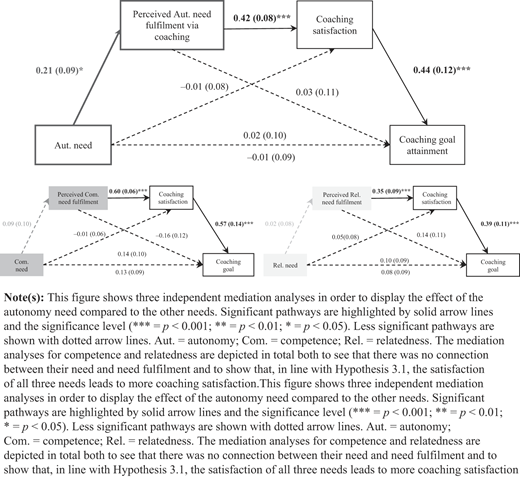
In support of H1, the autonomy need should influence the autonomy need fulfilment and, thus, the satisfaction and then goal attainment, while there should be no direct effect from need to satisfaction or goal attainment (Figure 1). In line with H1, the mediation analysis showed a significant indirect effect (0.04) of the autonomy need on goal attainment via autonomy need fulfilment and coaching satisfaction. However, the analysis did not show a significant total effect of the autonomy need on goal attainment, β = 0.02, SE = 0.10, t(109) = 0.23, p = 0.815, nor any significant direct effect when the potential mediators were added to the prediction, β = −0.01, SE = 0.09, t(109) = −0.15, p = 0.878. As expected, the clients' autonomy need led to higher autonomy need fulfilment via coaching, β = 0.21, SE = 0.09, t(109) = 2.27, p = 0.025. Subsequently, the autonomy need fulfilment via coaching positively influenced coaching satisfaction levels, β = 0.42, SE = 0.08, t(108) = 5.39, p < 0.001, which subsequently led to higher goal attainment, β = 0.44, SE = 0.12, t(107) = 3.69, p < 0.001 [3]. In summary, then, the autonomy need had an indirect effect on the coaching goal attainment, mediated by the autonomy need fulfilment and coaching satisfaction. This supports H1 as a higher need for autonomy should foster the autonomy need fulfilment within coaching, leading to more satisfaction and goal attainment (Figure 2).
As it can be argued that other needs may also influence the autonomy need fulfilment, regression analyses with the needs as independent variables and the need fulfilments as dependent variables were computed. The regression analyses showed that the autonomy need fulfilment in coaching could only be predicted by the autonomy need, β = 0.22, SE = 0.11, t(106) = 2.10, p = 0.038, but not the competence, β = 0.03, SE = 0.10, t(106) = 0.30, p = 0.765, or the relatedness need, β = 0.09, SE = 0.09, t(106) = 0.99, p = 0.327, R2 = 0.06, F(3,106) = 2.06, p = 0.110. Furthermore, the competence need fulfilment in coaching could not be predicted by any of the three needs, R2 = 0.04, F(3,106) = 1.27, p = 0.289. Additionally, the relatedness need fulfilment in coaching could not be predicted by any of the three needs, R2 = 0.03, F(3,106) = 1.13, p = 0.340. Furthermore, the mediation analyses did not show an effect of any of the other needs before coaching on the fulfilment, satisfaction or goal attainment (Figure 2). In conclusion, the autonomy need was the only need that played an important role in coaching and was fulfilled through coaching, which again led to increased coaching satisfaction and then flowed through to goal attainment.
Study 2: competence need in training
In the second study, students participated as training clients and were asked about their needs before training as well as their need fulfilment after training. Given that training clients should develop competence and expertise, it was hypothesised in Hypothesis 2 (H2) that the competence need at the beginning makes a difference in training.
The higher the training client's competence need, the more they can fulfil it through the training process, and as a result, the more they are satisfied and intrinsically motivated (mediation analysis).
By contrast, a client's need for autonomy and relatedness should not be specifically addressed in training and, therefore, there is no expected connection between need strength and their fulfilment in the social interaction. As training revolves around the learning of specific skills, the attainment not of personal goals but of specific skills is in focus (Rauen, 2014; Winfred et al., 2003). As intrinsic motivation is both a basic measure to measure learning success and a predictor for skill attainment (Cordova and Lepper, 1996; Gottfried et al., 2013), intrinsic motivation instead of goal attainment was used.
Method study 2
Participants. The participants were 176 students in their first term of a master's programme at a German-speaking university. These students participated in mandatory training in 2016 (111 students) and 2017 (65 students), which was part of their master's programme and for which they received two credits. The questionnaire was anonymous and voluntary. Of these 176 participants, 87 students (69 female, 18 male) filled out the first questionnaire before the training (where they were asked about gender), and 176 filled out the second questionnaire after the training.
Procedures and measures. The study was approved by the ethics committee as well as informed consent by every participant. The training was designed to improve social competencies such as communication and moderation. This training consisted of two sessions, with each session being 4 h long. During these sessions, the clients received input about communication skills and techniques (e.g. active listening) and also practised their knowledge through several exercises. The clients were asked to fill out one questionnaire before and one after the coaching process (see measure description if “before” or “after”). An online survey tool was used for the questionnaires (LimeSurvey 2.67.3; Schmitz, 2015).
Needs before the training. The definitions by Deci and Ryan (2000) and Fiske (2009) were used to develop a situational BPNS that ranged from 1 (not at all) to 5 (fully). The scale comprised a total of 15 items, measuring the autonomy need (five items; α = 0.67; e.g. “It is important to me to freely express my ideas and opinions”), competence need (five items; α = 0.64; e.g. “It is important for me to show what I am capable of”) and relatedness need (five items; α = 0.80; e.g. “It is important to me to get along well with my interaction partners”).
Need fulfilment at the end of the training. The same items were used to measure the basic psychological needs, asking the students how the training sessions fulfilled their autonomy need (five items; α = 0.86; e.g. “The training sessions have helped me to freely express my ideas and opinions”), competence need (five items; α = 0.81; e.g. “The training sessions have helped me to show what I am capable of”) and relatedness need (five items; α = 0.82; e.g. “The training sessions have helped me to get along well with my interaction partners”). The scale again ranged from 1 (applies not at all) to 5 (applies fully).
Training satisfaction after the training. To measure the satisfaction with the training, students were asked one question, “The training sessions helped me”, on a scale again ranging from 1 (applies not at all) to 5 (applies fully).
Intrinsic motivation after the training. To measure intrinsic motivation, the intrinsic motivation subscale of the Situational Motivation Scale (Guay et al., 2000) was again used, consisting of three instead of four items as the German translation of two items is the same (α = 0.84; e.g. “The training sessions were interesting”). The scale again ranged from 1 (applies not at all) to 5 (applies fully).
Statistics. IBM SPSS Statistics 24.0 (IBM Corporations, 2016) was used for computation. As we were interested in the process of how clients got intrinsically motivated in training via need fulfilment, we computed mediation analyses through the use of the add-on script PROCESS by Hayes (2013; model 6). Mediation analyses were employed to understand the process from an independent variable (need) to a mediator variable (need fulfilment) and then to a dependent variable (satisfaction). A 95% BCCI was also employed in conjunction with 1,000 bootstrap samples. As all scales were from 1 to 5, z-standardisation was not needed this time.
Results study 2
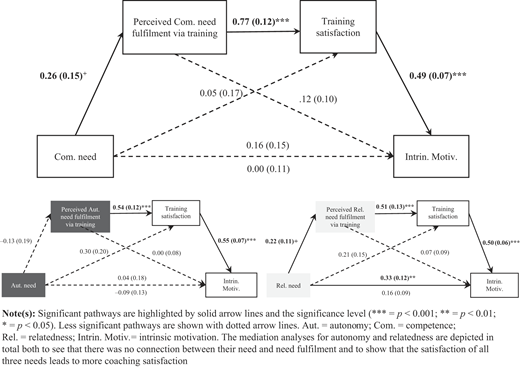
H2 predicts that, in training, the higher the need for competence, the higher the satisfaction with the training, and therefore, a higher intrinsic motivation after the training, fully mediated by the competence need fulfilment. In line with this hypothesis, the mediation analysis showed no significant indirect effect (0.15) of the competence need on intrinsic motivation via competence need fulfilment and training satisfaction. The analysis did not show a significant total effect of the autonomy need on intrinsic motivation, β = 0.04, SE = 0.18, t(86) = 0.20, p = 0.840, nor any significant direct effect when the potential mediators were added to the prediction, β = −0.09, SE = 0.13, t(86) = −0.70, p = 0.485. The clients' competence need did not lead to a higher competence need fulfilment via training, β = 0.26, SE = 0.15, t(86) = 1.79, p = 0.078, but the competence need fulfilment via training did have a highly significant influence on satisfaction with the training, β = 0.77, SE = 0.12, t(86) = 0.28, p < 0.001, and this satisfaction, in turn, had a highly significant effect on the clients' intrinsic motivation, β = 0.49, SE = 0.07, t(86) = 6.84, p < 0.001. The autonomy need fulfilment in training had a highly significant influence on satisfaction with the training, β = 0.54, SE = 0.12, t(86) = 4.54, p < 0.001, which also had a highly significant effect on the intrinsic motivation, β = 0.55, SE = 0.07, t(86) = 8.25, p < 0.001. In addition, the need fulfilment of relatedness had a highly significant influence on satisfaction with the training, β = 0.51, SE = 0.13, t(86) = 3.81, p < 0.001, which also had a highly significant effect on the intrinsic motivation, β = 0.50, SE = 0.06, t(86) = 7.77, p < 0.001. The total effect of relatedness need on the intrinsic motivation via the mediators of need fulfilment and training satisfaction was significant, β = 0.33, SE = 0.12, t(86) = 2.89, p < 0.01. In summary, the competence need had no indirect effect on the training benefit, mediated by the competence need fulfilment via training and the intrinsic motivation, β = 0.33, SE = 0.12. This does not support H2. As depicted in Figure 3, training satisfaction always had a great effect on the clients' intrinsic motivation, but only autonomy and relatedness need fulfilment affected this satisfaction.
For comparison purposes, regression analyses were computed and revealed that the competence need fulfilment can be predicted by the relatedness need, β = 0.27, SE = 0.11, t(83) = 2.58, p = 0.012, marginally by the competence need, β = 0.25, SE = 0.18, t(83) = 1.89, p = 0.063, but not by the autonomy need, β = −0.19, SE = 0.20, t(83) = −1.49, p = 0.140, R2 = 0.12, F(3,83) = 3.89, p = 0.012. Furthermore, the relatedness need fulfilment can only be predicted by the relatedness need, β = 0.23, SE = 0.12, t(83) = 2.09, p = 0.040, R2 = 0.08, F(3,83) = 2.55, p = 0.061. By contrast, the autonomy need fulfilment cannot be predicted by any of the three needs, R2 = 0.07, F(3,83) = 2.12, p = 0.103. In conclusion, then, the competence and relatedness needs but not the autonomy need play an important role in this social competence training and are fulfilled through training. This, once again, leads to increased training satisfaction and then flows through to intrinsic motivation.
Discussion
Supporting students in their personal development via coaching or training is important and effective (Bettinger and Baker, 2014; Godskesen and Kobayashi, 2016; Kenny and Faunce, 2004). Although coaching and training are often seen as similar, they differ in their focus (Rauen, 2014) and can support professional development among students in different ways: while training is about learning new competencies and skills, coaching is seen as a much more non-directive and non-consulting approach (Grover and Furnham, 2016; Joo, 2005; Passmore and Fillery-Travis, 2011; Rauen, 2014). Coaching supports the client with their self-congruency and self-determination (Bachkirova and Smith, 2015; Grant et al., 2010; Greif, 2008). These differences indicate that a client's competence need may be more relevant in training, while a client's autonomy need may be more relevant in coaching (Jonas et al., 2017).
Testing these assumptions regarding the professional development of students, two studies were conducted with coaching (Study 1) and training (Study 2) processes. In Study 1, it was found that the higher the coaching client's autonomy need at the beginning, the more their autonomy need was fulfilled via coaching, leading to a higher level of coaching satisfaction and improved rates of coaching goal attainment. This result demonstrates the importance of the autonomy need before coaching for the coaching process. In Study 2, it was found that the higher the training client's competence need at the beginning, the more their competence need was fulfilled via training. This fulfilment in turn led to a higher level of training satisfaction and, thus, to improved rates of intrinsic motivation. This demonstrates the importance of the competence need in coaching. Furthermore, the social competence training with peers not only addressed the competence but also the relatedness need. This relatedness need effect can come from the peer context, as the relatedness need is essential amongst peers to find a sense of belonging (Osterman, 2000). Furthermore, early studies had already found that learning social competencies can help with building better relationships amongst peers (Gottman et al., 1975). Thus, this relatedness need effect should be lower if the training is not with peers and is not about a social topic. In a similar way, peer versus client coaching may also differ regarding the relatedness need, as peer coaching is more about a mutual and equal partnership (Ladyshewsky, 2014). In addition, in both studies, need fulfilment overall led to increased satisfaction, which is a finding supported by many studies in other contexts (e.g. Ng et al., 2013).
To sum up, coaching supports students in their autonomy, while training supports students in their competence. This means that students with a high autonomy need have a better chance to have this need fulfilled in coaching than in training, whereas students with a high competence need have a better chance to have this need fulfilled in training than in coaching.
Limitations and theoretical implications
This study has taken a first step towards clarifying how two different personal development tools can support students in their professional development. Both tools are effective, but the processes differ: while coaching supports students by addressing their autonomy need, training supports them by addressing their competence need. Nevertheless, much research is still to be done to better understand other personal development tools when supporting students, such as mentoring or consulting. Furthermore, coaching and training can vary (e.g. Cox et al., 2014), and Study 2 showed that a training context with peers and on social competencies addressed the relatedness need. Thus, varying coaching or training contexts can change the prevailing need that is addressed. Thus, different forms of coaching and training, as well as different measures (e.g. self-efficacy), should be investigated in future research.
An additional limitation is the use of applied measurements for all the studies conducted in this research. Using measures that fit the context but have not been validated (e.g. need fulfilment after the coaching scale derived from SDT need definitions) is a first step, but only indicative. Further research should, therefore, concentrate on validating situational questionnaires that can be used in the personal development context. Moreover, the needs could also be measured qualitatively with picture cards (e.g. need coaching cards; Schiemann et al., 2020) or picture interpretations (e.g. Operant Motive Test; Scheffer et al., 2003) as qualitative results can give deep insights into coaching processes (Grant, 2016). This can be a more indirect measure of basic psychological needs.
A third limitation is that the coaching and training process was analysed only in terms of needs and need fulfilment. However, much more can be done to understand the process more deeply from need to need fulfilment within coaching and training. Thus, one further theoretical implication is to research how exactly the coaches and trainers support the clients in their respective needs. In other words, it is unclear how the coaches support the clients' autonomy need with regard to actual behaviour. Similarly, a trainer's competence need supportive versus restrictive behaviour should be investigated.
Practical implications
A first practical implication derives from the results that different personal development tools seem to address and fulfil different students' core needs. This finding implies that personal development tools should be consciously applied depending on the student client's core need (Jonas et al., 2017): only if the core need of a student is clear can the most suitable personal development tool be offered to that student. This implication is of great importance, as existing practice often is to find a “one-size-fits-all” approach and planned for instead of individually with the respective clients (Poell et al., 2015). A good example is a study by Grant et al. (2009), where they compared clients who received either only training or both training and coaching; the clients who received both training and coaching were more satisfied. This result indicates that the training alone did not fulfil every client's need.
The main practical implication for trainers and coaches is to support clients' respective needs. Thus, coaches should strengthen their autonomy-supportive communication (Moyers and Martin, 2006; Schiemann et al., 2018) by allowing the client to determine the content and to control the change themselves and, therefore, avoid repression and accept resistance. They should also appreciate the client's opinions and values and, therefore, try to understand them and empathise without judging (Markland et al., 2005). Furthermore, according to the Perceived Autonomy Need Support Scale (Baard et al., 2004), the coach is autonomy-supportive when they encourage the client towards self-reflexivity, listens to how the client wants to do things, encourages the client to think for themselves and gives the client the freedom to decide for themselves. Inversely, autonomy-restrictive communication in terms of the righting reflex (= convincing, persuading, confronting, preaching, criticising, warning, advising without permission) can lead to less autonomy and more change resistance (Klonek et al., 2014; Miller and Rollnick, 2013). Similarly, trainers should strengthen their competence-supportive communication by giving feedback (Amorose and Nolan-Sellers, 2016; Fransen et al., 2018) and focussing on helping the client improve, encouraging them and helping them to feel competent (Fransen et al., 2017).
Conclusion
Both coaching and training can support students in their personal development. In this paper, we investigated how the students' underlying psychological needs determined whether coaching or training was more effective. Our results showed that a student's high autonomy need is best addressed in coaching, which is more about self-determination and self-congruence, while a student's high competence need is best addressed in training, which is more about learning new skills. Our findings indicate that for students to develop, personal development tools should be chosen based on the students' underlying needs. Further research may investigate what specific need-fulfilling behaviours of coaches and trainers could look like and how these behaviours would influence need fulfilment and coaching and training outcomes.
Notes
It is to note that not every behaviour is need-driven, and thus intrinsically motivated, as we also have responsibilities, such as routine duties in our jobs; in other words, there are tasks we do not really want to carry out but maybe think that it is reasonable to carry them out, that we have benefits if we carry them out, or that we get in trouble if we do not carry them out. In these situations, we are more extrinsically motivated and use more self-control than self-regulation processes (Storch and Kuhl, 2013).
This autonomy need should not be confused with the autonomy continuum: whereas the autonomy continuum explains your overall motivational level, the “willingness and desire for change”, ranging from amotivation to intrinsic motivation (Ryan et al., 2010, p. 194), the autonomy need is one of three needs a client can have this willingness and desire to change for: people with a high autonomy need strongly desire to act congruently with their inner self, while people with a high competence need strongly desire to master challenges, learn new skills and experience effectiveness (Deci and Ryan, 2000, 2017).
The autonomy need had no significant direct effect on the coaching satisfaction, β = −0.01, SE = 0.08, t(108) = −0.19, p = 0.852. The first mediator autonomy need fulfilment via coaching had no direct effect on goal attainment, β = 0.03, SE = 0.11, t(108) = 0.24, p = 0.811.