


This paper investigates how mentors' capacity to navigate emotional labour varies across demographic and professional characteristics, with particular attention to the relative influence of teaching experience versus mentoring experience. Drawing on five validated scales from the Mentoring as Emotional Labour (MEL) framework (Relihan and O'Donovan, 2026), the study explores how the framework can help shed light on mentoring in initial teacher education (ITE). In doing so, it challenges the assumption that mentoring is simply an extension of teaching and demonstrates the utility of the MEL scales as a tool for capturing mentors' emotional labour capacity.
A cross-sectional survey of mentors (N = 341) across Australian education sectors examined variation in scores on the five MEL scales. Rasch-calibrated logit scores were analysed in SPSS to identify group differences, associations and predictors of emotional labour in relation to teaching experience, mentoring experience, gender and sector.
Mentoring experience, not teaching experience, was the strongest predictor of mentors' capacity to navigate the emotional demands of mentoring. Gender showed no statistically significant effects, and no sectoral differences reached statistical significance. These results confirm the importance of conceiving of and treating, mentoring as a distinct skill.
This study is among the first substantial-scale quantitative analyses to show that mentoring capacity is not simply a function of teaching experience but a distinct, developable skill shaped by mentoring practice. The empirical data generated by the MEL framework scales help provide a bridge between theory and practice, offering new insights to inform mentor selection, preparation, research and policy reform in teacher education.
Introduction
Mentoring preservice teachers (PSTs) is central to initial teacher education (ITE), as it shapes both the professional identity of novice teachers and the professional growth of their mentors (Ellis et al., 2020; Wexler, 2020). While mentoring is widely recognised as critical to ITE quality, little systematic evidence exists about what shapes mentors' capacity, particularly their ability to manage the emotional labour inherent in this deeply interpersonal work. Most research assumes that teaching experience translates into mentoring readiness, yet this assumption has rarely been tested empirically. To date, few large-scale quantitative studies have examined how demographic and professional factors, such as gender, educational sector and professional experience, influence mentors' emotional labour capacity. This study addresses that gap by providing the first robust quantitative analysis of these relationships in the context of ITE.
Emotional labour, conceptualised by Hochschild (1983) as the effort involved in managing one's own emotions while responding to the emotional needs of others, is integral to mentoring but often remains invisible in policy and practice. While research on emotional labour in education is expanding (Bodenheimer and Shuster, 2020; Kariou et al., 2021; Philipp and Schüpbach, 2010), its role in mentoring relationships is rarely examined and is often assumed to be an intuitive rather than a developable capacity. This lack of recognition arguably limits the design of targeted professional learning, the evaluation of mentoring quality and the provision of tailored support for mentors.
The Mentoring as Emotional Labour (MEL) framework, used in this study, was developed to capture and measure the emotional demands of mentoring in ITE (See Figure 1). It identifies mentoring as a form of emotional labour, characterised by the effort mentors invest in managing their own emotions and supporting the emotional, relational and professional growth of PSTs (Relihan and O'Donovan, 2024). Within the framework, emotional intelligence (EI) is positioned as a mediating capacity that enables mentors to regulate their emotions, maintain professional boundaries and respond effectively to the needs of their PSTs.
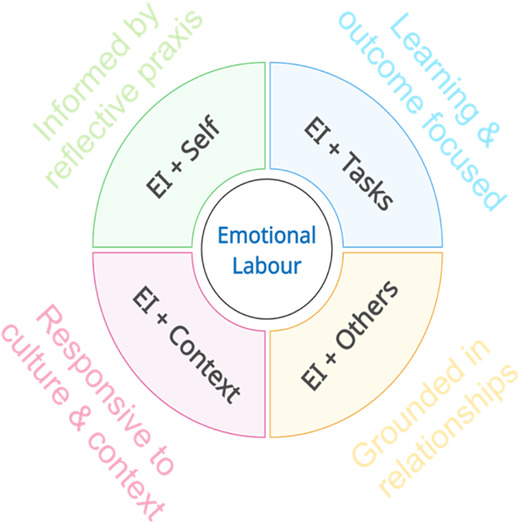
As shown in Figure 1, the framework identifies four interrelated aspects of mentoring with EI: EI + Self (informed by reflective practice), EI + Tasks (learning and outcome-focused), EI + Others (grounded in relationships) and EI + Context (responsive to culture and context). Together, these quadrants capture the emotional and pedagogical complexity of the mentoring role, foregrounding the relational and affective work that is frequently overlooked in national policy and professional learning initiatives.
The MEL framework enabled the creation of five independent psychometric measures: the overarching MEL-15 and four aspect-specific scales – MEL-C (Context), MEL-O (Others), MEL-S (Self) and MEL-T (Tasks). The MEL-15 functions as an overarching indicator of mentors' overall capacity to navigate emotional labour, while the four aspect-specific scales represent correlated but theoretically distinct facets of that broader mentoring capacity. Items across the MEL scales assess mentors' perceived capacity to navigate emotionally demanding aspects of mentoring, including reflective dialogue, responsiveness to PST needs, balancing task expectations with relational care and managing contextual pressures. Items are framed as self-assessments of mentoring capacity rather than frequency of behaviour or emotional intensity. Higher scores indicate greater perceived capacity to navigate the emotional labour of mentoring. Detailed scale development procedures are reported elsewhere (Relihan and O'Donovan, 2026). Each scale was validated separately as a separate unidimensional measure.
Building on this foundation, the present study applies the MEL scales to examine whether capacity scores vary systematically by teaching and mentoring experience, gender and sector. In doing so, the analysis demonstrates the scales' utility in highlighting meaningful differences in mentoring practice.
Literature review
Mentoring is widely recognised as a cornerstone of ITE, with the potential to strengthen PSTs' confidence, competence and retention while fostering mentors' own professional growth (Arnsby et al., 2023; Ellis et al., 2020; Schatz Oppenheimer and Goldenberg, 2024; Wells and De Nobile, 2021). Effective mentors act as catalysts for lifelong learning and play a formative role in shaping PSTs' professional identity (Garcia and Badia, 2023). However, these benefits are not guaranteed. Without appropriate conditions such as dedicated time, supportive leadership and high-quality training, mentors may default to a traditional “expert–novice” model (Maxwell et al., 2024; Thornton, 2024). With this approach, the transmission of expertise is prioritised, leaving little room for relational reciprocity, mutual learning or recognition of PSTs as adult learners with unique developmental needs (Ingersoll and Strong, 2011; Klinge, 2015; Larsen et al., 2025). In these contexts, mentors often rely on intuition and tacit knowledge from their own teaching experience (Jones and Straker, 2006; Orland-Barak and Wang, 2021). While this knowledge may hold potential value, it can also perpetuate unexamined routines and limit opportunities for critical reflection or theoretically informed practice (Thornton, 2024).
Aside from the resounding evidence that surrounds the need for mentoring training, there is limited research examining the demographic characteristics and contexts of those who mentor in ITE. For instance, anecdotal and cultural narratives have often implied that mentoring is more naturally suited to female teachers, a perception likely shaped by the feminised construction of teaching as a relational and caring profession (Zembylas, 2003). However, empirical evidence tackling this question within teacher education is limited. Broad analyses of workplace mentoring (e.g. O'Brien et al., 2010) point to gendered differences in the provision of psychosocial support, but findings within ITE are scarce. Ortiz's (2021) study in nursing education offers a useful parallel, highlighting gender-specific challenges and the influence of professional culture on mentoring roles. These insights raise questions about whether similar dynamics are at play in ITE mentoring.
Beyond gender, factors such as teaching philosophy, school culture, career stage and sector-specific demands can shape mentoring practice (Cherkowski and Walker, 2019; Goodwin et al., 2023 Hobson and Maxwell, 2020; Jones and Straker, 2006). While some research has identified sectoral differences – for example, Moloney et al. (2023) found distinctions between early years and primary mentors – most studies focus on single settings (e.g. Hudson, 2013; Quinones et al., 2019), which limits generalisability. Systematic, large-scale comparisons of sector-based variation remain rare, leaving a significant gap in evidence to inform more responsive approaches to mentoring.
Teaching and mentoring experience are the two demographic factors most frequently discussed, yet they are often conflated in policy and practice. The assumption that years of classroom teaching automatically equate to mentoring readiness remains common in some contexts, despite growing recognition that mentoring requires its own developmental capacities (Ellis et al., 2020; Ronfeldt et al., 2018). These capacities may not simply be by-products of years of teaching experience but may instead develop through sustained, intentional engagement in the mentoring role. Although qualitative studies highlight that structured training, peer collaboration and reflective practice can strengthen mentoring capacity (Arnsby et al., 2023; Schatz Oppenheimer and Goldenberg, 2024), there is a lack of significant quantitative evidence that can help disentangle the influence of teaching and mentoring experience. Addressing this gap requires validated tools that can capture and compare these influences.
This evidentiary gap is compounded by the fact that many existing frameworks (e.g. Ambrosetti et al., 2014; Clarke et al., 2012; Clarke and Mena, 2020; Hudson, 2005; Orland-Barak and Wang, 2021), while extensively mapping mentor behaviours and knowledge, give little attention to the emotional demands of the role on the mentor. Although models have advanced our understanding of mentor practices, they vary considerably in their theoretical grounding, methodological rigour and ability to capture the affective work that underpins effective mentoring. While the role of the mentor has been broadly defined in policy and research, the emotional aspects of this work have rarely been given a central positioning. This lack of emphasis, despite the well-documented emotional toll of teaching and mentoring (Bodenheimer and Shuster, 2020; Kariou et al., 2021), means that systematic data on how emotional labour capacity varies across demographics and contexts remain scarce.
In both Australia and internationally, policy-linked frameworks tend to emphasise professional standards, collaboration and reflective practice but give limited attention to emotional competencies, often framing mentoring through procedural or accountability-oriented lenses (Mockler, 2022). This is evident in national induction guidelines such as the Australian Institute for Teaching and School Leadership (AITSL) Graduate to Proficient teacher induction guidelines, Victoria's Mentoring Capability Framework (MCF) and their international equivalents, which focus heavily on procedural and standards-based aspects of mentoring. Targeted mentor training is often optional or inconsistently delivered, leading to substantial variation in provision across systems and sectors (Beutel et al., 2017; Ingersoll and Strong, 2011; Wells and De Nobile, 2021). Without explicit recognition of emotional labour as a core capacity, policy frameworks risk overlooking a critical component of mentoring quality and limiting the development of evidence-based strategies to support mentors across diverse contexts.
Recent reviews, such as those by Maxwell et al. (2024), emphasise the significance of relational trust, emotional awareness and reflective capacity in mentor development; however, few tools provide a validated method for assessing these capacities. This makes it challenging to identify targeted development needs, benchmark progress or evaluate whether emotional capacities are equitably supported across different mentor profiles. The MEL framework addresses this gap by providing a scalable, evidence-based tool for examining how demographic and professional factors influence the emotional labour of mentoring. By enabling cross-context comparisons, the framework creates new opportunities for research, policy and practice to strengthen mentor preparation globally. This research directly responds to calls in the literature for scalable, data-informed tools that reflect the complex realities of mentoring in ITE (Chen et al., 2016; Hobson et al., 2009; Hobson and Maxwell, 2020).
Method
This phase of the MEL project applied the validated MEL scales to examine whether emotional labour capacity varies meaningfully across demographic and professional groups (DeVellis and Thorpe, 2021; Furr, 2021). The MEL scales were developed and psychometrically validated using Rasch measurement modelling in a prior study (Relihan and O'Donovan, 2026).The Rasch measurement modelling applies strict psychometric criteria, including item fit, ordered thresholds, unidimensionality and differential item functioning (DIF) checks to ensure that each scale functions as a coherent measure of its underlying construct (Bond and Fox, 2015). Building on this validated structure, the current study used SPSS analyses to test whether MEL scores differ by gender, educational sector, years of teaching experience and mentoring experience and to assess the extent to which these factors explain variation in emotional labour capacity.
Participants were recruited through purposive voluntary sampling via ITE networks, professional associations and educator forums, with respondents drawn from across sectors and roles. As participation was voluntary, some degree of self-selection bias is possible, though this is likely to inflate overall scores rather than affect relationships between variables, given the study's focus on relative differences within the respondent sample. Ethical approval was obtained from the university's Human Research Ethics Committee, and participation was anonymous and voluntary.
As reported in Relihan and O’Donovan (2026) Rasch analysis produced the 15-item MEL-15 and four independent aspect-specific scales representing core components of mentoring: MEL-C (Context), MEL-O (Others), MEL-S (Self) and MEL-T (Tasks), each comprising 12 items. All scales demonstrated a good Rasch model fit, including ordered thresholds and the absence of local dependency, confirming their psychometric robustness (Bond and Fox, 2015). Participant responses were imported into RUMM2030+, where Rasch-based logit scores were generated for each scale. Logits transform ordinal raw scores into interval-level data, enabling more accurate comparisons between participants and supporting the use of parametric statistical analysis (Bond and Fox, 2015; Boone and Noltemeyer, 2017). Participants were required to complete enough items on each scale to meet Rasch thresholds for estimating person ability.
A total of 466 educators attempted the MEL survey. Of these, 341 generated valid Rasch logit scores for at least one scale after excluding 89 who completed demographic items only and 36 with insufficient responses. These 341 participants formed the analytic sample. Because survey items were interleaved across the five MEL scales, the number of valid cases varied: MEL-15/MEL-S/MEL-T (n = 341), MEL-O (n = 296) and MEL-C (n = 276). Within the analytic sample, demographic distributions of complete responders (n = 280) and partial responders (n = 61) did not differ meaningfully, indicating no systematic dropout bias among those who engaged with the scales.
Logit data were collated in Excel, merged with demographic variables (age, gender, educational sector, years of teaching experience, number of PSTs mentored) and imported into SPSS (IBM SPSS Statistics, Version 29.0.2) for analysis. As this study analysed all available cases, no a priori power calculation was conducted. The overall sample (N = 341) was sufficient to detect medium effects, although power was limited for smaller subgroups. The following procedures were used to examine patterns of variation and predictors of emotional labour capacity:
Descriptive statistics to summarise sample characteristics and MEL score distributions;
One-way ANOVAs to test for group differences across demographic variables (gender, sector, teaching experience, mentoring experience), with Games–Howell post-hoc tests for significant effects;
Effect sizes (partial eta squared) to assess the practical significance of group differences;
Multiple linear regression with simultaneous entry to examine the combined and unique contributions of demographic variables to MEL scores (Pallant, 2020).
Results
Across all analyses, mentoring experience showed the strongest and most consistent associations with MEL scores, confirming it as the dominant predictor of emotional labour capacity across all MEL scales. In contrast, teaching experience showed only modest contributions. Gender showed no statistically significant effects, and no sectoral differences reached significance. An apparent difference for early years mentors (n = 11) was not generalisable due to the very small subgroup size. The results that follow explore these patterns further by addressing the study's aim of applying the MEL framework to explore group-level patterns in emotional labour capacity.
Descriptive statistics
A total of 341 participants were included in the final dataset, with 280 providing complete data across all five MEL scales. The sample was predominantly female (76.5%), reflecting national workforce trends in Australian education (Australian Bureau of Statistics, 2023; AITSL, 2023). Sector representation included 52.2% secondary, 41.9% primary and 3.2% early childhood educators, which limited generalisability across all sectors. Teaching experience varied, with 7% having fewer than 5 years, 27% having 6–10 years, 36% having 11–20 years and 30% having more than 20 years. Mentoring experience was also diverse: 2.6% reported no mentoring experience; 42% had mentored one to five PSTs; 23% had mentored six to 10 PSTs and 32% had mentored more than 10.
Table 1 presents the demographic profile of the sample alongside mean MEL scores for each subgroup. This baseline profile provides the context for subsequent group comparisons. Due to the very small numbers in the non-binary and “prefer not to say” categories (n = 2 each), these groups are reported descriptively but were not included in inferential analyses.
Participant demographics and mean MEL capacity scores by subgroup
| Variable | Category | n (%) | MEL-15 | MEL-C | MEL-O | MEL-S | MEL-T |
|---|---|---|---|---|---|---|---|
| M (SD) | M (SD) | M (SD) | M (SD) | M (SD) | |||
| Gender | Female | 261 (76.5) | 38.6 (11.8) | 11.1 (4.0) | 13.4 (4.1) | 13.4 (3.8) | 12.9 (4.1) |
| Male | 80 (23.5) | 41.0 (12.2) | 11.2 (3.7) | 13.8 (3.7) | 14.2 (3.7) | 13.7 (3.8) | |
| Non-binary | 2 (0.6%) | – | – | – | – | – | |
| Prefer not to say | 2 (0.6%) | – | – | – | – | – | |
| Sector | Secondary | 178 (52.2) | 39.0 (11.8) | 11.0 (3.7) | 13.5 (4.1) | 13.5 (3.8) | 13.0 (4.1) |
| Primary | 143 (41.9) | 40.0 (12.3) | 11.6 (4.2) | 13.7 (4.1) | 13.9 (3.8) | 13.3 (4.1) | |
| Early childhood | 11 (3.2) | 33.0 (6.3) | 10.0 (4.2) | 11.9 (3.7) | 11.6 (3.3) | 11.4 (2.6) | |
| Teaching experience | <5 years | 25 (7.3) | 38.4 (13.4) | 11.1 (3.9) | 13.7 (4.5) | 13.4 (3.9) | 12.2 (4.5) |
| 6–10 yrs | 92 (27.0) | 38.0 (11.7) | 11.0 (3.8) | 13.0 (3.8) | 13.2 (3.6) | 12.5 (3.9) | |
| 11–20 yrs | 122 (35.8) | 37.3 (11.2) | 10.5 (3.7) | 12.9 (3.8) | 13 (3.5) | 12.5 (3.8) | |
| >20 yrs | 102 (29.9) | 42.4 (12.0) | 12.2 (4.1) | 14.6 (4.3) | 14.7 (4.0) | 14.4 (4.1) | |
| Mentoring experience | 0 PSTs | 9 (2.6) | 28.2 (15.7) | 9.3 (5.4) | 10.9 (5.0) | 9.4 (4.7) | 9.3 (5.1) |
| 1–5 PSTs | 143 (41.9) | 36.2 (11.1) | 10.2 (3.3) | 12.2 (3.6) | 12.7 (3.3) | 11.8 (3.6) | |
| 6–10 PSTs | 79 (23.2) | 36.7 (10.1) | 9.9 (3.1) | 12.9 (3.5) | 13 (3.4) | 12.4 (3.4) | |
| >10 PSTs | 110 (32.3) | 45.5 (11.0) | 13.6 (4.0) | 15.7 (4.1) | 15.5 (3.7) | 15.5 (3.8) |
Across the MEL scales, MEL-15 (scored out of 100) produced a mean score of 39.1 (SD = 11.9) with a near-normal distribution and no major floor or ceiling effects. The four MEL quadrants (scored out of 25) showed tighter standard deviations (SD = 3.8–4.1), indicating more consistent scoring on specific domains. Mean scores were moderate across the MEL quadrants: MEL-C (11.2), MEL-O (13.5), MEL-S (13.6) and MEL-T (13.1). The wider score distributions observed for MEL-S and MEL-C indicate greater variability among mentors in these domains.
Group comparisons
To examine whether MEL scores varied across demographic subgroups, a series of one-way ANOVA tests was conducted (See Table 2). Independent variables were gender, educational sector, years of teaching service and number of PSTs mentored. Dependent variables were the MEL-15 and the quadrant scales' scores. Assumptions of normality and homogeneity of variance were assessed; distributions were approximately normal given the sample size and Levene's tests were non-significant (all p > 0.05), confirming equal variances.
One-way ANOVA results (F, p, η2) for all scales across demographic and professional subgroups
| Variable | MEL-15 | MEL-C | MEL-O | MEL-S | MEL-T | ||||||||||
|---|---|---|---|---|---|---|---|---|---|---|---|---|---|---|---|
| F | p | η2 | F | p | η2 | F | p | η2 | F | p | η2 | F | p | η2 | |
| Sector | F (4,336) = 1.074 | 0.370 | 0.016 | F (4,271) = 1.258 | 0.287 | 0.018 | F (4,292) = 0.906 | 0.461 | 0.013 | F (4,336) = 0.844 | 0.498 | 0.012 | F (4,336) = 0.976 | 0.421 | 0.014 |
| Teaching experience | F (3,337) = 3.677 | 0.013* | 0.039 | F (3,272) = 3.004 | 0.031* | 0.032 | F (3,292) = 2.900 | 0.035* | 0.031 | F (3,337) = 4.189 | 0.006* | 0.044 | F (3,337) = 3.951 | 0.009* | 0.042 |
| Mentoring experience | F (3,337) = 18.614 | <0.001** | 0.170† | F (3,272) = 21.139 | <0.001** | 0.189† | F (3,292) = 16.605 | <0.001** | 0.155† | F (3,337) = 16.358 | <0.001** | 0.153† | F (3,337) = 23.552 | <0.001** | 0.206† |
Note(s): Sample sizes vary slightly across scales (see Methods). Complete post-hoc comparisons and 95% confidence intervals for key effects are available in the Supplementary Materials
* statistically significant result p < 0.05 **statistically significant result p < 0.001 †large effect size
Gender comparisons were tested using independent-samples t-tests, which showed no significant differences on any of the five scales (all p > 0.05). This indicates that, in this sample, male and female mentors reported similar levels of emotional labour capacity, challenging assumptions that these capacities are inherently gendered.
No statistically significant differences were detected on any of the scales across educational sectors. Mean scores suggested slightly higher task-related emotional labour (MEL-T) among primary and secondary mentors compared to early childhood mentors, but these differences did not reach significance. Given the minimal early years subgroup (n = 11), these results should be interpreted with caution and not overgeneralised.
In contrast, years of teaching experience produced small but statistically significant effects on multiple scales. Mentors with more than 20 years' experience scored slightly higher than their less-experienced peers, but the low η2 values indicate these were minor differences.
Post-hoc Games–Howell tests were conducted for sector, years of teaching service and mentoring experience (see Supplementary Tables S2–4). For sectors, no statistically significant pairwise differences were detected on any scale. The post-hoc results for teaching experience revealed significant contrasts, primarily between the >20 years group and the 6–10 and 11–20 years groups (p < 0.05), particularly evident in MEL-S and MEL-T.
For mentoring experience, the >10 PSTs group consistently outscored all other groups across MEL-15, MEL-C, MEL-S and MEL-T. For MEL-O, differences were smaller, with only the contrast between >10 and one to five PSTs reaching significance (see Supplementary Table S1). Within the group comparisons, mentoring experience consistently showed the most significant mean differences, translating into large effect sizes across MEL scales (see Table 2).
Figure 2 illustrates the most apparent group differences observed in the ANOVA analyses: MEL-15 scores by the number of PSTs mentored. Mean scores increased steadily with mentoring exposure, but the size and consistency of these effects are examined more fully in the following section on effect sizes.
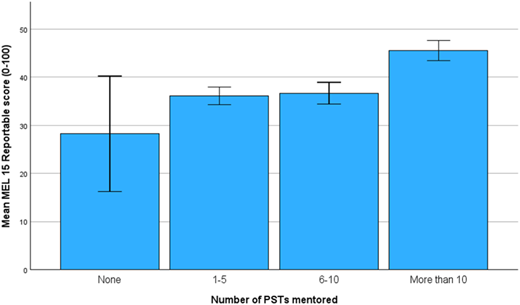
MEL-15 scores by the number of preservice teachers mentored. Source: Authors' own work
MEL-15 scores by the number of preservice teachers mentored. Source: Authors' own work
Effect sizes
To complement the ANOVA results, effect sizes were calculated using eta squared (η2) to assess the practical importance of group differences. Following Cohen's (1988) guidelines, values of 0.01, 0.06 and 0.14 represent small, moderate and large effects, respectively.
For teaching experience, all η2 values fell within the small range (η2 = 0.031–0.044), indicating that although some ANOVA differences reached significance, the amount of variance explained was limited. This suggests that years in the profession make only a minor contribution to emotional labour capacity.
By contrast, mentoring experience showed consistently large effects across all MEL scales. The strongest were observed for MEL-T (η2 = 0.206) and MEL-C (η2 = 0.189), with MEL-15, MEL-S and MEL-O also in the large range (η2 = 0.153–0.170). These values indicate that the number of PSTs mentored by a mentor accounts for a meaningful proportion of the variance in scores, particularly for task-related and context-responsive aspects.
Regression analysis
Having established the magnitude of group differences through effect sizes, multiple linear regressions were conducted to examine the independent contribution of demographic and professional variables to MEL scores (See Table 3). Separate models were run for each of the five MEL scales. Categorical predictors (gender, educational sector, teaching experience and mentoring experience) were entered using dummy coding, with the reference categories being female, secondary sector, >20 years of teaching experience and no prior PSTs mentored. The >20 years group was deliberately selected as the teaching reference category to test the common assumption that teaching longevity translates to mentoring capacity. This coding enabled coefficients to be interpreted as the difference in MEL scores between each group and its reference, while controlling for all other predictors. All predictors were entered simultaneously.
Regression coefficients for gender, sector, years of teaching and mentoring experience predicting MEL-15 scores
| Predictor | B | SE | β | t | p |
|---|---|---|---|---|---|
| Constant | 33.780 | 2.870 | - | 11.760 | <0.001** |
| Gender: male | 0.880 | 1.460 | 0.031 | 0.610 | 0.545 |
| Gender: prefer not to say | −8.400 | 7.810 | −0.054 | −1.080 | 0.282 |
| Gender non-binary/third gender | 0.300 | 7.770 | 0.002 | 0.040 | 0.969 |
| Sector: early years | −10.290 | 3.470 | −0.154 | −2.970 | 0.003* |
| Sector: primary | 3.860 | 4.990 | 0.092 | 0.780 | 0.433 |
| Sector: higher education | −3.990 | 5.060 | −0.040 | −0.790 | 0.431 |
| Sector: other | −7.800 | 5.570 | −0.071 | −1.400 | 0.163 |
| Service: < 5 years | 7.250 | 3.470 | 0.160 | 2.090 | 0.037* |
| Service: 6–10 years | 3.870 | 2.500 | 0.145 | 1.550 | 0.122 |
| Service: 11–20 years | 0.730 | 1.970 | 0.030 | 0.370 | 0.710 |
| Experience: 1–5 PSTs | −8.680 | 3.780 | −0.117 | −2.300 | 0.022* |
| Experience: 6–10 PSTs | 2.490 | 1.690 | 0.089 | 1.470 | 0.143 |
| Experience: >10 PSTs | 11.670 | 1.760 | 0.461 | 6.640 | <0.001** |
Note(s): N = 341. Female, Secondary sector, >20 years teaching and 0 PSTs mentored were used as reference categories. R2 = 0.20, Adj. R2 = 0.17, F(16, 324) = 5.01, p < 0.001. *p < 0.05, **p < 0.001
Assumptions of linear regression were systematically evaluated. Residual plots showed approximate normality and homoscedasticity. No influential outliers were detected (Cook's D range = 0.001–0.041, all below the threshold of 1.0). Independence of errors was confirmed with a Durbin–Watson of 2.10, within the acceptable range of 1.5–2.5 (Pallant, 2020). Multicollinearity was not present, with a VIF range of 1.49–1.57 and a tolerance range of 0.64–0.67 (Field, 2018). Given the substantial sample size (N = 341), minor departures from normality would not substantially affect the robustness of the analyses (Pallant, 2020).
Across all models, mentoring experience accounted for the largest and most consistent share of variance in MEL scores. A developmental pattern was evident: mentors with one to five PSTs scored significantly lower than those with no prior mentoring (B = −8.68, p = 0.022), indicating that early exposure may initially heighten the challenges of emotional labour. Scores began to rebound among those with six to 10 PSTs, although this increase was not statistically significant. Mentors who had supported more than 10 PSTs scored on average 11.7 points higher on MEL-15 (B = 11.67, p < 0.001). Given that the MEL-15 is scaled from 0 to 100, with a sample mean of 39.1 (SD = 11.9), this difference represents nearly a 1 standard deviation increase, a very substantial shift in emotional labour capacity.
Interestingly, years of teaching did not confer any additional benefit. The reversal of results from the small positive associations observed in the ANOVAs to the negative coefficients in the regressions suggests that the apparent benefits of teaching experience were mainly attributable to its correlation with mentoring exposure. Once mentoring experience was controlled for, longer teaching experience often became a flat or even negative predictor. For example, those with <5 years of teaching experience scored significantly higher on MEL-15 than those with >20 years (B = 7.25, p = 0.037), hinting that career stage alone may not translate into mentoring capacity.
No sectoral differences reached statistical significance, except early years mentors, who scored significantly lower than secondary mentors. Given the very small early years subgroup (n = 11), this result should be treated as exploratory.
Gender showed no significant effects across any model once other variables were held constant, reinforcing the fairness of the MEL framework and rejecting essentialist assumptions about emotional labour.
Model R2 values ranged from 0.17 to 0.23 across scales, indicating that these demographic and professional factors explained a modest but meaningful proportion of variance in emotional labour capacity (see Table 3 and Supplementary Table S1 a–d). The strongest effects consistently aligned with mentoring experience, particularly for the contextual (MEL-C) and task-focused (MEL-T) aspects, underlining that these capacities are especially shaped by hands-on mentoring engagement.
Regression analyses highlighted the central role of mentoring experience in shaping MEL scores, with demographic factors and teaching experience showing no statistically significant independent effects once mentoring experience was accounted for. These findings highlight the framework's sensitivity to differences in professional expertise and set the stage for interpreting their broader theoretical and practical implications.
Discussion
Key findings: mentoring experience matters more than years of teaching experience
This study addresses a significant gap by presenting robust quantitative evidence of how demographic and professional characteristics influence mentors' capacity to navigate emotional labour in ITE. Using the validated MEL framework, the findings show that mentoring experience was the strongest and most consistent correlate across all five scales. The number of PSTs mentored was linked to large effect sizes (η2 = 0.153–0.206), substantially exceeding Cohen's (1988) benchmark of η2 = 0.14 for a significant effect. In practical terms, mentoring experience explained 15%–21% of the variance in scores. For example, mentors who had supervised more than 10 PSTs scored approximately 1 standard deviation higher on the MEL-15 than novices, a difference equivalent to moving from the 50th to the 84th percentile in emotional labour capacity.
A distinctive pattern was that growth was non-linear. Mentors with only one to five PSTs often reported lower scores than those with no prior mentoring experience. This suggests that early exposure may temporarily heighten the difficulty of managing emotional labour, as mentors confront its complexity for the first time (Kinman et al., 2011). Scores began to rebound for those with six to 10 PSTs and increased markedly for those with more than 10, indicating that emotional capacity develops through sustained practice rather than emerging automatically with initial experience (Ericsson, 2006). Recognising this trajectory is critical: it positions mentoring capacity not as a simple by-product of service, but as a developmental process that requires repeated, supported engagement (Ericsson, 2006; Maxwell et al., 2024; Ulvik and Sunde, 2013).
With respect to teaching experience, effects were small (η2 < 0.035). Teaching experience appeared beneficial only when considered in isolation. Once mentoring was controlled for, its independent contribution was negligible or even slightly negative, suggesting the apparent benefits of teaching experience were explained by its correlation with mentoring exposure. This suggests that extended time in teaching, without sustained mentoring engagement, does not necessarily build emotional labour capacity and may even coincide with slightly lower scores. While modest, these results challenge the longstanding assumption that teaching longevity equates to mentoring readiness, echoing reviews showing that structured mentoring matters more than years of service (Ingersoll and Strong, 2011). Ronfeldt et al. (2018), in an extensive study of over 3,000 mentors, similarly found that cooperating teachers' instructional effectiveness, rather than years of experience, predicted PSTs' future performance. Qualitative evidence echoes this distinction: Goodwin et al. (2023) showed that even experienced teachers often emphasise technical replication and situational adjustment over reflective or relational mentoring if not exposed to mentor training and support.
This pattern could reflect several mechanisms. Role fatigue may contribute, as sustained workload pressures reduce teachers' emotional availability for mentoring (Kariou et al., 2021; Skaalvik and Skaalvik, 2018). It may also suggest a plateau effect, consistent with Ericsson's (2006) deliberate practice theory, where experience without intentional reflection leads to consolidation of classroom routines rather than growth in mentoring expertise. Finally, system-level practices that select mentors primarily based on teaching seniority rather than demonstrated capacity risk perpetuating a mismatch between the selection criteria and the effectiveness of mentoring (Ellis et al., 2020; Hobson et al., 2009; Maxwell et al., 2024). These findings confirm that emotional labour in mentoring is a distinct and context-dependent capacity that develops through repeated exposure to specific situations. This pattern aligns closely with situated learning theory and models of professional growth, which emphasise learning through authentic, relational practice rather than time served in the profession (Le Cornu, 2013; Orland-Barak and Wang, 2021).
While professional experience shaped variation in MEL scores, demographic factors did not. Gender showed no statistically significant differences, and no sectoral effects were statistically significant once small subgroups were taken into account. Taken together, these results suggest that emotional labour capacity is not strongly determined by identity or institutional category but rather by the nature and depth of mentoring engagement. This supports the fairness and transferability of the MEL framework across diverse contexts, highlighting that emotional capacities can be cultivated through practice rather than being tied to fixed demographic traits or professional settings (Cherkowski and Walker, 2019; Thornton, 2024; Ulvik and Sunde, 2013). This resonates with international findings that emphasise the evolving roles and expectations of mentors in PST education (Arnsby et al., 2023; Merket, 2022).
The SPSS results also revealed distinct patterns across the four MEL quadrants, with mentoring experience exerting the most pronounced influence on the task-focused (MEL-T) and context-responsive (MEL-C) domains. This suggests that sustained mentoring exposure is particularly valuable for developing the capacity to manage complex learning tasks and navigate institutional demands. This pattern reinforces the view that certain aspects of emotional labour, especially those requiring simultaneous pedagogical precision and contextual agility, are refined through repeated real-world mentoring practice (Ericsson, 2006). These insights highlight the MEL framework's potential for diagnosing specific areas for targeted mentor development. This implies that mentor preparation programs could benefit from authentic, scenario-based activities that simulate complex teaching tasks and institutional challenges (Le Cornu, 2013; Ulvik and Sunde, 2013). This is supported by research showing that complex emotional skills can be developed through structured, practice-based interventions (Hoffmann et al., 2020). Such programs would allow mentors to rehearse and refine these capacities before applying them in practice, moving beyond the assumption that teaching experience automatically translates to mentoring expertise.
Implications for theory, policy and practice
These findings have implications that extend beyond demonstrating the utility of the MEL framework. They speak directly to three interconnected spheres: the theoretical understanding of mentoring as a form of emotional labour, the policy frameworks that shape mentor preparation and the practical realities of developing mentors in diverse ITE contexts. The following sections address each in turn: first, situating the results within relevant theoretical traditions; then, considering their alignment (or misalignment) with current policy directions and finally, translating the insights into actionable strategies for mentor development in practice.
The MEL findings extend Hochschild's (1983) theory by demonstrating that mentoring involves significant intrapersonal and interpersonal work that grows through practice (Goodwin et al., 2023; Opengart and Bierema, 2015; Thornton, 2024). The predictive strength of mentoring exposure over teaching experience positions emotional labour as a learnable, contextually responsive skill rather than a fixed trait (Ronfeldt et al., 2018; Wells and De Nobile, 2021). This aligns with the situated learning theory, which emphasises that capacity is relational, embodied and refined through authentic engagement (Lave and Wenger, 1991). The study also advances ITE mentoring theory by providing one of the first quantitative demonstrations of emotional capacity as a central component of mentor development. The MEL framework demonstrates that active engagement and reflection, rather than years of teaching, are more accurate markers of proficiency (Goodwin et al., 2023; Schön, 1987), underscoring the need to distinguish between mentor identity and teacher identity (Hobson and Maxwell, 2020; Le Cornu, 2013). By combining Rasch-based scale construction with SPSS-based validation, the framework offers a theoretically coherent and empirically robust tool for operationalising a construct often treated as a “soft” skill (Bond and Fox, 2015; Boone and Noltemeyer, 2017). With the theoretical contribution established, the next step is to consider implications for policy and practice.
At a policy level, these findings highlight the need for mentoring standards and induction guidelines to recognise the emotional labour involved in mentoring explicitly, without reducing relational work to performance metrics (Ball, 2003). At present, most frameworks emphasise procedural and standards-based aspects of mentoring while treating the relational and affective aspects as implicit expectations (Beutel et al., 2017; Shanks et al., 2020; Wells and De Nobile, 2021). Notably, the MEL findings indicate that capacity follows a developmental curve, where beginning mentors may require scaffolding to navigate the initial dip in capacity. At the same time, experienced teachers need opportunities to adapt and refresh their practice to avoid stagnation or burnout (Bodenheimer and Shuster, 2020; Skaalvik and Skaalvik, 2018). Importantly, higher MEL scores may reflect both individual capacity and differential access to mentoring opportunities or organisational support rather than deficits in less-experienced mentors. Policy therefore needs to ensure that professional learning is not confined to induction but is sustained throughout the career trajectory. Embedding an explicit understanding of emotional labour into policy would validate its importance, create conditions for targeted professional learning and promote sustainable support for mentors.
In practice, these findings highlight the need for systematic professional learning that develops mentors' emotional labour capacity as deliberately as their pedagogical skills. Currently, mentor preparation often relies on informal, experience-based approaches, allowing emotional capacities to emerge through trial and error (Maxwell et al., 2024; Wells and De Nobile, 2021). The MEL framework provides a practical approach to addressing this by generating profiles that translate assessment results into actionable developmental feedback. These scales are intended for formative and reflective use rather than evaluative purposes (Relihan and O'Donovan, 2026). In reality, this might look like mentors receiving individualised reports that highlight strengths in routine tasks but identify areas for growth, such as managing complex feedback conversations or balancing institutional demands. ITE providers could then use these profiles to design targeted workshops that combine scenario-based activities, coaching and reflective dialogue. While capacity develops through practice, mentors at different career stages will require different kinds of support (Arnsby et al., 2023; Merket, 2022), underscoring the value of ongoing, mentoring-specific professional learning. By framing emotional labour as a learnable and improvable skill, the MEL framework reduces stigma around capacity gaps and supports a culture of reflective, adaptive practice (Wexler, 2020).
Limitations and future research directions
This study has several limitations that point to directions for future research. Participation was voluntary, raising the likelihood of self-selection bias: mentors more confident, reflective or interested in the emotional aspects of mentoring may have been overrepresented, while those under heavier workload pressure may have opted out (Bethlehem, 2021). As a self-report measure, MEL captures perceived capacity and may be shaped by professional self-concept, which warrants further exploration in future research, along with an investigation of the impact on access to mentoring supports. The predominantly female sample and small subgroup sizes also limit the stability of subgroup comparisons; accordingly, findings should be interpreted as patterns within the respondent sample rather than as population effects. Future studies should oversample underrepresented groups, such as male and early years mentors, to strengthen generalisability.
The cross-sectional design also restricts conclusions about development over time. Longitudinal studies could track changes in emotional labour capacity across multiple mentoring cycles, particularly in response to structured professional learning. Reliance on self-report survey data introduces the possibility of common method bias, where results reflect perceptions more than enacted behaviours (Podsakoff et al., 2024). Triangulating MEL scores with classroom observations or interviews would help address this concern.
Although the MEL scales were Rasch-validated, questions of measurement equivalence remain when extending the framework internationally. Careful cross-cultural adaptation will be required to ensure comparability (Byrne, 2016). Future studies could extend the construct by examining how mentoring capacity is shaped not only by experience but also by structural conditions such as leadership support, workload and organisational resourcing (DeVellis and Thorpe, 2021).
Finally, the absence of qualitative data limits insight into how mentors interpret and enact emotional labour. Mixed-methods designs integrating interviews, focus groups and reflective journals would help capture the strategies and contextual triggers that shape practice (Tashakkori and Teddlie, 2010). At the same time, future research could explore ways to translate MEL findings into practical development tools, such as simulated mentoring scenarios or structured reflection guides that provide formative feedback. Together, these directions set the stage for extending MEL as both a research instrument and practical support for mentor development across diverse contexts.
Conclusion
This study advances understanding of mentoring in ITE by showing that proficiency is not an incidental by-product of teaching experience but a distinct professional capacity shaped through direct mentoring practice. It provides new quantitative evidence that emotional labour is a situated, developable skill, challenging the assumption that years in the classroom automatically translate to readiness for mentoring. This study demonstrates that the MEL framework, underpinned by prior Rasch validation, can be applied with contextual sensitivity to capture nuanced variation. The implications are clear: mentor selection, preparation and ongoing development should be grounded in an understanding of emotional labour as a learnable and improvable skill. By making this often-invisible work measurable and actionable, the MEL framework offers a pathway to more responsive mentoring systems and a platform for advancing theory, policy and practice in ITE.
Appendix
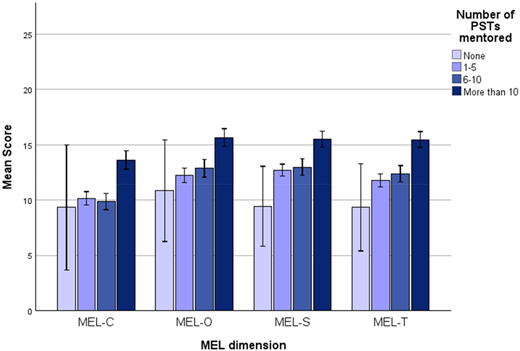
Mean scores across all MEL quadrants (MEL-C, MEL-O, MEL-S, MEL-T) by number of preservice teachers mentored (0–25 scale). Error bars represent 95% confidence intervals. Source: Authors' own work
Mean scores across all MEL quadrants (MEL-C, MEL-O, MEL-S, MEL-T) by number of preservice teachers mentored (0–25 scale). Error bars represent 95% confidence intervals. Source: Authors' own work
The supplementary material for this article can be found online

