

Purpose
Building on the social exchange theory (SET), this study aims to propose a model of the effects of green human resource management on employee in-role, extra-role and green innovative work behavior (GIWB). This study proposes, building on both the job demands-resources model and SET, that the aforementioned links can be explained through the mediating role of green work engagement (GWE).
Design/methodology/approach
Data were collected from employees (n. 208) working in Palestinian higher education organizations using a self-administered questionnaire. The partial least squares-structural equation modeling was the primary statistical technique adopted to examine the study’s hypotheses.
Findings
The results suggest that green human resources management (GHRM) was a significant predictor of employee in-role green behavior, extra-role green behavior and GIWB. Furthermore, GWE demonstrated to be a significant intervening mechanism to explain the above-mentioned relationships.
Practical implications
The results provide useful insights for higher education policymakers on how GHRM may positively contribute to employee green outcomes.
Originality/value
This paper is novel for several reasons. First, it contributes to the general literature of GHRM. Second, it contributes to the limited body of knowledge on GHRM in the context of higher education. Third, the distinct contribution of this study is the introduction of GIWB as an outcome of GHRM, and GWE as a mediating variable in the relationship between GHRM and employee green behaviors.
Introduction
As organizations currently shifting their strategies and priorities toward more green-oriented agendas, human resources management (HRM) professionals need to rethink the mission and extend the reach of their practices through the integration of green management practices to improve the way they conduct the fundamental HRM practices (Ángel del Brío et al., 2008). Pham et al. (2019) proposed that HRM can quantify and influence sustainability-related behaviors, attitudes, awareness and motivation of employees. Therefore, organizations may also use HRM to generate and develop environmentally-friendly policies in an effective manner (Renwick et al., 2013).
In the past few years, a growing number of higher education organizations around the world have tried to make environmental management and green practices an essential part of their provided services. As a teaching and research organizations, higher education organizations are expected to play a significant role in adopting approaches and alternates to tackle existing environmental issues (Benayas et al., 2002; Disterheft et al., 2012; León-Fernández and Domínguez-Vilches, 2015). Besides, they need to set a precedent in revitalizing and recognizing the evolving needs and challenges of environmental management concerns (Finlay and Massey, 2012). As such, to encourage an environmentally friendly workplace climate, higher education institutions should embrace the philosophy of “Go Green” (Gilal et al., 2019). Members of higher education institutions, including teaching, research and administrative staff, would need to adopt green and environmentally friendly practices in their day to day activities at the workplace (Benayas et al., 2002).
In general, employees’ behaviors that promote environmental management practices at the workplace refer to green behaviors (Dumont et al., 2017). Employee green behaviors are viewed as keys to the effective implementation of green practices in the workplace. Moreover, studies have demonstrated that involving employees in green practices is crucial for the environmental management initiatives (Jabbour et al., 2008; Mazzi et al., 2016), as this would contribute to the better environmental performance and completive advantage (Kim et al., 2019). To motivate green employees’ behaviors, green human resources management (GHRM) practices are considered as a critical HRM strategy to raise employees’ environmental awareness at the workplace. GHRM processes aimed at promoting environmental management incorporates several functions such as green recruitment, green training, green rewarding and green performance appraisal (Dumont et al., 2017; Jabbour et al., 2008; Renwick et al., 2013; Tang et al., 2018).
Research on GHRM has flourished in the past years with studies carried out in diverse industries such as tourism and hospitality (Luu, 2017), information and technology (Ojo and Raman, 2019) and automobile industry (Chaudhary, 2019). Nevertheless, research on GHRM in higher education is limited (Fawehinmi et al., 2020; Gilal et al., 2019). This was confirmed by a recent literature review by Pham et al. (2019), who called for the need to conduct more research in diverse service sectors. Among the limited studies, the study of Fawehinmi et al. (2020) found that GHRM increases employees’ green behaviors of academics through mediating role of environmental knowledge, whereas Gilal et al. (2019) found that including green behaviors of employees in the management doctrine of higher education organizations is vital to enhancing organizational financial and environmental performance and to gaining employee commitment.
Therefore, to advance the literature of green HRM in general and in higher education in particular, this study aimed to propose a model of the effects of GHRM practices on employees’ green behaviors, namely, in-role, extra-role and green innovative behavior. Green work engagement (GWE) was hypothesized to play a mediating role among the aforementioned links. This research makes the following contributions: first, it contributes to the general literature of GHRM, as the relationship between GHRM and employees’ green work-related outcomes are in infancy stage (Pham et al., 2019; Saeed et al., 2019; Yong et al., 2019). Second, it contributes to the limited body of HRM research (Aboramadan et al., 2020b) and green HRM research (Fawehinmi et al., 2020) in higher education organizations. Third, this research is novel as it investigates a model that introduces new variables to the literature of GHRM, namely, green innovative behavior and GWE. Fourth, it improves our understanding of the mechanisms that underline the relationship between GHRM and employees’ green workplace behavior (Ren et al., 2018).
Literature review
Green human resources management and green outcomes
GHRM practices have been defined and conceptualized by several scholars (Dumont et al., 2017; Tang et al., 2018; Pham et al., 2019) as practices that include green recruiting and hiring employees with green awareness and knowledge; green training to develop employees’ green skills, competencies and knowledge; green performance appraisal with established green standards for assessing performance; and green rewards to provide incentives based on the successful implementation of the green objectives set by the organization.
Employee green behavior reflects an individual friendly behavior toward the environment (Norton et al., 2015). This includes both in-role green behavior and extra-role behaviors (voluntary). In-role green behavior is defined as green formal tasks that are an integral part of an employee performance assessment. In contrast, extra-role green behavior reflects voluntary green behaviors the go beyond the required formal duties of an employee and is not recognized in his/her performance assessment (Paillé and Boiral, 2013). In general, the empirical research suggests that GHRM is positively linked to green task behavior, green employee empowerment, green job crafting and organizational citizenship toward the environment (Chaudhary, 2019; Dumont et al., 2017; Fawehinmi et al., 2020; Hameed et al., 2020; Renwick et al., 2013; Luu, 2019). The norm of reciprocity of the social exchange theory (Blau, 1964) may provide the basis for explaining the relationship between GHRM and employees’ green behaviors (both task-related and voluntary behaviors). When organizations send signs of commitment toward environmental management practices by providing clear green goals, green training and development, effective green performance appraisal and green rewarding systems, employees are, in turn, expected to trade this environmental dedication and efforts by their organizations through displaying green behaviors. Therefore, the following two hypotheses can be posited:
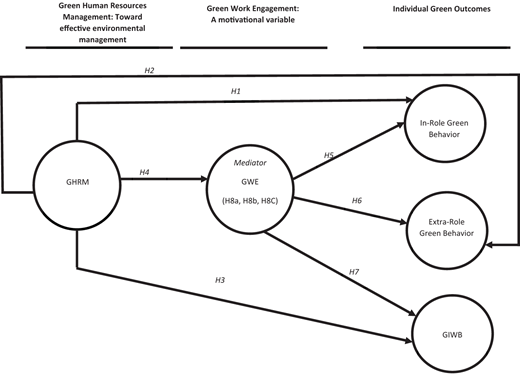
GHRM exerts a positive effect on employees’ in-role green behaviors.
GHRM exerts a positive effect on employees’ in-extra green behaviors.
Innovative work behavior is viewed as employee behavior that is composed of idea creation, promotion and realization (Scott and Bruce, 1994). In general, innovative work behavior has been perceived as an essential component to sustaining an organization’s competitive advantage (Bos-Nehles and Veenendaal, 2019; West and Farr, 1989). Furthermore, it has been argued that HRM practices are of primary importance in realizing innovation outcomes in the organization (Bos-Nehles and Veenendaal, 2019; Seeck and Diehl, 2017; Zhou et al., 2013). By applying the concept of environmental management to innovative work behavior, green innovative work behavior (GIWB) can be conceptualized as employees’ behaviors devoted toward green ideas generation, promotion and realization.
On the relationship between GHRM and GIWB, it can be argued that GHRM can positively contribute to GIWB for the following reasons. First, employees with higher environmental knowledge and awareness will generate more valuable and innovative environmental management concepts, thus contributing to the green innovation of the organization (Renwick et al., 2013). Second, green training and coaching practices create avenues for employees to acquire the skills and expertise needed to strengthen their innovative practices (Chang and Chen, 2013). Third, green performance assessment and incentive strategies will bring the behaviors of employees in line with the organization’ environmental objectives (Guerci et al., 2016), as green performance assessment is a crucial mean to increase employee dedication to the environment (Renwick et al., 2013), which would ultimately encourage green innovation behaviors. Fourth, previous researchers (McClean and Collins, 2011; Wright and Nishii, 2013) suggested that employees usually repay the organization with innovative work behaviors in exchange for the organization’s commitment toward HRM. Hence, in line with the social exchange theory, when employees effectively perceive the organization’s commitment toward environmental management, they are more likely to reciprocate with greater levels of discretionary actions such as GIWB. Finally, research suggests that GHRM practices were found to positively influence green innovation at the organization level (Song et al., 2020). Therefore, it can be argued that the employees’ perceptions of GHRM toward the environment will profoundly affect their green innovation behavior. Based on the previous arguments, the following hypothesis can be advanced:
GHRM exerts a positive effect on employees’ GIWB.
Green human resources management and green work engagement
Work engagement is defined as “a positive, fulfilling, work-related state of mind that is characterized by vigor, dedication and absorption” (Schaufeli et al., 2002, p. 74). Engagement can be seen as up to which level employees are connected to their works cognitively, emotionally and physically. Building on this, GWE can be defined as the energy an employee puts in his green work-related tasks, the willingness to exert efforts at the green level and the absorption level in green work.
In general, factors such as job characteristics (Christian et al., 2011), leadership (Aboramadan et al., 2020) and HRM practices (Karatepe and Olugbade, 2016) were found to be common antecedents to work engagement. The mainstream literature of HRM examined the top-down impact of HR practices and systems on work engagement. For instance, Albrecht et al. (2015) proposed a model that is composed of organizational, job, motivational and individual factors that can trigger higher levels of work engagement. Other studies (Aboramadan et al., 2020b; Karatepe, 2012; Schaufeli et al., 2006) demonstrated the positive relationship between job resources and work engagement.
On the relationship between GHRM and GWE, the job demand-resources (JD-R) framework provides a foundation to explain the relationship between GHRM and GWE. According to (Demerouti et al., 2001), organizational and job resources such as HRM practices may activate a motivational mechanism which links these resources to work engagement. Based on this perspective, GHRM at work can be viewed as a motivational factor and is, thus, positively related to work engagement of employees (Schaufeli and Bakker, 2004). Resources, such as GHRM, can play an intrinsic or extrinsic motivational role, nurturing the development of employees and adding to the accomplishment of their career aspirations. As such, they are deemed to promote dedication to work among employees (Bakker and Demerouti, 2008), and in particular GWE. Given this discussion, the following hypothesis is advanced:
GHRM exerts a positive effect on employees’ GWE.
Green work engagement and green outcomes
As per the SET, it appears that employees with greater levels of engagement are more inclined to have a secured and elevated quality relationship with their organizations. This, in turn, creates favorable job-related outcomes (Saks, 2006). Correspondingly, such manifestations will not only inspire workers to fulfill their jobs but also allow them to participate in voluntary activities that go beyond their work tasks (Kahn, 1990). For instance, previous research (Aboramadan et al., 2020; Agarwal et al., 2012; Alfes et al., 2013; Haynie et al., 2016; Rich et al., 2010; Rodwell et al., 2017) suggest that work engagement was found to be a significant predictor of work performance and extra-role behaviors, such as innovative and citizenship behaviors.
On the link between GWE and green outcomes, it can be argued that employees who display higher levels of GWE are more likely to have positive exchanges with the organization. Under these circumstances, GWE may yield positive effects on other green-work related outcomes. GWE can motivate employees to participate not only in green practices but also to commit to green-initiatives and assist other employees to decode the sense of green behaviors for organizational and community’ sustainability (Luu, 2019). Based on the above discussion, the following hypotheses are proposed:
GWE exerts a positive effect on employees’ in-role green behaviors.
GWE exerts a positive effect on employees’ extra-role green behaviors.
GWE exerts a positive effect on employees’ GIWB.
The mediating role of green work engagement
In general, work engagement was shown to be a significant mediator in several studies (Aboramadan et al., 2020b; Aboramadan et al., 2019; Agarwal et al., 2012; Karatepe and Olugbade, 2016; Rich et al., 2010; Sulea et al., 2012). Work engagement is generally seen as a motivational mechanism that influences performance outcomes (Karatepe et al., 2014). Building on JD-R and SET, the study proposes GWE as a potential intervening mechanism between the independent and dependent variables in this study. According to the JD-R framework, it is assumed that the presence of resources (GHRM, in the case of this study) would encourage goals achievement and instill positive work-related behaviors (Hobfoll, 2001), such as GWE. This will consequently create a state of motivation to enhance employees’ ability to display positive green behaviors (in-role and voluntary) and encourage them to try and create new things that could be formed as new ideas and alternates at the green level. From the perspective of the SET, employees with greater levels of engagement (GWE, in this case), are more prone to be in quality social exchanges with the employer. As a result, employees will display positive outcomes (Saks, 2006), including those of green outcomes. Hence, positive perceptions of GHRM would positively increase employees’ GWE and, ultimately, their green-related outcomes. Given this discussion, the following hypotheses are advanced:
GWE mediates the relationship between a) GHRM and in-role green behaviors, b) GHRM and extra-role green behaviors and c) GHRM and GIWB.
Research model.
The study aims at proposing a model of the effects of GHRM in higher education on green work-related outcomes at the individual level, namely, in-role green behavior, extra-role green behavior and GIWB. As shown in Figure 1, GWE was hypothesized to serve as an intervening mechanism among the aforementioned links.
Participants and procedures
Data were collected from staff working in Palestinian higher education institutions (n. 5). These included both academic staff and administrative employees. In total, 410 questionnaires were distributed, 215 were returned back, of which five were removed due to incomplete answers and two were removed due to the presence of multi-outliers. In total, 208 questionnaires were usable for statistical analysis representing a response rate of 50.7%. Questionnaires were distributed in Arabic, the official language used at the Palestinian workplace. The questionnaire was translated using the back-translation method of Brislin (1986). Drop off and pick up method was used to increase the response rate. Cover letters were attached to the questionnaire explaining the main purpose of the research and ensuring that respondents’ personal information will be kept confidential. The questionnaire was short, clear and easy to fill within 10–15 min. Of the respondents, 73.1% were men and 26.9% were women. Concerning age, 44.7% were between 25 and 30 years of age, 5.3% were between 31 and 35 years, 21.6% between 36 and 40 years and 28.4% were older than 40 years. Regarding experience, 53.8% had an experience ranging from 1–5 years, 14.4% had 6–10 years, 30.8% had 11–15 years, whereas only 1% had more than 15 years of experience. All employees had full-time contracts, 70% of which occupied administrative positions and 30% occupied academic positions.
Multicollinearity and common method bias remedies
Multicollinearity was checked using the Variance Inflation Factors for each item. According to Hair et al. (2018), data are free of multicollinearity if the VIF values are below 5. In this research, VIF values ranged from 1.061 to 3.304. This indicates that the data were free of multicollinearity. To check for common method bias, the Harman single factor test was used to check for the percentage of variance explained. The results suggest that a single factor did not explain the majority of the variance (only 31.495). As the variance explained was below the cut-off point of 50% (Podsakoff et al., 2003), this gives an indication that the data were free of common method bias (CMB) contamination.
Statistical strategy
Descriptive statistics, reliability measures and correlations were analyzed using SPSS v.24. To test the study hypotheses, the author has used partial least squares – structural equation modeling (PLS-SEM) (Hair et al., 2018). PLS-SEM was used as it has been widely used in different scientific disciplines, such as human resource management (Ringle et al., 2018), marketing (Hair et al., 2011), strategic management (Hair et al., 2012) and hospitality (Ali et al., 2018). PLS-SEM technique measures the path coefficients through the ordinary least squares (Rigdon, 2012). Moreover, PLS-SEM deals with correlated measurement errors (Rademaker et al., 2019) and ordinal measures (Schuberth et al., 2018).
Measures
Green human resources management.
This was measured using the six-item scale developed by Dumont et al. (2017) to gauge employees’ perceptions of GHRM adopted at their organizations. A sample item was “my university sets green goals for its employees.” The Cronbach’s alpha for this construct was 0.883.
Green work engagement.
This was measured using six-items obtained from Schaufeli et al. (2006). As this scale was originally developed to measure work engagement, the six items were modified to assess green employee engagement. A sample item was “I am enthusiastic about my environmental tasks at my job.” The Cronbach alpha for this construct was 0.851.
In role green behavior.
This was measured using the three-item scale developed by Bissing-Olson et al. (2013). A sample item was “I adequately complete the assigned duties in an environmentally friendly way.” Cronbach’s alpha for this construct was 0.667.
Extra role green behavior.
This was measured using the three-item scale developed by Bissing-Olson et al. (2013) to assess voluntary green behaviors. A sample item was “I take initiatives to act in environmentally friendly ways at work.” The Cronbach’s alpha for this construct was 0.667.
Green innovative work behavior (GIWB).
The six-item scale developed by Scott and Bruce (1994) was borrowed to gauge innovative work behavior. This scale was modified in which green-related terms were added to adapt to the study purposes. A sample item was “I Investigate, and secure funds needed to implement new green ideas” The Cronbach’s alpha for this construct was 0.866.
Measurement model assessment
Factor analysis loadings were checked for the items of the research scales. As shown in Table 1, the values of standardized factor loading ranged between 0.658 and 0.866. All the loadings were significant at the 0.001 level. The average variance extracted (AVE) and composite reliability (CR) were computed to check for convergent validity and internal consistency (Fornell and Larcker, 1981). The results suggest that all the research variables had AVE values higher than 0.5 and CR values higher than 0.70, indicating that the data were convergently valid and internally consistent.
Factor loading, with t-values, CRs and AVEs
| Construct | Item | S. loading | t-statistic | CR | AVE |
|---|---|---|---|---|---|
| GHRM | My university sets green goals for its employees | 0.774** | 21.54 | 0.912 | 0.635 |
| My university provides employees with green training to promote green values | 0.840** | 27.34 | |||
| My university provides employees with green training to develop employees’ knowledge and skills required for green management | 0.814** | 25.23 | |||
| My university considers employees’ workplace green behavior in performance appraisals | 0.866** | 32.82 | |||
| My university relates to employees’ workplace green behaviors to rewards and compensation | 0.804** | 17.25 | |||
| My university considers employees’ workplace green behaviors in a promotion | 0.666** | 14.67 | |||
| GWE | My environmental- related tasks inspire me | 0.709** | 14.86 | 0.890 | 0.577 |
| I am proud of the environmental work that I do | 0.820** | 25.25 | |||
| I am immersed in my environmental work | 0.806** | 24.99 | |||
| I am enthusiastic about my environmental tasks at my job | 0.802** | 20.56 | |||
| I feel happy when I am working intensely on environmental tasks | 0.748** | 17.82 | |||
| With environmental tasks at my job, I feel bursting with energy | 0.658** | 10.88 | |||
| In-role green behavior | I adequately complete the assigned duties in an environmentally friendly way | 0.807** | 13.64 | 0.814 | 0.595 |
| I fulfill the responsibilities specified in my job description in environmentally-friendly ways | 0.795** | 12.14 | |||
| I perform tasks that are expected of me in environmentally-friendly ways | 0.707** | 9.30 | |||
| Extra-role green behavior | I take initiatives to act in environmentally friendly ways at work | 0.755** | 10.89 | 0.785 | 0.549 |
| I take a chance to get actively involved in environmental protection at work | 0.714** | 8.20 | |||
| I do more for the environment at work than I am expected to | 0.753** | 10.61 | |||
| GIWB | I search out new environmentally-related technologies, processes, techniques and/or product ideas | 0.727** | 16.73 | 0.899 | 0.599 |
| I generate green creative ideas | 0.807** | 30.08 | |||
| I promote and champion green ideas with others | 0.806** | 27.58 | |||
| I Investigate and secure the funds needed to implement new green ideas | 0.698** | 12.95 | |||
| I develop adequate plans and schedules for the implementation of new green ideas | 0.824** | 26.19 | |||
| I am environmentally innovative | 0.775** | 27.65 |
Notes:
**Significant at 0.001 level.
All scales were measured on a seven-point Likert scale ranging from 1 (strongly disagree) to 7 (strongly agree)
Discriminant validity was checked using two tests. First, the Fornell and Larcker (1981) rule which compares the square root of AVE with the intercorrelations among the variables. The results in Table 2, show that the square root of AVE was higher than the intercorrelation, indicating that the condition of discriminant validity was met. On the other hand, to further confirm the presence of discriminant validity, the heterotrait-monotrait ratio (HTMT) was employed. The results in Table 3, suggest that all ratios are below 0.85 as suggested by Hulland (1999) suggesting that constructs were discriminantly valid.
Descriptive statistics, correlations and the square root of AVE in diagonal
| Constructs | Mean | SD | 1 | 2 | 3 | 4 | 5 |
|---|---|---|---|---|---|---|---|
| GHRM | 5.60 | 0.933 | (0.797) | ||||
| GWE | 5.42 | 1.25 | 0.329** | (0.759) | |||
| In-role green behavior | 5.54 | 0.960 | 0.256** | 0.361** | (0.771) | ||
| Extra-role green behavior | 5.12 | 1.17 | 0.267** | 0.390** | 0.317** | (0.741) | |
| GIWB | 5.69 | 0.913 | 0.614** | 0.363** | 0.281** | 0.356** | (0.774) |
Structural model assessment: quality check
To assess the structural model, several criteria were computed. First, the R square (R2) for the research variables were as follows: GWE (0.102), in role green behavior (0.164), extra-role green behavior (0.199) and GIWB (0.433). As per the recommendations of Chin (1998), these values are considered acceptable. Second, the f square (f2) for the research variables were as follows: medium effect for GHRM on GWE (0.113), GHRM on in-role green behavior (0.026), GHRM on extra-role behavior (0.037). The effect size was of GHRM on GIWB (0.509) was a string. On the other hand, the effect size of GWE on in role-green behavior (0.116), GWE on extra-role green behavior (0.140) and GWE on GIWB (0.062) was medium. Finally, predictive relevance (Stone–Geisser’s Q2) was calculated for latent variables and the results showed that Q2 values were: 0.053 for GWE, 0.083 for in-role green behavior, 0.092 for extra-role green behavior and 0.23 for GIWB. As Stone–Geisser’s Q2 values were higher than 0, this indicated high predictive relevance as suggested by Hair et al. (2018).
Results
Table 2 presents descriptive figures, means, standard deviations and correlations between the research variables of this study. Correlations were found significant and positive between the research variables. The reported correlations were: GHRM and GWE (r = 0.329, p = 0.000), GHRM and in-role green behavior (r = 0.256, p = 0.000), GHRM and extra-role green behavior (r = 0.267, p = 0.000) and GHRM and GIWB (r = 0.614, p = 0.000). significant correlations were found between GWE and in-role green behavior (r = 0.361, p = 0.000), GWE and extra-role green behavior (r = 0.390, p = 0.000) and GWE and GIWB (r = 0.363, p = 0.000).
Hypotheses testing
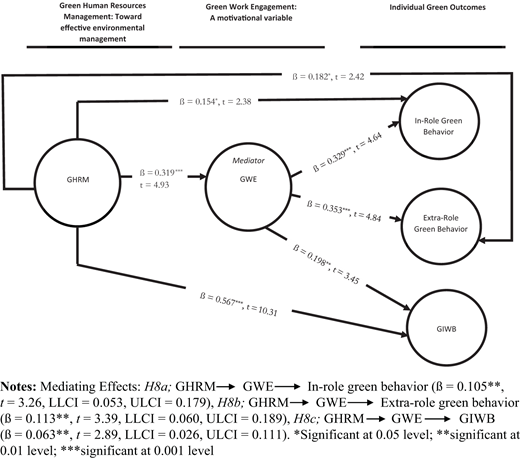
Figure 2 presents the results for the direct path analysis and mediation analysis. The results suggest that GHRM was positively associated with in-role green behavior (ß = 0.154, t = 2.38, p = 0.017), with extra-role green behavior (ß = 0.182, t = 2.42, p = 0.015) and with GIWB (ß = 0.567, t = 10.31, p = 0.000). The results lend support for H1, H2 and H3. Furthermore, the results provided support for H4, in which it was indicated that GHRM showed to exert a positive effect on GWE (ß = 0.319, t = 4.93 p = 0.000). GWE demonstrated to have a significant effect on in role-green behavior (ß = 0.329, t = 4.64 p = 0.000), on extra-role green behavior (ß = 0.353, t = 4.84 p = 0.000) and on GIWB (ß = 0.198, t = 3.45 p = 0.001), suggesting that H5, H6, H7 were supported. Finally, using the 5,000-sample bootstrapping technique, the mediating effect of GWE was examined. The results suggest that GWE showed to have a significant mediating effect between GHRM and in-role green behavior (ß = 0.105, t = 3.26 p = 0.001), between GHRM and extra-role green behavior (ß = 0.113, t = 3.39 p = 0.001) and between GHRM and GIWB (ß = 0.063, t = 2.89 p = 0.004), therefore, H8a, H8b and H8c were supported.
Discussion and implications
The study examined the relationship between GHRM and in-role green behavior, extra-role green behavior and GIWB through the mediating effect of GWE. The results demonstrate that GHRM significantly predicated both in-role and extra-role green behavior. The results were in line with the research of Dumont et al. (2017) that found that GHRM positively influenced both in-role and extra-role green behavior. Furthermore, these results were in line with the norm of reciprocity embedded in SET in which employees exchange the green management efforts of the organization with task-related and voluntary green behaviors. The results, as well, suggest the GHRM exerted a positive and significant effect on employees’ GIWB. This implies that attributes of HRM practices determine employees’ innovative work behavior as suggested by (Wright and Nishii, 2013).
The results indicated that GHRM and GWE were positively associated. The results support what has been discussed in the JD-R framework (Demerouti et al., 2001), highlighting that resources at work serve as a motivational variable to encourage employee’s engagement at work. Further, GWE was found to positively affect in-role green behavior, extra-role green behavior and GIWB. This implies that employees with higher levels of GWE are more prone to have a trustful and quality exchanges with their organization, which would ultimately encourage employees to display positive outcomes such as green outcomes.
Finally, the results suggest that GWE demonstrated to be a significant mediating mechanism among the examined relationships. GWE significantly mediated the relationship between GHRM and in-role green behavior, GHRM and extra-role green behavior and GHRM and GIWB. This implies the relationship between GHRM and green outcomes may not be only direct, which means that HRM (GHRM in this case) affects workplace outcomes (green outcomes) through a particular mechanism (Karatepe and Olugbade, 2016) such as GWE.
This study has several contributions to GHRM research in general and higher education research on green management in particular. Research on GHRM is evolving, and more research is needed (Pham et al., 2019), especially within the context of the higher education sector (Gilal et al., 2019). In response to that, the study proposed a model and empirically examined a new mechanism through which the relationship between GHRM and its consequences can be explained. It is the first study of its kind to use the GWE construct as a study variable and as an intervening mechanism. In previous research, the intervening mechanisms used were green psychological climate, environmental knowledge, environmental passion, green employee empowerment, green capital and green crafting (Dumont et al., 2017; Fawehinmi et al., 2020; Gilal et al., 2019; Hameed et al., 2020; Song et al., 2020; Luu, 2019). Furthermore, a new variable (GIWB) was introduced in the model as a latent variable, among other green outcomes. Most of what has been introduced on employees’ green behaviors in the GHRM literature was task-related green behaviors, voluntary green behaviors, organizational citizenship toward the environment (Pham et al., 2019), while GIWB was not addressed as a potential outcome of GHRM practices.
Managerially speaking, higher education organizations are called upon going green and creating a roadmap for their staff to serve as environmental activists. These organizations will need to effectively and successfully implement GHRM activities for better environmental management and to promote employees’ green behaviors at the workplace. Higher education organizations are required to adopt sustainable green practices to assist employees in resolving environmental challenges and concerns. This may lead to the improved green performance of these organizations and the community as a whole. Human resource (HR) professionals in higher education are advised to include GHRM practices at the top of their agenda, in addition to other HRM systems such as high-performance work practices and high-commitment HRM systems. GHRM practices should include clear green hiring policies, green training and development, a system of green performance evaluation and effective rewarding green rewarding and compensation policies. This research strongly recommends that HR specialists and senior management in higher education establish core organizational concepts and principles when articulating GHRM strategies. Hiring staff (academic and administrative) with common environmental protection values is an important practice to create a state of person-organization fit. Furthermore, HR practitioners in higher education may give a strong example by communicating their environmental morals and ethics at work through different techniques such as communication emails, broachers and regular seminars on green management. HR professionals can also assess candidates' environmental principles in the interview process by analyzing their awareness and readiness to get involved in green management practices. Furthermore, HR personnel can provide higher education staff with adequate training and coaching about environmental conservation, which will help align staff with the environmental policies of their organizations and increase awareness of environmental management concerns. Finally, HR policymakers in higher educations may link performance appraisal and rewarding schemes with employees’ environmental performance. This might include measuring the amount of paper used within a period of time and the number of printing orders performed, which can be tracked using printing monitors.
Limitations and future research
This study has limitations that provide opportunities for future research endeavors. First, the model proposed was investigated using data collected from one source (employees) at one point in time. Although, it was demonstrated that CMB was not a concern for this study, collecting data from multiple sources and at different intervals would minimize CMB. This includes having supervisors evaluate the green behaviors of their employees. Second, data come from employees working in five higher education institutions, which might limit the generalizability of the results. Hence, future research may consider replicating the study model using larger samples. Third, this study is cross-sectional in its nature, which puts restrictions on drawing cause-effect conclusions. Future studies may consider a longitudinal research design to examine the model over time. Moreover, the study examined one mediator (GWE) among the investigated links. Future studies may consider other intervening variables such as green engagement climate, green perceived organizational support and organizational identification. Finally, future research may consider investigating the model in diverse service sectors including higher education, nonprofits, healthcare and hospitality to check for differences between these sectors.
Conclusion
The study investigated the impact of GHRM practices on green outcomes, namely, in-role, extra-role and GIWBs, through the mediating effects of GWE. With data collected from the higher education sector in Palestine, the results demonstrated that GHRM showed a positive relationship with the aforementioned outcome variables. GWE was found to play a significant mediating role between the links examined. The study suggests future research to enrich the literature of GHRM with further investigation of the precise mechanisms governing the relationship between GHRM and its consequences.

