


This study aims to determine whether employees are satisfied with their connection to colleagues when working from home (WFH), whether their satisfaction is influenced by sociodemographic factors and home-based work settings and whether cross-country differences exist.
Using survey data from 137,487 knowledge workers across 88 countries, collected during a real-world global experiment (April 2020–March 2021) – when WFH was the only option for many employees – the authors present the proportion of employees who was satisfied with connection to colleagues when WFH and further regress satisfaction on sociodemographic factors; household setting; physical and virtual work settings at home; and country, using a linear probability model. The authors also conduct separate regressions for 40 countries.
In the global sample, about 42% of the workers were satisfied with their connection to colleagues when WFH. However, the probability of satisfaction varied significantly between countries, even after controlling for other variables. Nevertheless, in the global sample, this probability was reduced for workers younger than 35 years old, those who shared their workspace with others and those who were dissatisfied with their physical and virtual work settings at home, and increased for female workers. These global findings were also apparent in most of the 40 countries examined in greater detail.
Although sociodemographic factors and household settings are beyond organisational control, companies can potentially offer guidance to employees. Workplace management should ensure the provision of all necessary devices to support physical and virtual work settings.
This paper presents a global perspective on the factors affecting satisfaction with connection to colleagues when WFH, including countries seldom represented in workplace management literature.
1. Introduction
During the COVID-19 pandemic, physical distancing restrictions forced employees out of their organisational workplaces with very little notice or preparation. Moreover, work was required to take place in private homes, as access to third places – such as cafés, hotel lobbies or libraries – was also limited. Homes thus became spaces for work, recreation, day-care and homeschooling. In multi-person households, several members were present during office hours, causing household crowding (Russo et al., 2022). In essence, COVID-19 created an extreme situation and a unique context in which to examine a fully remote work experience.
Despite these adverse conditions, employees largely appreciated working from home (WFH) during the pandemic (Appel-Meulenbroek et al., 2022; Ipsen et al., 2021; Toivonen et al., 2025). They felt productive and valued the opportunity to choose not only their place of work but also their place of residence, enabled by remote work. As a result, organisations supporting remote work benefitted from access to larger labour pools and higher perceived productivity. However, diminished collaboration with colleagues and feelings of social isolation were reported as disadvantages (Shipman et al., 2023), and also these were already key concerns in remote work before the pandemic (Gajendran and Harrison, 2007; Pyöriä, 2011; Tavares, 2017). Nonetheless, virtual tools, such as web-conferencing systems, may facilitate a new form of virtual togetherness in remote work (Hacker et al., 2020).
Nevertheless, little is known about how sociodemographic factors and home-based work settings affect perceived connection to colleagues when WFH, especially on a global scale. Previous studies focused on individual countries or regions, most often in Europe or North America (Appel-Meulenbroek and Danivska, 2021;Appel-Meulenbroek et al., 2022; Dale et al., 2024; Ipsen et al., 2021; Weijs-Perrée et al., 2021; Wilson et al., 2024).
To address this research gap, this study drew on a real-world global experiment when WFH was the only viable work option for many due to the COVID-19 pandemic. Specifically, we aim to answer the following research question:
How are sociodemographic factors, home-based work settings and country related to perceived connection to colleagues when WFH?
We offer a truly global perspective by examining countries from both the global North and the global South based on a data set of 137,487 observations from 88 countries, collected between April 2020 and March 2021. We present the proportion of employees who reported satisfaction with their connection to colleagues when WFH and regress perceived connection on sociodemographic factors, home-based work settings and country using a linear probability model. We also conduct separate regressions for 40 countries.
The remainder of this paper is structured as follows: Section 2 discusses relevant theory, prior literature on connection to colleagues when WFH and recent research on the role of sociodemographic factors and home-based work settings in shaping WFH satisfaction. Section 3 introduces the data and methods. Section 4 presents the results. Section 5 discusses the findings, and Section 6 provides recommendations for workplace management.
2. Previous knowledge
Workplace management is a transdisciplinary field that draws on diverse traditions, including management sciences, environmental psychology, design, the built environment and computer sciences. Its theoretical foundations are still evolving (Appel-Meulenbroek and Danivska, 2021). This section first outlines theoretical underpinnings relevant to connectedness, followed by a brief review of literature on colleagues’ interaction when WFH. It concludes with recent studies on the sociodemographic factors and home-based work settings in relation to WFH satisfaction.
2.1 Theoretical underpinnings
Connectedness is closely linked to a sense of belonging and relationships with others, including family members and workplace communities (Rashidfarokhi and Danivska, 2023). It is seen as arising through emotion sharing (Lee and Robbins, 1995; Pardede et al., 2021) and as linked to social capital, which stems from networks, mutual trust and reciprocity (Lindström and Giordano, 2016; Putnam, 1994; Rashidfarokhi and Danivska, 2023). Maurer et al. (2011) defined intra-organisational social capital more narrowly as the number of intra-organisational ties, the tie strength and trust, which may be depleted during disruption (Lindström and Giordano, 2016; Rashidfarokhi and Danivska, 2023).
Attachment can also relate to the physical environment, referred to as place attachment or sense of place (Rashidfarokhi and Danivska, 2023). Person–environment (P–E fit) theory, central to organisational behaviour research and increasingly relevant to workplace studies (Armitage and Amar, 2021), proposes that fit occurs when personal and environmental characteristics align (Kristof-Brown and Billsberry, 2013). This entails control over and adaptation of the environment to suit personal needs (Armitage and Amar, 2021). Bronfenbrenner’s ecological framework suggests that individuals perceive their environments as satisfactory or not, linking belonging to environmental satisfaction (Pardede et al., 2021). Therefore, misalignment can lead to dissatisfaction.
2.2 Working from home
The European Framework Agreement on Telework defines it as “a form of organising and/or performing work, using information technology, in the context of an employment contract/relationship, where work that could be performed at the employer’s premises is carried out away from those premises on a regular basis” (EuroFound, 2021). This definition allows for telework in third places; however, during the pandemic, it was mainly home-based. Consequently, we use the term working from home (WFH) to refer to telework conducted at home.
WFH has become widely established post-pandemic and remains popular among knowledge workers (Ramani et al., 2024). Its reported benefits include increased productivity and improved work–life balance (Toivonen et al., 2025; Dale et al., 2024; Ipsen et al., 2021; Wilson et al., 2024), while reduced collaboration and social isolation are frequently cited disadvantages (Shipman et al., 2023). Remote work generally involves fewer informal, spontaneous interactions (Weijs-Perrée et al., 2021), and many employees in Shipman et al. (2023) reported less communication. As a result, remote workers are often drawn to corporate workplaces for social engagement (Appel-Meulenbroek et al., 2022; Dale et al., 2024; Weijs-Perrée et al., 2021; Wilson et al., 2024). Various factors shape the WFH experience, some of which are discussed below.
Age and time with company. Younger individuals often hold more junior roles, which may involve tasks better suited to remote work (Appel-Meulenbroek et al., 2022). Nonetheless, several studies from the pandemic and post-pandemic periods reported that younger employees were less satisfied with remote work than older age groups (Ipsen et al., 2021; Toivonen et al., 2025). Younger employees are perceived to require greater support through organisational policies and practices (Awada et al., 2021). Time with company can also influence connectedness, as mutual trust and collaboration are typically easier to maintain than initiate (Tampio and Haapasalo, 2022).
Gender. During the pandemic, women were indirectly affected by increased responsibilities, such as childcare and homeschooling (Alon et al., 2020). Nonetheless, they reported greater satisfaction with remote work (Appel-Meulenbroek et al., 2022; Awada et al., 2021; Ipsen et al., 2021; Kaur and Sharma, 2020). One reason for this may be reduced commuting time, which particularly benefits women – who tend to be more averse to long commutes (Nagler et al., 2024) – and enables more time for caregiving (Aksoy et al., 2023). Although gender differences in how time savings are used remain modest (Aksoy et al., 2023), women have reported improved work–life balance (Tan et al., 2024) and being a woman increased the probability to be satisfied with productivity (Toivonen et al., 2025).
The lack of daily in-person interactions during remote work may be mitigated by strong workplace relationships. Women tend to report more workplace friendships (Hoffmann et al., 2025) and greater social support than men (Yang and Jeong, 2020). Moreover, women appear to benefit more from these friendships in times of stress, drawing emotional and social support, whereas men are more likely to perceive such relationships instrumentally – for career advancement or task completion (Morrison, 2009).
Household setting. Home workspaces are often shared with cohabitants, primarily partners or family members (Tagliaro and Migliore, 2021; Xiao et al., 2021). The presence of children during work hours can interrupt parents (Craig and Churchill, 2021) and negatively affect perceived productivity (Tagliaro and Migliore, 2021). However, living with toddlers has been linked to physical well-being, and living with infants, to enhanced mental well-being (Xiao et al., 2021). The presence of other household members – such as friends or flatmates – has been associated with a lower probability of being satisfied with the physical work setting (Toivonen et al., 2022) and reduced productivity when WFH (Toivonen et al., 2025).
Physical setting. Constraints in the physical home environment have been identified as a major disadvantage of WFH (Ipsen et al., 2021). The ability to physically separate work from domestic life may contribute to a healthy work–life balance (Vander Elst et al., 2017). In a Japanese study, a suitable physical setup was the key contributor to satisfaction with mandatory remote work (Magnier-Watanabe et al., 2023). Having a dedicated room during the pandemic improved both mental health and perceived productivity (Arkesteijn et al., 2021;; Bergefurt et al., 2022; Toivonen et al., 2025). However, only 34% of workers were satisfied with their office furniture at home (Cuerdo-Vilches et al., 2021), and ergonomic challenges were frequently reported (Larrea-Araujo et al., 2021; Tagliaro and Migliore, 2021). Satisfaction with desk and chair was strongly linked to overall satisfaction with the physical work environment (Toivonen et al., 2022). Moreover, Pardede et al. (2021) highlighted social self-representation as important in social relations, and the physical workspace could form part of that self-representation.
Virtual setting. Virtual tools have enabled fully remote work; however, effective collaboration and community building require appropriate virtual tools, as informal encounters may be difficult to achieve. Communication with colleagues positively affects physical and mental well-being (Xiao et al., 2021), but ICT facilities at home often require improvement (Tagliaro and Migliore, 2021), and many employees lack adequate tools, such as software (Ipsen et al., 2021).
According to P–E fit theory, satisfaction with WFH settings may enhance social connectedness with colleagues.
3. Data and methods
This study adopted a quantitative approach, drawing on survey data collected by a private consultancy (Leesman). While the data set has previously been used by Toivonen et al. (2022) and Toivonen et al. (2025), the present analysis centres on a distinct survey item: “When I work from home, I feel connected to my colleagues”. The data set and methods are detailed below.
3.1 Data
The data set was collected during the pandemic between April 2020 and March 2021. The respondents were employees of companies who had commissioned a private consultancy to survey workplace experiences. Internal recruitment processes for survey participation remain unknown. The survey was available in 35 languages. Many participating companies operated across multiple countries. The original data set included 181,406 knowledge workers from 74 organisations in 90 countries, primarily from the private sector, with approximately 15% in the public sector. Of these, 29,650 respondents were not WFH at the time of the survey, leaving 151,756 respondents. We further excluded individuals who lacked country information, had not answered the statement or variables of interest. Moreover, we excluded respondents from two countries with fewer than 10 remaining observations. Consequently, the final sample includes 137,487 respondents from 88 countries. The summary statistics are presented in Appendix 1.
The data set was anonymised prior to access, and organisational names and respondent roles were unavailable. Ethical approval was deemed unnecessary by the Ethics Review Board of Aalto University, in accordance with national guidelines. Participation was voluntary, and Leesman obtained informed consent prior to data collection. All data were analysed anonymously, with full protection of respondent confidentiality.
3.2 Methods
This paper focuses on responses to the survey item: “When I work from home, I feel connected to my colleagues.” We acknowledge the limitations of a single-item approach to measuring connectedness to colleagues, but consider it sufficient for providing a general view of satisfaction in an efficient way, consistent with the typical benefits of single-item measures noted, for example, by Allen et al. (2022). Seven response options were available: Disagree strongly, Disagree, Disagree slightly, Neutral, Agree slightly, Agree and Agree strongly. Respondents who selected Agree or Agree strongly were classified as “satisfied” with their connection to colleagues when WFH. [1]
We first examined the share of satisfied respondents across the 88 countries. Then, using a linear probability model, we regressed individual satisfaction on country; sociodemographic variables (gender, age group, time with company); physical work setting (type of work space, dissatisfaction with ergonomics [chair, desk or table]); household setting (presence of children or dependents, partner or other family member(s), friend(s) or flatmate(s), other person(s)); and dissatisfaction with the virtual setting (access to IT devices and tools, access to software applications/programs).
More precisely, the outcome variable is modelled as a dummy variable that equals 1 if the respondent agreed or agreed strongly with the survey item at focus, and 0 otherwise. Most regressors are straightforward dummy variables corresponding to the groups in the original data set (see Appendix 1). However, the regressor “Dissatisfied with access to IT devices and tools” is constructed as a dummy variable that equals 1 if the respondent disagreed slightly, disagreed or disagreed strongly with the statement “I have access to all of the IT devices and tools I need to work from home,” and 0 otherwise. The same logic applies to “Dissatisfied with access to software applications/programs.” The regressor “Dissatisfied with chair” is constructed as a dummy variable that equals 1 if the respondent was dissatisfied, highly dissatisfied or had no chair, and 0 otherwise. The degree of satisfaction with chair was further only reported by those respondents who had first indicated that chair was an important feature when WFH. Therefore, another dummy variable, “chair not important,” is created that equals 1 if the respondent did not consider chair an important feature and 0 otherwise. Analogous variables were constructed for “dissatisfied with desk or table” and “desk or table not important.”
Regressions were initially conducted using the full data set, which included data from 88 countries. However, the distribution of observations is uneven, with the UK comprising nearly a quarter, and India and the USA together accounting for another quarter. Although country is controlled for in the regression, results may still be driven by one or a few countries. For example, a positive coefficient for “female” can be driven by a positive association between being female and being satisfied with connection to colleagues in some countries with many observations, while the association might be negative in many other countries.
To examine cross-country variation in the influence of sociodemographic factors and work settings, separate regressions were conducted for countries where we consider the number of respondents sufficient, in practice countries having at least 410 respondents. Forty countries qualified, with a mean of 3,291.5 respondents and a median of 872. Kenya had the smallest sample (410), while the UK had the largest (33,920).
4. Results
Globally, 42.3% of the respondents were satisfied with their connection to colleagues when WFH during the pandemic, i.e. agreed or agreed strongly with the statement: “When I work from home, I feel connected to my colleagues.” An additional 21.4% agreed slightly, 11.9% were neutral and 24.4% disagreed slightly, disagreed or disagreed strongly.
4.1 Regression analysis
This subsection examines how sociodemographic factors, home-based work settings and country relate to perceived connection to colleagues when WFH. Table 1 displays the regression results for the outcome variable satisfaction with connection to colleagues. The first column presents the results from univariate regressions, while the second column presents the results from a multivariate regression. [2]
Probability of being satisfied with connection to colleagues when WFH, unstandardized regression coefficients
| Variables | 1 | 2 |
|---|---|---|
| Results from univariate regressions | Results from multivariate regression | |
| Age group (ref: 35–44), years | ||
| −24 | −0.056** [−0.094, -0.017] | −0.097*** [−0.131, −0.063] |
| 25–34 | −0.014 [−0.042, 0.013] | −0.036*** [−0.048, −0.024] |
| 45–54 | −0.009 [−0.050, 0.033] | 0.006 [−0.010, 0.021] |
| 55–64 | −0.006 [−0.054, 0.041] | 0.009 [−0.006, 0.023] |
| ≥65 | 0.020 [−0.039, 0.078] | 0.001 [−0.048, 0.051] |
| Prefer not to say | 0.012 [−0.062, 0.086] | 0.055* [0.007, 0.104] |
| Time with company (ref: over 12 years) | ||
| 0–6 months | 0.011 [−0.025, 0.047] | 0.011 [−0.012, 0.034] |
| 6–18 months | 0.026 [−0.015, 0.067] | 0.029** [0.011, 0.048] |
| 18 months–3 years | −0.008 [−0.028, 0.012] | −0.000 [−0.023, 0.022] |
| 3–8 years | 0.001 [−0.031, 0.033] | −0.001 [−0.012, 0.011] |
| 8–12 years | 0.006 [−0.023, 0.036] | 0.000 [−0.010, 0.011] |
| Gender (ref: male) | ||
| Female | 0.059* [0.014, 0.105] | 0.071*** [0.043, 0.100] |
| Non-binary | 0.002 [−0.105, 0.110] | −0.007 [−0.162, 0.148] |
| Prefer not to say | −0.016 [−0.066, 0.035] | 0.042** [0.016, 0.068] |
| Usually present | ||
| One or more children or dependents | −0.031* [−0.055, −0.007] | −0.032*** [−0.048, −0.017] |
| A partner or other family member(s) | −0.050*** [−0.078, −0.021] | −0.039*** [−0.059, −0.019] |
| Friend(s) or flatmate(s) | −0.094** [−0.156, -0.032] | −0.031* [−0.061, −0.001] |
| Other person(s) | −0.105*** [−0.142, −0.068] | −0.052** [−0.082, −0.021] |
| Female # one or more children or dependents | 0.006 [−0.005, 0.018] | |
| Non-binary # one or more children or dependents | −0.011 [−0.166, 0.145] | |
| Prefer not to say # one or more children or dependents | 0.008 [−0.020, 0.037] | |
| Female # a partner or other family member(s) | −0.004 [−0.020, 0.012] | |
| Non-binary # a partner or other family member(s) | 0.078 [−0.028, 0.184] | |
| Prefer not to say # a partner or other family member(s) | −0.010 [−0.035, 0.015] | |
| Female # friend(s) or flatmate(s) | −0.065*** [−0.102, −0.028] | |
| Non-binary # friend(s) or flatmate(s) | −0.014 [−0.234, 0.205] | |
| Prefer not to say # friend(s) or flatmate(s) | −0.052 [−0.139, 0.036] | |
| Female # other person(s) | −0.032 [−0.068, 0.004] | |
| Non-binary # other person(s) | 0.227 [−0.362, 0.815] | |
| Prefer not to say # other person(s) | 0.046 [−0.028, 0.120] | |
| Work area (ref: a dedicated work room or office) | ||
| Dedicated area | −0.070*** [−0.084, −0.057] | −0.060*** [−0.077, −0.042] |
| Non-work-specific location | −0.184*** [−0.217, −0.150] | −0.097*** [−0.118, −0.076] |
| Other | −0.141*** [−0.179, −0.103] | −0.091*** [−0.121, −0.060] |
| Virtual setting | ||
| Dissatisfied with access to IT devices and tools | −0.291*** [−0.320, −0.262] | −0.181*** [−0.201, −0.160] |
| Dissatisfied with access to software applications/ programs | −0.277*** [−0.314, −0.241] | −0.114*** [−0.128, −0.099] |
| Chair (ref: neutral or more) | ||
| Dissatisfied | −0.239*** [−0.257, −0.221] | −0.110*** [−0.126, −0.093] |
| Not important | −0.019 [−0.047, 0.010] | 0.001 [−0.020, 0.022] |
| Desk or table (ref: neutral or more) | ||
| Dissatisfied | −0.260*** [−0.286, −0.234] | −0.096*** [−0.119, −0.073] |
| Not important | −0.008 [−0.043, 0.028] | 0.014 [−0.010, 0.038] |
| Country dummies (ref: USA) | Yes | |
| Constant | 0.533*** [0.493, 0.573] | |
| Observations | 137, 487 | |
| R2 | 0.120 | |
Standard errors clustered on countries. *p < 0.05, **p < 0.01, ***p < 0.001
Comparing the univariate and multivariate regression results, the coefficients related to age, time with company and gender are larger in absolute terms and more statistically significant in the multivariate model. In contrast, the coefficients related to household setting, physical work setting and virtual work setting are generally smaller. The analysis below focuses on the multivariate results, as presented in Column 2 of Table 1.
Age and time with company. Being younger than 35–44 years appears to reduce the probability of being satisfied with connection to colleagues when WFH. The point estimates for the youngest age groups are negative and statistically significant at the 0.1% level. Compared to the respondents aged 35–44, the youngest group shows a decrease of approximately 10 percentage-points while the second youngest group shows a decrease of around 4 percentage-points. The point estimates for “prefer not to say age” and “prefer not to say gender” are also statistically significant at least at the 5% level; however, given the varied motivations behind these responses, we do not interpret them further. Being employed for only 6–18 months appears to increase the probability of being satisfied with connection to colleagues when WFH by around 3 percentage-points as compared to those with over 12 years’ tenure, statistically significant at the 1% level.
Gender. Being female seems to be associated with a roughly 7 percentage-points increase in the probability of being satisfied with connection to colleagues when WFH, statistically significant at the 0.1% level.
Household setting. The presence of others at home appears to reduce the probability of being satisfied with connection to colleagues when WFH by approximately 3–5 percentage-points, statistically significant at least at the 5% level. This effect is consistent across genders for “children or other dependents,” “partner or other family member(s)” and “other persons.” However, when friend(s) or flatmate(s) are present, women appear to experience an additional 7 percentage-point reduction in the probability of being satisfied compared to men, a difference statistically significant at the 0.1% level.
Physical setting. Working outside a dedicated work room or office is associated with a 6–10 percentage-point decrease in the probability of being satisfied with connection to colleagues when WFH, statistically significant at the 0.1% level. Ergonomic factors also appear influential; dissatisfaction with a chair or table corresponds to a roughly 10 percentage-point reduction in the probability of satisfaction, likewise significant at the 0.1% level.
Virtual setting. Similarly, dissatisfaction with the virtual setting, i.e. IT tools and devices, or software, is associated with a reduction of over 10 percentage-points in the probability of being satisfied with connection to colleagues when WFH, statistically significant at the 0.1% level.
Country. To save space, the coefficients on the country dummies are provided in an online attachment ( Appendix 2). In many cases, the country coefficients differ notably between the univariate and multivariate regressions. Even after controlling for other variables, the absolute values of many of the country coefficients are statistically significant at the 0.1% level and rather large, ranging from above 0.2 for Guatemala and Costa Rica to below −0.1 for Finland, Norway, Sweden, Switzerland, the Netherlands, Saudi Arabia, Brunei, Vietnam, Panama and Japan. This suggests that the probability of being satisfied with connection to colleagues when WFH is over 20 percentage-points higher in Guatemala and 10 percentage-points lower in the Netherlands than for a similar person in a similar home environment in the USA. No clear geographical patterns emerged, as the probability of satisfaction varies substantially – even within continents. It should be noted that the country dummies control for all country-level factors (e.g. degree of urbanisation, GDP, and whether the country tends to have hierarchical or flat organisations) but do not allow us to distinguish between different such factors. However, the multivariate model only explains about a tenth of the variation in the satisfaction probability (R2 = 0.12), indicating that other individual factors (e.g. work roles, housing conditions, distance to office) may affect the probability of being satisfied with connection to colleagues while WFH.
4.2 Regressions by country
To assess whether the global associations between satisfaction with connection to colleagues when WFH and sociodemographic factors and home-based work settings hold across countries, multivariate regressions were run separately for each of the 40 countries with at least 410 observations (excluding country dummies and using robust standard errors). Figures 1–3 present the point estimates and 95% confidence intervals for the variables that were statistically significant at least at the 5% level in the pooled regression (see Column 2 of Table 1).
 The image contains four graphs presenting statistical data related to different demographics. The first graph, labelled a) Age 24 and under, shows data points accompanied by error bars for various categories, with a horizontal reference line. The second graph, labelled b) Age 25 to 34, similarly features data points with error bars along with a horizontal line. The third graph, labelled c) Time with the company 6 to 18 months, continues the trend with error bars and a reference line indicating different data points. The fourth graph, labelled d) Female, presents comparisons within this demographic, maintaining the same structure of data points and error bars. Each graph features various labelled categories along the horizontal axis and a numerical scale on the vertical axis, ranging from negative to positive values, conveying numerical relationships for each group represented.
Connection to colleagues, age, time with company, and gender
Source: Authors’ own work
The image contains four graphs presenting statistical data related to different demographics. The first graph, labelled a) Age 24 and under, shows data points accompanied by error bars for various categories, with a horizontal reference line. The second graph, labelled b) Age 25 to 34, similarly features data points with error bars along with a horizontal line. The third graph, labelled c) Time with the company 6 to 18 months, continues the trend with error bars and a reference line indicating different data points. The fourth graph, labelled d) Female, presents comparisons within this demographic, maintaining the same structure of data points and error bars. Each graph features various labelled categories along the horizontal axis and a numerical scale on the vertical axis, ranging from negative to positive values, conveying numerical relationships for each group represented.Connection to colleagues, age, time with company, and gender
Source: Authors’ own work
 The image consists of five graphs, arranged in two rows, each illustrating data related to different social groups. The first graph (a) focuses on children or other dependents, the second (b) on partners or other family members, the third (c) on friends or flatmates, the fourth (d) addresses other persons, and the fifth (e) pertains to females with friends or flatmates. Each graph features a horizontal axis labeled with groups or categories, while the vertical axis represents a numerical scale with values extending from negative to positive. Data points are shown as blue circles with vertical error bars indicating variability, and a red line tracks overall trends across groups. Each graph has a consistent layout, with titles provided in the upper left corner and a similar format for data presentation.
Connection to colleagues and presence of others
Source: Authors’ own work
The image consists of five graphs, arranged in two rows, each illustrating data related to different social groups. The first graph (a) focuses on children or other dependents, the second (b) on partners or other family members, the third (c) on friends or flatmates, the fourth (d) addresses other persons, and the fifth (e) pertains to females with friends or flatmates. Each graph features a horizontal axis labeled with groups or categories, while the vertical axis represents a numerical scale with values extending from negative to positive. Data points are shown as blue circles with vertical error bars indicating variability, and a red line tracks overall trends across groups. Each graph has a consistent layout, with titles provided in the upper left corner and a similar format for data presentation.Connection to colleagues and presence of others
Source: Authors’ own work
 The figure presents five subplots illustrating employee connectivity to colleagues under different workspace conditions. Subplot a represents dedicated areas, b represents non-work-specific locations, c represents other areas, d represents dissatisfaction with chairs, and e represents dissatisfaction with desks or tables. Each subplot includes plotted mean values with corresponding vertical bars indicating variation, along with a horizontal reference line for comparison. The analysis shows differences in levels of connection with colleagues based on workspace type and satisfaction with furniture or work conditions.
Connection to colleagues and physical work setting
Source: Authors’ own work
The figure presents five subplots illustrating employee connectivity to colleagues under different workspace conditions. Subplot a represents dedicated areas, b represents non-work-specific locations, c represents other areas, d represents dissatisfaction with chairs, and e represents dissatisfaction with desks or tables. Each subplot includes plotted mean values with corresponding vertical bars indicating variation, along with a horizontal reference line for comparison. The analysis shows differences in levels of connection with colleagues based on workspace type and satisfaction with furniture or work conditions.Connection to colleagues and physical work setting
Source: Authors’ own work
To see whether geographically close countries have similar estimated variable coefficients, the countries were grouped by continent and ordered approximately west to east, beginning with the northernmost. Given that we are running 40 separate regressions, there are many point estimates, and some may turn out to be falsely significant by chance.
Age and time with company. Consistent with the global regression, most countries display negative point estimates for age groups younger than 35–44 years in relation to satisfaction with connection to colleagues when WFH, although these are not always statistically significant at the 5% level [Figure 1(a) and (b), ]. In contrast, the positive association between having been with the company 6–18 months and reported satisfaction – observed in the global regression – appears in only about half the countries, and the point estimates are seldom statistically significant at the 5% level [Figure 1(c)]. Notably, Switzerland presents a negative association statistically significant at the 5% level.
Gender. Consistent with the global regression’s positive association between being female and satisfaction with connection to colleagues when WFH, most countries display positive point estimates for the “female” variable, although these are not always statistically significant at the 5% level [Figure 1(d)].
Household setting. Consistent with the global regression’s negative association between the presence of others and satisfaction with connection to colleagues when WFH, most countries display negative point estimates for such variables, although these are not always statistically significant at the 5% level [Figure 2(a)–(d)]. Exceptions include the United Arab Emirates, Japan, Sweden, Ireland and Singapore, which show positive point estimates, statistically significant at the 5% level, on at least one variable related to the presence of others. Regarding gendered effects, most countries display negative point estimates on the interaction variable between “female” and “friend(s) or flatmate(s)” [Figure 2(e)], although only a few of the point estimates are statistically significant at the 5% level. Notably, Nigeria presents a positive point estimate, statistically significant at the 5% level.
Physical setting. The global regression’s associations relating to the physical work setting are also evident in almost all countries, although not always statistically significant at the 5% level. This applies to both the type of workspace (dedicated, non-dedicated, other) [Figure 3(a)–(c)] and ergonomic conditions (desk, chair) [Figure 3(d)–(e)]. Canada is notable for a positive point estimate on the “other” workspace category, which was statistically significant at the 5% level.
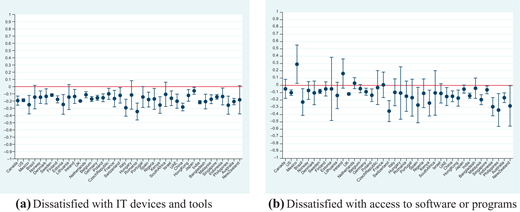
Virtual setting. The global regression’s negative associations between dissatisfaction with the virtual work setting and the probability of satisfaction with connection to colleagues when WFH are apparent in almost all countries, most often statistically significant at the 5% level [Figure 4(a) and (b)]. Mexico is notable for a positive point estimate on the variable “dissatisfied with access to software applications/programs” statistically significant at the 5% level [Figure 4(b)].
5. Discussion
This study investigated global employee satisfaction with connection to colleagues when WFH under mandatory conditions. It further examined how various factors – age, time with company, gender, household setting, virtual work setting and physical work setting – affect the probability of being satisfied with connection to colleagues and explores cross-country variation. The following section discusses the findings in relation to existing literature and points out this study’s limitations.
5.1 Experience of connectedness to colleagues globally
Prior research – largely from European and North American countries – has highlighted high levels of perceived productivity and overall satisfaction during the pandemic-induced remote work (Appel-Meulenbroek et al., 2022; Ipsen et al., 2021; Toivonen et al., 2025). However, our global findings reveal that only 42% of the employees reported satisfaction with their connection to colleagues when WFH. This supports the view that social connectedness often relies on physical proximity and that disruptive events may diminish social capital (Lindström and Giordano, 2016; Rashidfarokhi and Danivska, 2023). Additionally, the probability of being satisfied with the connection to colleagues varied substantially across countries, even after controlling for other factors.
5.2 Impact of sociodemographic factors
Our findings indicate that older employees tend to have a higher probability of being satisfied with their connection to colleagues when WFH, consistent with European evidence from Ipsen et al. (2021). The relationship with time with company was less conclusive.
Women also had a higher probability of satisfaction with connection to colleagues when WFH, aligning with Appel-Meulenbroek et al. (2022), who found that women are more likely to continue WFH post-pandemic – possibly due to their tendency to have more administrative or part-time roles that are more suitable for WFH. Women may benefit more from the flexibility and time efficiency of remote work, as they typically take on greater responsibility for housework and childcare (Alon et al., 2020). Even before the pandemic, commuting time has been shown to influence women’s job choices more strongly than men’s (Office for National Statistics, 2019). Furthermore, women are more likely than men to be satisfied with their physical work setting at home (Toivonen et al., 2022) and with their productivity when WFH (Toivonen et al., 2025). These work–life balance benefits and overall satisfaction with WFH experienced by women may positively influence multiple aspects of remote work, in line with P–E fit theory. It is also possible that women’s pre-existing strong workplace ties contributed to their sustained connection during remote work. However, remote work should not be used as an excuse to divide housework and childcare even more unequally at home.
5.3 Impact of work settings at home
The presence of others at home when WFH tends to reduce the probability of employees being satisfied with connection to colleagues – a pattern observed in most countries. The global results also suggest that women may be more likely to be negatively affected by the presence of friends or flatmates, although this gendered difference was seldom statistically significant in the country-wise regressions.
Dissatisfaction with the physical home setting – including non-dedicated workspaces and poor ergonomics – seems to decrease the probability of being satisfied with connections to colleagues. This aligns with prior research on hybrid work environments (Dale et al., 2024; Ipsen et al., 2021; Magnier-Watanabe et al., 2023; Tagliaro and Migliore, 2021; Wilson et al., 2024). Satisfaction with the physical work setting likely affects the overall satisfaction with remote work, consistent with P–E fit theory (Kristof-Brown and Billsberry, 2013) and environmental satisfaction theory (Pardede et al., 2021). Consequently, it also impacts feelings of connectedness. Moreover, dissatisfaction with the physical work setting could also negatively affect self-representation and, hence, social relations, in line with Pardede et al. (2021).
Similarly, dissatisfaction with the virtual work setting – access to IT devices, tools and software applications/programs – at home seems to decrease the probability of being satisfied with connection to colleagues in almost all countries. This is not surprising, given that they are prerequisites for remote communication.
5.4 Limitations
This study is subject to limitations primarily stemming from the data set. Notably, information on the respondents’ industry sectors, work roles, tasks or housing conditions was unavailable, although such factors probably influence satisfaction with WFH and, thus, warrant further investigation. Moreover, the data also do not distinguish between individuals accustomed to remote work pre-pandemic and those compelled by pandemic restrictions – an important distinction given the role of perceived control in workplace satisfaction and the potential stress caused by abrupt relocation.
It is also worth noting that the data were collected via a survey conducted by a consultancy commissioned by individual organisations. Such organisations are likely to prioritise employee well-being and to already have decent workplace management practices in place, introducing a degree of self-selection bias. Moreover, many of the participating companies are multinationals, where strong corporate cultures may partially override national cultural influences. These limitations should be considered when interpreting the results and drawing generalisations on a wider global scale. Still, while sociodemographic factors and home-based work settings tend to be related to satisfaction in a similar way across most countries, overall satisfaction levels still vary considerably. Therefore, further research is needed to, on the one hand, investigate reasons for cross-country differences and, on the other hand, to better understand how corporate culture shapes experiences of connectedness in remote and hybrid work environments. Further research is also required to clarify the conceptual relationships between sociodemographic factors, the characteristics of physical work settings and social connectedness. This is especially relevant given the persistence of hybrid work practices and the need to sustain social relationships in virtual environments.
6. Conclusions and recommendations
Pooling data from 88 countries, we found that few employees were satisfied with their connection to colleagues when WFH. Even after controlling for sociodemographic factors – including household settings and physical and virtual work settings at home – substantial cross-country variation remained. No clear geographical patterns emerged, as satisfaction levels varied widely between countries (e.g. within continents). Globally, dissatisfaction with home environments and the presence of others tended to reduce the probability of being satisfied with connection to colleagues, as did being under 35 years of age. In contrast, being female was associated with higher satisfaction levels. These global patterns were largely reflected across the 40 countries examined in greater detail.
6.1 Research contributions
This paper explores the impact of various factors on employees’ sense of connectedness to colleagues during fully remote work arrangements. The findings offer valuable contributions to workplace management literature, particularly through the use of a large and diverse data set comprising nearly 137,500 respondents across 88 countries – including those typically underrepresented in such research, notably from the global South. This study extends previous country- and continent-specific research by enabling country-specific findings to be reflected against a global perspective, showing how each country positions itself relative to others. The findings also indicate that several different factors (e.g. gender and physical work setting) shape WFH satisfaction. Moreover, the study isolates the impact of WFH, in contrast to hybrid work studies where the effects of office- and home-working days are more difficult to disentangle.
Theoretically, the results lend support to P–E fit theory and environmental satisfaction theory, highlighting the role of environmental conditions in shaping overall satisfaction. WFH satisfaction appears to be shaped by both material and immaterial aspects of the home environment, much like in corporate offices. They also align with social capital and belongingness theories, which propose that social capital is lost during disruption – an insight underscored by the pandemic-induced shift to remote work. Finally, our findings support previous research, suggesting females may be better equipped to gain and sustain emotionally supportive workplace connections.
6.2 Managerial implications
In conclusion, this paper recommends the following specific action points for organisations seeking to enhance their employees’ connectedness in remote work contexts:
Establish hybrid or fully remote work policies that empower employees to work from anywhere and to choose a home or other physical work setting that meets their needs and preferences.
Enhance home working conditions by offering desks and chairs, along with guidance and incentives for establishing dedicated workspaces.
Support both formal and informal virtual communication through accessible and reliable IT devices, tools and software.
Support, especially young employees, through virtual induction and onboarding programs, age-appropriate social events and virtual peer support groups.
Offer guidance and support in line with the socio-demographic factors and household setting of each employee.
Provide families with guidance on how to promote equitable sharing of domestic and caregiving responsibilities and foster healthier work–life balance.
Acknowledgements
The authors wish to thank Leesman for their kind collaboration and access to their valuable data.
Notes
The relationship between the responses to the statement “When I work from home, I feel connected to my colleagues” and sociodemographic factors, work settings at home and country could be studied in several ways, such as through a multinominal logistic regression with all seven response alternatives as outcome categories. However, from a managerial perspective, we believe that companies should aim for their employees to at least agree with the statement, and we have, therefore, opted for the dichotomous categorisation satisfied or not satisfied as an outcome variable.
We also ran multivariate regressions without country dummies and without interaction between gender and who is usually present at home. These regressions did not change the overall conclusions. The regression results are available upon request.
References
Appendix 1
Summary statistics
| Variables | % | N |
|---|---|---|
| Gender | ||
| Female | 43.120 | 59,284 |
| Male | 54.684 | 75,183 |
| Non-binary | 0.095 | 130 |
| Prefer not to say | 2.102 | 2,890 |
| Age group, years | ||
| −24 | 3.266 | 4,491 |
| 25–34 | 27.187 | 37,379 |
| 35–44 | 32.489 | 44,668 |
| 45–54 | 24.922 | 34,264 |
| 55–64 | 11.387 | 15,655 |
| ≥65 | 0.672 | 924 |
| Prefer not to say | 0.077 | 106 |
| Time with company | ||
| 0–6 months | 5.603 | 7,703 |
| 6–18 months | 12.390 | 17,034 |
| 18 months–3 years | 14.980 | 20,596 |
| 3–8 years | 25.901 | 35,611 |
| 8–12 years | 12.195 | 16,767 |
| >12 years | 28.931 | 39,776 |
| When you are working from home, who is usually present? | ||
| One or more children or dependents | 37.268 | 51,238 |
| Partner or other family member(s) | 61.514 | 84,574 |
| Friend(s) or flatmate(s) | 3.501 | 4,814 |
| Other person(s) | 2.555 | 3,513 |
| No one | 24.281 | 33,383 |
| Working from home, what type of work setting do you use most often? | ||
| Dedicated work area (but not a separate room) | 30.102 | 41,387 |
| Dedicated work room or office | 41.499 | 57,056 |
| Non-work specific home location (such as a dining table) | 26.745 | 36,771 |
| Others | 1.653 | 2,273 |
| I have access to all of the IT devices and tools I need to work from home | ||
| Disagree strongly | 1.421 | 1,954 |
| Disagree | 4.097 | 5,633 |
| Disagree slightly | 8.175 | 11,240 |
| Neutral | 5.480 | 7,534 |
| Agree slightly | 14.577 | 20,042 |
| Agree | 33.816 | 46,493 |
| Agree strongly | 32.433 | 44,591 |
| I have access to all of the software applications/programs I need to work from home | ||
| Disagree strongly | 0.578 | 795 |
| Disagree | 1.342 | 1,845 |
| Disagree slightly | 2.912 | 4,003 |
| Neutral | 4.381 | 6,023 |
| Agree slightly | 12.232 | 16,818 |
| Agree | 36.494 | 50,175 |
| Agree strongly | 42.061 | 57,828 |
| Chair | ||
| Not important | 9.208 | 12,660 |
| Not available | 3.077 | 4,231 |
| Highly dissatisfied | 6.974 | 9,588 |
| Dissatisfied | 14.921 | 20,515 |
| Neutral | 13.624 | 18,731 |
| Satisfied | 26.640 | 36,626 |
| Highly satisfied | 25.556 | 35,136 |
| Desk or table | ||
| Not important | 8.495 | 11,680 |
| Not available | 3.140 | 4,317 |
| Highly dissatisfied | 4.266 | 5,865 |
| Dissatisfied | 11.441 | 15,730 |
| Neutral | 13.581 | 18,672 |
| Satisfied | 31.284 | 43,011 |
| Highly satisfied | 27.793 | 38,212 |
| Country | ||
| Albania | 0.089 | 122 |
| Angola | 0.015 | 21 |
| Argentina | 0.149 | 205 |
| Australia | 5.011 | 6,889 |
| Austria | 0.058 | 80 |
| Bahrain | 0.041 | 57 |
| Bangladesh | 0.549 | 755 |
| Belgium | 3.395 | 4,668 |
| Botswana | 0.103 | 142 |
| Brazil | 0.487 | 670 |
| Brunei | 0.053 | 73 |
| Bulgaria | 0.177 | 243 |
| Cameroon | 0.017 | 23 |
| Canada | 1.206 | 1,658 |
| Chile | 0.095 | 130 |
| China | 2.250 | 3,094 |
| Colombia | 0.185 | 254 |
| Costa Rica | 0.052 | 71 |
| Czech Republic | 0.545 | 749 |
| Denmark | 0.456 | 627 |
| Egypt | 0.087 | 119 |
| Estonia | 0.394 | 542 |
| Finland | 1.273 | 1,750 |
| France | 0.353 | 486 |
| Gambia | 0.029 | 40 |
| Germany | 2.923 | 4,019 |
| Ghana | 0.213 | 293 |
| Greece | 0.053 | 73 |
| Guatemala | 0.053 | 73 |
| Hong Kong | 0.909 | 1,250 |
| Hungary | 0.478 | 657 |
| India | 13.478 | 18,531 |
| Indonesia | 0.490 | 673 |
| Ireland | 0.700 | 963 |
| Isle of Man | 0.209 | 288 |
| Israel | 0.311 | 427 |
| Italy | 0.890 | 1,223 |
| Ivory Coast | 0.036 | 50 |
| Japan | 1.043 | 1,434 |
| Jersey | 0.044 | 61 |
| Jordan | 0.018 | 25 |
| Kenya | 0.298 | 410 |
| Kuwait | 0.014 | 19 |
| Lebanon | 0.061 | 84 |
| Lithuania | 0.567 | 780 |
| Malaysia | 1.558 | 2,142 |
| Malta | 0.143 | 196 |
| Mauritius | 0.041 | 57 |
| Mexico | 0.991 | 1,362 |
| Morocco | 0.021 | 29 |
| Myanmar | 0.019 | 26 |
| Nepal | 0.150 | 206 |
| The Netherlands | 1.220 | 1,678 |
| New Zealand | 0.355 | 488 |
| Nigeria | 0.309 | 425 |
| Norway | 0.594 | 817 |
| Oman | 0.021 | 29 |
| Pakistan | 0.098 | 135 |
| Panama | 0.017 | 23 |
| Peru | 0.017 | 24 |
| Philippines | 0.333 | 458 |
| Poland | 1.990 | 2,736 |
| Portugal | 0.349 | 480 |
| Puerto Rico | 0.015 | 21 |
| Qatar | 0.015 | 20 |
| Romania | 0.577 | 793 |
| Russia | 0.113 | 156 |
| Saudi Arabia | 0.060 | 83 |
| Sierra Leone | 0.029 | 40 |
| Singapore | 2.652 | 3,646 |
| South Africa | 0.417 | 573 |
| South Korea | 0.107 | 147 |
| Spain | 0.674 | 927 |
| Sri Lanka | 0.176 | 242 |
| Sweden | 8.551 | 11,756 |
| Switzerland | 0.415 | 571 |
| Taiwan | 0.216 | 297 |
| Tanzania | 0.091 | 125 |
| Thailand | 0.233 | 321 |
| Turkey | 0.101 | 139 |
| Uganda | 0.144 | 198 |
| Ukraine | 0.147 | 202 |
| UAE | 0.490 | 673 |
| UK | 24.671 | 33,920 |
| USA | 11.608 | 15,960 |
| Vietnam | 0.209 | 288 |
| Zambia | 0.082 | 113 |
| Zimbabwe | 0.119 | 164 |
Appendix 2
Complete regression results: probability of being satisfied with connection to colleagues when WFH, unstandardized regression coefficients
| Variables | 1 | 2 |
|---|---|---|
| Results from univariate regressions | Results from multivariate regression | |
| Age group (ref: 35–44), years | ||
| −24 | −0.056** [−0.094, −0.017] | −0.097*** [−0.131, −0.063] |
| 25–34 | −0.014 [−0.042, 0.013] | −0.036*** [−0.048, −0.024] |
| 45–54 | −0.009 [−0.050, 0.033] | 0.006 [−0.010, 0.021] |
| 55–64 | −0.006 [−0.054, 0.041] | 0.009 [−0.006, 0.023] |
| ≥65 | 0.020 [−0.039, 0.078] | 0.001 [−0.048, 0.051] |
| Prefer not to say | 0.012 [−0.062, 0.086] | 0.055* [0.007, 0.104] |
| Time with company (ref: >12 years) | ||
| 0–6 months | 0.011 [−0.025, 0.047] | 0.011 [−0.012, 0.034] |
| 6–18 months | 0.026 [−0.015, 0.067] | 0.029** [0.011, 0.048] |
| 18 months–3 years | −0.008 [−0.028, 0.012] | −0.000 [−0.023, 0.022] |
| 3–8 years | 0.001 [−0.031, 0.033] | −0.001 [−0.012, 0.011] |
| 8–12 years | 0.006 [−0.023, 0.036] | 0.000 [−0.010, 0.011] |
| Gender (ref: male) | ||
| Female | 0.059* [0.014, 0.105] | 0.071*** [0.043, 0.100] |
| Non-binary | 0.002 [−0.105, 0.110] | −0.007 [−0.162, 0.148] |
| Prefer not to say | −0.016 [−0.066, 0.035] | 0.042** [0.016, 0.068] |
| Usually present | ||
| One or more children or dependents | −0.031* [−0.055, −0.007] | −0.032*** [−0.048, −0.017] |
| A partner or other family member(s) | −0.050*** [−0.078, −0.021] | −0.039*** [−0.059, −0.019] |
| Friend(s) or flatmate(s) | −0.094** [−0.156, −0.032] | −0.031* [−0.061, −0.001] |
| Other person(s) | −0.105*** [−0.142, −0.068] | −0.052** [−0.082, −0.021] |
| Female # one or more children or dependents | 0.006 [−0.005, 0.018] | |
| Non-binary # one or more children or dependents | −0.011 [−0.166, 0.145] | |
| Prefer not to say # one or more children or dependents | 0.008 [−0.020, 0.037] | |
| Female # a partner or other family member(s) | −0.004 [−0.020, 0.012] | |
| Non-binary # a partner or other family member(s) | 0.078 [−0.028, 0.184] | |
| Prefer not to say # a partner or other family member(s) | −0.010 [−0.035, 0.015] | |
| Female # friend(s) or flatmate(s) | −0.065*** [−0.102, −0.028] | |
| Non-binary # friend(s) or flatmate(s) | −0.014 [−0.234, 0.205] | |
| Prefer not to say # friend(s) or flatmate(s) | −0.052 [−0.139, 0.036] | |
| Female # other person(s) | −0.032 [−0.068, 0.004] | |
| Non-binary # other person(s) | 0.227 [−0.362, 0.815] | |
| Prefer not to say # other person(s) | 0.046 [−0.028, 0.120] | |
| Work area (ref: a dedicated work room or office) | ||
| Dedicated area | −0.070*** [−0.084, −0.057] | −0.060*** [−0.077, −0.042] |
| Non-work specific location | −0.184*** [−0.217, −0.150] | −0.097*** [−0.118, −0.076] |
| Other | −0.141*** [−0.179, −0.103] | −0.091*** [−0.121, −0.060] |
| Virtual setting | ||
| Dissatisfied with access to IT devices and tools | −0.291*** [−0.320, −0.262] | −0.181*** [−0.201, −0.160] |
| Dissatisfied with access to software applications/ programs | −0.277*** [−0.314, −0.241] | −0.114*** [−0.128, −0.099] |
| Chair (ref: neutral or more) | ||
| Dissatisfied | −0.239*** [−0.257, −0.221] | −0.110*** [−0.126, −0.093] |
| Not important | −0.019 [−0.047, 0.010] | 0.001 [−0.020, 0.022] |
| Desk or table (ref: neutral or more) | ||
| Dissatisfied | −0.260*** [−0.286, −0.234] | −0.096*** [−0.119, −0.073] |
| Not important | −0.008 [−0.043, 0.028] | 0.014 [−0.010, 0.038] |
| Country dummies (ref: USA) | ||
| Albania | 0.122*** [0.122, 0.122] | 0.126*** [0.117, 0.135] |
| Angola | −0.046*** [−0.046, −0.046] | 0.079*** [0.066, 0.092] |
| Argentina | 0.032*** [0.032, 0.032] | 0.094*** [0.088, 0.100] |
| Australia | 0.143*** [0.143, 0.143] | 0.099*** [0.095, 0.104] |
| Austria | −0.115*** [−0.115, −0.115] | −0.100*** [−0.103, −0.097] |
| Bahrain | −0.023*** [−0.023, −0.023] | 0.073*** [0.062, 0.084] |
| Bangladesh | 0.125*** [0.125, 0.125] | 0.174*** [0.163, 0.185] |
| Belgium | −0.044*** [−0.044, −0.044] | −0.032*** [−0.036, −0.028] |
| Botswana | −0.103*** [−0.103, −0.103] | 0.013* [0.002, 0.024] |
| Brazil | 0.066*** [0.066, 0.066] | 0.084*** [0.079, 0.088] |
| Brunei | −0.126*** [−0.126, −0.126] | −0.139*** [−0.145, −0.132] |
| Bulgaria | 0.030*** [0.030, 0.030] | 0.092*** [0.086, 0.099] |
| Cameroon | 0.051*** [0.051, 0.051] | 0.098*** [0.089, 0.106] |
| Canada | −0.014*** [−0.014, −0.014] | 0.018*** [0.015, 0.022] |
| Chile | 0.019*** [0.019, 0.019] | 0.077*** [0.071, 0.083] |
| China | 0.081*** [0.081, 0.081] | 0.070*** [0.067, 0.073] |
| Colombia | 0.085*** [0.085, 0.085] | 0.105*** [0.102, 0.108] |
| Costa Rica | 0.249*** [0.249, 0.249] | 0.242*** [0.238, 0.247] |
| Czech Republic | −0.149*** [−0.149, −0.149] | −0.072*** [−0.081, −0.063] |
| Denmark | −0.095*** [−0.095, −0.095] | −0.078*** [−0.082, −0.074] |
| Egypt | −0.091*** [−0.091, −0.091] | −0.020*** [−0.030, −0.010] |
| Estonia | 0.038*** [0.038, 0.038] | 0.035*** [0.031, 0.039] |
| Finland | −0.128*** [−0.128, −0.128] | −0.115*** [−0.119, −0.110] |
| France | −0.081*** [−0.081, −0.081] | −0.034*** [−0.039, −0.029] |
| Gambia | 0.073*** [0.073, 0.073] | 0.168*** [0.156, 0.179] |
| Germany | −0.115*** [−0.115, −0.115] | −0.073*** [−0.077, −0.069] |
| Ghana | −0.017*** [−0.017, −0.017] | 0.026*** [0.017, 0.035] |
| Greece | −0.071*** [−0.071, −0.071] | −0.068*** [−0.072, −0.064] |
| Guatemala | 0.244*** [0.244, 0.244] | 0.271*** [0.260, 0.281] |
| Hong Kong | 0.027*** [0.027, 0.027] | 0.058*** [0.050, 0.067] |
| Hungary | −0.030*** [−0.030, −0.030] | −0.010* [−0.018, −0.001] |
| India | 0.085*** [0.085, 0.085] | 0.144*** [0.136, 0.152] |
| Indonesia | 0.023*** [0.023, 0.023] | 0.060*** [0.051, 0.069] |
| Ireland | −0.021*** [−0.021, −0.021] | 0.006 [−0.002, 0.013] |
| Isle of Man | −0.021*** [−0.021, −0.021] | 0.005 [−0.001, 0.011] |
| Israel | −0.134*** [−0.134, −0.134] | −0.098*** [−0.102, −0.093] |
| Italy | 0.154*** [0.154, 0.154] | 0.148*** [0.145, 0.152] |
| Ivory Coast | −0.007*** [−0.007, −0.007] | 0.071*** [0.058, 0.083] |
| Japan | −0.256*** [−0.256, −0.256] | −0.165*** [−0.174, −0.156] |
| Jersey | 0.032*** [0.032, 0.032] | 0.075*** [0.064, 0.087] |
| Jordan | 0.053*** [0.053, 0.053] | 0.100*** [0.093, 0.107] |
| Kenya | −0.003*** [−0.003, −0.003] | 0.067*** [0.058, 0.076] |
| Kuwait | −0.164*** [−0.164, −0.164] | −0.096*** [−0.107, −0.085] |
| Lebanon | −0.034*** [−0.034, −0.034] | 0.050*** [0.038, 0.062] |
| Lithuania | 0.027*** [0.027, 0.027] | 0.030*** [0.028, 0.032] |
| Malaysia | −0.018*** [−0.018, −0.018] | 0.017*** [0.012, 0.022] |
| Malta | 0.037*** [0.037, 0.037] | 0.071*** [0.064, 0.077] |
| Mauritius | −0.076*** [−0.076, −0.076] | 0.007 [−0.000, 0.015] |
| Mexico | 0.163*** [0.163, 0.163] | 0.176*** [0.169, 0.184] |
| Morocco | −0.186*** [−0.186, −0.186] | −0.041*** [−0.057, −0.026] |
| Myanmar | −0.042*** [−0.042, −0.042] | 0.006 [−0.002, 0.015] |
| Nepal | −0.058*** [−0.058, −0.058] | 0.017*** [0.009, 0.025] |
| The Netherlands | −0.224*** [−0.224, −0.224] | −0.196*** [−0.200, −0.193] |
| New Zealand | 0.182*** [0.182, 0.182] | 0.151*** [0.147, 0.156] |
| Nigeria | 0.008*** [0.008, 0.008] | 0.091*** [0.080, 0.103] |
| Norway | −0.136*** [−0.136, −0.136] | −0.121*** [−0.130, −0.111] |
| Oman | 0.021*** [0.021, 0.021] | 0.034*** [0.023, 0.044] |
| Pakistan | 0.010*** [0.010, 0.010] | 0.070*** [0.060, 0.081] |
| Panama | −0.166*** [−0.166, −0.166] | −0.131*** [−0.137, −0.125] |
| Peru | −0.010*** [−0.010, −0.010] | 0.018*** [0.011, 0.024] |
| The Philippines | 0.060*** [0.060, 0.060] | 0.121*** [0.110, 0.132] |
| Poland | −0.017*** [−0.017, −0.017] | 0.028*** [0.024, 0.032] |
| Portugal | −0.002*** [−0.002, −0.002] | 0.016*** [0.012, 0.019] |
| Puerto Rico | 0.144*** [0.144, 0.144] | 0.094*** [0.089, 0.099] |
| Qatar | −0.027*** [−0.027, −0.027] | 0.022*** [0.015, 0.030] |
| Romania | 0.105*** [0.105, 0.105] | 0.103*** [0.097, 0.108] |
| Russia | 0.015*** [0.015, 0.015] | 0.030*** [0.025, 0.035] |
| Saudi Arabia | −0.174*** [−0.174, −0.174] | −0.120*** [−0.130, −0.111] |
| Sierra Leone | 0.048*** [0.048, 0.048] | 0.111*** [0.101, 0.122] |
| Singapore | −0.134*** [−0.134, −0.134] | −0.064*** [−0.073, −0.055] |
| South Africa | 0.112*** [0.112, 0.112] | 0.101*** [0.095, 0.107] |
| South Korea | −0.094*** [−0.094, −0.094] | −0.057*** [−0.062, −0.052] |
| Spain | 0.029*** [0.029, 0.029] | 0.028*** [0.022, 0.034] |
| Sri Lanka | −0.084*** [−0.084, −0.084] | −0.032*** [−0.040, −0.023] |
| Sweden | −0.160*** [−0.160, −0.160] | −0.125*** [−0.131, −0.119] |
| Switzerland | −0.124*** [−0.124, −0.124] | −0.122*** [−0.126, −0.119] |
| Taiwan | 0.129*** [0.129, 0.129] | 0.118*** [0.111, 0.124] |
| Tanzania | −0.099*** [−0.099, −0.099] | −0.011* [−0.021, −0.001] |
| Thailand | 0.056*** [0.056, 0.056] | 0.048*** [0.043, 0.053] |
| Turkey | 0.127*** [0.127, 0.127] | 0.197*** [0.190, 0.203] |
| UAE | −0.009*** [−0.009, −0.009] | 0.063*** [0.054, 0.072] |
| UK | 0.009*** [0.009, 0.009] | 0.044*** [0.038, 0.049] |
| Uganda | −0.043*** [−0.043, −0.043] | 0.025*** [0.016, 0.035] |
| Ukraine | 0.048*** [0.048, 0.048] | 0.068*** [0.064, 0.073] |
| Vietnam | −0.094*** [−0.094, −0.094] | −0.125*** [−0.131, −0.119] |
| Zambia | −0.055*** [−0.055, −0.055] | 0.046*** [0.033, 0.058] |
| Zimbabwe | 0.067*** [0.067, 0.067] | 0.131*** [0.120, 0.143] |
| Constant | 0.533*** [0.493, 0.573] | |
| Observations | 137487 | |
| R2 | 0.120 | |
Standard errors clustered on countries. *p < 0.05, **p < 0.01, ***p < 0.001

