


This article redefines innovation in urban regeneration as a systemic, educational process rather than purely a technological pursuit. It examines how participatory, youth-engaged approaches – like co-design, citizen science, service learning and multi-criteria decision analysis – generate micro-scale innovations that transform governance and community relations, operating as a living system of collaboration. Through three case studies in Italy, the United States and a global Connect4Climate workshop, the article explores how systems thinking reveals feedback loops between learning, governance and place. It argues that when participation is viewed as a dynamic system, youth become catalysts of micro-innovation driving inclusive, intergenerational and sustainable urban transformation.
The study employs a qualitative, comparative case study methodology grounded in participatory action research. Three cases – Sorrento Saggia (Italy), Renew Towns Lab (USA) and Youth4Innovation (global) – illustrate how youth-engaged, intergenerational collaboration fosters innovation in urban regeneration. Data were collected through participant observation, document review and interviews, analyzed thematically to identify patterns of process, social and institutional innovation. The framework draws from theories of participatory urbanism, social innovation and intergenerational governance, using “micro-innovation” as a lens to interpret how local educational and relational practices generate scalable systemic change.
Across all cases, youth acted as catalysts of innovation – introducing new ideas, bridging generations and reframing local challenges through human-centered design. The research reveals those micro-innovations – such as co-created campaigns, adaptive reuse of heritage buildings and intergenerational design workshops – strengthen local resilience and governance capacity. Educational partnerships between higher education institutions and communities emerged as key drivers, transforming cities into civic laboratories for sustainability. The study shows that innovation thrives in relational processes that nurture learning, inclusion and shared authorship, challenging the assumption that progress depends solely on technological advancement, but rather leveraging those through people-centered and driven design.
The study's scope is limited to three illustrative cases emphasizing small-scale, community-based initiatives; findings may not generalize to large metropolitan contexts. The author's participatory involvement introduces potential bias, mitigated through triangulation and comparison with existing literature. Long-term impacts remain under observation, as several projects are ongoing. Nevertheless, the study offers analytical generalization by linking empirical insights to broader theories of participatory and intergenerational governance. Future research should explore quantitative indicators of social innovation and longitudinal effects of youth engagement on institutional transformation and policy integration.
Urban practitioners and policymakers can apply these findings by embedding youth engagement and educational partnerships within regeneration processes. Mechanisms such as youth advisory boards, participatory decision tools (e.g. multi-criteria decision analysis) and service-learning collaborations can generate creative, locally grounded solutions. Municipalities can leverage higher education as civic partners, fund small-scale innovation pilots and formalize 4P (public-private-people) partnerships to sustain results. By treating participation as both education and governance, cities can create regenerative ecosystems that build social capital, improve policy continuity and foster inclusive, future-ready communities.
The research demonstrates how intergenerational collaboration enhances social cohesion, equity and civic trust. Engaging youth as co-creators empowers marginalized voices, supports knowledge exchange between generations and revitalizes collective ownership of place. Projects like Sorrento Saggia and Renew Towns Lab show that youth involvement can counter urban disengagement, stimulate volunteerism and renew civic pride. Such participatory frameworks contribute to the democratization of planning and align with the UN SDGs' call for inclusive, resilient and human-centered cities. They foster a culture of shared responsibility where innovation benefits both current and future generations.
This study offers a novel contribution by positioning education and intergenerational participation as central to urban innovation. It bridges planning, sustainability and youth development literature to argue that process and relational innovations are as transformative as technological ones. The article's comparative analysis across local and global cases provides new empirical evidence of “micro-innovation” in practice. By reframing higher education institutions as civic laboratories and youth as boundary-spanners in governance, it introduces a transferable model for inclusive, low-cost innovation in small and mid-sized communities worldwide.
Introduction
The increasing complexity of environmental and social challenges in recent decades has highlighted the need to rethink traditional models of urban planning and territorial management. Urban regeneration – the process of revitalizing underutilized or declining urban areas (Pignatelli et al., 2023) – has conventionally emphasized physical redevelopment and technical innovation (e.g. smart infrastructure, data-driven management). While such solutions are important, a growing body of thought (Steen and Van Bueren, 2017) contends that focusing on infrastructure alone fails to address the deeper relational, cultural and democratic dimensions of urban change and brings forward the necessity to clarify:
What do we mean by innovation in urban regeneration?
This question necessitates a paradigm shift from purely technological or infrastructural advancements to a more holistic understanding that encompasses social innovation, ethical awareness and the reimagination of public spaces as guarantors of fundamental citizen rights (Cangelli, 2015; Brunetta et al., 2023).
This article proposes that “innovation” must extend beyond new devices or designs, to encompass process-oriented changes in how people learn, interact and collaborate in shaping their cities (Pontikakis et al., 2024). In other words, social and educational innovation – particularly through participatory and intergenerational engagement – are as crucial as technological advances in achieving sustainable urban transformation. This perspective aligns with emerging literature that frames innovation as a social practice rather than a commodifiable product (van Meerkerk and Edelenbos, 2018; Hölscher and Frantzeskaki, 2021). Recent studies on urban experimentation and living laboratories further highlight how collaborative governance and participatory innovation processes are increasingly shaping urban regeneration strategies in cities worldwide (Evans et al., 2018; Frantzeskaki et al., 2025; Prisco et al., 2024).
A key argument in this article holds that engaging groups of young stakeholders in urban regeneration processes can be a powerful driver of such innovation. The argument is strongly supported by the United Nations Pact for the Future (United Nations, 2024). Young people bring fresh perspectives, digital fluency and a futures-oriented mindset that can challenge entrenched paradigms (Loudon et al., 2024). At the same time, meaningful youth participation facilitates knowledge transfer across generations: elders and long-time residents share local wisdom and cultural values, while youth introduce new tools and imaginative ideas. This intergenerational dialogue can generate creative solutions that neither age group would devise alone. For example, in one of the case studies examined in this article, university students reframed a local tourism strategy through a human-rights lens – bridging curriculum with practical application for building collaborative solutions with the local municipality (Canada et al., 2023).
In another, youths' use of digital storytelling and social-entrepreneurship strategies enlivened a historic preservation effort, engaging the community in new ways. In all cases, treating young people as co-creators (rather than mere beneficiaries or consultees) helped unlock micro-innovations: small-scale but significant changes in relationships, governance arrangements and local practices that cumulatively contribute to broader urban transformation (Bianchi et al., 2024). These micro-innovations illustrate how process innovations – like new participatory methods or partnerships – can enhance urban resilience and social sustainability.
The United Nations 2030 Agenda for Sustainable Development and the New Urban Agenda call for inclusive, participatory approaches to making cities safe, resilient and sustainable (United Nations, 2015). In this context, higher education institutions (HEIs) have a strategic role to play as civic actors and urban living laboratories for sustainability transitions (Martínez-Acosta et al., 2023). Universities that integrate teaching, research and community engagement – often termed “civic universities” (Goddard, 2018) – can enhance both student learning and local problem-solving. Through project-based coursework, service-learning programs and action research partnerships, HEIs can channel youthful energy and multidisciplinary expertise into real-world urban challenges (Chawla, 2009; Eichberg and Charles, 2024). Such arrangements benefit all parties: communities gain creative ideas and capacity, students gain practical experience and civic values, and universities fulfill a mission of societal impact (Goddard, 2018).
Existing literature has established the importance of collaborative planning, participatory governance and social innovation in urban regeneration. Yet less attention has been given to how social innovation emerges within these processes (Sirolli et al., 2025). Much research conceptualizes innovation at the macro level (Ardill, 2021; Meister Broekema et al., 2023), leaving small-scale, process-driven dynamics underexamined. The role of youth engagement and intergenerational exchange also remains analytically underdeveloped (Satterthwaite et al., 2022). This article addresses that gap by using micro-innovation to describe context-specific changes that arise through participatory interaction and accumulate within broader urban transformation systems.
The contribution of the article is threefold. Theoretically, it advances micro-innovation as an analytical lens for understanding how small-scale, relational and process-based changes accumulate within participatory urban regeneration. Methodologically, it offers a comparative mechanism-based reading of three youth-engaged cases, focusing on triggers, intergenerational interactions, micro-innovation outputs and feedback loops rather than descriptive case narration alone. Empirically, it demonstrates how youth and higher education partnerships can act as boundary-spanning civic laboratories that reframe local problems, connect institutional and community actors, and generate transferable governance practices.
Defining micro-innovation in participatory urban regeneration
In order to analytically capture the distinct forms of innovation observed across the case studies, this article applies the concept of micro-innovation. While innovation in urban regeneration is traditionally framed in terms of large-scale technological change or macro-level policy transformations, contemporary urban studies suggest that meaningful urban transformation is frequently place-based, emerging through human-scale, localized social relations (Moulaert et al., 2014).
Definition of key terms
For clarity, the article adopts the following working definitions:
Intergenerational governance refers to collaborative decision-making arrangements that formally include multiple generations (youth and older adults) in shaping outcomes, ensuring that voices across age groups share power and responsibility.
Participatory co-creation denotes an inclusive process where stakeholders jointly produce knowledge or solutions as equal partners, rather than one party merely consulting or informing the other.
Micro-innovation is defined in this study as small-scale, process-driven interventions that emerge through participatory interactions and contribute cumulatively to broader systemic change. These innovations are inherently localized, relational and iterative (creating feedback loops), arising from dynamic collaborations between diverse institutional and noninstitutional actors.
These concepts underpin the analysis in this study and are explained in accessible terms to engage both expert and nonexpert readers.
To recall the article's guiding question: What do we mean by innovation in urban regeneration? – specifically, micro-innovation – micro-innovation differs from established innovation frameworks in several distinct ways. First, while social innovation broadly emphasizes novel solutions that address unmet societal needs and improve macro-level outcomes (Mulgan, 2006; Phills et al., 2008), micro-innovation shifts the analytical focus to the micro-level process and relational mechanics through which these solutions are iteratively generated. Second, whereas classic incremental innovation models focus on gradual modifications designed to optimize efficiency within established firm or market structures (Dewar and Dutton, 1986; Ettlie et al., 1984), micro-innovation highlights the shifting civic and democratic dynamics that occur when stakeholders co-design public spaces. Moreover, micro-innovation distinctively departs from traditional grassroots innovation frameworks. As conceptualized by Seyfang and Smith (2007), grassroots innovations typically originate from community-led initiatives operating outside or in opposition to formal institutions. In contrast, micro-innovation captures what Bednerek et al. (2018) describe as “boundary-spanning” interactions, evaluating the cooperative friction and co-production that occurs when grassroots actors and formal institutional practitioners intentionally collaborate within structured spaces.
Importantly, micro-innovations should not be evaluated as isolated, passing events, but rather as distributed elements within a broader, adaptive participatory system. This systemic accumulation mirrors socio-technical transition theory, which posits that macro-level transformations often begin as small-scale, protected “niche” innovations that gradually disrupt and reshape rigid institutional regimes (Geels, 2011). Through continuous iterative interactions, feedback loops and shared learning, these small-scale interventions reinforce one another, creating a scaling pathway that drives substantial, long-term systemic change (Westley et al., 2011). In this sense, micro-innovation provides an analytical lens for decoding how urban regeneration evolves – not as a singular, top-down project outcome, but as a distributed and continuously negotiated process.
This conceptualization allows the study to move beyond purely descriptive accounts of participatory urban planning. Instead, it offers a framework to examine the precise operational mechanisms through which participation actively generates innovation. This lens is particularly vital for analyzing complex co-production environments that rely on youth engagement and intergenerational collaboration, moving the assessment of young stakeholders from tokenistic inclusion to active agents of systemic co-creation (Checkoway, 2010; Horelli et al., 2015).
Literature review
To structure the literature review, a targeted search strategy was adopted using Google Scholar and Scopus, drawing on sources spanning from foundational works in the 1990s to more recent studies up to 2025. Keywords included “urban regeneration,” “youth engagement,” “collaborative governance,” “intergenerational co-creation,” “systems thinking” and “social innovation.” This approach enabled both the integration of influential contributions and the inclusion of contemporary perspectives aligned with participatory planning, sustainability and youth-led development. While this is not a formal PRISMA review, it follows the model's emphasis on transparency and thematic coherence (Table 1) to ensure relevance across multiple disciplinary perspectives (Page et al., 2021).
Summarizes key clusters of literature drawn on in this review, highlighting conceptual focus areas and representative authors across different domains relevant to the study
| Theme | Key concepts | Sample authors |
|---|---|---|
| Urban regeneration and innovation | Micro-innovation, place-based development | Moulaert et al. (2014), Steen and van Bueren (2017) |
| Youth participation and governance | YPAR, co-creation, intergenerational dialogue | Akom et al. (2016), Eichberg and Charles (2024) |
| Collaborative planning and decision tools | MCDA, participatory mapping | Trane et al. (2023), Pontikakis et al. (2024) |
| Global policy context | SDGs, civic universities | Collado and Hervé (2022), United Nations (2024) |
Literature synthesis and gap
Taken together, these bodies of literature–urban regeneration and innovation, participatory governance and youth engagement–demonstrate a shared emphasis on collaboration, inclusivity and social learning as key components of contemporary urban transformation (Frantzeskaki et al., 2025). However, they also reveal a critical limitation: while these approaches acknowledge the importance of participation and co-creation, they often conceptualize innovation at a broad or outcome-oriented level, without sufficiently examining the processes through which innovation emerges in practice. In particular, existing research tends to treat participatory processes as enabling conditions for innovation (Mitchell et al., 2015; Torfing et al., 2021), rather than as dynamic systems within which innovation is actively generated. Similarly, youth engagement is frequently framed in terms of empowerment, capacity-building or representation (Anderson et al., 2024), but less often as a mechanism that produces concrete innovations within urban regeneration processes.
Based on this synthesis, the article adopts an integrated theoretical perspective that combines: (1) participatory governance, which emphasizes collaborative decision-making and stakeholder inclusion; (2) social and incremental innovation, which highlights the role of small-scale, context-specific change processes and (3) systems thinking, which frames urban regeneration as a dynamic and interconnected process shaped by feedback loops, interactions and emergent outcomes. This integrated framework provides the foundation for analyzing how participatory processes function as systems through which innovation is generated, reinforced and potentially scaled in the form of a Micro-Innovation Mechanisms Framework.
The integrated framework used in the analysis can be summarized as: contextual trigger → intergenerational participatory interaction → micro-innovation output → feedback loop → potential institutionalization or scaling. Triggers include local pressures such as overtourism, dormant heritage assets, climate risks or limited municipal capacity. Interactions occur through co-design, service learning, civic laboratories, storytelling and mentoring. Micro-innovation outputs appear as new narratives, collaborative routines, prototypes or governance ideas. Feedback loops then determine whether these outputs remain isolated experiments or become durable practices within wider regeneration systems.
Rethinking innovation in urban regeneration
Innovation in urban regeneration has long been associated with physical design, smart technologies and data-driven management (Leanza and Carbonaro, 2018). Recent work broadens this view by emphasizing governance, knowledge systems and social value creation (Bianchi et al., 2024). From this perspective, innovation is not delivered to a community from above; it develops through co-creation, adaptive learning and collaborative planning (Collins et al., 2022; Healey, 1998; Mulgan, 2006). Van Meerkerk and Edelenbos (2018) similarly frame innovation as a social practice generated through networks, trust and boundary-spanning work, while Hölscher and Frantzeskaki (2021) connect urban innovation to new governance and knowledge practices.
This broader view is especially relevant for small and medium-sized cities. These contexts often lack the financial and institutional capacity to pursue large-scale smart-city infrastructures, making purely technical innovation impractical or exclusionary (Selada et al., 2012). Instead, they often innovate through local social capital, cultural assets and collaborative governance (Bell et al., 2023). Such frugal and place-based strategies show that micro-innovations – new participatory methods, partnership models or cultural campaigns – can support resilience and well-being even without major technological investment (Bianchi et al., 2024; Olukoya, 2021; Torfing et al., 2021).
In practical application, the 4P model, unlike traditional public-private partnerships, explicitly formalizes community members (Public-Private-“People”) as co-implementers in urban projects. This governance innovation distributes decision-making and resource responsibilities among government, business and civil society, which can help maintain continuity and local buy-in even amid political changes (Mendialdua et al., 2021). The 4P model aligns with the New Urban Agenda and EU Urban Agenda principles of participatory governance and multi-stakeholder collaboration. By institutionalizing citizen roles, it reflects the idea that innovation lies in new relationships and roles in the development process (Bianchi et al., 2024). In summary, contemporary literature suggests that truly transformative urban regeneration requires both social innovation – changes in the culture of how we plan and regenerate cities – alongside technical advancements (Brunetta et al., 2023). Educational processes, community partnerships and inclusive governance arrangements are central to this broadened view of innovation in urban contexts.
Participatory approaches and youth engagement
Participatory approaches have developed alongside this broader concept of innovation. Rather than treating community members as passive recipients of redevelopment, participatory practice positions them as co-creators of knowledge and solutions (Arnstein, 1969; Friedmann, 1992). In urban regeneration, co-creation, living labs and participatory urbanism create spaces where stakeholders jointly diagnose issues, design interventions and evaluate outcomes (Saad-Sulonen et al., 2018; Steen and van Bueren, 2017). Youth participation is particularly important because young people are often underrepresented in formal decision-making yet can introduce alternative futures, digital methods and new civic imaginaries (Akom et al., 2016; Anderson et al., 2024; Ozer, 2016).
Within participatory approaches, several specific models and tools have proven effective for engaging youth and other stakeholders in urban regeneration:
Citizen science: Originating in environmental and public health domains, citizen science involves nonprofessionals (including students and youth) in data collection and research. In urban contexts, citizen science can democratize environmental monitoring and urban planning knowledge. Bonney et al. (2016) note that well-designed citizen science projects can enhance public understanding of science and spur civic action. In a European project cited in the following case studies, primary school students monitored microplastics on a beach, contributing to research and simultaneously developing “environmental literacy” and a sense of stewardship (Hopkins et al., 2012). Such citizen art-science projects blend scientific inquiry with creative engagement, enabling youth to see themselves as knowledge producers and problem-solvers in urban regeneration efforts. The data and insights generated by citizen scientists can influence micro-scale interventions (e.g. installing filters, redesigning public spaces) and validate community perceptions in formal decision processes (Gabrys et al., 2016).
Co-design and design thinking: Co-design refers to collaborative design processes that actively involve end-users or community members in generating solutions (Sanders and Stappers, 2008). In urban regeneration, co-design workshops, charrettes and hackathons invite residents – including youth – to work alongside professionals in envisioning changes to the built environment. This method values local expertise and often yields more contextually appropriate and accepted designs (Luck, 2018). Importantly, co-design activities can be empowering educational experiences for youth: they learn about urban systems, exercise creativity and see their ideas materialize in plans or prototypes. Co-creation not only generates innovative concepts but also builds participants' capacity and commitment to implementation. The use of playful, arts-based methods in co-design (e.g. modeling, illustration, storyboards) can further stimulate out-of-the-box thinking and make the process accessible to nonexperts, including younger participants (Mchunu and Berman, 2018). As Raetzsch et al. (2023) discuss, participatory “civic tech” and co-design workshops can create new data interfaces and impact pathways, meaning they produce both concrete designs and new relationships or practices that endure beyond the event.
Multi-criteria decision analysis (MCDA): MCDA refers to decision-support methods that evaluate options against multiple criteria, combining quantitative and qualitative evidence. In regeneration, MCDA can make trade-offs visible and improve transparency in community decision-making (Trane et al., 2023). When used participatively, it teaches stakeholders to articulate preferences, weigh evidence and compare alternatives across social, economic, cultural and environmental dimensions (Hernández et al., 2023; Pignatelli et al., 2023). In the Sorrento case, students applied stakeholder mapping, a power matrix and a business model canvas within a sustainability decision-making course. This connected academic training with community co-design and helped align proposals with local values (Revez et al., 2020).
Service learning and educational partnerships: Service learning integrates community service with academic instruction and structured reflection. In regeneration projects, it allows students to work on real urban challenges with community partners, turning the city into a learning environment. Place-based assignments can strengthen systems thinking while producing concrete community outputs (Quinn et al., 2019). Service learning also fosters intergenerational collaboration because students must work with residents, officials and local organizations to develop viable proposals (Yigletu et al., 2021). In Sorrento Saggia, this model connected a human-rights practicum with municipal tourism challenges, demonstrating how education can function as participation and participation as education (CASES Consortium, 2023; Eichberg and Charles, 2024; Thomas et al., 2021).
In summary, participatory and youth-engaged models contribute to innovation by expanding the knowledge base, creativity and legitimacy of urban regeneration efforts. Citizen science and co-design inject community insights and creative methods; MCDA and decision tools provide structure and inclusivity in choosing interventions; service learning and academic partnerships mobilize resources and foster mutual learning. These approaches often operate at a micro-scale – a single neighborhood, building or community project – but they can cumulatively lead to macro changes by shifting mindsets and building capacity (Brewer and Kliewer, 2023). They are also inherently aligned with principles of spatial justice and inclusivity: by involving those who are typically marginalized (youth, in this case) in shaping their environment, regeneration becomes not just about physical change but about empowerment and social justice (Soja, 2009).
Intergenerational governance and participatory systems
A concept emerging from the convergence of these ideas is intergenerational governance – governance processes that actively involve multiple generations in decision-making for sustainable development (Loudon et al., 2024). This current research suggests that intergenerational governance in territorial development can address a common pitfall in planning: short-termism and generational siloing. By designing participatory systems that include youth voices alongside adult and elder voices, communities create a feedback loop that spans time horizons (the needs of current and future generations) and knowledge types (conventional expertise and new ideas; Brunetta et al., 2023).
In practice, this may take the form of youth councils advising city councils, intergenerational planning committees or simply ensuring public meetings and workshops are welcoming to youth and elders alike. The participatory system can thus be seen as a “living system” – dynamic, adaptive and sustained by continuous input from diverse actors over time (Chowdhury, 2022). This systems perspective views each participatory initiative not as a one-off event but as part of a longer-term ecosystem of civic engagement. For example, a small youth-led project (micro-innovation) might spark interest that leads to institutional changes, such as the city formalizing a youth advisory board or integrating participatory budgeting in its processes. Over time, these linked innovations build a more resilient governance system that can learn and evolve – much like an ecosystem – rather than reverting to business-as-usual (Brunetta et al., 2023).
Studies of participatory governance in urban redevelopment note that when citizens regularly exercise power in decision-making, it shifts the culture of governance from paternalistic to collaborative (Bacqué and Gauthier, 2011). However, sustaining participation is challenging; it requires supportive policy frameworks, resources and trust. Here, the intergenerational aspect can be an asset: youth involvement often reinvigorates participatory efforts, as younger participants bring energy and can motivate older generations with their enthusiasm (and vice versa, elders can mentor youth in civic processes). Loudon et al. (2024) emphasize the importance of designing participatory action research projects that deliberately bridge age groups to maximize impact. Likewise, frameworks for intergenerational learning in communities show that mutual respect and clearly defined roles are key to effective collaboration (Kaplan and Sánchez, 2014).
Equally relevant, the concept of urban living labs, for instance, treats local projects as experiments whose lessons can be scaled up or transferred. Both the literature and policy circles (e.g. European Union's Horizon programs) encourage connecting local experiments to global knowledge networks (Steen and van Bueren, 2017). This enables micro-innovations to inform broader policy (e.g. compiling results from many local youth projects to shape national youth engagement strategies) as a type of meeting point from the top down and the bottom up. Indeed, multi-level governance theory suggests that innovation often trickles up from local pilot projects to higher-level institutional adoption when there are channels for diffusion (Hartz-Karp and Marinova, 2017). Aligning with the UN's call to “localize” the SDGs, participatory micro-innovations can feed into reviews and other iterative mechanisms that connect city-level progress to global goals (Eichberg and Charles, 2024).
In summary, the theoretical backdrop for this study asserts that innovation in urban regeneration is as much about how we collaborate as what we build. Educational and relational processes – especially those empowering youth and linking generations – are fundamental to driving sustainable innovation on the ground. Participatory, youth-engaged models function as catalysts for micro-scale innovations that cumulatively foster more resilient, just and future-ready cities. The role of HEIs as facilitators of these processes situates them as pivotal actors in civic innovation ecosystems. The following sections will detail how these concepts manifest in practice, through the methodology and case studies.
Methodology
This study adopts a qualitative, multiple-case study research design. Three case studies were selected for their illustrative value in demonstrating youth-engaged, intergenerational innovation within urban regeneration contexts (Ebbesson, 2022). The cases vary by geographic setting and scope – a small city in Europe, a small town in the United States and an international youth workshop – providing a breadth of insight into how participatory processes catalyze innovation at the micro-scale. Such diversity allows for cross-case analysis to identify common principles and contextual differences, enhancing the robustness of findings (Yin, 2018).
Case selection and comparative approach
Each case study was investigated using multiple data sources (triangulation): project documentation (plans, reports, media articles), direct or participant observations and semi-structured interviews or focus group inputs where available (Yigletu et al., 2021). The study provided participant-observer insights, including internal documents and reflections from fieldwork, which enrich the analysis. The study was therefore partly autoethnographic, acknowledging the dual role of the researcher and practitioner, aligning with the action-research paradigm (Tremblay et al., 2022).
Selection of cases
The selection of cases was guided by a comparative logic aimed at capturing variation in geographic context, governance structure and participatory configuration. The three cases (a small tourist city in Italy, a small town in the United States and an international workshop in Spain) were selected not as statistically representative examples, but as analytically relevant instances that allow for the exploration of how innovation emerges within different participatory environments. Specifically, the cases vary in terms of scale (local to transnational), institutional involvement (formal governance, hybrid structures and event-based platforms) and the role of youth within the participatory process. This variation enables a form of theoretical replication, allowing patterns and mechanisms of micro-innovation (Anderson et al., 2024) to be identified across contexts rather than within a single case. It captures a broad view of how youth-driven innovation can manifest in urban regeneration and transformation (Akom et al., 2016), enhancing the external relevance of findings. Thus, the cases are treated as parallel “experiments” in youth-engaged urban innovation, observing how the phenomenon plays out under different constraints and opportunities (Bianchi et al., 2024).
Contextual backgrounds
Before data collection, preliminary research was done to understand each case's governance and institutional context. Sorrento Saggia took place in a small municipality in Italy known for its tourism economy and international student body. The Renew Towns Lab occurred in a Midwestern U.S. town with local government, university and community organizations focused on downtown revitalization. The Youth4Innovation workshop was embedded in an international conference sponsored by a global development institution. Recognizing these differing contexts guided our methodology to ensure we probed relevant governance structures, stakeholder dynamics and cultural nuances in each case (Dike and Ugwuanyi, 2022; McEwen et al., 2022; De Silva et al., 2021). Each case was approached with a consistent general inquiry (how does youth engagement drive innovation in urban regeneration?), while remaining attentive to context-specific variables such as local political climate, policy support for youth participation and social-cultural attitudes toward youth.
Triangulation and consistency
A uniform qualitative case study protocol was employed across all three cases to maintain methodological consistency. For each case, multiple data sources were gathered and later triangulated (Cruz et al., 2022; Fletcher et al., 2015). These sources included direct observation, stakeholder interviews, workshop or meeting artifacts, and relevant documents or media (described in detail below). Using the same core questions and coding scheme for all cases ensured that findings could be compared systematically. Triangulation of data types within each case improves the credibility of results by cross-verifying information (Cruz et al., 2022). It also helps capture different dimensions of the case: for example, interviews provided insights into perceived challenges and power dynamics, while observations captured spontaneous interactions and behaviors. Combining sources allowed for mitigation of biases that might arise from relying on a single type of data. Table 2 summarizes key aspects of each case and the data collected.
Summary of case study contexts, youth engagement and data sources
| Case (location and focus) | Youth participants and partners | Data collection and sources |
|---|---|---|
| Sorrento Saggia (Sorrento, Italy) – Responsible tourism initiative in a coastal city | University students (as part of a course) partnered with the city tourism office, local associations, businesses and community members/residents | Participant observation (author as facilitator during workshops); project outputs (student presentations, tourism strategy documents); surveys; semi-structured interviews with local officials, community leaders and youth participants; analysis of local and regional policy documents |
| Renew Towns Lab (Edgerton, USA) – Co-created heritage regeneration project in a small town | College student team (Enactus); partnered with municipal council members, the local Veterans of Foreign Wars (VFW) chapter and Edgerton Community Outreach (ECO) and residents | Field observations during community meetings and site visits; interviews with youth team members, town officials and organization/nonprofit members; review of project materials (business pitch decks, grant proposals, revitalization plans); follow-up questionnaires to participants gauging perceptions of process, outcomes and future objectives |
| Youth4Innovation Workshop (Sevilla, Spain) – Global climate innovation exercise at an international conference | International youth delegates (aged ∼18–35) from multiple countries; facilitated by Connect4Climate (a global partnership for a livable planet hosted by the World Bank Group) with support from corporate, nonprofit and academic mentors | Participant observation throughout the one-day workshop (the author was present as an observer/lead facilitator); collection of workshop outputs (youth group presentations, idea prototypes, the official workshop outcome report); short post-event interviews with workshop organizers and a sample of youth participants; analysis of related communications (press releases, social media summaries) for additional context |
The analysis focused on the type of innovation observed, youth roles, intergenerational interaction, educational components, decision-support tools and outcomes. Because the projects were participatory, innovation was evaluated not only through expert interpretation but also through stakeholder feedback where available. In Sorrento and Edgerton, survey responses, meeting notes and participant reflections helped assess perceived innovation and early signs of sustainability or scaling (Collins et al., 2022).
Data collection and analysis
Data were collected through a combination of participant observation, semi-structured interviews, surveys and document analysis. Participant observation was conducted during workshops, stakeholder meetings and project activities, allowing for direct insight into participatory dynamics. Interviews and surveys captured perspectives from youth participants, facilitators, community members and institutional actors. Documentary sources, including project reports, policy documents, presentations, public communication materials and workshop outputs, were analyzed to triangulate events, stated objectives and reported outcomes across each case.
Surveys/Interviews: Semi-structured interviews were a cornerstone of data collection, offering in-depth perspectives from different stakeholders. In Sorrento, survey and interviews were conducted with 32 participants. In Edgerton, 6 interviews across the various stakeholder typologies (Revez et al., 2020) were carried out during and after the Lab project, with a follow-up survey. For the Youth4Innovation workshop, given its short duration, direct feedback from the participants and workshop within a week after the event (in person or via teleconference) focusing on perceived outcomes, and any challenges faced).
Document and artifact analysis: We collected and reviewed various documents and artifacts for each case to enrich the data. This included project proposals, meeting agendas and minutes, students' reports or presentations, policy documents referenced in the projects and external communications (e.g. press articles or website posts about the initiatives; Connect4Climate, 2025). Such documents were analyzed to corroborate events described in interviews or observations and to extract factual details (e.g., timeline of activities, stated goals and outputs, participant quotes).
Data analysis: Thematic insights were drawn from the qualitative data through an iterative process of reflective interpretation. Data sources – including workshop outputs, participatory observations, stakeholder interviews and project documents – were reviewed in relation to the guiding research questions and theoretical frameworks on youth participation, intergenerational co-creation and urban innovation (Anderson et al., 2024). Analytical categories emerged organically through repeated engagement with the material and were informed by relevant literature. Cross-case synthesis was supported by triangulation of data types and stakeholder perspectives, and the analysis remained grounded in positionality as a participant-observer.
The analysis was conducted using a qualitative, comparative approach focused on identifying patterns across the three case studies. Data were coded and interpreted through an iterative process that combined inductive and deductive reasoning. Initially, empirical material from each case was reviewed to identify instances of innovation emerging within participatory processes. These instances were then analyzed using the concept of micro-innovation as an analytical lens.
Methodology, analytical criteria, reflexivity and bias mitigation
To ensure consistency across cases, five analytical criteria were used to identify and evaluate micro-innovations:
Origin – whether the innovation emerged through participatory interaction among stakeholders;
Scale – whether it operated at a localized or process-specific level;
Relational dimension – the extent to which it involved collaboration across actors such as youth, institutions and community members;
Transformative potential – the degree to which it contributed to changes in practices, narratives or governance arrangements;
Replicability or scalability – whether it had potential to be transferred or expanded beyond its original context.
These criteria supported the movement from within-case interpretation to cross-case comparison.
The author's involvement in some of the initiatives studied provided valuable access to in-depth insights into participatory processes, but also introduced the potential for bias. To address this, the analysis relied on multiple data sources and perspectives, including interviews, surveys, observations and documentary evidence. The use of explicit analytical criteria helped ensure a consistent and systematic interpretation of data across cases. This approach supports the credibility of the analysis while acknowledging the situated nature of the research.
Limitations
It is important to note some limitations. First, the depth of data varies by case. The two community-based cases (Sorrento and Edgerton) benefited from extensive documentation and observation over longer periods of time, whereas the Youth4Innovation workshop case draws from the short-term, one-off nature of the workshop structure. This imbalance means the analysis of the third case is less granular. Second, the direct involvement in the cases could introduce bias; to mitigate this, reflections were cross-validated with input from other participants and by critically comparing with literature (to avoid overstating successes). Third, the cases were not selected to be representative of all urban regeneration efforts – rather, they are exemplars of a particular approach (youth-engaged, intergenerational co-creation). Caution is warranted in generalizing to very different contexts (e.g. large metropolitan megaprojects). However, the intent is analytical generalization (to theory) rather than statistical generalization (Yin, 2018). Finally, as these projects are ongoing or recently completed at the time of study, long-term impacts remain to be seen. This study captures a snapshot in time, with the understanding that the true measure of innovation may unfold over years. Despite these limitations, however, the cases provide a rich narrative to explore in further development.
Findings
The findings are reorganized to foreground mechanisms rather than extended case narration. Each case is presented through a common structure: a concise case overview, key micro-innovations and an analytical insight. This format preserves the case-study logic and the existing figure references while making the comparison more explicit.
Analytical coding frame
In each case, micro-innovations are identified when participatory interaction produces a localized change in narrative, relational configuration, design practice or governance routine. The analysis asks:
What triggered the innovation?
Which actors interacted?
What micro-innovation emerged?
How did feedback, iteration or institutional interfaces shape its potential to continue or scale?
Case 1: “Sorrento Saggia” (Italy): youth-driven reframing of tourism governance
“Sorrento Saggia” illustrates how structured youth engagement can generate micro-innovations in a mature tourism economy. The initiative involved university students collaborating with the municipality and local stakeholders to address overtourism and the need for more sustainable visitor management. Rather than producing a conventional tourism plan, students used stakeholder mapping, power-interest matrices, business model canvas logic and rights-based reflection to reframe tourists as “temporary citizens.” This shift broadened the governance narrative from hospitality management toward rights- and responsibility-based urban citizenship (Thomas et al., 2021; Aragú et al., 2021). The campaign materials included, for example, the “10 Easy Ways to be Sorrento Smart” (Figure 1).
 The image includes logos of Sant'Anna Institute Sorrento, Politecnico di Torino, and Città di Sorrento. The title reads 'Shared Social Value' followed by '10 Easy Ways to be Sorrento 'Saggia' - Be Sorrento 'Smart''. The list includes rules such as 'Respect Local Customs and Traditions', 'Be Mindful of Noise Levels for Your Neighbors', 'Dispose of Trash & Recycling Properly', 'Support Locally-owned Businesses', 'Respect the Sorrentine Peninsula's Unique Environment & Ecosystem', 'Learn Basic Italian Phrases - You'll make friends!', 'Be Courteous in Public Spaces', 'Respect Sorrento's Heritage', 'Experience Authentically', and 'Embrace the 'Passeggiata''. The description text explains the background and purpose of the campaign.
10 rules to be ‘Sorrento Smart’ from the Sorrento Saggia campaign. Source: Authors’ own work
The image includes logos of Sant'Anna Institute Sorrento, Politecnico di Torino, and Città di Sorrento. The title reads 'Shared Social Value' followed by '10 Easy Ways to be Sorrento 'Saggia' - Be Sorrento 'Smart''. The list includes rules such as 'Respect Local Customs and Traditions', 'Be Mindful of Noise Levels for Your Neighbors', 'Dispose of Trash & Recycling Properly', 'Support Locally-owned Businesses', 'Respect the Sorrentine Peninsula's Unique Environment & Ecosystem', 'Learn Basic Italian Phrases - You'll make friends!', 'Be Courteous in Public Spaces', 'Respect Sorrento's Heritage', 'Experience Authentically', and 'Embrace the 'Passeggiata''. The description text explains the background and purpose of the campaign.10 rules to be ‘Sorrento Smart’ from the Sorrento Saggia campaign. Source: Authors’ own work
Key micro-innovations
Reframing mechanism: Youth introduced a rights-based lens that challenged the municipality's established tourism discourse and created a new narrative of shared responsibility between residents and visitors.
Boundary-spanning collaboration: Students acted as intermediaries between municipal staff, local businesses and residents, facilitating conversations that had previously been fragmented (Steen and van Bueren, 2017).
Iterative learning loops: Co-design workshops and service-learning activities generated cycles of testing, feedback, refinement and re-presentation, turning the campaign into a participatory learning process rather than a one-off consultation (Eichberg and Charles, 2024; Innella et al., 2024).
Analytical insight
The innovation did not lie in a new tourism product alone, but in a process innovation: a shift in how local actors conceptualized and governed tourism. The micro-innovation emerged through intergenerational dialogue and structured participatory tools, showing how youth can catalyze reframing processes that alter local governance trajectories (Akom et al., 2016; Pontikakis et al., 2024). Its limitation was institutional continuity. The dissolution of the municipal government interrupted the pathway from pilot outputs to formal implementation, demonstrating that youth-driven micro-innovations require stable governance interfaces to endure (Healey, 2006).
Case 2: Renew Towns Lab – Edgerton (USA): co-created heritage regeneration
The Edgerton case shows how youth participation can activate dormant heritage assets in small towns with limited institutional capacity. The project centered on the adaptive reuse of a 170-year-old historic building on West Fulton Street (Figure 2), linking heritage preservation, veteran housing, community services and downtown revitalization. ENACTUS students from the University of Wisconsin–Whitewater joined the Renew Towns Lab process (Figure 3) to support storytelling, social-enterprise thinking and low-risk scenario development, developing the transferable Renew Towns blueprint for use in other communities both domestically and globally (Figure 4).
 The image shows a two-story building with a modern design. The ground floor features large windows and a glass facade, while the upper floor has smaller windows. There is a tree on the right side of the image and a car parked in front of the building. A fire hydrant is visible on the sidewalk.
Architects' rendering of renovated 210 West Fulton St. Source: Edgerton Community Outreach
The image shows a two-story building with a modern design. The ground floor features large windows and a glass facade, while the upper floor has smaller windows. There is a tree on the right side of the image and a car parked in front of the building. A fire hydrant is visible on the sidewalk.Architects' rendering of renovated 210 West Fulton St. Source: Edgerton Community Outreach
 The image shows a workshop setting with two men standing and talking in the foreground. In the background, several people are seated at tables, engaged in discussion or working. The room has wooden beams and modern light fixtures. A TV screen is visible on the wall.
Renew Towns Lab co-design workshop (Edgerton, Wisconsin, USA). Source: Authors’ own work
The image shows a workshop setting with two men standing and talking in the foreground. In the background, several people are seated at tables, engaged in discussion or working. The room has wooden beams and modern light fixtures. A TV screen is visible on the wall.Renew Towns Lab co-design workshop (Edgerton, Wisconsin, USA). Source: Authors’ own work
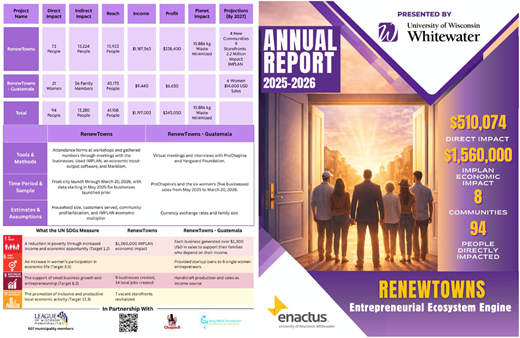 .
.Renew Town's blueprint. Source: ENACTUS University of Wisconsin–Whitewater Chapter
.Renew Town's blueprint. Source: ENACTUS University of Wisconsin–Whitewater Chapter
Key micro-innovations
Narrative activation: Youth used digital storytelling and visual materials to frame the historic building as a future-oriented community resource rather than a nostalgic relic (Marshall et al., 2021; Saija and Pappalardo, 2024).
Governance micro-shifts: The process connected municipal actors, ECO, the VFW, residents, business owners and students, forming an emergent proto-governance network around heritage regeneration.
Low-cost prototyping: Students produced visualizations, concept sketches and business-model ideas that allowed stakeholders to test possibilities without high financial risk. This supported a repeatable small-town regeneration model under resource constraints (Selada et al., 2012; Mendialdua et al., 2021).
Analytical insight
Innovation emerged through relational and procedural changes, not through physical redevelopment alone. The rehabilitation of the building was significant, but the micro-innovation lay in the new interpretive frames, collaborative routines and channels for community voice that formed around it (Bianchi et al., 2024; Hughes et al., 2024). These small-scale shifts accumulated into a more cohesive local regeneration agenda, illustrating how youth-led co-creation can unlock latent community assets. The case also shows the vulnerability of micro-innovation to administrative capacity gaps, particularly when funding, paperwork and institutional follow-through are not secured (Healey, 2006; Kennedy, 2020).
Case 3: Youth4Innovation – Connect4Climate (global): intergenerational futures thinking
The Youth4Innovation workshop, conducted during the Innovate4Climate 2025 meeting in Seville, demonstrates how youth engagement can generate micro-innovations in global sustainability dialogues (Figures 5 and 6). Participants from diverse countries collaborated with experts, policymakers, academics and private-sector mentors to co-design climate and urban sustainability solutions through systems thinking, design thinking and rapid ideation (Vardakosta et al., 2023).
 A woman in a blue blazer holds a poster with a flowchart detailing a youth innovation project. Two other women, one holding a microphone, stand nearby. The poster includes sections labeled DEVELOP, SOLUTION, IMPLEMENT, SOLVER, INNOVATOR, INNOVATION, and IMPACT. The background shows a screen with text and a partial image of a man.
Youth4Innovation workshop (Sevilla, Spain) – Global climate innovation exercise. Source: Kaia Rose/Connect 4 Climate
A woman in a blue blazer holds a poster with a flowchart detailing a youth innovation project. Two other women, one holding a microphone, stand nearby. The poster includes sections labeled DEVELOP, SOLUTION, IMPLEMENT, SOLVER, INNOVATOR, INNOVATION, and IMPACT. The background shows a screen with text and a partial image of a man.Youth4Innovation workshop (Sevilla, Spain) – Global climate innovation exercise. Source: Kaia Rose/Connect 4 Climate
 Several hands are seen writing and pointing at diagrams and post-it notes on a table. The diagrams include sections labeled 'PROBLEM', 'SOLUTION', and 'DEVELOP'. The participants appear to be collaborating on a project or problem-solving session.
Youth4Innovation workshop (Sevilla, Spain) – Global climate innovation exercise. Source: Kaia Rose/Connect 4 Climate
Several hands are seen writing and pointing at diagrams and post-it notes on a table. The diagrams include sections labeled 'PROBLEM', 'SOLUTION', and 'DEVELOP'. The participants appear to be collaborating on a project or problem-solving session.Youth4Innovation workshop (Sevilla, Spain) – Global climate innovation exercise. Source: Kaia Rose/Connect 4 Climate
Key micro-innovations
Systems reframing: Youth applied causal reasoning, futures thinking and rapid ideation to identify leverage points in climate-urban systems, producing insights that differed from expert-driven models.
Cross-cultural knowledge integration: The workshop created a temporary “global civic lab,” where youth perspectives from different socio-environmental contexts were synthesized into shared solution pathways (Connect4Climate, 2025).
Prototype governance ideas: Participants proposed micro-governance innovations, including youth advisory boards, climate storytelling platforms and community-based monitoring systems that could be adapted across cities (Anderson et al., 2024; Backåberg et al., 2024).
Analytical insight
The workshop functioned as a micro-innovation incubator. Intergenerational exchange produced new conceptual frames and governance ideas, even though the process was short and event-based. These innovations show how youth participation can influence global climate discourse by introducing alternative system representations and collaborative practices (Bolster et al., 2021; Bianchi et al., 2024). The main limitation is anchoring. Without follow-up mechanisms, workshop-generated innovations risk remaining inspirational rather than operational (Healey, 2006).
Cross-case analytical synthesis
Across the three cases, micro-innovations emerged through three recurring mechanisms (Table 3):
Cross-case synthesis of micro-innovation mechanisms across the three cases
| Mechanism | Sorrento Saggia (Italy) | Renew towns lab – Edgerton (USA) | Youth4Innovation – Connect4Climate (global) |
|---|---|---|---|
| Reframing | Youth reframed tourism from a consumer-oriented model to a “temporary citizenship” paradigm, shifting governance discourse toward rights, responsibilities and shared stewardship | Students reframed heritage assets from nostalgic relics to future-oriented community resources, enabling new narratives of opportunity rather than decline | Youth applied systems thinking to reframe climate-urban challenges as interconnected leverage-point systems, generating alternative conceptualizations compared to expert-driven models |
| Boundary-spanning collaboration | Students acted as intermediaries between municipality, residents and businesses, creating new relational channels in a previously siloed governance environment | Youth connected local officials, business owners and residents, forming an emergent governance network around heritage regeneration | The workshop created a temporary global “civic lab,” linking youth from diverse contexts with experts, policymakers and practitioners |
| Iterative learning loops | Co-design workshops produced cycles of testing, feedback and refinement, embedding learning into the municipal decision process | Rapid prototyping (visualizations, concept sketches) enabled low-risk experimentation and iterative adjustment of ideas with community input | Systems-thinking exercises and rapid ideation generated iterative cycles of mapping, critique and redesign, functioning as a micro-innovation incubator |
| Resulting micro-innovations | New governance narrative; participatory tools integrated into municipal practice; enhanced intergenerational dialogue | New interpretive frames for heritage; emergent collaborative routines; low-cost prototypes guiding future planning | Novel governance ideas (youth advisory boards, storytelling platforms); new systemic representations; cross-cultural solution pathways |
| Systemic implications | Process innovation in tourism governance; strengthened civic capacity | Activation of latent community assets; formation of a proto-governance network | Diffusion of youth-generated insights into global climate discourse; scalable participatory models |
Reframing: Youth introduced new interpretive lenses – temporary citizenship, heritage futures and systemic leverage points – that shifted how local actors understood problems.
Boundary-spanning collaboration: Youth acted as connectors between institutional and noninstitutional actors, enabling new governance relationships.
Iterative learning loops: Co-design, prototyping, storytelling and participatory tools created feedback cycles that allowed ideas to evolve and gain legitimacy.
These mechanisms demonstrate that innovation in urban regeneration often arises not from technological breakthroughs alone, but from process-based, relational and educational dynamics activated through intergenerational collaboration.
The mechanism-based comparison clarifies the empirical pattern that links the cases: youth engagement operates as a catalyst when it changes how actors frame a problem, who is connected through the process and how learning is fed back into subsequent action. These dynamics provide the basis for the discussion of participatory systems, civic laboratories and scaling beyond isolated experimental niches.
Research implications
This study demonstrates that innovation in urban regeneration can be understood as an emergent process arising from participatory systems, rather than as a discrete outcome of planned interventions. Across the three case studies, the analysis identified recurring patterns through which micro-innovations are generated, including participatory problem framing, relational collaboration across stakeholders, iterative learning processes and the catalytic role of youth engagement. These findings suggest that innovation is not primarily driven by large-scale technological or institutional change, but by the accumulation of small-scale, process-based innovations that emerge through interaction, negotiation and experimentation within participatory contexts.
Theoretically, the article contributes in three ways. First, it advances a process-based understanding of innovation by focusing on how change emerges within participatory systems. Second, it introduces micro-innovation as a lens for small-scale, relational and iterative change often overlooked in urban regeneration research (De Silva et al., 2021; Reypens et al., 2016). Third, it shows how feedback loops allow early innovations – such as new narratives or engagement formats – to generate further participation, experimentation and potential scaling (Frantzeskaki et al., 2025).
Across the three cases presented, a unifying theme is that youth engagement can act as a catalyst for innovation in urban regeneration, but the nature and impact of that innovation are profoundly shaped by context – especially governance structures and intergenerational dynamics. The experiences from the three cases underscore a central thesis: innovation in urban regeneration is not confined to technology or infrastructure – its success is achieved through new ways of learning, relating and governing, particularly when youth are actively engaged.
Intergenerational co-creation as innovation driver
All cases affirm that youth engagement injects imaginative ideas and fresh energy into regeneration efforts, validating the notion that young people can “imagine alternatives” beyond the conventional (Ozer et al., 2024; Loudon et al., 2024). In Sorrento, youth envisioned a tourism campaign grounded in human rights and cultural respect – pivoting away from the typical marketing or rule-enforcement mindset. In Edgerton, students introduced digital storytelling and multi-use design concepts that broadened the project's impact (e.g. a community kitchen doubling as an incubator). At Youth4Innovation, young participants proposed hybrid solutions that broke silos between sectors. These innovations might be seen as “micro” in scale – one campaign, one building, one app concept – but they demonstrate the qualitative difference that youth involvement can make (Anderson et al., 2024).
The process by which innovation occurred aligns with what collaborative governance scholars describe as the benefits of inclusive deliberation: diverse stakeholders generate more creative options (Ansell and Gash, 2008; van Meerkerk and Edelenbos, 2018). Here, the diversity was partly age-based. The mechanism frequently observed was that youth participants questioned assumptions that older stakeholders had long taken for granted. For instance, in Sorrento, the assumption that tourism growth is always good was interrogated by youth from a rights perspective, leading to new considerations for policy. In Edgerton, the assumption that a historic building must be either a museum or a commercial entity was disrupted by youths suggesting a hybrid community space. This resonates with the idea of urban experiments acting as niches where new narratives and solutions can develop (Hölscher and Frantzeskaki, 2021) – in these niches, intergenerational teams experimented with blending old and new ideas.
Collaborative governance in practice
Each case also operated as a small example of collaborative governance. Sorrento and Edgerton relied on local workshops, partnerships and committees; Youth4Innovation used a temporary but structured design process. Trust, shared motivation and joint action were visible in all three, although their durability varied (Emerson et al., 2011). In the local cases, collaboration continued into pilot outputs and planning discussions but remained dependent on resources and institutional follow-through (Healey, 2006). In the global case, collaboration was intense but event-bound, making post-workshop anchoring the central challenge.
Urban experimentation and scaling
From a sustainability transitions perspective, the cases suggest that HEIs and international platforms can operate as civic laboratories for local experimentation (Eichberg and Charles, 2024). Politecnico di Torino and Sant'Anna Institute connected student learning with Sorrento's tourism agenda, UW-Whitewater linked student enterprise with Edgerton's regeneration needs and Connect4Climate connected youth innovation to global climate networks. These partnerships translate SDG principles into localized learning and action, while the UN Pact for the Future reinforces the importance of youth participation in governance (Trane et al., 2023; United Nations, 2024).
The importance of scaling and replicability of micro-innovations is key here (Kocornik-Mina et al., 2021). While micro-innovations are valuable in situ, their cumulative impact depends on diffusion. Our cases have begun to scale horizontally: Sorrento's model attracting interest from nearby towns, Edgerton's being relevant to other rural communities, Youth4Innovation ideas being shared across cities via Connect4Climate. The discussion suggests developing toolkits or “living manuals” (as mentioned in the CASES framework and current working research) to codify methods and lessons so that other communities can adapt them, to mitigate what Savini and Bertolini (2019) have identified as “the politics of niches” in urban experimentation. There is both a challenge and opportunity to connect local micro-innovations with global frameworks more directly. This integration is crucial for translating localized successes into broader sustainable development initiatives (Bogedain and Hamm, 2020).
Across the three cases, feedback loops followed a recurring sequence: local pressure triggers youth-led reframing, boundary-spanning collaboration, participatory experimentation, stakeholder feedback, refinement and increased legitimacy. Institutional anchoring represents the critical transition through which micro-innovations may move from isolated experiments toward durable governance practice. This sequence is not strictly linear, but iterative. Where governance interfaces are stable, this cycle can support institutional learning. Where they are weak, the loop breaks and micro-innovations remain niche experiments.
Theoretical contributions
The study contributes to three theoretical debates. First, it supports a wider understanding of urban innovation as processual and social, not only technical. Second, it extends intergenerational governance by showing how youth-adult collaboration can enrich decision-making while still requiring facilitation and institutional support. Third, it contributes to collaborative governance theory by showing how age diversity can improve problem framing, creativity and legitimacy, while also exposing power imbalances that must be managed if youth participation is to become meaningful (Ansell and Gash, 2008; Bell et al., 2023; Emerson et al., 2011; Moulaert et al., 2014).
Practical implications
The findings suggest that practitioners and policymakers should move beyond viewing participation as a procedural requirement and instead design participatory processes as innovation-generating systems. This includes creating spaces for iterative engagement, supporting youth as active contributors rather than symbolic participants and fostering institutional interfaces that enable micro-innovations to influence broader governance structures. Rather than focusing solely on large-scale interventions, urban regeneration strategies should prioritize the conditions that enable micro-innovations to emerge, interact and accumulate over time.
Embed youth engagement in planning processes: Cities should institutionalize youth participation by creating advisory councils, youth seats in planning bodies or targeted public consultations with schools and youth centers. As seen in Sorrento and Edgerton, youth co-leadership leads to more creative and supported outcomes. Tools like youth charrettes or YPAR programs can systematize youth input (Akom et al., 2016). Intergenerational activities should also be included to encourage knowledge exchange.
Leverage higher education as a partner in innovation: Municipalities can partner with universities and schools as civic collaborators. The civic university model shows institutions' readiness to connect learning with local impact (Eichberg and Charles, 2024). This can include joint task forces, studio courses on city issues and co-hosted workshops. As demonstrated by Sant’Anna and UW-Whitewater students, youth can deliver practical outputs at low cost, while providing invaluable knowledge transfer and education. City staff can also benefit from university training in participatory and MCDA methods. Funding from national and EU programs is often accessible through these partnerships (Steen and van Bueren, 2017).
Adopt and adapt participatory decision tools: Tools like MCDA and participatory mapping (GIS with community layers) can structure inclusive planning and clarify trade-offs (Trane et al., 2023). Training local planners in these tools, possibly with academic support, can increase the sophistication and inclusivity of public engagement. These approaches increase transparency and public understanding. Digital storytelling, photovoice and Business Model Canvases (as used in Sorrento) help translate local ideas into action. Online innovation portals could also allow ongoing youth contribution beyond formal meetings.
Secure small funding for micro-innovations: Cities can offer mini-grants ($5k–$20k) for pilot projects by youth and community teams – e.g. murals, parklets or apps. These initiatives, like in Edgerton, can scale through hybrid funding models. Aligning proposals with SDG targets can unlock global funding or CSR sponsorships (Khayame and Abdeljawad, 2020). For example, tech firms might back the Youth4Innovation app or sustainable tourism campaigns in Sorrento. Practitioners should frame projects in funder-relevant language and seek multi-sector partnerships.
Foster networks and knowledge sharing: Peer learning should be expanded through local and global networks. Sorrento's tourism model could be shared in webinars; Edgerton's in small city and rural development forums such as ICLEI-Local Governments for Sustainability (ICLEI). Organizations United Cities and Local Governments (UCLG) or C40 Cities (for youth climate actions) support youth forums and innovation exchange. Toolkits and open-source resources should be developed: our cases can be distilled into “living handbooks” designed to adapt and change as city initiatives evolve. Practitioners must think beyond their locale. Sharing stories and practices is essential to scale this work.
Policy integration and longevity: Policymakers should embed participation in regeneration policy, include youth in master and climate plans, and protect successful initiatives (Pontikakis et al., 2024). National programs can scale these approaches – e.g. youth innovation components in urban strategies. Initiatives like the EU's New European Bauhaus and UNESCO's Creative Cities Network offer visibility and support. Recognizing youth-led micro-innovations as core to urban policy – not add-ons – is vital (Collado and Hervé, 2022).
In Summary, people-centered innovation is a key pathway to inclusive regeneration. Empowering youth and creating intergenerational partnerships unlocks creative energy and sustainable solutions. With the right tools, support and policy frameworks, these strategies can and should be embedded into everyday urban practice.
Research limitations
The study has several limitations. Data depth varies by case, with Sorrento and Edgerton documented over longer periods than the one-day Youth4Innovation workshop. The researcher's direct involvement also introduces potential bias, mitigated through triangulation, participant input and comparison with relevant literature. The cases are not representative of all regeneration efforts; they are illustrative examples of youth-engaged, intergenerational co-creation. Finally, long-term impacts remain uncertain because the projects are recent or ongoing. The findings should therefore be read as analytically suggestive rather than definitive (Yin, 2018).
Regarding findings, despite the above-presented positive outcomes, we also must acknowledge hidden power structures that condition participatory innovation. Hillier (2002) reminds us that planning processes unfold under the “shadows of power,” with influential forces often operating beneath the surface to shape agendas and outcomes. Even enthusiastic youth engagement can be limited by such invisible dynamics; institutional actors ultimately decide which ideas advance. This suggests a cautionary note: without committed follow-through by power-holders. Despite these limitations, for the participants and many observers, the Youth4Innovation workshop was a proof of concept that young people can constructively engage with elder mentors to address complex urban challenges on a global stage, and that they can hold their own in collaborative environments with seasoned professionals. The theoretical implication drawn from this case is that settings of urban experimentation need not be place-bound – they can be convened transnationally – but the key is linking them back to local action and institutional follow-through, a theme we delve into in the discussion.
Similarly, the cases may remain niche experiments if they are not institutionalized. Savini and Bertolini (2019) warn that urban experimentation can be celebrated while leaving dominant planning regimes unchanged. Sorrento, Edgerton and Youth4Innovation all show promise, but their transformative capacity depends on follow-through, policy uptake and durable governance arrangements.
Conclusions and future research
Finally, it's worth reflecting once more on the original question: “What do we mean by innovation in urban regeneration?” The cases collectively answer: innovation includes process innovations – new ways of collaborating (youth as equal partners, 4P governance, art-science integration), social innovations – new services or social enterprises (community ghost kitchen, wise tourism campaign) and institutional innovations – new roles for universities and youth in governance (Torfing et al., 2021). These often entail low-tech or no-tech interventions but are innovative in addressing root causes and relational aspects of urban issues.
Technical solutions (solar panels, apps, building retrofits) were present but always embedded in a socio-educational approach. Therefore, innovation in this context is multi-dimensional: it's technical and social, infrastructural and cultural. It is measured not just by efficiency gains or capital investment, but by enhanced participation, community capacity, inclusion and sustainability outcomes. Each case provided evidence of concrete changes spurred by youth engagement, e.g. Sorrento's novel responsible tourism initiatives, Edgerton's heritage revitalization plan and globally crowdsourced climate solutions in Sevilla. These examples enrich the empirical literature on participatory urbanism by illustrating how intergenerational co-creation can translate collaborative processes into tangible regeneration outcomes. The cases also shed light on the conditions necessary for success, such as supportive institutional partners, iterative trust-building and mechanisms for turning ideas into action. Practitioners can draw from these narratives actionable insights – like the importance of giving youth structured roles (e.g., youth councils, defined project responsibilities) and the benefit of quick pilot implementations to build momentum.
Theoretically, our study contributes to reframing urban innovation. It provides a nuanced perspective that innovation in regeneration is not a monolith; it often occurs in incremental, social ways that mainstream innovation metrics might overlook. We highlight intergenerational co-creation as an under-appreciated engine of innovation – one that aligns with calls for more inclusive and just forms of urban development. The findings support the idea that collaborative governance models, when extended to include younger stakeholders, can enhance creativity and legitimacy in decision-making. They also suggest that treating urban projects as experiments – emphasizing learning and adaptation – can be beneficial; but to transition from experiment to sustained practice, the insights must be absorbed by governing entities (be it a city council or an international organization). In summary, the study reinforces that process matters: how we innovate (collaboratively, inclusively) will shape what innovations are possible and sustainable.
Across the cases, the main mechanisms identified are:
Reframing: Youth introduced new interpretive lenses that shifted the meaning of tourism, heritage and climate action problems.
Boundary spanning: Youth and HEI partners connected actors who were previously institutionally, generationally or geographically separated.
Iterative learning: Co-design, storytelling, prototyping and systems mapping generated feedback loops that allowed ideas to evolve.
Institutional anchoring: Micro-innovations gained transformative potential only when connected to municipal, civic, educational or international governance interfaces.
Scaling potential: the cases show that small, relational innovations can become transferable models when documented, supported and linked to wider policy or learning networks.
Moving forward, there are several avenues for future research and practice. One is to explore scaling mechanisms: how can successful youth-engaged micro-innovations be scaled up within a city or replicated in others?; How can we best mitigate “politics of niches” through sufficient institutionalization? Comparative studies across different cultural or political contexts (e.g. comparing these findings with project proposal results from the Youth4Climate workshop that encompassed representation both from the Global North and South) would also be valuable to see how universal these dynamics are. Additionally, longitudinal research tracking the youth participants themselves could provide insight into how involvement in these regeneration efforts influences their civic trajectories and the communities' trajectories over time. While the initiatives examined in this study are relatively recent and therefore do not yet allow full longitudinal evaluation, early indicators – such as continued stakeholder engagement, policy dialogue and educational replication – suggest that youth-led participatory processes can contribute to longer-term institutional learning and community capacity building. For policymakers and organizations, the message is clear: engaging youth is not just a “nice-to-have” for public relations, but a strategic asset for innovation and resilience. When done authentically, it leads to outcomes that are creative, contextually rich and have buy-in from a broader constituency. The originality of this approach lies in integrating educational and participatory processes into the heart of urban innovation strategies.
In conclusion, this article reframes innovation in urban regeneration as an emergent and distributed process grounded in the dynamics of participatory systems. By introducing the concept of micro-innovation and empirically illustrating its role across multiple case studies, the study provides a lens for understanding how change occurs in practice. These insights contribute to ongoing debates on participatory governance, social innovation and urban transformation by highlighting the importance of small-scale, relational processes in shaping broader systemic outcomes. Future research should further explore the long-term trajectories of micro-innovations and their potential to scale within different institutional and socio-spatial contexts.

