Most companies claim to have a strategy, yet implementing it often remains a challenge. Tactical planning processes like Sales and Operations Planning (S&OP) and Integrated Business Planning (IBP) are commonly understood as a bridge between strategy and operations. However, academic literature that describes how these processes support strategy implementation (SI) remains scarce. To address this gap, our study describes how IBP expands upon practices in S&OP to support SI.
We have conducted 37 interviews with S&OP and IBP professionals in 2 rounds of data collection. Using an abductive reasoning approach, we leveraged literature on SI to analyze our empirical data. We outline six propositions that demonstrate how IBP can support SI.
A key finding of the paper is a description of how IBP supports SI. Building on previous SI research, we conclude that IBP can support the conceptualization and enactment of SI, along with the coordination of the resulting actions.
We encourage practitioners to leverage the full potential of IBP by using it as a process for SI. The outlined propositions demonstrate how this can be done in practice. Also, we allow for a clear distinction between IBP and S&OP to help practitioners make an informed decision to implement either or.
We show that IBP can support SI by describing how it entails all necessary activities for SI outlined in previous literature. This addresses an under-researched aspect of tactical planning while also providing a clear mechanism for SI.
1. Introduction
[P]ractitioners continue to rank SI [strategy implementation] as the most challenging task that they face and researchers have an incomplete picture of why some firms implement strategy better than others (Tawse and Tabesh, 2021, p. 23)
Most companies claim to have a strategy to denote positioning vis-à-vis competitors, a desired state or a direction for the company (Mintzberg et al., 2009). In effect, strategy is a staple of the modern business. There are, however, indications that companies falter with the implementation of said strategy (Friesl et al., 2021; Sull et al., 2015). Put differently, the formulation of a strategy is not a guarantee of its implementation (Greer et al., 2017). Research on strategy implementation (SI) has evolved from the realization that strategy formulation and SI, while intertwined, need to be viewed as distinct activities (Friesl et al., 2021; Gimbert et al., 2010; Tawse and Tabesh, 2021). While academic interest in SI has grown, there have been calls for more research on the topic (e.g. Greer et al., 2017; Weiser et al., 2020).
Weiser et al. (2020 p. 973) define SI as “the continuous interplay of three interrelated activities – conceptualizing, enacting, and coordinating – that enable an organization to realize strategies through collective actions by organizational stakeholders.” Conceptualizing SI involves the creation of structures and implementation plans, whereas enacting encompasses how strategies are communicated, understood, adapted to context and acted upon (Friesl et al., 2021; Weiser et al., 2020). Coordinating SI refers to the orchestration of collective actions needed to put plans into practice (Weiser et al., 2020). In practice, the implementation of a strategy involves taking action based on the outlined strategy to produce concrete results (Friesl et al., 2021; Gimbert et al., 2010). Previous research frequently denotes this as tactical planning that focuses on aligning operations with the strategic focus of the company (e.g. Thomé et al., 2012).
One tactical planning process with the potential to support SI is Sales and Operations Planning (S&OP). As a logistics and supply chain planning process, S&OP is mainly focused on balancing demand and supply by aligning different plans within the company (Wagner et al., 2014). However, the process also ensures that operations are aligned with corporate strategy (Tuomikangas and Kaipia, 2014). This alignment between strategy and operations effectively enables SI, as operational plans, actions and decisions are connected to strategy (Thomé et al., 2012).
In previous years, S&OP has also evolved into what many denote as Integrated Business Planning (IBP). As an advanced form of S&OP, the IBP process emphasizes a stronger link to finance and strategy (Kilkenny and Harman, 2020; Schlegel et al., 2021; Seeling et al., 2022). Also, IBP contains two process steps typically not found in S&OP: a product portfolio review and integrated reconciliation (Selmi et al., 2021). In these steps, the IBP process enables a review of strategic projects, new product introductions, a rationalization of the product portfolio, as well as full financial integration and scenario planning. These steps have also been outlined as crucial elements in tactical planning to enable successful SI (Shanahan et al., 2025).
While there is a widespread, albeit implicit, assumption that IBP can support SI (Kilkenny and Harman, 2020; Schlegel et al., 2021), we have a limited understanding of what this means in practice. There is a lack of empirical research that investigates how IBP can support SI, and to our knowledge, there is no extant literature that combines operations management with strategic management research to specifically investigate how tactical planning can support SI. This research gap presents challenges for further research on IBP and SI, and concrete issues for practitioners who wish to utilize IBP for SI. Answering calls for more research on the topic (e.g. Kreuter et al., 2022; Shanahan et al., 2025), we thus examine the following research question: How can IBP support strategy implementation?
To address this research question, we conducted 37 in-depth interviews with tactical planning experts in two rounds. As our research interest and specific research question evolved during the study, seven of these interviews were second-round interviews that focused specifically on the link between IBP and SI. Building on an abductive reasoning approach, we posit that IBP can support the conceptualization, enacting and coordination of SI activities (cf. Weiser et al., 2020). In this vein, we contribute to the body of knowledge by formulating six propositions that describe how IBP supports SI. This addresses an under-researched aspect of the IBP process, while also describing how an operations management process can be used to solve a strategic management problem, that is, SI. Furthermore, Schlegel et al. (2021) note that more terminological clarity regarding IBP is needed, and that there is an absence of academic definitions of IBP. Following this, we provide the first empirically grounded definition of the IBP process.
The paper is structured as follows. Next, we will discuss the activities needed for SI in more detail. In Section 2, we also examine the current understanding of IBP as an advanced form of S&OP in both academic and practitioner literature. In Section 3, we open up our data collection and data analysis process, followed by the results of the interview analysis in Section 4. We then discuss how IBP can be used for SI and present our definition of IBP in Section 5. Finally, in Section 6, we discuss the implications of our findings for both academia and practice.
2. Literature review
Weiser et al. (2020) have conducted an extensive review of literature on SI with a focus on articles in top strategic management journals during the past 40 years. In this paper, we will rely on Weiser et al.’s (2020) framework for SI. We will examine their framework in more detail in the next section, followed by an in-depth look at the S&OP and IBP processes in Section 2.2. Section 2.3 combines both perspectives to look at how extant literature currently describes the link between IBP and SI.
2.1 Conceptualizing, enacting and coordinating strategy implementation
Weiser et al. (2020) summarize their findings as a notion of SI that encompasses the conceptualization of plans for SI, the enacting of these plans by different actors and the coordination of associated activities. Where “conceptualizing” relies on a structural view of SI that emphasizes implementation of plans in a linear fashion, “enacting” has its roots in practices for SI, emphasizing the activities people actually do when implementing strategy (Jarzabkowski and Spee, 2009). In their review, Weiser et al. (2020) note that there has been a shift from a focus on structures for SI to how strategies are understood and enacted in the organization. At the same time, they maintain that both aspects are needed. “Coordinating” activities for SI exemplifies this dual focus as both formal structures (e.g. processes and tools) as well as social means (e.g. a corporate culture) are needed to align activities toward a common strategic goal (Weiser et al., 2020). These constructs have also been operationalized as organizational control (Cardinal et al., 2017).
Detailing more specific activities that can be seen as a part of conceptualization and enacting, Friesl et al. (2021) list five activities that drive SI: structure and process matching, resource matching, monitoring, framing and negotiating. Coordination of SI activities also involves iteration between conceptualizing and enacting that encompasses a feedback loop that can trigger reconceptualizing of SI if current plans are deemed unfeasible (Weiser et al., 2020). Furthermore, coordination should rely on both formal and informal organizational control. Table 1 outlines how we have positioned these detailed activities within the more high-level, general activities outlined by Weiser et al. (2020). Next, we will examine the activities in Table 1 in more detail.
Structure and process matching involves the alignment of teams and processes around a strategic intent, whereas resource matching ensures the necessary means to implement strategy, including financial means, time and personnel. Monitoring, in turn, follows up the progress of SI. All three activities also involve specific tools and processes, such as administrative mechanisms, budgeting and strategic performance management systems. Administrative mechanisms for matching structures and processes with strategy focus on setting up an appropriate organizational structure, decision-making mandate and ways of working to implement strategy (Govindarajan, 1988). A typical process for resource matching is budgeting, whereby resources for strategic initiatives are allocated. In effect, it is perceived as a key tool for implementing strategy (Libby and Lindsay, 2010). Strategic performance management systems support monitoring and are characterized by their link between long-term strategy, operational goals and performance measures (Gimbert et al., 2010). A prominent example of a strategic performance management system is the balanced scorecard (Kaplan and Norton, 1992), which has also been proposed as an effective tool for SI (Butler et al., 1997; Tawse and Tabesh, 2023; Weiser et al., 2020). Here, the link between strategy and performance follow-up comprises both financial and non-financial objectives, typically grouped under four headers: financial metrics, customer service, internal processes, as well as learning and growth (Kaplan and Norton, 1992). While a detailed review of these objectives lies beyond the focus of this paper, financial metrics and customer service tend to work with “hard” metrics in the form of quantifiable performance measures that determine financial performance and how customers perceive the company. Internal processes as well as learning and growth rely more on “soft” metrics derived from decisions and actions that drive customer satisfaction and the ability to learn and improve (Kaplan and Norton, 1992).
Enacting of strategy starts with framing that involves communication of the rationale and content of the strategy, typically by top management. The framing of strategy can involve metaphors and even descriptions of impending crisis, to instill a sense of urgency and to create a common understanding of the content of the strategy (Meyer and Stensaker, 2006). Negotiating, in turn, involves stakeholders exchanging views on the strategy based on their goals, interests and understandings (Ahearne et al., 2014). Here, the involvement and role of middle management is pronounced; it typically takes on a bridging role while a lack of proper framing of strategy by top management can lead to misunderstandings that will affect the outcome of SI (Friesl et al., 2021). Both enacting and negotiating involve a discourse that can be supported by symbols and visualization using, for example, presentation tools and reporting tools.
The coordination of activities needs to consider all activities, tools and processes pertaining to both conceptualization and enacting (Weiser et al., 2020). Specifically, the iteration between conceptualizing and enacting is important, and Weiser et al. (2020) note that we need to account for how enacting affects the conceptualization of strategy. In other words, when we move from strategic plans to concrete actions, we should ensure that there is a feedback loop to mitigate possible shortcomings and reconceptualize SI plans, if needed. Furthermore, coordination should involve a combination of a structural view and practice view of SI (Weiser et al., 2020). In other words, “procedural” activities and socially constructed perspectives are coordinated for a cohesive pattern of action. In line with this, Weiser et al. (2020) suggest organizational control as a suitable theoretical framework to examine the coordination of SI, suggesting that multiple forms of control are needed to coordinate SI.
Organizational control involves both explicit and implicit mechanisms that govern a cooperative effort toward common goals (Cardinal et al., 2017; Ouchi, 1979). In practice, various forms of control ensure that organizational members look past their self-interest in favor of collective action. Organizational control can be divided into two main categories: formal control that relies on things such as guidelines, processes, work descriptions and incentives; and informal control that makes up an organization’s traditions, shared norms and culture (Cardinal et al., 2017; Ouchi, 1979). The former is based on documented mechanisms to steer behavior, while the latter relies on unwritten mechanisms that form a commonly accepted conduct. These unwritten mechanisms are built upon, for example, stories shared in the organization that build a work ethic, group norms and the culture of the company (Ouchi, 1979). Weiser et al. (2020) emphasize the interplay between formal and informal control to coordinate action for SI, also referred to as a balance of control (Cardinal et al., 2017). In practice, this means that processes and other formal structures, as well as the corporate culture, are aligned with strategic priorities.
Next, we will examine the current understanding of IBP as an advanced form of S&OP (Section 2.2), followed by a review of how these processes can be leveraged to support SI (Section 2.3).
2.2 Integrated business planning as an advanced form of sales & operations planning
Widely used in many different industries, S&OP is a process to align demand and supply in a company (e.g. Grimson and Pyke, 2007; Jonsson et al., 2021; Wagner et al., 2014). The goal of S&OP is to integrate different tactical plans in the company to form a single set of plans (e.g. Pereira et al., 2020; Tuomikangas and Kaipia, 2014). To achieve a single set of plans, decision-making needs to encompass different functional departments (Oliva and Watson, 2011; Singhal and Singhal, 2007) and different organizational hierarchy levels (e.g. Thomé et al., 2012; Tuomikangas and Kaipia, 2014). A key challenge in achieving this is the sometimes different and opposing business goals in the involved departments. This could involve, for example, a dichotomy between demand volatility and stability in production. S&OP aims to align these opposing goals in a monthly process with a focus on the current and next year (see, e.g. Wagner et al., 2014, for a detailed description of the process).
In addition to departments concerned with demand and supply, the finance department plays an important role in the S&OP process to strengthen a focus on profitability (Seeling et al., 2022). This integration of financial aspects into the process is typically seen as a sign of a high maturity process (Danese et al., 2018; Grimson and Pyke, 2007), which is sometimes also denoted as IBP (e.g. Schlegel et al., 2021).
However, high-maturity implementations are rare (Jonsson and Holmström, 2016) and the understanding of IBP in academic literature remains fragmented. Some authors state that there is no difference between S&OP and IBP and that the terms are interchangeable (Stentoft et al., 2020). Kristensen and Jonsson (2018) argue that the renaming of S&OP into IBP was initiated by consultancy companies for marketing purposes. Others describe IBP as an advanced form of S&OP where the integration of financial decisions is seen as characteristic of the transition from S&OP to IBP (e.g. Seeling et al., 2022), alongside an emphasis on a link to strategic goals (Schlegel et al., 2021; Shanahan et al., 2025). Building on this understanding, Schlegel et al. (2021, p. 609) define IBP as “an organization’s unique, cross-functional business planning process, which results in a common set of tactical and strategic goals for profit optimization with the involvement of customers and suppliers”. However, Schlegel et al. (2021) do not detail how the process conceives these strategic goals, nor how they are implemented.
Partly in contrast to how academic literature frames IBP, practitioner literature focuses on the inclusion of strategic plans, initiatives and activities in the process; a key purpose of IBP is to implement strategy in a company (e.g. Kilkenny and Harman, 2020). The focus is not only on specific business units or departments, but on the alignment of all plans within the company, including, for example, human resources, information technology and research and development (Palmatier and Crum, 2023). As such, contrary to the original purpose of S&OP, the IBP process assumes a broader attention to the whole company. However, IBP still incorporates balancing of demand and supply as a part of its focus.
Furthermore, practitioner literature typically describes the IBP process with slightly different process steps compared to S&OP. Detailed descriptions of the IBP process in academia are scarce, but similar to practitioner literature, Selmi et al. (2021) describe it as a monthly cycle of different business reviews, where the financial consequences of decisions are considered at every step of the process.
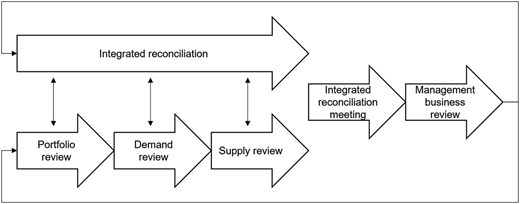
Figure 1 details the IBP process. It starts with a product portfolio review that focuses on decisions around product and project management, like launching or discontinuing products and projects. The projects under review are typically of a strategic nature, affecting, for example, customer service, delivery times or product capabilities. This process step is typically not found in descriptions of S&OP and emphasizes the strategic focus of the IBP process (Palmatier and Crum, 2023). Then, the demand review develops a demand plan based on market forecasts that considers demand shaping actions (e.g. promotions or marketing actions). Next, the supply review aims at matching this demand plan with production capacities, logistics capabilities and procurement volumes to achieve a feasible supply plan. Both demand and supply reviews can also be found in the S&OP process (e.g. Wagner et al., 2014). However, integrated reconciliation is exclusive to IBP. It is a continuous activity that runs across the other process steps, focusing on gap closing with the help of scenario planning or so-called what-if planning. Scenarios are developed with financial aspects considered, such as alternative revenue projections that consider the impact on working capital. This enables dynamic decision-making and is seen as essential to achieve alignment between strategy and operations (Shanahan et al., 2025). Issues that require cross-functional collaboration are then solved in the integrated reconciliation meeting. Finally, the management business review involves top management to address gaps regarding financial and strategic plans. These last two process steps resemble the pre-executive and executive meetings in the S&OP process (e.g. Wagner et al., 2014). Here, involvement of top management in the process is perceived as critical, both for the S&OP process and the IBP process (e.g. Pedroso et al., 2016; Smith et al., 2010; Wagner et al., 2014).
Table 2 summarizes descriptions of IBP in academic literature, with an emphasis on how IBP expands upon practices in S&OP while still retaining a focus on balancing demand and supply. In the next section, we will examine how the IBP process can support SI.
2.3 Leveraging IBP to support strategy implementation
In this section, we will focus on how IBP supports the SI activities outlined in Table 1. Given that IBP is usually framed as an extension of S&OP, we will look at how previous literature describes the link between SI activities (Table 1) and both S&OP and IBP processes. Starting with conceptualizing, the link between strategy and the S&OP and IBP processes is widely perceived as important (e.g. Jonsson et al., 2021; Schlegel et al., 2021; Tuomikangas and Kaipia, 2014). As such, both processes epitomize a structure and administrative mechanism that could be suitable for SI.
In addition to appropriate administrative mechanisms, the conceptualization of SI requires ways to ensure resource allocation. In line with this, previous literature stresses the need to enable resource allocation in S&OP and IBP by aligning the process with budgeting (Seeling et al., 2022; Shanahan et al., 2025), whereas Wagner et al. (2014) describe challenges with an over-reliance on budgets for supply chain planning purposes. Furthermore, Shanahan et al. (2025) put forward that the financial impact of decisions needs to be understood in S&OP so that resource allocation engages the right decision makers and considers the impact on strategy.
Hulthén et al. (2016) have developed a framework for monitoring the performance of the S&OP process. Their framework partly draws upon principles from the balanced scorecard, stressing the need to align the S&OP process performance measures with strategy. This alignment is assessed based on the degree of “cross-functional participation” (including executive participation) to manage disparate functional targets. Shanahan et al. (2025) note that key performance indicators need to be aligned with strategic goals. However, the focus is predominantly on “hard” metrics such as growth, market share or customer service. As such, both Hulthén et al. (2016) and Shanahan et al. (2025) focus less on, for example, learning and growth required by strategic objectives (cf. Butler et al., 1997).
Previous literature gives little attention to how S&OP or IBP can support enacting of SI. As such, an omission in existing literature is around framing and negotiating; previous literature on S&OP and IBP does not explicitly focus on how strategies are communicated and how disparate strategic interests are negotiated in the processes.
Coordination of SI relies on both formal and informal control (Weiser et al., 2020). Both S&OP and IBP epitomize a focus on formal control, as the processes detail both ways of working and associated roles and responsibilities (cf. Cardinal et al., 2017; Ouchi, 1979). However, informal control also plays a role in the processes. Studies in both academia and practice have found that successful S&OP relies on a change in culture to support alignment, ownership and empowerment (Goh and Eldridge, 2024; Mello and Stahl, 2011; Tuomikangas and Kaipia, 2014). As such, previous literature recognizes that a balance between formal and informal control is needed for S&OP and IBP.
3. Method
3.1 Research design
Drawing on two rounds of data collection through qualitative interviews, our study aims to analyze how IBP can support SI. However, our starting point for the study was to primarily examine differences between S&OP and IBP. We chose a qualitative research approach as this allowed us to do a holistic analysis of the characteristics and differences between both processes. Furthermore, an abductive reasoning approach allowed us to compare our empirical data to how S&OP and IBP are described in existing literature (Kovács and Spens, 2005). As the study progressed, our research interest evolved; we arrived at our final research question (“How can IBP support SI?”) through several iterations between the empirical data and existing literature. This also prompted a second interview round where we specifically focused on the link between IBP and SI. Next, we will explain the abductive process in more detail, followed by a brief recount of the iterations we went through and how our research interest evolved.
Abductive reasoning follows a pattern which is not purely deductive, nor purely inductive (Kovács and Spens, 2005). Key features in abduction include intuition and hunches that support the development of new insights that can be presented as hypotheses or propositions (Kovács and Spens, 2005; Mantere and Ketokivi, 2013; Sætre and Van De Ven, 2021). Here, we can also note a key difference to deductive reasoning that typically starts, rather than ends, with a hypothesis. Furthermore, whereas deduction tests what must be and induction shows what actually is, abduction suggests what may be (Sætre and Van De Ven, 2021). Thus, plausibility is a key criterion for abductive reasoning (Danermark et al., 2019). In practice, this entails a generative idea that is developed into a probable explanation, or as Sætre and Van De Ven (2021, p. 693) call it, a “process of disciplined imagination.” A key feature of abductive reasoning is thus the iteration between previous research and empirical data, while a key difference to an inductive approach is that previous research is considered from the very start of the research process (Kovács and Spens, 2005; Mantere and Ketokivi, 2013). In line with this, abduction works with a notion of an anomaly that does not fit the existing rule or previous theory (Kovács and Spens, 2005; Sætre and Van De Ven, 2021). As such, the purpose of the abductive reasoning process is to build an explanation for this anomaly.
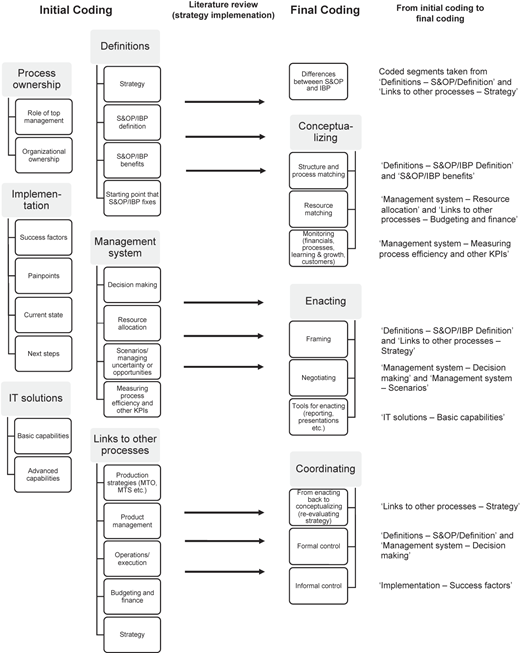
Next, we will provide an overview of how we iterated between extant knowledge and our empirical data. This process is further clarified in Section 3.2 (data collection) and Secction 3.3 (data analysis). As we analyzed our first-round interview data, we noted that many interviewees emphasized the purpose of IBP as a SI process. This contrasted with S&OP, where the focus was perceived to be less holistic and mostly driven by a need to balance demand and supply. This led us to re-examine both academic and practitioner literature on IBP. At this stage, we found that there are indeed aspects of the IBP process that might make it suitable for SI. However, the role of strategy was multi-faceted in IBP literature and a detailed description of how IBP supports SI was missing. At this point, our research interest had evolved: while we were still interested in the differences between S&OP and IBP, we now focused on how IBP can support SI, as our interviewees saw this as the decisive difference between the two processes. We had also identified a research gap in the literature, as there were no descriptions of how IBP enables SI. This, in turn, directed our focus to strategic management and how SI is described in that literature. The SI activities outlined in Table 1 in Section 2.1 then formed the basis for our final coding categories (see Figure 2). As the analysis of our empirical data unfolded, we started to form an understanding of how IBP can support SI. To verify this understanding, we then conducted a second round of interviews with some of the interviewees who had emphasized SI as a focus of the IBP process. For these second-round interviews, we developed a new interview guide (see Appendix 1) that reflected our interest in concrete examples of how IBP can support SI.
Our unit of analysis in this interview study is the IBP process. An important thing to note is that our interviews reflect expert opinions, whereby our first-round interview data reflects our interviewees’ perception of the processes and not necessarily what is currently in place at any given company. In the second interview round, we focused on more concrete examples of current practices. Next, we will look at our principles for data collection and then return to a more detailed description of our data analysis.
3.2 Data collection
For this interview study, we conducted 37 semi-structured interviews with S&OP and IBP experts in two Nordic countries, Finland and Sweden. As indicated in Table 3, seven of the interviews were second-round interviews (see Appendix 1 for our interview guide, separately for the first and second round of interviews). Our interviewees worked in 26 different companies, meaning that some interviewees worked for the same company. In these cases, the companies in question were larger, and we interviewed people representing different independently operating divisions that were running their own S&OP or IBP process. In 2023, the average turnover of the companies our interviewees worked for was 5.3 billion Euros. Our sampling was purposive; we looked to people with experience in S&OP or IBP. To find relevant interview candidates, we cooperated with an association for planning professionals that also has a special interest group for S&OP. We then used social media to understand the background of the people who were suggested. Our interviewees have long experience in this field, many having worked for several employers and being involved with several S&OP or IBP processes. Table 3 outlines more specific information about the industry where the interviewees currently work, their experience with S&OP or IBP, their current seniority, the length of the interview and the language used in the interview. The industry classification is derived from the Global Industry Classification Standard and the “industry group” in that standard. Materials (e.g. paper and forest products), capital goods (e.g. machinery) and services refer to companies that work predominantly in the business-to-business sector, whereas the other companies focus on consumer sales. The first round of interviews was conducted in 2022 between January and May. The second interview round was conducted in late 2024 and the beginning of 2025. For this round of interviews, we also interviewed one additional person with extensive experience with IBP. The interviews were held in Finnish, English or Swedish, depending on the interviewee’s preference. Translations (if applicable) of the quotes in Section 4 were done by the authors. The first-round interviews were 50–90 min in length, whereas the second-round interviews were 40–50 min. All interviews were recorded and transcribed word-for-word.
3.3 Data analysis
We started the data analysis by creating categories in a qualitative data analysis tool (MaxQDA) based on our prior knowledge of the process, literature on S&OP and IBP and assumptions regarding the topics that could be of interest. The left-hand side of Figure 2 details our initial coding structure. At this stage, our aim was to understand key differences between S&OP and IBP; we followed up on whether the coded segments were related to either S&OP or IBP processes. Coding was done by two of the authors proficient in all three languages used in the interviews. All coded segments were reviewed jointly, allowing us to reach a deep understanding and multiple viewpoints on the interviews. This also allowed us to challenge each other’s views, creating a coherent structure and logic regarding the coding categories and coded segments.
Despite a broad and holistic focus on both S&OP and IBP in our first interview round, our data analysis revealed that many interviewees specifically saw SI as integral for the IBP process. However, based on our initial coding, we could not surmise how strategy is implemented with IBP. This prompted a further review of literature, allowing us to build the final coding structure illustrated on the right-hand side in Figure 2. This final coding structure is derived from literature on SI and the coding was done based on the “general” and “detailed activities” outlined in Table 1 in Section 2.1. In addition, we coded segments where our interviewees describe how S&OP differs from IBP. Table 4 contains example quotes for each coding category. Figure 2 also contains a description of how we moved from our initial coding to the final coding; the coded segments in the final coding structure were derived from the initial codes, discarding some code segments along the way. With the final coding structure at hand, we could better understand how IBP supports SI. Based on this understanding, we decided to collect additional data to verify our findings and get more concrete examples of how IBP supports SI.
At this stage, we conducted a second interview round. We described our initial findings to the interviewees to give them a better context of the topics we wanted to discuss. As such, a key difference to the first round of interviews was that we specifically focused on SI with IBP, as indicated in our interview guide in Appendix 1. We used the same final coding structure as before to analyze the data. In the final stage of the data analysis, we formulated six propositions that describe how IBP can support SI.
In this paper, we view IBP as an extension of S&OP. That also means that we have examined the interviews for specific activities pertaining to SI, irrespective of whether the interviewee talks about S&OP or IBP (with the exception of Section 4.1, where we examine how our interviewees perceived the difference between S&OP and IBP). This is an important thing to keep in mind when we move to our findings and look at how strategy is conceptualized, enacted and coordinated.
4. Interview findings
4.1 Differences between S&OP and IBP
We found that the observed lack of clarity in the literature regarding the terms S&OP and IBP can also be observed in many of our interviews. Some interviewees even argued that the name of the process is irrelevant, as the goal of the process is often framed differently to enable companies (especially consultancies) to market it as their own solution: “Depending on who you ask, we talk about S&OP, or we talk about IBP, or we use some other term. [ …] I view IBP as a brand of [a particular consultancy]. In the end, different consultancies might have the same slides with different headers” (#8). However, some interviewees indeed saw a clear distinction between S&OP and IBP, with IBP seen as “a way and a method for implementing strategy in day-to-day work” (#6). While IBP still incorporates all elements of the S&OP process, it also “checks each month whether we are heading towards the strategy we have defined” (#29). In practice, this means that the IBP process enables a company to take strategic considerations into account while planning on a tactical level. For example, if the strategy emphasizes a high service level over low prices, this influences the decision-making on a tactical level. In practice, inventory levels need to be increased despite a need for higher working capital. As one interviewee put it, this consideration of strategy “is where I truly see the difference between IBP and S&OP. IBP should be able to recognize that our strategy is to serve customers [ …], be there for the customers. We are not competing based on price, we compete based on availability. So, we might need to grow our inventory levels” (#4).
Furthermore, different perspectives on process ownership were also evident when interviewees distinguished between S&OP and IBP. S&OP was typically considered a supply chain process and, therefore, “can still be owned by the supply chain [department]” (#28). However, since IBP is seen as “a way to run your company rather than a supply chain process” (#13: 2), top management plays an important role. This is necessary because “the supply chain [department] is not [alone] responsible for growth and profitability, or product strategy and product choices” (#31), which need to be considered for SI. Consequently, “IBP needs to be driven from the executive team and owned by the CEO” (#28) to ensure a focus on SI.
Currently, “the terms [S&OP and IBP] are easily mixed” (#28). This is also the case in some of our interviews. However, in this paper, we view IBP as an extension of S&OP; any feature of S&OP is included in the IBP process (but not vice versa). Moving forward, we build on the distinctions that some of our interviewees made, while we focus on the potential of IBP as an SI process. As such, we quote either term (S&OP or IBP) depending on which process the interviewee referred to but, at the same time, we focus on features that enable SI.
Table 4 provides an overview of our findings and demonstrates how IBP covers activities necessary for SI. We will describe our findings in more detail in Sections 4.2 - 4.4.
4.2 Conceptualizing strategy implementation with IBP
In terms of providing a structure and process for SI, many interviewees stated that the IBP process enabled them to create alignment around a common (strategic) goal. Dispersed teams that prior to the introduction of IBP were focused on their own goals, now work with a “joint plan […] a joint decision on where we are heading. The outcome is that everyone follows this joint plan where we have decided how to move forward” (#28). Incorporating this strategic decision-making into IBP was seen as “the missing piece [ …] because that’s where we basically set our targets, look even further ahead” (#13). Without a clear process and structure for SI, it is difficult to set a strategic goal that is accepted across different departments. IBP enables a company to overcome this challenge by providing a structure and forum for joint decision-making to “articulate what our goals are on a firm-level. Everybody works together on the same goals” (#23), which also “removes those famous silos” (#21) between different functions. As a result, the IBP process aligns the different parts of a company, enabling them to work together toward a joint strategic goal.
Moving to resource allocation for SI, IBP is used as a decision-making process to allocate resources, that is, financial means, time or personnel. Without an IBP process in place, and frequently also alongside the IBP process, such decisions are typically made in an annual budgeting process. Many of our interviewees highlighted that this can be problematic as budgets and tactical plans are not always aligned, with budgets being updated less frequently than the plans: “That’s one of the things that has kind of caused gray hairs in all the places I’ve worked: The annual budget in an environment with rolling forecasts and planning” (#22). For example, one interviewee described that when the company realized that a particular trend “became mainstream, we suddenly had to decide to expand the factory and buy a new production line” (#24). As such, the IBP process enabled a strategic decision that was not originally planned for in the annual budget. In one case, the company in question replaced their budgeting process with IBP: “we actually took the step to say, OK, we don’t do a budget anymore” (#13). In practice, the IBP process describes “how you prioritize your activities and your resources and your financial resources over the whole company” (#13). Or, as another interviewee put it: “[The IBP process] is a dynamic budget. You make resourcing decisions in IBP, and these are guided by strategic choices” (#31). In practice, this means that tactical decisions like, for example, prioritizing products for manufacturing are made with the strategy in mind. This can also mean that products get prioritized in manufacturing based on their strategic importance even if that is not the most profitable decision: “One of the cornerstones for our growth is that we bring new, innovative products to the market. So, then, when we have to prioritize what to manufacture and what not, the strategy is strongly in our minds. Based on the strategy, we have prioritized new products [to be manufactured] first, even though it might not even be profitable to do so as they are a bit more inefficient to manufacture in the beginning [of their lifecycle]” (#5: 2). Another part of conceptualizing is following up on the progress of SI by monitoring activities and outcomes. Our findings indicate that “a balanced scorecard or hand full of KPIs approach probably works best. You have targets derived from strategy [ …] and it’s really important that there are agreed KPIs” (#26). By using a balanced scorecard approach in the IBP process, companies follow up on “financials, customers, internal processes, and so on. [ …] It fits well to how our objectives align with strategy implementation” (#5). In line with the idea of the balanced scorecard, many of our interviewees focused on a combination of “hard” metrics in the form of financial measures and customer metrics, and “soft” metrics that reflect how well internal processes work and how well learning takes place. Regarding hard metrics, the IBP process is, for example, used to follow up on sales volumes, particularly relating to products with a strategic priority, but also to monitor overall profitability. In addition to financial measures, customer facing measures were also common, with some following up on “customer satisfaction on a monthly basis as a part of the IBP cycle” (#6: 2). Here, some aligned these measures with the overall strategy: “If our strategy is to offer the best customer service in the world, then on a tactical level our NPS [net promoter score] goal is such and such, and our service level should be at least like 98 percent. When we introduce new products, satisfaction with the new selection needs to be excellent” (#26).
The monitoring of SI progress does not only include hard measures. For example, one interviewee highlighted that the company’s strategy is “allocated to the different parts of the IBP process. Then you can start the decision-making with a question: Okay, where are we with these? And it doesn’t have to be hard metrics [that are being discussed], it can be anything” (#29: 2). Soft metrics that are monitored in the IBP process are focused on process effectiveness as well as learning and growth and include, for example, the “understanding between functions” (#19), the avoidance of surprises (#12), or the internal culture, especially the behavior in IBP meetings and the commitment toward joint decision-making (#29).
All in all, our interviews reflected that IBP is perceived as a suitable structure and process for aligning teams around joint strategic goals. It also enables companies to allocate their resources according to strategic priorities and enables quick reaction to changing resource needs. To monitor the progress of SI, the IBP process typically uses a balanced scorecard approach that combines hard and soft metrics.
4.3 Enacting strategy implementation with IBP
Enacting starts with the framing of the strategy, that is, communicating rationale and content of the company’s strategy. In the interview data, the IBP process was frequently described as a “communication channel” (#22). One interviewee described the process in more detail as “a structured approach to get the communication, the information, across to the different functions, and then to share the information and then capture it as well” (#14). The communication of the strategy is particularly important to make sure that all decision-makers always have the strategic direction in mind. In practice, this means that top management emphasizes the strategy in IBP meetings: “[Our slogan is:] ‘Obsessed with customer service'. [ …] And at the same time, [in the IBP meetings,] we hear from the highest [executive] level that we want to be customer centric” (#4). Another example for the framing of the strategy can be seen in the “typical discussions [in the IBP meetings] what our maximum profitability looks like in relation to strategic decisions” (#3: 2). The strategic direction of a company might also require that a maximum (short-term) profitability is not pursued, and “there might be really good reasons for this” (#3: 2). To make sure that the reasons for this (e.g. risk management, strategic prioritization of products or customers) are understood, and that the strategy is implemented and pursued in such situations, the strategy must be consistently communicated so that all decision-makers are aware of the strategic direction.
Negotiating the practical implications of the company’s strategy across functions was also frequently described as a feature of the IBP process. The aim is to establish a joint understanding that transcends individual departments’ needs and aspirations, and to determine the practical implications of the strategy. For example, if a company’s strategy emphasizes growth in particular segments, the IBP process is used to achieve “a common understanding. [ …] What do we need to do to get there? What are the actions needed so that we are all on the same page?” (#22). As a further example, this could involve discussions on whether the strategy requires investments in particular production technologies. Here, the IBP process enables the organization to consider different viewpoints. As one interviewee indicated, this can also lead to a reassessment of the need to invest: “Then maybe [we decide] that now is not yet the time, the market has not yet developed sufficiently” (#24). Prior to the introduction of IBP, these discussions often resulted in different departments arguing to protect their own interests and “pointing fingers at each other and the management being all confused” (#13: 2), but with the IBP process in place, companies are able to “bring the right people to the table and have them sort of look at the same data and reality, and align their priorities” (#13: 2). Many of our interviewees also emphasized the need for more advanced capabilities to support scenario planning. In many instances, scenario planning was used as a form of negation, whereby alternative courses of action and outcomes were discussed and acted upon. While scenarios were often used to support operational planning, they were also used to support discussions on strategic options in the IBP process. For example, the use of scenarios to discuss different strategic options can include scenarios for “which markets should we enter [or] maybe exit?” (#9). In these scenarios, a tactical plan gets developed based on the different strategic options, so that these plans and their consequences can be discussed and decided upon in the IBP process.
In terms of support for framing and negotiation, our interviewees often referred to presentation tools, dashboards, business intelligence (BI) tools, and spreadsheets as important to process data and visualize data: “It’s then [after an analysis] about visualization of the figures, so that they are easily understood by a broader group of people” (#2).
In summary, the IBP process was seen as a communication channel, both in general terms and specifically for framing strategy. Similarly, the IBP process was a forum for negotiating disparate interests and arriving at a joint understanding on how to move forward with the implementation of strategy.
4.4 Coordinating action with IBP
An essential part of coordinating action for SI is the iteration between activities pertaining to both conceptualization and enacting. This includes the formal structure that the IBP process brings about, as well as the socially constructed understanding of needed actions that spans across departments. In the interviews, this iteration between conceptualization and enacting involved a feedback mechanism, whereby the activities in the IBP process identified issues with the strategy that needed to be considered, which in turn should drive a reconceptualization of strategic plans. For example, if a company’s strategy prioritizes a specific product, but the sales department involved in the IBP process does not see a significant demand for this product in the next years, this information is used as an input to discuss whether the strategy is still relevant and up-to-date: “If we then have a target to grow this product family or this business [because it is prioritized in the strategy], but then in the S&OP plan we see that the following two years of demand are flat, shouldn’t we then discuss and think whether to update the strategy or update the S&OP plan?” (#18). This way, the strategy gives not only input for tactical planning, but both are “intertwined in that they feed each other” (#20) so that IBP also “gives input back, that, okay, now we have learned these kinds of things from the [strategic] choices” (#31). Here, “iteration [between strategic plans and their implementation] is the thing. [ …] I can’t say which leads to the other, they are part of the same entity” (#3). One interviewee summed this up: “IBP ensures the implementation of the strategy and sends a signal that that strategy may needs to be revised” (#1).
Another key part of coordination is how activities are controlled for a cooperative effort. This involves both formal and informal control. Looking at formal control, the IBP process provides a structure that typically details ways of working, roles and responsibilities and practices. This was a common topic in the interviews, exemplifying a strong reliance on formal control. For example, one interviewee described the need for a clear IBP process definition to ensure a successful implementation: “All divisions need to implement monthly tactical planning in the same way, so that it’s defined what the activities are. There’s a need for demand planning, supply planning, balancing, and executive meetings, and more. [ …] An important thing is that there is a defined frequency [for the process], defined roles and responsibilities, and so on” (#30).
In addition, the coordination of activities in the IBP process also relied on informal control. Here, an important aspect is that the corporate culture supports the IBP process: “If you have, for example, a culture where [joint] decisions aren’t respected, then you don’t have one set of numbers” (#29: 2). This can make it difficult to ensure a joint strategic direction. Also, the IBP process requires a culture in which the involved people are encouraged to make decentralized decisions and not rely on a “management [that] knows all the right answers, and even small decisions are escalated upwards” (#31). Lastly, one interviewee noted that the IBP process needs to be flexible enough to support “ad-hoc communication [in addition to the formal process]. [ …] For example, our sales directors in different markets recognize, without any guidance or formal process, when they should call me directly. [ …] A very typical example is when a sales director comes out of a big negotiation. Once back at the hotel, he gives me a call: “Hey, this didn’t work out the way we planned. [ …] What should we do?” And then actions are set in motion immediately. This requires that people are familiar with each other, and that personal chemistry is in place” (#3: 2). Consequently, informal control also plays an important role in ensuring coordinated ways of working toward joint strategic goals. In conclusion, we found that there was a feedback loop between the IBP process and strategy, whereby mismatches between strategic plans and the implementation thereof were identified and escalated. Furthermore, the IBP process relied on a combination of formal and informal control, whereby there was an interplay between sanctioned ways of working and a culture that promotes certain behavior.
5. Discussion
5.1 IBP as a strategy implementation process
SI is seen as an increasingly important yet difficult task (Friesl et al., 2021; Greer et al., 2017; Sull et al., 2015). To address this, we set out to understand how IBP can support SI. Our findings demonstrate the potential of IBP as an SI process. Next, we will describe how the different activities of the IBP process can support SI by enabling the general (Weiser et al., 2020) and detailed (Friesl et al., 2021) activities necessary for SI, outlined in Table 1 in Section 2.1. In Table 5, we have mapped the different IBP process steps against specific SI activities. Below, we will discuss this in more detail. Building on this, we also formulate six propositions that describe key considerations for implementing strategy with IBP.
The implementation of strategy with IBP relies on iteration between three high-level activities, conceptualizing, enacting and coordinating (cf. Weiser et al., 2020). Conceptualization starts with structure and process matching that emphasizes the alignment of teams and processes around a strategic intent (Friesl et al., 2021; Govindarajan, 1988). In our interviews, we found that IBP can create alignment by reducing silo-thinking, building a mandate for decision-making and articulating company-wide goals. Here, the integrated reconciliation process step and the management business review provide a forum for aligning different plans around a strategic goal. As the different departments commit to a joint strategic goal, they are encouraged to make their own decisions in the different review meetings (portfolio, demand and supply). If misalignments emerge, the different plans will be re-aligned during the integrated reconciliation and management business review meetings.
The IBP process can enable structure and process matching for SI by aligning teams, enabling decision-making and creating commitment toward a joint strategic goal.
Resource matching focuses on ensuring the necessary financial means, personnel or time for strategic initiatives (Friesl et al., 2021). Without IBP, this is typically done in the budgeting process (Libby and Lindsay, 2010). Based on our data, IBP enables resource allocation and prioritization based on the outlined strategy (cf. Shanahan et al., 2025). The rolling forecasts and frequent updates to plans in IBP also enable faster decisions based on new information, allowing for more agile decision-making that is not tied to annual budgeting. Consequently, we found that some companies have complemented or, in rare cases, replaced their budgeting process with IBP as a form of a “dynamic budget”. If there is a separate budgeting process alongside IBP, the link to budgeting is often perceived as problematic. In practice, plans might be updated more frequently in the IBP process, causing a discrepancy between these plans and an annual plan outlined in the budget (cf. Wagner et al., 2014).
The IBP process can enable agile and timely resource matching for SI, while complementing or replacing budgets. If a separate budgeting process exists, the interface between budgeting and IBP needs to be clearly defined.
Monitoring is the third activity pertaining to conceptualization, enabling a follow-up on the progress of SI (Friesl et al., 2021; Kaplan and Norton, 1992; Weiser et al., 2020). Some interviewees explicitly use balanced scorecards for this purpose and nearly all have an implicit focus on a balanced set of measures in the IBP process (cf. Butler et al., 1997; Tawse and Tabesh, 2023). First, in the portfolio review, the strategic priority of different elements of the portfolio is monitored to ensure that product lifecycles are in line with the strategy and that investments in new projects and products are made based on strategic goals. In the demand review, hard metrics like sales volumes or customer-facing measures like NPS are monitored, while the supply review monitors, for example, inventory levels. Here, it is important that these metrics are aligned with strategy: For example, if the strategy emphasizes high availability, service levels need to be monitored closely. Then, in the integrated reconciliation meeting and the management business review, top management follows up on the progress of SI, looking at financial measures like overall profitability (cf. Schlegel et al., 2021), as well as soft measures like commitment toward joint strategic goals or learning and growth.
The IBP process can be used for monitoring the progress of SI by using a balanced set of measures tied to strategic objectives. This should include financial and customer-facing measures, as well as targets for internal process efficiency and learning and growth.
The enactment of strategy relies on framing and negotiating (Friesl et al., 2021; Weiser et al., 2020). This involves the communication of the content and rationale of the strategy (i.e. framing), and a discussion on what this means for different parts of the organization (i.e. negotiating). IBP can provide a forum for framing strategy. In our interviews, communication and sharing of information across different functions were seen as an integral part of the whole process.
According to previous literature, top management plays a key role in the communication of strategy (Friesl et al., 2021; Meyer and Stensaker, 2006). This is reflected in the management business review, where top management communicates the strategy to make sure that all departments are aware of the desired strategic direction. This is also in line with literature that identifies top management involvement as a critical part of a well-functioning S&OP or IBP process (Pedroso et al., 2016; Smith et al., 2010; Wagner et al., 2014). Without top management involvement, the decisions made in the IBP process might skew more toward operative “day-to-day” issues as opposed to decisions that implement strategy.
As for negotiating, our interviews supported the notion that this is a key feature of the IBP process; the alignment of different interests is descriptive of how IBP supports negotiation. The practical implications of the strategy are discussed in the different review meetings in the IBP process, affecting the product portfolio, sales plans and corresponding market shaping actions, as well as supply plans. Here, it is important that the strategy has been communicated (i.e. framed) properly, to avoid different perceptions of what the strategy entails (Meyer and Stensaker, 2006). The integrated reconciliation meeting and the management business review can then utilize scenario planning to analyze different strategic options, thereby supporting alignment of disparate goals by creating an understanding of the firm-wide consequences of different scenarios (cf. Ahearne et al., 2014; Shanahan et al., 2025).
The IBP process can support the enactment of a strategy by providing a forum for framing the content of the strategy and for negotiating its practical implications for different departments. Top management should be involved, and scenario planning can be used to increase commitment and alignment.
Regarding coordinating, Weiser et al. (2020) note the importance of iteration between conceptualizing and enacting, whereby possible shortcomings of the strategy are identified and reconceptualized. This aspect was also highlighted in our interviews; IBP was seen as an iterative process, whereby the strategy influences the decisions made in IBP and vice versa. The different reviews in the IBP process can provide feedback on whether the product portfolio meets market demands, whether sales are in line with a strategic focus, and how supply capabilities should be dimensioned to meet strategic priorities. Based on this information, the integrated reconciliation meeting and the management business review can then determine whether there is a need to update the strategy and reconceptualize SI plans.
The IBP process can be used to determine the feasibility of strategic plans through various feedback mechanisms covering the product- and project portfolio, market trends and the supply situation. This enables reconceptualization of strategic plans, if so required.
Lastly, the coordination of activities for SI aims at building a cohesive pattern of action for all activities linked to SI (Weiser et al., 2020). Coordination should rely on both formal and informal control, also referred to as a balance of control (Cardinal et al., 2017; Weiser et al., 2020). The IBP process is an example of formal control, whereby there are documented ways of working that include roles and responsibilities, as well as clear process steps (cf. Cardinal et al., 2017). Our interviewees emphasized the importance of having clearly defined activities, roles and responsibilities in the process. However, previous literature also supports a notion that informal control in the form of a corporate culture and unwritten, implicit ways of working play a significant role in building a well-functioning process (Goh and Eldridge, 2024; Mello and Stahl, 2011; Tuomikangas and Kaipia, 2014). Our interviews supported this; informal control played a significant role in IBP. In practice, IBP promotes a culture of cooperation and joint decision-making, which is seen as essential for creating commitment and aligning teams around one joint strategic goal.
The IBP process can be used for coordinating activities for SI. Coordination should rely on a balance of formal and informal control to ensure commitment toward a joint strategic direction.
5.2 Distinguishing IBP from S&OP
While the ambiguity in literature regarding the terms S&OP and IBP was also observed in some of our interviews, we were able to identify distinguishing characteristics that provide clarity regarding the purpose and goal of the processes. The key difference between the processes is their goal: S&OP is a process focusing on balancing demand and supply (e.g. Jonsson et al., 2021; Wagner et al., 2014), while IBP has an additional focus on SI. This means that IBP still entails balancing of demand and supply but goes beyond this scope and enables the implementation of strategy. This is in line with Jonsson and Holmström (2016), who argue that the “ultimate step for SCP [supply chain planning] involves integrating tactical and strategic decision making” (p. 72).
Besides differences in goal and focus, our interviews highlight that there can also be differences in terms of process ownership: While S&OP can be owned by the supply chain, a stronger link to SI requires that the IBP process is owned by top management.
In summary, we define IBP as a tactical, iterative and cross-functional process that implements strategy. This is done by providing a structure and mandate for decision-making, principles for resource allocation and ways to monitor the performance of SI. A crucial part of the process is top management involvement to ensure that the content and rationale of the strategy are communicated and framed clearly, so that the different departments can negotiate the practical implications of the strategy. This supports the alignment of disparate interests around the outlined strategy. As an iterative process, IBP enables a reconceptualizing of strategy, if so required. Finally, coordinating actions to implement strategy relies not only on the IBP process itself but also on implicit mechanisms such as a culture that supports strategic objectives and joint decision-making.
6. Conclusion
6.1 Theoretical contribution
Our research contributes to the existing body of knowledge in multiple ways. First, we highlight the potential of IBP as a process for implementing strategy; we formulate six propositions that outline how IBP can be used for SI. With these propositions, we address an under-researched aspect of IBP as we describe how IBP can support the implementation of strategy (e.g. Kreuter et al., 2022; Tuomikangas and Kaipia, 2014). We also answer recent calls for more research on the mechanisms for SI (Friesl et al., 2021; Greer et al., 2017; Weiser et al., 2020).
Second, we provide an empirically grounded definition of IBP that distinguishes it from S&OP. While S&OP is focused on balancing demand and supply, IBP goes beyond this scope and incorporates SI. To balance theoretical rigor with practical relevance (Stentoft and Rajkumar, 2018), this distinction not only enables practitioners to deliberately decide whether to implement S&OP or IBP based on their goals and needs, but it also brings much-needed clarity regarding the mixed use of terminology in academic literature.
6.2 Implications for practice
Our study offers multiple implications for practitioners. First, based on the highlighted potential of IBP for SI, we encourage practitioners to utilize IBP as an approach for effectively implementing strategy. This can complement or replace previous static SI processes and tools like, for example, budgeting or strategic performance management tools (cf. Butler et al., 1997; Libby and Lindsay, 2010; Tawse and Tabesh, 2023). Second, we outline six propositions that demonstrate what is needed to successfully implement strategy with IBP. This can help practitioners determine whether they already utilize the full potential of their IBP process or what parts they need to address to enable SI. Finally, our study provides a better understanding of the differences between S&OP and IBP. Based on the distinction outlined in this paper, practitioners can make an informed decision to implement either or. This enables a clear understanding of the problem the process should address, facilitating a successful process implementation.
6.3 Limitations and avenues for further research
This study comes with several limitations. First, while our empirical data clearly highlight the potential of IBP for SI, all of the experts we interviewed have not specifically used IBP for SI. Second, some of our interviewees used the terms S&OP and IBP interchangeably. This ambiguity of terms drove the need for a clear definition of IBP. However, as we view IBP as an extension of S&OP, our definition of IBP partly builds on interview data where our interviewees use the term S&OP. At the same time, our research design explicitly accounts for these shortcomings. We present a plausible result based on our empirical data while acknowledging that there currently exists some confusion regarding what the terms S&OP and IBP refer to. Third, our interviews were conducted with (tactical) planning experts, including strategists as informants could have provided additional insights into how IBP supports SI. Lastly, literature on tactical planning emphasizes the context dependency of S&OP and IBP (e.g. Kristensen and Jonsson, 2018). Although we have interviewed people with different backgrounds (industry and seniority), this is not explicitly addressed in our research. Consequently, our propositions do not consider the effects of different contexts on the ability of IBP to support SI. This brings us to avenues for further research.
Although prevalent in practitioner literature, IBP remains under-researched in academia. A first avenue for further research concerns the applicability of IBP in different contexts. More research is needed to discover whether there are contexts in which IBP is well suited to support SI, and if there are contexts in which IBP is unable to support SI. This would not only be a valuable contribution to theory but also a highly relevant field of research to enable practitioners to overcome difficulties with implementing strategy. Here, we propose a multiple case study approach to compare the use of IBP to support SI in different contexts. Another interesting opportunity for research is to compare different approaches for SI. Here, it would be worthwhile to compare IBP with other approaches for SI to analyze the strengths of weaknesses of different approaches.
The authors would like to thank the anonymous reviewers for their helpful comments and feedback, which greatly improved the manuscript. Support for this research was provided by the A.F. Lindstedt Fund, which is gratefully acknowledged. The authors would also like to thank M.Sc. Timo Rantala for his insightful comments and practical help with arranging the expert interviews.
Appendix Interview guide
First-round interviews:
Your background
Education
Work history
Experience with S&OP or IBP
What is S&OP and what is IBP?
Purpose and outcome
Process steps
Participants and stakeholders, ownership and role of top management
Frequency, timeline, time buckets
Unit of analysis (product, product family, capacity)
What are the typical inputs/outputs? What are the typical decisions made?
What key behaviors does S&OP or IBP require?
What is the difference between S&OP and IBP?
Benefits and value
How does S&OP or IBP create value for the company as a whole?
What are the benefits for senior management?
… for logistics and supply chain management, operations
… for marketing
… for R&D
… for finance
What are typical KPIs you follow in the S&OP or IBP process?
How do you measure the performance of the S&OP or IBP process in itself?
Implementation
What top three advice would you give to others considering implementation?
How would you describe the implementation steps?
Timeline in your company, where are you now?
What were the biggest hurdles/challenges?
What is your target state in terms of maturity?
How would you describe the change management during the implementation?
Should S&OP or IBP be steered by a separate organization? Who should own the process?
Managing uncertainty
How do you manage uncertainty with S&OP or IBP?
How do you view the role of scenario planning? What practical examples of scenario planning could you give?
Links to other processes
What is the link to execution/near-term planning? Budgeting? Financial planning and analysis? Department and top Management meetings? Strategy?
What decisions belong in the S&OP or IBP process versus what decisions should be made elsewhere?
Technical tools
What are basic capabilities that are a must for S&OP/IBP?
If you could invest in any kind of tool support for S&OP/IBP, what would it be?
Second-round interviews:
How do you see the link between IBP and strategy?
What concrete examples of conceptualizing SI in IBP can you give?
Does the IBP process support resource allocation? What is the relationship with budgeting?
How do you monitor progress of SI in the IBP process? What kind of metrics do you have in place for IBP (overall, not just related to SI)?
What concrete examples of enacting SI in IBP can you give?
How is strategy communicated in the IBP process?
Did the strategy cause any conflicts or differences in opinion in the IBP team? How were these resolved? How did you end up with a common understanding of what the implementation of the strategy would require?
How were SI activities coordinated in the IBP process? Is the IBP process only a formal way of working or does corporate culture play a role in how things are done? Are there unwritten rules of ways of working that everybody abides to?