This study explores how manufacturing plants navigate tensions between economic and social-ecological priorities during high-impact, low-frequency (HILF) disruptions, which are conceptually understood as combining environmental uncertainty and internal resource constraints. It investigates whether cumulatively developed operations and network capabilities help mitigate trade-offs that arise under such conditions.
Drawing on paradox theory and cumulative capability models, the study applies partial least squares structural equation modelling and sequence testing to survey data from 135 automotive plants before and after COVID-19. Tensions are examined through observed trade-off patterns between traditional operations and sustainability capabilities. We clarify the scope by positioning HILF as contextual, and we support this with archival indicators.
The results suggest that plants which had developed capabilities cumulatively, following the Sand Cone sequence prior to disruption, experienced fewer trade-offs during the crisis. A high level of network capabilities prior to disruption further reduced trade-offs and enabled plants to either maintain or develop social-ecological sustainability capabilities under disruption conditions. Surprisingly, many of the analysed plants had not followed the Sand Cone sequence before the crisis, which exacerbated trade-offs during disruption.
The study re-examines the Sand Cone model within a HILF disruption context and proposes an extended Supply Chain Sand Cone model that integrates cumulative operations capabilities within plants with network capabilities across supply chains. It shows how manufacturing plants can manage sustainability-related tensions between economic and social-ecological priorities through paradoxical responses of temporal separation via cumulative capability development and spatial separation via the integration of network capabilities. Practical implications include the value of deliberate sequencing and supply network integration to support sustainability under crisis conditions.
1. Introduction
The COVID-19 pandemic, a high-impact, low-frequency (HILF) disruption, exposed tensions between economic and social-ecological goals in global manufacturing by amplifying environmental uncertainty and resource constraints (Benigno et al., 2022). In response to delivery bottlenecks and demand fluctuations, plants relied on emergency measures such as air freight, which increased CO2 emissions and undermined ecological sustainability. Flexible scheduling and extended working hours also came at the cost of health and safety standards (Pagell et al., 2020; Ban et al., 2022). These trade-offs reflect organisational tensions between competing goals. Under crisis conditions, organisations must navigate tensions between economic and social-ecological goals, which translate into competing operational priorities within the manufacturing context. This study examines whether capability development serves as an effective organisational response to tensions between competing priorities during HILF disruptions by helping to reduce trade-offs between underlying capability sets (Wilhelm and Sydow, 2018; Berti and Cunha, 2022).
The literature on cumulative capabilities suggests that trade-offs can be reduced through sequenced capability development over time. The Sand Cone model (Ferdows and De Meyer, 1990) proposes that quality forms the foundation for capability development, enabling improvements first in delivery, then flexibility and ultimately cost efficiency. Rather than treating capabilities as trade-offs, this model views them as complementary and mutually reinforcing. However, empirical support under uncertainty remains mixed. While several studies confirm the sequential logic (e.g. Noble, 1995; Rosenzweig and Roth, 2004), others find deviations or fail to observe cumulative effects (e.g. Boyer and Lewis, 2002; Flynn and Flynn, 2004). Scholars therefore emphasise the role of contingency factors, including national culture, market environments and manufacturing maturity, which shape how the Sand Cone unfolds (e.g. Schroeder et al., 2011; Amoako-Gyampah and Meredith, 2007; Ehie and Schoenherr, 2021). Although recent extensions incorporate social-ecological capabilities (e.g. Gold et al., 2017), it remains unclear whether cumulative capability logic holds under HILF disruptions, particularly regarding its effectiveness in reducing trade-offs between traditional operations and sustainability capabilities (Wiengarten et al., 2023).
Following scholars of paradoxical tensions in corporate sustainability, firms pursue economic, social and ecological goals that are interdependent yet conflicting (Elkington, 1994; Hahn et al., 2015). These goals translate into competing operational priorities at the plant level (Rosenzweig and Easton, 2010). Economic priorities, such as quality, flexibility, cost efficiency and delivery, are typically supported by traditional operations capabilities (Slack et al., 2016). In contrast, social-ecological priorities require sustained commitments to health and safety, resource efficiency and pollution prevention, which manifest as sustainability capabilities (Gold et al., 2017). During disruptions, these priorities compete more directly for limited resources, resulting in intensified trade-offs that not only reflect but also reinforce deeper organisational tensions. These tensions cannot be resolved through short-term adjustments but require paradoxical response strategies, including temporal separation (e.g. cumulative capability development over time to manage internal constraints) and spatial separation (e.g. distributing resources and capabilities across the network to manage external constraints), as part of deliberate capability development (Rosenzweig and Easton, 2010; Hahn et al., 2015; Smith and Lewis, 2011).
During HILF disruptions, plants often cannot rely solely on internal capabilities to meet competing priorities. Extreme volatility in supply and demand can overwhelm even well-sequenced operations (Rosenzweig and Easton, 2010). In such contexts, network capabilities such as collaboration, visibility, agility, risk management culture and supply chain reengineering help absorb shocks and stabilise performance (Christopher and Peck, 2004). While supplier integration and collaboration have been shown to support traditional operations and cumulative progression (Newman et al., 2009; Bortolotti et al., 2015; Tham and Chiadamrong, 2016), the broader set of network capabilities remains underexplored in relation to cumulative development (Rosenzweig and Easton, 2010). Limited empirical research explains how internal and external capabilities jointly reduce trade-offs between traditional operations and sustainability capabilities (Wiengarten et al., 2023; Kinra et al., 2025) or how such reductions help plants manage persistent tensions between competing priorities during HILF disruptions (Hahn et al., 2015).
The study is guided by the following research question: What role do cumulative operations capabilities and network capabilities play in enabling manufacturing plants to manage tensions between economic and social-ecological priorities during HILF disruptions?
This study analyses tensions from a paradox theory perspective (Smith and Lewis, 2011; Hahn et al., 2015), which helps evaluate the robustness of the Sand Cone model during disruption and explains the integration of network capabilities as part of paradoxical response strategies. Tensions are operationalised through observed trade-off patterns, where improvements in traditional operations are associated with declines in sustainability capabilities under disruption (Berti and Cunha, 2022). HILF disruptions are conceptually understood as compound contingencies that combine (1) internal resource constraints and (2) external environmental uncertainty, defined as volatility and unpredictability in supply and demand conditions. Thereby, HILF functions more as a contextual setting than as a measured construct (Brusset et al., 2023), supported by the Global Supply Chain Pressure (GSCP) Index, which visualises the unprecedented pressure on supply chains during the COVID-19 pandemic (Benigno et al., 2022). Building on cumulative capability models (Schroeder et al., 2011; Gold et al., 2017) and a supply network capability framework (Christopher and Peck, 2004), we use pre- and post-COVID-19 survey data from 135 automotive plants. It applies partial least squares structural equation modelling (PLS-SEM), guided by Hair et al. (2021), and sequence testing following Schroeder et al. (2011), to evaluate cumulative effects, identify trade-off patterns and assess sustainability capability progression under HILF disruptions.
Results show that adherence to a traditional Sand Cone sequence before disruption helps reduce capability-level trade-offs during crisis, particularly when complemented by strong network capabilities. These trade-offs reflect deeper tensions between competing economic and social-ecological priorities. The findings are positioned against existing literature (Table 1), showing how cumulative operations capabilities help address resource constraints and how external network capabilities mitigate environmental uncertainty as part of a paradox response strategy to these tensions. Section 2 develops the theoretical framework, followed by methodology (Section 3), results (Section 4), discussion (Section 5) and conclusion (Section 6).
2. Theoretical background
2.1 From trade-offs to cumulative capability development under HILF disruptions
Manufacturing strategy builds on competitive priorities derived from broader business strategy, including economic, social and ecological goals (Wu and Pagell, 2011; Rosenzweig and Easton, 2010). These priorities guide strategic choices and shape the development of capabilities, bundles of routines and resources that support performance in targeted areas (Miller, 2003). Trade-offs arise not from conflicting capabilities but from competing priorities that vie for limited resources, especially under volatile conditions (Rosenzweig and Easton, 2010). Since capabilities require sustained resource investment, shifts in strategic focus may cause stagnation or degradation of others. Trade-offs are thus observable at the capability level even when rooted in higher-level prioritisation. To remain competitive, plants must make deliberate choices by favouring some priorities over others (Skinner, 1969).
Contradictions to this logic led Ferdows and De Meyer (1990) to propose the Sand Cone model, which argues that operations capabilities should be developed cumulatively rather than pursued as trade-offs. Plants first establish quality, enhancing reliability and reducing process variability. High quality enables predictable delivery, which supports flexibility in managing production schedules and demand fluctuations. Together, these capabilities enhance cost efficiency by enabling process optimisation and reducing inventory. The cumulative effect improves resource allocation efficiency by building on earlier capabilities and their resources, lowering the effort required to establish subsequent ones (Rosenzweig and Roth, 2004).
In recent years, the focus of manufacturing strategy has expanded beyond economic priorities to include social and ecological concerns. Plants increasingly face pressure from regulators, investors and customers to deliver on both economic and sustainability-related goals (Slack et al., 2016). As a result, scholars have extended the Sand Cone model to incorporate these additional dimensions. For instance, Gold et al. (2017) propose an expanded sequence in which capabilities related to labour standards, safety practices, resource conservation and emissions reduction build upon traditional operational capabilities. These extensions suggest that social and ecological sustainability can be integrated as outcomes of cumulative capability development.
Yet the Sand Cone's applicability remains contested. Capability progression depends on internal factors, such as structure, and external factors, such as market volatility (Flynn and Flynn, 2004; Schroeder et al., 2011; Gold et al., 2017). Several studies confirm cumulative effects and reduced trade-offs under strategic or institutional uncertainty (e.g. Ehie and Schoenherr, 2021; Tamayo-Torres et al., 2017; Amoako-Gyampah and Meredith, 2007), though few explicitly include social or ecological priorities. Strategic uncertainty stems from ambiguity in business planning due to market turbulence, competitors, technological change or shifting customer expectations, while institutional uncertainty relates to weak or changing regulatory and governance structures (Dewulf and Biesbroek, 2018). Although Gold et al. (2017) found support for the extended Sand Cone under institutional uncertainty, it remains unclear whether this cumulative logic holds during global HILF disruptions.
HILF disruptions are conceptually understood as compound contingency conditions that combine environmental uncertainty and internal resource constraints. Environmental uncertainty refers to volatility in external factors, especially fluctuations in supply and demand, which undermine a plant's ability to plan effectively (Milliken, 1987; Dewulf and Biesbroek, 2018). This study focuses on supply and demand variation observed during the COVID-19 pandemic (Kinra et al., 2020). Resource constraints arise internally as plants face shortages in labour, capacity or materials, particularly near their performance frontiers (Schmenner and Swink, 1998). We therefore use HILF as the contextual setting, supported by archival indicators of GSCP (Benigno et al., 2022). These combined pressures can intensify trade-offs within manufacturing plants.
Building on this logic, Rosenzweig and Easton (2010) argue that supply chain management plays a crucial role in capability development when plants face such compound contingencies. Supply chain integration can extend the resource base beyond organisational boundaries. Empirical studies show that supplier collaboration and multi-tier integration enhance the progression of traditional operations capabilities (Newman et al., 2009; Bortolotti et al., 2015; Tham and Chiadamrong, 2016). However, many focus only on collaboration and overlook other network capabilities such as visibility, agility, risk management culture and supply chain reengineering (Christopher and Peck, 2004). These capabilities are particularly relevant during HILF disruptions as they help plants manage uncertainty, improve responsiveness and adapt supply chain structures (Mandal, 2012). The present study, therefore, incorporates a broader set of network capabilities and examines their role in mitigating trade-offs during HILF disruptions.
Table 1 provides an overview of prior research on the Sand Cone model, its sustainability extensions and its integration at the supply chain level.
2.2 Paradox theory and the management of tensions under HILF disruptions
Paradox theory offers a powerful lens for understanding persistent tensions when organisations pursue competing economic and social-ecological goals (Hahn et al., 2015). Rather than viewing these tensions as problems to be resolved, it promotes a shift from “either-or” thinking to “both-and” approaches that accommodate contradictory demands (Smith and Lewis, 2011). Paradoxical tensions are “contradictory yet interrelated elements that exist simultaneously and persist over time” (Smith and Lewis, 2011). These tensions may remain latent but often become salient under resource scarcity, environmental volatility or conflicting stakeholder pressures, which trigger trade-offs and intensify organisational tensions (Berti and Cunha, 2022). This perspective is particularly relevant in sustainability and disruption contexts, where uncertainty and resource constraints complicate efforts to pursue multiple priorities (Warmbier et al., 2022). Recent research in sustainable supply chains illustrates such tensions: plants may prioritise cost-efficient transport while undermining greener logistics (Björklund et al., 2024) or reduce packaging costs at the expense of environmental performance (Pålsson and Sandberg, 2021).
To help organisations manage rather than resolve paradoxes, paradox theory suggests two core response strategies: separation and synthesis (Poole and van de Ven, 1989; Smith and Lewis, 2011; Hahn et al., 2015). Separation addresses “the two poles of a tension at different locations or at different points in time,” while synthesis introduces a “new element that links or accommodates both poles” (Hahn et al., 2015). Digitalisation initiatives, such as supply-chain traceability platforms that enhance both cost efficiency and sustainability, represent a synthesis because they reconfigure the two poles into a higher-order combined concept (Buer et al., 2019; Kinra et al., 2022, 2025). Our study, however, focuses on contexts where economic and social-ecological priorities remain distinct but must be managed in parallel during acute HILF disruptions. We therefore focus on separation as the more appropriate response strategy for this study while acknowledging synthesis as a long-term path for post-disruption transformation, highlighted later as a future research path.
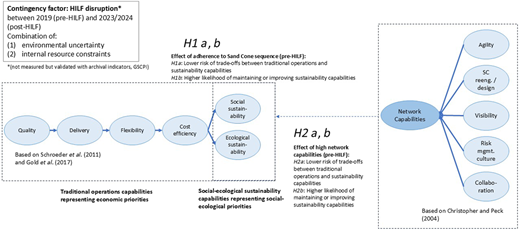
In our study, the two poles of the paradox are explicitly defined: economic priorities (represented by traditional operations capabilities such as quality, delivery, flexibility and cost efficiency) and social-ecological priorities (represented by social-ecological capabilities). We apply separation as the main response strategy, with temporal separation managing both poles over time through cumulative capability development and spatial separation managing them across multiple organisations by distributing resources and building capabilities across internal operations and external supply chain networks. These two forms of separation correspond to the cumulative logic of the Sand Cone model (H1a, b) and the integration of network capabilities (H2a, b), which together inform the following hypotheses.
2.3 Development of hypotheses
In paradox theory, temporal separation is not mere pragmatic ordering but an explicit way to allocate attention and resources to competing poles across time while keeping both salient and cycling them rather than resolving them (Poole and Van de Ven, 1989; Smith and Lewis, 2011). This implies a back-and-forth pattern in which organisations emphasise one pole in the short run while sustaining the other for later emphasis, thereby achieving dynamic equilibrium. In this lens, the Sand Cone constitutes a temporal separation response: plants stage the emphasis on economic priorities (quality → delivery → flexibility → cost efficiency) to stabilise performance while preparing the base to accommodate social-ecological priorities (labour standards, health and safety, resource efficiency, emissions reduction). By stabilising the economic pole first, firms create routines and slack that enable them to safeguard the social-ecological pole later. Temporality here thus means sustaining a both-and stance across time rather than pursuing simultaneous achievement.
This logic aligns with research on manufacturing strategy. Rosenzweig and Easton (2010) show that manufacturers with cumulative capability development and slack resources are less likely to experience trade-offs, whereas those near the performance frontier face sharper constraints. Pre-disruption sequencing can provide stability, routines and absorptive capacity, preparing firms to sustain social-ecological priorities when volatility and scarcity intensify under HILF conditions. Establishing this foundation only after disruption may strengthen firms for future events, but during disruption, it requires reordering scarce resources, which can increase trade-offs and compromise sustainability. Maintaining sustainability capabilities involves safeguarding routines and standards despite constraints, whereas developing them requires additional learning and investment. Both rely on the same resource base and represent different intensities of a temporal separation response, in which maintenance preserves continuity and development advances the established pole (Miller, 2003; Hahn et al., 2015).
Gold et al. (2017) extend the Sand Cone by showing that social-ecological sustainability can be integrated as additional capabilities, with firms' ability to do so depending on the maturity of their traditional operations capabilities. Firms with a stable Sand Cone base were better able to develop social and ecological sustainability even under institutional uncertainty. Henao and Sarache (2023) provide supporting evidence, showing that sustainability improvements follow a cumulative sequence from operational to environmental and social outcomes, while attempts to pursue all dimensions simultaneously resulted in partial trade-offs. This maturity perspective underscores why stabilised quality, delivery, flexibility and cost efficiency are prerequisites for sustaining or extending sustainability priorities. Prior studies also confirm that cumulative progression reduces trade-offs under institutional and strategic uncertainty (Amoako-Gyampah and Meredith, 2007; Tamayo-Torres et al., 2017; Ehie and Schoenherr, 2021). Taken together, the Sand Cone provides a pathway for embedding sustainability, though it remains unclear whether this logic holds in the extreme conditions of HILF disruptions. Thus, we hypothesise:
Plants that followed the Sand Cone sequence before HILF disruption events are less likely to experience trade-offs between traditional operations capabilities (quality, delivery, flexibility or cost efficiency) and sustainability capabilities (social or ecological) during such periods.
Plants that followed the Sand Cone sequence before HILF disruption events are more likely to maintain or further develop social and ecological sustainability capabilities during such periods.
The paradoxical response strategy of spatial separation manages tensions by addressing competing poles by distinct organisational loci (units, levels or firms), buffering conflict while sustaining both poles (Poole and van de Ven, 1989; Smith and Lewis, 2011; Hahn et al., 2015). Building on insights that tensions can be addressed across firm boundaries (Schrage and Rasche, 2022), we conceptualise spatial separation in global value chains as a mechanism through which internal operations hold both poles in tension while network partners buffer demand and supply volatility. Studies show that firms coordinate contradictory logics, such as cooperation and competition, by investing in both internal and shared boundary-spanning capabilities (Wilhelm and Sydow, 2018; Shi and Gregory, 1998; Teng and Cummings, 2002). Inter-organisational capability building in the form of collaboration, visibility, risk culture, re-engineering and agility thus constitutes a paradox response because it distributes the management of tensions across firm boundaries rather than collapsing one pole into the other.
HILF disruption events, such as pandemics or geopolitical shocks, typically originate outside the firm's boundaries but impose severe constraints on internal operations (Kinra et al., 2020). In such conditions, internal capabilities alone are often insufficient to absorb external shocks or to mitigate the resulting trade-offs between competing priorities (Li et al., 2023). External network capabilities are developed jointly with supply chain partners through shared resource investments and collaborative processes (Shi and Gregory, 1998; Teng and Cummings, 2002), reducing the burden on internal resources and supporting sustainability performance.
Some Sand Cone extensions incorporate supplier relationships and collaboration into the development of traditional operations capabilities (Newman et al., 2009; Bortolotti et al., 2015), but most do not address the broader set of network capabilities that extend cumulative development beyond the plant. Network capabilities, including collaboration, risk management culture, visibility, supply chain reengineering and agility, help plants buffer environmental uncertainty, especially in the form of volatile supply and demand, by stabilising interorganisational flows, enabling information exchange and facilitating coordinated responses across the supply chain (Christopher and Peck, 2004). They can complement internal operations by extending the firm's performance frontier and enabling adaptive, distributed responses in crisis contexts (Rosenzweig and Easton, 2010). Recent studies on the disruptions caused by COVID-19 (Mohammed et al., 2023; Li et al., 2023) confirm this logic and show that externally embedded capabilities support supply chain networks and stabilise internal operational processes, thereby maintaining both poles in practice. Network capabilities, therefore, represent the missing extension of the Sand Cone model at the network level, enabling spatial separation during HILF disruptions. Thus, we hypothesise:
Plants with a high level of network capabilities within their supply chain networks before HILF disruption events are less likely to experience trade-offs between traditional operations capabilities (quality, delivery, flexibility or cost efficiency) and sustainability capabilities (social or ecological) during such periods.
Plants with a high level of network capabilities within their supply chain networks before HILF disruption events are more likely to maintain or further develop social and ecological sustainability capabilities during such periods.
Based on the constructs and relationships discussed, the research model is illustrated in Figure 1.
3. Research methodology
This study combines survey-based data collection with SEM techniques and sequence testing. PLS-SEM was employed due to its suitability for smaller sample sizes and exploratory studies focused on theory extension (Hair et al., 2021; Cheah et al., 2023). To ensure rigour, consistent PLS-SEM (PLSc-SEM) was utilised, offering reliability and validity comparable to those of CB-SEM for reflective models (Hair et al., 2021; Wang et al., 2023). Sequence tests according to Schroeder et al. (2011) and Chen et al. (2023) supplemented the analysis by triangulating the cumulative effect of the sand cone sequence and providing insights into the progress made in capacity building and the trade-offs observed in the data sets before and after the HILF disruption (Narasimhan and Schoenherr, 2013).
3.1 Survey development
The survey instrument was developed from the research model (Figure 1) and established constructs (Table 2). These constructs represent three categories: internal traditional operations capabilities, internal social and ecological sustainability capabilities and external network capabilities. Measurement items (Table 2) were derived from the literature and respondents rated their manufacturing plants on a 5-point Likert scale (Schroeder et al., 2011). While most constructs were multi-item, the quality construct was reduced to one item after low-loading removal, a limitation acknowledged.
Given the challenges of longitudinal studies, a cross-sectional study design was adopted. Prior research shows that cross-sectional data comparing different conditions can approximate temporal dynamics and reveal capability progressions over time (Schroeder et al., 2011; Narasimhan and Schoenherr, 2013). The plants were retrospectively assessed under pre-HILF conditions (2019) and post-HILF conditions using data from 2023 to 2024. The questionnaire underwent rigorous pre-testing for content and face validity with three academics and two practitioners, and the SoSci Survey tool was assessed to confirm instrument validity. The questionnaire can be found in supplementary file A.
3.2 Data collection
The analysis focused on individual manufacturing plants, which often house diverse capabilities and performance levels compared to the broader business unit (Boyer and Lewis, 2002; Schroeder et al., 2011). Data collection occurred from November 2023 to March 2024. Plants were contacted via mailing lists and follow-ups, with outreach through industry associations. The process yielded a 10% response rate, reflecting the study's complexity and limited timeframe (Frohlich, 2002). Responses were collected via the SoSci Survey platform. Of 150 initial responses, 135 were retained after excluding entries with incomplete answers, uniform ratings or low self-reported confidence. The final sample includes 26 OEMs and 109 Tier 1 or lower-tier suppliers, with 51 plants operating for more than 20 years, 47 for 10–19 years and 37 for 10 years or fewer. Sixty-eight plants are located in Europe, 22 in North America, 13 in China and 32 in other regions. Regarding size, 44 plants employ more than 1,000 people, while 91 have fewer.
To ensure data quality, entries with uniform ratings or low response confidence were removed. At the survey's conclusion, respondents rated their confidence on a scale from 1 (very low) to 5 (very high); respondents with low confidence were excluded. To address common method bias (Podsakoff et al., 2003), we ensured respondent anonymity, cross-verified supplier data with rankings of a collaborating OEM and applied statistical remedies to assess the measurement model. Specifically, a full collinearity assessment, as proposed by Kock (2015), was conducted, ensuring that all variance inflation factor (VIF) values were ≤3.3. This indicates that the measurement model is free of significant common-method bias. To verify the disruption context, survey periods were compared with the New York Fed's Global Supply Chain Pressure Index (Benigno et al., 2022), which showed unprecedented supply chain pressure in 2020–2022 and stabilisation in 2023–2024. This confirms that the 2019 and 2023/24 datasets capture conditions before and after the HILF disruption phase.
3.3 Data analysis
The PLSc-SEM method was used to evaluate direct and indirect effects of operations capabilities and to assess the Sand Cone capability sequence as a prerequisite for testing H1a, b. Following Hair et al. (2021) and Wang et al. (2023), the approach included evaluating measurement and structural models, conducting mediation tests with bootstrapping and conducting robustness tests (Table 3). Data were analysed using SmartPLS 4.0 by two researchers independently.
To complement the PLS-SEM analysis, sequence testing followed Schroeder et al. (2011) and Chen et al. (2023) using the pre-HILF dataset. Constructs for quality, delivery, flexibility and cost efficiency were grouped into high (H) or low (L) based on sample medians. All theoretically valid sequences were compared against the Sand Cone logic and each plant was classified as consistent or inconsistent with this progression, enabling testing of H1a, b. An average network capability score was also calculated from the five network constructs, split at the median into high and low levels for testing H2a, b.
Trade-offs were identified when a sustainability capability decreased from high (H) to low (L) while a traditional operations capability increased from low to high. Capability building or preservation was observed when sustainability-related capabilities shifted from low to high or remained high across both periods. These patterns were analysed across the pre-disruption (2019) and post-HILF disruption (2023/2024) datasets, providing empirical insights into hypotheses H1a, b and H2a, b. Table 3 outlines these variables, including descriptions, data and corresponding hypotheses, which were then tested using Chi-square tests (Fahrmeir et al., 2016) to assess associations between categorised variables and observations, providing empirical validation for H1a, b and H2a, b.
4. Analysis and results
4.1 Results from PLS-SEM analysis
4.1.1 Measurement model evaluation
Following the measurement model assessment, certain items were removed to enhance reliability and validity. Table 4 provides both the initial and final values after these adaptations. In the operation capability (OC) model, Q1 of quality (OCQ) was removed due to outer loadings falling below 0.7, as well as critical values observed for AVE, Cronbach's alpha and reliability indicators, to improve the overall performance of the measurement model. Similarly, items S2 of social sustainability (OCSS) and E3 of ecological sustainability (OCSE) were removed due to issues with discriminant validity, as indicated by HTMT criterion values exceeding the threshold of 0.9. In the network capability (NC) measurement model, items R3 and R4 of supply chain reengineering and design (NCR), RM3 and RM4 of risk management culture (NCRM) and A3 of agility (NCA) were removed primarily due to failing the discriminant validity test, as indicated by the HTMT criterion, with high cross-loadings guiding the item selection for removal. More details on the HTMT criteria and cross-loadings are provided in Tables B.I–B.II of supplementary file B. All other measurement items in the models demonstrated highly stable results and measures, affirming their utility and reliability for measuring the constructs.
4.1.2 Structural model assessment
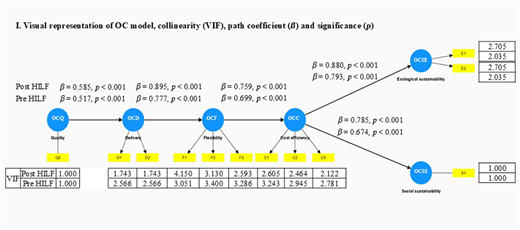
In the assessment of the operations capability model, the collinearity test (Figure 2) indicates no significant issues, as all VIF remain below the threshold of 5. Moving on to the network capability model, V1 of visibility (NCV) emerges as one item with the highest VIF in the post-HILF context (VIF 5.488), indicating slight multicollinearity concerns. However, the VIF in pre-HILF disruption remains below the threshold of 5 (VIF 3.218). The results suggest that multicollinearity may not be severely affecting the model's estimates.
Direct and indirect effects and significance of relationships of the operations capability model: The final empirical model, including the direct and indirect path coefficients (β), standard deviation (STDEV) values and statistical significance with T and p-values, was extracted using bootstrapping with 5,000 resamples. These results are summarised in Figure 2, which presents only the direct path coefficients, their significance and explained variance (R2). All remaining direct path coefficients (e.g. quality with flexibility) and indirect path coefficients, along with their significance results, are provided in the supplementary file (Table B.III). Following Hair et al. (2021), mediation testing was applied to classify the relationships as complementary, competitive, indirect-only or no mediation. In summary, both the indirect and direct effects are significant and point in the same positive direction, revealing complementary mediation. Delivery (OCD) and flexibility (OCF) were identified as key mediators across both the pre- and post-HILF disruption data sets.
Analysis of the operations capability model in pre- and post-HILF disruption contexts reveals that all direct and indirect effects are statistically significant (p-values <0.001), indicating strong direct and cumulative indirect relationships between the constructs. Despite this overall significance, notable differences emerge when comparing the pre- and post-HILF disruption data sets. In the post-HILF disruption context, the model shows stronger effects, suggesting that heightened environmental uncertainty and internal resource constraints reinforce and intensify relationships among capabilities. The model also demonstrates robust explanatory and predictive power, performing better in post-HILF disruption contexts (see Tables B.IV and B.V in Supplementary File B). The robustness checks, detailed in Table B.VI in the supplementary file B, confirm the reliability and validity of the model. Nonlinear effects demonstrate significant dynamics, such as the role of flexibility and cost efficiency in OC, highlighting the models' ability to capture complex relationships. Endogeneity testing revealed no major concerns, reinforcing the stability of key relationships, while FIMIX-PLS showed strong support for unobserved heterogeneity across segments, particularly under post-HILF disruption conditions. Together, these results support the robustness of the model, validating its relevance for understanding capability interactions in diverse contexts.
4.2 Results from sequence testing
The evaluated capability sequences are listed in Table 5, along with the number of plants that fall under each identified pattern. The associated columns indicate whether the observed sequence corresponds to the hypothesised sand cone sequence (H1a, b), marked as “Possible” or “No”. The analysis of the data reveals that 70% of plants possibly followed a traditional Sand Cone sequence in the pre-HILF disruption context, increasing to 87% in the post-HILF disruption phase. In the pre-HILF phase, a notable share of plants focused on building capabilities in quality, delivery and cost-efficiency, often at the expense of flexibility. During the disruption, however, many were required to (re)build flexibility under pressure, facing resource constraints and operational instability. This realignment often came at the expense of previously prioritised sustainability capabilities, indicating trade-offs. The post-HILF data show that more plants subsequently fell under the traditional Sand Cone sequence, suggesting a return to cumulative capability development as a response to disruption-induced pressure.
The summary below presents the results of testing hypotheses H1a, b and H2a, b. It provides detailed insights into how adherence to the traditional Sand Cone sequence (H1a, b), along with a high level of network capabilities (H2a, b), is associated with reducing trade-offs between traditional operations capabilities and sustainability capabilities (H1a, H2a). Furthermore, it examines how these capabilities relate to the preservation and development of social and ecological sustainability during phases of HILF disruptions (H1b, H2b):
H1a: Statistically supported; correlation with a χ2(1) value of 37.37, p-value <0.001 and a large Cramér's V effect size of 0.53.
H1b: Not statistically supported; no correlation with a χ2(1) value of 0.15, p-value of 0.696 and a small Cramér's V effect size of 0.03.
H2a: Statistically supported; correlation with a χ2(1) value of 12.52, p-value <0.001 and a medium Cramér's V effect size of 0.30.
H2b: Statistically supported; correlation with a χ2(1) value of 72.9, p-value <0.001 and a large Cramér's V effect size of 0.73.
Additional information on observed versus expected frequencies in relation to H1a, b and H2a, b is detailed in Table B.VII in the supplementary file B.2.
5. Discussion and implications
5.1 Discussion of results
This study examines how manufacturing plants manage tensions between economic and social-ecological priorities during HILF disruptions by developing cumulative internal and network capabilities. Paradox theory conceptualises these tensions as persistent and intensifying under uncertainty and resource constraints. Our findings imply that plants manage these tensions through two separation strategies: temporal, via sequential development of internal capabilities (Sand Cone model) and spatial, through integration of external network capabilities. Plants adhering to the Sand Cone sequence before the disruption experienced fewer trade-offs between traditional operations and sustainability capabilities (H1a supported). Likewise, plants with strong network capabilities managed trade-offs more effectively (H2a supported), confirming the role of network-based capabilities (Christopher and Peck, 2004). In line with H2b, plants embedded in such networks were also more likely to sustain or enhance social and ecological capabilities during crisis conditions.
Surprisingly, many plants had not followed the traditional Sand Cone sequence before the COVID-19 pandemic. Under stable conditions, automotive manufacturers often prioritised cost efficiency over flexibility, consistent with Schroeder et al. (2011). Once exposed to high uncertainty and resource constraints, however, many shifted towards cumulative capability development paths, indicating a realignment with Sand Cone logic. This pattern aligns with earlier findings that uncertainty can reinforce cumulative progress (Amoako-Gyampah and Meredith, 2007; Ehie and Schoenherr, 2021; Gold et al., 2017). From a paradox theory lens, this shift reflects temporal separation: as tensions intensified, plants initially made short-term trade-offs but simultaneously pursued a long-term, staged process to accommodate competing priorities over time (Smith and Lewis, 2011; Hahn et al., 2015). Structured sequencing under disruption thus represents a paradoxical response aimed at stabilising performance while integrating conflicting priorities (Berti and Cunha, 2022).
Supporting H2a and H2b, strong network capabilities helped plants buffer uncertainty and sustain or improve sustainability performance. This aligns with the spatial separation logic of paradox theory, showing how inter-organisational capability building enables plants to address trade-offs across boundaries (Hahn et al., 2015). The result echoes Wilhelm and Sydow (2018), who find that firms developing relationship-oriented capabilities better manage supplier–network tensions and Schrage and Rasche (2022), who show that spatial separation can serve as a context-sensitive response to inter-organisational misalignments.
Exploratory post hoc analyses of network capability progression (Supplementary File B.3) show a sequence of collaboration and risk management culture, progressing with visibility and supply chain redesign to agility, reflecting the hierarchical capability model of Jain et al. (2017). Plants with higher resource sharing showed stronger network capabilities, as well as control tests on network sequence adherence and shared resources (Supplementary File B.3, Table B.VII) confirm this pattern.
An additional post hoc robustness check, alternative Sand Cone extensions were analysed, as proposed in prior literature (Avella et al., 2011; Henao and Sarache, 2023). Several models, including those prioritising ecological sustainability before cost efficiency, produced weaker results based on BIC, path coefficients and R2. The cumulative path tested here: from quality through delivery, flexibility and cost efficiency to social and ecological sustainability showed the best fit (Supplementary File B.4). This supports Gold et al. (2017), who position sustainability capabilities as the top layer of an extended Sand Cone, while contrasting with the reverse sequence proposed by Molinaro et al. (2024).
5.2 Contribution and implications for theory and practice
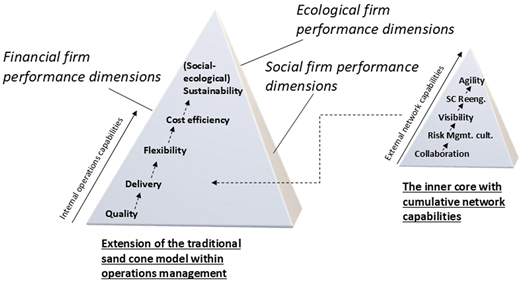
This study contributes to manufacturing strategy by re-examining the Sand Cone model under HILF disruptions and by proposing an extended Supply Chain Sand Cone model (Figure 3). Our empirical results support the cumulative capability logic and, therefore, the sand cone model as a valid mechanism to reduce trade-offs when firms face resource constraints and environmental uncertainty. This provides empirical insight into prior research linking strategic and institutional uncertainty to cumulative capability logic (Amoako-Gyampah and Meredith, 2007; Ehie and Schoenherr, 2021; Gold et al., 2017) and responds to Wiengarten et al.’s (2023) call to evaluate sustainability-related capabilities under disruptive conditions.
Relative to prior extensions, our model advances the literature in four ways. Firstly, while Gold et al. (2017) extend the Sand Cone to integrate social and ecological sustainability, their analysis remains limited to the firm level and to institutional uncertainty. In contrast, our study embeds sustainability within a multi-level supply-chain model and demonstrates how social and ecological capabilities are safeguarded or developed during HILF disruptions. Secondly, earlier extensions have linked cumulative logic to supply-chain integration. Newman et al. (2009) outline four levels of integration from functional to multi-tier, but their insights remain exploratory. Bortolotti et al. (2015) emphasise organisational fitness, such as supplier relationships and stability, as the foundation of cumulative progression. Tham and Chiadamrong (2016) provide quantitative evidence that supply-chain integration, operations and human-resource-management capabilities reinforce traditional operations capabilities and performance in line with Sand Cone logic. While these studies show that integration supports progression, they focus mainly on direct buyer–supplier relationships and do not address broader network capabilities or social-ecological trade-offs. We extend this work by integrating a wider set of network capabilities, including visibility, risk-management culture, supply-chain re-engineering and agility, alongside collaboration. This allows cumulative logic to extend across multiple tiers while explicitly incorporating social-ecological priorities. Our exploratory post-hoc analysis further suggests that network capabilities follow a cumulative sequence at the supply-chain level, an empirical pattern not previously articulated.
Thirdly, our study re-examines the cumulative capability logic in the context of HILF disruptions. Whereas earlier studies focused on institutional or strategic uncertainty (Gold et al., 2017; Amoako-Gyampah and Meredith, 2007; Ehie and Schoenherr, 2021; Tamayo-Torres et al., 2017), our study demonstrates how cumulative logic operates under global disruption conditions validated by archival indicators of the GSCP Index (Benigno et al., 2022). This contextualisation expands the cumulative capability theory by showing that temporal separation within manufacturing plants and spatial separation across supply chain networks serve as paradoxical response strategies during crises. Fourthly, we provide novel empirical insights into tensions between economic and social-ecological priorities by operationalising them as observed trade-off patterns across pre- and post-disruption periods (Hahn et al., 2015; Berti and Cunha, 2022). Previous sand cone extensions were typically based on performance results from a single time period (Schroeder et al., 2011). Our design approximates a longitudinal study design through retrospective assessments and captures how specific capability progressions influence trade-offs under disruptive conditions.
Based on these findings, we propose an extended Supply Chain Sand Cone model for global HILF disruptions (see Figure 3). This model incorporates: (1) the cumulative development of internal operations capabilities as a foundation for social and ecological sustainability, (2) external network capabilities that amplify internal effects and reduce trade-offs and (3) a multidimensional view of performance that includes financial, social and ecological outcomes (Elkington, 1994). Although firm performance was not part of this study, the proposed model reflects current research findings (Lee et al., 2016; Henao and Sarache, 2023; Molinaro et al., 2024), demonstrating the positive impact of operational capabilities on economic, environmental and social firm performance.
Beyond these specific extensions, the study also contributes to broader debates on sustainability transitions by showing that cumulative operations and supply chain capabilities act as stabilising mechanisms that help firms maintain progress on social, ecological and economic priorities during periods of disruption (Pahl-Wostl et al., 2023). In addition, the findings empirically enrich paradox theory by showing how temporal and spatial separation strategies interact in managing tensions between economic and social-ecological priorities within plants and across inter-organisational supply networks (Berti and Cunha, 2022; Hahn et al., 2015).
This study provides practical guidance for plant managers trying to balance economic and social-ecological goals during HILF disruptions. A key implication of the expanded model is that capability development should be consciously sequenced to achieve both economic and social-ecological priorities rather than trading one priority off against the other. Before disruptions, managers should strengthen fundamental capabilities in a stepwise approach, starting with quality, then delivery, to provide stability and routines to buffer shocks. Flexibility and, finally, cost efficiency can follow once these fundamentals are in place, supporting operational slack and resource efficiencies that secure sustainability initiatives. During disruptions, managers should resist sacrificing social-ecological priorities to short-term pressures and instead activate network capabilities to stabilise performance. Investments in visibility systems, contingency planning and collaborative platforms such as Catena-X enable shared quality, logistics and inventory information (Catena-X, 2025). Building trust and collaboration with suppliers establishes stronger risk management, visibility and agility, suggesting that network-capability development also follows a staged sequence. Mapping capabilities jointly across supply networks, as suggested by Newman et al. (2009), can help firms identify sequencing gaps and assign leadership responsibilities for collaborative initiatives.
Leading companies in the network should support their supplier base through step-by-step capability and collaborative development programmes, rather than withdrawing immediately, in line with the European Corporate Sustainability Due Diligence Directive (Kinra and Warmbier, 2025). Suppliers, in turn, should integrate internal sustainability practices into their development plans and gradually expand to network-wide initiatives such as Together for Sustainability or CSR Europe, which promote common standards and collaborative approaches. These implications underscore that a stepwise approach towards investments and collaborative governance is essential to manage tensions effectively between economic and social-ecological goals in times of uncertainty. Managers who view capability development as a cumulative, path-dependent process within their own manufacturing plants and across networks are better able to maintain competitiveness and meet the rising expectations of stakeholders in a volatile environment.
6. Conclusion
This study examined how manufacturing plants manage tensions between competing economic and social-ecological priorities under HILF disruptions, characterised by environmental uncertainty and internal resource constraints. Findings show that adherence to the Sand Cone sequence, beginning with quality, followed by delivery, flexibility and cost efficiency and extending towards social and ecological sustainability, mitigates trade-offs between traditional operations and social-ecological sustainability capabilities. Furthermore, a high level of network capabilities across the supply chain reduces trade-offs and supports the development of sustainability capabilities by reinforcing internal operations under volatile conditions.
By situating cumulative capability development within the paradox of competing economic and social-ecological priorities, this study advances the research agenda on corporate sustainability paradoxes under crisis conditions. It conceptualises HILF disruptions as a compound contingency that makes paradoxical tensions salient and proposes an extended Supply Chain Sand Cone model that links temporal separation within manufacturing plants (cumulative operations capabilities) with spatial separation across supply chain networks (network capabilities). This model explains how firms use cumulative operations and network capabilities to mitigate trade-offs, navigate sustainability-related tensions in practice and maintain momentum in sustainability transitions under disruptive conditions.
While the study advances understanding of cumulative capability development during HILF disruptions, it is not without limitations. The short survey duration may have affected the response rate and measurement models. Additionally, the use of cross-sectional data limits causal inferences, as it captures responses at a single point in time. Future research could therefore focus on longitudinal studies to better understand the dynamic effects of cumulative capability development. The reliance on dual perspectives collected at a single time point may introduce biases, despite efforts to reduce these through cross-checks, emphasis on historical company data and exclusion of low-confidence entries. Moreover, survey-based research remains susceptible to common method bias, including social desirability and item ambiguity. While steps were taken to minimise these biases, they cannot be fully ruled out. A further limitation is that HILF disruptions were conceptualised as a compound contingency but not directly measured, with archival indicators such as the GSCP index used for validation.
Future research should further extend this work on sustainability paradoxes under crisis conditions. Longitudinal studies could capture how capability sequences unfold across disruption phases and how plants shift between short-term trade-offs and longer-term balancing strategies. Future studies may also incorporate plant-level measures of uncertainty or examine different types of HILF disruptions to clarify when cumulative capability logic is most effective in mitigating tensions. Furthermore, examining how network capabilities and shared resources are owned and utilised within supply chains, particularly focusing on the buyer–supplier relationship, could significantly enhance the understanding of their effectiveness within manufacturing strategies. Finally, researchers could explore synthesis strategies, such as digitalisation, data-sharing platforms or collaborative governance, to understand how firms may simultaneously advance both poles of the corporate sustainability paradox. Together, these avenues would contribute to the broader agenda of understanding how organisations manage economic, social and ecological tensions and support sustainability transitions under conditions of severe uncertainty.
The supplementary material for this article can be found online.