


The collective impact (CI) model has been applied to facilitate the systemic change of family services in Finland. Backbone organizations support the CI model in regional implementation. This article aims to examine the roles of backbone organizations in the CI model through an integrative leadership framework.
This qualitative study is based on data from 41 thematic interviews. The interviewees worked at the local level (municipalities), regional level (well-being services counties) and national level (national backbone organizations). The interviews were analyzed using qualitative content analysis.
Achieving systemic change through the CI model requires ongoing support from national and regional backbone organizations. Based on the analysis, we combine previous research on integrative leadership to the recognized roles of backbone organizations, further developing existing understanding. Of eight established integrative leadership functions, seven roles were recognized as appearing in either regional, national or both levels of backbone organizations.
The study advances understanding of the integrative leadership functions of backbone organizations and suggests that the function of knowledge and information broker to be added to the main functions of integrative leadership.
Introduction
Table A1Public-sector organizations currently face increasingly complex challenges that cross organizational boundaries (Head and Alford, 2015, p. 712; Bryson and Crosby, 1992, p. 4; Luke, 1998, p. 1). These problems are visible in various sectors, such as social and health services, municipal educational services and third sector activities. Social problems, in particular, are highly complex and tend to accumulate over time, making early intervention essential (e.g. Hilli et al., 2017). Addressing these problems often requires systemic change (Jones, 2014; Maani and Maharaj, 2001; Stroh, 2015). Clarke and Crane (2018) define systemic change as “the result of actions that lead to a significant alteration within a system, potentially leading to substantial impacts. The system can be at any scale.” Similarly, Foster-Fishman et al. (2007) describe systems change as “an intentional process designed to alter the status quo by shifting and realigning the form and function of a targeted system.” To tackle these complex problems requires shared resources and intensified interaction between different actors (Huxham and Vangen, 2005, p. 7; Klijn and Koppenjan, 2016, p. 4; Williams, 2013). Such collaboration involves the engagement of leaders from multiple organizations – none of whom have formal authority over the others (e.g. Crosby and Bryson, 2010, p. 211; Sun and Anderson, 2012, p. 309). New forms of leadership and collaborative governance are needed to gain an advantage (e.g. Silvia and McGuire, 2010, pp. 264–265; Costumato, 2021, p. 262). Organizations need methods of utilizing each other's resources in order to address public problems more effectively. This requires various forms of resource sharing, each involving some level of commitment and some degree of reduced independence (Crosby and Bryson, 2005, p. 17).
The discussion around leadership in cooperation involves competing concepts, such as catalytic leadership (Luke, 1998), collaborative leadership (e.g. Chrislip and Larson, 1994), collective leadership (e.g. Contractor et al., 2012; Quick, 2017), facilitative leadership (e.g. Svara, 2003; Ansell and Gash, 2008; Greasley and Stoker, 2008), network leadership (e.g. McGuire and Silvia, 2009; Silvia, 2011), shared leadership (Bryson and Crosby, 1992; Crosby and Bryson, 2005) and integrative public leadership (e.g. Crosby and Bryson, 2010; Morse, 2010). Integrative public leadership seems to be a unifying and interdisciplinary framework (Morse, 2010, p. 231; Parkkinen, 2024); therefore, this study adopts this perspective to explore the leadership of public service renewal in children and family services.
The integrative leadership perspective is particularly relevant in the context of the welfare service reform that came into effect in Finland at the beginning of 2023, which fundamentally altered the logic and relationships within the service system. Responsibility for organizing health care, social welfare and rescue services was transferred from municipalities and municipal federations to newly established regional well-being services counties (WSC) (Mattila and Kallio, 2025). Finland has 21 WSC, and the number of municipalities within each county varies between 2 and 30. The state finances the operations of the WSC. Municipalities still manage education, early childhood education and youth services. Coordinating services across these two levels presents a key challenge.
The collective impact (CI) model can be collaboratively applied at different levels. In Finland, the CI model has been utilized by Itsenäisyyden juhlavuoden lastensäätiö (ITLA) to address service system challenges since 2020. ITLA is an independent, non-profit foundation with a delegation consisting of members of parliament. Parliament elects the members of the delegation from among its own members. The delegation, in turn, appoints the members of the foundation's board (Itla, 2026). The funding of ITLA is based on an endowment (EUR 50mn) by parliament. ITLA's operations are financed through the returns generated by this investment capital. The CI work is funded from ITLA's own budget, and ITLA also finances the operations of the national backbone (NB) organization from its internal budget. In addition, ITLA funds the work of the regional backbone employees, also known as development workers (at 50% working time), in the four regions (during 2020–2026) that first initiated CI work. Other participating regions finance their CI work from their own budgets.
The CI model is grounded in systems thinking (Clarke and Crane, 2018), viewing the child's environment – family, school, hobbies and services – as an interconnected community. These services include, for example, educational services (such as schools and early childhood education), social services (e.g. child welfare), health care services, youth services and leisure services. The concept of CI has been defined as “a network of community members, organizations, and institutions that advance equity by learning together, aligning and integrating their actions to achieve population and systems-level change” (Kania et al., 2022).
The application of the CI model is a multi-phase process (Takalo et al., 2022) that requires support for effective implementation. Backbone support plays a central role by supporting and coordinating the work done at the regional level among different actors (e.g. Kania and Kramer, 2011; Virtanen et al., 2020). A backbone organization is usually a separate actor from the organization implementing the CI model (Kania and Kramer, 2011). In ITLA's model, ITLA serves as a national and independent backbone support organization. In addition, development workers from regional organizations (municipalities and/or WSC) act as regional backbone support. Together, national and regional backbones support CI work and implement a common strategy and action plan (e.g. Kania and Kramer, 2011; Virtanen et al., 2020). Backbone organizations have specific skills designed to promote coordination, cooperation and leadership (Kania and Kramer, 2011, pp. 7–8). Previous research on backbone organizations identifies key mechanisms and functions (e.g. regular dialog, providing strategic direction, national visibility, handling communication and coaching), with which these entities foster change among participating organizations (DuBow et al., 2018; McGladrey et al., 2020).
In this article, we focus on the CI model's backbone support to enhance the understanding of the roles backbone organizations play in the Finnish context. Our perspective focuses on the two levels of backbone support: ITLA acts as a NB organization, while development workers play a backbone role at the regional level. Existing literature reveals a research gap in understanding the roles of backbones at different levels. To address this gap, this study examines the CI model built to support the development of services for children and families, particularly from the perspective of the backbone organization's roles and the relations between national and regional organizations. Our research questions are:
What kind of leadership roles do backbone support organizations play?
How are roles divided between national and regional organizations?
The CI model has not previously been examined through the lens of integrative leadership. This study combines observations from national and regional level backbones. The scientific contribution of this study arises from identifying the integrative leadership functions of backbone organizations, as opposed to individual roles, and understanding how these functions are distributed among different actors. The practical contribution of the study focuses on the significance of leadership in the CI model and how leadership should be implemented and developed to achieve the desired goals.
Integrative leadership functions
Integrative leadership has been defined as bringing together diverse groups in semi-permanent ways to address complex public problems across sectoral boundaries to advance the common good (Crosby and Bryson, 2010, p. 211). Integrative leadership recognizes the dispersal of influence and the transformation of supervisor–subordinate relationships, which form as a result of networked relations between different actors (Luke, 1998, pp. 22–23). Successful integration is more profound than normal collaboration, and it strengthens relations between actors, helps networks to operate more smoothly and helps the participants achieve outcomes that would not otherwise be possible (Morse, 2010). While integrative leadership functions can be carried out by a single actor, they are usually performed by various actors with different competencies (Crosby et al., 2017, p. 661). The concept of integrative leadership can be used to understand the leadership functions of national and regional backbone organizations. It provides a framework for reviewing how integrative leadership functions are divided between national- and regional-level backbone organizations and actors.
Huxham and Vangen (2000, pp. 1166–1167) can help with the exploration of integrative leadership by pointing to the importance and effects of leadership as exercised or instantiated through structures, processes and participants. In this article, we examine structural leadership through backbone organizations. Structure plays a key role in shaping agendas and implementing them. The role of structures determines key factors such as who sets the agenda, who has power to act and what resources are used. Despite their importance, collaborative structures in the public sector are often externally imposed by policymakers or funders rather than designed by the collaborators themselves, limiting members' control over how the partnership is organized and governed (Huxham and Vangen, 2000, pp. 1166–1167). Leading a social transformation, such as a CI initiative, requires multi-issue, multi-level, multi-organizational, cross-sectoral changes, and it may cross national borders. It also demands deep and permanent changes in relationships, including power relationships, among people and groups. Advancing social transformation necessitates leadership that is relational, visionary, political, adaptable and capable of navigating complex systems (Bryson et al., 2021).
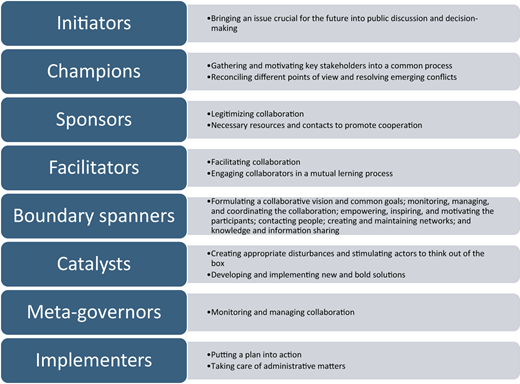
Previous research recognizes different characteristics of integrative leaders. Integrating leaders act as initiators, champions, sponsors and facilitators (Crosby and Bryson, 2010, p. 219; Torfing and Díaz-Gibson, 2016, pp. 107–108), creating the prerequisites for effective collaborative network. These functions mean that leaders build a shared understanding of the problems that need to be solved and the goals that need to be met to do so. Leaders also encourage participants to keep engaging in collaboration, build trust and legitimacy between participants, facilitate interactions, reconcile different points of view and resolve emerging conflicts (Huxham and Vangen, 2005, p. 214; Crosby and Bryson, 2010, p. 219; Page, 2010, pp. 249–250). Collaboration can be promoted through various practices and processes, such as redefining problems and combining viewpoints in a manner that resonates with various actors (Morse, 2010, p. 241; Redekop, 2010, p. 289).
In addition to initiators, sponsors and champions, other leadership functions become essential after a collaboration network is established. These functions include boundary spanners, catalysts, meta-governors and implementers. Boundary spanners are particularly important for crossing organizational boundaries and building integrative partnerships (Morse, 2010, p. 244). Process facilitators, in turn, are beneficial for achieving effective collaboration across organizational boundaries and engaging collaborators in mutual learning (Torfing and Díaz-Gibson, 2016, pp. 107–108). The literature identifies typical behaviors that are central to boundary-crossing collaboration. The function of the boundary organization as a boundary spanner is important in cross-sectoral collaboration. The CI model requires this kind of cross-sectoral collaboration. Boundary organizations help build collaboration by providing a platform that facilitating cross-boundary integration (Morse, 2010, pp. 239–240; Cash et al., 2006; Feldman et al., 2006). Previous literature recognizes the function of a boundary spanner in knowledge and information sharing (Williams, 2002, pp. 20–21). A boundary organization's function can facilitate communication by ensuring that all collaborators have an equal possibility to participate (Morse, 2010, pp. 233–234). It should formulate a collaborative vision and common goals; monitor, manage and coordinate the collaboration; empower, inspire and motivate the participants; contact people and create and maintain networks (Morse, 2010, p. 241; Torfing and Díaz- Gibson, 2016, p. 106; Redekop, 2010, p. 286). Boundary organizations develop and leverage relationship capital and recognize different perspectives, which enables them to act as a mediator and interpreter between participants (Ospina and Foldy, 2010, p. 297; Sun and Anderson, 2012, p. 314). Leaders should be able to build trust between participants and promote organizational learning (Redekop, 2010, p. 286; Alban-Metcalfe and Alimo-Metcalfe, 2010, p. 4). These functions appear to be important components of backbone support in CI work.
Catalysts are essential in introducing suitable disruptions and inspiring participants to think creatively, as well as in developing and implementing bold solutions (Morse, 2010, p. 234; Torfing and Díaz-Gibson, 2016, p. 108). Meta-governors are responsible for monitoring and managing the collaboration, while implementers ensure that actions are carried out (Torfing and Díaz-Gibson, 2016, p. 106; Crosby et al., 2017, p. 661). The function of implementers is crucial in networked innovations, which are typically uncertain processes (Crosby et al., 2017, p. 661). Based on the previous literature, we have outlined the functions of integrative leadership in a backbone organization (Figure 1).
Integrative leadership functions can be shared among participants, which can mean that integrative leadership includes shared leadership practices (Silvia and McGuire, 2010, p. 275; Anderson and Sun, 2017, pp. 85–86; Bryson and Crosby, 1992, p. 32). The distribution or exchange of leadership functions should be based on the leader's competencies and ability to facilitate necessary actions (Huxham and Vangen, 2005, p. 206). Collaboration may be highly resource consuming and stressful. Consequently, participants should only engage in collaboration when there is clear benefit (Huxham and Vangen, 2005, p. 80). Collaboration may involve power imbalances, shocks and competing institutional logics, and integrative leaders have a responsibility to resolve these situations (Silvia and McGuire, 2010, pp. 266–267; Williams, 2002, pp. 115–116). ITLA's role as a backbone organization is to help align diverse aspirations and goals toward a common direction.
Research data and methodology
This article draws on data from ITLA's CI model evaluation, collected between November 2024 and February 2025 across five WSC (Pohde, Siunsote, Soite, Pirha and Oma Häme) (see Table 1), two cities (which are also municipalities) (Tampere and Oulu) and ITLA (NB). The two cities, Oulu and Tampere, initiated CI work before the WSC reform. After the reform, cities and WSC have co-operated in CI work. Tampere is part of the Pirha WSC, and Oulu is part of the Pohde WSC.
Well-being services counties and number of municipalities
| Well-being services county | Number of municipalities in total | Number of municipalities participating collective impact work* |
|---|---|---|
| OmaHäme | 11 | 11 |
| Soite | 8 | 7 |
| Pirha | 23 | 4 |
| Siunsote | 13 | 13 |
| Pohde | 30 | 30 |
Note(s): * Situation at the time of data collection
The data cover all regions where CI work was conducted during the data collection period. The research material consists of 41 thematic interviews: 37 from CI regions (WSC and cities) and 4 from the CI work's NB, ITLA. The NB consists of four members, all of whom participated in the interviews. At the regional level, the backbone's function is carried out by development workers, usually 1 to 2 individuals in each area. Development workers from all WSC and cities participated in interviews. In addition to the development workers, other individuals involved in CI activities were interviewed. They worked in municipalities and WSC in leading positions or as professionals and developers in the social and healthcare or education sectors (see Table 2). The interviews lasted 30–60 min long on average and were transcribed. All interviews were conducted in Finnish, and the quotations used in the analysis section were translated into English. In addition to the interviewee's number code, the following abbreviations indicate organizations that were referred to in the quotations: WSC (wellbeing services counties), M (municipalities) and NB (national backbone). Ethical guidelines were followed in the handling of the research data.
Background organizations of the interviewees
| Interviewees background organization | Amount of interviewees |
|---|---|
| National level | 4 persons (includes all national-level employees) |
| Regional level (well-being services counties) | 17 persons |
| Municipality (cities included) | 20 persons |
This research is based on a qualitative design, and the data was produced through thematic interviews. The interview themes included the CI model phase (when was the CI work initiated and how has the work progressed in the region), systemic change and change goals, results, development and roles. The interviews were analyzed using qualitative content analysis, also known as ethnographic content analysis, a systematic technique for compressing meanings from text data. The analysis focuses on identifying the topics, issues and themes discussed by the interviewees. The data were coded into content-related categories, and the relationships between these categories were examined. Attention was paid to both differences and similarities across the data units. Qualitative content analysis is typically used in research aiming to describe a phenomenon (Hsieh and Shannon, 2005, p. 1279). Our analysis focused on the roles of backbone organizations in CI context and the similarities and differences between the roles of national and regional backbone organizations.
The analysis (see Figure 2) was based on the researchers' independent reading of the interviews. Instead of relying on predefined categories, researchers let the data guide the development and naming of categories, following an inductive approach (Hsieh and Shannon, 2005, p. 1279). Themes subsequently emerged as a result (Neuendorf and Kumar, 2015 p. 4), and we recorded general observations that arose from the transcriptions according to backbone roles and leadership, highlighting the relevant points in the data that addressed different roles. We then coded the data (see Appendix 1), extracting points from the interviews and grouping them on the basis of their similarities (grouping). After that, we compressed these categories into fewer topics (categorization), which formed the backbone roles (Elo and Kyngäs, 2008, pp. 109–112). After the analysis, we returned to the literature to identify a more comprehensive framework for the backbone roles beyond the backbone literature. Then, we identified the connection between backbone roles and integrative leadership. After gaining a deeper understanding of integrative leadership roles, we interpreted the backbone roles within the framework of integrative leadership as a form of abstraction.
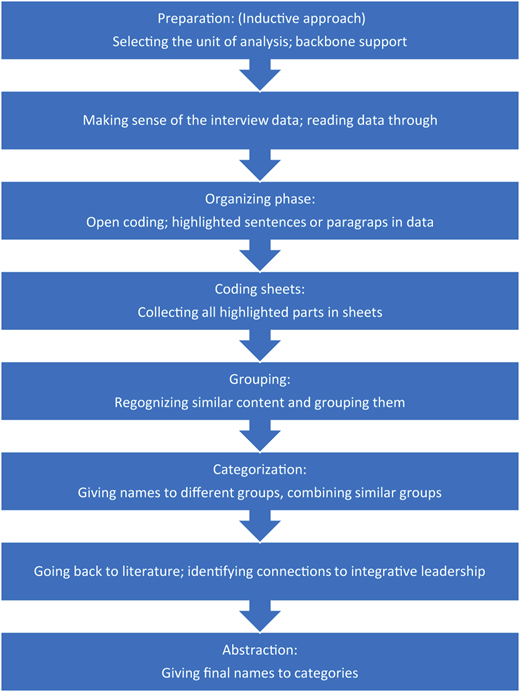
Analysis process description (accordingly Elo and Kyngäs, 2008, p. 110). Authors’ own work
Roles of the backbone organizations
This analysis section describes the different roles that a backbone organization plays in CI work in our sample. First, we examine the roles of a NB, in this case the ITLA Foundation, and the roles of a regional backbone, here representing various regional organizations, within the CI model.
Roles of a national backbone organization
The analysis identified five distinct roles in the functioning of the NB organization within the CI model.
Futures thinker
The NB organization challenges the thinking of CI regions and aims to broaden perspectives, helping regions recognize their prevailing ways of thinking. It is typical for regions to have a short-term operational horizon and to examine changes within the prevailing context. The NB organization introduces a longer-term horizon into the discussion and encourages future opportunities for change in the functioning and development of the service system. Additionally, the NB organization strengthens the pursuit of change in services through its support. The following quotation illustrates how one interviewee described a broader future perspective:
Somehow, I think this at best stops us at the point of asking good questions. Where are we and what are we striving for? What helps us all in our work and especially when we do it for children and young people and families. 21/M
Implementation supporter
The NB organization acts as an implementation supporter in the regions, assisting in the practical implementation of systemic change. It facilitates broader regional events and acts as a coach in the planning, implementation and execution stages of the change process, as well as in addressing everyday questions. The NB organization encourages regional actors and strengthens their belief in the possibility of change when facing setbacks on the path to transformation. The need and role of a facilitative implementation supporter were highlighted in the interviews:
To facilitate the dialogue that is needed, so that we can learn experientially what systemicity is and how we connect in a new way beyond our usual boundaries. Even there, it feels like external facilitation is absolutely essential. 31/WSC
The support team provides nationwide assistance for the expansion of work activities and offers resources to local developers. 38/NB
The role of the NB organization is also prominently visible in the development work carried out in the regions. In practice, this involves problem-solving work that is closely connected to everyday life and addresses issues that emerge during the change process. Additionally, the backbone organization helps regions to embed the model, which is a long-term part of the development process. The need for practical support was emphasized by one interviewee:
Yes, in this stage of implementation and development, if it were left solely to the leaders in a change situation, it wouldn't take root because there is so much other change to manage. 24/WSC
Evaluator
The NB organization also acts as an external evaluator of the region's activities and changes. As an external entity, it examines the overall development of the regions, including the achievement of goals and the progress of work. Based on this evaluation, the backbone organization guides and directs activities towards the goals while helping to keep the change process on the right track. At the same time, the evaluator supports the regions through the different phases of change, which was described in an interview:
But we clearly need people who are walking alongside us and we need support for this. And I think we are going in the right direction. Of course, when you don’t really think about it in terms of what we need, we are on so many levels. But that kind of systematic moving forward is really good support for us. 11/WSC
Bridge builder
In addition, the backbone organization builds connections between different actors. It enables various forms of peer support within the CI model. This support for employees may occur at the national, regional, local or individual levels. It provides opportunities for peer development and connects regions with each other to share knowledge and experiences on local issues. As one interviewee described the role of peer support:
It does make the national perspective and the work being done in other welfare services counties visible. Then the dialogue and, in a way, the exchange of ideas about how those issues have been resolved in different areas has given us tips for the future. That we see in the welfare service county that we ourselves have to come up with those solutions, how we act. 10/WSC
Knowledge broker
ITLA, as a NB organization, plays a crucial role in various knowledge-related practices. It provides regions with research data, for example, on services and well-being for children, young people and families, as well as on the principles and key components of the CI model. The backbone organization offers training in the regions, which enhances understanding of the CI model and facilitates its implementation. Additionally, the backbone organization enables research based on the emerging research needs from the regions. One interviewee described ITLA's role in sharing research:
A compilation of what this means. And through researched information, concretizing what this means in practice. Being supportive in that, that is probably also ITLA’s most significant task. 11/WSC
Roles of regional backbone organizations
The analysis identified four distinct roles in the functioning of regional backbone organizations within the CI model. Local backbone support typically consists of the region's development worker or workers. These roles are described in more detail below.
Cross-sectoral player
The regional backbone coordinates and plans collaboration between sectors and actors. Additionally, it is crucial to bring together key actors in day-to-day operations. Development workers build interactions between various actors and distribute materials. They act as local promoters of the CI model, especially in the early stages of its implementation, by attracting new actors and sectors to join the work. As one interviewee described interaction building:
It’s like a spider’s web in a way, where you’re dealing with all these actors and you wake up when a message comes from somewhere, so you grab it and create these relationships with each other in a way. 3/WSC
Of course, (city and name removed) has served as an expert who has been outstanding in the role of a bridge builder between different administrative sectors. 32/M.
Local support
Regional backbone support is responsible for initiating the CI model in the region and ensuring the progress of its implementation. It serves as a practical resource for the change process. Regional organizations can also train local actors to apply the CI model themselves. The role of development workers is to coach and encourage local actors in the execution of the model. They play a central role in maintaining the model and making it visible in regional discussions. The responsibility of development workers to provide local support and motivation was described in the interviews:
So, it’s like being a messenger of good news, but more so at the moment, my work time is focused on meeting people, explaining why this is being done, trying to motivate and encourage. But now, more often, I get contacted with requests to hear more about it, rather than having to forcefully push it, which was more the case in the beginning. 13/M
Local knowledge gatherer
The regional backbones maintain an overview of the CI model in the region. They monitor progress and identify local needs in development work. They strive to understand the development of activities occurring in the region. The development workers serve as a crucial link to the NB support. They share the regional overview with the national support and collaborate closely with them.
And then the collaborative work with ITLA’s backbone. 18/WSC
So, these regional backbones provide the knowledge of how things work in practice and what kinds of challenges arise; in a way, the support is reciprocal. I could even say that it does not function if either side is missing. 23/M
Information broker
The regional backbones act as information intermediaries across various local levels and sectors. Development workers engage in communication work both within their own organization and with regional partners. They bring insights from national networks into local activities and utilize peer knowledge from other regions to advance local operations. The role of development workers is supportive but not leading. One interviewee described the informative role between region and ITLA as follows:
The development worker cannot lead the collective impact work. It’s an impossibility to take that on; there must be strong leadership from the leaders in that area. And then supporting them and communicating what comes from ITLA, and being in between. 3/WSC
Based on the analysis, national and regional backbone organizations have differing and similar roles within CI models. While they may perform the same kinds of functions, the level at which these roles are performed differs. Even though national and regional backbones exist in different organizations, they support each other and form a continuum.
Discussion
The integrative leadership framework (Silvia and McGuire, 2010) proposes that leadership functions may vary between different actors. Our analysis shows that the roles of backbone organizations (see Table 3) can be synthesized with previous research on integrative leadership. Of the eight integrative leadership functions, we recognize seven that appear in backbone organizations at regional, national or both levels. Four functions – champions, facilitators, boundary spanners and meta-governors – are exhibited by both national and regional backbones. It is typical that integrative leadership functions are carried out by various actors (Crosby et al., 2017, p. 661) and functions are shared based on competencies (Huxham and Vangen, 2005, p. 206). ITLA, as an NB organization, carries the functions of initiator and catalyst, while the regional backbones serve as implementors. The NB is responsible for the development and dissemination of the CI model across regions. At the same time, it supports regional CI efforts in various ways, as reflected in its roles. The regional backbone organizations represent a continuation of national-level activities, with their main role being to implement the CI model at the regional level. The national and regional backbones work in close collaboration with one another.
Integrative leadership functions compared to backbone roles
| Functions of integrative leadership | Role keeper/keepers on CI backbone | Backbone role(s) representing integrative leadership function |
|---|---|---|
| Initiators Bringing issues crucial for the future into public discussion and decision-making | National backbone | Futures thinker |
| Champions Gathering and motivating key stakeholders into a common process Reconciling different points of view and resolving emerging conflicts | National backbone and regional backbones | National backbone role: Bridge builder Regional backbone role: Cross-sectoral player |
| Sponsors Legitimizing collaboration Providing necessary resources and contacts to promote cooperation | Missing role of backbone organizations | The role operates outside the backbone organization |
| Facilitators Facilitating collaboration Engaging collaborators in a mutual learning process | National backbone and regional backbones | National backbone role: Implementation support Regional backbone role: Local support |
| Boundary spanners Formulating collaborative vision and common goals, monitor, manage, and coordinate the collaboration, empower, inspire, and motivate the participants, contact people, create and maintain networks; knowledge and information sharing | National backbone and regional backbones | National backbone role: Evaluator, Knowledge broker Regional backbone role: Cross-sectoral player, Information broker |
| Catalysts Creating appropriate disturbances and stimulating actors to think out of box Developing and implementing bold solutions | National backbone | National backbone role: Futures thinker |
| Meta-governors Monitoring and manage collaboration | National backbone and regional backbones | National backbone role: Implementation supporter, Evaluator Regional backbone role: Local support, Local knowledge gatherer |
| Implementors Implementer and administrator | Regional backbones | Regional backbone role: Local support |
| Information and knowledge broker* Acts as a knowledge broker by conveying practical and scientific knowledge and sharing expertise | National backbone and regional backbones | National backbone role: Knowledge broker Regional backbone role: Information broker |
Note(s): *Suggested new integrative leadership role
The NB acts as a knowledge broker, providing research data, information about the CI model, knowledge about required structures and training sessions, as well as conducting research on the model. Each regional backbone serves as an information brokers, disseminating information at the regional level, communicating within the organization and utilizing information received from the national level in the regional context. Shared knowledge plays a crucial role in the collaboration between backbone organizations within the CI model. While previous literature (Crosby and Bryson, 2010; Torfing and Díaz-Gibson, 2016; Morse, 2010; Crosby et al., 2017; Williams, 2002) portrays the role of information and knowledge broker as part of the boundary spanner role, our analysis found the brokering role to be so significant that we view it as an independent function.
Missing function of sponsors
The only integrative leadership function not represented by backbone organizations was that of sponsors. While regional backbones have several features of integrative leadership and play a key role in the regional implementation of the model, according to their own interpretation, they do not lead the CI model. However, this function still exists within the regional organizations and is performed by other regional leaders (e.g. sector directors and political leaders). Although these other leaders may only be loosely or unofficially connected to the backbone organization, they legitimize the work, enable resourcing and help ensure that the goals of CI models are met in regional circumstances. To fully realize the benefits of integrative leadership functions of the backbone, there is a need to integrate sponsors more closely into backbone support.
Conclusions
Achieving systemic change (Clarke and Crane, 2018; Jones, 2014; Maani and Maharaj, 2001; Stroh, 2015) through the CI model in children and family services requires the implementation of many simultaneous development processes and commitment at various levels, nationally and regionally. This study examines the roles of backbone organizations through the lens of an integrative leadership framework and applies a structural approach to integrative leadership (see Huxham and Vangen, 2000). Backbone organizations, as integrative actors, are central in enabling and implementing systemic change according to the principles of integrative leadership. We identified the roles of backbone support form a continuum across national and regional levels. In the Finnish context, integrative leadership functions in the CI model are carried out by multiple actors; this is a typical characteristic of integrative leadership (Crosby et al., 2017). Roles at the national level include futures thinker, implementation supporter, evaluator, bridge builder and knowledge broker. Roles at the regional level comprise cross-sectoral player, local support, local knowledge gatherer and information broker. Understanding these roles is important because leading a social transformation like CI initiative requires deep and permanent changes in power relationships (see Bryson et al., 2021).
In ITLA's CI model, the integrative leadership roles are partly shared and partly divided between the national and regional level, with one role – the sponsor's role – existing outside of the backbone and, in this case, held by other regional leaders. The function of the sponsor is particularly significant in ensuring the continuity of the CI model. The practical implementation and operationalization of the model require securing the necessary resources and long-term sustainability. This, in turn, necessitates the legitimacy of both organizational leadership and political leadership, as the activities are carried out within the public service system. Having examined integrative leadership from a structural perspective, we acknowledge the importance of organizations taking part in CI work recognizing that both organizational and political leaders serve as sponsors. Regional backbones cannot independently decide on a course of action or guarantee the continuity of CI work. Political authorities significantly influence these efforts, especially in terms of the resources they provide (see Huxham and Vangen, 2000).
Through this study, our understanding of integrative leadership has evolved. Based on our analysis, we propose highlighting the role of knowledge and information broker in the framework of integrative leadership. Backbone organizations as integrative actors enhance the understanding of relevant research data in practice as well as information considering the CI model.
There are some limitations in the study. As a qualitative review, its results cannot be broadly generalized. Context and shared goals inherently influence which actors are involved and what kinds of roles emerge. Therefore, the results of the study should be evaluated in the context in which the research was conducted and the data were collected. However, regardless of the context, there is some generalizability regarding the need for particularly integrative leadership and more diverse roles compared to what previous research has suggested. Based on the study, we also identify the need for further research. Future studies should examine how the role of the sponsor evolves within the CI model over time and across different stages of implementation. A deeper understanding is needed of the dynamics between political leaders and public officials in the operationalization of the CI model, particularly regarding how their interaction shapes and legitimizes the sponsor role. Such inquiry could provide valuable insights into the governance conditions that enable or constrain the effective functioning of sponsorship in public-sector CI initiatives. The framework of integrative leadership delves into questions of leadership structure (Crosby and Bryson, 2010) alongside roles. We recognize that this is another key issue that should be examined in the future within the context of the CI model.
As a practical contribution we recognize that ITLA emerges as a neutral external actor capable of facilitating transformation within the public service system at national and regional levels. By identifying leadership functions within CI work and within the role of backbone support, the study enables the practical development of leadership, with particular emphasis on the sponsor function. Furthermore, it highlights the importance of leaders legitimizing the CI model in their organizations. This is essential for ensuring the model's continuity at the local level.
We thank Itsenäisyyden juhlavuoden lastensäätiö (ITLA), as well as the participating wellbeing services counties and municipalities, for their contributions to the study.
Appendix
Data analysis steps with examples
| Steps | Examples from interview data |
|---|---|
| Meanings collected from national-level mentions (total of 76 rows of data) | Examples from national-level mentions: encourager, reinforcer; unifier: sparring help/peer support from other regions; Questioner, thought provoking, outside eyes; Structure for work; Theoretical basis and background; Name and content for joint work; expert help; Support from development worker/coordinator; Partner; Discussions and help; Bringing regions together; Gatherer/maintainer of national networks; Solving problems together, offering models; Research into everyday life; Guidance and signposting; Sparring, challenger; The importance of national knowledge and support in regional work: strengthening the model; Dialogue/exchange of ideas, what others have done; Substantive support for CI work; Training plays a big role; Sparring, discussion; background support, work supervision, training, sparring, negotiation support, reflection support, verbalizing concepts, directing work, national discussion and broader/longer-looking horizon |
| Grouping | Bridge builder as example Consolidator: peer support from other regions (similar situation or being ahead), Bringing regions together, Consolidator/maintainer of national networks, Power and pressure of example: what has been done/successful elsewhere, Dissemination of the CI model, all WSCs included, Dialogue/exchange of ideas, what others have done, Support for developers: national discussion/other developers, comparison of phenomena/thinking, experiences and practices, ecosystem, continuous learning, Supporting developer workers, national network, societal influence, advocacy work at the national level (actors and decision-making), advocacy network, work done in different parts of Finland (experiences, what works), national discussion and sharing practices |
| Other categories | |
| Sparring partner | |
| Information and training | |
| Resource | |
| Developer | |
| Categories | Futures thinker |
| Change agent | |
| Evaluator | |
| Bridge builder | |
| Development partner | |
| Knowledge broker | |
| Abstraction: final categories | National level |
| Futures thinker | |
| Implementation supporter | |
| Evaluator | |
| Bridge builder | |
| Knowledge broker |

