Strategic foresight remains marginal in public management. This article asks why, given the growth of foresight units, long-term national strategies and better analytical tools since Roberge’s (2013) diagnosis.
The paper develops a conceptual synthesis of the strategic foresight literature, illustrated with secondary evidence from recent crises and examples from OECD and non-OECD settings. It groups recurring barriers according to the institutional processes they describe and uses this synthesis to explain why foresight remains difficult to integrate into decision-making.
Foresight remains marginal because six recurring barriers form a self-reinforcing institutional pattern. The article identifies evidential standing as the central mechanism through which the lock-in is reproduced, since foresight is often not treated as usable policy evidence. Foresight is more likely to be treated as evidence when it is robust, fit for the policy context, inclusively produced and connected to decision processes, but these qualities usually develop only after foresight has already won a place in decision-making. This circularity explains why one-off reforms rarely last. Breaking this circularity requires both capability inside government and institutional backing for using foresight in decisions.
The paper goes beyond listing barriers to foresight integration. It shows how those barriers form a self-reinforcing lock-in that reabsorbs single-point reform, identifies evidential standing as the problem at its centre, and develops four propositions that public management scholars can test empirically.
1. Introduction
This conceptual article asks why strategic foresight matters for public management, why it has remained peripheral, and how that might change. Writing in this journal more than a decade ago, Roberge (2013, p. 534) observed that public management had “paid little attention to foresight, though governments do make use of this instrument.” His paper described a discipline more comfortable looking back than planning ahead, and a practice in which foresight, where it existed at all, was confined to specific policy fields, isolated from core decision processes, and constrained by the daily rhythm of political life. The gap between what foresight scholars claimed for the practice and what governments actually did with it was, in his account, sustained by departmental structure, political short-termism and limited policy capacity (Roberge, 2013).
Roberge's diagnosis remains relevant because the growing formal presence of foresight has not made it central to public management. Foresight units have proliferated across the OECD without moving into the core of government decision-making (Tõnurist and Hanson, 2020), while the steep rise in foresight policy documents since 2015 has been concentrated mainly in the European Union and the United States (Cabral and Salles-Filho, 2025). Governments now write national strategies with longer time horizons, but resource allocation still follows the budget cycle (Roberge, 2013; Pollitt, 2008; Howlett and Goetz, 2014). Even where governments invest in horizon scanning, the findings often remain in specialist reports, but do not necessarily reach relevant decision-makers (Schmidt, 2015; Janzwood and Piereder, 2019; Greenblott et al., 2019).
The costs of poor anticipation have become more visible since Roberge's diagnosis. The 2008 financial crisis was preceded by signals that authorities overlooked (Tett, 2009; Financial Crisis Inquiry Commission, 2011; Boin et al., 2016). The COVID-19 pandemic exposed serious weaknesses in global preparedness, while South Korea illustrated how existing administrative capability, transparency and public participation could support a more agile response (Moon, 2020; Independent Panel for Pandemic Preparedness and Response, 2021). Rapid developments in artificial intelligence have created significant anticipatory-governance challenges because governments must respond to fast-moving technological change under conditions of technical and regulatory uncertainty (Taeihagh, 2021; Kanzola and Petrakis, 2024). Climate change also creates substantial uncertainty for long-lived public investments, requiring decisions that remain robust across several possible future conditions (Hallegatte et al., 2012). Across these areas, relevant risks and possible futures had often already been considered by analysts, foresight units or academic specialists, but such analysis did not consistently reach the forums where decisions were made (Boin et al., 2016). Even when crises trigger spending and strategic reviews, the relationship between review processes and subsequent institutional change is not always straightforward (Lindquist and Shepherd, 2026).
This article builds on Roberge (2013) by seeking to explain the gap between foresight's usefulness and its marginal position in decision-making. This shifts attention from foresight tools themselves to the institutional conditions that prevent their use. The tools are not the main obstacle, since foresight methods are well developed and widely used (Popper, 2008; Saritas et al., 2022). Instead, foresight remains disconnected from the planning and resource-allocation processes it is intended to inform (George, 2025; Monteiro and Dal Borgo, 2023). This motivates the paper's central question: Why does foresight remain marginal in public management despite a decade of efforts to institutionalise it, and under what conditions can it become integrated into decision-making? The article answers this question through a structured reading of the strategic foresight literature, supplemented by secondary evidence from recent crises.
1.1 Approach and methodology
The review of the literature started from a small set of foundational works (Roberge, 2013; Habegger, 2010; Janzwood and Piereder, 2019), traced their citations forward and backward following established snowballing procedures (Wohlin, 2014), and then drew on targeted searches of the foresight and public management literature on Scopus and Google Scholar (Snyder, 2019). The search terms combined the practice, the setting, the uptake problem and the conditions shaping it, among them “strategic foresight”, “anticipatory governance”, “futures literacy”, “horizon scanning”, “scenario planning”, “public management”, “public administration”, “policy capacity”, “evidence use”, “institutionalisation”, “polycrisis”, “digital transformation” and “non-OECD”. This was not intended as an exhaustive systematic review, and consistent with a conceptual synthesis (Jaakkola, 2020), the reading continued until additional sources began to repeat the institutional processes already identified and no longer pointed to new barriers, mechanisms or boundary conditions.
The review covered mainly work published between 2008 and 2026. Foresight scholarship is, of course, older than this, but 2008 provides an appropriate starting point because the financial crisis revealed the cost of failing to anticipate systemic risk (Tett, 2009; Boin et al., 2016). Earlier works that define the field's core concepts, including Wack (1985), Slaughter (1995) and Schoemaker (1995), are retained because later scholarship continues to build on them. The illustrative cases are drawn mainly from work published since 2020 and were selected for what they show about the institutional conditions under which foresight is taken up in public organisations.
This analytical process identified six recurring barriers to the uptake of foresight in public organisations and five reform mechanisms through which governments have attempted to integrate it, discussed in Sections 4 and 5, respectively. The individual barriers and reform mechanisms are drawn from the existing literature. The article's contribution lies in synthesising these elements to explain how the barriers reinforce one another and which combinations of reform mechanisms may disrupt them. In Jaakkola's (2020) terms, it develops a theory synthesis by connecting findings that are usually treated separately and making their relationships explicit. The aim is therefore not to provide an integrative review that systematically critiques and reconciles the full evidence base (Cronin and George, 2023), but to develop a conceptual explanation of the relationships among the barriers and reform mechanisms and how they form a wider institutional pattern. Jaakkola (2020) judges such work by its coherence, parsimony and generativity. The synthesis is coherent because it specifies relationships that can be examined empirically. It is parsimonious because it captures the main dynamics in the literature without collapsing analytically distinct processes into a single category. Finally, it is generative because it develops propositions that public management scholars can test, following the conventions of propositional theorising (Cornelissen, 2017).
1.2 Overview of the argument
The synthesis offers a specific account of why marginalisation has persisted. Roberge (2013) traced it to departmental boundaries, political impediments and declining policy capacity, but why it survived a decade of new foresight units, national strategies and improved tools remained an open question. This article argues that the six barriers reinforce one another to produce an institutional lock-in centred on evidential standing. De Vito and Taffoni (2026) treat foresight as future-oriented evidence and identify robustness, appropriateness and inclusivity as conditions of policy usability. Building on that premise, this article argues that these qualities are themselves institutionally produced. Foresight often acquires evidential standing only through integration into the decision processes that such standing is initially needed to enter. This creates a self-reinforcing circularity: foresight becomes credible through use but requires credibility before decision-makers will use it. The resulting loop explains why isolated reforms are repeatedly reabsorbed. Training programmes, methodological improvements and new foresight units rarely alter foresight's position unless the agency to produce credible foresight is coupled with an authorising environment that gives it access to decision-making.
The article makes three contributions. First, it explains the persistent marginalisation of strategic foresight by conceptualising its barriers as a self-reinforcing institutional lock-in. Second, it shows how evidential standing is institutionally produced through a circular relationship in which foresight gains credibility through use but requires credibility before it can be used. Third, it identifies agency and an authorising environment as complementary conditions for sustained integration and explains how state capacity and external dependence affect whether that integration endures.
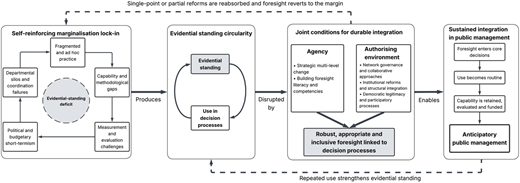
Figure 1 provides an overview of the article's argument. It depicts the six barriers as a self-reinforcing marginalisation lock-in centred on a circular relationship between credibility and use: foresight gains credibility through use but requires credibility before it is used. The figure also shows how combining agency with an authorising environment can move foresight from a peripheral activity towards sustained integration in public management. The subsequent sections develop each element in turn.
2. Strategic foresight: concept and boundaries
The term “foresight” has been used loosely (Saritas et al., 2022), and in ways that have invited the criticism that foresight scholarship overclaims (Van der Laan, 2021; Fidler, 2011). Three boundaries matter for what follows, between foresight and forecasting, between foresight and strategic decision-making, and between foresight as an activity and foresight as an institutional capability. A broader scepticism underlies all three, that foresight has no genuine object at all, which the article addresses in Section 4.6 because answering it depends on the distinctions the boundaries draw.
2.1 Foresight, forecasting and planning
Strategic foresight differs from forecasting in how it understands an organisation's relationship to the future. Forecasting seeks to identify the most likely future through trend extrapolation and probabilistic estimation, assuming that the past provides a reasonable guide to what lies ahead (Wack, 1985; Schoemaker, 1995). Foresight, by contrast, identifies drivers of change and explores multiple possible futures instead of extrapolating a single likely outcome (Roberge, 2013; Slaughter, 1995). It is therefore concerned less with predicting the future than with broadening preparedness and reducing the consequences of surprise (Wack, 1985; Schoemaker, 1995; Van Woensel, 2020).
The shift from prediction to preparation, and from a singular future to several plausible ones, distinguishes foresight from forecasting (Wack, 1985; Schoemaker, 1995). The boundary is not absolute, however, because anticipatory methods range from quantitative forecasting through scenario analysis to expertise-based deliberation, and hybrid approaches are increasingly common (Fontana et al., 2025). Foresight also differs from strategic planning, which typically operates over a shorter horizon, allocates resources to defined objectives and assumes sufficient stability for present commitments to be made (Bryson, 2018). Foresight questions that assumption. Its purpose is to broaden the range of possibilities considered before commitments are made, so that those commitments reflect a clearer understanding of what might disrupt them (Habegger, 2010).
2.2 Foresight as pre-decisional search
A persistent source of confusion is the tendency of practitioners to claim that foresight drives strategy. Van der Laan (2021) shows that such claims can undermine its credibility because experienced decision-makers often discount them. Fidler (2011) offers a clearer boundary by positioning foresight within Simon's (1947) notion of pre-decisional search: the information gathering that precedes choice. From this perspective, foresight involves “the creation of anticipatory information channels” (Fidler, 2011, p. 542) and is most useful when change is rapid, comparable experience is limited and the past provides a poor guide. Foresight supports strategic decision-making by broadening the search space before choices are made and surfacing weak signals before priorities are set (Popper, 2008; Schoemaker, 1995). The way a foresight unit defines its role therefore shapes its standing. Units that make expansive claims risk being dismissed when anticipated developments do not materialise, whereas those presented as one input among several can be integrated into routine decision processes without generating the credibility problem documented by Van der Laan (2021).
2.3 Futures literacy, anticipatory governance and the question of evidence
Two further terms are now widely used in the foresight literature. Futures literacy refers to the organisational and individual capacity to detect, interpret and act on signals of plausible futures (OECD, 2019; Janzwood and Piereder, 2019), and has two components. The cognitive component is the ability to reason under uncertainty, resist present bias and consider several plausible futures simultaneously. The institutional component consists of the routines, structures and cultures through which such thinking can influence decisions. Developing futures literacy therefore requires sustained investment in organisational capability and broader cultural change, instead of periodic training in scenario techniques alone (Janzwood and Piereder, 2019).
Anticipatory governance refers to the institutional arrangements through which foresight is connected to collective decision-making and action. The concept emerged from science and technology studies, where it described society's capacity to anticipate and respond to possible futures through processes of anticipation, integration and engagement (Karinen and Guston, 2010; Guston, 2014). It also builds on earlier work that positioned foresight as the front end of a governance system rather than as a discrete analytical product (Fuerth, 2009). Heo and Seo (2021, p. 2) define anticipatory governance as “a sustainable decision-making process based on consensus on a desirable future or vision through the participation of various stakeholders,” while Galvin (2025) emphasises its collaborative dimension.
Foresight, futures literacy and anticipatory governance can be distinguished analytically. Foresight is the practice of exploring plausible futures and their implications for present decisions (Slaughter, 1995; Popper, 2008; Habegger, 2010; Roberge, 2013). Futures literacy is the capability that enables individuals and organisations to use such thinking in policy work (OECD, 2019; Janzwood and Piereder, 2019). Anticipatory governance refers to the institutional arrangements through which foresight and related capabilities are connected to decision-making, engagement and learning across the policy cycle (Fuerth, 2009; Karinen and Guston, 2010; Guston, 2014; Heo and Seo, 2021). Ahern (2025) makes a similar point in regulatory scholarship, showing how anticipatory governance connects regulatory foresight with experimentation and learning. Anticipatory governance therefore describes how foresight is integrated into governance processes and is not simply another term for foresight itself.
A more recent framing treats foresight as future-oriented evidence for policy, subject to the same demands for reliability and usability as other inputs into decision-making (De Vito and Taffoni, 2026). From this perspective, foresight warrants a place in policy only when it is produced in ways that make it credible and usable. The question therefore shifts from whether foresight has been integrated to whether it has been produced to a standard that justifies its use, an issue examined further in Section 4.6. This emphasis reflects a broader shift in foresight scholarship over the past 2 decades, away from technology applications and towards the organisational conditions under which foresight is produced, integrated and used (Saritas et al., 2022; Adegbile et al., 2017; Iden et al., 2017).
3. Why foresight matters in public management
Roberge (2013, pp. 537–538) identified three reasons for taking foresight seriously. It can strengthen governance where complexity exceeds the competence of any single department, improve strategic management within particular policy fields, and help governments prepare for crises and mitigate risks before they materialise. Each of these arguments remains relevant, while subsequent crises and policy challenges have made the consequences of weak anticipation more visible. This section revisits Roberge's three reasons and adds a fourth that has gained prominence since his article: the role of foresight in supporting democratic legitimacy under uncertainty.
3.1 Governing under complexity
Roberge's first reason was that governments face multifaceted problems requiring a holistic, cross-departmental perspective. The past decade has reinforced this argument, as many consequential policy challenges have continued to transcend departmental boundaries. As Habegger (2010, p. 49) observed, “in an interdependent and complex world, only few public policy challenges can be confined to one particular policy area anymore.” Climate-induced migration, pandemic preparedness and the regulation of artificial intelligence span multiple policy domains, including environment, health, education, security, labour markets and economic policy (Taeihagh, 2021). The underlying coordination problem persists despite longstanding commitments to overcoming departmental silos, suggesting that rhetorical support for cross-government working has not been matched by corresponding structural change (Peters, 1998; Christensen and Lægreid, 2007).
Foresight is an analytical practice suited to this kind of complexity. Scenario work examines how social, technological, economic, environmental and political forces interact across policy domains (Van Woensel, 2020). Unlike conventional planning, which often treats issues separately, foresight assumes that major disruptions can emerge at the intersection of different systems (Popper, 2008). Whereas Roberge (2013) framed this challenge in terms of holistic governance, more recent literature describes it as polycrisis: the causal entanglement of crises across multiple systems, in which their combined harms exceed the sum of their individual effects (Lawrence et al., 2024). Analysing the Team Finland network across successive crises, Keinänen et al. (2026) show that foresight can support a shift from reactive to proactive crisis management by revealing interconnections and enabling organisational adaptation under unpredictable conditions. Similar dynamics are evident outside the OECD. Research on anticipatory methods in migration governance across fragile settings suggests that organisations with anticipatory capacity are better able to manage compound, cross-boundary disruptions because the necessary analytical tools, relationships and coordination channels are established before crises occur (Fontana et al., 2025).
3.2 Strategic management within policy fields
Roberge's second reason was that, even where holistic foresight is impractical, it remains valuable for strategic management within particular policy fields, especially those characterised by long lead times and limited reversibility. This is evident in labour markets, science and technology, demographic policy and long-lived public systems. Kanzola and Petrakis (2024) argue that governments can systematically anticipate future skill needs to design more adaptive workforce strategies, even when the precise forms of disruption remain unclear. The same logic applies to energy and transport planning, where long-lived investments must remain workable under substantial uncertainty about future demand, technological change and environmental conditions (Hallegatte et al., 2012).
Evidence from strategic-planning research points in the same direction. Strategic planning is positively associated with performance in public organisations, especially when it is formalised and sustained (George et al., 2019). Foresight often struggles to achieve these conditions. George (2025) argues that the problem is not a lack of foresight tools, but their disconnection from the planning and management processes through which decisions are made. This diagnosis provides a starting point for the article, which interprets that disconnection as one manifestation of the wider lock-in produced by the interaction of the six barriers. The value of foresight within particular policy fields also lies in challenging the tendency to anchor policy in current conditions and inherited assumptions. Burke and Hulse's (2009) analysis of housing futures, for example, shows how foresight can move policy debate beyond historical precedent and path-dependent policy parameters.
3.3 Crisis preparedness and the cost of surprise
Roberge's third reason was crisis preparedness. As the cases discussed in the introduction suggest, the recurring failure was not always a lack of foresight, but a failure to act on available analysis. Roberge (2013) drew on the 9/11 Commission's diagnosis of a failure of imagination before the 2001 attacks, while the collapse of the Afghan government and security forces in 2021 provides a more recent example. In both cases, relevant analyses existed but did not reach the decision forums where they could have shaped action (Boin et al., 2016; Special Inspector General for Afghanistan Reconstruction, 2021). Comparative research on foresight for national emergencies in the United Kingdom and the United States reaches a similar conclusion: analysis often lacks an institutional route into decision-making (Lee, 2025). The politics of crisis governance compounds this problem because crises are not neutral triggers for reform; political actors may use them either to accelerate change or to resist it (Capano et al., 2026).
Foresight does not predict crises or eliminate risk. When integrated into decision-making, it helps organisations consider a wider range of plausible futures and prepare responses before crises occur. Its value does not lie in removing surprise, but in reducing organisations' dependence on improvisation under emergency conditions (Habegger, 2010). The cases discussed earlier illustrate the consequences of failing to connect anticipatory analysis to decision-making. The case for integrating foresight therefore rests not only on theoretical arguments about uncertainty, but also on evidence of what governments risk losing when foresight remains outside the forums in which decisions are made (Boin et al., 2016; Moon, 2020).
3.4 Democratic legitimacy under uncertainty
A fourth reason, which has gained greater prominence in recent years, concerns democratic legitimacy. Public sector foresight differs from its private sector counterpart because long-horizon decisions must remain accountable to present-day publics, even though future risks, costs and benefits are distributed unevenly across groups. Leigh (2003) argued early that effective public foresight must incorporate competing values through inclusive consultation, while Roberge (2013, p. 535) noted that foresight projects “are, by definition, inclusive and deliberative.”
Later work extends this argument by showing how deliberative foresight can strengthen the legitimacy of long-horizon policy choices. Galvin (2025) argues that deliberative scenario processes can build social licence for transformative policies that might otherwise encounter short-term political resistance, particularly where adjustment costs fall on identifiable constituencies. Van Woensel (2021, p. 3) similarly notes that foresight enables policymakers to “assess considered evidence-based policy options against societal concerns,” a capability that is “especially important in a parliamentary setting.” This argument aligns with a longstanding emphasis in public management on stakeholder engagement in strategic decision-making (Bryson and George, 2024). When governments confront difficult long-term choices, including climate adaptation, energy transition and demographic change, open and deliberative foresight processes can make policy choices more publicly legitimate and less vulnerable to political reversal than analyses presented after the principal decisions have already been made (Leigh, 2003; Roberge, 2013; Van Woensel, 2020; Galvin, 2025; Bryson and George, 2024).
4. Systemic barriers to foresight integration
If the case for foresight has strengthened but its position in government has not, the question is what continues to keep it peripheral. The literature broadly points to six recurring barriers, namely, fragmented practice, capability and methodological gaps, departmental silos, political and budgetary short-termism, measurement and evaluation challenges, and legitimacy deficits (Schmidt, 2015; Janzwood and Piereder, 2019; OECD, 2019). These barriers are recognisable individually in Roberge's (2013) account and in later work on foresight integration, institutionalisation and evaluation (Schmidt, 2015; Janzwood and Piereder, 2019; OECD, 2019; Monteiro and Dal Borgo, 2023).
Roberge (2013) identified the structural and political obstacles most directly, particularly departmental boundaries, political impediments and declining policy capacity. The capability and methodological gaps examined here clarify what this capacity problem means for foresight: governments often lack the skills, routines and methods needed to produce credible analysis and connect it to decision-making (Schmidt, 2015; Janzwood and Piereder, 2019; OECD, 2019). Later literature has brought other barriers into sharper focus, including fragmented and ad hoc practice, difficulties in measuring preventive value, and a legitimacy deficit that this article conceptualises as a problem of evidential standing (Monteiro and Dal Borgo, 2023; De Vito and Taffoni, 2026).
This article conceptualises the six barriers as a self-reinforcing lock-in in which each barrier creates conditions that sustain the others and make the wider pattern difficult to disrupt. Monteiro and Dal Borgo (2023) offer a complementary account by treating demand and mandate, capabilities and skills, institutional arrangements, embeddedness in the policy cycle, and feedback and learning loops as connected elements of effective foresight. The lock-in developed here explains the persistent gap between the knowledge foresight produces and its translation into policy action. Tõnurist and Hanson (2020) similarly observe that foresight generates critical insight and knowledge but is often disconnected from policymaking and is insufficient on its own to produce anticipatory action. Table 1 presents each barrier, its mechanism and its consequences. The following subsections examine the barriers separately for analytical clarity, without implying a linear causal order. Section 4.7 and Table 2 then specify the relationships through which they reinforce one another.
4.1 Fragmented approach and ad hoc practice
Schmidt (2015, p. 489) describes governmental adoption of foresight as having proceeded “not at all methodical[ly],” following “many different paths where it has occurred at all.” This fragmentation takes three forms. First, foresight units often remain separate from core decision processes, so even strong outputs do not reliably reach decision-makers. Second, methods vary considerably across foresight exercises, making comparison and synthesis difficult where governments lack shared protocols or common frameworks (Popper, 2008). Third, foresight is often commissioned in response to a crisis or sustained by an individual champion, with little institutional protection as a standing function (Janzwood and Piereder, 2019).
Janzwood and Piereder (2019) argue that integrating foresight is more difficult in the public sector than in the private sector because governments face greater complexity, higher public stakes and organisational cultures that are often less receptive to disruptive change and futures-oriented thinking. Limited integration constrains influence, which in turn reinforces continued underinvestment. Foresight units may be established and produce reports, yet remain vulnerable to downsizing when political priorities change (Tõnurist and Hanson, 2020). What often survives is residual methodological knowledge and individual expertise, while a durable institutional structure within government rarely does.
A survey of foresight practice across nineteen United States federal agencies reveals similar fragility across government. Greenblott et al. (2019) find that foresight activity is expanding but remains unevenly institutionalised. Agencies have no standard organisational location for foresight, and programmes range from occasional speaker series to more integrated efforts in the Department of Veterans Affairs and the Coast Guard. Where foresight is not incorporated into planning and management routines, capability remains vulnerable to changes in leadership.
Public sector innovation units display a similar pattern. Labs often operate as isolated sites of experimentation and may lose political support, close or be absorbed into larger structures, as occurred with the Helsinki Design Lab and Denmark's MindLab (Pólvora and Nascimento, 2021). This fragility is more pronounced when foresight is donor-funded and organised through temporary projects. North Macedonia's migration-foresight programme produced training, a governance model and stakeholder coalitions, but its continuation became uncertain after external funding ended because ownership had not been fully transferred to government (Ashkapova and Zulfiu Alili, 2025).
4.2 Capability and methodological gaps
Even where institutional support exists, foresight depends on the analytical, operational and political capabilities identified in the wider policy-capacity literature (Wu et al., 2015). Van Woensel's (2020) STEEPED framework illustrates the demands involved, requiring organisations to assess societal, technological, economic, environmental, political, ethical and demographic factors in combination. Most public organisations lack sufficient staffing for this multidimensional work. They are also rarely structured to allow staff in small foresight units to accumulate the sustained experience needed to produce credible foresight.
The capability constraint is exacerbated by the absence of systematic learning. Research on organisational learning in public services shows that lessons are rarely captured, codified or transferred across organisational boundaries, preventing experience from accumulating into validated practice (Rashman et al., 2009). The OECD (2019) similarly notes that organisations rarely conduct rigorous post-exercise assessments, leaving foresight without a sufficient empirical basis for methodological refinement. The Queensland Government's Futures and Foresight Team provides a partial counter-example. Working with a university partner, the team deliberately built capability through iterative cycles of design, testing and refinement, treating repeated practice as a mechanism of capability development (Picavet et al., 2026). Such sustained investment is difficult to achieve where foresight units are understaffed and personnel rotate frequently.
4.3 Departmental silos and cross-boundary coordination failures
Roberge (2013, p. 539) identified departmental organisation as the biggest structural barrier to foresight integration. This reflects a long-standing problem in public administration where governments are organised around departments, while many policy problems cut across them (Christensen and Lægreid, 2007; Head and Alford, 2015). More recent work on crisis and polycrisis governance confirms the continuing relevance of this problem, since cross-boundary risks still have to be managed through structures that remain largely departmental (Moloney et al., 2025). As Roberge (2013) observed, public bureaucracies remain organised on a departmental basis, and whole-of-government commitments often fail to change coordination in practice. New Public Management reforms have reinforced this problem by multiplying agencies without creating the cross-boundary coordination that foresight requires (Bakvis and Juillet, 2004).
The mismatch between cross-boundary problems and departmental structures becomes especially costly under polycrisis conditions, where crises interact across the same boundaries through which public administration is organised (Moloney et al., 2025). Keinänen et al. (2026) show that effective polycrisis management depends on networked arrangements connecting organisations, levels of government and areas of expertise. In the terms used here, such arrangements support shared sensing, adaptive reorganisation and strategic renewal. Without them, weak signals identified in one department may not reach others, scenario analyses in one ministry may not influence budget decisions elsewhere, and crisis responses may be improvised at moments of greatest pressure (Roberge, 2013; Moloney et al., 2025). The OECD (2025) likewise identifies interministerial coordination as essential for moving foresight beyond isolated projects and detecting risks that cut across policy sectors.
4.4 Political and budgetary short-termism
The temporal misalignment between political cycles and the long-term orientation of foresight is another critical barrier (Howlett and Goetz, 2014; Roberge, 2013). Political life is organised around electoral cycles, annual budgets and accountability systems that reward visible short-term results (Pollitt, 2008). The benefits of foresight, by contrast, may emerge only much later through crises avoided, risks mitigated or opportunities recognised and pursued years after the original analysis (Schmidt, 2015; Monteiro and Dal Borgo, 2023). As Roberge (2013, p. 539) observed, “Politicians and citizens alike often expect quick results, and have very little time for a view of the long term.” This temporal tension is reinforced by organisational learning patterns. Public organisations tend to give greater weight to experience that is recent, local and visible than to developments that are distant, rare or uncertain, a tendency Levinthal and March (1993) describe as the myopia of learning. Yet foresight requires organisations to take such developments seriously (Habegger, 2010; Janzwood and Piereder, 2019).
Frequent political transitions disrupt institutional memory, while incoming administrations often restructure departments, making it difficult to build the sustained capability that foresight requires (Janzwood and Piereder, 2019). Hierarchical accountability can also discourage innovation and experimentation, making exploratory forms of analysis more difficult to justify (Janzwood and Piereder, 2019; Schmidt, 2015). Annual appropriations create a further constraint by limiting support for initiatives whose benefits may not become visible within the budget cycle (Schmidt, 2015; Monteiro and Dal Borgo, 2023). These obstacles are therefore rooted in political and budgetary institutions. Addressing them requires arrangements that protect long-horizon work while preserving democratic accountability.
4.5 Measurement and evaluation challenges
Foresight's value is difficult to demonstrate through conventional public sector evaluation metrics (Calof and Smith, 2012; Schmidt, 2015). Programme managers often rely on proxies such as perceived report quality, stakeholder reach or breadth of dissemination, none of which establishes whether foresight changed decisions or improved preparedness (Janzwood and Piereder, 2019; OECD, 2019). A more underlying problem is that many of foresight's most important effects are counterfactual. If foresight helps prevent a crisis, the observable outcome is the absence of an event; if it helps an organisation act on an emerging opportunity, attribution is complicated by the many other factors shaping the result (Boin et al., 2016; Pawson and Tilley, 1997). Foresight therefore creates an evaluation paradox. Its most readily countable outputs such as reports, scenarios and workshops are weak indicators of impact, while its most consequential effects are the least visible to conventional evaluation.
Recent practice illustrates the difficulty of demonstrating foresight's policy impact. De Vito and Taffoni (2026) argue that subsequent policy change cannot be confidently attributed to foresight without process tracing, while the evaluation of North Macedonia's migration-foresight programme reaches a similar conclusion (Ashkapova and Zulfiu Alili, 2025). The Queensland Government pilot highlights a related measurement problem. Although it produced quantitative evidence, the indicators captured efficiency and scenario production but did not establish whether foresight improved decision-making or reduced exposure to surprise. Even a well-resourced and carefully designed exercise therefore measured what was readily observable, while its most consequential effects remained difficult to assess (Picavet et al., 2026). This reflects a broader institutional limitation, as existing performance frameworks are poorly suited to evaluating preventive action whose benefits may emerge only over long time horizons (Monteiro and Dal Borgo, 2023).
Furthermore, Ahern (2025) argues that anticipatory governance is resource-intensive but often produces few direct or immediately observable outputs. Its value may instead lie in preparing policymakers to recognise emerging risks, consider alternative responses and act more effectively when intervention becomes necessary. Evaluating it only through the regulation ultimately adopted may therefore miss the anticipatory work that made later action possible. Across these cases, the central difficulty is the same: foresight often creates value through risks avoided, harms mitigated and possibilities incorporated into decision-making, effects that conventional performance measures are poorly equipped to capture.
4.6 Legitimacy, credibility and the question of worth
Foresight faces legitimacy challenges that differ from those confronting established forms of policy analysis because it must produce usable evidence about futures that cannot yet be observed (De Vito and Taffoni, 2026; Robinson and Doherty, 2025). This gives rise to an epistemic objection concerning whether foresight can claim sufficient authority to inform policy. Galvin (2025) argues that foresight struggles to establish the epistemic standing enjoyed by established natural and social science disciplines. It must demonstrate methodological rigour while acknowledging that the future remains uncertain (De Vito and Taffoni, 2026). This tension leaves foresight vulnerable to dismissal as speculation, particularly when its findings unsettle existing interests or challenge established policy commitments (Van der Laan, 2021).
Two distinct objections arise, one concerns the practical value of foresight, and the other its epistemological basis. In a recent study of public managers trained in anticipatory governance, participants suggested that foresight would remain distant from administrative practice without substantial cultural change because public organisations are oriented towards responding to events after they occur, not acting in advance (Todisco et al., 2026). They also judged its value by whether it informed regulation or remained at the level of recommendation. This practical concern has merit, since some foresight gives decision-makers little they can use even when recognised methods have been followed (Todisco et al., 2026; De Vito and Taffoni, 2026). No integration mechanism can, or should, compensate for genuinely weak foresight. Robustness, appropriateness and inclusivity therefore remain necessary conditions of evidential standing (De Vito and Taffoni, 2026; Robinson and Doherty, 2025). The argument developed here is narrower: even foresight that meets these standards may still be ignored when the institutional conditions required for its uptake are absent.
The second objection is epistemological: because the future cannot be known, foresight is said to have no real object. This criticism rests on a misconceived understanding of what foresight is intended to do. As Section 2.2 argued, foresight is a form of pre-decisional search that broadens the range of possibilities considered before choices are made (Fidler, 2011; Popper, 2008). The unknowability of the future is therefore relevant to assessing the accuracy of a forecast, but not to assessing whether foresight improved the search preceding a decision by surfacing weak signals, challenging underlying assumptions and expanding the range of alternatives considered.
The properties that allow foresight to count as evidence, including robustness, appropriateness and inclusivity, depend on the institutional conditions under which it is produced (De Vito and Taffoni, 2026). The legitimacy barrier therefore concerns the production of foresight as much as its perception by decision-makers. Robinson and Doherty (2025) advance a complementary argument in the OECD's work on strategic intelligence, treating robustness as a feature of how horizon scanning, technology assessment and foresight are produced and used, while noting the continuing absence of agreed standards. The legitimacy problem is further compounded when practitioners overstate what foresight can achieve (Van der Laan, 2021; Fidler, 2011). For this reason, the legitimacy deficit, conceptualised here as a problem of evidential standing, occupies a central position in the lock-in examined next.
Treating the legitimacy barrier as a deficit in evidential standing is not simply a change of label. It shifts attention from how foresight is perceived to the institutional conditions under which it is produced and used, revealing the circularity developed below. A problem of perception could, in principle, be addressed through better communication. This problem cannot, because the qualities that give foresight evidential standing are developed through the forms of institutional integration that such standing is initially needed to secure.
4.7 Synthesis: the marginalisation lock-in
The six barriers do not just coexist; they form a patterned set of reinforcing relationships in which weakness in one area makes the others more difficult to overcome (Monteiro and Dal Borgo, 2023). Fragmented, project-based foresight prevents capability from accumulating because staff often move on before methods and routines become established (Janzwood and Piereder, 2019; Tõnurist and Hanson, 2020). Departmental silos intensify this fragmentation by confining foresight to specialist units and preventing its outputs from circulating across government (Roberge, 2013; OECD, 2025). Capability gaps then make evaluation more difficult, as under-resourced units often lack the capacity to demonstrate value (OECD, 2019; Janzwood and Piereder, 2019). Weak evidence of impact gives budget authorities little basis for protecting multi-year funding, reinforcing political and budgetary short-termism (Schmidt, 2015). Short-termism, in turn, limits the structural investment needed to reduce silos and build sustained capability (Pollitt, 2008; Howlett and Goetz, 2014).
The evidential-standing deficit reinforces the other barriers in several ways. When foresight is not treated as usable policy evidence, it is more easily confined to optional reports, specialist units or temporary projects. This pattern is characteristic of immature foresight programmes that remain output-focused and disconnected from the policy cycle (Janzwood and Piereder, 2019). Low evidential standing also constrains capability-building because activities regarded as speculative are less likely to receive the sustained technical, structural and cultural investment required for mature foresight practice (OECD, 2019). It further entrenches departmental silos, as analysis without recognised authority is less likely to circulate across organisational boundaries (Roberge, 2013).
Political and budgetary short-termism is also reinforced because future-oriented analysis is easier to defer when it is not connected to recognised decision processes or resource-allocation routines (Monteiro and Dal Borgo, 2023). Measurement difficulties deepen for the same reason: foresight that does not enter decisions leaves fewer traces through which its subsequent influence can be assessed (De Vito and Taffoni, 2026). Evidential standing is therefore not simply one barrier among others. It is the point at which the loop closes and becomes self-reinforcing. Fragmented, weakly resourced and poorly evaluated foresight is easier to dismiss, while that dismissal justifies the underinvestment that reproduces fragmentation. Table 2 summarises these reinforcing relationships and the mechanisms through which each sustains the wider lock-in.
Marginalisation is not simply a consequence of limited capacity or poor design. It reflects an institutional pattern in which established arrangements generate increasing returns, raise the costs of reversal and make alternatives more difficult to sustain (David, 1985; Arthur, 1989; Pierson, 2000; Mahoney, 2000). In the case of foresight, fragmented practice, weak capability, departmental silos, short budget cycles, limited measurement and low evidential standing leave reform efforts vulnerable to reabsorption. The pattern is recursive: failure to demonstrate value justifies underinvestment, underinvestment prevents capability development, and continued fragility confirms the original scepticism. Organisational myopia further sustains this process because public organisations tend to privilege recent, local and visible experience over developments that are distant, rare or uncertain (Levinthal and March, 1993). Foresight's marginalisation therefore cannot be attributed to any single barrier, and interventions directed at only one part of the pattern remain vulnerable to the barriers left intact. This reasoning leads to the first proposition:
The marginalisation of foresight in public management operates as an institutional lock-in. Reforms addressing a single barrier are likely to be reabsorbed by the barriers left intact, while reforms addressing multiple interacting barriers are more likely to persist.
The evidential-standing deficit sits at the centre of the lock-in because it reinforces the other barriers and cannot be overcome through technical reform alone. Decision-makers are unlikely to use foresight until they regard it as credible policy evidence, yet that credibility often develops only after foresight has entered decision processes. This creates the circularity at the heart of the problem. Validation, traceability and inclusive production can strengthen foresight's standing, but these qualities depend on institutional arrangements as well as analytical methods (De Vito and Taffoni, 2026). Foresight also requires an authorising environment that gives credible analysis access to the forums in which decisions are made. Without both credible production and institutional access, it is likely to remain peripheral.
The following cases illustrate this relationship. In Queensland, expert validation, source traceability and links to decision forums strengthened the credibility and practical use of the analysis (Picavet et al., 2026). Tuscany's smart-specialisation process displays a similar pattern, as external expert panels validated the roadmaps before their formal adoption as a regional strategy and submission to the European Commission (Fabbri, 2016). North Macedonia illustrates the fragility of capability-building without sustained institutional support. Its migration-foresight programme developed capability through training, but limited government ownership and dependence on external support made its continuation uncertain once external funding ceased (Ashkapova and Zulfiu Alili, 2025). Across these cases, technical capability alone does not determine whether foresight influences decisions. Uptake also depends on institutional arrangements that validate the analysis, connect it to relevant decision forums and confer evidential standing. This reasoning leads to the second proposition:
Foresight outputs are more likely to inform policy and management decisions when institutional arrangements make their robustness, appropriateness and inclusivity visible, connect them to relevant decision forums and thereby confer evidential standing.
5. Pathways to anticipatory public management
This section returns to Figure 1 to explain how the marginalisation lock-in may be disrupted. The first part depicts the six barriers and the evidential-standing deficit that sustain foresight's marginal position. The second shows the circular relationship between evidential standing and use in decision processes. The third panel identifies the joint conditions for durable integration: agency enables public servants to produce robust, appropriate and inclusive foresight, while an authorising environment connects it to decision-making and confers sufficient evidential standing. The fourth panel shows the resulting progression towards anticipatory public management, as foresight enters core decisions, its use becomes routine, and capability is retained, evaluated and funded. The upper dashed arrow indicates that single-point or partial reforms may be reabsorbed, returning foresight to the margin, while the lower dashed arrow shows how repeated use strengthens evidential standing and supports continued integration.
Table 3 elaborates the reform pathways that support this transition. The five mechanisms do not correspond one-to-one with the six barriers. Each can weaken several barriers, while most barriers require a combination of mechanisms to overcome. The following subsections examine the mechanisms separately for analytical clarity, but the underlying argument remains systemic. As Table 3 indicates, durable change depends on combining these mechanisms, even though individual pathways are already evident in the illustrative cases presented there.
The reform pathways perform two complementary functions. Drawing on the OECD's account of anticipatory capacity, foresight requires both agency and an authorising environment (OECD, 2025; Monteiro and Dal Borgo, 2023). Agency consists of the tools, methods and knowledge that enable public servants to produce credible foresight, while the authorising environment comprises the mandates, structures and leadership support that give foresight access to the policy cycle. Strategic multi-level change and foresight literacy primarily build agency by strengthening the technical, organisational and cultural capabilities needed to produce and sustain foresight (Janzwood and Piereder, 2019; OECD, 2019). Network governance, structural integration and democratic legitimacy primarily build the authorising environment by creating cross-boundary channels, formal links to planning and budgeting, and public legitimacy for long-horizon decisions (Sørensen and Torfing, 2009; OECD, 2021; Bryson and George, 2024; Galvin, 2025).
Combining the mechanisms does not require applying all five equally. It requires at least one agency-building mechanism and one mechanism that strengthens the authorising environment, because neither condition can substitute for the other. A skilled foresight unit without a mandate is likely to be ignored, while a mandate without sufficient capability gives government little credible foresight to use. The two conditions do not need to develop simultaneously, and either may emerge first. However, prolonged separation leaves reform vulnerable to reabsorption by the lock-in, as represented by the upper dashed arrow in Figure 1. The second condition must therefore develop before the first loses its momentum or support, although the cases examined here cannot establish which sequence is most effective under different circumstances. Durable integration consequently depends on coupling the capability to produce credible foresight with the institutional authority to use it:
Foresight is more likely to become durably integrated into decision-making when the agency to produce credible analysis is coupled with an authorising environment that gives it access to decisions. Capability without authority is likely to be ignored, while authority without capability provides little credible foresight to use.
5.1 Strategic, multi-level change
The first pathway concerns the organisational conditions needed to move foresight from episodic exercises to sustained practice. Janzwood and Piereder (2019, p. 617) argue that successful foresight programmes require change at three levels: technical, structural and cultural. Technical change develops the methods needed to produce reliable outputs. Structural change establishes the routines, units and reporting lines through which those outputs can inform decisions. Cultural change builds willingness to engage with uncertain and potentially uncomfortable future possibilities (OECD, 2019). Reform confined to only one of these levels is likely to be undermined by weaknesses in the others (Janzwood and Piereder, 2019).
This form of change also depends on actors who can build coalitions and keep foresight connected to decision-making. Programmes need champions who can manage organisational politics, create authorised spaces for experimentation and connect pilot work to decision forums (Janzwood and Piereder, 2019, p. 618; Mintrom and Norman, 2009). In Queensland, the Futures and Foresight Team performed this role by building a coalition of supportive stakeholders, securing leadership engagement and extending a six-month pilot into a tool adopted by a second agency (Picavet et al., 2026). The case illustrates how capability and mandate can be developed in combination, although its short time horizon does not establish durability across political and budget cycles. OECD work in Lithuania, Italy and Malta shows a similar pattern at national level, where institutional anchoring, leadership commitment and pilot-based learning helped move anticipatory practice beyond isolated exercises. Donor-funded programmes, however, demonstrate the fragility of such progress when no durable domestic mandate is established (OECD, 2025; Ashkapova and Zulfiu Alili, 2025). Multi-level change therefore moves foresight beyond episodic projects and reduces the fragmentation, siloing and limited feedback that keep it peripheral.
5.2 Building foresight literacy and competencies
Building foresight literacy strengthens the analytical and operational capabilities needed to produce and use foresight in public organisations, extending the wider policy-capacity framework developed by Wu et al. (2015). These capabilities encompass scenario methods as well as the judgement required to interpret weak signals, compare plausible futures and connect anticipatory analysis to actual policy choices. Janzwood and Piereder (2019, p. 619) describe foresight literacy as a form of self-education that changes how people think about the future. It cannot be developed through training in scenario techniques alone. Public servants must also become comfortable considering multiple plausible futures, resist the present bias that public organisations often reinforce and recognise weak signals before they become widely apparent (Washington, 2023). Kanzola and Petrakis (2024) show how foresight competencies can be combined with complementary skills to prepare staff for a wider range of contingencies, including developments that cannot be captured through predetermined skill requirements.
Building these capabilities requires three conditions. First, foresight training must be connected to role-specific decisions, because scenario work rarely changes behaviour when detached from the choices participants actually face (Habegger, 2010). Second, staff need exposure to the multidimensional analysis required by Van Woensel's (2020) STEEPED framework. Third, foresight literacy requires sustained practice, since it develops through repeated use rather than one-off workshops (Rashman et al., 2009). The North Macedonia programme illustrates the scale of this undertaking. It included masterclasses, an advanced certificate and a training-of-trainers session organised around structured learning pathways. It also produced some institutional continuation, including a master's course in foresight established by a participating academic (Ashkapova and Zulfiu Alili, 2025; OECD, 2025). When developed across an organisation, foresight literacy can lower cultural barriers, improve the quality of anticipatory analysis and reduce the legitimacy deficit that arises when foresight remains confined to a small, opaque unit (Galvin, 2025).
5.3 Network governance and collaborative approaches
The first two mechanisms, strategic multi-level change and foresight literacy, build the agency needed to produce credible foresight. The remaining three strengthen the authorising environment through which foresight can influence decisions, beginning with network governance. Network governance creates channels through which analytical and operational knowledge can move across organisational boundaries while preserving the specialised expertise located within departments (Bakvis and Juillet, 2004; Sørensen and Torfing, 2009). Keinänen et al. (2026) illustrate this mechanism under polycrisis conditions, where effective coordination depends on networks connecting interests, levels of government and areas of expertise. Their analysis of the Team Finland network shows how such arrangements can support foresight and coordination across the policy cycle during successive crises.
ESPAS provides a clear example of network governance in practice. Coordinated through the European Commission's Joint Research Centre Policy Lab, the initiative connects nine EU bodies, sustains a community of practice through monthly sense-making workshops and shares emerging signals through a common repository. These signals are then discussed and prioritised according to their relevance for decision-making (De Vito and Taffoni, 2026). Foresight therefore crosses institutional boundaries by design. The Policy Lab's blockchain foresight project illustrates a related participatory approach. It engaged a diverse group of stakeholders and connected the resulting analysis to wider EU policy discussions, including those reflected in a European Parliament resolution and related Commission communications (Pólvora and Nascimento, 2021).
Other examples illustrate the connective function of network governance. Foresight checkpoints can be incorporated into the design, implementation and review of major decisions, while cross-agency teams can be given mandates that endure beyond ministerial change. Boundary-spanning roles can translate foresight findings into operational terms and feed operational concerns back into analysis (Williams, 2002). Tuscany's smart-specialisation roadmapping demonstrates the coalition-building dimension of this mechanism by bringing together public, research, industry and civil-society actors (Fabbri, 2016). Network governance complements hierarchy by creating channels that hierarchical structures alone cannot provide (Sørensen and Torfing, 2009; Bryson and George, 2024). When foresight is produced and used across multiple constituencies, it is also less easily dismissed as the speculation of a single unit. Network governance therefore creates routes across departmental boundaries and reduces the likelihood that analysis remains confined to specialist units or one-off projects.
5.4 Institutional reforms and structural integration
Foresight is unlikely to become durable when organised as a temporary project. Sustained practice requires formal mandates, protected funding and explicit links to planning and resource-allocation cycles (OECD, 2021). Addressing political short-termism requires institutional protection for long-horizon work, while meaningful evaluation requires programmes to continue long enough for their effects to emerge. Standing units connected to central planning and budgeting can translate foresight insights into resource and programme decisions more effectively than ad hoc projects (OECD, 2019; Monteiro and Dal Borgo, 2023).
Institutional design involves difficult trade-offs. Janzwood and Piereder (2019) argue that foresight programmes must balance analytical rigour, relevance to current policy priorities and legitimacy among affected stakeholders. Several institutional arrangements are now documented in practice, including formal links to cabinet and treasury cycles and the integration of foresight into the European Commission's impact-assessment process (OECD, 2019, 2022; De Vito and Taffoni, 2026). Comparative research on the United Kingdom and the United States similarly highlights the importance of connecting foresight to budgeting, talent development and strategic doctrine, while leaving unresolved whether centralised or distributed models are more effective (Lee, 2025).
Evidence from United States federal agencies illustrates both the value of these linkages and the unresolved question of institutional design. In the more integrated cases, foresight was connected directly to strategic or executive decision processes (Greenblott et al., 2019). The Department of Veterans Affairs incorporated foresight into its strategic plan, the Coast Guard aligned its Evergreen cycle with the tenure of each incoming Commandant, and the Office of Net Assessment worked directly with the Secretary of Defense. Proposals for a central foresight hub nevertheless reflect continuing uncertainty over whether government should establish a central unit to support agency-level programmes or adopt a more distributed model (Greenblott et al., 2019).
Structural integration also requires foresight to become an ongoing practice instead of a sequence of episodic exercises. Regular scanning and feedback loops, supported by hybrid analytics and expert judgement, can keep foresight connected to operational decision-making. Saritas et al. (2022, p. 11) describe an emerging “foresight-on-site” model that combines human and machine intelligence in sustained anticipatory activity. Such a model would position foresight alongside finance, human resources and performance management as part of the basic machinery of public management. It would also require budgetary and accountability systems, often associated with short-termism, to support anticipatory work through mandates, funding and planning routines (George, 2025; George et al., 2019; Monteiro and Dal Borgo, 2023).
5.5 Democratic legitimacy and participatory processes
The final mechanism for strengthening the authorising environment is democratic legitimacy, developed through transparent and inclusive engagement. Inclusion is particularly important in public-sector foresight because public decisions must remain accountable to citizens as well as organisational leaders. Long-horizon policies distribute costs and benefits unevenly across groups and over time, requiring foresight processes to surface competing values alongside plausible futures. Leigh (2003) and Roberge (2013) emphasise the role of scenario processes in exposing these differences while preserving democratic accountability. Galvin (2025) further argues that deliberative processes can build social licence for transformative policies that might otherwise encounter short-term political resistance.
Recent cases illustrate both the value and the limits of inclusion. The UK Net Zero Society exercise incorporated public dialogue, selected participants to broadly reflect the demographic composition of the UK population and included groups likely to be disproportionately affected by climate change (Government Office for Science, 2023). This gave the analysis a degree of public legitimacy that a purely technical exercise could not provide. However, participation did not automatically ensure inclusivity. The dialogue was introduced only at later stages, while technical language created barriers to accessibility. De Vito and Taffoni (2026) therefore treat inclusivity as a question not only of who participates, but also of when they are involved and whether the framing of the exercise privileges some groups over others.
The importance of early and meaningful participation is consistent with wider public management research on stakeholder engagement, environmental scanning and collaborative governance. This literature shows that participation strengthens legitimacy when affected groups can shape the process, not when they are consulted only after key choices have been settled (Ansell and Gash, 2008; Bryson, 2018; Bryson and George, 2024). When deliberation begins at the outset, the resulting policy choices are more likely to retain public support across changes of government or leadership because affected groups have contributed to their development. Democratic legitimacy therefore does more than expand participation; it makes long-horizon choices more publicly justifiable and less vulnerable to short-term political reversal.
The Queensland and North Macedonia cases also highlight two important boundary conditions: state capacity and external dependence. Where state capacity is limited and dependence on external support is high, the lock-in is more difficult to disrupt because the authorising environment is harder to establish and easier to lose. In North Macedonia, the continuation of the migration-foresight programme became uncertain after external funding ended because ownership had not fully transferred to government and no durable domestic mandate had been established. Queensland presents a contrasting pattern, in which capability and mandate were developed in combination (Ashkapova and Zulfiu Alili, 2025; Picavet et al., 2026).
These cases illustrate how the mechanisms operate in combination, not their independent effects. Queensland and North Macedonia differ in state capacity, external dependence, domestic ownership and the extent to which capability was paired with mandate. Future research should therefore examine the effects of these conditions both individually and in combination. Evidence from the Sahel, Ukraine, and South and Southeast Asia similarly suggests that fragile states often struggle to sustain the administrative capacity and cross-government routines required for anticipatory governance (Fontana et al., 2025). The mechanisms identified here may also support foresight outside OECD settings, but durable integration is more difficult where institutional capacity is limited and reliance on external support is high. State capacity and external dependence consequently shape whether partial reforms acquire lasting domestic support or are reabsorbed by the marginalisation lock-in. This reasoning leads to the final proposition:
The marginalisation lock-in is more stable when limited state capacity and high external dependence jointly weaken domestic ownership and the authorising environment. Under these conditions, partial reforms are more likely to be reabsorbed by the wider institutional pattern, even when the resulting foresight is technically robust.
6. Concluding remarks
Roberge (2013) closed his article in this journal by calling for conceptual work that would situate foresight within public management. More than a decade later, the case for foresight has strengthened, but the gap between foresight activity and core decision-making remains. This article explains that persistence by showing how fragmented practice, capability gaps, departmental silos, short-termism, measurement difficulties and weak evidential standing interact as an institutional lock-in. It extends Roberge's concern with declining policy capacity by demonstrating how skills, routines, institutional structures and decision processes jointly reproduce marginalisation.
The analysis therefore moves beyond identifying barriers to explaining how they endure. Reforms directed at only one part of the pattern remain vulnerable to reabsorption by the wider institutional arrangement. At the centre of this process is a circular relationship in which foresight often gains credibility through use but requires credibility before it can enter decision-making. Disrupting that circularity requires coupling the agency to produce credible foresight with an authorising environment that gives it access to relevant decision forums. Neither condition is sufficient alone. When they are combined, repeated use can strengthen evidential standing and support the sustained integration of foresight into public management. Future research should test the four propositions comparatively, examining how the sequencing of agency and authorising-environment development, together with variation in state capacity and external dependence, shapes whether integration endures.
I would like to express my sincere gratitude to Professor Enrico Bracci, Associate Editor, and Professor Rocco Palumbo, Editor-in-Chief, for their thoughtful guidance and constructive engagement throughout the review process. I also thank the two anonymous reviewers for their careful reading, insightful comments and excellent suggestions, which substantially improved the clarity, coherence and overall quality of the article.