Amidst the backdrop of a poly-crisis and increasing turbulence, this research addresses the pressing need to understand the dynamics of crisis decision making within the European Union. The COVID-19 pandemic's transboundary nature revealed unprecedented adaptability within EU member states and institutions.
Using the lens of hybrid governance, the study examines decision-making in three key policy areas affected by the pandemic: restrictions on travel, vaccine procurement and the Recovery and Resilience Facility. By adopting a process tracing approach based on desk research and semi-structured interviews with senior EU officials, the article investigates the patterns and dynamics of hybrid governance observed during the crisis.
The findings reveal how mixes of governance ideal-types evolved to address varying levels of crisis complexity and urgency, leading to a common pattern of hybrid compositions across cases.
The research provides new insights into how the hybrid governance occurs in EU crisis decision-making, shedding light on the dynamic tensions and synergies between different governance mechanisms in times of unprecedented uncertainty.
1. Introduction
Europe will be forged in crisis and will be the sum of the solutions adopted for those crises Jean Monnet (1978).
As declared by the European Union (EU)'s founding father, Jean Monnet, crisis decision-making is a key component of EU creation, design and sustainability. Terms such as turbulence, wicked problems, emergencies, urgency, shocks and uncertainty have been used to characterise the state of poly-crisis faced by the European continent. In response to the heightened frequency of crises, administrations have been trying new ways of effectively governing and managing crises (Zeitlin et al., 2019). The COVID-19 pandemic offers an ideal context in which to research the dynamics of crisis decision-making, owing to the transboundary nature of the pandemic and its impact on policy domains that went far beyond health – including economic, fiscal and border policies, where the EU was compelled to coordinate responses both vertically and horizontally. This period demonstrated unprecedented adaptability within and among EU member states and institutions, though consistency across policy areas and over time was not always achieved (Wolff and Ladi, 2020).
To understand this unprecedented adaptability, we draw on the hybrid governance framework, broadly defined as the blending of diverse ideal types of governance mechanisms (Brandsen and Karré, 2011; Voets et al., 2015; Meuleman, 2019; Sørensen and Torfing, 2019), which offers a dynamic perspective to address multifaceted crises that defy traditional categorisation. It introduces flexibility and adaptability into crisis responses allowing for the integration of different approaches and resources from various sectors and stakeholders (Meuleman, 2019; Sørensen and Torfing, 2019). This capability is particularly important in modern crises, such as the COVID-19 pandemic which span multiple policy domains. While the existing literature recognises the importance of hybrid governance in crisis response (Gjaltema et al., 2019; Larsson, 2017; Meuleman, 2019), we know very little about how hybridity occurs and how it changes in the course of crises.
Given the EU's recurrent crises, it is crucial to explore effective mechanisms for crisis navigation to ensure the welfare of European citizens. However, there is a notable gap in understanding how hybrid governance functions at the EU level, including the associated opportunities and challenges. The practical implementation of hybrid governance within the EU remains underexplored, highlighting the need for further research and its potential application to crisis decision-making practices in future. This study seeks to identify and elucidate the dynamics of hybrid governance in the EU crisis response to the COVID-19 pandemic. It investigates how hybrid governance is integrated into the EU's decision-making processes and examines the evolving hybrid compositions across different temporal phases of crisis response. To address these issues, the article poses two guiding questions: (1) What hybrid governance compositions emerged in the EU's crisis response to COVID-19? (2) What do these patterns reveal about the sequential progression of hybrid compositions in the EU's crisis response to COVID-19?
The analysis draws on desk research and semi-structured interviews with EU officials, focusing on three critical policy responses to the COVID-19 crisis: “Restrictions on Travel”, “Vaccine Procurement” and the “Recovery and Resilience Facility”. By adopting a single case study approach with three embedded units of analysis, this research contributes to the understanding of hybrid governance and its dynamics within the EU's unique supranational institutional framework.
The next section introduces an analytical framework grounded in the themes of hybridity and crisis decision-making, followed by an overview of research methodology. The empirical section examines three instances of EU crisis decision-making during the COVID-19 pandemic, chosen to illustrate varying responses across key policy domains at different stages of the crisis. The concluding sections summarise the findings, highlighting patterns of hybrid solutions at the EU level.
2. Hybrid governance: literature review and analytical framework
Crises present unique challenges, such as severe threats, time pressure and high uncertainty, necessitating adaptations of bureaucratic structures and processes. These challenges often require governments to strike a balance between various organisational and coordination mechanisms. Traditional command-and-control approaches, while effective in some situations, are no longer sufficient to address the complexities of modern crises. Governance has evolved to incorporate multiple coordination modes, each rooted in distinct logics, to manage these demands effectively (Pierre and Peters, 2020; Tenbensel, 2018). The public management literature commonly categorises these modes of coordination into three governance “ideal types”: hierarchy, market and network (Verhoest et al., 2007; Bouckaert et al., 2010; Pierre and Peters, 2020). Each type offers specific advantages and limitations, in brief, hierarchies emphasise control and clear authority structures, markets leverage competition and efficiency, and networks focus on collaboration and relational governance.
To provide a foundation for analysing hybrid governance, Table 1 summarises the three governance ideal types, hierarchy, market and network (drawing upon Bouckaert et al., 2010; Meuleman, 2019).
Within governance literature, these ideal types are not discrete nor mutually exclusive but rather operate in interaction with one another. The advantages of each are often accompanied by disadvantages that may become especially salient during crises. For instance, hierarchical instruments provide clarity and decisiveness, yet risk rigidity and over-centralisation (Boin et al., 2021). Market mechanisms enhance flexibility and cost-awareness but may undermine transparency and accountability (Dommett and Flinders, 2015). Network arrangements encourage inclusivity and trust but may lead to indecisiveness and blurred accountability (Pierre and Peters, 2020). These tensions form the foundation for understanding governance hybridity as the adaptive interplay of multiple ideal types (Meuleman, 2019; Braithwaite, 2020).
In response to the multifaceted pressures of crises, hybrid governance approaches have gained prominence. By combining elements of hierarchy, market and network governance, hybrids aim to capitalise on the strengths of each ideal type (Koppenjan et al., 2019). This adaptive approach has been extensively explored in literature on (meta-) governance (Meuleman, 2008, 2019; Voets et al., 2015), with hybridity recognised as a versatile framework for effective crisis management (Braithwaite, 2020; Jessop, 2003).
Hybrid governance serves as a framework to describe situations that transcend the boundaries of governance paradigms. This paper adopts the definition of hybrid governance provided by Brandsen and Karré (2011), which view hybridity as a deliberate attempt to reconcile differing governance rationales and integrates it with the meta-governance approaches of Meuleman (2019) and Sørensen and Torfing (2019) to analyse hybridity through multiple ideal types. Specifically, hybridity seeks to find common ground by constructing compositions of different governance elements, even when they have seemingly contradictory or conflicting rationales (Brandsen and Karré, 2011). Thus, by combining different ideal types, hybridity helps understand how governance models may be “mixed and matched” in practice to address complex realities (Bouckaert et al., 2010; Skelcher and Smith, 2015; Voets et al., 2015).
Rather than being a static mixture, hybrid governance is hence, a dynamic process of combination, substitution and compensation between governance logics (Tenbensel, 2018). Through designing and managing thoughtful combinations of governance ideal types, hybridity enables decision-making and implementation strategies that are best suited to achieving suitable outcomes (Verhoest et al., 2007; Voets et al., 2015; Meuleman, 2019; Sørensen and Torfing, 2019). Each ideal type can offset the weaknesses of another, for instance, networks might mitigate the rigidity of hierarchy by expanding participation and sense-making (Moynihan, 2008), markets could provide flexibility and responsiveness to counter bureaucratic inertia (Levi-Faur, 2014), and hierarchical authority can constrain market manipulation while ensuring decisiveness in otherwise diffuse networks (Elst and Rynck, 2013). This compensatory logic transforms hybridity into an adaptive problem-solver under crisis conditions (Ansell and Trondal, 2018). Understanding hybrid governance, or hybridity, as not “static, or in a stable, constant balance” (Keast et al., 2006, p. 37; Karré, 2023) is a crucial key to this framework.
Although research has made use of the concept of hybridity, gaps remain in relation to its compositions or “mixes”, notably in relation to their formation and evolution (Keast and Meeks, 2025). Over time, these interactions produce shifting configurations where one governance mode may dominate or recede depending on effectiveness and legitimacy (Elst and Rynck, 2013). Mixing different ideal types of governance provides decision makers with a wider and larger playing field from where to seek policy solutions (Duclaud-Williams, 1993; Keast et al., 2006). Through hybrid governance, new potential measures may become possible, the effect of other measures amplified, which illustrate the dynamic nature of hybrids (Tenbensel, 2018). Hybrid compositions evolve in response to a myriad of factors such as context, power relations, stakeholder demands and many more (Torfing et al., 2024; Carstensen and Schmidt, 2018).
Unlike prior approaches which treat hybridity as a byproduct of institutional dynamics, this framework positions hybridity as a purposeful strategy aimed at achieving context-sensitive outcomes. This study further extends this conceptualisation by treating hybridity as an evolving configuration whose internal balance may continually shift in response to contextual signals, pressures and the unfolding dynamics of crises. This evolution is particularly evident in administrative responses to crises, where governance actors assemble a “patchwork” of instruments tailored to the problem at hand (Jensen et al., 2022; Giuliani, 2024). The interplay of governance paradigms in these contexts underscores the importance of hybrid compositions. Consequently, hybrid compositions should be designed with practicality in mind, prioritising what works in a given context over the pursuit of optimal solutions (Jessop, 2003; Tenbensel, 2018). The relative dominance of each governance ideal type depends on its capacity to address phase-specific demands. Consequently, hybridity is understood here as a temporally situated and path-dependent process of reconfiguration rather than a fixed equilibrium (Torfing et al., 2024; Keast and Meeks, 2025).
The bigger the crisis, the higher the need for hybridisation becomes (Eckhard et al., 2021). Although maintaining a consistent hybrid composition during the initial response of a crisis may seem adequate to reduce disruption, it may become inadequate or insufficient over time, as the problems evolve (Boin and Lodge, 2016; Boin et al., 2021). Inadequate responses and the escalating nature of crises prompt actors to deviate from prior arrangements and seek other combinations that better address problems while meeting diverse stakeholder expectations (Duymedjian and Rüling, 2010; Jessop, 2003). For instance, hierarchical elements may dominate during the initial phases of a crisis to establish control, but as circumstances stabilise, network and market logics may be integrated to enhance flexibility and efficiency (Keast et al., 2006, p. 40).
To capture these evolving dynamics, this study employs a four-stage temporal framework to analyse crisis governance, grounded in the contributions by Fink (1986). The phases are delineated as follows, “inception” corresponds to Fink's “prodromal” phase, focusing on the identification of early warning signals and the implementation of preventative measures to mitigate potential crises. “Midst” aligns with Fink's “acute” phase, capturing the critical period when the crisis manifests fully, requiring immediate and decisive response efforts. Solution reflects Fink's “chronic” phase, emphasising efforts to manage the ongoing impacts of the crisis and initiate recovery processes. Finally, “Post-Crisis” parallels Fink's “resolution” phase, highlighting the conclusion of the crisis, the restoration of stability, and the incorporation of lessons learned to enhance future preparedness.
3. Methodology
This study examines how hybrid governance emerges and evolves in EU crisis decision-making, focusing on the responses to the COVID-19 pandemic. The research adopts a single-case study design with three embedded units of analysis (Yin, 2003), each corresponding to a distinct EU policy response during the pandemic. This methodological option enables comparison across policy domains while maintaining analytical coherence within a common institutional setting. Each unit captures the interaction and evolution of hybrid governance mechanisms, highlighting variations across hierarchical, market and network dynamics.
To understand the causal mechanisms linking governance hybridity to crisis responses, the study applies a process tracing approach (Beach and Pedersen, 2019). This method helps open the “black box” between hybrid governance and crisis outcomes by examining sequences of decisions, interactions and institutional adjustments over time. Given the complexity of these processes, a qualitative design was chosen to capture context-specific insights and reveal underlying dynamics of EU crisis management.
The data collection combined comprehensive desk research with semi-structured elite interviews. The desk research included primary sources, namely official policy documents, institutional reports and other relevant sources on EU crisis governance, and secondary sources such as academic literature. In addition, 15 semi-structured interviews were conducted in early 2024 with senior and mid-level officials from the European Council, Commission and Parliament. Participants were selected through purposive sampling to ensure balanced representation of actors directly engaged in crisis decision-making or with relevant expertise. Each interview lasted about one hour, was recorded, transcribed, anonymised and coded (I1–I15).
The data analysis followed a thematic and abductive approach, combining deductive and inductive strategies (Thompson, 2022; Proudfoot, 2023; Fereday and Muir-Cochrane, 2006). This layered method ensured both theoretical rigour and empirical grounding, allowing insights to move iteratively between data and theory. Although presented linearly, the process was iterative and reflexive. The analysis began with abductive reasoning to identify plausible explanatory patterns emerging from documentary sources. Based on both prior literature and desk research findings, a deductive coding framework was developed to examine how governance logics interacted and evolved throughout the crisis. The main themes of the analysis were grounded in existing public management and meta-governance literature, ensuring a theoretically informed foundation for identifying governance dynamics. This framework allowed for systematic comparison across the three embedded cases and across the different temporal phases of crisis response (inception, peak, resolution and post-crisis). From this process, three distinct hybrid compositions (HC1–HC3) were conceptualised, each representing a patterned response type. The development of sub-themes followed a combined inductive–deductive approach. Across multiple rounds of coding, the initial framework was iteratively expanded. When primary or secondary data revealed dynamics that were not sufficiently captured by existing sub-themes, new sub-themes were added to ensure analytical coverage and conceptual precision. Then, inductive coding was applied to the interview data to refine and validate these compositions. This phase helped identify nuances, actor perceptions and relational dynamics, confirming or adjusting the initial abductive propositions. The interviews thus served primarily as a confirmatory layer, reinforcing and elaborating on the hybrid patterns identified through document analysis rather than generating new theoretical constructs.
Next, the process tracing method was employed to map the longitudinal progression and causal interplay between the different governance forms. This analysis showed how the EU moved from fragmented ad hoc responses, to more coordinated and strategically consolidated governance over time. It highlighted the sequential and adaptive nature of hybrid governance during crises.
Table 2 summarises how each hybrid composition (HC1–HC3) was grounded in empirical data. Each composition is divided into sub-themes reflecting the dominant governance ideal type (network, hierarchy or market). As each composition corresponds to a specific phase of the crisis, the attributes of these themes differ across compositions. Illustrative interview quotes demonstrate how empirical material supported and deepened the interpretations derived from the documentary analysis.
It is important to acknowledge potential limitations inherent in the methodology, as well as the political sensitivity of the topics covered and the subjective interpretation of interview responses. One significant limitation is the subjectivity inherent in the coding process, which can introduce researcher bias and affect the reliability and validity of the findings. The flexibility of abductive reasoning, while beneficial for generating new insights, may lead to inconsistent categorisation as different researchers might interpret the same data differently (Thompson, 2022). Additionally, reliance on perception-based answers from interviewees introduces a potential source of bias, as responses may be influenced by personal experiences or recollections. The single time period of data collection may also constrain the ability to capture evolving dynamics over time. These limitations were addressed by triangulating findings with supplementary data sources and ensuring a transparency for interpretive decisions, thus strengthening the study's overall reliability.
4. Hybrid governance in context: the EU's crisis responses during COVID-19
The European Union provides for an exemplary empirical setting for analysing hybrid governance in play. Within the EU, decision-making processes, by combining diverse governance approaches, have gained increasing traction as a crucial framework for understanding and steering crisis response notably through the notion of coercive and coordinative Europeanisation (Jessop, 2003; Meuleman, 2019; Ladi and Wolff, 2021). The interplay between coercive and coordinative Europeanisation, framed within the broader concept of governance hybridity, provides a critical lens for examining EU crisis responses. These adaptations manifest as hybrid configurations, blending hierarchical enforcement mechanisms characteristic of coercive Europeanisation with the flexibility, negotiation and discursive coordination emblematic of coordinative Europeanisation (Wolff and Ladi, 2020; Ladi and Wolff, 2021). Despite this recognition, there remains limited empirical insight into how hybridity specifically manifests in EU decision-making practices, notably in times of crises. Through its complex architecture combining intergovernmental and supranational forces, the EU thus offers itself as a fertile ground for the study of hybrid governance.
The study examines the European Union's response to the COVID-19 pandemic as a single, overarching case of crisis governance, within which three policy domains “Restrictions on Travel” (RT), “Vaccine Procurement” (VP) and the “Recovery and Resilience Facility” (RRF) function as embedded units of analysis. These domains are not treated as independent cases, but as analytically distinct cases within a shared institutional and temporal context. This design enables the study to capture internal variation in governance dynamics across different domains while remaining within a unified crisis response framework.
These three separate EU policy responses, covering three different policy domains which were affected during COVID-19 were chosen (see Table 3), not only to identify the co-presence of various governance ideal types but also to analyse the dynamics of hybrid solutions. The first case, “Restrictions on Travel” (RT) explores the implications of the pandemic on the Schengen area's border management policies and the EU's response to the challenges posed by the need to balance public health concerns with the principles of free movement. The second case, “Recovery and Resilience Facility” (RRF), examines the EU's economic recovery measures and the integration of hybrid approaches in addressing the socioeconomic impacts of the pandemic through financial assistance and policy reforms. The third case, “Vaccine Procurement” (VP), sheds light on hybrid governance mechanisms in facilitating coordinated efforts to secure vaccines and ensure equitable distribution among member states.
5. Hybrid patterns in EU-level crisis governance
Despite their distinctiveness in terms of policy domains, historical backgrounds and levels of integration, these three policy domains present parallelisms in the way they have transpired. These trajectories were outlined as four distinct phases to structure the analysis of hybrid governance compositions over a temporal sequence covering the inception, midst, solution and post-crisis phases adapted to the specifics of each case (refer to Table 3). Although the shared crisis context inevitably influences observed similarities, these patterns are analytically meaningful. They reveal recurring governance logics that transcend sectoral boundaries, illustrating how hybrid compositions manifest across the EU's crisis response apparatus. The convergence of hierarchical, market and network ideal types across policy domains thus reflects the EU's broader institutional tendency toward hybridisation under conditions of stress.
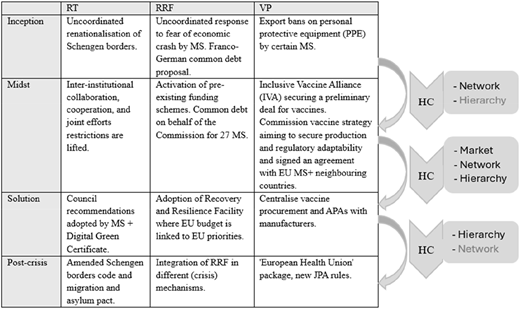
This sequential progression is constituted of three hybrid compositions (HC), firstly a departure from narrow, actor-specific concerns, fostering a space for new politicised dynamics of interaction among all EU actors (HC1), followed by the creation of an arena for brokerage and fast-tracking legislation, essential for navigating the complexities of the crisis (HC2) and culminating in the capitalisation on crisis decisions (HC3). These three steps are representative of a specific mixture of ideal types known as hybrid compositions. Each hybrid composition presents a specific mix of governance ideal types tailored to face different phases of the crisis as well as different levels of complexity and uncertainty (see Figure 1).
The first hybrid composition (HC1), transitioning from the inception to the midst phase, is distinguished by a mix of network and hierarchical ideal types. The uncoordinated responses of MS, as well as the unprecedented nature of the pandemic, necessitated the intervention of network mechanisms in order to face the crisis. An interviewee stated “[at the onset the] main topic was to coordinate actions” (I12). Networks, playing a leading role in this composition due to the high level of uncertainty, permit a solid foundation for exchange, a common vision, trust and reciprocity for involved actors. Establishing such a foundation was crucial at the inception of the crisis as the EU had limited formal powers in the health domain. This provided room for (re-)shaping the various institutional and interpersonal relationships, into collective and joint action. For instance, for all three units of analysis moving from the inception to the midst of the pandemic, intensive collaboration occurred between core actors, notably the European Commission, European Council and MS. In the RT case, the activation of the Integrated Political Crisis Response (IPCR) platform enabled trust-based coordination among Member States and EU institutions to manage cross-border movement (European Council - Council of the European Union, 2020; Blauberger et al., 2022). Similarly, in the VP case, the initial fragmentation of national procurement initiatives gave way to a unified approach when all 27 MS voluntarily mandated the Commission to negotiate Advance Purchase Agreements on their behalf (Deters and Zardo, 2023). Additionally, complementing the network mechanisms in HC1, there are elements of hierarchy that come into play leveraging the available formal structures of the EU in order to better exploit the instruments already at hand. For instance, in the case of the RRF following the intense negotiations where solidarity, reciprocity and trust were at the forefront, the Commission was able to adopt a temporary recovery instrument (RRF). This instrument had been inspired by a pilot Reform Support program they had previously introduced in 2015/16; moreover, the agenda of a stronger EMU and the development of ideas on joint borrowings was not a new phenomenon and was created to avoid a repetition of the financial crisis (Juncker, 2015; Van Rompuy, 2012).
The following hybrid composition (HC2), transitioning from the midst to the solution phase of the crisis, balances market, network and hierarchy ideal types. Building on the previous HC1, market-based tools are introduced to enhance efficiency, which becomes a critical imperative at this stage. These tools are instrumentalised to foster innovative solutions, extending governance responses beyond previously constrained policy domains. Simultaneously, network governance is maintained, ensuring the continuity of discursive coordination, shared responsibility and solidarity. This fosters collaboration among diverse actors, underpinning the legitimacy and coherence of collective responses. Hierarchical governance complements these dynamics by deploying formal mechanisms that enhance the strategic use of available instruments, providing stability and authority amidst the complexities of the crisis. This composition created an arena for brokerage and fast-tracking legislation, essential for addressing the complexities of the crisis, as stressed by an interviewee “No, it was never a persuading exercise. It is always many layers of discussion. Personal, political, ambassador, Brussels, levels, a lot of dialogue, a lot of exploration, a lot of compromise, a lot of understanding of each other's positions” (I13). Figure 1, exemplifies this transition from the crisis's midst phase to the solution phase, illustrating the implementation of substantial crisis policy responses. HC2 leverages market mechanisms to streamline processes and achieve rapid advancements, all while upholding the principles of network governance established in HC1. For instance, in the RT case, the adoption of the EU Digital COVID Certificate operationalised measurable health standards to safely aid reopen borders, offering a digital innovation that extended EU influence in public health, a previously limited domain in the EU (Quaglia and Verdun, 2023; European Council - Council of the European Union, 2020).
The final composition (HC3), moving from the solution to the post crisis phase, represents a reciprocal blend similar to HC1, where hierarchical mechanisms take the lead. This is achieved through the reliance on legitimate authority and the use of structural instruments to bind decisions and establish control, facilitating the achievement and further implementation of desired goals and priorities. Namely, in the RRF case, the structural embedding of national reform agendas through the Multiannual Financial Framework (MFF) and the conditionality attached to disbursements served as formal instruments to enforce long-term EU priorities, particularly the green and digital transitions (Schramm et al., 2022). Network mechanisms complement this composition by fostering the ownership and cooperation of involved actors easing adoption and implementation. This was evident in the continued collaboration between the European Commission and Member States in shaping and adjusting National Recovery and Resilience Plans (NRRPs), where mutual trust and dialogue sustained national commitment to shared goals. As decision-making transitions to a more routine level, moving away from the heightened uncertainty of the crisis, the focus of the hybrid composition shifts from short-term crisis decisions to long-term strategic decisions. These decisions aim to capitalise on the measures taken during the crisis to pursue enduring solutions that extend beyond the immediate crisis context. This approach leverages the turmoil caused by the crisis to deepen and solidify European priorities and interests. A telling instance of HC3 in action is present in RT case, where the adoption of an updated version of the Schengen Borders Code incorporating a more binding system of coordination, as well as the new Pact on Migration and Asylum, were realised due to the concerted efforts generated during the COVID-19 pandemic “this is one of the reasons why you know after [the pandemic], the Commission proposed to change the Schengen border codes to make a more binding system of coordination” (I12). In the RRF case, various interviewees stressed the crystallisation of the facility in different policy domains “The new Balkan facility, which was proposed is almost completely the same as the RRF. They now go more into that direction, then, instruments in agricultural policy are very much similar to the RRF as well, this is something the Commission actually tries to develop further.” (I2)
6. Discussion
The EU's response to the COVID-19 pandemic represents a significant evolution in crisis governance. The findings demonstrate a distinct pattern of hybrid crisis governance which emerges across the three units of analysis.
Initially, there is an emphasis on flexibility, collaboration and network-driven mechanisms to quickly mobilise resources and secure stakeholder engagement under pressing circumstances. As the crisis unfolds, however, the governance dynamics tend to gravitate towards a more hierarchical mode, albeit not entirely abandoning coordinative elements. This gradual rebalancing reflects the need for hierarchical mechanisms to consolidate decisions, enforce compliance and steer long-term strategic objectives. The negative stigma of previous crises differently impacted the EU in these policy areas. Regarding the RRF, there was a desire by the Commission to change the narrative that had been established during the euro-crisis. Hence, plans on reform, investment and common borrowings had been in the works for some time as a solution to avoiding the brutal reforms of the euro crisis. Adopting a bottom-up approach for the RRF was necessary to securing legitimacy and efficiency in the implementation of reforms (Corti and Vesan, 2023; Schramm et al., 2022). Scholars argue that a purely hierarchical approach to the implementation of the RRF would be unrealistic (Corti and Vesan, 2023; Bokhorst and Corti, 2023; Ladi and Wolff, 2021; Schramm et al., 2022). With the Restrictions on Travel, however, there was an initial reluctance on behalf of the Commission to pro-actively engage and push for the right to exercise free movement as well as maintaining internal borders open in the Schengen area. The previous refugee crisis provoked a surge in territorial logic making Member States protective of their sovereignty of their borders. Rather than re-adopting coercive methods used in the past, the RT and the RRF have shown that the EU combines different governance mechanisms to provide crisis solutions to the pandemic. The evidence of the combination of governance mechanisms establishes the evidence of hybrid patterns as a crisis response at the EU level.
Diverse hybrid compositions, which involve mixing governance ideal types over time, emerge as a solution that resonate with the evolving needs of crisis response in the EU. As highlighted by Brandsen and Karré (2011), hybridity is not merely a byproduct of institutional dynamics but a deliberate attempt to reconcile differing governance rationales to achieve context-sensitive outcomes (see also Meuleman, 2019; Voets et al., 2015). The three units of analysis presented in this paper seem to support this view by finding that hybrid compositions are not static nor stable, rather, they evolve and reconfigure throughout the course of the crisis, responding to evolving needs and shifting circumstances as well as following a specific pattern (cf. “mixing and matching”, see Verhoest et al., 2007; Bouckaert et al., 2010). The adoption of hybridity in crisis decision making further underscores a broader trend towards the blurring of lines between the intergovernmental and supranational levels within the EU (Schmidt, 2021). As crises increasingly transcend national borders and policy domains, the sole emphasis on traditional hierarchical structures and coercive mechanisms become less effective in addressing the multifaceted challenges at hand. Diverse hybrid compositions thus emerge as a purposeful strategy to navigate the evolving demands of governance challenges during crises.
Moreover, the three units of analysis illustrate a discernible pattern in how certain compositions tend to dominate at specific stages of the crisis across different policy domains. Each of the units of analysis under study move through distinct phases: an initial phase marked by fragmented national responses driven by concerns over sovereignty, a midst phase characterised by enhanced coordination and solidarity among stakeholders, a third phase focusing on concrete crisis resolution measures, and finally, a phase of consolidating and perpetuating crisis-driven decisions for long-term benefits. These phases collectively illustrate a crisis response pattern within the European Union during the COVID-19 pandemic.
The sequential pattern unfolds across three hybrid compositions (HC1, HC2, HC3), each tailored to address different stages of complexity and uncertainty of the crisis (see Table 4):
HC1: Foundational cohesion initiates a departure from narrow, actor-specific concerns, aligning visions and turning actor's focus from their interests into a collective focus on joint effort, thereby fostering a space for new politicised dynamics of interaction among all EU actors.
HC2: Crisis brokerage integrates market mechanisms alongside continued collaboration, creating an arena for brokerage and fast-tracking legislation, essential for navigating the complexities of the crisis.
HC3: Strategic consolidation reverts to an emphasis on hierarchical and network mechanisms to consolidate decisions and steer towards long-term strategic goals, leveraging crisis-induced momentum for enduring policy advancements.
7. Conclusion
This study has shown that the EU's response to COVID-19 unfolded through three distinct hybrid governance compositions (HC1–HC3), each combining hierarchical, market, and network logics in ways tailored to the evolving demands of the crisis. These compositions demonstrate that hybrid governance is not merely an emergent byproduct of institutional complexity, but a deliberate, adaptive strategy in which actors actively assemble, recalibrate and reconfigure governance instruments to achieve context-sensitive outcomes. In HC1, network mechanisms promoted inclusivity and flexibility; HC2 introduced market instruments to incentivise compliance and mobilise resources; and HC3 relied on hierarchical structures to ensure coherence and stability, translating crisis-driven decisions into enduring reforms. This temporal pattern illustrates that hybridity is dynamic, continuously evolving in response to phase-specific demands.
The findings contribute to hybrid governance theory by highlighting how governance logics interact over time, rather than coexisting statically. Hybrid compositions are temporally situated and path-dependent, reflecting the sequencing of strategies that respond to evolving crises. By tracing HC1–HC3, the study shows that hybridity involves a process of combination, substitution, and rebalancing, expanding the decision-making repertoire beyond what any single governance logic can achieve. This perspective emphasises that effective crisis governance requires not only the coexistence of multiple logics but also the capacity to align them strategically with contextual demands.
The study underscores the importance of flexibility and openness in public sector crisis management. Shifting between hybrid compositions depends on two dimensions: the breadth of available options and the readiness to implement them. Such flexibility is achieved through learning processes that overcome reliance on rigid, pre-planned responses, enabling actors to function as strategic bricoleurs who adapt instruments to emerging challenges. While hybrid solutions can enhance inclusivity, coordination and effectiveness, they also carry risks, including tensions between mechanisms, diluted accountability, and potential transparency challenges. Ensuring clarity in decision-making processes, enhancing transparency and fostering trust with and between European institutions, Member States and citizens will be critical for the long-term success of crisis decision-making.
Extending the analysis beyond the pandemic context is essential to assess whether the identified phases and dynamics reflect general features of crisis governance or are contingent on specific circumstances. The study therefore opens several avenues for future research. Longitudinal and comparative analyses can examine how hybrid compositions are mixed, matched and recalibrated across different crises and institutional contexts. Further research should also investigate the capacities and conditions that enable actors to act as strategic bricoleurs, as well as the implications of hybrid configurations for accountability and legitimacy. Such research would reveal whether hybrid governance can be intentionally and proactively designed as an adaptive governing strategy rather than emerging primarily through ad hoc, reactive responses. Overall, these findings contribute both theoretically and practically by showing that hybrid governance offers a flexible, context-sensitive approach for managing complex, multilevel crises in the public sector.
Annex Case descriptions
1 Restrictions on travel (RT)
Inception
In March 2020, viewing COVID-19 as a national security issue, 17 Member States (MS) proceeded to close their borders, adopting an administrative territorial logic of border management (Bigo et al., 2021). These exceptional measures, diverging from typical Schengen arrangements, were introduced, to combat the spread of the virus, security concerns trumped efficiency considerations (Genschel and Jachtenfuchs, 2015). This uncoordinated renationalisation was justified by framing public health as a national security issue, limiting the EU's ability to encourage reopening borders (Wolff and Ladi, 2020; Ladi and Wolff, 2021).
Midst
The EU, particularly the Council, based on Commission proposals, prioritised maintaining the free movement through political efforts to unify MS (I12, I13). Initially, the restrictions on European citizens' freedom of movement were not widely contested by the EU as it would have meant to politicise and question the discourse of doing the necessary to protect the citizen (Wolff and Ladi, 2020). However, MS eventually lifted restrictions as well as coordinated with EU-level recommendations, through strong inter-institutional collaboration, cooperation and joint efforts (I13).
Solution
In autumn 2020, following Council recommendations, most MS lifted restrictions on free movement (although some MS re-introduced travel bans in the winter), leading to the adoption of the EU Digital COVID Certificate, which facilitated safe travel during the pandemic (Quaglia and Verdun, 2023; European Council - Council of the European Union, 2020). This coordination was supported by the Integrated Political Crisis Response (IPCR), enabling EU and Schengen-associated countries, European institutions and relevant actors to discuss and manage the epidemiological situation (European Council - Council of the European Union, 2020; Blauberger et al., 2022). Additionally, in response to previously uncoordinated measures, the European Commission introduced a New Pact on Migration and Asylum, aiming to update the Schengen Borders Code to enhance resilience against serious threats and adapt to evolving challenges (European Parliament, 2024).
Post-crisis
This swift response facilitated free movement during subsequent pandemic waves and allowed for the eventual lifting of restrictions, emphasising the need for uniform criteria and shared responsibility among member states. The crisis fostered a pro-European realisation of collective effort, leading to policy changes and the eventual post-crisis adoption of a more binding Schengen Borders Code and a New Pact on Migration and Asylum (European Parliament, 2024; European Commission, 2024), as well as the adoption of the Internal Market Emergency and Resilience Act aimed at better preparing for future crises (I1, I2). Despite this pro-European momentum, finalising these agreements required extensive time and negotiations, reflecting resistance from member states to establish a comprehensive strategic framework for EU Home Affairs.
2 Recovery and resilience facility (RRF)
Inception
Regarding the economic challenge of the pandemic, the EU took decisive steps to prevent an economic crash, committing to using every available euro in the budget (I2). The Commission quickly established funding schemes like the “Pandemic Crisis Support” and the temporary recovery fund (SURE) and made the use of cohesion funds more flexible (I8). Similarly, the ECB launched the “Pandemic Emergency Purchase Programme” (PEPP) in mid-March 2020 to stabilise financial markets and the economic outlook of the Euro area, receiving wide support from Member States (Ladi and Wolff, 2021, p. 36). Previously, the Commission had struggled with Member States' resistance to reforms, a longstanding issue within the EU (I5, I6, I7). However, the EU soon realised that a much larger instrument was necessary to mitigate the pandemic's impact (I3, I4, I11).
Midst
Despite introducing a pilot Reform Support program in 2015/16, which later formed the basis for the RRF, the agenda for a stronger EMU and the concept of joint borrowings had already been developed to avoid repeating the financial crisis (I2). Nevertheless, on May 18, 2020, the Franco-German alliance agreed on a common debt, proposing that the Commission finance a recovery fund by borrowing on the markets on behalf of the EU. This agreement, a significant shift for Germany, previously against such measures, enabled the Commission to extend the plan to all 27 Member States.
Solution
On July 21st, 2020, following intense negotiations, all 27 EU Member States agreed on a groundbreaking common EU fiscal response to the COVID-19 pandemic (Schramm et al., 2022; Four et al., 2023; European Council, 2020). The announcement of the plan positively impacted market spreads and led to a rapid infusion of funds into EU economies (I2). The RRF was part of the larger Next-Generation EU (NGEU) package, a temporary instrument designed to boost recovery, which was adopted by February 2021 (Schramm et al., 2022). The 2021/2026 Multi-annual Financial Framework (MFF) had yet to be agreed upon, necessitating reliance on the Union budget. This alignment with the MFF ensured the RRF supported European priorities, particularly the green and digital transitions, as expressed by the European Semester (I8, I11). The RRF functions through collaboration and coordination between institutions and MS, particularly due to the demand-driven nature of the NRRPs (I6, I7). This approach has led to the creation of national reform agendas aligned with EU priorities, with MS taking ownership of their NRRPs (I3, I4).
Post-crisis
Although issued amid the complex environment of the pandemic, the RRF is one of the European funds with the lowest error rate (ECA, 2023). The RRF is a temporary instrument and sees its end in 2026/27, its outcomes have led the EU to adopting and developing similar instruments in response to different challenges, for instance in the Ukraine facility, Social Climate Fund or the Balkan facility (I1, I2). Thus, it further seems that the RRF may have acted as a basis for the blueprint of crises response instruments in features such as common borrowing and conditionality on EU priorities.
3 Vaccine Procurement (VP)
Inception
Due to challenges faced in previous pandemics, the European Council mandated the Commission to establish a collaborative procurement framework, the Joint Procurement Agreement which provided a framework for joint procurement procedures for medical countermeasures and outlined practical arrangements and decision-making processes for joint procurement (European Council, 2020).
Midst
Amid the COVID-19 pandemic's onset in March 2020, the failure of joint procurement schemes led to export bans on personal protective equipment (PPE) by some MS (European Court of Auditors, 2022). This lack of solidarity raised alarms about a future vaccine and its subsequent purchase. Hence, the vaccine procurement case unfolded in two phases. In the initial phase, there were parallel efforts. On the one hand, a Joint European Roadmap towards lifting COVID-19 containment measures of March 2020 stressed that “the development of a safe and effective vaccine [was] crucial to help put an end to the COVID-19 pandemic” (European Council and European Commission, 2020). In parallel, France and Germany initiated their own joint procurement efforts, forming the Inclusive Vaccine Alliance (IVA) with Italy and the Netherlands (European Court of Auditors, 2022; Netherlands Court of Audit, 2024), securing a preliminary deal for millions of doses, parallel to the Commission's efforts (Deters and Zardo, 2023).
Solution
In a second phase, in June 2020, the Commission outlined a vaccine strategy (European Commission, 2020a), aiming to secure production and regulatory adaptability and signed an agreement with each of the 27 MS, including the IVA countries, and 10 neighbouring states, allowing it to centralise the procurement and conclude Advance Purchase Agreements (APAs) with COVID-19 vaccine manufacturers on the behalf of the national governments (European Commission, 2020b). Between August 2020 and November 2021, the Commission signed eleven contracts with eight vaccine manufacturers (European Court of Auditors, 2022).and, by the end of 2021, almost 952 million doses had been distributed to MS, over 739 million doses administered and 80% of the EU's adult population had been fully vaccinated (European Centre for Disease Prevention and Control, 2023).
Post-crisis
The pandemic's structure terminated by the end of 2023, but the EU is expected to adopt a series of plans and tools to better respond to a future health crisis. Among those there are the APAs used to purchase vaccines, and a proposal for a Single Market Emergency Instrument provides a swift and flexible crisis response to crisis, including public procurement legislation to fast-track negotiations in cases of extreme urgency and procurement on behalf of Member States for goods beyond the current limitation to medical countermeasures (European Commission, 2021). The European Parliament also recommended “a proper European Health Union” (European Parliament, 2023).